

Crypto World
Arthur Hayes scoops up $5.4M in Ethereum after Iran deal

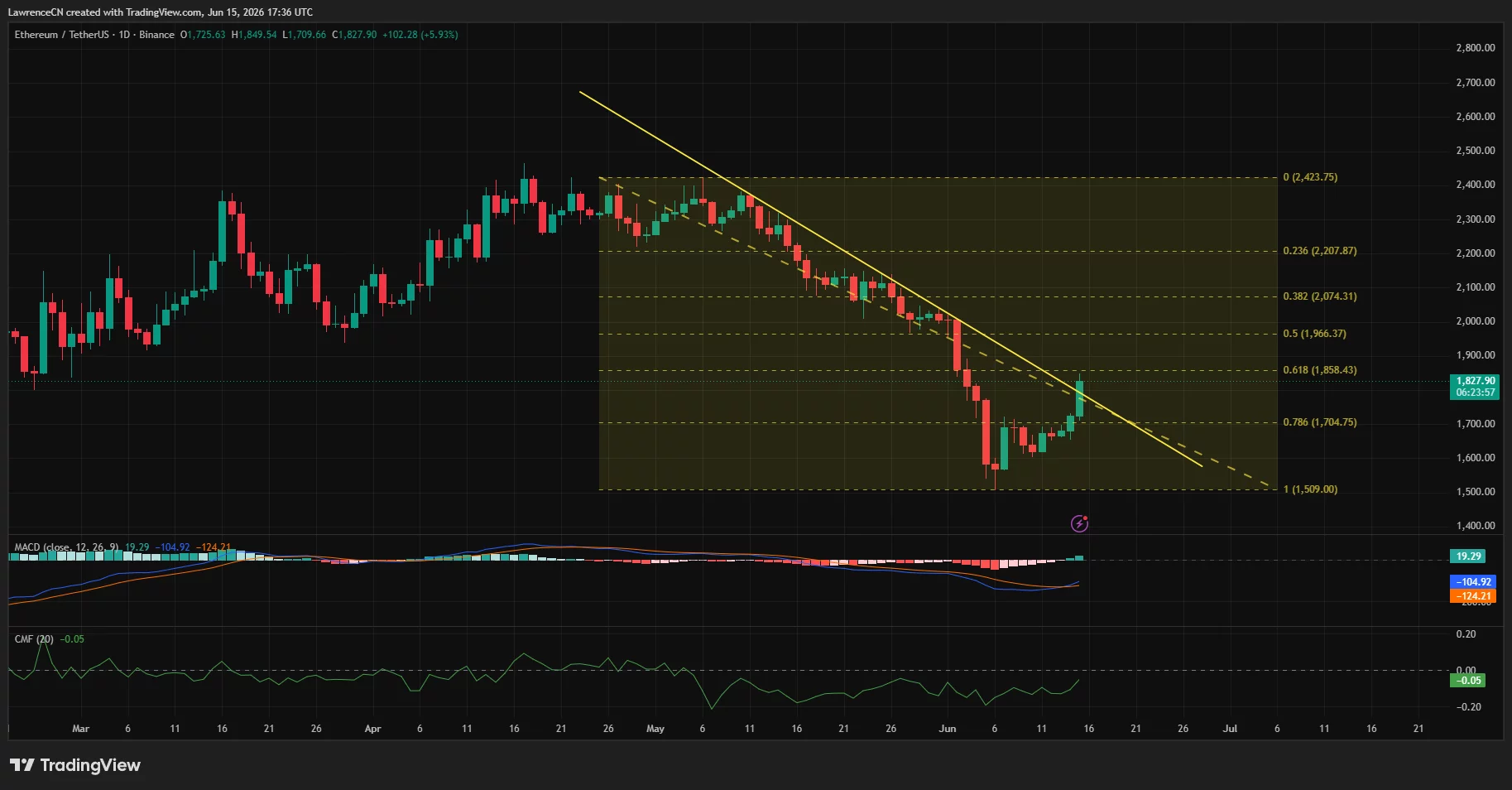
Ethereum has surged nearly 6% and attracted fresh whale buying after a reported U.S.-Iran peace agreement improved risk sentiment across global markets.
Summary
- A wallet reportedly linked to Arthur Hayes received 3,000 ETH worth $5.42 million as Ethereum rallied following news of a U.S.-Iran peace agreement.
- Ethereum climbed nearly 6%, while another whale, geministar.eth, accumulated 21,136 ETH worth about $37 million from Binance.
- Technical indicators show ETH breaking above a multi-week downtrend, with analysts eyeing the $1,850-$1,860 resistance zone.
According to on-chain tracker Lookonchain, a wallet possibly linked to BitMEX co-founder Arthur Hayes received 3,000 ETH worth approximately $5.42 million from market maker Flowdesk on June 15. The transfer came as Ethereum rallied alongside other cryptocurrencies following signs that tensions in the Middle East may be easing.
The purchase follows a period in which Hayes had been reducing exposure to several altcoins. In his June 8 essay titled Reality Test, the Maelstrom chief investment officer disclosed that he had sold positions in Hyperliquid, Near Protocol, Worldcoin, and Zcash.
Hayes described the moves as a defensive response to macroeconomic risks rather than a rejection of those projects, while noting that Bitcoin and Ethereum remained among his core holdings.
Ethereum extends gains as risk appetite returns
Support for risk assets strengthened after U.S. President Donald Trump announced that a peace deal with Iran had been completed. Trump said shipping traffic through the Strait of Hormuz had resumed and that vessels carrying oil were once again moving through what he described as a secure route.
The development triggered a sharp decline in energy prices. Crude oil fell more than 5% to around $80.53 per barrel, easing concerns that disruptions in one of the world’s most important energy corridors could fuel inflation and weigh on financial markets.
Ethereum responded strongly to the change in sentiment. At press time, ETH traded near $1,828 after climbing almost 6% over the previous 24 hours. The move pushed the asset to its highest level in more than a week and helped it outperform several major cryptocurrencies during Monday’s session.
Large investors appeared to be adding exposure during the rally. Separate data shared by Lookonchain showed that wallet address geministar.eth purchased 21,136 ETH worth roughly $37.05 million from Binance through a series of transactions on June 15.
Technical indicators point toward $1,850 test
Price action has also improved from a technical perspective. On the daily chart, Ethereum has broken above a descending trendline that had capped rallies since late April. The move places ETH above the upper boundary of a bearish flag structure that had formed during the decline from roughly $2,400.
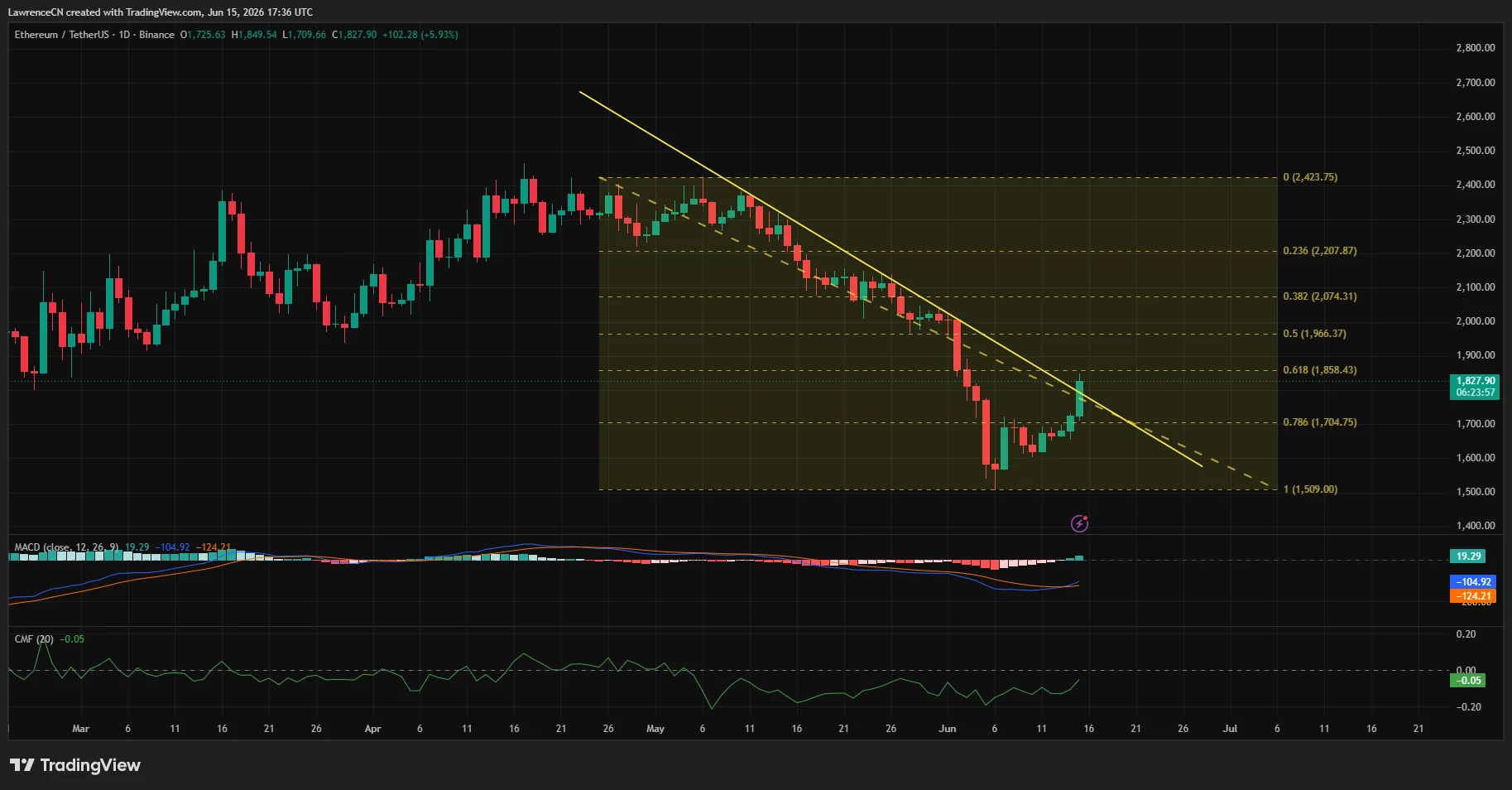
Momentum indicators have started to recover as well. The daily MACD has produced a bullish crossover, while the Chaikin Money Flow indicator has been moving higher, signaling that selling pressure is fading.
Additional upside could depend on whether Ethereum clears a key resistance zone near the 0.618 Fibonacci retracement level around $1,858. A successful move above that area would strengthen the argument that the recent breakout is invalidating the bearish flag pattern rather than confirming it.
Meanwhile, crypto analyst Ali Martinez pointed to a potential ascending triangle breakout on Ethereum’s four-hour chart. According to Martinez, confirmation of the pattern projects a move toward $1,850, placing the target almost directly in line with the resistance area currently being tested.
Even before the latest purchase, Hayes had maintained an optimistic outlook on Ethereum. In a June market thesis, he projected that ETH could reach between $10,000 and $20,000 before the current market cycle ends, citing expected liquidity growth and Ethereum’s position within decentralized finance.
Disclosure: This article does not represent investment advice. The content and materials featured on this page are for educational purposes only.

Crypto World
Top 3 Cryptos to Watch as Wall Street Moves Deeper Into Ethereum and Pepeto Presale Attracts Big Capital While BNB and ADA Recover
The top 3 cryptos to watch this cycle are the tokens with working infrastructure and a clear repricing event ahead, because Wall Street just moved past crypto pilots and deeper into Ethereum according to Etherealize’s cofounder, confirming that institutional capital is now building on blockchain instead of watching from the sidelines.
While BNB holds near $620 and ADA recovers to $0.18 after its five-year low, Pepeto has passed $10.25 million in presale demand with a live exchange and an approaching Binance listing where projected returns start at 100x.
Etherealize cofounder Vivek Raman told CoinDesk that Wall Street is now moving past pilot programs and building directly on Ethereum, adding that the infrastructure has largely been built but adoption has not yet been reflected in ETH itself. Institutional ETH ETFs hold above $8 billion in net assets and growing.
The tokens worth watching are those with exchange infrastructure already running, because institutional commitment rewards projects generating fees over those depending on speculation.
Tokens Holding Ground and the Presale Already Delivering What Others Promise
Pepeto: Leading the Top 3 Cryptos to Watch This Cycle
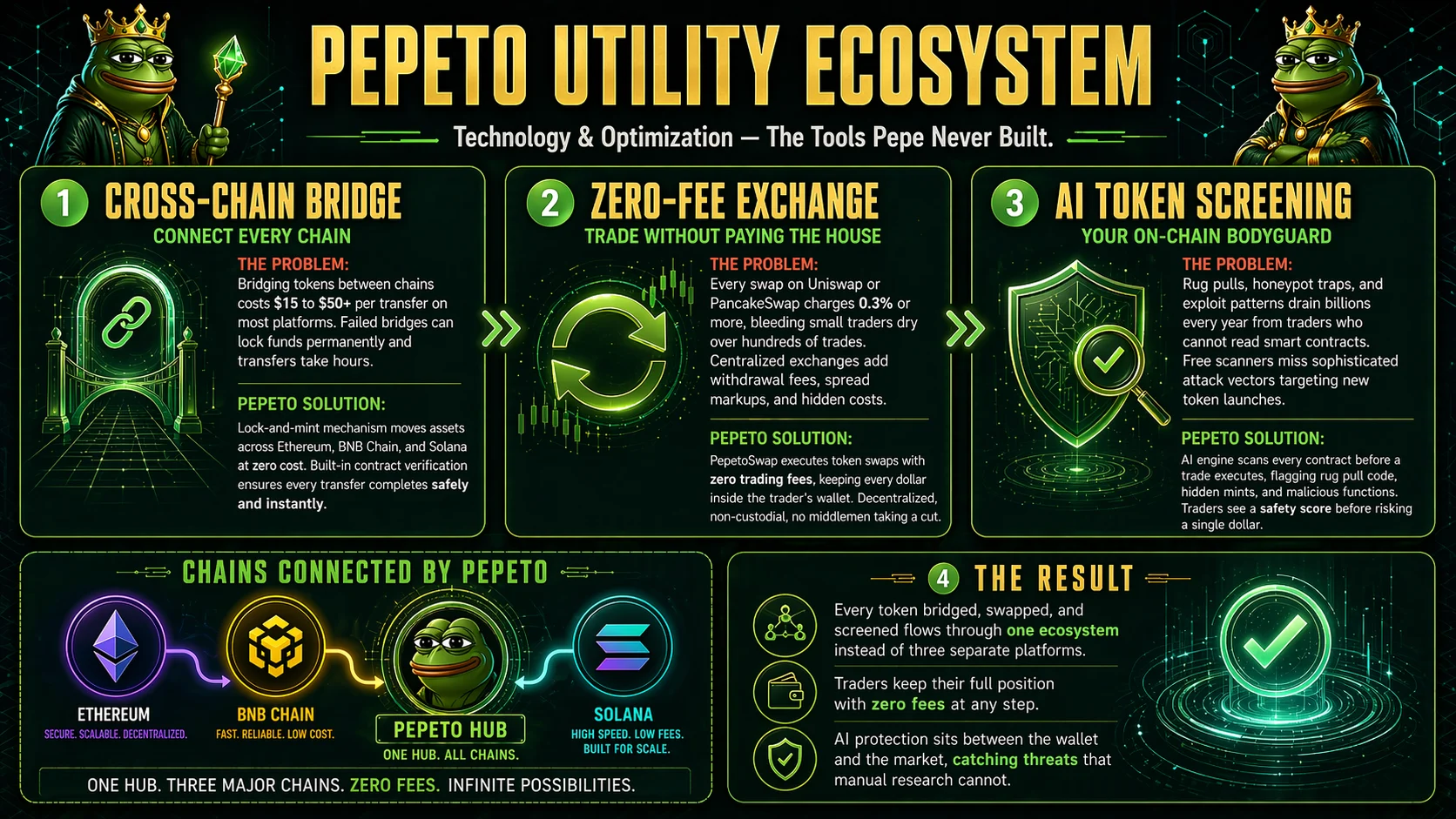
Wall Street building on Ethereum proves institutions want on-chain infrastructure, but the presale that passed $10.25 million during extreme fear secured that capital because the exchange was already live. Pepeto’s contract scanner audits every token for hidden traps before a single trade goes through, keeping positions safe while malicious contracts spike across the market.
PepetoSwap processes every trade without charging a fee, so each position carries through every rotation untouched. The 170% APY staking pulls committed tokens from supply daily, compounding returns while thinning what reaches exchanges. When the listing day arrives, it meets a reduced float, and that supply gap creates the price distance between early wallets and everyone else.
This live infrastructure makes Pepeto one of the strongest entries this cycle because the product already works while the token still trades at presale rates. BNB sat at pennies before Binance turned it into a $79 billion asset, and the wallets that entered early built real positions.
The same formation plays out now with the creator who built Pepe’s $11 billion rise and a former Binance advisor, with SolidProof verifying every contract. The presale price at $0.0000001876 exists only while rounds remain open, and the Binance listing erases that price level with exchange-level demand.
Binance Coin (BNB) Price at $620 as Market Recovery Gains Steam
Binance Coin (BNB) trades near $620 per CoinMarketCap, recovering 6% from its June low as the Iran peace deal and returning ETF inflows lift risk assets. A spot BNB ETF filing adds a potential catalyst.
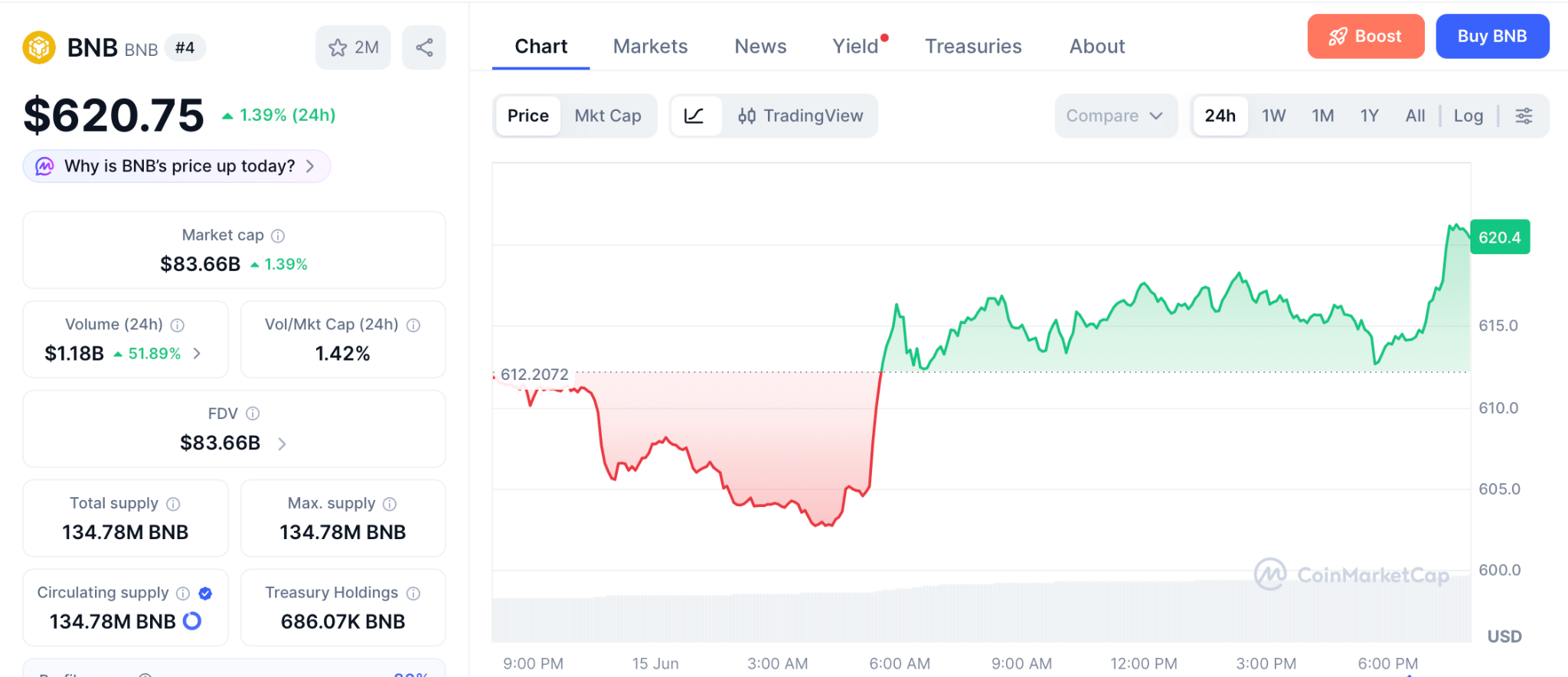
BNB sits 54% below its all-time high of $1,369 with support near $600 and resistance at $660. From $620, the path to $700 gives 11% over months, solid for holders but not the same distance a presale-to-listing event produces.
Cardano (ADA) Price at $0.18 as T. Rowe Price ETF Inclusion Boosts Outlook
Cardano (ADA) sits at $0.18 per CoinMarketCap, recovering 11% in a week from the five-year low of $0.1485 touched on June 6. T. Rowe Price’s new $1.8 trillion crypto ETF featuring ADA received regulatory approval for NYSE Arca listing on June 13.
Support holds at $0.16 with resistance near $0.24. Even a recovery to $0.24 gives 39% from here, a fraction of the distance the presale offers before the listing closes the entry.
Conclusion
Wall Street building on Ethereum proves that institutional capital is not leaving crypto, and Pepeto stands apart with a live exchange and presale pricing that BNB and ADA at their current sizes cannot match.
BNB sat at fractions of a dollar before it produced millionaires, and the wallets that believed early enough still hold those positions as proof of what conviction pays. Pepeto under the same Pepe creator is building that exact outcome for the wallets entering now. Rounds are filling. The listing is getting closer.
And the Pepeto presale price that exists today will not exist the day trading opens. The people reading this right now are either going to be the ones who got in before the listing repriced everything, or the ones who spend the rest of the year asking themselves why they did not act when every signal was pointing in the same direction.
Click To Visit Pepeto Website To Enter The Presale

FAQs
What are the top 3 cryptos to watch in June 2026?
Pepeto leads the top 3 cryptos to watch with $10.25 million raised, a live zero-fee exchange, and projected 100x returns before a Binance listing opens this cycle. BNB holds $620 and ADA recovers to $0.18.
Why is Pepeto considered a top presale as Wall Street enters crypto?
Pepeto is a top presale because its live exchange earns trading revenue as institutional adoption grows, positioning it ahead of speculative tokens. Over $10.25 million raised with 170% APY staking at $0.0000001876 confirms demand before a Binance listing.
Disclaimer: This is a Press Release provided by a third party who is responsible for the content. Please conduct your own research before taking any action based on the content.



Nvidia has raised the stakes in the artificial intelligence infrastructure race with plans to borrow at least $20 billion from debt markets, a move that comes as Bitcoin miners increasingly reposition themselves as AI and high-performance computing providers.
Summary
- Nvidia plans to raise at least $20 billion through a multi-part bond offering to fund AI investments and refinance debt.
- Bitcoin miners are expanding into AI and HPC services, with more than $70 billion in contracts announced across the sector.
- Industry forecasts suggest listed miners could generate up to 70% of revenue from AI by the end of 2026.
According to Bloomberg, Nvidia is preparing a multi-part bond offering worth at least $20 billion to fund AI-related investments and refinance existing debt.
People familiar with the matter told Bloomberg that the chipmaker intends to issue notes across seven maturities ranging from two to 30 years, with the longest-dated bonds expected to price at about 0.9 percentage points above comparable U.S. Treasury securities.
The planned offering arrives as demand for AI infrastructure continues to attract large pools of capital. As the leading supplier of graphics processing units used to train and run large language models, Nvidia occupies a central role in the AI ecosystem, with its spending plans closely watched by investors and technology companies.
Recent expansion efforts have extended beyond the United States. As previously reported by crypto.news, Nvidia announced partnerships in South Korea with SK Hynix, Naver, SK Telecom, Doosan Group, LG Group, and Hyundai Motor Group during a visit by CEO Jensen Huang. According to Nvidia, those agreements cover memory chips, AI data centers, robotics, mobility, and industrial AI systems.
Bitcoin miners pursue AI revenue streams
Growing investment in AI infrastructure has opened new opportunities for Bitcoin mining companies, many of which already control large amounts of power capacity and data center infrastructure.
Companies including HIVE Digital, TeraWulf, Hut 8, and CleanSpark have increasingly promoted AI and high-performance computing services alongside their traditional mining operations.
By repurposing existing facilities and leveraging power agreements originally secured for Bitcoin mining, these firms are seeking revenue sources that are less dependent on cryptocurrency market cycles.
Industry data suggests investors have responded positively to the trend. As reported by crypto.news, while Bitcoin declined roughly 17% during the opening months of 2026, a basket of Bitcoin mining stocks gained more than 50%, with the strongest performers advancing over 70%.
Notably, publicly traded miners have announced more than $70 billion in cumulative AI and high-performance computing contracts. Industry projections referenced by crypto.news suggest listed mining companies could derive as much as 70% of their revenue from AI activities by the end of 2026, up from around 30% today.
Mining margins remain under pressure
Despite growing enthusiasm around AI, many miners continue to face challenges in their core business.
Following Bitcoin’s April 2024 halving, higher mining difficulty and operating expenses have compressed profit margins across the sector.
Some market observers have described current conditions as the harshest margin environment the industry has experienced, prompting miners to reduce leverage, liquidate portions of their Bitcoin holdings, and search for alternative sources of income.
According to data from TheEnergyMag, Bitcoin miners sold more than 15,000 BTC between October and March as companies adjusted to tougher operating conditions.
Recent results from Canaan illustrate those pressures. According to the company’s June operational update, the Nasdaq-listed miner produced 90 BTC during the month and received another 24 BTC from customers. At the same time, Canaan’s first-quarter earnings report projected second-quarter revenue between $35 million and $45 million, well below analyst expectations of roughly $96 million.
Regulatory hurdles have also emerged. As previously reported by crypto.news, Canaan received a second Nasdaq non-compliance notice in January after its share price remained below the exchange’s $1 minimum bid requirement. The company has until July 13, 2026, to regain compliance.
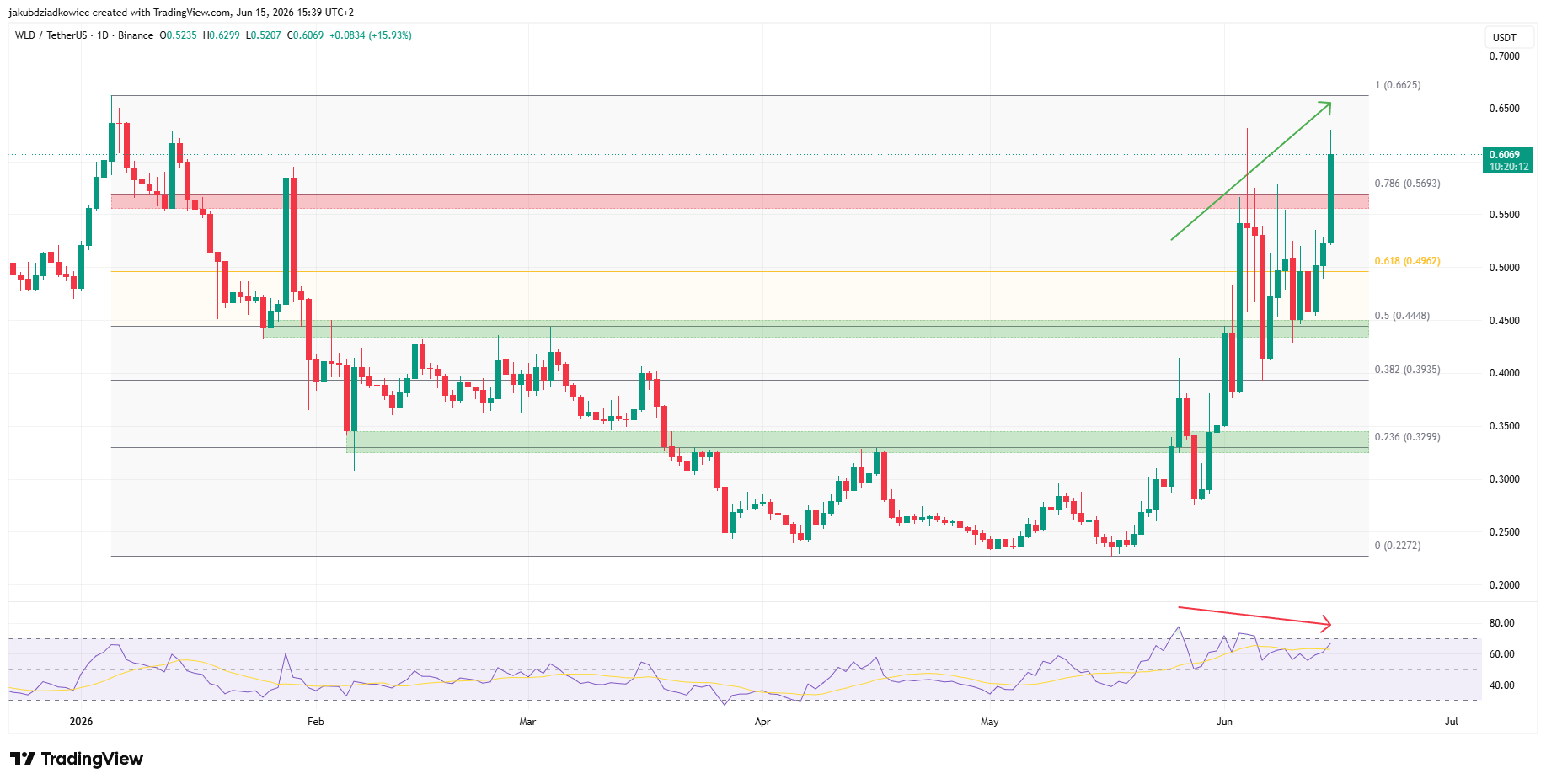
Worldcoin (WLD) jumped 21% on June 15 as Eightco Holdings (ORBS) reinforced its standing as the largest public holder of the token, with 283 million WLD now anchoring its growing digital asset treasury.
The rally lifted WLD to about $0.61, extending its 30-day gain to 154%. Recent disclosures put Eightco’s total treasury near $406 million.
Eightco Doubles Down on Its 283 Million WLD Position
Eightco Holdings reported holding 283,452,700 WLD as of June 10. That stake equals roughly 8.4% of the token’s circulating supply.
It stands as the largest publicly disclosed institutional position in WLD. No other listed company has confirmed a holding of this size.
The firm values the position at about $406 million. Alongside WLD, Eightco holds more than 16,000 ether and a $90 million stake tied to OpenAI.
The Proof of Human Thesis Behind the Buying
Eightco frames its WLD stake as a bet on digital identity. The company cites data showing that non-human activity now drives most web traffic and trading volume.
It positions Worldcoin and its Proof of Human network as the verification layer for that problem. The token, co-founded by OpenAI chief Sam Altman, counts more than 16 million verified users.
Speculation around an OpenAI public listing has added fuel to WLD this month. That narrative has kept demand for the token elevated.
WLD Jumps to $0.66 Swing High
On the daily chart, WLD broke above the 0.786 Fibonacci level near $0.57. The token now targets the prior swing high around $0.66. A clean close above that mark would open room for further upside.

The daily reading carries a warning, however. RSI is printing lower highs while price prints higher highs, a textbook negative divergence. That signal hints at a sharper correction later. The first support sits near $0.45, with deeper support around $0.33.
The hourly chart tells a firmer story. WLD has respected a rising parallel channel since May 26, only to be briefly broken in early June. RSI is holding former resistance as support inside bullish territory, which favors continuation if buyers defend the channel.

Volume rose on the breakout but stayed below early-June peaks. That gap suggests the move needs stronger participation to sustain the rally.
The setup leaves WLD balanced between a catalyst-driven breakout and clear technical warning signs. Holding $0.45 keeps the bullish case alive, while a drop below $0.33 would suggest the rally has stalled.
The post Worldcoin Jumps 20% After Treasury Reveals Massive Stake in WLD appeared first on BeInCrypto.
Crypto World
Ethereum News: Last Chance to Buy Ethereum Under $2K? ETH USD Powers Up After Hormuz Peace Deal
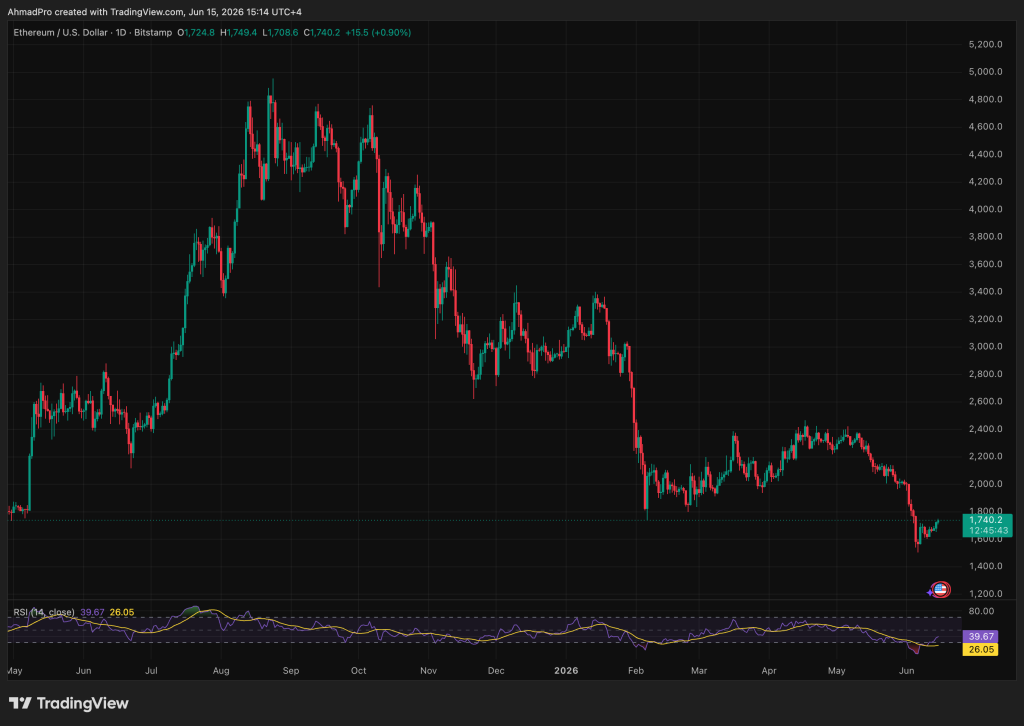
In the latest Ethereum News, Ethereum ETH Price is trading at $1,739 up 4% in 24 hours, as risk assets catch a bid following the Hormuz peace deal, and the chart is setting up a move traders haven’t seen in years. The question isn’t whether ETH bounces.
It’s whether this is the last entry point before $2,000 becomes a distant memory. One analyst just called ETH the most oversold it has ever been in its history, a claim that deserves more than a scroll past.
On June 14, 2026, analyst Ash Crypto flagged that ETH’s monthly RSI has fallen below readings recorded at the 2018 and 2022 bear market bottoms, both of which preceded multi-hundred-percent recoveries.
ETH is down nearly 70% from its all-time high and trading at price levels last seen four years ago. The asset bounced from a swing low of $1,603 and has since pushed toward $1,731, then pulled back to consolidate above the 23.6% Fibonacci retracement of that range.
The Hormuz peace deal injected fresh macro tailwinds across risk markets, with Bitcoin reclaiming $65,000 and dragging large-cap alts along with it. That broader backdrop matters; ETH rarely stages a sustained recovery without BTC providing the lift.
Ethereum News: Can ETH Price Hit $1,850 This Week?
ETH is holding above the $1,700 pivot after clearing what Bitget describes as a key resistance level, signaling a noticeable improvement in market outlook.
Volume backs the move. 24-hour trading sits at $26 billion against a $210 billion market cap, suggesting genuine participation rather than thin-air price action.
The technical structure is range-bound but coiling. Near-term support sits at $1,665 and $1,640, with resistance stacking at $1,690, $1,701, and $1,715. CoinCodex projects a potential high near $1,845 within days.
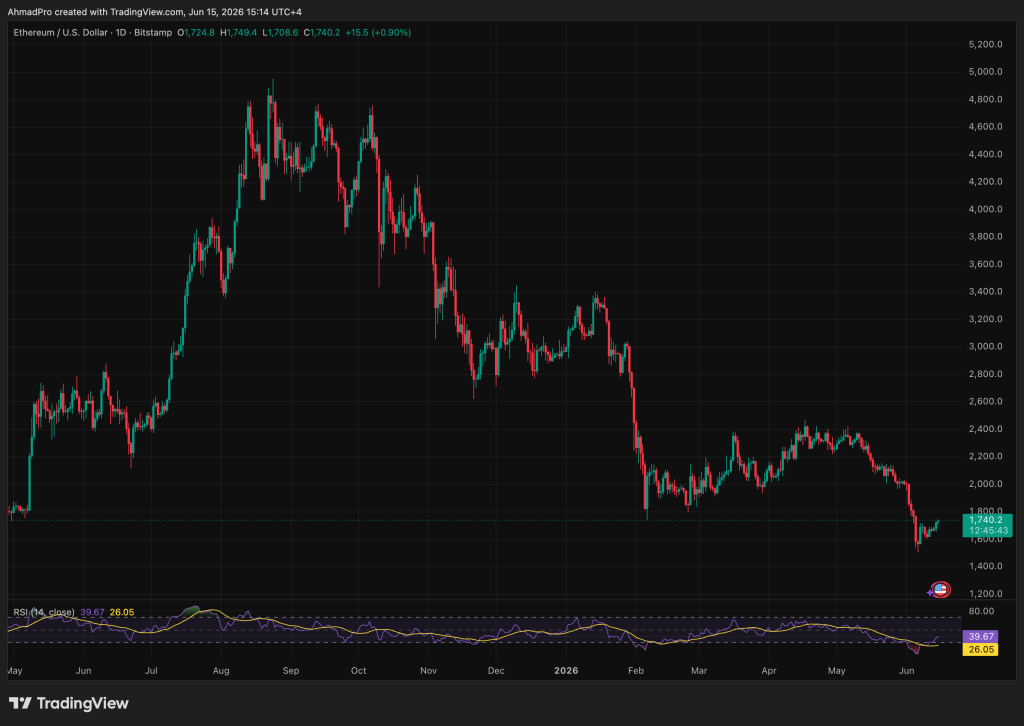
ETH holding $1,700 and clearing $1,734 opens the door to $1,923 and $2,133 in sequence. Consolidation between $1,665 and $1,780 through the week with a gradual grind toward $1,845 is the base case if BTC sentiment holds steady.
A daily close below $1,603 voids the bounce thesis entirely and reopens $1,585 and potentially lower.
The structural argument comes from RSI. Monthly extremes this deep have historically preceded violent recoveries rather than continued bleed. That does not guarantee the bottom is in. But the asymmetry is harder to ignore than usual.
LiquidChain Could be The Next Big Chain Layer 3 And Here is Why
ETH at $1,720 is compelling on historical metrics, but even a move to $2,022 represents roughly 17% upside from a $200+ billion market cap asset.
Significant in absolute terms; modest relative to where early-stage capital has historically multiplied. ETH’s market cap dynamics underscore exactly why some rotation toward smaller, pre-launch projects makes tactical sense during macro recovery windows.
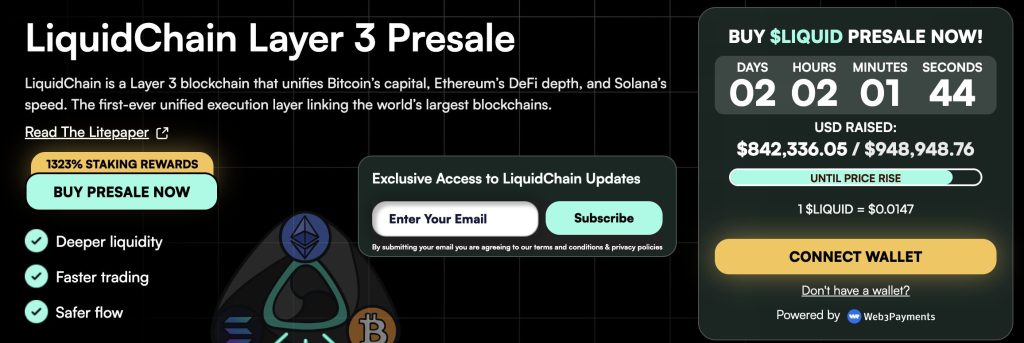
LiquidChain ($LIQUID) is an L3 infrastructure project building what it calls the Cross-Chain Liquidity Layer, fusing Bitcoin, Ethereum, and Solana liquidity into a single execution environment.
The pitch is structural rather than speculative: a Unified Liquidity Layer with Single-Step Execution and Verifiable Settlement means developers deploy once and access all three ecosystems without bridging friction.
The presale is currently priced at $0.0147 with $841,128.18 raised to date. Early-stage infrastructure plays at this raise level carry real risk — liquidity, execution, and adoption are all unproven, but the entry price reflects that risk explicitly.
Research LiquidChain here before the presale price moves.
The post Ethereum News: Last Chance to Buy Ethereum Under $2K? ETH USD Powers Up After Hormuz Peace Deal appeared first on Cryptonews.

The U.S. Commodity Futures Trading Commission (CFTC) has named Donald Battle as its new chief data innovation officer, a role focused on data strategy and advanced analytics for the agency. The appointment underscores how regulators are increasingly turning to blockchain-specific expertise and modern data tools to support surveillance, investigations, and enforcement across digital-asset markets.
In a notice dated Monday, CFTC Chair Michael Selig said the move reflects the commission’s growing emphasis on data science capabilities, including blockchain forensics, programming interfaces, and the use of cutting-edge AI solutions. Battle’s background spans both regulatory and enforcement-related work in the crypto space, positioning the CFTC to deepen its technical capacity as policy debates over digital asset market structure intensify.
Key takeaways
- The CFTC appointed Donald Battle as chief data innovation officer, with stated emphasis on blockchain forensics and advanced analytics.
- Battle previously advised the SEC’s crypto task force and earlier served as a blockchain data adviser to the CFTC, according to Selig’s description of his experience.
- The move aligns with ongoing U.S. efforts to redefine digital asset regulatory responsibilities through proposals such as the CLARITY Act.
- Coinciding with enforcement and jurisdiction disputes, the appointment may support the CFTC’s approach to digital-asset surveillance and market oversight.
- The CFTC is also progressing a separate rulemaking effort that could clarify how sports event contracts are regulated.
Why the CFTC’s data leadership change matters
Regulatory technology is becoming a core capability for U.S. financial oversight, particularly where crypto markets involve cross-border activity, rapid product innovation, and complex on-chain behavior. By creating a senior post dedicated to data innovation—and filling it with someone described as having blockchain forensics expertise—the CFTC signals a shift toward more technically specialized internal tooling.
This matters for compliance and enforcement because the effectiveness of investigations often depends on the ability to reliably map relationships between entities, transactions, and trading activity. Blockchain forensics skills and the capacity to integrate programming interfaces and advanced analytics can improve how regulators identify risk patterns, substantiate cases, and maintain audit-ready documentation.
At the same time, institutional readers should note that a leadership change does not itself resolve jurisdictional disagreements or the underlying question of how specific crypto-related activities should be classified under U.S. law. It does, however, strengthen the infrastructure regulators rely on when they seek to apply existing frameworks to evolving markets.
Battle’s background and the signal to U.S. crypto enforcement capacity
According to the CFTC notice, Selig appointed Donald Battle as chief data innovation officer. Selig described Battle’s experience as spanning “data science, blockchain forensics, programming interfaces, and cutting-edge AI solutions.”
The notice also links Battle’s previous work to both sides of the U.S. crypto regulatory landscape. Battle has been characterized as an adviser to the SEC’s crypto task force, which he joined in January 2025 in connection with the incoming Trump administration. The same CFTC announcement describes prior service as a blockchain data adviser for the CFTC and as a crypto enforcement specialist within the U.S. Treasury’s Financial Crimes Enforcement Network (FinCEN).
From a regulatory coordination perspective, the appointment is notable because it bridges key institutions involved in crypto oversight. The SEC and CFTC frequently address different—but overlapping—areas of digital asset regulation. A data-focused leader with experience across both agencies can potentially support internal consistency in how data is collected, analyzed, and presented to enforcement teams.
That said, unresolved policy questions remain. The U.S. digital asset regulatory architecture is still contested, and product classification disputes—such as whether certain offerings resemble gambling, sports betting, or regulated derivatives—are likely to keep driving litigation and rulemaking.
Jurisdiction debates and the broader policy context
The CFTC appointment arrives during a period when Congress is examining legislative changes intended to clarify digital asset market structure. Selig’s comments framed the hiring as part of an agency effort to better address crypto regulation and enforcement while policy discussions continue around a digital asset market structure bill, the CLARITY Act.
Coinbase and other large market participants are not mentioned in the notice, but the institutional relevance is clear: how the CFTC and SEC draw jurisdictional lines affects licensing expectations, compliance planning, and the operational design of trading venues and offerings.
Within this broader context, the CFTC has also faced significant legal challenges connected to its approach to jurisdiction over certain market activities. Cointelegraph has reported that the CFTC’s position on excluding jurisdiction for prediction market platforms has contributed to lawsuits involving state-level authorities. Those disputes reflect how rapidly courts and regulators are being asked to interpret longstanding legal concepts in relation to new market structures.
Additionally, the CFTC chair remains the only commissioner at the agency at the time of the reporting, a detail that can affect institutional capacity and the pace of rulemaking. While leadership structure alone does not determine legal outcomes, it can influence how quickly the agency advances guidance and how regulators prioritize enforcement and compliance initiatives.
Public comment begins on CFTC’s proposed sports event contracts framework
Alongside the data innovation appointment, the CFTC has advanced a related rulemaking effort that could affect how certain crypto-adjacent sports event contracts are treated under U.S. law. The CFTC released a proposed rule intended to distinguish sports event contracts offered on platforms such as Kalshi and Polymarket from what the agency described as “games of random chance,” a framing commonly associated with gambling.
The CFTC said the public has 45 days to comment on the draft rule. If finalized, the proposal may shape how the agency addresses regulation of sports event contracts across both state and federal levels—particularly in cases where platforms face scrutiny under gambling-related laws.
For regulated entities and compliance teams, this is a practical development because it bears directly on classification risk: whether a product is treated as a regulated financial instrument, and which regulator’s framework applies. It can also influence how market operators design offerings, disclosures, and custody or settlement processes to satisfy expected regulatory standards.
The uncertainty that typically accompanies proposed rules should be recognized as well. Comments received during the consultation period can lead to revisions, and even finalized rules may face legal challenges depending on how courts interpret statutory authority and the boundaries between gambling and regulated markets.
Closing perspective
The CFTC’s hiring of a data innovation leader with blockchain forensics expertise signals a strengthening of the agency’s technical capabilities as it pursues crypto regulation and enforcement. In parallel, the sports event contracts proposal highlights the regulator’s continued focus on classification questions that have already driven litigation. The next steps—public comments, potential rule revisions, and how courts respond to ongoing jurisdiction disputes—will likely determine how these developments translate into operational compliance expectations.
Crypto World
XRP Price Analysis: Ripple Token Eyes 10% Gain with Flashing Bullish Pattern and ETF Inflows

XRP price posts 9% moves today from low $1.1 to $1.24, with a prediction that it could go even higher. Two independent tailwinds are converging at the same time.
One, a textbook ascending triangle is pressing against horizontal resistance on the 4-hour chart. Two consecutive weeks of positive XRP Spot ETF inflows. The setup has a defined target; it just needs the trigger to fire.
From the latest ETF flow data, XRP Spot ETFs recorded a net inflow of $10.68 million for the week ending June 12, 2026. This is the second consecutive positive week, pushing cumulative net inflows to $1.44 billion and total AUM to $978.86 million.
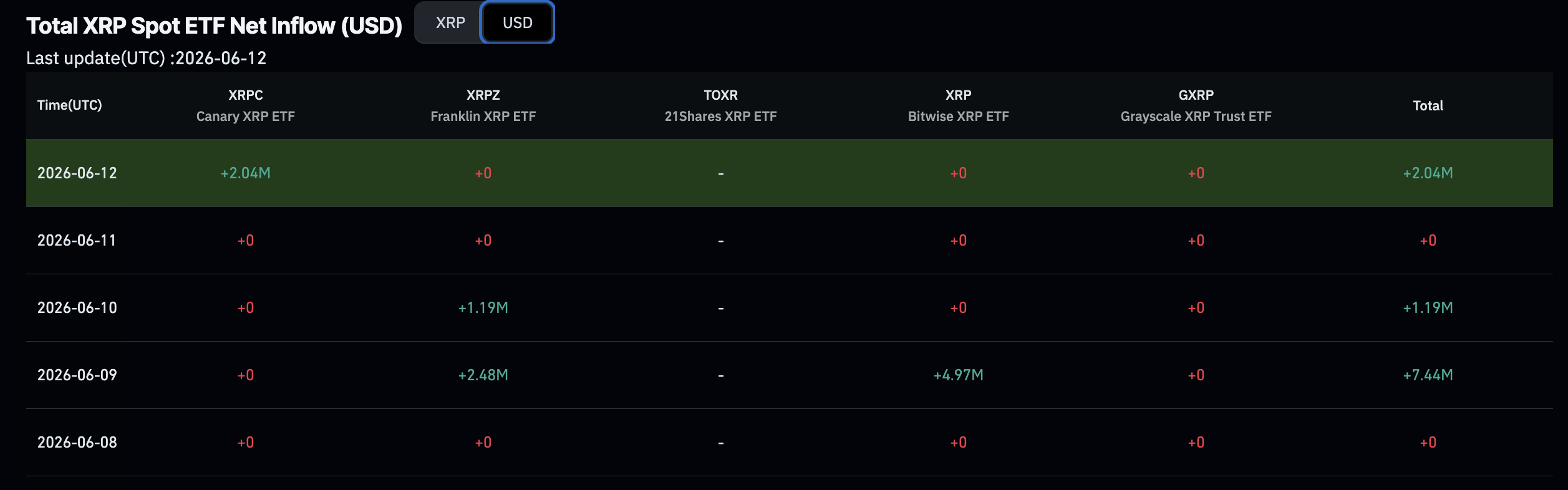
Why do the numbers matter? The $1 billion threshold tends to generate incremental media coverage in traditional finance channels, which historically pulls in additional allocators who benchmark product credibility by AUM size.
The macro backdrop, with improved risk sentiment following the US-Iran peace deal, has given the entire altcoin complex a lift, but the ETF data and chart structure suggest XRP’s move has more substance than a pure sentiment trade.
Ripple’s business side is also generating adoption signals worth tracking: the OpenPayd integration for Ripple Payments and ongoing RLUSD mint/burn flows both point to real settlement utility expanding. This, over time, will likely anchor demand more durably.
—
 Nice! Ripple partner OpenPayd confirms Nasdaq listing plans (OP): a decent reminder that the Ripple partnership wasn't just a one-off headline. Fiat rails, $RLUSD support, and cross-border payments still suggest a stack where an OP public listing could add more visibility
  pic.twitter.com/OJUTpnMm3X
 ChartNerd
  (@ChartNerdTA) June 1, 2026
Discover: The Best Crypto to Diversify Your Portfolio
Can XRP Price Hit $1.32 This Week?
XRP is currently hovering in the $1.25 range. On the 4-hour chart, the ascending triangle has been forming since early June, a series of higher lows compressing against horizontal resistance in the $1.18–$1.19 zone.
Price recently found support at $1.12, coinciding with the 50-period moving average, before rebounding toward the upper boundary. That moving average defense is the key structural signal: buyers are defending dips systematically, not reactively.

The measured move target on the ascending triangle breakout resolves near $1.32, still more than 5% from the current resistance. Our ETF-linked XRP price analysis has been tracking this structure for several sessions, with the $1.20 level identified as key downside support and $1.45–$1.50 as the next major resistance band if the initial breakout extends.
Discover: The Best Token Presales
LiquidChain Targets Early-Mover Upside as XRP Tests Key Levels
XRP is breaking out and in a reasonable trade after the triangle broke. But even a clean 10% move on an asset with a $70+ billion market cap is, structurally, a different risk-reward profile than catching a pre-breakout infrastructure layer before the market prices in the narrative.
Traders watching XRP’s ETF-driven institutional momentum might find it worth cross-referencing with where early-stage capital is currently pricing cross-chain infrastructure plays.
LiquidChain is always cooking something new. — LiquidChain (@getliquidchain) June 15, 2026
This is what happens when a great idea meets innovation.  pic.twitter.com/qYbth0impA
LiquidChain ($LIQUID) is a Layer 3 infrastructure project positioning itself as the cross-chain liquidity layer, fusing Bitcoin, Ethereum, and Solana liquidity into a single execution environment. The architecture centers on a Unified Liquidity Layer with single-step execution, verifiable settlement, and a deploy-once model that lets developers access all three ecosystems without rebuilding per chain.
The presale is currently priced at $0.0147 per $LIQUID token, with $840K raised to date.
Research LiquidChain’s presale structure before the current round closes.
The post XRP Price Analysis: Ripple Token Eyes 10% Gain with Flashing Bullish Pattern and ETF Inflows appeared first on Cryptonews.
Key Highlights
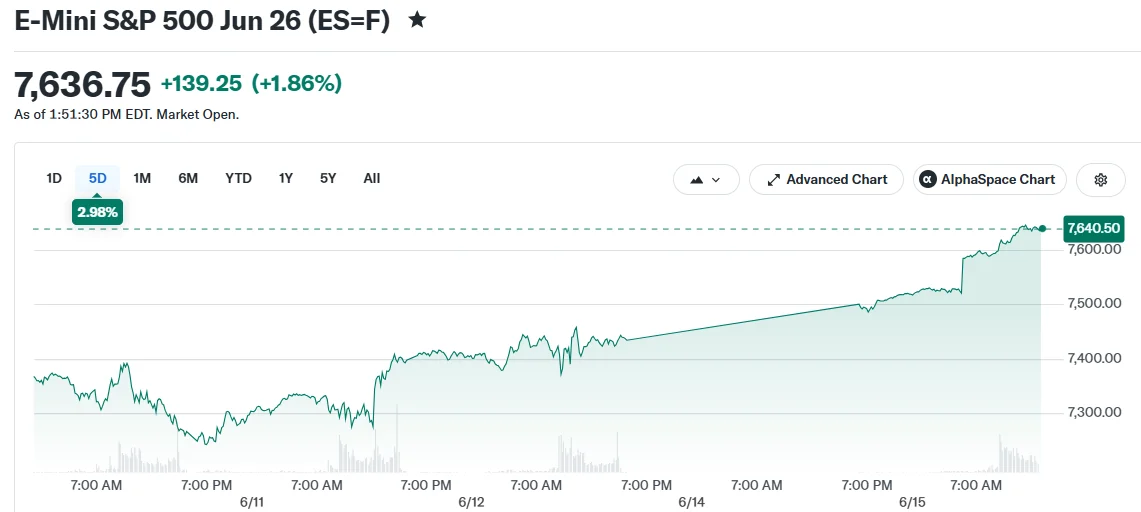
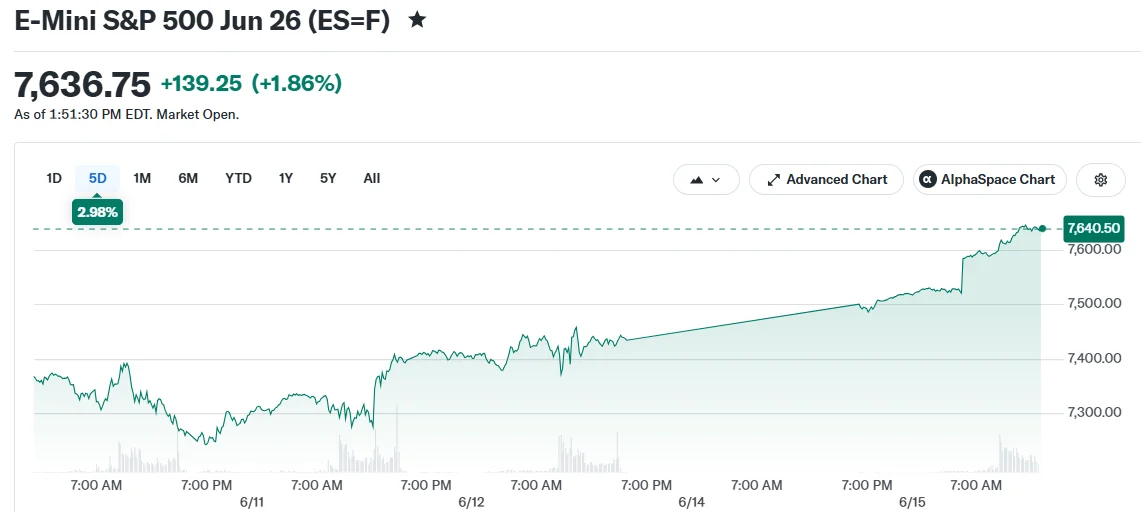
- Major U.S. indices rallied Monday with the Nasdaq climbing nearly 3%, the S&P 500 advancing 1.8%, and the Dow gaining 1.3% following ceasefire confirmation
- The peace agreement targets reopening the Strait of Hormuz, a waterway responsible for approximately 20% of global oil transport
- Brent crude tumbled close to 5% to approximately $83 per barrel as supply disruption concerns eased
- SpaceX stock climbed more than 8% Monday following Friday’s historic public market debut that valued the company over $2 trillion
- Federal Reserve policy decision anticipated Wednesday, with markets assigning a 98% probability of unchanged interest rates
U.S. equity markets delivered impressive gains Monday following confirmation from Washington and Tehran of a preliminary ceasefire agreement designed to conclude their military confrontation and restore access to crucial Middle Eastern oil transit routes.
The tech-heavy Nasdaq Composite commanded the rally with a jump approaching 3%. The broader S&P 500 index advanced 1.8% while the Dow Jones Industrial Average posted a 1.3% increase.
President Trump revealed the ceasefire arrangement late Sunday evening via Truth Social, characterizing the agreement as “complete.” An official signing ceremony has been scheduled for Friday in Switzerland.
The diplomatic breakthrough arrives after more than three months of heightened tensions between Washington and Tehran that unsettled financial markets worldwide and sparked concerns regarding potential disruptions to petroleum supplies.
Critical Oil Transit Corridor Poised to Resume Operations
The Strait of Hormuz, a strategically vital waterway situated along Iran’s southern coastline, may resume oil tanker traffic as soon as this week. President Trump attributed the implementation delay to necessary mine-clearing procedures.
Approximately one-fifth of global oil shipments traveled through this narrow passage before hostilities commenced in late February. Industry experts anticipate several months before shipping operations return to pre-conflict levels.
Oil prices experienced substantial declines following the announcement. Brent crude plummeted nearly 5% to settle around $83 per barrel. West Texas Intermediate similarly declined over 5% while maintaining levels above $80.
Pakistani Prime Minister Shehbaz Sharif validated the agreement, stating both countries had proclaimed “the immediate and permanent termination of military operations on all fronts,” extending to Lebanon.
Tehran has indicated the arrangement won’t become operational until formal signatures are affixed. Complete terms remain undisclosed by either party, prompting continued caution among shipping operators.
Precious metal prices increased while the U.S. dollar weakened after the peace deal disclosure. Treasury yields retreated, providing additional momentum to stock markets.
Central Bank Decision Takes Center Stage
Market participants now shift focus toward the Federal Reserve’s two-day policy deliberations, scheduled to conclude Wednesday.
Financial markets are pricing in better than 98% odds that policymakers maintain current interest rate levels, based on CME FedWatch Tool indicators. Nevertheless, certain economists suggest the Fed might eliminate accommodative language from its policy statement.
Newly appointed Fed Chair Kevin Warsh confronts competing pressures from accelerating inflation metrics and President Trump’s demands for substantial rate reductions.
SpaceX maintained its position as a focal point for Wall Street observers. Shares climbed over 8% Monday after the company’s Friday public market debut saw shares surge more than 19%, propelling market capitalization beyond $2 trillion.
Fox Corporation shares tumbled 15% following disclosure of a $22 billion acquisition proposal for Roku. Roku stock dipped 1% Monday after recording a 20% gain Friday.
Both the New York Stock Exchange and Nasdaq will observe market closures Friday for the Juneteenth holiday.
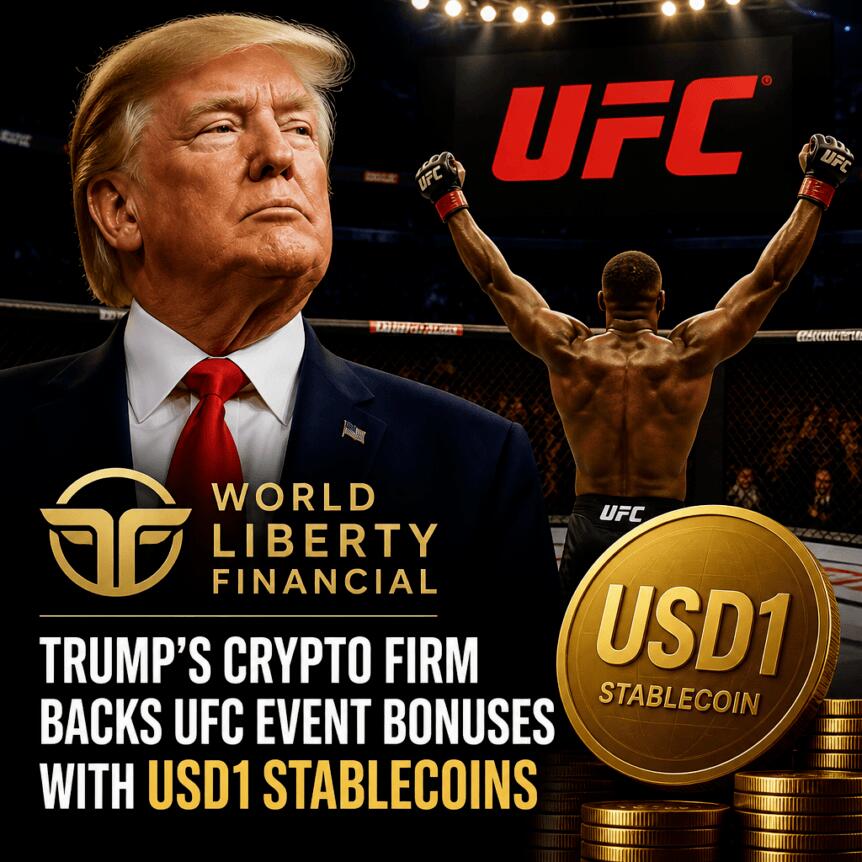
World Liberty Financial has confirmed that some fighters at the UFC’s “UFC Freedom 250” event on the White House lawn will receive performance bonuses paid in its USD1 stablecoin, a U.S. dollar-pegged token issued by the Trump family crypto firm.
According to a Business Wire announcement released Monday, UFC will pay up to $250,000 in bonuses denominated in USD1. CoinMarketCap data shows USD1 traded slightly above its $1 peg on June 12, remaining above $1 at the time of the report, with 24-hour trading volume up more than 93% to $2.38 billion.
Key takeaways
- UFC says it will pay up to $250,000 in bonuses using World Liberty Financial’s USD1 stablecoin for the White House lawn event.
- USD1 briefly traded above its $1 peg around June 12, alongside a sharp increase in reported trading volume.
- “UFC Freedom 250” drew significant congressional criticism over its reported $60 million price tag and political implications.
- World Liberty’s role in US regulatory filings and ongoing legal disputes has kept the project at the center of broader crypto policy debate.
Stablecoins become part of UFC’s White House event
World Liberty Financial’s confirmation ties the UFC Freedom 250 weekend to the stablecoin payment strategy the company has been promoting in public. UFC previously signaled a similar plan ahead of the event, and Monday’s update formalizes that fighter bonuses may be distributed in USD1.
Stablecoin-based payouts matter for more than headline optics. For investors and traders, they can increase near-term demand for the specific asset being used in settlement and may shift liquidity flows toward the issuer’s on-chain rails or trading venues. In this case, CoinMarketCap’s figures show USD1’s market activity expanded markedly around the announcement period.
USD1 trades above the peg as activity spikes
CoinMarketCap data cited in the report indicates USD1 jumped above $1 on June 12 and held above that level at last look. The same snapshot put USD1’s past-24-hour trading volume at $2.38 billion, up more than 93%.
The article also notes that USD1 had spent most of the previous month trading below $1, underscoring that the stablecoin’s behavior has not been uniformly close to the peg. That matters to users who rely on predictable dollar value for payments, custody, or arbitrage: even small deviations—especially if they persist—can affect who benefits from stablecoin-based settlement and at what effective rates.
For market participants, the key watchpoint is whether the brief above-peg move reflects temporary liquidity effects tied to the UFC-linked demand, broader conditions affecting dollar-pegged assets, or a continued pattern in USD1’s pricing around major news cycles.
Broader controversy surrounds the event and its sponsors
The UFC Freedom 250 event was held on the White House’s south lawn as part of activities tied to the country’s semiquincentennial. The report highlights that many members of Congress criticized the event, including attention to its reported $60 million price tag.
Sponsorship for the UFC event included World Liberty Financial, prediction markets company Polymarket, and crypto exchange Crypto.com. Crypto.com said it would offer $1 million in bonuses to fighters using its Cronos (CRO) token, adding to the sense that digital assets were being leveraged across multiple bonus structures.
The situation sits at the intersection of sport, politics, and finance—where stablecoin settlement can quickly become a proxy for larger debates over influence and conflicts of interest in the crypto industry.
World Liberty’s regulatory and legal turbulence
World Liberty Financial was launched in 2024 by members of the Trump family and others later linked to his administration. The project has been repeatedly cited in connection with corruption and conflicts-of-interest claims targeting the president.
The report points to regulatory momentum as well as controversy. World Liberty has an application pending with the US Office of the Comptroller of the Currency for a national trust charter, a move that—if approved—could shape how the firm operates within the US financial system.
At the same time, legal disputes have continued to escalate. In April, Tron founder Justin Sun—described in the report as a Trump supporter and one of the largest holders of the president’s TRUMP memecoin—filed a lawsuit against World Liberty alleging that the company froze his tokens and threatened to destroy them without proper justification. The report also notes that World Liberty countersued Sun weeks later.
These disputes and regulatory questions provide context for why UFC-linked USD1 payouts are likely to be closely scrutinized, not only by crypto market participants but also by lawmakers and advocates concerned about how US political power overlaps with private digital-asset ventures.
Political responses and questions of conflicts
The report includes a quoted response from a Democratic National Committee spokesperson, Jaelin O’Halloran, who characterized UFC’s stablecoin bonuses as self-dealing. A White House spokesperson, Davis Ingle, told Cointelegraph there are no conflicts of interest, arguing that President Trump’s assets are held in a trust managed by his children.
Whether observers view USD1 usage as a normal business arrangement or as evidence of improper entanglement may hinge on how regulators and courts interpret World Liberty’s corporate structure, charter application progress, and the outcomes of its ongoing litigation.
What to watch next
Investors and users should monitor whether USD1’s peg stability improves after the UFC announcement and whether trading-volume spikes fade or recur during future politically prominent events. In parallel, readers will likely want updates on World Liberty’s OCC charter process and the status of the Tron founder lawsuit, since those developments could materially affect how confidently market participants treat USD1 and World Liberty’s broader footprint in the US.
A sports-themed display in a Beijing mall ahead of the World Cup kickoff on June 11, 2026.
CNBC | Yin Hon Chow
BEIJING — Long gone are the days when catching World Cup soccer games on the go meant buying a portable mini television set.
Instead, consumers in China can just whip out their phones. Soccer is popular in China, even if the national team hasn’t qualified for the World Cup since 2002.
“We mostly watch on smartphones, very little on TV,” said Faye Jin. “The TV at home is basically not used. Maybe to watch some competitions we will turn on the TV at the last minute, but most of the time it’s on our phones.”
This year, Chinese social media company Xiaohongshu won the rights to stream the World Cup games for free to all users. The app, also called Little Red Book, is sometimes compared to Meta’s Instagram.
Xiaohongshu’s deal is a strategic partnership with state-owned China Media Group, which sealed broadcast rights less than a month before the World Cup kicked off last week. The company runs China Central Television (CCTV), which has both mobile and smart TV apps that let subscribers watch matches and replays ad-free.
CNBC spot checks found that locals in Beijing are not as eager to head out to bars for World Cup games this year, and instead follow matches online, often at home.
The games this year tend to fall in the middle of the night or during morning working hours due to the 12-hour-plus time difference. Interviews are translated from the original Mandarin Chinese.
“If my friends are interested in the World Cup they will definitely watch at home,” said Xu Wang, who works at Absolut Bar in a tourist-heavy part of Beijing. “It’s hard to find a suitable place for people to gather at that time of night, especially because everyone is spread out across the city.”

The shift to mobile devices builds on a digital-first trend in China.
During the World Cup in 2022, China already accounted for nearly half of all hours of viewing on digital and social platforms globally, according to FIFA.
Widespread 5G connectivity and relatively low-priced roaming packages help. People in China already spend 40% of their daily mobile phone time watching videos, primarily on short-video apps such as ByteDance’s Douyin, according to QuestMobile.
To stay updated on the World Cup matches, Quan Zhao said he scrolls through Douyin, and only plans to watch the last few games in full. He’s not sure yet whether he will go out to do so.
That also reflects how tough it is for Xiaohongshu to capitalize on World Cup streaming to reach more users.
Douyin won streaming rights for the World Cup in 2022, when many people in China still faced Covid-19 restrictions on gathering and moving around. This time, Douyin is promoting a packed lineup of soccer commentators and creators, along with World Cup-themed AI special effects templates.
Douyin has more than 1 billion monthly active users, Questmobile data showed, while Xiaohongshu had 245.3 million as of March.
A shopping-focused version of Douyin ranked first among the top 10 downloaded apps on Apple’s China app store as of midday Monday.
CCTV’s app for streaming the World Cup ranked second, while China’s official sports betting app ranked sixth — and Xiaohongshu ranked ninth.
Chinese tech companies aren’t just focused on the domestic market. Tencent Cloud said Friday that two-thirds of official World Cup broadcasting platforms in Asia Pacific use the company’s services.
The company said it’s supporting match streaming in 16 regions, including Singapore, the United Arab Emirates and Argentina — the largest territory for a World Cup ever covered by a Chinese cloud provider.


Recently, the concept of so-called covenants has received renewed attention as Bitcoin development and protocol discussions underwent a renaissance. Covenants could enable and facilitate a wide range of applications, including new trustless and scalable layer 2s, fully non-custodial vaults with more complex spending logic, and more efficient payment channels. However, most paths to implementing this functionality require a soft fork of Bitcoin’s consensus rules, a process that would likely spark debate within the community.
With the recent diversification of consensus clients into Core and Knots nodes, reaching agreement on such a change has become less likely. In spite of recently pushing for a soft-fork of their own, namely BIP-110, the Knots side tends to advocate for protocol ossification and appears less supportive of facilitating scaling solutions on the base layer. The recent controversy that Bitcoin Core has attracted, both as a technical debate and in governance, is diminishing the prospect of covenant implementations on Bitcoin anytime soon.
Prominent figures such as Michael Saylor have also publicly advocated for protocol ossification, portraying zealous, well-funded developers as the greatest threat to the protocol. Nonetheless, some minimal covenant implementation likely offers the most conservative path to trust-minimized Layer-2s, which can bring the privileges of self-custody to the next billion people. Should mainnet fees spike again in the future and a resolution to the spam wars is found, discussions around these proposals are likely to regain momentum. In this article, we will lay some of the foundations for our readers to understand covenants. In follow-up pieces we will take a deep dive into individual proposals.
To understand covenant proposals, it is necessary to grasp the basic validation flow for Bitcoin transactions. Bitcoin locking conditions are expressed in a stack-based, non-Turing-complete language called Bitcoin Script. The sender of a Bitcoin transaction specifies the spending conditions in this language by creating a so-called locking script (also known as scriptPubKey). When the recipient of the funds later wants to spend the outputs, they must provide the corresponding unlocking script (also known as scriptSig) that fulfills these conditions. Bitcoin’s scripting language can express a variety of validation conditions. It can verify public key signatures, enforce timelocks, verify hash preimages, and combine spending conditions with propositional logic. An entity with the correct unlocking script can move the Bitcoin to any arbitrary location, i.e., encumber them with any arbitrary scriptPubKey. However, it cannot put restrictions on where funds are sent after the correct scriptSig is provided.
It is this feature that covenants aim to enable. Covenants would allow users to impose restrictions on how coins can be spent in the future. The concept was introduced by Gregory Maxwell all the way back in 2013 to improve the scalability and flexibility of Bitcoin. It was later popularised by Möser, Eyal, and Sirer in 2016. Maxwell initially proposed using zk-SNARKs to impose spending restrictions. Since then, the discussion has seen an explosion of different proposals, culminating in some that may sidestep the requirement for a soft fork.
Basic (or precomputed) versus General (or recursive) covenants
A key distinction in covenant proposals lies between basic (or precomputed) and general (or recursive) covenants. In principle, basic covenants only impose restrictions on the next transaction in line. However, by chaining together encumbered addresses, basic covenants can also be used to define a finite sequence of transactions in advance. While this sequence of permitted transactions can be arbitrarily long or complex, it must be specified beforehand.
General covenants would be able to express recursive spending rules directly within Bitcoin Script. This allows a spending condition to be reapplied indefinitely. For example, if Alice sent Bob 1 BTC, a basic covenant could ensure Bob can only send the funds to a specific address or encumbers it for a fixed number of steps. Under a general covenant, however, the UTXO worth 1 BTC would retain its same spending restrictions when Bob sends it to Steve, and again when Steve transfers it further, without any predefined endpoint. Although general covenants would offer greater versatility, they face significant technical hurdles and are viewed critically by the community. Their implementation would also require major protocol updates.
Proposed Covenant Implementations and Their Applications
Various implementation proposals and debates have shaped our understanding of how covenants could enhance Bitcoin’s functionality. To navigate this topic clearly, it is important to distinguish the proposed changes into four categories:
- Opcodes that fully implement covenant functionality. They directly impose spending restrictions on Bitcoin transactions. This includes OP_CHECKTEMPLATEVERIFY and SIGHASH_ANYPREVOUT.
- Opcodes that serve as supporting tools. These extend the expressiveness of Bitcoin script or data handling but do not implement covenant functionality unless combined with other opcodes. In this category, we will discuss OP_CHECKSIGFROMSTACK and OP_CAT.
- Opcodes for specialized applications. We consider OP_VAULT, OP_UNVAULT and OP_EVICT.
- Proposals that approximate covenant behavior without a soft fork. These rely on cryptographic constructions within existing consensus rules or trust-minimized infrastructure rather than new opcodes. Within this category, we will discuss ColliderScript, Bitcoin PIPE and FE-based covenants.
In our next article we will commence our discussion of the first category of covenant proposals by covering OP_CHECKTEMPLATEVERIFY — one of the most popular proposals so far.

Top 3 Cryptos to Watch as Wall Street Moves Deeper Into Ethereum and Pepeto Presale Attracts Big Capital While BNB and ADA Recover

The ‘Obsession’ Universe Could Be Horror’s Answer to the Greatest Anthology Series Ever Made

Timing #bitcoin #crypto #blockchain #cryptocurrency #money #ethereum #trending #solana #ai #news

BloFin War of Whales 2026 Grand Prix opens registration for $5M trading championship

Blockchain.com files with SEC for U.S. IPO

Israel says it has killed new Hamas military leader in Gaza City airstrikes
Timing #bitcoin #crypto #blockchain #cryptocurrency #money #ethereum #trending #solana #ai #news

Are money sheets legal to cut and spend?

#trading #liquidity #crypto #bitcoin #cryptonews #cryptocurrency #altcoins #trader #altcoinseason
-

 Business1 day ago
No Jackpot Winner as $257 Million Prize Rolls Over to $269 Million Monday Draw
-

 Crypto World4 days ago
Oppenheimer backs SpaceX as $70 billion retail frenzy builds
-

 Crypto World4 days ago
Markets Rally as SpaceX IPO Looms Amid Iran Tensions and Inflation Surge
-

 Fashion3 days ago
Weekend Open Thread: Tuckernuck – Corporette.com
-
 Crypto World1 day ago
Zimbabwe Requires Crypto Businesses to Register Annually Under New FIU Regulations
-

 Entertainment7 days ago
The Ryan Gosling True Crime Thriller On Netflix That Gets Even Stranger, Stream It Now
-
 Sports6 days ago
Bangladesh beat Australia after 20 years in ODIs, register only their second win over six-time world champions | Cricket News
-

 Tech3 days ago
NanoClaw integrates JFrog registries to secure AI agent downloads
-

 Crypto World3 days ago
Bitget enters Argentina’s regulated crypto market through PSAV registration
-

 Tech3 days ago
This Week In Security: Microsoft On Microsoft, Register Your Domains, Linux On ARM, And FreeBSD Joins The File Cache Club
-
 Tech4 days ago
Dutton Ranch star claims they ‘didn’t see any disruption’ on set following Chad Feehan’s exit from Yellowstone spinoff fueled by Taylor Sheridan clash rumors
-

 Politics4 days ago
Politics Home | Healey Resignation Is “Colossal Failure Of Government”, Says Former Labour Defence Secretary
-

 NewsBeat4 days ago
El Nino has formed in the Pacific and could set records, forecasters say
-

 Tech6 days ago
‘This is Seattle’s position on AI’: City Council votes unanimously to pause big new data centers
-
 Entertainment4 days ago
Donnie Wahlberg & More Heat Up Las Vegas at Circa’s Barry’s Downtown Prime
-

 Business6 days ago
Thailand Ranks Second Worldwide for AI Adoption Growth, Microsoft Reports
-

 Sports4 days ago
First Time Since 1971: Australia Register Historic Low In ODI Cricket
-
 Tech4 days ago
Opendoor Ends India Operations, Fueling a Bigger Conversation About AI and Outsourcing
-

 Politics4 days ago
Belfast burns, while Met chief points finger at Iran and Russia
-

 NewsBeat3 days ago
FBI searches office of Ohio voter registration group
You must be logged in to post a comment Login