
Crypto World
Asia Stocks Climb and Rate Bets Ease. Now Comes Wednesday’s CPI Test

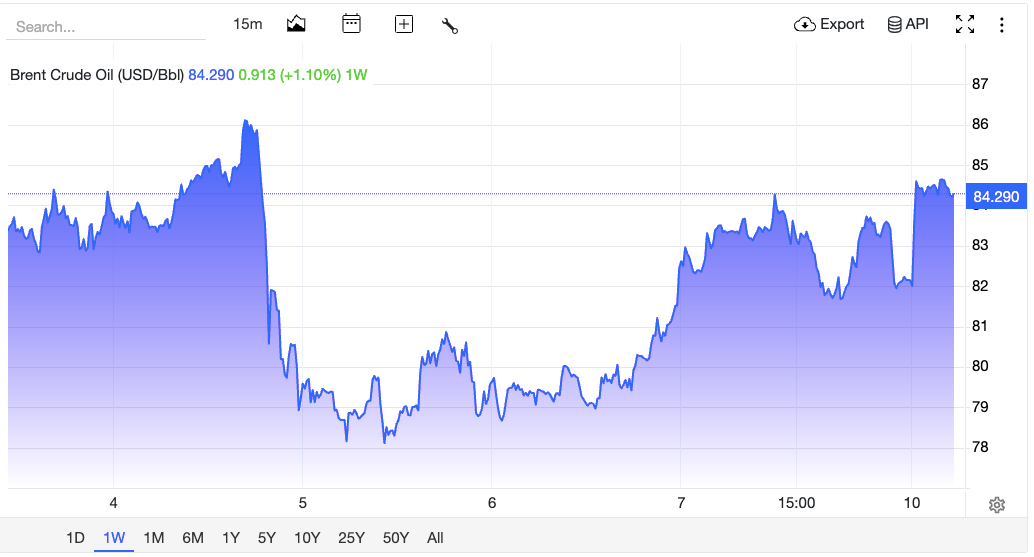
Asian stocks edged higher Monday and the probability of a September US rate hike dropped sharply, giving global markets room to extend last week’s record run. The calm has one clear expiry date: Wednesday’s inflation report.
Japan’s Nikkei and South Korea’s KOSPI added marginally as the new week began. The MSCI Asia-Pacific index outside Japan also edged up, all tracking Wall Street’s Friday close, where the S&P 500 notched a fresh record high.
The CPI Report That Could Reset the Rate Trade
The shift in rate expectations drove most of last week’s action. Futures markets now price around a 44% chance the Federal Reserve raises borrowing costs at its September meeting, down from 67% a week ago. A soft US jobs report triggered the move, pushing Treasury yields lower and lifting risk appetite globally.
Wednesday’s consumer price index (CPI) report, covering July prices, is the next checkpoint. Analysts expect a 0.1% rise in headline inflation and 0.2% for core, which strips out food and energy.
JPMorgan chief US economist Michael Feroli told clients: “Our forecast for core CPI of 0.22% is probably not quite firm enough to prompt a hike from the Fed at the September meeting, though repeated prints closer to 0.3% could do it.” He flagged a potential rebound in core goods prices as a specific watch item.
The stakes around this week’s CPI are familiar for crypto markets; rising rate hike expectations tend to suppress risk appetite and weigh on Bitcoin and digital assets.
Hike odds had briefly touched 66% earlier this year before softening on cooler data. Wednesday could move that number fast in either direction.
Oil Is the Inflation Wildcard
The complication is oil. Brent crude rose 0.9% to $84.32 a barrel Monday and US crude added 0.7% to $78.74. The driver: Iran said on Sunday that a deal with Oman defining new shipping lanes through the Strait of Hormuz is in “final stages,” but reiterated the waterway would only reopen once the US met separate conditions.
Shipping through the Strait, one of the world’s critical oil chokepoints, remains minimal.

Sustained oil pressure feeds directly into headline inflation. A hot CPI print Wednesday would reignite rate hike speculation and put the current rally under immediate pressure.
The dollar dropped broadly on easing rate fears, with the euro near a seven-week high at $1.1557 and gold holding at $4,342 an ounce after climbing more than 7% last week.
With nearly 90% of S&P 500 results in, Bank of America data shows earnings per share up 30% year-on-year, with AI stocks posting median growth of 28% against 12% for the rest of the index. The backdrop is strong. Wednesday decides whether it holds.
The post Asia Stocks Climb and Rate Bets Ease. Now Comes Wednesday’s CPI Test appeared first on BeInCrypto.


The previous business week ended with a bit of a surprise as the jobs report showed that the US economy had lost 23,000 jobs in July, compared to expectations for roughly 80,000 new positions.
Previous months were revised sharply lower as well, solidifying the argument that the labor market is finally weakening. Although this was initially interpreted as good news for risk assets since a softer economy gives the Fed less reason to tighten monetary policy further, one big obstacle remains, and more light will be shed on it this week.
Inflation Week
The analysts at The Kobeissi Letter described the coming five days as another ‘big week’ for economic data, with July’s CPI and PPI reports getting the most attention. They will be announced on Wednesday and Thursday, respectively, followed by retail sales and consumer sentiment on Friday.
Wednesday’s Consumer Price Index (CPI) report is undoubtedly the main event, especially since last month’s showed a substantial decline. However, it was probably misleading since it was based on lowered energy costs due to the de-escalation of the Middle East war, which has since deteriorated.
Although Friday’s employment report tilted the monetary policy equation toward a no-hike event, another hot inflation reading could quickly reverse the narrative. As usual, a cooler July CPI report could lead to a BTC and altcoin rally due to reduced expectations for a rate hike, and vice versa.
The PPI reading on Thursday will provide another look at inflation, but from a producer’s side. It’s typically less influential than CPI, but a significant upside surprise could reinforce concerns that price pressures remain high.
Friday’s July retail sales could be the dark horse, as stronger consumer spending would demonstrate that the US economy remains resilient despite the weak employment figures. On the surface, this sounds positive, but it could give the Fed another reason to maintain restrictive monetary policy given the current environment.
In contrast, a weak retail sales reading would strengthen the narrative that the economy is slowing, potentially reducing the requirement for additional rate hikes.
Key Events This Week:
1. July Existing Home Sales data – Tuesday
2. OPEC Monthly Report – Wednesday
3. July CPI Inflation data – Wednesday
4. July PPI Inflation data – Thursday
5. July Retail Sales data – Friday
6. August MI Consumer Sentiment data – Friday
It’s a big week…
— The Kobeissi Letter (@KobeissiLetter) August 9, 2026
War Moves
The previous week was also quite eventful, leading to substantial volatility for BTC, which dropped to a monthly low of $62,200 before jumping by over $3,000 at the end of the week. One factor that wasn’t mentioned in the report above is the war against Iran.
Any significant moves in that direction tend to severely impact the crypto market (as well as other financial markets). The promise of a deal from last week brought some hope, but the failure erased it. The latest reports claim that Trump has undertaken a new strategy by “low-keying it with Iran.” According to Axios, he is preparing to allow economic pressure to mount as opposed to ordering a new military offensive.
For now, bitcoin remains sideways at around $65,000 after little to no fluctuations over the past 48 hours.
The post Another Big Macro Week Is Here: 3 Events That Could Move Bitcoin appeared first on CryptoPotato.


Empery Digital sold 1,635 Bitcoin for $102.2 million between July 1 and Aug. 6, cutting its total holdings to 1,279 BTC, according to an Aug. 7 SEC filing.
Summary
- Empery Digital sold 1,635 BTC for $102.2 million between July 1 and August 6, 2026.
- Only 325 BTC remained unrestricted after 954 BTC secured $35 million of outstanding company debt.
- Unrestricted Bitcoin holdings fell 76% from 1,375 BTC at June 30, according to company filings.
- Empery repaid $20 million after June, prompting its lender to return 585 pledged Bitcoin tokens.
- A $62.1 million property commitment remains conditional, with due diligence extended through August 13, 2026.
Of that balance, 954 BTC remained pledged to a lender, leaving a derived 325 BTC unrestricted.
The latest disclosure extends a sharp reduction in the Nasdaq listed company’s Bitcoin treasury. Empery held 2,914 BTC on June 30, including 1,375 unrestricted coins. The available pool therefore fell by 1,050 BTC, or about 76.4%, in just over five weeks.
Empery Digital’s unrestricted Bitcoin pool falls 76%
The July and August sales came after Empery had already sold 1,167 BTC for $80.1 million during the first half of 2026. Those earlier disposals produced a $56.8 million realized loss based on the original cost of the Bitcoin sold, according to the filing.
The latest figures also move beyond the company’s July 10 filing. At that point, Empery said it held 1,514 BTC and about $73.9 million in cash after selling 1,400 BTC since May 7. As crypto.news reported in earlier July coverage, the company said those proceeds were intended for debt repayment, a planned property purchase, legal expenses and operations.
The filing also shows how the treasury sales fit into a broader capital allocation plan. Through Aug. 6, Empery had repurchased 26.24 million shares for $149.7 million at an average price of $5.71. The company said proceeds from $105 million of borrowings, together with Bitcoin sales, helped finance the repurchases. Digital asset losses totaled $106.3 million in the first half and represented 87% of operating expenses.
That marks a major change from the company’s original treasury expansion. In August 2025, Empery reported holding more than 4,000 BTC as it pursued a strategy centered on increasing Bitcoin exposure. Its balance sheet now combines a much smaller Bitcoin reserve with debt reduction, share repurchases and new infrastructure investments.
Debt fell, but most remaining BTC is still pledged
Empery repaid another $20 million under its master loan arrangement after June 30, reducing outstanding borrowings from $55 million to $35 million. The lender returned 585 BTC, bringing pledged collateral down from 1,539 BTC to 954 BTC.
The loan still carries tight collateral conditions. A February amendment set the collateral call level at 153% and the liquidation level at 143%, while reducing the period to restore collateral at the liquidation threshold to 12 hours. Empery had already supplied 576 BTC after a February collateral call and another 186 BTC after a June call. In related March coverage, the company was already selling Bitcoin while reducing leverage and repurchasing shares.
Data center funding could create another cash requirement
Empery is also expanding beyond its Bitcoin treasury strategy. Through its EMHU venture with TexStack Infrastructure, the company contributed $2.9 million and committed another $62.1 million if a proposed Midwest property acquisition closes. The roughly $230 million property is intended to be converted into an AI data center.
The Aug. 7 filing adds a new deadline. EMHU extended its due diligence review period by 15 days to Aug. 13 and can extend it another 15 days. Empery said it expects the acquisition to close during the third quarter but cautioned that “there can be no assurance that it will occur.”
Separately, Empery closed a $20 million investment in Cardinal Data Power on July 20 for an approximately 8% stake, according to an SEC release. In recent data center coverage, crypto.news tracked a broader shift by several digital asset treasury companies toward AI infrastructure as the treasury model came under pressure.
Management said cash, operations, borrowing and potential Bitcoin sales should “be sufficient to fund planned operations beyond one year.” The statement is forward looking. Empery had $3.6 million of cash, cash equivalents and restricted cash and a $5.6 million working capital deficit at June 30, while its unrestricted Bitcoin cushion has since narrowed to 325 BTC.
What happens next depends partly on the Aug. 13 property review deadline and whether EMHU extends the review again or moves toward closing. Any further Bitcoin disposal would require another company decision. The current filing lists potential Bitcoin sales among possible funding sources but does not say additional sales are certain.
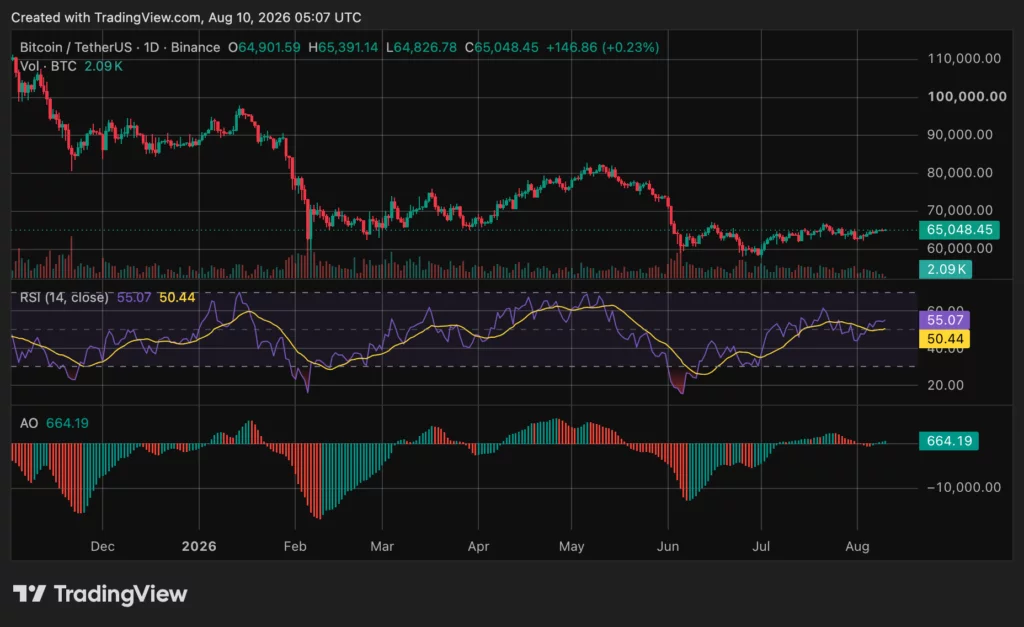
Bitcoin pushed above $65,000 during early trading on Aug. 10 before slipping back below the level, extending its recovery as investors reassessed the U.S. interest rate outlook.
Summary
- SoSoValue reported $854 million in weekly Bitcoin ETF inflows as BTC briefly topped $65,000 Monday.
- July payrolls fell 23,000, prompting traders to reduce expectations for another Federal Reserve rate increase.
- U.S. July CPI arrives Wednesday, with economists expecting headline inflation to slow to 3.4% annually.
- BlackRock’s IBIT drew $694 million last week, leading positive flows across U.S. Bitcoin ETF products.
- Bitcoin gained 3.4% over seven days while remaining roughly 48% below its October record high.
BTC was trading near $64,955 at the time of writing, up 0.3% over 24 hours and 3.4% over seven days. Its intraday high reached $65,363.
The move leaves traders with a clear macro event ahead. The Bureau of Labor Statistics will release July consumer inflation data at 8:30 a.m. ET on Wednesday, Aug. 12. The report follows Friday’s unexpectedly weak employment numbers, which reduced expectations that the Federal Reserve would need to raise rates again soon.
Bitcoin gets relief from weaker U.S. jobs data
The U.S. economy lost 23,000 nonfarm payroll jobs in July, while unemployment held near 4.1%, according to official BLS data. May payroll growth was revised down by 66,000 and June by 37,000, removing 103,000 jobs from the two previous estimates combined. Average hourly earnings rose 3.2% from a year earlier.
Bitcoin moved above $65,000 after the report as rate expectations shifted. As crypto.news reported in Friday’s payroll reaction, BTC initially gained almost 2% as investors interpreted weaker hiring as reducing pressure on the Fed to tighten policy. The move has since held, although $65,000 has not yet become firm support.
The policy backdrop remains divided. The Federal Reserve held its target range at 3.50% to 3.75% on July 29, but three voting officials preferred a 25 basis point increase, according to its statement. The central bank also said inflation remained above its 2% goal, partly because of energy related supply pressures.
Bitcoin ETF demand strengthened throughout last week
Institutional demand also improved as Bitcoin approached resistance. SoSoValue reported $854 million in net inflows into U.S. spot Bitcoin ETFs from Aug. 3 through Aug. 7, with BlackRock’s IBIT accounting for about $694 million. The figure marked a reversal from the weaker fund flows seen around the end of July.
There is a small difference between ETF datasets. Farside’s current flows show daily totals of $170.1 million, $211.5 million, $244.4 million, $137.6 million and $101.7 million over the same five sessions, which sum to about $865.3 million. For that reason, the $854 million weekly total is best attributed specifically to SoSoValue rather than treated as a universal figure.
The demand followed several sessions in which ETF buying failed to produce an immediate breakout. In earlier ETF flow coverage, Bitcoin remained near $64,200 on Aug. 7 even after funds recorded four consecutive positive sessions. Friday’s additional inflows extended that streak while BTC continued challenging the same resistance area.
$65,800 remains a closely watched Bitcoin barrier
The price structure has improved since Bitcoin traded near $62,500 at the beginning of last week, but the market has repeatedly struggled between $65,000 and $66,000. Crypto.news previously identified the same area in recent resistance analysis, where $65,000 to $65,500 also contained a concentration of liquidation liquidity.
The Relative Strength Index stood at 55.07, above its moving average of 50.44 and the neutral 50 level. The reading points to moderate bullish momentum, with buyers holding a slight advantage. However, RSI remains well below overbought territory, suggesting momentum has strengthened without becoming stretched.
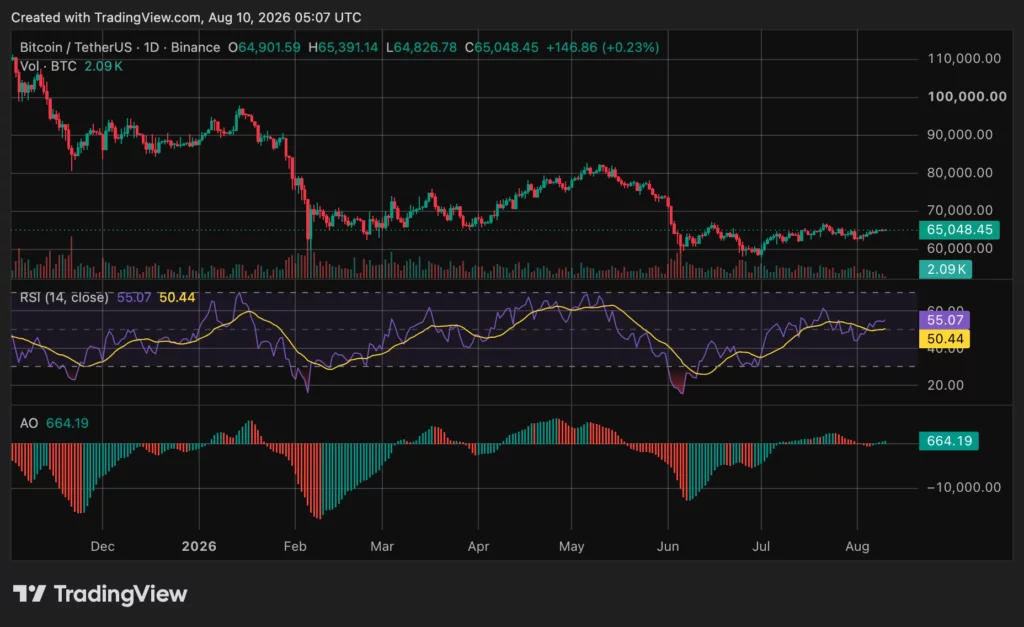
The Awesome Oscillator was positive at about 664.19, supporting the improving momentum picture. Its histogram bars remained relatively small compared with those recorded during stronger directional moves, so the indicator points to improving momentum rather than confirming a major breakout.
Analyst Michaël van de Poppe has placed the next level slightly higher. In an Aug. 9 post, he called $65,800 the “critical level” and said BTC was “ready for a breakout to at least $73,700.”
He also cited bullish divergence in longer duration RSI and MACD readings. Those figures are his technical targets, not confirmed price objectives, and Bitcoin still needs to clear the resistance he identified.
What happens next as U.S. inflation takes focus
Wednesday’s CPI report is now the nearest scheduled U.S. catalyst. June consumer prices fell 0.4% from May while rising 3.5% from a year earlier. Core CPI was unchanged during June and rose 2.6% annually. Economists surveyed by Reuters expect July headline inflation to ease to 3.4% annually and core inflation to slow to 2.5%.
The market is also dealing with renewed energy pressure. Brent crude rose 1% to $84.40 on Monday as uncertainty around shipping through the Strait of Hormuz continued. Meanwhile, the U.S. 10 year Treasury yield traded near 4.66%. Futures markets put the probability of a September Fed rate increase near 44%, down from 67% one week earlier.
A hotter CPI reading could rebuild expectations for another increase and put renewed pressure on risk assets. A softer reading could reinforce the interpretation traders drew from Friday’s weak employment report, but it would not guarantee a Bitcoin breakout. The Fed’s next scheduled policy meeting runs Sept. 15 to Sept. 16, leaving policymakers with several more economic releases before deciding whether rates should change.
For Bitcoin, the immediate test therefore remains narrow: holding the recovery around $65,000 while attempting to clear the $65,800 area. Wednesday’s inflation numbers will provide the next evidence on whether the U.S. macro environment supports that move or sends traders back toward the lower end of Bitcoin’s recent range.
Disclosure: This article does not represent investment advice. The content and materials featured on this page are for educational purposes only.


A Bitcoin security researcher says he has been forced to go back to using open-source Chinese AI models after finding himself restricted from analyzing further codebases by OpenAI, highlighting a growing concern that the most capable AI tools aren’t being made available to defenders.
In an X post on Tuesday, AnchorWatch CEO Rob Hamilton said he had begun integrating OpenAI’s Trust & Cyber capabilities into his Bitcoin Red Team work on Saturday, only to find his access restricted the following morning.
“It absolutely guts me as a patriotic American to have to do this, but I will be going back to using Chinese open source models to conduct my research to protect Bitcoin infrastructure,” he added.
Bitcoin Red Team, a group of volunteers, has been using AI tools and human review to scan hundreds of open-source Bitcoin-related repositories for vulnerabilities, with efforts accelerating days after the Coldcard hardware wallet hack, which has seen over $100 million in Bitcoin stolen.
Last month, crypto executives told Cointelegraph that many of crypto’s biggest players are still waiting to gain access to powerful new AI models to strengthen their code from attacks, with only a select few having been able to get it.
“I am now prevented from being able to continue the investigation in a further effort to make sure their code changes are sufficient, as well as understand if there are other issues that have yet to be discovered,” said Hamilton.
“Black hats will not hit these issues. The white hats will. We’ve hit a local minima in policy,” said Hamilton. “Intelligence is unrestricted for those who don’t follow rules, and those who engage in harm reduction are left on the sidelines.”
Related: Crypto firms still seeking frontier AI access; only select few have it
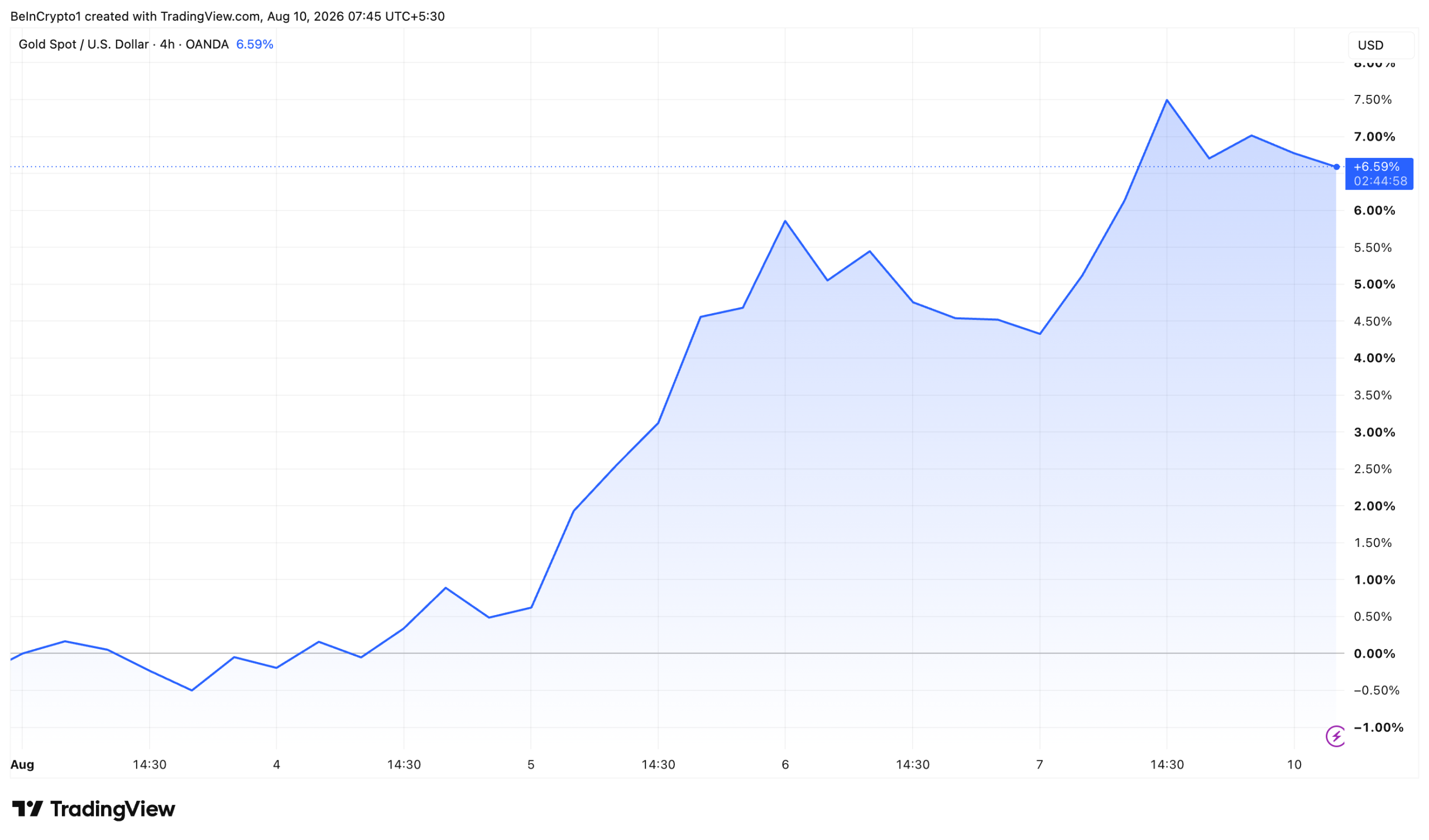
Gold (XAU) futures on Binance recorded one of their strongest trading days in four months on Friday. The surge followed a July jobs report that missed expectations.
The move came alongside a broader gold rally, which ended a four-month losing streak. Investors appear to be returning to the precious metal after months of pressure.
Weak Jobs Data Boosts Gold
BeInCrypto reported that nonfarm payrolls (NFP) fell by 23,000 in July, compared with a forecast of an 85,000 gain.
Revisions to May and June erased another 103,000 jobs. The unemployment rate still fell to 4.1%. However, the decline did not reflect stronger hiring conditions.
Instead, 264,000 people left the labor force during the month. That pushed participation to 61.4%, its lowest level in nearly five and a half years.
Gold responded quickly to the data, closing Friday’s session 2.48% higher. The metal has gained more than 6% since the start of August.

Follow us on X to get the latest news as it happens
Gold Futures Activity Surges on Binance
Binance’s XAU futures market also captured that momentum. Analyst Darkfost highlighted that gold futures recorded more than $2.5 billion in volume on Friday alone.
This marked one of the strongest trading sessions in four months. Since launching on Binance roughly nine months ago, gold futures have surpassed $200 billion in cumulative trading volume.
The activity highlights growing demand among crypto-native traders for exposure to traditional safe-haven assets.
“This renewed interest in gold, combined with weakening employment data, confirms that the market appears to be pricing in a possible deterioration of the economic situation,” the analyst said.
Traditional gold markets have also shown a parallel shift. Global gold-backed exchange-traded funds attracted $3 billion in July.
That inflow reversed two consecutive months of outflows. Total assets under management also rose 1% to $530 billion. European funds accounted for most July inflows.
The weak jobs report also reshaped expectations for the Federal Reserve’s September meeting. Markets now see a 44% chance of a rate hike, down from 67%.
The shift could further support gold if traders continue to price in a less restrictive policy outlook. The next major catalyst is the July CPI data, due Wednesday, August 12.
Subscribe to our YouTube channel to watch leaders and journalists provide expert insights
The post Weak US Jobs Data Drives $2.5 Billion Gold Futures Surge on Binance appeared first on BeInCrypto.

Quantum computing is often discussed in crypto as a future doomsday scenario—sometimes framed around the idea that Satoshi Nakamoto’s dormant Bitcoin could be drained once “Q-day” arrives. But Quantus Network CEO and co-founder Christopher Smith argues the first real-world impact may look far less cinematic: not a public, forensic-friendly hack, but a series of wallet breaches that are difficult to attribute to quantum capabilities at all.
Smith tells Cointelegraph that once quantum computers become powerful enough to break the public-key cryptography used by major blockchains, attackers may be able to derive private keys from public information on-chain. Crucially, the compromised pathway could avoid triggering obvious internal security failures in wallets or exchanges, leaving investigators with scant evidence beyond the fact that no meaningful breach was detected.
Key takeaways
- Q-day attacks may be hard to detect because they can be executed without compromising a wallet, device, or exchange infrastructure.
- Rather than only “Satoshi’s Bitcoin,” early quantum-enabled targets could include high-value administrative keys and other sensitive systems.
- Security researchers believe attackers might prioritize hot wallets at exchanges because they are less likely to raise alarms quickly.
- Predictions for when quantum can break modern elliptic-curve cryptography range from late-2020s odds to near-certainty in the early 2030s.
- Blockchain teams are already migrating toward post-quantum signatures, largely because waiting for certainty is too risky.
Why quantum theft could be indistinguishable from “normal” breaches
Smith’s central warning is that quantum-enabled compromise may not resemble the kind of intrusion that generates clear forensic trails. “When someone cracks your key, you don’t get a memo saying how they did it,” he said in an interview with Cointelegraph. In this scenario, an attacker could compute the corresponding private key after enough quantum capability exists—using information already visible on a public blockchain.
That shift in attack mechanics matters for incident response. Smith suggests that if a highly secure organization were targeted, “the only forensic evidence would be that there was no breach.” The attacker wouldn’t need to exploit the systems in which the wallet is running, nor necessarily leave traces of compromise in logs that would point to a conventional intrusion path.
Security expectations are therefore likely to be mismatched with how the earliest quantum-driven thefts would appear. If investigators primarily look for device-level compromise, key-management failures, or exchange-side intrusions, they could be left without the traditional indicators that typically accompany catastrophic key loss.
The first targets may be more strategic than famous
Much of the public concern about Q-day focuses on Satoshi Nakamoto’s estimated holdings—described in the source reporting as worth roughly $63 billion at the time of writing. Smith argues that while that narrative dominates headlines, the first quantum-enabled targets could be elsewhere.
According to Smith, the earliest high-value targets might include military systems and state secrets. In the crypto ecosystem specifically, he points to the “single most valuable key,” suggesting it could be Tether’s minting key. In his framing, a quantum attacker could mint tokens from an administrative wallet and sell them before the issuer can react.
He also notes that USDT is deployed across multiple networks, and that some of those networks are already working on post-quantum migration. That detail underscores an important practical point: even where a stablecoin is widely used, the risk is not only about user wallets. Administrative or minting keys—or other privileged cryptographic roles—could be where quantum leverage becomes most economically damaging.
Another idea comes from Blockchain Capital security researcher Sean Cheetham. He argues an attacker would more likely pursue hot wallets at exchanges—particularly those “that aren’t going to ring alarm bells”—rather than trying to take famously held coins. Cheetham’s comment suggests attackers may optimize for timing and operational friction: quantum capability might not eliminate the value of choosing targets, it may just change how compromise is achieved.
Smith adds a further wrinkle: attackers could disguise quantum thefts by using plausible, deniable explanations. “There’s an alternative scenario where they… have these plausible, deniable [explanations]: ‘Oh, somebody just lost their keys somehow,’” he said. That increases the chance that quantum-related incidents could be misclassified as ordinary loss or conventional compromise.
Q-day timing remains uncertain as AI reshapes assumptions
Part of what makes Q-day hard to plan around is that forecasts have been moving as quantum progress and related algorithmic improvements develop. In March, Cointelegraph previously reported that Google accelerated its post-quantum migration timeline to 2029, citing an AI-assisted breakthrough suggesting elliptic curve cryptography could be cracked with fewer physical qubits than earlier estimates.
In the current reporting, NGRAVE CEO Roy Blackstone is cited for criticizing earlier quantum threat models that, in his view, did not adequately account for the parallel development of AI. The excerpt attributed to him argues that many threat models assumed ample time before public-key cryptography could be broken, but failed to reflect how quickly AI could evolve alongside quantum research.
Despite this urgency, there is still no single consensus on when quantum computers will be capable of breaking modern cryptography. Smith, whose company is building a blockchain network intended to be quantum-resistant from launch, says there is a “50-50” chance Q-day could arrive by 2028, arguing that continued AI-assisted improvements in quantum algorithms and ongoing hardware research make forecasts less reliable.
Cheetham’s view, as presented in the source, is that the early 2030s are “definitely almost a certainty,” while earlier dates are “more of a trailing probability.” Michael Coates, the Solana Foundation’s chief information security officer, declined to estimate during an earlier interview, telling Cointelegraph that “there’s no way to know.” He also pointed to a long-standing industry pattern: “it is always five years away,” a perspective he says has persisted for a decade or more.
Even with widely varying predictions, the recurring theme across these experts is that uncertainty should not become a reason to delay. Blackstone in the source emphasizes that blockchains have begun migrating to post-quantum signatures because “the damage would be catastrophic if they didn’t.”
What post-quantum migration changes for crypto security
The practical implication of these warnings is straightforward: migrating cryptography is the only way to reduce exposure as quantum timelines shift. While Q-day may be difficult to pinpoint, the risk model changes in a way that makes “wait and see” a poor strategy—especially because early quantum-enabled attacks could be indistinguishable from other security failures.
Post-quantum signature migration, as referenced in the reporting, is therefore not just about long-term research alignment. It changes what defenders can expect in real incidents. If a chain adopts post-quantum signatures, it narrows the window during which attackers might exploit public-key weaknesses through quantum computation. That also reduces the chance that a theft will be misattributed to a conventional breach.
It may also influence how exchanges and institutional custody providers prioritize key management and operational security. If an attacker can derive private keys without “breaching” systems in the usual way, then the strongest defense becomes cryptographic resilience rather than solely perimeter and device hardening.
The open question readers should watch next is how quickly major ecosystems complete post-quantum signature transitions, and whether their migration schedules account for the increasingly AI-influenced pace of quantum-related research. If the earliest quantum compromises can look ordinary, the timing of migration—and how consistently it’s implemented across networks and administrative key roles—may matter as much as any single “Q-day” date.


Australia’s anti-money laundering watchdog has suspended the operation of Cryptolink’s Bitcoin ATMs for three months, citing “ongoing concerns” about its compliance with anti-money laundering obligations.
Australia has the highest number of crypto ATMs of all countries in the Asia-Pacific region. Australian authorities have been cracking down on the criminal use of crypto ATMs since at least late 2024.
AUSTRAC CEO Brendan Thomas said Monday the company’s Virtual Asset Service Provider (VASP) registration has been suspended for three months starting Sunday, meaning its crypto ATMs will not be allowed to operate during that time.
AUSTRAC said Cryptolink failed to meet basic reporting requirements, particularly threshold transaction reports, and did not respond to AUSTRAC’s request for information.
“As part of our continued focus on digital currency as a money laundering risk, AUSTRAC has ongoing concerns about the company’s ability to manage high-risk transactions through its CATMs,” said Thomas.
The action follows an enforceable undertaking that Cryptolink entered into with AUSTRAC in October 2025, after its Cryptocurrency Taskforce identified alleged breaches including late transaction reporting and shortcomings in Cryptolink’s risk assessments. AUSTRAC also issued a $56,340 infringement notice, which Cryptolink paid.
Cryptolink has 96 ATMs in Australia, allowing customers to exchange cash for Bitcoin. Most of its ATMs are located in major cities including Sydney, Melbourne and Brisbane.
Cointelegraph reached out to Cryptolink for comment.
Related: Bitcoin Depot stock crashes 71% premarket after Chapter 11 filing


Canary Capital’s XRP exchange traded fund ended the first half of 2026 with $81.6 million fewer net assets even after positive capital share activity added $82.4 million.
Summary
- Canary XRP ETF ended June with $241.2 million, down $81.6 million from December despite creations.
- Net capital share transactions added $82.4 million, while operations reduced assets by $164.0 million overall.
- Unrealized XRP depreciation accounted for $159.7 million of the fund’s operational decline during 2026 midyear.
- XRP holdings climbed 31.7% to 231.3 million tokens, even as their dollar value declined sharply.
- XRPC posted a 42.84% NAV loss during 2026’s first six months, according to Canary data.
An Aug. 7 SEC filing shows that falling XRP valuations more than offset the increase in shares during the six months through June 30.
The unaudited Form 10 Q puts XRPC’s net assets at $241.17 million on June 30, down from $322.82 million at the end of 2025. Meanwhile, outstanding shares increased from 16.49 million to 21.77 million as the fund created 5.65 million shares and redeemed 370,000. XRP itself fell 43.27% from $1.84 to $1.04 over the same period.
Canary XRP ETF added shares while XRP erased value
The accounting behind the decline shows two forces moving in opposite directions. XRPC recorded $88.26 million from shares sold and $5.90 million from shares redeemed. The resulting $82.36 million increase from capital share transactions was outweighed by a $164 million decrease in net assets from operations.
Most of that operational decline came from XRP rather than fees. The fund recorded $159.70 million in unrealized depreciation, $3.59 million in realized investment losses and $716,898 in sponsor fees during the six month period. Unrealized depreciation was therefore almost twice the value added through net capital share transactions.
The contrast follows an initially strong reception for the fund. As crypto.news reported in its launch day coverage, XRPC generated about $58 million in trading volume when it debuted on Nasdaq in November 2025, making it one of that year’s largest new ETF launches by first day volume.
The $82 million figure is not simply investor cash inflow
The $82.36 million increase should not be treated as $82.36 million of retail investors depositing cash into XRPC. Canary’s SEC prospectus allows authorized participants to create and redeem baskets using either cash or XRP. Investors trading XRPC shares on Nasdaq do not directly create or redeem shares with the trust.
The latest filing shows the distinction clearly. XRPC purchased 34.13 million XRP valued at $52.20 million during the first half, while another 25.93 million XRP valued at $36.05 million entered the trust through in kind share creations. The fund also sold 3.93 million XRP worth $5.90 million to meet redemptions and reported no XRP distributed in kind for redemptions.
Accordingly, the filing supports describing the $82.36 million as net capital share activity rather than a direct measure of investor cash inflows. It does show that creation activity exceeded redemptions during the period.
XRPC held 31.7% more XRP but the position was worth less
XRPC’s XRP holdings increased from 175.63 million tokens at the beginning of 2026 to 231.28 million on June 30, a rise of about 31.7%. Yet the fair value of the XRP position fell from $322.97 million to $241.28 million because the underlying asset declined sharply.
That disconnect has also appeared across the wider U.S. XRP ETF market. In related ETF flow coverage, crypto.news reported in July that cumulative inflows across spot XRP funds remained well above their combined net assets as falling token prices reduced portfolio values.
The price weakness does not mean creations stopped altogether. More recent fund flow reporting showed XRP ETFs recording fresh net inflows on July 29 after a four day pause, while XRP remained near the $1.10 area.
XRPC assets slipped further after the June quarter
Canary’s latest published fund data shows XRPC remained below its June level after the reporting period. Net assets stood at $237.38 million on Aug. 7, with both NAV and market price at $10.85. Shares outstanding had increased to 21.87 million from 21.77 million at June 30.
The same data puts XRPC’s NAV return at negative 43.93% for 2026 through Aug. 7, compared with negative 42.84% through June 30. Its market price return was negative 44.22% year to date. Those figures show that the valuation pressure documented in the SEC report had not fully reversed by early August.
For XRPC, the next financial filing will provide another formal snapshot of whether continued share creation can offset movements in XRP’s price. The first half results already make the current dynamic clear: the trust accumulated substantially more XRP, but the falling value of each token left the fund with fewer dollars in net assets.


Grayscale withdrew registration statements for three planned U.S. altcoin exchange traded products on Aug. 7, ending the current registration process for its Cardano, Hedera and Polkadot funds.
Summary
- Grayscale withdrew Cardano, Hedera and Polkadot ETF registrations through three Form RW filings on Friday.
- All three filings state registrations never became effective and no securities were issued or sold.
- NYSE Arca and Nasdaq had already withdrawn corresponding listing proposals during September and November 2025.
- SEC generic listing standards now let qualifying crypto products bypass separate exchange rule change filings.
- Bittensor, Aave, BNB, NEAR and Zcash registrations remained preliminary in recent SEC filings reviewed.
SEC records show the three Form RW submissions were accepted between 4:33:37 p.m. and 4:36:47 p.m. ET, a span of exactly 190 seconds.
The filings are withdrawal requests, not SEC rejections. Grayscale said it no longer intends to proceed with the planned distribution of shares under those registration statements. It also confirmed that none had become effective and that no securities had been issued or sold.
Grayscale withdraws three S-1 registrations
The Cardano filing sought withdrawal of registration statement No. 333-289948, originally filed in August 2025. The Hedera request covered No. 333-290129, first filed in September 2025, while the Polkadot filing covered No. 333-289949, also first filed in August 2025.
Each request gives the same core explanation: the sponsor does not intend to proceed with the planned share distribution. The documents provide no separate commercial, demand related or regulatory reason. They also state that no preliminary prospectus had been distributed.
Meanwhile, the latest withdrawals follow earlier exits on the exchange listing side. SEC records show NYSE Arca withdrew its proposed rule change for the Grayscale Cardano Trust on Sept. 29, 2025. Nasdaq’s proposed rule changes for the Grayscale Polkadot Trust and Grayscale Hedera Trust were both withdrawn on Nov. 3, 2025.
Those exchange proposals were separate from the S-1 registrations withdrawn on Aug. 7. The Cardano review was covered as previously reported, while Nasdaq’s Polkadot proposal appeared in earlier related coverage. The Hedera review also entered the SEC process in March 2025, as crypto.news reported in its earlier coverage.
New SEC rules changed the crypto ETF approval route
The regulatory backdrop changed after those original exchange proposals were filed. In September 2025, the SEC approved generic listing standards allowing qualifying commodity based trust shares, including digital asset products, to list without a separate Section 19(b) rule change for each fund.
The faster exchange route does not replace Securities Act registration. A sponsor still needs an effective registration statement before selling shares. That distinction matters here because Grayscale withdrew the S-1 layer itself. A current overview of the U.S. ETF process explains how exchange listing and registration now operate separately.
What happens next for Grayscale’s altcoin ETF slate
Under Rule 477(b), an application to withdraw an entire registration statement before effectiveness is deemed granted when filed unless the SEC objects within 15 calendar days. The three requests therefore take effect without a separate approval order unless the Commission intervenes during that window.
The withdrawals do not establish that the SEC rejected ADA, HBAR or DOT products, and they do not prevent Grayscale from filing again later. For now, SEC records reviewed Aug. 10 show preliminary registrations for Bittensor, Aave, BNB, NEAR and Zcash at different stages. The Zcash registration received its third amendment on July 31.
Grayscale also has altcoin products further along. The SEC declared the Grayscale Avalanche Staking ETF registration effective on March 11 and the Grayscale Hyperliquid Staking ETF registration effective on June 2. Those differing statuses show the Aug. 7 filings are not evidence of a companywide retreat from altcoin exchange traded products.
What remains unknown is why Grayscale ended these three registrations together. The filings give no explanation beyond the decision not to proceed, leaving claims about investor demand, economics or regulatory resistance unconfirmed.
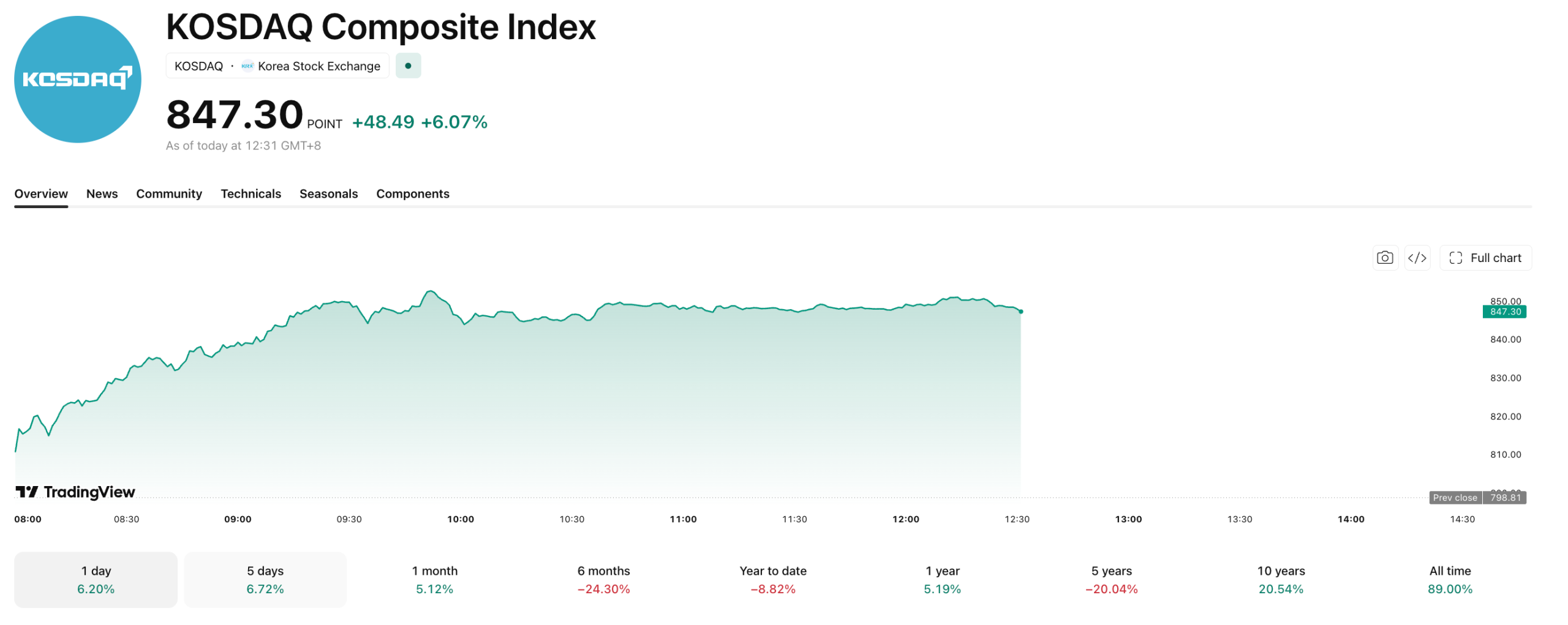
South Korea’s financial regulators wanted to calm a volatile stock market as they cracked down on leveraged ETFs. However, they have made it more chaotic instead.
Crackdowns on leveraged ETFs tied to Samsung Electronics and SK Hynix, which required retail investors to post higher cash deposits, did not cool speculation. Retail money rotated en masse into Kosdaq small caps, which have now surged 30% from their July 30 low.
How Restricting Chip ETFs Sparked a Kosdaq Surge
The Kosdaq index jumped 6.8% on Monday alone, enough to trigger a Korea Exchange program trading halt for the third time this month.

Park Wooyeol, a global ETF analyst at Shinhan Securities, described the shift plainly. “We are seeing more money flow to Kosdaq, particularly today,” he said. “Volatility-loving retail investors who have moved to the single-stock leveraged ETFs are expected to make a comeback to the Kosdaq.”
An AI-driven selloff had already sent the Kospi plunging nearly 40% from its June peak to a late-July low, triggering forced liquidations and unwinding billions in margin loans. BeInCrypto reported that the SK Hynix leveraged ETF collapsed 45%, with regulators admitting the products had amplified market swings.
When authorities then tightened cash deposit requirements, they did not account for where that speculative energy would flow next.
Kosdaq vs Kospi: Best Divergence Since the Year 2000
The Kosdaq surged last week while the Kospi slipped. The small-cap gauge is now on track to outperform the benchmark by its widest gap since the dot-com era.

Korea’s retail investors have a well-documented appetite for high-volatility trades that has shaped even its crypto markets, and BeInCrypto found that Bitcoin was posting lower volatility than the Kospi at the height of the AI selloff.
The traders now flooding into small caps are the same cohort that drove the chip ETF boom. Regulators remain one step behind.
Whether the Kosdaq rally has genuine legs depends on whether Korea’s AI selloff has truly bottomed. If this is just another venue for the same speculative cycle, the circuit breakers will keep tripping.
The post South Korea’s Regulators Accidentally Triggered a 30% Small-Cap Rally appeared first on BeInCrypto.

Tributes to Cambridge hospital volunteer among death and funeral notices

BlackRock TCP Capital: Upgrading To Hold – The Portfolio Sale Changes The Thesis
Another Big Macro Week Is Here: 3 Events That Could Move Bitcoin


-

 Fashion3 days ago
Frugal Friday’s Workwear Report: Cap-Sleeve Pointelle Crewneck Sweater
-

 Fashion3 days ago
Weekend Open Thread: Mattifying Sunscreen
-

 Sports4 days ago
Jordan Coyle & Cordiamo take Laya Arena Stakes at RDS
-
 Business4 days ago
US stocks: Dow closes at record on Mideast optimism; SpaceX, AMD drag Nasdaq
-

 News Videos2 days ago
Can Astrology Help Find Gold and Silver Trends? A Financial Astrology Guide
-
 Crypto World6 days ago
US Tech Stocks See Largest 5-Week Inflow in History: Can Nasdaq Break Its Downtrend?
-

 Politics4 days ago
Reform UK And Greens Sink To Lowest Favourability Ratings To Date
-

 Business5 days ago
Nvidia Stock Climbs 2.5% as Chip Sector Rally Builds Ahead of AMD Earnings, Nvidia’s Own Report Looms
-

 Crypto World6 days ago
Polymarket targets $20 billion valuation as competition heats up in prediction market sector
-

 Tech5 days ago
OpenAI, Anthropic AI agents targeted real people and systems in cyber tests
-

 Business4 days ago
Supply chain issues impact Ingredion
-
 Crypto World6 days ago
CLARITY Act Senate Vote Locked In, But 60-Vote Hurdle Looms Large
-

 Tech2 days ago
Rinn Pharma & Biopharma to join NordicPharmaTrain network
-

 Crypto World6 days ago
The Senate has one week: CLARITY’s last August window
-
 Crypto World6 days ago
California Wildfire Bets Expose Polymarket’s Dark Side
-
 Crypto World5 days ago
Dow and S&P 500 Hit Records on AI Earnings: When Will the Bubble Burst?
-

 Business19 hours ago
Datadog: Best Of Breed For Multiple Reasons
-

 Business5 days ago
McDonald’s (MCD) Q2 2026 earnings
-

 Business6 days ago
CNH Industrial Shares Jump Over 15% After Beating Estimates and Raising Full-Year Earnings Guidance
-
 Tech6 days ago
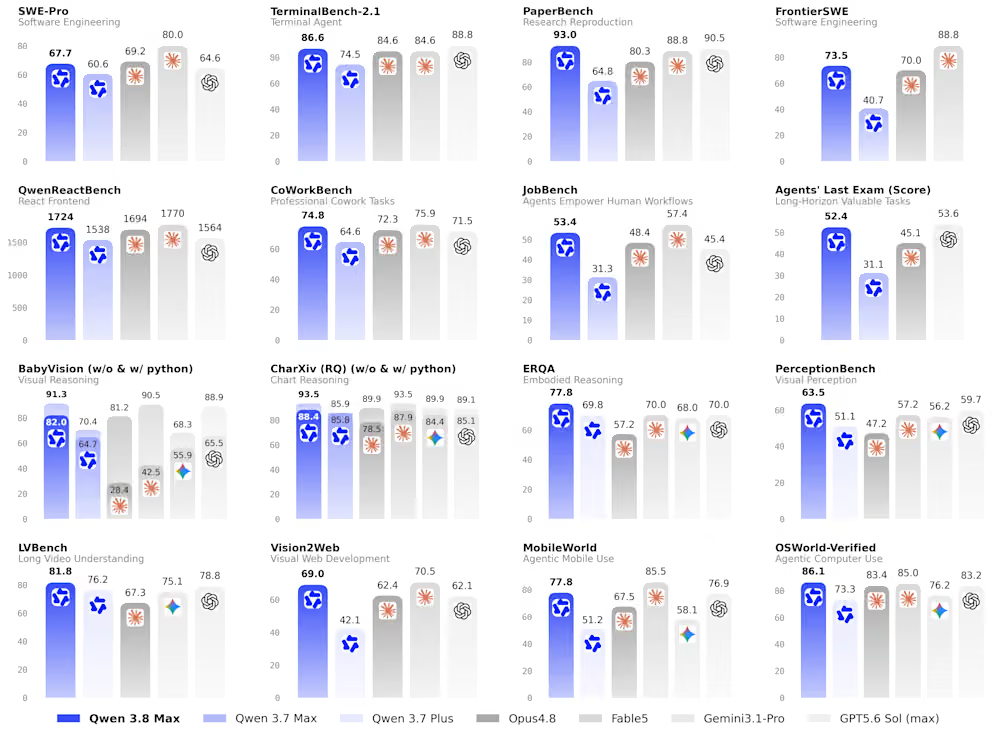
Qwen3.8-Max arrives with a bold claim: it outperforms GPT-5.6 Sol Max and Fable 5 on agentic computer use
You must be logged in to post a comment Login