

Crypto World
AWS Northern Virginia data center overheats, impacting Coinbase


Coinbase said on Friday its markets are being placed in “cancel only” mode but will begin to re-enable trading “shortly.”


Key Highlights
- IREN shares climbed 27% following the disclosure of a major collaboration with Nvidia for deploying 5 gigawatts of AI infrastructure
- The chip giant received a five-year option to purchase up to 30 million IREN shares at $70 apiece, representing a possible $2.1 billion stake
- IREN’s Sweetwater facility in Texas (2 GW capacity) will function as the primary deployment location for Nvidia’s DSX platform
- Separately, IREN announced the acquisition of Ingenostrum (Nostrum Group), a Spain-based developer, establishing its European presence
- The Spanish acquisition contributes 490 megawatts of grid-secured power capacity, elevating IREN’s combined portfolio to 5 gigawatts
Shares of IREN Limited (IREN) surged 27% during after-hours trading on May 7 following the simultaneous release of two significant corporate developments.
The company unveiled a strategic alliance with Nvidia (NVDA) focused on rolling out up to 5 gigawatts of AI-focused infrastructure. Concurrently, IREN disclosed plans to purchase Ingenostrum, a data center development firm based in Spain, alternatively known as Nostrum Group.
Prior to these announcements, IREN shares were hovering near $56. The after-hours surge drove the stock substantially higher, demonstrating strong investor enthusiasm for both initiatives.
The collaboration with Nvidia revolves around implementing Nvidia’s DSX-optimized accelerated computing infrastructure throughout IREN’s worldwide data center network. The partnership encompasses compute resources, networking systems, software platforms, power management, and operational coordination.
A significant portion of this development will take place at IREN’s Sweetwater facility in West Texas. With a total capacity of 2 gigawatts, this location is positioned to become the flagship demonstration site for Nvidia’s DSX AI factory architecture.
Jensen Huang, Nvidia’s founder and CEO, emphasized that AI factories are emerging as critical infrastructure for the worldwide economy, noting that IREN possesses both the scale and technical capability required to expedite this expansion.
Under the agreement’s terms, IREN provided Nvidia with a five-year warrant to acquire up to 30 million IREN shares priced at $70 each. This amounts to a potential $2.1 billion commitment, contingent upon regulatory clearances and additional stipulations.
IREN Establishes European Foothold
Simultaneously, IREN revealed its agreement to purchase Ingenostrum, S.L., a data center development company headquartered in Spain. This transaction represents IREN’s inaugural expansion into European territory.
The acquisition delivers 490 megawatts of secured, grid-integrated power capacity in Spain, alongside an active development pipeline and an experienced local workforce specializing in engineering, construction, and facility management.
Following this transaction, IREN’s aggregate power capacity reaches 5 gigawatts spanning its international operations. The deal remains pending customary closing requirements.
Analyst Perspectives
Financial analysts have maintained an optimistic outlook on IREN leading up to these announcements. The stock holds a Strong Buy consensus rating derived from six Buy recommendations and one Hold rating issued by analysts during the previous three months.
The consensus price target among analysts stands at $78.43, suggesting approximately 39% appreciation potential from pre-announcement trading levels.
The dual impact of the Nvidia collaboration and the European acquisition provides IREN with expanded power infrastructure and a more defined strategy for scaling its AI Cloud offerings across diverse geographic markets.
IREN’s two-gigawatt Sweetwater campus in Texas continues to anchor its immediate strategic priorities, and the facility now benefits from a prominent technology partner in Nvidia to facilitate full-scale deployment.



Zoomex hosted a two-part X Space around its “Speed You Can Trust” theme, bringing Formula 1 and crypto trading into one conversation. Fernando Lillo, Marketing Director at Zoomex Exchange, led the sessions with Haas F1 Team driver Ollie Bearman, CryptoRover, and WallStreetBets.
The discussion centered on performance under pressure. Racing and trading both demand fast decisions, discipline, and trust in a plan.
Across both sessions, one idea kept returning. Speed creates openings, while consistency keeps people in the game long enough to use them.
Formula 1 and Crypto Trading Meet Under Pressure
Lillo opened the Space by connecting Formula 1 and crypto trading through pressure, speed, and decision-making. Both fields require fast reactions, but the speakers kept returning to discipline as the real test.
CryptoRover brought the F1 comparison to life through his experience at the Shanghai GP, where he watched the race from the pit box.
“It was pretty insane to see the F1 race from there. We were watching it from the pit box, and that is the closest you can come to an F1 race,” he said. “We were seeing how the team reacted and the strategy they had.”
For CryptoRover, the same applies to trading. Fast reactions help, but long-term survival depends on consistency across different market cycles.
“You can be profitable in bull markets, but if you are not profitable in bear markets, you are never going to survive,” he said. “Consistency is definitely key.”
He added that experience changes how traders respond to pressure.
“I have been trading for nine years, which is a very long time when I look back at it,” CryptoRover said. “You have to keep learning, improve, and have skin in the game.”
CryptoRover Says Consistency Keeps Traders Alive
When Lillo asked how traders should manage market crashes, CryptoRover’s answer was risk control.
“Trading crashes comes down to having stop losses,” he said. “It is simple. Have a stop loss.”
He called the advice common but essential, especially in volatile markets where one bad position can erase an account.
“You need a stop loss. Otherwise, you face major liquidations,” CryptoRover said.
He also warned traders against trying to recover losses too quickly after a sharp drawdown.
“Be careful with revenge trading,” he said. “A lot of people got wrecked on October 10 when they started going long again while the dip kept dipping.”
CryptoRover acknowledged that experienced traders can treat stop losses as basic discipline, while newer traders often learn the lesson through painful losses.
“When you have been trading for nine years, having a stop loss feels like the most normal thing you can think about,” he said. “But people still need to learn it. Having a stop loss is crucial because it saves you from being liquidated.”
WallStreetBets Says Trading Is a Game of Emotions
WallStreetBets supported CryptoRover’s view, but placed more focus on psychology. He said traders often damage their own consistency by chasing fast gains.
“Everybody wants to get rich quick in this day and age,” he said. “That is very much because of social media and the things we are always digesting.”
He argued that traders lose control when they take on too much risk too fast.
“When they swing too big, too fast, they end up striking out,” WallStreetBets said. “Trading is a game of emotions. It is a game of being able to control your emotions and see things objectively.”
In his view, emotional control affects consistency because a trader can only keep improving if the account survives.
“Without controlling your emotions, you can get out of whack really quickly,” he said. “That affects people’s consistency because even if they wanted to show up every day, they could not, because they blew their account.”
His advice was to reduce the size of each step and build progress over time.
“If we take smaller steps and keep getting better one percent every day, we make more progress,” he said. “We should avoid risking it all on one trade.”
He closed the point with a long-term view.
“I definitely think consistency is underrated,” WallStreetBets said. “We all need to adopt a more long-term mindset.”
Ollie Bearman Sees Speed and Consistency as a 50/50 Balance
When Bearman joined the second session from Miami, Lillo asked him to choose between speed and consistency. Bearman treated both as equally important in Formula 1.
“Both of them are very important factors in Formula 1,” Bearman said. “Speed is the number one tool we use to measure drivers and ourselves. We are always competing against the clock, so speed is step one.”
At the same time, he said repeatable performance decides the strength of a season.
“Consistency is very important if you want to build a strong championship campaign, fight for a championship, or even fight for a good position,” Bearman said.
He added that single-race speed has limited value without repeatability.
“You need to be consistent because speed is one thing,” he said. “If you only have that speed for one or two races of the year, then it does not count for much.”
Bearman summed up his answer with a simple split.
“I think it is 50/50, and both of them are incredibly important,” he said.
Preparation Comes Before Instinct
Bearman also explained how drivers manage race conditions. Preparation gives a driver a base, but the race still creates situations no driver can fully predict in advance.
“You do as much preparation as you can before you drive,” Bearman said. “But in the end, you cannot be prepared for every situation.”
When unexpected moments arrive, drivers need to trust their instincts.
“There are often things that come up which you are not ready for,” he said. “In that case, you need to rely on your talent, your instincts, and the correct instincts to do well.”
For Bearman, consistency also depends on the driver’s mindset and confidence in the car.
“Good consistency comes down to the hard work away from the track, your mental state, and your feeling within the car,” he said. “If you feel confident with the car underneath you, it is much easier to be consistent.”
The same idea fits the trading side of the discussion. A trader can prepare a plan before volatility hits, but still needs judgment when the market moves against expectations.
The Lesson From the Zoomex Space
The Zoomex Space brought the F1 and crypto trading comparison into a simple conclusion. Speed opens opportunities, while consistency helps people stay ready to act without losing control.
CryptoRover focused on survival through stop losses, risk control, and avoiding revenge trading. WallStreetBets focused on emotional discipline and smaller steps. Bearman showed how F1 demands both raw pace and repeatable execution across a season.
The strongest takeaway came from the overlap between all three perspectives. Pressure rewards preparation. In racing and trading, fast decisions work best when they come from a plan built before the moment arrives.
The post Zoomex X Space Recap With Ollie Bearman and Crypto KOLs appeared first on BeInCrypto.
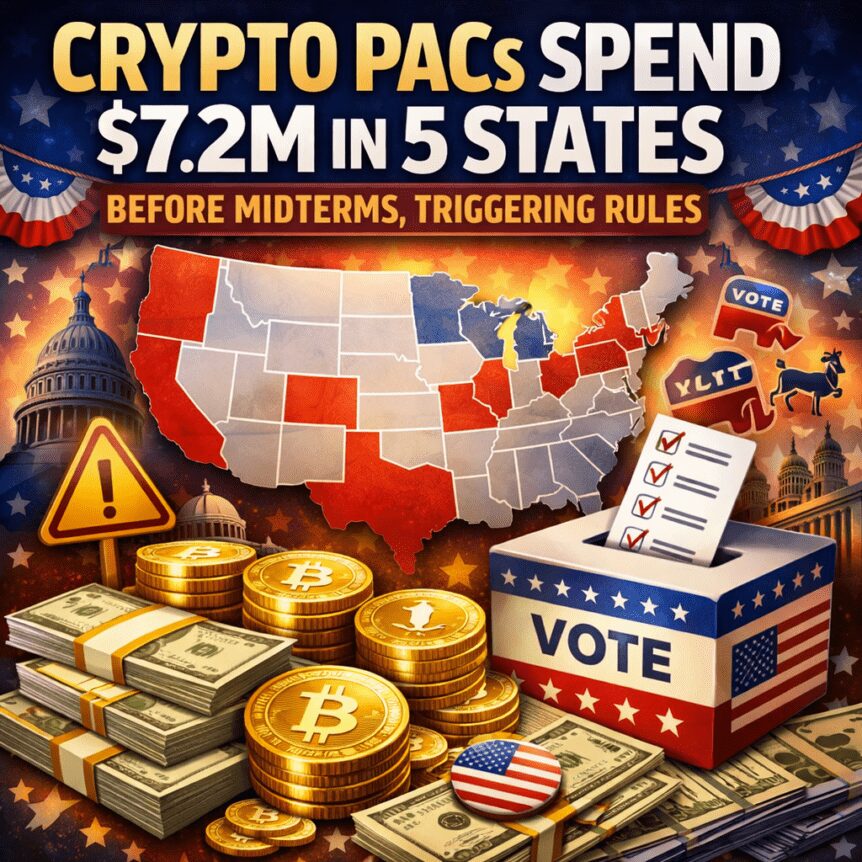
Crypto-backed political action committees have escalated their spending as the 2026 midterm cycle approaches, with new Federal Election Commission filings showing multi-million dollar media buys aimed at shaping several congressional contests. The activity underscores how industry-affiliated groups intend to influence policy discussions around digital assets as lawmakers prepare to consider a slate of crypto-related legislation and regulatory proposals.
According to filings with the Federal Election Commission this week, the Protect Progress PAC, an affiliate of Fairshake, reported roughly $1.6 million in expenditures supporting two Democratic candidates: Jasmine Clark in Georgia’s 13th Congressional District and Christian Menefee in Texas’s 18th District. Clark faces a May 19 Democratic primary, while Menefee’s path includes a May 26 runoff against Representative Al Green. Protect Progress also asserted that Green has been “actively hostile towards a growing Texas crypto community,” pledging to spend about $1.5 million to oppose his reelection.
Protect Progress is part of a broader Fairshake ecosystem that typically channels support to Democratic candidates, while another affiliate, Defend American Jobs, backs Republican candidates. The Defend American Jobs PAC reported about $5.6 million in expenditures on candidates across Georgia’s 1st and 14th districts, Nebraska’s 3rd district, and United States Senate races in Alabama and Kentucky. These figures emerge as several state primaries unfold in May and as the midterm landscape evolves around crypto policy and political forensics.
Within Defend American Jobs’ activity, Kentucky Senator Andy Barr emerged as a principal beneficiary, receiving more than $3.5 million in media support. Barr has been a vocal advocate for pro-cryptocurrency policies in Congress, including backing for the GENIUS Act and the CLARITY Act. In Indiana, Defend American Jobs directed approximately $514,000 toward advertising in support of Republican James Baird’s reelection bid. The filings reflect a broader pattern of targeted media buys aligned with the group’s policy priorities.
Fairshake, which reported holding $193 million in cash and other assets as of January, has already deployed significant sums in the 2026 primaries in an effort to shape political outcomes. In its broader online ecosystem, the group has included coverage of races in Texas and Illinois, among others, with a stream of media spending designed to influence voters and potentially shift the balance of power on crypto-related policy issues.
Key takeaways
- Protect Progress PAC disclosed roughly $1.6 million in expenditures supporting Jasmine Clark (GA-13) and Christian Menefee (TX-18), with a separate pledge to spend about $1.5 million opposing Rep. Al Green in Texas.
- Defend American Jobs reported approximately $5.6 million in spending across Georgia’s 1st and 14th districts, Nebraska’s 3rd district, and Alabama and Kentucky Senate contests, illustrating a broad national focus.
- Kentucky Senator Andy Barr received more than $3.5 million in media support through Defend American Jobs, reflecting the group’s investment in pro-crypto policy champions who have backed bills like the GENIUS Act and CLARITY Act.
- Indiana’s James Baird reelection bid drew about $514,000 in Defend American Jobs advertising money, highlighting targeted regional focus within the broader national strategy.
- Fairshake’s cash position and historical spending suggest continued climate-shaping activity ahead of 2026 primary dates, reinforcing the link between industry advocacy and policy outcomes.
Crypto policy trajectory and the electoral calculus
The spending arc described above arrives at a moment when lawmakers are closely watching the policy arc around digital-asset market structure and regulation. The CLARITY Act, which aims to clarify the treatment of digital assets for tax, securities, and commodities purposes, has been a touchstone for crypto-friendly policymakers and industry groups seeking clearer regulatory guardrails. Observers say the act’s fate in Congress could serve as a litmus test for the 2026 midterm landscape, given the potential political credit or risk tied to concrete policy commitments on innovation, consumer protection, and financial stability.
According to industry commentary and coverage surrounding these developments, the faith placed in policy outcomes by crypto advocates translates into a broader media and messaging strategy designed to influence voters’ perceptions of candidates’ crypto platforms. The extent of spending by Fairshake and its affiliates signals a view that regulatory clarity and favorable policy alignment could meaningfully affect the sector’s growth, investment, and banking relationships at a time when compliant access to financial rails remains a priority for many firms.
In regulatory terms, some progress has emerged on related questions. Last week, Senate lawmakers disclosed a compromise on stablecoin yield structures that could open a path for CLARITY Act considerations to progress toward markup in the Senate Banking Committee. While the committee had not scheduled a markup as of the latest briefing, the development signals a potential shift toward advancing crypto-regulatory legislation in a framework that includes banking-sector safeguards and consumer protections. This dynamic sits within a broader U.S. policy environment where enforcement, licensing, AML/KYC obligations, and cross-border compliance continue to shape corporate strategies for exchanges, lenders, and asset managers.
For observers tracking cross-border policy, the contrast with the European Union’s MiCA framework remains salient. While MiCA offers a centralized, rules-based approach to crypto assets and crypto-asset service providers within the EU, U.S. policy has tended to emphasize a mosaic of sector-specific bills, agency enforcement actions, and targeted regulatory updates. The ongoing debate over market structure, asset classification, and stablecoin regulation underscores how directional policy signals—whether through committee markups, public statements, or campaign-era messaging—can influence corporate risk assessments and licensing trajectories for crypto firms seeking to operate across multiple jurisdictions.
From an institutional and compliance perspective, the current landscape underscores several practical considerations. Banks and payment infrastructure providers watch congressional activity closely, given AML/KYC requirements, liquidity risk, and the need for robust due diligence around asset issuers and trading platforms. A clearer, more durable framework could facilitate more predictable onboarding of crypto entities into regulated banking channels, while ambiguity could prolong suspense over licensing and correspondent relationships. In this context, the political spending described above is not merely a headline—it reflects a strategic effort to shape the policy environment in which risk controls, disclosure regimes, and enforcement priorities are set.
Regulatory context, enforcement, and policy implications
As lawmakers deliberate the balance between fostering innovation and safeguarding markets, the activity of Fairshake-affiliated PACs highlights how industry participants translate policy positions into political leverage. The protection of investor interests, the safeguarding of consumer funds, and the integrity of market infrastructure all depend on a coherent regulatory path. The sector’s visibility in high-profile races raises questions about transparency, campaign finance disclosure, and the potential for policy commitments to factor into investment and risk management decisions by institutions, fund managers, and financial partners.
Looking ahead, watchdogs and compliance teams will be assessing not only the policy outcomes but also the procedural integrity of campaign finance disclosures and the way those disclosures intersect with corporate governance. Regulatory filings—paired with legislative developments and enforcement signals from the SEC, CFTC, and DOJ—will help determine the practical implications for licensing, stablecoin operations, custody, and the broader banking interface for crypto firms.
In the broader policy discourse, observers note the importance of ongoing clarity around asset classification, stablecoin stability mechanisms, and the treatment of revenue, taxation, and liquidity provisioning in digital-asset markets. The path forward will likely hinge on a combination of committee activity, executive guidance, and market readiness to integrate compliant, interoperable solutions with traditional financial rails. The interplay between campaign-driven policy advocacy and formal regulatory action will continue to shape the near-term risk and opportunity calculus for institutions operating in this space.
Note: This report incorporates data from Federal Election Commission filings and related reporting, with contextual reference to coverage from industry media. For further framing on related policy debates and governance considerations, readers can consult coverage of crypto PAC activity and legislative developments as they unfold.
What to watch next: committee schedules for CLARITY Act markup, the evolution of stablecoin yield policy, and the unfolding impact of campaign finance disclosures on regulatory risk assessments for crypto firms and their banking counterparts.
Key Takeaways
- Tom Lee declares the crypto bear market finished based on Bitcoin’s three consecutive monthly gains
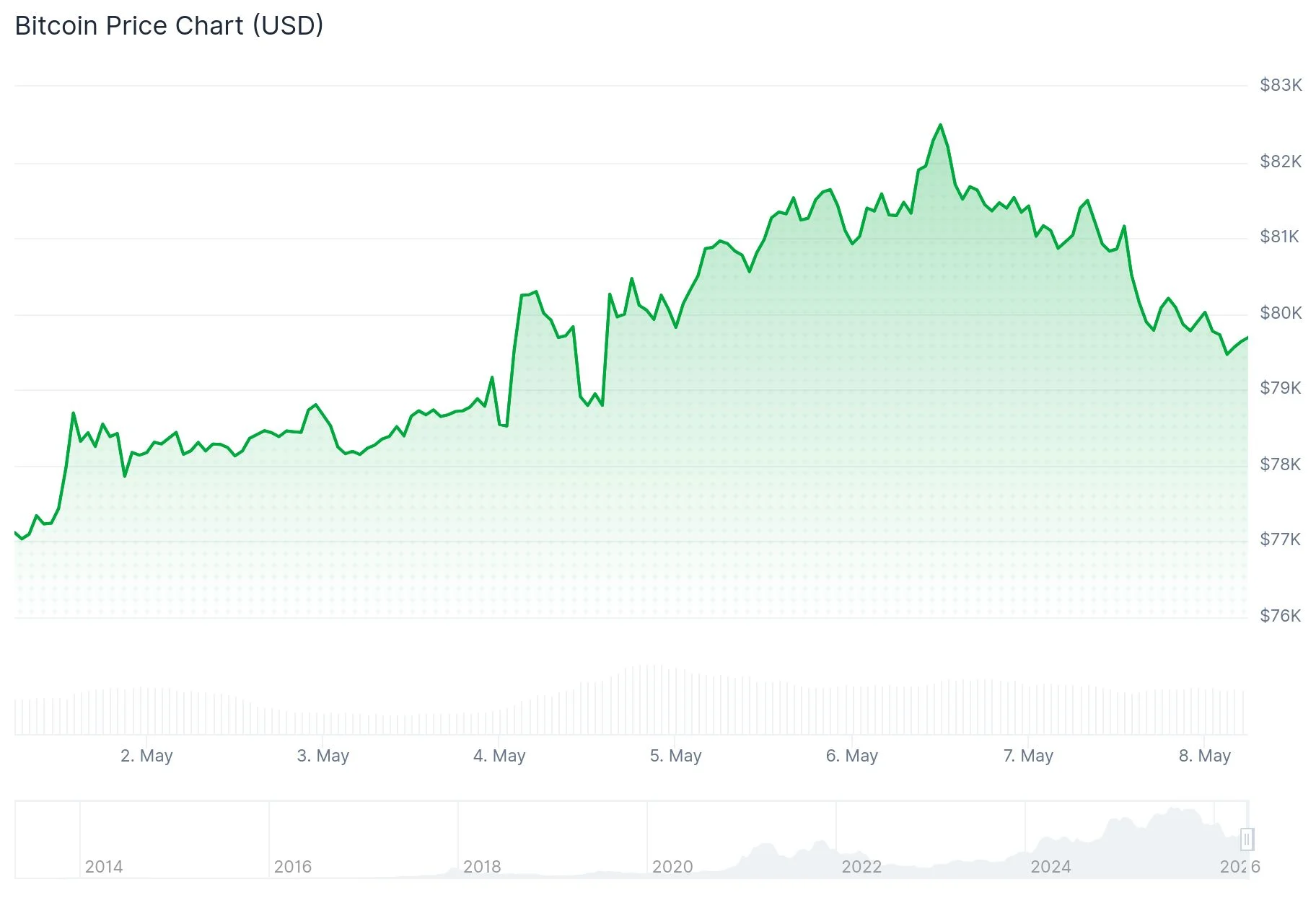
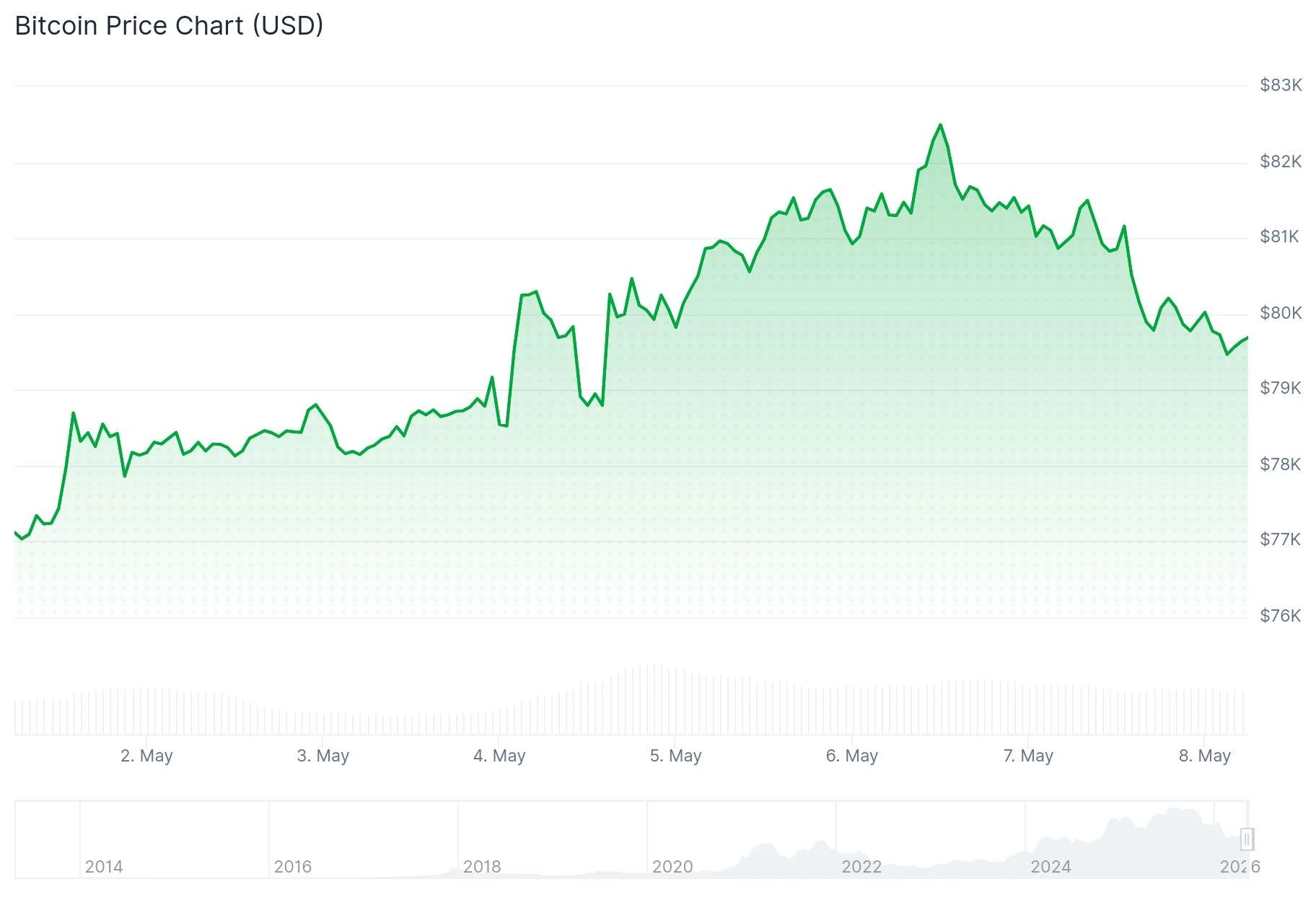
- Bitcoin has risen approximately 5% in May after positive March and April closes; now trading around $80,000
- AI agents and tokenization identified as primary catalysts for upcoming bull cycle
- Stablecoin transaction volumes now exceed Visa payment networks, according to Lee
- Lee forecasts 2027 may bring “one of the biggest rallies we see in our lifetime”
Tom Lee, Fundstrat’s co-founder and Bitmine’s chairman, declared at Consensus 2026 in Miami on May 7 that the cryptocurrency bear market has concluded.
Lee established a specific threshold: should Bitcoin finish May trading above $76,000, marking three consecutive positive monthly closes, the downward trend has definitively ended. “You have never in a bear market if bitcoin closes up three consecutive months,” Lee stated.
According to the CoinDesk Bitcoin Price Index, Bitcoin concluded April at $76,300. Currently, BTC hovers just under $80,000, representing approximately 20% growth over the last month.
Lee’s assessment received support from legendary technical analyst John Bollinger, the inventor of Bollinger Bands. Bollinger announced via X that his trend model for Bitcoin had flipped bullish and his Tactica program had gone fully invested. Lee reshared Bollinger’s post with a straightforward message: “Crypto spring is here.”
Lee characterized the recent decline from $126,000 in October to $60,000 in February as the bearish phase. He contends that market participants remain mentally tethered to that correction and are failing to recognize the strength of the ongoing recovery.
Tokenization and AI Leading Next Bull Run
Lee identified two fundamental forces that will propel the upcoming bull market: the tokenization of real-world assets and AI agents leveraging blockchain infrastructure for autonomous financial transactions.
He highlighted stablecoin adoption as evidence this transformation is underway. Transaction volumes for stablecoins have already eclipsed Visa’s payment network, Lee noted. Research from Grayscale indicates the $300 trillion global securities market could eventually transition onto blockchain platforms as tokenized instruments.
“The networks that host a large share of tokenized activity are going to capture the economic value,” Lee emphasized.
Traditional Finance Versus Crypto-Native Operations
Lee drew comparisons between JPMorgan, expected to generate approximately $60 billion in earnings this year with 300,000 employees, and entities like Tether and Jane Street, which produce comparable profits with significantly smaller workforces.
He explained that crypto-native enterprises remove numerous conventional financial intermediaries. “In 10 years, half of the largest financial institutions in the world will be native digital,” Lee projected.
During a CNBC appearance, Lee also connected cryptocurrency strength to AI-fueled stock market gains, robust corporate earnings reports, and substantial capital remaining uninvested.
He recognized potential headwinds, including uncertainty surrounding the next Federal Reserve chair appointment and global oil supply vulnerabilities.
Lee reaffirmed his previous forecast that Bitcoin could achieve $250,000 this year if it establishes a new all-time high. Bitcoin’s current valuation stands near $79,245.

TLDR:
- Sei Labs requires all exchanges to complete SEI EVM migration by June 15, 2026, or face fund loss.
- Every native sei1… address already has a paired EVM 0x… address on the same Sei blockchain.
- Four migration paths exist, ranging from automated smart contracts to fully manual fund transfers.
- After deprecation, Cosmos RPC endpoints and address associations will be permanently unavailable.
Sei Labs has announced a firm deadline for exchanges and custodians holding SEI tokens. The protocol is completing its transition to a unified, EVM-only architecture.
All platforms must migrate customer holdings from native Cosmos addresses to EVM addresses before June 15, 2026.
After that date, Cosmos and IBC-related functionality will be deprecated permanently. This move affects any service provider currently supporting SEI token deposits and withdrawals using native sei1… addresses.
What the Sei EVM Migration Means for Exchanges
Sei EVM is not a separate blockchain from the Sei network. It is the same chain with a second method of interaction.
Any integration currently treating both as distinct chains must be consolidated before the Cosmos shutdown. Exchanges operating under a split integration model need to act quickly.
Every native sei1… address has a corresponding EVM 0x… address on the same chain. The pairing exists at the keypair level and does not require any funds to move.
Exchanges need to derive or look up the EVM address for each native wallet under management. They must also ensure addresses are associated on-chain before the deprecation date.
Sei Labs stated on X: “The core thing exchanges and custodians need to know: Sei EVM is not a separate chain. It’s the same chain with a second way to interact with it.”
After June 15, 2026, Cosmos-native transaction interfaces will no longer be available. Exchanges will not be able to broadcast Cosmos-format transactions or interact via Cosmos RPC endpoints.
Address associations will also no longer be creatable through a Cosmos wallet. The FundsForwarder pattern will stop functioning for new deposits as well.
Four Migration Paths Available to Custodians
Sei Labs has outlined four upgrade paths for exchanges and custodians to follow. The first involves combining native and EVM access points, which is the cleanest option available.
The exchange surfaces the EVM address corresponding to each existing native wallet directly to customers. No funds need to move, and no customer action is required.
The second option involves an automated forwarding contract deployed by the exchange. The FundsForwarder smart contract moves customer funds from the native side to the EVM wallet automatically.
The contract was audited by OtterSec and has a fixed destination address. That destination cannot be changed after deployment.
The third path is a user-directed forwarding contract, where customers initiate the transfer themselves. This triggers the contract to forward funds to the appropriate EVM wallet on the exchange.
It suits exchanges that cannot operate the contract directly. However, it still provides customers with an automated destination.
The fourth option is a fully manual transfer, requiring customers to withdraw and redeposit funds. Exchanges notify customers to move holdings to a self-custodial wallet first.
Customers then redeposit to the new EVM address provided by the exchange. Sei Labs confirmed the June 15 deadline is firm, and address association must be completed before deprecation.
Aptos Foundation and Aptos Labs have committed more than $50 million to grow the Aptos ecosystem.
Summary
- Aptos Foundation and Labs committed $50 million to support trading, AI agents, research, and protocol infrastructure.
- Decibel and Shelby sit at the center of Aptos’ plan for markets, data, and agents.
- Crypto firms are racing into AI payments as stablecoin tools gain adoption across agents.
The funding will cover first-party products, research, protocol infrastructure, and a strategic fund for trading and AI partners.
The plan centers on markets and autonomous systems that can transact at machine speed. Aptos said it is building for AI agents that can operate without human checks, using fast settlement and low-cost blockchain infrastructure.
Decibel and Shelby lead the plan
Decibel is one of the main products in the plan. It is an onchain order book and perpetuals exchange that went live on Aptos mainnet in February. Aptos said Decibel has crossed $1 billion in cumulative volume.
Shelby is the other key product. Aptos describes it as a storage protocol for data-heavy workloads, including AI agents. The network said data could become the next major agentic workload as agents license, exchange, and trade datasets.
Moreover, Aptos is moving as more crypto firms build payment rails for AI agents. Crypto.news recently reported that Coinbase launched Agentic.market, where AI agents can find services and pay with USDC through x402. That report said x402 had settled about 165 million transactions across more than 480,000 agents.
Other projects are also testing agent payments. Oobit launched Visa-backed Agent Cards that allow AI agents to spend USDT under business controls. As previously reported, Solana and Google Cloud also launched Pay.sh, which lets agents pay for API services using stablecoins.
APT gets a central role
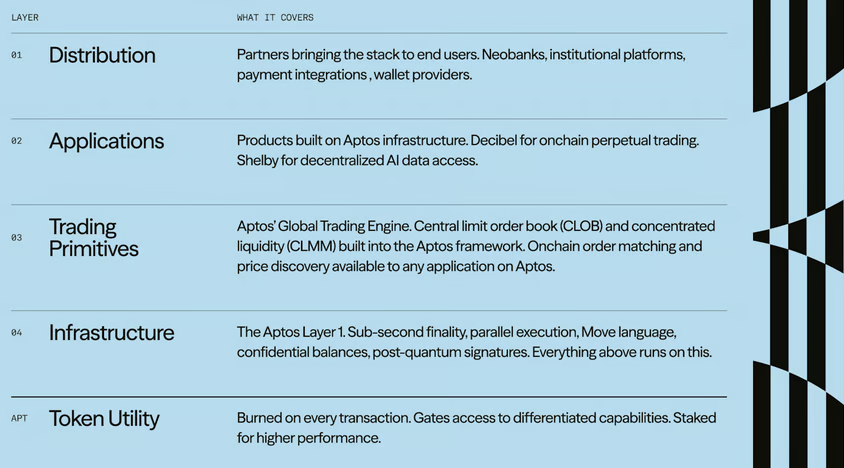
Aptos said APT will remain tied to network use. The token is burned in transactions, used for access to advanced features, and staked to support higher performance for large workloads.
The network also said stablecoin market cap on Aptos has grown nearly tenfold since late 2024, reaching a peak of $1.93 billion. It added that real-world assets on Aptos have reached $1.2 billion, while major asset managers have already deployed on the network.
Aptos is also working on privacy features for institutional use. Recently, Aptos launched Confidential APT on April 24, adding concealed transfer data while keeping verifiability.
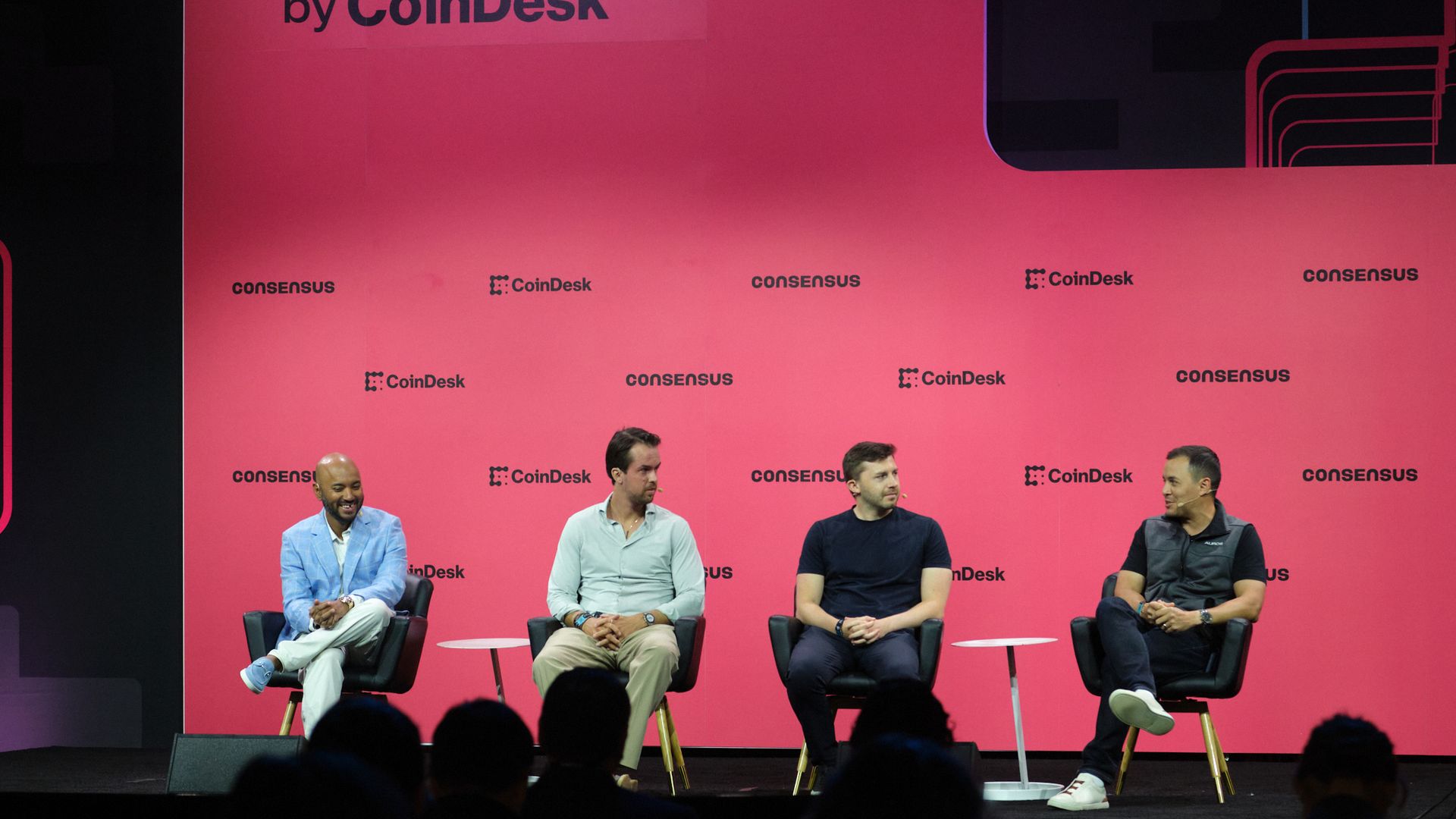
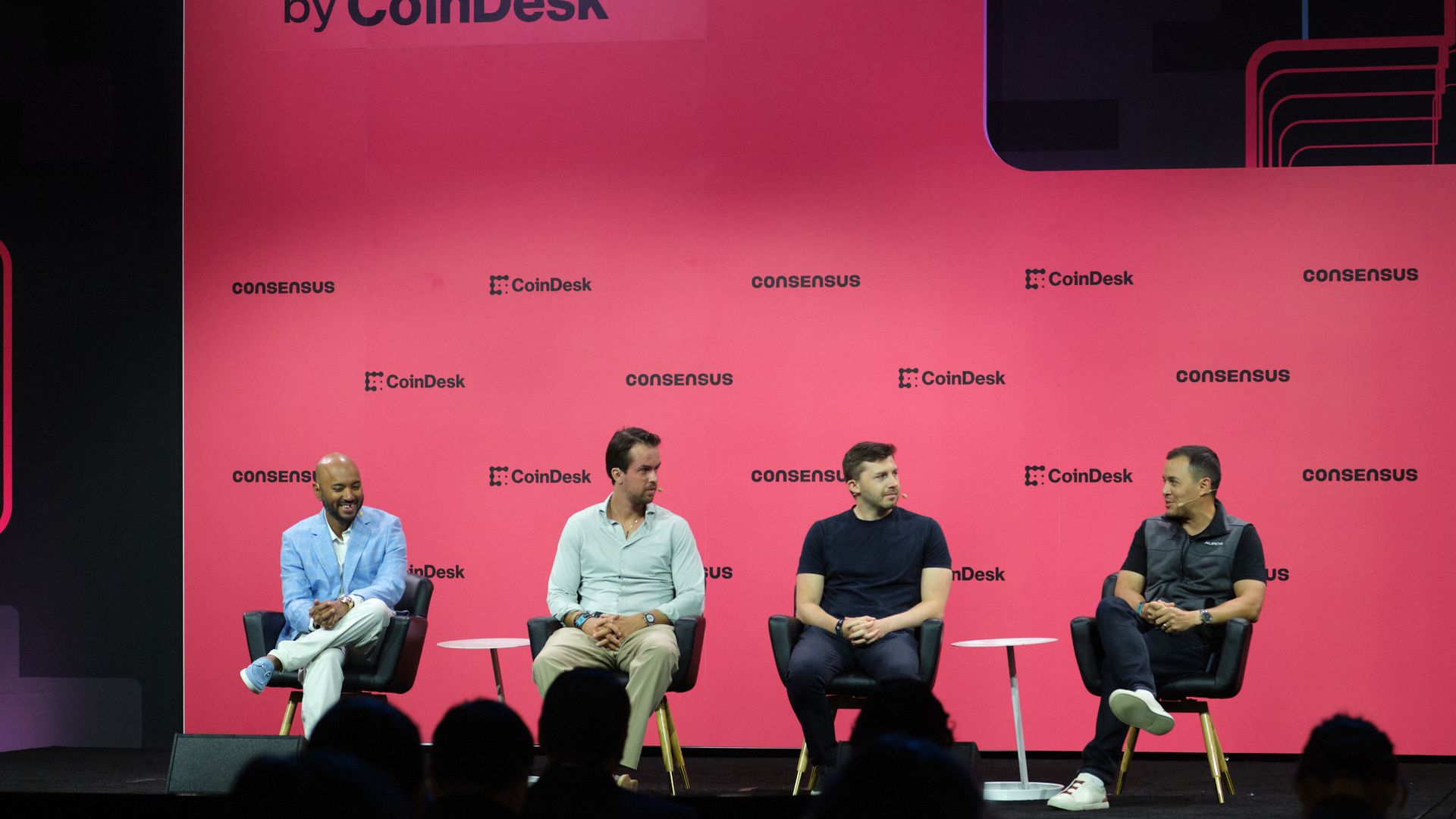
Institutional investors have increasingly gained exposure to bitcoin and other major tokens through ETFs and centralized exchanges.
However, they have largely stayed away from decentralized exchanges (DEXes) offering perpetual (perp) futures tied to crypto and tradfi assets, panelists said at Consensus Miami, citing security risks and a mismatch between DeFi’s permissionless design and institutional identity and compliance requirements.
The session titled “Perp DEX Explosion: Bullish Volumes & Bear Market Resilience” featured Wizard of SoHo, a veteran trader and family office manager; Michaël van de Poppe, founder and CIO of MN Fund & MN Capital; and Michael Anderson of Canary Labs. Jason Atkins, chief commercial officer at liquidity provider Auros, moderated the discussion.
The discussion focused on perpetual-focused decentralized exchanges and what it would take for them to attract institutional capital and scale up.
Wizard of SoHo said that institutions are unlikely to move onto perp DEXs easily due to recurring security/exploit risks highlighted by the recent multi-million-dollar hack of Drift, and that the next major competitive battleground for all perp DEXs will be whether any of them can safely onboard institutional capital.
“How do you convince the big institutional players to go on the perp devs? I think that’s going to be the biggest challenge, especially given the exploit on Drift. And, you know, we’ve had a lot of exploits lately,” he said.
Canary Labs’ Anderson struck a cautious tone on decentralized finance, saying he is reluctant to use it despite having explored parts of the ecosystem.
“I’m scared to use DeFi right now,” he said. “It does feel like a bit of a minefield, and you’re just waiting for the next headline each day.”
Anderson added that while activity has picked up in some areas, particularly from Asia amid tighter KYC enforcement on centralized exchanges, the overall environment still feels risky.
“Right now, it feels slightly dangerous on the product side,” he said.
Anderson argued that the risk perception makes it difficult to see large institutional players adopting decentralized exchanges at scale, especially compared with centralized platforms.
“I think it’s gonna be very difficult for some of the larger firms to use it on the institutional level, versus some of the centralized exchanges,” he said.
Anderson also pointed to product innovation gaps as another constraint, noting that centralized exchanges are increasingly integrating trading tools, such as bots, into futures markets. In contrast, decentralized exchanges have yet to match that pace of development.
KYC, or know-your-customer verification, is another key point of divergence. DeFi is built around open, permissionless participation, where users can interact without formal identity checks or traditional onboarding requirements.
Institutions, by contrast, operate under strict regulatory obligations and must meet full KYC and compliance standards, which makes that permissionless model difficult to adopt at scale.
“Crypto wants to be more non-KYC,” he said, “but to bring on institutional [players] you need to have some form of KYC at the larger size.”
The discussion also broadened into adjacent themes shaping market structure, including the rise of AI-driven trading tools and Hyperliquid’s dominance.
Michaël van de Poppe said AI agents are effectively an evolution of algorithmic trading, rather than a fundamentally new concept.
“To be honest, I think that AI agents are just the next level algorithmic trading anyways, so it’s just a little different execution,” he said. Responding to a moderator’s point about reduced human control in automated systems, he acknowledged the shift in oversight but argued the direction is inevitable.
“Yeah, there are some risks, but I think that at the end of the day, we are not going to be trading ourselves anymore. Nothing will be manual,” he said. “AI agents will be doing it for us, and they are probably better.”
van de Poppe added that the technology is still early and highly dependent on how it is deployed.
“If you start using those AI protocols or LLMs and you’re not putting in the right context or framework, it’s going to build a bad trader for you,” he said. “So if you are not a good trader, then it’s not going to build anything for you.”
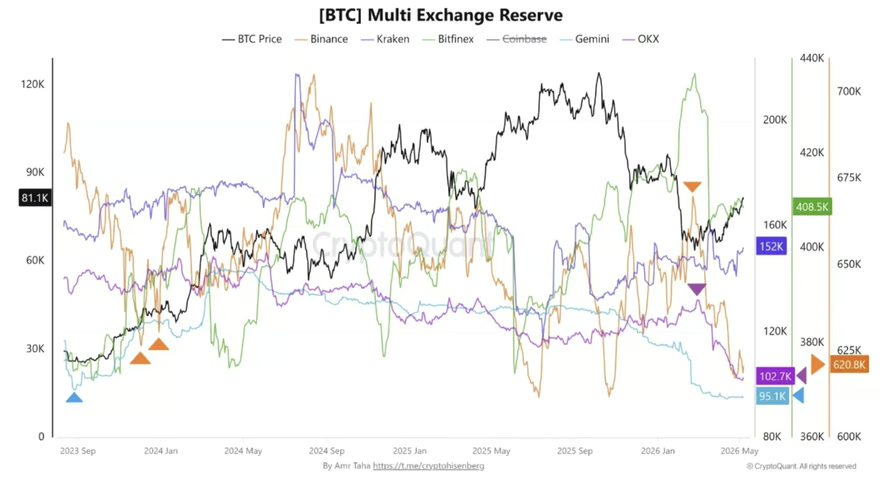
Bitcoin (BTC) reserves on major crypto exchanges have dropped to their lowest level since 2023, with nearly 100,000 BTC withdrawn from Binance, OKX and Gemini in less than three months.
The outflows coincided with stronger demand from accumulator addresses, as the cohorts’ holdings have increased by 60.5% over the past two weeks.
Bitcoin exchange reserves fall to two-year low
Crypto analyst Amr Taha noted that Bitcoin reserves on Binance, OKX and Gemini have declined sharply since February. Binance recorded the largest drawdown, with reserves dropping to nearly 620,000 BTC on May 7, down from roughly 670,000 BTC on Feb. 21. The decline pushed Binance’s holdings below levels last seen in December 2023.
OKX followed the same trend. Its Bitcoin reserve fell to around 102,000 BTC this week, from nearly 132,000 BTC on March 2. Gemini also posted steady outflows, sliding to 95,000 BTC from 114,800 BTC in early February.
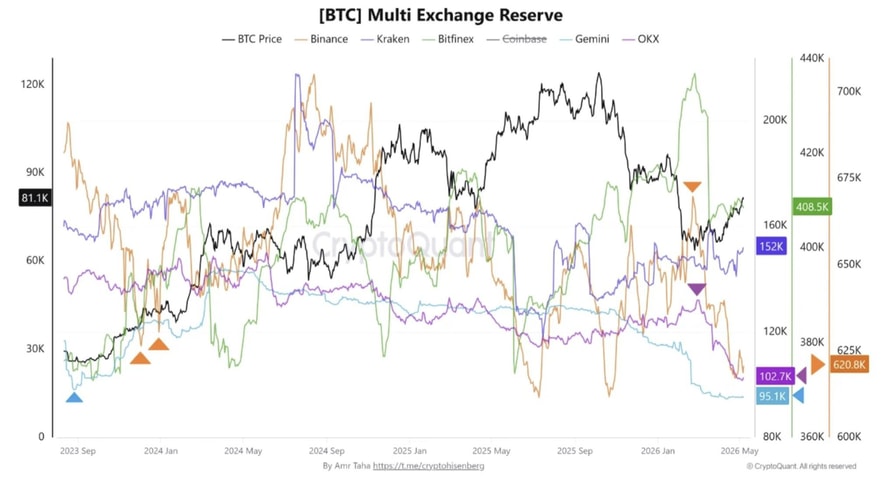
BTC multi-exchange reserves. Source: CryptoQuant
Combined, the three exchanges recorded an outflow of nearly 100,000 BTC, valued at over $8 billion at current prices.
Taha noted that a synchronized decline across multiple exchanges carries more weight than isolated outflows from a single exchange. Fewer coins on trading platforms can amplify the price reaction when strong spot demand returns.
The move coincides with a shrinking OTC balance. Lower OTC balances can reduce the amount of Bitcoin available for large private transactions outside exchanges.
The latest 30-day OTC balance change showed a net decline of 24,940 BTC, while the same metric had risen to nearly 25,300 BTC on Feb. 8 after Bitcoin’s drop toward $60,000. The reversal shows that OTC supply inflows have slowed significantly since the February sell-off.
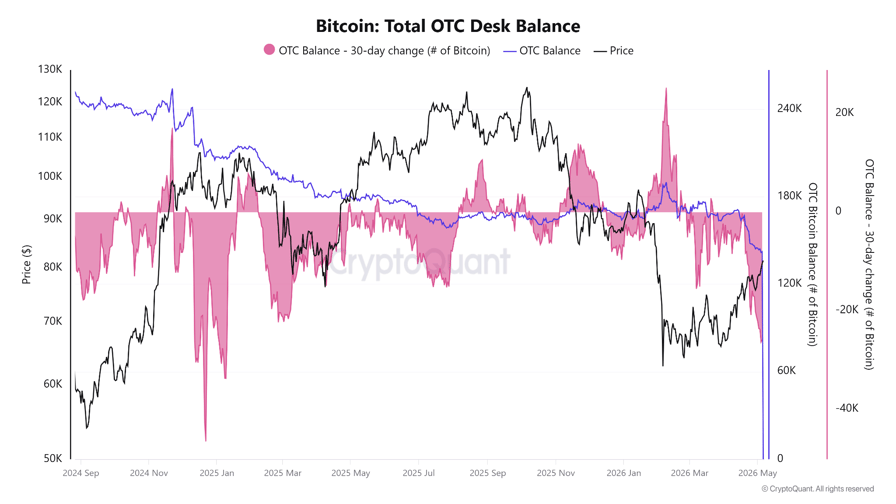
Bitcoin total OTC desk balance. Source: CryptoQuant
Related: Bitcoin Bollinger Bands push key breakout as creator acts on positive signal
“Accumulator” demand rises as Binance buyers turn positive
Long-term participants increased their Bitcoin accumulation during the latest recovery phase. CryptoQuant data shows demand from accumulator addresses climbed to 264,000 BTC on May 6, up from 164,440 BTC on April 23. The same metric fell to nearly 100,000 BTC on March 15, after peaking above 205,000 BTC on Feb. 5.
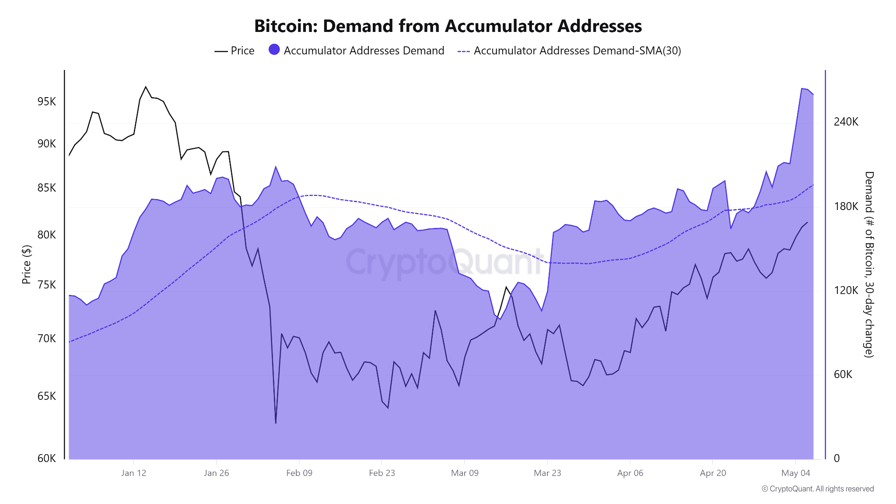
Bitcoin demand from accumulator addresses. Source: CryptoQuant
The increase in accumulation coincided with Bitcoin’s recovery toward $82,800, indicating stronger buying activity by long-term holders during the recent price advance.
Derivatives activity also strengthened during the recent rally. Binance’s seven-day net taker volume moved from approximately -$1 billion (seller-dominated) in late March to +$2.63 billion (buyer-dominated) on Thursday.
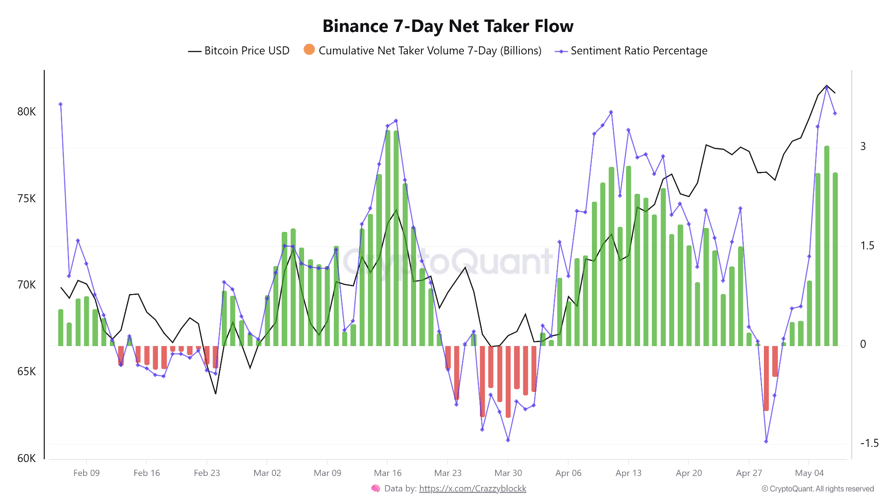
Binance’s seven-day net taker volume for BTC. Source: CryptoQuant
Related: VanEck’s Sigel sees Bitcoin reaching $1M within five years
Aptos Foundation and Aptos Labs have committed $50 million to Aptos development, with a particular focus on AI agent infrastructure and research, including support for two products it shipped last year to meet rising demand for onchain AI agent activity.
Those products include Decibel, an AI-powered onchain order book and perpetuals exchange that launched on the Aptos mainnet in February, and Shelby, a decentralized storage protocol that seeks to support the workloads of AI agents, the Aptos Foundation said on Thursday.
“Autonomous agents are already transacting onchain at frequencies no human can match, routing to whatever venue is fastest, most consistent, and least gameable,” it said.
Aptos joins a growing number of crypto protocols seeking opportunities in supporting the agentic AI economy. Aptos said there is a need to build infrastructure that offers sub-second finality and systems that “run 24/7 with no human to escalate to.”
AI agents can act as personal assistants for people, both at home and in the workplace, completing everyday tasks on their behalf, whether it be booking a flight, making a shopping purchase or executing a high-level trade onchain.
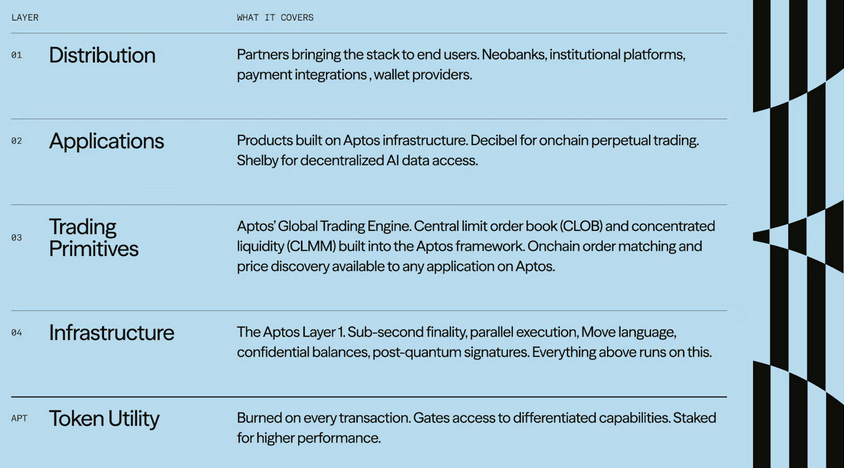
The Aptos ecosystem’s “full stack” plan for markets and machines. Aptos Network
Last month, Coinbase CEO Brian Armstrong predicted there will be “more AI agents transacting online than humans very soon,” echoing comments from Circle CEO Jeremy Allaire in January that “literally billions of AI agents” will be transacting onchain in three to five years.
The World Economic Forum is expecting a boom too, having predicted in January that AI agents could become a $236 billion market by 2034, a 43-fold rise from its $5.4 billion market size in 2024.
AI agents use blue-chip stablecoins to transact
On Wednesday, Amazon Web Services said it integrated Coinbase’s x402 payments protocol into Amazon Bedrock AgentCore to allow AI agents to make USDC (USDC) payments and access services through AWS-managed payment controls.
A week earlier, crypto wallet startup Oobit launched a Visa-supported virtual card for AI agents to make online purchases in USDt (USDT) on behalf of businesses.
The foundation said the Aptos (APT) token would play a central role in the ecosystem’s AI agent economy by being burned in transactions, required to access advanced AI agent features, and staked to improve performance.
Related: How AI agents can reshape arbitrage in prediction markets
The foundation said the $50 million would also be used to develop other aspects of the “Aptos stack,” which also includes integrations with neobanks, institutional platforms and wallet providers.
Aptos said it also plans to work on building encrypted mempools and offer confidential perps trading, among other things.
Aptos rolled out privacy-focused coin last month
Meanwhile, Aptos launched a privacy-focused coin — Confidential APT — on Aptos mainnet on April 24 as part of an effort to fix a long-standing trade-off between protecting user privacy and preserving transparency for compliance.
Aptos Labs founding engineer Sherry Xiao, told Cointelegraph that Confidential APT could help businesses hide the salaries of employees who are paid onchain, as well as conceal treasury movements, settlement flows and trading strategies that competitors could otherwise see.
Magazine: Guide to the top and emerging global crypto hubs — Mid-2026
Crypto World
Hyperliquid Strategies Reports $152.5 Million Quarterly Profit as HYPE Rally Lifts Treasury


Hyperliquid Strategies Inc (PURR) reported a $152.5 million net profit for the three months ended March 31, 2026.
The firm said that unrealized gains of $198.4 million on its Hyperliquid (HYPE) token holdings drove the result. HYPE surged 44% in Q1 2026, significantly outperforming major cryptocurrencies.
Hyperliquid Strategies Records Profits on HYPE Rally
Despite the strong quarterly performance, the company reported a net loss of $165.4 million for the nine months ending March 31, 2026. However, Hyperliquid Strategies maintains a bullish stance on HYPE.
“We materially scaled our HYPE treasury, announced our validator partnership with Unit, and completed the disposition of the majority of our legacy bio-tech operations… We remain highly optimistic about Hyperliquid’s trajectory as HIP-3 RWA perps, portfolio margin, and outcome markets drive the potential for sustained growth and fee generation,” CEO David Schamis said.
Since December 2025, the firm has deployed $216 million to accumulate roughly 7.3 million HYPE. It also spent $10.5 million repurchasing 3 million PURR shares.
Hyperliquid Strategies’ treasury reached 20 million HYPE tokens as of April 29, with $103 million in cash. Total assets stood at $809.4 million on March 31. The firm also booked $2.6 million in staking revenue during the quarter.
Follow us on X to get the latest news as it happens
How HYPE Outperformance Reshaped the DAT Leaderboard
The DAT sector has been under pressure since late 2025. Firms holding Bitcoin, Ethereum, and Solana (SOL) have experienced deep paper losses.
BeInCrypto data showed Hyperliquid Strategies sitting on $595.1 million in unrealized profit in March. Hyperion DeFi was the only other HYPE-focused treasury in positive territory at the time.
Notably, Strategy has since returned to the green following BTC’s recovery. The three firms now stand as the only DAT vehicles posting unrealized profits, according to Artemis data.
Bitmine Immersion Technologies (BMNR), the largest corporate Ethereum holder, carries $6.8 billion in paper losses by comparison.
Subscribe to our YouTube channel to watch leaders and journalists provide expert insights
The post Hyperliquid Strategies Reports $152.5 Million Quarterly Profit as HYPE Rally Lifts Treasury appeared first on BeInCrypto.

Record vs. Ranked Teams for Top CFB Programs in the West

Sony PS5 Sales Fall Off A Cliff Amid Memory Shortages

Barcelona vs Real Madrid: Prediction, kick-off time, TV, live stream, team news, h2h results, odds

Manchester United reach agreement with Casemiro over contract clause amid transfer speculation

US brings back mandatory military draft registration

Steven Gerrard disagrees with Gary Neville over ‘shock’ Chelsea and Arsenal claim | Football


![[KPOP IN PUBLIC] LISA - 'MONEY' | Cover by BN DANCE TEAM FROM VIETNAM](https://wordupnews.com/wp-content/uploads/2026/02/1770893501_maxresdefault-80x80.jpg)
-

 NewsBeat5 days ago
Channel 5 – All Creatures Great and Small series 7 new post
-

 Crypto World24 hours ago
Upbit adds B3 Korean won pair as Base token gains Korea access
-
 Tech7 days ago
Trump’s 25% EU auto tariff breaches Turnberry Agreement that also covers semiconductors and digital trade
-
 NewsBeat1 day ago
NCP car park operator enters administration putting 340 UK sites at risk of closure
-
 Sports7 days ago
Paul Scholes issues Marcus Rashford reality check as agreement emerges over Man United star
-

 Entertainment6 days ago
Met Gala 2026 Rumored Guest List Is Turning Heads
-

 Entertainment6 days ago
Kylie Jenner Hit With Second Lawsuit From Ex-Housekeeper
-
Entertainment7 days ago
New on Prime Video in May 2026 — Full List of Movies and Shows
-

 Tech7 days ago
Meta ends Sama contract after Kenyan workers report seeing intimate footage from Ray-Ban smart glasses users
-

 Sports6 days ago
Cavaliers vs. Raptors Game 6 live score, updates, highlights from 2026 NBA playoffs first-round series
-
 Sports6 days ago
David Benavidez responds to team Canelo saying the fight will never happen
-
Entertainment5 days ago
New Netflix Movies in May 2026 — My Top 3 Picks to Stream
-

 Entertainment5 days ago
Melissa Joan Hart and More Stars Attend 2026 Kentucky Derby
-
 Sports6 days ago
IPL 2026: ‘Love you darling’- Hardik Pandya’s reaction to MS Dhoni steals the show |Watch | Cricket News
-

 Entertainment6 days ago
Young and the Restless Next Week: Cane Arrested & Matt’s Deadly New Scheme!
-
Crypto World6 days ago
Pi Network Mandates Protocol 23 Upgrade for All Mainnet Nodes Before May 15 Deadline
-

 Business5 days ago
Luka Doncic Injury Update: Doncic’s Hamstring Recovery Slows Lakers’ Hopes Against Thunder: Can He Run Yet?
-

 Sports7 days ago
Bayern won’t hand bottom side Heidenheim ‘gifts’ despite PSG game
-

 Sports7 days ago
What Preity Zinta Said After Punjab Kings’ First Defeat Of IPL 2026
-

 Tech7 days ago
Mother’s Day 2026 Gift Guide: Audio to Upgrade Mom’s Lifestyle
You must be logged in to post a comment Login