Connect with us
DAPA Banner
DAPA Coin
DAPA
COIN PAYMENT ASSET
PRIVACY · BLOCKDAG · HOMOMORPHIC ENCRYPTION · RUST
ElGamal Encrypted MINE DAPA
🚫 GENESIS SOLD OUT
DAPAPAY COMING

Business

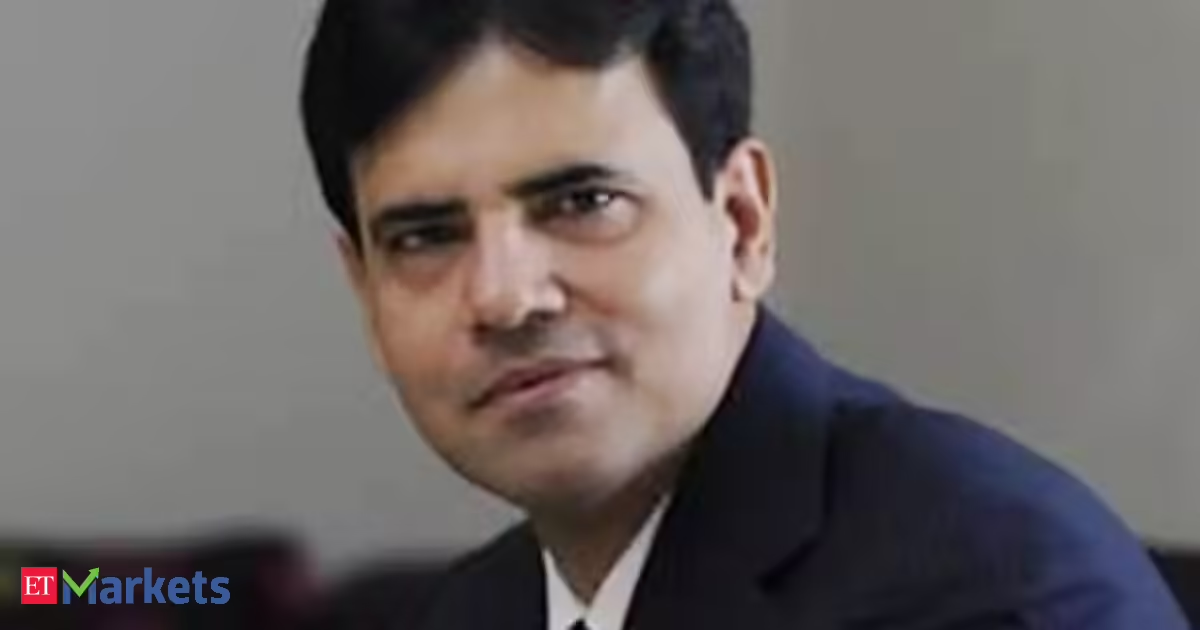
Sandip Sabharwal remains bullish on FMCG, retail and defence themes

Published

on

Sandip Sabharwal remains bullish on FMCG, retail and defence themes
Indian equity markets may be poised for another leg higher in the coming months as strong corporate earnings, resilient consumer demand, and hopes of easing geopolitical tensions continue to support sentiment, according to market expert Sandip Sabharwal in an interaction with ET Now.

After recovering nearly 10% from the March lows, investors are now closely watching whether the rally can sustain itself amid elevated crude oil prices, mixed global cues, and uncertainty around the West Asia conflict.

“The result season is actually turning out to be quite good overall,” said Sabharwal, pointing to strong performances from consumer-facing businesses despite multiple cost pressures.

Crude Oil Remains the Biggest Variable
Sabharwal noted that oil prices continue to be the key uncertainty for markets. While geopolitical developments have periodically triggered sharp spikes in crude, he believes the overall structure suggests prices may correct sharply if a formal resolution emerges in West Asia.

Advertisement

“So, once the actual deal happens, from the looks of it it seems that crude prices could crack pretty strongly,” he said.


He added that the Indian government’s decision not to raise fuel prices has helped preserve the consumption momentum generated by earlier GST cuts and tax relief measures.
According to Sabharwal, the Indian economy currently appears “pretty well placed,” though a renewed escalation in global hostilities or another commodities spike could once again create pressure on markets and inflation.Markets Could Have Been Higher Without the War
Sabharwal believes Indian equities would already have been trading at fresh record highs had the geopolitical tensions not pushed oil prices toward the $100 mark.

“I would think that if the war was not there and given the way the results have come out and the outlook would have been if the crude oil prices were $70-80 and not $100 which they are today, the markets could have been 7% to 8% higher than what they are right now,” he said.

He expects markets to eventually move toward new highs over the next few months if geopolitical stability returns and earnings momentum continues.

Earnings Remain the Core Driver
While several global markets have already touched record levels, Sabharwal stressed that long-term market performance ultimately depends on earnings growth.

Advertisement

“Markets are slave of earnings, so eventually it will track how earnings do,” he said.

He contrasted India with markets such as South Korea, where companies linked to the artificial intelligence boom and component shortages are witnessing exceptionally strong earnings momentum.

India may not currently have a comparable technology-driven earnings cycle, but Sabharwal believes improving pricing power, moderate inflation, and stable growth could still support equities.

“The current quarter results and the commentary which is coming out of companies gives me specifically a lot of comfort,” he added.

Advertisement

Consumer Revival Emerging Across Sectors
One of the strongest themes emerging this earnings season has been the recovery in consumer demand.

Sabharwal highlighted encouraging management commentary from several FMCG and retail companies, including Dabur India, which he said remained optimistic about sustaining margins and growth despite rising transportation, packaging, and shipping costs linked to the Middle East conflict.

He also pointed to strong results from Pidilite Industries, which reported robust volume growth, along with improving trends among paint makers and apparel retailers.

“GST rate cuts have really helped them and they have some leeway to pass on prices because of cost impact,” he observed.

Advertisement

However, Sabharwal cautioned that sustained inflation could eventually affect consumer spending power if companies continue passing on higher costs.

Retail and Apparel Stocks Back in Focus
The revival in consumption is also becoming visible in value retail and fashion segments, where companies had struggled with subdued demand for several quarters.

Sabharwal cited improved numbers from companies such as Arvind Fashions and Aditya Birla Fashion and Retail as signs of a broader recovery.

“There is a definitive consumer revival,” he said, while adding that many retail and FMCG stocks remain under-owned and out of favour among investors, potentially creating opportunities if demand trends sustain.

Advertisement

At the same time, he acknowledged concerns raised by companies including Britannia Industries and Nestlé India regarding slower growth during March and April.
Another key variable for rural demand, he said, will be the impact of El Niño and monsoon trends on agricultural output.

Banking Sector Expectations Remain Measured
On the banking space, Sabharwal said expectations from lenders, including State Bank of India, should remain realistic amid pressure on margins.

He explained that higher funding costs, RBI rate cuts, and bond-market losses have weighed on profitability across both private and public sector banks.
“Most of the banking results have been somewhat muted because net interest income growth has been subdued,” he said.

Despite that, he expects asset quality trends to remain stable and improving across the sector, with investors likely to focus on future growth guidance and margin commentary.

Advertisement

Defence Stocks Still a Long-Term Theme
Sabharwal also maintained a constructive long-term outlook on defence and shipyard companies, though he advised investors to use corrections as entry opportunities rather than chase rallies.

Companies such as Cochin Shipyard and Bharat Forge continue to benefit from strong structural tailwinds tied to defence and aerospace spending.

“Shipyard companies definitely investors should be looking at them on every correction,” he said.

However, he cautioned that many defence stocks have already rebounded sharply from recent lows and could consolidate in the near term after their strong run-up.

Advertisement

Outlook: Stability Could Trigger a Fresh Rally
For now, the market narrative appears increasingly tied to two variables — crude oil and earnings durability.
If geopolitical tensions ease and oil prices moderate, analysts believe India’s strong domestic demand trends and improving corporate commentary could pave the way for equities to attempt fresh record highs later this year.

Sabharwal’s assessment suggests that despite lingering global uncertainty, the current earnings season has strengthened confidence that India’s economic recovery remains intact.

Continue Reading
Click to comment

You must be logged in to post a comment Login

Leave a Reply

Business

Research Frontiers Incorporated (REFR) Q1 2026 Earnings Call Transcript

Published

on

OneWater Marine Inc. (ONEW) Q1 2026 Earnings Call Transcript

Research Frontiers Incorporated (REFR) Q1 2026 Earnings Call May 7, 2026 4:30 PM EDT

Company Participants

Joseph Harary – CEO, President, General Counsel, Corporate Secretary & Director

Advertisement

Presentation

Operator

Good afternoon, and welcome to Research Frontiers investor conference call to discuss the first quarter of 2026 results of operations and recent developments. The company will be answering many of the questions that were e-mailed to it prior to this conference call in their presentation. In some cases, the company has responded directly to e-mail questions prior to this call or will do so afterwards. Some statements today may contain forward-looking information identified by words such as expect, anticipate and forecast. These reflect current beliefs and actual results may differ materially from those expressed due to various risk factors, including those detailed in our SEC filings. Research Frontiers assumes no obligation to update or revise these statements. The call is being recorded and will be available for replay on Research Frontiers website at smartglass.com for the next 90 days.

I would now like to turn the conference over to Joe Herary, President and Chief Executive Officer of Research Frontiers. Please go ahead, sir.

Advertisement

Joseph Harary
CEO, President, General Counsel, Corporate Secretary & Director

Thank you, Paul, and good afternoon, everyone, and thank you for joining us on our first quarter 2026 investor conference call. I was informed a little after 4:00 p.m. that the SEC website was down. I’m not sure if it’s up yet or not, but our 10-K should be filed once everything gets straightened out and whatever backlog they have is cleared. As always, I appreciate the time and interest of our shareholders, customers, licensees and industry partners joining us today.

Today, I want to talk about Research Frontiers, our business, our markets and also address the question I’ve been

Advertisement
Continue Reading

Business

Nektar Therapeutics (NKTR) Q1 2026 Earnings Call Transcript

Published

on

OneWater Marine Inc. (ONEW) Q1 2026 Earnings Call Transcript

Operator

Hello and thank you for standing by. Welcome to the Nektar Therapeutics First Quarter 2026 Financial Results Conference Call. [Operator Instructions] Please be advised that today’s conference call is being recorded.

I would now like to hand the conference over to Vivian Wu from Nektar Investor Relations to kick things off. Please go ahead.

Advertisement

Vivian Wu
Investor Relations

Thank you, Crystal, and good afternoon, everyone. Thank you for joining us today. On today’s call, you will hear from Howard Robin, our President and Chief Executive Officer; Dr. Jonathan Zalevsky, our Chief Research and Development Officer; and Sandra Gardiner, our Chief Financial Officer. Dr. Mary Tagliaferri, our Chief Medical Officer, will also be available during the Q&A.

Before I begin, I would like to remind you that we will be making forward-looking statements regarding our business, including statements related to the therapy potential and development plans for rezpegaldesleukin, the timing and expectations for clinical data presentations, regulatory interactions and other statements regarding the future of our business. Because forward-looking statements relate to the future, they are subject to uncertainties and risks that are difficult

Advertisement
Continue Reading

Business

Aritzia Inc. (ATZ:CA) Q4 2026 Earnings Call Transcript

Published

on

OneWater Marine Inc. (ONEW) Q1 2026 Earnings Call Transcript

Operator

Thank you for standing by. This is the conference operator. Welcome to Aritzia’s Fourth Quarter 2026 Earnings Conference Call. [Operator Instructions] The conference is being recorded. [Operator Instructions]

I will now turn the conference over to Beth Reed, Vice President, Investor Relations. Please go ahead.

Advertisement

Beth Reed
Vice President of Investor Relations

Thanks, operator, and thank you all for joining Aritzia’s Fourth Quarter Fiscal 2026 Earnings Call. On the call today, I’m joined by Jennifer Wong, our Chief Executive Officer; and Todd Ingledew, our Chief Financial Officer.

As a reminder, please note that remarks on this call may include our expectations, future plans and intentions that may constitute forward-looking information. Such forward-looking information is based on estimates and assumptions made by management regarding, among other things, general economic and geopolitical conditions as well as the competitive environment.

Actual results may differ materially from the conclusions, forecasts or projections expressed by the forward-looking information. We would refer you to our most recently filed management’s discussion and analysis and

Advertisement
Continue Reading

Business

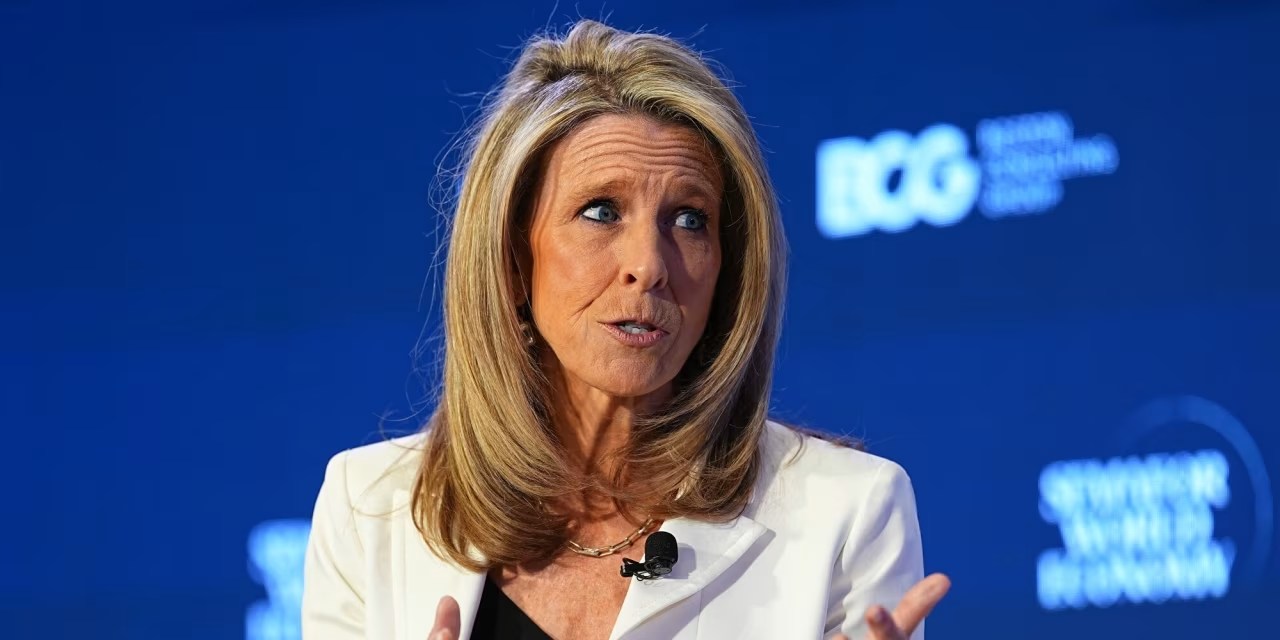
FanDuel Chief Executive Amy Howe Departs Company

Published

on

FanDuel Chief Executive Amy Howe Departs Company

FanDuel Chief Executive Amy Howe has left the company after five years at the helm of the gambling platform as part of broader executive changes at parent company Flutter Entertainment FLUT 1.28%increase; green up pointing triangle.

Howe, who led the sports-betting company since 2021, will be succeeded by Christian Genetski, FanDuel’s president, the company said Wednesday. Genetski has been with FanDuel since 2015.

Copyright ©2026 Dow Jones & Company, Inc. All Rights Reserved. 87990cbe856818d5eddac44c7b1cdeb8

Continue Reading

Business

Lumentum Earnings Paused the Stock’s Rally. Why Wall Street Isn’t Worried.

Published

on

Lumentum Earnings Paused the Stock’s Rally. Why Wall Street Isn’t Worried.

Lumentum Earnings Paused the Stock’s Rally. Why Wall Street Isn’t Worried.

Continue Reading

Business

MGK: A Keeper For Both Growth And Value (NYSEARCA:MGK)

Published

on

Nvidia: What Could Happen On Wednesday? (Earnings Preview)

This article was written by

Michael Fitzsimmons is a retired electronics engineer and avid investor. He advises investors to construct a well-diversified portfolio built on a core foundation of a high-quality low-cost S&P500 fund. For investors who can tolerate short-term risks, he advises an over-weight position in the technology sector, which he believes is still in the early stages of a long-term secular bull-market. For dividend income, and as a 4th generation oil & gas man, Fitzsimmons suggests investors consider a position in large O&G companies that provide strong dividend income and dividend growth. Fitzsimmons’ articles on portfolio management recommend a top-down capital allocation approach that is aligned with each individual investor’s personal situation (i.e. age, retired/working, risk tolerance, income, net worth, goals, etc) and might include allocations into investment categories such as the S&P500, technology, dividend income, sector ETFs, growth, speculative growth, gold, and cash.

Analyst’s Disclosure: I/we have a beneficial long position in the shares of AVGO, NVDA, GOOG, VOO, DIA, QQQ either through stock ownership, options, or other derivatives. I wrote this article myself, and it expresses my own opinions. I am not receiving compensation for it (other than from Seeking Alpha). I have no business relationship with any company whose stock is mentioned in this article.

I am an electronics engineer, not a CFA. The information and data presented in this article were obtained from company documents and/or sources believed to be reliable, but have not been independently verified. Therefore, the author cannot guarantee their accuracy. Please do your own research and contact a qualified investment advisor. I am not responsible for the investment decisions you make.

Advertisement

Seeking Alpha’s Disclosure: Past performance is no guarantee of future results. No recommendation or advice is being given as to whether any investment is suitable for a particular investor. Any views or opinions expressed above may not reflect those of Seeking Alpha as a whole. Seeking Alpha is not a licensed securities dealer, broker or US investment adviser or investment bank. Our analysts are third party authors that include both professional investors and individual investors who may not be licensed or certified by any institute or regulatory body.

Continue Reading

Business

Even if Oil Hit $200 a Barrel, War Would Have Been Worth It

Published

on

Trump: Even if Oil Hit $200 a Barrel, War Would Have Been Worth It

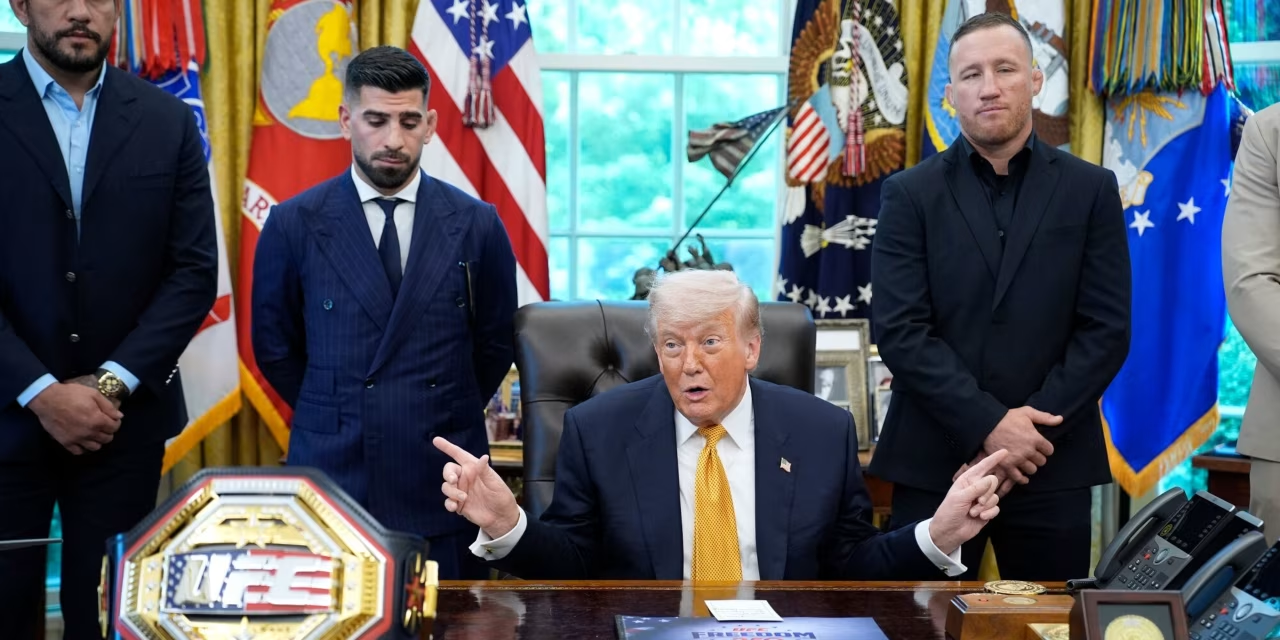
President Trump said he was surprised the price of oil hadn’t been driven higher by the Iran war, but even if it reached $200 a barrel, the conflict was worth it. “I thought oil prices would go to $200, $250,” Trump told reporters in the Oval Office. “You’re surprised and I’m surprised. But even if it went to $200, it would have been worth it.”

The war has disrupted the energy industry, sending prices higher. Brent crude, the global benchmark, jumped to over $100 a barrel from about $75 a barrel after the conflict started and was about $101 on Wednesday. Gas prices in the U.S. topped $4.50 a gallon, the AAA said Wednesday, the highest they’ve been since July 2022.

Continue Reading

Business

Meta Sues Ofcom Over Online Safety Act Fines

Published

on

The owner of Facebook and Instagram will cut another 10,000 jobs, months after laying off 11,000 staff, as the technology group prepares for years of economic disruption.

The owner of Facebook and Instagram has taken the UK’s media regulator to the high court, opening a fresh front in the increasingly fractious relationship between Silicon Valley and Britain’s online safety regime.

Meta has filed for a judicial review of Ofcom’s methodology for setting fees and penalties under the Online Safety Act, arguing that pegging charges to a company’s qualifying worldwide revenue (QWR) is disproportionate and out of step with the geographic scope of the regulator’s remit. A hearing has been scheduled for 13 and 14 October.

The stakes are considerable. Under the Act, Ofcom can levy fines of up to 10 per cent of QWR or £18m, whichever is higher. Given that Meta reported global revenues of roughly $201bn last year, the regulator could in theory issue a penalty of around $20bn, a sum that would dwarf the largest fines in UK corporate history. The fee regime introduced last September applies the same QWR principle to annual tariffs, capturing companies whose user-generated content, search or adult-content services in the UK generate more than £250m a year.

Meta contends that liability should be determined by activity within the jurisdiction doing the regulating. “We and others in the tech industry believe its decisions on the methodology to calculate fees and potential fines are disproportionate,” a company spokesperson said. “We believe fees and penalties should be based on the services being regulated in the countries they’re being regulated in. This would still allow Ofcom to impose the largest fines in UK corporate history.”

Court documents filed on Meta’s behalf by Monica Carss-Frisk KC describe Ofcom’s approach as “troubling”, warning that it would result in a handful of large platforms shouldering the bulk of the regulator’s costs even though the Act covers a much broader sweep of internet services. The barrister noted that QWR is not pegged to revenue generated by any particular service in the UK; rather, once a service is offered to British users, the entirety of its global turnover is counted.

Advertisement

Ofcom, for its part, is preparing to dig in. The regulator said its fees and fines framework reflected “a plain reading of the law” and pledged to “robustly defend our reasoning and decisions”.

Meta is not alone in pushing back. The US online forum 4chan has refused to pay penalties imposed under the Act, and Ofcom is facing separate litigation from the operators of both 4chan and Kiwi Farms. The regime has also drawn criticism from Donald Trump’s White House, which has signalled growing impatience with European digital rules that it sees as targeting American firms.

The financial significance of the new system for Ofcom itself is hard to overstate. Once the preserve of broadcasters and telecoms operators paying for spectrum and licence fees, the regulator now expects the bulk of its £233m budget for the year to come from online safety tariffs, which are forecast to bring in £164m. That marks one of the most substantial shifts in Ofcom’s funding base in its two-decade history.

For SME founders watching from the sidelines, the case is more than a transatlantic skirmish between Big Tech and a British quango. The threshold of £250m in qualifying turnover means most smaller platforms sit outside the fee net, but the principles being tested in October, how revenue is attributed across borders, and how proportionality is measured for global digital businesses, will shape the regulatory environment for any UK-based scale-up that one day finds itself trading internationally on the back of user-generated content. The judgment, when it comes, will be read closely well beyond Menlo Park.

Advertisement

Amy Ingham

Amy is a newly qualified journalist specialising in business journalism at Business Matters with responsibility for news content for what is now the UK’s largest print and online source of current business news.

Advertisement
Continue Reading

Business

Broadcom Stock Strong Buy in 2026 as AI Revenue Explodes 106% and Analysts See Further Upside

Published

on

FTSE 100 Surges 0.8% Today as Oil Eases and Markets

NEW YORK — Broadcom Inc. (NASDAQ: AVGO) remains a compelling buy for investors in 2026, with Wall Street analysts issuing overwhelmingly bullish ratings amid explosive growth in its artificial intelligence semiconductor business and strong execution across its diversified portfolio. The semiconductor and infrastructure software giant continues to benefit from surging demand for custom AI accelerators and networking chips, positioning it as a core holding in the ongoing AI infrastructure boom.

FTSE 100 Surges 0.8% Today as Oil Eases and Markets
Broadcom Stock Strong Buy in 2026 as AI Revenue Explodes 106% and Analysts See Further Upside

As of early May 2026, Broadcom shares trade near all-time highs following robust fiscal first-quarter results that exceeded expectations. The company reported record revenue of $19.3 billion for the period ended February 2, up 29% year-over-year, driven largely by its AI segment. AI semiconductor revenue alone surged 106% to $8.4 billion, beating internal forecasts and highlighting accelerating momentum from hyperscale customers.

CEO Hock Tan emphasized the strength of the custom AI accelerator business, noting robust demand across its five major customers. For the second quarter, Broadcom guided AI semiconductor revenue to $10.7 billion, representing approximately 140% year-over-year growth. The company now has line of sight to more than $100 billion in AI chip revenue by 2027, underscoring its deepening role in the artificial intelligence supply chain.

Analyst Consensus and Price Targets

Wall Street remains highly optimistic. Across 26 to 33 analysts covering the stock, the consensus rating stands at Moderate Buy to Strong Buy, with the vast majority recommending purchase. Average 12-month price targets range from approximately $435 to $477, implying 12% to 16% upside from recent trading levels around $425. Some bullish forecasts reach as high as $630.

Analysts highlight Broadcom’s unique position supplying custom AI accelerators to major hyperscalers including Google, Meta and others, alongside its leadership in AI networking silicon. The VMware integration, while facing some channel adjustments, continues to provide stable, high-margin software revenue that complements the high-growth semiconductor side.

Advertisement

Key Growth Drivers in 2026

Broadcom’s transformation into an AI powerhouse is the dominant theme. AI-related revenue now accounts for a rapidly growing share of the semiconductor segment, with custom XPUs and networking solutions seeing sequential acceleration. Gross margins remain healthy despite heavy investment in next-generation technologies, and operating leverage is expanding as scale benefits kick in.

The company’s diversified portfolio provides ballast. Networking, broadband and storage solutions continue to deliver steady performance, while the software segment — anchored by VMware — generates predictable recurring revenue. Broadcom’s $10 billion share repurchase authorization and consistent dividend increases further enhance shareholder returns.

Risks and Considerations

No investment is without risks. Broadcom faces intense competition in the AI chip space from Nvidia and others, and any slowdown in hyperscaler capital spending could pressure growth. Geopolitical tensions, particularly around semiconductor supply chains, remain a factor. VMware-related channel changes have created some friction, though management views these as transitional.

Valuation is elevated compared to historical norms, with the stock trading at a forward price-to-earnings multiple in the mid-30s. However, when factoring in projected earnings growth rates above 20% annually, many analysts argue the multiple remains reasonable for a high-quality compounder.

Advertisement

Long-Term Outlook Remains Bright

Looking further into 2026 and beyond, Broadcom is well-positioned to benefit from secular AI tailwinds. Analysts project continued strong revenue and earnings growth as custom silicon ramps and AI networking expands. The company’s ability to win large, multi-year design slots with major cloud providers provides significant revenue visibility.

For investors considering a position, the consensus is clear: Broadcom represents a high-conviction opportunity in the AI infrastructure theme. Those already holding shares have strong reasons to maintain or add on dips, while new buyers may find current levels attractive given the growth trajectory and analyst support. Diversification within the semiconductor sector remains prudent, but Broadcom stands out for its combination of growth, margins and ecosystem strength.

As earnings season progresses and AI spending trends become clearer, Broadcom’s execution will be closely watched. With accelerating AI momentum, disciplined capital allocation and a favorable analyst backdrop, the case for owning Broadcom stock in 2026 appears compelling for growth-oriented investors.

The company’s trajectory reflects broader shifts in the technology industry, where leaders in enabling AI infrastructure are commanding premium valuations. Broadcom has successfully transitioned from a diversified chipmaker to a critical AI enabler, a move that analysts believe will continue rewarding shareholders in the years ahead.

Advertisement
Continue Reading

Business

Berkshire Hathaway Stock a Solid Buy in 2026 as Record Cash Pile and Greg Abel’s Leadership Signal Strength

Published

on

Greg Abel Faces First Berkshire Hathaway Annual Meeting as CEO

OMAHA, Neb. — Berkshire Hathaway Inc. (NYSE: BRK.B) stands out as a compelling buy for patient, long-term investors in 2026, even as the conglomerate navigates the transition to new CEO Greg Abel and faces questions about deploying its massive cash reserves amid elevated market valuations. With a fortress balance sheet, diversified operating businesses and a proven ability to compound capital over decades, Berkshire continues to appeal to value-oriented investors seeking stability in an uncertain economic environment.

Greg Abel Faces First Berkshire Hathaway Annual Meeting as CEO
Greg Abel Faces First Berkshire Hathaway Annual Meeting as CEO on May 2

Class B shares have traded around $465–$475 in early May, reflecting modest year-to-date performance compared to broader indices. Yet analysts largely view current levels as attractive given the company’s intrinsic value, with average 12-month price targets clustering near $525, implying roughly 10–12% upside. Consensus ratings lean toward Hold to Buy, with several firms highlighting Berkshire’s resilience and capital allocation discipline under Abel’s leadership.

Berkshire reported strong first-quarter 2026 operating earnings of $11.35 billion, up 18% from the prior year, driven by improved insurance underwriting, railroad performance and manufacturing results. The headline figure was a record cash position exceeding $397 billion at quarter-end, underscoring the challenge of finding sufficiently large, high-quality acquisition or investment opportunities in today’s market.

Transition to Greg Abel Proceeds Smoothly

Abel, who officially took the reins from Warren Buffett on Jan. 1, 2026, delivered his first quarterly report with steady results. Insurance underwriting profits rose despite lower investment income, BNSF Railway posted solid gains and Berkshire Hathaway Energy remained stable. Operating businesses overall showed resilience, with manufacturing, service and retailing segments contributing positively.

Buffett, now serving as chairman, remains involved in major investment decisions. The company’s massive cash hoard has drawn attention, with some investors wondering when Berkshire will deploy capital more aggressively. Abel has signaled a patient approach, consistent with Berkshire’s long-standing philosophy of waiting for compelling opportunities rather than forcing deals.

Advertisement

Portfolio and Investment Strategy

Berkshire’s equity portfolio, still anchored by major holdings in Apple, Bank of America and others, continues to generate substantial value. The company has conducted modest share repurchases when stock trades below intrinsic value, providing a floor for shareholders. Analysts expect continued opportunistic buying, particularly in technology and financials, as Abel puts his stamp on the portfolio.

The insurance float remains a powerful engine, providing low-cost capital for investments. Despite periodic catastrophe losses, Berkshire’s underwriting discipline has produced consistent profits over time, reinforcing its status as one of the world’s premier financial institutions.

Valuation and Risks

At current prices, Berkshire trades at a reasonable multiple to book value, a key metric for the conglomerate. While not the deep value opportunity of past decades, the stock offers a margin of safety relative to its diversified earnings power and fortress balance sheet. Risks include slower growth in mature businesses, potential market corrections that could pressure equity holdings and the challenge of outperforming in a high-valuation environment.

Some analysts note sluggish growth in certain legacy segments and question whether Abel will deploy capital as aggressively as Buffett. However, most view the succession as well-planned, with Abel’s deep operational knowledge providing continuity.

Advertisement

Why Buy Berkshire in 2026

For long-term investors, Berkshire offers several compelling attributes: downside protection through its cash reserves and insurance float, diversified exposure across industries, disciplined capital allocation and a proven track record of weathering economic cycles. In an era of high market valuations and geopolitical uncertainty, the company’s conservative approach provides ballast.

Dividend-focused investors may eventually benefit if Berkshire initiates a payout, a possibility some analysts have floated for later in Abel’s tenure. Share repurchases provide an ongoing return of capital when shares are undervalued.

Investor Considerations

Investors weighing a position should consider Berkshire as a core holding rather than a high-growth speculative play. The stock’s lower volatility makes it suitable for conservative portfolios, retirement accounts and those seeking an “all-weather” equity allocation. Dollar-cost averaging during periods of weakness can enhance long-term returns.

While not expected to deliver the outsized returns of Berkshire’s early decades, the company remains exceptionally well-positioned for the next chapter under Abel. Its ability to compound book value over time, combined with a massive cash war chest for opportunistic moves, supports a constructive outlook for 2026 and beyond.

Advertisement

As markets navigate potential volatility, Berkshire Hathaway offers a time-tested formula of patience, quality businesses and prudent risk management. For investors seeking stability and long-term wealth preservation with reasonable upside, the case for buying Berkshire stock in 2026 remains strong.

Continue Reading

Trending

Copyright © 2025