

Crypto World
Baillie Gifford Launches Tokenized Fixed Income Fund on Ethereum and Solana


British asset manager Baillie Gifford has launched a tokenized fixed income fund, adding another entry into the list of products that use blockchain for access to conventional yield products. The fund operates on both Ethereum and Solana blockchains, while BNY is responsible for tokenizing and providing digital wallet services. The news was shared via CoinMarketCap’s X post, which included some initial information about the launch.
Tokenized Fund Structure Across Ethereum and Solana
The Baillie Gifford investment fund was designed to be used on both the Ethereum and Solana blockchains. Using two large blockchain networks with smart contracts and settlement of digital assets would allow the fund to interact with the two blockchain environments.
Ethereum is one of the most popular environments where decentralized apps work. Solana offers high transaction speeds and reduced fees. It allows the fund to operate across different technological platforms within the blockchain space.
BNY Role in Tokenization and Digital Infrastructure
BNY provides the tokenization protocol that transforms conventional financial assets into tokens through blockchain. The company also offers wallet services that will facilitate custody and processing of transactions. This places a regulated financial institution in the operational layer of the fund’s blockchain deployment.
This infrastructure enables the issuance and transfer of tokenized assets in a secure way. It also facilitates interoperability between the conventional finance system and blockchain.
Market Reaction and Social Media Disclosure
The launch received attention when CoinMarketCap posted an article on X. This article discussed Baillie Gifford’s entry into the realm of tokenized fixed income products and also mentioned Ethereum, Solana, and BNY.
The topic highlights the growth of tokenized real-world assets within prominent blockchain networks. This post added fuel to interest in tokenization models for fixed income instruments.

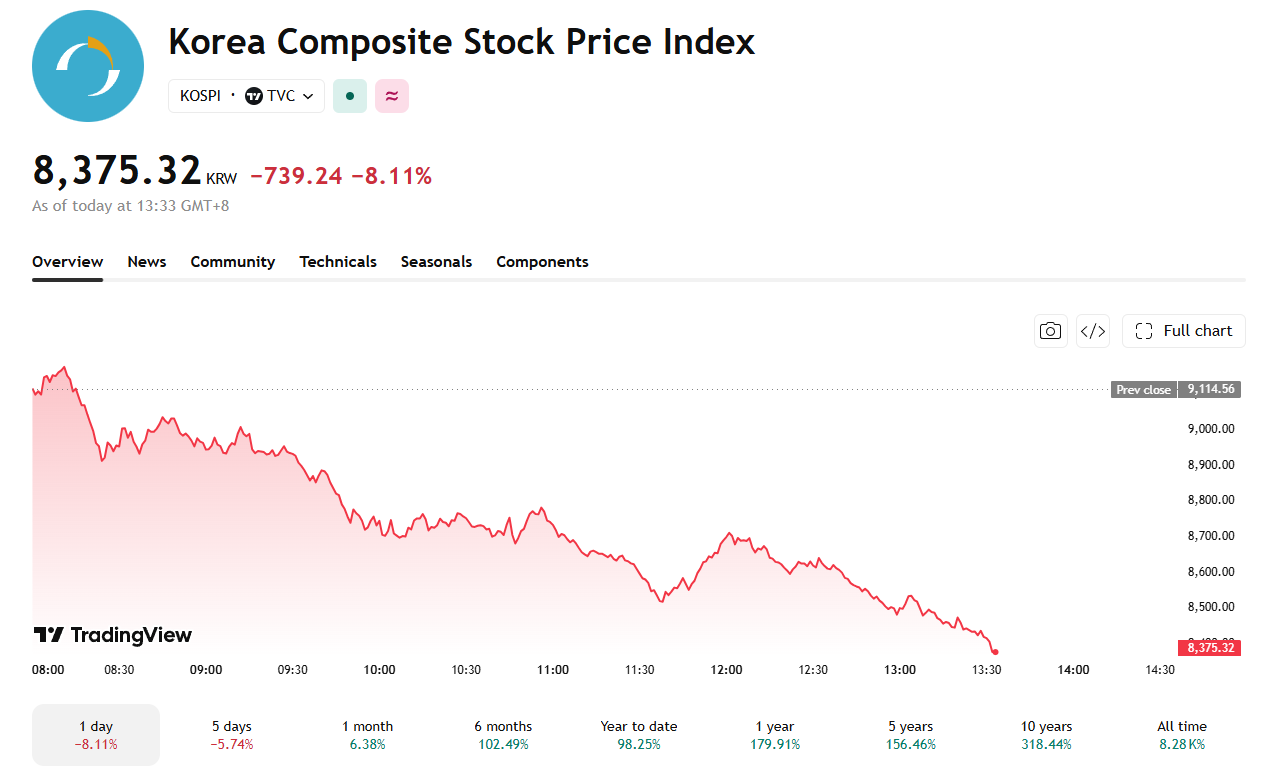
South Korea’s KOSPI crashed more than 8% on June 23, triggering circuit breakers twice, as Japan’s Nikkei 225 broke an eight-session winning streak in a broad selloff driven by US technology stocks.
The moves extended a turbulent stretch for Asian equities as Tuesday’s tech-driven reversal erased early gains across the region. Benchmarks in Taiwan, South Korea, and Japan had each climbed at least 40% this year, making the concentrated semiconductor trade the most exposed when US megacap sentiment shifted.
Circuit Breakers Triggered as KOSPI Freefall Deepens
The KOSPI opened at 9,083.54, down 0.34% from the prior close, then collapsed through the 9,000, 8,900, and 8,800 levels and all the way down to 8,500 in rapid succession. The Korea Exchange triggered a sell-side circuit breaker at 11:40 a.m., then activated a first-stage circuit breaker around 2:40 p.m. as the index sank to 8,375.31, an 8.11% decline on the day.

Wall Street set the tone. Alphabet fell 4.99% after two high-profile AI researchers left the company for rivals. SpaceX shed 16%, its third straight losing session, after the company announced a large investment-grade bond offering that rattled confidence in AI capital spending.
In Tokyo, the Nikkei 225 snapped its recent record run, and is also in freefall, down almost 3% at the time of publishing.
Samsung and SK Hynix Lead Seoul’s Losses
Foreign investors are at the source of the collapse, as there has been net selling in KOSPI shares. Samsung Electronics fell 8.77% to 322,500 won. The drop extended a historic session from the prior day, when Samsung lost the top KOSPI market-cap position to SK Hynix for the first time in 26 years. SK Hynix itself fell a massive 11.55 % to 2.582 million won, despite Micron surging 6.82% overnight.
Han Ji-young of Kiwoom Securities noted that the Magnificent Seven weakness and rising Treasury yields weighed on growth stocks, while falling oil prices tied to US-Iran ceasefire talks could partially cushion the rate burden.
The post KOSPI Falls 8%, Triggers Circuit Breakers, as Big Tech Selloff Hits Asia appeared first on BeInCrypto.
The US Senate has passed housing legislation that includes a ban on the Federal Reserve creating or working on a central bank digital currency (CBDC) until 2030, which is expected to be quickly taken up and passed by the House.
The Senate on Monday voted 85-5 to pass the 21st Century Road to Housing Act, which aims to increase the housing supply after a bipartisan group of House and Senate leaders reached a deal last week to move forward with the legislation.
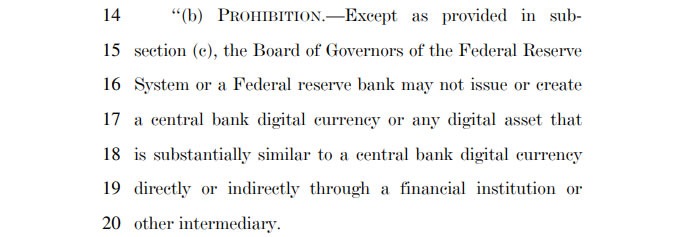
The bill has included a CBDC ban since the Senate first passed a version of the bill in March, which outlines that the Fed may not, directly or indirectly, “issue or create a central bank digital currency or any digital asset that is substantially similar to a central bank digital currency.”
Crypto advocates have long criticized CBDCs, which they see as an attempt by governments to bring digital currency under central bank control, and the bill is set to be a win for Republicans who have for years attempted to ban CBDCs.
The bill will now be sent to the House for a vote, where it is expected to pass quickly with the deal struck by House leaders last week, before it’s then sent to the president to sign it into law.
The CBDC clause in the bill became wrapped into the housing package as a political sweetener to secure support from House Republicans and the administration for faster passage.
Related: South Carolina governor signs bill protecting Bitcoin miners, banning CBDC
The ban makes a carve-out for stablecoins, or any “dollar-denominated currency that is open, permissionless, and private,” and that even after the CBDC ban lifts in 2030, the Fed can’t act on a CBDC without explicit congressional authorization.
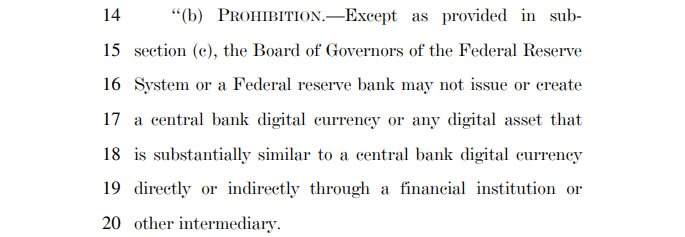
A section of the housing bill banning the Federal Reserve from creating a CBDC. Source: Senate Banking Committee
Meanwhile, other nations are charging ahead with their plans for a CBDC.
Reuters reported on June 16 that China signed up 26 financial institutions to its digital yuan (e-CNY) cross-border payment platform.
Three countries have officially launched a CBDC, while 41 are in the pilot phase, 33 are in development, and 40 are still researching, according to the think tank Atlantic Council.
Magazine: Bitcoin decouples from tech stocks, Ether eyes ‘selling wave’: Market Moves
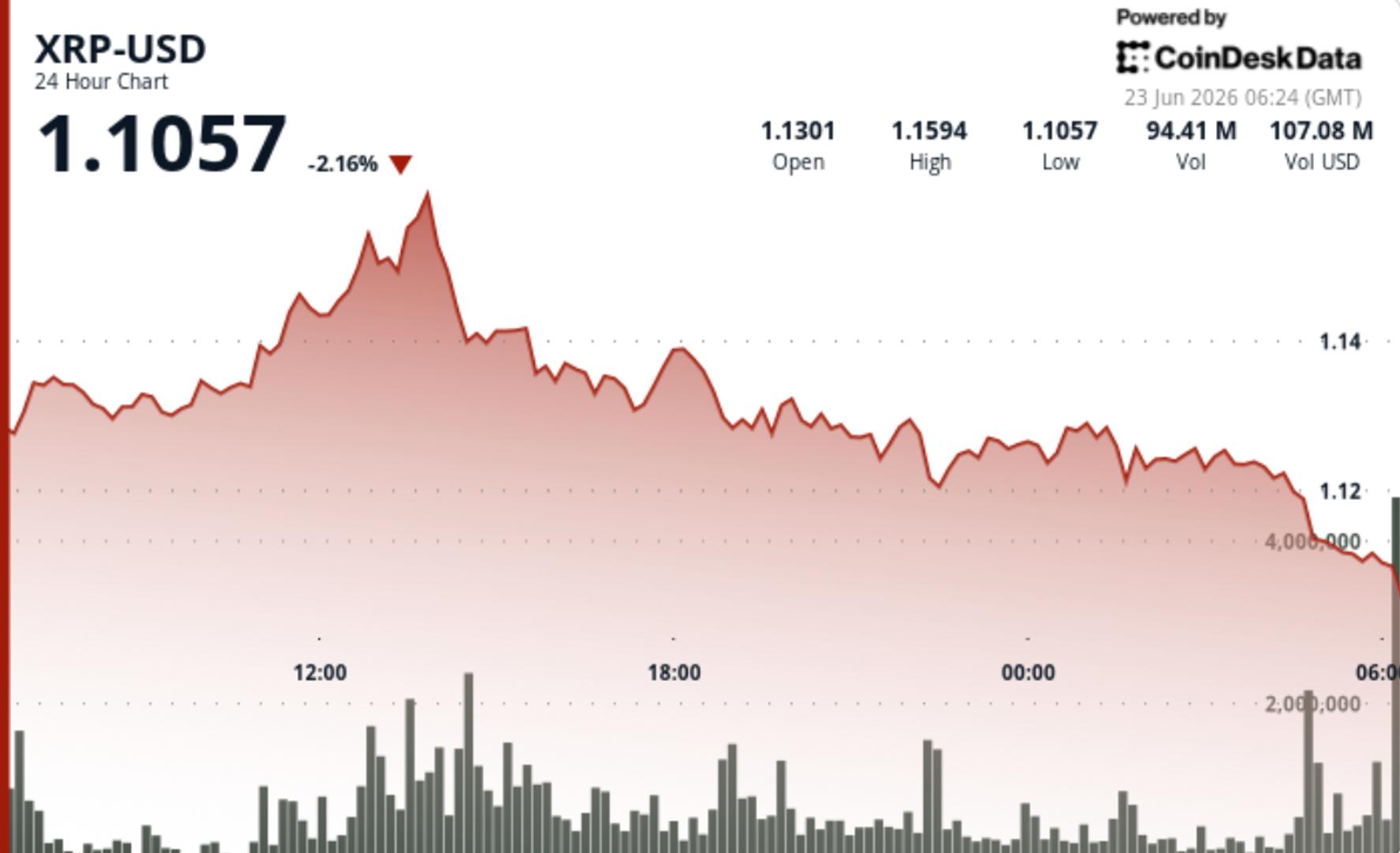
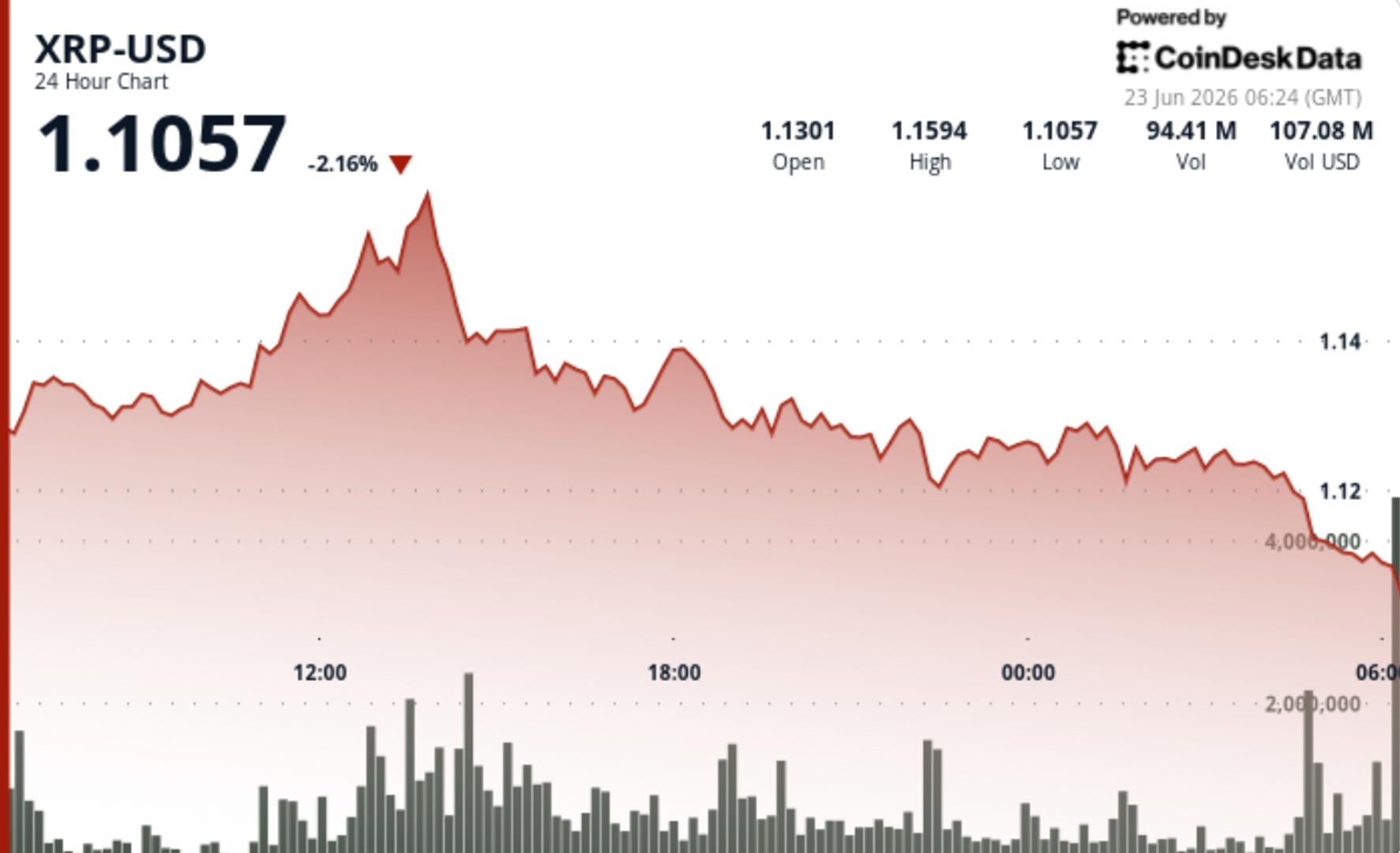
XRP is running out of room. After spending most of June trapped between resistance overhead and support near $1.10, the token is once again testing the bottom of its range.
While the latest decline was small, the inability to build on recent rebounds has left traders focused on whether buyers defend support or finally give way after weeks of compression.
News Background
• XRP ETFs attracted another $2.4 million in inflows on June 20, extending a run of institutional buying even as retail sentiment weakened.
• Analysts continue to watch the year-long downtrend from XRP’s 2025 highs, with several identifying $1.28-$1.30 as the level needed to change the broader structure.
• Network activity has softened in recent weeks while futures positioning and open interest have drifted lower.
Price Action Summary
• XRP fell from $1.1313 to $1.1109 during the 24-hour session, losing 1.8%.
• The sharpest selling came during a June 22 reversal when volume jumped to 65.4 million XRP, roughly 84% above average.
• Price spent most of the session grinding lower before testing support near $1.10 into the close.
Technical Analysis
• The market remains trapped inside the same range that has defined trading for much of June.


A widely watched indicator has flipped to “altcoin season,” for the opposite reason the label suggests. Glassnode’s Altcoin Cycle Signal, which reads above 50 when alternative coins, or alts, outperform bitcoin, has climbed to 86. Alts are not rallying. Bitcoin is just falling faster than they are.
[@portabletext/react] Unknown block type “image”, specify a component for it in the `components.types` prop
The signal tracks relative performance, so alts can lead either by rising or by falling less. This is the second case. After nearly two years of declines, alts have run out of sellers and steadied, while bitcoin has dropped hard, sliding back toward $63,600, per CoinDesk data. Bitcoin, as Glassnode puts it, “is still doing most of the work.”
A real altcoin season has capital rotating into smaller tokens as they climb. This is the hollow version, where the reading turns bullish for alts because bitcoin is selling off, which is bearish for the market as a whole. Relative strength is not a rally.
Until alts start rising on their own rather than holding while bitcoin falls, the signal says more about bitcoin’s weakness than about demand for anything else.

Combined institutional flows across spot Bitcoin ETFs, stablecoins and the world’s largest corporate holder of BTC, Strategy, have swung to a record $8 billion in net outflows in the last 30 days, according to analysis published by BIT on June 22.
The scale of the reversal went beyond the mere slowing down seen in late 2025, with flows turning outright negative this time around, and the firm warned that without a major catalyst, buying may not return soon.
ETF Withdrawals and Falling Liquidity Weigh on Sentiment
BIT wrote in a June 22 post on X that combined flows from stablecoins, spot BTC ETFs, and Strategy have swung to “a record $8 billion in net outflows,” adding that institutions were reducing exposure to the cryptocurrency ahead of summer.
Indeed, data from SoSoValue shows that funds tracking Bitcoin bled out $2.43 billion in May and have recorded net outflows of $2.26 billion so far in June, with more than a week still left. As CryptoPotato reported earlier, the products have gone for six weeks straight in the red, with last week seeing nearly $227 million leave, which was an actual improvement on the -$1.72 billion and -$316 million recorded in the previous two weeks.
Furthermore, on-chain stablecoin data from CryptoQuant adds some texture to BIT’s claims, as it shows all-exchange stablecoin reserves currently sitting at $63.3 billion, with a 24-hour net flow of -$103.7 million. A negative net flow indicates that more coins are being withdrawn than deposited, which often means that buying power is leaving exchanges rather than accumulating.
According to analyst Markus Thielen, who authored the market brief, flows did go down in Q4 2025 as well, but importantly, at that time, they merely stalled rather than actually reversing, and that difference matters for how the current price drop should be interpreted.
“This suggests the move to from $82,000 to $62,000 could prove more consequential than the earlier decline from $102,000 to $82,000,” he wrote.
His assessment concluded that without a dovish pivot from the Federal Reserve or another clear catalyst, there might be very little buying in the near term. He, however, noted that selling volatility may still offer opportunities, even if “upside appears limited.”
Meanwhile, Strategy’s preferred STRC stock experienced a major sell-off last week, apparently caused by leveraged traders who pulled its price as low as $82.50. And although the company recently spent $100 million to add 1,587 BTC to its stash, popular analyst Kaleo warned that it could be forced to sell as much as 50,000 BTC over the next two years.
Bitcoin Nears $65,000
During the weekend, BTC rose from around $63,000 to just above $64,000, according to CoinGecko data. However, early Monday morning, the OG cryptocurrency dipped back near the $63,000 level, but at the time of writing it had clawed back those losses and even managed to go above $65,000, gaining a modest 2% over 2 weeks despite the outflows.
But if BIT’s analysis holds, it could be at the mercy of institutions preserving capital instead of increasing exposure, with their data suggesting that caution could shape the market heading into the second half of the year.
The post Crypto Institutional Flows Turn Negative as $8B Exits in 30 Days appeared first on CryptoPotato.
Crypto World
Trump signs orders to build a quantum computer and protect against the one that could break encryption


It explicitly says that adversaries may already be collecting encrypted U.S. data, or information mathematically scrambled into an unreadable format to protect it from unauthorized access, and could decrypt it in future with the help of quantum computers.
That’s the “harvest now, decrypt later” problem. Steal the locked box today, crack it open whenever the tool to do so finally exists.
The fix, according to the order, is a hard post quantum cryptography (PQC) migration timeline. Federal agencies must move their most sensitive systems to post-quantum cryptography for key establishment by the end of 2030, and for digital signatures by the end of 2031.
In other words, the government plans to replace the current method for setting up secure, encrypted connections with a new way that remains secure from future quantum computers.
The crypto angle
Quantum computing has been a buzzword in the crypto industry since Google researchers said a sufficiently powerful machine could crack Bitcoin’s blockchain with significantly less firepower than previously expected.
The March paper, co-authored with Ethereum Foundation researcher Justin Drake and Stanford cryptographer Dan Boneh, said that breaking the elliptic curve cryptography behind Bitcoin and Ethereum blockchains could take fewer than 500,000 physical qubits. That’s a 20-fold drop from earlier estimates.
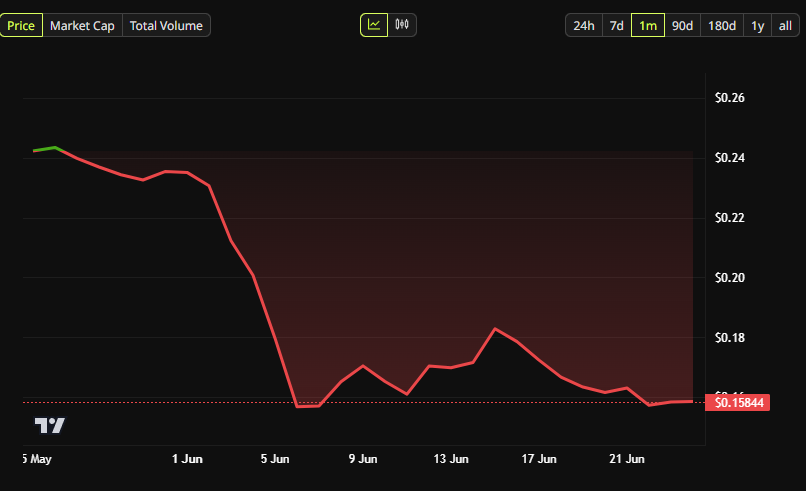
Cardano (ADA) launched the public testnet for its Leios scaling protocol today, June 23. It is the most significant technical milestone the network has hit in years, and it arrives with ADA sitting at a five-year price low.
The testnet carries the name Musashi Dojo, after 16th-century samurai Miyamoto Musashi. Its five phases map to the chapters of Musashi’s Book of Five Rings: Earth, Water, Fire, Wind, and Void, progressing from basic design validation through adversarial testing and into mainnet readiness.
The Price Problem
The launch lands in difficult conditions. ADA hit its lowest level in five years this month, down roughly 35% over the past 30 days. Meanwhile, its all-time high of $3.09 came on September 2, 2021, today’s price of $0.16 sits 95% below that peak.

The backdrop is bleak. At first, the analytics platform TapTools shut down earlier this year while Cardano cancelled its 2026 Singapore Summit. Hoskinson warned of a “wave of failures” among Cardano DeFi projects in the same period.
Cardano has lived through an unusual contradiction. The network kept shipping and moving toward its roadmap, but the price went nowhere. Leios removes the most persistent technical criticism of the chain: that the base layer cannot scale.
Whether the market reprices over the next five months of testing, or waits for mainnet, remains the question that defines Cardano’s second half of 2026.
How Leios Works
Leios runs as an overlay on Cardano’s existing Ouroboros Praos mechanism. When demand rises, an elected slot leader produces an additional “endorser block” that travels in parallel with the standard Praos block.
The upgrade targets scaling Cardano from its current throughput of 4.5 KB/s to 200 KB/s. The official roadmap puts that at 30 to 65 times current Praos levels.
Input Output product manager Carlos Lopez de Lara confirmed the initial rollout starts at two to five times current throughput, with the full ceiling available as demand grows.
The Leios governance proposal passed with over 84% support from Cardano’s delegated representatives, and Lopez de Lara is targeting a November 2026 hard fork.
The Cardano 2030 Vision requires scaling from today’s roughly 800,000 monthly transactions to over 27 million; the current base layer cannot get there alone.
The post Cardano Launches Leios Musashi Dojo Testnet, With ADA at 5-Year Lows appeared first on BeInCrypto.


Bitcoin fell toward $63,000 on Tuesday, caught in a broad retreat from risk as investors pulled out of the technology stocks that have led markets all year.
The token traded around $63,640, down 0.9% over 24 hours and 3.3% on the week, per CoinDesk data, after touching about $65,076 on Monday and sliding through the session. The selling was marketwide. Ether fell 0.9% to $1,719 and is also down 3.3% on the week, XRP dropped 1.6% to $1.12 for a 9% weekly loss, solana lost 3.4% to $71 and dogecoin slid 6.6% over seven days.
Tron was the rare gainer, up 1.3% on the day and 4.6% on the week. Hyperliquid’s HYPE fell 4.8% on the week.
The pressure came from outside crypto. A rotation out of this year’s best-performing technology and chip shares sank global equities, with a gauge of Asian stocks falling more than 2% after a record close and South Korea’s Kospi plunging more than 6% on fears that the rally in chipmakers had run too far.

US President Donald Trump signed two executive orders on Monday to push to build a quantum computer and to focus on creating cryptography that can resist quantum attacks.
The orders aim to take a “cohesive, whole-of-government approach” to accelerate the deployment and commercialization of quantum computing and “protect sensitive technologies and work with allies to ensure adversaries cannot use QIST [Quantum Information Science and Technology] to undermine national security.”
The orders come as China ramps up its quantum computing ambitions following the announcement of its “Five-Year Plan” in March, which aims to expand investment in scalable quantum computers and the development of an integrated space-earth quantum communication network.

Source: The White House
Trump’s orders state that within 180 days, relevant agencies must update the National Quantum Strategy to support commercialization and industry partnerships.
Various agencies are also tasked with identifying implications of increasing scale and performance of commercial quantum computers, “such as the implications for the migration to post-quantum cryptography.”
Related: Researchers say quantum computers could, in theory, be ready by 2030
The order also establishes Quantum Computer for Application Development and Discovery Science (QC-ADDS), a national effort to pursue the development of a quantum computer at a scale intended to “initiate the era of quantum-enabled scientific discovery.”
Focus on post-quantum cryptography
The other executive order aims to secure the US against quantum-assisted cryptographic attacks and is more focused on upgrading to post-quantum cryptography.
“We’re going to be investing in American quantum leadership like never before to stay ahead of the pack,” Trump said.
The order directs the Office of Management and Budget and the National Cyber Director to lead an accelerated, nationwide migration to post-quantum cryptography, ensuring the nation’s data stays secure as quantum technology evolves.
“The advent of large-scale quantum computers, particularly in the hands of adversaries, will pose a significant threat to widely used cryptographic security systems,” the order said.
Major crypto blockchains such as Ethereum and Solana have already started working on post-quantum roadmaps, while the Bitcoin community is still divided on how to approach securing old coins against the quantum threat.
Magazine: Nobody knows if quantum secure cryptography will even work


Ethereum co-founder Vitalik Buterin has challenged internet users to identify an anonymous Ethereum document he says he wrote earlier this decade.
Summary
- Vitalik Buterin asked the internet to identify an anonymous Ethereum document he wrote this decade.
- The challenge tests whether AI writing analysis can weaken online anonymity for crypto contributors.
- Related coverage shows Buterin has tied AI, privacy and Ethereum security to wider online debates.
The post turns a privacy debate into a public test of AI text analysis.
Buterin said there have been claims that AI text analysis will make online anonymity hard to keep. He then wrote, “So let me cannibalize a piece of my own anonymity to do an experiment.” He asked users to find a published Ethereum document that he wrote without using his name.
The document has not been named. Buterin described it as a medium-importance Ethereum document and estimated that around 200 to 2,000 Ethereum documents are as important or more important. He added, “Find it,” while noting that he did not know how easy or hard the task would be.
Challenge puts stylometry back in focus
The test centers on stylometry, a method that compares writing style, word choice and structure to link text to an author. Researchers and investigators have used this type of analysis for years, but newer AI tools can scan far larger sets of writing faster than manual methods.
Buterin is a strong test case because he has a large public writing record. His public work includes blog posts, research notes, Ethereum discussions, social media posts and technical comments. That broad record may give AI tools more material to compare against any anonymous Ethereum text.
No one had publicly confirmed a successful identification of the document at press time. That leaves the experiment open and makes the result hard to judge until Buterin or another reliable source confirms a match.
Related Ethereum and AI debate grows
The challenge also fits with Buterin’s recent focus on AI safety and privacy. As crypto.news earlier reported, Buterin urged a local-first approach to AI, warning that cloud-based tools can expose user data and create risks from leaks, manipulation and unwanted actions.
He has also linked AI to Ethereum development. crypto.news reported in May that Buterin said AI-assisted formal verification could become the “final form” of software development. That report noted his view that AI could help Ethereum ship code with machine-checkable proofs of correctness.
The latest test looks at another side of AI. Instead of using AI to improve code or security checks, it asks whether AI can weaken anonymity by finding a writer behind a text. For Ethereum, that matters because many contributors use pseudonyms when they write, build or discuss protocol ideas.
Privacy remains central to Ethereum discussions
The experiment also comes after crypto.news reported that Buterin mapped a three-step Ethereum privacy upgrade in May. That plan focused on account abstraction with FOCIL, keyed nonces and access-layer work to reduce metadata leaks and censorship risks.
Those privacy efforts deal mainly with transactions and user activity. Buterin’s latest test moves the privacy debate into authorship. It asks whether writing style itself can become a data trail, even when a person avoids using a real name.
For now, the challenge has no confirmed answer. It may show that AI can trace pseudonymous authors through writing patterns, or it may show that anonymity still holds when the search area is large. Either outcome would add fresh context to the wider debate over AI, privacy and Ethereum’s open contributor culture.

Opinion: No mavericks on conference floor as need for speed agreed

KOSPI Falls 8%, Triggers Circuit Breakers, as Big Tech Selloff Hits Asia

House Of The Dragon Season 3: Jace Velaryon Actor Reacts To Character’s Death


-

 Fashion4 days ago
Weekend Open Thread: Miami – Corporette.com
-
 Tech7 days ago
The Adder At The Heart Of Intel’s 8087 FPU
-

 Entertainment2 days ago
Renter of Home in Anne Heche Crash Denies Settlement With Son
-

 Tech18 hours ago
Microsoft accidentally kills epic Outlook email threads
-

 Business2 days ago
Soccer-U.S. defends Iran World Cup travel restrictions, says discussions ongoing
-

 Politics4 days ago
BBC Reporter Discusses Cross Party Criticism Of Trumps Iran Deal
-
 Business3 days ago
Wall Street Week Ahead: Investors see Micron earnings as pulse check of AI rally momentum
-

 Tech5 days ago
AWS enters the context layer race with a graph that learns from agents, not manual curation
-

 Crypto World3 days ago
HIVE shares jump as $220M AI deal speeds Bitcoin mining pivot
-
 Crypto World3 days ago
Can Charles Hoskinson Really Rescue Cardano?
-

 Crypto World3 days ago
Jake Chervinsky accuses CME of protecting derivatives monopoly
-

 Tech11 hours ago
Nearly 7,000 fake Amazon domains registered ahead of Prime Day 2026, researchers warn
-

 Sports4 days ago
FIFA World Cup 2026: Canada beat 9-men Qatar 6-0 to register first ever win | FIFA World Cup 2026
-

 Business2 days ago
MHP SE 2026 Q1 – Results – Earnings Call Presentation (OTCMKTS:MHPSY) 2026-06-20
-

 Politics3 days ago
Andy Burnham and the meaning of Makerfield
-

 Business4 days ago
Brexit cost 6% of UK economy, Bank of England company data suggests
-
 Tech2 days ago
Signal’s Meredith Whittaker says AI chatbots ‘are not your friends’ and calls Copilot agents a backdoor
-

 Crypto World5 days ago
Anthropic’s Dario Amodei Urged AI Unity at G7, Even as US Banned His Models
-

 Tech5 days ago
Weeks Of In-The-Field Testing And A Verdict
-

 Entertainment3 days ago
Jose Alvarado Wants Taylor Swift at More Knicks Games
You must be logged in to post a comment Login