
Crypto World
Bakkt Finishes Acquisition of Stablecoin Infrastructure Firm

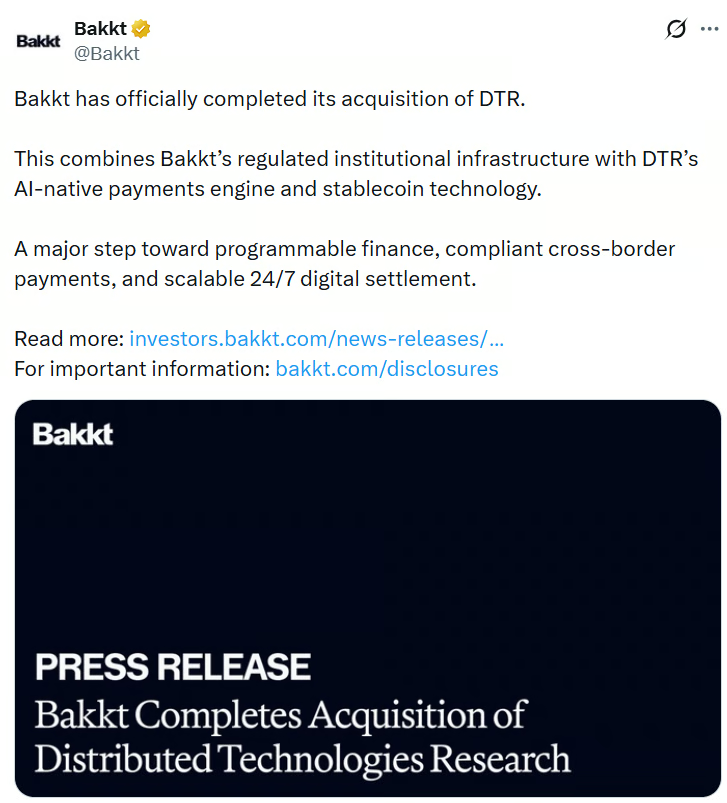
Digital asset company Bakkt completed its acquisition of stablecoin infrastructure firm Distributed Technologies Research (DTR) through an equity-based transaction as part of its bid to create a digital settlement layer.
Bakkt CEO Akshay Naheta said on Thursday that the deal aims to combine Bakkt’s institutional infrastructure with DTR’s native artificial intelligence payments engine and stablecoin technology to create a 24/7 digital settlement layer.
“The architecture of money movement rarely evolves at this level,” he said. “This transaction accelerates the re-platforming of global financial infrastructure. By fully integrating DTR’s technology, we are introducing stablecoin functionality as a critical bridge between legacy financial systems and the next generation of digital assets.”
The global stablecoin market has grown to roughly $320 billion, with adoption expanding across both developed and emerging economies as banks and institutions seek to leverage the technology for faster payments and other benefits.
Source: Bakkt
Acquisition deal completed through share issuance
As part of the deal, Bakkt issued more than 11.3 million shares to the beneficial holders of DTR, with the possibility of an additional 725,592 shares, according to the announcement.
The deal was initially revealed in January and originally involved 9.3 million shares. The company also announced a corporate name change to Bakkt Inc. at the same time.
Ahead of the deal’s completion, Bakkt’s share price (BKKT) fell roughly 8% to $7.86 by Wednesday’s close, but recovered to $8.62 by Thursday’s market close.
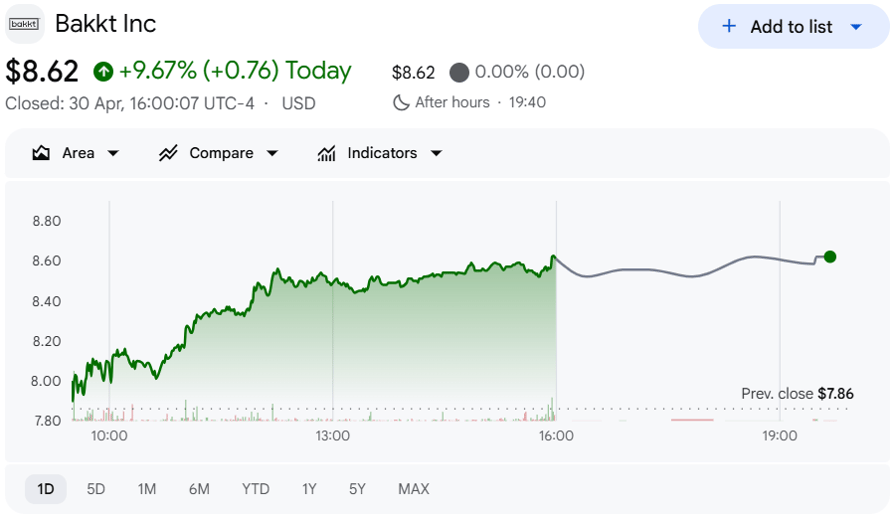
Bakkt’s share price fell Wednesday but has since risen 10%. Source: Google Finance
Bakkt threatened with delisting in 2024
Founded in 2018, Bakkt is 55% owned by Intercontinental Exchange (ICE), which also owns the New York Stock Exchange (NYSE), and has received backing from major partners such as Starbucks and Mastercard.
In March 2024, the NYSE threatened to delist Bakkt’s shares because the price had fallen below $1 and remained there for 30 days.
By May the company disclosed to regulators that there was “significant uncertainty associated with our expansion to new markets and the growth of our revenue base, given the uncertain and rapidly evolving environment associated with crypto assets.”
Related: Stablecoins overtake Bitcoin in Latin America crypto purchases — Bitso
Months later, reports said President Donald Trump’s media and tech group, Trump Media, was in advanced talks to acquire the company but the deal ultimately fell through.
The company has since launched multiple fundraising rounds through share sales, with the latest, in February, aiming to raise $48 million.
Magazine: Forget stablecoin yield, how does the CLARITY Act treat DeFi?

Crypto World
Paris Blockchain Week 2026. Arcanum and Mercuryo on institutional capital, MiCA, and crypto market maturity


At Paris Blockchain Week 2026, the conversation around digital assets felt different. The old divide between traditional finance and crypto-native firms appeared less relevant, replaced by discussions around capital deployment, regulation, execution, and market structure.
BeInCrypto spoke exclusively with Arcanum and Mercuryo to understand what institutional players want now, where Europe stands after MiCA, and how the market may evolve over the next two years.
What surprised you most at PBW, and what does European institutional capital want from crypto?
Michael Ivanov, Chief Executive Director at Arcanum Foundation: What struck me most was how the “us versus them” dynamic between traditional finance and crypto-native firms has effectively dissolved. It felt like a structural change, rather than a sentiment change.
The buy-side interest at PBW was precise. Privacy and composability on-chain are essential for serious institutional capital flows. European institutions are asking whether the market can support the accountability requirements they operate under. That is a fundamentally different conversation, and one that demands market-level answers rather than product pitches.
What from Arcanum Pulse’s retail roots still matters to institutions?
Michael Ivanov: More than most assume. The discipline of public, real-time verifiability — every trade on record, no black box — emerged from a retail context where trust has to be earned daily. What we are seeing now is institutional compliance teams arriving at the same requirement from a different direction. A live, auditable track record is not a retail feature. It is what a risk committee needs before it can approve an allocation.
What retail also forced us to do early was pass real scrutiny. To operate as an Official Broker on Bybit across our product line, we went through full KYB verification — the kind of institutional-grade compliance review most algo products never face because they never seek formal recognition from a regulated exchange.
That process matters. It means the trading statistics are not the only thing validated. The entity behind them has been validated too.
The architecture did not need to change for institutions. The framing around it did, but the compliance setup was already there. When a risk committee asks, “Does it perform?” and “Who is running this, and can we trust the structure around it?” we have answers that go beyond the chart.
During October’s liquidations, none of your clients lost deposits. What worked in the architecture?
Michael Ivanov: The strategy does not use stop-losses. What protected clients was the opposite of what most systems do under stress. Instead of cutting exposure, the algorithm read the volatility as an entry signal and executed diversified buys into the drawdown.
By the time markets recovered through the night, those positions were already in profit. That month ended with over 6% average return — one of the strongest in our track record, and it came precisely because of the liquidation event, not despite it.
The architecture is built to treat volatility as information, not threat. The risk management is in the entry logic and position sizing, not in exits. That distinction matters more than most people realise. A system that exits under pressure locks in losses. A system sized and diversified correctly from the start can stay in and capture the recovery.
What has MiCA changed in institutional demand, and where is the main bank-to-exchange bottleneck now?
Arthur Firstov, Chief Business officer at Mercuryo: The introduction of MiCA has provided much-needed legal grounding for institutions to adopt digital token services. The legislation has removed the ambiguity that existed before.
MiCA has opened the door for digital token services to be adopted in so-called TradFi payment systems. As for bottlenecks, here lies the opportunity, as fully compliant connectivity services remain critical for the industry to grow. It is in the linkages between TradFi and DeFi services where the battle will be won, and in this regard Mercuryo is playing an important role.
Is algorithmic trading becoming standard in crypto, or is this still a different market?
Michael Ivanov: It is becoming standard, but the conditions that make it reliable are still maturing. Liquidity depth in major pairs now supports serious algorithmic systems. The missing piece sits around custody arrangements, counterparty transparency, and jurisdiction-specific compliance.
In traditional markets, algos run on rails built over decades. In crypto, operators are stress-testing those rails in real time. That asymmetry is both the risk and the opportunity. The funds that build rigorous systems now will have structural advantages that are difficult to replicate once the market normalises.
How do you navigate regulatory fragmentation across Europe, the U.S., and Asia, and what risk is still being ignored?
Michael Ivanov: Regulatory fragmentation is not just a compliance problem. It is a product design problem.
Our decision to operate through Bybit, and to restrict access for users in the U.S. and EU, was not a workaround. It was a deliberate choice to stay within legally clear boundaries rather than test grey zones that could put clients at risk.
That discipline costs you some markets. It also means you are not carrying hidden regulatory exposure that surfaces at the worst possible moment.
What we observe across Asia, and particularly in Hong Kong, is a regulatory environment actively constructing frameworks to attract institutional capital. That is where we are building.
The risk still being ignored more widely is counterparty concentration. Most funds have not seriously stress-tested what happens if their primary exchange faces a liquidity event. Regulatory conversations focus on disclosure and custody. Operational concentration risk often sits outside that discussion.
Where do retail and small-fund infrastructure needs overlap, and where do they split?
Arthur Firstov: Retail and small fund infrastructure needs overlap more than people assume. Both require reliable on- and off-ramps, secure custody, compliant payments, clear reporting, and a user experience that reduces operational friction.
Nobody wants fragmented rails, settlement uncertainty, or systems that demand specialist knowledge to operate safely. These principles shape how Mercuryo thinks about its infrastructure, and why building for intuition, trust, and workflow integration sits at the centre of everything we do.
The differences emerge at the level of complexity, control, and accountability. Retail infrastructure is about simplicity and confidence. The priority is ease of use, fast transactions, and protections that limit the risk of user error.
Small funds need something different. Their infrastructure has to support multi-step approvals, role-based permissions, auditability, reconciliation, and more sophisticated reporting. They are managing mandates, controls, counterparties, and fiduciary obligations. That means the infrastructure has to support operational precision.
Retail can tolerate standardisation in a way small funds cannot. A retail user is well served by a streamlined product with limited choices. A small fund may need to tailor workflows around execution, custody arrangements, treasury policies, or jurisdiction-specific compliance requirements.
The overlap is secure, seamless, compliant infrastructure. The divergence is how much complexity the product needs to expose. For retail, good infrastructure hides complexity. For small funds, good infrastructure manages it. The strongest platforms are those that can serve both without treating them as the same user.
What needs to change by PBW 2028 for the institutional adoption story to look different?
Michael Ivanov: The products that matter by 2028 will not be the ones that solved a single problem well. They will be the ones that built the connective tissue between trading infrastructure, distribution, and on-chain capital flows — and did it in a way that scales across different types of participants, from individual allocators to institutional funds to exchanges building their own branded offerings.
That is the trajectory Arcanum Foundation is on. Arcanum Pulse was never meant to be a standalone bot. It is the foundation layer of a broader infrastructure — one that already powers white-label products for exchanges and funds, and that we are actively extending.
In the coming months, we will be bringing new products to market that expand what that infrastructure can do and who it can serve. We are not announcing them today, but the direction is consistent. We are building the layer others build on, not just a product they allocate to.
By 2028, the institutional adoption story looks different when the infrastructure is invisible — when the rails are so embedded in how capital moves through crypto markets that the question stops being “should we use algorithmic infrastructure” and starts being “which layer of it do we want to sit on.” We intend to be that layer.
The post Paris Blockchain Week 2026. Arcanum and Mercuryo on institutional capital, MiCA, and crypto market maturity appeared first on BeInCrypto.
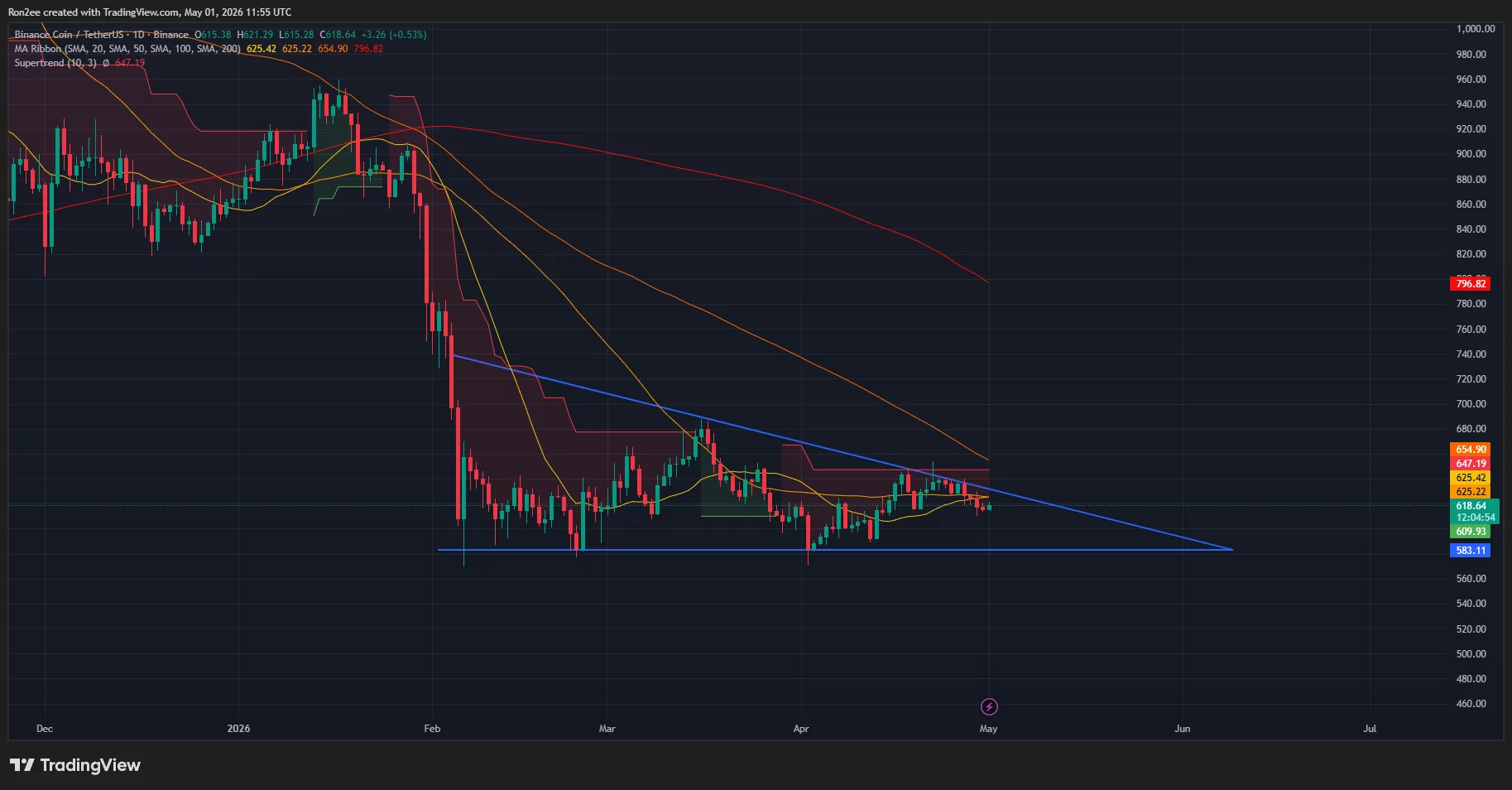
BNB price is consolidating within a descending triangle pattern, with a horizontal support near $600 and a series of lower highs pressing against a downward-sloping resistance trendline, pointing to a potential breakdown.
Summary
- BNB price trades near $616, compressing within a descending triangle with key support at $600 and resistance around $625–$630.
- Price remains below major moving averages, with bearish MACD divergence and weakening momentum signaling downside risk toward $579–$580.
- Broader market pressure persists, with Fear & Greed Index in fear territory and Bitcoin’s $70K–$72K support seen as critical for BNB’s direction.
According to data from crypto.news, BNB (BNB) price was trading around $616 at press time on May 1, down roughly 1% over the past 24 hours. Over the past week, the token has largely moved between $600 and $635, reflecting a narrowing range as price compresses toward the apex of the triangle.
The asset remains significantly below its recent highs, still down more than 30% from levels above $900 seen earlier this year. Participation has also cooled, with price action lacking strong follow-through on either side. When price compresses near major support while volatility declines, it often signals that a larger move is approaching.
BNB price remains at risk of more downside as broader market conditions continue to weigh on risk assets like it.
The Crypto Fear & Greed Index remains in fear territory at 26, indicating weak risk appetite among investors. Traders appear hesitant to aggressively buy dips, especially as macro uncertainty builds.
BNB also remains highly correlated with Bitcoin (BTC). Analysts warn that if Bitcoin loses the $73,000–$74,000 support range, it could trigger a broader market sell-off, increasing downside pressure on altcoins like BNB.
At the same time, macroeconomic factors are adding to volatility expectations. Concerns over the Federal Reserve maintaining higher interest rates have reduced liquidity in risk markets. Upcoming U.S. data releases, including Non-Farm Payrolls on May 8 and CPI data on May 12, could further drive sharp price swings.
BNB price analysis
The daily chart shows BNB forming a tightening descending triangle, with a flat support near $580 and a descending resistance trendline connecting lower highs since February.
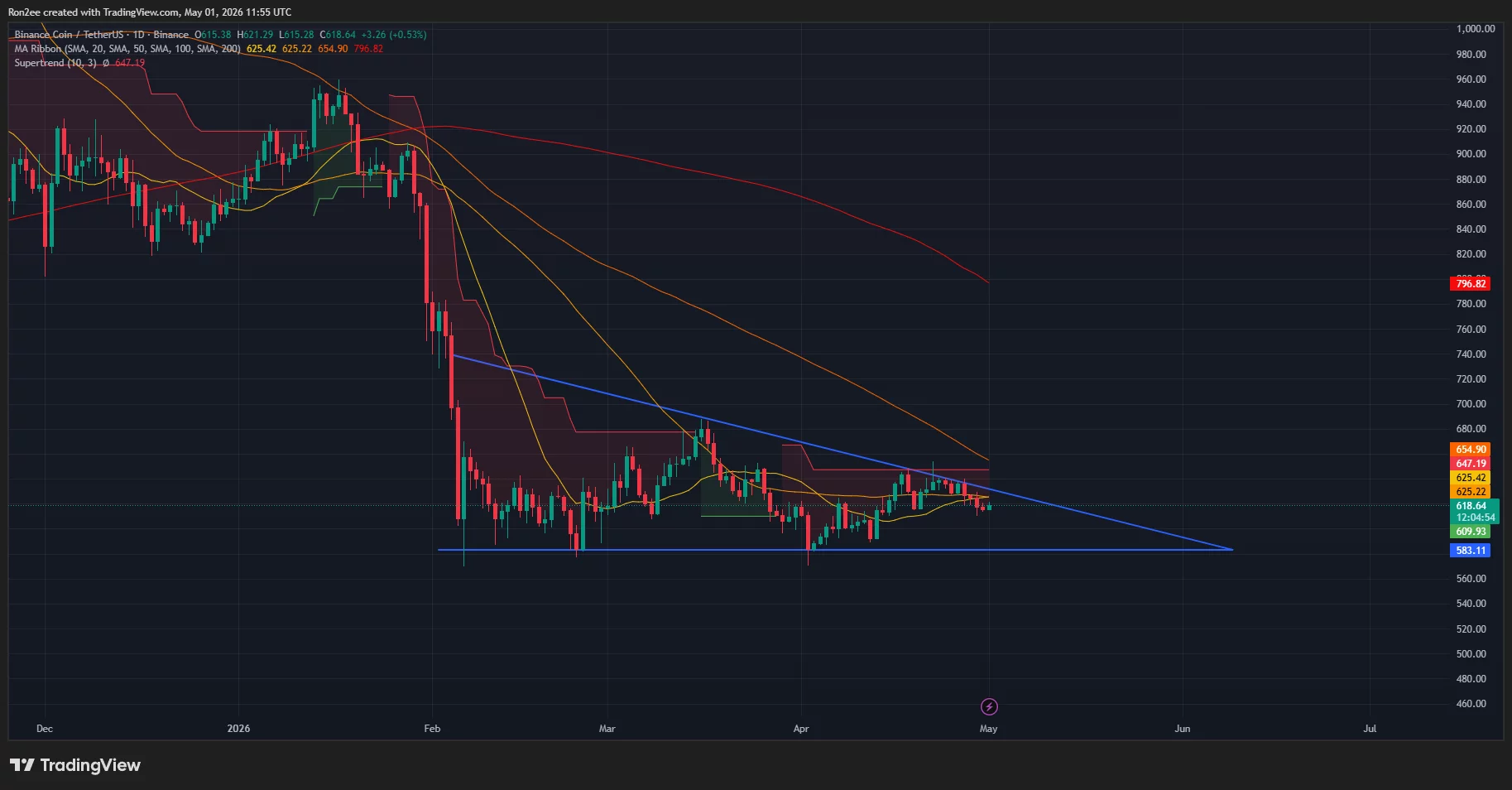
Repeated tests of the $600–$610 zone suggest buyers are still defending this level. However, each bounce has been weaker, indicating fading demand.
Momentum indicators also lean bearish. BNB is currently trading below its 50-day simple moving average near $625, a level that has now turned into resistance. The 100-day and 200-day SMAs, positioned higher around $654 and $796, respectively, further reinforce the broader downtrend.
In addition, a bearish divergence has been observed on the MACD histogram on the daily timeframe, suggesting that upward momentum is weakening despite recent attempts to stabilize.
Hence, a clean breakdown below the $600 support would confirm the bearish structure and could open the door toward the next major support near $580.
On the other hand, a strong move above the descending trendline and reclaim of the $625–$630 zone could invalidate the setup and shift momentum back in favor of buyers, though current signals suggest that scenario carries lower probability in the short term.
Disclosure: This article does not represent investment advice. The content and materials featured on this page are for educational purposes only.
Ripple CEO Brad Garlinghouse publicly reaffirmed the company’s strong commitment to XRP at the Bitcoin 2026 conference, directly confronting narratives suggesting the company has moved away from its native token.
The announcement came alongside news that Ripple is aggressively expanding into the Middle East and Africa.
CEO Confronts Skepticism
Speaking at the Vegas conference, Garlinghouse delivered a pointed message to critics. He stated that Ripple remains the largest holder of XRP worldwide and will continue supporting the token’s success.
“Ripple is extremely committed to make XRP the most useful digital asset, the most liquid digital asset, and the most trusted digital asset,” Garlinghouse said.
The statement directly addressed persistent criticism that Ripple abandoned XRP. Some observers argued that the company shifted its focus toward institutional payment solutions such as RippleNet and xCurrent, which do not require tokens.
Garlinghouse’s declaration signals that institutional payments and XRP adoption are complementary, not competing, strategies.
Middle East Expansion Accelerates
Beyond XRP commitments, Ripple announced the opening of a new regional headquarters in Dubai’s Dubai International Financial Centre (DIFC).
The move positions Ripple to expand operations across the Middle East and Africa. This region offers significant opportunities for the development of payment infrastructure and the adoption of blockchain technology.
Ripple’s treasury platform processes $12.5 trillion in annual payment volume across 13,000 connected banks. The Middle East expansion could unlock additional volume from regional financial institutions and payment providers.
XRP Army Vindication
The CEO’s remarks resonated deeply with XRP community members present at the conference. Years of skepticism about Ripple’s commitment to XRP have created tension between the company and its token holders.
Garlinghouse’s statement functioned as both reassurance and pushback. He emphasized that Ripple’s massive XRP holdings align the company with the interests of token holders. Ripple profits when XRP succeeds.
This alignment contrasts with narratives suggesting Ripple views XRP as baggage or a legacy obligation rather than a core strategic asset.
Institutional Adoption and XRP Integration
The CEO’s remarks suggest plans to more deeply integrate XRP into institutional payment flows. As RippleNet adoption grows, opportunities emerge to incorporate XRP settlement for certain transaction types.
Garlinghouse emphasized making XRP the most liquid digital asset. This implies building infrastructure that enables financial institutions to easily trade and hold XRP for settlement.
The three stated goals, most useful, most liquid, most trusted, paint a vision of XRP becoming the preferred settlement token for international payments.
Skeptics Remain
However, not all observers view Ripple’s strategy positively. Some argue utility remains limited despite years of development. Others contend that stablecoins like USDC offer superior payment characteristics.
Ripple’s commitment to XRP success must ultimately manifest in adoption metrics. Token holders will judge the company’s sincerity based on whether transaction volume and adoption accelerate following these announcements.
The post Ripple CEO Sends Strong XRP Signal From Las Vegas appeared first on BeInCrypto.
US-listed spot Bitcoin (BTC) exchange-traded funds (ETFs) finished April in the green as Bitcoin rallied throughout the month.
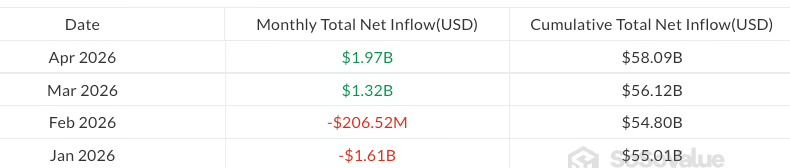
Bitcoin ETFs drew $1.97 billion in inflows in April, well above March’s $1.37 billion, marking their highest monthly inflows of the year, according to SoSoValue data.
With inflows in March and April offsetting outflows in January and February, Bitcoin ETFs now show about $1.47 billion in net inflows for 2026. The cumulative net inflows to the products since they launched have topped $58 billion.
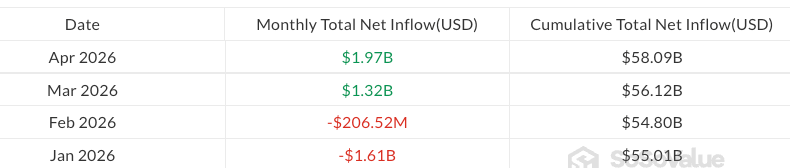
Monthly spot Bitcoin ETF flows in 2026. Source: SoSoValue
The April inflows came alongside a 12% rise in Bitcoin, its strongest monthly gain since April 2025, when it rose more than 14%, according to CryptoRank.
April’s data comes ahead of the 13F filing season in May, when major financial institutions will disclose their holdings in crypto ETFs for the first quarter of 2026.
ETFs post $490 million in late-month outflows
Late-month redemptions were not enough to offset April’s inflows. The ETFs saw around $490 million in outflows during three days in late April.
BlackRock’s iShares Bitcoin Trust ETF (IBIT) was the dominant driver of gains in April, bringing around $2 billion in net inflows. On the other hand, Grayscale Investments’ Bitcoin Trust ETF (GBTC) was the biggest loser, with net outflows totaling around $280 million.
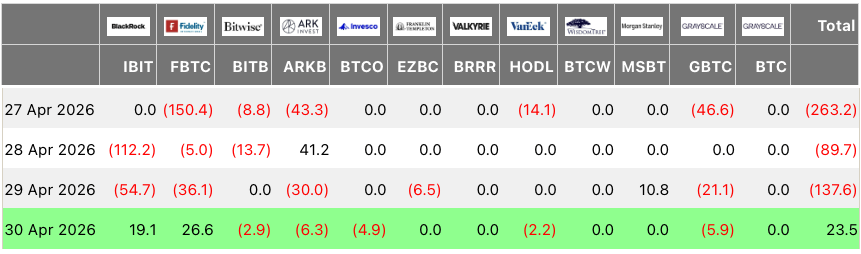
Daily spot Bitcoin ETF flows by issuer since April 27, 2026. Source: Farside
The Morgan Stanley Bitcoin Trust ETF (MSBT), which began trading on April 8, generated around $194 million in inflows, with no single day of outflows over the month.
The first month of gains for Ether ETFs since October 2025
April’s positive trend extended to some altcoin ETFs, with Ether (ETH) funds logging their first monthly inflow since October 2025, at $356 million versus about $570 million in October 2025.
Still, Ether ETFs remain in negative territory after four months of 2026, with about $413 million in net outflows year to date, according to SoSoValue. The cumulative net inflows since launch stood at about $11.9 billion.
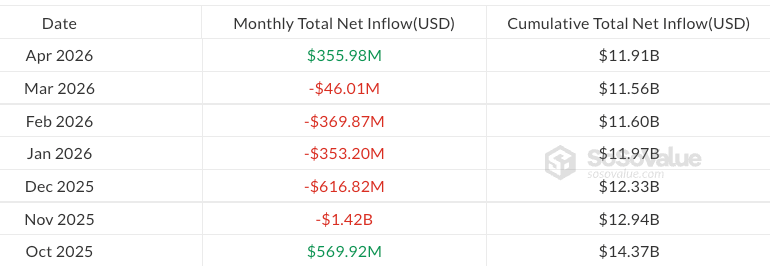
Monthly spot Ether ETF flows since October 2025. Source: SoSoValue
XRP funds also surged in April, logging their strongest month since December 2025 with $81.6 million of inflows. The ETFs saw about $124 million in net inflows across the first four months of 2026, while total cumulative inflows stand at around $1.3 billion.
Related: Bitcoin risks extended retreat as April rally was futures-driven: CryptoQuant
Dogecoin (DOGE) ETFs rallied in April as well, logging $2 million of inflows, accounting for roughly 21% of total cumulative inflows of about $9.6 million.
Meanwhile, Solana (SOL) ETFs saw $38.7 million in April inflows, the smallest monthly total on record, compared with cumulative inflows of about $1 billion.

Key Highlights
- Virtual assets excluded from Brazil’s regulated foreign exchange payment infrastructure
- Central bank enforces stricter supervision over international crypto-based transactions
- Resolution bars stablecoins from operating within authorized settlement systems
- Regulated payment providers prohibited from using crypto for cross-border services
- Rising stablecoin adoption prompts Brazil to implement stronger payment oversight
Brazil has prohibited the use of virtual assets for settlement within its regulated foreign exchange payment infrastructure, strengthening oversight of cryptocurrency-related cross-border transactions. Banco Central do Brasil released Resolution BCB No. 561, revising guidelines for international payment service providers. Under these updated provisions, cryptocurrencies and stablecoins are now excluded from settling transactions through supervised payment channels.
Central Bank Prohibits Virtual Assets in Foreign Exchange Infrastructure
According to Banco Central do Brasil, eFX service providers must execute foreign exchange transactions when processing payments involving international counterparties. Alternatively, they may utilize movements through non-resident Brazilian real accounts as permitted by the revised regulation. The resolution explicitly prohibits virtual assets from being used for these payment and receipt activities.
This regulation governs authorized international payments and transfers operating under Brazil‘s foreign exchange regulatory structure. It impacts companies functioning within the official eFX ecosystem. Service providers are forbidden from utilizing cryptocurrencies or stablecoins as settlement instruments within this supervised framework.
The directive does not constitute a comprehensive prohibition on cryptocurrency activity in the country. Crypto transfers remain permissible outside the designated eFX infrastructure. Rather, the central bank has eliminated one regulated pathway for virtual asset settlement.
Temporary Provisions Apply to Unauthorized Service Providers
The resolution establishes transitional arrangements for companies not yet included on the authorized eFX provider registry. These entities may maintain operations while pursuing central bank approval. They must submit authorization requests by the May 31, 2027 deadline.
During this interim phase, these firms must adhere to identical settlement requirements. Their transaction processing must rely on foreign exchange operations or non-resident real account movements. Virtual assets remain prohibited even during the pre-approval period.
Brazil seeks to maintain cross-border payment operations within regulated financial infrastructure. The regulation provides the central bank with enhanced monitoring capabilities over payment flows. It restricts the application of private cryptocurrency settlement within authorized international transfer services.
Expanding Stablecoin Adoption Prompts Enhanced Regulatory Measures
Brazil has strengthened cryptocurrency supervision as stablecoins assume a more prominent position in domestic financial activity. Regulatory authorities incorporated virtual assets into the financial and foreign exchange regulatory framework in November 2025. These provisions established licensing requirements for virtual asset service providers.
The central bank has connected stablecoin activity to issues regarding tax compliance, money laundering vulnerabilities, and reserve transparency. Authorities have examined tokens created beyond Brazil’s regulatory jurisdiction. As a result, certain stablecoins may encounter stringent restrictions in the local marketplace.
The recent eFX prohibition reinforces Brazil’s broader initiative toward supervised crypto payment infrastructure. It also safeguards the foreign exchange system from unregulated settlement mechanisms. Brazil is establishing more defined boundaries between cryptocurrency usage and regulated payment infrastructure.



SBI Group has partnered with Visa on a credit card product that allows users to earn crypto assets through card rewards.
Summary
- SBI’s Visa card lets users earn crypto rewards in Bitcoin, Ethereum, and XRP.
- SBI VC Trade and Aplus will support the crypto rewards and card service.
- SBI is also discussing a Bitbank deal to expand its Japan crypto exchange presence.
The card supports Bitcoin, Ethereum, and XRP rewards through SBI VC Trade and Aplus. The product links daily card spending with crypto rewards. It also shows SBI’s continued push to connect traditional finance with regulated digital asset services in Japan.
Meanwhile, the new card gives users exposure to major crypto assets without direct spot purchases. Rewards are tied to BTC, ETH, and XRP, which are among the most traded digital assets in Japan.
SBI VC Trade will support the crypto side of the service. Aplus, part of SBI Shinsei Bank Group, will support the credit card and points structure.
Bitbank talks add exchange growth angle
The card launch comes as SBI Holdings is also seeking a larger role in Japan’s crypto exchange market. As we reported earlier today, SBI has started talks with Bitbank over a capital and business alliance that could make Bitbank a consolidated subsidiary.
The company plans to acquire shares after due diligence and internal procedures. The timing and structure of the transaction will be discussed later.
Moreover, SBI’s Bitbank talks follow SBI VC Trade’s merger with Bitpoint Japan in April 2026. This shows faster consolidation among Japanese crypto platforms.
Earlier this week, Bitbank has also expanded into crypto-linked payments. Its EPOS Crypto Card allows users to settle monthly bills with bitcoin balances and offers 0.5% cashback in crypto.


Japanese financial conglomerate SBI Holdings plans to acquire a stake in Bitbank, one of the country’s largest crypto exchanges.
The Tokyo-based broker submitted a letter of intent to Bitbank Co., Ltd. regarding the purchase of the exchange’s shares with the goal of turning it into a consolidated subsidiary, according to an announcement on Friday.
SBI frames the Bitbank move as part of its broader strategy to expand its crypto footprint and strengthen its position ahead of potential regulatory changes in Japan.
Japan’s cabinet approved a draft amendment last month that would classify cryptocurrencies as financial products, bringing crypto assets under the Financial Instruments and Exchange Act, which is used for stocks and other securities. If passed during the current parliament session, the law could take effect as early as fiscal 2027.
SBI already absorbed Bitpoint, a regulated Japanese crypto exchange that offers spot trading and has offered an onchain bond from which investors can receive rewards in XRP.
The move is also part of SBI’s broader regional expansion push, having disclosed plans to acquire a majority stake in Singapore-based Coinhako, a MAS-regulated digital asset platform in February.
SBI has also commenced a Visa partnership to launch credit cards that automatically convert spending rewards into crypto (BTC, ETH, or XRP), enabling users to accumulate digital assets through everyday purchases, according to a separate announcement on Friday.
Crypto World
BTC price bounces as big tech earnings fuel optimism; short-term pressures remain: Crypto Daily
This is an excerpt from CoinDesk newsletter ‘Daybook.’ Sign up here, if you haven’t already.
Bitcoin climbed to $77,400, turning higher with other risk assets after earnings reports from the largest U.S. tech companies helped steady markets.
The gains came after Apple (AAPL) joined peers with an earnings report that improved sentiment across the industry. The companies, which include Google parent Alphabet (GOOG), Microsoft (MSFT), Meta (META) and Amazon (AMZN), all reported double-digit revenue growth earlier this week.
The earnings reports helped risk assets rise as renewed confidence in the AI growth story pulled investors back into equities and crypto, though the bounce so far reflects relief buying rather than conviction that a new rally has begun.
In a note shared with CoinDesk, crypto exchange Mercado Bitcoin said the market is dealing with “short-term pressure with still-mixed structural factors,” including reduced rate-cut hopes, ETF outflows and higher geopolitical risk.
Crypto prices held this week even as oil surged and spot bitcoin ETFs saw more than $400 million of outflows as April came to a close.
Oil remains a key factor. Higher crude prices from the Iran conflict and disruption in the Strait of Hormuz could feed inflation, making central banks less willing to cut interest rates. That can weigh on crypto and other risk assets by making cash and bonds more attractive.
The Federal Reserve kept rates at 3.50% to 3.75% this week, though the four dissenting voices are the most since 1992. Mercado Bitcoin said the decision and the absence of clear rate-cut signals led markets to reprice policy expectations.
“In the short term, the market should remain volatile and highly reactive to economic data,” the company’s head of research, Rony Szuster, said. “In the medium term, the structure remains dependent on the stabilization of institutional flows and the path of global monetary policy.”
Jerome Powell’s chairmanship at the Fed ends on May 15, and Kevin Warsh is expected to chair the June FOMC meeting,which could induce volatility given Warsh’s favor for tightening monetary policy.
The key test remains at $80,000. A break could draw new buyers, while a failed move may trigger selling if leveraged longs unwind. Stay alert!
Read more: For analysis of today’s activity in altcoins and derivatives, see Crypto Markets Today. For a comprehensive list of events this week, see CoinDesk’s “Crypto Week Ahead.”
What’s trending
Today’s signal

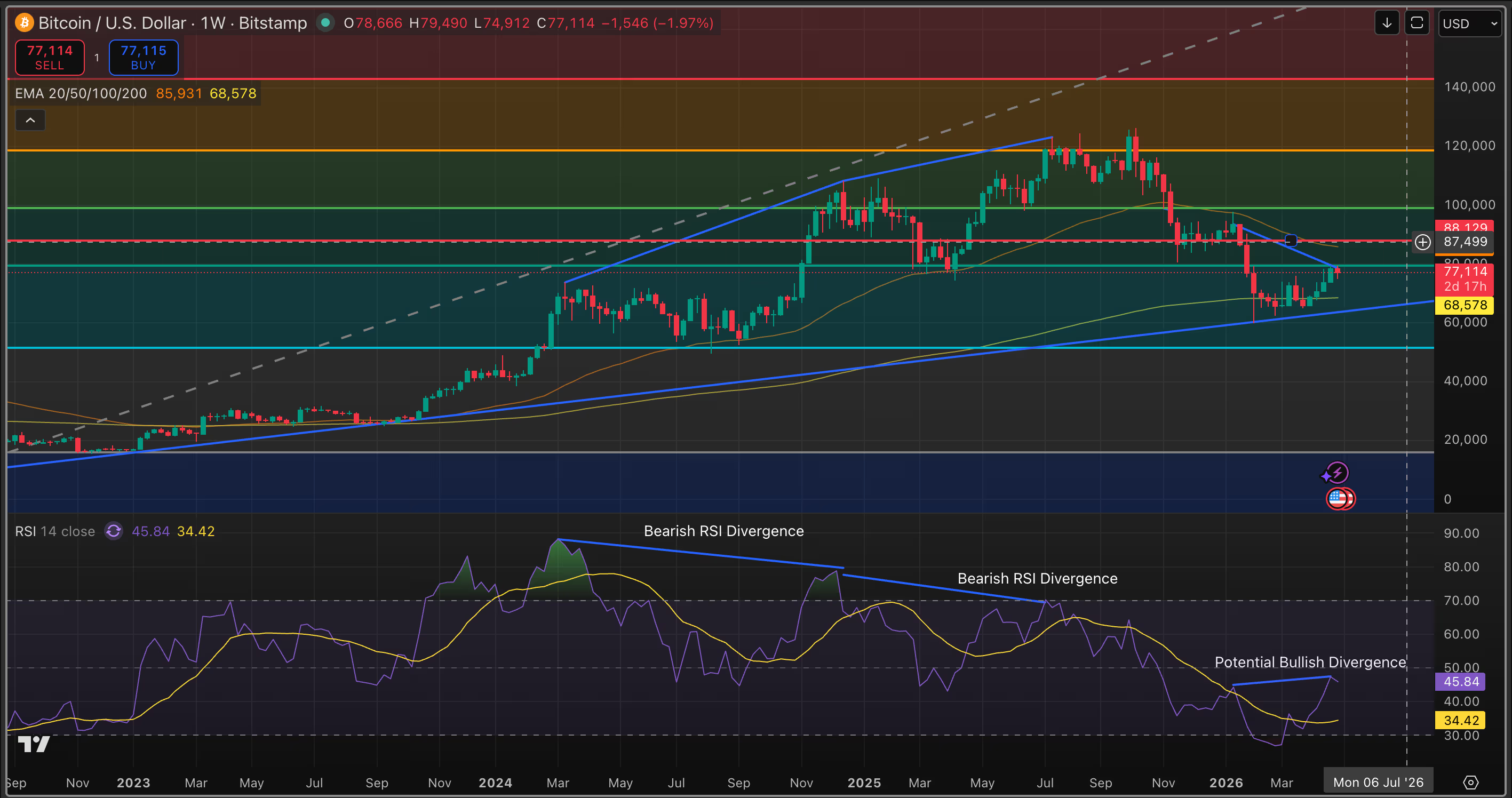
The weekly plot of the bitcoin price is testing rejection at the $80,000 resistance zone, with RSI showing early signs of a bullish divergence — the price printed a lower low while the RSI held higher — though unconfirmed on a weekly close.
A failure to break above keeps the price range-bound between the 200-day exponential moving average of about $68,000 and that level.


SBI Holdings has moved to expand its crypto presence by opening talks with Bitbank on a possible share acquisition. The planned deal could bring Bitbank under SBI as a consolidated subsidiary, strengthening its exchange network in Japan.
While key terms remain undecided, the discussions come soon after SBI’s Bitpoint merger, signaling faster consolidation in the country’s digital asset market as firms prepare for regulatory changes.
Move Follows SBI’s Bitpoint Merger
The talks come soon after another SBI crypto move. In April 2026, SBI VC Trade absorbed Bitpoint Japan through a merger.
That deal added another exchange business to SBI’s crypto operations. The Bitbank talks now show further expansion in the same market.
Japan’s crypto sector is also moving through a period of change. Regulators are discussing how crypto assets should be handled under financial market rules.
SBI’s latest step comes as large firms prepare for tighter oversight. It may also help the group combine exchange services under one structure.
If the deal is completed, SBI would control several major crypto platforms. That would increase its presence in Japan’s digital asset market.
Bitbank’s IPO Path Remains in Focus
Bitbank had earlier prepared for a Tokyo Stock Exchange listing. Reports said the company aimed to list by mid-2025.
The company also raised about 7 billion yen in 2021. That funding came through a capital and business alliance with Mixi.
Mixi became a major shareholder with a 26.2% stake. The investment helped Bitbank build an independent growth plan.
The new SBI talks may affect Bitbank’s listing path. Investors will watch how the share talks develop from here.
Bitbank has also promoted its security record since its founding. The company has said it has had zero hacking incidents.
Its stated vision is “realizing an open and fair society.” SBI may see that record as useful for wider financial services.

JPX is moving closer to a possible crypto ETF launch in Japan, with 2027 seen as the earliest target. CEO Hiromi Yamaji said preparations can begin once legal reforms and tax rules become clear.
The move comes as Japan reviews how crypto assets are classified and taxed, while asset managers show growing interest in regulated crypto investment products.
Jpx Waits for Legal Clarity Before Etf Launch
Japan Exchange Group may move ahead with crypto ETFs once the legal process is complete. The company operates Japan’s main securities markets. So, its role could shape future crypto investment products.
Yamaji told Bloomberg that JPX is ready to prepare when laws and taxes are clear. He said, ‘If the legal framework is in place and tax treatment is clear, it can be done anytime.’
The earliest listing could happen in 2027. However, the timing may shift to 2028 if law changes take longer.
Japan has not yet approved spot crypto ETFs in the same way as some other markets. For that reason, market operators are waiting for clear rules before listing such products.
Japan Reviews Crypto Tax Treatment
Japan is also reviewing how crypto gains should be taxed. Current rules treat many crypto gains as miscellaneous income. That can lead to tax rates as high as 55%.
A new tax proposal may place some crypto assets under financial product rules. If passed, certain gains could face a flat 20% tax rate. This would be closer to the system used for stocks.
The proposal may also allow losses to be carried forward for up to three years. That rule already applies to some financial products in Japan. It could help investors manage losses from market swings.
However, the plan may not cover every crypto activity. Staking, lending rewards, and NFTs may still need separate treatment. Final details will depend on future legislation.
Asset Managers Show Interest in Crypto ETFs
Yamaji said many asset managers have shown interest in crypto ETFs. These funds could give investors exposure to crypto through regulated markets. They may also offer a familiar structure for retail and institutional buyers.
Japan’s Financial Services Agency has supported wider debate on crypto reclassification. The move could bring crypto closer to traditional financial products. It may also support rules on market abuse and investor protection.
Still, the process remains unfinished. Lawmakers must decide how crypto assets should be defined and taxed. Regulators must also decide which assets can qualify for ETF products.
JPX is now watching the pace of reform. A 2027 launch remains possible, but the schedule depends on final rules. The next stage will decide how Japan opens its listed market to crypto ETFs.

Thousand homes to be built on the seafront in major plans to transform Porthcawl

VNQI: Good Low Cost Diversifier For Other US-Based Real Estate Investments (NASDAQ:VNQI)

Paris Blockchain Week 2026. Arcanum and Mercuryo on institutional capital, MiCA, and crypto market maturity

Manchester United reach agreement with Casemiro over contract clause amid transfer speculation

US brings back mandatory military draft registration

Steven Gerrard disagrees with Gary Neville over ‘shock’ Chelsea and Arsenal claim | Football


-

 Tech4 days ago
Register Renaming | Hackaday
-

 Fashion7 days ago
Weekend Open Thread – Corporette.com
-
Crypto World6 days ago
Hyperliquid $HYPE Rally Builds Momentum as AI Sector Enters Prove-It Phase
-

 Politics4 days ago
Drax board avoid their own AGM, accused of greenwashing & environmental racism
-

 Tech4 days ago
Images of Samsung’s rumored smart glasses have leaked
-
 Sports5 days ago
IPL 2026: Ruturaj Gaikwad registers slowest fifty of the season, enters all-time unwanted list | Cricket News
-

 Tech4 days ago
Why Blue Badges Disappeared From Toyota Hybrids
-

 NewsBeat5 days ago
LK Bennett closes all stores after entering administration
-

 Fashion3 days ago
Kylie Jenner’s KHY Enters a New Era with ‘Born in LA’
-
 Entertainment6 days ago
Mariah Carey Slams Deposition Claims In Brother’s Lawsuit
-

 Business3 days ago
Most Commercial Energy Audits Miss the Real Losses
-

 Business4 days ago
(VIDEO) Charlize Theron Climbs Times Square Billboard to Promote New Netflix Thriller ‘Apex’
-

 Business7 days ago
Jeanine Pirro announces closure of Federal Reserve building cost probe
-

 Tech5 days ago
Microsoft to roll out Entra passkeys on Windows in late April
-

 Crypto World3 days ago
CFTC’s AI will review U.S. crypto registration applications, chairman tells CoinDesk
-
 Crypto World7 days ago
Nvidia (NVDA) Stock Jumps 5% as Intel Earnings Ignite Semiconductor Rally
-

 Tech5 days ago
OpenAI’s Sam Altman apologizes for not reporting ChatGPT account of Tumbler Ridge suspect to police
-

 Business2 days ago
Barclay Brothers Avoid Bankruptcy: HSBC Drops High Court Petitions After IVA Deal
-

 Tech7 days ago
Apple’s Next CEO Has a Different Battle Ahead
-

 Tech3 days ago
Get Ready for More Brain-Scanning Consumer Gadgets
You must be logged in to post a comment Login