

Crypto World
Bankless co-founder sells ETH but stays bullish on Ethereum

Bankless co-founder David Hoffman said he sold his ETH after reassessing the long-running “ETH is money” thesis.
Summary
- Hoffman sold his ETH after saying the asset’s money thesis has largely played out now.
- He remains bullish on Ethereum, but says apps and L2s may capture more value directly.
- Related crypto.news coverage shows stablecoins, L2 fixes, and ETH treasuries still driving activity across Ethereum.
In a May 26 X post, Hoffman wrote that Ethereum has earned its current market position, but he sees less room for ETH to receive a new structural rerating from the market.
Hoffman said the sale does not mean he has turned bearish on Ethereum. He said he remains bullish on the network and its ecosystem, while arguing that only part of that growth may flow back to ETH itself. He framed the decision as a capital allocation move after concluding that “the ‘ETH is money’ thesis has played out.”
Ethereum growth may not flow directly to ETH
Hoffman’s argument centers on how Ethereum creates value. He said the network supports applications, layer-2 networks, stablecoins, tokenized assets, and DeFi, but its open-source design gives much of that value back to the ecosystem.
In his view, Ethereum can grow as infrastructure even if ETH does not capture all of that growth as an asset.
He also pointed to stablecoins as part of that shift. As previously reported in April, Ethereum’s stablecoin supply had reached a record $180 billion, giving the network close to 60% of global stablecoin supply. That supports network use, but it also shows how Ethereum can strengthen dollar-based payment rails rather than only ETH demand.
Meanwhile, as crypto.news reported, Vitalik Buterin said the Ethereum Foundation will sell less ETH under a leaner long-term plan focused on security, privacy, openness, and censorship resistance.
L2 activity remains central to the debate
The same value-capture question also appears across Ethereum’s layer-2 roadmap. Hoffman said L2 teams needed freedom to move fast, but also needed stronger ties to the broader Ethereum economy and brand. His point was that Ethereum’s rollup strategy helps scaling, but may leave more margins with L2s and applications.
As previously reported by crypto.news, Gnosis, Zisk, and the Ethereum Foundation launched the Ethereum Economic Zone at EthCC to address L2 fragmentation. The framework targets more than 20 L2s securing about $40 billion in value and aims to standardize ETH as gas across participating networks.
ETH treasuries show another side of demand
Hoffman’s sale comes as some public companies keep building Ethereum-linked treasury strategies. Crypto.news reported that SharpLink secured inclusion in the Russell 2000 and Russell 3000 indexes, with the move tied to its Ethereum treasury business and broader institutional crypto exposure.
That contrast gives the story its market angle. One Ethereum-native voice has moved away from ETH as a personal holding, while some companies continue to build financial products around the asset.
Hoffman’s position sits between those two views: Ethereum can keep growing, but ETH may no longer offer the rerating he once expected.
The timing also lands during a wider Bankless transition. As crypto.news reported on May 21, Bankless faced backlash over reported staff cuts, while co-founder Ryan Sean Adams said the media brand’s first era had ended. Hoffman’s ETH sale now adds another marker to that shift.
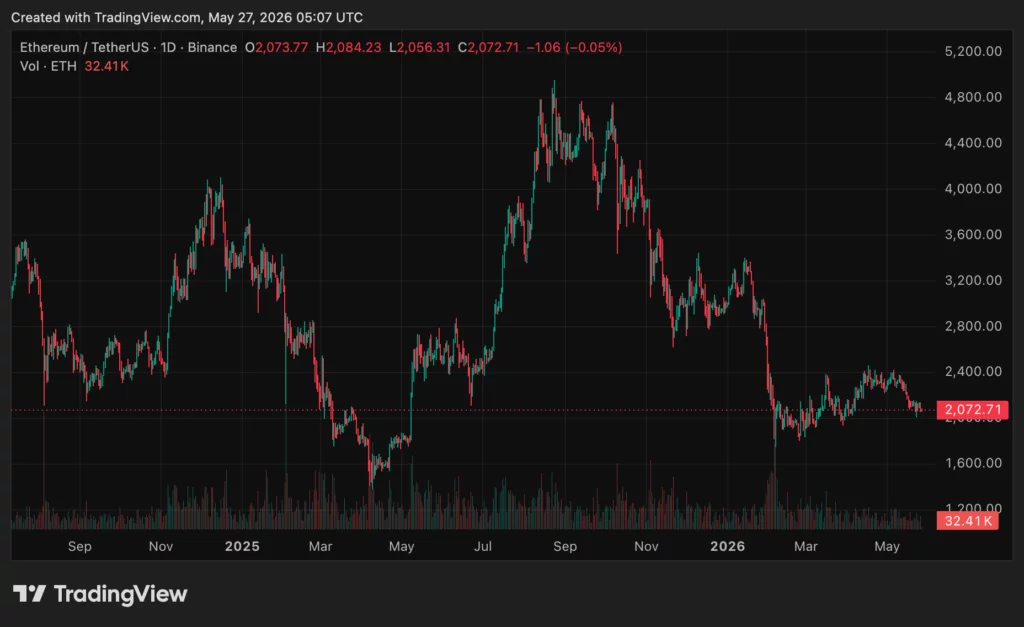
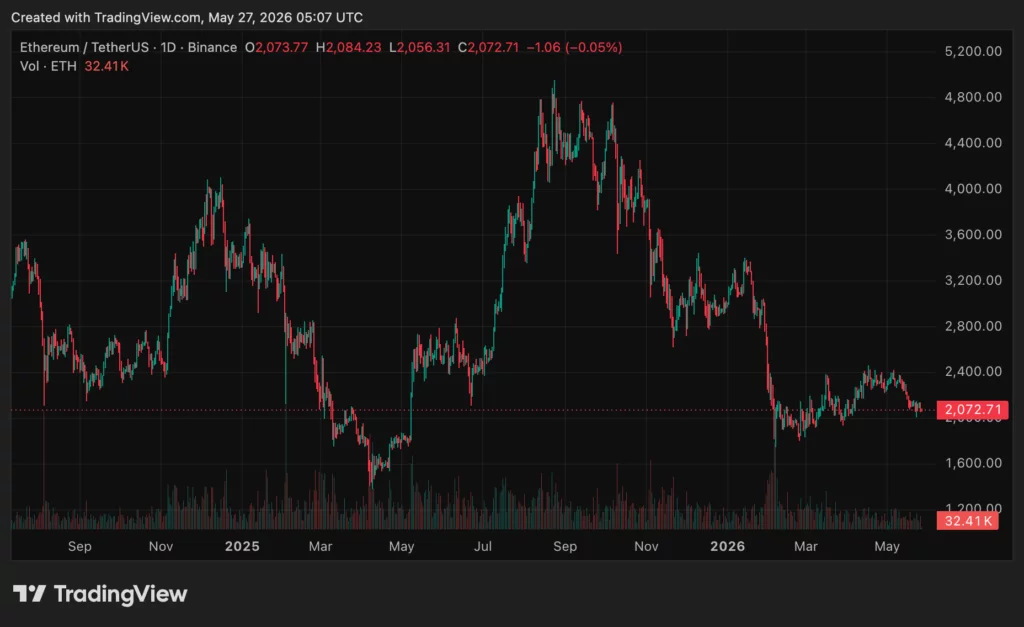
Meanwhile, Ethereum (ETH) traded near $2100 at the time of reporting, indicating 1% decline in the past 24 hours and 2% decline in the past week, based on crypto.news data.

The US stock market trades higher on Friday as SpaceX (SPCX) shares jump around 22% in the largest IPO on record. Improved consumer sentiment and hopes for Middle East peace add support.
However, technology lags the rally because the $75 billion SPCX listing siphons capital from space peers and mega-cap leaders.
How Are SpaceX Shares Trading After Record Debut?
SpaceX raised $75 billion by selling 556 million shares at $135 each, the biggest IPO in history. The stock opened at $150, well below the $175 level that trading desks initially indicated. Demand was strong, but cooler than the pre-debut hype implied.
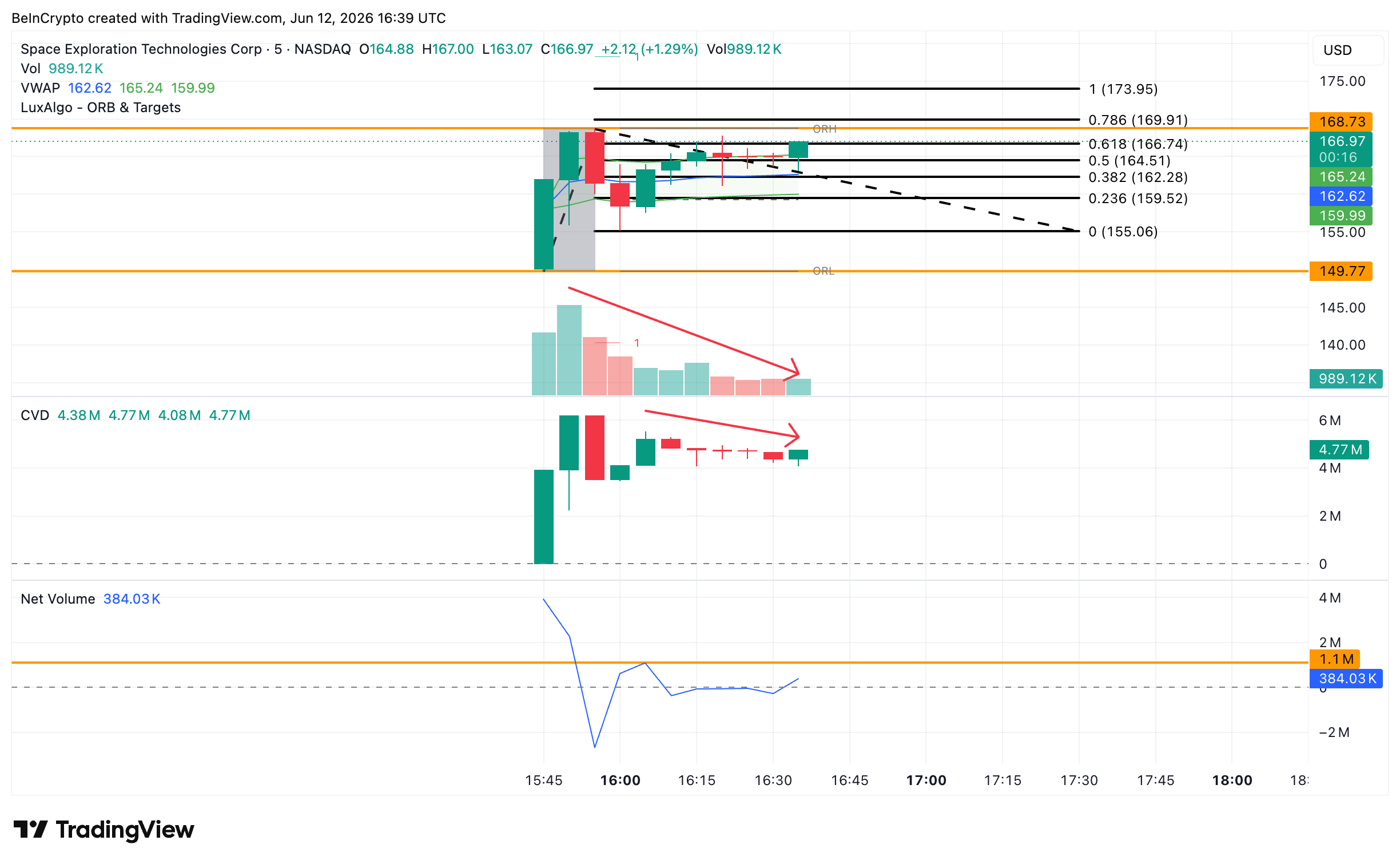
Buyers then stepped in. SPCX touched a session high of $168.73 at press time before settling near $166, up around 22% and worth above $2 trillion.
The five-minute chart shows the rally thinning out. Price holds above the volume-weighted average price (VWAP) at $162.62, the volume-adjusted average institutions use as an execution benchmark.
However, cumulative volume delta (CVD), which tracks the running gap between buying and selling pressure, keeps trending down. Net volume sits near 384,000 shares and needs to reclaim the 1.1 million mark to confirm genuine demand.

Perpetual futures positioning tracked by Nansen signals caution. Shorting the listed stock is barely possible on the debut day, since shares have not settled and borrowing is scarce. That makes perps the only venue for bearish bets.
Whales hold a net short of $18.6 million and smart traders a net short of $7.2 million. This divergence could fuel a squeeze-like move on perps, or it may show experienced traders fading the rally.

The opening range breakout (ORB) indicator marks the high and low of a stock’s first minutes of trading. These levels act as breakout triggers.
A five-minute close above the $168.73 range high could open $173.95. On the downside, SPCX should not lose $155. Below that, the $149.77 range low sets up a move lower.
Why Is the US Stock Market Up Today?
Three forces explain the move.
1. SpaceX’s Record IPO Lifts Risk Appetite
A successful mega-listing signals investors will still fund growth at scale, and that confidence spills into the broader tape. The flip side is rotation.
Rocket Lab (RKLB) fell 9.36% and Tesla (TSLA) dropped 2.32% because holders sold existing space and Musk-linked exposure to fund SPCX positions.
2. Consumer Sentiment Beats Expectations
The University of Michigan’s preliminary June consumer sentiment index, which measures household confidence in finances and the economy, rose to 48.9 from 44.8.
Consumption accounts for roughly two-thirds of US output, so a stronger reading eases recession fears even though sentiment remains depressed.
3. Middle East Peace Hopes Cut the Risk Premium
Reports that the US and Iran are nearing an interim deal to reopen the Strait of Hormuz pushed oil lower.
Cheaper energy reduces inflation risk and input costs, which benefits cyclicals and small caps the most.
What Happened to Major US Indexes?
- S&P 500: +0.39%
- Dow Jones: +0.58%
- Nasdaq: +0.12%
- Russell 2000: +1.16%
Small caps led because domestic cyclicals gain most from lower energy costs. Meanwhile, the Nasdaq lagged as the IPO drained flows from its largest members.

The S&P 500 trades near 7,423 after defending its 50-day exponential moving average (EMA) at 7,273. An EMA is a moving average that weights recent prices more heavily.
The index now battles the 20-day EMA at 7,422. A push above 7,459 would require only a 0.47% move and could open at 7,527 by the close, with 7,595 positioning the index for strength.

Losing 7,237 would bring the 100-day EMA near 7,098 into play. How SPCX shares trade from here matters because the index needs the debut to feed sentiment, not drain liquidity.
Which Sectors Are Holding Up?
Basic Materials leads at 2.20% because peace hopes improve global trade and commodity demand expectations. Financials gained 1.21% as JPMorgan (JPM) rose 2.04%.
Banks earn underwriting fees from the record listing, and a hot SpaceX shares’ IPO pipeline lifts deal revenue forecasts.

Energy added 1.11% as investors rotated into cheap cyclical groups that lagged last week.
Which Sectors Are Falling?
Consumer Cyclical dropped 1.10% as Amazon (AMZN) fell 2.14%, and Tesla slid. Healthcare slipped 0.17% because defensives lose appeal on risk-on days.
Technology rose just 0.38% and trailed the tape. Nvidia (NVDA) sat flat at 0.08% while Microsoft (MSFT) lost 0.65%. A $75 billion IPO absorbs cash, so funds trim their most liquid holdings, mega-cap tech, to pay for allocations.

The drain started early. Technology gained only 0.98% last week while Basic Materials rose 3.50%, showing money moved out before the debut.
Major Stock News Investors Are Watching
Adobe (ADBE) sank 6.62% after Wolfe Research and Stifel downgraded. Both flagged a weaker organic annual recurring revenue (ARR) outlook, the yearly value of subscription contracts, tied to its freemium push, and the CFO’s departure.
Arm Holdings (ARM) climbed around 9% after a Bank of America report sized the agentic AI opportunity at $170 billion. AMD rose 4.81% in sympathy as chip demand expectations improved.
What Are Investors Watching Next?
SPCX shares listed on the final session of the week, so Monday becomes the first test without debut-day mechanics, and today’s close sets next week’s tone. Traders will also watch which index baskets eventually add SPCX, since inclusion would force passive funds to buy.
Next week brings the FOMC meeting, the first rate decision under Fed Chair Kevin Warsh, plus fresh consumer confidence data. An SPCX hold above $166 with the S&P 500 above 7,422 hands bulls control into Monday.
The post How is the US Stock Market Reacting as SpaceX (SPCX) Shares Go Live? appeared first on BeInCrypto.
The Solana price has started to move again, with weekly gains above 4%.
Summary
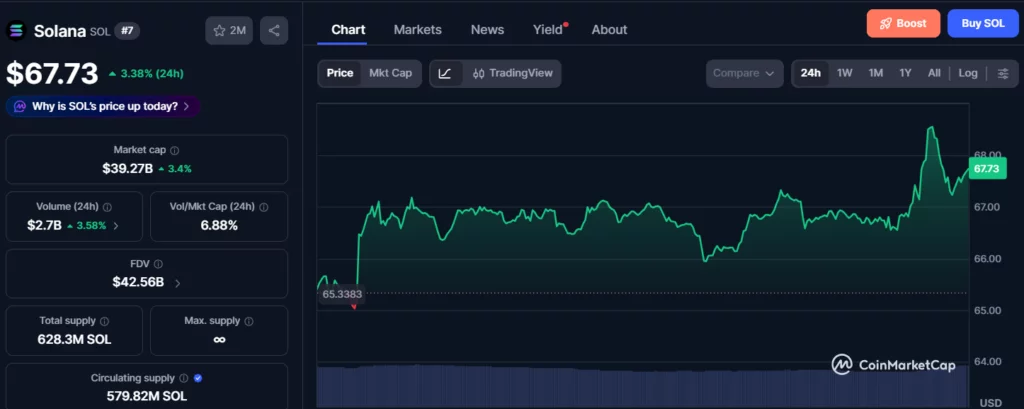
- Solana climbed 3.38% to $67.73, extending weekly gains as upward momentum returned.
- Backpack and Sunrise launched SPCX on Solana, bringing tokenized SpaceX share exposure to the network.
- Technical indicators show bears losing strength as bulls defend support and attempt a trend reversal.
This recent Solana price trend comes at a time when the SpaceX IPO token, SPCX, has gone onchain on Solana. This new momentum has made market participants weigh in on where the Solana price will target in the next few days as bulls take the current limited lead.
Solana’s price climbs 3.38%
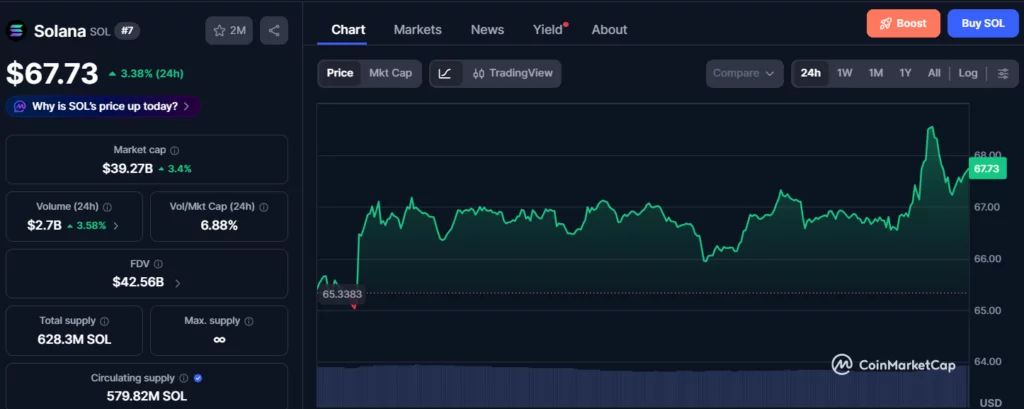
According to CoinMarketCap data at the time of press, Solana’s price traded at $67.73, up 3.38% over the past 24 hours. The price began the session near $65.30 and moved sharply higher early in the period. Following that advance, SOL traded within a relatively narrow range around the $66.7 level. Several short-term fluctuations appeared throughout the session, although the broader movement remained upward.
Source: CoinMarketCap
Midway, the price briefly slipped toward the $66.0 area before recovering. It then returned above $66.5 and continued moving within a stable range. Later, SOL recorded another upward move that pushed the price beyond $67.0. The rally accelerated during the final section of the session and lifted the token above $68.5.
After reaching that intraday peak, the price retreated and gave back part of the advance. However, the decline remained limited, and SOL stayed above earlier trading levels. The token then stabilized near $67.0 before posting another moderate recovery. By the end of the observed period, SOL traded at $67.73, maintaining most of the gains recorded during the session.
SpaceX tokenized shares launch on-chain.
As previously reported by crypto.news, the ongoing Solana price movement comes as the project has become the foundation for a new tokenized SpaceX product. Backpack and Sunrise recently launched SPCX, a blockchain-based asset backed by underlying SpaceX shares.
The product allows eligible users to convert tokenized holdings into actual shares through regulated brokerage partners. At the same time, users can transfer SPCX across supported Solana platforms like other digital assets. The launch places Solana at the center of a tokenized equity framework that connects traditional securities ownership with onchain trading.
According to the companies, SPCX supports trading, redemption, and self-custody through compatible Solana applications. The rollout also coincides with SpaceX’s Nasdaq debut that happened today, allowing tokenized and traditional share markets to operate simultaneously. As a result, Solana now supports another high-profile real-world asset use case as tokenized securities continue expanding into private equity markets.
Solana bulls test bears after months of pressure
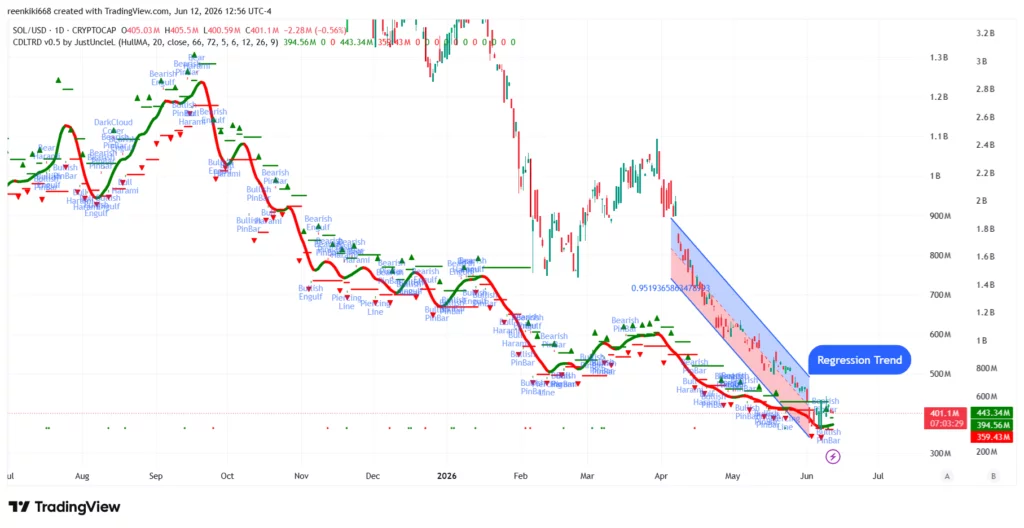
According to a TradingView technical analysis, bears have controlled the market for most of the observed period. The red trend line remained below the green line for several months, reflecting sustained bearish pressure. During that stretch, bearish signals appeared frequently, while bullish signals failed to produce lasting reversals. Each recovery attempt lost strength quickly, allowing bears to maintain lower highs across the trend.
Source: TradingView (SOL/USD)
The regression channel on the right side of the chart reinforces this bearish structure. Price continued moving lower within the channel, confirming that sellers remained in control. However, the most recent signals reveal a change in behavior. Bullish markers have started appearing more frequently near the lower boundary of the channel. At the same time, the distance between bullish and bearish signals has narrowed.
The latest candles show bulls defending an area that previously attracted strong selling pressure. The indicator also displays a fresh bullish pin bar near recent lows. While bears still hold the broader trend advantage, their momentum has weakened compared with earlier months. If bullish signals continue to increase and the red trend line begins to flatten, bulls could challenge the current bearish structure and attempt a trend reversal.
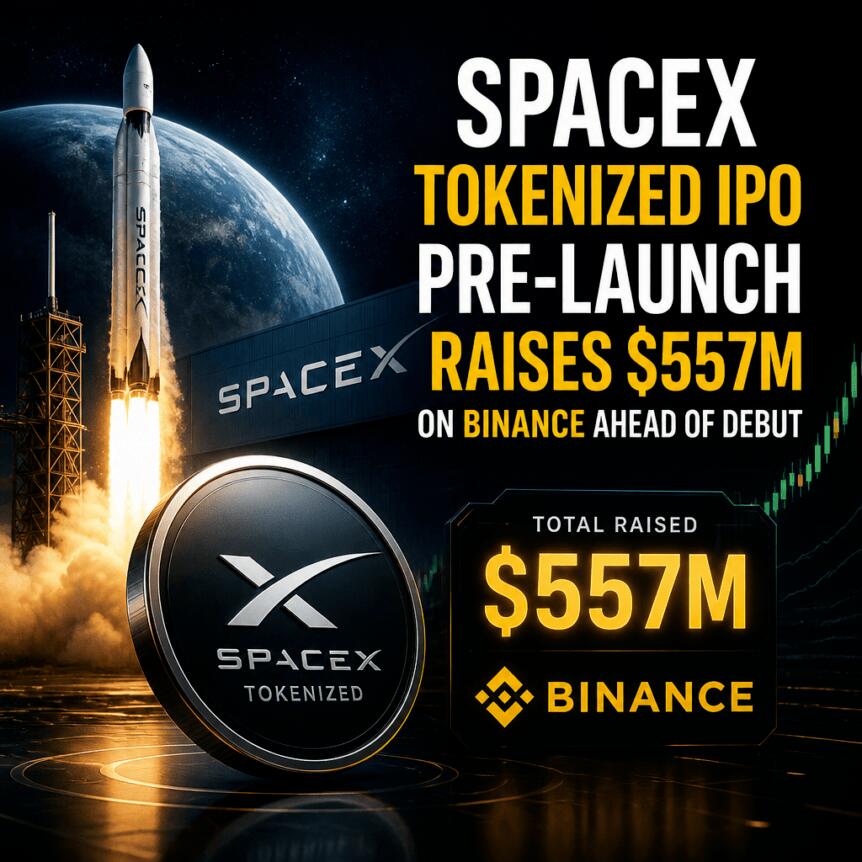
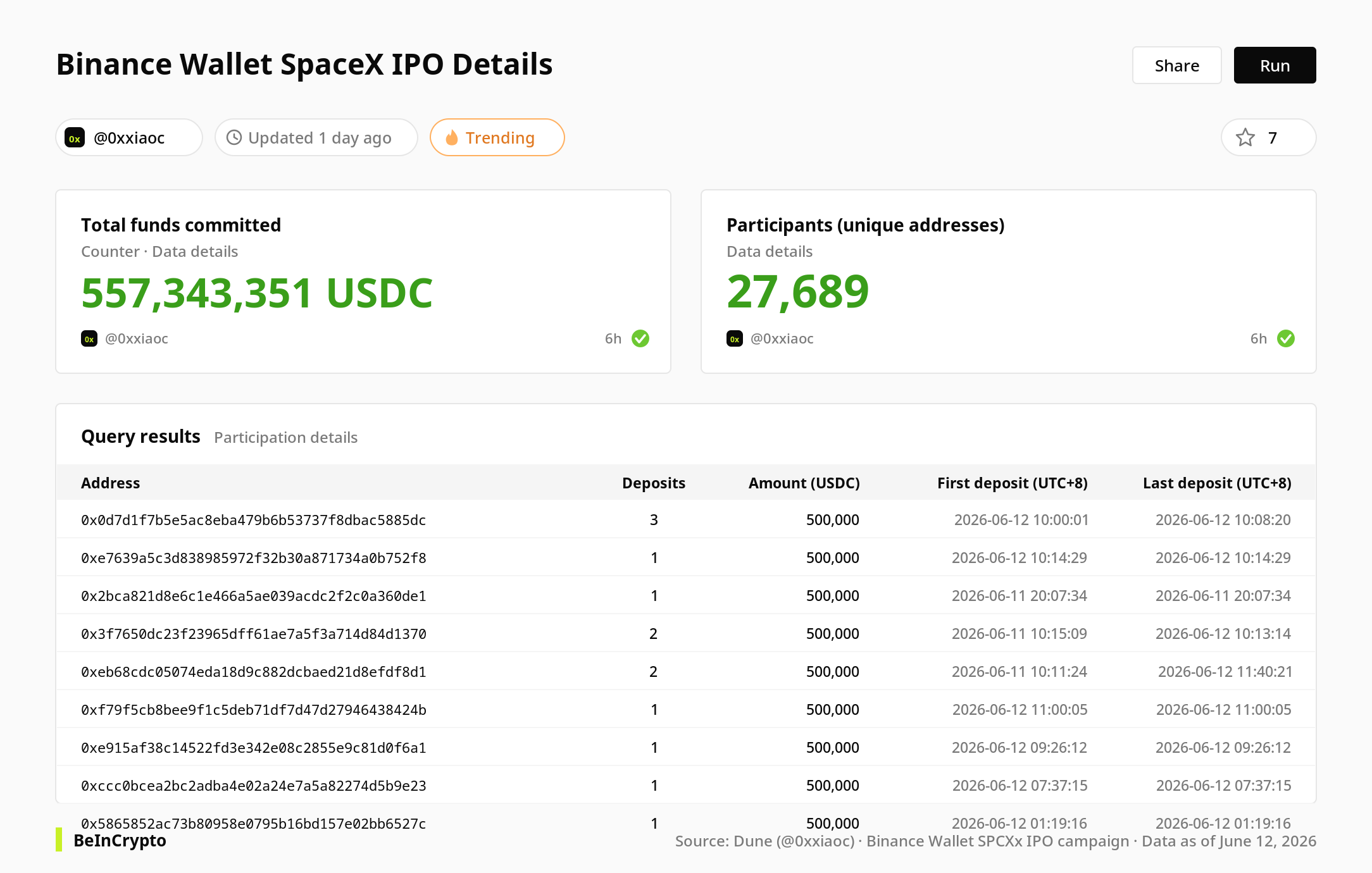
Binance’s tokenized SpaceX IPO campaign has drawn more than $557 million in USDC deposits from roughly 27,689 wallet addresses ahead of SpaceX’s public-market debut on Friday. The flow, tracked through Dune analytics, points to sustained demand for crypto-based routes to pre-IPO exposure.
At the same time, trading in decentralized derivatives has helped pull expectations toward the upper end of market chatter. On Hyperliquid, SpaceX perpetual futures moved in a wide band around $180–$200 after the pre-IPO market opened on May 18, according to analytics cited in a Talos report, with the implied valuation hovering near multi-trillion-dollar levels.
Key takeaways
- Binance’s SpaceX tokenized IPO product drew over $557 million in USDC deposits from about 27,689 wallets, based on Dune data.
- Small-to-mid contributors dominated participation counts, while a smaller number of large depositors accounted for a disproportionate share of total USDC.
- On Hyperliquid, SpaceX perpetual futures traded roughly in the $180–$200 range after May 18, with implied valuations discussed around the $2.5 trillion area.
- Coin-market activity is increasingly shaping “price discovery” for pre-IPO expectations, Talos argues—especially as crypto exchanges list proxy instruments.
Deposits on Binance: participation vs. concentration
Dune data for Binance’s SpaceX IPO campaign shows that wallets contributing up to $20,000 made up more than 81% of participating addresses, but only 18.39% of total USDC deposits. That indicates a heavily skewed distribution: many smaller wallets participated, while the bulk of capital was concentrated among fewer accounts.
In contrast, 114 addresses deposited more than $500,000 each. Together, these larger contributors accounted for about 10.2% of the total funds, highlighting how pre-IPO crypto access can attract both broad retail participation and significant whale-sized positioning.
These deposits are being framed as demand for crypto rails that offer early or proxy exposure to a major equity event. For traders, the campaign also functions as a sentiment barometer—though the deposits themselves do not necessarily translate 1:1 into IPO allocation outcomes.
What SpaceX is seeking—and how crypto pricing is responding
SpaceX is pursuing a large-scale public offering, with filings referenced in the reporting describing an intention to raise $75 billion at $135 per share and an approximately $1.8 trillion valuation. The scale is part of what makes the stock so widely tracked ahead of the Nasdaq debut.
However, the crypto derivatives market has shown a different sensitivity to the “what if” scenarios of valuation. Talos, in a Tuesday report, said that on Hyperliquid the SpaceX perpetual futures traded in a $180–$200 range after the pre-IPO market went live on May 18. That price action was described as implying a valuation closer to $2.5 trillion.
The movement wasn’t linear. As the IPO date approached, the implied share price reportedly moved closer to the IPO level but then rebounded to around $179, according to the same reporting. For participants, the key takeaway is that decentralized pricing can oscillate quickly as liquidity and positioning shift—potentially reflecting expectations, risk premia, and arbitrage opportunities rather than only a single “consensus” forecast.
Crypto as a new venue for pre-IPO “price discovery”
Beyond the SpaceX-specific numbers, Talos used the episode to argue that crypto exchanges are increasingly acting as a price discovery venue for pre-IPO stocks. The report cited Hyperliquid’s pre-IPO perps market pricing as having closely tracked Cerebras’ (CBRS) subsequent Nasdaq debut—within 1.3% of its $350 opening price.
If that relationship holds across other listings, crypto venues may become more than just off-ramp speculation; they could increasingly inform how market participants anchor expectations before the first print on traditional markets.
Still, the mechanism differs from conventional equity markets. Perpetual futures and tokenized proxy offerings are shaped by leverage, market depth, and trading incentives—factors that can cause divergences from IPO terms. That doesn’t invalidate the signals, but it does mean investors should treat crypto-implied levels as expectations under a different trading framework.
Derivatives bets and the expanding menu of SpaceX proxy products
Outside exchange order books, Polymarket’s event page shows participation split across valuation ranges. In the figures cited, 56% of participants bet that SpaceX will close its first day with a market cap between $2 trillion and $2.5 trillion, while 25% predict a $1.5 trillion to $2 trillion close.
Meanwhile, exchange support for pre-IPO exposure is broadening. According to the reporting, OKX told Cointelegraph it is preparing to list SpaceX on its X-perps on Friday, designed to give Europe-based traders futures exposure with up to 10x leverage. The report also notes that the launch adds to a wider roster of crypto platforms offering SpaceX-linked products, including Bitget, Blockchain.com, Bybit, Kraken and Coinbase.
For users, this expansion matters because it increases access points—potentially tightening spreads and improving liquidity in crypto-based pre-IPO markets. For regulators and market structure watchers, it raises another question: how closely these crypto proxies should be viewed as substitutes for equity price formation, especially as their influence grows across retail and sophisticated traders.
As SpaceX begins trading on Friday, the most important thing to watch is whether crypto-implied levels converge toward the first traditional-market prints—or whether the divergence persists. The answer will help clarify whether crypto derivatives and tokenized campaigns are merely reflecting speculation, or whether they are increasingly capturing durable, first-order expectations for major listings.
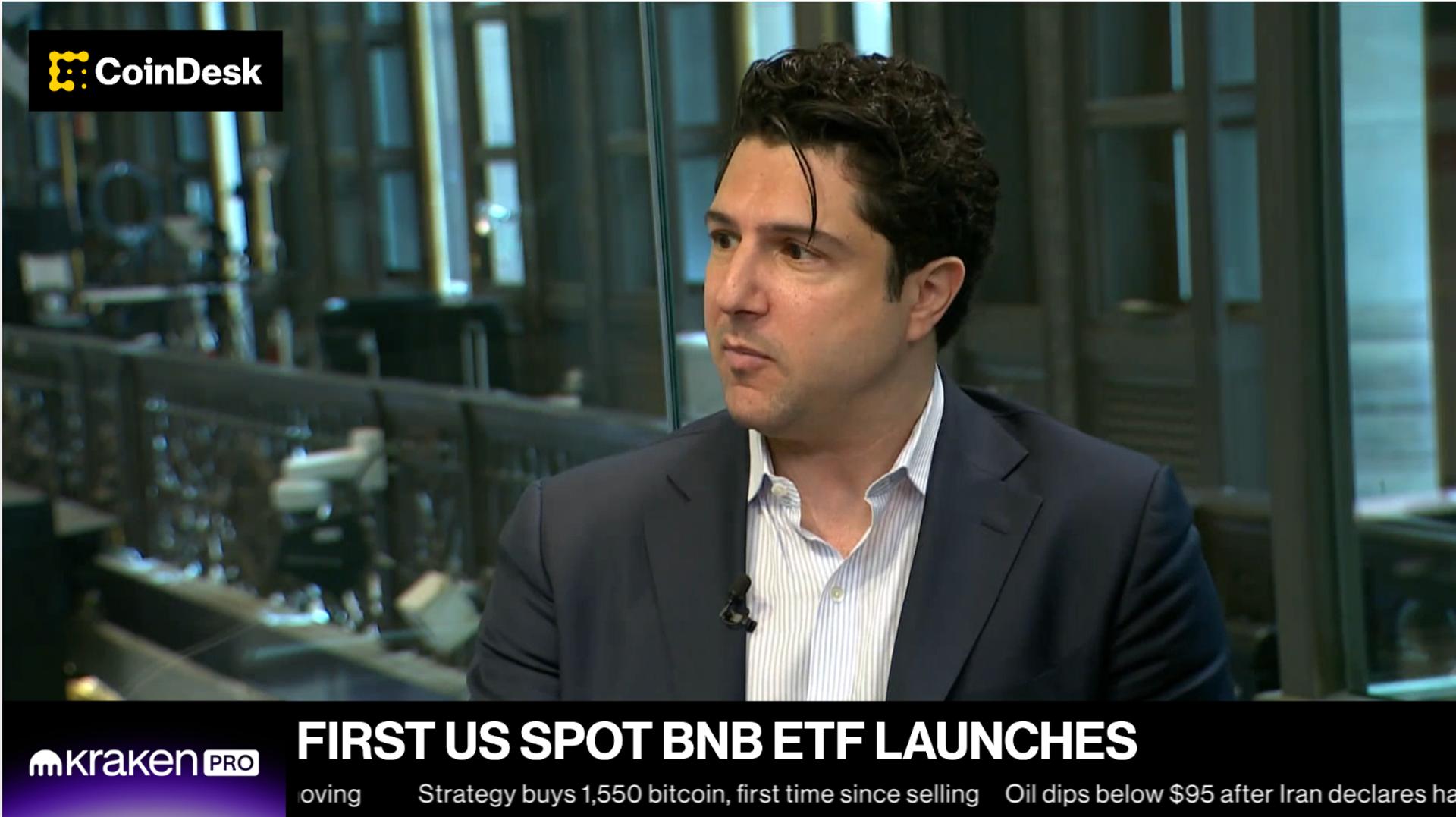
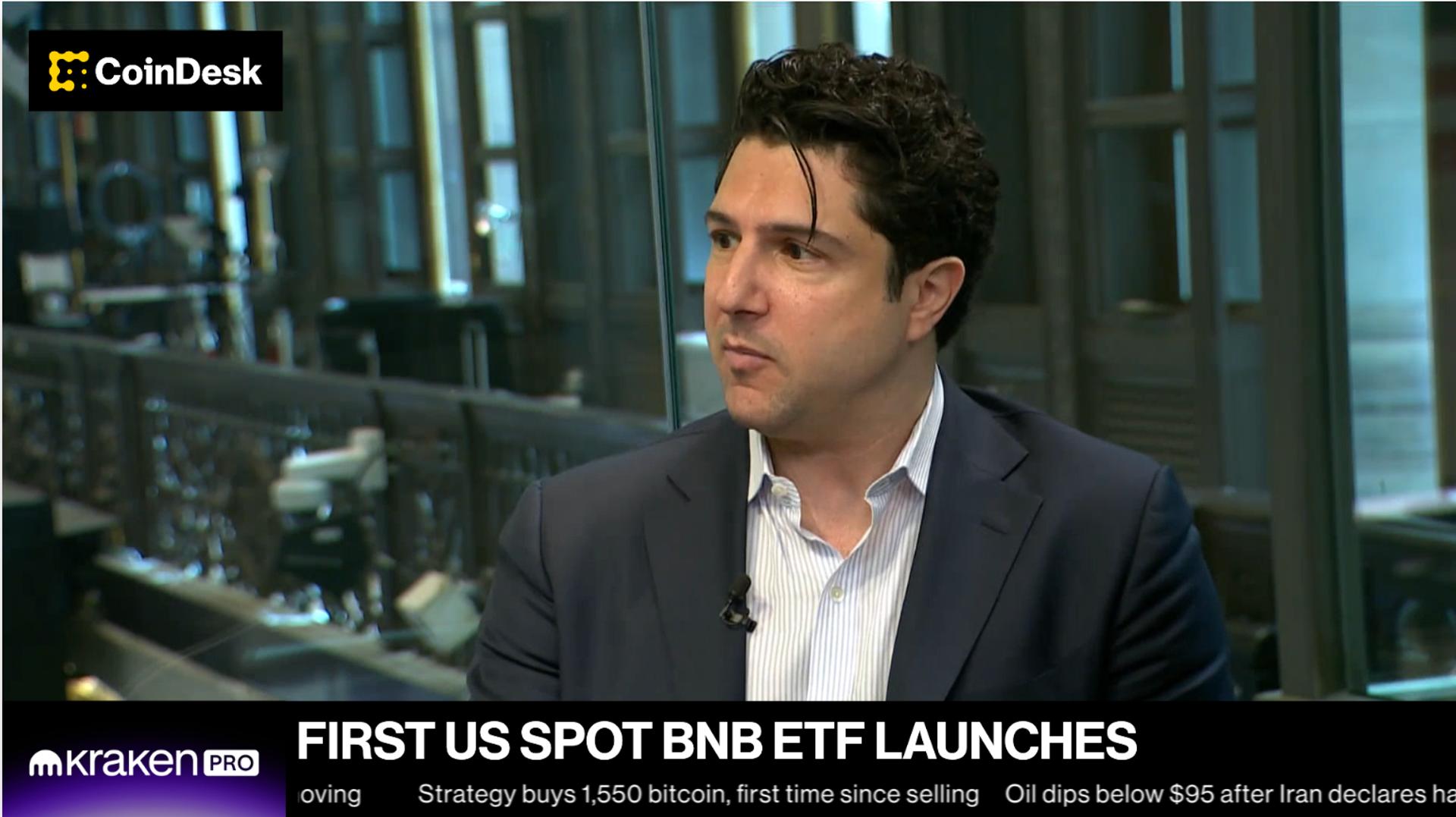
Latest developments: VanEck recently launched the first U.S. spot BNB ETF, trading under the ticker VBNB on Nasdaq.
- The fund gives investors exposure to BNB through traditional brokerage accounts.
- VanEck Director of Digital Assets Product Kyle DaCruz said the firm focuses on blockchains with measurable adoption rather than purely technical promises.
- The ETF has attracted roughly $2 million in assets since launch, according to DaCruz.
- DaCruz joined CoinDesk’s Jennifer Sanasie and Bloomberg’s James Seyffart on Public Keys.
Why it matters: VanEck argues BNB has already achieved the user adoption many crypto projects are still pursuing.
- DaCruz said BNB Chain has 33 million monthly active users and 2.1 million daily active users.
- He cited roughly $100 billion in monthly stablecoin transfer volume and $16 billion in stablecoins minted on the network.
- The firm’s investment thesis centers on identifying chains with active users and economic activity rather than what DaCruz called “ghost chains.”
Reading between the lines: VanEck is increasingly emphasizing blockchain revenue as a key metric for investors.
- DaCruz said advisors are becoming less interested in technical distinctions between blockchains and more interested in sustainable business models.
- He described BNB and Hyperliquid as examples of “revenue chains” generating tangible economic value.
- According to DaCruz, BNB generates roughly $160 million in annual revenue.

TLDR:
- USDC news is in focus after Circle moved 4.397 billion USDC to a Coinbase-linked wallet through HyperEVM.
- The record transfer appears to be tied to Coinbase’s treasury role on Hyperliquid rather than to immediate market selling.
- Hyperliquid’s reliance on USDC shows how stablecoins are becoming central to on-chain trading and settlement.
- Traders are watching the transfer because large stablecoin flows can signal future liquidity shifts across crypto markets.
USDC news is drawing fresh market attention after Circle moved 4.397 billion USDC to a Coinbase-linked address through HyperEVM. Arkham described the transaction as the largest single on-chain USDC transfer ever recorded.
The movement was not tied to a normal exchange deposit. Instead, it appears connected to Coinbase’s role as Hyperliquid’s official USDC treasury deployer.
That role places Coinbase near the center of stablecoin liquidity management for one of the busiest on-chain trading ecosystems.
USDC News Puts Coinbase and Hyperliquid Treasury Role in Focus
The transfer came from Circle’s CoreDepositWallet and was sent to a Coinbase-linked treasury address. The size of the transaction made it stand out immediately across on-chain dashboards.
Large stablecoin moves often raise questions because they can precede changes in market activity. Traders watch these flows to see whether capital is moving toward exchanges, lending markets, or new trading venues.
In this case, USDC news points more toward treasury coordination than immediate trading demand. Coinbase recently became Hyperliquid’s official USDC treasury deployer under the Aligned Quote Asset framework.
That structure supports USDC as a preferred settlement asset across the Hyperliquid ecosystem. It also reduces the need for users to move between competing stablecoins before trading.
Hyperliquid already uses USDC as a core quote and settlement asset. Its markets rely heavily on stablecoin liquidity for spot trading, perpetual futures, collateral, and internal settlement.
Coinbase said the arrangement could improve market efficiency by concentrating liquidity around USDC. Circle supports the technical side through native USDC and cross-chain transfer infrastructure on HyperEVM.
The transfer also comes as Native Markets’ USDH stablecoin faces a planned transition. Coinbase said users can continue converting USDH into USDC without fees during the shift.
Why USDC News Matters for Stablecoin Liquidity Flows
USDC news often matters because stablecoins serve as the cash layer of crypto markets. Large transfers can show where liquidity is being prepared before volume becomes visible.
That does not mean every major transfer creates immediate buying or selling pressure. Issuers and exchanges often move stablecoins to balance their treasuries, adjust custody, or provide liquidity support.
The 4.397 billion USDC transaction appears more like infrastructure rebalancing. It aligns with Coinbase’s new treasury role and Hyperliquid’s deeper move toward USDC-based settlement.
Still, the scale gives the market a reason to watch follow-on activity. If the funds support trading demand, Hyperliquid could see stronger liquidity across its order books.
The move also reinforces Circle’s growing role in on-chain capital markets. USDC is no longer just a payment token or an exchange-balance asset. It is becoming a settlement layer for trading venues, treasury systems, and cross-chain markets.


Bitcoin’s bear market is entering its final phase and could bottom out around the 2026 FIFA World Cup, which runs from June 11 to July 19, according to a June 12 report from BIT Research.
Its main thesis is that a mix of technical patterns, weak market sentiment, and easing inflation pressure could set the stage for the next big BTC recovery after months of decline.
World Cup Window Could Be a Potential Market Bottom
According to BIT, Bitcoin has been following an A-B-C structure since the bear market started in October 2025. Wave A saw the cryptocurrency drop into the $60,000 to $69,000 range. It was then carried up toward the $80,000 to $90,000 zone by Wave B and topped out near $83,000 in the middle of May before it faded.
Now, according to the crypto research firm, the market has entered the final Wave C correction, and its target zone for a possible bottom is between $50,000 and $55,000, with the FIFA World Cup period the most likely timeframe for that low to form.
On the sentiment side, the report noted that the Greed & Fear Index has gone back to what it called historically depressed levels, something it says matches up closely with where things stood at the 2022 bottom.
In addition, the BIT analysts pointed out that the stochastic indicator has also dropped into deeply oversold territory and that Bitcoin is currently trading at least two standard deviations below its weekly moving average.
They also marked the $61,576 level as one that could potentially offer support and highlighted Bitcoin’s Realized Price, currently at around $54,591, as a key reference for where the asset becomes undervalued.
“History suggests that while prices may briefly dip below this level, they rarely remain there for long,” the report noted.
However, the macro piece of the puzzle is inflation, and BIT directly compared the current environment with that of 2022, when cooling inflation helped to mark the cycle low. According to the firm, something similar could be needed this time around too.
Where Bitcoin Is Right Now
The world’s largest cryptocurrency by market cap has had a rough few weeks. After getting rejected near $73,000 at the start of June, it fell through $70,000, then $65,000, and eventually broke below the long-held $60,000 support.
That drop bottomed out just above $59,000 last Friday, marking Bitcoin’s lowest point in nearly 2 years, before it recovered to around $63,000. At the time of writing, the asset had dipped back below $63,000, and was down over 22% across 30 days and almost 42% off its price from one year ago.
Much of that volatility has been down to geopolitics, with the ongoing conflict between the United States and Iran forcing the cryptocurrency to seesaw with every piece of news about an attack, a retaliation, or the announcement of a potential peace deal.
For now, BIT’s researchers believe the market may still need one to three months before a confirmed reversal appears. But they maintain that the first whistle at Mexico’s Estadio Azteca to start the 2026 World Cup may have also kicked off the current cycle’s final chapter.
The post Report: Bitcoin Could Bottom During the 2026 World Cup appeared first on CryptoPotato.

Justin Sun’s made-up micronation Liberland has fired its secretary of technology after he allegedly blocked President Vít Jedlička from voting and centralised control of the country’s blockchain.
That’s according to a “congress resolution” published by Liberland today.
As part of the resolution, Dorian Stern Vukotić was removed from the country’s blockchain-based congress and accused of “gross misconduct, abuse of power, and breach of trust.”
Specifically, it claims that in November 2024, Vukotić removed multisig protections from the Sudo account, which grants administrative powers, and in turn “unlawfully centralized control of the Liberland Blockchain.”
In October 2025, he allegedly tried to take over Liberland’s web domain Liberland.org, and when this failed, pushed for a fraudulent liberland.io site.
A previous warning also links Vukotić to an unauthorized token launch connected to the Liberland name.
Read more: The jailed $6B bitcoin fraudster who wanted to be Liberland’s queen
During that same month, he also allegedly received funds from Liberland’s Ministry of Finance, made up of BNB and Liberland’s own Liberland Merit (LLM) token, to help create a trading pair for the two tokens.
Liberland claims the funds still haven’t been deployed and that “Mr. Vukotić refuses to honor the request of the Ministry of Finance and Congress to return these funds.”
Vukotić also allegedly tweaked “critical governance parameters,” increasing the congressional voting period from four to 75 days while blocking Jedlička’s voting powers.
Liberland wants its liquidity pools back
Liberland has demanded that Vukotić return the funds and hand over control of all the liquidity pools to the Ministry of Finance.
It said, “Should Mr. Vukotić fail to comply within seven days, Congress shall treat his continued actions as defiance and misappropriation and shall take all appropriate measures, including public censure.”
Public censure essentially involves a government body publicly scorning an individual for their actions.
As a result of Vukotić’s alleged transgressions, Liberland has announced some changes:
- The congressional voting period will be reverted to four days.
- Jedlička’s voting powers will be restored.
- The Sudo account will be transferred to Senate members before plans are made to remove the account altogether.
- LLM held within the Sudo account, will be moved to the Senate. Newly minted tokens will be distributed to Congress.
- The introduction of a “three-judge system” with a 2-of-3 multisig wallet arrangement.
Who is Vukotić?
In his pitch for the 2026 March congressional election, Vukotić claims he’s been involved in the Liberland project since 2021 and that he’s lived in the micronation for over a year.
He notes that he met his girlfriend there, and that they “have a kid who was also kinda made in Liberland.”
Vukotić’s congressional pitch complains that Liberland is suffering from “disorganization and lack of direction.”
He claimed that the micronation wasn’t transparent about the money it received and where it was being spent, and he promised to overhaul Liberland’s budgeting and planning.

Read more: Justin Sun’s Forbes article prompts geography lesson from Liberland
Some of his more drastic proposals include establishing a “Ministry of Propaganda” that would feed Croatians, Serbs, and Hungarians “good Liberland vibes,” and an Intelligence agency called “The Invisible Hand.”
In his proposed final “attack” phase for Liberland, he hypothesizes, “Maybe with a large enough bribe, we can straight up buy the land. Maybe we will need a D-Day style landing operation with 10 ships and 1000 people.”
He added, “Maybe some dumbf**kistan somewhere sees how great we are and sells us the land somewhere else entirely.”
Liberland comprises 7km² of disputed land between Serbia and Croatia. The micronation isn’t officially recognised by any other country and continues to maintain a balancing act of complex entry and off-site camps to avoid upsetting Croatian and Serbian authorities.
Read more: Justin Sun is now prime minister of Liberland, an entirely made-up country
The congressional election that elected Vukotić — albeit in a test election — has voted Tron billionaire Justin Sun as its prime minister seven times. Protos is confident Sun has never set foot in Liberland.
Protos has reached out to Vukotić for comment and will update this piece should we hear anything back.
Got a tip? Send us an email securely via Protos Leaks. For more informed news and investigations, follow us on X, Bluesky, and Google News, or subscribe to our YouTube channel.
Binance, Bybit and Kraken users received only a fraction of the SPCX shares they subscribed for, as the SpaceX IPO allocation handed to crypto platforms came in far below demand.
SpaceX began trading on Nasdaq under the SPCX ticker on June 12 after raising $75 billion at a $1.75 trillion implied valuation. Exchanges offering tokenized access have started refunding unfilled orders.
SpaceX IPO Allocation Comes in Below Demand
The Kraken growth team said the pre-IPO allocation received from underwriters fell below expectations for its tokenized SpaceX IPO access program.
User demand significantly exceeded supply, so the exchange could only partially fill orders. Every unfilled portion will be refunded.
Community feedback indicates that successful Kraken subscribers all received an identical 4.2786 SPCXx.
That equals roughly $578 at the $135 offering price, whether users committed $5,000 or $50,000. Kraken has not confirmed the figure.
Binance Wallet faced the same squeeze at larger scale. Its SPCXx campaign drew roughly $557 million in USDC from 27,689 addresses in 28 hours, according to on-chain data tracked on Dune.

More than 81% of wallets committed $20,000 or less, while 114 addresses pledged at least $500,000 each.
“Due to circumstances outside of our control, we are unable to proceed with this campaign,” Binance said.
Bybit fared worse. The exchange said in an X (Twitter) post that it received no allocation at all and refunded subscribers in full.
Follow us on X to get the latest news as it happens
Participation also carried costs. Kraken applied a 5% spread to the final price at allocation, while Binance passed on a 5% underwriting fee above the 135 USDC indicative price.
“The xStocks team made every effort to secure the allocation, but it ultimately wasn’t available as expected,” Bitget also said on X.
Against this backdrops, Binance, Bitget, and Bybit said they would be cancelling the campaign and issue full refunds. There would also be additional compensation for affected users.
“Protect users when things don’t go as planned,” Binance founder CZ wrote.
Underwriters, Not Exchanges, Made the Call
Kraken stresses that underwriters decide how shares are distributed. Allocations may be pro-rata, random, tiered, or relationship-based, and high demand can produce partial or zero fills.
The squeeze was predictable in scale. SpaceX sold 555.6 million shares at $135 each, setting a record for IPO proceeds.
Crypto platforms had spent weeks pricing SpaceX before listing through perpetuals and synthetic products.
The affected platforms all route through xStocks, the tokenized equities framework issued by Backed Assets.
Kraken acquired Backed in December 2025 as part of its tokenized equities expansion, and says the framework passed $25 billion in volume across more than 100 tokenized stocks by March.
Distribution scale, however, bought no leverage with underwriters.
SpaceX was the debut listing for both programs. Kraken launched IPO Access with it, and Binance Wallet made it the first project under its IPO Campaign.
Allocated SPCXx now trades 24/7 alongside other tokenized SpaceX share products, with price exposure only and no voting rights.
The case marks the first large-scale stress test for tokenized IPO access.
The demand side passed while the supply side fell short.
Future listings reserving a larger on-chain tranche, and what happens next for SPCX, would decide if the model matures beyond marketing.
“Tried to get 8000 Shares of SpaceX and only got 1000. The demand must be ridiculous. I hate stocks!” Grant Cardone remarked.
The post Binance Bybit and Kraken Get Less SpaceX Shares Than Expected, But One Fared Worse appeared first on BeInCrypto.


The last real shot FTX founder Sam Bankman-Fried had at undoing his fraud conviction just collapsed. A three-judge panel of the powerful, Second US Circuit Court of Appeals in Manhattan upheld his conviction and 25-year prison sentence on Friday.
The panel flatly rejected his claim that he never got a fair trial.
The evidence against him, the judges wrote in a 42-page opinion, was “conservatively stated” and “robust.”
Bankman-Fried’s only remaining possibility to escape prison before the 2040s has narrowed to a presidential pardon.
Judges Barrington Parker, Eunice Lee, and Maria Araújo Kahn heard oral arguments in November 2025. Bankman-Fried’s appellate lawyer, Alexandra Shapiro, argued that US District Judge Lewis Kaplan hamstrung Bankman-Fried’s defense.
The appeal failed to convince the panel.
Bankman-Fried’s convictions and prison sentence sustained
In November 2023, a Manhattan jury convicted Bankman-Fried on two counts of fraud and five counts of conspiracy.
Kaplan duly sentenced him to prison in March 2024, delivering a 25-year sentence and ordering an $11 billion forfeiture.
Read more: Sam Bankman-Fried begs Trump for pardon, gets bipartisan ‘No’
The court found that FTX customers lost more than $8 billion. Investors lost another $1.7 billion, and Alameda lenders lost $1.3 billion.
Three of his four closest deputies pleaded guilty and cooperated with the US government during his prosecution. They testified that Bankman-Fried directed them to drain customer deposits to plug holes at Alameda, his hedge fund.
Prosecutors called it a “fraud of epic proportions.”
Bankman-Fried has chased any possibility of a prison exit for over a year. As Protos has documented, he’s repeatedly asked Donald Trump for a pardon and launched a social media campaign to praise Trump’s policies.
Unfortunately, the White House and Trump have acknowledged his requests and publicly declined. His legal appeals are now exhausted, as well, unless he wants to appeal to the Supreme Court.
Bankman-Fried’s projected prison release date is 2044.
Got a tip? Send us an email securely via Protos Leaks. For more informed news and investigations, follow us on X, Bluesky, and Google News, or subscribe to our YouTube channel.
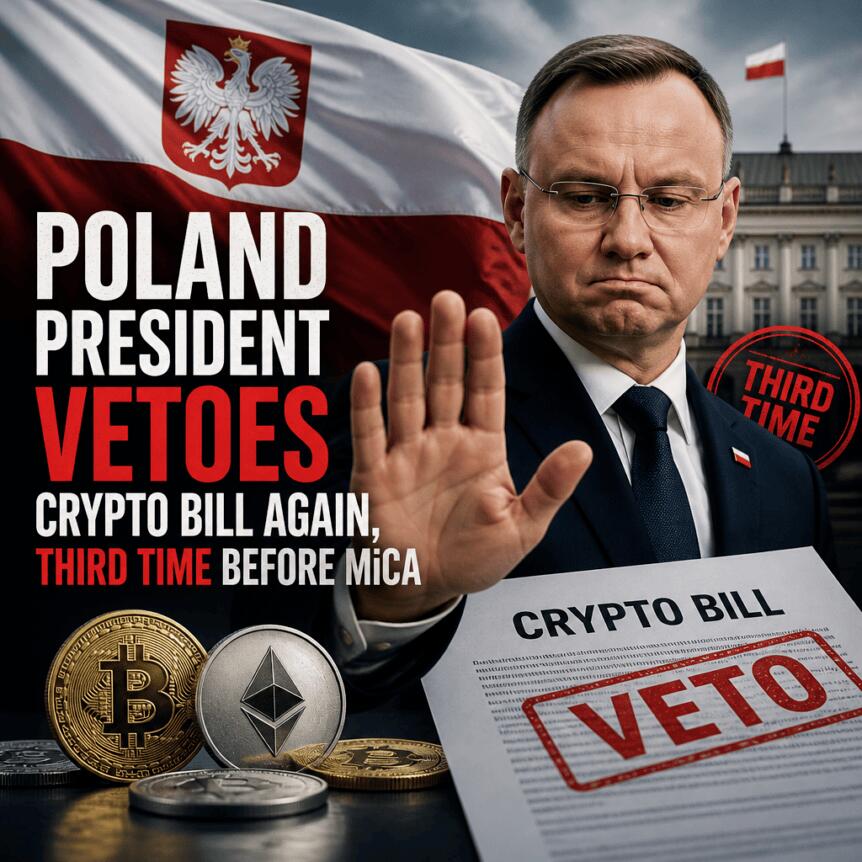
Poland’s President Karol Nawrocki has vetoed a crypto regulation bill for the third time, despite the measure’s stated goal of bringing the country in line with the European Union’s Markets in Crypto-Assets (MiCA) framework.
Nawrocki said he supports regulating cryptocurrencies, but argued that the government adopted only one of 16 amendments proposed by his office. He added that the latest text was nearly identical to the two previous drafts he rejected, prolonging a regulatory gap as the EU approaches its next major deadline for MiCA compliance.
Key takeaways
- President Karol Nawrocki vetoed Poland’s MiCA implementation bill for the third time.
- The veto delays Poland’s alignment with MiCA just weeks before the EU transitional period ends on July 1.
- After July 1, crypto asset service providers without a MiCA license may lose the legal basis to serve EU clients.
- Poland remains the only EU member state without domestic MiCA implementation, intensifying legal uncertainty for local firms.
- The political dispute has also coincided with heightened enforcement attention, including a prosecutor probe into Zondacrypto.
A third veto threatens MiCA readiness
The latest rejection pushes Poland further away from adopting MiCA at the national level. MiCA’s transitional phase is due to end on July 1, after which crypto asset service providers operating in the EU will generally need to hold a MiCA license or risk losing the ability to service EU customers.
Poland is currently the only EU country without domestic legislation implementing MiCA, a position that can make firms based in Warsaw, Kraków, and other Polish cities especially exposed to compliance and continuity risks. If providers cannot rely on a domestic legal framework for MiCA-related operations, they may face uncertainty over licensing pathways and their ongoing ability to offer services to EU users.
Nawrocki’s stance centers on amendments. He said he supports regulating the crypto market but objected because his office’s proposed changes were not fully incorporated. In his remarks Thursday, he claimed the bill submitted to his desk was nearly the same as earlier drafts that he vetoed.
Earlier, Polish politics had already stalled on the issue. The veto arrives with only limited time for parliament to respond in a way that can still meet the EU schedule, raising questions about how quickly the domestic process can restart and whether lawmakers can achieve a version that satisfies the presidency.
Parliament and the presidency fail to break the deadlock
This third veto deepens a broader institutional standoff over crypto oversight. It follows a period of legislative gridlock in which Poland’s parliament attempted to undo the second veto but fell short.
According to earlier coverage, lawmakers did not reach the 263 votes needed to override Nawrocki’s second veto in an April vote. The bill is backed by Prime Minister Donald Tusk’s government and is designed to align Poland with MiCA.
Nawrocki has previously defended his opposition by citing concerns that the bill would impose excessive regulation, offer limited transparency, and place a burden on small businesses. Supporters of the measure, however, have warned that delays leave the market exposed—both for consumers and businesses—potentially increasing the risk of fraud and abuse.
On Thursday, Tusk publicly criticized the president’s move in a post on X, writing: “It sounds unbelievable, but the president has vetoed the cryptocurrency bill again. He seems more entangled in it than everyone thought.”
Regulatory delays come as enforcement attention grows
While the political process has remained stuck, scrutiny of Poland’s crypto sector appears to be increasing. Prosecutors are investigating one of the country’s largest crypto exchanges, Zondacrypto, over suspected fraud and money laundering allegedly involving 2,000 customers with alleged links to Russian organized crime, according to earlier Cointelegraph reporting.
Zondacrypto CEO Przemysław Kral has denied accusations that funds were misappropriated.
For market participants, the juxtaposition is stark: instead of clarifying the domestic regulatory environment through MiCA implementation, Poland’s legislative uncertainty continues alongside high-profile legal inquiries. That combination can complicate compliance decisions for exchanges and other service providers—especially when firms must simultaneously respond to enforcement risk and prepare for EU licensing standards.
What changes after July 1—and what remains uncertain
The operational consequence of MiCA’s end of transitional period is straightforward: crypto asset service providers will need a MiCA license to continue servicing EU clients under the framework’s rules. Because Poland has not yet adopted domestic MiCA legislation, the timing amplifies the risk that Polish-based firms without the relevant licensing posture could face interruptions or require restructuring to keep serving EU users.
However, the precise impact for each operator depends on its current status—how it provides services, which customer base it serves, and whether it can obtain the required license in time. What readers should watch next is whether Poland’s lawmakers can craft and pass a revised bill that the president is willing to sign, and whether enforcement developments like the Zondacrypto case accelerate calls for faster compliance.

Polanski question leads Khan to reveal he told police to investigate Great Israeli Real Estate event

Vaibhav Sooryavanshi’s 10-year-old younger brother Aashirwad Sooryavanshi slams century | Cricket News

Sam Bankman-Fried Loses Bid To Overturn Crypto Fraud Conviction

BloFin War of Whales 2026 Grand Prix opens registration for $5M trading championship

Blockchain.com files with SEC for U.S. IPO

Israel says it has killed new Hamas military leader in Gaza City airstrikes
![[KPOP IN PUBLIC] LISA - 'MONEY' | Cover by BN DANCE TEAM FROM VIETNAM](https://wordupnews.com/wp-content/uploads/2026/02/1770893501_maxresdefault-80x80.jpg)
[KPOP IN PUBLIC] LISA – ‘MONEY’ | Cover by BN DANCE TEAM FROM VIETNAM

Financial freedom depends on you Big ticket#A dog robbed a bank while wearing a head cover

Leverage | Part – C | One Shot | Financial Management | Sem-6 CCF/CBCS| Calcutta University
-
 Entertainment6 days ago
The Best Mystery Series of All Time Is Surging on Streaming 30 Years After It Ended
-

 NewsBeat5 days ago
Alexander Zverev wins the French Open to finally earn a 1st Grand Slam title
-

 Crypto World4 days ago
Anatomy of the June crypto crash: Fed, Iran, Saylor
-

 Crypto World1 day ago
Oppenheimer backs SpaceX as $70 billion retail frenzy builds
-

 Tech7 days ago
Suspicious Polyfill login prompts pop up on Toshiba, Muji websites
-

 Crypto World1 day ago
Markets Rally as SpaceX IPO Looms Amid Iran Tensions and Inflation Surge
-
Crypto World6 days ago
Senator Cynthia Lummis Calls CLARITY Act the Most Consequential Financial Legislation of This Generation
-

 Tech5 days ago
Microsoft unveils seven homegrown AI models in new bid for ‘long term self-sufficiency’
-
 NewsBeat5 days ago
Alexander Zverev conquers demons and outlasts Flavio Cobolli to win French Open for first major title
-

 Tech7 days ago
Von der Leyen’s AI envoy pick draws conflict-of-interest fire
-

 Business5 days ago
High Stakes for Wembanyama as New York Pushes for 3-0 Lead
-

 Tech6 days ago
Hackers now exploit SolarWinds Serv-U flaw to crash servers
-
 Business6 days ago
The Pain Points Taking a Fragile Tech Rally Down a Notch
-
 Crypto World4 days ago
Eli Lilly (LLY) Stock Surges 4% Following Breakthrough Sleep Apnea Trial Results
-

 Tech5 days ago
Notion restores access to Anthropic after service disruption
-

 Crypto World5 days ago
Trump’s AI Ownership Plan Could Benefit Anthropic at OpenAI’s Expense
-
 Business5 days ago
The investment to transform historic St Helen’s ground in Swansea
-
 Sports3 days ago
Bangladesh beat Australia after 20 years in ODIs, register only their second win over six-time world champions | Cricket News
-

 Business6 days ago
Forensic Expert Floats Handyman Theory in Disappearance of Savannah Guthrie’s Mother
-

 Tech3 hours ago
This Week In Security: Microsoft On Microsoft, Register Your Domains, Linux On ARM, And FreeBSD Joins The File Cache Club
You must be logged in to post a comment Login