
Crypto World
BeInCrypto Institutional Research: 15 Firms Leading Digital Asset Adoption



Digital asset adoption is now moving through banks, asset managers, custodians, tokenization platforms, and crypto-native institutional arms. Leader in Digital Asset Adoption is an award category within The BeInCrypto Institutional 100, an annual research-driven program recognizing institutional digital asset excellence across 26 categories and six pillars.
This category sits in Pillar 3: Adoption & Use Cases. The long list tracks 15 firms that launched products, deployed capital, built infrastructure, or created market signals between April 2025 and March 2026. A shortlist will be named in May 2026, with the winner announced at Proof of Talk in Paris on June 2–3, 2026.
- Long list: 15 firms across banks, asset managers, custodians, tokenized funds, deposit tokens, stablecoins, and institutional crypto platforms
- Initial pool: More than 30 institutions screened; 15 advanced to the long list
- Scoring: 30% quantitative data · 50% Expert Council · 20% disclosed company data
- Criteria assessed: Strategic commitment, products launched, capital deployed, organizational investment, industry signal, forward momentum
- Data sources: SEC 13F filings, OCC approvals, MiCA-CASP authorizations, FCA, FINMA, MAS, BaFin, JFSA disclosures, audited reports, company releases, PitchBook, Tracxn, and Crunchbase
| # | Firm | Adoption Sub-Segment | HQ | Reach | Top Licensure / Live Product | Representative Work |
|---|---|---|---|---|---|---|
| 1 | JPMorgan Chase | Bank-led tokenization | New York, USA | $4T+ assets JPMD live on Base |
OCC-regulated national bank JPMD USD deposit token |
Hired Oliver Harris to lead Kinexys Kinexys Fund Flow live with private bank partners |
| 2 | BlackRock | Asset manager adoption | New York, USA | $12.5T+ AUM IBIT 800K+ BTC; BUIDL $2.85B |
IBIT, ETHA, ETHB BUIDL tokenized money market fund |
ETHB staked Ether ETF launched Mar 2026 IBIT became a major institutional Bitcoin vehicle |
| 3 | Goldman Sachs | Tokenization platform | New York, USA | $3.1T AUM GS DAP live on Canton |
SEC and FINRA registered GS DAP institutional DLT platform |
Tokenized MMF platform launched with BNY GS DAP planned industry-owned spinout |
| 4 | BNY | Crypto custody | New York, USA | $55.8T AUC/A $2.5T daily payments |
OCC-regulated bank Live BTC and ETH custody |
Co-custodian for Morgan Stanley MSBT IBIT cash custodian and administrator |
| 5 | Fidelity Investments | Full-stack crypto adoption | Boston, USA | $15T+ AUA FBTC and FETH live |
OCC conditional national trust charter Fidelity Digital Assets, NA |
National trust bank charter approved Dec 2025 Plans include stablecoin and staking services |
| 6 | Morgan Stanley | Wealth crypto distribution | New York, USA | $5.5T+ wealth assets MSBT live on NYSE Arca |
OCC charter pending Morgan Stanley Digital Trust filed |
Franklin Crypto launched via a 250 Digital deal BENJI used as part of acquisition consideration |
| 7 | Standard Chartered | Multi-product bank adoption | London, UK | $900B assets CIB custody live in Lux and HK |
FCA and multi-jurisdiction CIB HK stablecoin licence candidate |
Naveen Mallela joins as the payments head Zodia Custody reportedly moving into the CIB division |
| 8 | KuCoin | Crypto-native institutional bridge | Mahé, Seychelles | 40M+ users 200+ countries |
MiCAR-CASP via KuCoin EU Institutional custody integrations |
Ceffu and Cactus custody integrations Asseto tokenized RWA collateral pilot |
| 9 | Citi | Tokenized deposits | New York, USA | $2.4T assets CTS live in major markets |
OCC-regulated bank Citi Token Services |
CTS integrated with 24/7 USD clearing Ether custody pilot completed |
| 10 | Franklin Templeton | Tokenized funds | San Mateo, USA | $1.7T+ AUM BENJI/FOBXX ~$843M |
SEC-registered FOBXX EZBC and EZET live |
Franklin Crypto launched via a 250 Digital deal BENJI used as part of the acquisition consideration |
| 11 | Nomura · Laser Digital | TradFi crypto subsidiary | Tokyo / Zurich | Nomura $650B AUM Komainu regulated custody JV |
UAE VARA, ADGM, Switzerland OCC charter filed Jan 2026 |
Laser Digital National Trust Bank application filed Komainu custody active across jurisdictions |
| 12 | HSBC | Tokenization and digital securities | London, UK | $3T+ assets Orion $3.5B+ issuance |
UK DIGIT mandate HKMA stablecoin issuer licence |
HSBC Orion selected for UK DIGIT pilot Cross-bank tokenized deposit transaction completed |
| 13 | DBS | Bank-backed digital exchange | Singapore | $540B assets DDEx volume up 8x in 2025 |
MAS Recognised Market Operator DBS Digital Exchange |
Integrated crypto into trust planning Crypto options and ETF-linked notes live |
| 14 | Société Générale · SG-FORGE | Bank-issued stablecoins | Paris, France | SocGen €1.4T assets EURCV and USDCV live |
MiCA CASP authorized EUR and USD stablecoins |
Issued MiCA-compliant EUR and USD stablecoins SWIFT pilot for tokenized bond settlement |
| 15 | MEXC | Tokenized RWA bridge | Seychelles | 40M+ users 13.74M MAU |
100+ Ondo tokenized stock pairs listed Gold futures reached a strong global share |
100+ Ondo tokenized stock pairs listed Gold futures reached strong global share |
About This List
The BeInCrypto Institutional 100: Digital Asset Adoption (2026 Long List) identifies institutions making productized moves into digital assets. The category focuses on banks, custodians, asset managers, asset servicers, broker-dealers, and selected crypto-native institutional arms that connect traditional finance with tokenized assets, custody, settlement, stablecoins, or regulated digital asset access.
Crypto-native firms focused mainly on exchange infrastructure, prime brokerage, market making, or trading systems are evaluated separately under Pillar 2 categories.
Methodology
This category is evaluated under Track B of the BeInCrypto Institutional 100 methodology: 30% quantitative metrics, 50% Expert Council scoring, and 20% disclosed data.
Assessment spans six weighted criteria: strategic commitment, products launched, capital deployed, organizational investment, industry signal, and forward momentum.
Data was verified using SEC 13F filings, OCC national trust bank charter approvals, MiCA-CASP authorizations, FCA, FINMA, MAS, BaFin, and JFSA disclosures, audited annual reports, company releases, and private-market sources, including PitchBook, Tracxn, and Crunchbase.
The post BeInCrypto Institutional Research: 15 Firms Leading Digital Asset Adoption appeared first on BeInCrypto.

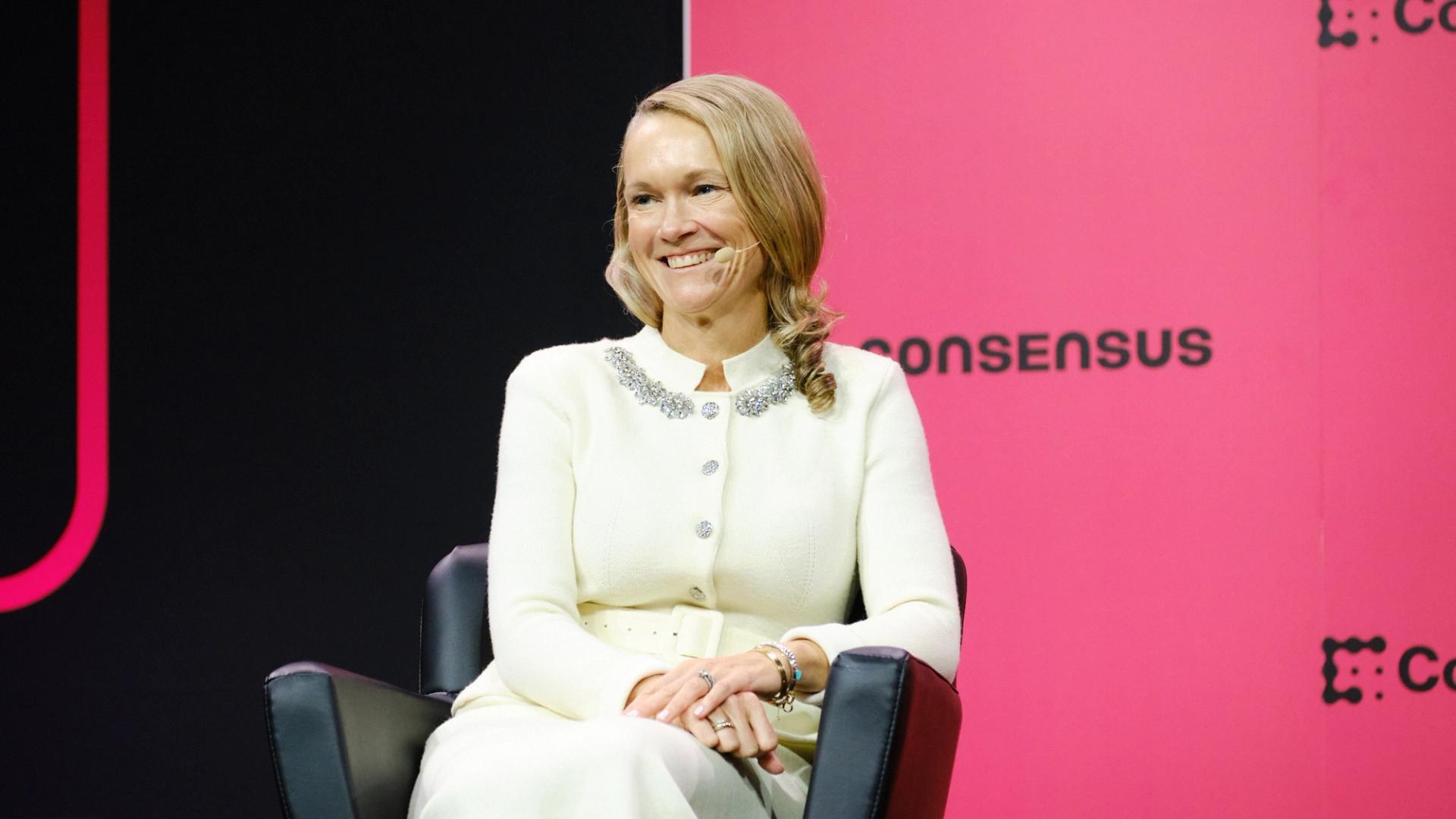
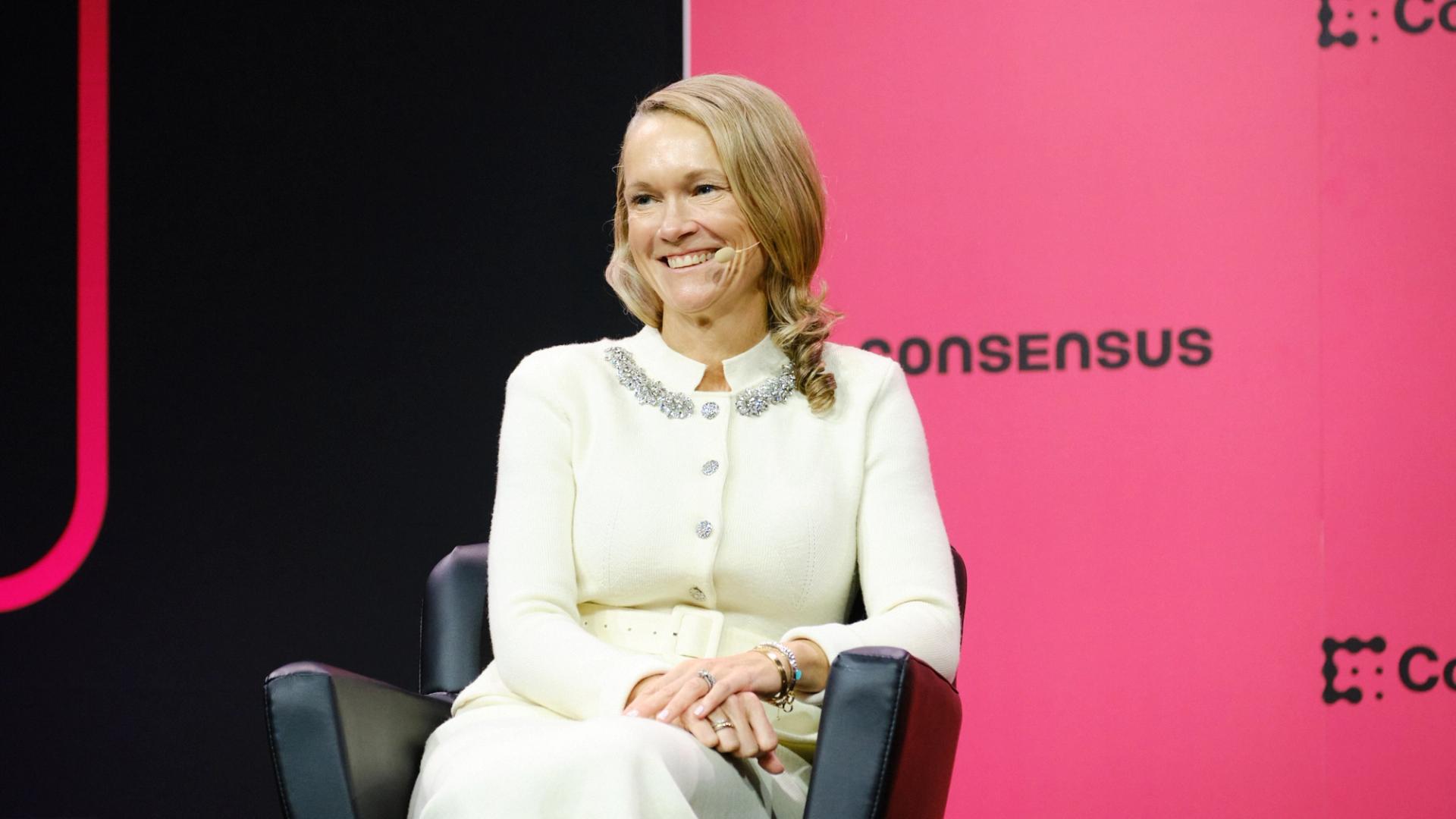
Miami Beach, FL — Tokenized money will fail to deliver on its promise if it remains siloed within individual banks, according to Ryan Rugg, Citigroup’s head of digital assets for treasury and trade solutions.
Speaking at Consensus in Miami, Rugg said large corporate clients are not looking for single-bank solutions but systems that work seamlessly across financial institutions. “No one wants just a Citi token,” she said. “They want that multi-bank aspect of it.”
The comment reflects a core challenge in the push to bring blockchain-based payments into mainstream finance. While banks have begun issuing tokenized deposits and building internal platforms, many of those systems operate within closed networks.
For global companies, that approach falls short. Rugg said Citi’s clients often manage “hundreds, if not thousands of bank accounts across multiple banks globally,” creating complexity in moving money for payroll, suppliers and investments.
Those clients are increasingly asking for real-time capabilities. In a survey Citi conducted several years ago, Rugg said the response was “basically unanimous” that faster, always-on payments were a top priority.
Blockchain technology offers one path to that goal, but only if systems can connect. Citi has built its own tokenized platform and linked it to its broader banking network, including a 24/7 U.S. dollar clearing system with more than 300 banks. Still, Rugg emphasized that internal upgrades alone are not enough.
“This is another tool in the toolkit,” she said, adding that banks must also modernize traditional infrastructure and connect it with digital systems.
The broader industry faces fragmentation. A growing number of banks, fintech firms and crypto projects are building separate networks, often using different standards. That risks recreating the same inefficiencies blockchain aims to fix.
Rugg argued that shared infrastructure — built “for the industry, by the industry” — will be key to scaling tokenized finance, citing models such as Swift’s global messaging network.
At the same time, regulation remains a constraint. Large banks require clear legal frameworks before rolling out new products. “Unless it is 100% permissible, we are not going to do that,” Rugg said.
Crypto World
Vitalik Buterin Calls Consortium Blockchains a Failure and Backs Cryptographic Server Upgrades

TLDR:
- Buterin declared consortium blockchains a failure at Arbitrum Day on July 20, 2024, citing cartel-like structures.
- He proposed adding Merkle roots and validity proofs to centralized servers as a low-disruption enterprise fix.
- Buterin defined four L2 categories: EVM chains, server upgrades, experimentation zones, and app-specific chains.
- Interoperability between diverse L2 types is central to Ethereum’s vision of a heterogeneous sharded ecosystem.
Ethereum co-founder Vitalik Buterin has publicly stated that consortium blockchains have largely failed to deliver on their original promise.
Speaking at Arbitrum Day, Buterin argued that these private chains combine the worst traits of both centralized and decentralized systems.
The result, he said, resembles cartel-like structures that lack genuine openness or meaningful privacy. He then proposed a more practical path forward for enterprises seeking blockchain benefits.
Buterin’s Case Against Consortium Blockchains
Consortium blockchains were once viewed as a middle ground for enterprises wary of fully public chains. However, Buterin pointed out that they inherit drawbacks from both worlds without capturing the strengths of either. They are neither truly open nor genuinely private, making them difficult to justify at scale.
Rather than scrapping existing infrastructure entirely, Buterin offered a practical alternative. He proposed retrofitting centralized servers with cryptographic tools such as Merkle roots and validity proofs. These proofs would be anchored on-chain to strengthen security without requiring a full system overhaul.
Buterin described consortium chains as structures that produce outcomes resembling cartels, noting they are “devoid of real openness or privacy.”
His remarks pointed to a fundamental design problem that no incremental fix could address within the consortium model itself.
This approach, which he described as adding a “sidecar” for verification, targets enterprises that do not need full censorship resistance.
It provides transparency and user-facing security guarantees while keeping disruption to current deployments minimal.
The proposal reflects a broader shift in how Buterin now views the relationship between centralized systems and blockchain technology.
Layer 2 Solutions and the Road Ahead
Buterin also addressed the evolving role of Layer 2 solutions within the Ethereum ecosystem. He defined L2s as systems that operate largely off-chain but draw their security from Ethereum’s base layer. Their development has moved well beyond early concepts like state channels.
He outlined two main frameworks for understanding L2s. The first treats them as an extension of Ethereum’s sharding vision, allowing for scalable transaction processing and reduced fees.
The second frames them as “servers, but better,” suited for mainstream and enterprise use cases that require a balance between centralization and decentralization.
Buterin further broke down L2s into four categories: EVM-compatible chains, server-like systems with on-chain proofs, experimentation zones for new programming languages and virtual machines, and application-specific chains such as Worldcoin’s World Chain. Each serves a different segment of the broader ecosystem.
He stressed that interoperability between these varied L2 types remains critical. Cross-chain communication and shared security allow the ecosystem to serve a wide range of applications.
Together, they form what Buterin envisions as a heterogeneous sharded network capable of meeting diverse performance and security needs.

Update May 5, 2026, 1:30 pm UTC: This article has been updated to add information from an SEC filing.
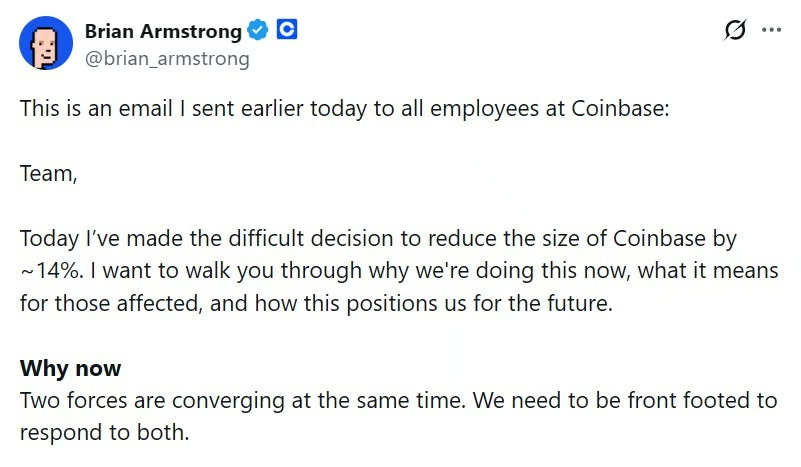
Coinbase will cut about 14% of its workforce, or roughly 700 jobs, as CEO Brian Armstrong moves to make the crypto exchange leaner and more focused on artificial intelligence.
Armstrong said in an email to employees that Coinbase is responding to two forces at once: a down market that pressured the company’s quarter-to-quarter business and rapid advances in AI that are changing how teams work.
He said the company will flatten its organizational structure to a maximum of five layers below the CEO and chief operating officer, require leaders to act as “player-coaches” rather than pure managers and concentrate around smaller AI-native teams that can use automated tools to increase output.
“To those affected, we will be providing a comprehensive package to support you through this transition,” Armstrong said, saying that it will include at least 16 weeks of base pay for US employees, additional pay based on tenure, their next equity vest and six months of “COBRA” or the “Consolidated Omnibus Budget Reconciliation Act,” a US program that allows former employees to temporarily continue employer-sponsored health insurance coverage.
A Tuesday filing with the US Securities and Exchange Commission showed that Coinbase expects its restructuring plan to incur about $50 million to $60 million in expenses tied to severance and termination benefits. The company expects the plan to be substantially complete in the second quarter of 2026.
The cuts show Coinbase framing AI not only as a productivity tool, but as a reason to rethink staffing, management and team structure across one of the largest US crypto companies.
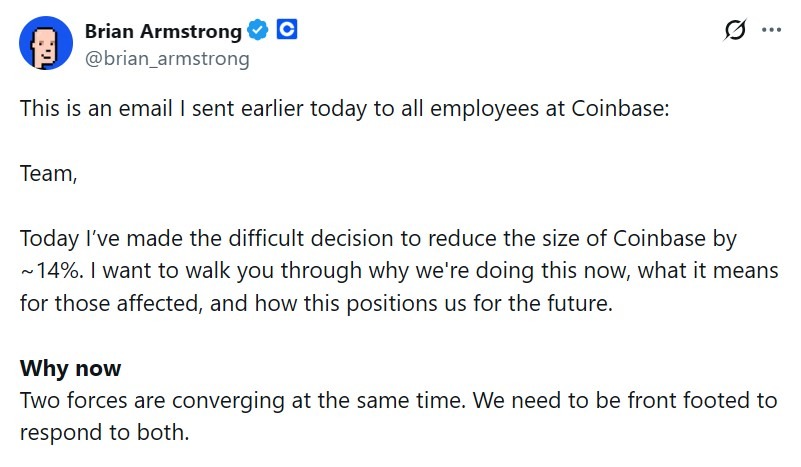
Source: Brian Armstrong
Crypto companies cut staff amid AI shift
Coinbase’s restructuring follows other workforce reductions across crypto companies in recent months, as firms respond to weaker market conditions, cost pressures and the growing use of AI in internal operations.
In February, Gemini said that it planned to cut up to 200 jobs, or about 25% of its workforce, while exiting the UK, EU and Australia as part of a broader cost-reduction plan, according to Reuters. The cuts were expected to affect employees in the United States, Singapore and Europe and be completed in the first half of 2026.
Related: Most crypto investors believe Bitcoin is undervalued: Coinbase survey
In March, Crypto.com cut 12% of its workforce as it accelerated its AI push. The move affected about 180 employees based on the exchange’s listed headcount of around 1,500. The company said the layoffs were part of its plans to prioritize resources around key growth areas.
In the same month, the Algorand Foundation also cut 25% of its staff, citing macroeconomic uncertainty, weaker crypto prices and the rise of AI.
Magazine: AI-driven hacks could kill DeFi — unless projects act now


Pavel Durov says Telegram will replace the TON Foundation and become the network’s largest validator as part of a ‘Make TON Great Again’ roadmap.
Coinbase cuts 700 jobs today, with CEO Brian Armstrong saying AI is making small engineering teams far more productive
Summary
- Coinbase is eliminating roughly 700 employees, approximately 14% of its total workforce, in a restructuring announced on May 5.
- CEO Brian Armstrong cited AI acceleration as a core reason, saying the technology enables small teams to do what previously required far more people.
- The company expects to incur $50 to $60 million in restructuring charges as a result of the workforce reduction.
Coinbase CEO Brian Armstrong announced on May 5 that the company is eliminating roughly 700 employees, representing approximately 14% of its total workforce.
Armstrong attributed the cuts directly to AI changing the economics of engineering, saying the technology makes small teams capable of output that previously required far larger headcount. Coinbase shares rose on the announcement, a reaction investors typically read as margin improvement.
The company expects to record $50 to $60 million in restructuring charges. Armstrong’s framing puts Coinbase among a growing list of major tech companies using AI productivity as justification for headcount reductions, but his is a significant public statement from the CEO of the largest US crypto exchange.
What this signals for Coinbase and the broader industry
Armstrong has been building toward this position for months. As crypto.news reported, Coinbase began testing AI agents internally in April, with Armstrong stating that “we will have more agents than human employees at some point soon.” The May 5 layoffs are the first structural workforce action that reflects that forecast moving from prediction to operational reality.
The cuts arrive as Coinbase continues to press for the Clarity Act’s passage. The company spent $1.07 million on Washington lobbying in Q1 2026 and reversed its earlier opposition to the bill after a stablecoin yield compromise was reached. A leaner cost structure strengthens Coinbase’s position heading into what is shaping up to be a high-stakes regulatory engagement window.
Coinbase is not alone in citing AI as a driver of workforce reduction. As crypto.news documented, Gemini earlier stated that “AI is now too powerful not to use,” and Crypto.com cited AI integration as a reason for its own staff reductions in early 2026.
What makes Coinbase’s announcement distinctive is its scale and the clarity with which Armstrong tied AI productivity, not market conditions, to the decision.
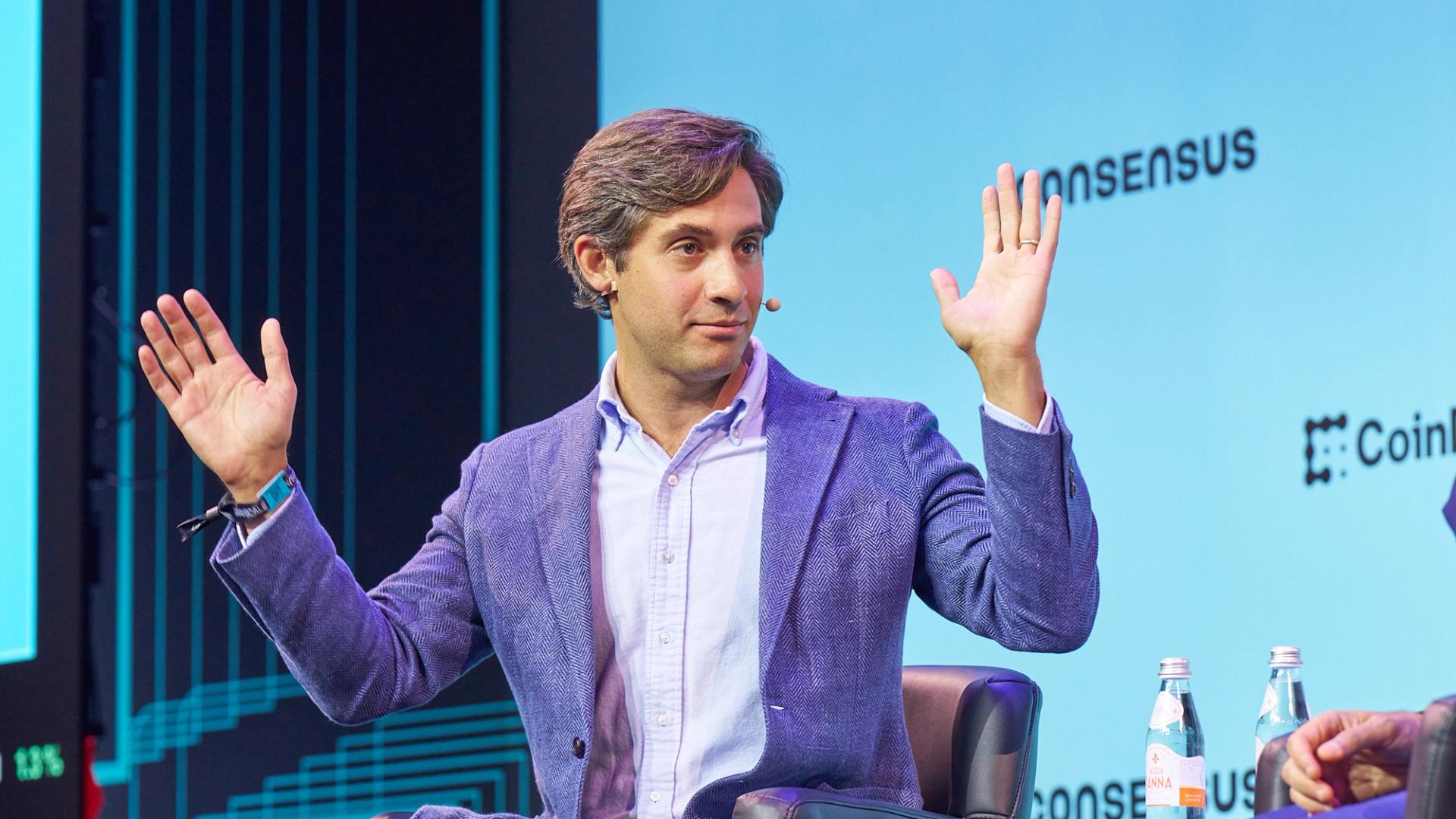
Miami Beach, FL — After years of experimentation, crypto today is boiling down to two core uses: trading and payments.
Speaking at a fireside chat at Consensus 2026 in Miami, Tempo’s go-to-market lead, Dan Romero, said the industry is settling into a “barbell” shape, with speculative trading like Hyperliquid’s marketplace on one end and stablecoin-based payments gaining traction on the other.
“The things that have worked over the last five years are speculation and stablecoins,” he said. “In the middle, it’s a bit of a wasteland,” he added, describing a slew of projects that have struggled to find product-market fit despite years of development and funding.
Romero is speaking from experience. Before joining Tempo, he was the co-founder of crypto social app Farcaster, which struggled to gain traction despite hefty venture capital checks and years of hype.
Tempo, a payments-focused blockchain backed by Stripe and Paradigm, is positioning itself firmly on the payments side of that divide. Built as a purpose-specific layer-1 blockchain, the network focuses on enterprise needs like compliance and transaction control — features often missing from public blockchains.
For example, companies can block interactions with certain wallet addresses, a function aimed at reducing regulatory risk, Romero said.
That design reflects a broader shift in how large firms approach crypto. Rather than experimenting with tokens, many are adopting stablecoins as backend infrastructure. “It’s plumbing,” the executive said. “But enterprises like plumbing if it’s better, faster, cheaper.”
Stablecoins are already gaining ground in areas like remittances. One example cited was cross-border payments between the U.S. and Mexico, where crypto rails now account for a growing share of flows.
The next wave could come from internet-native businesses. Startups, especially those built around AI agents, are likely to default to stablecoins as the easiest way to move money globally, he said — much like Stripe simplified online payments more than a decade ago.


Anthropic venture with Blackstone and Goldman Sachs will deliver enterprise AI tools to private equity-backed companies.
Summary
- Anthropic is finalising a $1.5 billion joint venture with Blackstone, Goldman Sachs, and Hellman and Friedman to serve private-equity-backed companies.
- The platform will deliver AI tools across finance, operations, customer service, and enterprise software to PE portfolio companies.
- The announcement arrived on the same day OpenAI launched a rival enterprise AI joint venture valued at $10 billion.
Anthropic is close to finalising a $1.5 billion joint venture with Blackstone, Goldman Sachs, and Hellman and Friedman, targeting private-equity-backed companies as its primary deployment market. Blackstone and Hellman and Friedman are each expected to commit approximately $300 million, while Goldman Sachs will contribute around $150 million.
The platform will deliver AI tools across finance, operations, customer service, analytics, and enterprise software to companies within the firms’ portfolio networks.
The announcement coincides with a rival launch from OpenAI, which announced its own enterprise AI joint venture valued at $10 billion on the same day.
The simultaneous announcements signal that both leading AI developers view private equity as the most capital-efficient channel for enterprise AI distribution at scale.
The race to capture enterprise AI deployment
The Anthropic venture arrives as the company’s revenue has been accelerating rapidly. As crypto.news reported, Anthropic’s run-rate revenue reached $30 billion in April 2026, tripling from $9 billion at the end of 2025, with over 1,000 business customers each spending more than $1 million annually. CEO Dario Amodei has said the company must “build the infrastructure to keep pace with rapidly growing demand,” a statement that captures the logic driving both the revenue growth and the new PE distribution strategy.
The venture also arrives against the backdrop of legal tension. Anthropic has been suing the US government over a directive that barred federal agencies from using its technology after the company refused to allow Claude to be used for autonomous weapons or mass surveillance. That dispute has complicated Anthropic’s government contracting pipeline, making the private equity channel a strategically important alternative route.
Both Anthropic and OpenAI are accelerating into enterprise markets ahead of potential public listings. Anthropic is exploring valuations above $300 billion, making the $1.5 billion joint venture a commercial signal as much as a revenue play.


a16z crypto’s Crypto Fund 5 was announced just a day after Haun Ventures revealed its $1 billion fund focused on crypto and the agentic economy.
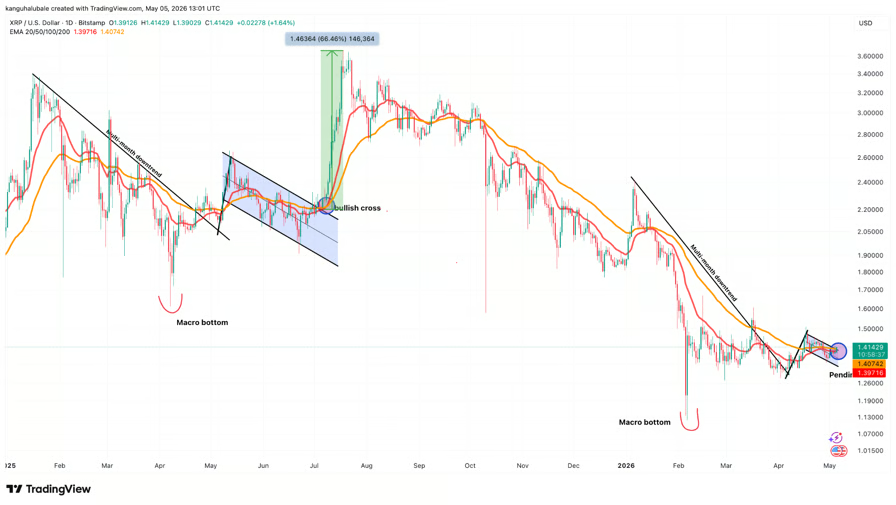
XRP (XRP) is currently displaying a technical pattern that follows a 2025 fractal that produced 66% gains. The daily chart shows XRP price breaking out of a bull flag, which can also result in massive gains.
Key takeaways:
- XRP is currently displaying a technical pattern similar to the 2025 price action that ignited a 66% price rally
- XRP’s spot taker CVD has turned positive, suggesting confidence among buyers.
XRP price chart fractal targets $2.35
XRP’s price action in the daily time frame mirrors a technical structure after recovery from the April 2025 cycle low, preceding a sharp upward continuation.
The formation came after a multi-week consolidation inside a bull flag, followed by a bullish cross by the 20-day and 50-day exponential moving averages (EMAs), as shown in the chart below.
Related: XRP set for ‘strongest’ 2026 monthly ETF inflows as bulls target $2
The XRP/USD broke above the upper boundary of the flag in early July 2025, triggering a cascade of short liquidations and fresh buying that ultimately delivered 66% gains to its current all-time high of $3.66, less than two weeks later.
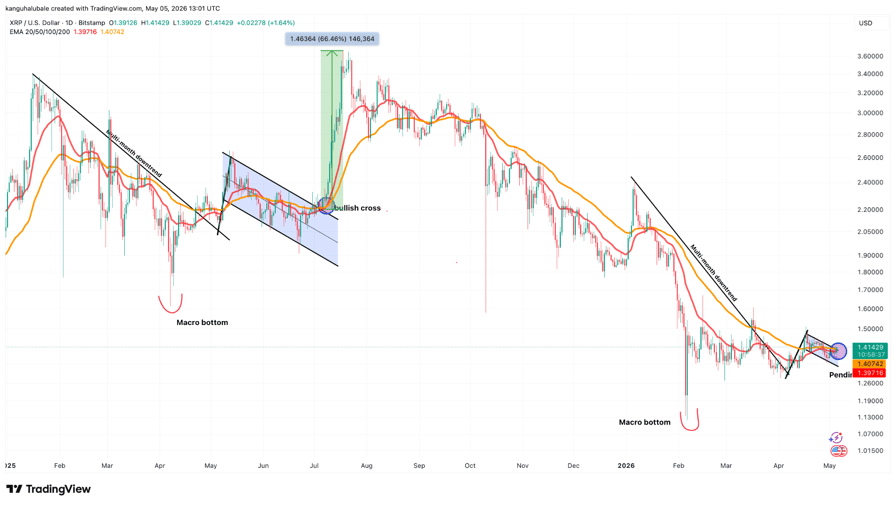
XRP/USD daily chart. Source: Cointelegraph/TradingView
XRP’s current price action is following a similar pattern, with the price again breaking out of a bull flag pattern and a pending bullish crossover from the moving averages.
If history repeats itself, XRP/USD may rally by more than 66% toward $2.35. Further confirmation of a trend reversal now hinges on the price holding above $1.40, which is also the flag’s upper boundary and the 50-day SMA.
“XRP is gaining momentum above $1.40, holding firmly over its 100-hour SMA” analyst Jack Straw said in a Tuesday post on X, adding:
“A clean break above $1.420 could trigger the next leg up.”
Fellow analyst Sam Mti said XRP was “looking good” after a buy signal from the MTI indicator, with potential to move above $1.45 as long as support at $1.40 holds.
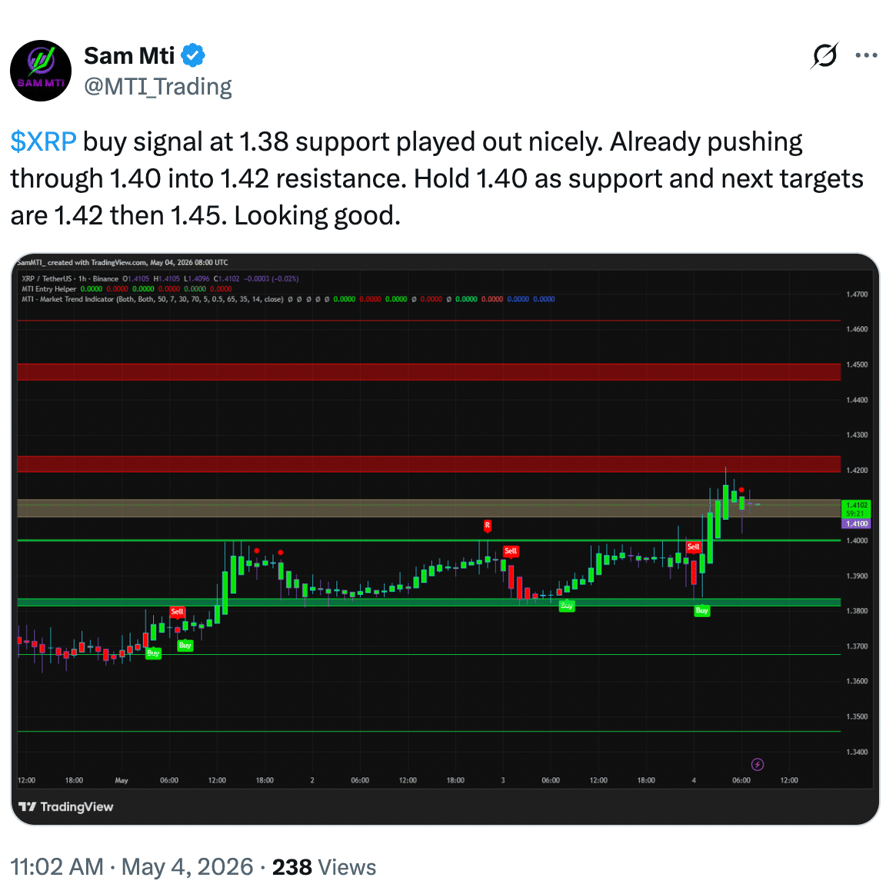
XRP/USD 1-hour chart. Source: Sam Mti
As Cointelegraph reported, buyers will gain the upper hand on a close above the $1.40 level, paving the way for an XRP rally toward $2, then to $2.40.
XRP’s spot taker CVD suggests buyers are back
XRP’s 90-day spot taker cumulative volume delta (CVD) shows that buy-orders (taker buy) have become dominant again. CVD measures the difference between buy and sell volume over three months.
The metric flipped positive (green bars in the chart below) on May 1 as the price broke above the $1.38 resistance and has remained positive since. This indicates optimism among traders, as they’re actively positioning for further gains.
If the CVD remains green, it means buyers are not backing down, which could set the stage for another rally as seen in the past. A similar occurrence in June 2025 accompanied 70% XRP price gains.
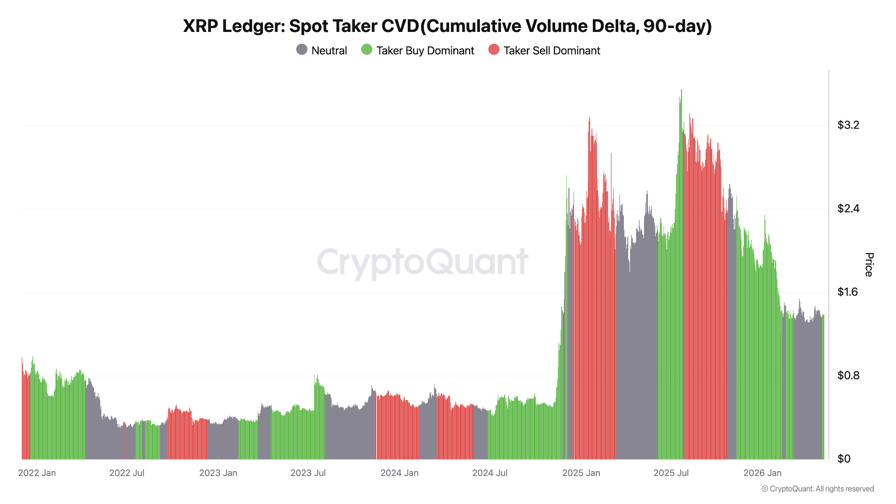
XRP spot taker CVD. Source: CryptoQuant
Meanwhile, XRP’s open interest (OI) delta flipped positive, rising to as high as $27 million on May 1, reflecting a change in active derivatives positioning, data from CryptoQuant shows
“A sharp positive reading suggests that new positions are being added to the market,” CryptoQuant analyst Amr Taha said in a QuickTake analysis on Tuesday, adding:
“When this happens while price is rising, it often shows that traders are increasing exposure as momentum begins to recover.”
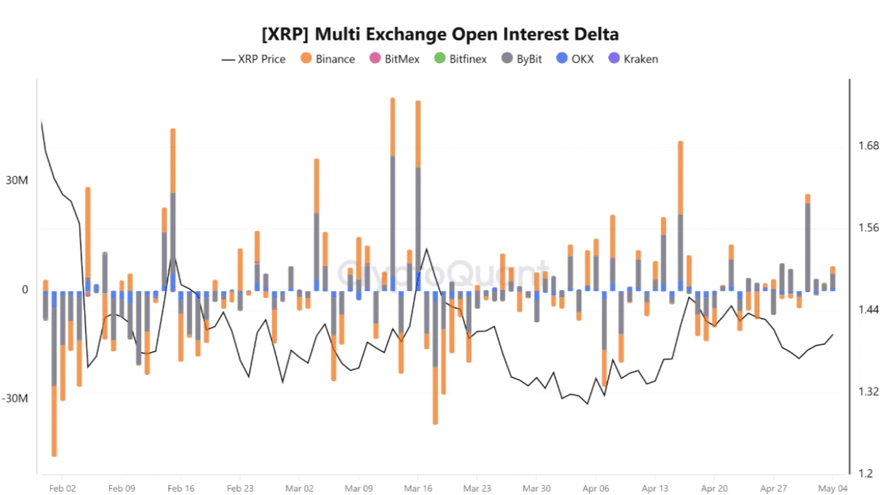
XRP OI delta across exchanges. Source: CryptoQuant
Crypto World
State Street says institutions want improved blockchain security in wake of recent DeFi attacks
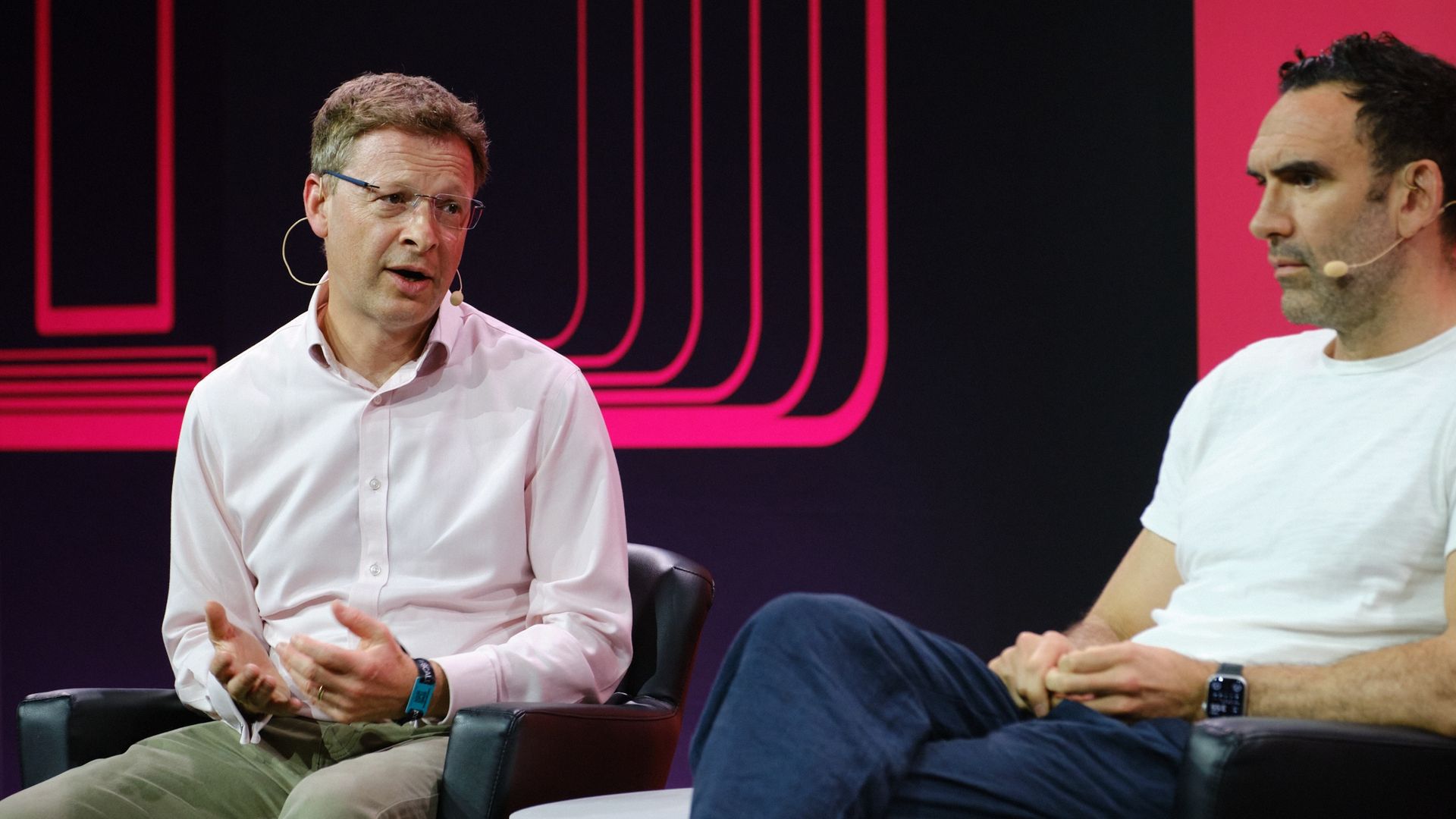
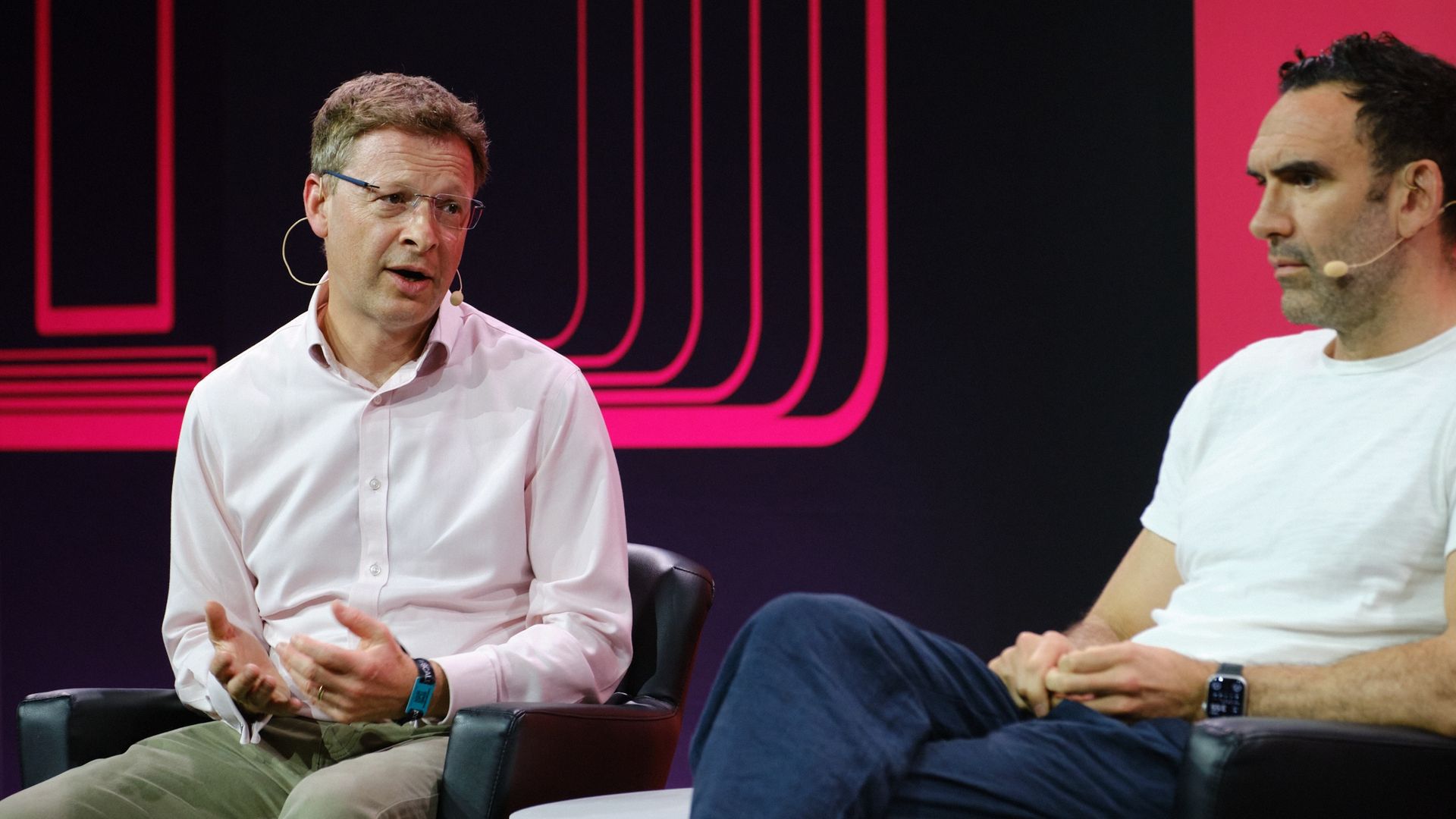
Big traditional finance firms need guardrails in a world of blockchain-based assets, particularly given how decentralized finance (DeFi) remains so susceptible to hacks and losses, the head of digital assets at custodial banking giant State Street said on Tuesday at Consensus Miami.
Still fresh in people’s minds, last month turned out to be a hacker’s bonanza in DeFi, with on-chain lending protocol Drift suffering a $295 million exploit early April, followed by a similarly sized attack on KelpDAO later in the month.
Speaking about the future of tokenized real-world assets (RWAs), Angus Fletcher, State Street’s head of digital assets, said the young crypto industry needs to find solutions now. “What are the things we actually need to solve now for a future where we’ve got trillions of dollars worth of activity on-chain? We need to start to unpick those issues now,” Fletcher said.
For institutions, interoperability between blockchains needs to be clearly defined and understood, Fletcher said, for crypto to safely scale.
“There has to be an understanding of what is the legal title and legal right when you have a token on one chain versus on another, on a cross chain basis. Our customers need to know and understand that. As institutions, it’s critical we get there,” he said.
The head of institutional at the blockchain lending protocol Morpho, Dennis Bree, said April was probably the month that has seen the most hacks in DeFi so far. “I think there’s just a general sense of understanding the security vectors, the underlying assets that are used as collateral. And we’re starting now, certainly to see curators do a lot more diligence as we think about the risk of some of those assets,” Bree said.
The everyday barriers to institutional involvement included a plethora of regulatory gray areas, Bree said. He said Morpho has curators coming to them with $10 to $15 billion in assets under management, seeking to understand how a digital vault manages that capital.
“For example, when you’ve got your capital, and you bring it into a blockchain, you have a receipt token, and instead of receipt tokens just increasing by number, they increase by value. So how does the CFO of a treasury firm think about the accounting treatment of that?”

Rays place LHP Steven Matz (elbow) on 15-day IL

JAIIB May 2026 | JAIIB AFM One Shot | Accounting and Financial Management | by Akhilesh Sir

Indie’s Attic Westhoughton is one of Bolton’s best independent firms

Manchester United reach agreement with Casemiro over contract clause amid transfer speculation

US brings back mandatory military draft registration

Steven Gerrard disagrees with Gary Neville over ‘shock’ Chelsea and Arsenal claim | Football


-

 NewsBeat2 days ago
Channel 5 – All Creatures Great and Small series 7 new post
-
 Business6 days ago
Tesla Officially Registers Elon Musk’s Stock: What Investors Need to Know
-
 Tech4 days ago
Trump’s 25% EU auto tariff breaches Turnberry Agreement that also covers semiconductors and digital trade
-
 Sports4 days ago
Paul Scholes issues Marcus Rashford reality check as agreement emerges over Man United star
-

 Business7 days ago
Barclay Brothers Avoid Bankruptcy: HSBC Drops High Court Petitions After IVA Deal
-

 Entertainment4 days ago
Met Gala 2026 Rumored Guest List Is Turning Heads
-

 Entertainment6 days ago
Celebrities Who Are Attending the 2026 Met Gala Event
-

 Entertainment6 days ago
Insider Claims Reason Behind Key & Peele Split
-

 Crypto World6 days ago
Meta (META) starts stablecoin payout to creators in Circle’s USDC on Polygon, Solana via Stripe
-

 Business6 days ago
Strait of Hormuz Remains Heavily Restricted on April 29 Amid Iran Conflict
-
Business5 days ago
Strait of Hormuz Blockade Persists Amid US-Iran Standoff, Sending Oil Prices Soaring
-

 Tech6 days ago
Texas Instruments made a new flagship graphing calculator: the TI-84 Evo
-

 Business5 days ago
Two Powerball Tickets Split $143 Million Jackpot in Indiana and Kansas
-
 Sports4 days ago
David Benavidez responds to team Canelo saying the fight will never happen
-

 Entertainment4 days ago
Kylie Jenner Hit With Second Lawsuit From Ex-Housekeeper
-

 Sports6 days ago
Saudi Arabia set to withdraw LIV Golf funding after 2026 season, per reports
-

 Sports4 days ago
Cavaliers vs. Raptors Game 6 live score, updates, highlights from 2026 NBA playoffs first-round series
-
Business3 days ago
Winning Numbers Drawn as Jackpot Resets to $20 Million
-

 Sports6 days ago
Arsenal, Atletico Madrid share draw after penalty drama in Champions League semi-final
-
 Crypto World5 days ago
CoreWeave (CRWV) Stock Climbs 8% Despite $45M Insider Share Dump
You must be logged in to post a comment Login