

Crypto World
Coinbase Cuts 14% of Staff in AI Restructuring

Update May 5, 2026, 1:30 pm UTC: This article has been updated to add information from an SEC filing.
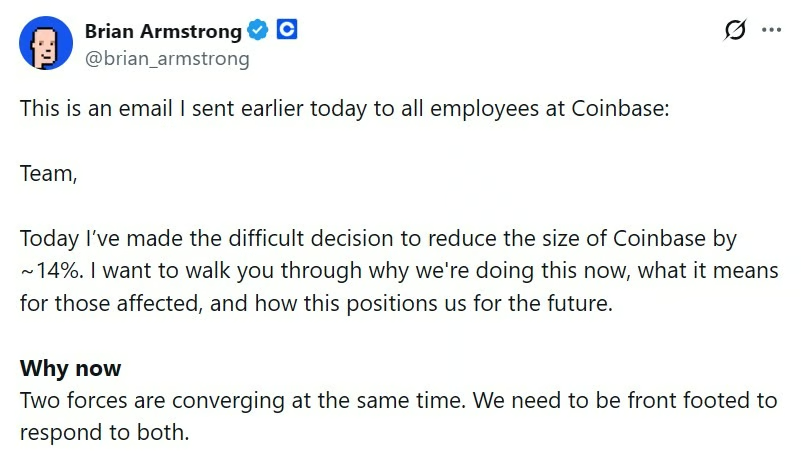
Coinbase will cut about 14% of its workforce, or roughly 700 jobs, as CEO Brian Armstrong moves to make the crypto exchange leaner and more focused on artificial intelligence.
Armstrong said in an email to employees that Coinbase is responding to two forces at once: a down market that pressured the company’s quarter-to-quarter business and rapid advances in AI that are changing how teams work.
He said the company will flatten its organizational structure to a maximum of five layers below the CEO and chief operating officer, require leaders to act as “player-coaches” rather than pure managers and concentrate around smaller AI-native teams that can use automated tools to increase output.
“To those affected, we will be providing a comprehensive package to support you through this transition,” Armstrong said, saying that it will include at least 16 weeks of base pay for US employees, additional pay based on tenure, their next equity vest and six months of “COBRA” or the “Consolidated Omnibus Budget Reconciliation Act,” a US program that allows former employees to temporarily continue employer-sponsored health insurance coverage.
A Tuesday filing with the US Securities and Exchange Commission showed that Coinbase expects its restructuring plan to incur about $50 million to $60 million in expenses tied to severance and termination benefits. The company expects the plan to be substantially complete in the second quarter of 2026.
The cuts show Coinbase framing AI not only as a productivity tool, but as a reason to rethink staffing, management and team structure across one of the largest US crypto companies.
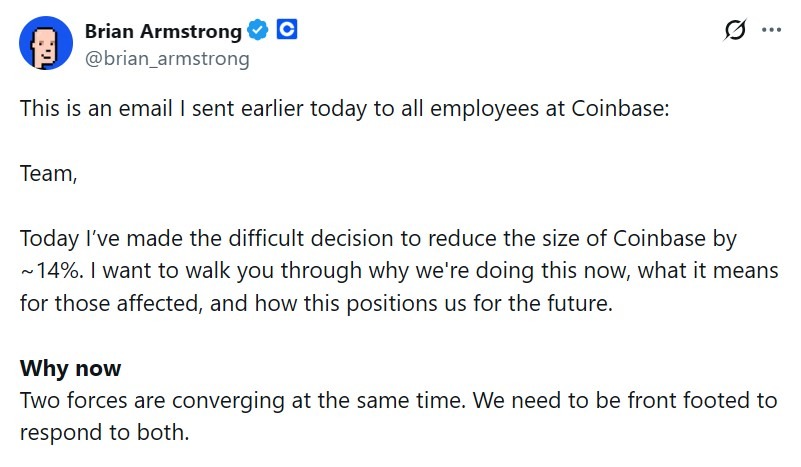
Source: Brian Armstrong
Crypto companies cut staff amid AI shift
Coinbase’s restructuring follows other workforce reductions across crypto companies in recent months, as firms respond to weaker market conditions, cost pressures and the growing use of AI in internal operations.
In February, Gemini said that it planned to cut up to 200 jobs, or about 25% of its workforce, while exiting the UK, EU and Australia as part of a broader cost-reduction plan, according to Reuters. The cuts were expected to affect employees in the United States, Singapore and Europe and be completed in the first half of 2026.
Related: Most crypto investors believe Bitcoin is undervalued: Coinbase survey
In March, Crypto.com cut 12% of its workforce as it accelerated its AI push. The move affected about 180 employees based on the exchange’s listed headcount of around 1,500. The company said the layoffs were part of its plans to prioritize resources around key growth areas.
In the same month, the Algorand Foundation also cut 25% of its staff, citing macroeconomic uncertainty, weaker crypto prices and the rise of AI.
Magazine: AI-driven hacks could kill DeFi — unless projects act now


TLDR:
- ARMA would create a Treasury-managed Strategic Bitcoin Reserve with nationwide cold storage facilities.
- The bill authorizes purchases of 200,000 BTC yearly, targeting 1 million Bitcoin over five years.
- All reserve Bitcoin would face a mandatory 20-year holding period before any potential release.
- Quarterly proof-of-reserve reports and independent audits would increase public transparency.
The publication of the American Reserve Modernization Act of 2026 (ARMA) marks a new stage in U.S. Bitcoin policy discussions.
The bill introduces detailed legislative language for creating a Strategic Bitcoin Reserve within the Treasury Department.
Unlike previous proposals and political statements, the measure establishes specific rules governing Bitcoin acquisition, custody, reporting, and oversight.
The legislation frames Bitcoin as a reserve asset with characteristics that could complement traditional national reserves.
Lawmakers state that Bitcoin’s scarcity, adoption, and resilience support its potential role in strengthening U.S. financial security.
The bill also distinguishes Bitcoin from other digital assets by proposing a separate Strategic Bitcoin Reserve alongside a Digital Asset Stockpile for non-Bitcoin holdings.
The proposal further introduces reporting requirements, independent audits, and public proof-of-reserve disclosures.
These provisions seek to provide transparency regarding government-controlled digital assets and their management.
Treasury Reserve Structure Includes Long-Term Holding Rules
The bill directs the Treasury Secretary to establish a decentralized network of secure Bitcoin storage facilities across the United States.
These facilities would collectively form the Strategic Bitcoin Reserve and store government Bitcoin holdings using cold-storage methods.
Under the proposal, the Treasury would oversee monitoring, auditing, and security operations. The legislation also requires consultation with the Departments of Defense and Homeland Security, alongside industry experts, to develop security measures for reserve holdings.
A notable provision requires Bitcoin acquired by the reserve to remain untouched for at least 20 years. During that period, the assets could not be sold, auctioned, swapped, or otherwise disposed of.
Two years before the holding period expires, the Treasury Secretary would submit recommendations to Congress regarding future management of reserve holdings.
Bitcoin Purchase Program Targets One Million BTC Acquisition
The legislation establishes a Bitcoin Purchase Program that would authorize Treasury purchases of 200,000 BTC annually over five years.
The program’s stated objective is the acquisition of one million Bitcoin through structured purchases designed to limit market disruption.
The bill also permits additional Bitcoin acquisitions through forfeitures, agency transfers, gifts, and other lawful means.
Any Bitcoin obtained through those channels would be transferred to the Strategic Bitcoin Reserve and remain subject to the same custody and holding requirements.
To fund the initiative, the proposal outlines several mechanisms involving Federal Reserve resources and the revaluation of gold certificates.
The legislation also amends federal law to allow Bitcoin holdings within the Exchange Stabilization Fund while requiring additional reporting on related transactions and balances.
The measure further mandates quarterly proof-of-reserve reports, third-party cryptographic audits, and congressional oversight.
Federal agencies holding Bitcoin would be required to transfer those assets into the reserve rather than selling them.
The bill also establishes a voluntary program allowing U.S. states to store their Bitcoin holdings in segregated reserve accounts while retaining ownership rights.
Additionally, the legislation affirms private property rights by stating that the federal government may not seize or impair lawfully acquired Bitcoin holdings belonging to individuals or organizations.
If enacted, the proposal would create a formal framework governing the acquisition, custody, reporting, and long-term management of federal Bitcoin reserves.


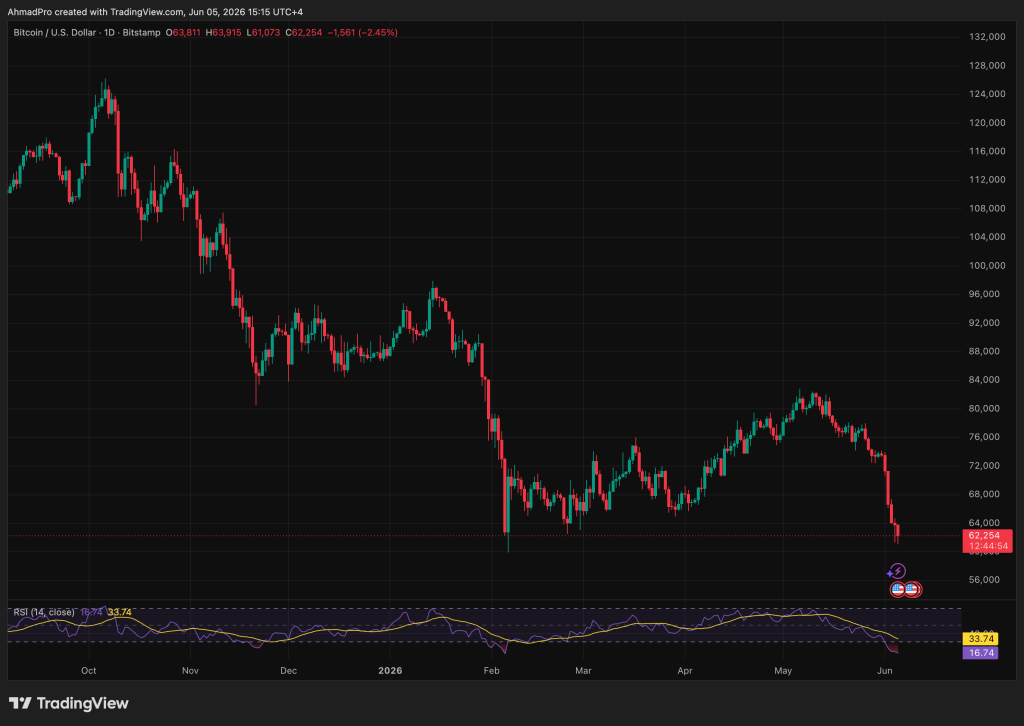
Bitcoin price is bleeding. The leading crypto has dropped to the $61,800–$64,000 range, shedding roughly 5–6% in 24 hours as capital rotates aggressively into equity markets ahead of what could be the most consequential SpaceX IPO.
The question traders are asking isn’t just when BTC recovers, it’s whether this sell-off signals a deeper structural shift in where risk appetite is being deployed. Ethereum and XRP are following BTC lower, with mid-single-digit losses across the board as correlations hold tight.
Veteran investor Thomas Park pointed directly at the IPO pipeline as the culprit, arguing that traders are “moving funds out of Bitcoin to position for high-profile IPOs”, calling them “the market’s upcoming hot ball of money trades” and suggesting BTC is “paling in comparison.” SpaceX has formally filed for a record IPO targeting roughly $75 billion in proceeds at a valuation near $1.75 trillion, eclipsing Saudi Aramco to become the largest public offering in history.
U.S. spot Bitcoin ETFs have bled $2.43 billion in May alone, with another $1.40 billion exiting in the first days of June. The selling pressure is not subtle.
What makes this rotation complex, almost paradoxically, is that SpaceX’s IPO filing revealed a meaningful Bitcoin treasury position, suggesting the long-term institutional narrative around BTC as a corporate reserve asset remains intact even as short-term flows move the other direction.
That tension is setting up a critical inflection point across all three major tokens.

Discover: The Best Crypto to Diversify Your Portfolio
Can Bitcoin Price Reclaim $65,000 Ahead Of SpaceX IPO, Or Is the Low $60,000s the New Crypto Range?
Bitcoin is in a confirmed short-term breakdown from its recent range, trading between $61,800 and $64,000 and pressing against support in the low $60,000s. A decisive close below $61,500 opens the door to a deeper retest of the high $50,000s.
Resistance is stacked above. The mid-$60,000s capped the last recovery attempt, and $70,000 looks increasingly distant given current ETF flow dynamics.
BTC has already erased its geopolitical risk premium, and persistent institutional outflows are compressing any near-term bounce potential. Bitcoin treasury strategies have absorbed a $62 billion wipeout in recent sessions, and retail sentiment is visibly fraying.
ETF outflows stabilizing alongside the SpaceX IPO closing without further crypto rotation gives BTC a path back above $66,000 and re-establishes the prior range.
If capital sits on the sidelines through the IPO window, choppy consolidation between $61,500 and $65,000 is the most likely outcome. Support cracking below $61,500 on continued ETF selling triggers a momentum-driven leg toward $57,000 to $58,000.
Volume and ETF flow data are the signals to watch. Not price alone.
ETH support sits in the low to mid $3,000s with resistance near prior cycle highs. XRP is range-bound, watching horizontal support in the low $0.40s to $0.50s with no breakout signal in sight. Both remain high-beta plays on whatever BTC does next.
Bitcoin Hyper Targets Early-Mover Upside as Bitcoin Tests Critical Support
Here’s the uncomfortable reality for spot BTC holders: at $62,800, the risk/reward on a market-cap-weighted position is asymmetric in the wrong direction near-term.
The upside to prior all-time highs is capped by macro headwinds; the downside is open if ETF outflows accelerate. That dynamic is pushing some traders toward earlier-stage infrastructure plays within the Bitcoin ecosystem itself, where the valuation entry points are structurally different.
Bitcoin Hyper ($HYPER) is one project capturing that rotation interest. Positioned as the first-ever Bitcoin Layer 2 with Solana Virtual Machine (SVM) integration, it targets the three core limitations that have historically constrained Bitcoin’s utility: slow transactions, high fees, and the absence of programmable smart contracts.
The pitch is direct, bring Solana-grade speed and contract execution to Bitcoin’s security layer, without abandoning Bitcoin’s underlying trust model.
The presale has raised $32,804,971.85 at a current price of $0.0136811, with staking available for early participants. The project has drawn particular attention during this BTC dip cycle, as traders seek asymmetric positioning within the Bitcoin ecosystem.
Discover: The Best Token Presales
The post SpaceX and Mega IPOs Fuel Crypto Sell-off: Is Retail Moving Away From Bitcoin? appeared first on Cryptonews.
TLDR:
- Aster crypto fell 7.7% to around $0.62 as broader market weakness triggered heavy selling pressure.
- CZ stated that Aster and Hyperliquid serve different trading needs rather than direct competition.
- Hyperliquid faced added pressure after a $700 million token unlock increased circulating supply.
- Arthur Hayes exited his HYPE position as the token retreated from its recent record high.
Aster crypto traded lower on June 6 as weakness across the digital asset market weighed on prices. The token fell about 7.7% and hovered near $0.62. At the same time, Hyperliquid came under pressure as a major token unlock added fresh supply to the market.
Aster Crypto Tests Key Support as Traders Watch Market Direction
Aster crypto moved lower alongside Bitcoin during Friday’s market decline. However, the token recorded a steeper drop than the broader market, pushing its price into the $0.61-$0.62 range.
Meanwhile, a post shared by Wu Blockchain brought renewed attention to Aster crypto and its position within the perpetual futures sector.
The post referenced comments from Binance founder Changpeng Zhao (CZ) during an October 2025 interview on the Threadguy channel.
According to the post, CZ said Aster and Hyperliquid address different trading needs rather than competing directly.
He described Hyperliquid as a platform designed for open and transparent trading activity. In contrast, he said Aster offers greater privacy features and supports native asset deposits beyond a BNB Chain-focused structure.
CZ also noted that both projects remain relatively young. As a result, future market leadership could still shift as new platforms enter the sector.
Despite the latest decline, Aster crypto continued to post strong trading activity. Elevated volume suggested that traders remained active even as prices moved lower. Market participants are now watching whether Aster crypto can maintain support above the $0.60 level.
Analysts cited on CoinMarketCap noted that holding above that area could help stabilize price action. If support fails, attention may shift toward the $0.55 region.
Hyperliquid Faces New Selling Pressure From Scheduled Unlock
While Aster crypto struggled with market weakness, Hyperliquid faced a separate challenge linked to token supply. A scheduled $700 million token unlock took place on June 6 as part of an ongoing monthly vesting schedule.
The release increased the number of tokens entering circulation. Consequently, traders monitored the market closely for signs of additional selling activity.
Pressure also increased after reports emerged that investor Arthur Hayes had liquidated his entire HYPE position. The move attracted attention across the crypto market and coincided with renewed weakness in the token’s price.
HYPE traded near $59.35 during the session. The token remained well below its June 1 all-time high of $75.51 and was down roughly 12% over the past week.
Even so, Hyperliquid’s treasury position remained a focus for market participants. Reports showed approximately $1.1 billion in unrealized token gains within the project’s treasury holdings.
As traders assess current market conditions, attention remains on two key developments. Investors are watching whether Aster crypto can defend support above $0.60.
They are also monitoring how Hyperliquid performs following the large token release and recent selling activity.
For now, both assets remain among the most closely watched cryptocurrencies as market participants evaluate near-term price direction.
TLDR:
- ZachXBT questioned Arthur Hayes over WLD exit after prior bullish statements and price targets.
- Hayes sold Worldcoin shortly after public endorsements, triggering scrutiny over timing and intent signals.
- The debate centers on whether public calls influenced retail entry before liquidity exits occurred in markets.
- Hayes defended trades, stating he sold at market price to willing buyers following his trading strategy.
On-chain investigator ZachXBT has questioned BitMEX co-founder Arthur Hayes over recent token sales involving Worldcoin and other assets.
He raised concerns about whether public commentary contributed to retail liquidity exit during volatile trading periods.
ZachXBT has previously monitored public crypto trader activity using on-chain data analysis tools, platforms, and records systems.
Hayes sold his entire Worldcoin position shortly after publicly expressing bullish views and setting price targets for the recently announced sale.
The sale followed strong social media commentary that included a $10 price target from his firm Maelstrom entity.
The Worldcoin token drew increased attention after posts from high-profile investors circulated widely across markets and exchanges.
He also exited NEAR Protocol, Hyperliquid, and Zcash within a short timeframe, according to public post records available.
The moves prompted scrutiny over consistency between public statements and subsequent trading actions across markets, according to reported analysis coverage.
ZachXBT raises concerns over trading pattern and market influence
ZachXBT referenced repeated bullish commentary on NEAR, HYPE, ZEC, and Worldcoin across multiple posts in online archives and records.
The analysts compared the timing of posts and subsequent market movements and correlations observed across trading data.
He suggested rapid reversals created questions about exit liquidity generated during volatile market conditions across trading sessions and periods.
Analysts monitored trading behavior patterns following repeated timing gaps between commentary and position closures, observations in reports.
He argued influencer commentary can affect liquidity dynamics in short-term trading environments; market conditions observed trends.
The discussion spread across crypto communities tracking on-chain data and social sentiment indicators, with metrics analysis platforms widely.
Social sentiment tools recorded heightened discussion volumes during price swings across tokens tracked in multiple datasets observed globally.
Arthur Hayes defends exits and cites market-based execution
Arthur Hayes stated he sold tokens at market price to willing buyers during trading conditions across markets globally observed.
He argued trades followed predefined objectives and were not influenced by social media reactions or online sentiment pressure factors.
His firm, Maelstrom, continues to manage investments tied to broader market positioning strategies and frameworks across portfolios globally structured.
He confirmed a full exit from Worldcoin after posting commentary on its price direction changes and recently observed trends.
Arthur Hayes also exited NEAR Protocol, Hyperliquid, and Zcash in earlier disclosed transactions, publicly reported activity logs available.
He maintained that post-trade narratives do not accurately reflect execution timing in volatile markets, according to his view.
Worldcoin experienced increased volatility following the announcement of Hayes’ full position exit disclosure across trading platforms globally reported.
Retail sentiment remained elevated while price movements continued during the same trading period observed across market data sets.
Analysts continued tracking Worldcoin volatility patterns after the announcement across derivatives and spot markets data reported across exchanges.
TLDR:
- Gold prices fell to a three-month low, wiping out all gains recorded during the 2026 rally.
- Strong US jobs data reduced rate-cut expectations, adding pressure on non-yielding assets.
- Silver followed gold lower, extending losses after a powerful rally earlier in the year.
- Markets now await June inflation data, which could shape the next move for gold prices.
Gold prices have erased all gains recorded earlier in 2026 after a steep decline pushed the precious metal to a three-month low.
The retreat comes despite geopolitical tensions, rising inflation concerns, and continued uncertainty surrounding US monetary policy, conditions that traditionally support safe-haven demand.
The latest market move has sparked fresh debate about the strength of the safe-haven trade. Investors are now reassessing expectations as gold prices and silver prices continue to retreat from their January peaks.
Gold Prices Slide Despite Traditional Safe-Haven Conditions
A recent post from Bull Theory drew attention to the sharp reversal across precious metals markets. The post noted that gold reached an all-time high of $5,600 per ounce on January 29. During the same period, silver climbed to $121 per ounce.
https://TWITTER.com/BullTheoryio/status/2063323610383880197?s=20
According to the post, both metals benefited from strong safe-haven demand at the start of the year. However, the trend changed after market conditions shifted.
The US-Iran conflict escalated during February, while the Strait of Hormuz closure pushed oil prices to $93 per barrel. Inflation also climbed to 3.8%.
Historically, those developments would support higher precious metal prices. Instead, the market moved in the opposite direction.
Gold has now fallen sharply from its January peak. The decline wiped out trillions of dollars in market value across gold and silver markets.
At the latest settlement, spot gold traded near $4,327 per ounce. The metal lost about 3.3% in a single trading session and posted a weekly decline exceeding 4%.
The current level leaves gold roughly 18% below its record high. As a result, gold prices have turned negative for the year despite their strong start.
Silver also recorded a deeper correction. The metal has fallen substantially from its January highs, erasing gains accumulated during the early rally.
Strong Economic Data Pressures Gold Prices
The latest decline in gold prices followed stronger-than-expected US labor market data. Government figures showed that the economy added 172,000 jobs in May.
The report exceeded market expectations and strengthened confidence in the resilience of the US economy.
As a result, investors reduced expectations for near-term Federal Reserve rate cuts. Some market participants also began considering the possibility of higher rates for longer.
Higher interest rates often pressure non-yielding assets such as gold. Investors can find better returns in interest-bearing investments when rates remain elevated.
At the same time, Treasury yields moved higher following the jobs report. The US dollar also strengthened against major currencies.
A stronger dollar generally weighs on gold demand because the metal becomes more expensive for international buyers. That trend added further pressure to gold prices during the recent sell-off.
Market participants are also monitoring weaker physical demand from China. Recent Shanghai Gold Exchange data showed that buying activity has slowed to its lowest level since 2020.
The pullback has also affected retail markets abroad. In India, local gold prices dropped sharply, while Pakistan reported a steep one-day decline in domestic gold rates.
Attention now shifts to upcoming US inflation data scheduled for June 10. Traders view the Consumer Price Index report as the next major catalyst for gold prices.
If inflation remains elevated, expectations for prolonged higher interest rates could continue weighing on sentiment. However, some large financial institutions maintain bullish year-end forecasts, citing ongoing central bank purchases and geopolitical uncertainty.
For now, gold prices remain under pressure as investors balance economic strength, monetary policy expectations, and changing demand trends.
Crypto World
Gate Sees $30M Equity Trading Surge as Tokenized Stocks Drive Crypto Market Convergence
TLDR:
- Gate recorded multiple equity trading spikes, with volumes approaching $30M over a three-month period.
- Investors are rotating between crypto and equities as exchanges unify multi-asset trading ecosystems globally.
- AI-driven market narratives are accelerating demand for tokenized exposure to tech and semiconductor stocks.
- Major platforms like Binance, Coinbase, and Crypto.com are scaling tokenized stock infrastructure rapidly.
Recent CryptoQuant data shows a clear shift in trading behavior across global crypto exchanges. Gate daily equity trading volume surged to nearly thirty million dollars, a three-month high.
This pattern signals rising demand for hybrid access between traditional equity markets and crypto trading ecosystems globally integrated. Equity-linked trading on crypto platforms continues expanding as investors seek broader global market access.
Crypto exchanges increasingly connect traditional stock exposure with digital asset infrastructure for international users.
This integration accelerates market convergence as investors shift toward unified trading platforms with broader accessibility features globally.
Market participants now treat crypto exchanges as unified venues for diversified financial instruments across regions.
This shift reflects growing demand for simplified cross-border trading and continuous market access worldwide without restrictions or constraints.
Rising Equity Volume on Crypto Exchanges
Gate trading data shows multiple volume spikes across three months near the thirty million threshold. Activity spans technology, artificial intelligence, semiconductor, and crypto-related equities rather than a single stock.
Spikes often align with periods of heightened retail engagement and macro-driven risk appetite across markets, with cycles emerging globally. Artificial intelligence narratives continue drawing capital into related equities traded on crypto-native platforms.
International investors use tokenized stock products to bypass traditional brokerage barriers across regions. These products reduce friction for global investors seeking exposure to U.S. equity markets efficiently today, widely adopted across regions.
Volatility continues driving traders to rotate between equities and crypto-linked instruments on leveraged platforms.
Crypto exchanges now function as multi-asset venues integrating equities, digital assets, and tokenized instruments.
This evolution positions crypto exchanges as integrated financial ecosystems, bridging multiple asset classes seamlessly, operationally unified, and globally active.
Expansion of Tokenized Equity Infrastructure
Binance launched trading for over 7,000 U.S. stocks and ETFs on June 1, 2026, globally.
The platform offers commission-free trading for qualifying orders, fractional shares from five dollars, and 24/5 access.
The rollout expands access to fractional investing and continuous market participation across global users efficiently at scale globally.
Coinbase expanded stock and ETF trading through Coinbase Capital Markets and announced future stock perpetual products. Crypto.com introduced 24/5 U.S. stock trading and partnered with High Roller Technologies for prediction markets.
These initiatives reflect accelerating demand for 24-hour market exposure and hybrid financial instruments worldwide, rapidly expanding adoption trends.
Ondo Global Markets surpassed one billion dollars in total value locked across tokenized asset offerings. Platforms now support over 260 assets and reflect growing demand for integrated multi-asset trading ecosystems globally.
The expansion signals increasing convergence between decentralized finance platforms and regulated financial market infrastructure ecosystems globally aligned growth.

Ethereum has emerged as the blockchain with the largest number of holders, far ahead of Bitcoin.
Data on non-empty wallets shows that Ethereum has around 189.49 million holders, which is more than three times Bitcoin’s 59.08 million.
Network Growth vs Market Performance
The figures, shared by the head of research at Lisk, analyst Leon Waidmann, indicate Ethereum’s significantly large user base even as the asset’s price remained in a bearish zone. After Ethereum and Bitcoin, Tether ranks third with 13.61 million holders, followed by XRP with 7.8 million and USDC with 6.76 million non-empty wallets.
Even with such strong network adoption, ETH has been on a steady decline over the past month, losing more than 30% during the period. The crypto asset was trading near $1,620 at the time of writing.
The weakness in its price has also affected companies that built large treasury positions in the asset. One example is Nasdaq-listed FG Nexus, which has reportedly accumulated losses of more than $85 million on its Ethereum strategy after selling a substantial portion of its holdings below its purchase price.
The company had made ETH its main treasury reserve asset and started building its position around Ethereum’s 10th anniversary, with plans to become a major holder. However, the broader market downturn forced it to reduce its exposure.
Meanwhile, crypto analyst Michaël van de Poppe noted that ETH’s daily Relative Strength Index (RSI) has dropped to the lowest level ever recorded. He believes this extremely oversold condition could mean the crypto market is getting close to the end of the current bear market and that a turnaround may not be far away.
ETFs Reverse Outflow Streak
The market pressure has also been visible in spot Ethereum ETF activity. However, after 17 straight trading days of outflows, these funds recorded net inflows of $19.3 million on June 4. The inflows were driven entirely by ETHA, while the remaining nine ETFs saw no activity.
Overall, Ethereum ETFs still posted $168 million in net outflows for the week. SoSoValue said the latest figures could mean that ETF flows are starting to stabilize, although a meaningful recovery will depend on whether inflows continue across Ethereum and the other major crypto assets.
The post Ethereum Has 3x More Holders Than Bitcoin Despite a Brutal Price Decline: Analyst appeared first on CryptoPotato.
Crypto World
Zcash’s Orchard Vulnerability Leaves Users Unable to Verify ZEC Circulating Supply, Says Zooko Wilcox
TLDR:
- Zooko Wilcox confirms users cannot independently verify if ZEC supply was hit by the Orchard flaw.
- The Ironwood upgrade would create a new shielded pool using the patched Orchard circuit upon activation.
- Turnstile mechanisms will block any excess ZEC from exiting the old Orchard pool after Ironwood activates.
- Wilcox says exploitation is unlikely but users should not rely on Shielded Labs’ assessment alone.
Zcash co-founder Zooko Wilcox has confirmed that users currently cannot independently verify whether ZEC’s circulating supply was affected by the recently disclosed Orchard counterfeiting vulnerability.
Wilcox, alongside Jason McGee and Taylor Hornby of Shielded Labs, published a proposal for the Ironwood network upgrade.
The upgrade would restore user-level supply verification through consensus rules. No deployment timeline has been announced.
Wilcox: Privacy Properties of Orchard Block Independent Verification
The Orchard vulnerability was patched through an emergency network upgrade completed on June 2. That fix closed the security gap, but it did not resolve a separate problem.
The privacy architecture of the Orchard pool makes it impossible for users to confirm whether the vulnerability was exploited before the patch.
Wilcox acknowledged that Shielded Labs believes exploitation was unlikely. However, he was direct about the limits of that position.
Users should not have to rely on the team’s assessment when verifying the integrity of the ZEC supply, he stated in the published proposal.
The proposed Ironwood upgrade addresses this gap at the protocol level. It would create a new shielded pool using the corrected Orchard circuit.
Simultaneously, any transaction attempting to create new outputs in the existing Orchard pool would be rejected as invalid.
Once Ironwood activates, users would gain immediate, trustless verification of the circulating supply. They would simply sum the balances across active pools by running a node, with no need to reason about other parties’ actions or wait for fund migrations to complete.
Ironwood’s Two-Outcome Framework Targets On-Chain Evidence of Counterfeiting
Wilcox and his co-authors structured Ironwood around what happens when users begin migrating funds out of the old Orchard pool. The migration process creates conditions that may surface evidence of whether counterfeiting occurred.
Any counterfeiter holding excess ZEC in the old pool would face two options. Moving those funds into the new pool would expose their existence on-chain. Leaving them behind would risk permanent inaccessibility as legitimate users complete their migrations.
Wilcox outlined two resulting outcomes. Under the first, no excess ZEC attempts to exit the old pool. That result would serve as strong on-chain evidence that the vulnerability was never exploited.
Under the second, excess ZEC attempts to cross the turnstile and gets blocked by the protocol, destroying those funds while creating publicly verifiable proof of counterfeiting.
Turnstiles, Zcash’s existing cross-pool accounting mechanism, enforce these rules automatically. They track the total ZEC entering each pool and reject any withdrawal attempt that exceeds the legitimate balance. This prevents excess ZEC from escaping into other pools regardless of outcome.
Wilcox recommended that all wallets supporting the existing Orchard pool add support for the new one ahead of activation.
Existing Orchard addresses would remain valid after Ironwood activates, with incoming ZEC automatically received in the new pool. The team noted that the transition from zcashd to the Zebra node client may affect the upgrade’s timing.
TLDR:
- Peter Schiff warns Bitcoin could plunge to $30,000 if sellers force a decisive break below $50,000.
- Bitcoin’s RSI dropped below 30, highlighting extreme bearish momentum and oversold market conditions.
- Prediction markets assign an 83% probability that Bitcoin trades below $55,000 during 2026.
- BTC remains trapped between $60K and $61.8K as traders await a breakout from consolidation.
Bearish sentiment about BTC intensified across markets following renewed warnings from economist Peter Schiff in recent sessions.
Schiff predicted a potential drop toward $30,000, arguing that complacency among investors remains at excessively high levels.
He stated that a break below $50,000 could trigger a rapid move toward lower levels in markets. He suggested that Market sentiment remains fragile amid macroeconomic uncertainty.
Market data shows Bitcoin RSI falling below 30, indicating strong selling pressure in recent sessions. However, readings below 30 sometimes signal oversold conditions that can precede short-term relief rallies in markets.
Furthermore, Strategy’s sale of 32 Bitcoins worth approximately $2.5 million during the late May period marked a bearish transition for traders. This marked their first reduction since 2022.
Polymarket contracts saw about $15 million in trading volume tied to Bitcoin price outcomes recently. Traders are still monitoring macroeconomic signals for direction. Sentiment remains cautious among institutional investors.
Schiff Warns of Deeper Market Correction
Peter Schiff reiterated expectations of a deeper Bitcoin correction, citing persistent investor complacency across current market conditions. He argued that a break below $50,000 could accelerate selling toward $30,000 levels rapidly in markets.
Market observers remain divided on near-term Bitcoin trajectory. He also suggested Bitcoin weakness could signal broader risk asset declines across markets globally.
He questioned whether Bitcoin would act as a harbinger for wider financial turbulence globally. Risk sentiment across crypto markets remains highly reactive.
He linked Bitcoin weakness to political debates surrounding proposed strategic Bitcoin reserve policies in the United States.
He claimed that pressure could build from crypto supporters seeking government-backed interventions in the future. Regulatory discussions continue to influence investor positioning.
Market Structure and Technical Pressure Intensify
Bitcoin traded in a narrow consolidation range between $59,300 and $61,800 during recent sessions this week. Analysts noted repeated resistance near $61,500 as bullish momentum continued to weaken in markets.
Price action showed lower highs forming after an initial sharp upward spike earlier. A brief dip below $60,000 suggested stop-loss activity and liquidity-driven volatility recently. Support remained concentrated near $60,000 while resistance held between $61,500 and $62,000 levels.
Market participants awaited a breakout direction as trading volume gradually declined recently. Volatility remains elevated across major trading sessions. Short-term traders reacted quickly to intraday price swings.
Market makers adjusted positions throughout the session. Liquidity conditions appear thinner during consolidation phases. Investors await clearer directional signals.
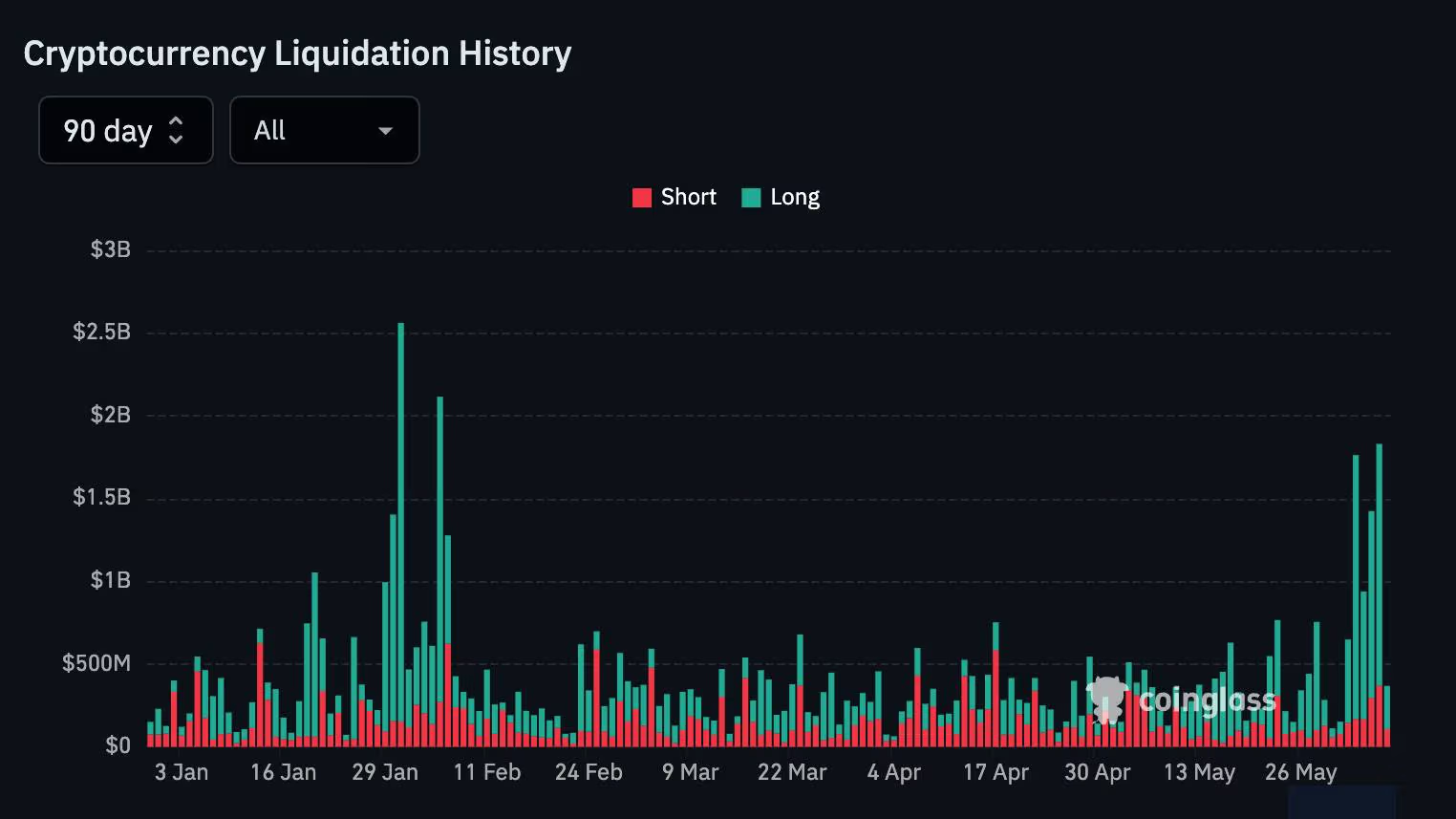
Crypto investors endured one of their toughest week in years as a wave of selling wiped out hundreds of billions of dollars from digital asset markets.
Bitcoin fell 17.3% this week while ether (ETH) dropped 22%, putting both assets on track for their largest weekly declines since November 2022, when the collapse of Sam Bankman-Fried’s FTX exchange triggered a market-wide panic.
Despite a modest stabilization on Saturday, both assets remained near their lows, with BTC trading just above $60,000 and ETH changing hands around $1,550.
The damage extended far beyond the two largest cryptocurrencies. The digital asset market shed roughly $390 billion in value during the week, leaving total market capitalization hovering just above $2 trillion, according to TradingView data. That’s less than half of the nearly $4.2 trillion peak reached in October.
It wasn’t just prices that got hit. Crypto derivatives traders suffered one of the largest wipeouts of this year.
Roughly $7 billion in leveraged positions were liquidated across digital assets during the week, according to CoinGlass data, with Monday and Friday delivering the most severe flushes.
About $5.7 billion of those were long positions, or bullish bets on higher prices.

Why crypto crashed this week
The selloff came as several bearish forces converged at once.
Starting the week, Strategy (MSTR), the largest corporate holder of bitcoin, disclosed it sold BTC for the first time in nearly four years. The transaction was negligible — just 32 BTC worth roughly $2.5 million — but the sale rattled investors who had long viewed Michael Saylor’s company as a perpetual source of demand.
Investors also began questioning whether Strategy may need to sell additional bitcoin to help cover obligations tied to its growing stack of preferred equities.
At the same time, bitcoin ETFs continued to bleed assets. K33 Research head Vetle Lunde argued earlier this week that some of those outflows reflected a broader rotation of capital away from crypto and into artificial intelligence (AI) investments.
With AI-related stocks pushing to record highs and investors anticipating potential IPOs from companies such as OpenAI, Anthropic and SpaceX, “the opportunity cost of holding BTC” has become increasingly difficult for some investors to ignore, Lunde said.
Concerns about AI’s ability to expose flaws in crypto protocols also added to the pressure. Zcash (ZEC), one of the best-performing cryptos earlier this year, tumbled more than 40% after researchers used Anthropic’s latest AI model to uncover a critical vulnerability in the network’s privacy system.
The final blow came with Friday’s stronger-than-expected U.S. jobs report, forcing investors to rethink the Federal Reserve’s next move. Markets that earlier this year anticipated rate cuts are now increasingly expect that the central bank could hike if inflation remains stubbornly high.
U.S. Treasury bond yields surged, while the Nasdaq 100 suffered its worst day since the tariff-driven selloff in April 2025, snapping a record-setting rally that had fueled much of Wall Street’s enthusiasm this year.
For now, the selling appeared to have paused with traditional markets closed for the weekend and crypto prices stabilizing on Saturday.
Whether this week’s rout marked the capitulation that often comes at market bottoms or was merely the latest episode in the downtrend may come down to the broader macro picture. Higher bond yields, rate-hike fears and continued competition from AI investments and IPOs remain key hurdles for the recovery.

Manchester Airport passengers warned of US airport closure
ARMA Bill Proposes U.S. Strategic Bitcoin Reserve With 1M BTC Acquisition Framework

James Gunn Just Fixed Marvel’s Biggest Problem



-

 Business5 days ago
Jade Biosciences, Inc. (JBIO) Discusses Positive Interim Results From JADE101 Phase I Healthy Volunteer Study and Development Plans Transcript
-

 Fashion1 day ago
Weekend Open Thread: Evereve – Corporette.com
-

 Sports4 days ago
French Open 2026 results: Alexander Zverev beats Rafael Jodar and will play Jakub Mensik in semi-finals
-
 Crypto World1 day ago
Jensen Huang Approves Samsung, SK Hynix, and Micron for NVIDIA (NVDA) HBM4 Memory Supply
-

 Tech4 days ago
CryZENx Releases Fresh Playable Content Deep Inside Jabu-Jabu for His Ocarina of Time Remake
-

 Business4 days ago
Trump Taps Housing Chief Bill Pulte as Acting Intelligence Director After Gabbard Exit
-
Crypto World2 days ago
LBank Surpasses 25 Million Users Worldwide as AFA Partnership Continues to Drive Global Growth
-
 NewsBeat4 days ago
Republicans balk at Trump’s attempt to appoint a MAGA enforcer to lead National Intelligence
-
 Crypto World4 days ago
Seagate (STX) Stock Surges to Record High on AI Boom and Legal Settlement
-

 Tech1 day ago
RCS Messages Between iPhone and Android Get End-to-End Encryption With iOS 26.5
-
Crypto World4 days ago
EU AI Data Center Project Faces Delays as Funding Gaps Grow
-

 Entertainment4 days ago
Did The Mandalorian And Grogu Already Ruin The Next Star Wars Movie?
-

 Business4 days ago
Aehr Test Systems Stock Soars 17% Amid Surging AI Demand and Conference Spotlight
-
 Business4 days ago
Claude AI Down Today Reason: Why Anthropic’s AI is not working today? What’s the latest quota update
-

 Business4 days ago
Relay Therapeutics Shares Surge 20% on ASCO Momentum for Zovegalisib Breast Cancer Program
-

 Tech4 days ago
Instagram will stop bombarding teens with the same kind of obsessively unhealthy content
-
 Crypto World1 day ago
Merlin (MRLN) Stock Soars 32% on Major USSOCOM Autonomy Milestone
-

 Tech1 day ago
Credit card theft campaign abuses Stripe to host stolen payment info
-
Crypto World5 days ago
Tether Brings Google’s TurboQuant to Production, Unlocking Long-Context AI on Everyday Devices
-
 Entertainment4 days ago
‘Aliens’ Star Reveals How the US Military Co-Opted James Cameron’s Sci-Fi Tech [Exclusive]
You must be logged in to post a comment Login