

Crypto World
Bernie Sanders Questions Elon Musk on Universal High Income



Bernie Sanders publicly challenged Elon Musk, demanding to know how the tech billionaire plans to fund a “Universal High Income” while refusing to support a 5% tax on his own $817 billion fortune.
Elon Musk posted on X that government checks could be the best solution to AI-driven unemployment. He argued that AI and robotics would generate enough goods and services to offset any increase in the money supply and prevent inflation.
Sanders Turns the Funding Question Back on Musk
The Vermont senator fired back in a direct post to Musk, pointing to the contradiction. Sanders framed his criticism as a broader challenge to economic fairness and the funding model behind large-scale income-support proposals.
Sanders and Rep. Ro Khanna have proposed the “Make Billionaires Pay Their Fair Share Act”. The bill would impose a 5% annual wealth tax on net assets above $1 billion. The bill targets roughly 938 billionaires and projects $4.4 trillion in revenue over a decade.
AI Job Displacement Is Already Accelerating
The policy clash arrives as AI layoffs mount in 2026 across major industries. AI agents claimed 9,200 jobs in 2026 alone, with Goldman Sachs estimating AI trimmed roughly 16,000 US monthly payroll positions over the past year.
The displacement affects not only entry-level work. Musk has amplified warnings about AI eliminating PhD-level finance and research roles. He suggest the threat extends well up the skills ladder.
Dario Amodei has warned that AI could eliminate up to 50% of entry-level white-collar jobs within five years. He also suggested that US unemployment could potentially rise to 20%. Musk has previously stated he expects AI to become the most disruptive economic force in history, predicting a future where no job is ultimately necessary.
Whether that future can be managed through government income support, and who would pay for it, is a question neither side has yet answered concretely.
The post Bernie Sanders Questions Elon Musk on Universal High Income appeared first on BeInCrypto.

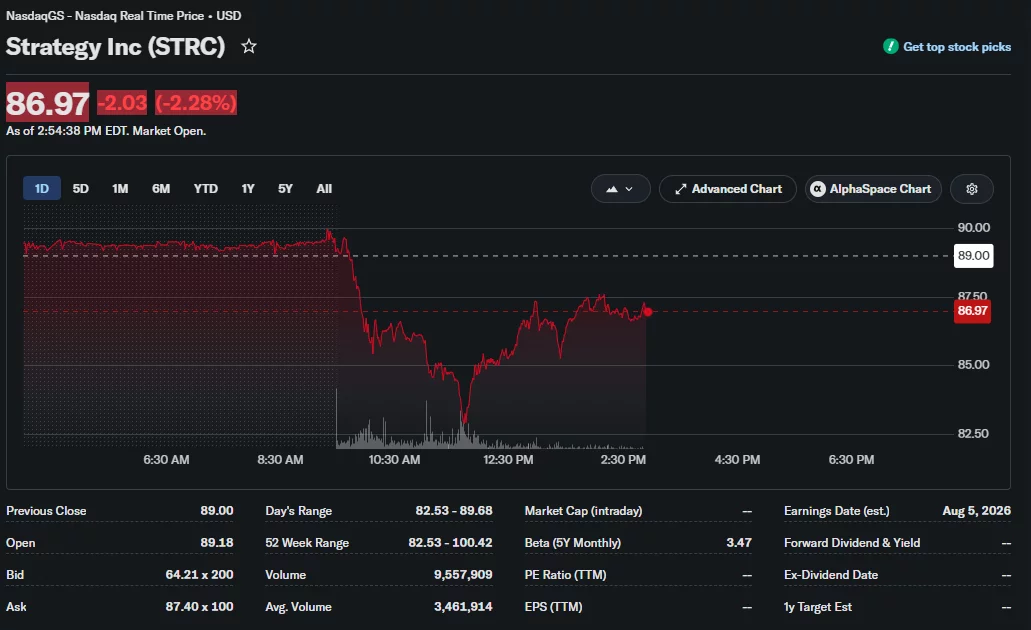
Peter Schiff has accused Michael Saylor of misleading investors in Strategy’s STRC preferred stock, as the security has fallen roughly 15% below its $100 par value.
Summary
- Peter Schiff claimed STRC investors may have legal grounds against Michael Saylor if risks were not properly disclosed.
- STRC fell to a record low of $82.53, intensifying concerns over Strategy’s dividend obligations and funding model.
- QCP warned Strategy’s liquidity may support dividends for only 7.5 months, while insider sales added to investor scrutiny.
In a series of X posts on June 18, the longtime Bitcoin critic argued that some retirees and income-focused investors who purchased STRC after Saylor promoted its yield could have grounds for legal action if they were not adequately informed about the risks associated with the investment.
STRC fell to a record low of $82.53 on Thursday before rebounding to $86.97 at press time, according to Yahoo Finance data, extending its decline well below the stock’s $100 par value. The drop has intensified debate around Strategy’s capital structure and its ability to support dividend obligations tied to its growing lineup of preferred securities.
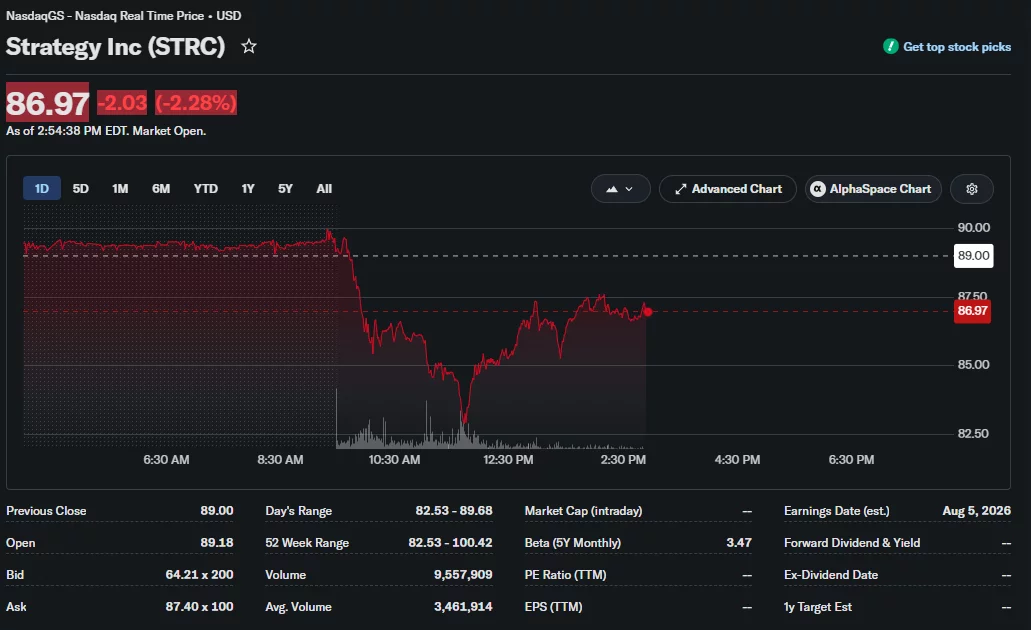
Schiff claimed investors who bought STRC based on yield-focused marketing may have an “ironclad” case against Strategy and its co-founder if risk disclosures were insufficient. He further alleged that Saylor may have violated securities marketing rules, although he did not provide evidence that regulators had opened any investigation or taken enforcement action.
According to Schiff, the stock’s decline creates a problem for future fundraising because new investors may demand higher yields before buying additional STRC shares. He argued that if Strategy wants to return the preferred stock to its $100 par value while continuing to issue new shares, dividend costs could increase significantly.
Dividend concerns have moved into focus
Attention on Strategy’s funding model has increased after market maker QCP estimated that the company’s current liquidity could support dividend payments for about seven and a half months.
According to QCP, Strategy recently repurchased nearly $1.5 billion of convertible notes due in 2029 while raising approximately $200 million through MSTR share sales. The firm also used part of those proceeds to acquire another $100 million worth of Bitcoin, continuing its long-running accumulation strategy.
Based on its analysis, QCP suggested that Strategy could eventually face pressure to find additional sources of capital if current funding channels become less attractive. The market maker noted that future Bitcoin sales could become one option should liquidity conditions tighten.
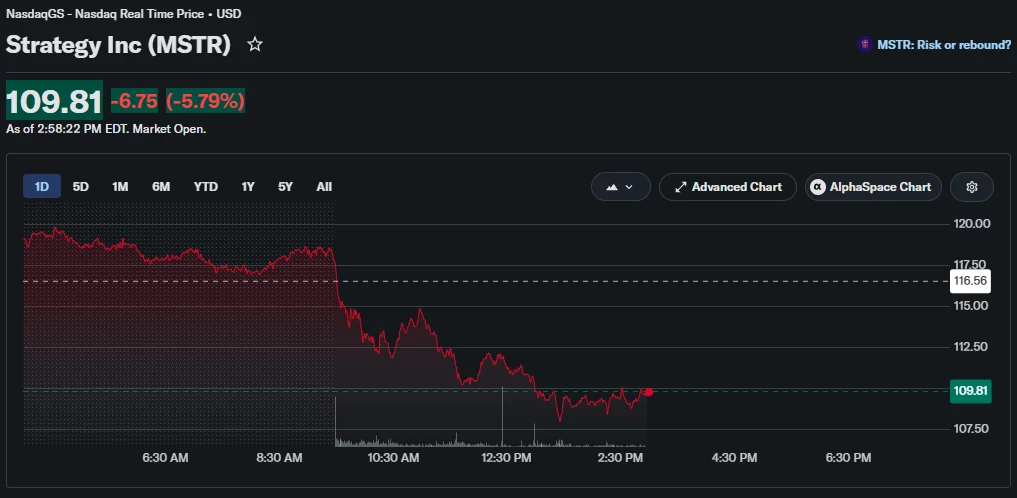
Those concerns have emerged alongside weakness in both Strategy’s common and preferred securities. MSTR was trading near $109 on Thursday, down nearly 6% on the day and over 7% during the past five sessions.
Critics question whether Bitcoin purchases still benefit shareholders
Recent criticism from Schiff has extended beyond STRC to Strategy’s broader Bitcoin acquisition strategy.
Earlier this week, he argued that the company’s approach worked more effectively when MSTR traded at a large premium to the value of its Bitcoin holdings. According to Schiff, issuing stock above net asset value previously helped increase Bitcoin exposure on a per-share basis.
Following Strategy’s purchase of 1,550 BTC for roughly $101 million in early June, Schiff claimed the transaction reduced shareholder value because the company issued more equity than the Bitcoin it added on a per-share basis. He described the outcome as a “negative Bitcoin yield.”
Meanwhile, insider transactions have added another layer to the discussion. A recent filing with the U.S. Securities and Exchange Commission showed Strategy director Jarrod Patten exercised options to acquire 1,500 Class A shares before selling them on the open market. SEC filings indicate Patten has sold 55,750 MSTR shares over the last three months, generating proceeds approaching $9 million.
As STRC continues to trade well below par value, Schiff maintains that investors face increasing risks. Strategy and Saylor have not publicly responded to his latest allegations as of press time.
Crypto World
NEAR Protocol Approaches 5.4 Billion Transaction Milestone Amid Technical Bullish Outlook

TLDR:
- NEAR Protocol has processed 5.36B transactions since its 2020 mainnet launch, nearing the 5.4B milestone.
- The network supports 397 active validators and a peak throughput of 4,135 TPS across 100 blocks.
- Analysts identify $9 as NEAR’s first major resistance, with trapped holders likely to sell at that level.
- A confirmed break above $9 could open a relatively clear technical path toward NEAR’s $20-plus ATH zone.
NEAR Protocol is closing in on a major network milestone, with transaction data pointing to steady blockchain activity.
On-chain figures from Chainspect show the layer-1 network has processed approximately 5.36 billion transactions since its 2020 launch.
The network currently supports 397 active validators and records a maximum throughput of 4,135 transactions per second.
Meanwhile, technical analysts are drawing attention to NEAR’s price structure, which mirrors patterns seen before previous bull runs.
Network Activity Reflects Growing On-Chain Demand
The approaching 5.4 billion transaction mark puts NEAR Protocol among the more active layer-1 blockchains in the current market cycle.
BSC News reported the milestone figures citing Chainspect data, noting validator count and peak TPS alongside the transaction total.
These metrics collectively reflect a network that has maintained consistent usage since its mainnet debut six years ago.
The validator count of 397 points to a reasonably distributed consensus layer. A broad validator set generally reduces centralization risk and strengthens network reliability over time. For a proof-of-stake chain, this number carries weight when evaluating long-term infrastructure credibility.
The 4,135 maximum TPS figure, measured across 100 blocks, positions NEAR among faster layer-1 networks in the space.
High throughput capacity is a key requirement for applications handling large transaction volumes, including DeFi protocols and gaming platforms. This capacity matters as developers evaluate which base layers can handle real-world scale.
Transaction volume alone does not determine a network’s value, but it does serve as one baseline signal of ecosystem usage.
As NEAR edges closer to 5.4 billion processed transactions, the milestone adds a concrete data point to ongoing conversations about the network’s adoption trajectory.
Price Structure Points to Key Resistance Levels Ahead
On the technical side, analyst Flippix outlined a market structure on X that has drawn attention from traders watching NEAR’s price action.
According to the post, NEAR at approximately $2.23 has already reclaimed a price zone where major rallies historically originated.
The analyst identified two critical resistance levels: $9 as the first major test and $20-plus as the all-time high zone.
Flippix noted that NEAR is not recovering from mid-range territory but rather from a historically significant demand zone where buyers previously stepped in with force.
This distinction matters to technical traders who track entry zones tied to prior cycle behavior. The positioning suggests a different recovery dynamic compared to assets bouncing from weaker support areas.
The $9 level carries particular significance because that zone marked where the previous cycle lost upward momentum.
Trapped holders from that period may look to exit around that price, creating natural selling pressure. A clean break above $9 would remove a key overhead obstacle and shift market sentiment considerably.
Above that level, the analyst noted relatively thin resistance stretching toward the $20-plus ATH region. If NEAR can confirm the multi-year downtrend reversal and clear $9, the technical path toward previous highs becomes more straightforward.
That outcome, however, remains contingent on broader market conditions and sustained buying pressure at current levels.



Senator Bill Hagerty has renewed expectations that Congress could advance the Digital Asset Market Clarity Act before the July 4 recess, even as several lawmakers continue to caution that final Senate action may take longer.
Summary
- Bill Hagerty said he still hopes the CLARITY Act can pass before the July 4 recess.
- David Nage said lawmakers and industry participants are roughly 80–85% aligned on the bill.
- Debate has narrowed to ethics provisions as industry groups continue backing regulatory clarity.
According to comments made by Hagerty during a FOX Business interview, negotiations on the legislation remain ongoing, but he still hopes lawmakers can complete work on the bill before Congress breaks for Independence Day.
“This will be something more a matter of focus after the 4th of July recess period, but I certainly hope to see it done before,” Hagerty said.
The Tennessee Republican described the legislation as a key step toward establishing clear rules for digital assets in the United States. In his view, the bill would provide the certainty needed for businesses and investors to participate in the sector under a defined regulatory framework.
His remarks come as the Senate recently approved the GENIUS Act, which created a federal framework for stablecoins. Hagerty argued that the stablecoin legislation demonstrated how regulatory clarity can support dollar-backed digital assets while strengthening the role of the U.S. dollar through fully reserved stablecoins.
Senate debate has narrowed to ethics provisions
While Hagerty continues to push for action before July 4, other lawmakers have offered a more cautious timeline. Senator Cynthia Lummis has indicated that a Senate floor vote is more likely before the August recess than before Independence Day.
Additional insight from Washington discussions suggests that most policy disagreements may already be settled. As reported earlier by crypto.news, David Nage, managing director and portfolio manager at Arca, said conversations with Senate offices left him believing lawmakers and industry participants are roughly 80% to 85% aligned on the substance of the legislation.
According to Nage, stablecoin yield provisions no longer appear to be a major source of disagreement despite continued criticism from banking executives, including JPMorgan Chief Executive Officer Jamie Dimon.
Instead, Nage said discussions have increasingly focused on conflict-of-interest and ethics rules that would restrict government officials from participating in crypto-related business activities while holding office.
Following meetings with congressional staff, Nage stated that lawmakers are now debating how such restrictions should be enforced rather than whether they should exist. He characterized the remaining disagreement as a political and implementation issue rather than a dispute over digital asset market structure.
Under Nage’s base-case scenario, lawmakers would resolve the ethics provisions and reconcile competing proposals in the coming weeks, allowing the legislation to reach the Senate floor after Congress returns from recess on July 13.
Industry sees regulation as key to institutional participation
Supporters of the legislation argue that regulatory certainty remains one of the largest barriers preventing broader participation from traditional financial institutions.
Speaking on the issue, Solana Policy Institute President Kristin Smith said many asset allocators continue to explore opportunities in digital assets but are waiting for clearer regulatory guidelines before committing capital.
Smith also rejected claims that the CLARITY Act would weaken oversight of the industry. According to her, the legislation would introduce additional consumer protections, provide law enforcement with new tools, and address gaps in existing regulations.
Backers of the measure further note that the bill would clarify the responsibilities of the Securities and Exchange Commission and the Commodity Futures Trading Commission while establishing compliance requirements for digital asset firms.
At the same time, Lummis has disclosed that the legislation includes $150 million in funding intended to combat illicit activity involving cryptocurrencies. She has also warned that if Congress fails to advance the measure during the current legislative window, meaningful action on market structure legislation could potentially be delayed until 2030.

Malta’s financial regulator has opened a public consultation that proposes a dedicated legal framing for decentralized finance (DeFi), including how decentralized autonomous organizations (DAOs) and other “software-governed” structures might be recognized under European rules. The move arrives as EU policymakers continue working through the practical question of which aspects of DeFi can be treated as falling outside existing crypto legislation—and which cannot.
On June 12, the Malta Financial Services Authority (MFSA) launched its consultation on DeFi in connection with the EU’s Markets in Crypto-Assets (MiCA) regime. Stakeholders have until July 10 to respond. The discussion paper introduces the concept of a new category—“software-based organizations”—intended to capture entities whose governance is implemented through code or software logic, while distinguishing governance and liability at the organization level from the technical operation of the underlying blockchain protocol.
Key takeaways
- The MFSA consultation proposes treating DAOs and similar DeFi actors as “software-based organizations,” separating the legal status of governance from protocol/software mechanics.
- The paper is positioned within the MiCA context, while underscoring that “fully decentralized” arrangements may not be intended to fall within MiCA’s scope.
- Malta’s regulator argues that many DeFi projects still contain centralized elements that complicate claims of full decentralization and raise accountability questions.
- The consultation is designed to solicit industry feedback before potential EU and national approaches to DeFi governance and responsibility solidify.
- The MFSA’s 2018-era regulatory experience suggests Malta intends to remain an active jurisdiction for digital-asset legal development as Europe refines its compliance expectations.
Malta MFSA proposes “software-based organization” concept under MiCA
The MFSA’s discussion paper centers on legal classification and regulatory accountability. Rather than treating DAOs as a freestanding legal category, the authority suggests mapping DAOs into a broader construct: software-based organizations. In this framework, the organization governed via decentralized software would be assessed separately from the software/protocol itself.
Regulators across Europe have grappled with a recurring compliance challenge in DeFi: decentralization is often presented as eliminating intermediaries, but many real-world arrangements still exhibit concentrated control, identifiable decision-makers, or operational structures that effectively function like centralized entities. The MFSA’s approach reflects that tension by focusing on governance and responsibility—areas that directly affect how supervision and enforcement might work.
In laying out its position, the MFSA also reiterated MiCA’s underlying boundary. The paper notes that MiCA excludes fully decentralized models from its regulatory scope, meaning projects without intermediaries or central control may not need to comply with MiCA requirements. At the same time, the regulator highlights that DeFi projects can be difficult to characterize as “fully decentralized,” especially when legal or operational levers point to someone who can be held responsible.
This distinction matters in practice for institutional stakeholders because it can determine whether a DeFi activity is treated as an exempt decentralized service or as a regulated offering that triggers licensing, disclosures, and ongoing compliance obligations. For legal and compliance teams, the MFSA proposal is therefore not simply a theoretical classification—it is an attempt to clarify how governance arrangements influence regulatory reach.
EU-wide focus on DeFi decentralization tests and regulatory gaps
Malta’s consultation is taking place within a wider EU conversation about how MiCA should apply to decentralized finance and DAOs. Multiple EU institutions have recently examined whether major DeFi systems can realistically satisfy the thresholds implied by “fully decentralized” treatment.
In March, an European Central Bank working paper concluded that governance and control across four major DeFi protocols remained highly concentrated. The finding suggested that many projects may struggle to qualify as “fully decentralized,” potentially keeping them within regulatory sight rather than outside MiCA.
In May, the European Commission initiated a targeted review of MiCA. Among the issues flagged for consideration were stablecoin-related questions, the treatment of DeFi, and whether the current framework contains gaps that might require additional regulation. The Commission’s focus signals that EU lawmakers see decentralization as an operational and legal variable—one that may not be fully resolved by the existing text.
At the same time, there is no single policy consensus. Speaking to Cointelegraph at the WAIB Summit Monaco earlier this month, European Commission adviser Peter Kerstens argued that policymakers should prioritize integrating tokenization into a broader digital asset framework rather than developing a second version of MiCA specifically aimed at DeFi. The position underscores a key uncertainty for market participants: whether Europe will address DeFi through an expanded MiCA architecture, through targeted adjustments to existing rules, or through a broader tokenization-centric framework that incidentally covers DeFi governance risks.
Why the “decentralization” question drives compliance risk
The core policy tension behind the MFSA proposal is that decentralization is not only a technical characteristic of a protocol; it also determines how liability and oversight can be assigned. For compliance monitoring, the practical question is whether there is an identifiable governance structure, decision-making center, or operational intermediary—factors that can pull a project back into regulated territory even if the software is deployed in a decentralized manner.
The MFSA’s discussion paper explicitly leans on this point. By distinguishing governance of an organization from the protocol and software that run it, the regulator appears to be aiming at a more enforceable legal mapping: if there is a “software-based organization” with governance that can be linked to a responsible set of actors or decision processes, then regulators need a legal framework that can be operationalized.
For exchanges, banks, payment firms, and other institutional partners that may interact with DeFi systems, these distinctions can affect risk controls and onboarding policies. In cross-border contexts, where counterparties may rely on a mixture of local interpretations, clearer classification concepts can also reduce uncertainty about regulatory expectations for lawful access, custody, or service provision.
However, unresolved questions remain. The EU’s legal treatment of DeFi depends on how “fully decentralized” is interpreted in practice, how governance concentration is measured, and how regulators determine whether intermediaries exist in substance even when they are not named in a traditional corporate form. Any national proposals—such as Malta’s—may influence EU thinking, but they will also likely be tested against divergent interpretations across jurisdictions.
Malta’s regulatory posture and implications for the next policy step
Malta has previously played an early and prominent role in European crypto regulation, including establishing one of the region’s first comprehensive frameworks for digital assets in 2018. Against that background, the MFSA consultation suggests Malta intends to contribute actively to the emerging European approach to DeFi governance and legal responsibility.
Still, the consultation does not signal an automatic shift in MiCA’s scope. Instead, it aims to build a conceptual bridge between existing EU rules and the operational realities of DeFi structures. By inviting industry feedback through July 10, the regulator is effectively testing whether market participants can provide workable perspectives on how to identify governance, intermediaries, and accountability in software-governed systems.
Institutional stakeholders—including compliance officers, counsel, and risk committees—may want to focus their responses on how the proposed “software-based organization” concept would apply to concrete governance arrangements, including how decision authority is exercised, how upgrades or parameter changes are handled, and what level of control would be considered incompatible with “fully decentralized” treatment.
As the EU considers its MiCA review agenda and as enforcement attention continues to evolve across member states, consultations like Malta’s are likely to play a role in shaping the compliance baseline for DeFi. The immediate next step is the MFSA’s assessment of submissions and any resulting amendments to the framework. Longer-term, the open question for the broader EU market is whether legislators will converge on a consistent method for separating protocol decentralization from organization-level legal accountability—or whether decentralization will remain a contested, case-by-case determination.
TLDR:
- Uniswap API won 52.4% of 554,137 MetaMask swaps over 99 days, beating all rivals combined by count
- The API recorded the lowest median slippage of 0.21–0.88 bps and a 0.12% failure rate across all providers
- OKX’s volume lead of 25.3% stemmed from whale concentration, with one signer routing $42.6M in six trades
- Excluding top 100 wallets per provider, Uniswap led adjusted volume at 32.9%, ahead of Kyber and 1inch v6
The Uniswap API has emerged as the dominant routing provider inside MetaMask’s swap architecture on Ethereum mainnet.
An independent researcher identified as Vaish analyzed 554,137 successful swaps over 99 days, totaling $567.8 million in volume.
The study found the Uniswap API won 52.4% of all routed transactions by count. That figure exceeds every competing provider combined, raising questions about how AMM-based routing holds its ground against RFQ desks.
Uniswap API Leads on Transaction Count and Execution Quality
MetaMask operates a multi-provider swap architecture where each trade request goes out to roughly a dozen routing providers simultaneously.
The platform selects the best quote net of fees and presents it to the user. Since Uniswap’s API integration in March 2026, it has consistently won more of those head-to-head quote competitions than any rival.
Realized execution data backs the routing outcome. Vaish’s study measured slippage as the deviation between a user’s actual fill and the on-chain mid-price at execution time.
The Uniswap API posted the lowest median slippage across all five trade-size buckets, ranging from 0.21 to 0.88 basis points. Competitors recorded medians between 1 and 27 basis points.
Vaish summarized the finding directly: “Among the hundreds of thousands of ordinary users whose wallet shops their order across a dozen providers, Uniswap is the routing outcome more often than every competitor combined, and the settled trades justify the routing.”
The Uniswap API also recorded a failure rate of just 0.12%, the lowest among all major providers. Competing platforms ran failure rates between 0.27% and 0.64%.
At MetaMask’s transaction volume, that gap translates to thousands of avoided failed swaps and their associated gas costs.
The routing advantage held across pair types, gas conditions, and times of day, with transaction share staying between 52% and 55% in every UTC hour.
OKX Volume Lead Tied to Whale Concentration, Not Broad User Demand
By raw dollar volume, OKX led the dataset at 25.3%, compared to Uniswap’s 21.3%. However, the researcher found that figure came from extreme wallet concentration. OKX’s $143.8 million in volume originated from just 13,850 wallets, with the top 10 accounting for 48% of it.
A single intermediary contract operated by one signer sent $42.6 million through OKX across just six transactions. That entity alone represented roughly 30% of OKX’s total volume in the study period.
On this distinction, Vaish was direct: “Routing share by transaction count is a tally of independent quote competitions, one per user decision. Routing share by raw volume is that same tally reweighted by a few large actors.”
Uniswap, by contrast, drew its volume from 134,876 wallets, with only 5.4% concentrated among its top 10. After excluding the top 100 wallets from each provider, Uniswap led the adjusted volume ranking at 32.9%. Kyber followed at 18.2%, with 1inch v6 at 15.7%, OKX at 13.3%, and 0x at 12.9%.
On routes involving five or more legs, OKX captured 43.1% of volume while Uniswap dropped to 4.1%. That split reflects a structural divide: AMM-based routing performs strongest on standard retail trades, while RFQ desks hold an edge on complex, large-ticket routes above $100,000.
The Uniswap API was the only major provider whose share rose consistently under progressive whale exclusion.

Ether’s near-term outlook is deteriorating as spot flow and derivatives positioning both point to weaker participation. Over the past several days, Binance saw net inflows of about 57,700 ETH, while Ether futures open interest has dropped to $10.3 billion—down from roughly $15 billion a month earlier—marking the lowest level across exchanges since April 2025, according to CryptoQuant.
Analysts say the mix of rising exchange supply, fewer new depositors, and cooling leverage is consistent with a market that may be running out of fresh buying pressure. Several traders are now watching key weekly demand areas around $1,700 and $1,400, with the potential for renewed downside if Ether fails to hold.
Key takeaways
- Binance net inflows of ~57,700 ETH suggest more Ether is moving onto the most liquid venues, increasing the risk of sell-side pressure if price rallies.
- Ether futures open interest fell ~31% to $10.3B—its lowest aggregate level since April 2025, reflecting cooling speculative activity.
- Estimated leverage ratio declined to 0.83 from an early-June peak, signaling reduced trader conviction and less leverage-driven volatility.
- Weekly price levels in focus: the market is hovering near $1,700 and $1,400, with lower liquidity targets below there.
Why Binance inflows matter for short-term selling risk
CryptoQuant analyst Pelin Ay highlighted that Binance received roughly 57,700 ETH on a net basis over the past few days. In crypto market structure, large and sustained exchange inflows can act as a warning sign for near-term sell pressure—especially when the influx is concentrated on a venue with deep liquidity like Binance.
Ay also tied the pattern to a lack of offsetting demand. The number of new ETH depositors is currently around 320 addresses, which is described as materially below levels seen during earlier demand surges. When deposit growth is weaker, the spot market’s ability to absorb incoming supply without repricing can fade—leaving price action more dependent on existing holders.
There is also a supply-side counterweight to consider. Ay noted that daily ETH issuance sits near 2,791 ETH, a relatively modest figure that has been typical since Ethereum’s EIP-1559 upgrade in 2021. Still, even with comparatively lower issuance, elevated exchange inflows can be enough to tilt order books if buyers don’t step in.
In Ay’s view, the near-term risk is that a brief relief rally into resistance could encourage further distribution from exchange balances, turning “stability” into renewed pressure.
Derivatives activity cools as open interest hits a multi-month low
Beyond spot flows, the derivatives tape has weakened. Ether futures open interest fell to $10.3 billion on Thursday, down from about $15 billion a month ago—roughly a 31% decline. CryptoQuant characterizes this as the lowest aggregate open interest across exchanges since April 2025.
Open interest is often used as a proxy for participation and the balance of hedging versus new speculative bets. A drop of this scale typically points to fewer market participants taking fresh positions, which can translate into less willingness to press trades during a rebound attempt.
Leveraged positioning has also eased. The estimated leverage ratio (ELR) fell to 0.83 from an all-time high of 1.10 on June 2. CryptoQuant also notes that this move represents the largest leverage unwind since October 2025, when the metric slid from 0.72 to 0.56.
Lower leverage can reduce short-term volatility and speculative pressure, but it usually comes with a trade-off: it often reflects weaker conviction. In other words, the market may be less prone to sharp liquidations, yet less capable of sustaining a strong uptrend on its own momentum.
Weekly demand zones under scrutiny: $1,700 and $1,400
On the chart, Ether’s weekly trend has continued to struggle. The weekly outlook referenced in the analysis shows ETH down about 30% over the past 42 days, trading near demand zones around $1,700 and $1,400.
The April 2025 low at $1,384 is cited as the nearest external liquidity target if weakness continues. Below that, the analysis points to a broader demand area dating back to January 2023, spanning roughly $1,289 to $1,071.
Trader Ardi previously argued on X that there are early technical “bottoming” signals forming for altcoins, including ETH. In the same framing, Ardi noted that Ether touched the lower band of a long-term acceptance range that had previously aligned with macro lows—suggesting the market may be approaching a decision point rather than continuing an uninterrupted slide.
Part of that argument is based on momentum indicators. The weekly RSI is near 31, while a daily RSI reading of 11 during the recent sell-off is described as the lowest recorded level. In practical terms, these readings are often interpreted as improving the odds of stabilization—though they do not guarantee a reversal.
Ardi also emphasized that ETH/BTC remains an important metric to watch because the pair continues to trend lower. For now, the key trading range remains where liquidity and position-taking are concentrated: roughly $1,400 to $1,700.
What investors and traders should monitor next
If exchange inflows keep outpacing new depositors while futures open interest remains depressed, Ether could struggle to convert any bounce into a sustained trend—especially if leverage continues to unwind. The immediate question for markets is whether ETH can hold the weekly demand bands near $1,700 and $1,400, or whether the combination of supply returning to exchanges and reduced derivatives activity will push price toward the next liquidity pockets below.
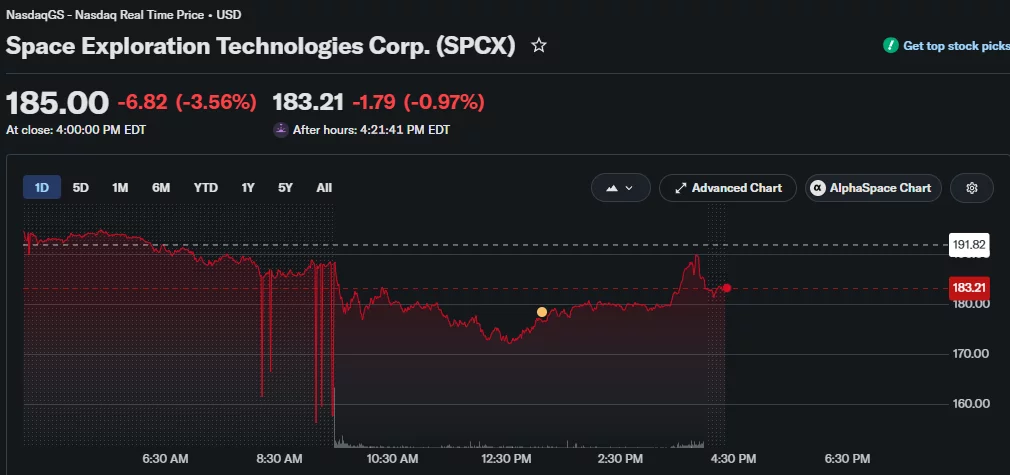
SpaceX has explored a bond offering worth as much as $20 billion while its publicly traded shares have fallen more than 9%, trimming Elon Musk’s fortune by roughly $59 billion from recent highs.
Summary
- SpaceX is considering a bond sale of up to $20 billion to refinance debt due in 2027.
- SPCX shares fell more than 9% intraday, while Elon Musk’s net worth dropped by $59 billion.
- Major Wall Street banks remain involved in the financing effort despite investor concerns over leverage.
Bloomberg reported, citing people familiar with the matter, that SpaceX and its banking partners are preparing investor discussions for a potential bond sale that could raise up to $20 billion, one of the largest corporate debt offerings in recent years.
The proposed financing would be used primarily to refinance a bridge loan due in September 2027. According to Bloomberg, that loan represents a significant portion of SpaceX’s long-term debt, which stood at approximately $29.1 billion at the end of March.
While the transaction remains under discussion, Bloomberg reported that the final size, structure, and timing could still change depending on market conditions and investor demand. Bank of America, Citigroup, JPMorgan Chase, Goldman Sachs, and Morgan Stanley are expected to lead the process. Those same institutions previously participated in the bridge financing arrangement.
The debt discussions come only days after SpaceX completed a landmark public listing that pushed the company’s valuation above major technology firms and elevated Elon Musk’s wealth to unprecedented levels.
Investors weigh debt plans against recent stock volatility
Following reports of the potential refinancing transaction, SpaceX shares came under selling pressure. SPCX stock fell more than 9% from its previous close of $191.82 to an intraday low of $172.11 on June 18. The stock later recovered part of those losses and finished the session near the $185 level.
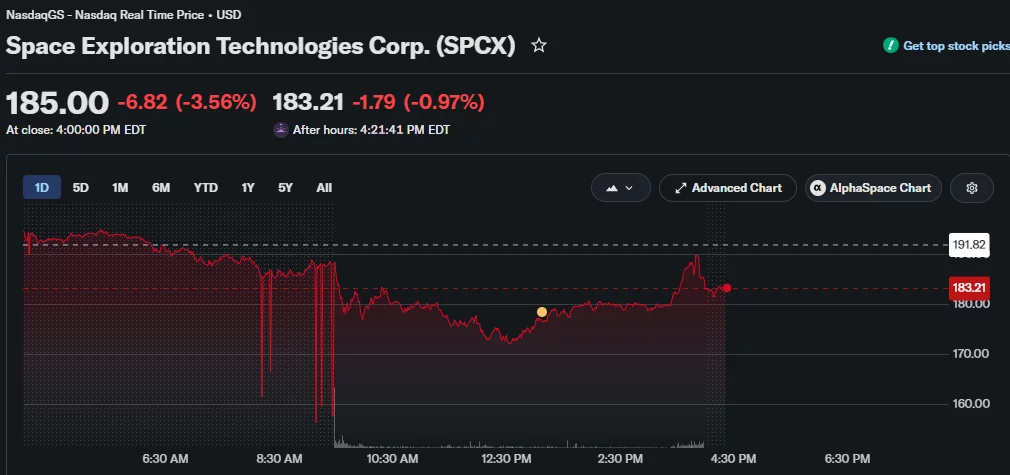
The decline follows a sharp rally that had briefly lifted SpaceX’s valuation close to $3 trillion. As crypto.news previously reported, shares reached an intraday high of about $225.84 on June 16, pushing Musk’s net worth to nearly $1.4 trillion and temporarily placing the value of his holdings above Bitcoin’s market capitalization of roughly $1.31 trillion at the time.
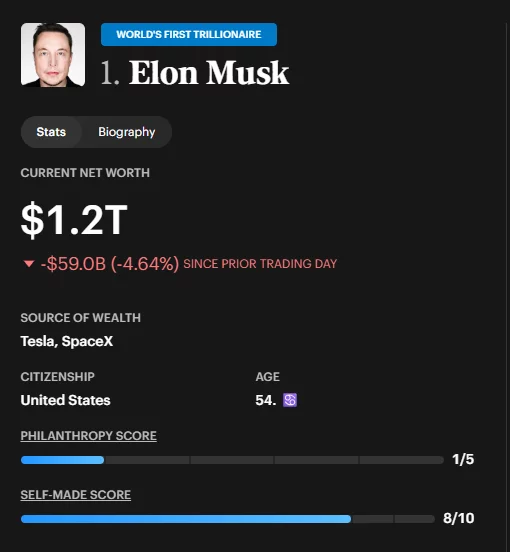
Earlier reporting by crypto.news also noted that SpaceX’s market debut made Musk the world’s first trillionaire. Continued gains after the listing added hundreds of billions of dollars to his paper wealth before the recent pullback reduced those gains.
According to data by Forbes, Musk’s net worth has since fallen back to around $1.2 trillion, representing a decline of approximately $59 billion, or 4.6%, over the past trading day.
Banks remain involved despite growing debt burden
Despite the recent pullback, Bloomberg reported that major Wall Street banks remain involved in SpaceX’s financing plans. The institutions expected to arrange the proposed bond offering are the same lenders that previously provided the bridge loan the company now intends to refinance.
Investor interest in SpaceX has remained strong since its public debut. As crypto.news previously reported, some retail investors reportedly took out bank loans to increase their IPO allocations before shares began trading.
Beyond its aerospace operations, the company has also drawn attention for its expansion into artificial intelligence. Recent reports indicated that SpaceX is exploring an acquisition of Anysphere, the developer behind the Cursor AI coding platform.
At the same time, investors are evaluating what a potential $20 billion refinancing transaction could mean for the company’s balance sheet, as large debt deals often bring renewed focus to leverage levels and future funding needs.


How the Ultrasonic CT Scanner Works
1 Billion Scans Per Month Through AI
The post Midjourney’s New Scanner Maps Your Whole Body in 60 Seconds appeared first on BeInCrypto.
Custodia and Vantage Bank have proposed a token that automatically switches between a bank deposit and a stablecoin as it moves between participating banks and external users.
According to a white paper shared with Cointelegraph on Thursday, the token would operate as a deposit issued by a participating bank when held within a banking consortium and as a stablecoin backed by cash and short-term Treasurys when transferred outside the so-called Hazel network.
The companies said the system has been running on Ethereum (ETH) since March and is being tested by participating banks ahead of a broader rollout planned for later this year. The platform is designed to support tokenized deposits, stablecoins and other blockchain-based financial assets through a shared banking infrastructure.
According to the white paper, participating institutions would not need to replace existing core banking systems, with the platform operating alongside current ledgers and payment infrastructure.
The companies said it was designed for banks and credit unions of all sizes, including community banks, and aims to let institutions participate in tokenized payments without moving customer deposits outside the banking system.
Wyoming-based Custodia and Texas-based Vantage said they expect the Hazel network to become broadly available to banks and their customers in the fourth quarter of 2026.
Related: UK crypto advocates launch campaign against banks blocking exchange transfers
Banks seek alternatives to stablecoins
The proposal comes as banks increasingly look for ways to offer blockchain-based payment services without losing customer deposits to stablecoin issuers.
Earlier this month, The Wall Street Journal reported that The Clearing House, whose owners include JPMorgan Chase, Bank of America and Citigroup, plans to launch a tokenized deposit network in the first half of 2027, allowing banks to settle payments using blockchain-based representations of customer deposits.
Banking groups have also pushed back against legislation that could allow stablecoin issuers to offer yield-bearing products.
JPMorgan CEO Jamie Dimon recently said banks would continue fighting provisions in the CLARITY Act, a US crypto market structure bill, arguing they could let crypto companies compete for deposits without obtaining bank charters. The bill advanced out of the Senate Banking Committee in May and still requires approval from both chambers of Congress.
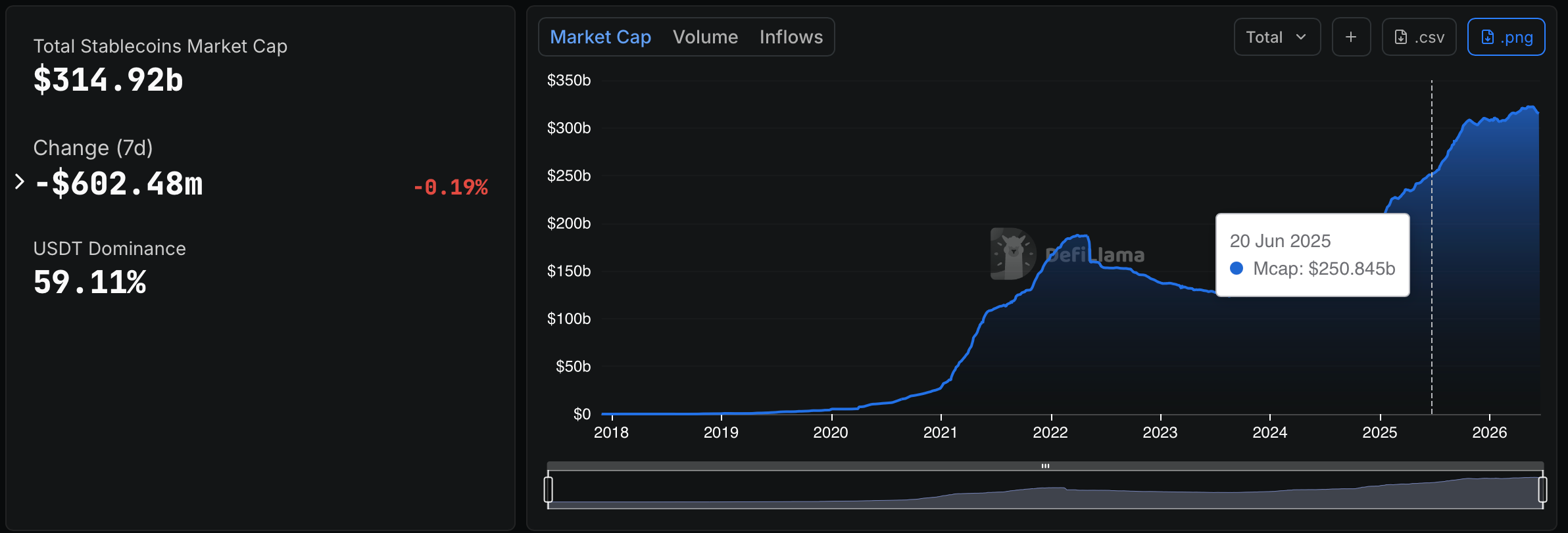
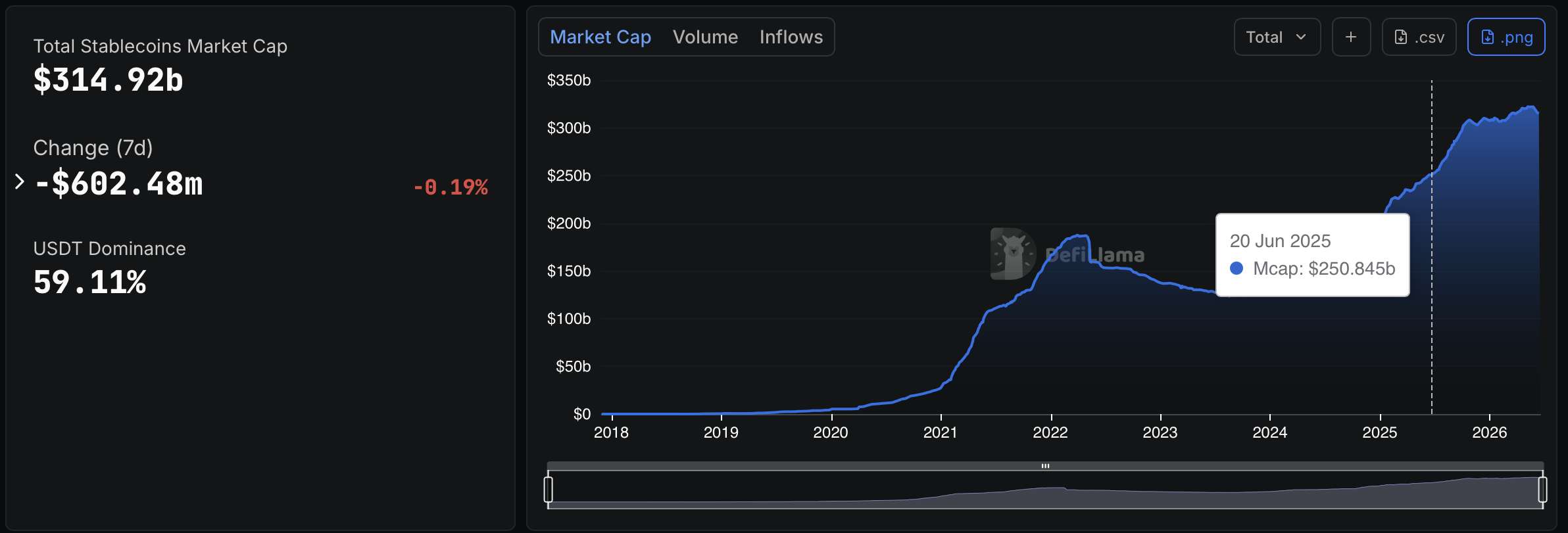
According to DefiLlama data, the total stablecoin market capitalization stands at roughly $315 billion, up from about $251 billion a year ago.
Source: DefiLlama
Magazine: Vietnam preps crypto pilot, HK pushes tokenization: Asia Express
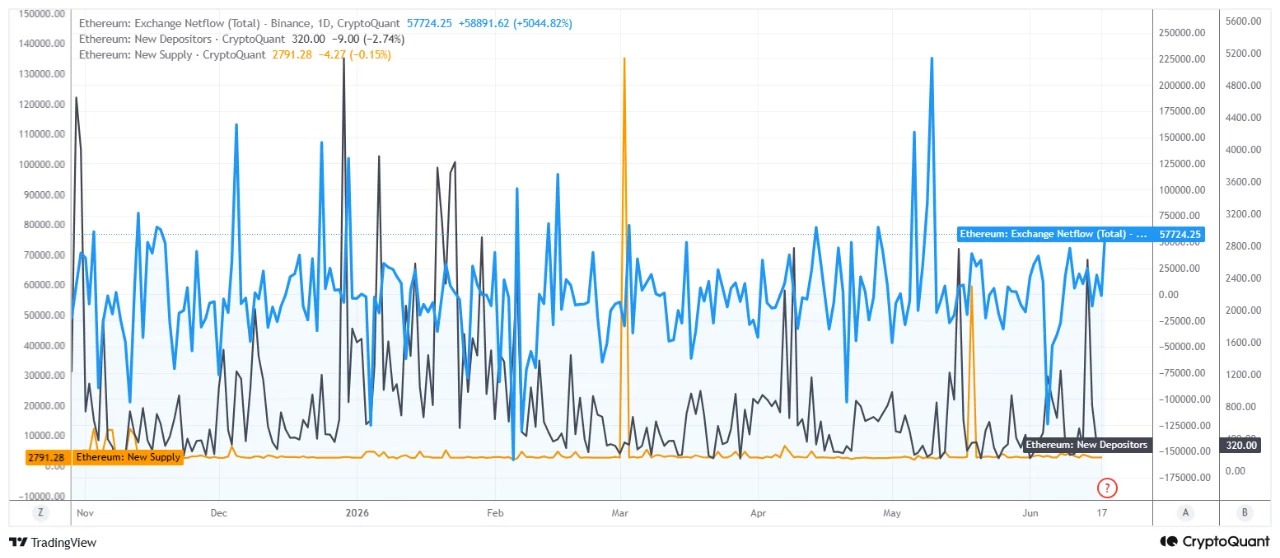
Ether’s (ETH) exchange and derivatives data turned weaker over the past month. Binance recorded net inflows of 57,700 ETH, while futures open interest fell to a year-low of $10.3 billion from $15 billion, and the ratio of leveraged positions retreated sharply from their early June highs.
The combination of rising exchange supply, muted new participation, and declining futures activity has led ETH analysts to forecast another wave of selling pressure below $1,700.
ETH inflows on Binance outpace new demand
Crypto analyst Pelin Ay noted that roughly 57,700 ETH flowed into Binance on a net basis over the past few days. Large inflows to the exchange often signal potential selling since Binance is one of the most liquid exchanges in the crypto market.
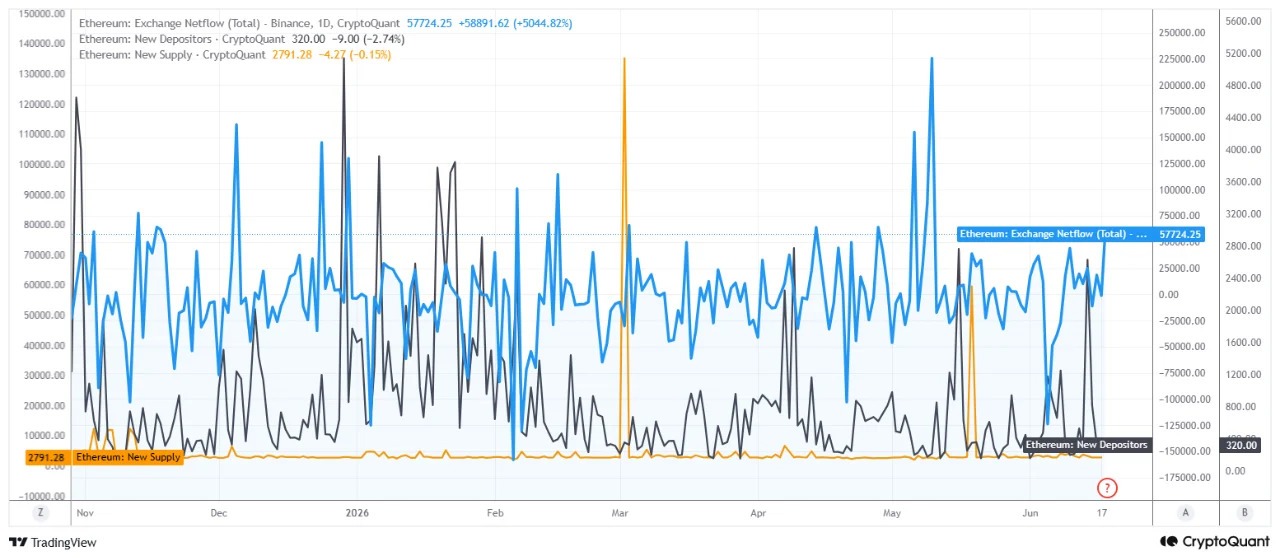
ETH exchange inflows, new depositors and fresh supply. Source: CryptoQuant
At the same time, the number of new ETH depositors is around 320 addresses, well below the levels seen during previous demand surges. The muted participation suggests limited new capital entering the market, leaving recent price stability dependent on existing holders.
The analyst noted that supply growth continues to offer a counterbalance. Daily ETH issuance stands near 2,791 ETH, a relatively low figure since Ethereum’s EIP-1559 upgrade in 2021.
For now, exchange flow data paints a cautious picture. Ay said elevated net inflows raise the risk of another selling wave if Ether approaches resistance levels during any relief rally.
Related: BitMine boosts ETH holdings closer to $10B as bear market accumulation continues
Can Ether price defend its weekly demand zone?
ETH derivatives data have also cooled sharply in recent weeks. Ether futures open interest fell to $10.3 billion on Thursday from $15 billion a month ago, a decline of roughly 31%. The reading marks the lowest aggregate open interest across exchanges since April 2025.
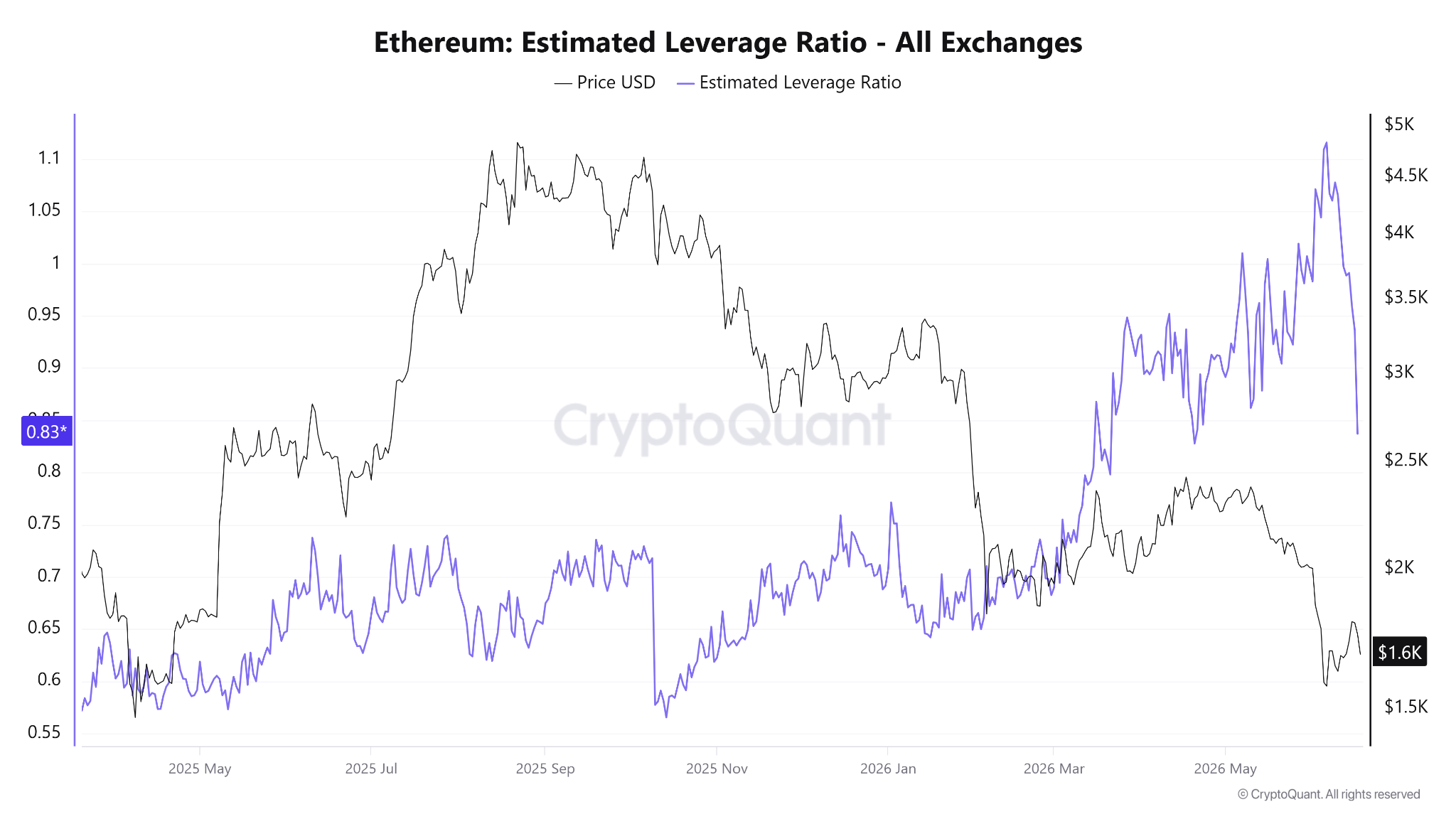
Ether estimated leverage ratio for all exchanges. Source: CryptoQuant
The number of leverage positions has also retreated at a similar pace. The estimated leverage ratio (ELR) dropped to 0.83 from an all-time high of 1.10 on June 2, marking its largest leverage unwind since October 2025, when the metric slid from 0.72 to 0.56.
Lower leverage often reduces the short-term volatility and speculative demand, but it also signals weaker conviction among traders.
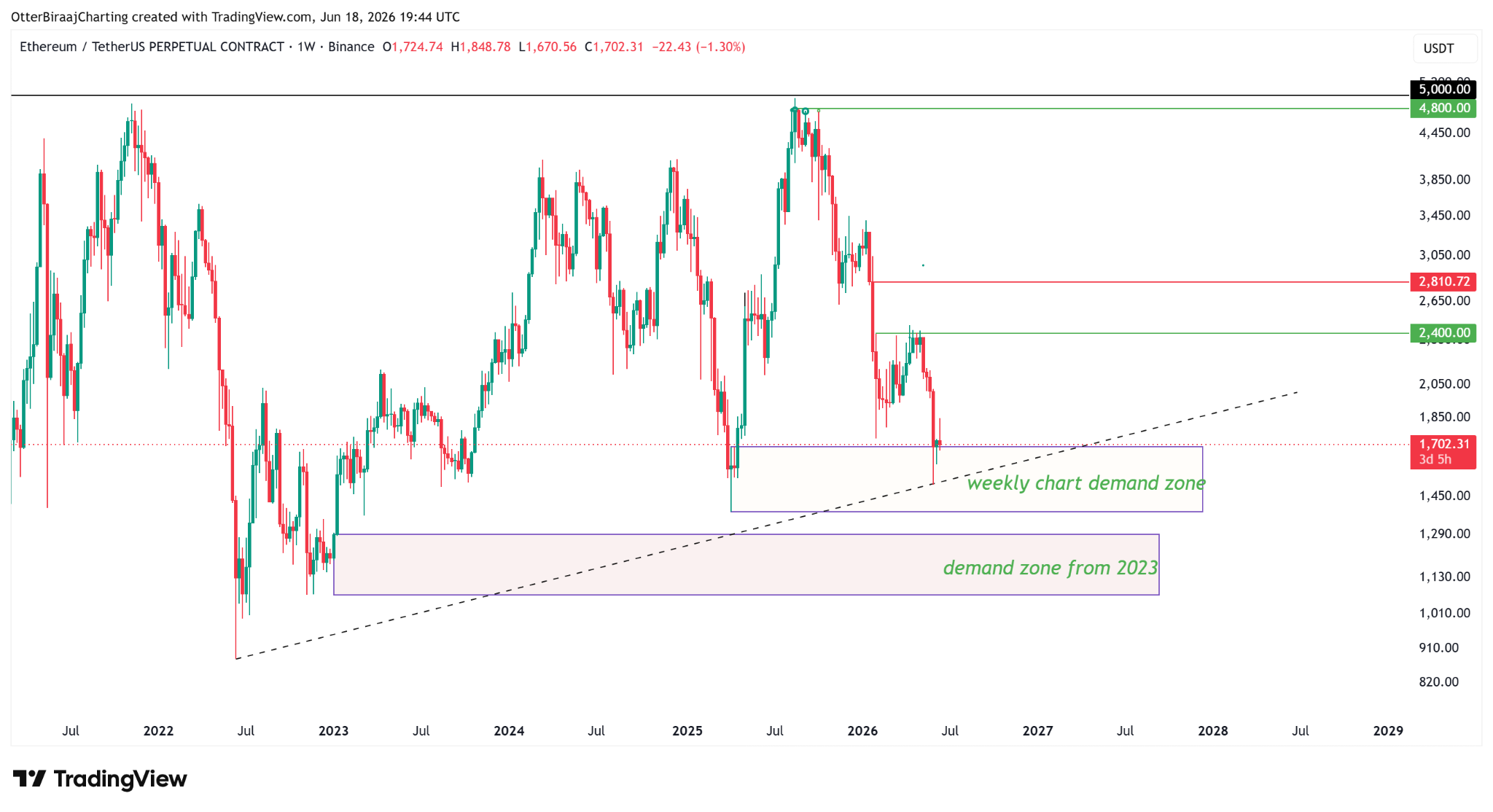
ETH/USDT, one-week chart analysis. Source: Cointelegraph/TradingView
Ether’s weekly chart is down 30% over the past 42 days and continues to trade near the demand zone of $1,700 and $1,400. The April 2025 low at $1,384 stands as the nearest external liquidity target if price weakness continues.
Below that level, the immediate area of interest is the demand zone from January 2023 between $1,289 and $1,071.
From a market standpoint, crypto trader Ardi said last week that some technical bottoming signals are emerging for the altcoin. ETH recently touched the lower band of a long-term acceptance range that previously coincided with macro lows.
The weekly relative strength index (RSI) sits near 31 after a daily RSI reading of 11 during the recent sell-off, its lowest level on record, which improves the chances of ETH bottoming in the current price range.
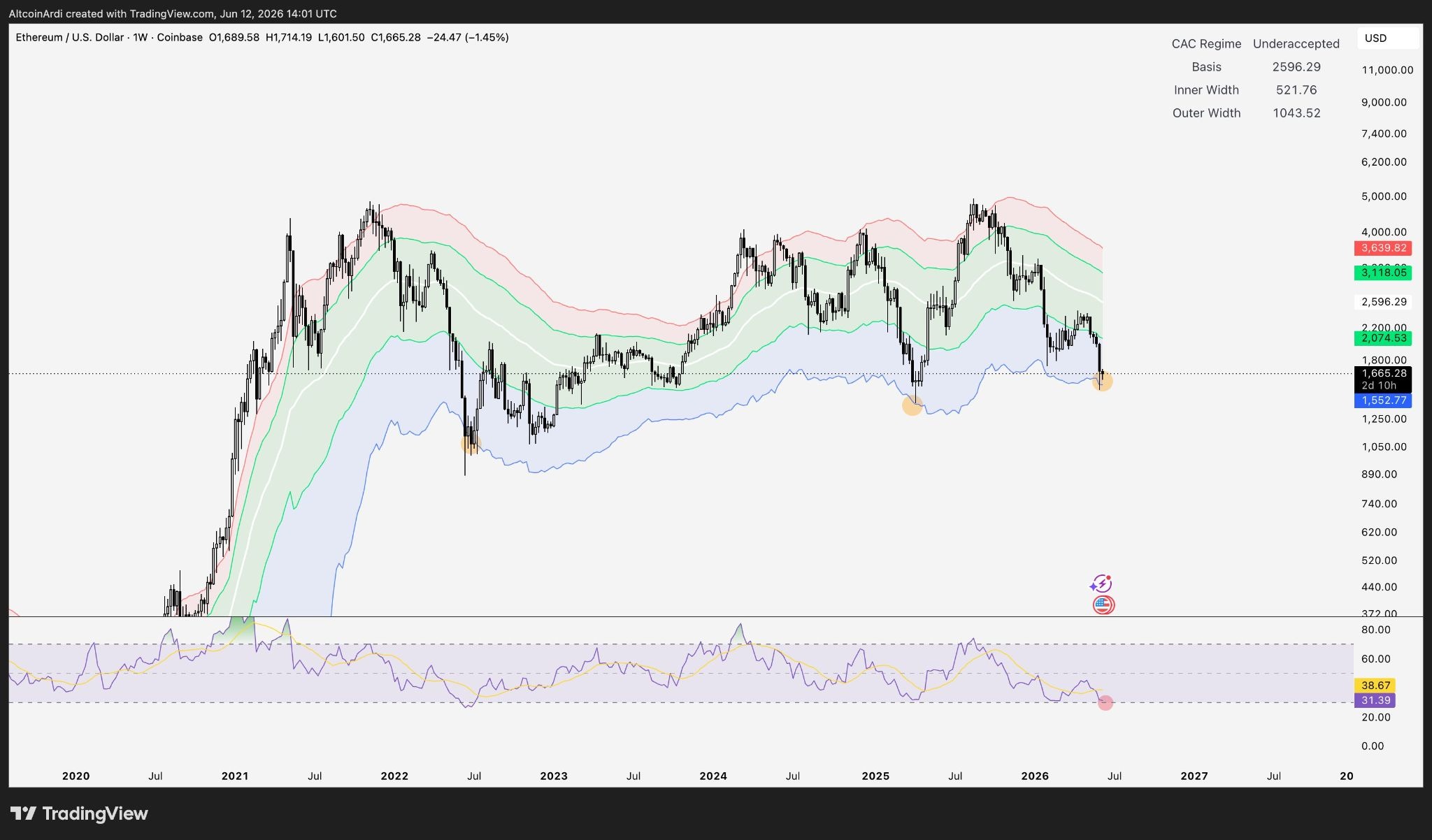
ETH/USD weekly analysis by Ardi. Source: X
Ardi added that ETH/BTC remains a key chart metric to monitor, as the pair continues to trend lower. For now, the $1,400 to $1,700 range remains the area where buyers and sellers are most actively positioned.
Related: Altcoin selling tops $266B as capital rotates out of crypto: Is altseason extinct?

Universal Credit savings limit rules all claimants should know

JetBlue to shut down key Newark, LaGuardia operations this fall

Peter Schiff accuses Michael Saylor of misleading STRC buyers


-

 Business4 days ago
No Jackpot Winner as $257 Million Prize Rolls Over to $269 Million Monday Draw
-

 Fashion6 days ago
Weekend Open Thread: Tuckernuck – Corporette.com
-
Crypto World4 days ago
Zimbabwe Requires Crypto Businesses to Register Annually Under New FIU Regulations
-

 Crypto World6 days ago
Bitget enters Argentina’s regulated crypto market through PSAV registration
-

 Tech6 days ago
NanoClaw integrates JFrog registries to secure AI agent downloads
-

 Tech6 days ago
This Week In Security: Microsoft On Microsoft, Register Your Domains, Linux On ARM, And FreeBSD Joins The File Cache Club
-

 NewsBeat6 days ago
FBI searches office of Ohio voter registration group
-
 Entertainment7 days ago
‘The Pitt’s Fan-Favorite Doctor Confirms Noah Wyle Gave His Blessing to Return [Exclusive]
-
 Crypto World7 days ago
Ripple and Bitso Bring MXNB Stablecoin to XRP Ledger
-
 Entertainment4 days ago
Matt Damon’s Viral Sci-Fi Thriller Has Taken Over HBO Max
-

 Business4 days ago
Anthropic staff to meet White House officials next week, Axios reports
-

 Tech4 days ago
As AI companies race to go public, who else is along for the ride?
-
 Crypto World4 days ago
Bitcoin could crash to $48,000, if this historical pattern is triggered
-
 Tech7 days ago
Euro-Office 1.0 Arrives To Open-Source Infighting: ‘Compatibility Is Not Sovereignty’
-

 Politics4 days ago
“Israel’s” ban on ICRC visits ruled illegal, but Knesset moves to stop them permanently
-
Entertainment7 days ago
Ana Navarro unleashes explosive tirade on ex-Trump aide, Disney Channel star in epic on-air fight: 'Have you no shame?'
-
 NewsBeat4 days ago
Warning of disruption as Cardiff Crossrail works to start
-

 News Videos4 days ago
Financial Accounting | Last Day Revision Strategy and Booster | CMA Inter – June 2026
-
 NewsBeat4 days ago
Tributes to former deputy head teacher at Cambridge school among death and funeral notices
-
 Crypto World4 days ago
Market Preview: SpaceX (SPCX) IPO Record, Federal Reserve Meeting, and Iran Nuclear Agreement
You must be logged in to post a comment Login