

Crypto World
Binance plans crypto super app with payments, stocks and stablecoins



Binance is looking beyond cryptocurrency trading as it works to build a broader financial “super app” centered on payments, stablecoins and investment products.
Summary
- Binance plans to expand beyond trading by combining payments, stablecoins, stocks and broader financial services.
- Stablecoin adoption is pushing Binance toward payment services aimed especially at users in emerging markets.
- Binance already offers thousands of US stocks and tokenized equities alongside its core crypto products.
Shunyet Jan, the exchange’s head of spot trading and derivatives, outlined the strategy as Binance marked its ninth anniversary.
In an interview with CoinDesk, Jan said trading remains central to Binance but no longer defines the full market available to the company. “We’re trying to not just be a crypto exchange, but be a super app that involves payment,” he said.
Stablecoins push Binance deeper into payments
Jan linked the strategy to growing stablecoin use for payments and transfers. Stablecoins have expanded beyond their original role as trading assets, giving exchanges a way to serve users who need cross-border payments, spending tools and access to dollar-based digital assets.
“If you think of us as a payment provider, then that number becomes much bigger,” Jan said. Binance Research has also identified payments as a major path for crypto super apps. Its April report said Binance Pay had reached more than 21 million merchants and connected with local payment systems such as Brazil’s Pix.
Binance has also expanded its card services. As previously reported, the exchange launched a Mastercard-linked crypto card in selected CIS markets in February, allowing eligible users to spend Bitcoin, Ether, stablecoins and other supported assets through automatic conversion at checkout.
Binance adds stocks to its financial ecosystem
The exchange has spent 2026 adding products outside traditional crypto markets. Binance said in its ninth-anniversary update that it now wants users to move between digital assets, stablecoins, public markets, payments and onchain services from one platform.
However, Binance opened access to more than 7,000 US stocks and ETFs for eligible users outside the United States in June. Users can buy fractional shares using assets including USDT and USDC, connecting stablecoin balances directly with traditional investments.
Binance said direct stock positions reached $1 billion in assets within about 30 days, with close to $3 billion in cumulative trading volume. More than 73% of first-month trading volume came from emerging markets, according to the exchange.
Tokenized equities add an onchain layer
Binance has also launched bStocks, which convert supported US equity exposure into blockchain-based assets. The initial lineup included tokenized versions of Nvidia, Tesla, Circle, Micron and Sandisk.
The products can trade around the clock and move to supported self-custody wallets. Binance says eligible users can also use them in supported decentralized finance applications. The company reported that bStocks passed $100 million in assets within 15 days, while 47% of trading volume occurred outside normal US market hours.
Emerging markets form a key part of the strategy
Jan said demand for Binance’s broader financial services is particularly strong in emerging economies, where access to foreign investments and traditional banking services can remain limited. The company sees its existing crypto infrastructure as a way to connect those users with more payment and investment products.
Binance Research previously estimated that crypto exchanges could bring nearly 300 million new investors and about $2 trillion into global equity markets by 2031. As per report, stablecoin settlement could help exchanges serve investors who face high costs or limited access to overseas markets.
Binance is not alone in pursuing the model. Coinbase has also outlined a financial super app strategy combining trading, lending, payments and other services. Binance’s approach now centers on linking its large trading business with stablecoin payments, traditional assets and onchain products within one platform.

Crypto World
WEEX OpenAPI 101: 5 Powerful Modules, AI Trading Tools, and Grab Up to 70% Revenue Opportunities

WEEX is proudly building an open ecosystem where traders, developers, AI agents, and trading platforms all connect through a single, unified infrastructure — the WEEX OpenAPI.
With Binance-compatible integration for a seamless migration path, automated trading workflows built for speed and scale, and real revenue-sharing opportunities for technical partners, WEEX OpenAPI is designed to power the next wave of trading innovation — from algorithmic strategies to AI-driven trading agents.
TL;DR:
- WEEX OpenAPI connects your WEEX account with trading bots, AI agents, quant tools, and custom platforms.
- 70% commissions rebate for brokers, top of the industry.
- Binance-compatible, helping developers migrate with lower learning costs.
- Five API modules cover market data, spot trading, futures trading, affiliate tools, broker integration, and copy trading.
- With AI integration and broader asset support, WEEX API is building an open trading ecosystem for the future.
What Is WEEX API? A Simple Guide to Smarter Trading
The way people trade today is changing. More traders are using bots, quantitative strategies, AI assistants, and custom tools to analyze markets and improve efficiency. But these tools need a way to communicate with exchanges.
That connection comes from API.
API stands for Application Programming Interface. Simply put, it is a set of rules that allows different software systems to communicate and work together.
For trading, WEEX API acts as a bridge between your WEEX account and external applications, allowing authorized tools to access market data and perform trading actions.
With WEEX OpenAPI, users can:
- Connect trading bots and AI tools
- Build automated trading workflows
- Access market data through external applications
- Use personalized trading interfaces
- Create custom strategies and trading solutions
WEEX API is not just a technical tool. It is a connection layer that links traders, developers, AI agents, and the broader trading ecosystem.
Why Choose WEEX API? 3 Key Advantages for Developers and Users
Binance-Compatible: Easier Migration for Developers
Switching API providers often requires developers to rebuild systems and learn new structures.
WEEX OpenAPI is designed to reduce this challenge.
Key advantages:
- Data structures follow Binance API standards
- Parameter naming is highly consistent
- JSON response formats are familiar
- Documentation structure is easy for experienced developers to understand
For developers already familiar with Binance API, WEEX OpenAPI helps reduce migration costs and learning time.
Secure Access: Flexible Permission Management
Security is a core part of API trading.
WEEX API provides:
- API Key management
- Permission controls
- Trading access settings
Users can select different permission levels:
- Read-only access
- Spot trading access
- Futures trading access
This gives users more control over how external applications interact with their accounts.
High-Performance: Built for Trading Automation
Reliable performance is important for automated trading workflows.
Speed and stability are essential for automated trading. WEEX API uses a structured rate limit system to provide reliable performance across different trading scenarios. Non-trading requests support up to 500 requests per 10 seconds through the REQUEST_WEIGHT system, while trading requests are managed through the ORDERS system, supporting up to 30 orders per 10 seconds and 100 orders per minute.
Whether you are running personal strategies or developing professional trading tools, WEEX API helps you execute ideas more efficiently.
Five API Modules for Market Data, Automated Trading, and Ecosystem Growth
WEEX OpenAPI provides five core API modules covering market data access, automated trading, partner solutions, and ecosystem applications. Whether you are a trader, developer, or platform partner, WEEX API helps you build more efficient and flexible trading experiences.
Public API: Access Real-Time Market Data
WEEX Public API provides essential market information, helping users and developers easily connect with WEEX market data. It supports access to exchange information, trading pairs, and market updates, making it easier to build dashboards, analysis tools, and quantitative strategies.
Spot API: Enable Automated Spot Trading
WEEX Spot API allows users to connect external tools and applications with spot trading functions. Through API integration, users can place orders, manage trades, and track order history automatically, creating a smoother and more efficient spot trading workflow.
Futures API: Power Advanced Trading Strategies
Designed for professional traders and developers, WEEX Futures API provides the core functions needed for automated futures trading. Users can manage futures orders, track positions, and connect quantitative strategies or trading bots to execute more advanced trading workflows.
Affiliate and Broker API: Build Connected Trading Ecosystems
WEEX Affiliate and Broker API helps partners manage users, trading data, and platform connections more efficiently. Affiliate API supports user information, trading activity, asset data, and commission management, while Broker OAuth enables faster API Key authorization and smoother user onboarding for brokers, trading platforms, and service providers.
WEEX Copy Trading API: Create Better Copy Trading Experiences
WEEX Copy Trading API provides the foundation for building copy trading products and services. Partners can access lead trader information and trading pair data to create smoother copy trading experiences and help users discover new trading strategies.
Who Can Use WEEX API? Explore Different Trading Possibilities
WEEX API is designed for different types of users, from everyday traders to professional developers and ecosystem partners.
AI-Powered Trading with WEEX API: Make Trading More Intelligent
AI is changing the way users interact with technology and trading tools. Through WEEX API integrations, AI-powered solutions can help users complete trading actions in a simpler and more natural way. For example, after API authorization, users can give instructions like “Buy 1 BTC,” and an AI assistant can understand the request and execute the corresponding action.
WEEX is exploring AI-powered trading experiences through solutions such as WEEX Trader Skill, OpenClaw integrations, and AI Agent tools, making advanced trading capabilities more accessible and easier to use for everyone.
Custom Trading Tools with WEEX API: Trade Your Way
Every trader has different preferences.
Some users prefer:
- Custom dashboards
- Quant platforms
- Trading bots
- Personal strategy systems
WEEX API allows users to connect these tools with their WEEX accounts and continue trading through familiar interfaces.
WEEX API for Developers: Build Tools and Grow With the Ecosystem
WEEX API opens new opportunities for:
- AI Agent developers
- Trading bot developers
- Quantitative teams
- KOLs and KOCs
Developers can build:
- Trading bots
- AI trading assistants
- Quant strategies
- Portfolio management tools
- Trading platforms
But WEEX API is not only about building products. It also creates opportunities for developers to benefit from the ecosystem they help build.
WEEX API Revenue Sharing: Create Tools and Earn From Trading Activity
WEEX provides competitive API commission opportunities for ecosystem partners.
Key benefits include:
- Spot and futures API trading share the same commission structure
- API trading commission rates can reach 50%-60% based on applicable programs
- Eligible Taker orders can participate in commission sharing
Commission comparisons with other leading exchanges:
Exchange
Commision
Broker
WEEX
50%-60%
70%
Binance
30%-50%
N/A
Bitget
25%-50%
N/A
BingX
40%-50%
N/A
Success Case Study: WEEX API Empowering CryptoMind’s Exponential Growth
The remarkable partnership between WEEX and CryptoMind serves as a compelling testament to the high performance and robust capabilities of the WEEX API.
CryptoMind, an AI-powered crypto trading tools platform, integrated with WEEX API through OAuth to enable instant, zero-manual-setup trading access for users. The integration delivered a 1,912.40% increase in API Futures Trading Volume and a 1,300% growth in Active API Traders, demonstrating WEEX API’s ability to power scalable solutions across trading signals, copy trading, bots, and quant platforms.

WEEX API Expands Beyond Crypto: More TradFi Assets Supported
WEEX API continues expanding asset accessibility.
Supported TradFi-related symbols include:
- SPCX
- SNDK
- MU
- NVDA
- TSLA
By supporting popular TradFi assets, WEEX API helps users move beyond crypto-only trading and explore more diversified investment strategies. This expansion enables multi-asset trading, automated strategies, and broader market access through a single API connection, bringing more possibilities to the future of digital asset trading.
How to Use WEEX API: Start in Three Simple Steps
Getting started with WEEX API is simple.
Step 1: Apply for WEEX API Access
Visit the WEEX API Management Center.
Choose your required permissions:
- Read-only
- Spot trading
- Futures trading
Step 2: Submit Your WEEX API Application
After submission:
- Your request enters the review process
- Approval usually takes only a few minutes
Step 3: Create Your WEEX API Key
Once approved, create your API Key and connect:
- Trading bots
- AI tools
- Quant systems
- Custom applications
WEEX API: Building the Future of Open Trading
WEEX API is more than a connection interface. It is an open gateway connecting:
- Traders looking for smarter experiences
- Developers creating innovative tools
- AI agents transforming trading interactions
- Partners building new financial products
As digital asset trading continues to evolve, APIs will become a key foundation for the next generation of trading experiences.
With WEEX API, smarter trading starts here.
About WEEX
Founded in 2018, WEEX has developed into a global crypto exchange with over 6.2 million users across more than 150 countries. The platform emphasizes security, liquidity, and usability, providing over 1,200 spot trading pairs and offering up to 400x leverage in crypto futures trading. In addition to the traditional spot and derivatives markets, WEEX is expanding rapidly in the AI era delivering real time AI news, empowering users with AI trading tools, and exploring innovative trade to earn models that make intelligent trading more accessible to everyone. Its 1,000 BTC Protection Fund further strengthens asset safety and transparency, while features such as copy trading and advanced trading tools allow users to follow professional traders and experience a more efficient, intelligent trading journey.
Follow WEEX on social media
Instagram: @WEEX Exchange
Tiktok: @weex_global
Youtube: @WEEX_Official
Discord: WEEX Community
Telegram: WeexGlobal Group
The post WEEX OpenAPI 101: 5 Powerful Modules, AI Trading Tools, and Grab Up to 70% Revenue Opportunities appeared first on BeInCrypto.
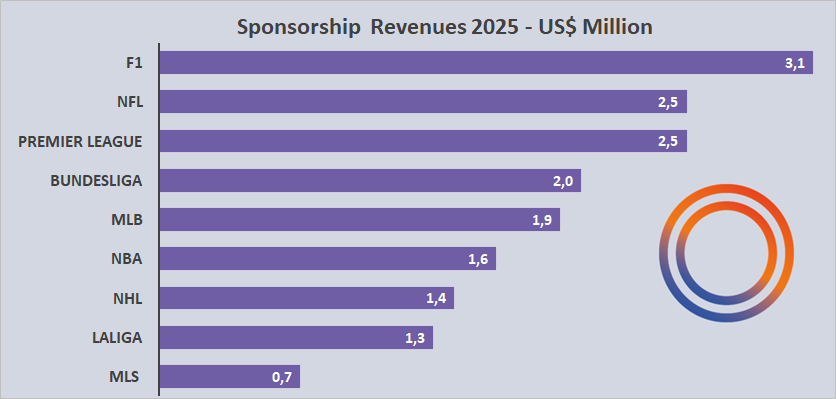
Formula 1 has quietly turned into the most crypto-friendly grid in global sport. Total sponsorship spend across the 2026 season is projected to clear $3 billion, and a growing share of that money is coming from exchanges and Web3-native brands chasing the same thing F1 itself sells, speed, precision, and split-second decision-making under pressure. No other global league has anywhere near the density of crypto branding currently parked on the side of a race car and few partnerships capture why that trend makes better sense than the one between Zoomex and the TGR Haas F1 Team.

Source: Sports & Entertainment Trends
The Season So Far: A Storyline Worth Backing
It helps that the team Zoomex chose to back is actually giving fans something to watch right now. Through the first half of the 2026 season, Haas sits seventh in the Constructors’ Championship with 21 points, solidly the leader of F1’s midfield pack, ahead of Williams and well clear of Audi and Aston Martin. Almost all of that points haul has come from one driver, Ollie Bearman, who’s outscored teammate Esteban Ocon 18 points to 3, and is currently winning the head-to-head battle across qualifying, races, and sprints by a wide margin.

The last few rounds have shown both sides of that story. At Monaco, Ocon clawed his way to ninth place in a chaotic, red-flagged Grand Prix that saw four other cars retire with reliability issues, a rare points finish for the Frenchman in a season where he’s mostly been fighting Bearman rather than the field. Then, at the Austrian Grand Prix on June 28, the form flipped: Bearman crossed the line 14th and Ocon 16th, both a lap down on race winner George Russell, in a Mercedes-dominated weekend that also saw Max Verstappen produce one of his strongest drives of the year following a Red Bull upgrade. It’s the kind of midfield grind, a points finish one week, an anonymous Sunday the next, that defines a long F1 season far more than any single highlight reel moment.
That grind is exactly the backdrop against which the Zoomex partnership makes sense. Ocon is racing this season under real pressure, with his Haas seat for 2027 reportedly tied to outperforming Bearman, Bearman, meanwhile, is doing to his more experienced teammate this year roughly what he did to the rest of the F2 grid before he ever got the call to Formula 1, quietly accumulating results until people stop calling him a rookie. A brand that’s been with him since before any of that started gets to tell a much better story than one that signed on after the points were already on the board.
Zoomex and Haas: A Partnership Built on More Than a Logo
Zoomex signed on as Haas’s crypto partner in March 2025, and ahead of the 2026 FIA Formula 1 World Championship, the two sides renewed the deal for a second season, with Zoomex returning as the team’s Official Crypto Exchange Partner. The branding isn’t a small sticker on the rear wing, ZOOMEX runs across the barge-boards and nose of the VF-26, the team’s 2026 challenger, as well as the race suits worn by Esteban Ocon and Ollie Bearman every Grand Prix weekend. The renewal was announced alongside the VF-26’s launch in Q2 2026, timing the partnership’s relaunch to the exact moment fans were paying the most attention to the new car.

What sets the partnership apart from a standard logo placement is the story behind it. Zoomex has backed Bearman since 2023, well before his move from Formula 2 into a full-time F1 seat, and well before anyone outside the paddock knew his name. A platform that builds its users from their very first trade, attached to a team that’s been developing a driver since his junior career: it’s the same patience-and-development philosophy applied to two different arenas, and it gives the sponsorship a continuity that’s hard to manufacture after the fact. It’s also a continuity that’s now paying off on the timing front, the same driver Zoomex backed as an unproven F2 graduate is, two years later, the highest-scoring driver on the team carrying its logo.
That continuity has been visible throughout the 2026 season. Zoomex framed the year as its “Road to the Championship” initiative, timing the campaign launch to coincide with Haas unveiling the VF-26, and pairing the team activation with the continuation of its global brand ambassador deal with World Cup-winning goalkeeper Emiliano Martínez.

The framing connects two very different fields, motorsport and football, around the same idea, outcomes get decided by stability and execution under pressure, not just raw speed. For the community, the initiative has translated into VIP race-day access, exclusive content tied to Grand Prix weekends, and trading rewards timed to coincide with the calendar’s biggest moments, turning the abstract idea of a “season-long campaign” into something fans can actually participate in race by race, not just watch from the sidelines.
In April, Zoomex took that idea directly to its community with a live AMA titled “Speed You Can Trust,” hosted by the platform’s own Marketing Director, Fernando Lillo, and featuring Bearman alongside crypto analyst CryptoRover and the WallStreetBets community.

Fans who tuned in, followed the official channels, and engaged in the live Q&A were eligible for a $1,000 USDT reward pool, split between an early-access reward for following and reposting the announcement and a live-interaction pool for fans active during the session itself, a fan-engagement format that turns a sponsorship into an actual two-way conversation rather than a one-way billboard.
Why “Speed You Can Trust” Is More Than a Tagline
That title isn’t just a clever name for one livestream, it’s the operating thesis of the whole partnership, and it’s backed by substance rather than slogans. While several rival exchanges have learned the hard way what happens when growth outpaces security, most notably the $1.4 billion hack that ended one competitor’s own F1 run in 2025, Zoomex has built its activation on the opposite foundation.
The platform has passed security audits from blockchain auditor Hacken, and holds regulatory registrations spanning Canada and U.S. MSB status, U.S. NFA membership, and Australia’s AUSTRAC. On the trading side, Zoomex operates with 600+ trading pairs, leverage up to 150x for traders who want it, and optional No-KYC access for those who’d rather get straight to trading, serving a user base of more than 3 million people across 35+ regions, scale that’s grown alongside, not despite, its compliance footprint.
That combination, global reach with a regulatory paper trail is precisely what makes the Haas alignment feel less like sponsorship-as-marketing and more like sponsorship-as-mirror. Haas has spent recent seasons quietly building one of the most-improved cars in the midfield through consistency rather than splashy spending; Zoomex has spent the same stretch building its user base through reliability rather than hype. Two organizations betting that doing the unglamorous things right, race after race, eventually shows up in the results.
What’s Next on the Road to the Championship
With sixteen rounds still left on the 2026 calendar, Ocon racing for his Haas future and Bearman racing to confirm he’s outgrown the “promising rookie” tag, the on-track half of this story has plenty of drama left to deliver. The off-track half should keep pace with it, expect more fan-facing activations in the Zoomex mold, AMAs, trading rewards tied to race weekends, and continued VIP access for the community, as the exchange keeps using the team’s progress through the rest of the season as the backdrop for its own “Road to the Championship” narrative.
Follow the journey race by race on zoomex.com, the official Zoomex × TGR Haas F1 Team hub, and @ZoomexOfficial on X. For more on the platform itself, security audits, licensing, and product updates, the Zoomex blog has the full picture.
The post Formula 1 & Crypto: How Motorsport Became Web3’s Favorite Playground appeared first on BeInCrypto.
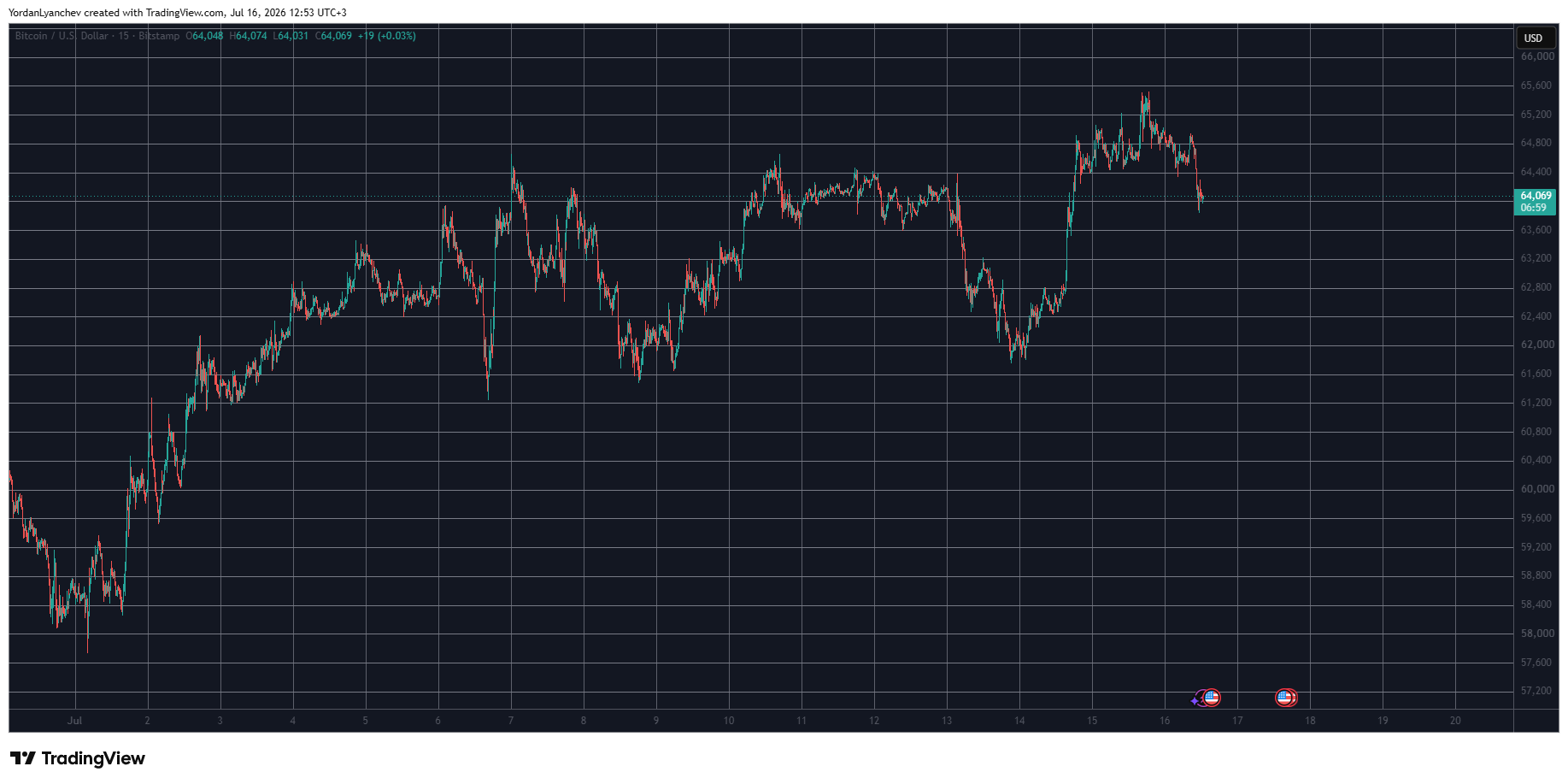
Bitcoin’s price rose to a multi-week high of its own yesterday when it briefly exceeded $65,500 on the heels of the lower-than-expected US CPI data. However, it was stopped there and now sits a grand and a half lower.
ETH rode the wave even harder, jumping to roughly $1,950 for the first time since early June before it was halted and pushed south to under $1,900.
BTC Back to $64K
The primary cryptocurrency had a relatively quiet and positive weekend in which it stood mostly at around $64,000. This came after a volatile business week in which it plunged a couple of times from that high to under $62,000 after Strategy announced its latest BTC sale and the tension in the Middle East escalated once again with new attacks.
On Monday, though, bitcoin slipped once again as the markets priced in the new strikes between the US and Iran initiated during the weekend. The cryptocurrency dipped below $62,000 by Tuesday morning but then rocketed by several grand in a day or so after the US CPI data for June was a lot lower than expected.
Bitcoin first reclaimed the $64,000 level before it did the same to $65,000 and peaked at $65,600. After tapping this three-week high, though, it retreated by $1,500 and now sits at around $64,000 again.
Its market cap is down to $1.285 trillion on CG, while its dominance over the alts remains at the same level at 56.7%.
ETH Pulls Back
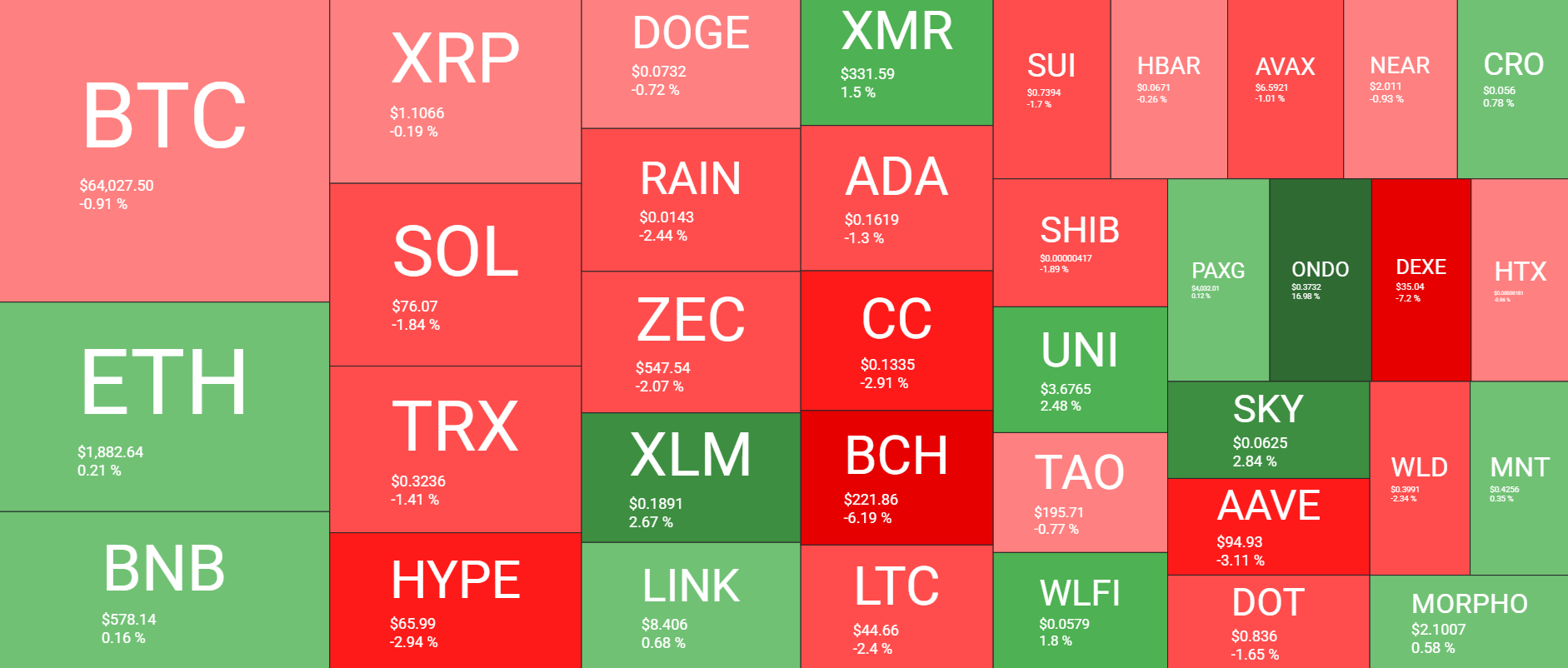
Ethereum stole the show from the larger-cap alts today, jumping to almost $1,950 for the first time in six weeks. However, it was stopped there and now sits below $1,900. BNB is close to $580 after a minor increase, while XRP is fighting for $1.10 after a minor daily decline.
SOL, TRX, HYPE, RAIN, ZEC, CC, LTC, and ADA are all in the red today, while BCH and DEXE have dumped the most from the larger caps. ONDO, in contrast, has rocketed by 17% to $0.37.
The total crypto market cap has declined by $40 billion in a day from its peak and is down to $2.270 trillion on CG.
The post Bitcoin Slips Down to $64K, Ethereum Pulls Back From Six-Week Peak: Market Watch appeared first on CryptoPotato.

China’s top AI hedge funds have started booking profits, and the AI bubble question is back. Shanghai Everlead Capital, up 164% this year, leads the funds now trimming their biggest winners.
They are not calling a crash. However, BeInCrypto’s exclusive layer data shows money rotating out of the hottest AI trades. The debate now hangs on 2027 spending.
China’s Winning AI Funds Start Booking Profits
Everlead trimmed its optical and chip-packaging stocks, both part of the compute layer that runs AI data centers.
It sold because those names had gone vertical. Zhongji Innolight’s trillion-yuan market cap and Yangtze Optical Fibre’s twelvefold rally show how far the AI optical trade ran. Gains that size invite profit booking.
A second fund moved the same way. Hunjin Capital trimmed its most crowded AI holdings, including memory-chip names it expects to lose pricing power, and rotated into cheaper traditional stocks. By its own measure, the AI hardware cycle is now 60% complete, double its February reading.
That is two funds. The real question is whether the whole market is turning with them.
Layer Data Confirms a Market-Wide Rotation
It certainly is. Money is rotating between the layers of the AI trade, and the leaders have flipped.
Compute stocks, the chip and hardware names, gained about 62% over the window but fell roughly 13% last month. Power and infrastructure rose about 11%, then stalled. Both former leaders are fading.

Apps and software are the opposite. They lagged all year, down about 9%, then gained roughly 5% last month as fresh money moved in.
Want more insights like this? Sign up for Editor Harsh Notariya’s Daily Newsletter here.
This looks like a late-cycle rotation, not a collapse. One layer sits at the center of the fade, and that layer is power.
Power Stocks Now Trade as AI Stocks
Power stocks once traded on their own story of rates and regulation. AI’s bottleneck has moved from chips to electricity, with data-center power demand set to roughly double by 2030. So power now moves with the AI trade.
A proprietary gauge tracks the 30-day correlation between the power and compute baskets. It sits at 0.74, up from near neutral earlier in the cycle. The AI energy trade is on.

The link cuts both ways. When compute fades, power fades with it. That is why every fund watches the same thing, how much big tech keeps spending on AI.
The 2027 Capex Number That Decides the AI Bubble
That spending has a name, AI capex, the money big tech pours into chips, data centers and power. It is what keeps the compute and power layers earning.
So the whole story turns on one question. If that capex keeps flowing, the funds simply took profits early. If it dries up, they sold before a burst.
The big cloud firms will commit more than $600 billion to the buildout in 2026, up about 36%, and forecasts push it past $1 trillion in 2027. For now the money keeps flowing, so this still looks like profit-taking.
The threat is a 2027 plateau, and a price war could force one. Chinese models now match top US systems at a fraction of the cost, some about 55 times cheaper.
Cheap models erode the return on all that spending. Here is how it connects. If that return breaks, big tech cuts capex, the compute and power layers fade for good, and the funds’ early profit-taking becomes the first sign of a bubble burst.
The bulls still see real profits, not a 2000-style bubble. The bears see the price war breaking those returns first. So 2027 capex is the deciding number. If it holds, this was profit-taking. If it breaks, the AI bubble was real.
The post AI Bubble Burst or Profit-Taking? The China Fund Up 164% Just Started Selling appeared first on BeInCrypto.

Bitcoin’s price action so far this year has put the four-year cycle narrative back in focus as its timing and overall structure increasingly resemble the major reset years of 2014, 2018, and 2022, even though the current market has not followed those cycles exactly.
BTC has fallen almost 50% from its all-time high of $126,000 established on October 6, 2025, with the cryptocurrency hitting a new cycle low of $57,700 on July 1 during the quarter-end period. The drawdown lasted more than 268 days before BTC staged a mild recovery this week.
$38K in Play
Looking at previous cycles, the last two major drawdowns extended for 363 and 376 days before bottoming, with peak-to-trough declines of 84.3% and 77.6%, respectively.
Based on that historical framework, NYDIG said a repeat of the duration seen in those cycles, combined with a shallower 70% decline in line with the trend of progressively less severe cycle bottoms, would point to a potential low in the $38,000-$39,000 range around early October.
The firm also added that this is a scenario and not a base-case forecast, but said the comparison highlights why the four-year cycle framework is becoming increasingly relevant as Bitcoin’s current drawdown continues to deepen and lengthen.
Analyst Doctor Profit previously predicted that Bitcoin would likely find its final low between $40,000 and $48,000 around September or October 2026.
Even as analysts continue debating where that bottom will ultimately form, the world’s largest crypto asset gained around 3% this week. It is currently trading a little below the $65,000 mark. The rebound, however, has done little to change some analysts’ broader outlook. Alphractal founder Joao Wedson said the surge in optimism across social media following Bitcoin’s recovery indicates the market has yet to reach its ultimate bottom.
Attractive Buy Zone
Not everyone believes investors should focus on finding the exact bottom, though. Crypto analyst Ali Martinez urged investors not to “obsess” over the exact timing. Looking at BTC’s performance over the past decade, the analyst noted that periods when the asset traded near its 200-week moving average have consistently turned into strong long-term buying opportunities, even though very few investors managed to buy at the absolute low.
He added that as Bitcoin matures and its returns gradually diminish, investors now need more capital to achieve the same gains from simply holding the asset. Despite this, Martinez said he believes the current price remains an attractive area for long-term accumulation.
The post Don’t Obsess Over Bitcoin’s Bottom as $38K Low Comes Into Focus: Analyst appeared first on CryptoPotato.
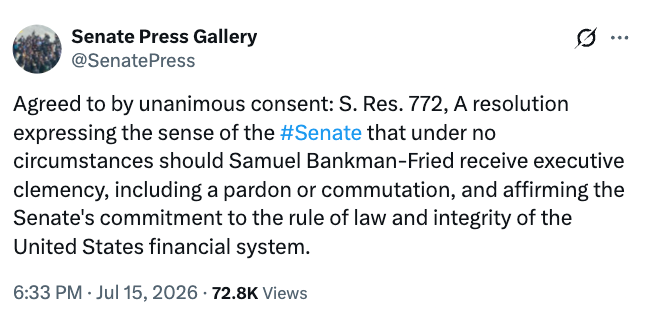
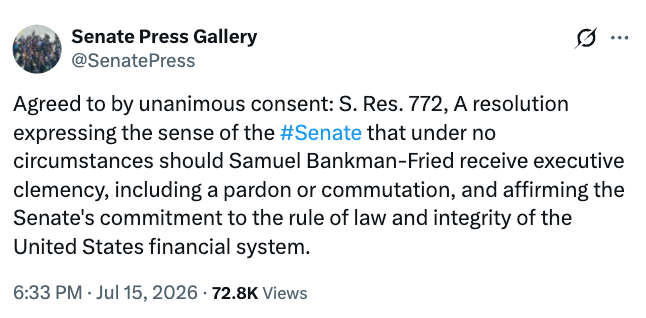
The US Senate has adopted a resolution opposing executive clemency for former FTX CEO Sam Bankman-Fried, the convicted crypto executive behind one of the industry’s largest collapses.
The Senate has agreed by unanimous consent to the simple resolution (S. Res. 772), with a nonbinding measure stating that Bankman-Fried should not receive executive clemency, according to a Wednesday X post by the Senate Press Gallery.
The resolution affirms the Senate’s commitment to the rule of law and the integrity of the US financial system following Bankman-Fried’s conviction on fraud and conspiracy charges related to FTX’s collapse.
The measure cannot block a presidential pardon but reflects bipartisan Senate opposition after Bankman-Fried sought executive clemency from President Donald Trump.
Senate weighs in, but cannot block a pardon
Introduced on June 17 by Senator Ruben Gallego, with Senator Cynthia Lummis as a cosponsor, S. Res. 772 opposes any form of federal clemency for Bankman-Fried, including a presidential pardon or sentence commutation.
Unlike legislation, a simple Senate resolution does not require approval from the House or the president and does not have the force of law, according to the Senate’s “Types of Legislation” guide.
Source: Senate Press Gallery
Congress.gov had not yet reflected the latest floor action at the time of publication.
Related: FTX exec’s wife scheduled for November trial on campaign finance charges
Senator Bernie Moreno of Ohio joined as a cosponsor on Tuesday, adding Republican support to the bipartisan measure.
Prediction markets see little chance of a pardon
Bankman-Fried was sentenced to 25 years in federal prison in March 2024 after being convicted of fraud and conspiracy charges linked to FTX’s collapse in 2022.
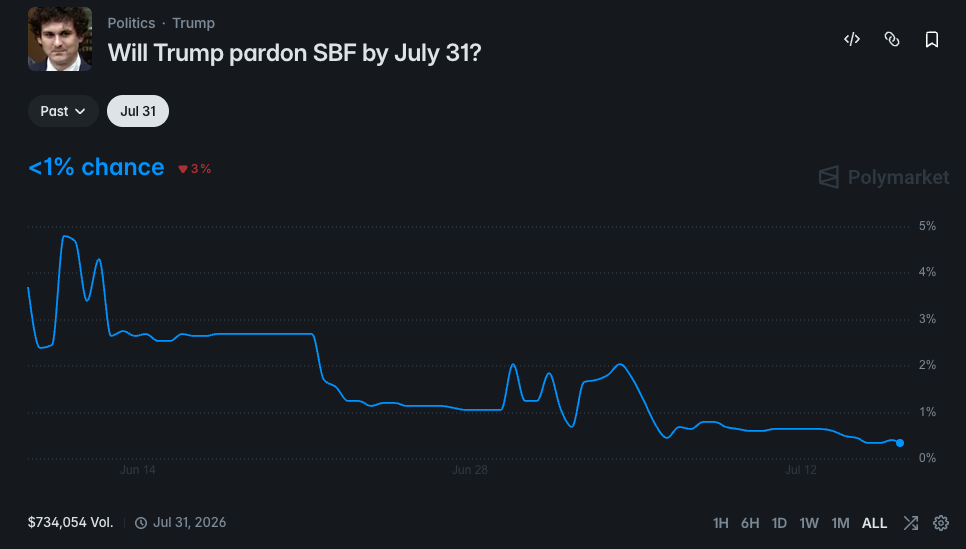
Speculation about a possible presidential pardon grew after Bankman-Fried applied for clemency from Trump in June 2026, with the request listed as pending in Department of Justice records.
Source: Polymarket
On Polymarket, traders currently assign less than a 1% chance that Trump will pardon Bankman-Fried by July 31. The market has attracted more than $734,000 in trading volume, indicating notable interest despite the low odds.
Magazine: Strategy became a symbol of the dot-com crash: Could history repeat?
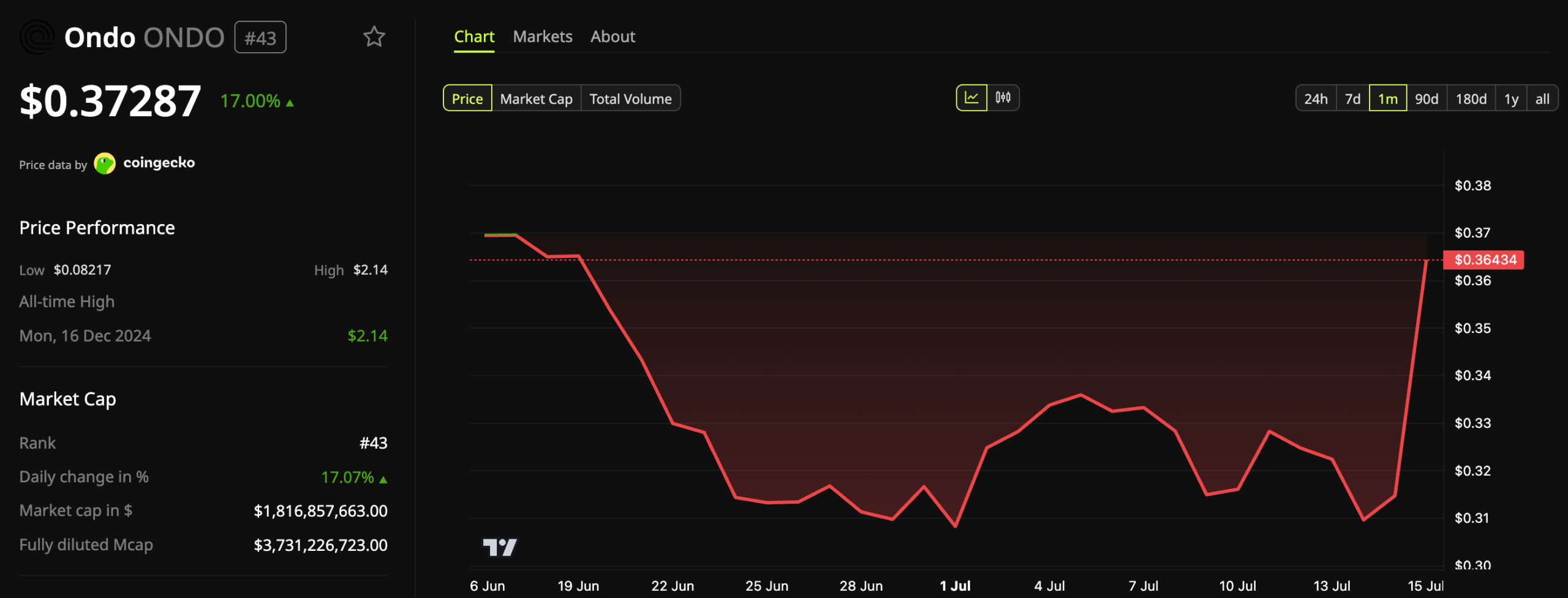
Ondo (ONDO) climbed to a one-month high after a sharp rally driven by the debut of the first tokenized stocks backed by DTC Tokenized Entitlements.
The altcoin surged as much as 17% over the past 24 hours to an intraday high of $0.37. This marked its strongest level since June 18.
The rally also propelled ONDO to the top of CoinGecko’s list of the day’s biggest cryptocurrency gainers. The surge stood out against a flat market, with Bitcoin (BTC) little changed over the same period.

Follow us on X to get the latest news as it happens
Ondo Debuts First DTC-Backed Tokenized Stocks
Ondo’s tokenized stocks are backed by DTC Tokenized Entitlements to securities held at The Depository Trust Company (DTC). The design ties on-chain tokens directly to shares inside Wall Street’s core custody system.
The company called it a first for tokenized equities. The tokens represent Circle (CRCL) stock and the SPDR S&P 500 ETF (SPY) on-chain. Ondo issues them as CRCLon and SPYon, each fully backed by the underlying security.
“Under this model, DTC tokenized entitlements to DTC-held securities are generated through the DTCC Tokenization Service, and the DTC Tokenized Entitlements associated with CRCL and SPY serve as digital twins of the securities underlying existing CRCLon and SPYon tokens (Ondo’s tokenized versions of the stocks),” the team explained.
Ondo is connected to the DTC participant network through Alpaca Markets. The underlying shares stay within DTC custody throughout the process, according to the firm.
“Ondo joins more than a dozen leading TradFi and DeFi firms — including BlackRock, JPMorgan, Goldman Sachs, Nasdaq, and NYSE — participating in DTCC’s largest tokenization initiative to date, representing an important step toward the broader adoption of tokenized securities,” the blog read.

DTCC’s Tokenization Push Gains Traction
The launch comes as the Depository Trust & Clearing Corporation (DTCC) completed the tokenization of assets held at The Depository Trust Company. More than 30 firms participated in the initiative.
The transactions covered collateral pledges, securities lending, and equity settlements. DTCC ran them across its private HyperLedger Besu network and the public Canton network.
The platform plans to launch its full tokenization service in October 2026. That milestone arrived seven months after the SEC granted DTC a No-Action Letter to tokenize custodied assets.
Subscribe to our YouTube channel to watch leaders and journalists provide expert insights
The post Ondo Hits 1-Month High: Here Is What’s Driving The 17% Surge appeared first on BeInCrypto.


Hyperion DeFi has committed 500,000 HYPE tokens to support institutional perpetual futures listings on Hyperliquid through a new agreement with Skew Technologies.
Summary
- Hyperion DeFi will deploy 500,000 HYPE tokens to support institutional perpetual futures markets on Hyperliquid.
- The agreement gives Hyperion an equity stake in Skew Technologies and a share of revenue from listing services.
- The partnership expands institutional use of Hyperliquid’s HIP 3 framework for launching custom perpetual markets.
According to a Wednesday press release, the Nasdaq-listed company will deploy the tokens under Hyperliquid’s HIP-3 permissionless listings framework while receiving an equity stake in Skew Technologies and a share of the listing-service revenue generated through the platform.
The companies said the partnership is intended to help institutional clients launch custom perpetual futures markets on Hyperliquid, a layer-1 blockchain focused on perpetual futures trading.
Hyperion expands role in Hyperliquid ecosystem
Under Hyperliquid’s HIP-3 framework, developers can create custom perpetual markets by posting HYPE as bonded capital, giving the token a use case beyond staking. The same infrastructure has recently been used to launch synthetic markets linked to assets outside crypto, including pre-IPO companies such as Chinese memory chipmaker ChangXin Memory Technologies.
Commenting on the agreement, Hyperion DeFi chief executive officer Hyunsu Jung said the company continued to receive requests from teams worldwide looking to launch and distribute new markets using Hyperliquid’s infrastructure while evaluating opportunities within HIP-3.
Rather than operating the markets directly, Skew Technologies will provide the listing service, while Hyperion contributes HYPE tokens required to support the permissionless listings under the agreement.
The arrangement also deepens Hyperion’s exposure to the Hyperliquid ecosystem beyond holding the token, with the company set to receive both an ownership interest in Skew and a portion of the revenue generated by the listing business.
Institutional activity around Hyperliquid continues to grow
The latest announcement comes as institutional interest in Hyperliquid has continued to expand across several areas of the ecosystem.
Earlier this month, Bitwise added HYPE to its Bitwise 10 Crypto Index ETF (BITW), placing the token inside one of the industry’s largest diversified crypto index products after its latest index rebalancing.
At the same time, Hyperliquid has been attracting new infrastructure partnerships. Circle and Coinbase recently deepened USDC integration on the network, making USDC the platform’s preferred stablecoin, although JPMorgan said this week that the revised revenue-sharing structure could reduce long-term reserve income retained by Circle and Coinbase even as USDC adoption grows.
Recent HIP-3 deployments have also extended beyond crypto-native assets. Last week, Hyperliquid introduced a synthetic perpetual market tied to ChangXin Memory Technologies ahead of its Shanghai listing, showing how the framework can support custom derivatives linked to real-world and pre-IPO assets without giving traders ownership of the underlying securities.
For fifteen years the loudest promise in crypto was that XRP would replace Swift. Not complement it, not plug into it, replace it: the slow, expensive, pre-funded machinery of correspondent banking swept away by a bridge asset that settles in seconds.
Summary
- Swift’s blockchain ledger went live with 17 major banks and chose tokenized deposits, not XRP.
- The system targets real-time liquidity management and cross-border settlement inside existing bank balance sheets.
- XRP rallied on the headline, but the architecture leaves no public bridge asset in the middle.
- The strongest XRP arguments rely on old artifacts, overlapping relationships, and optional future liquidity use cases.
- The launch weakens the original “XRP replaces Swift” thesis while leaving Ripple’s broader business intact.
It was the thesis that sold the token, filled the conference halls, and outlasted a five-year lawsuit.On July 9, 2026, Swift answered.
The network moved its own blockchain ledger into live operation with seventeen pioneer banks, among them Citi, HSBC, Wells Fargo, UBS, Standard Chartered, and MUFG. The build took nine months. The system runs 24 hours a day across six continents, coordinating cross-border payments on a shared ledger that eliminates the batch windows and cut-off times that made correspondent banking feel like a fax machine. It is, by any fair reading, Swift doing the thing everyone said Swift would never do: shipping blockchain settlement, at scale, with the incumbents, before the disruptor could take the market.
And the asset moving across it is tokenized bank deposits. Not XRP. Not any public token. Banks convert dollars and euros they already hold into digital claims and send those claims to each other directly. No third coin sits in the middle.
That is not a rumor, a leak, or an interpretation. It is the design, and it is the most consequential piece of information the XRP thesis has received since the SEC dropped its appeal.What followed was five days of the loudest argument the XRP community has had in years, conducted almost entirely over a resurfaced slide and a two-word post from a man who no longer works there. That argument is worth walking through, because the way it is being fought reveals more than the thing being fought over.
What Swift actually shipped
The details matter, because the gap between what was announced and what was believed became its own story within hours.
Swift confirmed that its blockchain-enabled shared ledger completed roughly nine months of development and testing and is ready for commercial use. The stated purpose is liquidity management: letting banks monitor and move tokenized deposits in real time, with visibility into cash positions across institutions. The system reportedly runs on Hyperledger Besu with Chainlink’s cross-chain interoperability protocol handling messaging between chains, though that stack detail comes from secondary reporting rather than a Swift technical disclosure and deserves the caveat.
The seventeen pilot banks are not a random sample. They are the tier-one institutions that XRP holders spent a decade naming as future Ripple customers. Citi. HSBC. Wells Fargo. UBS. MUFG. Standard Chartered. When Swift decided how money would move in a tokenized era, it convened exactly the banks the bridge-asset thesis was waiting on, and those banks agreed to test settlement using their own deposits.
The ledger’s economic function is worth stating plainly, because it is where the XRP question actually lives. Its purpose is to let banks see and move their own liquidity in real time across a shared record. Every participant reads the same state. Positions net continuously instead of at end of day. Cut-off times stop existing. Whatever else that is, it is a direct attack on the specific inefficiency that made a bridge asset attractive in the first place, executed by the party that owns the relationships.
Swift has also signaled where this goes next, describing an ambition to become a platform for programmable money and agentic commerce, payments that execute automatically when conditions are met without a human approving each one. That is not a defensive crouch. It is a network that watched the tokenization argument play out for a decade and decided to build the endgame itself.crypto.news covered the market’s immediate reaction, which was, revealingly, a rally. XRP rose on the news that Swift had built a system without it.
Why the rally happened
That reaction is the most interesting thing in this story, because it was not irrational. It was the product of a genuine ambiguity that both sides are now exploiting.
Two of the seventeen banks, Standard Chartered and UBS, already work with Ripple through custody or payment infrastructure on the XRP Ledger. Ripple Treasury entered Swift’s Certified Partner Program in April 2026. Swift’s broader payments framework names more than thirty institutions with existing Ripple relationships, a set that extends beyond the seventeen pilot participants, though the overlap has never been specified. Read those facts quickly and it looks like Ripple is inside the tent.
Then the artifacts arrived. A researcher operating as SMQKE resurfaced a Swift-branded slide that places Ripple explicitly in the middle of a payment flow, positioned between local bank and local bank. A widely shared clip features a former Swift insider, now linked to Euro Exim Bank, predicting XRP adoption within the network. The slide got called a mic-drop moment. The clip got called verbatim proof.
The rebuttal came just as fast and from a more credentialed source. Tom Zschach spent six years as Swift’s Chief Innovation Officer, running the network’s digital asset strategy. He answered the rumor with two words: not happening. A separate analyst urged followers to stop engaging with anyone claiming Swift currently uses XRP, on the grounds that the only public evidence shows adoption of ISO 20022 messaging standards, which is a data format, not an asset choice.
Both sides have a problem. Zschach left Swift earlier this year and has criticized Ripple for years, which makes his read informed but personal and not official policy. The slide is undated, resurfaced rather than leaked, and interpreted through a YouTube channel and an anonymous account. Neither is evidence in the sense that a production integration would be evidence.
What is not ambiguous is the ledger. Seventeen banks. Tokenized deposits. Live.
A decade of the banks saying no
The July 9 launch reads differently once you remember how long the question has been open, because the record is not one of banks failing to understand the pitch. It is one of banks understanding it precisely and declining.
Ripple’s original enterprise product was messaging: a way for banks to exchange payment instructions with better data and fewer errors than legacy rails. Banks bought that. Santander, SBI, Standard Chartered, and hundreds of others signed on across the late 2010s, and RippleNet became a real business. Then came the second ask, the one the token depended on: route your liquidity through XRP instead of pre-funding accounts. That ask went almost nowhere. The company’s own On-Demand Liquidity product reached a fraction of its partner base, and most institutions stayed on the messaging layer and never touched the asset, a divide crypto.news has documented at length across the XRP vertical.
The explanations offered for that gap were always circumstantial: regulatory uncertainty, the SEC lawsuit, accounting treatment, custody immaturity, market depth. Each was legitimate at the time. Each has since been resolved or substantially reduced. XRP is classified as a digital commodity. The lawsuit ended. Custody is a solved product sold by every major bank. Market depth is adequate for the ticket sizes involved.
So the circumstantial explanations have expired, and the behavior has not changed. When the constraints lift and the decision stays the same, the constraints were not the reason. That is the uncomfortable inference available on July 9 and it does not require believing anything bad about Ripple, only accepting that treasurers weighing a volatile bridge asset against a deposit token they issue themselves have a preference, and have had it for ten years, and just spent nine months building infrastructure that encodes it.
The thesis under the argument
Strip away the personalities and one real technical dispute remains, and it is worth stating precisely because it is the only part that could still cut Ripple’s way.
The bridge-asset argument was never about messaging. It was about nostro and vostro accounts, the pre-funded pools of foreign currency that banks must park in every destination country in order to settle. That trapped capital is the actual cost of correspondent banking, running to trillions globally, and it is the problem XRP was designed to solve: instead of pre-funding a lira account in Turkey, a bank buys XRP, sends it in seconds, and sells it into lira at the far end, freeing the capital that was sitting idle.
Ripple’s supporters argue that Swift’s upgrade is a front-end improvement that does not touch this. Tokenized deposits are still deposits. If a bank sends a tokenized dollar to a bank that needs lira, someone still has to bridge the currency pair, and a shared ledger does not conjure liquidity where none exists. On this reading, Swift built a faster pipe and left the plumbing problem intact, which is exactly the gap XRP was built for.
The counter is harder and mostly wins. A shared ledger with real-time visibility across seventeen tier-one banks changes the economics of pre-funding even if it does not abolish it, because the reason nostro balances are so large is uncertainty about position and timing. Netting improves. Buffers shrink. And critically, the tokenized-deposit model gives banks something a public bridge asset never could: settlement in an instrument they already issue, with no exposure to a volatile third token, no market-maker spread, and no question about who is liable when the price moves mid-transfer. The bridge asset solves trapped capital by introducing price risk and a dependency on a token’s liquidity. Banks have been consistent for a decade about which trade-off they prefer, and Swift just built infrastructure that encodes the answer.
There is one more asymmetry the bridge argument tends to skip. A tokenized deposit is a liability of a regulated bank, which means it arrives inside the legal and accounting framework treasurers already operate in. A bridge asset is a bearer instrument on a public ledger, which means somebody has to write a policy for holding it, mark it to market, explain it to an auditor, and answer for it when it gaps. That is not a technology problem and no amount of settlement speed fixes it. It is why the ODL conversion rate stayed low even in corridors where the math worked, and it is the quiet reason Swift’s design was always the likelier winner.
The honest version is that Swift’s ledger does not make XRP technically impossible as a liquidity leg. It makes it commercially unnecessary for the corridors that matter most, which is a slower and more final kind of defeat.
What the artifacts actually show
The evidentiary standard in this argument collapsed almost immediately, and it is worth being precise about what each item is, because the community is treating them as interchangeable.
The Swift-branded slide is the strongest bull artifact and the weakest form of evidence. It is undated. It was resurfaced by a researcher rather than released or leaked. Nobody has confirmed when it was produced, for what audience, whether it described a live integration or a hypothetical architecture, or whether it survived contact with a product decision. Corporate slide decks are full of vendors placed in diagrams during evaluation phases that ended in no. Even read maximally, the slide depicts Ripple as a connector or optional leg inside Swift-adjacent infrastructure, which is a substantially smaller claim than the thesis it is being used to defend.
Zschach’s post is the strongest bear artifact and is also not evidence. He is a former executive stating a personal view, months after departure, about an organization whose current architecture he no longer sets, and he has a documented history of criticizing Ripple. His read is well-informed. It is not policy.
The Euro Exim Bank thread is the strangest of the three. Its force comes from David Schwartz’s court testimony, where Ripple’s chief technology officer initially told regulators that the company’s primary customers were not banks, and later acknowledged failing to mention Euro Exim Bank as a bank customer using XRP. The XRP argument holds that this proves the asset is already in production use at the margins of traditional finance. It does prove that. It also concedes the scale: the reference case, cited in 2026 as evidence of bank adoption, is a trade finance specialist that nobody would mistake for a tier-one institution. If the strongest live example is Euro Exim Bank while the seventeen banks on Swift’s ledger are Citi, HSBC, and Wells Fargo, the argument has answered itself.
The pattern across all three is the same. The bull case runs on interpretation of artifacts. The bear case runs on a live system with named participants. Those are not the same kind of fact.
The case that this changes nothing for Ripple
Now the argument that Ripple’s defenders make, and it deserves a serious hearing, because on the corporate side it is largely correct.
Ripple never needed Swift. The company runs its own corridors, its own bank relationships with Santander and SBI, and its own dollar stablecoin. Ripple Prime, the institutional arm built out of the Hidden Road acquisition, has cleared more than $3 trillion across roughly 300 institutional clients. The company spent the last two years buying its way into prime brokerage, treasury software, and payments infrastructure, and none of that revenue routes through Swift or depends on Swift’s approval. A network that competes with Ripple’s messaging business building a better messaging business is a competitive fact, not an existential one.
The direction of travel also vindicates Ripple intellectually, which is not nothing. Swift spent years dismissing blockchain settlement and has now shipped 24/7 tokenized cross-border payments with an explicit roadmap toward programmable money and agentic commerce. That is Ripple’s thesis, delivered by Ripple’s incumbent. Being right about where finance was heading, and losing the contract anyway, is a real outcome, and Ripple’s supporters are entitled to point out that nobody was building this in 2015 except them.
Ripple is also still in the room. The Certified Partner Program membership is real. The Ripple-linked institutions inside Swift’s framework are real. Standard Chartered and UBS working with both is real. Nothing about the July 9 launch forecloses XRP serving as an optional liquidity leg for exotic corridors where no deep deposit market exists, which is precisely what the resurfaced slide depicts, and which was always the realistic ceiling for a bridge asset anyway.
And Ripple’s institutional business keeps compounding regardless. The XRP Ledger’s credit layer is in validator voting, an effort crypto.news examined in detail in its analysis o what on-chain credit means for XRP. SBI Digital Finance and Doppler announced institutional XRP lending infrastructure for Japan on July 13. Goldman Sachs sits atop the XRP ETF holder table with a $153.8 million position, a fact crypto.news reported when the funds crossed $1.53 billion. The company is fine. That was never the question.
Ripple in 2026 is a payments and prime brokerage conglomerate with a stablecoin, a pending bank charter, and billions in acquisitions behind it, and it would remain all of those things if XRP traded at fifty cents.
The case that it is the end of an argument
The question was always whether Ripple being fine does anything for XRP, and July 9 is the cleanest data point anyone has produced.
Here is the uncomfortable sequence. The bridge-asset thesis required banks to hold and route a volatile public token. The banks said no for a decade. XRP holders explained that the banks were slow, captured, and would come around once the technology proved itself and the regulatory fog lifted. The fog lifted: XRP is a digital commodity, the lawsuit is over, the appeals are dropped. The technology proved itself: Swift just deployed it. And at the exact moment both preconditions were satisfied, the seventeen largest banks in the world adopted tokenized settlement and chose deposits.That is not the banks being slow. That is the banks answering.
The market noticed even while the price rallied. Spot XRP ETFs recorded $7.29 million of net outflows on July 8, the largest single-day withdrawal since March. Open interest fell from $2.58 billion on July 5 to $2.33 billion on July 9 as traders closed positions instead of opening them. The long-to-short ratio slipped to 0.96, meaning bears slightly outnumbered bulls into the news. Retail bought the Swift headline. Institutions sold into it. When those two groups disagree about an institutional-adoption story, the institutions are usually the ones who read the announcement.
That divergence is the tell worth carrying forward. Price reacted to the word Swift appearing next to the word blockchain. Flow reacted to the architecture. Over any horizon longer than a week, flow wins.
The deeper problem is that this compounds with everything else already on the record. Most of Ripple’s bank partners use RippleNet for messaging and never touch the token. The XRP Ledger’s EVM sidechain, built to give XRP a DeFi economy, holds $25,741 and trades nothing. RLUSD, Ripple’s own product, has grown into a business while the ledger’s native asset has not. Each of these is survivable alone. Together they describe a pattern: every route by which value was supposed to reach XRP has been tested, and the value keeps arriving somewhere else.
Swift is the biggest of those tests because it was the original one. The thesis was not that XRP would find a niche. It was that XRP would become the settlement layer of global finance. That specific claim now has a specific answer, delivered by the specific institution the claim was about, using the specific banks the claim named.
What would have to be true for the bulls
Fairness demands stating the conditions under which the bear reading here is wrong, because they exist and they are not absurd.
Tokenized deposits only work between banks that hold each other’s currencies in size. The model is excellent for dollar-euro-sterling-yen, which is most of the volume and nearly all of the profit. It is useless for a Nigerian bank settling with a Philippine bank, where no deposit market exists in either direction and someone must still bridge. If tokenized deposit networks handle the deep corridors and a public bridge asset handles the long tail, XRP has a real business. It is a smaller business than the pitch, and it competes with stablecoins that carry no price risk, but it is real.
The second condition is agentic settlement. Swift has said it wants to be the platform for programmable money and machine-to-machine payments. Those flows are high-frequency, low-value, and permissionless by nature, which is the environment where a neutral public asset with a native ledger has genuine structural advantages over an interbank consortium. Ripple has been building directly at this, and if the agentic economy materializes at scale, the question reopens on different terms.
The third is time. Seventeen banks in pilot is not global adoption. Consortium infrastructure has failed before, repeatedly, and Swift’s ledger could stall in exactly the way that bank blockchain consortia have stalled since 2016. A pilot that quietly does not scale would leave the field open again. R3, Corda, Utility Settlement Coin, and a decade of bank consortia are a real precedent for exactly that failure mode, and Ripple has outlived most of them.
None of those conditions rescue the original claim. They describe a smaller, more plausible XRP: a liquidity instrument for corridors nobody else wants, and a settlement rail for machines. Which is a decent business, and is not what anyone bought.
The answer nobody wanted to hear
Fifteen years of argument reduced to a design document. Swift built the blockchain. It went live with the exact banks the thesis named. And it moves tokenized deposits, because banks would rather settle in money they issue themselves than in an asset whose price can move against them between the send and the receive.
The XRP community will spend this week debating a resurfaced slide and a former executive’s two-word post, and both of those things are more interesting than the ledger, and neither of them matters. The slide is undated. The executive is gone. The ledger is live.
What is left is the smaller question, the one that has quietly been the only real one for two years: not whether Ripple wins, because Ripple is winning, but whether anything Ripple wins reaches the token. On July 9 the largest institution in cross-border payments answered that question in the most expensive way available, by building the future and leaving XRP out of the blueprint.The thesis is not dead. It is just no longer a thesis about Swift.
Disclaimer: This article is for informational purposes only and does not constitute investment advice. Swift has not published a technical disclosure of the ledger’s full stack; the Hyperledger Besu and Chainlink CCIP details derive from secondary reporting. The Swift-branded slide discussed here is undated and was resurfaced by a third party, not released by Swift, and no party has confirmed its provenance or current status. Tom Zschach’s comments are his personal view and not Swift policy; he left the organization earlier in 2026. ETF flow, open interest, and long-to-short figures derive from SoSoValue and CoinGlass. Details reflect information current as of July 14, 2026, and are subject to change. Always do your own research.
Crypto World
Crypto News, July 16: All Eyes on Tomorrow’s Clarity Act Hearing as Bitcoin and Ethereum Hold Key Price Levels

South Korea jolted financial markets with an unexpected interest rate hike, sending local stocks sharply lower and even briefly halting trading. Crypto, however, reacted differently. We shifted our focus to tomorrow’s Clarity Act hearing in Congress, while Bitcoin price hovers near recent highs and Ethereum continues to hold above a key support zone.
The House Financial Services Committee will meet on July 17 for a hearing titled “Building the Future of Finance: How the Clarity Act Unlocks Innovation.” With Congress set to begin its summer recess soon after, many in the industry see the discussion as one of the last meaningful chances to move crypto legislation before lawmakers leave Washington.
BREAKING: — Crypto Rover (@cryptorover) July 16, 2026
 Tomorrow could decide the ENTIRE future of crypto in the United States.
The House is holding a field hearing on the CLARITY Act:
"Building the Future of Finance: How the CLARITY Act Unlocks Innovation."
Turn on notifications for updates. pic.twitter.com/yjzDSnGUYC
These all explain the current market’s mood. Macro headlines still drive expectations, but they are no longer the only force steering digital assets. This week, the conversation has narrowed around one question. If the Clarity Act can bring enough regulatory certainty to keep institutional money flowing into the sector.
Discover: The Best Token Presales
Bitcoin Price Holds Firm as Clarity Act Gets Closer

Bitcoin price spent Thursday hovering between $64,500 and $65,000, extending a recovery that has carried it to its highest level in about three weeks. After several months of choppy trading, the market finally looks willing to defend higher ground instead of selling at every rally.
Institutional demand remains part of that story, with BlackRock adding another $139 million worth of Bitcoin to its holdings, while the iShares Bitcoin Trust now custodies more than 733,000 BTC. Larry Fink also struck an optimistic tone this week, saying the current price of Bitcoin appears more stable than before and expressing confidence in financial markets over the next year.
Although traders remain cautious, analysts note Bitcoin is approaching the short-term holder realized price, an area that has historically produced resistance as newer investors exit at break-even. At the same time, those levels have often marked the beginning of longer accumulation phases rather than the end of a recovery.
Another signal arrived from a wallet that had been inactive for eight years. About as much as 5,908 BTC, valued near $383 million, moved to a fresh address without touching an exchange. The transfer did little to disturb sentiment, showing that the market viewed it as a reshuffle instead of a liquidation. For now, Bitcoin price remains steady, with tomorrow’s Clarity Act hearing likely to set the next tone.
Don’t Miss Out on Our $1,000 USDT Airdrop on ByBit
Ethereum Price Builds on Improving Momentum

Ethereum is trading around the $1,900 price mark after reclaiming an important resistance level and triggering more than $30 million in short liquidations. The move was not explosive, but it continued a steady improvement that has quietly placed Ethereum among the stronger large-cap performers this week. And yes, the Ethereum price has been outperforming Bitcoin with a more than 17% jump in the ETH/BTC ratio.
Investor appetite is also beginning to recover. Spot Ethereum ETFs recorded $84 million in net inflows during the week ending July 11, breaking an eight-week streak of withdrawals. That turnaround has helped stabilize sentiment, while BlackRock’s ETHA has contributed to several of the strongest daily inflows. As a result, the price of Ethereum is once again finding support from institutional investors.
Away from the ETF market, development across the network continues. Robinhood Chain, an Arbitrum-based Layer 2, is attracting activity through tokenized assets, AI applications, and NFT projects, all of which rely on ETH for transaction fees. Growing usage may not move markets overnight, but it steadily strengthens the network beneath the surface.
The next catalyst now sits in Washington. A constructive outcome from the Clarity Act hearing could reinforce confidence, just as ETF flows improve and the Bitcoin price remains resilient. If that happens, we can, once again, believe that the Ethereum price has a realistic chance of reclaiming $2,000 in the weeks ahead.
Discover: The Best Token Presales
The post Crypto News, July 16: All Eyes on Tomorrow’s Clarity Act Hearing as Bitcoin and Ethereum Hold Key Price Levels appeared first on Cryptonews.

WEEX OpenAPI 101: 5 Powerful Modules, AI Trading Tools, and Grab Up to 70% Revenue Opportunities

How Hollywood Sells Kids Stories Parents Don’t Want

Four illegal vehicles seized in Teesside police crackdown

No Jackpot Winner as $257 Million Prize Rolls Over to $269 Million Monday Draw

Renter of Home in Anne Heche Crash Denies Settlement With Son

Weekend Open Thread: Staud – Corporette.com

XRP JAPANESE CLARITY ACT PASSED !!!! MR POOL CALLED IT !!!!

Trump’s Gordie Howe Bridge deal about money and power: former ambassador Bob Rae | Power & Politics

Are Interest Rates About To Explode? ‘Greatest Financial Bubble In History’ | Peter Boockvar
-

 Fashion7 days ago
Loro Piana Fall 2026 Enters Houston’s Art Scene
-

 Fashion5 days ago
Weekend Open Thread: Nutriplenish Leave-In Conditioner
-
 Sports7 days ago
2026 Genesis Scottish Open Thursday TV coverage: Round 1
-

 Sports6 days ago
Super Eagles star Moses Simon opens up on Liverpool transfer regret
-

 Tech7 days ago
Character.AI enters the microdrama arena with its own productions, but there’s a twist
-

 Politics22 hours ago
Young campaigners urge incoming PM to act on outdoor junk food ads
-

 News Videos2 days ago
XRP BOMBSHELL… XRP OMBOARDED FOR TRANSACTIONS!!!
-

 Tech2 days ago
Get Your ESP32 Sunny Side Up With This Solar Dev Board
-

 Tech2 days ago
Dark Secrets Emerge When Jailbreaking LLMs
-
 Sports13 hours ago
New Cornerback Enters Vikings Trade Rumor Mill
-
 Entertainment17 hours ago
Disney’s Most Ambitious Failed Star Wars Attraction Is Coming to SDCC
-

 Tech7 days ago
Level Infinite Launches Gangstar Mirage City in India with Pre-Registrations
-
 NewsBeat7 days ago
Major update after Huntingdon train attack as man enters plea
-

 News Videos3 days ago
how to make coin bank box with cardboard #scienceproject #money #diy #shorts
-
 Tech3 days ago
Cloudflare Precursor Watches Your Mouse and Keyboard To Decide If You Are Human
-
 Entertainment16 hours ago
Vicki Gunvalson Defends Discussing Heather Dubrow’s Money
-
Crypto World2 days ago
Ripple, Coinbase, Circle Join Linux x402 Foundation to Help Shape AI Payments
-

 NewsBeat13 hours ago
Watch: Is Donald Trump facing a popular backlash on immigration?
-

 Sports10 hours ago
Michigan officials not expected to discuss AD Warde Manuel at Thursday meeting
-
 NewsBeat12 hours ago
Firefighters issue update on Dovestone moorland blaze as fire enters fourth day
You must be logged in to post a comment Login