

Crypto World
Binance stablecoin reserves drop $9B, signal fading risk appetite



Binance logs three straight months of heavy stablecoin outflows, erasing $9B in reserves and signaling a sustained liquidity squeeze across crypto markets.
Summary
- Binance has seen negative stablecoin netflows for three consecutive months, the longest stretch since the 2023 downturn.
- Net outflows climbed from about $1.8B in December to nearly $2.9B in January and around $3B halfway through February.
- Stablecoin reserves dropped from roughly $50.9B in November to $41.8B, shrinking the exchange’s capacity to absorb volatility.
Binance has recorded three consecutive months of negative stablecoin netflows, marking a sustained contraction in crypto market liquidity, according to data shared by CryptoQuant.
The outflows represent the longest comparable stretch since the 2023 bear market, the data showed.
Monthly figures indicate an acceleration in the trend. December saw approximately $1.8 billion in net stablecoin outflows, followed by nearly $2.9 billion in January, according to the data. February outflows have reached close to $3 billion despite the month being only halfway complete.
Binance’s stablecoin reserves have declined from approximately $50.9 billion in November to $41.8 billion, representing a contraction of nearly $9 billion, the data indicated.
Stablecoin outflows from major exchanges typically indicate capital leaving the exchange ecosystem rather than being redeployed into other crypto assets, according to market analysts. Stablecoins serve as readily deployable capital in cryptocurrency markets, and declining balances reduce the capacity to absorb price volatility.
The outflows occur amid elevated global uncertainty and geopolitical tensions, factors that market observers say may be influencing investor behavior toward more defensive positioning.
The trend has continued without signs of stabilization, according to the latest available data from CryptoQuant.

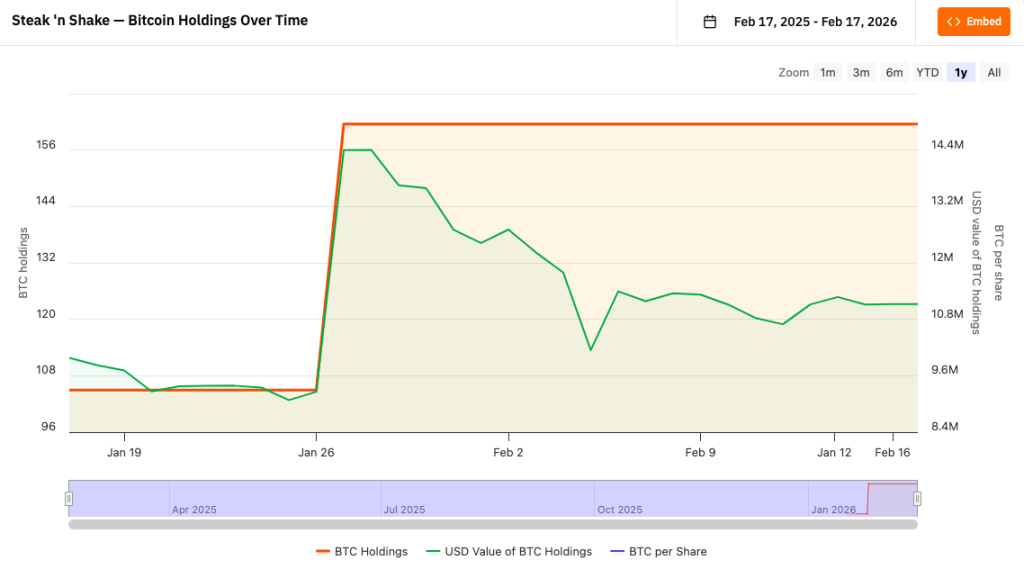
In a bullish bit of news for everyday crypto usage, Steak ‘n Shake reports that Bitcoin payments have “dramatically” lifted same-store sales over the last nine months.
The 90-year-old burger chain is now routing all crypto revenue directly into a Strategic Bitcoin Reserve, effectively blending retail operations with institutional asset accumulation.
This is no longer just a marketing stunt, it’s a balance sheet strategy.
- Sales Growth: Reported 15% same-store sales jump by October 2025 and 18% growth in 2026, significantly outpacing industry averages.
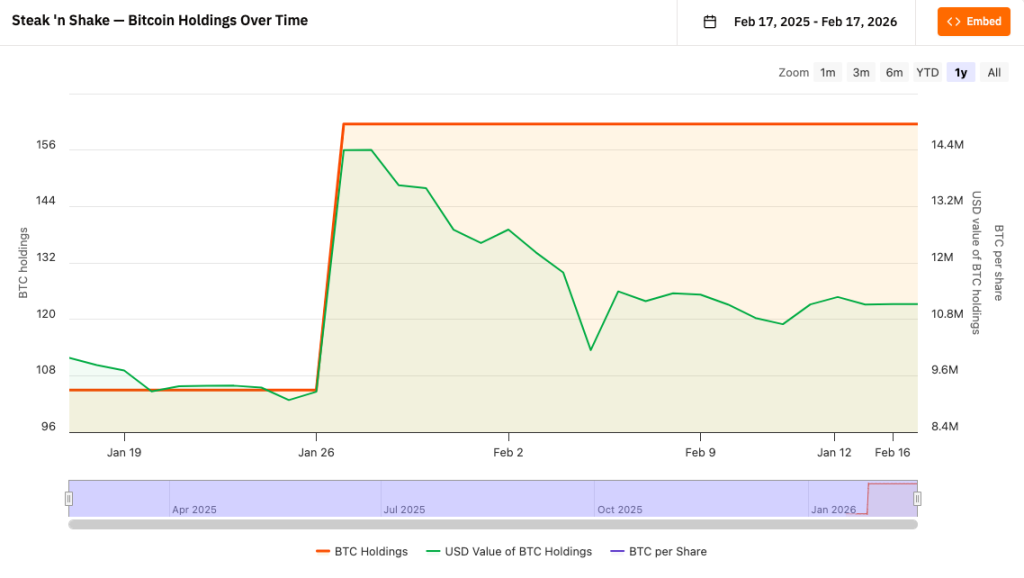
- Treasury Strategy: The company now holds approximately 168.6 BTC (valued near $15 million) in its Strategic Bitcoin Reserve.
- Operational Efficiency: Lightning Network transactions have reduced payment processing fees by nearly 50% compared to traditional credit cards.
Is Data Finally Overtaking the Hype?
Steak ‘n Shake began this pivot nine months ago, and the data suggests it is paying off.
While Wall Street firms like BlackRock and Goldman Sachs are quietly doubling down on crypto, this chain chose to go loud.
Unlike competitors testing the waters with third-party processors that instantly convert to fiat, Steak ‘n Shake is holding the asset.
The company stated the move has driven a “sharp rise” in sales. It signals a shift from using crypto as a novelty to treating it as both digital gold and digital cash.
Corporate adoption is shifting from tech-native firms to traditional businesses seeking hard asset reserves.
Discover: The best meme coins on the market.
Inside the Treasury and Bonus Model
The financials show a dense commitment to the ecosystem. Steak ‘n Shake has accumulated approximately 168.6 Bitcoin, valued at around $15 million.
This reserve was built through a mix of customer receipts and direct treasury allocations, including a $10 million initial investment in May 2025 and subsequent buys in January 2026.
This mirrors how other firms plan to equitize convertible debt into Bitcoin to strengthen long-term solvency.
Beyond holding the asset, the operational mechanics are yielding immediate margins. By processing payments via the Lightning Network, the chain reports transaction fee savings of nearly 50% versus standard credit card rails.
The strategy extends to the workforce as well. Starting March 1, the company will issue bonuses to hourly employees at company-operated locations.
Workers will accrue $0.21 worth of Bitcoin for every hour worked, creating a vesting retention mechanism tied to the asset’s performance.
A New Standard for Retail?
Steak ‘n Shake’s metrics challenge the narrative that Bitcoin is too slow or volatile for commerce.
The burger chain’s immediate planned expansion into El Salvador, where Bitcoin is legal tender, signals global ambitions.
This integration reflects a broader institutional trend. As Trump-linked Truth Social files for Bitcoin staking ETFs and Elon Musk’s X launches smart cashtags for trading, the infrastructure between consumer apps and crypto rails is hardening.
Steak ‘n Shake just provided the proof of concept that it works for burgers, too.
Discover: The best new crypto to watch out for.
The post Steak ‘n Shake Reports Bitcoin Acceptance Has ‘Dramatically’ Lifted Sales in 9 Months appeared first on Cryptonews.
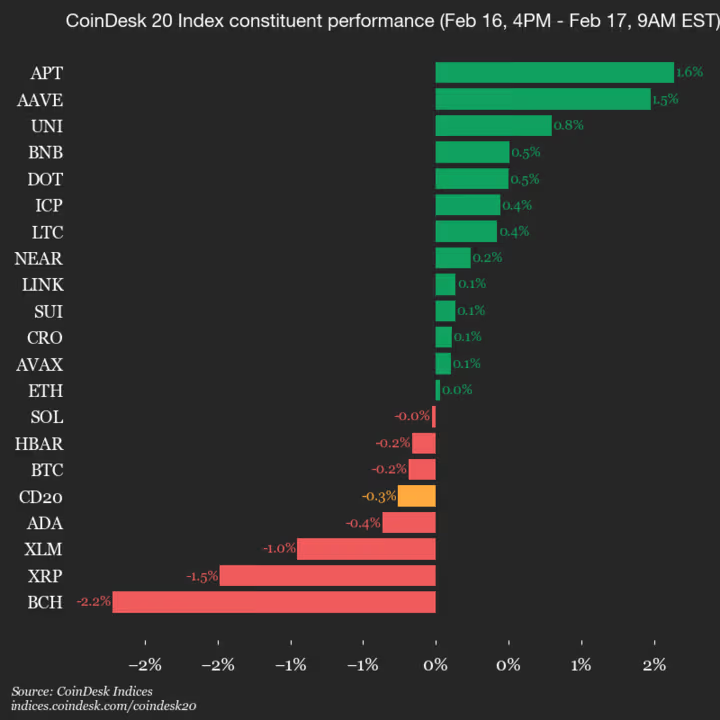
CoinDesk Indices presents its daily market update, highlighting the performance of leaders and laggards in the CoinDesk 20 Index.
The CoinDesk 20 is currently trading at 1979.83, down 0.3% (-5.15) since 4 p.m. ET on Monday.
Thirteen of the 20 assets are trading higher.

Leaders: APT (+1.6%) and AAVE (+1.5%).
Laggards: BCH (-2.2%) and XRP (-1.5%).
The CoinDesk 20 is a broad-based index traded on multiple platforms in several regions globally.
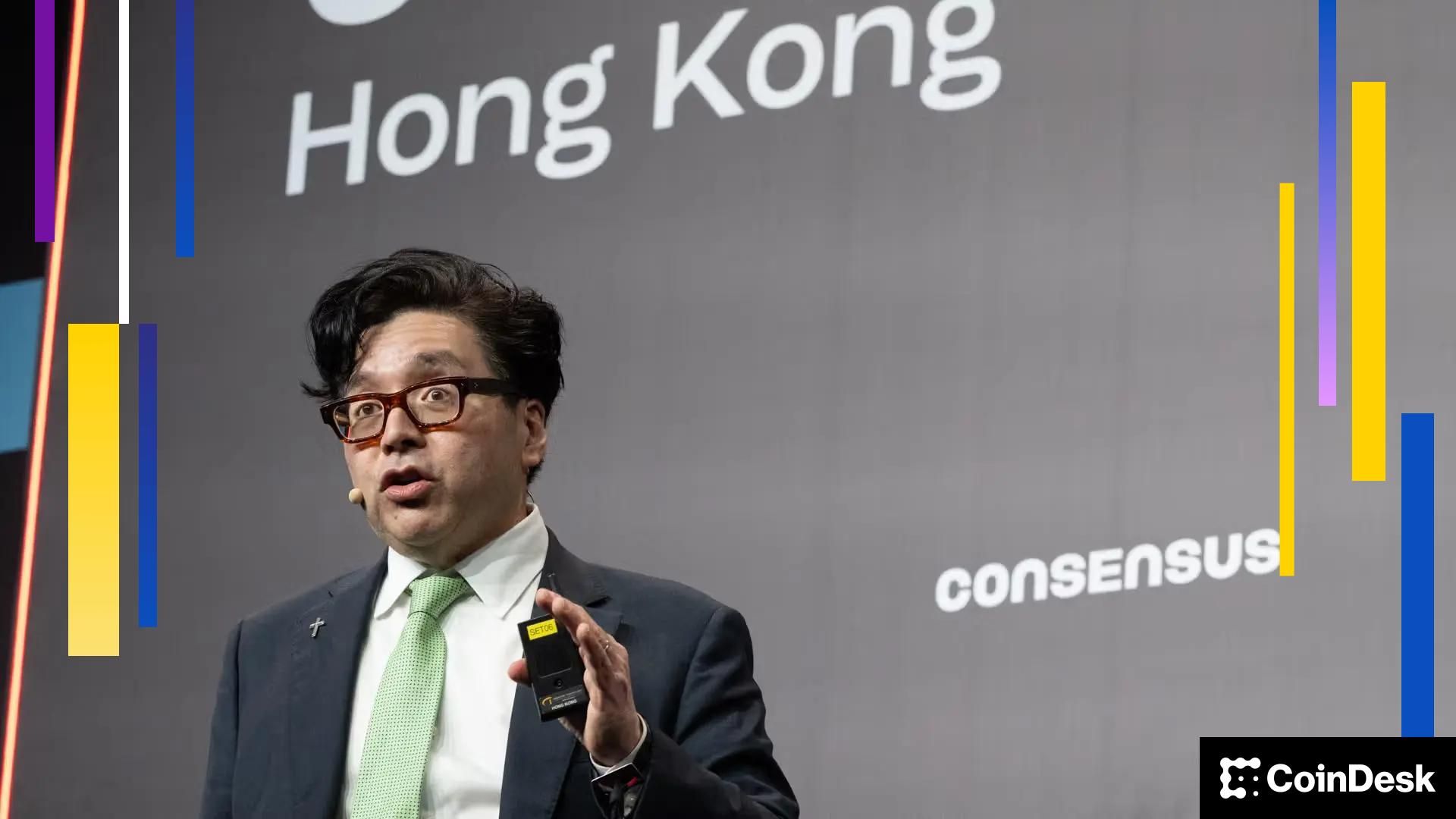
BitMine Immersion Technologies (BMNR), the largest Ethereum treasury company, purchased 45,759 ether last week, extending its buying spree despite the sharp pullback in crypto prices.
The haul was the largest weekly purchase this year in token terms, bringing the firm’s total ETH holdings to 4,371,497 tokens, the company said in a Monday update. That’s equivalent to $8.7 billion at current prices, while the company is estimated to be sitting on almost $8 billion in paper losses.
The firm also raised its cash pile to $670 million, alongside its small bitcoin stash and equity stakes, including a $200 million position in Beast Industries. Total assets stand at $9.6 billion, while BitMine’s share of ETH’s total supply rose to 3.62%.
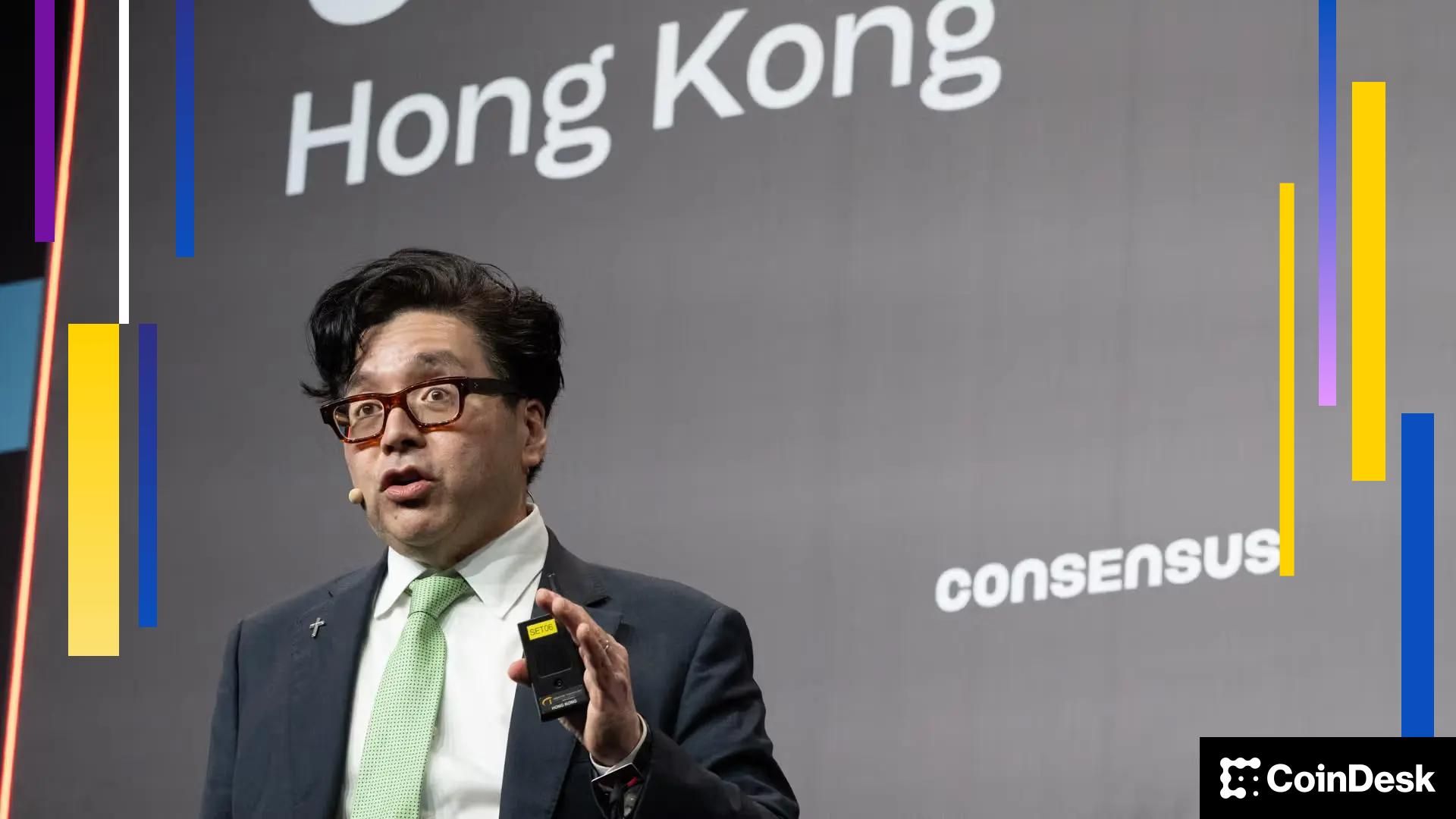
BitMine has now staked over 3 million ETH — about 69% of its holdings — that generate $176 million in annualized rewards, according to Chairman Tom Lee. The firm’s staking operations currently yield 2.89% annualized.
Lee said sentiment in crypto markets remains depressed, drawing comparisons to the lows of 2018 and 2022. But he argued the current environment differs in that there have been no major collapses of large players.
“Investor sentiment and enthusiasm are rock bottom, reminding us of the forlornness and dejection seen at the November 2022 lows and depths of 2018 crypto winter,” he said. “Rather, it seems like crypto has remained weak since the ‘price shock’ and massive deleveraging seen on October 10th.”
Lee also highlighted developments from last week’s Consensus Hong Kong conference, where he cited tokenization, artificial intelligence (AI) integrations and proof-of-humanity infrastructure as long-term growth drivers for Ethereum.
“The price of ETH is not reflective of the high utility of ETH and its role as the future of finance,” Lee said. “Hence, we continue to buy ETH even as crypto moves through this ‘mini-winter.’”
Read more: Tom Lee says stop timing the bottom and start buying the dip
Bitcoin has struggled to regain upward momentum in recent sessions. The price has remained range-bound amid uncertain macro conditions. Volatility in equities and rate expectations has capped recovery attempts.
With short-term signals mixed, attention shifts to long-term holders, or LTHs. This cohort has historically shaped major Bitcoin reversals. Their behavior now offers critical insight into whether BTC is nearing a turning point.
Sponsored
Bitcoin LTHs Have a Critical Support Established
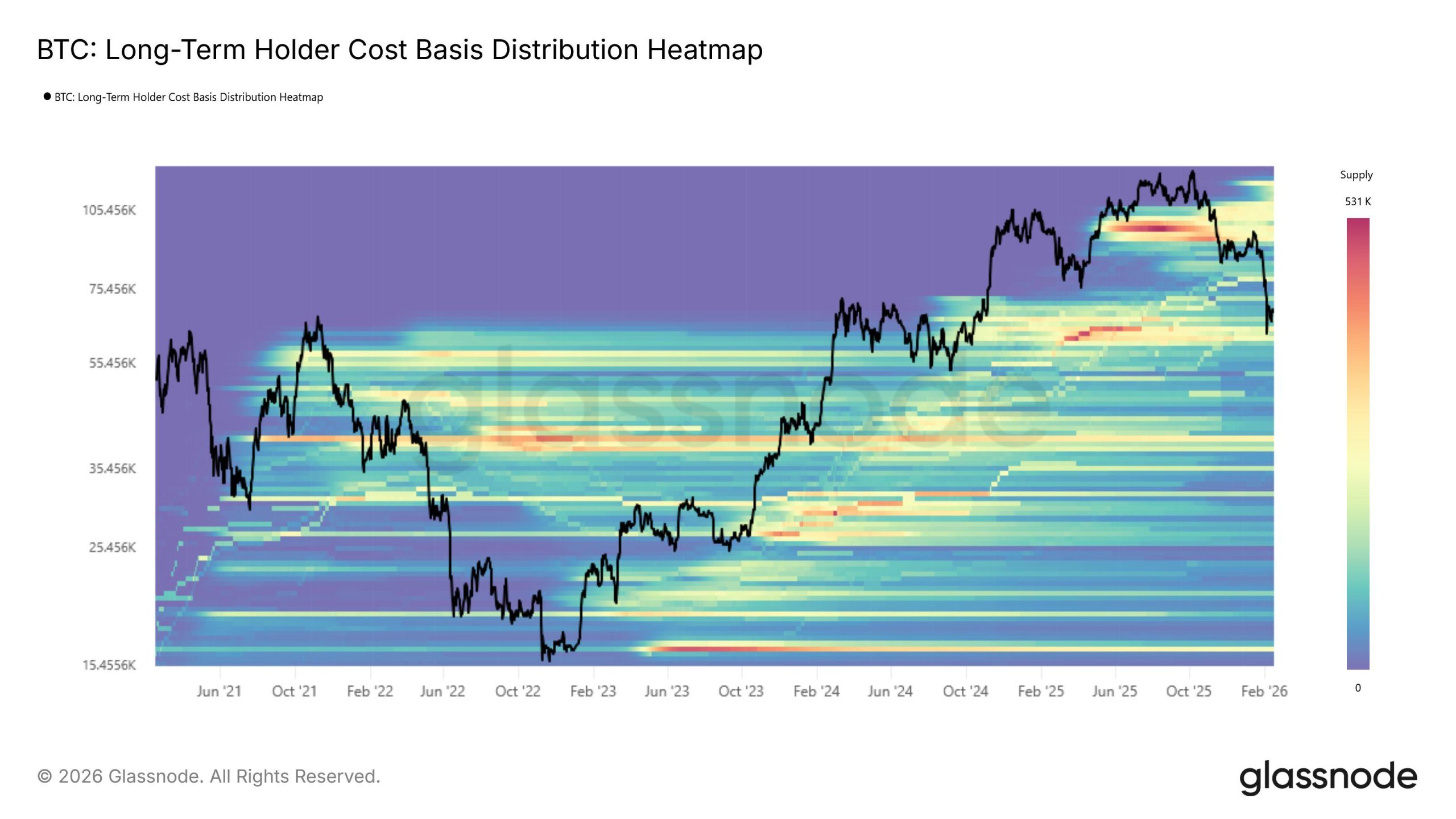
The LTH CBD Heatmap highlights significant supply density above $65,000. This cluster is anchored in the 2024 first-half accumulation range. That zone has repeatedly absorbed recent selling pressure. Strong demand there suggests conviction among experienced Bitcoin holders.
This support band has acted as a buffer during pullbacks. Capital accumulated during prior consolidation phases remains largely dormant. As long as this structure holds, large-scale distribution appears unlikely.
Want more token insights like this? Sign up for Editor Harsh Notariya’s Daily Crypto Newsletter here.
A decisive breakdown below this range would change the narrative. It could open the path toward Bitcoin’s Realized Price, currently near $54,000. However, such a move seems less probable while LTH supply remains stable. The data suggests holders are not preparing for capitulation.
Sponsored
How Are LTHs Reacting?
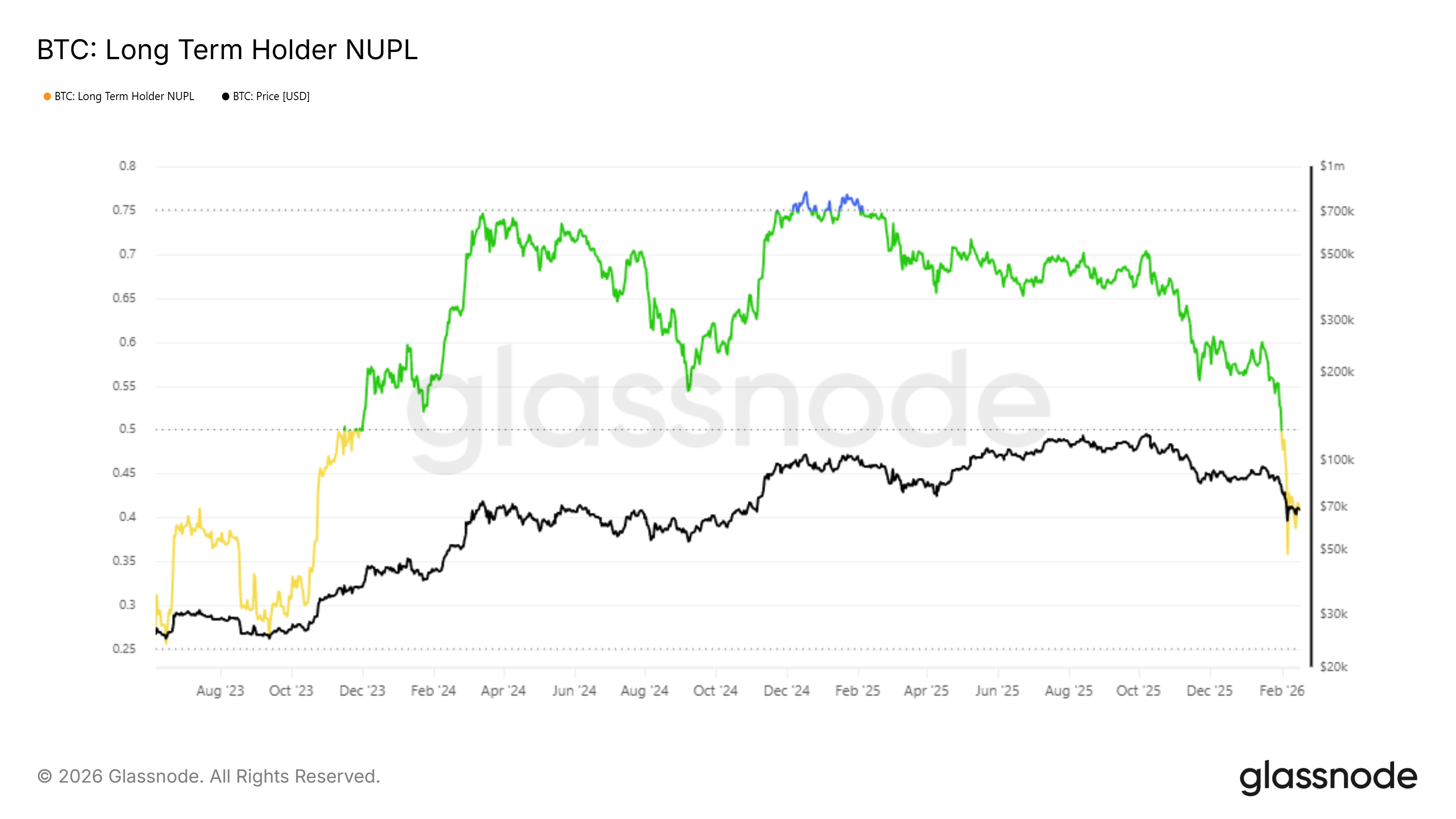
The Long-Term Holder Net Unrealized Profit and Loss, or NUPL, has recently declined. This metric measures aggregate unrealized gains within long-term wallets. Falling NUPL indicates shrinking profitability among this BTC cohort.
Historically, extended NUPL declines have coincided with deeper price corrections. Similar patterns appeared in February 2020 and June 2022. In those periods, weakening profitability led to broader capitulation events.
Sponsored
This cycle appears different. Institutional flows and spot Bitcoin ETF support have strengthened structural demand. Persistent inflows from regulated products provide a stabilizing force. As a result, LTHs may be less inclined to exit positions despite margin compression.
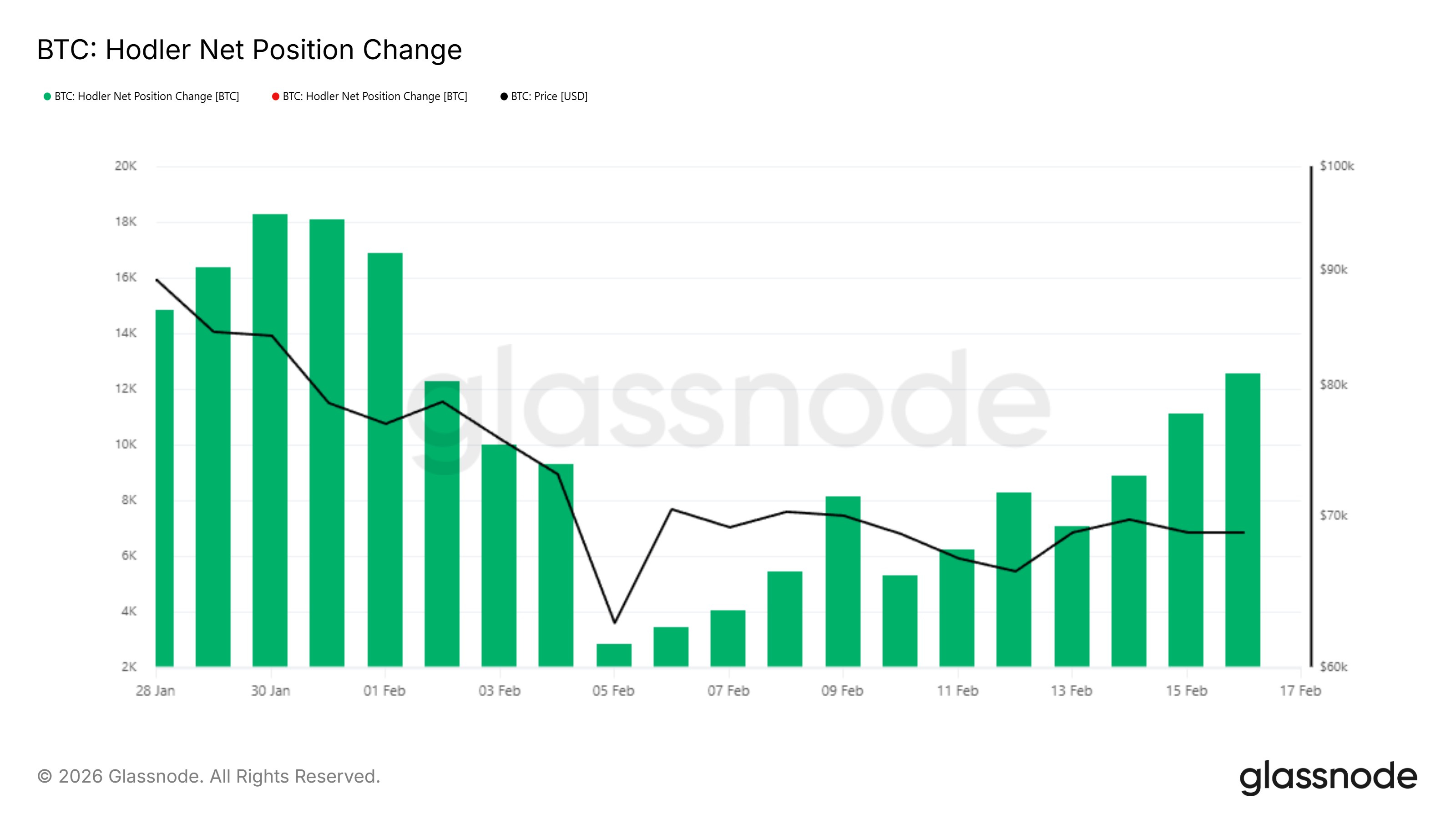
HODLer Net Position Change data shows Bitcoin LTHs are accumulating rather than distributing. Rising green bars on the metric suggest coins are moving into long-term storage. This is a positive sign as their accumulation tends to stick for a long while, unlike STHs, who are prone to selling at the first sign of profits.
Continued inflows into LTH wallets reinforce this trend. Accumulation during uncertainty can slow downside momentum, and if this pattern persists, it may help establish a foundation for a broader Bitcoin price recovery.
Sponsored
BTC Price Is Still Under Resistance
Bitcoin is trading at $68,282 at the time of writing. The primary near-term target remains reclaiming the $70,000 level. This psychological barrier has capped upside for roughly ten days.
The $68,342 support level is critical in the short term. Strong defense of this zone could enable BTC to challenge the $70,610 resistance. A confirmed breakout may extend gains toward $73,499 and potentially higher if momentum accelerates.
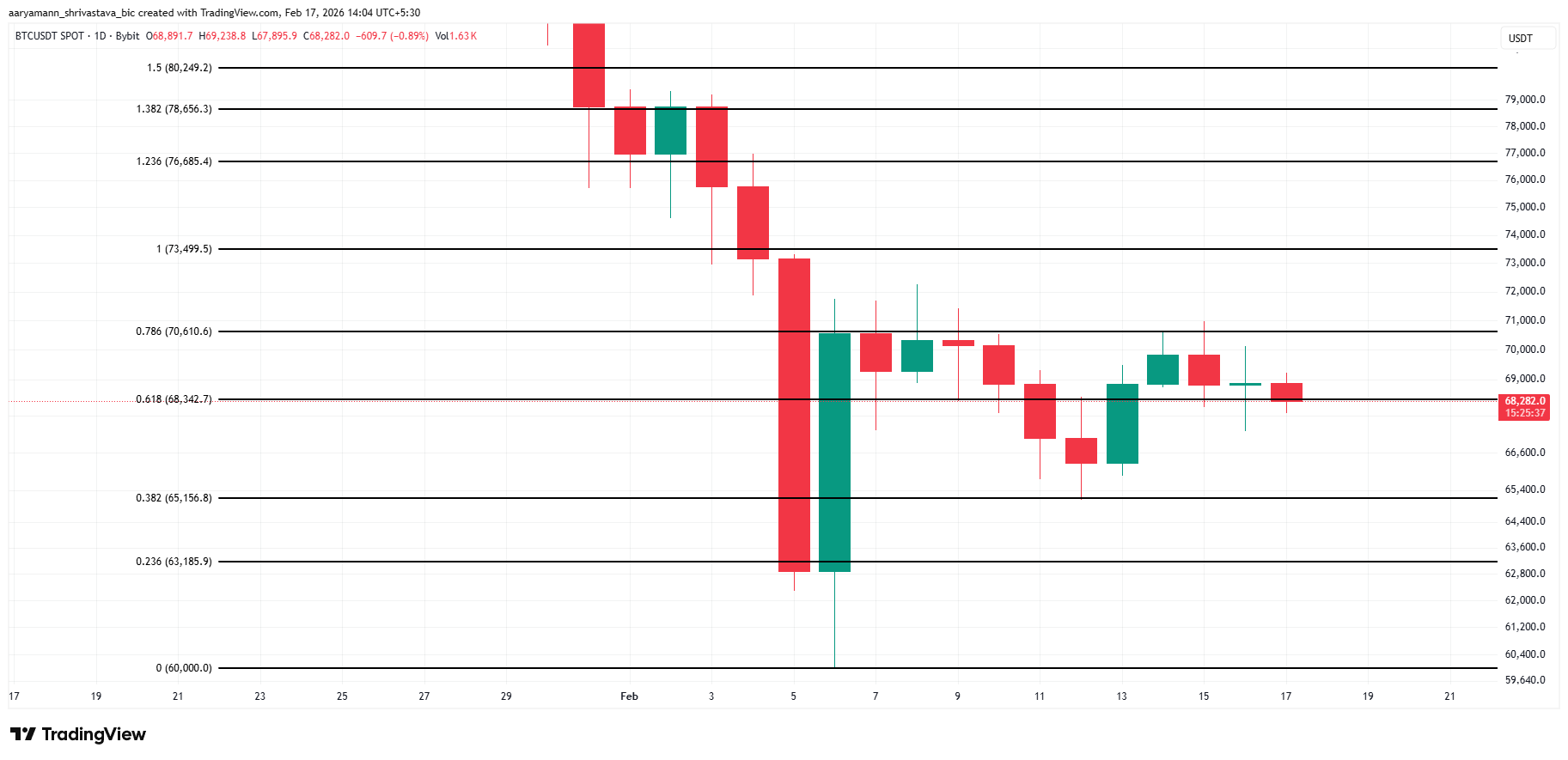
Downside risk remains present under adverse macro conditions. A break below $65,158 would weaken the current structure. Losing that support could expose Bitcoin to a deeper retracement. In such a scenario, price could gravitate toward the Realized Price near $58,000.


- NEXO returns to the US with fully compliant crypto services.
- NEXO token rises to $0.8871, up 9.4% over the past week.
- Key support lies at $0.8655, with the immediate resistance near $0.9619–$1.07.
NEXO, the native token of the crypto lending and financial services platform Nexo, has seen a notable uptick in price following the company’s return to the United States nine months after announcing it would return.
The token currently trades at around $0.8871, marking a 5.7% surge in 24 hours and a 9.4% gain over the past week, reflecting renewed investor confidence and growing anticipation surrounding the platform’s US relaunch.
The platform originally exited the US market three years ago due to regulatory hurdles.
At the time, Nexo faced scrutiny over its crypto lending products, leading to a temporary halt of its services to American customers.
Now, the company has returned with a fully compliant approach after partnering with Bakkt, a regulated US infrastructure provider, to ensure its offerings meet local financial regulations.
Nexo’s relaunch in the United States
The US relaunch brings back key services that had previously been unavailable.
Users can once again access flexible and fixed-term crypto yield programs, allowing investors to earn interest on their digital assets.
Additionally, Nexo is offering a fully integrated crypto exchange for spot trading.
This gives US clients the ability to buy, sell, and trade supported cryptocurrencies directly on the platform.
Crypto-backed credit lines have also returned, and users can borrow against their digital holdings without having to sell them, providing liquidity while retaining exposure to the assets.
The platform has reintroduced its loyalty program, rewarding clients for participation and activity.
Fiat on and off-ramps are now available, enabling smooth transfers between bank accounts and the platform.
The partnership with a regulated US provider ensures that all these services operate within a compliant framework.
This regulatory alignment not only mitigates risk but also strengthens institutional confidence in NEXO’s operations.
NEXO price forecast
The combination of Nexo’s regulatory-compliant relaunch, a strong product suite, and favourable technical indicators makes the token one to watch in the coming weeks.
Looking ahead, the first major support is at $0.8655, which is crucial for maintaining upward momentum.
If this level holds, the token could test its first major resistance at $0.9619.
Breaking above $0.9619 may open the path to $1.02, with a further target at $1.07.
On the downside, analysts note that if the support at $0.8655 fails, NEXO could slide toward the next support level at $0.7923.
However, the token’s short-term performance will likely depend on the platform’s adoption in the US, liquidity on exchanges, and overall crypto market sentiment.

“Technology with a Human Promise”
The digital asset revolution has created the need to establish trust in an environment layered with new technology. True to its promise, the ethos of America is represented by the motto

The challenge of balancing disruptive innovation with unyielding trust is exemplified by the current state of crypto wallets, which are at the core of mass adoption of Web3. It is essential for any enterprise’s digital asset strategy to have a solid crypto wallet infrastructure as the foundation.
Analysts estimate that the crypto wallet market will grow from an estimated value of 12–15 billion USD mid-period, up to approximately 90–100+ billion USD during the early part of the next decade. [Source: Multi-Source Synthesis of Fortune Business Insights, Grand View Research, etc.] North America alone accounted for approximately 31% of global crypto wallet revenues in 2024 and is projected to be the leading region.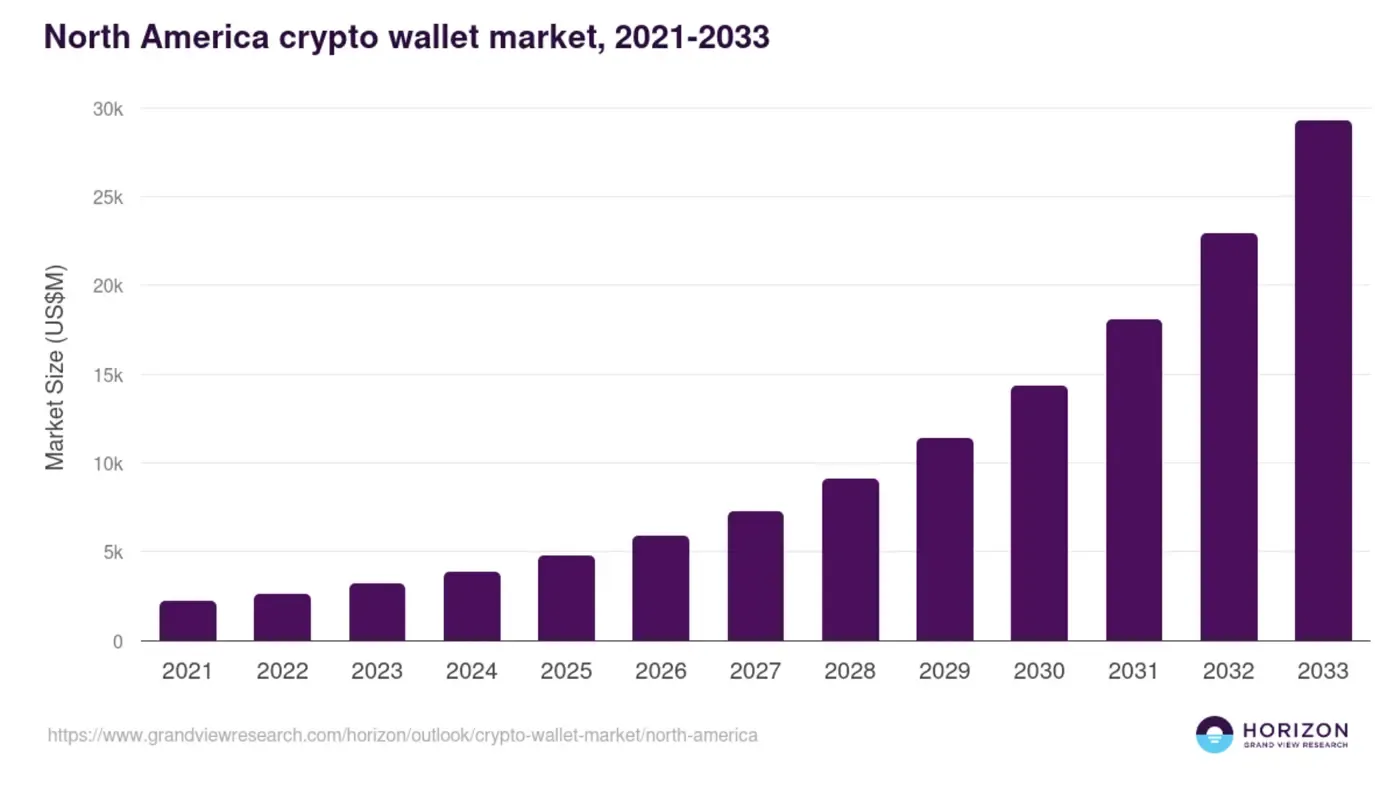
Customers in 2026 desire more than just a basic interface from your wallet offering; they expect security, compliance, multi-chain compatibility, excellent UX, and true enterprise-scale capabilities. This blog is intended for technical leaders as well as Web3 strategy teams, describing ten crypto wallet development partners in the US focused on delivering quality solutions. Our purpose is to provide you with the accurate information necessary for decision-making, based on real-world context and strategic alignment, not mere marketing feature lists.
Why Choosing the Right Crypto Wallet Development Company Matters in 2026
Cryptocurrency wallets serve as a means of holding digital assets but also function as the hearthstone of trust between your product and the consumer. If an organization has implemented a poor-quality Web3 wallet solution, it exposes its digital assets as well as the firm to multiple risks from both an operational and regulatory perspective (e.g., loss of consumer confidence or reputation).
The past three years have seen billions of dollars’ worth of crypto lost due to poor wallet security practices and hackers exploiting vulnerable digital wallets through theft. As a result, companies are creating and adopting high-level security controls such as MPC key management, multi-sig schemes, hardware security, and real-time compliance monitoring.
In order to remain compliant with both legal requirements and expectations, having a security-centric design is now a prerequisite for you to participate in the Web3 marketplace.
Now, pause and absorb this-
“Security without usability is a fortress with no door; usability without security is a house with no locks.”
The right cryptocurrency wallet development venture can turn this apparent contradiction between security and usability into a competitive differentiator.
Let’s turn our attention to the main subject:
And have a look at those wallet providers that possess sufficient experience in the development and integration of blockchain wallets, particularly for clients based in the United States and abroad.
Snapshot of Leading Wallet Development Partners in the US
| Company | Founded | Team Size | Focus | Enterprise Strength |
|---|---|---|---|---|
| Antier | 2005 | 700+ | Enterprise wallets,MPC,compliance | Balanced security,UX and compliance alignment |
| INORU | 2000’s | ~250+ | Custom wallets and Web3 platforms | Adaptive,strategy‑driven enterprise builds |
| Blockchain App Factory | 2017 | 250–500 | DeFi‑centric wallets and ecosystems | End‑to‑end token and DeFi integration |
| ScienceSoft | 1989 | 750+ | Blockchain wallets for enterprises | Deep compliance and IT integration |
| PixelPlex | 2007 | ~130+ | Wallet + UX + dApp integration | User‑centric,adoption‑focused design |
| Dev Technosys | 2010 | ~51-200 | High-caliber wallets and eWallets | Scalable,performance‑oriented architectures |
| Codezeros Technology | 2015 | 51–200 | Agile,custom wallet and Web3 solutions | Rapid,flexible iteration for enterprises |
1. Antier
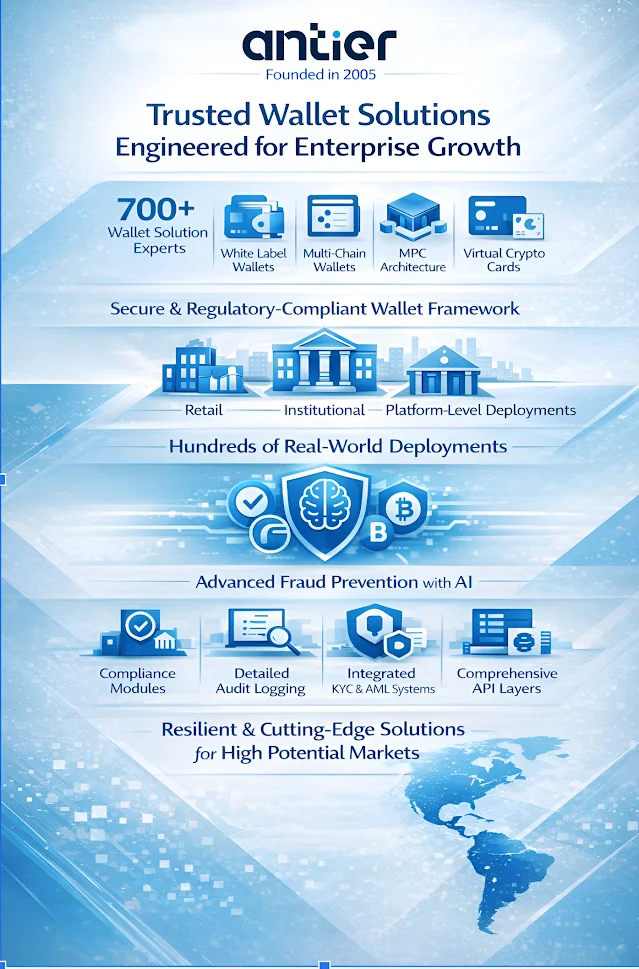
Founded in 2005, Antier has a team of over 700 employees specializing in the creation of white label wallets, multi-chain wallets, MPC wallet architecture, and virtual crypto card implementations.
Their value proposition is a secure and compliant wallet framework built to enterprise standard specifications.
They have a hybrid engineering and risk-based approach to the creation of wallets, and that base has been utilized in hundreds of deployments—retail, institutional, as well as platform-level use cases.
Their services are designed to support multi-currency assets and increasingly use artificial intelligence to support unprecedented fraud control and premium performance.
The difference between Antier and its competitors resides in how focused they are on corporate-tier benchmarks like
- Compliance modules – for multiple jurisdictions
- Audit quality logging capabilities
- Dynamically integrated KYC/AML systems
- And well-designed API layers
That makes them an ideal choice for projects requiring both resilient and world-class user experiences, especially for those willing to target high-growth markets, including America and others.
2. Inoru
Founded: 2000’s (subsequent expansion to blockchain and Web3)
Size: 250+ professionals
USP: Complete wallet development, Web3 platforms, and regulatory-friendly architectures
With particular emphasis on in-depth customization and balanced incorporation, Inoru has established a strong presence in the creation of blockchain solutions, including token platforms, secure wallets, and DApps.
It has delivered significant value by aligning wallet functionality with distinct business models, specifically for those enterprises that cannot adhere to one-off generic wallet models.
They offer wallet features that are accessible on both mobile and web-based applications, and follow robust security and quality assurance practices while maintaining a configurability factor that allows for continual evolution of usage to accommodate changing product and regulatory environments.
3. Blockchain App Factory
Founded: 2017
Size: Approx. 250-500
Company Focus: Crypto wallet development with extensive DeFi, NFT & Web3 assimilation
Blockchain App Factory has built its brand by providing end-to-end blockchain solutions with priority placed on decentralized exchanges, DeFi platforms, and token launch systems.
Wallets created by BAF are more than secure storage solutions; they come with the capability to act as the primary access point to on-chain activities, marketplaces, and tokenized services.
Their modus operandi blends wallet engineering with token standards, automated smart contracts, and strong back-end architecture, all of which facilitate complex decentralized functions from staking to providing liquidity to NFTs.
What does this mean for businesses? Your wallet could potentially become an overall utility platform where people no longer just keep their assets but rather use them.
4. ScienceSoft
Founded in 1989, ScienceSoft has more than 750 IT experts, including specialists who are dedicated to crafting enterprise-class wallet offerings for clients.
Their USP is their extensive institutional experience in delivering compliance-ready designs.
The firm’s track record for mature software engineering is rare among pure-play blockchain startups. The majority of their experts have decades of experience working with regulated, mission-critical systems and have successfully applied that experience to develop Web3 wallets that are secure and scale effectively, while also meeting rigorous compliance, audit, and operational standards.
Many of ScienceSoft’s wallet offerings are presented with orchestration tools designed to provide integration with identity and access management solutions, back-office systems, and compliance layering options depending on applicable regional laws.
Find Reliable & Trusted Crypto Wallet Development Companies across the USA
5. PixelPlex
Founded: 2007
Size of Team: ~130+
USP: Carefully planned for usability, along with an acute focus on security.
PixelPlex works ideally for projects that want to balance user experience with cryptographic hardening. They create wallet products that are tailored for intuitive use by end-users, scalable enough to allow for future growth, and at the same time safe and secure.
Their wallet ecosystems preserve a level of accessibility to a non-technical audience using a decentralized system for the first time.
To guide their product direction, they view wallet adoption as a three-phased behavioral funnel with a direct relationship between onboarding experience and subsequent user activation and retention.
6. Dev Technosys
Dev Technosys provides expandable crypto wallet development services suited for launches that must handle a high volume of activity from the start. Their crew comprises the necessary engineers, architects, and project managers for building the underlying setup and the customer-facing components.
Originated in 2010, the company currently has 51-200 employees. Their core impetus is to provide blockchain wallets and eWallet platforms, offering elite performance.
Their cryptocurrency wallet engines are crafted to optimize for high transaction loads and concurrent transactions, providing direct seamless integrations with exchanges, payment processors, and custodial infrastructure.
This positioning creates an ideal vendor for enterprises that are expecting large user bases or global distribution.

7. Codezeros Technology
Established: 2015
Personnel: 51 to 200
Areas of Expertise: Custom wallets, Web3 consolidation, DeFi‑ready base
Value Proposition: Flexible and customized wallet creation through agile engineering.
If you require speed and iteration for your digital wallets, look to Codezeros. Whether you are planning to merge utilities like staking & cross-chain support or modify compliance logic components in response to a fluid regulatory backdrop, this organization has proven experience.
With its full suite of services comprising wallet creation, NFT marketplace establishment, dApps, exchange development, etc. Codezeros provides an opportunity for developing complementary digital wallets within the broader blockchain ecosystem.
By stressing an agile methodology, they help achieve rapid product releases without losing sight of security or quality. Their services allow the flexibility to make changes or upgrades based on user feedback or new governance rules.
Worth Noting
In 2026, the product experience created by your Web3 crypto wallet will define the way your customers interact with your business.
The selection of your wallet solution provider will directly impact many critical facets of your overall enterprise, including defense posture, legal conformance, user adoption, and long-term value, depending on whether your organization plans to support DeFi, tokenized services, blockchain gaming, or global asset platforms.
You should consider asking these questions concerning your potential partners:
1. Will the scale of this white label crypto wallet offering be as effective as our audience grows and our transaction volume increases?
2. Will the wallet offer established key management methods, for instance, HSMs, MPC, and good recovery routes?
3. What is the level of complexity associated with synchronizing the wallet service into our compliance and reporting systems without disruption?
4. How does the engineering team demonstrate both pragmatic problem-solving and overall mastery in our industry?
Wrap Up
For those who take enterprise suitability and long-term sustainability seriously, companies like Antier, Inoru, ScienceSoft, and others on this list present credible, battle-tested wallet technologies.
Antier stands out among these firms because of its inexorable focus on security-first innovation and its extensive expertise in developing across numerous different types of networks & implementing large-scale global systems, which provide compelling reasons for alignment with the digital asset structural needs of American corporations.
Frequently Asked Questions
01. Why is a solid crypto wallet infrastructure important for enterprises?
A solid crypto wallet infrastructure is essential for any enterprise’s digital asset strategy as it serves as the foundation for mass adoption of Web3, ensuring trust and security in managing digital assets.
02. What are customers expecting from crypto wallets in 2026?
Customers in 2026 expect more than just a basic interface; they desire security, compliance, multi-chain compatibility, excellent user experience, and true enterprise-scale capabilities from crypto wallet offerings.
03. What risks do poor-quality Web3 wallet solutions pose to organizations?
Poor-quality Web3 wallet solutions can expose organizations to operational and regulatory risks, including loss of consumer confidence, reputation damage, and potential financial losses due to security vulnerabilities and hacking incidents.
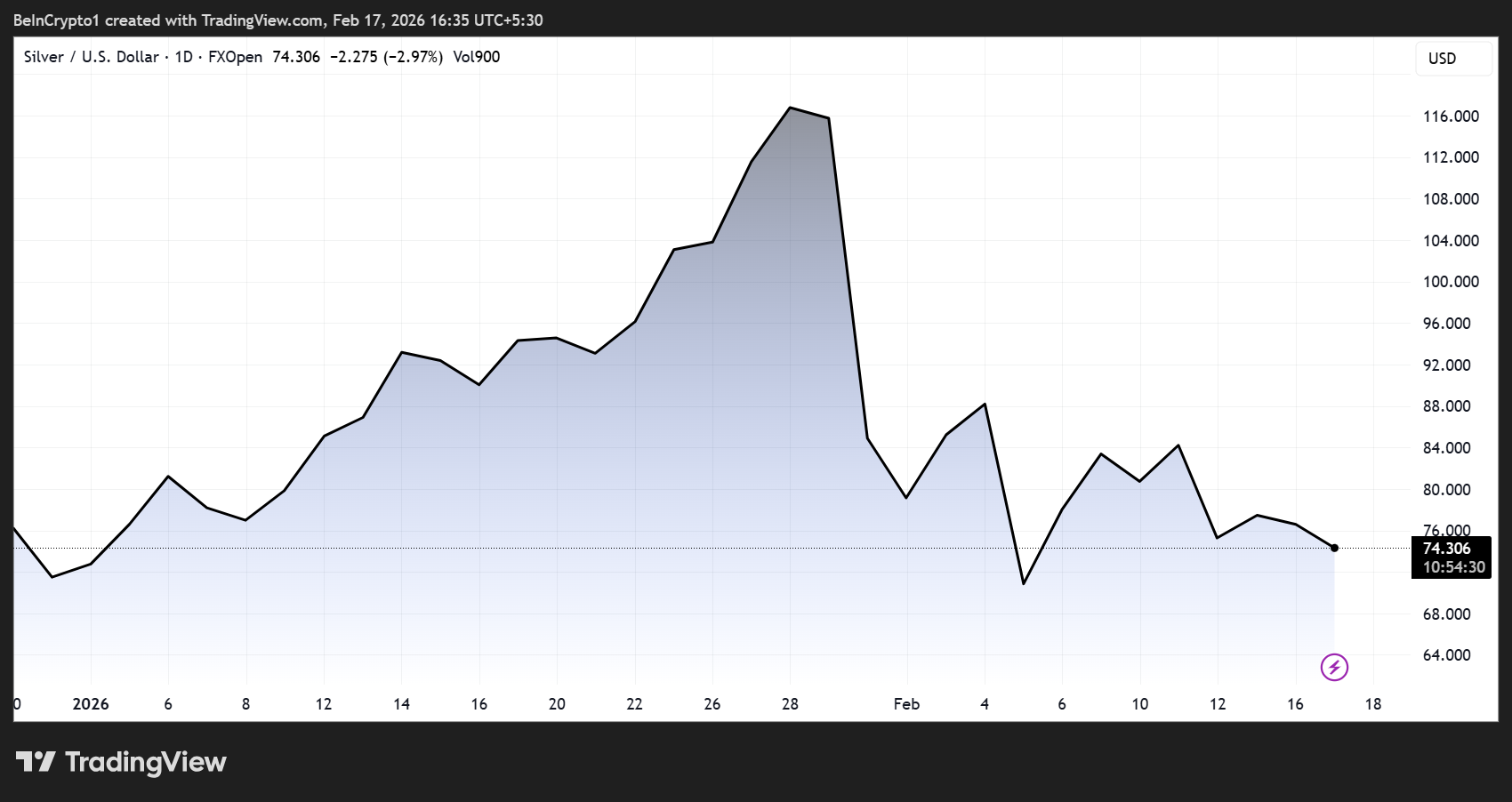
Gold and silver markets are in a sharp correction, with prices falling for a second consecutive session. Commodity-based exchange-traded funds (ETFs) are also declining by as much as 4%.
The sudden downturn has erased an estimated $1.28 trillion in combined market value, reflecting how even traditional safe-haven assets remain vulnerable to macro shocks and liquidity shifts.
Lunar New Year Liquidity and Macro Pressures Fuel Gold and Silver Correction
The decline follows a powerful rally earlier in 2026 that pushed gold above $5,000 per ounce and drove silver to record highs.
Sponsored
Sponsored
Analysts now say the pullback reflects a mix of seasonal factors, macroeconomic pressure, and profit-taking after an extended run-up.
Silver has been hit particularly hard, falling nearly 40% from its all-time high (ATH) of $121.646 recorded in late January.
As of this writing, Silver (XAG) was trading at $74.11, reinforcing its reputation as a more volatile counterpart to gold, given its smaller market size and stronger industrial demand.
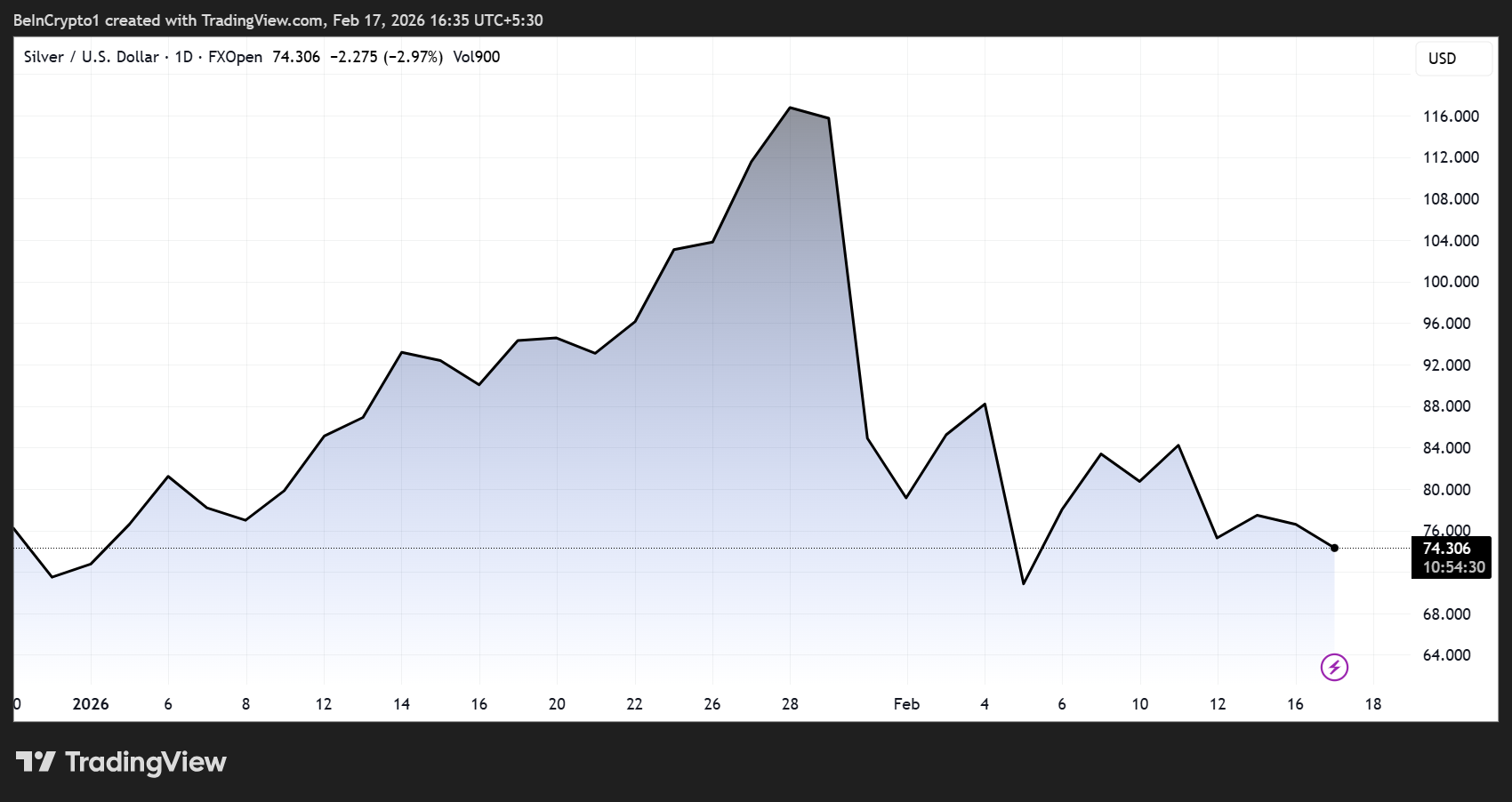
“Gold and Silver wiped out $1.28 trillion today… even ‘safe havens’ bleed,” wrote one analyst, emphasizing the speed of the decline and the risks of assuming stability in any asset class.
Others pointed to the role of market structure and liquidity, arguing that temporary dislocations may occur when key physical markets slow, particularly in Asia.
Sponsored
Sponsored
Lunar New Year Liquidity Effects Come into Focus
Against this backdrop, one of the most widely cited short-term drivers is the Lunar New Year holiday period, during which trading activity across major Asian financial centers declines sharply.
Mainland China, Hong Kong, Singapore, Taiwan, and South Korea all experience reduced participation as traders, manufacturers, and market makers step away.
Lower liquidity can amplify price movements in global futures markets, especially for commodities like silver, where physical demand from the Chinese industry plays a major role.
Weaker demand during the holiday period could temporarily pressure prices, with physical buying potentially resuming once factories and exchanges return to full activity.
Analysts Warn of Continued Volatility As Macro Pressures Weigh on Bullion
Beyond seasonal factors, broader macroeconomic developments are also contributing to the downturn. Precious metals came under pressure as investors focused on narratives that strengthen the US dollar in the short term. These include:
Sponsored
Sponsored
A firmer dollar typically weighs on bullion by making gold and silver more expensive in other currencies, reducing demand from international buyers.
ETF flows reflect the cautious sentiment. Several gold and silver ETFs declined between 2% and 4%. This mirrors weakness in futures markets and suggests that some investors are locking in profits after the recent rally.
Meanwhile, market strategists say precious metals are now in a “volatile consolidation phase.” After such a strong advance, corrections and sideways trading are common as markets digest gains and rebalance positions.
Therefore, a disciplined approach may be advisable, rather than chasing prices at elevated levels; instead, consider staggered buying during corrections.
Technical analysis also shows key support levels, with estimates placing silver price support near $65 per troy ounce and gold support around $4,770 per ounce on a weekly closing basis.
Sponsored
Sponsored
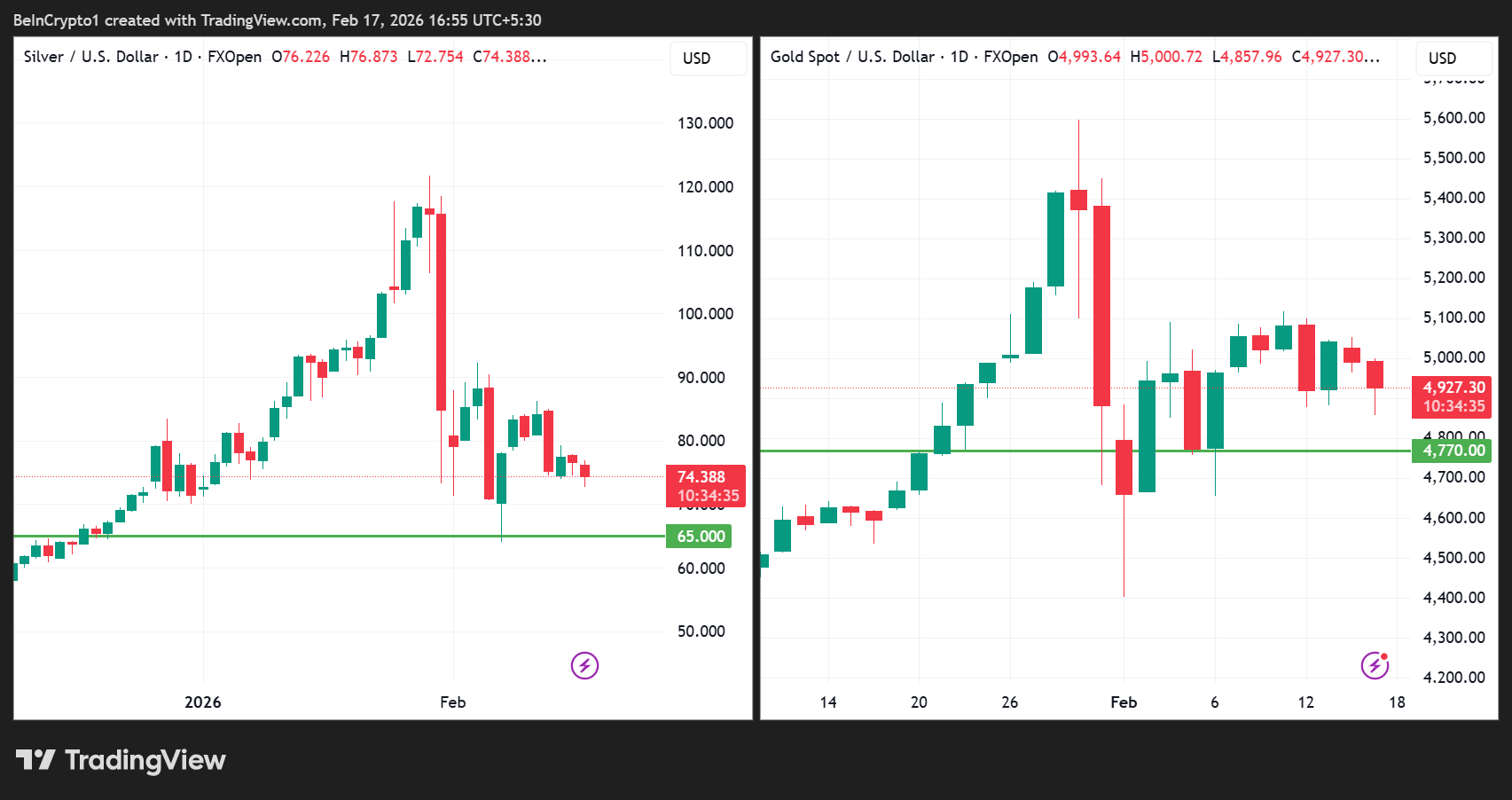
While these levels could determine whether the current pullback stabilizes or deepens, investors should conduct their own research.
Despite the sharp drop, structural forces such as rising global debt, currency debasement, and historical cycles in ratios, such as the gold–silver ratio, could support a powerful long-term bull market in precious metals.
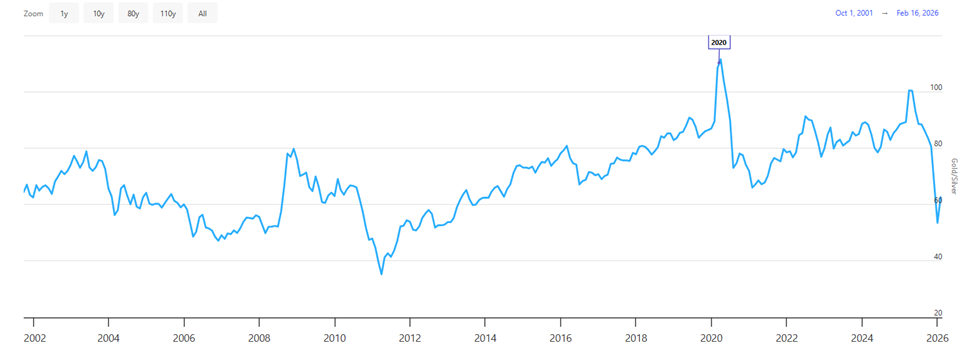
If historical ratio reversals repeat, silver could experience significant upside over the coming decade, potentially reaching dramatically higher price levels by the early 2030s.


Altcoin Sherpa says Bitcoin’s bear phase could end within 12 months as ETFs, macro risks and a possible capitulation shape the next accumulation zone.
Summary
- Altcoin Sherpa projects Bitcoin’s peak‑to‑bottom phase will likely conclude in less than a year, excluding the post‑bottom accumulation range.
- The analyst says a major selloff from the October peak and ETF outflows may already have marked capitulation, putting Bitcoin in early accumulation.
- Structural shifts such as US spot ETFs and macro headwinds mean this cycle may diverge from 2018 and 2022, even if the one‑year bear timing repeats.
Bitcoin market analyst Altcoin Sherpa has projected the current cryptocurrency bear phase will conclude in less than 365 days, with the digital asset potentially resuming its broader uptrend before year-end, according to analysis published on social media platform X.
The projection comes as Bitcoin trades well below its all-time high reached in October, prompting investor questions about when the cryptocurrency might establish its next bottom.
Sherpa specified the timeline refers to the move from peak to bottom and does not include the accumulation period that typically follows, according to the analysis. The accumulation phase is characterized by sideways price action with relatively low volatility and subdued trading volume, historically lasting between two and four months.
Historical data shows Bitcoin experienced major rallies in 2017 and 2021, each followed by year-long declines in 2018 and 2022, according to the analyst. Extended accumulation periods followed those drawdowns in 2019 and 2020. From peak to bottom in both the 2017-2018 and 2021-2022 cycles, Bitcoin required approximately one year to complete its downward move.
Past bear markets have featured a final capitulation event—a sharp sell-off marking the end of the downtrend, according to Sherpa’s analysis. The analyst indicated a capitulation may have already occurred earlier this year, pointing to a substantial price drop as a potential final decline. If correct, the market could already be in early accumulation stages.
Sherpa stated the current decline will differ from previous patterns due to structural changes in the market. The analyst cited the growing role of US spot Bitcoin exchange-traded funds, which have altered capital flow structures despite declining alongside the broader market. An extended consolidation period of approximately eight months in a prior price range was also noted, with such trading ranges often acting as support zones during pullbacks from a technical analysis perspective.
Broader macroeconomic factors including equities, metals, overall risk appetite and artificial intelligence developments remain critical variables, according to the analysis. Sherpa stated Bitcoin does not require another seven months of decline to form a bottom, suggesting accumulation may already be underway if the recent slide was the final capitulation.
The analyst acknowledged one key risk to the outlook: the possibility that a final capitulation has not yet occurred. If another significant sell-off emerges, that would be interpreted as the definitive bottoming event, with accumulation likely following for several months, according to the analysis.


Global investors are rotating into FTSE 100 and FTSE 250 as stretched US equity valuations, sector mix, yields, and FX stability make UK stocks look undervalued.
Summary
- International investors are reallocating from expensive US mega-caps into FTSE 100 and FTSE 250 as valuation spreads widen.
- UK indices offer lower price-to-earnings ratios, higher dividends, diversified sectors, and global revenue exposure versus concentrated US tech.
- Stable pound dynamics and a gradual Bank of England policy path support UK equity appeal amid broader portfolio rebalancing.
The FTSE 100 and FTSE 250 indices are drawing increased international capital as investors reassess elevated US equity valuations, according to recent market analysis.
Fund managers have begun rotating into British assets amid concerns over pricing levels in US mega-cap shares, market data shows. The shift reflects a widening valuation differential between the two markets.
The S&P 500 currently trades at a premium to historical averages, while UK indices display lower price-to-earnings ratios and higher dividend yields, according to market metrics.
The FTSE 100 maintains significant exposure to energy, financial and commodity sectors, which provide global revenue streams and inflation-resistant characteristics. The FTSE 250 consists primarily of domestically focused mid-cap companies positioned to benefit from stabilizing UK inflation and potential improvements in consumer confidence.
Currency factors have also influenced investment decisions. The pound’s relative stability has reduced volatility risks for overseas investors and enhanced the attractiveness of UK-listed multinational corporations, analysts noted.
US markets have outperformed global indices in recent years, propelled by artificial intelligence developments and technology sector earnings growth. However, concentration risks have increased as a small number of large-cap stocks now account for a substantial portion of market returns, prompting diversification efforts among institutional investors.
UK equities offer broader sector distribution and defensive investment characteristics, with dividend payouts exceeding those of US counterparts, according to comparative market data. Global asset allocators are reassessing regional portfolio allocations, with lower relative valuations potentially providing downside protection in the event of slowing global growth.
The Bank of England’s monetary policy trajectory represents an additional consideration, with market expectations pointing toward gradual interest rate adjustments that could support equity valuation multiples.
While capital flows remain subject to rapid shifts, the current trend indicates a broader portfolio rebalancing as international investors reconsider UK markets following an extended period of underperformance relative to other developed markets.
Continued valuation disparities could sustain inflows into UK equities, with the FTSE 100 and FTSE 250 positioned to benefit from ongoing global portfolio diversification strategies, market observers stated.

TLDR
- Eli Lilly stockpiled $1.5 billion of Orforglipron weight-loss pill before expected April 2026 FDA approval
- Strategy aims to prevent supply shortages that hurt Zepbound and Mounjaro launches in 2022
- Novo Nordisk’s oral Wegovy reached 50,000 prescriptions by January after December 2025 approval
- Orforglipron could hit $13 billion in annual sales by 2031 according to GlobalData forecasts
- Company investing $27 billion in four new U.S. manufacturing facilities for weight-loss drugs
Eli Lilly disclosed $1.5 billion worth of pre-launch Orforglipron inventory in its 2025 annual report. The weight-loss pill awaits FDA approval expected in April 2026.
The massive stockpile represents a calculated move to avoid past mistakes. In 2022, Eli Lilly couldn’t meet demand for injectable drugs Zepbound and Mounjaro. Patients switched to compounded alternatives when they couldn’t find branded products.
Those shortages lasted until late 2024. They cost the company revenue and market share during a critical growth period.
The FDA fast-tracked Orforglipron’s review using a Commissioner’s National Priority Review Voucher. Eli Lilly plans a major marketing push this summer when shipments begin.
Chasing Novo Nordisk’s Early Lead
Novo Nordisk launched oral Wegovy in January 2026 after December 2025 FDA approval. The Danish company captured first-mover advantage in the oral weight-loss pill market.
By the end of January, oral Wegovy had 50,000 prescriptions. UBS analysts expect 400,000 prescriptions in Q1 2026.
Pills appeal to patients who avoid injections. Current options like Zepbound require weekly shots. The oral format removes needle anxiety from the treatment equation.
Eli Lilly started building Orforglipron inventory over a year ago. The company reported $550 million worth of the drug in February 2025.
GlobalData analyst Shehroz Mahmood called the stockpile “a decisive effort to avoid repeating the supply constraints that plagued its Mounjaro and Zepbound rollouts.”
Billion-Dollar Sales Projections
GlobalData projects Orforglipron could generate $13 billion in annual sales by 2031. That forecast assumes FDA approval and successful commercialization.
Eli Lilly’s weight-loss drug portfolio drove 45% revenue growth in 2025. Mounjaro brought in $23 billion. Zepbound added $13.5 billion.
The company is building four new U.S. manufacturing facilities with $27 billion in investment. At least three will produce weight-loss therapies. Eli Lilly announced the fourth facility this month.
Orforglipron showed positive results in clinical trials. The once-daily pill fits into an industry shift toward more flexible obesity treatments.
Mahmood noted that while Novo Nordisk has early momentum, “it remains to be seen whether Eli Lilly can yet again take the spotlight, as it did in the competition for injectable therapies.”
The $1.5 billion Orforglipron stockpile makes up most of Eli Lilly’s total pre-launch inventory. The company expects huge global demand once the pill reaches pharmacy shelves this summer.


Cargill to cease operations at Milwaukee beef plant

Steak ‘n Shake Reports Bitcoin Acceptance Has ‘Dramatically’ Lifted Sales in 9 Months

Restore Britain just waded into anti-Semitism


-

 Sports6 days ago
Big Tech enters cricket ecosystem as ICC partners Google ahead of T20 WC | T20 World Cup 2026
-

 Tech6 days ago
SpaceX’s mighty Starship rocket enters final testing for 12th flight
-

 Video22 hours ago
Bitcoin: We’re Entering The Most Dangerous Phase
-

 Tech2 days ago
Luxman Enters Its Second Century with the D-100 SACD Player and L-100 Integrated Amplifier
-

 Video4 days ago
The Final Warning: XRP Is Entering The Chaos Zone
-
 Tech10 hours ago
The Music Industry Enters Its Less-Is-More Era
-

 Crypto World7 days ago
Blockchain.com wins UK registration nearly four years after abandoning FCA process
-

 Crypto World3 days ago
Bhutan’s Bitcoin sales enter third straight week with $6.7M BTC offload
-
 Crypto World6 days ago
Pippin (PIPPIN) Enters Crypto’s Top 100 Club After Soaring 30% in a Day: More Room for Growth?
-

 Video5 days ago
Prepare: We Are Entering Phase 3 Of The Investing Cycle
-

 Crypto World4 hours ago
Can XRP Price Successfully Register a 33% Breakout Past $2?
-
 NewsBeat2 days ago
The strange Cambridgeshire cemetery that forbade church rectors from entering
-

 Sports11 hours ago
GB's semi-final hopes hang by thread after loss to Switzerland
-

 Business5 days ago
Barbeques Galore Enters Voluntary Administration
-

 Crypto World6 days ago
Crypto Speculation Era Ending As Institutions Enter Market
-
 Crypto World5 days ago
Ethereum Price Struggles Below $2,000 Despite Entering Buy Zone
-

 Politics7 days ago
Why was a dog-humping paedo treated like a saint?
-
 NewsBeat2 days ago
Man dies after entering floodwater during police pursuit
-
 Crypto World4 days ago
BlackRock Enters DeFi Via UniSwap, Bitcoin Stages Modest Recovery
-

 NewsBeat3 days ago
UK construction company enters administration, records show