

Crypto World
Bitcoin Builds a Floor Near $60,000, but On-Chain Data Says the Bear Isn’t Over

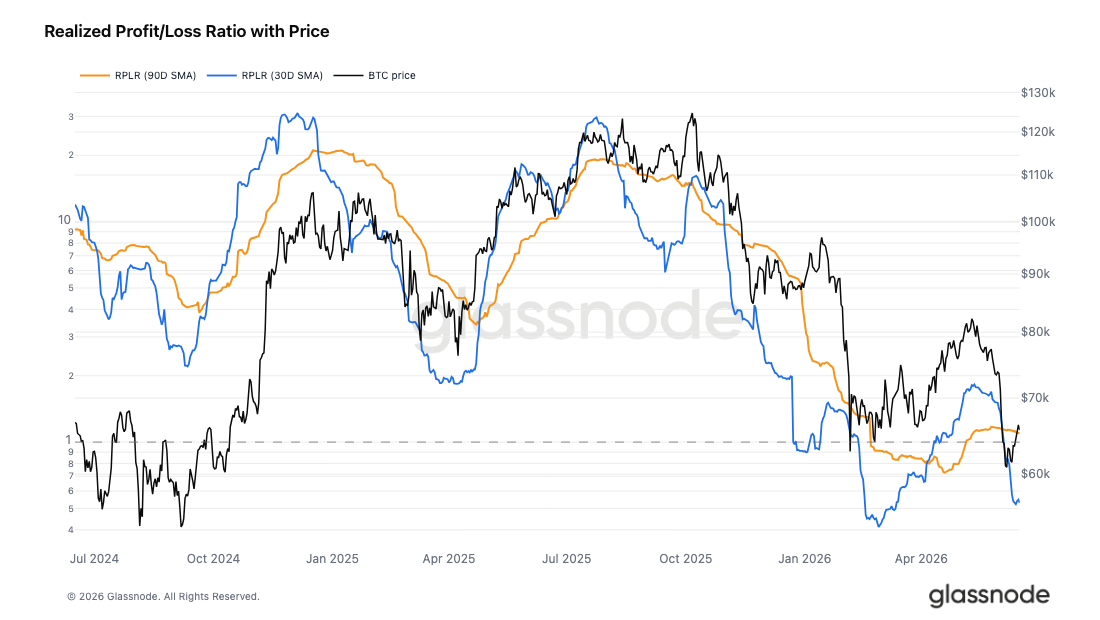
Bitcoin (BTC) is carving out a possible floor near $60,000 as spot buyers step back in, yet on-chain valuation and profitability data confirm the market remains firmly in bear territory.
The recovery from the early June low has eased pressure on recent buyers without resolving it. Several indicators now point toward stabilization rather than a confirmed bottom.
BTC trades around $64,171, down 1% over the past 24 hours, with a market capitalization near $1.29 trillion.
Realized Losses Still Dominate Bitcoin Flows
The Realized Profit/Loss Ratio measures the dollar value of coins moving in profit against those moving at a loss. Readings below 1 show that loss realization is the prevailing force.
The 30-day average sits at 0.53, while the 90-day average holds at 1.10. That split confirms loss-taking has outpaced profit-taking across most of the past month.

Valuation tells the same story. Glassnode places the True Market Mean at $77,200, roughly 15% above spot, so the on-chain regime stays bearish. Short-Term Holder MVRV has recovered to 0.90 but remains under the 1.0 breakeven line.
A sustained move in both averages toward 2 would be the first real signal that the bias is turning.
Spot Order Books Build a Bitcoin Floor Near $60K
The flow data leans bearish, yet spot liquidity has shifted in the opposite direction. That divergence is where the repair thesis begins.
Binance Spot Orderbook Depth Imbalance has moved decisively in favor of bids. Buy-side liquidity now outweighs resting sell orders by the widest margin in recent months.

This suggests traders are positioning to absorb supply at lower prices rather than sell into rallies. Passive bids near the $60,000 region appear to be defending current support.
Open interest also compressed off its late-May peak, while funding cooled toward neutral. The deleveraging points to a more patient buyer base instead of crowded leverage.
Macro Index Flags Rare Deep Value for Bitcoin
A longer-term gauge adds weight to the stabilization case. The Capriole Macro Index Oscillator reads -2.03, one of the deepest prints in its history.
Analyst Charles Edwards notes prior visits to these depths were brief. They lasted about four months in late 2018 and two months in mid-2022. Both periods preceded major cycle recoveries.
“In the past 10 years Bitcoin has only spent 6 months at these levels of deep value (5% of time). That should be a great long-term opportunity… If you believe these will be solved, you probably love Bitcoin here.”
He balances the call with two caveats absent in earlier cycles. Edwards points to digital-asset-treasury risks and the looming quantum threat as open questions. That tension keeps the deep-value read constructive rather than a confirmed bottom.

Bitcoin Floor: Price Hinges on the $64K to $66K Zone
Price action remains neutral on the daily chart. Bitcoin broke down from a parallel ascending channel and reached its $59,000 to $60,000 target quickly.
That drop carried a sharp volume spike and an extreme volatility reading, confirming the flush rather than a slow bleed. The bounce since then has lifted the price into the $64,000 to $66,000 pivot.
This zone is the decisive level for the next move. A reclaim opens a path toward the lower channel band near the $74,000 to $76,000 resistance.

A rejection here would likely trap Bitcoin in a range between $60,000 and $65,000. The $59,000 to $60,000 floor is the support that must hold, while the $74,000 to $76,000 caps any recovery attempt.
Whether the patient’s bid can outlast the weak profitability backdrop is the question that decides the next leg.
The post Bitcoin Builds a Floor Near $60,000, but On-Chain Data Says the Bear Isn’t Over appeared first on BeInCrypto.

Crypto World
Bitcoin to $145K by October? This Old Post With ‘Crazy Accurate’ BTC Price Predictions Say So
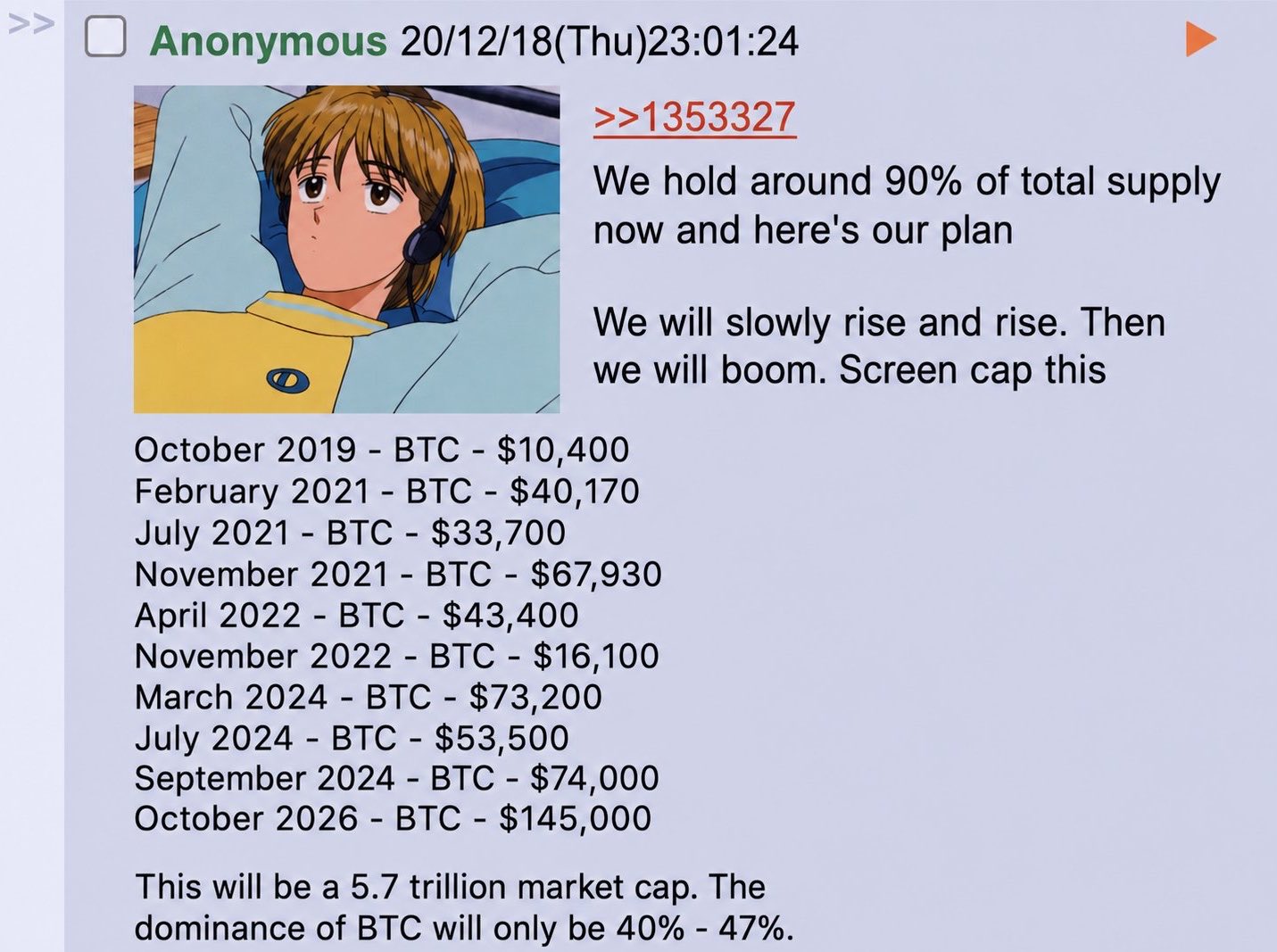
A viral social media post is reviving an alleged Bitcoin prediction that appears to have called several major BTC price levels from 2019 through 2024, with one final target remaining: $145,000 by October 2026.
Key takeaways:
- The new viral post appears to be an iteration of an older post with different Bitcoin price targets.
- It also claims the author holds more than 90% of the Bitcoin supply, which is mathematically impossible.
The Bitcoin target still requires proof
The screenshot, shared by crypto account Corleone, shows an anonymous 4chan-style post dated Dec. 20, 2018.
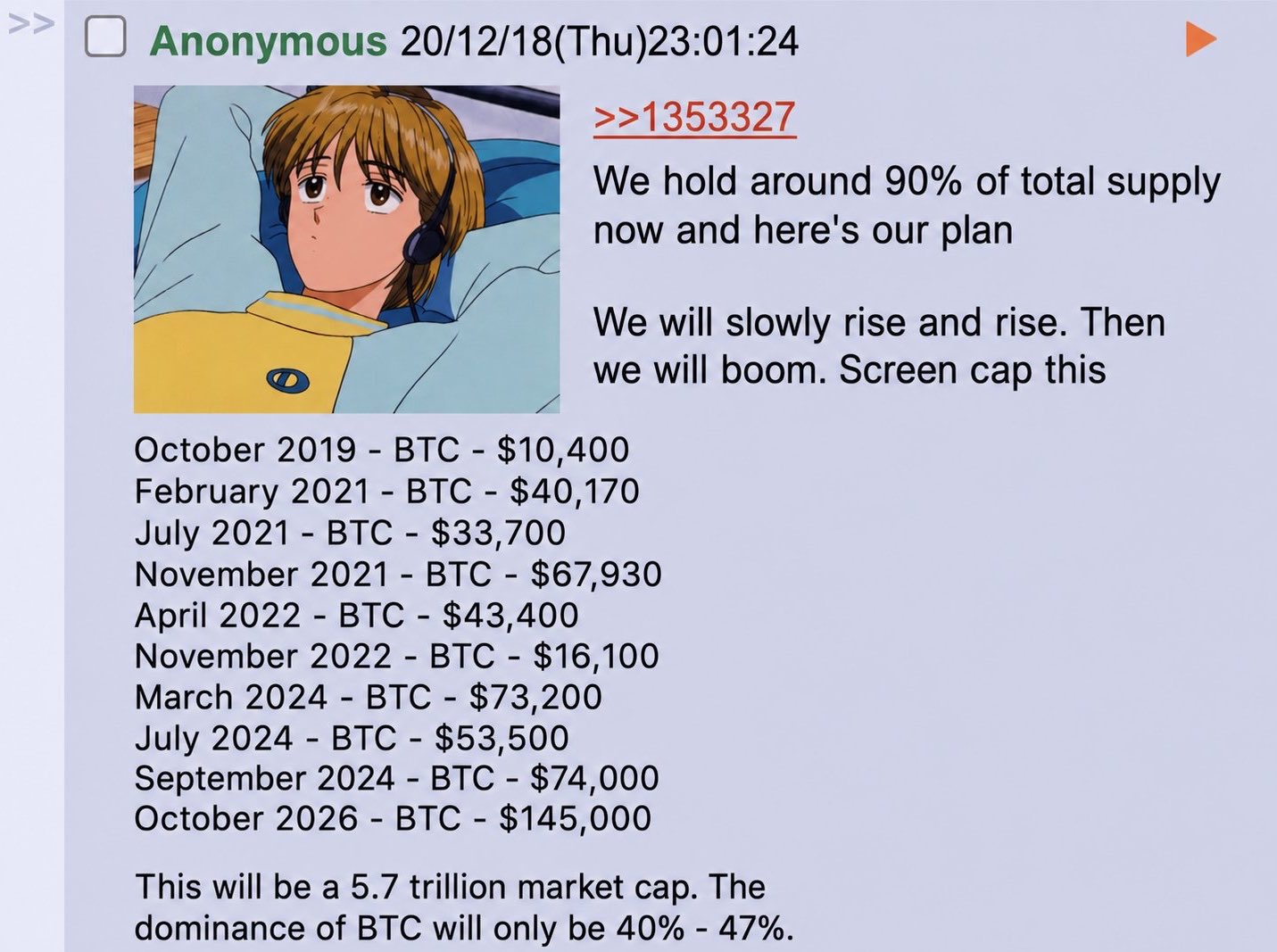
Bitcoin price prediction screenshot. Source: X/Corleone
It claims that a certain group holds “around 90% of total supply” and lists Bitcoin price targets for October 2019, February 2021, July 2021, November 2021, April 2022, November 2022, March 2024, July 2024, September 2024 and October 2026.
At first glance, the prediction looks unusually correct, with Corleone calling them “crazy accurate.” Bitcoin did trade at several of the listed historical levels, including around $67,000 in November 2021 and near $16,000 during the November 2022 bear-market low.
But there are several problems with treating the screenshot as authentic.
The original post is not publicly verifiable
The biggest issue is provenance. The screenshot does not show a verifiable archive link, tripcode, or any identity marker tying the prediction to a repeatable 4chan user.
That matters because 4chan posts are usually anonymous by design. “Anonymous” is not a single person or account. Without an archived source, there is no reliable way to prove that the same person predicted the events before they happened.
A Binance Square post from July 2024 uses the same “we hold around 90% of total supply” wording and many of the same targets, but lists Bitcoin at $105,400 in September 2024.
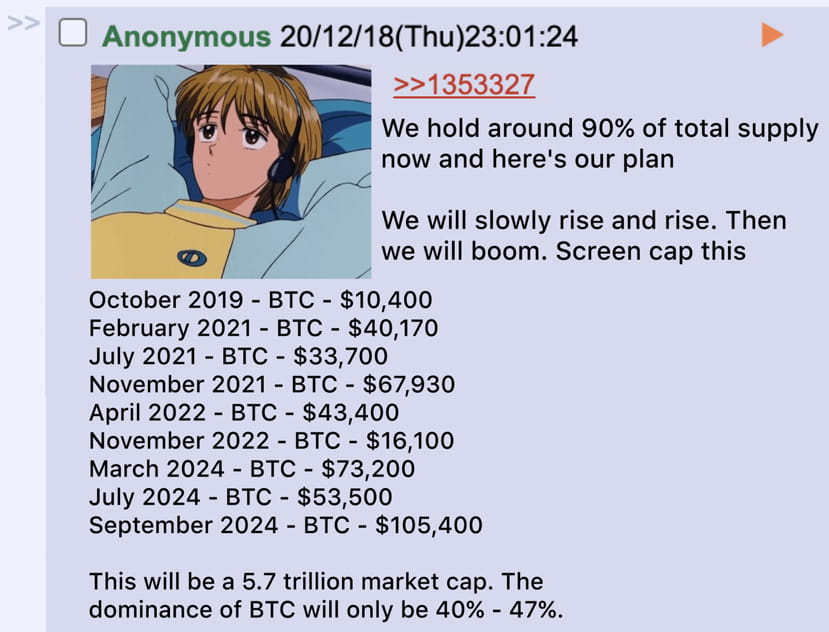
Bitcoin price prediction screenshot. Source: Binance Square
The newer viral screenshot instead shows September 2024 at $74,000 and adds the October 2026 target of $145,000.
Related: Bitcoin $150K price calls are ‘drying up,’ which is healthy
That difference is a major red flag. It suggests the image or prediction list may have been edited over time to better match Bitcoin’s historical price action.
The market cap claim does not add up
The screenshot also says the prediction would produce a $5.7 trillion market cap, with Bitcoin dominance at 40%–47%.
If the $5.7 trillion figure refers to Bitcoin alone, it is mathematically wrong. At $145,000 per BTC and roughly 20 million BTC in circulation, Bitcoin’s market capitalization would be about $2.9 trillion.
Even using Bitcoin’s full 21 million maximum supply, the market cap would be around $3.05 trillion.
If the post refers to the total crypto market, the wording is unclear and still does not prove anything about the prediction’s authenticity.
The “90% of BTC supply” claim lacks proof
The screenshot also claims: “We hold around 90% of total supply now.”
Bitcoin has about 20.04 million BTC in circulating supply and a 21 million BTC supply cap, so 90% would imply control of roughly 18 million BTC.
Also, the top 100 richest Bitcoin addresses control about 15.27% of the BTC supply, while the top 10,000 addresses hold about 53.89% of the same, according to data resource Bitinfocharts.
That is far below the 90% supply supposedly held by the viral post’s author.
For now, the claim that an anonymous 4chan user accurately predicted Bitcoin’s major price moves through 2026 should be treated as unproven. It appears more likely to be an edited or recycled crypto meme than proof of a trader who “does not miss.”
BlackRock’s spot Bitcoin exchange-traded fund has been a gateway for new investors to enter the wider ETF market, according to Jay Jacobs, US head of equity ETFs at BlackRock.
Around three-quarters of investors in BlackRock’s iShares Bitcoin Trust ETF have never owned an ETF before, Jacobs told Cointelegraph on the Chain Reaction podcast Thursday.
“IBIT was a way for traditional investors to now get into digital assets. But we have seen a lot of people really kind of enter into IBIT, starting with digital asset ETPs,” he said.
Bitcoin ETFs were heralded as a way to bring traditional investors into the world of digital assets. BlackRock’s Jacob suggests the shift has been two-way.
The iShares Bitcoin Trust, launched in January 2024, is BlackRock’s flagship crypto product with $48 billion in assets under management. It holds 765,936 BTC and has been an on-ramp for many digital asset investors to engage with ETPs.
However, Jacobs said that once investors get exposure to the Bitcoin product, many start buying other BlackRock funds, such as S&P 500 (IVV), artificial intelligence (BAI) and gold (IAU).
“We absolutely see it as this is a way to engage with a different group of people than maybe we’ve engaged with in the past,” he said.
The company launched a new product called the iShares Bitcoin Premium Income ETF (BITA) on Wednesday, which generates income by selling covered call options on Bitcoin holdings.
The “Great Convergence” of TradFi and crypto
Bitcoiners’ engagement with TradFi comes amid a growing overlap between crypto, decentralized finance and traditional finance, which BlackRock is calling the “Great Convergence,” according to Jacobs.
“Historically, you’ve seen a lot of different assets held separately,” he said. “DeFi versus TradFi, actively managed funds versus index funds, private assets versus publicly listed assets… and what’s happening is people are looking for more solutions to manage their portfolios,” he said.
“I think you’re gonna hear a lot less about versus, you know, TradFi versus DeFi, and I think you’re gonna see a lot more ampersands, it’s TradFi and DeFi.”
Related: TradFi advisers want stablecoins, tokenization over Bitcoin: Bitwise
A recent example could be seen during the high-profile SpaceX IPO earlier this month, with crypto traders given an opportunity to get a piece of the action through pre-IPO perpetual futures or tokenized stocks.
Pre-IPO perps enable investors to get exposure to private companies before they start trading on TradFi exchanges.
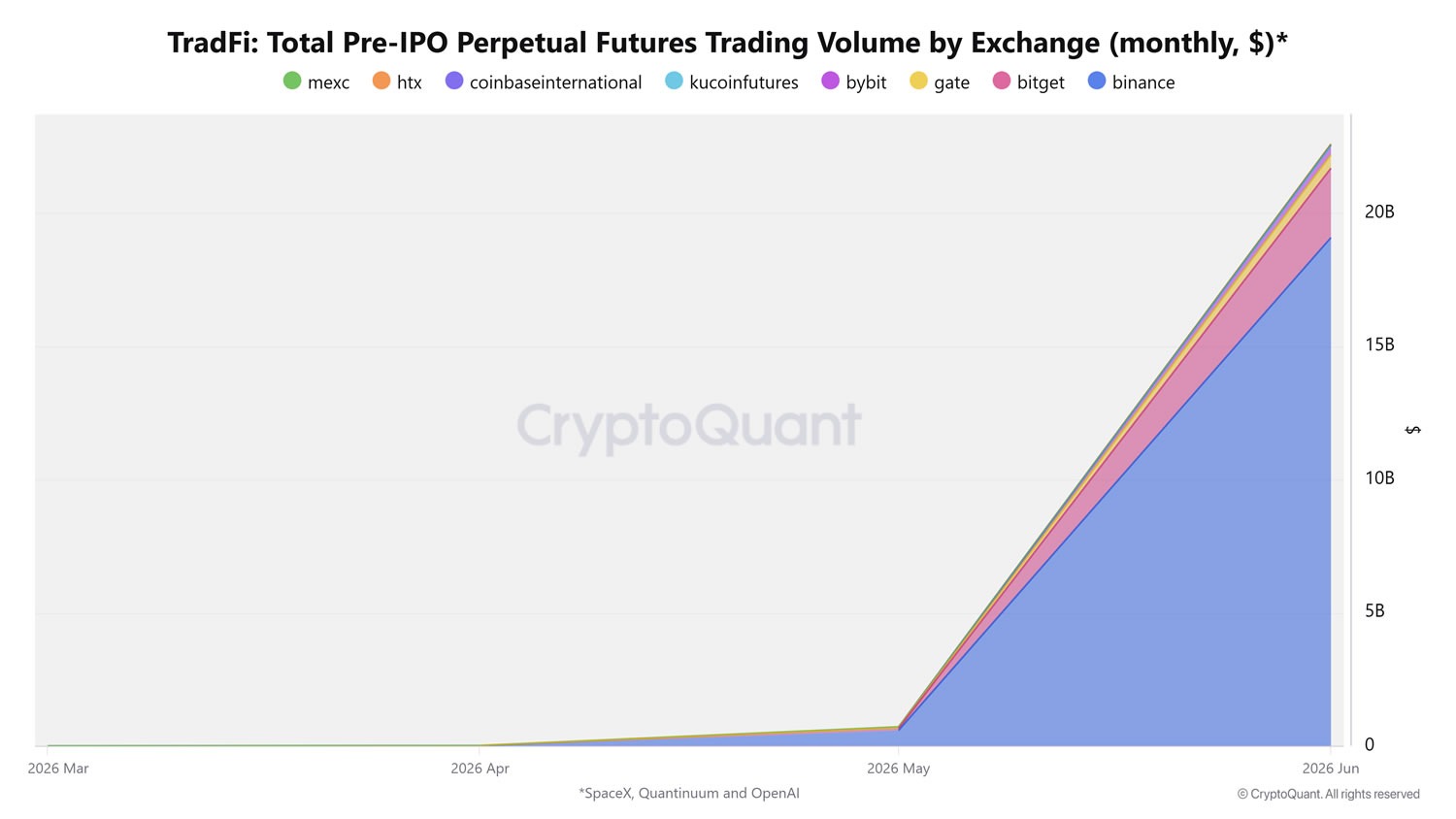
All major crypto exchanges are now offering pre-IPO perps, and trading volume has skyrocketed from around $1 billion in early May to about $22 billion, with Binance establishing itself as the largest venue, according to CryptoQuant.
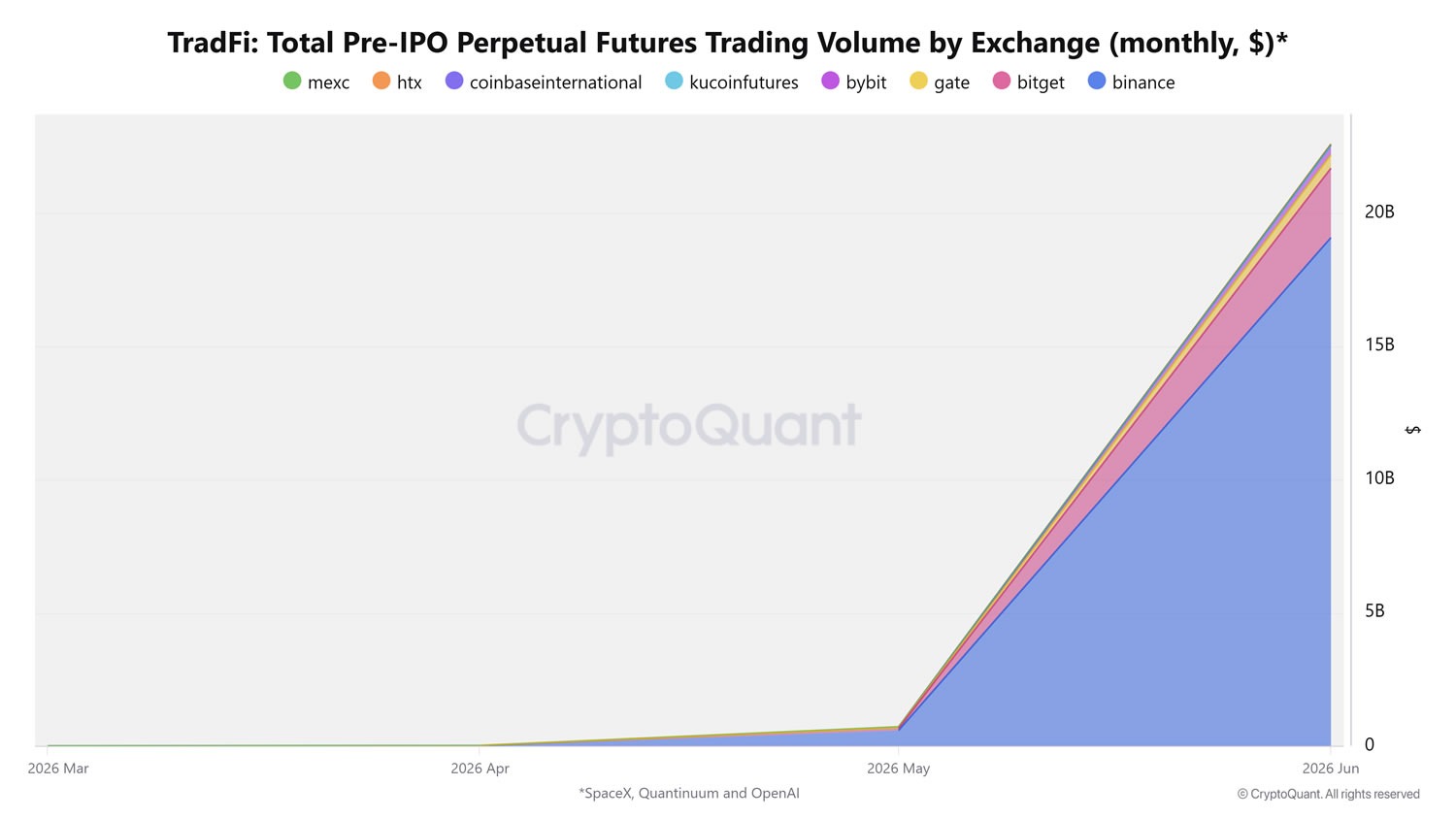
Pre-IPO perp volumes on crypto exchanges have surged over the past few weeks. Source: CryptoQuant
Magazine: The end of anon? AI could unmask crypto’s hidden identities
XRP has dropped nearly 5% after a Fed-induced risk-off move swept across crypto markets, though traders remain focused on bullish chart signals and a major liquidity cluster near $1.30.
Summary
- XRP fell nearly 5% after a hawkish Fed outlook triggered a broad crypto market selloff.
- Analysts have identified a bullish divergence and key trendline support near the $1.16-$1.18 zone.
- Ripple’s Flutterwave investment and $1 billion revenue target offer fundamental support amid macro uncertainty.
The pullback began shortly after XRP (XRP) failed to break through the $1.25 resistance area. XRP fell nearly 5% in 24 hours to an intraday low of $1.16 on June 18 as heavy spot selling intensified below the recently reclaimed $1.20 level, triggering stop-loss orders and leveraged liquidations.
XRP also fell alongside a broader crypto market retreat after the Federal Reserve kept rates unchanged at 3.50%-3.75% while projecting additional tightening risks in 2026.
Despite the decline, XRP has continued to attract attention from market participants looking for signs that the correction may be nearing exhaustion. Several technical indicators, derivatives metrics, and recent Ripple business developments have kept bullish sentiment alive even as macro conditions remain challenging.
XRP technical structure remains intact above $1.16 support
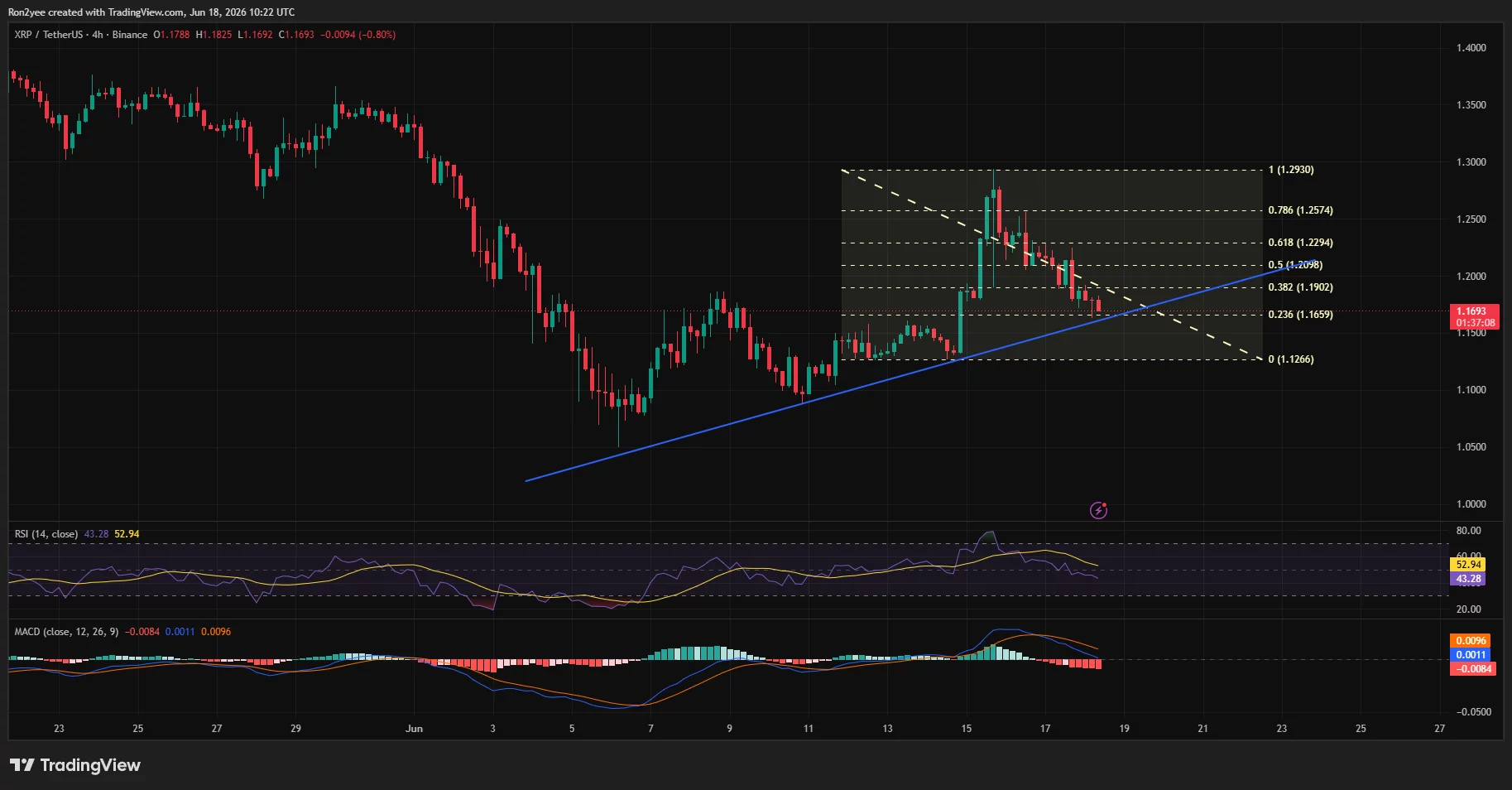
The four-hour chart shows XRP pulling back within a descending channel that formed after the token rallied toward $1.29 earlier this month. The asset’s price is currently testing the 23.6% Fibonacci retracement level near $1.165 while holding above an ascending trendline that has supported the market since early June.
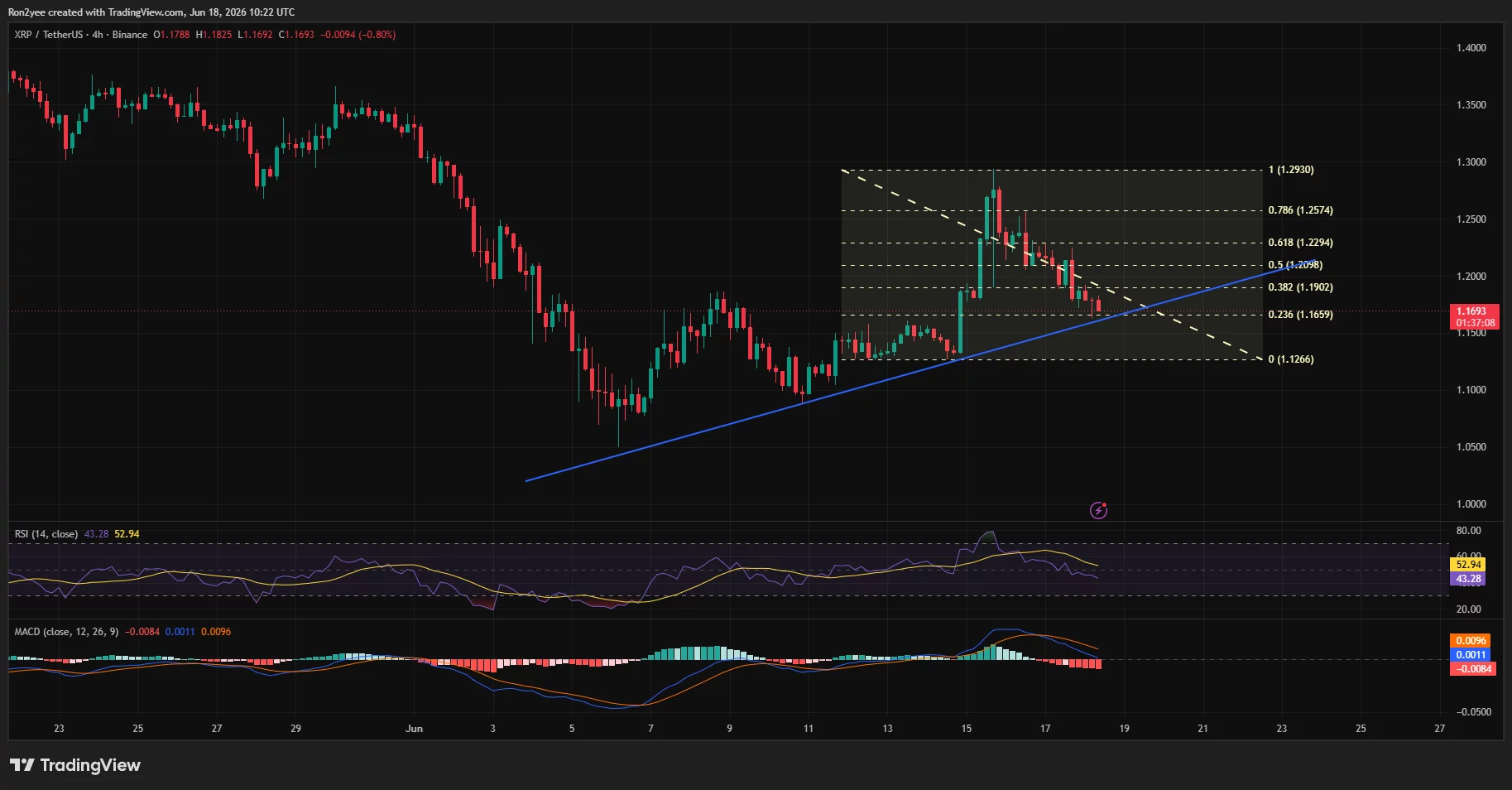
Momentum indicators have weakened but have not yet entered deeply bearish territory. The Relative Strength Index has retreated to around 43, while the MACD histogram remains below zero after a bearish crossover.
A decisive break below $1.16 could expose the June swing low near $1.12, while reclaiming $1.20 would place resistance levels at $1.23, $1.26, and ultimately $1.29 back into focus.
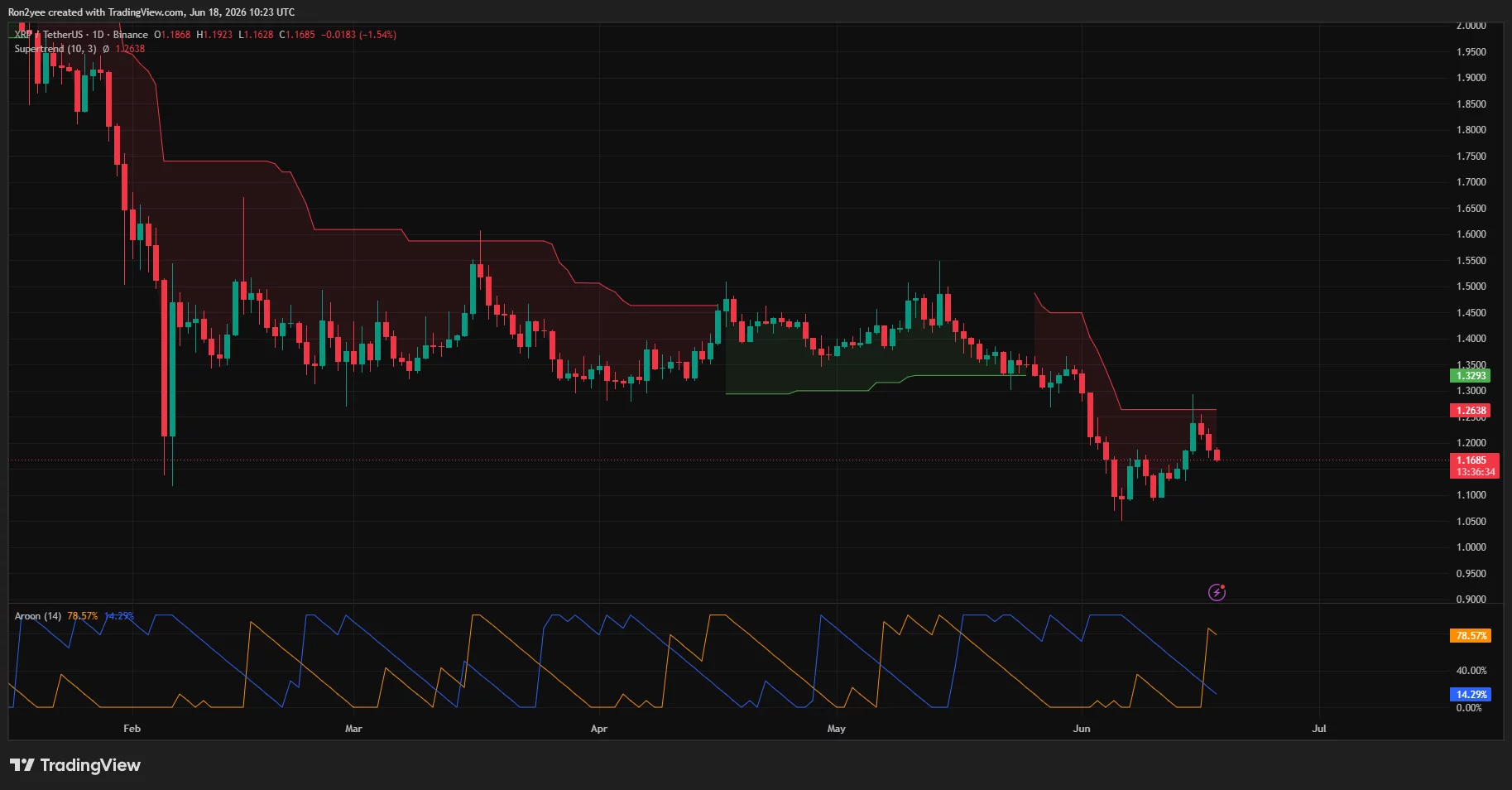
On the daily timeframe, XRP remains below the Supertrend resistance level near $1.26. At the same time, the Aroon indicator shows Aroon Up above 78% and Aroon Down near 14%, suggesting the longer-term trend has not fully shifted in favor of bears despite the recent decline.
Several market commentators continue to watch for reversal signals despite XRP’s recent weakness. According to analyst Gerla, the token has flashed a bullish divergence on the three-day chart.
“$XRP just flashed a bullish divergence on the 3D chart while trading inside a falling wedge. Momentum is turning higher even as price makes lower lows.”
Gerla argued that the divergence suggests selling pressure may be losing strength even as XRP continues printing lower lows, raising the possibility of a breakout if buyers can reclaim nearby resistance levels.
Another trader, Nebraskangooner, highlighted a possible accumulation structure forming on the daily chart. Commenting on the setup, the analyst noted that confirmation would require “a break above $1.34,” which remains a key level to monitor for a larger trend reversal.
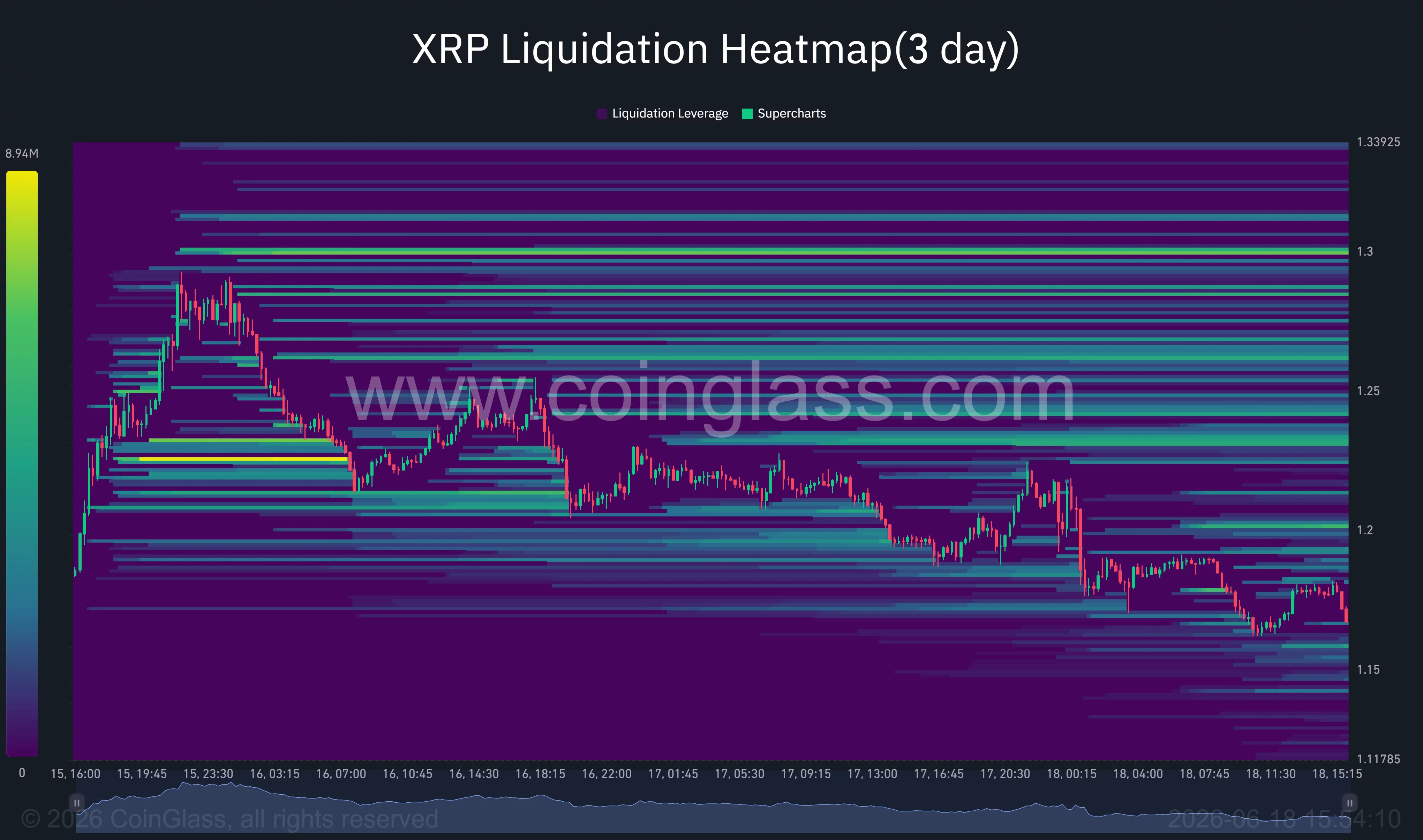
Derivatives positioning also reveals significant liquidity concentration above current prices. CoinGlass liquidation heatmaps show one of the largest leverage clusters sitting near $1.30, with additional liquidation pockets extending toward $1.34. Those levels could act as magnets for price if buyers regain control and trigger a short squeeze.
Ripple business expansion offsets some macro headwinds
Away from the charts, Ripple has continued expanding its payments ecosystem. Earlier this week, the company acquired an equity stake in African fintech firm Flutterwave in a transaction that valued the payments company at $3.3 billion.
While the deal does not include a commercial partnership, it gives Ripple exposure to one of Africa’s largest payments networks as Flutterwave continues expanding across the region.
Ripple has also raised expectations for its operating business. The company recently said it expects to finish 2026 with a $1 billion revenue run rate, excluding XRP held on its balance sheet. The projection provides investors with another fundamental growth metric beyond XRP price performance.
However, macro conditions continue to remain the primary risk factor for the token. Elevated oil prices, uncertainty surrounding Middle East tensions, and the Federal Reserve’s higher-for-longer policy stance continue to limit risk appetite across speculative assets. Any further deterioration in global market sentiment could pressure XRP alongside the rest of the crypto market.
For bulls, holding the $1.16-$1.18 demand zone remains critical. Losing that support would invalidate the current recovery structure and increase the probability of a deeper move toward $1.12. A rebound above $1.20, however, could place the large liquidation clusters near $1.30 back into play and revive momentum toward the upper boundary of XRP’s recent trading range.
Disclosure: This article does not represent investment advice. The content and materials featured on this page are for educational purposes only.


A debate among XRP Ledger community figures has put fresh focus on how stablecoins, payments and XRP may work together on XRPL.
Summary
- XRPL validator Vet said XRP and stablecoins are complementary parts of the payment stack.
- Eri argued Ripple has used stablecoins to bridge ODL while keeping XRPL liquidity important too.
- The debate centers on whether neutral native assets can reduce fragmented liquidity across payment routes.
In an Eri post, the researcher said Ripple has used Tether and USDC stablecoins to support On-Demand Liquidity flows, while liquidity on XRPL remains central.
Eri also said XRP has use cases outside payments, including collateral and DeFi. The post pointed to future financial products on XRPL that may use XRP in ways beyond simple transfer settlement.
Stablecoin sandwich gets clarified
Vet, an XRPL dUNL validator and XRPL Foundation contributor, responded that he sees “XRP and Stablecoins as complementary parts of the stack.” In a Vet post, he said a stablecoin sandwich works like a normal payment, not a cross-currency payment.
He said local currency swaps can happen at the sender and receiver ends. In that setup, the swap does not need to happen on-chain or touch the XRPL DEX. Still, he said quality assets and stablecoins are needed so service providers can build reliable payment flows.
In addition, Vet argued that once many issued currencies exist on-chain, markets still need a bridge asset. Without one, liquidity can split across too many direct pairs. He said XRP can serve that role on the XRP Ledger when a bridge transaction makes sense.
As crypto.news reported earlier, XRPL Foundation’s AMM proposal would add StableSwap and concentrated liquidity to improve stablecoin, RWA and DeFi pricing. The proposal aims to reduce slippage for assets that trade close to the same value, including stablecoins.
XRP’s neutral bridge role stays debated
Vet said an issued asset should not become the main bridge asset on a decentralized network because regulated issuers follow local laws. He argued that native assets are better suited for neutral bridging where no single issuer controls the system.
According to an earlier crypto.news report, RLUSD’s 40-chain rollout expanded Ripple’s stablecoin access for payments, tokenization and institutional liquidity. crypto.news previously reported that XRP Ledger utility beyond payments is moving into tokenized assets, DeFi and lending.
The debate does not settle whether stablecoins reduce or strengthen XRP demand. It shows that XRPL builders see the two as separate tools. Stablecoins may handle routes where price-stable settlement works, while XRP may still matter where neutral cross-asset liquidity is needed.

Opening summary
Ireland has released a new national assessment on the risks associated with digital assets, marking the first such review in seven years. The government’s findings emphasize heightened exposure to money laundering and terrorist financing risks, alongside concerns about fraud, bribery, sanctions evasion, and weak oversight in parts of the crypto ecosystem.
The assessment forms part of Ireland’s policy work toward implementing “standards relating to the acceptance of crypto-related activities as a source of funds” by the second half of 2027. For compliance teams and regulated firms, the document signals that authorities are refining threat models and tightening expectations around monitoring, reporting, and controls for crypto-related flows.
Key takeaways
- Ireland’s finance department describes crypto assets as posing “very significant” risks of money laundering and terrorist financing.
- The 2026 report cites rising money-laundering prosecutions and fraud activity where crypto is “particularly attractive” to criminal groups.
- The assessment flags vulnerabilities including sanctions evasion potential, tax compliance and enforcement challenges, and use of crypto in bribery.
- Ireland identifies regulatory fragmentation and largely unregulated areas (including decentralized finance) as risk multipliers for Irish service providers.
- The review is positioned to support implementation of industry standards on accepting crypto-related activities as a source of funds during 2027.
Ireland’s national risk assessment: scope and main findings
According to the Irish government’s national risk assessment released on Thursday, crypto assets present “very significant” risks connected to money laundering and the financing of terrorism. The assessment frames these risks within a broader set of criminal typologies seen across the last several years, including fraud schemes in which digital assets increase operational anonymity and cross-border reach.
The report also notes that, since Ireland’s previous published risk assessment on digital assets, authorities have observed changes that raise the compliance stakes. It points to an increase in money-laundering prosecutions and to incidents of fraud where the use of crypto has become “particularly attractive” for criminal actors.
In addition to financial crime, the assessment highlights operational and supervisory stress points for the Irish market. It says crypto can facilitate sanctions evasion, create vulnerabilities that complicate tax compliance and enforcement, and be used to pay bribes tied to decisions affecting the industry. The document also identifies “inconsistent international regulation” as a factor that can put Irish service providers under additional pressure—particularly when counterparties and intermediaries operate under different legal regimes.
Regulatory gap analysis: why weak coverage matters
A central theme of the assessment is that Ireland does not yet have the same breadth of crypto-specific laws and regulatory coverage seen in some other jurisdictions, including within the European Union and the United States. While Ireland has a comparatively high level of retail participation relative to some peers, the government argues that the legal and supervisory framework has not kept pace with the threat landscape.
Institutional compliance significance is twofold. First, regulatory gaps can widen the distance between the risks authorities describe and the controls firms are required to deploy. Second, fragmentation across jurisdictions can lead to inconsistent customer due diligence outcomes, uneven monitoring standards, and challenges in building auditable compliance trails for cross-border activity.
The assessment also points to “largely unregulated” segments of the industry, explicitly referencing decentralized finance as an area where typical oversight mechanisms may be less effective. For regulated entities, this creates practical questions around how they manage counterparty and customer exposure to activities that are not subject to the same obligations as centralized platforms.
Criminal misuse and financial integrity risks
Ireland’s assessment expands beyond headline money laundering and terrorism financing concerns by detailing specific misuse pathways that can affect regulated firms. The government notes vulnerabilities that may facilitate sanctions evasion, creating a compliance burden for institutions required to screen counterparties, track origin and destination of funds, and maintain controls capable of responding to fast-moving schemes.
It further links crypto activity to challenges in tax compliance and enforcement. While the assessment does not quantify tax losses, the emphasis indicates authorities view digital assets as complicating standard compliance processes—especially when transactions can be structured across jurisdictions, with limited transparency and varying reporting practices.
On bribery, the assessment states crypto is “increasingly used to make payments to corrupt officials.” This aligns with a broader pattern in anti-corruption enforcement where digital assets can be leveraged to obscure payment trails. The government’s framing is important for institutions because it broadens the compliance perimeter: controls cannot be limited to laundering typologies alone, but must be responsive to broader financial integrity risks, including fraud and corruption-related payment flows.
Connection to licensing and enforcement trends
Although Ireland’s assessment is not presented as a court or regulator-specific action, it is issued against a backdrop of enforcement by Irish authorities in the broader crypto compliance domain. For example, in November 2025 the Central Bank of Ireland fined Coinbase Europe Limited about $24 million for Anti-Money Laundering and Countering the Financing of Terrorism violations, citing delays in reporting failures related to its transaction monitoring system.
This enforcement context underscores the operational relevance of the new risk assessment. A national risk assessment typically informs supervisory expectations, supervisory priorities, and the risk-based approach taken by financial intelligence and regulators. For regulated service providers, the assessment’s emphasis on transaction monitoring, fraud attraction, and cross-border vulnerabilities suggests firms will be expected to ensure monitoring programs are capable of detecting high-risk patterns, documenting decisions, and escalating issues in line with legal requirements.
The report’s attention to areas with inconsistent international regulation also signals the compliance complexity that remains for Irish firms dealing with global counterparties. As European regulatory structures evolve and cross-border standards develop, firms may face continuing pressure to demonstrate that their due diligence and monitoring are effective even when counterparties operate under different regimes.
Political donations and policy constraints
The assessment also addresses the use of crypto for political purposes. While it notes concerns that crypto could be used to make payments to corrupt officials, Ireland has already moved to limit crypto involvement in political financing. The government states that accepting cryptocurrencies for political donations has been banned in Ireland for more than four years.
In April 2022, officials proposed restrictions that would prevent Irish political parties from accepting cryptocurrencies such as Bitcoin, Ether, privacy coins, and other digital assets. The inclusion of this policy detail in the 2026 risk assessment suggests authorities view crypto-linked payments as part of the same broader risk framework that covers bribery, corruption, and the integrity of public decision-making.
Closing perspective
Ireland’s return to publishing a digital asset national risk assessment is likely to influence how regulators and supervised firms interpret and implement financial integrity obligations in the lead-up to 2027. The next phase to watch is how the assessment’s threat analysis translates into practical supervisory priorities—particularly around transaction monitoring effectiveness, sanctions-related controls, and approaches to exposure in less-regulated segments such as decentralized finance.

Canadian fintech Wealthsimple is preparing to launch a new prediction markets app, Wealthsimple Predict, built on Kalshi contracts. The rollout—scheduled for this summer—aims to give Canadian retail investors regulated access to thousands of event-based contracts across themes such as financial markets, economic indicators and climate.
The move follows a regulatory green light earlier this year from the Canadian Investment Regulatory Organization (CIRO), which authorized Kalshi to offer certain prediction market contracts in Canada. Investors will receive the contracts through Wealthsimple’s standalone interface, but the underlying structure remains tied to Kalshi’s exchange listings and Canadian derivative rules.
Key takeaways
- Wealthsimple Predict is scheduled for summer and will provide Canadian users access to roughly 4,000 Kalshi event contracts.
- CIRO authorization in March means the contracts are treated as regulated derivatives, with settlement periods of at least 30 days.
- Kalshi’s Canada rollout arrives as the company moves further into crypto derivatives, including perpetual futures.
- Established exchange players are pushing back: CME Group has sued the CFTC over its approval framework for Kalshi-style perpetual futures.
- Prediction markets remain controversial globally, with regulators in Europe and Asia taking actions ranging from access blocks to bans and investigations.
Wealthsimple brings Kalshi event contracts to Canada
Wealthsimple’s planned app is designed to be a retail-facing doorway into prediction markets. According to the announcement, Wealthsimple Predict will offer Canadian users access to about 4,000 Kalshi-listed event contracts. The available markets span areas such as:
- Financial markets
- Economic indicators
- Climate
Regulation is central to the pitch. In March, CIRO authorized the firm to offer prediction market contracts linked to those categories. The regulator also positioned the business as the second investment dealer authorized by CIRO to offer prediction market trading in Canada.
Importantly for compliance-minded investors, CIRO’s framework treats these instruments as derivatives. The contracts must also include settlement periods of at least 30 days, a requirement intended to shape how event positions are held and resolved.
Kalshi expands again: perpetual futures go live
Wealthsimple’s Canada launch comes as Kalshi continues broadening beyond its reputation as a prediction-market venue. On Thursday, the company said its perpetual futures products were live for trading, following a May 31 announcement that marked Kalshi’s entry into the crypto perpetual futures market.
That expansion matters because it changes the company’s risk profile and audience: moving from event-based contracts to perpetual derivatives brings Kalshi into a more traditional—yet heavily contested—regulatory and exchange-competition arena. In practice, it means investors who start with “events” may increasingly encounter derivatives structures that behave more like crypto trading products than pure market forecasting tools.
CME challenges the CFTC’s crypto perpetual futures approvals
Kalshi’s derivatives expansion has already triggered pushback from incumbents. CME Group reportedly sued the U.S. Commodity Futures Trading Commission (CFTC) over the regulator’s approval of cryptocurrency perpetual futures contracts offered by Kalshi and similar products by Coinbase. CME’s argument is that the CFTC misclassified the products under federal law.
The filing followed comments from CME CEO Terrence Duffy stating the exchange planned to challenge the approvals in court. The dispute underscores a broader industry tension: whether certain crypto derivatives should be treated under existing futures and swaps frameworks—or whether regulators have overstepped their authority when characterizing the instruments.
These developments build on the CFTC’s earlier actions. In May, the agency approved Bitcoin perpetual futures for Kalshi and issued a no-action position allowing Coinbase to offer similar products. Since then, other crypto trading venues have also leaned into regulated perpetual access, including Coinbase expanding institutional availability to global crypto derivatives markets and Kraken launching perpetual futures for U.S. traders through its Bitnomial exchange.
Prediction markets face mounting regulatory resistance
Canada’s approval contrasts sharply with the regulatory headwinds prediction markets continue to face elsewhere. In Spain, regulators ordered internet providers to block access to Kalshi and Polymarket while investigating whether the platforms were breaching national gambling rules.
Other jurisdictions have taken harsher steps. In Indonesia, Polymarket was banned after users reportedly traded contracts tied to whether President Prabowo Subianto would leave office early. Meanwhile, Japan saw warnings to users regarding Polymarket-linked transfers, and South Korea has reportedly involved police investigations into alleged gambling violations tied to local users.
In the United States, the conflict is less about a single ban and more about legal classification. At least 11 states have challenged prediction markets in recent months, with the disagreement centered on whether event contracts should fall under state gambling laws or under federally regulated CFTC derivatives oversight. The stakes are practical: the same contract could be framed legally as a wager by one regulator and as a derivative by another.
Speaking at Bitso’s Stablecoin Conference in Mexico City on June 16, Digital Chamber CEO Cody Carbone said the CFTC-versus-state gambling regulator conflict is likely headed to the U.S. Supreme Court. The comment reflects how quickly prediction-market legality has shifted from a niche policy debate into an institutional legal fight.
What to watch next
With Wealthsimple Predict set to bring CIRO-authorized event contracts to Canadian retail investors, the immediate question is how smoothly the offering scales within derivative guardrails—especially the 30-day settlement requirement. At the same time, Kalshi’s move into perpetual futures and CME’s lawsuit against the CFTC signal that the regulatory battle is widening beyond prediction markets, so readers should watch for court developments and any further changes to how derivatives are classified and approved.
Upbit will list 9 digital assets across its Bitcoin (BTC) and Tether (USDT) markets on June 19, adding Lido DAO (LDO), PAX Gold (PAXG), Morpho (MORPHO), and six others in a staggered rollout spanning four hours.
The South Korean exchange will open trading in hourly windows from 3 PM to 7 PM Korea Standard Time (KST).
Upbit Listing Brings 9 New Altcoins to BTC and USDT Markets
The sequence begins with PEAQ and LIT at 3 PM KST. Kamino Finance (KMNO) and Morpho (MORPHO) follow at 4 PM. Gram (GRAM), which recently rebranded from Toncoin, opens at 5 PM.
LDO and PAXG begin at 6 PM. Osmosis (OSMO) and AMP close the rollout at 7 PM. Each token will gain both BTC and USDT pairs, except Amp (AMP), which will trade only against USDT.
The exchange said that the deposits will open within three hours of the notice. Upbit will apply short-term trading restrictions.
For the first five minutes after trading opens, traders will not be able to place buy orders, and sell orders priced more than 10% below the previous day’s closing value will be blocked.
Additionally, the exchange will permit only limit orders for approximately two hours after trading support begins.
“Deposits and withdrawals are supported only on the specified networks. Deposits sent through unsupported networks may not be recoverable and can require lengthy return procedures,” Upbit said.
Follow us on X to get the latest news as it happens
Tokens Diverge as Market Weakens
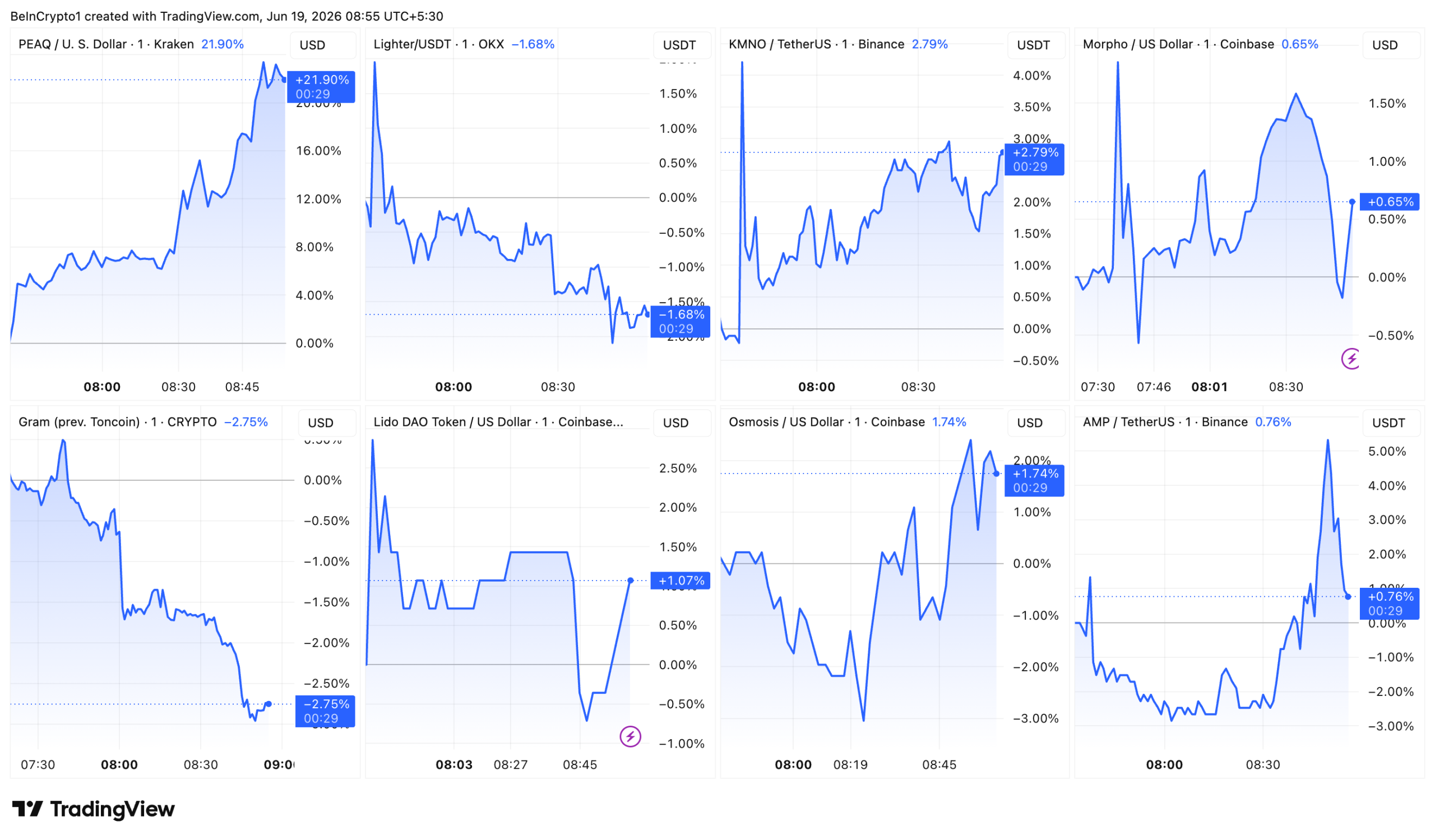
The altcoins all saw modest gains following the announcement, but some fell quickly after. PEAQ was up 21.90% at press time, by far the strongest move among the nine. KMNO added 2.79%.

OSMO rose 1.74%, while LDO gained 1.07%. AMP and MORPHO edged up 0.76% and 0.65%, respectively. The rest of the two tokens fell. GRAM was down 2.75%, the weakest performer. LIT slipped 1.68%.
The uneven reaction follows days of pressure across the digital asset market. Bitcoin and the broader crypto market have fallen as macroeconomic fears weigh on risk appetite.
Subscribe to our YouTube channel to watch leaders and journalists provide expert insights
The post Upbit Listing Announcement Triggers Price Swings Across 9 Altcoins appeared first on BeInCrypto.

Tokenized stocks emerged as the fastest-growing crypto coin category between January 2024 and May 2026, according to a new CoinGecko report tracking the number of coins listed across major sectors.
The category expanded by a whopping 3,314.3% during the period, after rising from just 14 listed coins to 478.
Crypto’s Fastest-Growing Category
Real World Assets (RWA) followed closely as another major growth area, as it increased by 1,903.1% from 64 coins to 1,282. The sharp rise in both categories highlights growing interest in bringing traditional financial assets onto blockchain networks. CoinGecko said that the shift toward real-world asset tokenization accelerated significantly from late 2024 onward.
Despite these emerging trends, Decentralized Finance (DeFi) remained the largest non-meme crypto category by the end of the study period. The number of DeFi-related coins climbed from 549 in January 2024 to 2,328 by May 2026, which represented growth of 324.0%.
Another major theme during the period was the rapid expansion of AI-related coin listings. CoinGecko found that AI became the second-largest listed category on its platform after surging from 145 coins at the start of 2024 to 1,798 by May 2026, a rise of 1,140.0%.
In the process, AI overtook Gaming (GameFi), which had occupied the second spot for much of 2024. GameFi grew by almost 263% and ended the period with 1,379 listed coins. CoinGecko said the AI category gained momentum in October 2024 alongside the launch of the AI-themed meme coin Goatseus Maximus (GOAT).
Growth continued as artificial intelligence became a mainstream topic, further fueled by the rapid expansion of companies such as OpenAI, Anthropic, and Nvidia. Within crypto, the trend was driven by two key developments: a growing number of AI-branded meme coins and the emergence of on-chain AI agents, which attracted significant speculative attention and developer activity toward the end of 2024.
Meme Coin Trends Evolve
Meme coins followed a different path from the broader crypto market. 3,287 coins were listed on CoinGecko across 10 meme coin categories by May 2026. Dog-themed tokens remained the biggest group with 1,055 coins, after exploding during the 2024 meme coin craze as traders piled into Solana-based dog coins alongside the DOGE and WIF rallies.
AI Meme was another standout. This cohort grew from virtually nothing at the start of 2024 to 499 coins by May 2026 as interest in AI spread across crypto. Boy’s Club ecosystem grew into one of the largest memecoin subcategories in the crypto market and reached 346 coins. Meanwhile, PolitiFi surged ahead of the 2024 US election but stopped growing afterward. Chinese Meme was the newest trend, as it climbed to 117 coins by May 2026.
Despite the rapid growth in meme coin listings, market performance has been far less encouraging. According to CryptoRank, the meme coin sector has struggled to recover since its 2024 peak. Its overall market value has shrunk significantly despite several rebound attempts. While Dogecoin remains the dominant player, most major meme coins continue to trade well below their previous highs.
The post Forget Meme Coins: Tokenized Stocks and RWAs Are Becoming Fastest-Growing Categories appeared first on CryptoPotato.
Public Bitcoin miners are increasingly being valued as AI infrastructure companies, but turning that narrative into reality could require roughly $50 billion in near-term capital, according to a new framework highlighted by Blocksbridge Consulting’s latest Miner Weekly newsletter.
Using data from VanEck, the report argues that miners need long-term financing to convert power assets into AI-ready data centers, where higher infrastructure standards translate into much larger capital requirements than traditional Bitcoin (BTC) mining operations.
“A Bitcoin mine can run with relatively simple buildings, modular infrastructure and ASIC fleets that tolerate fast curtailment. AI and HPC facilities require higher standards for uptime, cooling, electrical redundancy, networking and customer support,” Miner Weekly said.
The report follows one of the largest percentage declines in Bitcoin mining difficulty on record, with difficulty dropping 10.09% to 124.93 trillion on June 14 after an estimated 100 exahashes per second (EH/s) of computing power went offline. While weaker mining economics and seasonal power curtailments contributed to the decline, Miner Weekly said the growing shift toward AI infrastructure could reshape future hashrate growth as miners allocate more energy capacity to data centers instead of Bitcoin production.
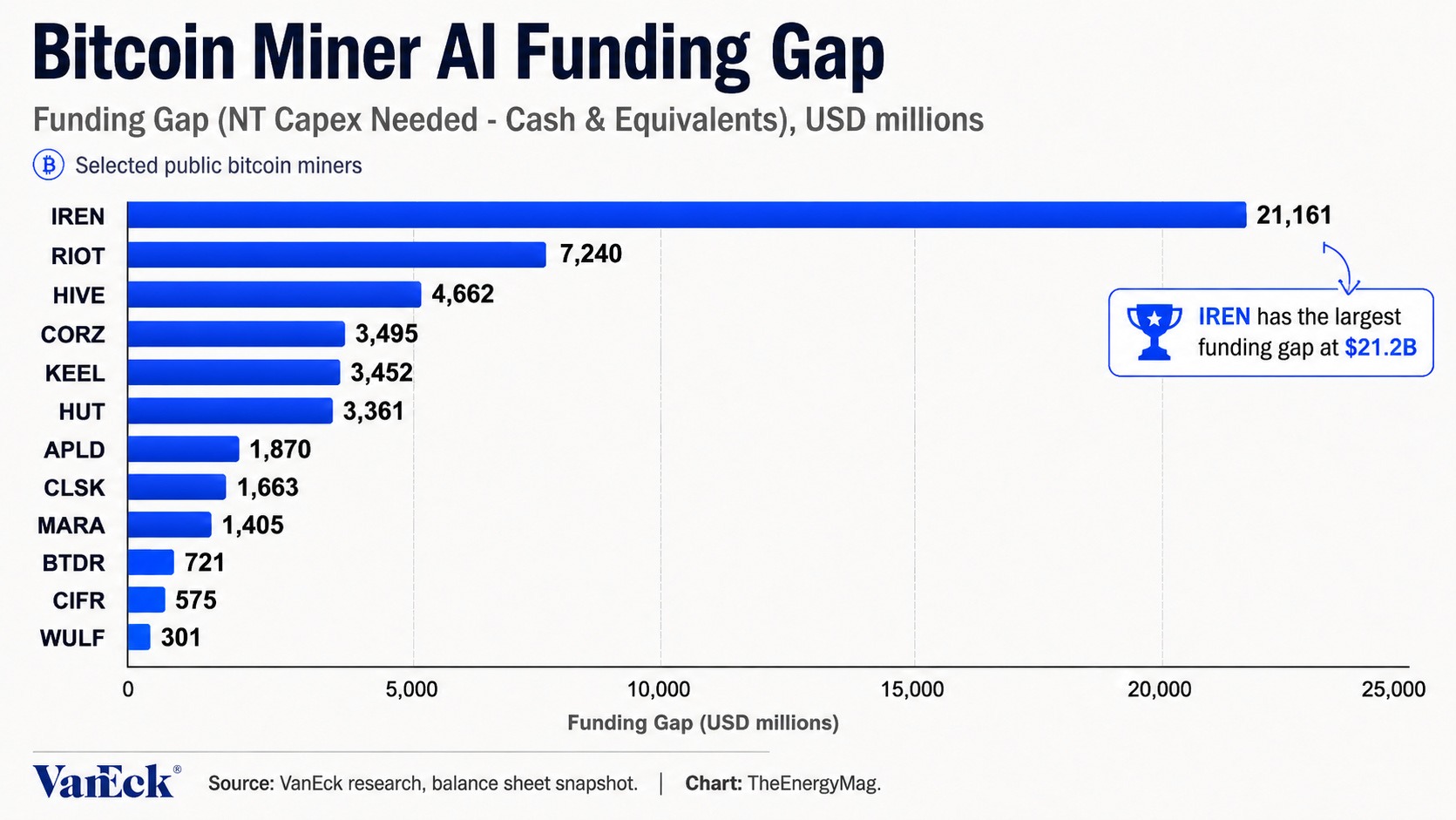
IREN faces the largest funding gap among public Bitcoin miners pursuing AI infrastructure, requiring an estimated $21.1 billion to fully develop its AI data center ambitions. It’s followed by Riot Platforms, which faces a $7.2 billion funding gap, and HIVE Digital, at $4.6 billion.
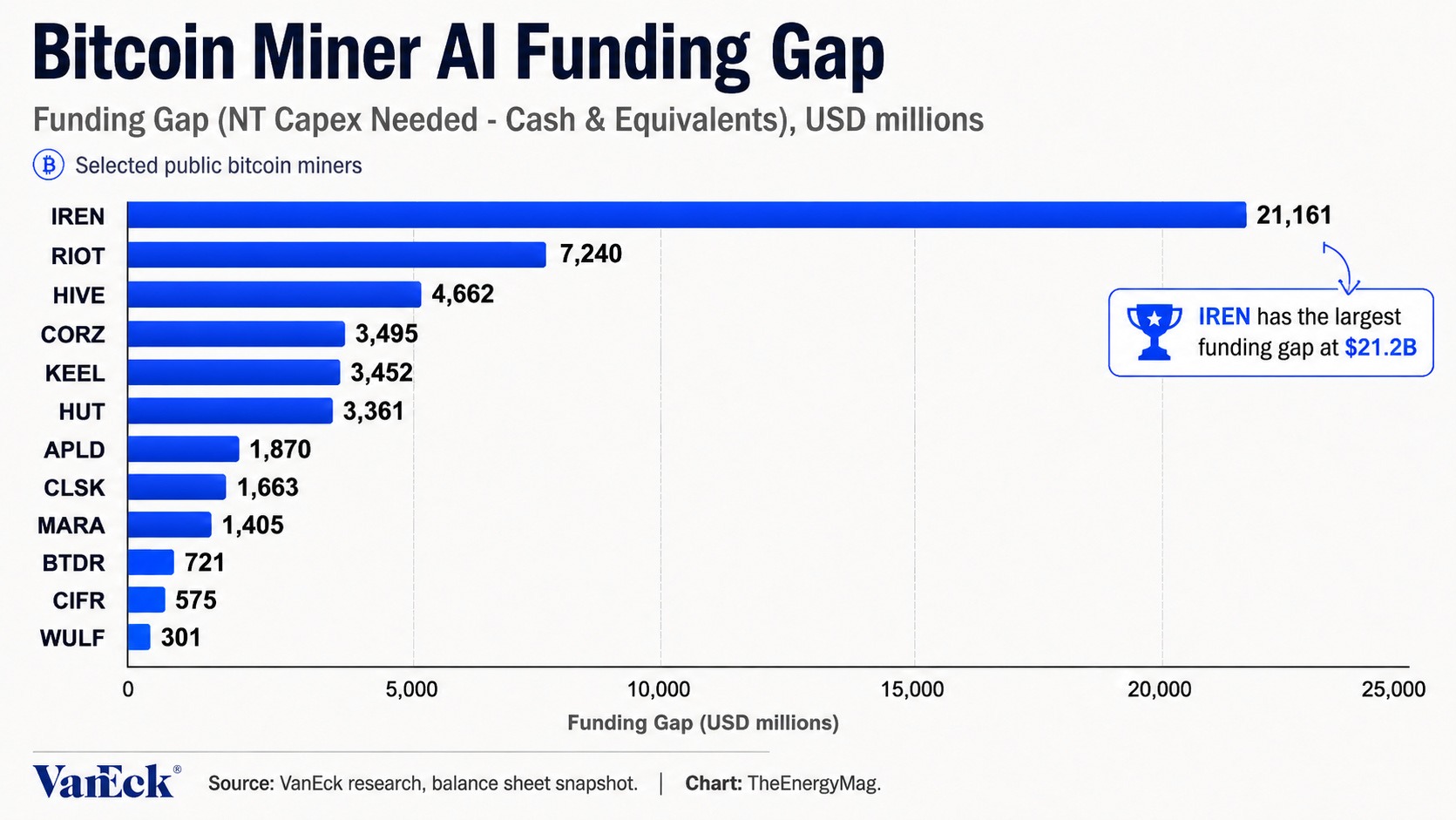
The estimated AI data center funding gap among public Bitcoin miners.
Source: MinerWeekly
To be sure, Bernstein recently flagged IREN as the public miner most likely to abandon Bitcoin mining in favor of AI cloud infrastructure, projecting a $3.7 billion annualized revenue run rate once its AI operations are fully built out.
Related: Bitcoin mining difficulty falls, but is projected to rise in next adjustment
Bitcoin miners face broad economic pressures
Bitcoin mining economics have been under increasing pressure in the two years since the biggest cryptocurrency’s 2024 halving, with lower hashprice and weaker BTC prices squeezing profit margins across the industry.
Hashprice, a measure of the daily revenue earned per unit of computing power, has fallen sharply since Bitcoin reached an all-time high last October. In a December report, TheEnergyMag described the fourth quarter of last year as the “harshest margin environment of all time” for public miners, citing a decline in hashprice to roughly $35 per petahash per second (PH/s).
Conditions deteriorated further in the first quarter, with CoinShares estimating hashprice had fallen to around $28 per PH/s. At those levels, as many as 20% of Bitcoin miners were operating at a loss, particularly those relying on older-generation machines or facing higher electricity costs.
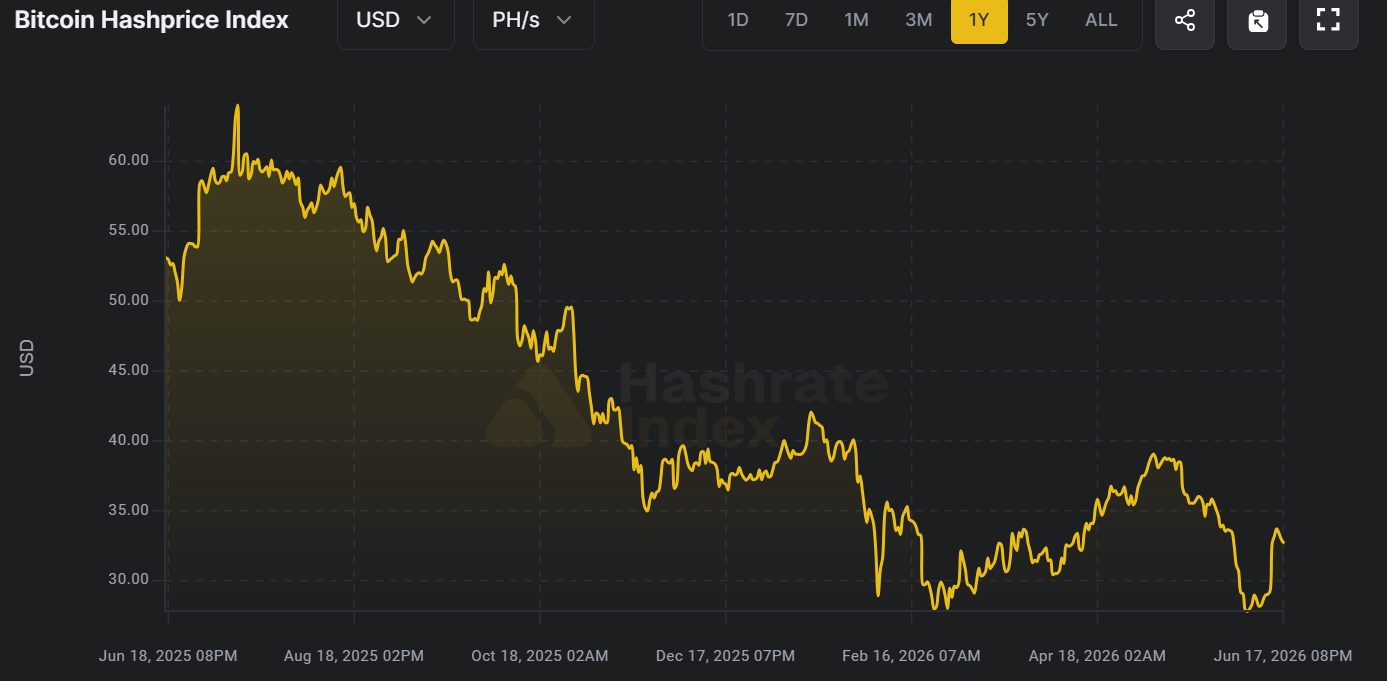
Bitcoin’s hashprice has declined sharply over the past year.
Source: Hashrate Index
Against this backdrop, the AI pivot has become an increasingly attractive strategy for public miners seeking to monetize their power infrastructure through a potentially higher-margin business. The broader AI buildout shows little sign of slowing, with industry bellwether Nvidia reportedly planning a $20 billion bond offering to help finance AI-related investments.
Related: Professional investors dumped 52K BTC worth of ETFs in Q1, filings show
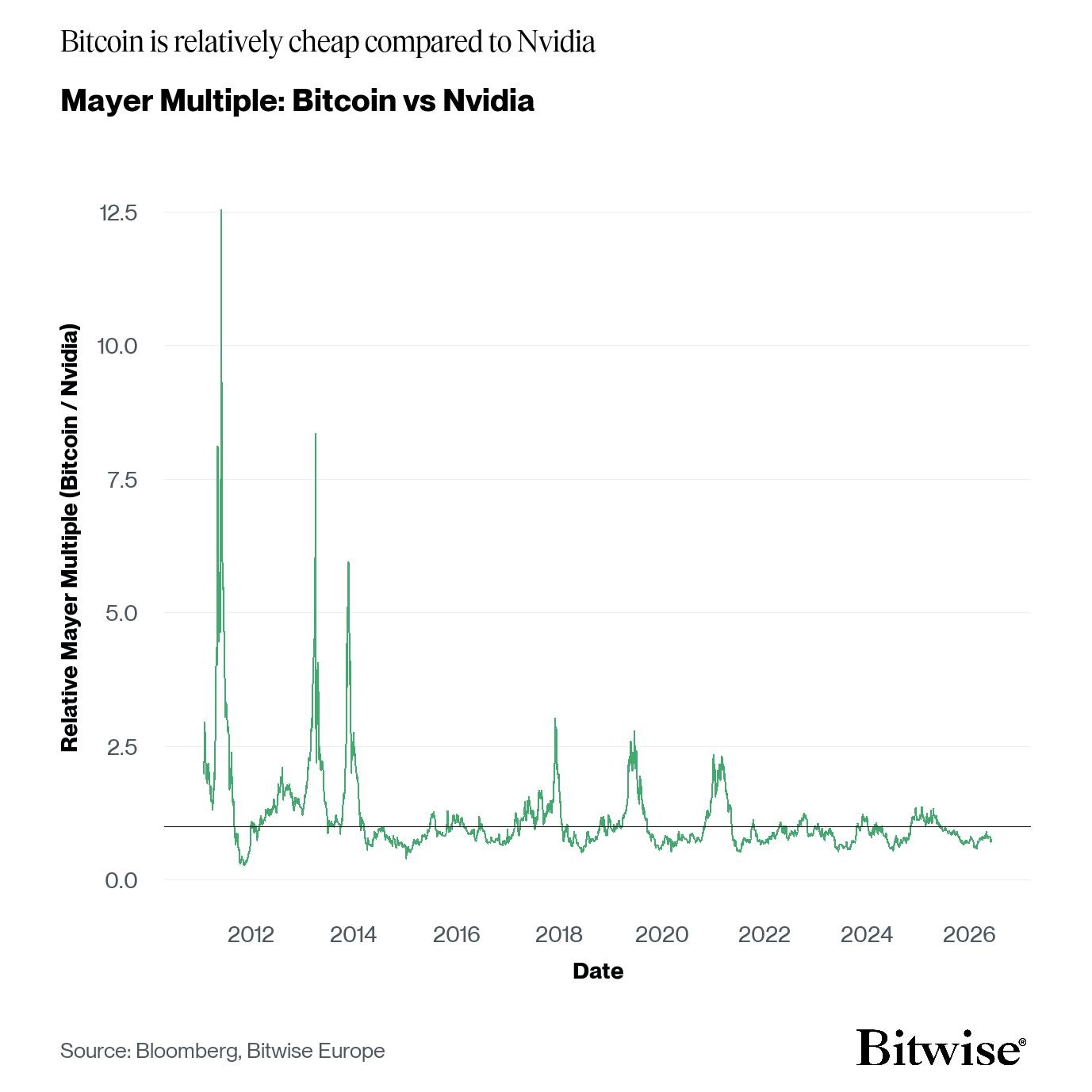
Bitcoin’s (BTC) valuation metrics continue to highlight a deep discount even as markets brace for a potentially hawkish Federal Reserve under new chair Kevin Warsh. Analysis from Bitwise Investments said BTC remains in a “deep value” zone after a valuation metric fell below 1.0, a level associated with long-term accumulation periods.
However, investor participation remains subdued, with CryptoQuant’s realized cap growth metric remaining in a bear phase since late October 2025. This points to a steady slowdown in fresh capital entering the BTC network.
At the same time, a growing list of key companies going public raises increased competition for liquidity across the investment market, so the focus shifts to whether BTC attracts new capital amid tighter liquidity conditions.
Deep-value or liquidity squeeze, which is most important?
The Federal Reserve kept interest rates unchanged at 3.5%-3.75% on Wednesday, a decision that largely matched Bitwise’s market expectations and avoided the hawkish surprise the market had feared.
While BTC dropped back below $64,000 on Thursday following the Fed’s interest rate announcement, Bitwise described its price as a “deep value” opportunity based on its Mayer Multiple, which compares price to its 200-day moving average. The firm noted the metric had remained below 1.0, a level that has historically aligned with accumulation periods.
Bitcoin’s Mayer multiple vs Nvidia. Source: Bitwise
Bitwise argued that Bitcoin’s valuation stood out compared with AI-linked equities like NVIDIA, which were trading at significant premiums to long-term trend levels. The firm also flagged a growing pipeline of major capital raises, including potential offerings tied to SpaceX, Anthropic, and OpenAI. Collectively, those deals could attract more than $200 billion in investor demand.
Large listings often coincide with strong investor appetite. They also absorb liquidity that might otherwise flow into equities and cryptocurrencies. Bitwise said that elevated rates continue to limit the availability of capital for speculative assets despite Bitcoin’s attractive valuation profile.
The subdued participation is also reflected in Bitcoin’s capital flow trends. CryptoQuant’s realized cap growth metric has remained in a bear-phase regime since Oct. 30, 2025, even as Bitcoin’s valuation indicators moved into historically attractive territory.
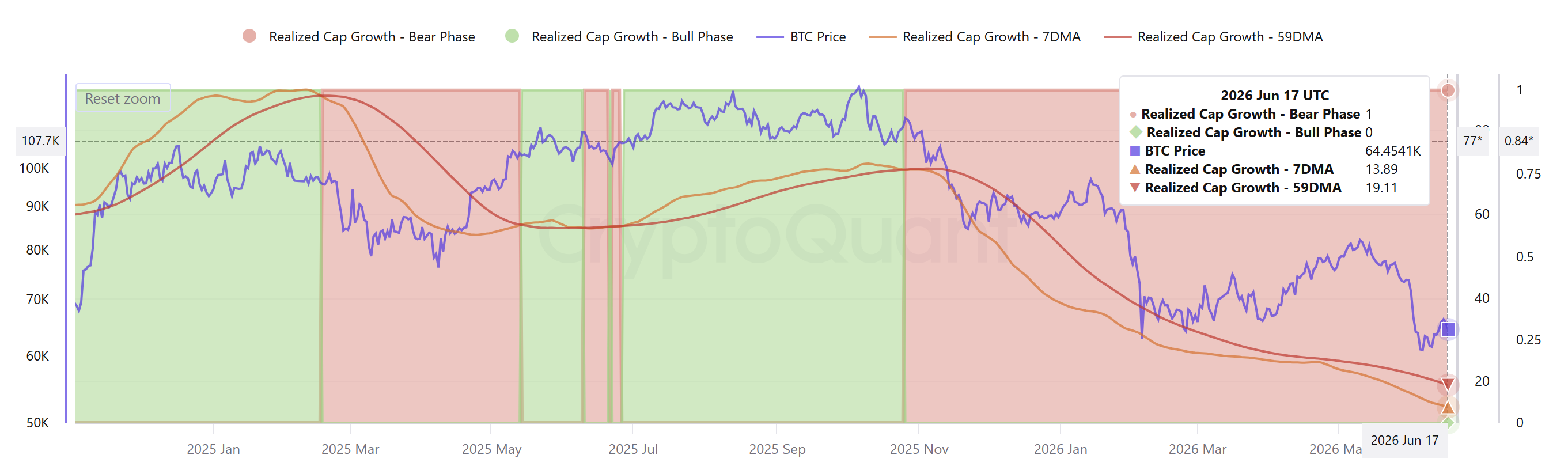
Bitcoin’s realized cap growth analysis. Source: CryptoQuant
Since entering the bear phase, the metric’s seven-day and 59-day moving averages have declined to 13.9 and 19.1 on June 17 from roughly 70 in Q4 2025. The slowdown suggests the pace of new capital entering the Bitcoin network has continued to weaken, highlighting investor caution.
Bitcoin researcher Axel Adler Jr. pointed to a separate concern following the Fed’s decision. While rates remained unchanged, the updated dot plot showed nine officials expecting at least one rate hike this year and six projecting two or more.
Bitcoin reacted negatively to the update, with selling volume expanded during the decline on Wednesday, marking the heaviest trading activity at the point of rejection at $66,200. For gold, an initial rebound above $4,300 faded, leaving the metal trading near $4,244 on Thursday.
The reaction aligns with Adler’s view that markets are pricing in a higher-for-longer rate path rather than a near-term policy easing.
Related: Capital B shareholders approve up to $120B in financing capacity for Bitcoin strategy
BTC traders split on the next move
Market data shows that BTC traders are interpreting the Fed’s outcome in different directions.
Market commentator Crypto Rover highlighted a newly opened $38.5 million Bitcoin short position using 30x leverage shortly after the FOMC meeting. The trader was reportedly sitting on roughly $750,000 in unrealized profit as Bitcoin moved lower.
Meanwhile, Bitcoin investor Jelle viewed the pullback below $64,000 from the weekly high of $67,255 as a routine retest of support. The analyst identified the $64,000 threshold as a key price point for buyers, adding,
“Hold here, and we likely see extended relief into $70k in the coming weeks. Big day ahead.”
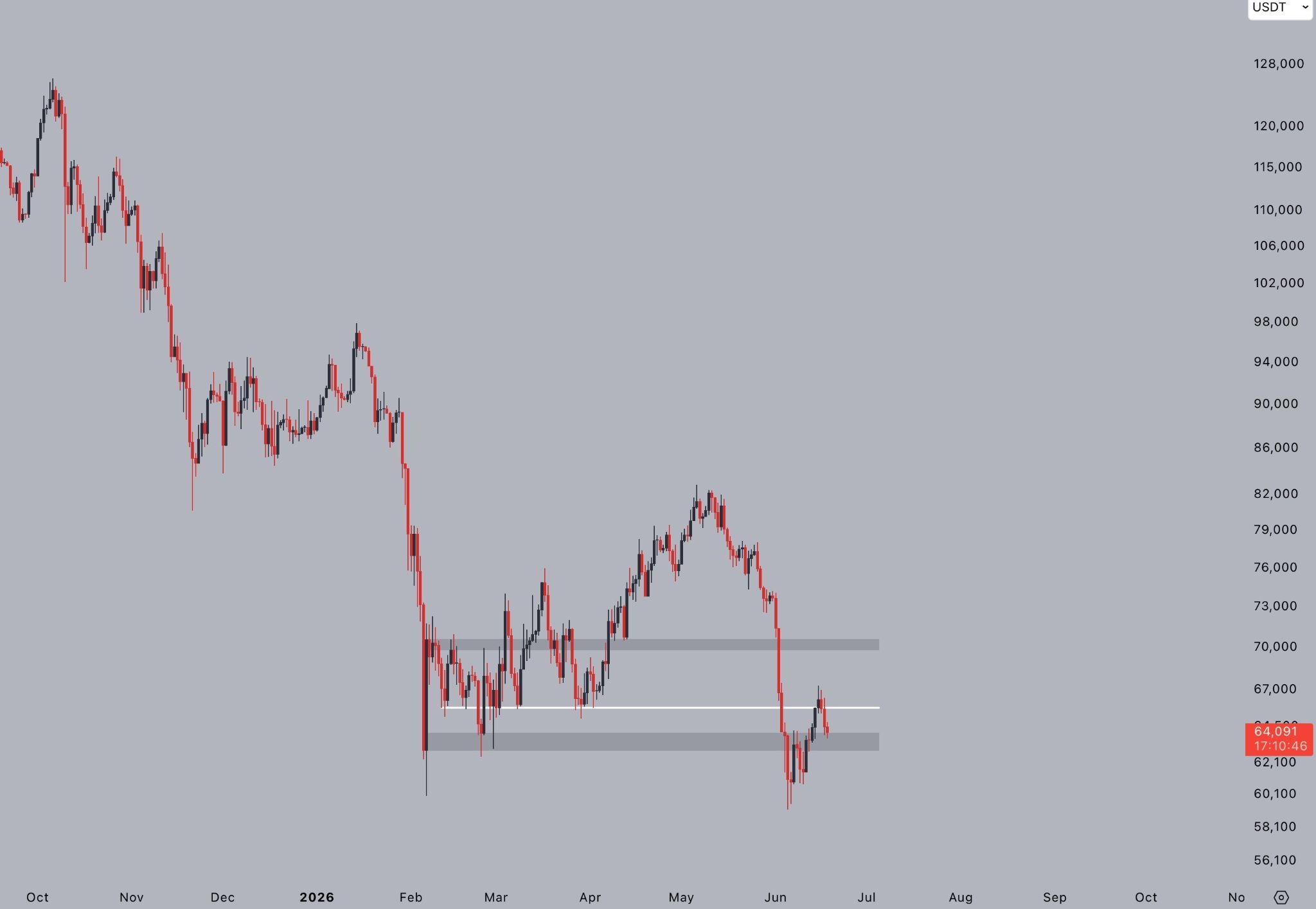
BTC/USD, one-day analysis by Jelle. Source: X
Related: Bitcoin capitulation ‘twice as weak’ after spot liquidity turns supportive: Glassnode

Bitcoin to $145K by October? This Old Post With ‘Crazy Accurate’ BTC Price Predictions Say So

7 Detective Shows That Are 10/10, No Notes

XRP TO ABSORB $13 TRILLION?! Ripple CEO Brad Garlinghouse INSANE Prediction


-

 Business5 days ago
No Jackpot Winner as $257 Million Prize Rolls Over to $269 Million Monday Draw
-

 Fashion6 days ago
Weekend Open Thread: Tuckernuck – Corporette.com
-
 Crypto World4 days ago
Zimbabwe Requires Crypto Businesses to Register Annually Under New FIU Regulations
-

 Crypto World6 days ago
Bitget enters Argentina’s regulated crypto market through PSAV registration
-

 Tech6 days ago
NanoClaw integrates JFrog registries to secure AI agent downloads
-

 Tech7 days ago
This Week In Security: Microsoft On Microsoft, Register Your Domains, Linux On ARM, And FreeBSD Joins The File Cache Club
-

 NewsBeat6 days ago
FBI searches office of Ohio voter registration group
-
 Entertainment4 days ago
Matt Damon’s Viral Sci-Fi Thriller Has Taken Over HBO Max
-

 Business4 days ago
Anthropic staff to meet White House officials next week, Axios reports
-

 Tech5 days ago
As AI companies race to go public, who else is along for the ride?
-
 Crypto World4 days ago
Bitcoin could crash to $48,000, if this historical pattern is triggered
-

 Politics4 days ago
“Israel’s” ban on ICRC visits ruled illegal, but Knesset moves to stop them permanently
-
Entertainment7 days ago
Ana Navarro unleashes explosive tirade on ex-Trump aide, Disney Channel star in epic on-air fight: 'Have you no shame?'
-
 NewsBeat4 days ago
Warning of disruption as Cardiff Crossrail works to start
-

 News Videos4 days ago
Financial Accounting | Last Day Revision Strategy and Booster | CMA Inter – June 2026
-
 NewsBeat4 days ago
Tributes to former deputy head teacher at Cambridge school among death and funeral notices
-
 Crypto World5 days ago
Market Preview: SpaceX (SPCX) IPO Record, Federal Reserve Meeting, and Iran Nuclear Agreement
-
 NewsBeat4 days ago
what doctors are seeing in ebike crashes
-
 Entertainment4 days ago
Kate Middleton Glare Goes Viral After Kids Booed At Royal Event
-

 Entertainment5 days ago
Deion Sanders Shares Powerful Post After Viral Advice To Deiondra
You must be logged in to post a comment Login