
Crypto World
Bitcoin Bulls See Their First Weekly Close Above 21-Week Resistance in Six Months

Bitcoin (BTC) counts down the final days of April with a fresh attack on $80,000 as price teases key breakouts.
- Bitcoin sees its first weekly close above a key trend line since October 2025.
- Liquidity grabs ramp up as traders eye a potential support retest closer to $70,000.
- The Federal Reserve interest-rate decision and inflation data form macro volatility catalysts.
- Analysis sees the “end of capitulation” on Bitcoin as institutions shore up the market.
- US manufacturing data could allow BTC/USD to avoid a retest of its macro lows.
Bitcoin closes above 21-week trend line for the first time in six months
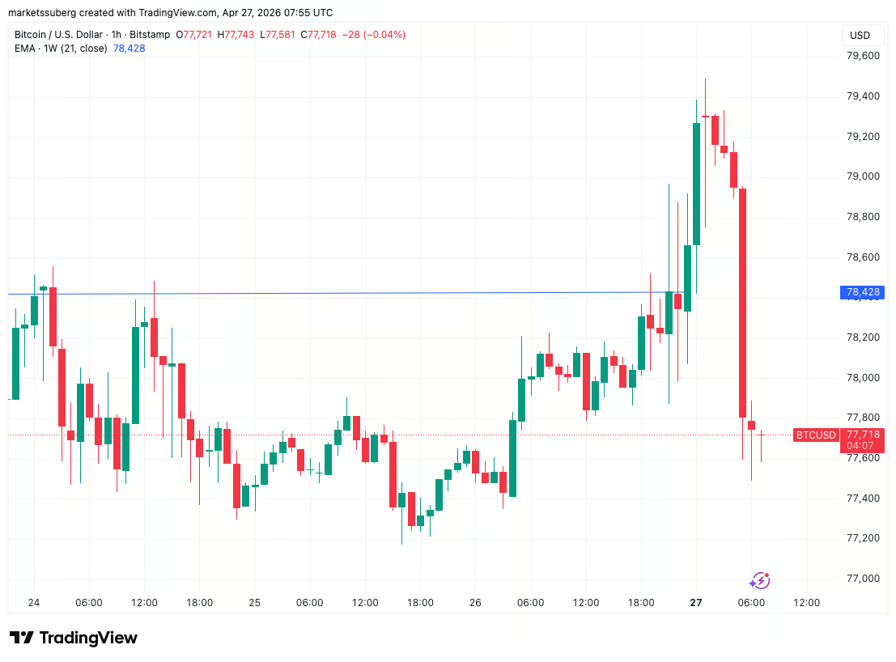
Bitcoin may have failed to tap $80,000 or even hold its latest gains, but the weekly close was still significant.
After a last-minute push higher, BTC/USD managed to close out the weekly candle just above a key trend line, data from TradingView confirms.
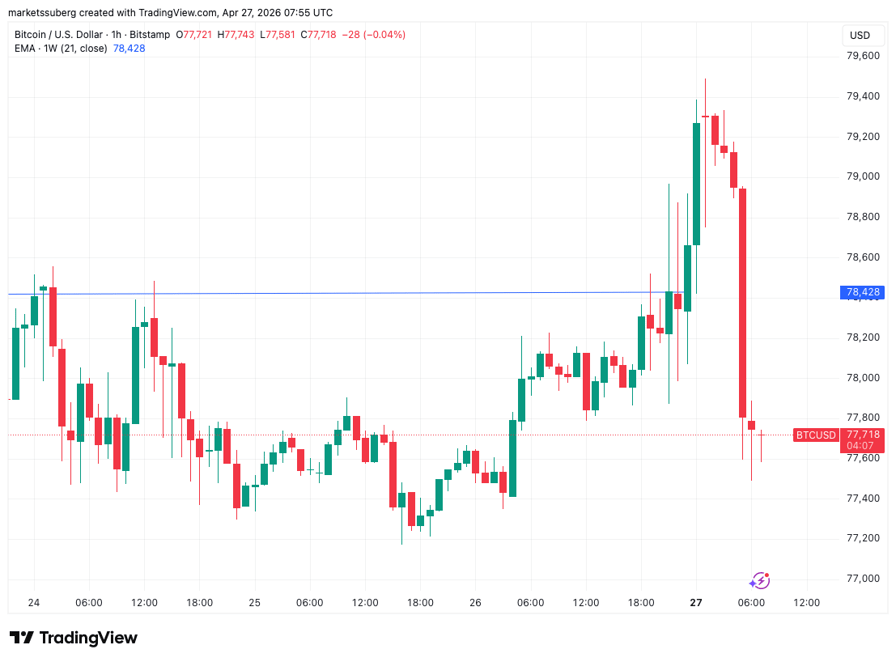
BTC/USD one-hour chart with 21-week EMA. Source: Cointelegraph/TradingView
This was its 21-week exponential moving average (EMA) — a resistance feature on the chart in place since October 2025. The last weekly close above it was when the pair traded at nearly $115,000.
As Cointelegraph reported, the 21-week EMA was already on the radar for trader and analyst Rekt Capital.
A weekly close above it, he argued last week, was a prerequisite for avoiding a support retest of $73,000.
“Unless BTC is able to reclaim the 21-week EMA as support… Then this EMA could indeed force BTC into a post-breakout retest of the top of the Double Bottom price broke out from last week,” he told X followers.
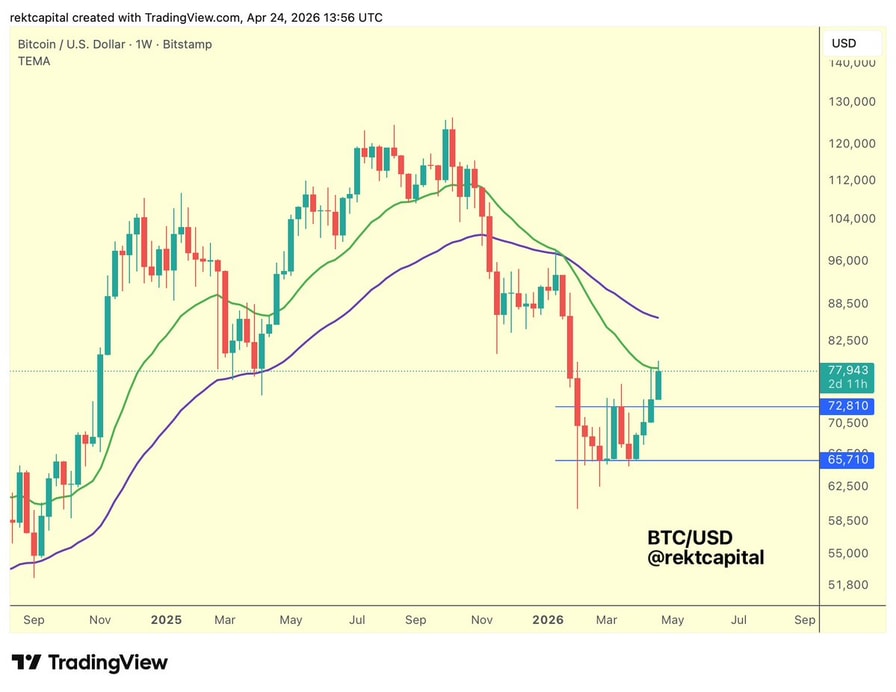
BTC/USD one-week chart. Source: Rekt Capital/X
The 21-week EMA currently forms the upper boundary of Bitcoin’s bull market support band, together with the 20-week simple moving average (SMA) at $76,550.
Similarly, it was in October last year that price completed a weekly close fully above the band’s two trend lines.
Last week, trader Daan Crypto Trades said that such an event “could confirm the end of this down trend and further relief bounce.”
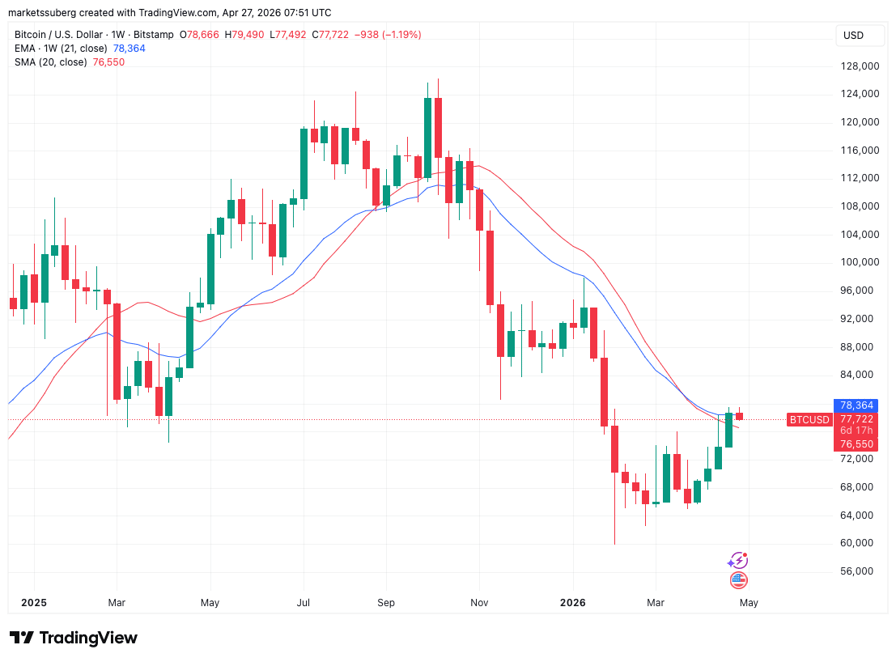
BTC/USD one-week chart with bull market support band. Source: Cointelegraph/TradingView
Liquidity grabs drive low-time frame BTC price action
On short time frames, the BTC price landscape is offering traders mixed signals.
As overall strength persists despite geopolitical uncertainty, bulls continue to struggle with reclaiming key support lines.
“Some great momentum on $BTC lately, however there are some crucial levels to consider,” crypto trader Michaël van de Poppe commented in his latest analysis on X.
Van de Poppe said that price breaking through $79,000 opens up the path to levels up to $100,000, which will nonetheless “take time.”
“If there’s no clear breakout at $79K, it wouldn’t be surprising to expect some period of consolidation before there’s another test of the resistance,” he reasoned.
“In that case, there’s a level that I prefer to see hold: $73.5k+.”
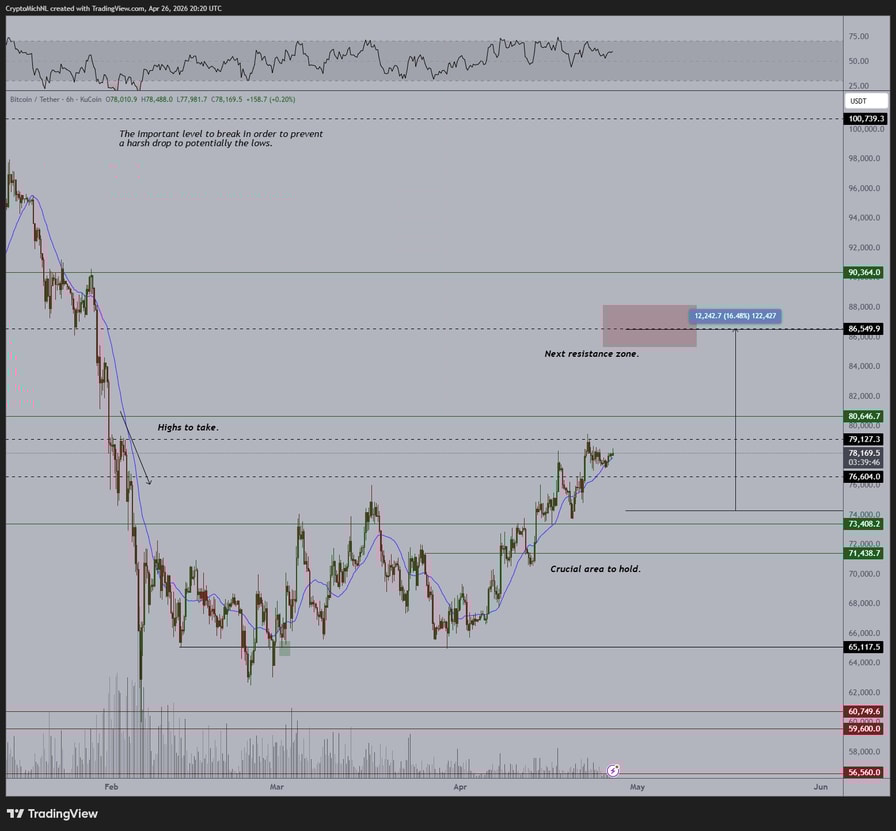
BTC/USDT six-hour chart. Source: Michaël van de Poppe/X
Earlier, Cointelegraph reported on expectations of a fresh BTC price comedown and even new macro lows.
Van de Poppe added that such an outcome could occur should the $73,000 area fail.
Continuing, trader CrypNuevo suggested that liquidity grabs could bring about that trip to the lower end of the $70,000-$80,000 corridor.
After the weekly close, BTC/USD took out late shorts above $79,000 before rapidly heading downward, liquidating newly placed longs, data from CoinGlass shows.
-2026-04-27_10_54_38.png?prefix=media%2Fcontent)
BTC 24-hour liquidation heatmap. Source: CoinGlass
“Price could take the upside liquidations first in a range highs deviation, before going for the lower ones at $70k mid-range,” CrypNuevo predicted.
He added that both $70,000 and $80,000 had an “interesting amount” of potential liquidations to offer.
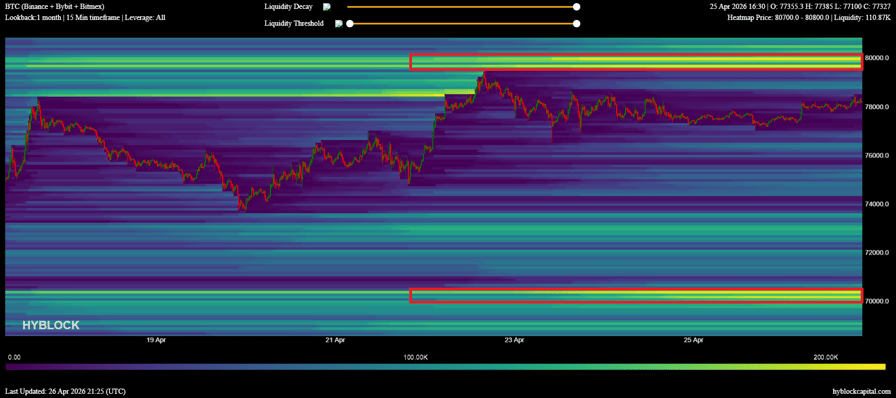
BTC liquidation heatmap. Source: CrypNuevo/X
Powell’s final Fed FOMC meeting brings stocks warning
With markets still unsure of the roadmap for the US-Iran war, risk appetite is nonetheless “returning,” analysis says.
This week has begun with the hope of further negotiations to end the conflict, this time thanks to an Iranian proposal.
Bitcoin appeared to find reason for relief on the news, hitting new multimonth highs before quickly retracing.
“Risk appetite continues to grow rapidly in this market,” trading resource The Kobeissi Letter wrote in an X response as BTC/USD neared $79,500.
Macro volatility is set to continue in the coming days, thanks also to US macroeconomic events.
Wednesday will see the Federal Reserve’s next decision on interest-rate changes, and markets will be watching Chair Jerome Powell’s press conference for cues when it comes to future policy.
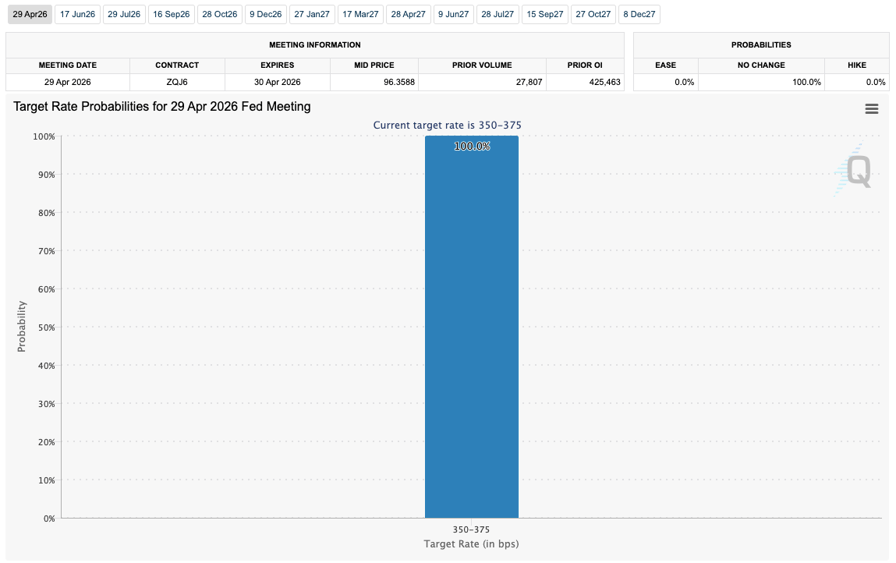
Fed target rate expectations for Wednesday’s FOMC meeting (screenshot). Source: CME Group FedWatch Tool
The war has added new inflation risks for the US, and Thursday’s release of the Fed’s “preferred” inflation gauge should reflect its impact on the trend.
This week also marks the last Federal Open Market Committee (FOMC) meeting with Powell as Chair, ahead of the assumed takeover by Kevin Warsh.
“New Fed chairs have a history of being greeted with market volatility,” trading resource Mosaic Asset Company noted in the latest edition of its regular analysis series, The Market Mosaic.
An accompanying chart put the average S&P 500 drawdown in the year a new Fed chair takes over at 20%.
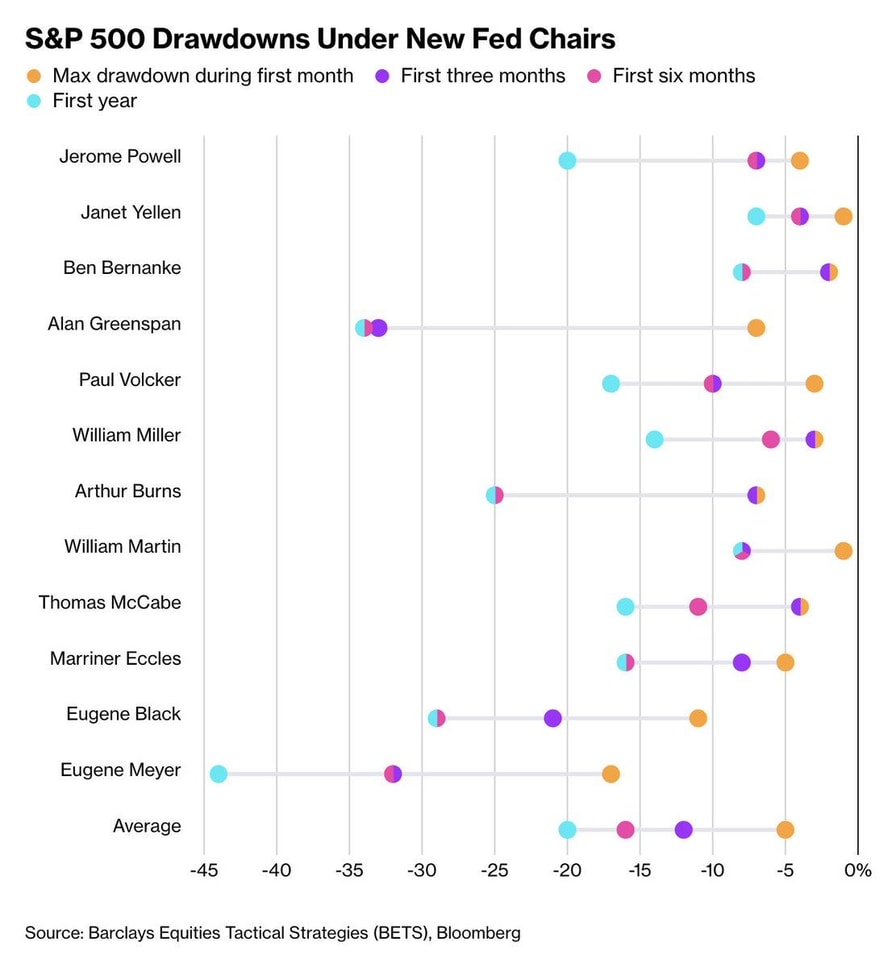
S&P 500 drawdowns under new Fed chairs. Source: Mosaic Asset Company
BTC price analysis sees “structural bottom” in place
Bitcoin near $80,000 has led analysts to suggest that the “end of capitulation” is already here.
In one of its QuickTake blog posts on Monday, onchain analytics platform CryptoQuant pointed to institutional investors as the key supporting factor during the 2026 bear market.
“During the Hormuz Shock, large investors refused to sell their Bitcoins and the panic in derivatives was irrelevant, as institutional conviction was already cemented,” contributor GugaOnChain summarized.
In early February, CryptoQuant argued, when BTC/USD briefly fell to near $60,000, a “purge” of low-conviction investors had already been underway for several months.
“Operators took profits, purging weak hands and retreating the support to $54.5K,” GugaOnChain continued, referring to Bitcoin investors’ average cost basis, also known as realized price.
“In practice: the retail that paid the speculative premium at $90K entered absolute panic with the free fall. Forced to sell at a loss, they returned their Bitcoins to the Smart Money in the $62K zone, establishing an early support above the fair price.”
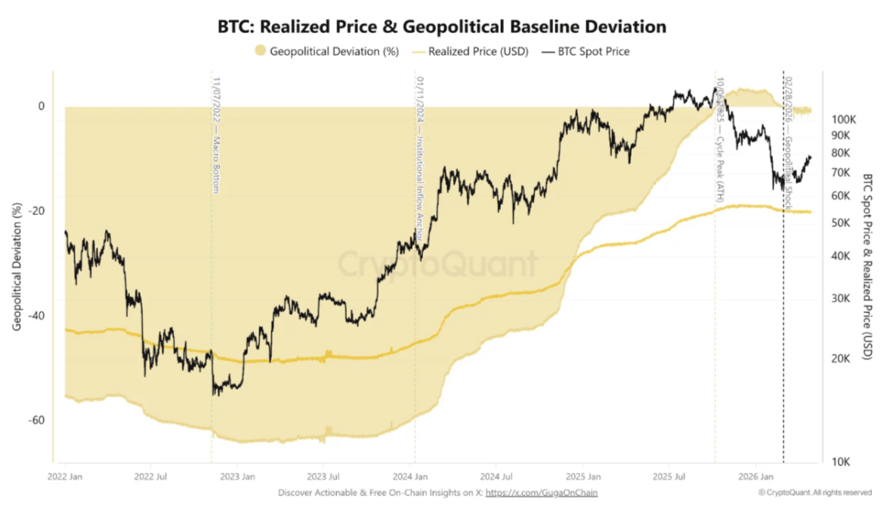
Bitcoin realized price data (screenshot). Source: CryptoQuant
CryptoQuant described the “apex” of the process occurring in February, with a recovery underway ever since.
“The apex of this purge occurred on February 5, 2026, consolidating the ground zero of this Bear Market. With the Spot squeezed at $62.8K and the Realized Price (RP) at $55.3K, the deviation was only 1.34%,” GugaOnChain explained, calling a “structural bottom.”
“Unlike the absolute capitulation of 2022, when the price crossed below the network’s base, this time the panic stalled at a 13% distance from the Wall. Institutional capital erected a concrete floor before the abyss, exhausting the selling power of investors without conviction.”
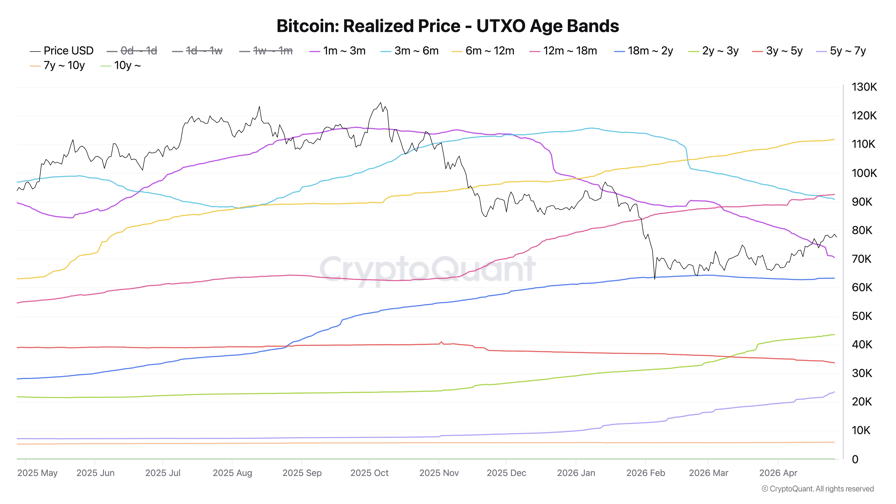
Bitcoin realized-price data ordered by date coins moved onchain. Source: CryptoQuant
US macro data may save Bitcoin from new bear-market low
Throughout the current macro volatility, US Purchasing Managers’ Index (PMI) has formed a key upside catalyst for crypto and risk assets.
Related: Bitcoin Bull Score hits six-month high as 2022 bear-market fears linger
This is set to continue, with PMI entering an “expansion” phase for the first time since 2022.
For commentator Matthew Hyland, this now has implications for Bitcoin price action for the rest of 2026. In this bear-market year, BTC/USD should find a bottom in Q4, matching 2022 — but PMI should change the landscape.
“Because of the strength of the PMI expansion trigger along with the other 10+ signals I do not believe the ‘4 year cycle’ works out as most expect,” he wrote on X.
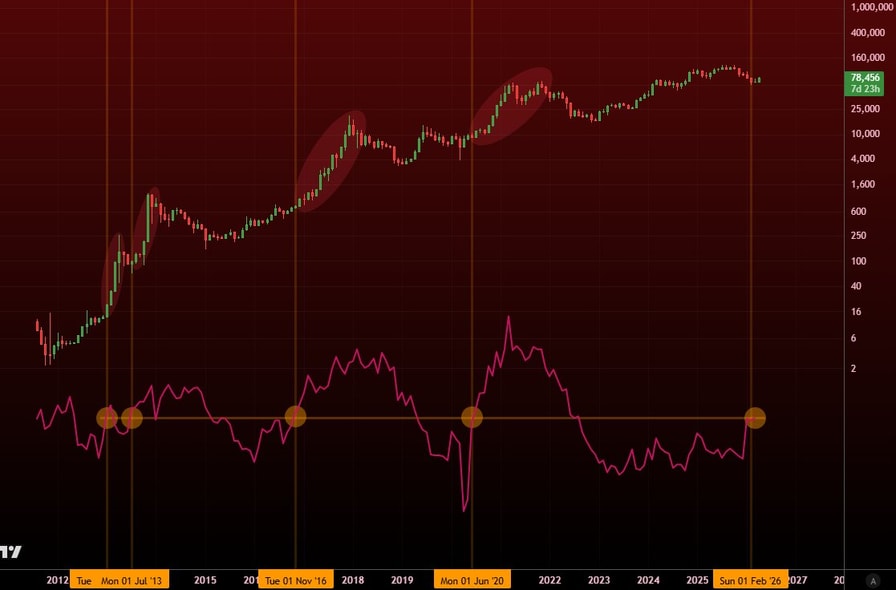
BTC/USD versus US PMI data. Source: Matthew Hyland/X
Instead of beating its February lows, Bitcoin should instead put in “higher low” near $60,000, contrary to the majority’s expectations. Supporting this, Hyland made reference to “10+ signals” showing that the new bottom is already in place.
“My invalidation would be a severe black swan something worse than the past few months however black swans are NOT likely so Its low percentage odds of being invalidated and not favorable to happen,” he added.



The Solana Foundation says it has a plan for dealing with future quantum computing risks, outlining in a new blog post how its developers are already aligned on a potential solution.
The foundation said on Monday two of the network’s core developer teams, Anza and Jump Crypto’s Firedancer, have independently landed on the same solution, a new type of digital signature called Falcon designed to withstand quantum computing, and have already started building early versions of it.
The alignment is notable given Solana’s technical constraints. The network’s high-speed, low-latency design has raised questions about whether more computationally intensive post-quantum cryptography could be adopted without trade-offs. The foundation said, however, that any eventual migration would be manageable and unlikely to significantly impact performance.
The blog post comes as debate intensifies across the crypto industry about whether advances in quantum computing could eventually undermine blockchain security. The Solana Foundation’s position: the risk is real but still distant.
“Quantum is still years away,” the foundation said, adding that migration plans are “well-researched, understood, and ready to deploy.”
Beyond core protocol work, the foundation pointed to existing efforts within the ecosystem, including Blueshift’s “Winternitz Vault,” a quantum-resistant primitive that has been live on Solana for more than two years and was recently cited by Google Quantum AI.
For now, no immediate changes are planned. Solana outlined a phased roadmap that includes continued research into Falcon and alternatives, introducing post-quantum schemes for new wallets if needed, and eventually migrating existing wallets.
Read more: Solana’s quantum-threat readiness reveals harsh tradeoff: security vs speed
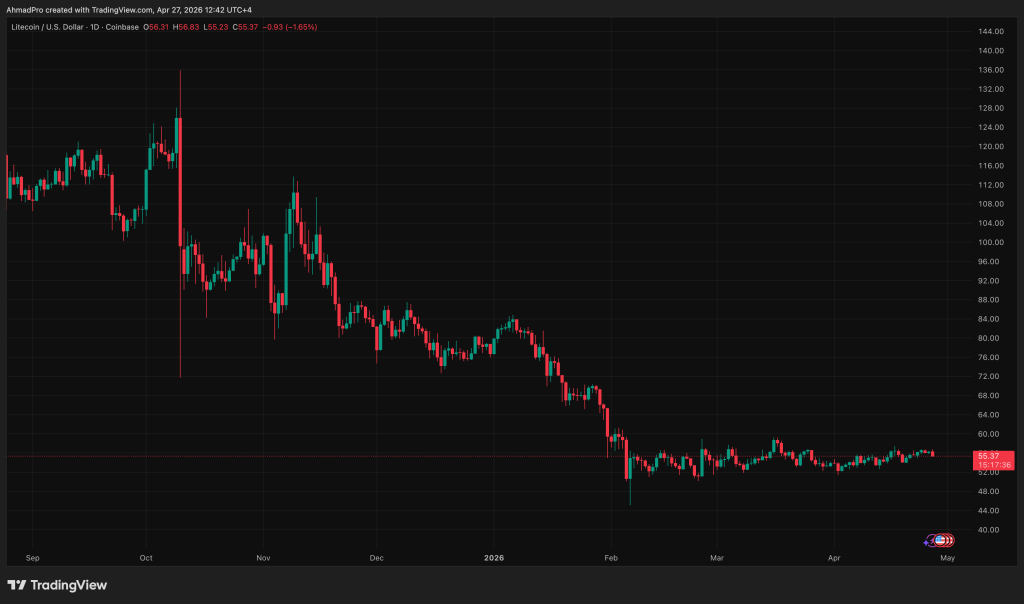
Litecoin (LTC) took a hit on April 25, and not a small one. What exactly triggered the chaos, and whether the hack damage is truly contained, deserves a closer look.
A zero-day vulnerability in Litecoin’s codebase was exploited on April 25, triggering a 13-block reorganization that temporarily halted transaction finality across major mining pools.
The attack vector: un-updated nodes incorrectly accepted invalid MWEB (MimbleWimble Extension Block) transactions, which a Denial-of-Service attack exploited to flood the network.
The Litecoin team confirmed the bug on their official X account and stated a patch has been fully deployed, with node operators urged to update immediately.
No user funds were lost, but the reorg reversed transactions across those 13 blocks, a depth that qualifies as a serious network event by any measure.
A 13-block reorg isn’t a rounding error. Broader crypto markets are already navigating fragile sentiment around Bitcoin stalling near key levels, and a security incident on a top-20 chain adds pressure that technical analysis alone can’t absorb.
Can Litecoin Price Recover to $94 After the Hack Incident?
LTC holding up after the incident is actually the story, not the dip. Price bounced despite negative headlines, which tells you sellers did not fully take control.
But it is not strong either, it is just stable. Volume is messy across exchanges, which points to fragmentation, not a clean trend.
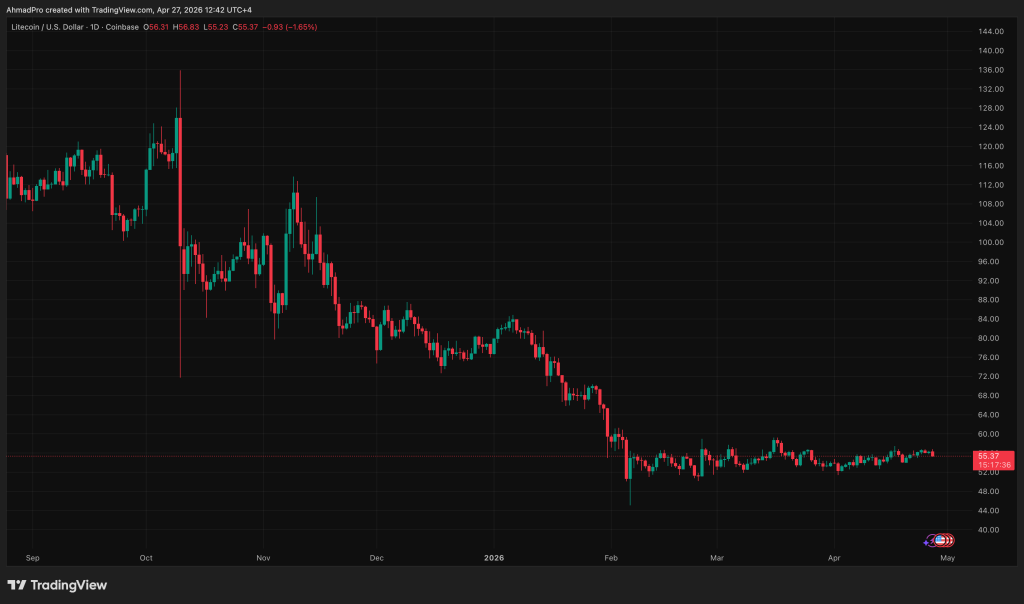
Right now, everything comes down to $60. That is the level that flips the structure if it breaks with volume.
If that happens, LTC can move back toward the top of its range and regain momentum.
More realistically, this just stays sideways between roughly $56 and $59 while the market moves on and the news fades.
The risk is if issues resurface or sentiment weakens, because $52 is the floor, and if that breaks, downside opens quickly.
So this is a neutral setup, holding steady for now, but still waiting for a real direction.
Here is Why LiquidChain Could Be Replacing OG Coins Like Litecoin
LiquidChain is positioning around that idea, aiming to connect Bitcoin, Ethereum, and Solana liquidity into one layer so developers and users are not tied to a single ecosystem.
The pitch is about reducing fragmentation and making execution smoother across chains.

The presale is still early, around $0.01453 with just over $700K raised, which means it is in the early accumulation phase rather than widely priced.
But that also comes with the trade-off. Early-stage projects carry real execution risk, and liquidity only comes after launch.
So the contrast is simple, LTC offers stability with limited upside, while something like LiquidChain offers higher potential, but with much higher uncertainty.
The post A Zero-Day Hack Triggered a 13-Block Reorg on Litecoin: Are User Funds Actually Safe? appeared first on Cryptonews.


The plan allows trapped lenders to sell tokenized claims on deposits, offering buyers an option-like bet on CRV’s recovery.


Banking Circle’s stablecoin settlement launch follows its CASP approval, entering a crowded market with SocGen, Sygnum and a 12-bank euro stablecoin consortium.
Crypto World
MicroStrategy Purchases 3,273 Bitcoin for ~$255 Million; Polymarket Odds Show 10% Chance of Sale This Year
MicroStrategy has acquired an additional 3,273 Bitcoin in a new purchase valued at approximately $255 million, while prediction market Polymarket sets 10% odds on the company selling any Bitcoin before year-end.
MicroStrategy purchased an additional 3,273 Bitcoin for approximately $255 million, according to a Polymarket announcement on April 27, 2026. The acquisition marks the latest expansion of MicroStrategy’s Bitcoin holdings, which have become a cornerstone of the company’s treasury strategy.
Polymarket, a cryptocurrency prediction market, has priced the odds of MicroStrategy selling any Bitcoin in 2026 at 10%, indicating strong market confidence in the company’s continued hodling stance. MicroStrategy has been one of the largest corporate Bitcoin accumulators since 2020, using the digital asset as a primary vehicle for treasury management.
Sources: Polymarket | Polymarket
This article was generated automatically by The Defiant’s AI news system from publicly available sources.


South Korean internet-only bank Kbank has signed a strategic partnership with blockchain payments company Ripple to test blockchain-based overseas remittances.
According to local media outlets like News1, The Korea Herald and Maeil Business, Kbank CEO Choi Woo-hyung and Fiona Murray, Ripple’s Asia-Pacific managing director signed the agreement at Kbank’s Seoul headquarters. The bank said the partnership will use Ripple’s global network and blockchain infrastructure to test whether overseas remittances can be made faster, cheaper and more transparent.
The companies are already conducting a phased technical verification. The first phase reportedly tested a separate app-based remittance structure, while the second phase is digitally linking customer accounts and internal systems to test remittance stability. It includes onchain transfers to countries such as the United Arab Emirates and Thailand, according to local reports.
The tie-up comes as South Korean financial companies test blockchain-based cross-border payment infrastructure while the country’s stablecoin and digital asset rules remain under discussion.
South Korea companies prepare for stablecoin rules
South Korea is weighing how to regulate stablecoins under broader digital asset legislation. On April 8, South Korea’s ruling Democratic Party prepared a draft bill that would classify stablecoins as foreign exchange payment instruments and require tokenized real-world assets to be backed by assets held in trust.
Citing an integrated draft of the proposed Digital Asset Basic Act, the Seoul Economic Daily previously reported that stablecoins used in cross-border transactions would be treated as a “means of payment” under the country’s Foreign Exchange Transactions Act.
Related: South Korea tightens crypto withdrawal-delay exemptions after scam losses
The policy backdrop may explain why stablecoin and blockchain-payment tie-ups are accelerating before the rules are final. Banks, card companies and payment firms appear to be testing infrastructure, partners and use cases while avoiding full commercial launches ahead of legislation.
On March 16, Hana Financial Group, one of South Korea’s largest financial conglomerates, signed a business agreement with the United Kingdom’s Standard Chartered Group for cooperation on various sectors, including foreign exchange and digital assets.
The South Korean conglomerate also previously partnered with USDC-issuer Circle and major US crypto exchange Crypto.com to promote stablecoin-based payments for foreign visitors in the country, according to The Korea Times.
On March 5, Asia Business Daily reported that South Korean payments company Danal will officially launch a digital asset payments service for foreign visitors in Korea in partnership with Binance Pay.
Magazine: Adam Back says current demand is ‘almost’ enough to send Bitcoin to $1M


A new Blockchain for Europe report says MiCA has made euro stablecoins safer but less competitive, and urges targeted reforms to reserves and remuneration.


International stablecoin payments among businesses will total $5 trillion by 2035, fintech analysts Juniper Research said in a new report.
That figure would be 373 times greater than the estimated total value of $13.4 this year.
“Stablecoins are increasingly embedded in cross-border business-to-business (B2B) transactions, treasury operations, and supply chain settlements, where their programmability and 24/7 settlement finality offers advantages over correspondent banking rails,” the research firm said, adding they are “causing disruption to correspondent banking channels.”
Juniper said the growth is driven by stablecoins increasingly addressing the current inefficiencies within cross-border payments that traditional finance handles.
The firm estimates that 85% of the total stablecoin transaction value in 2035 will come from B2B, with the fiat-pegged cryptocurrencies shifting from a speculative asset to a foundational layer of institutional payment infrastructure.
Stablecoins are increasingly integrated in international payments among businesses, treasury operations, and supply chain settlements, because their speedy 24/7 settlement finality offers advantages over correspondent banking rails, the firm said.
“Stablecoins are not replacing payments infrastructure; they are being adopted where the advantages are most pronounced,” said Juniper Research Analyst Jawad Jahan. “Cross-border B2B is where those advantages are greatest, and where we expect the most sustained volume growth over the forecast period.”
He suggested stablecoin issuers should focus on enterprise integrations and treasury partnerships to capture the majority of this value.
Earlier this month, Chainalysis said stablecoins were on track to become a foundational layer of global finance, with adjusted transaction volumes projected to reach $719 trillion by 2035. The blockchain intelligence firm also said that when crypto becomes the default for the next generation, “the question is no longer if stablecoins compete with traditional rails, but how quickly they replace them.”


The Ethereum Economic Zone aims to unify fragmented rollups, but its broader goal is to extend interoperability to other blockchains, says Ernst.
Pi Network price rallied over 6% in the past week as anticipation for its upcoming mainnet upgrades spurred demand for the token.
Summary
- Pi Network price rose over 6% this week to $0.186 as demand increased ahead of its Protocol 22 mainnet upgrade.
- Upgrade roadmap and upcoming Consensus 2026 appearance by co-founders boosted sentiment around scalability, security, and ecosystem expansion.
- Technical indicators show strengthening momentum, with potential upside toward $0.20, while loss of $0.170 support could trigger a pullback toward $0.155.
According to data from crypto.news, Pi Network (PI) price rallied from a weekly low of $0.166 to $0.186 on Friday, bringing the token’s total market cap to over $1.89 billion.
Pi Network price rose as investor demand for the token rose ahead of its mainnet upgrade to version 22 or Protocol 22, which will reportedly streamline transaction processing and enhance the network scalability for decentralized applications. This technical leap is a major step toward the Open Mainnet phase that the community has long awaited.
The upgrade also prepares the network for Protocol 23, which is expected in May and would mark the completion of critical security audits and enable cross-chain interoperability for the first time. This transition is seen as the final bridge before the ecosystem opens up to the broader crypto market.
The token’s price has also gained traction as the team prepares for a high-profile appearance at Consensus 2026 in Miami. As per reports, the project’s two co-founders, Nicolas Kokkalis and Chengdiao Fan, will speak at the event with a core focus on Pi’s blockchain infrastructure, digital identity, artificial intelligence, and future application development.
Pi Network price analysis
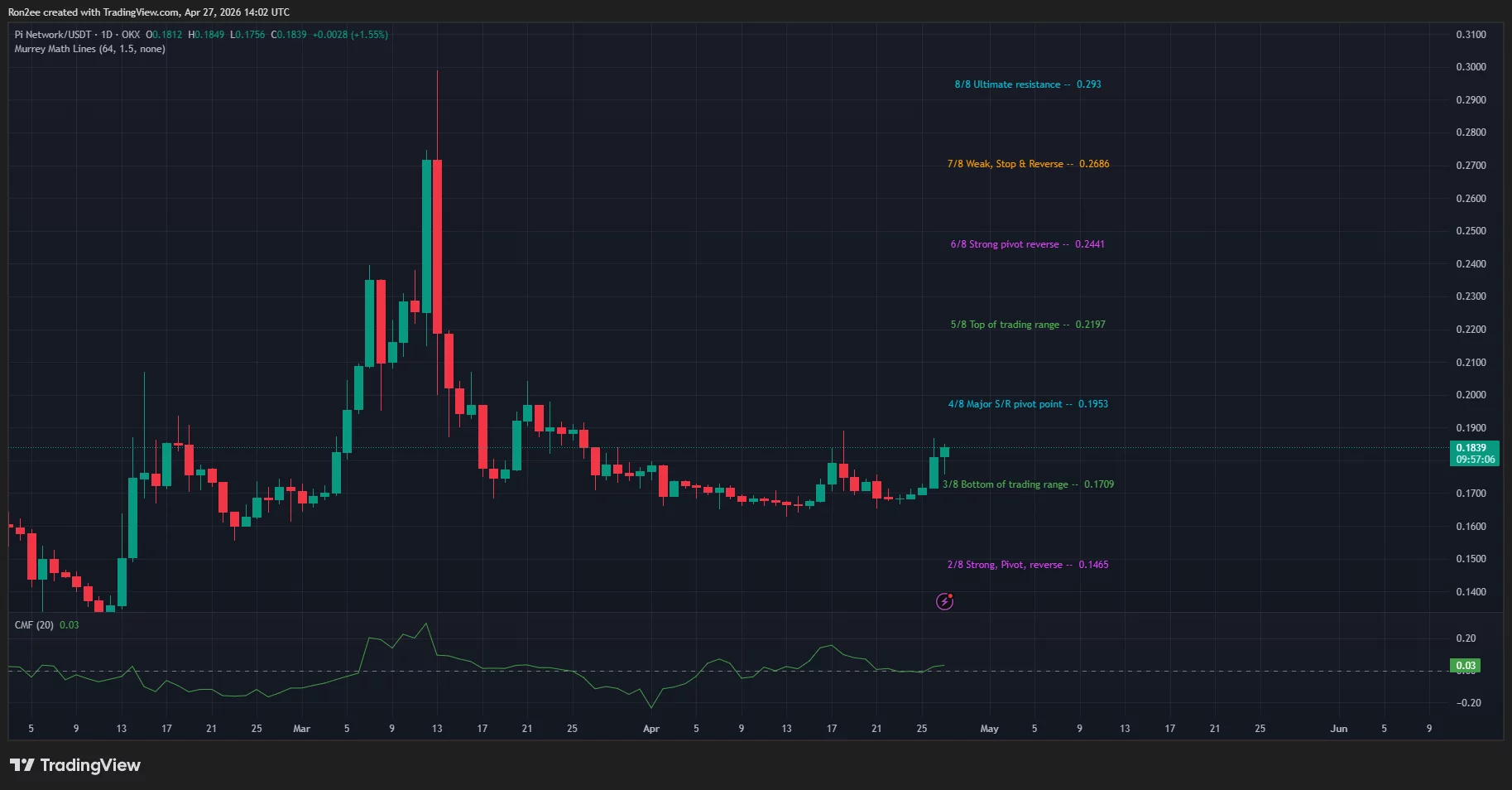
On the daily chart, Pi Network price has broken above the 3/8 Murrey Math line and therefore signals that the bulls have regained control of the immediate trend.
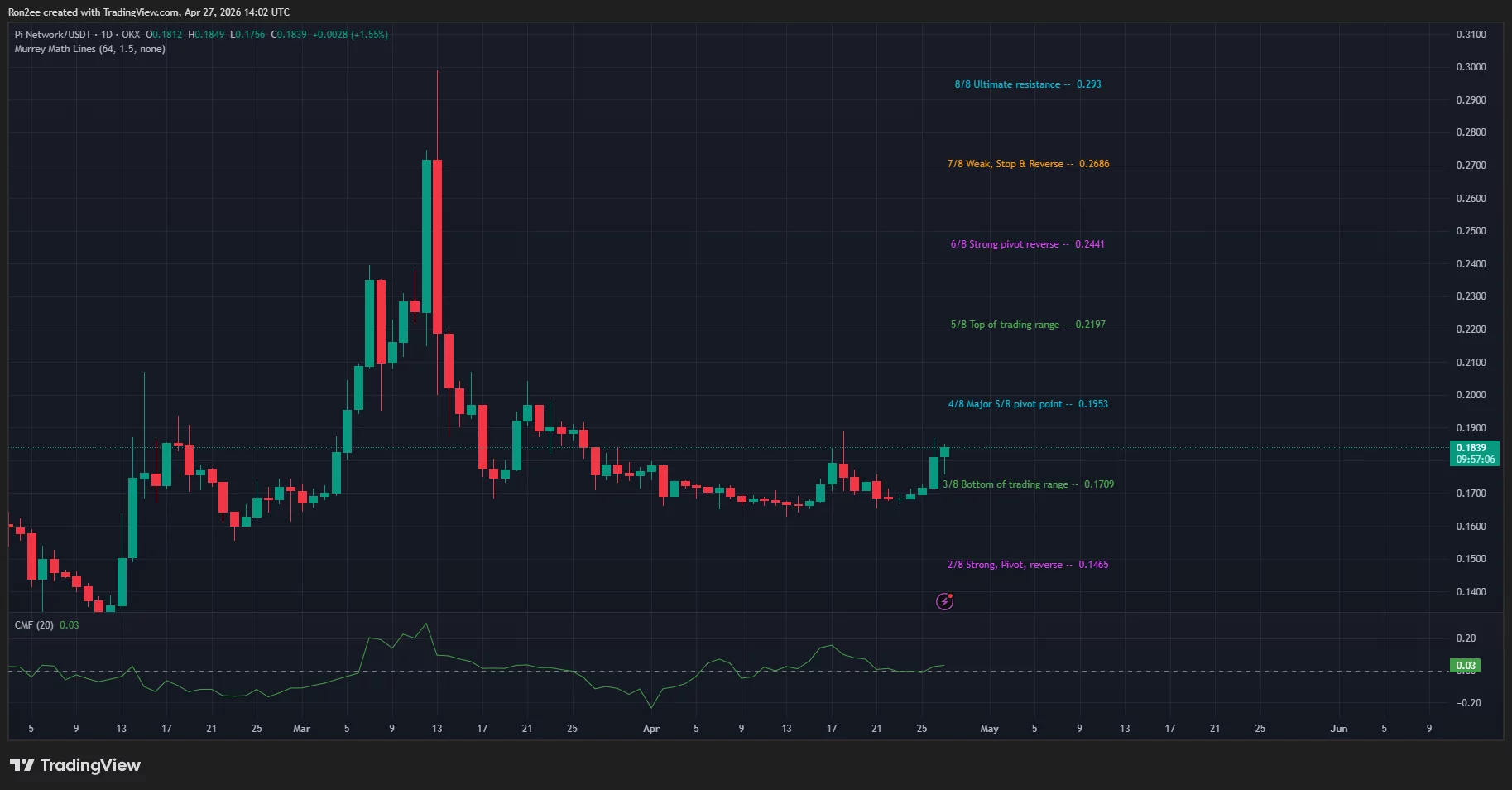
The Chaikin Money Flow index, which indicates whether capital is flowing into or out of the asset, has also turned positive, confirming that buyers are accumulating at current levels.
Hence, Pi Network price is positioned to rise toward $0.195 next and potentially push past the major psychological resistance at $0.20 if the positive news cycle continues through the week.
However, if the token loses the $0.170 support, then the bullish momentum would likely fade, leading to a period of consolidation or a retracement toward $0.155.
Disclosure: This article does not represent investment advice. The content and materials featured on this page are for educational purposes only.
3 Thrillers to Watch on Netflix and More Before April 2026 Is Over

When Attenborough met the gorillas

Claire's closes all 154 stores in UK and Ireland with loss of 1,300 jobs

Manchester United reach agreement with Casemiro over contract clause amid transfer speculation

US brings back mandatory military draft registration

Steven Gerrard disagrees with Gary Neville over ‘shock’ Chelsea and Arsenal claim | Football


-

 Politics7 days ago
Gary Stevenson delivers timely reminder to register to vote as deadline TODAY
-

 Fashion3 days ago
Weekend Open Thread – Corporette.com
-
 Crypto World2 days ago
Hyperliquid $HYPE Rally Builds Momentum as AI Sector Enters Prove-It Phase
-
Crypto World7 days ago
Bank of Hawai’i (BOH) Q1 2026: Net Income Drops to $57.4M as Net Interest Margin Expands
-

 Politics5 days ago
Making troops accountable for war crimes threatens US alliance, ex-SAS colonel warns
-

 Politics5 days ago
Disabled people challenge government SEND proposals over segregation concerns
-

 Business5 days ago
Rolls-Royce Voted UK’s Most Iconic Trade Mark as IPO Register Hits 150
-

 Business4 days ago
Patterson-UTI Energy, Inc. (PTEN) Q1 2026 Earnings Call Transcript
-

 Politics5 days ago
Zack Polanski responds to home secretary’s taser threat
-
 Crypto World6 days ago
Five Value Stocks with Recovery Potential in 2026: PayPal (PYPL), Nike (NKE), and More
-

 Politics5 days ago
Starmer handler McSweeney to be dragged from shadows by Foreign Affairs Committee
-
 Sports1 day ago
IPL 2026: Ruturaj Gaikwad registers slowest fifty of the season, enters all-time unwanted list | Cricket News
-
Politics5 days ago
Wings Over Scotland | How To Get Away With Crimes
-

 Crypto World6 days ago
New York sues Coinbase, Gemini over prediction market offerings
-
Entertainment6 days ago
Sydney Sweeney cameo cut from “The Devil Wears Prada 2”, source explains why (exclusive)
-
 Business5 days ago
HCL Tech share price tank over 9% after weak Q4. JPMorgan, HSBC & 3 others cut target price
-

 Politics5 days ago
‘Iran is still a nuclear threat’
-

 Crypto World6 days ago
Crypto’s great hope in Senate’s Clarity Act still has a path to survive tight calendar
-
 Sports5 days ago
Tim Bradley names the current best in the world: “Better than Inoue and Usyk”
-

 NewsBeat1 day ago
LK Bennett closes all stores after entering administration
You must be logged in to post a comment Login