
Crypto World
Bitcoin climbs above $70,000 as more contrarian bottoming signs emerge



Crypto has added to a Sunday rally, with bitcoin rising above $70,000 in quiet post-Easter U.S. trading hours.
The gains come alongside a modest advance in the major stock market averages ahead of President Trump’s Tuesday ultimatum for Iran to open the Strait of Hormuz. Just past the noon hour on the East Coast, the Nasdaq is higher by 0.45% and the S&P 500 by 0.3%.
Bitcoin is now higher by nearly 4% over the past 24 hours, with ether, XRP and solana posting similar gains.
Contrarian bitcoin bulls — as bitcoin crashed to $60,000 in early February — first took hope that a bottom was forming, as the strongly no-coiner Financial Times took a victory lap.
The bulls may have been even more pleased over this past weekend by a couple of other bottoming signals. First was the late Friday news that Jeff Park was exiting his role as chief investment officer at ProCap Financial (BRR). Led by Anthony Pompliano, ProCap was among 2025’s hastily formed bitcoin treasury companies aiming to hitch their wagon to the BTC bull market and replicate the success of Michael Saylor’s Strategy.
As with others of the 2025 crop — David Bailey’s Nakamoto (NAKA) and Jack Mallers’ Twenty One Capital (XXI) among them — ProCap stock has struggled mightily, performing far worse for shareholders than bitcoin itself.
Second was well-followed, longtime bull Willy Woo, suggesting that bitcoin could trade sideways for 8 to 12 years from here before finally entering a major bull market.
Other signals of the past couple of weeks: bitcoin miner MARA Holdings unloading more than 15,000 of its bitcoin stack, peer Riot Platforms selling off its entire March BTC production of 3,778 coins, and the aforementioned Nakamoto parting with some its holdings.
Whether the true bottom is in remains to be seen, but the bottoming signs continue to grow.

ZetaChain has paused cross-chain transactions on its mainnet after detecting an attack on its GatewayEVM contract.
Summary
- ZetaChain paused cross-chain transactions after detecting an attack on its GatewayEVM smart contract.
- The team said only internal wallets were affected and no user funds were lost.
- DefiLlama reported $300,000 in losses as ZetaChain prepared a detailed post-mortem.
The Layer 1 network said the move was a precaution while the team investigates the incident. GatewayEVM works as a key entry point for cross-chain activity between EVM-compatible networks and applications on ZetaChain. The contract helps route interactions across connected chains.
ZetaChain said the attack affected only internal team wallets. The team added that it had already closed the attack path to stop more funds from being compromised.
“As a precaution, cross-chain transactions are currently paused on ZetaChain,” the team said. “Investigation is still ongoing, and at this time no user funds were impacted by this attack.”
DefiLlama reports $300,000 loss
DefiLlama data shows the attack caused about $300,000 in losses. ZetaChain has not confirmed the exact amount and said it plans to publish a full post-mortem.
According to ZetaChain’s official status page, cross-chain transactions remained paused as of 9:00 p.m. ET on Monday. That was about nine hours after the team first identified the attack.
DeFi security concerns continue
ZetaChain launched its mainnet in early 2024 and focuses on blockchain interoperability. The project describes itself as a universal blockchain that connects networks such as Bitcoin, Ethereum, and Polygon.
The attack comes after several recent DeFi security incidents. The LayerZero-powered Kelp DAO bridge exploit drained $292 million and created bad debt on Aave. Since that event, DefiLlama data shows at least 10 attacks on DeFi projects.

Online payments firm Block has launched proof-of-reserves for its corporate Bitcoin treasury and two of its flagship products, Cash App and Square, joining a growing list of crypto companies proving their holdings onchain.
“People shouldn’t have to trust that their bitcoin is there, they should be able to verify it,” the Jack Dorsey-led company said in a post to X after announcing the proof-of-reserves feature and other new offerings in Las Vegas on Monday.
Block said anyone can “independently confirm Block’s holdings” through on-chain signatures. “Reserves are actively controlled, not just historically observed,” it added.

Source: Block
The proof-of-reserves seeks to verify the 8,883 Bitcoin, worth $681.4 million, marked on Block’s balance sheet — the 14th-largest Bitcoin holding among corporate treasuries.
Proof-of-reserves became more widely adopted after the collapse of FTX in November 2022 as a transparency measure to assure customers that holdings were fully backed, secure and not at risk of misuse.
Binance, Kraken, OKX, Bitfinex and Bitget are among the largest crypto trading platforms that have adopted proof-of-reserves disclosures.
Strategy’s Saylor once said proof-of-reserves is a ‘bad idea’
Strategy, the biggest corporate holder of Bitcoin in the world, has not issued any proof-of-reserves.
In May 2025, Strategy executive chairman Michael Saylor flagged proof-of-reserves as a security risk when asked why his company doesn’t adopt the measure, arguing that it exposes sensitive information.
“It actually dilutes the security of the issuer, the custodians, the exchanges and the investors,” Saylor said at the time. “It’s not a good idea. It’s a bad idea.”

Display of Bitcoin proof-of-reserves for Block’s Bitcoin treasury, Cash App and Square. Source: Block
Block also launched a Bitkey hardware wallet with a touchscreen to verify transactions while rolling out a feature on Cash App allowing certain users to have payments automatically converted into Bitcoin.
Related: ‘Historical average’ could push Bitcoin bottom at $57K level: Analyst
Block is also offering 5% Bitcoin cash back rewards at Square merchants and has raised customer withdrawal limits fivefold to $10,000 per day and $25,000 per week.
Dorsey is one of the biggest advocates seeking to push Bitcoin payments into the mainstream.
He previously said Bitcoin payments must see wide adoption to uphold Satoshi Nakamoto’s original vision of Bitcoin as an electronic peer-to-peer cash system.
Magazine: Adam Back says current demand is ‘almost’ enough to send Bitcoin to $1M
Crypto World
BTC remains under pressure after three Bank of Japan (BoJ) members call for a rate hike


The Bank of Japan’s (BoJ) monetary policy decision on Tuesday boosted expectations of a hike in borrowing costs by the end of the second quarter. The yen is loving it, while bitcoin remains under pressure.
The central bank kept its benchmark interest rate unchanged at 0.75% as widely expected. The decision, however, wasn’t unanimous, as three board members wanted to hike rates today itself.
The 6–3 vote split is the largest since Kazuo Ueda became governor of the central bank, indicating that more policymakers are now pushing to raise borrowing costs.
Markets price June rate hike
The central bank also raised its forecast for core inflation to 2.8% for this fiscal year, while revising economic growth projections lower to 0.5% from 1%. The rationale behind the BoJ’s hawkish tilt is largely tied to war-related disruptions in energy flows through the Strait of Hormuz, which have pushed up global energy prices and fed into inflationary pressures across energy-import-dependent economies like Japan.
Traders immediately priced in a 74% chance of a rate hike on June 16. That aligns with the consensus among Bank of Japan watchers, who had widely expected a June hike ahead of the decision, according to Bloomberg News.
Yen jumps: Another carry unwind shock ahead?
The Japanese yen rose, pushing the dollar-yen (USD/JPY) pair down nearly 0.5% to 158.95 (For major currencies, that’s a notable move). Rate hikes, or expectations of them, typically support a country’s currency, in this case, the yen.
The bitcoin-yen pair (BTC/JPY) listed on bitFlyer fell by 0.6% to 12.28 million yen, consistent with the weakness in the dollar-denominated prices, according to data source TradingView.
Trends in the Japanese yen are closely watched, given its long-standing role as a funding currency.
Sustained yen strength is often associated with risk aversion. This is because the Bank of Japan’s prolonged period of ultra-low interest rates over the past decade, including the post-COVID years, encouraged traders to borrow in yen and invest in higher-yielding assets abroad.
As a result, yen strength is often seen as triggering the unwinding of these so-called carry trades. The unwinding of yen-funded positions was widely cited as weighing on global risk assets in August 2024, when bitcoin fell from $65,000 to $50,000 over the course of a week.
It is therefore possible that growing expectations of a potential rate hike in June could renew concerns about another episode of yen carry trade unwind-driven global risk aversion.
That said, the latest available data on market flows from February suggests otherwise. Japan continued increasing its holdings of U.S. Treasury notes, indicating that yen-funded carry trades remain active.
“Japan, the largest foreign holder, raised its stockpile by +$14 billion, to $1.24 trillion, the highest since February 2022. This marks Japan’s 13th monthly purchase of the last 14 months, as Japanese institutions continue chasing higher yields overseas,” the founders of newsletter service LondonCryptoClub said.
“As we have said, there is no “JPY carry unwind” trade. Those who are talking about that don’t understand how Japanese investors operate and you should ignore them,” they added.
Crypto World
Acting US AG Says Devs Will No Longer Be Charged Unless they Knowingly Help Third Parties Commit Crimes

Acting US Attorney General Todd Blanche said the US Department of Justice and FBI are no longer targeting blockchain developers over platforms used for illegal activity, instead shifting focus to the users engaged in financial crime.
Speaking at a Bitcoin conference in Las Vegas alongside FBI Director Kash Patel and Coinbase chief legal officer Paul Grewal on Monday, Blanche said that the approach to enforcement has significantly changed under the Trump administration.
The acting attorney general explained that as long as developers have nothing to do with illicit activity, the DOJ and FBI have no reason to go after them, noting that “we have fundamentally changed the game when it comes to our investigations.”
“The basic principle is that if you are developing software, if you are a coder, if you are part of that process and you are not the third-party user, and you are not helping and knowing the third party is using what you developed to commit crimes, you are not going to be investigated and not going to be charged,” he said.
The comments mark a shift in tone from the US government, which had taken strong action against the developers of platforms like Tornado Cash. The crypto mixer and privacy protocol faced significant enforcement action over illicit activity facilitated on the platform, such as money laundering and sanctions evasion.
Tornado Cash was sanctioned by the Office of Foreign Assets Control in August 2022 before the sanctions were lifted in November 2024. Developers Roman Storm and Roman Semenov were indicted in August 2023; Storm was convicted in August 2025, while Semenov remains at large. Storm has denied any wrongdoing.

Source: Cointelegraph
Doubts remain over DOJ’s approach
Blanche’s comments were seen as positive within the crypto community, but some argued that more work needs to be done to provide developers with clarity.
Responding to Blanche on X, Coin Center executive director Peter Van Valkenburgh said it was a “better message than developers have heard from DOJ in recent years,” but the message still leaves room for doubt.
“But the real question is where [the] DOJ draws the line between publishing noncustodial software and ‘helping’ or ‘knowing’ about a bad user,” he said.
Van Valkenburgh pointed to a court case in which developer Michael Lewellen sued the DOJ for pre-enforcement clarity on whether publishing his Ethereum-based crowdfunding tool constituted money transmission.
Related: Tennessee crypto kiosk ban set to go into effect July 1
The case was dismissed in late March, with a Texas court finding that Lewellen had failed to demonstrate that there was a credible threat of enforcement from the DOJ.
“DOJ is publicly acknowledging that developers are still sleeping with one eye open. At the same time, DOJ is telling the courts that Lewellen should not be allowed to ask for legal clarity because there is no credible threat,” he said, adding:
“If the law is so clear why are devs sleeping with one eye open? If the law is so clear why fight to have the case dismissed?”
The DOJ’s change in approach has been taking shape for more than a year. In April 2025, Blanche released a memo explaining how the DOJ would handle enforcement differently going forward.
The memo outlines a commitment to “ending regulation by prosecution,” under which developers will not be targeted for the actions of users of their platforms or for unwitting regulatory violations.
“I do not want any platform to look at the Department of Justice or the FBI as somebody who’s going to just cause them a lot of problems,” Blanche said at the Las Vegas conference.
Magazine: AI-driven hacks could kill DeFi — unless projects act now


Japanese crypto exchange Bitbank has launched a crypto-linked credit card that allows users to settle bills with assets held on its platform.
Summary
- Bitbank users can settle monthly credit card bills directly with bitcoin held on the exchange.
- The EPOS Crypto Card offers 0.5% cashback in bitcoin, ether, or Aster to users monthly.
- Bitbank and EPOS may add more crypto payment options after the bitcoin-only launch in Japan.
The product marks a new step for crypto payments in Japan’s regulated market.
The card, named “EPOS Crypto Card for Bitbank,” was launched through a partnership with EPOS Card, the fintech arm of Marui Group. Bitbank said the service is the first in Japan to let credit card bills be settled directly from crypto exchange balances.
Bitcoin bill payments added for users
The card allows users to pay monthly credit card bills with bitcoin from their Bitbank accounts. The payment feature is currently limited to bitcoin, according to the company’s Monday release.
Bitbank said the service gives crypto holders another way to use digital assets without moving funds to another platform. The exchange and EPOS Card may consider adding more cryptocurrencies later.
Moreover, the EPOS Crypto Card for Bitbank also offers 0.5% cashback in crypto on monthly spending. Users can receive rewards in bitcoin, ether, or Aster.
The rewards will be deposited into users’ Bitbank accounts. This setup keeps the cashback inside the exchange and gives users direct access to their crypto rewards.
Japan’s crypto card market sees more activity
Bitbank’s launch follows growing activity around crypto-linked cards in Japan. Binance Japan introduced its own Binance Japan Card in January, allowing users to earn BNB from card spending.
The Bitbank card takes a different route by focusing on bill settlement from exchange-held crypto assets. The launch shows how Japanese crypto firms are adding payment services while working within local market rules.
Anthropic’s implied pre-IPO valuation crossed $1 trillion on Jupiter’s Prestocks market, making the artificial intelligence (AI) company the third private firm to reach that mark.
The onchain pricing aligns with Forge Global, a private marketplace exchange, which also places the valuation at that level.
Onchain and Secondary Markets Converge on Anthropic’s Valuation
According to a post from The Kobeissi Letter, Anthropic’s implied valuation has jumped 733% since October 2025. The AI firm joins OpenAI and SpaceX in the pre-IPO trillion-dollar club, a group whose combined implied market cap now stands at $3.7 trillion.
Forge Global, a leading private marketplace exchange, confirmed similar demand. CEO Kelly Rodriques told Business Insider that Anthropic’s valuation on the platform was around $1 trillion. By comparison, Forge pegged OpenAI at roughly $880 billion.
Hiive, another accredited secondary venue, priced Anthropic shares at $849 per share, implying an $851 billion market cap. That figure sits within 18% of Jupiter’s onchain reading.
“A Solana DEX and a regulated US secondary market for accredited investors are pricing the same private company within 18% of each other. Pre-IPO discovery used to be a quarterly tender pegged to a 409A. It is now a real-time book,” Podcast host Aakash Gupta said.
Follow us on X to get the latest news as it happens
Anthropic closed its Series G round in February, valuing the firm at a $380 billion post-money. It raised $30 billion in the round led by GIC and Coatue.
“It has been less than three years since Anthropic earned its first dollar in revenue. Today, our run-rate revenue is $14 billion, with this figure growing over 10x annually in each of those past three years,” the team said.
Google also plans to invest up to $40 billion in the AI firm, starting with $10 billion at the same valuation, with the remaining $30 billion tied to performance milestones.
“Anthropic has fielded multiple offers from VCs valuing the startup behind Claude at as much as $800 billion in recent weeks, more than double its current valuation, according to multiple people familiar with the matter,” Business Insider reported.
Meanwhile, the listing race is heating up. In early April, SpaceX submitted a confidential draft Initial Public Offering (IPO) registration to the SEC, on track for a June listing.
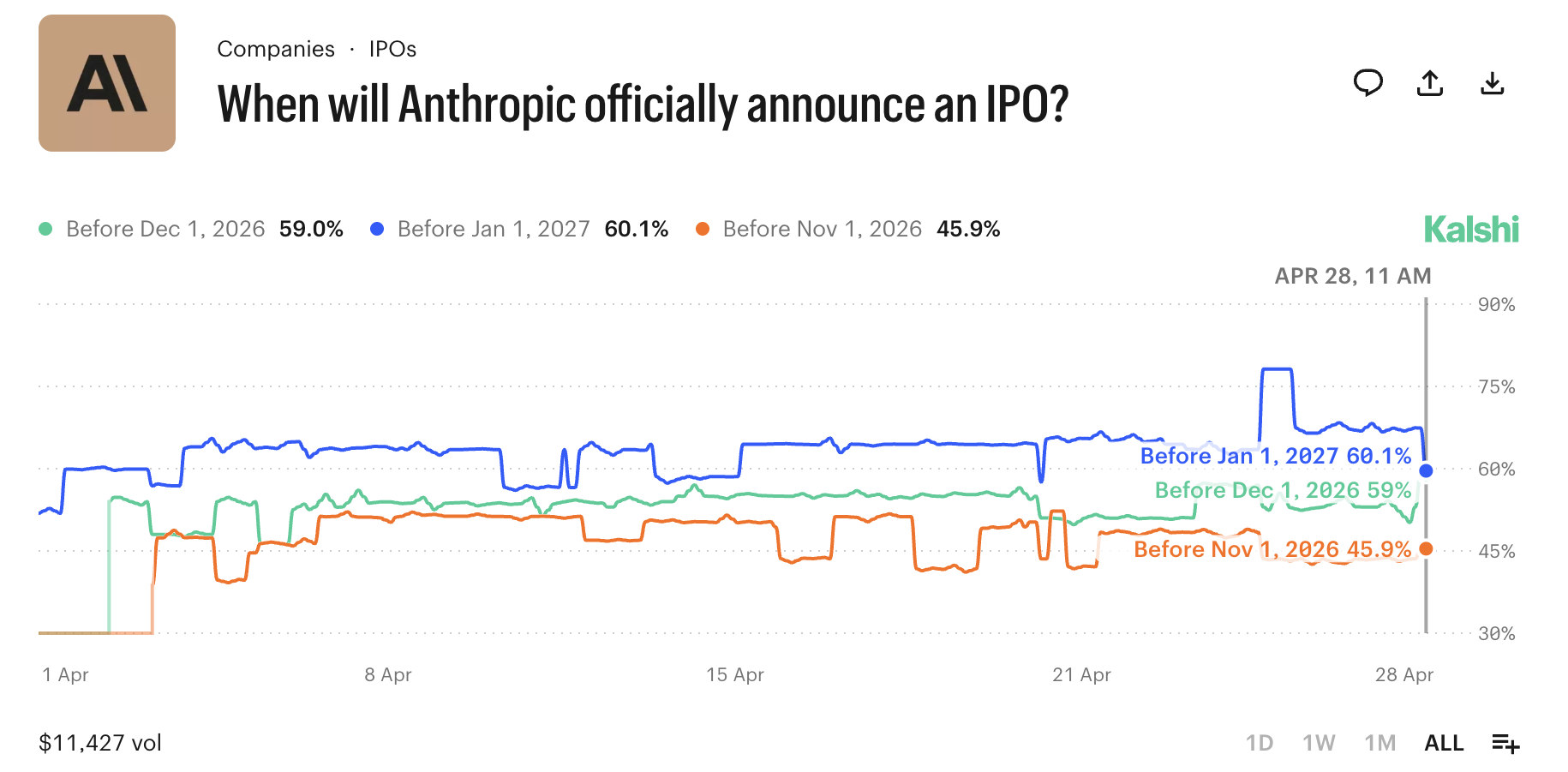
Prediction market Kalshi puts the odds of an Anthropic IPO this year at 59%. Whichever firm lists first will set the comparison for the others.
Subscribe to our YouTube channel to watch leaders and journalists provide expert insights
The post Anthropic’s Pre-IPO Valuation Hits $1 Trillion on Jupiter appeared first on BeInCrypto.
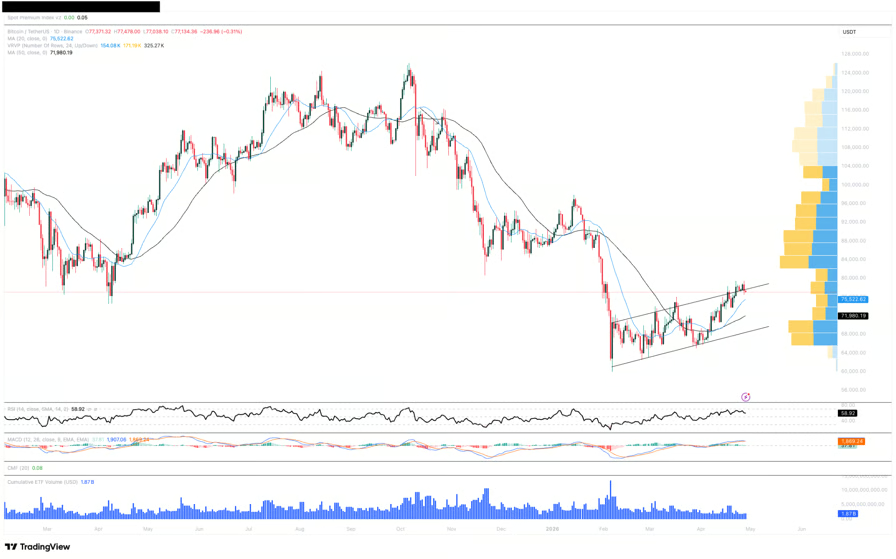
Bitcoin bulls fell $515 short of their $80,000 target after BTC (BTC) topped out at $79,485 on Monday, but a potential upside is that the brief pullback provides a necessary retest of key underlying levels.
In technical analysis, a break of structure is generally followed by a support-resistance retest as swing traders take profits at preset levels that align with metrics such as the Fibonacci retracement, exponential moving averages, Bollinger Bands, order book structure, and more. The support-resistance flip is also a feature traders look for to confirm that a longer-term resistance (in this case) has turned into support. When confirmed, it gives some traders the confidence to open new positions at the S/R level as they believe the break of structure and retest marks either the completion or the start of a trend reversal.
After managing the first decisive breakout from the three-month-old channel, Bitcoin retested the channel resistance (at $76,688) that had pinned down every BTC rally since Feb. 8. A deeper retest could see the price drop to the 20-day moving average at $75,250, and then confirmation of the S/R flip would entail daily candle closes above the former trendline resistance.
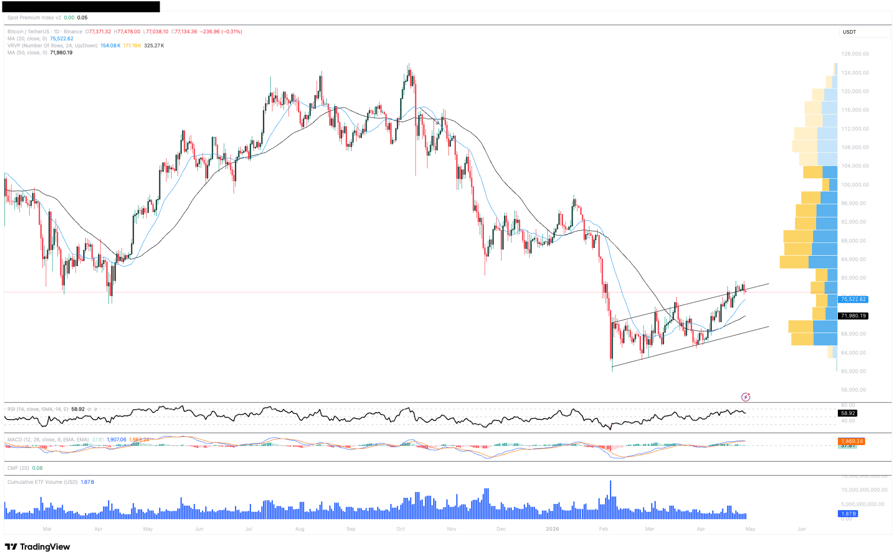
BTC/USDT 1-day chart. Source: TradingView
Outside of the naked price action from the candlestick chart, the long-to-short delta (heatmap below) shows longs currently with the advantage, with a -$38.6 million delta, and the figure widens to -$153 million if BTC rises to $77,500.
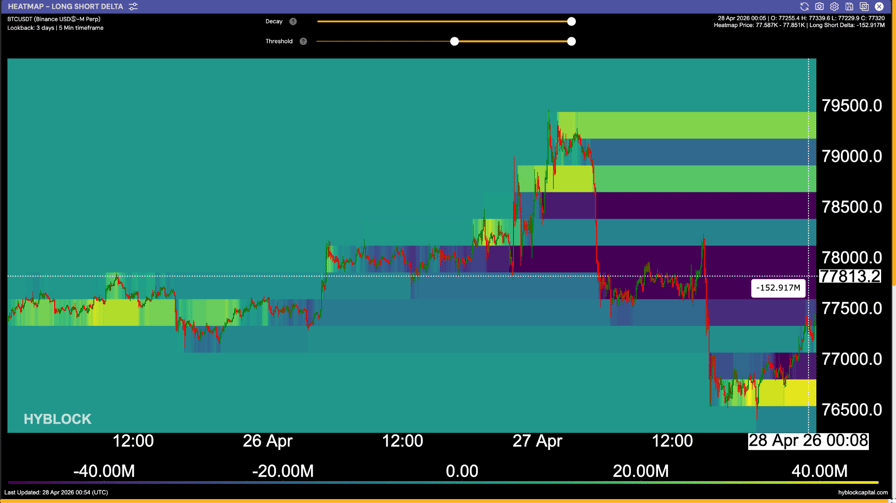
BTC/USD long-short delta. Source: Hyblock
Essentially, the SR flip from the Monday US morning session liquidated long positions down to $76,500, potentially confirming the trendline resistance as support. As the price rebounds, the chart shows shorts having significantly more leveraged exposure at risk.
Related: Bitcoin shorts create $1.4B liquidation risk: Is a price squeeze to $80K next?
Bulls may succeed in pushing the price through the most immediate overhead shorts and returning BTC to its range highs below $80,000, but the aggregate orderbook set at 2.5% to 5% shows a wall of asks stacked from $79,700 to $80,000. This suggests that clearing the $80,000 level could remain a challenge in the short-term.
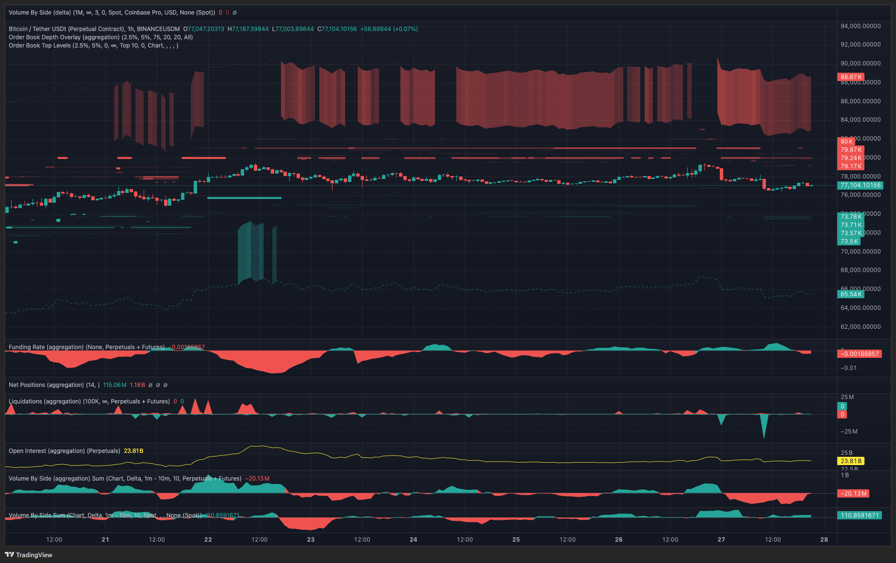
BTC/USDT orderbook bids and asks. Source: TRDR.io

Robinhood users are confronting a new phishing campaign that rides on Gmail’s native dot alias feature and weaknesses in the platform’s account-creation flow. The emails, which appear to originate from Robinhood’s mail server, warn of an unrecognized device login and direct recipients to malicious sites via a deceptive call-to-action button.
Early reports on social media show users receiving messages that look like legitimate Robinhood alerts. The attackers exploit Gmail’s dot-insensitivity to register nearly identical-looking accounts, then leverage a flaw in Robinhood’s onboarding flow to inject forged content into the automated emails. The result is an email that can slip past common defenses and prompt a user to click through to a phishing page.
Key takeaways
- The attack leverages Gmail’s dot alias behavior to route phishing emails to a target’s inbox by creating Robinhood-style accounts that differ only by a dot in the address.
- Fraudsters embed HTML instructions in the optional “device name” field during Robinhood’s account creation, which Gmail treats as formatting, enabling a seemingly legitimate email with a malicious phishing link.
- The forged message can pass standard email authentication (SPF, DKIM, DMARC), making the email appear trustworthy and increasing the likelihood of a click on the phishing button.
- Victims are at risk mainly if they enter credentials on the fake site; the mere visit does not grant access, but credential input can lead to account compromise.
- Robinhood confirmed that the incident involved abuse of the account creation flow, not a breach of its systems or customer accounts, and no personal data or funds were reported as impacted.
The exploitation mechanics
Experts describe a two-pronged method that underpins the campaign. First, scammers create Robinhood accounts using email addresses that differ only by the presence or absence of a dot in Gmail’s address handling, such as “jane.smith@gmail.com” versus “janesmith@gmail.com.” In the eyes of Robinhood, these are distinct accounts, but Gmail routes mail to the same inbox, enabling fraudsters to seed legitimate-looking communications under a target’s actual address.
Second, attackers exploit the account-creation flow by injecting HTML into the optional “device name” field. Gmail interprets field content as formatting, allowing a phony email to contain a credible header and a convincing call to action. The crafted email can pass SPF, DKIM, and DMARC checks, making it appear as though it truly originates from noreply@robinhood.com. When a recipient clicks the phishing button, they are taken to a counterfeit login page designed to harvest credentials.
Robinhood’s response and user guidance
Robinhood’s official stance was communicated through its support account on X, which acknowledged that some users received a falsified email from “noreply@robinhood.com” with the subject line “Your recent login to Robinhood.” The company attributed the issue to an abuse of the account-creation flow and stressed that there was no breach of Robinhood’s systems or customer accounts, and that personal information and funds were not impacted.
“This phishing attempt was made possible by an abuse of the account creation flow. It was not a breach of our systems or customer accounts, and personal information and funds were not impacted. If you received this email, please delete it and do not click any suspicious links. If you have clicked a suspicious link or have any questions about your account, please contact us directly within the Robinhood app or website.”
Security researchers emphasize prudence: users should avoid clicking unfamiliar links, delete suspicious messages, and contact official Robinhood channels for account questions. The episode also underscores the need for vigilance around onboarding flows and the resilience of email authentication measures, which attackers now appear capable of circumventing in targeted contexts.
Industry context and what’s next
The phishing wave hitting Robinhood arrives amid a broader trend in crypto-security risk. Hacken, a blockchain security firm, reported earlier this month that phishing and social engineering dominated crypto attacks in the first quarter of 2026, accounting for about $306 million in losses. The finding highlights a persistent vulnerability vector in the crypto ecosystem, where attackers increasingly blend social manipulation with technical exploits to bypass conventional safeguards.
For investors, traders, and builders, the episode reinforces several practical considerations. Platforms must tighten onboarding checks to prevent impersonation through dot aliases or other address-equivalence tricks, while improving email authentication and leveraging behavioral signals to distinguish genuine messages from forged ones. Users should practice heightened skepticism with any alert that requests action within a financial app, especially when a message prompts credential input or redirects to a login page. Enabling two-factor authentication, staying within official apps or websites for sign-in, and cross-checking any unusual activity with direct support channels become critical defensive habits in this environment.
Looking ahead, observers will be watching how Robinhood and other platforms shore up their onboarding processes and email security controls. Investigators will also assess whether additional victims were targeted and whether similar dot-alias techniques are leveraged in other services. For now, the incident serves as a pointed reminder that even well-known fintech apps remain vulnerable to technically simple yet highly effective social engineering plays when combined with misconfigurations in onboarding flows.
Readers should watch for updates from Robinhood on account-flow protections and for guidance from security researchers on mitigations that can be deployed both by platforms and by users to reduce exposure to this evolving tactic.
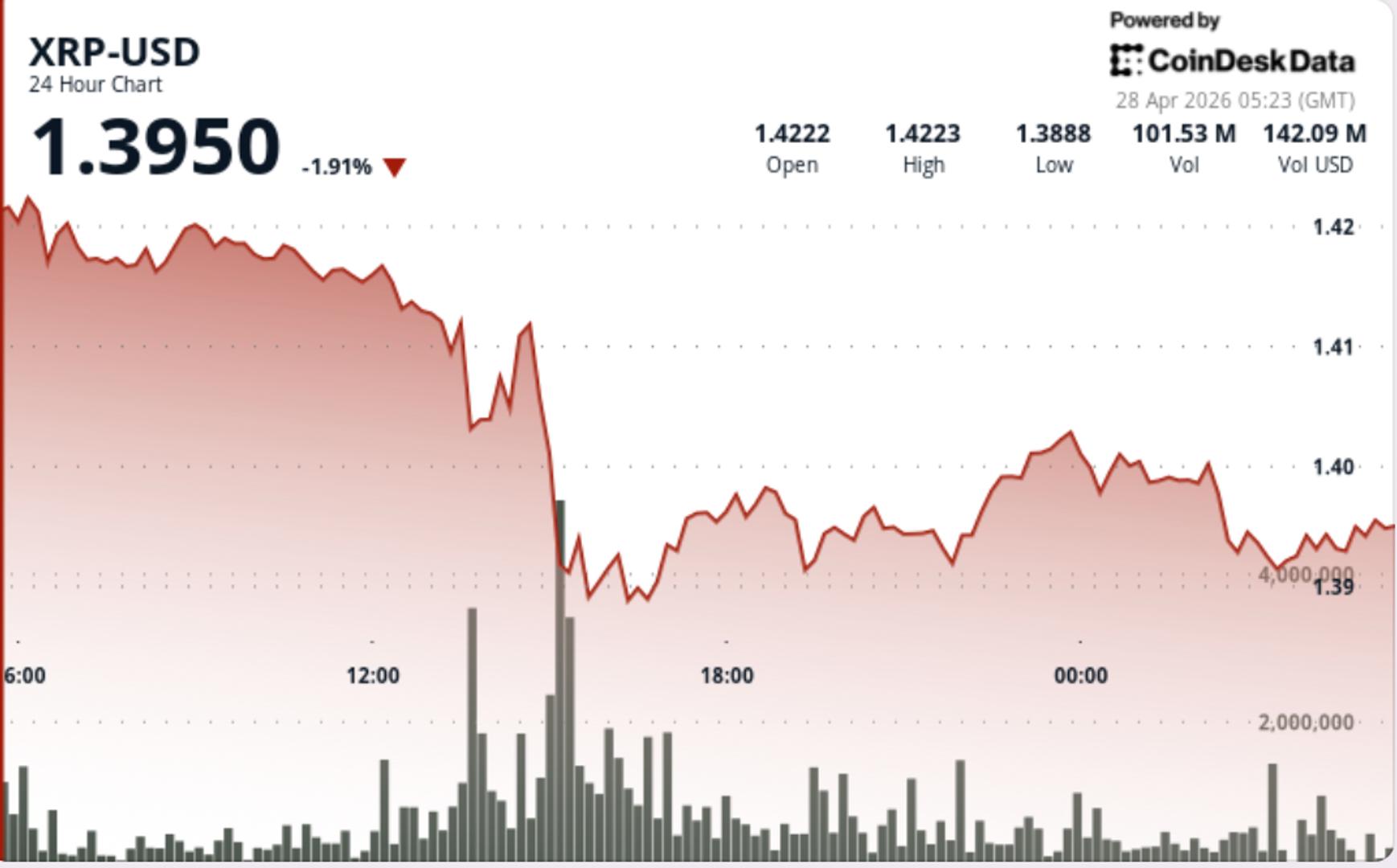
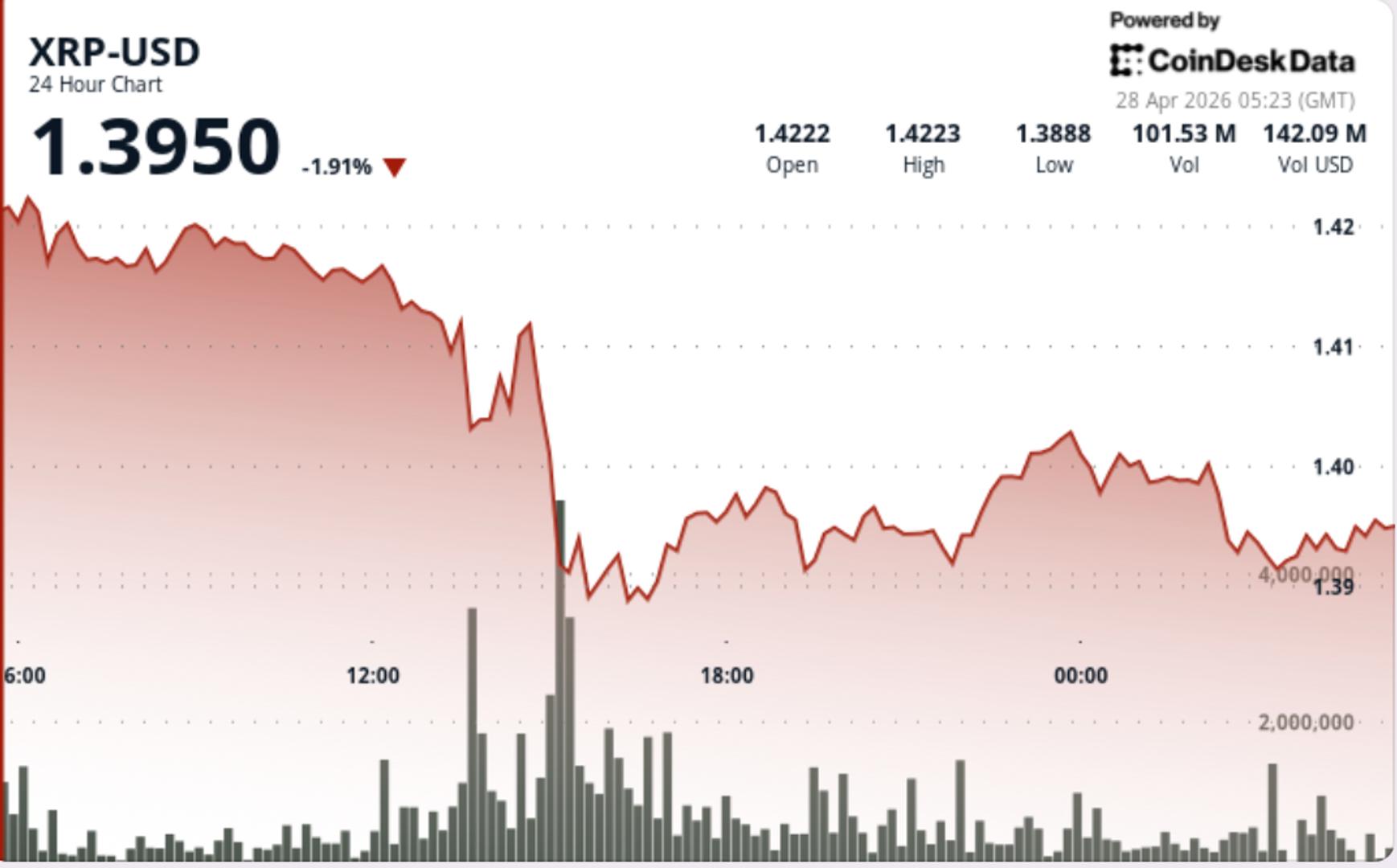
XRP finally gave way at $1.40, and the way it broke matters more than the move itself. This wasn’t a slow drift lower. It was a high-volume push that cleared a level buyers had defended for weeks. Once that kind of support goes, it usually doesn’t snap back quickly. It tends to flip, and that’s exactly the test now.
News Background
• Bitcoin dominance pushed toward 60%, reinforcing a rotation out of altcoins and limiting follow-through demand for XRP.
• The multi-month triangle structure that had been compressing price finally resolved, with the move breaking lower instead of triggering the expected upside expansion.
Price Action Summary
• XRP dropped from $1.44 to $1.39, breaking cleanly through the $1.40 support zone.
• The move was driven by a sharp spike in participation, not thin liquidity.
• Price is now stabilizing just below the breakdown level, trading in a tight $1.39–$1.40 range.
Technical Analysis
• The key shift is structural. $1.40 was support, now it’s resistance unless reclaimed quickly.
• Volume expanding into the breakdown confirms real selling pressure, not just positioning noise.
• The triangle pattern that held price for weeks has resolved lower, removing the compression support.
• Short-term bounces are showing up, but they’re reactive, not strong enough to reverse the move yet.
What traders should watch
• $1.40 is now the pivot. Reclaim it with volume, and the breakdown starts to look like a fakeout.
• $1.37 is the next downside level. Losing that opens the path toward deeper support near $1.31.
• If price keeps holding below $1.40, sellers stay in control and rallies are likely to get sold.


Canada has advanced a bill to block cryptocurrency donations in federal elections, pushing tighter controls on how political funding is handled.
Summary
- Canada’s Bill C-25 has cleared second reading in the House of Commons, moving the proposal to committee for detailed review.
- The legislation seeks to ban cryptocurrency donations to political parties and candidates, citing concerns over traceability and compliance with funding rules.
According to Canada’s House of Commons, Bill C-25, known as the Strong and Free Elections Act, cleared its second reading on Friday, allowing lawmakers to move the proposal to committee for detailed review and possible amendments.
Tabled on March 26, the bill would bar political parties and candidates from accepting crypto contributions, with regulators identifying digital assets as a gap in existing campaign finance rules. Lawmakers backing the measure have linked the restriction to concerns around verifying the source of funds and enforcing contribution limits under current law.
No timeline has been set for the committee stage, leaving the pace of further progress dependent on parliamentary scheduling.
The decision to restrict crypto in elections is unfolding alongside efforts to define how digital assets fit within the financial system. Regulators have been working on stablecoin oversight frameworks that would expand the role of the central bank while refining rules for custody, investment funds, and storage practices.
Policy direction has taken shape under Prime Minister Mark Carney, who has previously expressed skepticism toward cryptocurrencies. Despite that, Canadian authorities have continued to build a structured regulatory approach, separating financial system integration from political use cases where tighter limits are now being proposed.
Crypto donations face growing scrutiny across democracies
Debate around crypto-linked political funding has intensified beyond Canada, with similar concerns raised in other jurisdictions. In the United Kingdom, the Joint Committee on the National Security Strategy warned in its March 18 report that cryptocurrency donations pose risks to transparency and national security due to difficulties in tracing their origin.
The UK committee called for an immediate halt to such donations until clearer rules are introduced, citing the possibility of foreign actors attempting to influence political outcomes. Lawmakers also proposed stricter disclosure thresholds and stronger penalties tied to foreign funding violations.
JPMorgan Emerging EMEA fund faces suspended Russian lawsuit

ZetaChain halts transfers as DefiLlama reports $300K loss

MPs mark Workers’ Memorial Day, warning safety cuts are putting lives at risk

Manchester United reach agreement with Casemiro over contract clause amid transfer speculation

US brings back mandatory military draft registration

Steven Gerrard disagrees with Gary Neville over ‘shock’ Chelsea and Arsenal claim | Football


-

 Fashion4 days ago
Weekend Open Thread – Corporette.com
-

 Tech13 hours ago
Register Renaming | Hackaday
-
 Crypto World2 days ago
Hyperliquid $HYPE Rally Builds Momentum as AI Sector Enters Prove-It Phase
-

 Politics6 days ago
Making troops accountable for war crimes threatens US alliance, ex-SAS colonel warns
-

 Politics6 days ago
Disabled people challenge government SEND proposals over segregation concerns
-

 Business4 days ago
Patterson-UTI Energy, Inc. (PTEN) Q1 2026 Earnings Call Transcript
-

 Business6 days ago
Rolls-Royce Voted UK’s Most Iconic Trade Mark as IPO Register Hits 150
-
 Crypto World7 days ago
Five Value Stocks with Recovery Potential in 2026: PayPal (PYPL), Nike (NKE), and More
-
 Sports2 days ago
IPL 2026: Ruturaj Gaikwad registers slowest fifty of the season, enters all-time unwanted list | Cricket News
-

 Politics6 days ago
Starmer handler McSweeney to be dragged from shadows by Foreign Affairs Committee
-

 Crypto World6 days ago
New York sues Coinbase, Gemini over prediction market offerings
-

 Politics6 days ago
Zack Polanski responds to home secretary’s taser threat
-

 Politics9 hours ago
Drax board avoid their own AGM, accused of greenwashing & environmental racism
-
Politics6 days ago
Wings Over Scotland | How To Get Away With Crimes
-
Entertainment7 days ago
Sydney Sweeney cameo cut from “The Devil Wears Prada 2”, source explains why (exclusive)
-

 Crypto World6 days ago
Crypto’s great hope in Senate’s Clarity Act still has a path to survive tight calendar
-
 Business6 days ago
HCL Tech share price tank over 9% after weak Q4. JPMorgan, HSBC & 3 others cut target price
-

 Politics5 days ago
‘Iran is still a nuclear threat’
-

 Fashion7 days ago
Kilkenny Design New Beauty Arrivals for Spring 2026
-
 Sports5 days ago
Tim Bradley names the current best in the world: “Better than Inoue and Usyk”
You must be logged in to post a comment Login