
Crypto World
Bitcoin Climbs to 11-Week High as US Treasury Expands Debt Buybacks

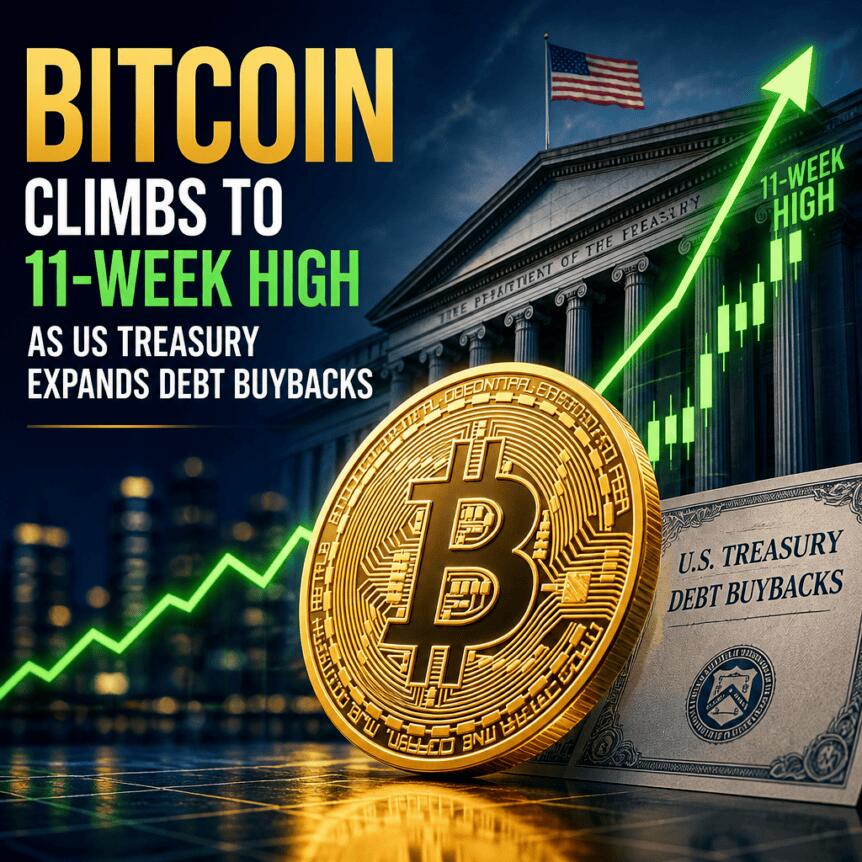
Bitcoin climbed to its highest level since early June as trading picked up during the Wall Street open and US markets reacted to a government liquidity plan. By the time of writing, BTC was up roughly 6% on the day and trading above $69,700 on Bitstamp, pushing it to about $69,749—its strongest point since June 2, according to TradingView data.
The catalyst was a US Treasury announcement that aims to expand the size of certain debt buyback operations, a move that eased pressure in bond yields and encouraged broader risk appetite. But crypto-specific liquidity signals also suggest the rally may face friction: Bitfinex highlighted that stablecoin liquidity on exchanges has been shrinking, which it argues can leave upside “unfunded.”
Key takeaways
- Bitcoin rose about 6% to $69,749, its highest level since June 2, as the Wall Street session coincided with a shift in US bond yields.
- The US Treasury plans to at least double the maximum size of some debt buybacks to $4 billion per operation starting Sept. 9, supporting liquidity in longer-dated nominal debt.
- Following the announcement, the US 30-year yield fell to around 5.19% at the time of writing (down 9 basis points), helping lift risk assets.
- Bitfinex warned that declining stablecoin supplies on exchanges—down $14 billion since May—could cap the durability of Bitcoin’s rebound.
- CryptoQuant data shows stablecoin liquidity tightening recently, with its Stablecoin Supply Ratio rising further since the end of June.
US Treasury buyback plan cools yields, lifts risk appetite
US stock markets opened higher after the US Treasury Department said it would increase the maximum size of government debt buybacks to at least $4 billion per operation, up from $2 billion. The Treasury stated this applies to operations beginning on Sept. 9.
In the bond market, the yield on the US 30-year note—previously pushed higher and described in earlier coverage as reaching its highest level in nearly 20 years—dropped immediately on the news. At the time of writing, the 30-year yield was around 5.19%, down 9 basis points, according to the report’s TradingView reference.
In a press release, the Treasury said larger buyback sizes reflect its goal of providing more liquidity support in longer-dated nominal sectors where it receives consistently strong participation in such operations. The filing frames the change as a liquidity enhancement rather than a straightforward reduction in debt.
One point of emphasis from financial commentary was that scaling buybacks does not equal debt paydown. Peter Boockvar, chief investment officer at One Point BFG Wealth Partners, was quoted by CNBC saying it is “just a rearrangement of the maturity schedule of Treasuries.”
Meanwhile, the broader context remains that US national debt continues to trend upward toward the $40 trillion mark, with interest costs also climbing—an issue highlighted by trading resource The Kobeissi Letter using data it said came from Bank of America, forecasting rising interest payments if rates stay steady.
Why bond-market liquidity can matter for Bitcoin
Bitcoin’s sensitivity to macro liquidity is not new, and the timing of this move—during the Wall Street open—underscores how quickly changes in US rates can spill into crypto positioning. When yields ease, investors often rotate toward risk assets, while improved market liquidity can help shorten the time it takes for speculative capital to reach higher-beta markets.
Still, the mechanism here is indirect: the Treasury announcement concerns government debt operations, while Bitcoin trades based on a mix of macro flows and crypto-native liquidity conditions. That is where the next layer of the story becomes important.
Stablecoin liquidity shrinks, raising questions about rally “fuel”
While the macro tailwind helped lift BTC, Bitfinex pointed to an internal constraint within crypto markets. In comments shared on X, the exchange argued that the rally remains “unfunded” until stablecoin supply on exchanges starts to improve.
Bitfinex said stablecoin liquidity on exchanges has decreased by $14 billion since May. It described stablecoin supply as “dry powder” waiting on the sidelines—liquidity that can be deployed into cryptoassets when conditions are right. If that liquidity continues to leave exchanges, the exchange suggested there may be less capacity for sustained buying pressure even if headlines in traditional markets look supportive.
Bitfinex’s message matters because stablecoins often function as the immediate bridge between fiat or offshore liquidity and crypto trading activity. When stablecoin reserves decline on exchanges, traders may find less readily available collateral or less immediate inventory for new positions, which can dampen follow-through after an initial price pop.
To quantify the trend, the article cited CryptoQuant’s Stablecoin Supply Ratio (SSR) indicator, which compares Bitcoin’s market cap relative to the aggregate stablecoin market cap. According to the referenced data, stablecoin liquidity tightening has been most visible over the last six weeks.
The SSR rose as stablecoin liquidity moved away from exchanges: since June 30, the indicator increased from 9.82 to 11.69. The source also noted that the highest SSR reading in 2026 was 12.83 on Jan. 14, offering a benchmark for how elevated liquidity pressure has become during earlier parts of the year.
What to watch next: whether liquidity returns to exchanges
Bitcoin appears to have captured a macro-driven bid, but the durability of the move may hinge on whether stablecoin liquidity continues to contract—or stabilizes and starts returning to exchanges. Traders and investors watching the next leg of price action may want to track not just bond yields, but also exchange stablecoin balances and CryptoQuant’s stablecoin liquidity indicators for signs that the “dry powder” Bitfinex referenced is either missing or beginning to reappear.



Ethena and FalconX have launched a $1 billion secured lending facility that will use assets backing USDe to finance overcollateralized loans for institutional borrowers.
Summary
- The $1 billion facility will direct part of USDe’s backing assets into secured institutional loans.
- FalconX will originate and service the loans through a special purpose vehicle.
- Qualified custodians will hold collateral valued above each borrower’s outstanding loan.
- Institutional lending accounted for $310 million, or 6.9%, of USDe backing in early July.
How the $1 billion USDe facility will work
FalconX and Ethena said the warehouse financing arrangement will give FalconX capital to extend secured loans to institutional clients for trading, corporate treasury operations, and payment-related services.
Operating through a special purpose vehicle, FalconX will originate the loans, assess borrowers, service the credit, and manage the collateral. Qualified third-party custodians will hold the assets securing each position rather than leaving them under the borrower’s direct control.
Borrowers must pledge assets worth more than the amount they receive, creating a buffer that FalconX can use if the collateral loses value. Ethena will retain a first-priority security interest over assets held within the facility, according to the company’s announcement.
Collateral values, margin requirements, and liquidation procedures matter because falling crypto prices can quickly reduce the protection created by overcollateralization. While the structure can limit potential losses, it does not remove market, custody, operational, or counterparty risks.
FalconX will provide financing across several institutional activities, with both companies planning to increase deployments when borrowing demand supports additional loans. Neither party disclosed the interest rates, loan durations, eligible collateral, or minimum collateral ratios that will apply across the full facility.
Guy Young, founder of Ethena Labs, described institutional credit as a large and established source of returns that on-chain capital has rarely accessed.
“Partnering with FalconX gives us a secured, overcollateralized channel into institutional credit,” Young said.
FalconX Head of Credit Craig Birchall said the agreement would let the company provide secured financing for several institutional uses as digital asset lending becomes more connected with other capital-market services.
Ethena adds institutional credit to USDe backing
For Ethena, the facility introduces another source of returns for the portfolio supporting USDe, a synthetic dollar designed to track the value of the U.S. dollar.
USDe has historically relied on crypto collateral and hedged derivatives positions, including short futures positions intended to offset changes in the value of backing assets. Returns can come from funding payments, staking rewards, liquid stablecoins, tokenized assets, and lending arrangements.
Institutional loans had already become part of the reserve structure before the FalconX agreement. Ethena’s June governance report placed the segment at about $310 million, equal to 6.9% of USDe backing as of July 3, with an estimated annual yield of between 4% and 7%.
By comparison, DeFi lending accounted for roughly $2 billion, or 46%, across Aave, Morpho, Kamino, and Jupiter. Liquid stablecoins represented about 35% of the portfolio, while tokenized real-world assets made up 11.2%.
Crypto basis positions, once a central part of Ethena’s model, had fallen to around $39 million, or 1% of the backing portfolio. The same governance report recorded a backing ratio of 101.59%, a reserve fund of approximately $62 million, and nearly $1.2 billion in stablecoins available to process redemptions.
The figures show that Ethena was already reducing its reliance on derivatives-based returns before allocating additional capital to FalconX. Credit exposure carries a different set of risks because returns depend on borrower performance, collateral quality, enforceable legal claims, and a lender’s ability to liquidate pledged assets promptly.
Ethena’s institutional lending framework requires separate reviews for each counterparty. The protocol also includes off-chain credit positions in its proof-of-reserves reports and transparency dashboard, allowing users to see how much backing has been allocated outside DeFi markets.
FalconX joins Anchorage Digital, Maple Institutional, and Coinbase Asset Management among the counterparties approved under the program during March and April.
FalconX relationship expands beyond USDe trading
The lending facility builds on FalconX’s previous integration of the synthetic dollar. In September 2025, FalconX added USDe support across parts of its spot, derivatives, and custody operations.
Approved institutional clients gained access to over-the-counter liquidity and could hold USDe or use it as collateral for selected credit and derivatives transactions. The new arrangement reverses part of that relationship by allowing USDe backing assets to fund loans originated through FalconX.
Ethena has also connected USDe with other institutional platforms. As crypto.news reported in June, BlackRock integrated the synthetic dollar into Aladdin, an investment and risk management system used by institutions overseeing more than $20 trillion.
Ethena also selected BlackRock’s BUIDL tokenized money market fund as the main reserve asset for a white-label stablecoin product. BUIDL invests in cash, repurchase agreements, and U.S. Treasury securities, giving Ethena another reserve strategy outside its original crypto-based trades.
Public-market exposure to the Ethena ecosystem increased days before the Aladdin announcement when StablecoinX completed its merger with TLGY Acquisition Corp. The company began Nasdaq trading under the ticker USDE on June 26, with warrants listed under USDEW.
StablecoinX held about 3.03 billion ENA tokens valued at approximately $275 million using the 30-day average applied before the transaction closed. Its operating plan includes Ethena infrastructure, software services, and institutional distribution.
U.S. access depends on the contracting entity
For American institutions, the FalconX group operates through several affiliated entities with different registrations and permitted activities. FalconX Bravo Inc. appears on the Commodity Futures Trading Commission’s list of registered swap dealers and is a member of the National Futures Association.
FalconX Delta provides trading services to eligible U.S. institutional clients and is registered with the Financial Crimes Enforcement Network as a money services business, according to FalconX’s licensing disclosures. State money-transmitter requirements apply in jurisdictions listed by the company.
The Ethena facility, however, extends credit to a Cayman Islands segregated portfolio rather than FalconX Bravo or FalconX Delta. Its legal structure therefore depends on the contracting vehicle, the jurisdiction governing the arrangement, and the enforceability of Ethena’s first-priority claim.
For ENA holders and investors in Nasdaq-listed StablecoinX, the arrangement adds indirect exposure to Ethena’s institutional lending activity because revenue and ecosystem demand depend partly on the performance and adoption of USDe. The announcement does not state that retail customers or U.S. investors can borrow directly through the $1 billion facility.
The Federal Reserve may soon meet less often, minutes released Wednesday reveal, as Chairman Kevin Warsh floated fewer Fed meetings at just six a year. Three officials wanted a rate hike, leaving Bitcoin (BTC) facing a quieter, tougher central bank.
The Fed held interest rates at 3.50% to 3.75% on July 29, but the 9-3 vote hid a deeper split. The full minutes now show how close the committee came to raising rates.
Three Fed Officials Wanted a Rate Hike Right Now
Most officials chose to wait. However, Beth Hammack, Neel Kashkari, and Lorie Logan voted for a quarter-point hike. The three are the committee’s leading hawks, officials who favor higher rates to fight inflation.
Many others agreed a hike may come soon. They said the Fed would likely need to act if inflation does not fall. The Fed’s preferred inflation gauge ran at 3.7% in June, far above its 2% goal.
Officials also saw more risks ahead. Many warned the Middle East conflict could keep supply costs high. Others said the price impact of past tariffs had mostly played out.
Artificial intelligence (AI) split the room too. Some officials said the AI boom is already pushing prices up. Others expect it to cut costs and cool inflation later.
Nearly all members kept one clear promise in the statement. The Fed “will deliver price stability.” The July hold had already spooked bond markets, pushing long-term yields to their highest since 2007.
Why Fewer Fed Meetings Under Warsh Matter for Bitcoin
Warsh’s pitch is simple. Six meetings a year, roughly every two months, would give the Fed more data before each call. No decision was made, and the 2026 calendar stands. However, the idea is now officially on the table.
It fits a bigger pattern. Warsh has already cut statements short and stopped hinting at future moves. Fewer meetings would mean fewer signals for traders to trade on.
That matters for crypto. Bitcoin moves on Fed expectations, and a quieter Fed is a harder Fed to read. Fewer scheduled decisions could also mean sharper market swings when they land.
The pressure is real. Traders entered July pricing a one-in-three chance of a hike, per the minutes. A full quarter-point move was priced in by September.
Higher rates have already hurt. Bitcoin has lagged gold this year as 5% Treasury yields pulled money toward safer assets.
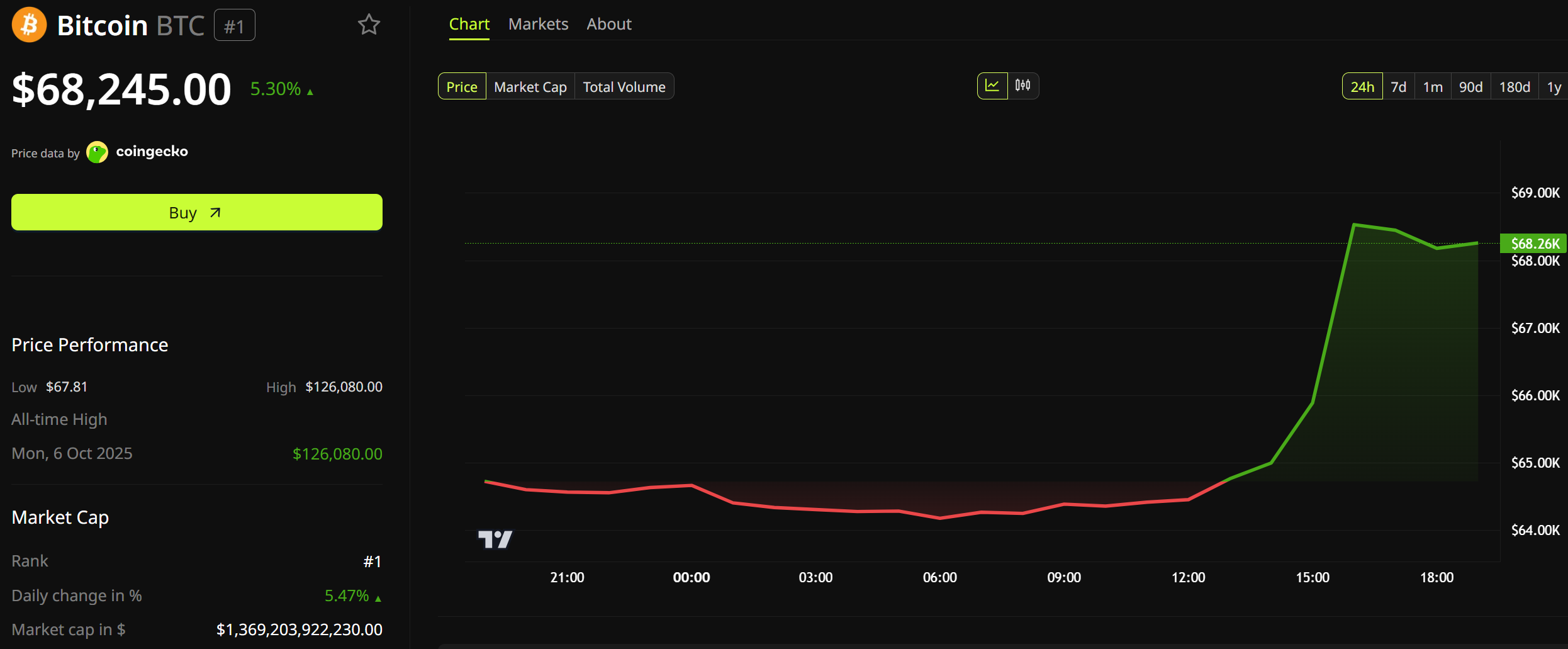
BTC price traded near $68,245 after the release, up 5.3% in a day, per BeInCrypto Markets data.

The tough tone quickly added pressure on Bitcoin. The next big test comes on September 15-16. Markets will then learn if the hawks grow louder or finally get their hike.
The post Fed Minutes Pressure Bitcoin as Hawkish Rate Risks Return appeared first on BeInCrypto.


As students go back to school in the midst of record-breaking summer heat, many are returning to overheating classrooms whose aging air conditioning systems can’t keep up with extreme heat waves—if they even have air conditioning at all.
Extreme heat has already caused school closures and disruptions across the country. In July, Milwaukee Public Schools shut down its Summer Academy and other indoor school programs for two days because of extreme heat. One day in May, 57 Philadelphia schools went remote and canceled all in-person activities due to soaring temperatures. That same month, a Washington, D.C. high school carried out a “heat evacuation” as classroom temperatures reached the mid-90s. Eight elementary schools in Doylestown, PA also closed for a day because old buildings couldn’t protect students from the heat. And in recent years, schools in Memphis dismissed students early as temperatures climbed to 110 degrees.
During the 2024-25 school year alone, more than 9 million students at 10,000 schools nationwide experienced extreme heat- and weather-driven school closures or disruptions. These are not isolated inconveniences. They are warning signs that our school buildings and grounds were not designed for today’s new weather patterns.
It’s important to understand that students struggle to learn in hot, stuffy classrooms. Air quality, temperature, and ventilation can affect how students think, focus, and perform. Poor ventilation can impair cognitive function, while excessive heat diverts the body’s energy from learning, slows reaction time, and weakens attention.
In fact, research has shown that in schools without cooling, each 1° Fahrenheit increase in school year temperature reduces the amount learned that year by approximately 1%.
Extreme temperatures (80 to 90 degrees Fahrenheit and above) are known to exacerbate student absenteeism and disciplinary referrals, while poor indoor environments can also contribute to the spread of illness and exacerbate respiratory conditions like asthma, one of the leading causes of missed school days. Younger children, whose bodies and brains are still developing, are especially susceptible.
In medicine and education alike, we have seen how the environments where people spend their time can directly affect their health, well-being, and ability to thrive. We would never accept these conditions in a hospital. We should not accept them in a classroom.
At the same time, outdated heating and cooling systems are placing a growing financial strain on school districts. Across the country, energy costs are rising and becoming more unstable. For school leaders, that often means tradeoffs: dollars spent on inefficient energy systems are dollars not spent directly on teaching and learning. But there is a better path forward.
Modern HVAC systems, often paired with on-site solar energy, offer schools a way to deliver reliable heating and cooling while reducing exposure to volatile fossil fuel costs. These solutions can stabilize energy budgets over time and are increasingly supported by domestic manufacturing, including the production of heat pumps here in the United States.
Just as important, new federal tools make these upgrades far more accessible than they once were. Through energy tax credits and a mechanism known as Elective Pay, public school districts can receive direct financial support to invest in these improvements. That means lower upfront costs and faster payback, turning what was once out of reach into a practical, near-term option.
We are already seeing what this looks like in practice.
In Indiana, Center Grove Community Schools are demonstrating how modern HVAC upgrades can improve classroom comfort while helping manage energy costs, in part by replacing aging boilers, chillers, and fan coils with a geothermal heat pump system. In Virginia’s Prince William County, at the heart of the nation’s data center corridor, district leaders are acting to shield their budgets from steep projected utility increases. And in Wisconsin, a school in Menasha modernized its facility with a ground-source heat pump system, solar panels, and energy storage to deliver better air quality, lower costs, and create local jobs.
The benefits extend well beyond temperature control. Students are better able to focus and learn. Districts gain predictability in their operating costs. And communities benefit from more resilient, efficient infrastructure that reduces strain on the grid during periods of peak demand.
For school and district leaders, this moment calls for action. Now is the time to explore how these solutions can work in your community.
The environments we live in shape the health within us. Nowhere is that more immediate, or more consequential, than in the classroom.
We can improve student health and learning, strengthen our schools, and protect public resources at the same time. And we have real-world proof from communities across the country that this is not only possible, but doable.
The real risk is not the price of modernization, but the cost of continuing to send students and teachers into unhealthy, inefficient buildings unprepared for the realities ahead.

A proud father
The recording ends with a gift and a form of severance. “I’m not giving you the money, but I’m giving you your freedom. I hope you use it wisely,” Lucky says. “I love you, Dad. But you won’t see me again. Goodbye.” John thumps the bear against the dashboard, pulls over, gets out, stares at the horizon, and laughs.
Ask the showrunners what that laugh contains and they answer, independently, with the same word. “I saw it as pride,” Tropper says, with John thinking, “if she was able to pull this on me, I taught her well.” Pappas echoes the sentiment. “After absorbing the blow, he almost makes it again about himself. Like, look at how well I taught her,” she says. His laugh is also a reversal, of sorts: hours before his abduction, John told Lucky he was proud of the ways she isn’t like him. But the laugh is pride in the way she is.
For Taylor-Joy, the message is the closure the relationship never offered between father and daughter in person. “[John] is a person who will continuously dismiss her, not listen to what she’s saying,” she says, adding, “If she’s going to have a shot in hell of living a decent life, he just can’t come with her.” Pappas calls the goodbye a look at the “tension of opposites.” Two things can both be true: John can be bad for Lucky, and she can know it, but he’s also her dad, and there’s no undoing that. Tropper, meanwhile, has no illusions about what John does with his life. “He’ll be back in jail in a year or two,” he says.
Crypto World
SEC Regulatory Proposal Marks ‘Important’ Step Forward From ‘Inapt’ Crypto Rules: Commissioner Peirce


The Securities and Exchange Commission’s (SEC) new regulatory proposal marks a significant step forward from a set of “inapt” crypto rules to clearer and more enforceable digital asset regulations, according to Commissioner Hester M. Peirce.
A “whole generation has struggled with the SEC’s insistence” and the application of “a set of inapt rules to crypto,” but the SEC’s new crypto guidelines mark an important step toward “putting clear, sensible, enforceable rules in place for crypto offerings,” said Peirce in a statement released on Tuesday.
SEC Chairman Paul S. Atkins also praised the initiative and said that the agency’s prior enforcement-heavy approach has “driven investment offshore, limiting the type of protections that we can provide investors here,” according to a separate statement.
In a Tuesday notice, the SEC proposed new rules to create a “clear and fit-for-purpose framework for certain investment contracts involving crypto assets,” allowing entities to raise capital while preserving investor protections.
The proposal came days after the US Senate failed to advance the Digital Asset Market Clarity (CLARITY) Act, which would provide a comprehensive framework for financial regulators overseeing the crypto industry.
On July 27, Atkins told CNBC the agency was “ready, willing, and able to come out with rules“ on digital assets if the Senate failed to pass the CLARITY Act.
Meanwhile, Galaxy Digital has cut its odds on the CLARITY Act’s chances of passing in 2026 to 10%, warning that multiple political issues remain unresolved and the Senate will have only about two to three weeks to pass it when it reconvenes on Sept. 14.
Magazine: Why Meta is choosing partners over power in its 2026 stablecoin push
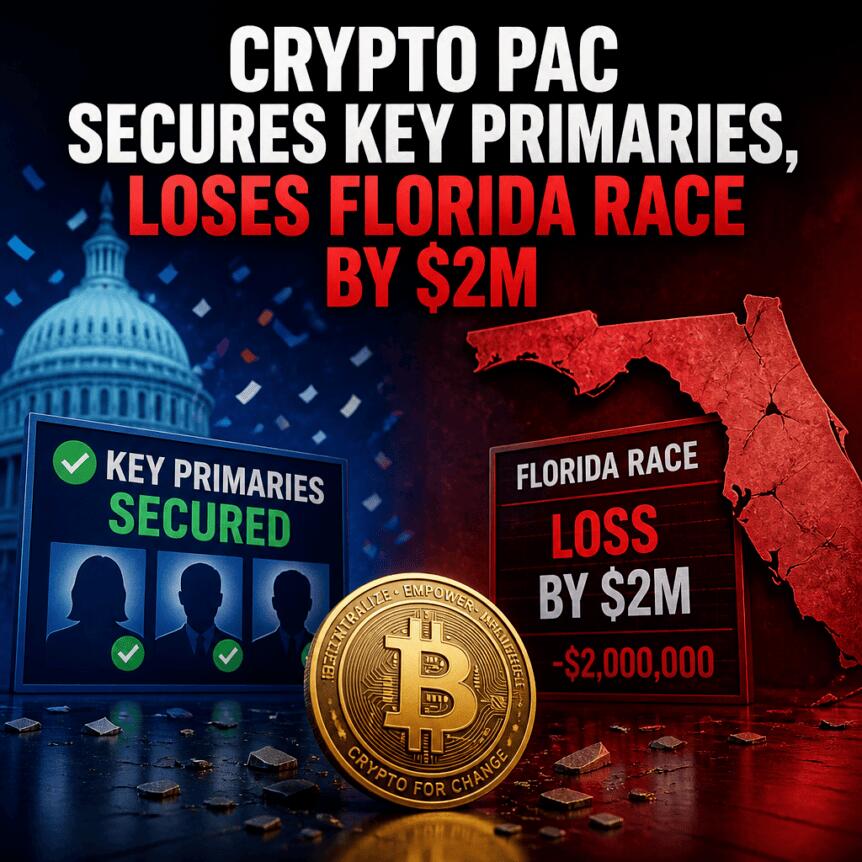
Crypto-aligned political spending appears to have delivered tangible results in key US congressional primaries on Tuesday, with four of five candidates backed by ads from the Fairshake-affiliated PAC network winning or moving forward. The outcomes across Florida, Alaska, and Wyoming offer a snapshot of how aggressively the industry is trying to shape the next Congress ahead of the 2026 midterms.
According to reporting cited in the story, Protect Progress and Defend American Jobs together spent roughly $3.6 million on House and Senate-related campaigns in those three states—supporting candidates deemed favorable to the sector and, in one Florida case, backing a candidate who was also targeted by negative advertising financed by the same PAC.
Key takeaways
- Four of the five Fairshake-PAC-backed candidates won their primaries or advanced Tuesday.
- Protect Progress and Defend American Jobs spent about $3.6 million total on targeted ads across Alaska, Florida, and Wyoming.
- Florida’s 23rd district became a clear example of positive PAC spending: Protect Progress backed Lois Frankel with more than $150,000 in supportive media.
- Florida’s 24th district showed the sector’s presence in both directions: Oliver Gilbert won despite Protect Progress-negative ads exceeding $2 million.
- Lawmakers return in September as the Digital Asset Market Clarity (CLARITY) Act is set for Senate action.
PAC-backed primary results in Florida, Alaska and Wyoming
In Florida’s 23rd congressional district, Democrat Lois Frankel won her primary after Protect Progress funded supportive media costing more than $150,000. In Alaska’s at-large congressional race, Republican Nick Begich was expected to advance after Defend American Jobs spent a combined $1.5 million across multiple campaigns supporting sector-friendly candidates.
Elsewhere, Defend American Jobs-supported candidates also performed well in their primaries. Republican Sydney Gruters won in Florida’s 16th congressional district, while Representative Harriet Hageman won the Wyoming Republican primary for the US Senate.
With primaries completed, the article indicates all four winners are likely to face opponents in November’s 2026 midterms. In other words, Tuesday’s results may function less as an end point and more as a test run for PAC-backed strategy heading into the general election phase.
Protect Progress-backed ads amid accusations of “crypto con” messaging
Florida’s 24th congressional district carried an especially pointed twist. The Democrat Oliver Gilbert defeated challengers Shevrin Jones and Kendrick Meek, securing 34.4% of the vote, even though—according to the story’s cited reporting—he was the target of more than $2 million in negative ads funded by Protect Progress.
The article also notes that Oliver Gilbert reportedly accused “Trump’s tech billionaire buddies” of backing “crypto con artists” through the Protect Progress advertising. The Miami Herald report cited in the story described ads that included fake Miami Herald headlines that allegedly misrepresented Gilbert’s policy positions, while a Protect Progress spokesperson maintained that “the underlying facts in our ad are true.”
Gilbert did not mention the crypto industry or the ads in his Tuesday night acceptance speech, according to the piece. That absence matters in two ways: first, it suggests that the candidate may be trying to frame the victory in terms other than PAC-driven controversy; second, it underscores that voters may not be treating PAC messaging as a decisive factor—or at least not in a way that prevents a favored candidate from advancing.
The episode highlights a key tension in crypto political strategy. PACs can spend heavily to shape narratives, but negative campaigning can produce unpredictable outcomes—especially when opposition candidates still win primaries despite the attempted pressure.
How big the Fairshake-linked spending is—and why it matters now
The article places Tuesday’s results against the scale of Fairshake’s political activity. It says Fairshake reported a $193 million war chest as of January, and that the committee was responsible for funding more than $130 million in ads supporting candidates it viewed as pro-crypto and opposing those it believed were hostile to the industry in the 2024 election cycle. As of June, it states Fairshake had spent more than $82 million on races ahead of the 2026 midterms.
In this context, the primary results can be read as more than local election trivia. PAC spending affects who gets positioned as the “party’s” candidate going into November. Candidates who benefit from high-budget messaging may also gain confidence and visibility that matters for fundraising, turnout operations, and general-election persuasion—even when the spending is controversial.
The story further reports that a Fairshake spokesperson, Geoff Vetter, said the PAC is “just getting started,” framing Tuesday’s outcomes as part of building what the spokesperson described as a larger pro-crypto bloc in Congress.
Congress timing and the CLARITY Act’s upcoming Senate step
Beyond the election results, the article ties the political calendar to legislative momentum. Both the US House and Senate are on recess until September. It also states the Senate is scheduled to address a cloture motion related to the Digital Asset Market Clarity (CLARITY) Act, legislation expected to establish broader regulatory coverage for digital assets.
The piece notes that the bill passed the House in July 2025 with bipartisan support on a 294-134 vote. It also highlights that Senate Democrats have been pushing for stronger ethics provisions linked to the Trump family’s reported crypto investments, and that these concerns could affect whether the Senate proceeds quickly—or at all—with CLARITY during the current session.
Under that framing, 2026 election outcomes could shift the balance of power. If Congress changes hands after November, the article suggests lawmakers could either advance or block legislation affecting the industry—including CLARITY—especially if the measure does not move before the 2027 session.
That linkage is important for investors and builders because it connects campaign spending to the mechanics of policy. Regulatory clarity is often treated as a long-term theme in crypto, but the legislative process runs on committee schedules, floor votes, and party control. Primary elections that change who appears on the November ballot can ultimately alter which version of “clarity” becomes law.
With September looming and the Senate’s cloture motion for CLARITY on the horizon, readers should watch whether crypto-focused PAC victories translate into legislative momentum—or whether ethics-linked disputes keep CLARITY stalled. Just as importantly, the Florida 24th district result suggests that even heavy negative advertising funded by the sector is not guaranteed to derail candidates, leaving uncertainty about how far political spending can reliably control outcomes.
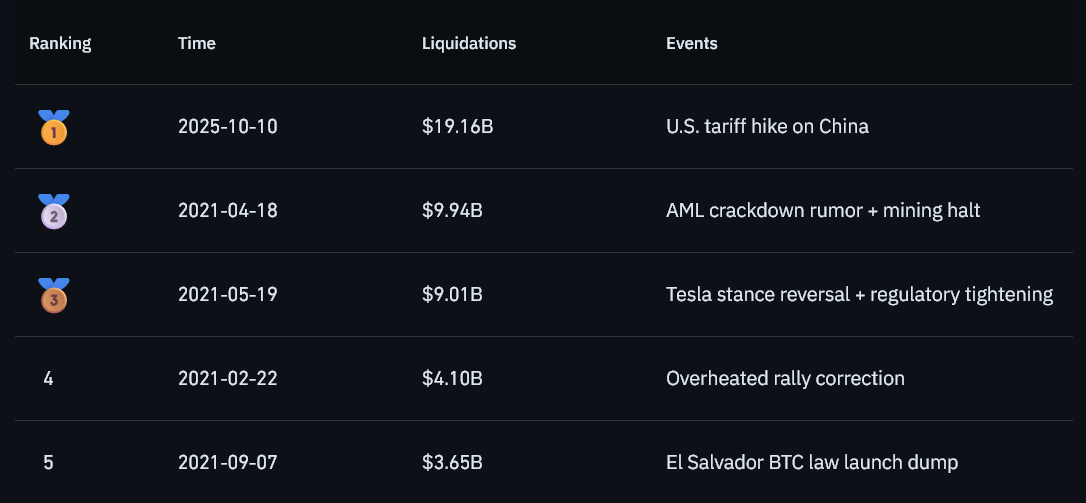
On October 10 last year, a Friday, a tariff headline hit an over-leveraged market, and roughly $19 billion in positions were liquidated within 24 hours, most of them longs, most of them retail.
Bitcoin fell from above $120,000 to around $105,000. Solana lost 40% before finding a bid, and more than 1.6 million accounts went to zero or close to it. Prices eventually stabilized. The people did not come back the same way.
Ten months on, October 10 will be remembered less for the crash itself than for what it did to retail behavior. The risk appetite survived. It just stopped showing up in the same places.

A Drawdown for Some, a Wipeout for Others
The October 10 crash showed how different spot and futures trading are, if it wasn’t clear before. A spot trader took a brutal hit that day, but they still held on to their coins. They can still wait for prices to eventually go back up. But a perpetual futures trader likely has nothing left.
Rebuilding capital from zero is a different project than sitting through a bad year.
Every dataset since carries the mark. On-chain perp volumes fell for five straight months after October, from $1.36 trillion to under $700 billion, with no bounce in between.
An estimated 38% of altcoins now sit near all-time lows, a worse reading than the aftermath of FTX, and the median altcoin trades roughly 79 percent below its cycle peak.
Tokens that carried multi-billion-dollar valuations in September learned in October that there was no bid underneath them until they were 50-80% lower.
Something else shifted alongside the prices. With stock markets setting records on AI, crypto stopped being the only destination for risk capital, and investors started demanding an answer to a question this industry dodged for years: what is a token actually worth when speculators’ attention moves elsewhere?

Why Hyperliquid Went Up While Markets Crashed
Hyperliquid is instructive because it had an answer. HYPE traded down into the mid-$20s over the winter, then set a new all-time high near $77 in June on the back of more than $650 million in annual revenue, and now carries a market cap above $12 billion.
A crypto business with real cash flow got repriced upward in the middle of a bear market. The wave of perpetual DEXs that launched to copy it mostly did not, because they were not creating new traders so much as renting the same ones from each other.
One prominent venue lost 83% of its monthly volume the moment its incentive season ended. The industry kept adding venues while the pool of perp traders shrank. Hyperliquid is starting to look like the exception, not the template.

The Game That Never Needed Leverage
Meanwhile, the traders everyone assumed would be the first casualties were barely noticed. Meme coin traders came through October relatively intact because their game never ran on leverage, and by January, while altcoins bled out, pump.fun was printing an all-time high above $2 billion in daily volume.
Roughly 97% of meme coins die. Every serious participant knows it and plays anyway. There is no white paper to read and usually no technology to evaluate. Because dead tokens are part of the design, the way lost hands are part of poker.
What gets analyzed instead is holder counts, wallet concentration, supply distribution, who bought and when, and how fast attention is spreading. Market structure, attention, and social coordination. That is the asset.
The closest analogy is competitive gaming rather than investing. These traders grind, refine their tactics, study the other players at the table, and treat a losing trade as one bad round in a long session rather than a failed thesis.
The goal is not to invest in an asset. It is to win a PvP game.
Where the Volume Went
So are the perpetual futures dying along with the altcoin market it grew up on? The volume data points the other way.
In the first five months of 2026, exchanges processed $1.32 trillion in perpetual futures tied to stocks, indices, and commodities, against $104 billion in all of 2025. The first regulated tokenized-equity perps went live in February.
The S&P 500 now has a licensed on-chain perpetual, and when Wall Street closes on Friday afternoon, these contracts keep trading through the weekend, increasingly setting the price Monday opens against.
Some exchanges, like Phemex, launched TradFi futures. This is because users have been demanding it through their behavior, if not their words.
Tesla, Apple, Nvidia, gold, silver, and the major indices now trade around the clock on the same USDT account and margin system as their crypto positions, and volume crossed $100 million on day one. Nobody was holding out for another altcoin listing. They wanted something worth trading at 3 a.m. on a Sunday.
As today’s meme coin traders age and accumulate capital, many of them will likely diversify into exactly these markets, on rails they already know how to use.
The Rewiring: Crypto Will Never Be the Same Again
The 2020 version of this industry, hundreds of tokens sustaining deep valuations and deep perp books all at once, is probably gone for good. What replaced it is narrower and more honest.
On one end, a fast, explicitly player-versus-player game in the memecoin ecosystem. On the other hand, perpetual futures are quietly becoming infrastructure for global markets.
The market that produced the last altcoin boom may never come back. The infrastructure it built is getting started, and it is already moving markets far beyond crypto. Our job is to be where speculation is going, not where it was.
The post Altcoin Boom May Never Come Back: How Crypto Trading Has Changed in 2026 appeared first on BeInCrypto.


Nethermind has ended its LayerZero verifier role and moved its cross-chain operations to Chainlink after reviewing the two infrastructure providers.
Summary
- Nethermind has stopped operating a decentralized verifier network within LayerZero.
- The Ethereum engineering firm has joined Chainlink as a node operator and technology provider.
- Nethermind did not identify a LayerZero flaw or disclose the migration’s cost and completion date.
- BitGo, Kelp DAO, and Wyoming have also selected Chainlink for cross-chain operations.
Nethermind said Wednesday that it had migrated away from its decentralized verifier network operations and joined Chainlink as a node operator and strategic technology provider.
The company will help operate Chainlink’s network while supplying engineering tools, infrastructure services, and integration support to blockchain developers. Nethermind said the decision followed an “extensive review,” but it did not publish the review or explain which technical and operational factors determined the result.
As part of the change, Nethermind will concentrate its cross-chain work on Chainlink’s Cross-Chain Interoperability Protocol. CEO Daniel Celeda described the move as a long-term infrastructure decision tied to the responsibilities carried by node operators.
“Being a node operator carries real responsibility for a network’s reliability, and that’s consistent with how we approach every engineering commitment we make.”
Neither company disclosed the financial terms of the arrangement. Nethermind also did not provide a deadline for completing the migration, saying only that it would issue updates as the process continued.
Nethermind’s Chainlink role replaces LayerZero verification
Within LayerZero, decentralized verifier networks independently check whether messages sent between blockchains are genuine and unchanged. Applications can choose which DVNs verify their messages and set the number of approvals needed before a transaction proceeds.
LayerZero’s documentation describes each DVN as a combination of smart contracts and off-chain systems. Once a message leaves its source blockchain, the selected verifiers confirm its digital fingerprint before the message can be committed and executed on another network.
Nethermind had served as one of the infrastructure operators available under that model. Its own website previously listed LayerZero DVNs among the cross-chain services run through its globally distributed infrastructure.
Under the Chainlink arrangement, Nethermind will instead operate a node within Chainlink’s network. Chainlink says its CCIP system uses independent node operators, transaction limits and a separate risk-management network to monitor cross-chain activity.
Reportedly, the move represented a decision by a major LayerZero infrastructure operator to use Chainlink’s “secure-by-default architecture.” Because the description came from Chainlink, it does not independently establish that one system eliminates the technical, governance, or operational risks found in cross-chain infrastructure.
Celeda said Nethermind has historically made “deliberate, long-term bets” on infrastructure that it believes will support on-chain financial services. Consolidating the firm’s cross-chain work around CCIP followed the same approach, he added.
LayerZero migrations followed the $292 million rsETH attack
Nethermind’s decision arrives four months after hackers drained 116,500 rsETH, worth about $290 million at the time, from Kelp DAO’s LayerZero-powered bridge.
The April 18 attack involved a forged cross-chain message and a single-verifier configuration. The attacker created unbacked rsETH and later placed much of it into Aave lending positions to borrow wrapped Ether, spreading losses beyond the bridge itself.
In May, Kelp DAO announced an rsETH migration to Chainlink while disputing LayerZero’s account of the security setup. Kelp said LayerZero had known about its 1-of-1 verifier arrangement and had previously treated the configuration as secure.
LayerZero CEO Bryan Pellegrino rejected Kelp’s claims. He said the protocol initially used a multi-verifier setup involving LayerZero Labs and Google before changing it to a single verifier, a configuration he said LayerZero had not recommended for production.
After the attack, LayerZero said it would stop approving messages for applications secured by only one verifier and would move affected projects toward configurations with multiple DVNs. LayerZero also attributed the incident to a compromised verifier rather than a flaw in its core messaging protocol.
Nethermind has not said whether the Kelp exploit triggered its review. Its announcement did not identify a security failure at LayerZero.
Other large projects have made comparable decisions since the attack. BitGo selected Chainlink in August as the exclusive cross-chain provider for Wrapped Bitcoin, replacing LayerZero across a WBTC ecosystem then valued at about $7.3 billion. As previously reported by crypto.news, the announcement brought the value covered by publicly disclosed LayerZero-to-Chainlink migrations to nearly $15 billion.
Aave adopted CCIP in July as the default system for cross-chain functions across its app and Stable Vaults. The protocol already used the service for GHO stablecoin transfers and governance messages before expanding the CCIP integration to deposits, withdrawals, vault rebalancing, and asset movements.
Wyoming adds a U.S. public-sector angle
For U.S. users, the closest public-sector comparison comes from Wyoming’s Frontier Stable Token, or FRNT. The Wyoming Stable Token Commission said on Aug. 18 that it had completed its migration from LayerZero to Chainlink following a state security review.
FRNT is issued by a U.S. public entity and is available on eight blockchains, including Ethereum, Solana, Base, Arbitrum, and Avalanche. Wyoming holds its reserves in cash and short-term U.S. Treasury securities, while reserve income supports the state’s School Foundation Program.
The commission named disclosure practices and operational security among its concerns about LayerZero. Executive Director Anthony Apollo said CCIP was the only system assessed by the state that met its security and reliability requirements “across the board.”
Under a multiyear agreement, Chainlink has become the exclusive cross-chain provider for FRNT, and the state has deprecated its LayerZero bridge. The Wyoming security review was not released publicly, leaving its full criteria and technical findings unavailable.
LayerZero said it respected Wyoming’s decision and was assisting with the transition. A company spokesperson said LayerZero had strengthened its security approach in recent months but did not address the state commission’s specific disclosure concerns.
Nethermind supports core Ethereum infrastructure
Founded in 2017, Nethermind develops one of Ethereum’s main execution clients, software used by network nodes to process transactions and maintain Ethereum’s state. The firm employs more than 200 people across client development, cryptography, blockchain security, formal verification, and institutional infrastructure.
According to Nethermind, its software supports more than 16,000 Ethereum validators and over $5 billion in delegated assets. Its infrastructure clients and partners include EtherFi, Gnosis, Lido, StarkWare, World, and Arbitrum.
Nethermind also contributes to Ethereum and Starknet development while providing smart-contract audits, research, and engineering services to financial institutions and crypto protocols. The company said its new Chainlink role will include technical support for developers integrating cross-chain services, alongside its responsibility for operating network infrastructure.


Injective’s affiliated entity can now maintain securities ownership records, adding regulated market infrastructure to its growing push into tokenized assets.
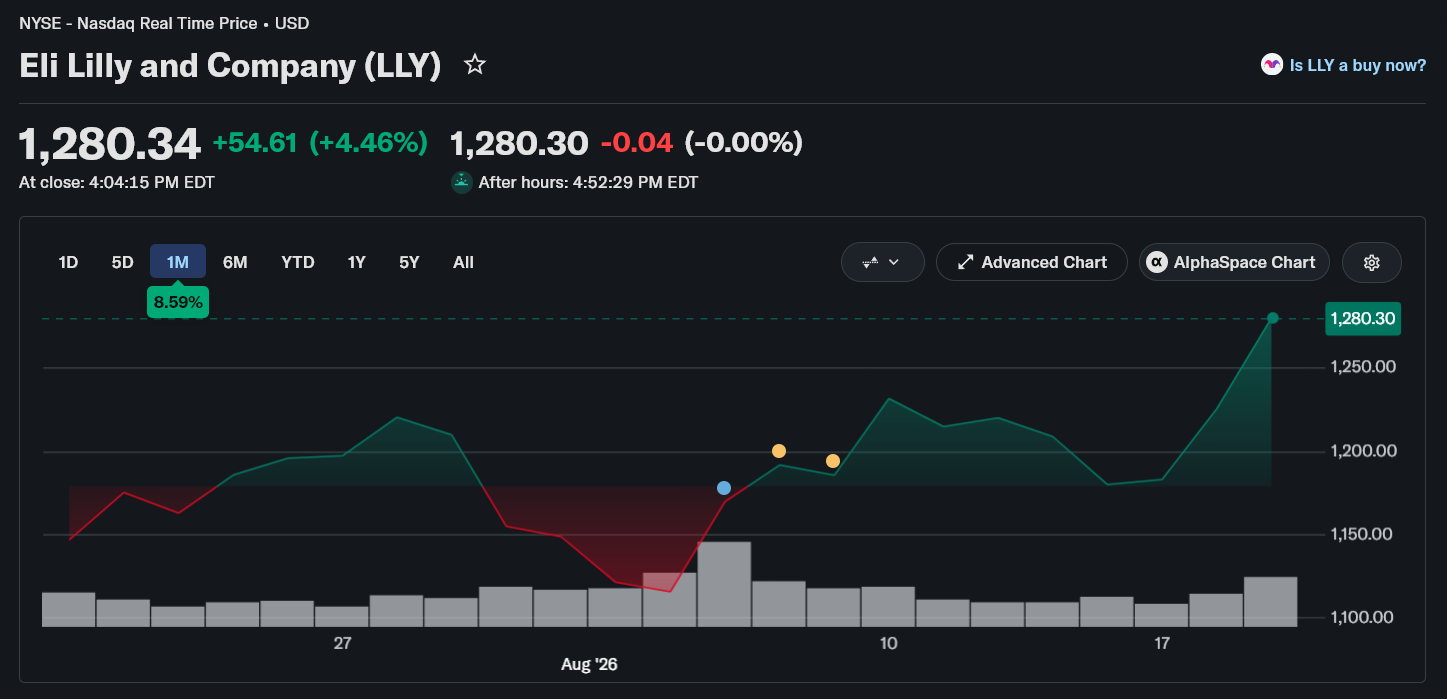
Eli Lilly is one of the most popular names today in America’s weight-loss and diabetes drug market. Its drugs delivered an average weight loss of 28.3% in a Phase 3 trial, approaching results historically associated with bariatric surgery and potentially giving Lilly another major product after the success of Mounjaro.
The company’s stock price has benefited from this hype, gaining almost 9% in August. With Eli Lilly already valued at roughly $1.1 trillion and management recently raising its 2026 revenue guidance, investors are increasingly focused on whether future drug launches can support the premium valuation.
Here’s the latest Eli Lilly price prediction from CoinCodex analysts.

Retatrutide Could Become Eli Lilly’s Next Major Obesity Drug
Retatrutide is emerging as one of the most important products in Eli Lilly’s development pipeline. In the Phase 3 TRIUMPH-1 study, participants taking the drug lost an average of 28.3% of their body weight after 80 weeks.
Eli Lilly executive Patrik Jönsson described the results as being in a class of their own, saying the company had not previously seen weight reduction of that magnitude.
The result is particularly significant when compared with existing obesity treatments. The report notes that patients taking Novo Nordisk’s Wegovy typically lose around 14% of their body weight after 72 weeks, while users of Lilly’s Mounjaro lose approximately 20% over a comparable period.
Retatrutide could therefore represent another substantial improvement in treatment effectiveness if the Phase 3 results translate into real-world use.
Retatrutide could also broaden Lilly’s opportunity beyond weight reduction alone. The report highlights results from the TRIUMPH-4 study involving participants with knee osteoarthritis, where patients receiving retatrutide experienced a substantial reduction in pain.
That creates the possibility that the drug’s commercial value could eventually extend beyond the headline obesity numbers.
Eli Lilly’s Obesity Business Is Already Producing Billions
The investment case does not depend solely on an experimental drug. Lilly has already demonstrated that highly effective metabolic treatments can translate into enormous commercial demand.
Mounjaro generated more than €27 billion in revenue during the previous 12 months, according to the attached report.
Lilly’s success in obesity treatments has helped turn the Indianapolis-based company into the world’s most valuable pharmaceutical group, with its valuation around five times that of Novo Nordisk and more than four times that of AstraZeneca at the time of the report.
Retatrutide could potentially strengthen that position by moving Lilly’s obesity portfolio from roughly 20% weight reduction toward the 30% range. The major uncertainty will be access and reimbursement.
Earnings Growth Supports the Eli Lilly Price Prediction
The fundamental picture behind the Eli Lilly price prediction remains strong even before retatrutide reaches the market.
Eli Lilly’s second-quarter 2026 revenue reached $23 billion, up 48% from the previous year, while EPS increased from $6.30 to $7.94. Revenue exceeded analyst estimates by 11%, while EPS came in 5.3% ahead of expectations.
That performance followed an exceptionally strong first quarter, when revenue climbed 56% year over year to $19.8 billion and net income jumped 168% to $7.4 billion. Full-year 2025 revenue had already increased 45% to $65.2 billion, illustrating how quickly Lilly’s existing product portfolio has expanded.
Management has responded by repeatedly increasing its outlook. The company initially guided for $80 billion to $83 billion in 2026 revenue, raised that range to $82 billion to $85 billion in May, and lifted it again in August to between $85 billion and $87 billion.
Analysts now expect revenue to grow around 11% annually, while earnings are forecast to increase 16.6% per year and EPS approximately 16.8%. Forecast return on equity stands near 50% over the next three years.
Those estimates represent a slowdown from Lilly’s extraordinary recent growth, with earnings having expanded at an average annual rate above 35% historically, but they still point to substantial underlying expansion for a company already carrying a market capitalization of roughly $1.1 trillion.
The central risk is valuation. At that size, Lilly needs continued execution from Mounjaro, its broader drug portfolio and future products such as retatrutide to justify further appreciation.
Clinical setbacks, regulatory delays or reimbursement restrictions could therefore have an outsized effect on investor expectations.
CoinCodex Eli Lilly Price Prediction
According to the latest CoinCodex Eli Lilly price prediction, LLY is expected to trend higher into late 2026, with steady gains building through the year.
The model shows a gradual rise from around $1,174 in August 2026 to roughly $1,365 in November, before ending the year on a similarly strong note near $1,360–$1,377.
This suggests the most meaningful upside in 2026 could come in the fourth quarter, with November showing the strongest monthly gain.

In early 2027, the forecast points to a short-term pullback, with average prices easing from about $1,325 in January to near $1,220 by March.
However, this weakness is framed as a temporary correction rather than a trend reversal, as momentum is expected to rebuild quickly afterward.
From April 2027 onward, CoinCodex projects a strong acceleration phase, with prices climbing above $1,600 by May and reaching around $1,700 by July.
The most aggressive outlook comes in August 2027, where the model sees an average near $1,962 and a potential peak above $2,073, briefly pushing LLY past the $2,000 level and implying upside of roughly 75% from current levels.
The post Eli Lilly Price Forecast: The Next Big Stock After Weight-Loss Drug Breakthrough? appeared first on BeInCrypto.

What to know about the trial of former Tiananmen vigil organizers

Multi-cap funds offer equity-like returns with lower drawdowns

Ethena, FalconX launch $1 billion USDe lending facility





-

 Fashion5 days ago
Weekend Open Thread: Ann Taylor
-
 Sports6 days ago
This U.S. Amateur is a glimpse into golf’s future in more ways than you think
-
 Tech6 days ago
11 Ways to Rank Your Videos
-
 NewsBeat5 days ago
Myanmar says over 300,000 Rohingya refugees verified for repatriation as exodus enters ninth year
-

 Sports5 days ago
Birmingham 2026: Day 6 Timetable for Irish Athletes
-

 Politics5 days ago
SEQ Code: The Three Letter Boarding Pass Code That Could Give You The Worst Seat
-

 Tech6 days ago
DeepSeek Harness launches as open source rival to Claude Code, alongside V4-Pro on API with higher prices
-

 Crypto World2 days ago
OCC Greenlights Trump Family Crypto Firm for Trust Charter
-

 Tech2 days ago
Qwen3.8-27B runs frontier-class coding agents and reasoning locally, no cloud API required
-

 Fashion7 days ago
The Details Do the Dressing
-

 Fashion5 days ago
Weekly News Update, 8.14.26 – Corporette.com
-
 Tech4 days ago
Every fusion startup that has raised over $100M
-
 Entertainment6 days ago
10 Netflix Shows That Quietly Became Modern Classics
-
 Entertainment5 days ago
Marvel Studios Reveals New X-Men Cast Including Adam Driver and Sadie Sink
-

 Business6 days ago
15 Ways to Make Money From Your Phone (2026 Guide)
-

 Business5 days ago
Facebook Down Now? Users Report Login And Loading Problems As Outage Trackers Monitor Ongoing Issues
-

 Crypto World6 days ago
Robinhood Chain Approaches $1B TVL as Uniswap Integration Boosts Liquidity
-

 Fashion5 days ago
Cart Confidential Vol. 44 – Julia Berolzheimer
-

 Crypto World5 days ago
Pi Network Protocol 27 endgame: last upgrade before what?
-
 Business5 days ago
Monarch Mutual Fund set to enter MF space with maiden overnight fund; files draft with Sebi
You must be logged in to post a comment Login