
Crypto World
Bitcoin developer says 5.6 million ‘lost’ tokens may need freezing to stop hackers



A leading core Bitcoin developer said he would rather see the estimated 5.6 million bitcoin he believes to be lost frozen by the network than risk them falling into the hands of future quantum hackers.
Jameson Lopp told CoinDesk that while he does not want to freeze anyone’s bitcoin, removing dormant tokens from potential circulation may be safer for the network.
“At the moment, I don’t believe any of this is necessary,” Lopp said in an interview, emphasizing that he is thinking “adversarially about a potential future threat.” Still, he would “rather for lost or dormant coins to be taken out of reach from an attacker rather than have them flow into the hands of an entity that likely doesn’t care much about the ecosystem.”
His comments follow the Tuesday release of BIP-361, a proposal from Lopp and others that explores phasing out bitcoin’s current cryptographic signatures and, over time, invalidating transactions from quantum-vulnerable wallets, potentially freezing assets that fail to migrate. At current prices, the dormant tokens Lopp referenced are worth roughly $420 billion.
In a subsequent post on X, Lopp said he “doesn’t like” the proposal and hopes it never needs to be adopted, describing it as a “rough idea for a contingency plan” rather than a finalized specification. “I wrote it because I like the alternative even less,” he wrote, adding that in the face of an existential threat, “individual economic incentives outweigh philosophical principles.”
It’s not the first time Lopp has expressed his feelings about quantum recovery, which he said amounts to rewarding technological supremacy rather than productive participation in the network. “Quantum miners don’t trade anything,” Lopp wrote. “They are vampires feeding upon the system.”
Millions of bitcoin likely lost forever
Roughly 28% of all bitcoin, or about 5.6 million tokens, has not moved in over a decade, Lopp said, adding that he and other analysts consider it likely lost. If ever recovered through advances in quantum computing, that amount could introduce significant volatility and undermine confidence in the original crypto network, Lopp added.
While the proposal remains in early stages with no set timeline for adoption, it has already sparked fierce debate within the community.
Lopp framed the idea as a way to encourage or even push others to upgrade their wallets before any real threat emerges.
“It’s not that I want to freeze anyone’s bitcoin,” he said. “We believe it will be necessary to incentivize the ecosystem to upgrade because humans tend to be procrastinators.”
Any change would require consensus across the decentralized network. While no formal vote takes place on the matter, similar upgrades have in the past required overwhelming support from miners to activate.
Read more: To freeze or not to freeze: Satoshi and the $440 billion in bitcoin threatened by quantum computing
Massive market panic risk
More significant risks include the loss of trust in the largest cryptocurrency itself, Lopp said. While a sudden dump of millions of bitcoin onto the market could trigger sharp price swings, he said the bigger danger lies in perception.
“It doesn’t even require a massive market dump,” Lopp said. “If there is any credible evidence that anyone has the capability to recover lost or vulnerable coins with a quantum computer, you should expect a massive market panic immediately.”
In that scenario, he said, rational holders would probably exit the system until there is confidence the blockchain has been secured against such threats.
The result is a growing divide within the community, one that pits Bitcoin’s long-standing promise of immutable, censorship-resistant ownership against the need to defend the network from a potential future shock.
Departure from Bitcoin’s principles
Market analyst Mati Greenspan, founder of Quantum Economics, said the debate is more philosophical than technological.
“The path to quantum resistance is relatively clear,” he said. “The real question is how the Bitcoin community chooses to handle vulnerable coins along the way.”
In his opinion, freezing dormant bitcoin accounts would mark a significant departure from Bitcoin’s core principles.
“On one hand, freezing dormant or exposed coins could remove a major tail-risk and protect market confidence,” Greenspan said. “On the other, it introduces a precedent of intervention that many would argue is more dangerous than the threat itself.”
Greenspan explained that even without a large-scale sell-off, visible quantum attacks on dormant wallets could trigger panic across the market.
Others argue that freezing dormant BTC accounts risks undermining Bitcoin’s foundational guarantees.
“Ownership becomes conditional. Having keys no longer guarantees you can spend,” said Leo Fan, founder of Cysic and former lead on quantum resilience at Algorand. “That weakens Bitcoin’s ‘unstoppable money’ promise.”
And while he does not agree with freezing the accounts, Fan noted that removing millions of bitcoin from circulation could tighten supply, potentially boosting its value.

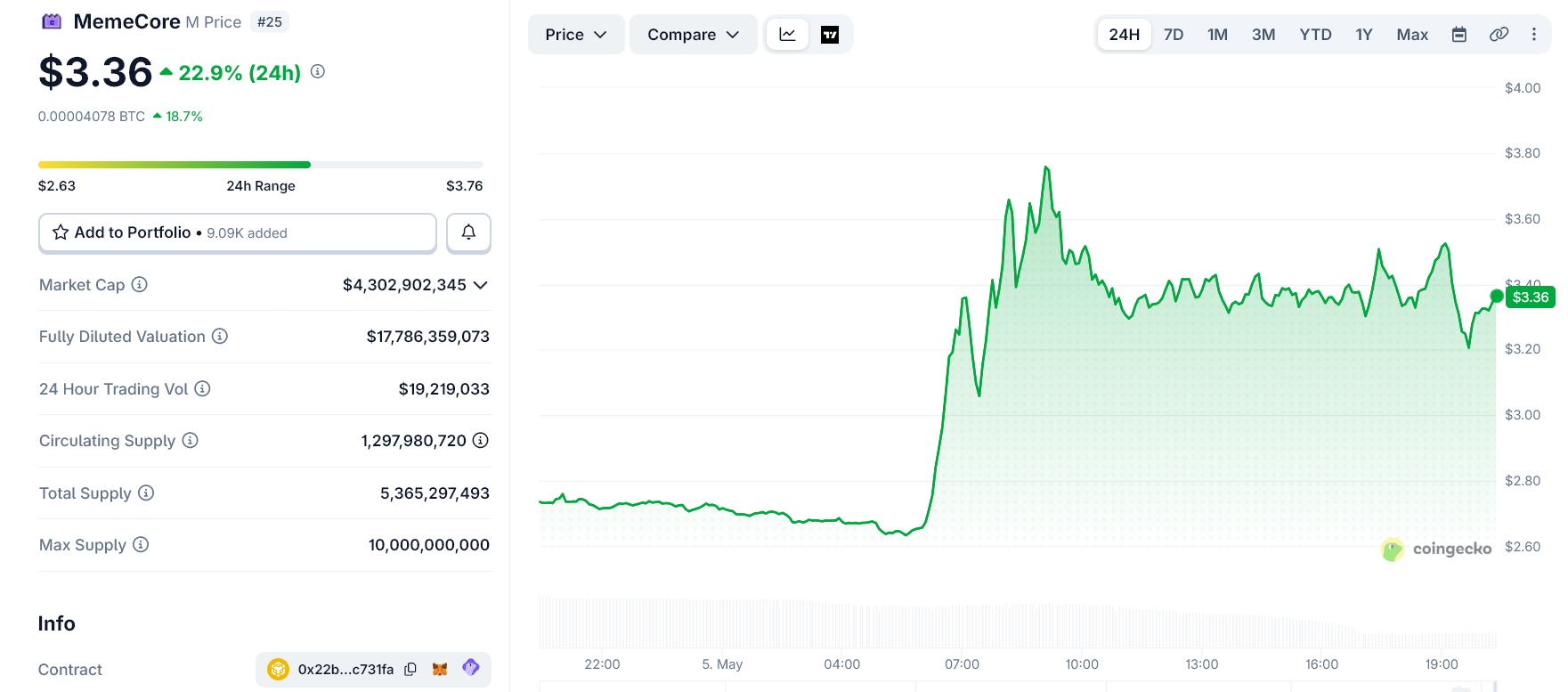
MemeCore (M) price jumped more than 20% on May 5, climbing to around $3.45 after a sharp correction from its April all-time high. MemeCore is up because meme coin demand rotated back into high-volatility tokens after a sharp April selloff.
Other high-risk meme assets also rallied in recent weeks, including PENGU and SkyAI. That suggests M is benefiting from sector rotation rather than leading a new trend on its own.

MemeCore Price Is Bouncing After a 49% Drop
The biggest reason MemeCore is up today is simple: the token was heavily oversold.
M dropped from $4.82 to $2.45 in just ten days. That kind of move often creates a short-term rebound, especially when traders rotate back into volatile meme coins.
The current rally is therefore partly a recovery trade. Buyers are stepping in after a deep pullback, while short-term traders are chasing momentum across the meme sector.
This matters because a bounce after a large selloff is different from a confirmed breakout. A true breakout usually needs strong volume, clear demand, and a clean move above resistance. MemeCore has not shown all of that yet.
Meme Coin Rotation Is Driving M Higher
MemeCore’s rally appears tied to broader meme coin strength.
When traders regain risk appetite, meme coins often move faster than Bitcoin or Ethereum. That happened again here. Bitcoin gained around 1.45% and Ethereum rose around 0.85% in the same window, while M moved roughly 20 times more than BTC.
That gap shows MemeCore had token-specific momentum. But it does not prove the project has a new fundamental catalyst.

The better reading is that traders are rotating into high-beta meme names. MemeCore was already down sharply, so it became a natural target for a fast rebound.
Technical Indicators Show Momentum, But Not Full Confirmation
On the 4-hour chart, MemeCore’s momentum has improved.
The RSI sits near 59.76, which means buyers have regained control without pushing the token into overbought territory. That gives the rally some short-term room to continue.

The MACD has also crossed bullish, with the histogram expanding. This signals improving trend momentum after the recent selloff.
The breakout candle was also notable. M moved from $2.65 to $3.69 on 57,000 volume, around 3.6 times higher than the previous eight-candle average. That was the strongest technical confirmation in the current setup.
The problem is what happened next. Volume quickly faded. The next three candles printed much lower volume at 13,000, 8,000, and 7,000.

That suggests buyers rushed in during the breakout, but follow-through demand slowed quickly.
Smart Money Data Does Not Show Heavy Accumulation
Smart money activity also looks underwhelming.
Nansen data shows top-PnL wallets bought a net $13,123 across seven wallets. Exchange wallets saw a net outflow of $123,642, which can suggest tokens moving away from exchanges.
However, these numbers are tiny compared with MemeCore’s reported $4.5 billion market cap.
That means smart money data does not strongly support the rally. There is some buying, but not enough to show major accumulation by large wallets.
For now, the data points to a retail-led move rather than a high-conviction institutional or whale-driven rally.

MemeCore Price Prediction: Where is the Price Heading Next?
MemeCore’s short-term setup is mixed.
The rally has real momentum on the 4-hour chart, and the bounce from $2.45 shows buyers are active after the deep correction.
But the broader evidence is weaker. Volume faded after the breakout. Daily volume stayed below average. Smart money buying was small. DEX flow showed selling pressure near resistance.
That makes $3.78 the level to watch.
If M closes above $3.78 on strong volume, the rally could shift from a sector-driven bounce to a more convincing bullish breakout.
If M loses $3.16, the current move likely weakens, and the $2.45 base comes back into focus.
For now, MemeCore is up because meme coin demand has returned after a steep selloff. The price is moving with the sector, but buyers still need to prove this is more than a short-term rotation trade.
The post Why Is MemeCore Up 20% Today? appeared first on BeInCrypto.

TLDR:
- Hyperliquid DATs now hold nearly 9% of HYPE’s circulating supply, surpassing BTC, ETH, SOL, and BNB float-adjusted.
- HYPE is the only asset in the DAT dataset currently trading at a positive mNAV, easing fresh capital raises.
- Legacy sellers distributed holdings before ETF products arrive, lowering the risk of new demand meeting heavy sell pressure.
- If approved, HYPE ETF inflows would enter a tight float with early institutional ownership and an active treasury bid.
Hyperliquid-linked digital asset treasury companies now hold close to 9% of HYPE’s circulating supply. This figure places HYPE above Bitcoin, Ethereum, Solana, and BNB on a float-adjusted basis.
The concentration of institutional holdings, combined with recent ETF filing activity, has drawn attention from market analysts.
If an ETF approval materializes, new passive inflows could enter an already tight float, potentially creating upward price pressure on the asset.
Treasury Demand Sets HYPE Apart From Other Major Assets
Digital asset treasury vehicles, commonly called DATs, have become a growing force in crypto markets. They represent a new category of institutional balance sheet demand that was largely absent in prior market cycles. Their presence adds a structural bid that functions differently from retail or short-term speculative buying.
Moreover, HYPE stands out within this DAT cohort for one key reason. It is currently the only asset in the dataset trading at a positive modified net asset value, or mNAV.
That status gives treasury vehicles a cleaner path to raise fresh capital and continue purchasing supply from the open market.
As analyst @0xaletheia369 noted, “DATs now hold close to 9 percent of circulating HYPE, materially above BTC, ETH, SOL, and BNB on a float-adjusted basis.”
The concentration of this institutional demand within a relatively small circulating supply makes the dynamic more pronounced compared to larger-cap assets.
However, one caveat remains worth noting. HYPE’s circulating supply still represents a low share relative to its fully diluted valuation. This means that while treasury demand is strong, a broader supply unlock in the future could shift the balance.
ETF Filing Progress Adds a New Layer to the HYPE Supply Picture
Recent amendments to ETF filings for HYPE have made an approval path appear more realistic to market observers. The filings suggest that issuers are actively working through regulatory requirements.
That progress has brought renewed attention to how an ETF approval could interact with the current supply setup.
According to the analyst’s note, legacy sellers already had a visible route to distribute holdings before passive products arrive.
That prior distribution reduces the risk that new ETF demand simply meets old concentrated sell pressure. The timing of this supply absorption matters in how any future ETF flows would land.
Furthermore, if approvals do come through, incoming flows would hit a float that is already tightened by treasury activity.
The institutional ownership base remains early-stage, meaning there is still room for further accumulation. Together, these factors create a setup where passive inflows could translate more directly into price support than in more saturated markets.
The combination of treasury demand, a positive mNAV environment, and a clearer ETF pathway makes HYPE one of the more structurally distinct assets in the current market cycle.

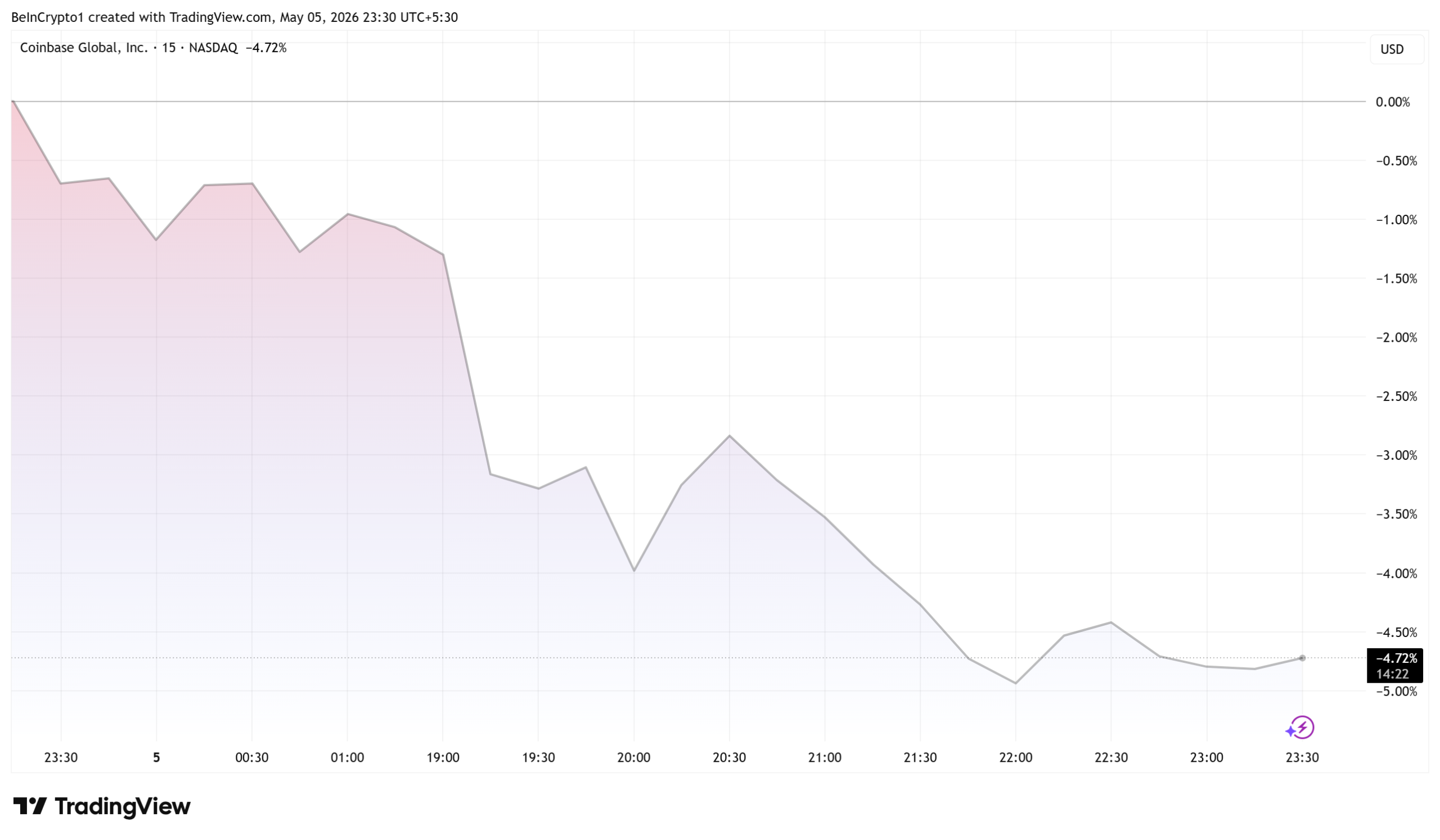
Coinbase shares (COIN) came under pressure immediately the market opened on Tuesday, as a wave of customer backlash followed an internal disclosure that non-technical employees at the exchange are now shipping production code.
The reaction tapped into raw memories of the company’s May 2025 data breach, with several account holders publicly threatening to move funds off the platform and pushing back against CEO Brian Armstrong’s drive to accelerate engineering output.
A Coinbase Trust Wound That Never Fully Closed
For many Coinbase customers, the news arrived with the weight of a story they had heard before.
In May 2025, the exchange disclosed a breach affecting 69,461 customers, equal to less than 1% of its monthly active users at the time.
Cybercriminals bribed overseas customer support contractors linked to outsourcing firm TaskUs to siphon data from internal support tools.
The exposed data included names, emails, phone numbers, home addresses, dates of birth, masked Social Security numbers, masked bank account numbers, government ID images, and account balances.
Passwords and private keys were never compromised, yet the leaked information seeded phishing campaigns and social engineering attacks against affected users.
“…I don’t want to hear about what Coinbase is doing to recover funds – I want to hear what they are doing to better deal with private data. And why a $60B company, had such rubbish data policies when they can easily afford to hire top class talent?” Adam Cochran, a renowned X (Twitter) figure, said at the time.
Coinbase refused a $20 million ransom demand, publicly disclosed the incident, and pledged a matching bounty for information leading to arrests.
The company later estimated remediation costs could reach up to $400 million and faced multiple class-action lawsuits.
Customers Push Back After Latest Disclosure
The acknowledgment that non-technical staff at Coinbase are now shipping production code reignited those memories almost immediately.
“AI is changing how we work. Over the past year, I’ve watched engineers use AI to ship in days what used to take a team weeks. Non-technical teams are now shipping production code and many of our workflows are being automated,” Armstrong said in the layoff announcement.
Account holders flooded social media with grievances tying the operational shift back to unresolved security anxieties.
“I think it goes without saying… Not your keys, not your coins. But the whole “non-technical teams are shipping production code” is…. kind of scary. I don’t keep a lot on CB as it’s only an on/off ramp for me, but this email just further cements that conviction,” one user stated.
Other account holders went further, citing personal harm tied to the 2025 incident. One user said home address exposure had triggered weekly harassment from social engineering scammers.
The pattern of complaints carried a common thread. Retail customers no longer trust the exchange as a custodian when its development pipeline now includes employees they assume lack formal engineering training.
Against this backdrop, Coinbase stock, COIN, fell by almost 5% after markets opened on Tuesday, and was trading for $196.21 as of this writing.

Armstrong Defends the Production Pipeline
Coinbase CEO Brian Armstrong addressed the criticism directly on X (Twitter), denying that the company allows untested code into live systems.
His response reframed the policy as a productivity push rather than a quality concession. Whether that distinction reassures retail holders who already feel exposed by the 2025 breach is a separate question, and one the market appears to be answering through pressure on the COIN ticker.
The friction reflects a deeper standoff over how much trust an exchange should expect from users who have already paid the cost of a prior security failure.
The post Coinbase Stock Falls Amid User Concern Over Internal AI Pivot appeared first on BeInCrypto.
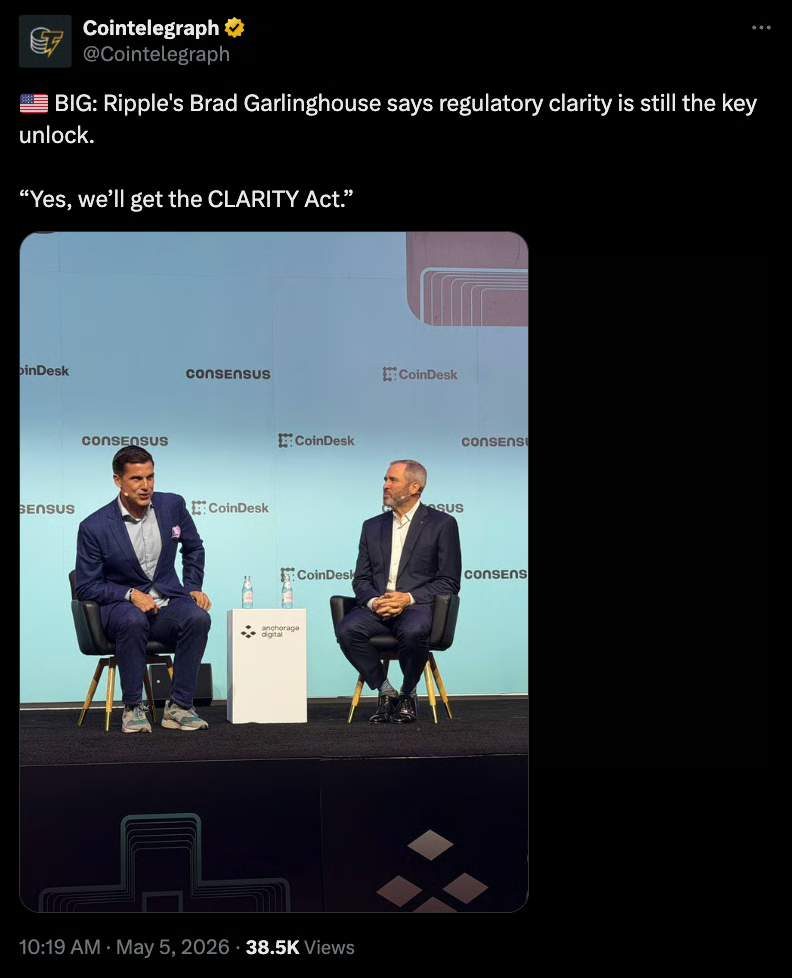
Brad Garlinghouse, CEO of Ripple Labs, warned Tuesday that recent progress on the digital asset market structure bill in the US Senate did not guarantee success for the legislation, speculating that the next two weeks would be crucial.
Speaking at the Consensus crypto conference in Miami, Garlinghouse said that the likelihood of the market structure bill, the CLARITY Act, passing would “drop precipitously” if not addressed in the next two weeks. According to the Ripple CEO, the bill would be “too much of a loaded issue” amid campaigns for the 2026 US midterms, with primaries ongoing until the November elections.
“Do I think it’s perfect? Hell no,“ said Garlinghouse, referring to CLARITY. “I challenge you to show me any piece of legislation that we would call perfect. There’s tradeoffs and compromises, but I do think clarity is better than chaos.”
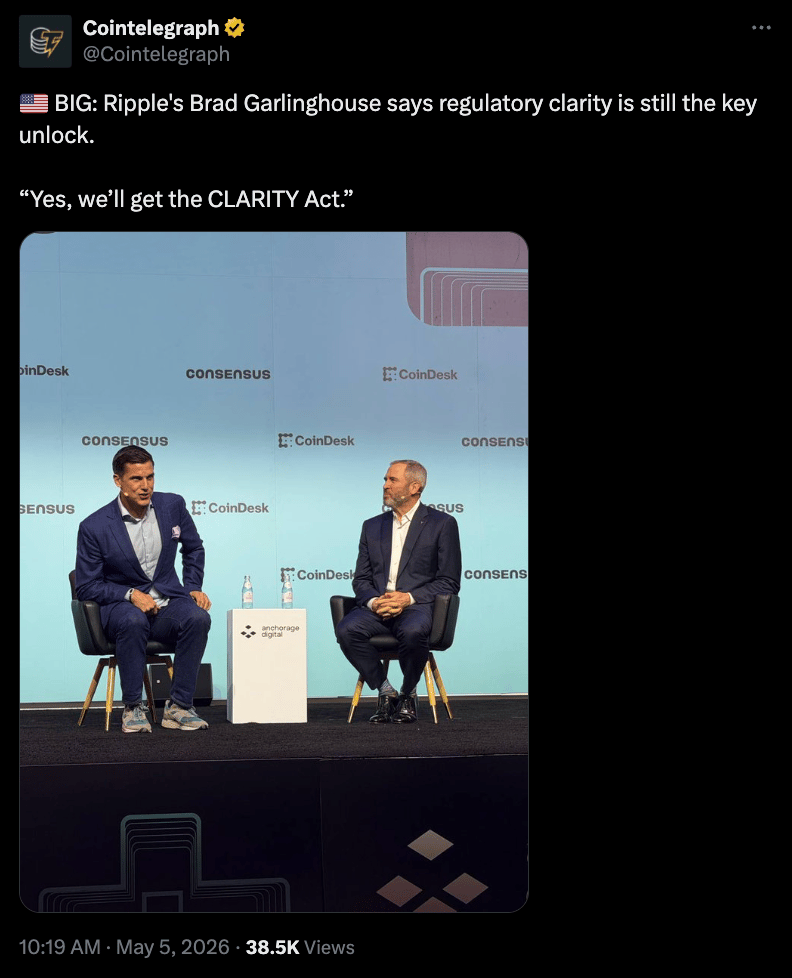
Source: Cointelegraph
The CEO’s remarks came after US Senators Thom Tillis and Angela Alsobrooks announced a compromise on stablecoin yield last week that could lead to the advancement of the CLARITY Act. Addressing stablecoins, as well as tokenized equities and ethics, has been one of the factors holding up the bill in the Senate since it was passed by the US House of Representatives in July 2025.
Related: Crypto PAC spends $500K in support of Indiana candidate ahead of primary
The CLARITY Act, already advanced by the Senate Agriculture Committee in a January markup, also requires approval by the Senate Banking Committee before a vote in the full chamber. Garlinghouse and Ripple executives have been part of negotiations on the CLARITY Act between White House officials and representatives of the crypto and banking industries.
“The Clarity Act is not a future priority; it is the priority,” said Senator Cynthia Lummis, a member of the banking committee, in a Tuesday X post. “Every corner of the industry is operating under legal uncertainty that Congress has the power to fix. The Senate needs to act.”
US financial agencies already moving forward without Congress
The US Securities and Exchange Commission (SEC) and Commodity Futures Trading Commission (CFTC) signed a memorandum of understanding in March to coordinate their approach to oversight of the digital asset market structure. SEC Chair Paul Atkins said that the agency‘s approach to crypto laws provided a “beginning, not an end,” with the commission awaiting passage of the CLARITY Act.
Magazine: How to fix suspected insider trading on Polymarket and Kalshi


A Fairshake poll finds 45% of Americans call crypto too risky as industry PACs deploy over $100 million into midterms.
Summary
- A Public First poll conducted for Politico found 45% of Americans say investing in cryptocurrency is not worth the risk.
- The same poll found 44% say AI is developing too fast, and two-thirds want Congress to impose strict oversight on artificial intelligence.
- Pro-crypto PAC Fairshake and pro-AI PAC Leading the Future have together deployed over $100 million in 2026 midterm races.
A Politico poll conducted by Public First in April 2026 found that 45% of Americans say investing in cryptocurrency is not worth the risk, even if potential returns are high. The survey of 2,035 adults also found 44% believe AI is developing too fast, and nearly two-thirds want Congress to impose strict regulations or broad oversight on artificial intelligence.
The findings arrive as industry-backed super PACs pour unprecedented sums into the 2026 midterm cycle. Fairshake, the pro-crypto PAC backed by Coinbase, Andreessen Horowitz, and Ripple, has spent roughly $28 million across competitive primaries.
The pro-AI group Leading the Future, launched in August 2025, has raised more than $75 million and deployed funds in races across North Carolina, Texas, Illinois, and New York. Their combined spending exceeds $100 million.
A political liability in the making
The poll found that in hypothetical matchups, respondents were far less likely to support candidates backed by groups pushing looser AI regulation. Political observers told Politico that once voters connect campaign money to the industries behind it, backlash could be swift. “I do think if they see somebody is backed by crypto, that’s always going to be a problem,” former Ohio Representative Jim Renacci reportedly said.
The disconnect between spending and public trust is sharpest in name recognition. Only 9% of respondents have heard of Leading the Future, and just 3% recognise Fairshake. The industry has financial power that has not yet translated into public legitimacy.
That gap matters because both Fairshake and the crypto industry’s primary legislative goal, the Clarity Act, depend on the same Senate that faces midterm exposure.
As crypto.news documented, if Democrats take control of either chamber in November, Clarity Act passage odds are described as close to zero. Voter distrust of crypto at 45% makes the midterm environment a risk that PAC spending alone cannot resolve.
Crypto World
Different voices in product, policy and hiring change crypto outcomes, panelists tell Consensus Miami
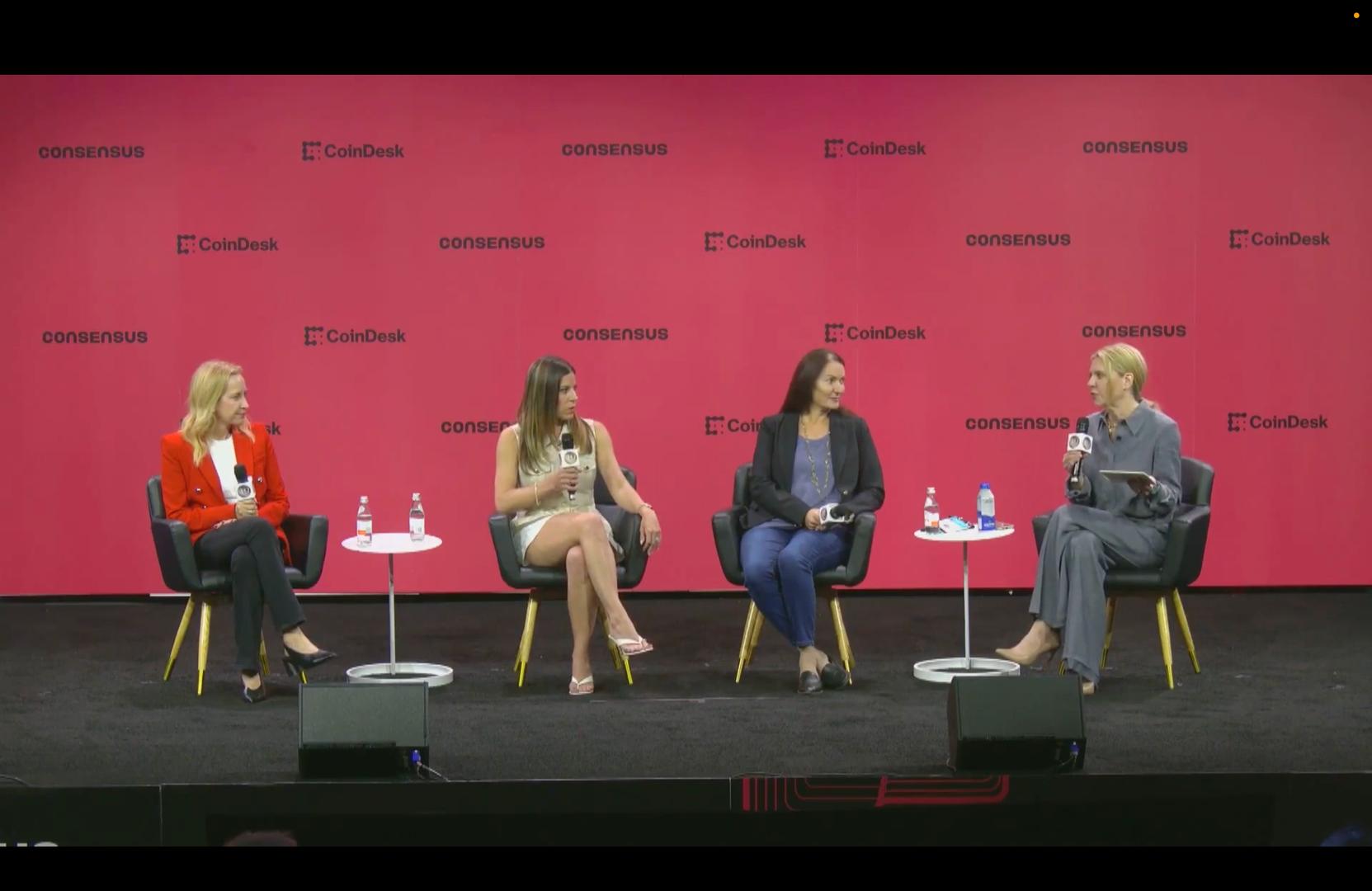
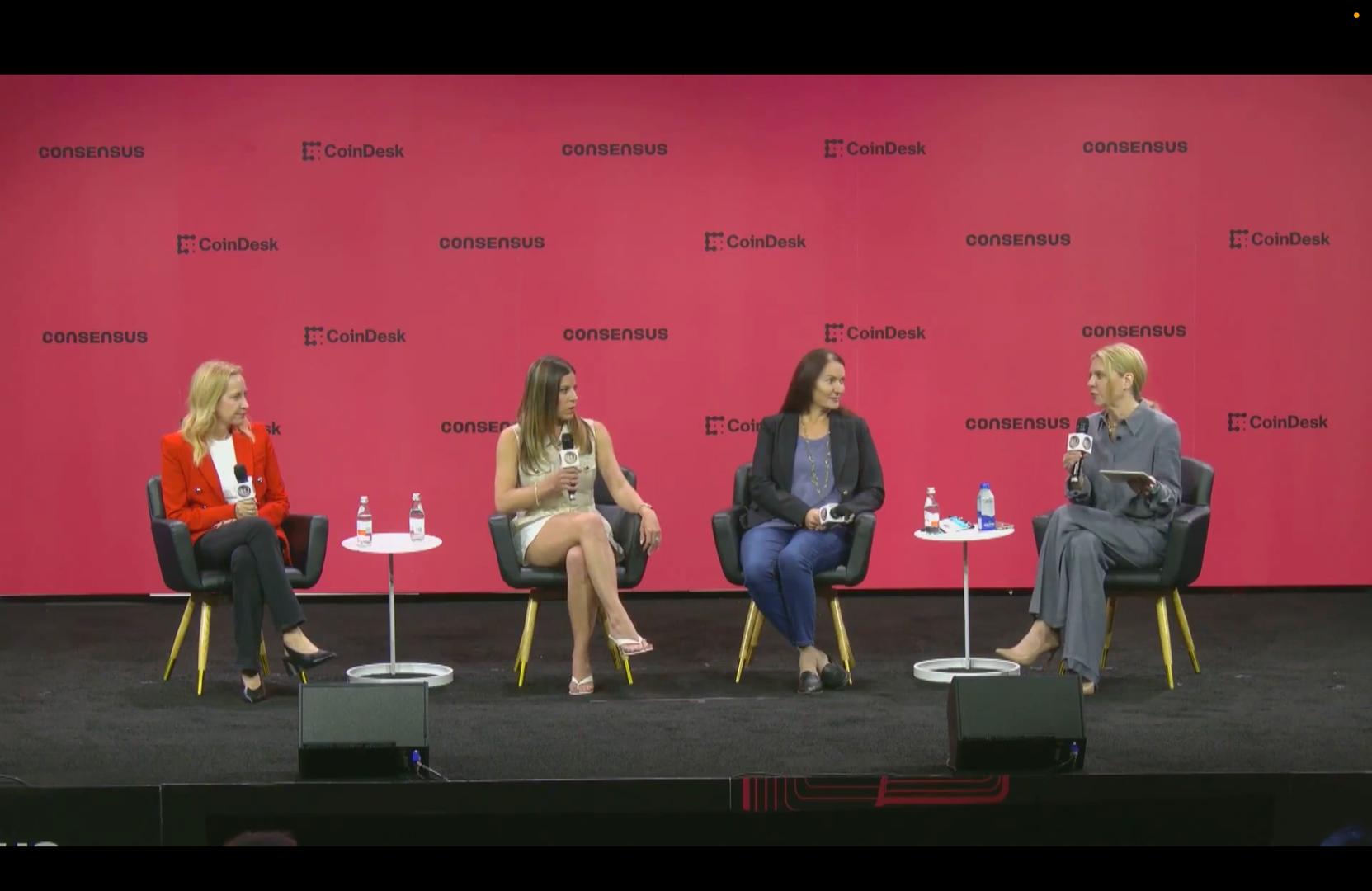
The right voices in the right rooms can reshape product, policy and hiring outcomes in crypto, three senior executives told CoinDesk’s Consensus Miami conference on Tuesday. Each cited a moment from her own organization when an outside perspective changed what was being built, argued or prioritized.
Mastercard SVP for Blockchain & Digital Assets Maja Lapcevic said her company’s crypto team had initially viewed infrastructure as the key to crypto adoption, until a partner reframed the problem around usability. “We probably all thought about infrastructure to be the winning formula for crypto,” she said. “But one of our partners actually really helped shed light on how we make crypto accessible, not complex, very simple to use.” That thinking helped push Mastercard toward cards linked to stablecoins, including for users in markets with limited access to traditional financial services, she said.
Crypto Council for Innovation Chief Strategy Officer Alison Mangiero said her organization had a similar realization around staking after bringing builders into policy discussions. “Sometimes we might think we understand, or we’ll put things into a bucket,” she said. “We’ll take a shortcut and say, oh, that sounds like a fund. Oh, that sounds like interest or yield, when in actuality what’s going on under the hood is fundamentally different.” After hearing from people building staking primitives, she said, CCI understood the need to describe staking as a technical service rather than a financialized product.
Clerisy Co-Founder and Managing Partner Alexandra Wilkis Wilson brought the argument to hiring. “Many of us fall into a very comfortable bias of hiring people who not only might look like ourselves or remind you of your younger self,” she said. She recalled one 10-person startup where a Myers-Briggs analysis found that eight of the 10 team members were extroverts. “It’s really important, when you’re growing teams, to not only bring in diversity on the outside, but also to think about diversity on the inside,” she said.
Mangiero closed by framing the issue as one for the broader industry. Crypto “is having a moment right now where folks are really interested in hearing our voice,” she said, “but that begs the question, what is our voice at the end of the day?” The conference, she added, “is called Consensus for a reason.” Good policy, she said, requires the industry to ensure different communities are reflected, including token holders and people building on top of blockchain networks, while also protecting consumers and allowing innovation to thrive.


Strategy (MSTR), the world’s largest publicly traded corporate holder of bitcoin, floated the idea of selling bitcoin in order to cover its dividend obligations.
Executive Chairman Michael Saylor suggested, during its Q1 2026 earnings call, the company may sell a portion of its bitcoin holdings to fund dividend payments, stating: “We will probably sell some bitcoin to pay a dividend just to inoculate the market and send the message that we did it.”
The company disclosed a $12.54 billion net loss for Q4, while maintaining a total bitcoin position of 818,334 BTC at an average acquisition cost of $75,537 per coin.
Strategy has an outstanding dividend obligation of approximately $1.5 billion, including annualized preferred stock dividends and interest on outstanding debt. The firm has roughly 18 months of dividend coverage, based on its USD reserves relative to these obligations.
Saylor described the model as leveraging credit to acquire Bitcoin, allowing it to appreciate, and then selectively selling portions of the asset to meet dividend commitments.
“You buy bitcoin with credit, you let it appreciate, and then you sell bitcoin to pay the dividend.
Following the announcement, Strategy’s stock fell more than 4% in after-hours trading, while bitcoin declined below $81,000.
The derivatives giant is rolling out CFTC-regulated contracts that let traders isolate Bitcoin volatility from price direction, settling to a new 30-day implied volatility benchmark.
The agreement spans spot and perpetual trading, settlement, liquidations, and onboarding flows on the decentralized exchange.


The exchange’s strategic investment cements Centrifuge as the go-to issuance layer for compliant onchain assets, starting with a tokenized S&P 500 product for non-U.S. users.

Diego Simeone makes Arsenal and Barcelona claim after Atletico Madrid defeat | Football

Latest Iran Flare-Uup Challenges Stock Market’s Record Run and AI Momentum

Why Is MemeCore Up 20% Today?

Manchester United reach agreement with Casemiro over contract clause amid transfer speculation

US brings back mandatory military draft registration

Steven Gerrard disagrees with Gary Neville over ‘shock’ Chelsea and Arsenal claim | Football


-

 NewsBeat2 days ago
Channel 5 – All Creatures Great and Small series 7 new post
-
 Business6 days ago
Tesla Officially Registers Elon Musk’s Stock: What Investors Need to Know
-
 Tech4 days ago
Trump’s 25% EU auto tariff breaches Turnberry Agreement that also covers semiconductors and digital trade
-
 Sports4 days ago
Paul Scholes issues Marcus Rashford reality check as agreement emerges over Man United star
-

 Business7 days ago
Barclay Brothers Avoid Bankruptcy: HSBC Drops High Court Petitions After IVA Deal
-

 Entertainment4 days ago
Met Gala 2026 Rumored Guest List Is Turning Heads
-

 Entertainment6 days ago
Celebrities Who Are Attending the 2026 Met Gala Event
-

 Entertainment6 days ago
Insider Claims Reason Behind Key & Peele Split
-

 Tech6 days ago
Texas Instruments made a new flagship graphing calculator: the TI-84 Evo
-

 Crypto World6 days ago
Meta (META) starts stablecoin payout to creators in Circle’s USDC on Polygon, Solana via Stripe
-

 Business6 days ago
Strait of Hormuz Remains Heavily Restricted on April 29 Amid Iran Conflict
-

 Business5 days ago
Two Powerball Tickets Split $143 Million Jackpot in Indiana and Kansas
-
Business5 days ago
Strait of Hormuz Blockade Persists Amid US-Iran Standoff, Sending Oil Prices Soaring
-

 Entertainment4 days ago
Kylie Jenner Hit With Second Lawsuit From Ex-Housekeeper
-
Business3 days ago
Winning Numbers Drawn as Jackpot Resets to $20 Million
-
 Sports4 days ago
David Benavidez responds to team Canelo saying the fight will never happen
-

 Sports6 days ago
Saudi Arabia set to withdraw LIV Golf funding after 2026 season, per reports
-
 Crypto World5 days ago
CoreWeave (CRWV) Stock Climbs 8% Despite $45M Insider Share Dump
-
Crypto World6 days ago
Securitize and Computershare Enable Tokenized Equity Issuance for Over 25,000 U.S.-Listed Stocks
-

 Sports4 days ago
Cavaliers vs. Raptors Game 6 live score, updates, highlights from 2026 NBA playoffs first-round series
You must be logged in to post a comment Login