
Crypto World
Bitcoin developer says 5.6 million ‘lost’ tokens may need freezing to stop hackers



A leading core Bitcoin developer said he would rather see the estimated 5.6 million bitcoin he believes to be lost frozen by the network than risk them falling into the hands of future quantum hackers.
Jameson Lopp told CoinDesk that while he does not want to freeze anyone’s bitcoin, removing dormant tokens from potential circulation may be safer for the network.
“At the moment, I don’t believe any of this is necessary,” Lopp said in an interview, emphasizing that he is thinking “adversarially about a potential future threat.” Still, he would “rather for lost or dormant coins to be taken out of reach from an attacker rather than have them flow into the hands of an entity that likely doesn’t care much about the ecosystem.”
His comments follow the Tuesday release of BIP-361, a proposal from Lopp and others that explores phasing out bitcoin’s current cryptographic signatures and, over time, invalidating transactions from quantum-vulnerable wallets, potentially freezing assets that fail to migrate. At current prices, the dormant tokens Lopp referenced are worth roughly $420 billion.
In a subsequent post on X, Lopp said he “doesn’t like” the proposal and hopes it never needs to be adopted, describing it as a “rough idea for a contingency plan” rather than a finalized specification. “I wrote it because I like the alternative even less,” he wrote, adding that in the face of an existential threat, “individual economic incentives outweigh philosophical principles.”
It’s not the first time Lopp has expressed his feelings about quantum recovery, which he said amounts to rewarding technological supremacy rather than productive participation in the network. “Quantum miners don’t trade anything,” Lopp wrote. “They are vampires feeding upon the system.”
Millions of bitcoin likely lost forever
Roughly 28% of all bitcoin, or about 5.6 million tokens, has not moved in over a decade, Lopp said, adding that he and other analysts consider it likely lost. If ever recovered through advances in quantum computing, that amount could introduce significant volatility and undermine confidence in the original crypto network, Lopp added.
While the proposal remains in early stages with no set timeline for adoption, it has already sparked fierce debate within the community.
Lopp framed the idea as a way to encourage or even push others to upgrade their wallets before any real threat emerges.
“It’s not that I want to freeze anyone’s bitcoin,” he said. “We believe it will be necessary to incentivize the ecosystem to upgrade because humans tend to be procrastinators.”
Any change would require consensus across the decentralized network. While no formal vote takes place on the matter, similar upgrades have in the past required overwhelming support from miners to activate.
Read more: To freeze or not to freeze: Satoshi and the $440 billion in bitcoin threatened by quantum computing
Massive market panic risk
More significant risks include the loss of trust in the largest cryptocurrency itself, Lopp said. While a sudden dump of millions of bitcoin onto the market could trigger sharp price swings, he said the bigger danger lies in perception.
“It doesn’t even require a massive market dump,” Lopp said. “If there is any credible evidence that anyone has the capability to recover lost or vulnerable coins with a quantum computer, you should expect a massive market panic immediately.”
In that scenario, he said, rational holders would probably exit the system until there is confidence the blockchain has been secured against such threats.
The result is a growing divide within the community, one that pits Bitcoin’s long-standing promise of immutable, censorship-resistant ownership against the need to defend the network from a potential future shock.
Departure from Bitcoin’s principles
Market analyst Mati Greenspan, founder of Quantum Economics, said the debate is more philosophical than technological.
“The path to quantum resistance is relatively clear,” he said. “The real question is how the Bitcoin community chooses to handle vulnerable coins along the way.”
In his opinion, freezing dormant bitcoin accounts would mark a significant departure from Bitcoin’s core principles.
“On one hand, freezing dormant or exposed coins could remove a major tail-risk and protect market confidence,” Greenspan said. “On the other, it introduces a precedent of intervention that many would argue is more dangerous than the threat itself.”
Greenspan explained that even without a large-scale sell-off, visible quantum attacks on dormant wallets could trigger panic across the market.
Others argue that freezing dormant BTC accounts risks undermining Bitcoin’s foundational guarantees.
“Ownership becomes conditional. Having keys no longer guarantees you can spend,” said Leo Fan, founder of Cysic and former lead on quantum resilience at Algorand. “That weakens Bitcoin’s ‘unstoppable money’ promise.”
And while he does not agree with freezing the accounts, Fan noted that removing millions of bitcoin from circulation could tighten supply, potentially boosting its value.

US Treasury Secretary Scott Bessent marked Tax Day by praising the Working Families Tax Cuts, saying tens of millions of Americans now keep more of their paychecks. But for Bitcoin (BTC) users, the tax code tells a very different story.
Cato Institute research fellow Nicholas Anthony published a new analysis arguing that capital gains rules have made it nearly impossible to spend Bitcoin as money in the United States.
Bitcoin Spending Triggers a Paperwork Avalanche
Anthony explained that every purchase made with BTC requires users to record the acquisition date, the spending date, the original cost, and the gain or loss.
All of those details must land on IRS Form 8949 and Schedule D of Form 1040.
The result, he wrote, is staggering. A person who buys a cup of coffee every day with bitcoin could face more than 100 pages of filings by year-end. Form 8949 alone could run to roughly 70 pages for daily transactions.
“Capital gains tax rates are structured to incentivize long-term holding. This policy distorts the market by incentivizing buying and selling solely to mitigate tax losses. However, it’s especially distortionary in the context of money, given that long-term holding policies discourage what is generally considered ‘currency use,’” wrote Nicholas Anthony,
Congress Has Options, Anthony Says
Anthony outlined several potential fixes. The simplest would eliminate capital gains taxes entirely. A narrower approach would exempt cryptocurrency and foreign currency from capital gains treatment.
He also referenced the Virtual Currency Tax Fairness Act, which would create a de minimis exemption for gains under $200, though he argued the threshold should rise to match average household spending of $80,000.
Meanwhile, payment infrastructure is moving faster than the tax code. Square recently launched no-fee Bitcoin payments at merchant terminals, and self-hosted wallets from Bull Bitcoin, Zeus, and Trezor have simplified consumer spending.
The post Tax Day Relief Skips Bitcoin Users Buried in Capital Gains Paperwork appeared first on BeInCrypto.
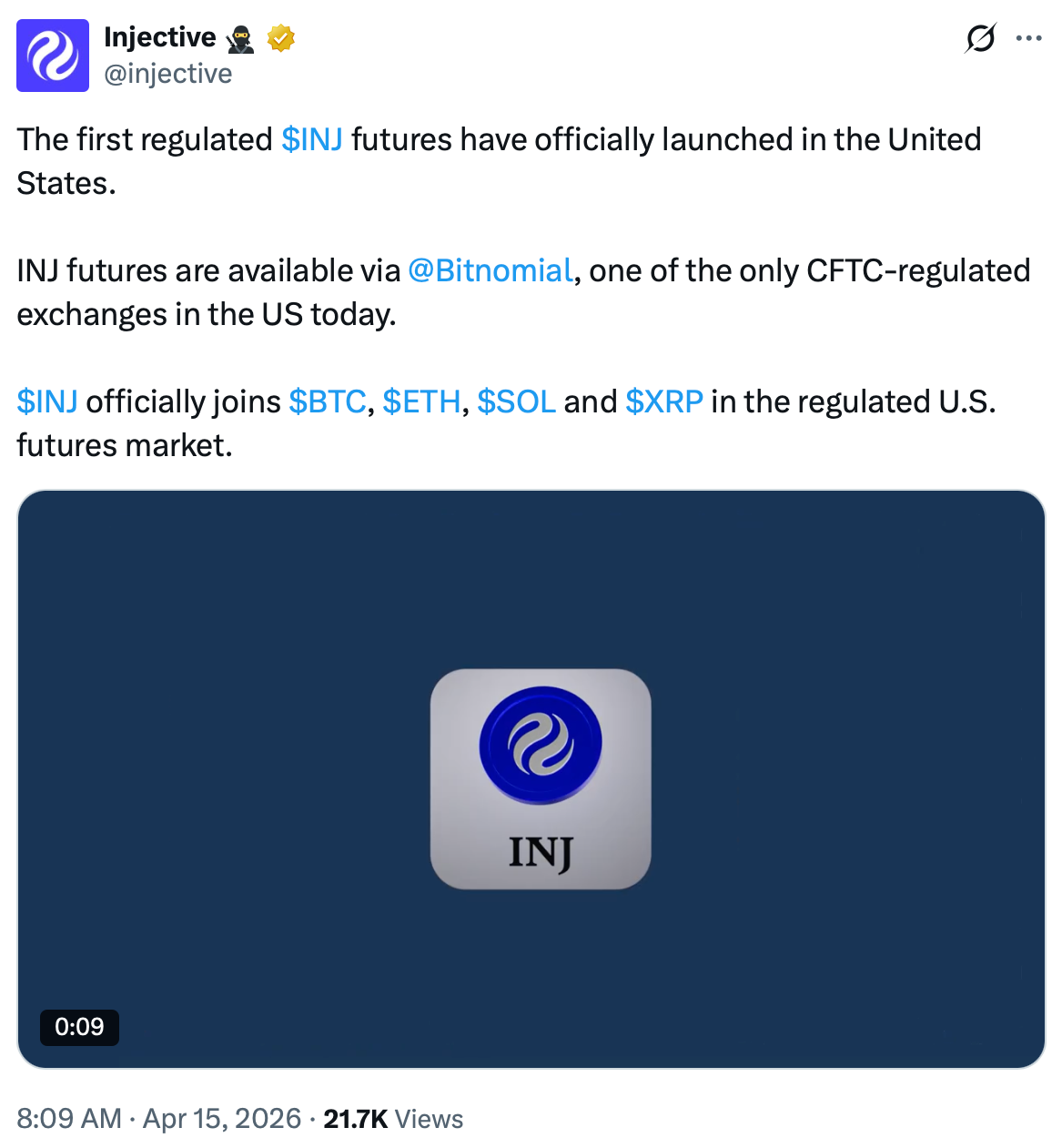
Chicago-based crypto exchange Bitnomial has launched monthly futures contracts tied to Injective, marking the first US-regulated derivatives product for the Web3 financial ecosystem’s native token.
According to Wednesday’s announcement shared with Cointelegraph, the contracts settle in INJ (INJ) with monthly expiries, allowing traders to gain price exposure without holding the underlying asset, and can be margined in crypto or US dollars through Bitnomial’s clearinghouse.
The listing also starts a six-month track record that could support a spot exchange-traded fund under US Securities and Exchange Commission (SEC) listing rules. In July, Canary Capital filed for a staked INJ ETF, with Cboe BZX Exchange submitting a corresponding rule change to the SEC.
Institutional clients can access the futures immediately, with retail trading expected to follow via Bitnomial’s Botanical platform in the coming weeks. The company said it also plans to add perpetual futures and options tied to INJ.

Injective runs on a Layer 1 blockchain built for financial applications, with an onchain order book and cross-chain connectivity to networks including Ethereum (ETH) and Solana (SOL).
Bitnomial is a derivatives exchange that operates a trading venue, clearinghouse and brokerage for crypto futures and options that is regulated by the Commodity Futures Trading Commission (CFTC). In January, the exchange launched monthly futures contracts tied to Aptos (APT) marking the first US-regulated derivatives product for the alt coin.
Related: Injective community passes governance vote to slash INJ token supply
Exchanges push to expand US crypto futures offerings
US-regulated crypto futures remain largely concentrated in major assets like Bitcoin (BTC) and Ether (ETH), with Bitnomial among the few venues listing derivatives tied to altcoins. Expanding those offerings has required navigating a shifting and often uncertain regulatory environment.
In August 2024, Bitnomial moved to list XRP (XRP) futures through CFTC self-certification, but the SEC challenged the plan, arguing the contracts could require securities exchange registration.
After filing a lawsuit in October 2025, Bitnomial dropped the case in March and later that month launched regulated XRP futures for US users, citing evolving SEC policy.
Other platforms have taken a more gradual approach. Coinbase launched CFTC-regulated futures tied to Bitcoin and Ether for institutional clients in June 2023, later expanding access with retail-sized contracts in May 2025 and introducing 24/7 trading to provide round-the-clock market access for US participants.
Also in May, Kraken acquired futures platform NinjaTrader for about $1.5 billion, gaining a CFTC-registered Futures Commission Merchant and expanding its reach into regulated derivatives markets.
Magazine: Should users be allowed to bet on war and death in prediction markets?
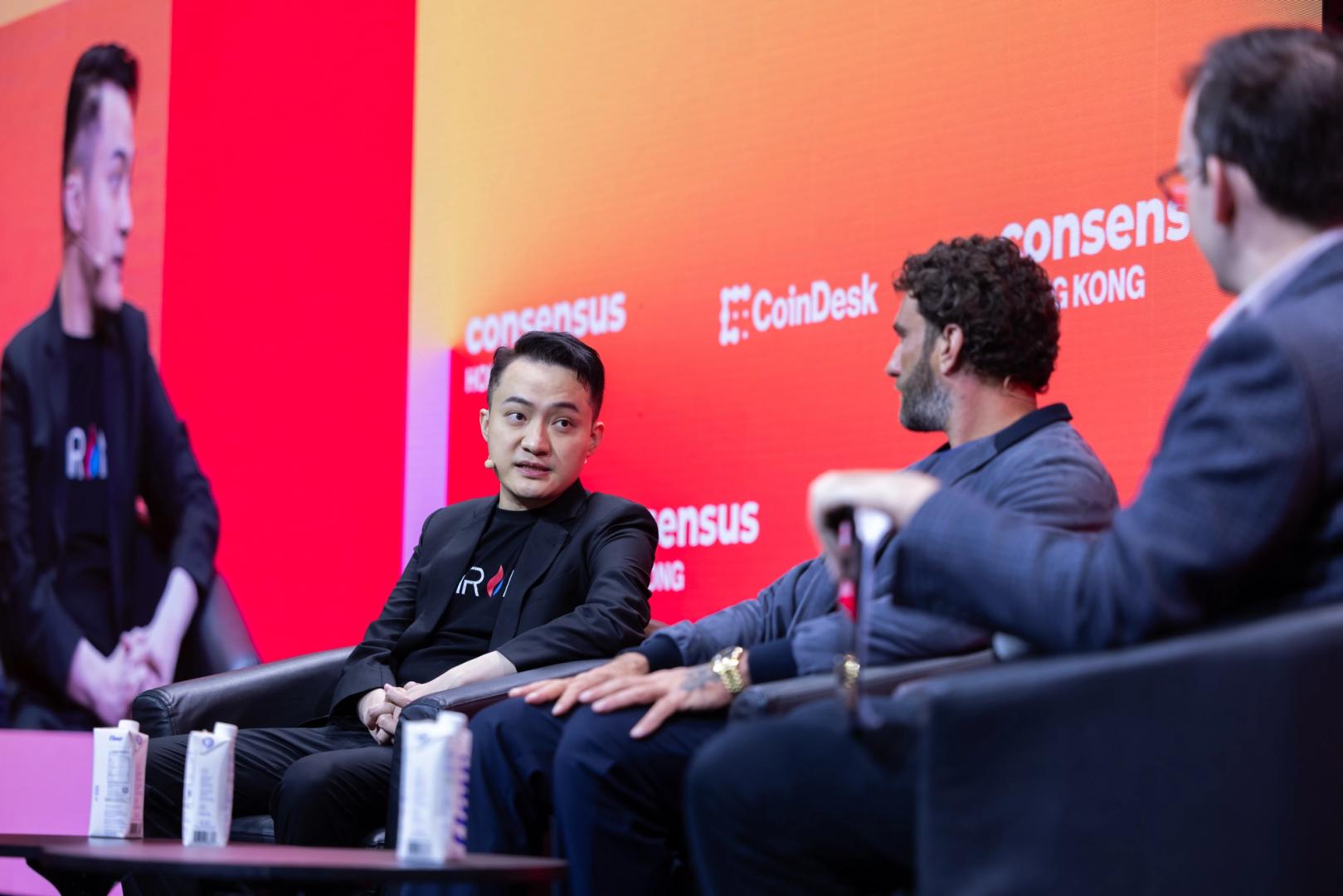
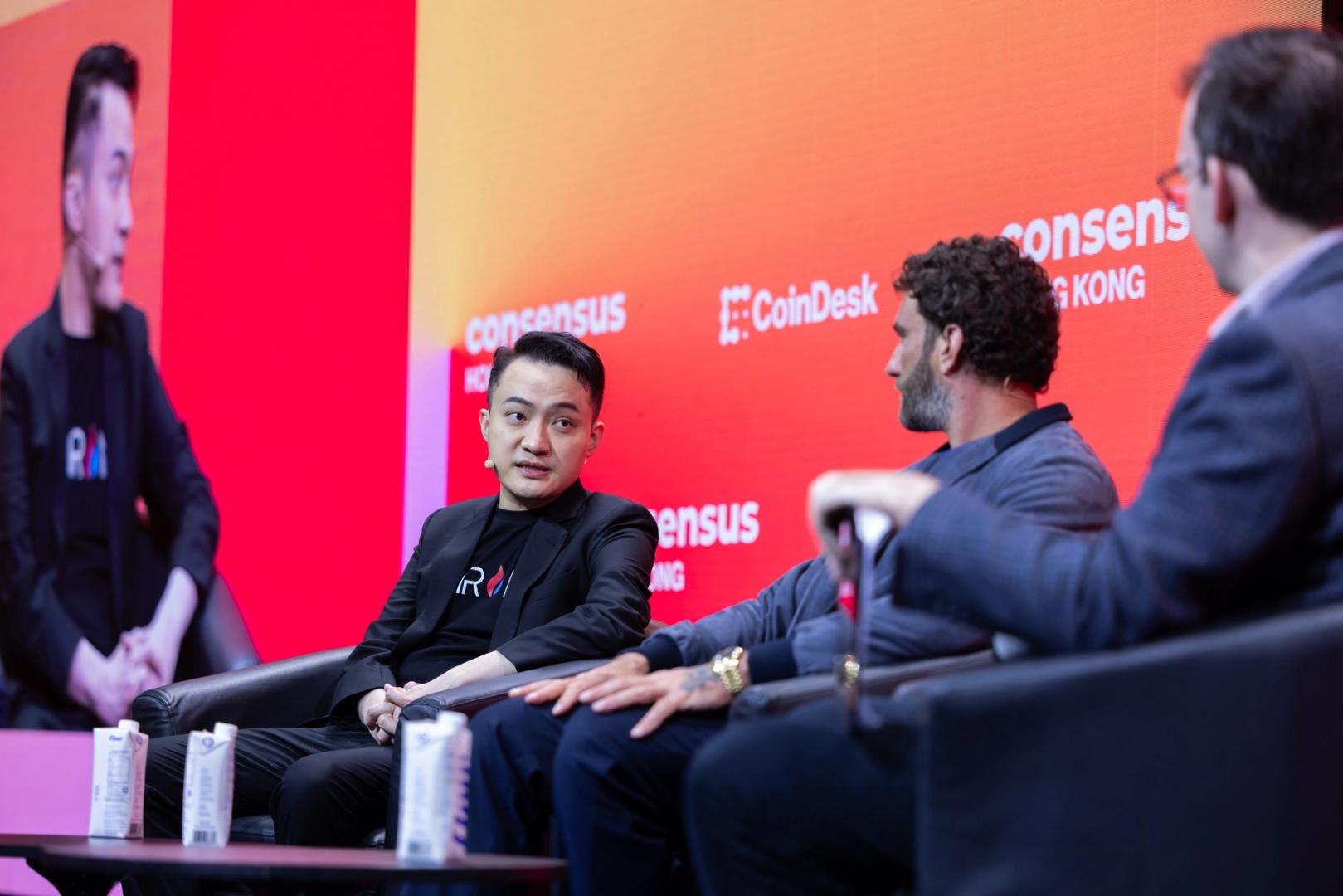
A public dispute between Tron founder Justin Sun and Trump-linked crypto project escalated Wednesday after Sun sharply criticized a new governance proposal, calling it “one of the most absurd governance scams” he has seen.
In a lengthy post on X, Sun accused the project of designing a vote that punishes dissent, with token holders who vote against the proposal risking having their tokens locked indefinitely.
He also claimed he and other large holders had been excluded from the process, alleging that tokens tied to roughly 4% of voting power under his control had been frozen.
More broadly, Sun questioned whether the vote has any real authority, claiming control over the protocol sits with anonymous wallet addresses, including a multisignature setup that can override outcomes and a separate account with the power to blacklist users.
“This proposal is not governance,” Sun said in the post. “It is an exercise of power by the selected few who are carefully engineering a further power consolidation and property expropriation operation.”
WLFI proposal
The criticism centers on WLFI’s new proposal that would overhaul token lockups across the ecosystem. More than 62 billion WLFI tokens would be subject to new terms, including multi-year lockups and vesting schedules.
Under the plan, tokens held by insiders — such as team members, advisors and partners — would face a two-year lockup followed by a three-year gradual release, alongside a 10% token burn upon opting in. Early supporters would face slightly shorter vesting terms but no burn. In total, up to 4.5 billion tokens could be permanently destroyed.
Holders who do not accept the new terms would remain locked indefinitely, per the proposal.
Sun was not alone in pushing back. Simon Dedic, founder of Moonrock Capital, said early investors had effectively been “rugged.”
“All the $WLFI early investors who thought they were sitting on solid profits just got rugged, by the Trump family themselves,” Dedic wrote on X, adding that the move appeared to give the project another chance to extract value from investors. He also criticized what he described as “blatant misconduct” with little effort to conceal it.
A World Liberty Financial spokesperson told CoinDesk that the proposal “was designed to further align all the participants in the WLFI ecosystem for the long-run,” adding that it aims to “optimally ensure long-term participation in our ecosystem and help ensure healthy market supply.”
Escalating feud
The backlash marks the latest episode in the breakdown in relations between Sun and the project.
Earlier this week, WLFI threatened legal action, saying it had “contracts” and “evidence” after Sun accused the team of exploiting users through DeFi transactions.
The dispute has been building for months. In September, WLFI blacklisted a blockchain address linked to Sun that held about $107 million worth of its governance tokens at the time. That marks a sharp reversal from late 2024, when Sun was a key backer, investing $30 million in WLFI tokens and taking on an advisory role to help support the project.
Tensions intensified after WLFI deposited 5 billion of its own tokens into lending protocol Dolomite — where one of its advisers is a co-founder — and borrowed roughly $75 million in stablecoins. The tokens fell 12% to a record low the next day, after which Sun publicly accused the project of treating users as “personal ATMs,” triggering the latest legal threats.
TLDR
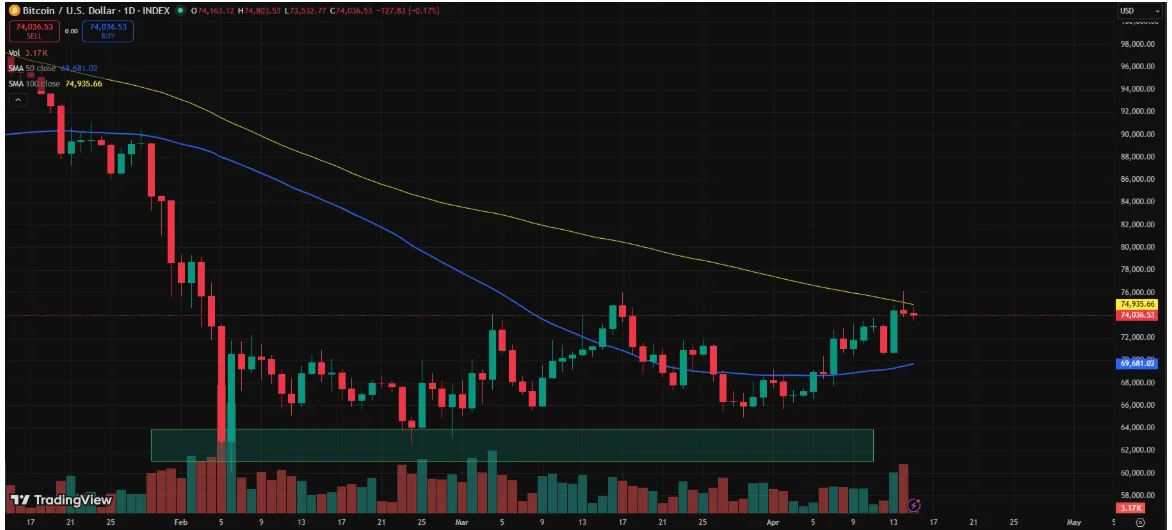
- Bitcoin climbed to $76,100 but failed to close above the $75,000 resistance level.
- The asset ended the session at $74,164 after sellers defended the key supply zone.
- Bitcoin rebounded 15.8% from $65,692 earlier this month before pulling back.
- The $72,000 level continues to act as short-term support for the current range.
- The 50-day moving average at $69,680 could provide support if the price declines.
Bitcoin price faced renewed selling pressure near $75,000 after another failed breakout attempt. The asset reached $76,100 on Tuesday but closed below resistance. Despite the pullback, technical indicators still show room for further upside.
Bitcoin Price Tests $75,000 Resistance Again
Bitcoin (BTC) climbed to $76,100 on Tuesday, marking its highest level since early February. However, sellers pushed the price down before the daily close. The asset ended the session at $74,164 after failing to hold above $75,000.
Earlier this month, Bitcoin rebounded from $65,692 and gained 15.8% to reach the recent peak. It has since retained about 8.45% of that advance. On March 17, Bitcoin also touched $76,000 but fell back to $73,920 after facing strong supply.
The repeated rejection at $75,000 confirms the level as firm resistance. Sellers continue to defend the zone, which limits upward movement. Bitcoin trades at $74,036 at the time of writing.
The price also encountered the 100-day simple moving average near the resistance zone. This moving average stands at $94,935 and adds technical pressure. As a result, bulls failed to secure a daily close above the barrier.
Failure to break resistance increases the risk of a decline toward $68,000 and $65,000. The 50-day moving average at $69,680 could provide support if the price drops. Market structure remains dependent on holding key levels.
Bitcoin Price Holds $72,000 Support as Indicators Stay Positive
Bitcoin price continues to hold the $72,000 micro support level identified by analyst Michael van de Poppe. He stated, “Holding $72,000 opens the path toward a new breakout.” The level now acts as a short-term foundation.
Van de Poppe projected a move toward $80,000 to $85,000 if Bitcoin closes above $75,000 with strong volume. He said the move could occur before the end of April. Such a rally would return Bitcoin to levels last seen in late January.
The daily Relative Strength Index stands at 60.74, which signals room before overbought conditions above 75. The reading reflects steady momentum without extreme conditions. Buyers still maintain control under current levels.
The Moving Average Convergence Divergence also supports bullish momentum. The MACD line reads 1,201.91 and remains above the signal line at 590.84. Green histogram bars continue to expand on the daily chart.
Bitcoin must secure a decisive close above $75,000 to confirm renewed upward momentum. Until then, the price remains within a defined range. Current data shows Bitcoin trading at $74,036.

Bitcoin stalls near $75,000 on Gate as traders test a familiar resistance band after bouncing from $68,000 support that has repeatedly defined this cycle’s downside line.
Summary
- Bitcoin trades at $75,000 on Gate with 1.19% daily gain.
- Move comes after weeks of choppy range between $68,000 and $75,000.
- Traders watch if BTC can finally clear the $75,000 ceiling.
Bitcoin (BTC) surged to $75,000 on Gate’s BTC/USDT market on April 15, marking another test of the level that has capped every major rally this year.
According to Gate market data, BTC/USDT is currently quoted at $75,000 with a 24‑hour increase of 1.19%, after touching an intraday high near $74,949 and a low around $73,510.
The latest push higher extends a rebound that began when Bitcoin bounced from roughly $68,000 support, a range that crypto.news recently described as “the last line of defense” before deeper downside.
In a recent crypto.news story, Bitcoin was trading near $74,400 after a more than 5% intraday jump, with the outlet flagging $75,000 to $76,100 as the “next meaningful resistance” tied to February’s pre‑war swing high.
That zone has repeatedly rejected upside attempts; earlier coverage noted that $73,000 to $75,000 has “capped every rally” since the US‑Iran ceasefire, forcing altcoins like ETH, SOL and DOGE to lag whenever BTC stalls below a clean breakout.
RootData, citing Gate’s order book, similarly reported that “BTC/USDT is currently reported at $75,008.8, with a 24‑hour increase of 5.65%,” underscoring how quickly momentum can accelerate once Bitcoin approaches this band.
The latest move unfolds against a backdrop of strong spot and derivatives flows, with prior crypto.news analysis highlighting that ETF inflows, whale accumulation and short liquidations have repeatedly driven spikes as Bitcoin reclaims key psychological levels such as $70,000 and $75,000.
While the current gain of 1.19% on Gate is modest compared with earlier 5% surges, traders are watching whether sustained closes above $75,000 can finally confirm a technical breakout and reopen the path toward Bitcoin’s all‑time high near $125,600 set in late 2025.
For broader context, previous reporting on Bitcoin’s sharp drop below $75,000 during April 2025 circuit‑breaker events showed how quickly the level can flip from support to resistance when macro risk and leverage unwind collide, a dynamic still in the back of traders’ minds as BTC revisits the mark today.
Relevant crypto.news articles referenced in the piece include this story on Bitcoin’s $68,000 support and $75,000 ceiling, this analysis of BTC’s four‑week high near $74,400, and this breakdown of how $73,000 and $75,000 have repeatedly capped altcoin recoveries.

TLDR
- Michael Saylor signaled a renewed plan to reach 1,000,000 Bitcoin through continued STRC issuance.
- Strategy may have surpassed 800,000 Bitcoin in total corporate reserves.
- The company raised funds this week to acquire 17,284.73 Bitcoin through STRC.
- Strategy continues to purchase an average of 9,000 Bitcoin per working week.
- The firm needs to increase its holdings by about 20% to reach 1,000,000 Bitcoin.
Michael Saylor signaled a renewed accumulation plan as Strategy approaches 1,000,000 BTC on its balance sheet. He posted an image with the caption, “Millions of Possibilities, One Solution,” which referenced STRC preferred shares. Meanwhile, the company continues raising capital and converting proceeds into Bitcoin purchases at a steady pace.
STRC Mechanism Drives Capital Toward Bitcoin Accumulation
Saylor shared a photo holding an orange Rubik’s Cube and wrote, “Millions of Possibilities, One Solution.” He linked the message to STRC, which Strategy uses to fund Bitcoin acquisitions. The post appeared as issuance levels for STRC preferred shares reached record highs.
According to the company’s weekly report starting April 13, STRC keeps channeling market liquidity into Bitcoin purchases. Data from strc.live shows Strategy raised funds this week to acquire 17,284.73 BTC. The firm continues executing purchases as capital becomes available.
STRC enables Strategy to buy Bitcoin by leveraging the spread between its cost of capital and the asset’s yield. Shares currently trade at parity near $100, which supports issuance efficiency. As a result, the company maintains steady access to funding under present market conditions.
Path to 1,000,000 BTC and Current Reserve Status
Strategy’s Bitcoin reserves may have surpassed 800,000 BTC based on recent disclosures. To reach 1,000,000 BTC, the company needs to increase holdings by about 20%. The firm continues accumulating coins through weekly purchases funded by STRC.
At the current rate of roughly 9,000 BTC per working week, Strategy could reach its target within 24 weeks. That timeline points to completion by the end of 2026 if the pace remains unchanged. The company maintains a structured acquisition schedule tied to capital inflows.
Strategy’s Bitcoin holdings now carry a market value of more than $57.7 billion. The company reports it has reached breakeven on its aggregate position at current prices. It continues publishing updates that detail both issuance activity and Bitcoin purchases.
STRC issuance volume remains active as shares trade close to their $100 reference value. This pricing level supports continued capital raises without discount pressure. The company therefore, sustains its funding approach while expanding its Bitcoin reserves.
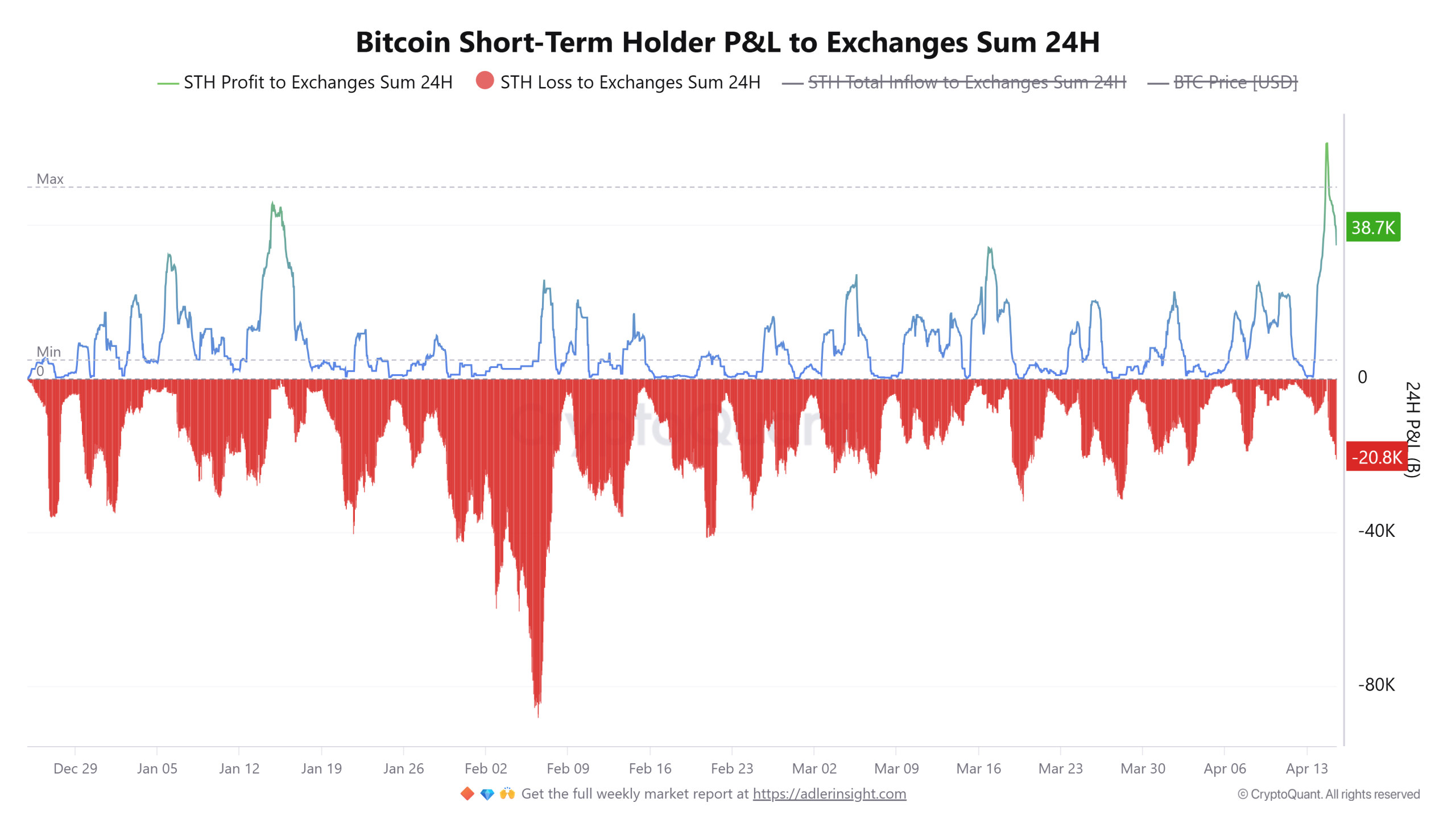
Bitcoin’s (BTC) rally stalled above $76,000 stalled on Tuesday after short-term profit-taking by traders reached its highest level in 2026.
The activity coincided with continued accumulation by long-term holders, and this opposing interaction between the two cohorts may continue to impact Bitcoin’s attempts to break into the $80,000 range.
Bitcoin profit-taking meets whale demand
New Bitcoin short-term holders moved their holdings as BTC in profit sent to exchanges reached 63,000 BTC on April 14, the highest level in 2026, since the 44,800 spike on Jan. 14.

Onchain data shows that the one-day-to-one-week cohort moved nearly 2,000 BTC back to Binance during the same time. This implied that freshly acquired coins are rotating into sell-side liquidity as BTC traded near $76,000.
Crypto analyst Amr Taha flagged this as the first clear wave of profit-taking after the retest of the monthly highs. The activity aligns with cautious distribution, in which newer participants seek to secure gains at key resistance levels during a bear market.
Taha noted that this indicates a natural cooling phase in momentum.
Meanwhile, BTC whale behavior shows a different pattern. Market analyst CW noted a single-day inflow of over 71,000 BTC into accumulation addresses, the largest bullish inflow since early 2022. The large holders appear to be absorbing available supply from the short-term sellers.

The relationship between these flows points to a transfer of coins from weaker hands to stronger ones, which may stabilize the price while limiting an immediate rally.
Related: Bitcoin ETFs post $412M in inflows as Goldman Sachs files for BTC ETF
Bitcoin liquidity cluster may lead to a small dip
After forming equal highs near $76,000, BTC’s price rejected near the 100-day exponential moving average (EMA), marking the first test of this trend since Jan. 14. The momentum slowed after the rejection, with price slipping to $73,500.

However, on the lower time frame, the bullish trend remains intact.
On the one-hour chart, internal liquidity levels are resting around $73,000 and $72,000. These zones may attract bid orders that may get filled before a trend continuation.

The liquidation heatmap provides additional context, with $1.4 billion in cumulative long liquidations clustered around $73,000. That figure rises to $3.5 billion in long positions at risk near $70,500.
At the opposite end, a move toward $80,000 would expose $2 billion in leveraged short positions. The spread between the long and short liquidation zones suggests BTC may retest the $72,000 to $70,000 range before moving higher.

Related: Bitcoin shows ‘bull market behavior’ as chart pattern targets $90K
This article is produced in accordance with Cointelegraph’s Editorial Policy and is intended for informational purposes only. It does not constitute investment advice or recommendations. All investments and trades carry risk; readers are encouraged to conduct independent research before making any decisions. Cointelegraph makes no guarantees regarding the accuracy or completeness of the information presented, including forward-looking statements, and will not be liable for any loss or damage arising from reliance on this content.
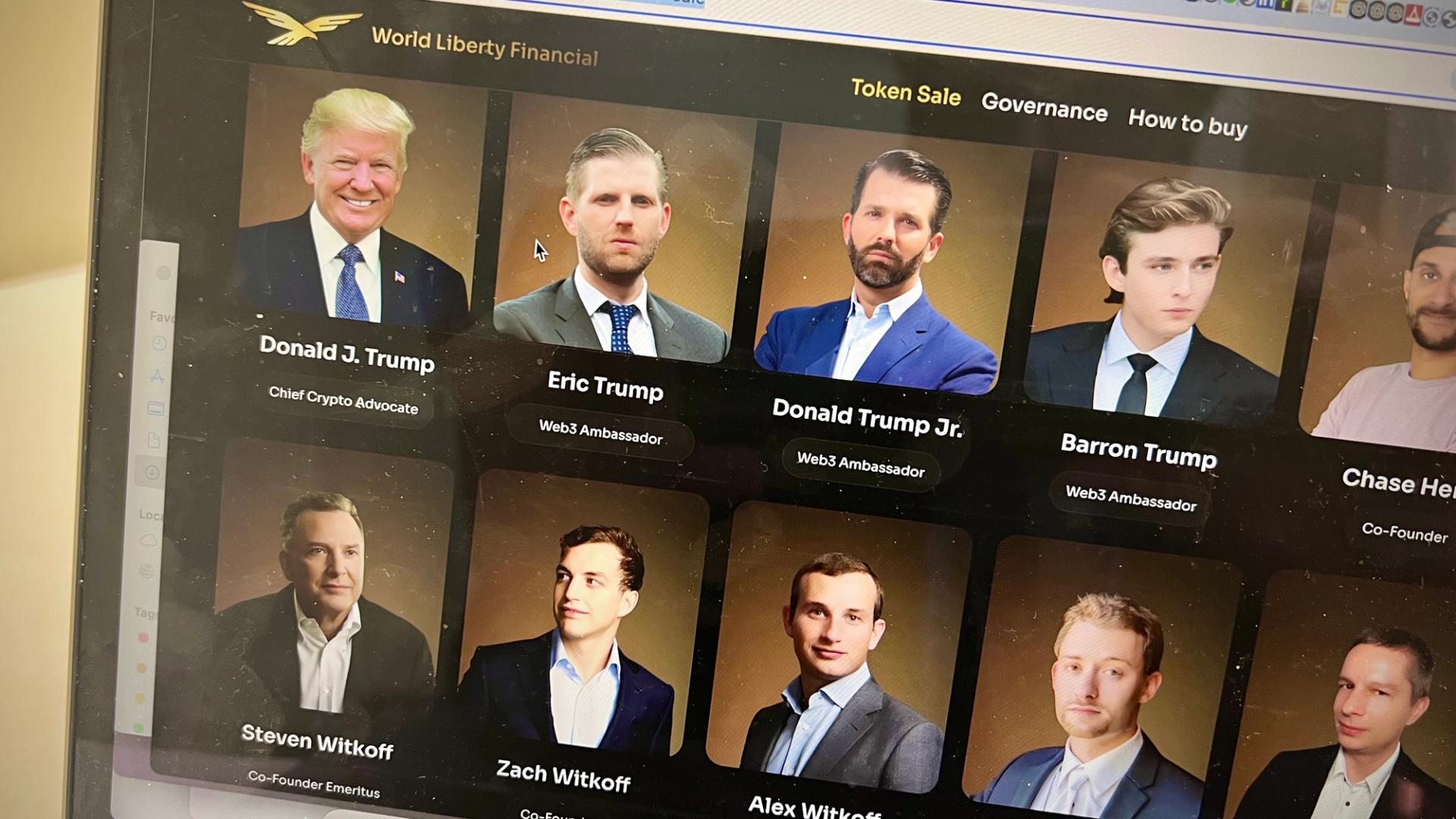
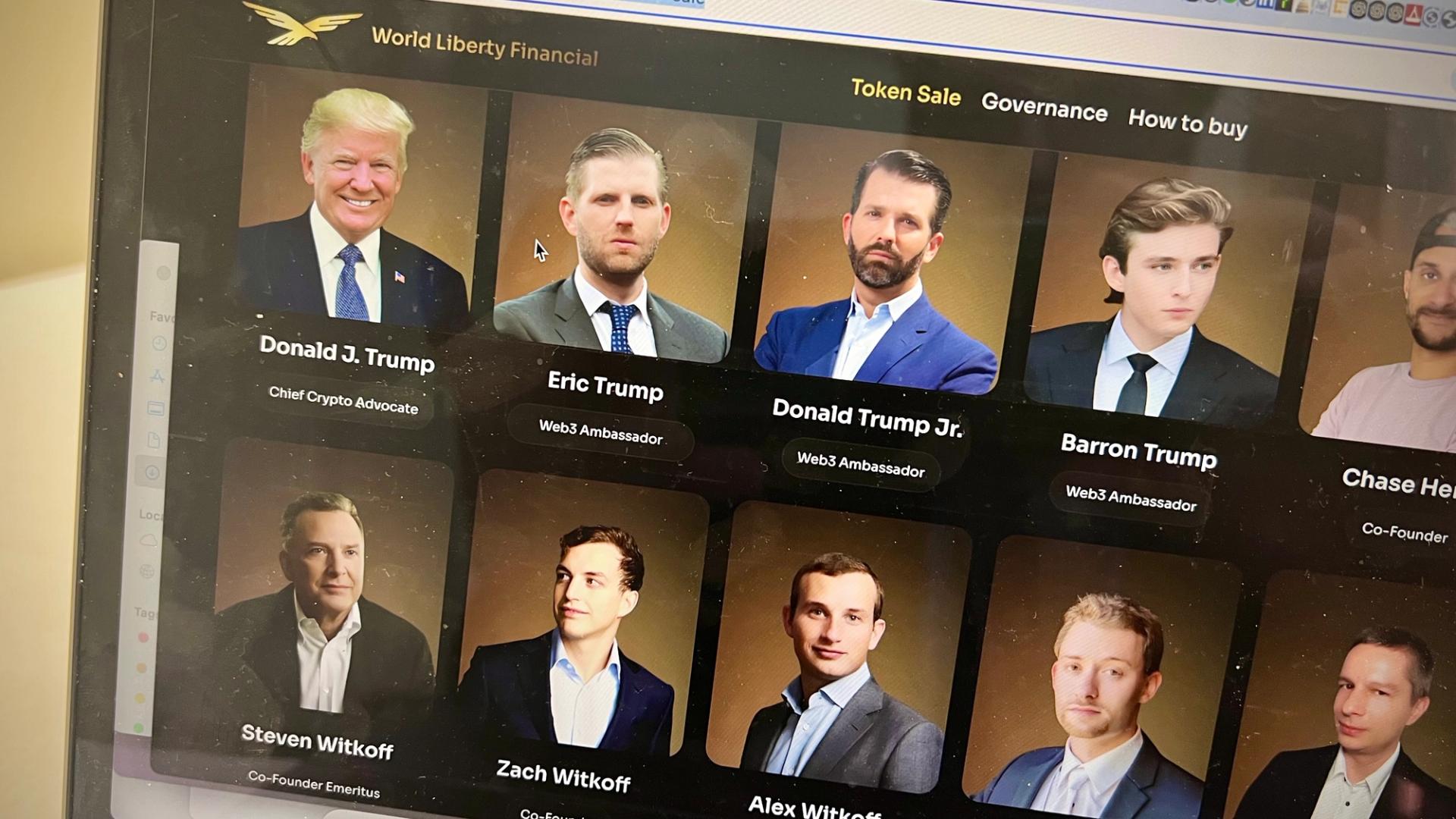
The Trump family-backed World Liberty Financial has proposed unlocking 62.3 billion WLFI governance tokens on Tuesday, less than a week after CoinDesk reported the venture had used 5 billion of its own tokens as collateral on lending platform Dolomite to borrow $75 million in stablecoins.
WLFI’s token was originally sold as a governance-only token with no transferability and indefinite locks. A vesting schedule with a defined path to liquidity changes the economic profile of what holders bought.
The proposal would open up liquidity for insiders who previously had no exit, changing the economics of the token.
The proposal splits the locked supply into two groups. Early supporters holding 17 billion WLFI would receive a 2-year cliff followed by a 2-year linear vest, retaining all tokens.
Founders, team members, advisors, and partners holding 45.2 billion WLFI would face a 2-year cliff and 3-year vest, but with 10% of their allocation, roughly 4.5 billion tokens, burned immediately on passage. (Burns refer to the permanent removal of tokens from supply, usually by sending to an address that is not controlled by anyone.)
In practice, it means insiders would surrender 4.5 billion tokens in exchange for beginning to unlock 40.7 billion that were previously locked indefinitely with no vesting schedule attached. Those tokens had no path to liquidity before this proposal.
WLFI included participation data from its six prior votes in the Wednesday post, showing that even the most engaged proposal – the vote to make the token tradeable – drew 11.1 billion WLFI in voting power.
The quorum for this proposal is 1 billion, with a simple majority required to pass. At those thresholds, the proposal could pass with a fraction of the founders and team allocation alone.
Holders who do not affirmatively accept the new vesting terms keep their tokens locked indefinitely and retain governance voting rights.
The timing comes on the back of events of the past week.
CoinDesk reported on April 9 that WLFI had deposited 5 billion of its own governance tokens into Dolomite, a lending protocol whose co-founder advises WLFI, and borrowed $75 million in stablecoins that were partially routed to Coinbase Prime.
The WLFI token dropped 12% to a record low the following day. Then, Tron founder Justin Sun, once the project’s largest backer, publicly accused the team of treating users as “personal ATMs,” prompting WLFI to threaten legal action.
The token was trading near $0.079 on Tuesday, down roughly 48% from the average price at which WLFI’s own treasury conducted $65.6 million in open-market buybacks over the past six months.
Voting on the Wednesday proposal runs for a seven day period.


OpenAI circulated an internal memo this week directly attacking rival Anthropic, accusing it of inflating its $30 billion revenue figure by roughly $8 billion as Claude’s grip on enterprise AI becomes increasingly hard for the company to dismiss.
Summary
- OpenAI chief revenue officer Denise Dresser sent a four-page memo to employees accusing Anthropic of overstating its run rate through gross accounting on cloud deals with Google and Amazon.
- The memo describes Anthropic’s strategy as built on “fear, restriction, and the idea that a small group of elites should control AI,” and labels its compute position a strategic misstep.
- Anthropic’s annualized revenue has surpassed $30 billion by its own figures, up from $9 billion at end-2025, as Claude was described as having “become a religion” among enterprise users at a major AI conference.
OpenAI’s chief revenue officer Denise Dresser sent a four-page internal memo to employees this past Sunday attacking rival Anthropic, accusing it of inflating its widely reported $30 billion run-rate figure by roughly $8 billion. The memo, reported by CNBC and The Verge, alleges that Anthropic “grosses up” revenue sharing from its cloud partnerships with Amazon and Google rather than reporting net figures, which OpenAI does with its Microsoft arrangement.
The accusation puts the real Anthropic figure closer to $22 billion, which would place it behind OpenAI’s reported $24 billion run rate. Both companies are preparing for potential IPOs and are competing aggressively for enterprise contracts and investor positioning.
Dresser goes well beyond accounting in the note. She describes Anthropic’s strategy as built on “fear, restriction, and the idea that a small group of elites should control AI,” contrasting it with what she frames as OpenAI’s more “positive message.” She also calls Anthropic’s compute strategy a “strategic misstep,” noting that OpenAI is targeting 30 gigawatts of compute by 2030 while projecting Anthropic will have only 7 to 8 gigawatts by end-2027.
Anthropic announced a deal with Google and Broadcom earlier this month for “multiple gigawatts” of compute. OpenAI itself is also in the middle of a pivot, turning to Amazon after acknowledging that its Microsoft partnership has “limited our ability” to reach enterprise clients on rival cloud platforms.
Claude Mania and the Enterprise War
The sharpness of the memo reflects a real competitive problem for OpenAI. At the HumanX conference in San Francisco last week, enterprise sentiment was overwhelmingly in Anthropic’s favor. Arvind Jain, CEO of enterprise AI startup Glean, described the phenomenon plainly. “It has become a religion, that’s the level of that mania,” he said of Claude’s penetration into corporate workflows.
Anthropic’s momentum has come primarily from Claude Mythos and its coding tools, which have driven the revenue surge from $9 billion to $30 billion in under a year. The two labs are also racing to build competing AI cybersecurity products, with OpenAI finalizing a security tool for limited partner release while Anthropic runs its tightly controlled Project Glasswing initiative.
What It Means for the AI Race
OpenAI is valued at over $850 billion following a March fundraise. Anthropic was valued at $380 billion in its most recent round. Both companies are heading into IPO windows with very different stories to tell investors about their enterprise position.
The memo is notable precisely because confident market leaders do not typically challenge a rival’s accounting in writing. It signals that Anthropic’s gains are being felt inside OpenAI in a way that a memo to employees alone cannot solve.
TLDR
- Kalshi launched a new Commodities Hub that expands its 24/7 event contracts platform into agriculture, metals, and energy markets.
- The company added contracts tied to natural gas, coffee, copper, sugar, corn, soybeans, wheat, nickel, diesel, and lithium.
- Kalshi structured the contracts as binary markets based on price direction and threshold outcomes.
- The platform allows users to trade around the clock, including weekends and holidays.
- Kalshi said federal authorities and courts confirmed that its event contracts fall under CFTC oversight.
Kalshi has expanded its platform with a new Commodities Hub that adds agriculture, metals, and energy markets. The company launched the hub on Tuesday to widen access to event contracts tied to raw materials. The move strengthens its 24/7 trading model and targets rising demand for flexible commodity exposure.
Kalshi Expands Commodities Suite with Agriculture, Metals, and Energy Contracts
Kalshi added new markets linked to natural gas, coffee, copper, sugar, corn, soybeans, wheat, nickel, diesel, and lithium. The expansion builds on existing contracts tied to WTI crude, Brent crude, gold, and silver. The company said the hub offers broader commodity coverage through binary event contracts.
The platform structures each contract around price direction and threshold outcomes. Users can trade on whether a commodity will close above or below a set level. Kalshi said this format removes margin requirements, contract rollovers, and complex mechanics tied to futures.
Kalshi stated that geopolitical stress and inflation concerns have fueled higher commodities activity. The company linked the launch to oil market swings tied to Middle East tensions. It said supply chain disruption has also increased trading interest across global markets.
The hub allows continuous trading, including weekends and holidays. Users can express views during off-hours when traditional exchanges remain closed. Kalshi said this access supports faster reactions to macro shocks in energy and agriculture.
The company emphasized that contracts operate under federal financial oversight. It said federal authorities and courts recently affirmed that its event contracts fall under CFTC jurisdiction. This position places the products outside state gaming law.
Regulatory Clarity and Institutional Push Support Kalshi Growth
Kalshi said recent court decisions strengthened its regulatory standing. Federal rulings supported the company’s view that prediction markets qualify as financial products. The firm stated that CFTC oversight governs its commodity event contracts.
The company also confirmed that it received an NFA license for margin trading. This approval allows Kalshi to expand trading features for qualified participants. It said the license supports broader participation across its markets.
Kalshi reported that it has worked with Jump Trading on contract development and liquidity support. The firm said these efforts aim to deepen market efficiency and order flow. It stated that institutional engagement remains a core priority.
The Commodities Hub integrates with Kalshi’s existing event contract interface. Users can access price thresholds and directional markets from a single dashboard. The company said contracts trade around the clock without interruption.

INNOCN’s 27″ QD-OLED 2K Display Brings Sharp Detail and Fluid Motion to More Desks with 280Hz Refresh Rate

Champions League semi-final dates in full: Arsenal FC eye Atletico Madrid revenge as Bayern Munich get holders

Scheme to support energy-intensive firms to be expanded

Why Israel is blocking foreign journalists from entering

Bitcoin: We’re Entering The Most Dangerous Phase

Alan Cumming Brands Baftas Ceremony A ‘Triggering S**tshow’
![Ripple Executives Are Aware XRP Will Be Valuable... But They LEGALLY Can't Say Anything! [MUST SEE]](https://wordupnews.com/wp-content/uploads/2026/04/1776291322_maxresdefault-80x80.jpg)
Ripple Executives Are Aware XRP Will Be Valuable… But They LEGALLY Can’t Say Anything! [MUST SEE]

HDB Financial Services Q4 results 2026 | HDB Financial results today | HDB Financial Services Share

Why Bitcoin’s Supply Shock is ALREADY Here
-

 Politics5 days ago
US brings back mandatory military draft registration
-
 Sports5 days ago
Man United discover Nico Schlotterbeck transfer fee as defender reaches Dortmund agreement
-

 Fashion5 days ago
Weekend Open Thread: Veronica Beard
-

 Politics6 days ago
Malcolm In The Middle OG Turned Down ‘Buckets Of Money’ To Appear In Reboot
-

 Politics3 days ago
World Cup exit makes Italy enter crisis mode
-

 Crypto World6 days ago
Canary Capital Files SEC Registration for PEPE ETF
-

 Business5 days ago
Tesla Model Y Tops China Auto Sales in March 2026 With 39,827 Registrations, Beating Cheaper EVs and Gas Cars
-

 Crypto World2 days ago
The SEC Conditionalises DeFi Platforms to Be Avoided for Broker Registration
-

 Crypto World2 days ago
SEC Signals Exemption for Crypto Interfaces From Broker Registration
-

 News Videos14 hours ago
Secure crypto trading starts with an FIU-registered
-
 NewsBeat3 days ago
Pep Guardiola and Gary Neville agree over Arsenal title problem that benefits Man City
-

 Business5 days ago
OpenAI Halts Stargate UK Data Centre Project Over Energy Costs and Copyright Row
-

 Business4 days ago
Ireland Fuel Protests Enter Day 5 as Blockades Spark Shortages and Government Prepares Support Package
-

 Politics6 days ago
LBC Presenter Mocks Trump Over Iran War Failures
-

 Crypto World5 days ago
Federal judge blocks Arizona from bringing criminal charges against Kalshi
-
 NewsBeat4 days ago
JD Vance announces ‘no agreement’ with Iran over nuclear weapons fear
-

 NewsBeat2 days ago
Trump and Pope Leo: Behind their disagreement over Iran war
-

 Crypto World2 days ago
SEC Proposes Certain Crypto Interfaces Don’t Need to Register as Brokers
-

 Tech6 days ago
A version of Windows 10 released a decade ago is now eligible for additional security patches
-

 Business5 days ago
IMF retains floor for precautionary balances at SDR 20 billion
You must be logged in to post a comment Login