
Crypto World
Bitcoin developer says self-custody fears cost him gains

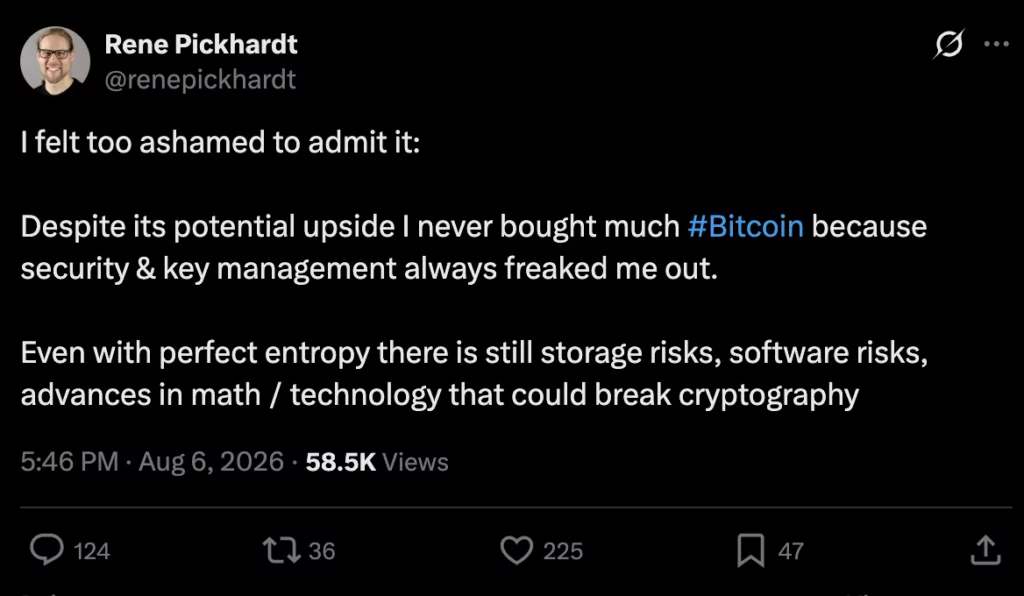
German Bitcoin developer René Pickhardt said on Aug. 6 that fears about self-custody security and key management kept him from accumulating more Bitcoin, despite believing the asset had upside.
Summary
- Bitcoin developer René Pickhardt says self-custody security concerns kept him from accumulating more BTC earlier.
- Coldcard vulnerabilities made some wallet seed phrases predictable, exposing users to remote key recovery attacks.
- Galaxy Research estimates roughly 1,755 BTC was stolen across several waves linked to vulnerable wallets.
- Coinkite says patched firmware cannot repair previously generated weak seeds, requiring users to migrate funds.
- Adam Back argues Bitcoin self-custody remains powerful but requires users to accept greater security responsibility.
In a post, Pickhardt wrote that “security & key management always freaked me out,” framing his decision as a risk-management choice rather than a criticism of Bitcoin.
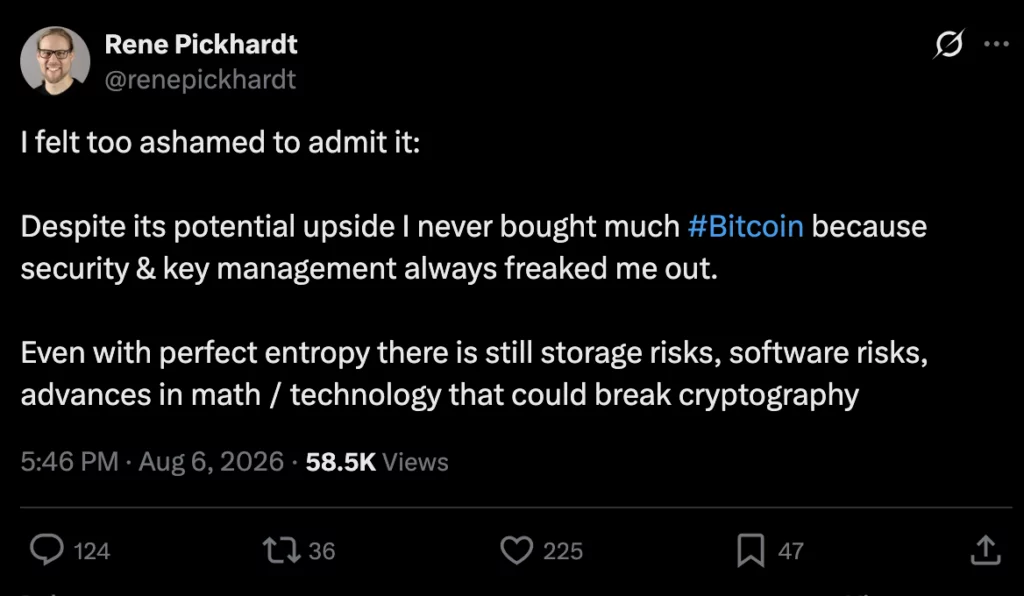
His remarks landed after the Coldcard hardware-wallet incident renewed scrutiny of how self-custody tools generate private keys. Security research linked vulnerable Coldcard firmware to predictable seed generation, while on-chain analysis cited by Galaxy Research estimated roughly 1,755 BTC had been stolen across several attack waves. The loss total remains under investigation.
Coldcard failure puts Bitcoin key generation under scrutiny
The Coldcard issue involved randomness used when generating wallet seeds, not a failure of the Bitcoin protocol. Block’s Bitcoin security researchers found that certain firmware configurations could bypass hardware randomness and fall back to weaker software-generated entropy. That reduced the unpredictability of some seed phrases and potentially allowed attackers to reconstruct private keys without physically possessing the device.
Coinkite acknowledged the firmware problem and released patched software. However, the company warned that installing new firmware does not repair a seed created under vulnerable conditions. Users with affected seeds must generate a new one securely and move funds on-chain. Reports citing Galaxy Research put one July 30 theft wave above 1,000 BTC, with subsequent attacks lifting estimated losses.
The episode illustrates the distinction explained in our self-custody guide: controlling private keys removes exchange counterparty risk, but transfers responsibility for key generation, backup and recovery to the owner. Hardware wallets reduce online attack surfaces, yet depend on firmware, hardware design and secure randomness.
Pickhardt says security concerns outweighed Bitcoin upside
Pickhardt has worked extensively on Lightning Network routing and payment reliability, and Bitcoin Optech identifies him as a Lightning developer and researcher with OpenSats. His 2026 paper includes a mathematical framework for payment-channel networks focused on liquidity and off-chain throughput.
Against that background, his admission drew attention because technical familiarity did not eliminate his custody concerns. Pickhardt said even correctly generated private keys face risks involving storage, implementation mistakes and future advances in computing. Those concerns do not mean properly implemented self-custody is inherently unsafe; they describe the operational burden individual holders accept.
Blockstream CEO Adam Back responded that “with great bearer cash power comes great responsibility to not lose your keys.” The response captures the trade-off: Bitcoin allows holders to control assets without a bank, but no central institution can reset a lost private key or reverse an unauthorized valid transaction.
Coldcard losses sharpen the self-custody debate
Recent wallet security incidents give that debate context. Cinco Días, citing Galaxy Research, reported that roughly 1,755 BTC had been stolen from about 5,000 wallets across several waves. Earlier Galaxy estimates were lower, and Coinkite has said the full attribution and scope remain unresolved, so the figure should be treated as an evolving on-chain estimate rather than a final confirmed loss.
The failure also does not show that every hardware wallet faces the same flaw. Block said its products were unaffected, while other manufacturers have separately explained their entropy-generation designs. The vulnerability followed affected seed phrases even if users imported them into another wallet, meaning changing hardware without creating new keys would not remove the underlying exposure.
Our seed phrase security guide explains why the recovery phrase is effectively the master key to a wallet. If generation is weak, offline storage cannot restore the missing entropy afterward. The Coldcard case therefore shifts attention from simply hiding a seed toward verifying how securely it was created.
What Bitcoin holders should watch next
Coinkite’s investigation, blockchain tracing and any law-enforcement findings will determine the final scale of the Coldcard losses. Users who created seeds on affected firmware should follow the manufacturer’s remediation guidance rather than assume a firmware update alone fixes an existing wallet.
For the broader Bitcoin market, Pickhardt’s comments are anecdotal and do not establish that self-custody fears are suppressing adoption. Still, the episode shows why usability and security remain linked. As hardware wallets become easier to buy, manufacturers face pressure to make key management both verifiable and understandable.
Pickhardt’s decision shows that conviction in Bitcoin’s monetary thesis does not automatically translate into comfort with bearer-asset security. Self-custody removes one class of intermediary risk while creating another set of responsibilities. The Coldcard failure has made that trade-off harder to dismiss, especially for holders deciding whether direct ownership outweighs the operational burden of securing keys themselves.

Crypto World
Bitcoin hovers below $65,000 as Middle East tensions escalate further: Crypto Markets Today
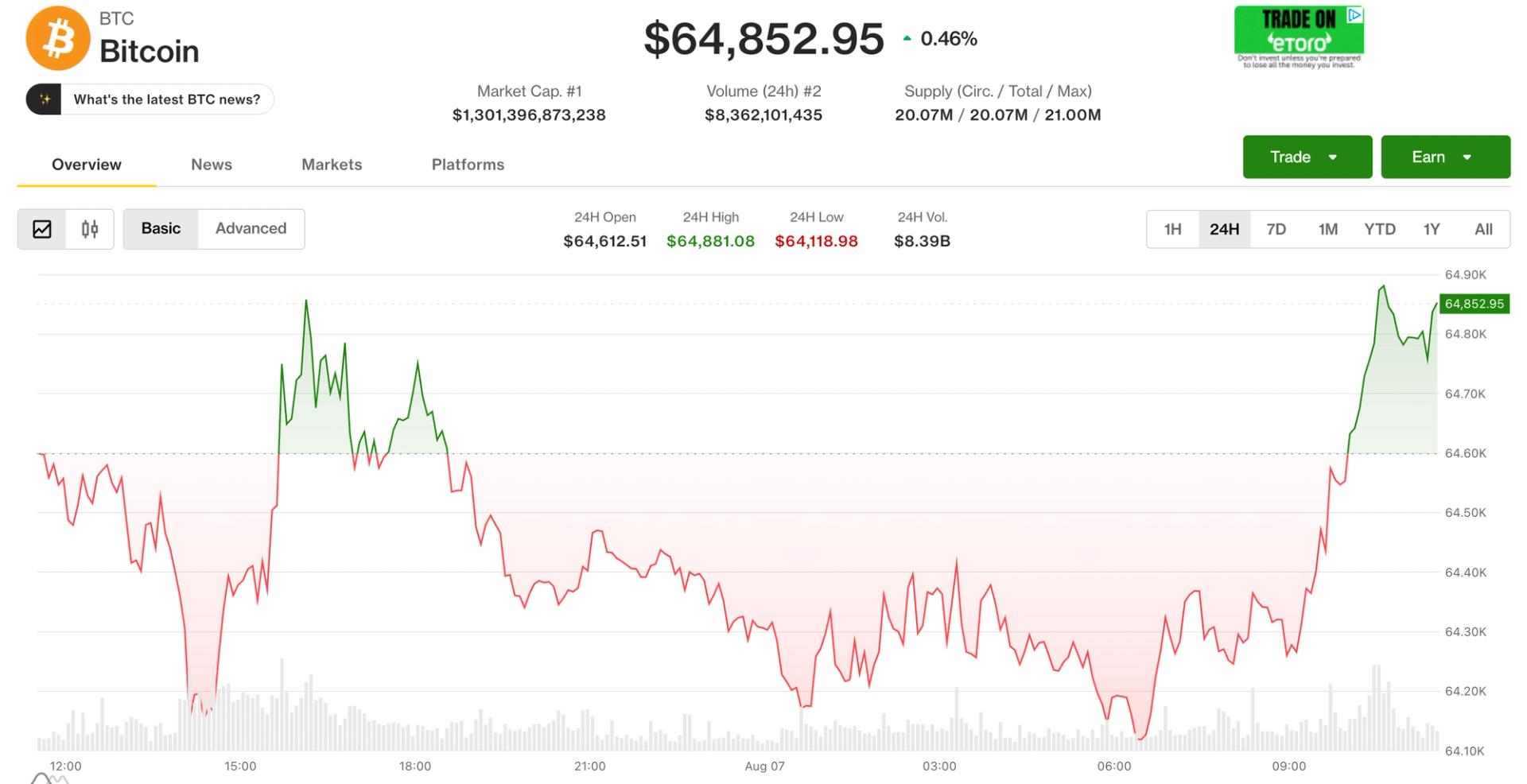
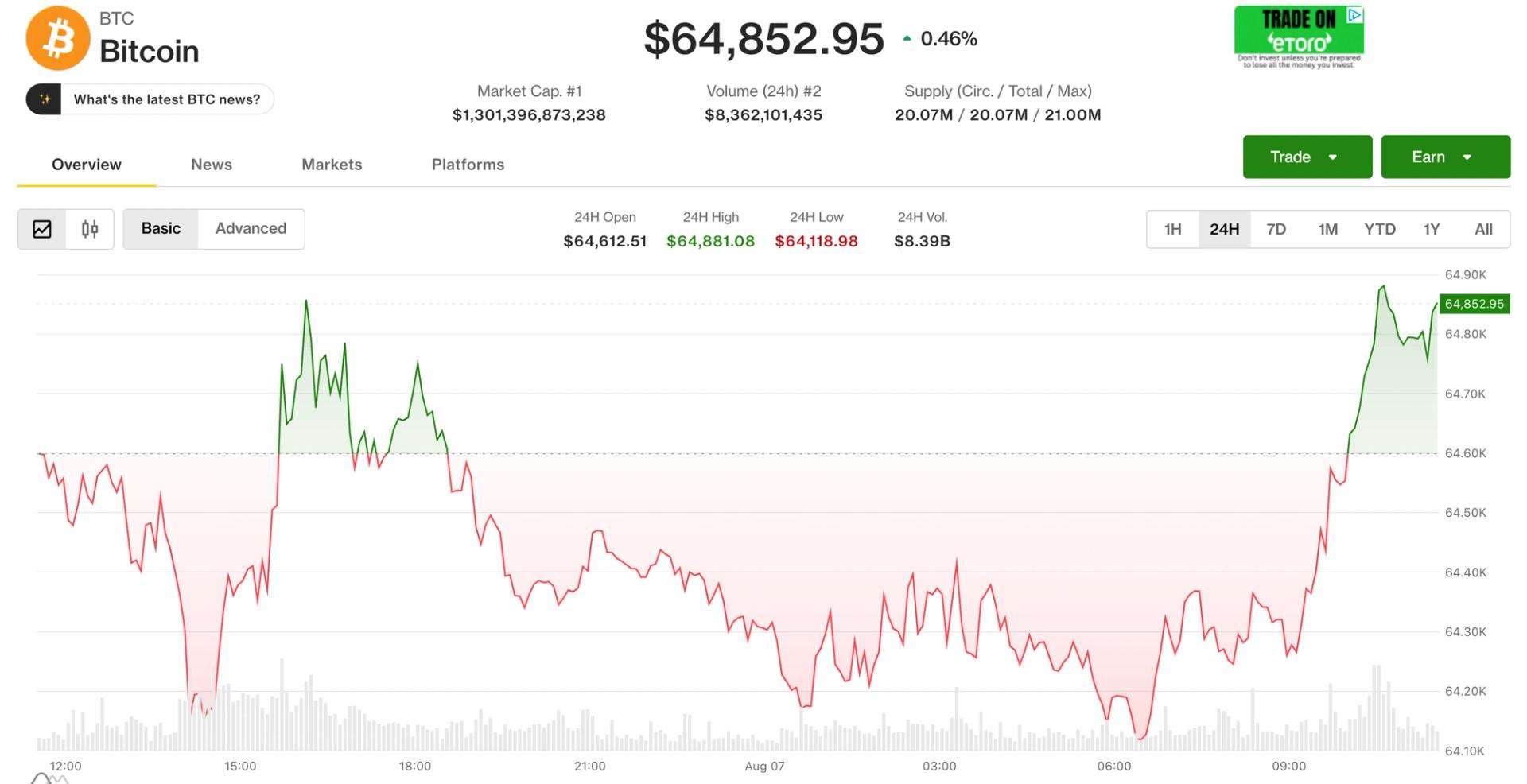
Bitcoin is holding near $64,700 Friday, barely changed over the last 24-hour period, while the broader CoinDesk 20 (CD20) index is down 0.2% over the period.
Brent crude has meanwhile moved to over $83 a barrel after Yemen’s Iran-linked Houthis attacked Saudi Arabia, further escalating tensions in the Middle East.
Treasury yields have seen a slight correction, but remain at 4.67% for the 10-year note, a level Fidelity’s Director of Global Macro Jurrien Timmer said “history suggests that nothing good happens.”
Higher oil could add to inflation pressure if sustained, while elevated Treasury yields tighten financial conditions. Together, they could limit expectations for near-term rate cuts and weigh on bitcoin and other risk assets.
Gold has meanwhile maintained its recovery, moving up 1.5% to now trade at $4,300 per ounce as investors move toward safety in the face of uncertainty.
Derivatives positioning
- Long-short taker ratio: The crypto futures market’s long-short taker ratio has returned to neutral after leaning bullish on Thursday, suggesting traders may be adopting a more cautious stance ahead of the U.S. payrolls report.
- CC token leads OI growth: Canton Network’s CC token is down 13% in 24 hours, yet its futures open interest (OI) has surged over 5%. The combination is said to validate the downtrend, especially as the 24-hour OI-adjusted cumulative volume delta remains negative, indicating sellers are more aggressive by shorting futures via market orders rather than passive limit orders.
- Open Interest Movers: DOGE, XRP, and SUI are open interest gainers, while SHIB has seen a drop.
- CVD Indicator: The CVD indicator paints a bearish picture for the market, as most majors (excluding ADA, HBAR, and ETH) show negative CVD readings.
- Volatility Indexes: The BVIV index, representing BTC’s annualized 30-day implied volatility, remains near a long-held floor of 36%, showing little signs of stress despite the Clarity Act delay and the impending U.S. jobs report. The same holds true for ether’s volatility index (EVIV).
- Options Activity: In Deribit-listed options, puts (bearish bets) at the $60,000 and $62,000 strikes dominate the 24-hour volume rankings for BTC, while the $2,000 call is the most popular for ETH.
Token Talk
- Sui is adding quantum-resistant security to its accounts, integrating two post-quantum signature schemes approved by the U.S. standards body NIST, per The Block. The upgrade lets users optionally adopt quantum-safe keys derived from their existing recovery phrases, so nobody has to generate a new seed or move funds to a new address to be protected.
- The threat it’s guarding against is specific to crypto. In most systems an attacker has to break in before they can go after a key. Onchain, the public key is exposed permanently the moment an account transacts, which opens the door to “harvest-now, forge-later,” where attackers collect exposed keys today and crack them once quantum computers are capable enough to run Shor’s algorithm, the technique that could break the elliptic-curve cryptography securing most wallets. No quantum hardware is needed to start collecting.
- Sui is using two schemes for two risk levels. ML-DSA-65 covers everyday accounts at the protocol level, and the hash-based SLH-DSA-SHA2-128s runs inside Move smart contracts for high-value vaults. The two rest on different math, so a weakness in one doesn’t compromise the other. Sui went with a higher security tier after a July incident where an AI model halved the effective strength of a different post-quantum candidate, a reason to carry margin rather than pick the cheapest option.
- It’s a feature add, not a rebuild. Sui says it was built for “cryptographic agility,” meaning new signature schemes slot in without touching consensus or existing balances, so this ships as a routine protocol update. That contrasts with bitcoin and ethereum, where quantum-proofing is a heavier lift, and lands the same month Strategy and BlackRock formed a consortium to prepare bitcoin for the same threat. SUI traded around [X], per CoinDesk data.

An eagle is seen framed though construction fence on the Marriner S. Eccles Federal Reserve Board Building, the main offices of the Board of Governors of the Federal Reserve System on September 16, 2025 in Washington, DC, U.S.
Kevin Dietsch | Getty Images News | Getty Images
The U.S. economy surprisingly shed jobs in July, and it’s leading investors to think that an interest rate hike by the Federal Reserve in September is increasingly unlikely.
After the jobs report was revealed on Friday morning, odds on prediction market platform Kalshi that the central bank holds rates steady at its meeting next month jumped to 65%. Before the report, odds were about 50-50 for a hike or maintaining the status quo, and just after the Fed’s last meeting at the end of July odds of a hike were at almost 58%.
On CME’s FedWatch tool, odds that the Fed will maintain rates are now at 60%, based on trading in Fed funds futures. On Thursday, those chances were at 45%, and a week ago they were just one-in-three.
The weaker-than-expected jobs report sent Treasury yields lower and stocks higher, as investors priced in the new outlook for the rate path.
If the labor market is weakening, that may change how the central bank thinks about rate hikes, which some members of the Fed have called for amid higher energy prices due to the U.S.-Iran war. At the bank’s July meeting, three members of the Federal Open Market Committee dissented, arguing the bank should have raised interest rates rather than held them steady.
However, those calls have come after the labor market showed resiliency in 2026 with consistent job growth, after a more mixed picture in 2025. If the job market is showcasing weakness, raising interest rates to slow down the economy may be viewed as more risky.
Investors’ eyes will now be on what the inflation picture in July looked like, and the Consumer Price Index for the month is set to be released next week on Aug. 12. In June, prices posted their biggest month-over-month fall in six years as energy prices fell, though oil rose in July amid renewed tensions in the Middle East.
“Today’s weak payrolls print may ease the pressure on the Fed to raise rates at its September meeting, but next week’s inflation data will still likely be the deciding factor,” said Ellen Zentner, chief economic strategist at Morgan Stanley Wealth Management. “If those numbers come in hotter than expected, a cooler labor market may not be enough to quiet the calls for hikes inside the Fed.”
And rate hikes this year still aren’t out of the question. Even after the report, CME’s FedWatch tool still sees a 55% chance of a hike in October, and an almost 75% chance in December.
— CNBC’s Sean Conlon contributed reporting
Disclosure: CNBC and Kalshi have a commercial relationship that includes customer acquisition and a minority investment.
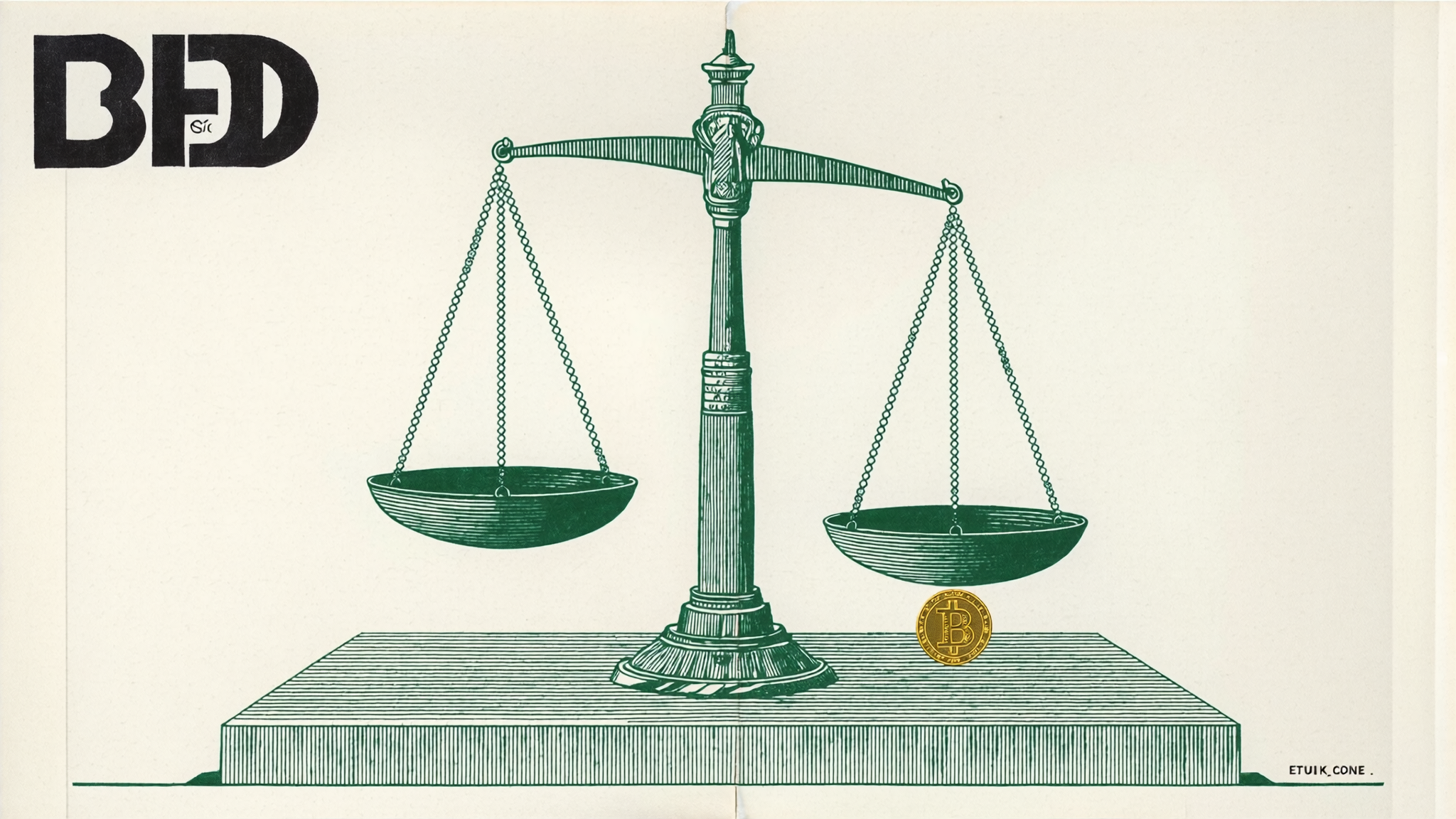
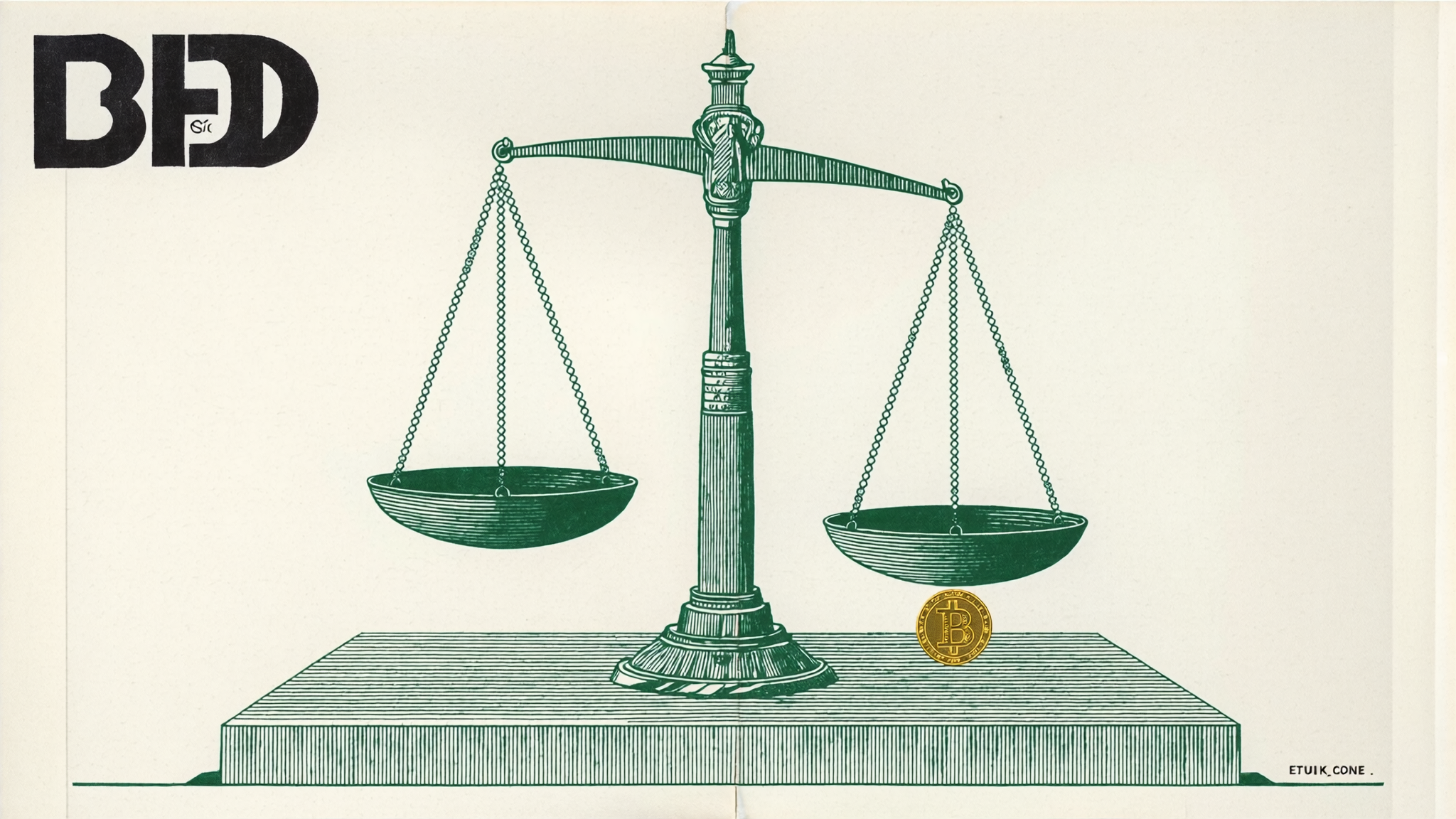
Spot ether ETFs took in $103.8 million in the week ended July 24, roughly triple the $33.9 million that flowed into spot bitcoin funds, according to Farside Investors data. It is the second consecutive week ether products have out-raised bitcoin's, extending a rotation that began when both… Read the full story at The Defiant
This Friday, we examine Ethereum, Ripple, Cardano, Binance Coin, and Hyperliquid in greater detail.
Ethereum (ETH)
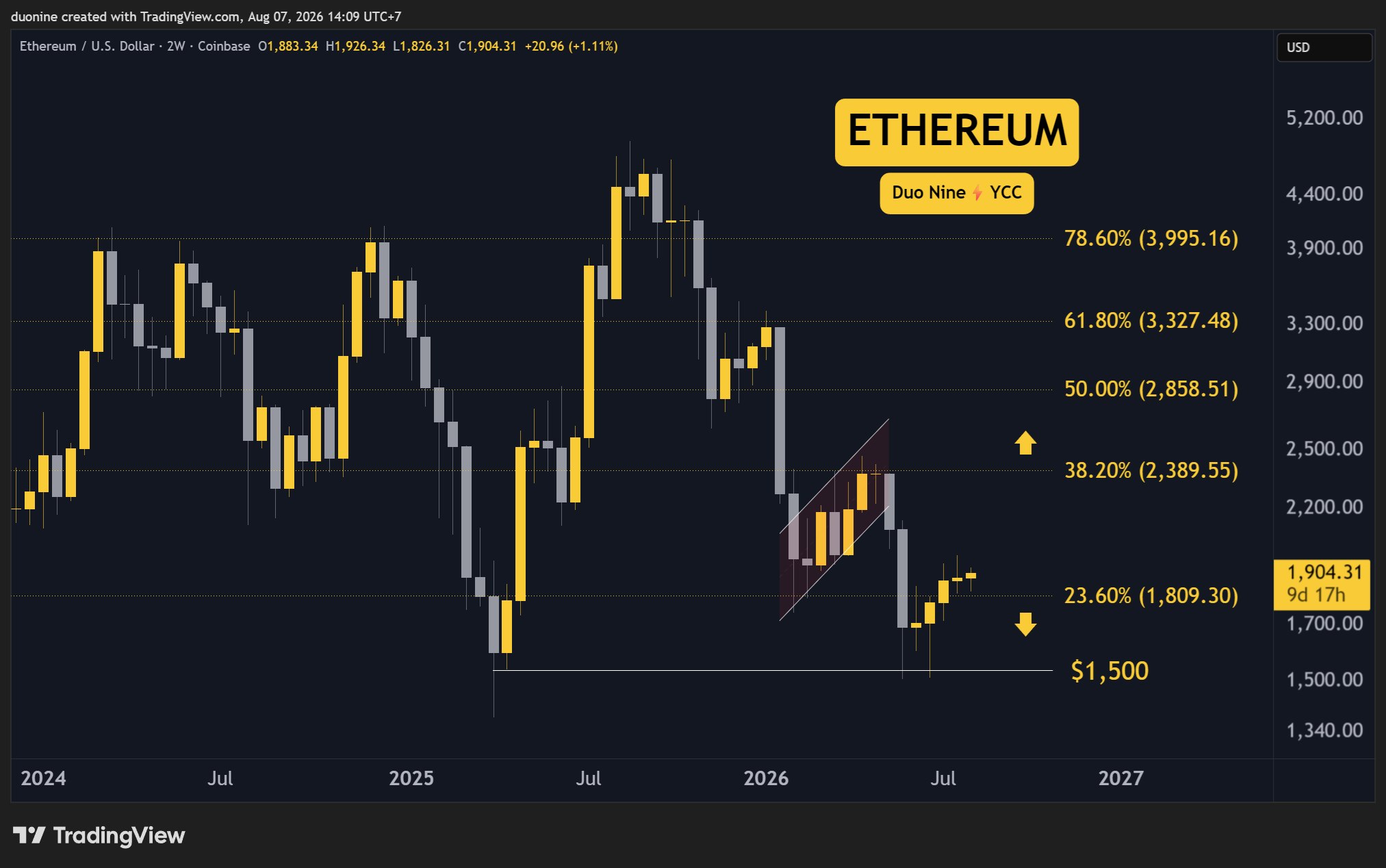
This week, Ethereum continued to range without any significant volatility. This has allowed the price to consolidate under the $2,000 resistance. At the time of this post, the support at $1,800 is holding well and was recently re-confirmed.
The concern, based on this price action, is that ETH does not have the strength to break above $2,000. Any attempts in the past few weeks were rejected and sellers could speculate on an opportunity to take over.
Looking ahead, Ethereum remains in a macro downtrend, and this will only change once the price makes a higher low and high. Ideally, ETH secures $2,000 as support and aims for $2,400 next to escape the current downtrend.
Ripple (XRP)
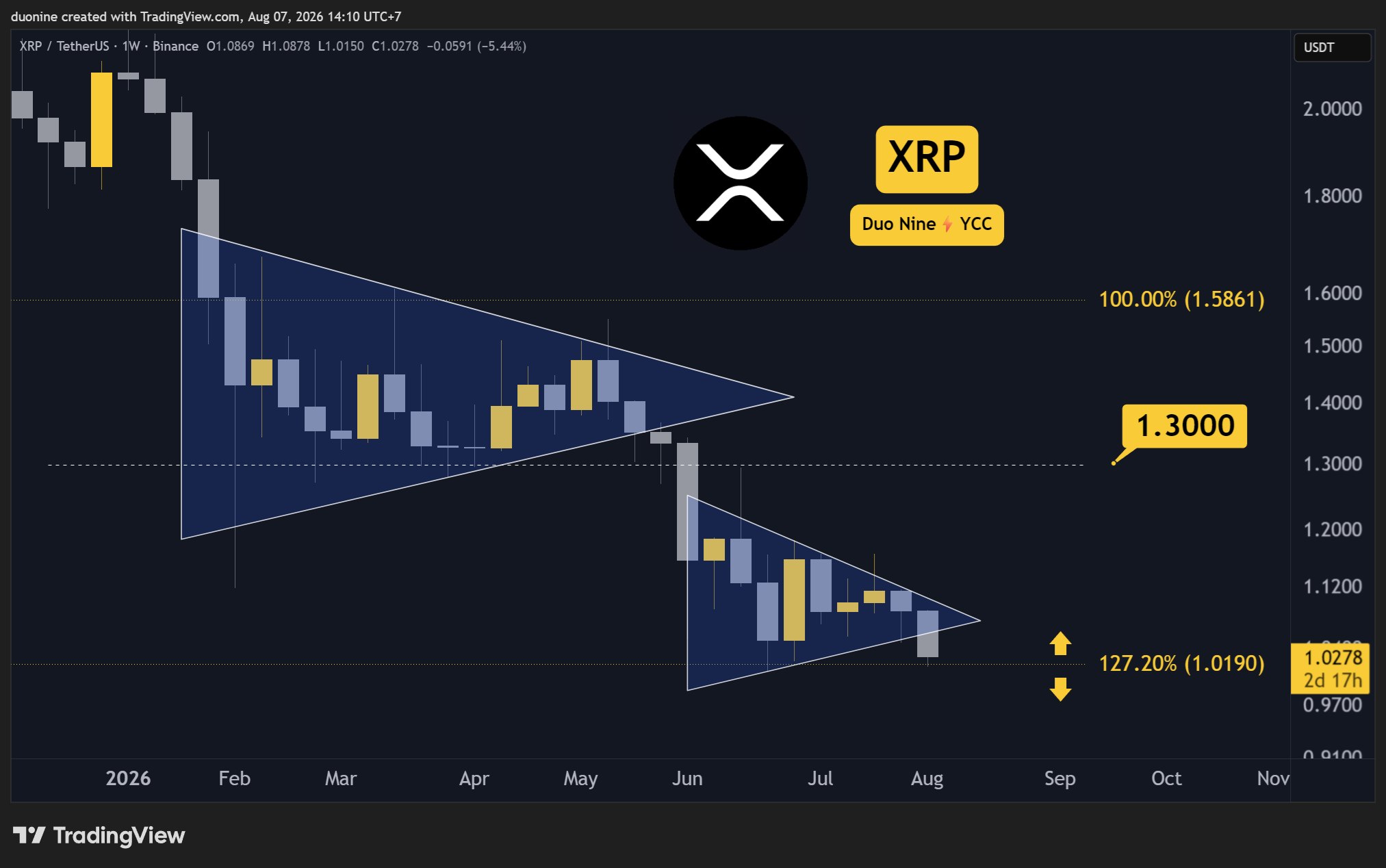
As expected, XRP broke below its latest pennant (in blue on the chart) to re-test the key support at $1. It is critical for buyers to hold here, as otherwise, the price may end up in a nosedive.
Because sellers have the advantage at the moment, the price closed the week 4% lower. Hopefully, buyers return here to send XRP higher, but even if they try that, it could end up as a dead cat bounce.
Looking ahead, the price action remains bearish with a lower low more likely than a reversal. If $1 turns into a resistance, then XRP will have a difficult time stopping its downtrend in the future.
Cardano (ADA)
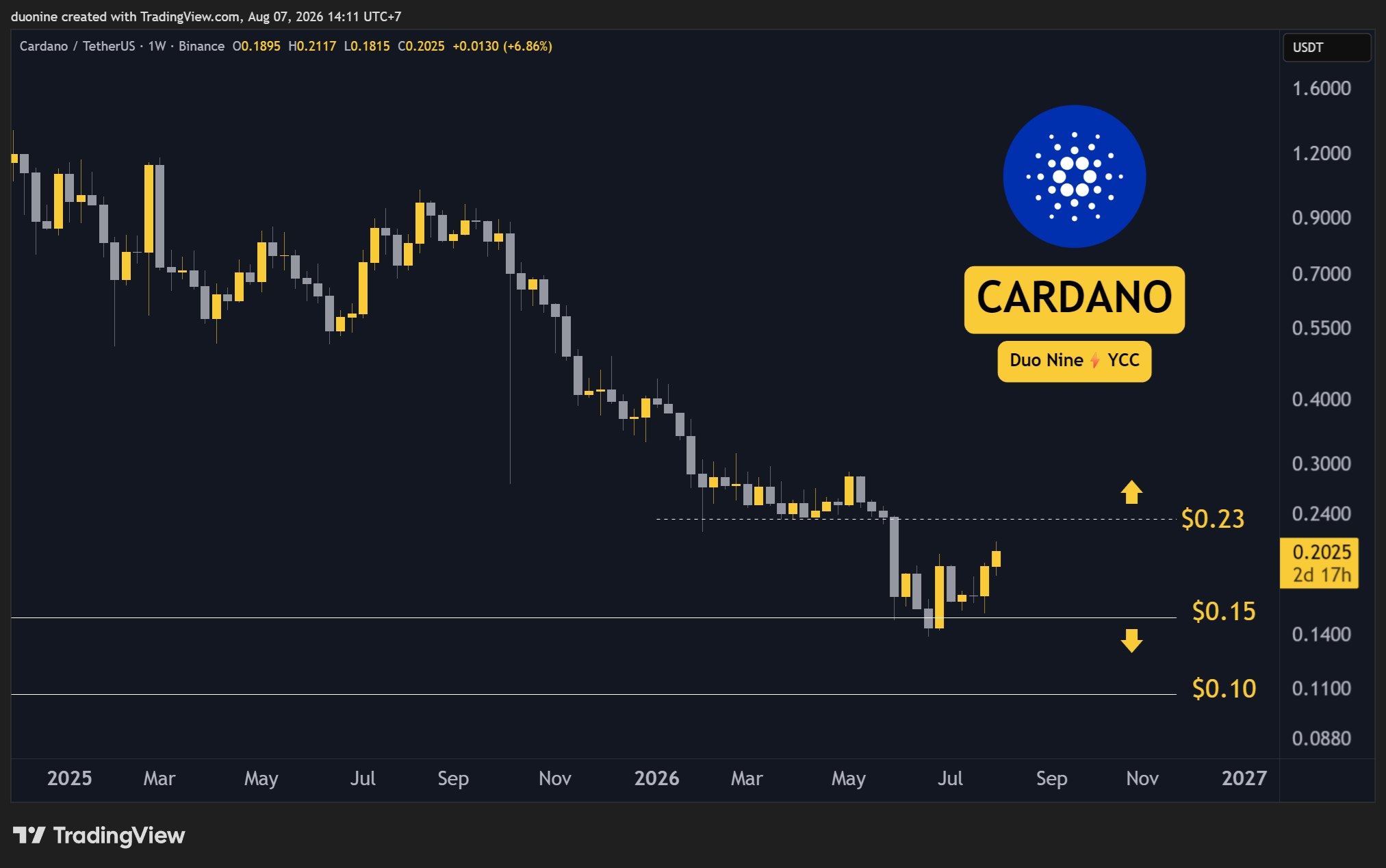
Cardano is one of the few major altcoins closing in double-digit gains this week with an impressive 18% pump. This has allowed the price to move to $0.20 and may go all the way to $0.23, where there is major resistance.
With the current support at $0.15 secured, ADA has good momentum and buyers to sustain this uptrend. The biggest question is how sellers will react at the key resistance. Best to be patient and wait for a reaction at $0.23 first.
Looking ahead, Cardano has a major opportunity to break away from its multi-year downtrend. Moreover, this is the first time in months when the price action turned positive. However, bulls will need to turn $0.23 into support if they want to sustain this uptrend.
Binance Coin (BNB)
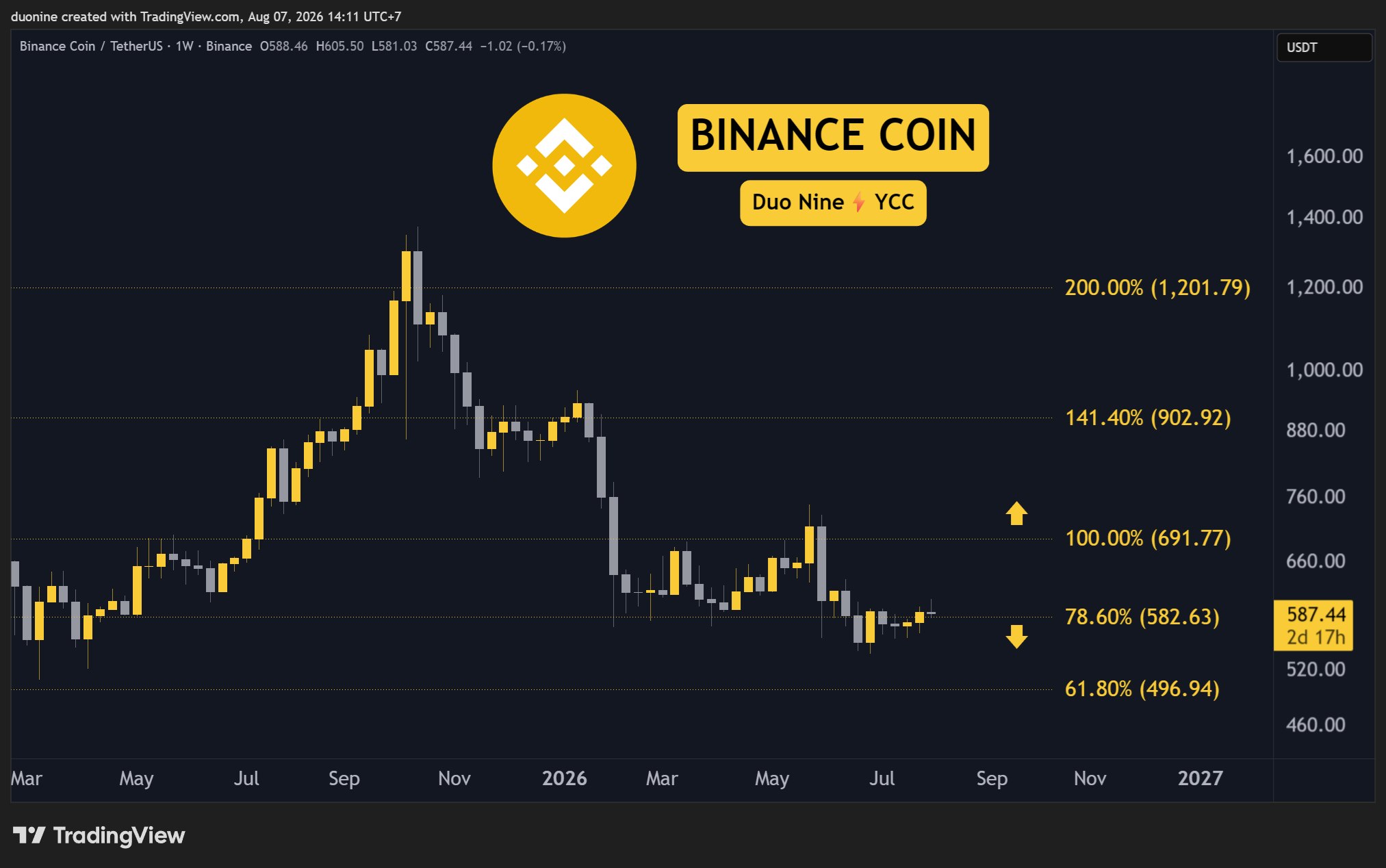
Binance Coin was flat this week and mirrors ETH’s price action, but in a more toned-down way. On the positive side, the price appears to hold above the support at $580. However, buyers did not push much beyond this level, which shows a lack of conviction.
Since sellers are also absent, the price was forced to move sideways and did not give any hints at a decisive direction. Best to watch closely how the $580 level is resolved before picking a side.
Looking ahead, BNB has been moving around the $600 level since the start of the year without any major breakout. While the price remains in a downtrend, this has been less aggressive lately which may hint at a possible reversal later this year.
Hype (HYPE)
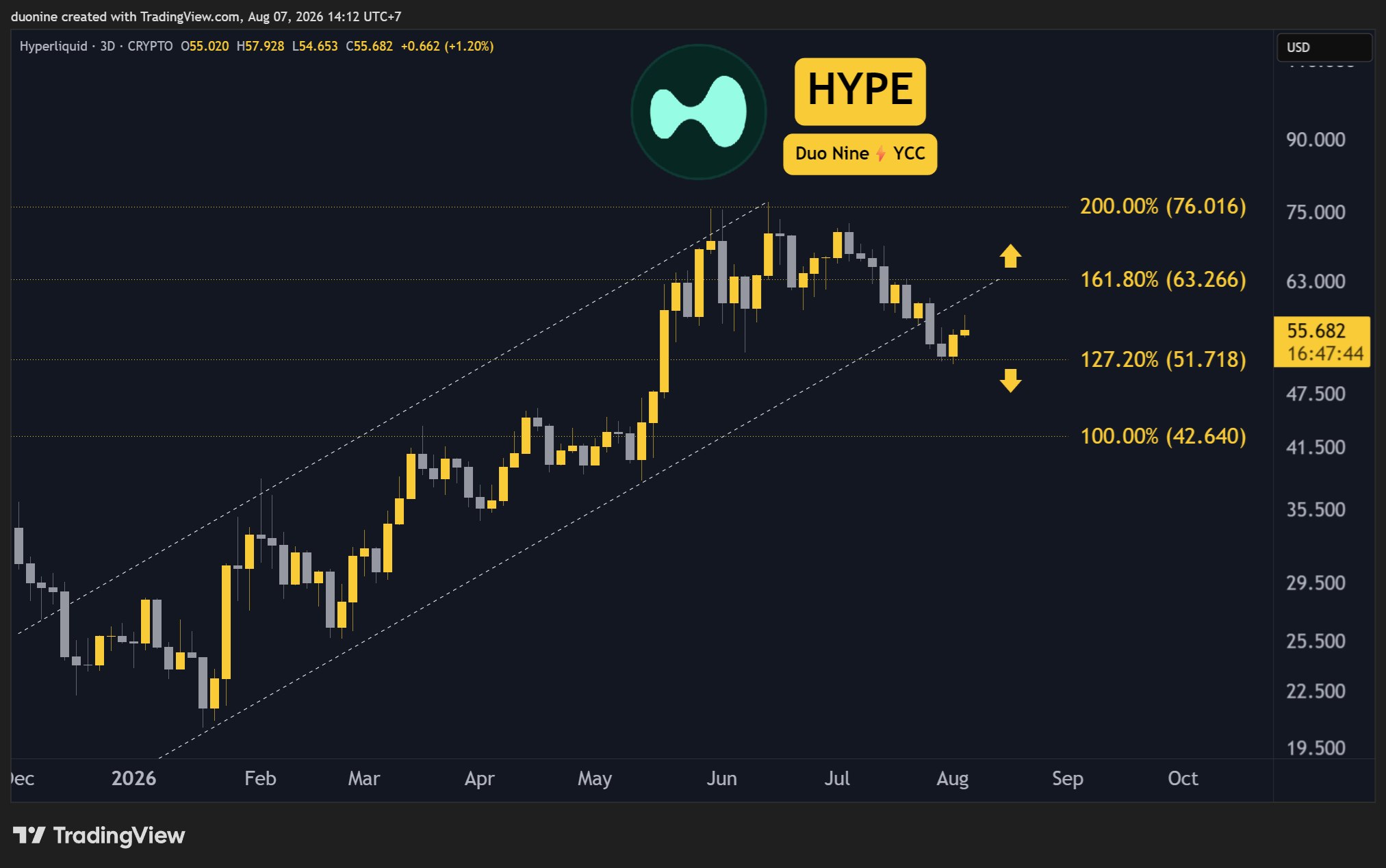
HYPE managed to close 3% higher this week after a successful test of the $52 support level. However, this could end up as a temporary bounce before sellers return to push against the key support again.
On higher timeframes, Hyperliquid has lost its uptrend, and the price is making lower lows. This is bearish. If buyers cannot reclaim $64 in the future, which is also a major resistance, then sellers could take this cryptocurrency much lower.
Looking ahead, the battle will be decided at the $52 support level. So far, this has held against the pressure from bears, but a renewed push later in August may see HYPE make new lows. Best to be cautious here as the price continues to show weakness.
The post Crypto Price Analysis August-07: ETH, XRP, ADA, BNB, and HYPE appeared first on CryptoPotato.


Ondo Finance, a tokenization company, launched the Ondo Network, an execution layer it describes as the evolution of its vision for Ondo Chain, the blockchain it had planned to build for real-world assets. Ondo said the first version is live. In its own announcement, Ondo said the network is not a… Read the full story at The Defiant


Spot bitcoin ETFs are yet to see outflows this month, bringing in $754 million in the first week of August. Yet, bitcoin remains steady at $64,700, while options flow favors protection at $62,000 and $63,000.
The opposing signals point to a market with a spot bid but limited conviction. ETF demand has seemingly returned, but derivatives traders are guarding against a retreat ahead of today’s U.S. jobs report.
The options market adds another layer. Put options, giving holders the right but not the obligation to sell, accounted for 53.8% of bitcoin options volume over the past 24 hours, and three of the four most-traded contracts were puts at $62,000 or $63,000 expiring Aug. 10, Aug. 14 and Aug. 28, CoinGlass data shows.
Calls still represent 60.7% of total open interest, showing that the broader options market remains tilted toward calls even as recent trading focuses on downside puts.
Protection is also cheap. Deribit’s DVOL index, which tracks bitcoin’s expected 30-day volatility, is near 35, down from a high of 90 earlier this year. That implied volatility tracks the market’s pricing of future movements, implying not much is expected to happen in the near future.


Private equity firms have become the latest target of ransom-seeking hackers who use voice phishing to trick company employees, according to a new Google report.
The report withheld the names of the firms targeted. Reuters worked them out by feeding the 72 web addresses Google published into tools like DomainTools and urlscan, which surfaced subdomains matched to each company.
Inside the Vishing Campaign
In its latest report, Google Threat Intelligence Group (GTIG) said it continues to track a group known as UNC6671. The actors rely on voice phishing (vishing), posing as IT helpdesk staff pushing urgent security updates.
They often reach employees on personal mobile devices. The calls direct victims to spoofed login portals.
There, adversary-in-the-middle (AiTM) systems intercept credentials and multi-factor authentication (MFA) tokens. Once inside, the hackers run automated scripts to pull data from cloud services like Microsoft 365 and Okta.
“These operations uniformly leverage tailored IT helpdesk voice phishing (vishing), AiTM credential harvesting panels, and data theft from SaaS applications,” the report read.
Follow us on X to get the latest news as it happens
A Shift Toward High-Value Targets
The choice of victims shifted over the summer. Through June, the group leaned toward technology, transport, and hospitality names, chasing trade secrets, code, and client data.
The following month, it turned to money and law. Google saw the group’s infrastructure pointed at private equity firms, law firms, and financial rating agencies.
According to Reuters, hackers created fake sites to lift passwords from staff at several firms. The outlet listed Blackstone, Bridgewater Associates, Apollo Global Management, Bain Capital, KKR, TPG, CME Group, Clearlake Capital, and Moody’s, among others.
Google said some firms paid up, without naming them. Reuters also could not pin down which targets were actually breached.
The campaign highlights how old-school techniques still beat modern defenses. Firms spend heavily on security software, yet a single phone call can walk past all of it.
Subscribe to our YouTube channel to watch leaders and journalists provide expert insights
The post Phone-Scam Hackers Now Target Wall Street’s Biggest Firms appeared first on BeInCrypto.
Franklin Templeton, an asset manager with $1.79 trillion under management, publicly endorsed the CLARITY Act, the federal crypto market-structure bill moving through the U.S. Senate. "Franklin Templeton supports passage of the CLARITY Act," the firm said on July 27 from its verified account. "It's… Read the full story at The Defiant


Rodolfo Novak (NVK), co-founder of Coldcard maker Coinkite, is deleting posts from his social media. Some people think Coinkite has also deleted recently content from its website.
The apparent elimination of these historical artifacts is concerning amid the ongoing theft of BTC from Coldcard customers.
For over five years, Coldcard hardware wallets generated private keys for customers with insufficient entropy. Since hackers discovered and began exploiting that vulnerability last week, they’ve drained over $130 million from victims.
The thefts continue as they crack insecure private keys using brute force computation.
For whatever reason, NVK has decided to remove certain pieces of content that he published over those five years.
Take, for example, in November 2024, when NVK wrote that a knockoff of his company’s Blockclock might be “a back door into peoples home network.” That post now resolves to an X error page. It went dark this week.
Bitcoin developer Peter Todd caught that deletion. On August 5, Todd posted the screenshot of the original post. “Deleted recently enough it seems it was still in my phone’s cache,” Todd explained.
Read more: What to do if you’re a Coldcard victim
NVK deletes posts about Coinkite, Coldcard
An archiving expedition is underway and a volunteer archive at nvk.wtf/receipts (Protos does not endorse nor recommend visiting unfamiliar websites) claims to be preserving evidence.
Coinkite critic Greg Tonoski alleged the company is deleting content from its website. “‘Unnamed v.4.0.0 security issue’ was deleted from the [coinkite.com/historical-disclosures] a few hours ago (see archived screenshot),” he wrote.
Matthew Kratter amplified that alleged deletion, asking, “NVK and Coinkite now deleting evidence from their website?”
That webpage today contains no entry by that “Unnamed v.4.0.0 security issue.” Coldcard also responded to Tonoski’s allegation, so whether the company inappropriately deleted anything is debatable.
Unfortunately, Archive.org’s Wayback Machine never archived that URL.
NVK hasn’t fully wiped, only selectively pruned, his personal timeline. For example, his pinned apology about the Coldcard failure is still up, saying, “I’m sorry and I’m devastated.”
His post about Blockclock knockoffs being a hypothetical backdoor for spyware is the most documented. Alex Waltz wrote, “NVK is deleting tweets as we speak,” while another Coldcard skeptic reposted the screenshot with his opinion: “NVK deleted this today. Every accusation is a confession.”
‘There is no need to panic’
NVK’s early response to the Coldcard bug is also under scrutiny. Hodlonaut posted a screenshot in which NVK claimed there was no need to panic, adding, “NVK deletes old tweets.”
No live copy of that post remains. Nonetheless, NVK tacitly admitted to writing-and-deleting it, conceding it contained “wrong” information that he intended to correct.
Another skeptic claimed NVK deleted a 2019 comment about Judaism. “I’ll post this here since he deleted the comment,” he wrote, attaching the alleged screenshot.
Zach Herbert of Foundation, a direct competitor of Coinkite, noticed an asymmetry. “What’s strange is the posts that arent deleted,” Herbert observed.
“Why hasn’t @DocHex or @switck deleted any posts?” referring to Coinkite’s co-founder.
“I originally assumed that Coinkite was under some kind of litigation hold,” Herbert continued, “but if that was so then NVK wouldn’t be deleting tweets.”
“NVK is currently deleting old posts from 2020 to try to clean up the history,” he broadcasted. “Screenshot them while you can. They will all be gone soon.”
Painfully, a celebratory post from Coldcard in October 2021 has survived with no deletion. “Coldcard makes retirement attacks impossible,” it declared incorrectly.
A follower asked it to define a retirement attack. Coldcard obliged, “It’s when the project makers could have a ‘bug’ in the entropy generation for later retrieval.”
Got a tip? Send us an email securely via Protos Leaks. For more informed news and investigations, follow us on X, Bluesky, and Google News, or subscribe to our YouTube channel.


The U.S. labor market showed weakness for the second consecutive month in July, possibly giving the Federal Reserve room to hold rates in place despite high inflation.
According to the government’s Nonfarm Payrolls Report released Friday morning, the U.S. lost 23,000 jobs last month. That was far below the consensus expectation of a gain of 80,000 jobs, and down from June’s add of 20,000 (revised down from an originally reported 57,000).
The last negative jobs print was in February, when the U.S. lost 156,000 jobs.
The unemployment rate dipped to 4.1%, compared with the expected 4.2% and June’s 4.2%.
Market reaction is swift, with U.S. stock index futures gaining and interest rates dipping. There’s little action in crypto, with bitcoin remaining modestly higher on the session at $65,000.
Ahead of this morning’s data, markets were split on whether the Fed would hike rates at its next policy meeting in September. According to CME FedWatch, interest rate traders were pricing in a 55% chance the U.S. central bank would tighten next month. In the immediate aftermath of the print, that number has slipped back to 46%.

Scottish subsea robotics firm opens North East base

Bitcoin hovers below $65,000 as Middle East tensions escalate further: Crypto Markets Today

Rangers Face Katsina United as Opening-Day Fixtures Are Released


-

 Fashion7 days ago
Weekend Open Thread: Wit & Wisdom
-

 Politics7 days ago
Meta enters AI-training agreement with far-right ‘propaganda rag’ Newsmax
-

 Politics5 days ago
Zack Polanski: an incitement to murder Nigel Farage?
-

 Crypto World6 days ago
MicroStrategy Post-Earnings CLARITY Act Push Could Add New Catalyst for Its Stock
-

 Crypto World6 days ago
XRP Ledger v3.3.0 brings five institutional features
-

 Crypto World7 days ago
New York sues Kalshi over prediction market gambling
-

 Crypto World5 days ago
Crypto PAC spending tops $2M in Michigan House race
-

 Business5 days ago
DTCR: Deleveraging And A Hedge Fund Collapse Point To A Possible AI Bottom
-

 Tech5 days ago
ESET tracks rise in malicious AI skills and adaptable malware
-
 Crypto World7 days ago
3 Fed Officials Just Explained Their Rate Hike Vote: Is Inflation Winning?
-

 Sports6 days ago
France Cricket implodes: letters hidden in a drawer and a board at war
-
Crypto World5 days ago
XRP Ledger urges node upgrade after manifest flood
-

 Crypto World6 days ago
Moneyflip CEO charged in $40K murder-for-hire plot
-
 Sports7 days ago
Bruno Fernandes decision made as Man United ‘discuss’ striker transfer option
-
Business7 days ago
FIFA has scrapped $20 billion World Cup sell-off plan, New York Post reports
-

 News Videos6 days ago
Financial Crash Expert: The 90-Day Collapse Timeline They Are Desperately Hiding.
-

 Sports1 day ago
Jordan Coyle & Cordiamo take Laya Arena Stakes at RDS
-

 Sports7 days ago
Commonwealth Games 2026 Live Updates | Day 9 CWG 2026: Lovlina Borgohain, Sachin Siwach Enter Final After Indian Judokas Script History
-
 Crypto World4 days ago
US Tech Stocks See Largest 5-Week Inflow in History: Can Nasdaq Break Its Downtrend?
-
 NewsBeat6 days ago
Tourist plane on sightseeing flight in Peru crashes into a field, killing all 13 people on board
You must be logged in to post a comment Login