
Crypto World
Bitcoin ETF Inflows Jump to $471M, Largest Since Late February

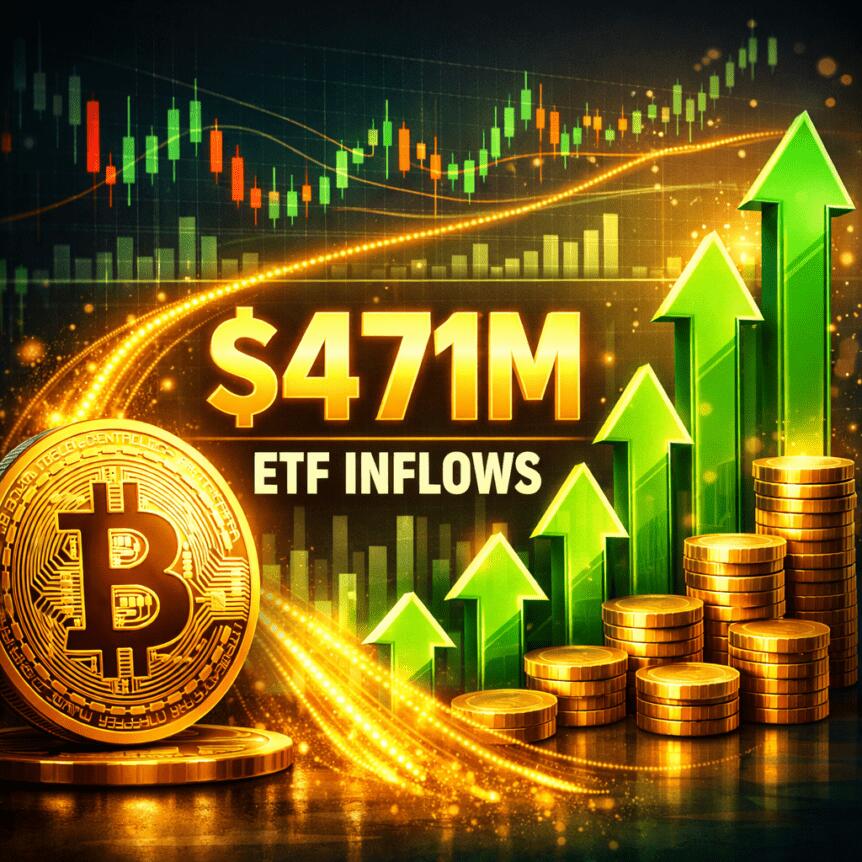
US-listed spot Bitcoin ETFs renewed their inflow pace on Monday, drawing in $471 million in a single day, according to SoSoValue. The size of the inflow marks the strongest daily momentum in weeks as Bitcoin briefly climbed toward $70,000 before retreating to just under $69,000, per CoinGecko.
Market mood remained fragile amid ongoing geopolitical pressure and renewed concerns over Bitcoin’s quantum-resistance debate, while the Crypto Fear & Greed Index stayed in Extreme Fear at 13, highlighting the cautious stance of many investors.
Key takeaways
- Monday’s spot-Bitcoin ETF inflows reached $471 million, the largest single-day intake since February 25.
- Leading inflows by issuer: BlackRock’s IBIT with about $182 million, Fidelity Wise Origin Bitcoin Fund (FBTC) with $147 million, and ARK 21Shares Bitcoin ETF (ARKB) with roughly $119 million, per data from Farside.
- ARKB’s surge represented its strongest daily inflow in months, signaling renewed appetite among some long-duration players.
- Arkham data indicates ETF outflows slowed last week, with major issuers selling around $16.6 million in BTC; ARK Invest’s ARKB ETF bought about $34 million in BTC in that period, per Arkham.
- In April’s early sessions, US spot BTC ETFs posted about $307 million in net inflows, lifting total assets under management above $90 billion.
Top inflows and the issuer lineup
BlackRock’s iShares Bitcoin Trust ETF (IBIT) led the charge on Monday with roughly $182 million in new money, followed by Fidelity’s Wise Origin Bitcoin Fund (FBTC) at about $147 million, according to data tracked by Farside. The ARK 21Shares Bitcoin ETF (ARKB) rounded out the top three with roughly $119 million in fresh inflows, marking its strongest daily showing since mid-2025.
The activity underscores that, even amid volatility and macro concern, institutional-grade vehicles remain capable of moving sizable sums into the regulated crypto access space in the United States.
Arkham signals and weekly positioning
Arkham’s monitoring shows a refreshing pause in ETF outflows last week, with major issuers selling only about $16.6 million in Bitcoin. In that same period, ARK Invest’s ARKB ETF was the standout buyer, adding about $34 million worth of BTC. The signals point to a nuanced reweighting among funds—some lightening exposure while a subset targets fresh BTC purchases.
Looking at the broader April picture, Arkham data summarized that the first three trading sessions of the month produced roughly $307 million in net inflows for US spot BTC ETFs, helping push total assets under management over the $90 billion mark. This suggests a potential shift in risk appetite among US-listed ETF vehicles as market conditions quietly stabilize from earlier volatility.
Ether ETFs rebound, but the broader alt-coin set remains cautious
Ether-based ETF products joined the recovery, recording about $120 million in inflows on Monday and offsetting about $78 million of outflows from the prior two sessions, according to SoSoValue. Still, Ether ETFs have faced three consecutive months of losses, with total outflows reaching about $770 million for the period.
Activity across other altcoin ETFs remained comparatively muted. XRP ETFs posted zero inflows on Monday, while Solana (SOL) ETFs brought in roughly $247,000. The pattern suggests a cautious approach among investors toward non‑BTC chains, even as appetite for regulated BTC access remains firm.
What the data implies for traders and investors
The April uptick in US spot BTC ETF inflows could be interpreted as a return of institutional interest, carried partly by marquee vehicles such as IBIT and ARKB. For traders, the inflows may reflect a combination of price proximity to $70,000, ongoing macro uncertainty, and the appeal of regulated exposure with transparent custody and compliance frameworks.
Yet the backdrop remains mixed. While inflows are evolving, Bitcoin’s quantum-resistance debate and geopolitical tensions continue to cast a shadow over sentiment. The ongoing resilience in ETF demand may hinge on how regulatory clarity evolves and whether more traditional asset allocators view crypto exposure as a core, capital-efficient segment of their portfolios.
In March, Bitcoin ETFs posted about $1.3 billion in inflows—the first monthly gain after January outflows of $1.61 billion and February outflows of $207 million—indicating that financial-market participants are cautiously re-engaging with regulated crypto access after a period of outsized outflows.
As the month progresses, investors will be watching whether this renewed ETF interest translates into sustained net flows or remains episodic. Key questions include how issuer strategies adjust to shifting BTC price action, whether Ether and other altcoin ETF inflows pick up in tandem, and how regulatory developments in the U.S. shape the appetite for institutional-grade crypto exposure.
Watch next for any changes in the ETF lineup, additional weekly flow data, and how market volatility around macro headlines interacts with the ongoing push for regulated crypto access in the United States.

Litecoin (LTC) took a hit on April 25, and not a small one. What exactly triggered the chaos, and whether the hack damage is truly contained, deserves a closer look.
A zero-day vulnerability in Litecoin’s codebase was exploited on April 25, triggering a 13-block reorganization that temporarily halted transaction finality across major mining pools.
The attack vector: un-updated nodes incorrectly accepted invalid MWEB (MimbleWimble Extension Block) transactions, which a Denial-of-Service attack exploited to flood the network.
The Litecoin team confirmed the bug on their official X account and stated a patch has been fully deployed, with node operators urged to update immediately.
No user funds were lost, but the reorg reversed transactions across those 13 blocks, a depth that qualifies as a serious network event by any measure.
A 13-block reorg isn’t a rounding error. Broader crypto markets are already navigating fragile sentiment around Bitcoin stalling near key levels, and a security incident on a top-20 chain adds pressure that technical analysis alone can’t absorb.
Can Litecoin Price Recover to $94 After the Hack Incident?
LTC holding up after the incident is actually the story, not the dip. Price bounced despite negative headlines, which tells you sellers did not fully take control.
But it is not strong either, it is just stable. Volume is messy across exchanges, which points to fragmentation, not a clean trend.
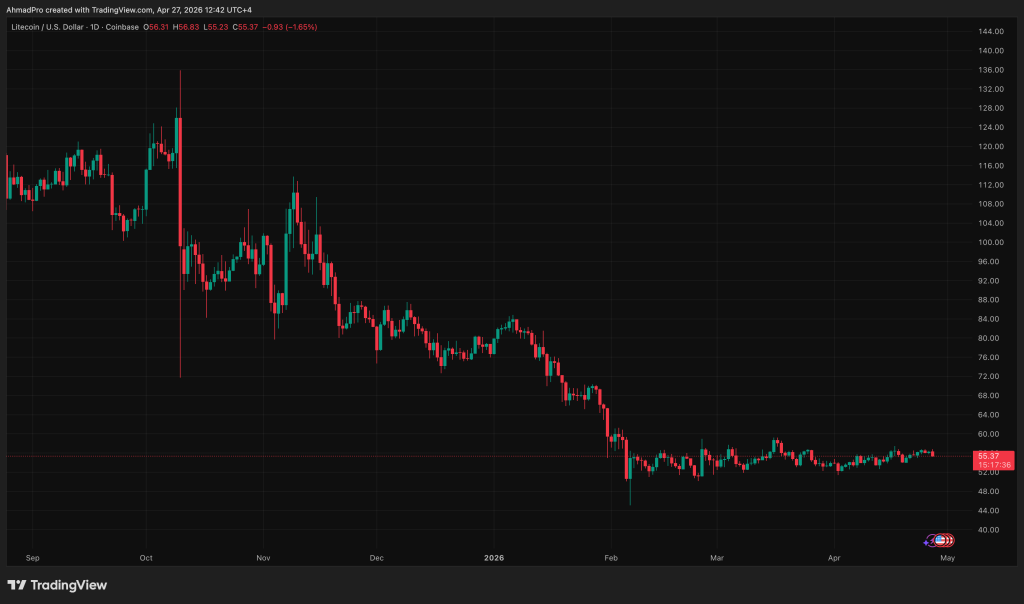
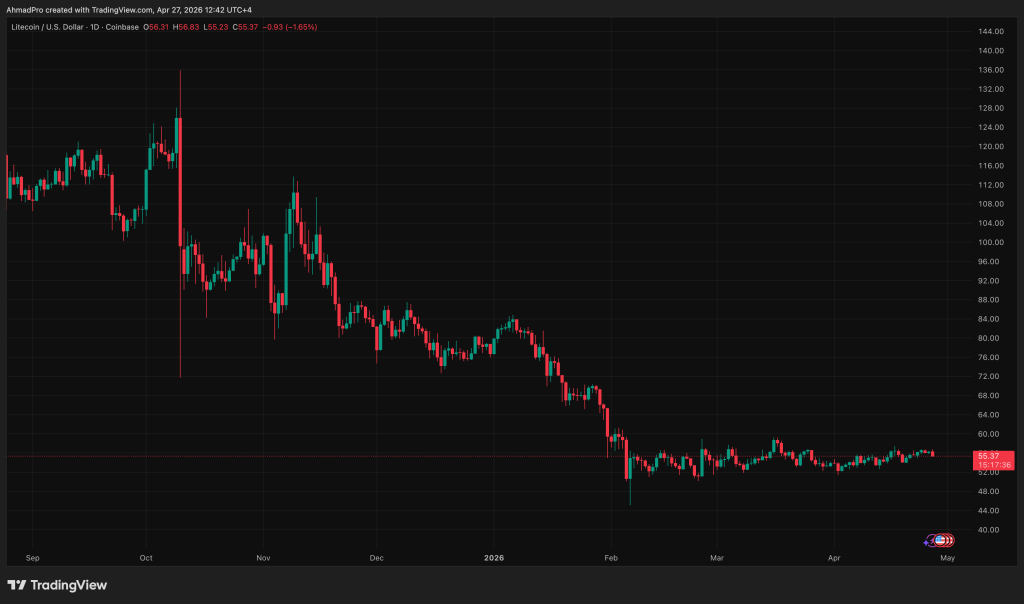
Right now, everything comes down to $60. That is the level that flips the structure if it breaks with volume.
If that happens, LTC can move back toward the top of its range and regain momentum.
More realistically, this just stays sideways between roughly $56 and $59 while the market moves on and the news fades.
The risk is if issues resurface or sentiment weakens, because $52 is the floor, and if that breaks, downside opens quickly.
So this is a neutral setup, holding steady for now, but still waiting for a real direction.
Here is Why LiquidChain Could Be Replacing OG Coins Like Litecoin
LiquidChain is positioning around that idea, aiming to connect Bitcoin, Ethereum, and Solana liquidity into one layer so developers and users are not tied to a single ecosystem.
The pitch is about reducing fragmentation and making execution smoother across chains.
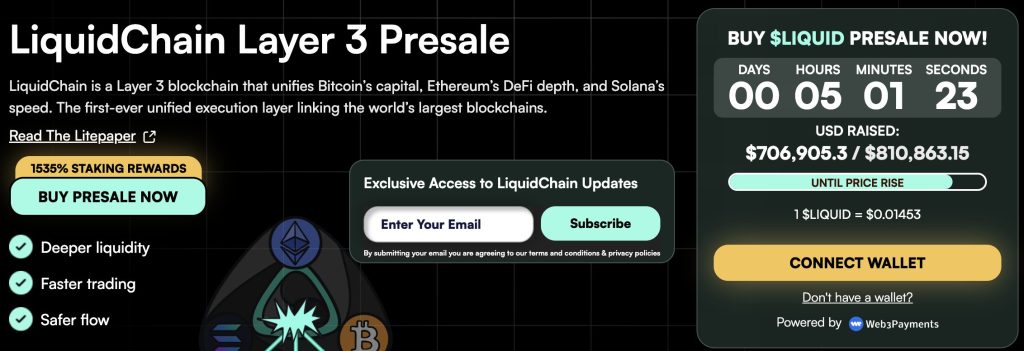
The presale is still early, around $0.01453 with just over $700K raised, which means it is in the early accumulation phase rather than widely priced.
But that also comes with the trade-off. Early-stage projects carry real execution risk, and liquidity only comes after launch.
So the contrast is simple, LTC offers stability with limited upside, while something like LiquidChain offers higher potential, but with much higher uncertainty.
The post A Zero-Day Hack Triggered a 13-Block Reorg on Litecoin: Are User Funds Actually Safe? appeared first on Cryptonews.


The plan allows trapped lenders to sell tokenized claims on deposits, offering buyers an option-like bet on CRV’s recovery.


Banking Circle’s stablecoin settlement launch follows its CASP approval, entering a crowded market with SocGen, Sygnum and a 12-bank euro stablecoin consortium.
Crypto World
MicroStrategy Purchases 3,273 Bitcoin for ~$255 Million; Polymarket Odds Show 10% Chance of Sale This Year
MicroStrategy has acquired an additional 3,273 Bitcoin in a new purchase valued at approximately $255 million, while prediction market Polymarket sets 10% odds on the company selling any Bitcoin before year-end.
MicroStrategy purchased an additional 3,273 Bitcoin for approximately $255 million, according to a Polymarket announcement on April 27, 2026. The acquisition marks the latest expansion of MicroStrategy’s Bitcoin holdings, which have become a cornerstone of the company’s treasury strategy.
Polymarket, a cryptocurrency prediction market, has priced the odds of MicroStrategy selling any Bitcoin in 2026 at 10%, indicating strong market confidence in the company’s continued hodling stance. MicroStrategy has been one of the largest corporate Bitcoin accumulators since 2020, using the digital asset as a primary vehicle for treasury management.
Sources: Polymarket | Polymarket
This article was generated automatically by The Defiant’s AI news system from publicly available sources.


South Korean internet-only bank Kbank has signed a strategic partnership with blockchain payments company Ripple to test blockchain-based overseas remittances.
According to local media outlets like News1, The Korea Herald and Maeil Business, Kbank CEO Choi Woo-hyung and Fiona Murray, Ripple’s Asia-Pacific managing director signed the agreement at Kbank’s Seoul headquarters. The bank said the partnership will use Ripple’s global network and blockchain infrastructure to test whether overseas remittances can be made faster, cheaper and more transparent.
The companies are already conducting a phased technical verification. The first phase reportedly tested a separate app-based remittance structure, while the second phase is digitally linking customer accounts and internal systems to test remittance stability. It includes onchain transfers to countries such as the United Arab Emirates and Thailand, according to local reports.
The tie-up comes as South Korean financial companies test blockchain-based cross-border payment infrastructure while the country’s stablecoin and digital asset rules remain under discussion.
South Korea companies prepare for stablecoin rules
South Korea is weighing how to regulate stablecoins under broader digital asset legislation. On April 8, South Korea’s ruling Democratic Party prepared a draft bill that would classify stablecoins as foreign exchange payment instruments and require tokenized real-world assets to be backed by assets held in trust.
Citing an integrated draft of the proposed Digital Asset Basic Act, the Seoul Economic Daily previously reported that stablecoins used in cross-border transactions would be treated as a “means of payment” under the country’s Foreign Exchange Transactions Act.
Related: South Korea tightens crypto withdrawal-delay exemptions after scam losses
The policy backdrop may explain why stablecoin and blockchain-payment tie-ups are accelerating before the rules are final. Banks, card companies and payment firms appear to be testing infrastructure, partners and use cases while avoiding full commercial launches ahead of legislation.
On March 16, Hana Financial Group, one of South Korea’s largest financial conglomerates, signed a business agreement with the United Kingdom’s Standard Chartered Group for cooperation on various sectors, including foreign exchange and digital assets.
The South Korean conglomerate also previously partnered with USDC-issuer Circle and major US crypto exchange Crypto.com to promote stablecoin-based payments for foreign visitors in the country, according to The Korea Times.
On March 5, Asia Business Daily reported that South Korean payments company Danal will officially launch a digital asset payments service for foreign visitors in Korea in partnership with Binance Pay.
Magazine: Adam Back says current demand is ‘almost’ enough to send Bitcoin to $1M


A new Blockchain for Europe report says MiCA has made euro stablecoins safer but less competitive, and urges targeted reforms to reserves and remuneration.


International stablecoin payments among businesses will total $5 trillion by 2035, fintech analysts Juniper Research said in a new report.
That figure would be 373 times greater than the estimated total value of $13.4 this year.
“Stablecoins are increasingly embedded in cross-border business-to-business (B2B) transactions, treasury operations, and supply chain settlements, where their programmability and 24/7 settlement finality offers advantages over correspondent banking rails,” the research firm said, adding they are “causing disruption to correspondent banking channels.”
Juniper said the growth is driven by stablecoins increasingly addressing the current inefficiencies within cross-border payments that traditional finance handles.
The firm estimates that 85% of the total stablecoin transaction value in 2035 will come from B2B, with the fiat-pegged cryptocurrencies shifting from a speculative asset to a foundational layer of institutional payment infrastructure.
Stablecoins are increasingly integrated in international payments among businesses, treasury operations, and supply chain settlements, because their speedy 24/7 settlement finality offers advantages over correspondent banking rails, the firm said.
“Stablecoins are not replacing payments infrastructure; they are being adopted where the advantages are most pronounced,” said Juniper Research Analyst Jawad Jahan. “Cross-border B2B is where those advantages are greatest, and where we expect the most sustained volume growth over the forecast period.”
He suggested stablecoin issuers should focus on enterprise integrations and treasury partnerships to capture the majority of this value.
Earlier this month, Chainalysis said stablecoins were on track to become a foundational layer of global finance, with adjusted transaction volumes projected to reach $719 trillion by 2035. The blockchain intelligence firm also said that when crypto becomes the default for the next generation, “the question is no longer if stablecoins compete with traditional rails, but how quickly they replace them.”


The Ethereum Economic Zone aims to unify fragmented rollups, but its broader goal is to extend interoperability to other blockchains, says Ernst.
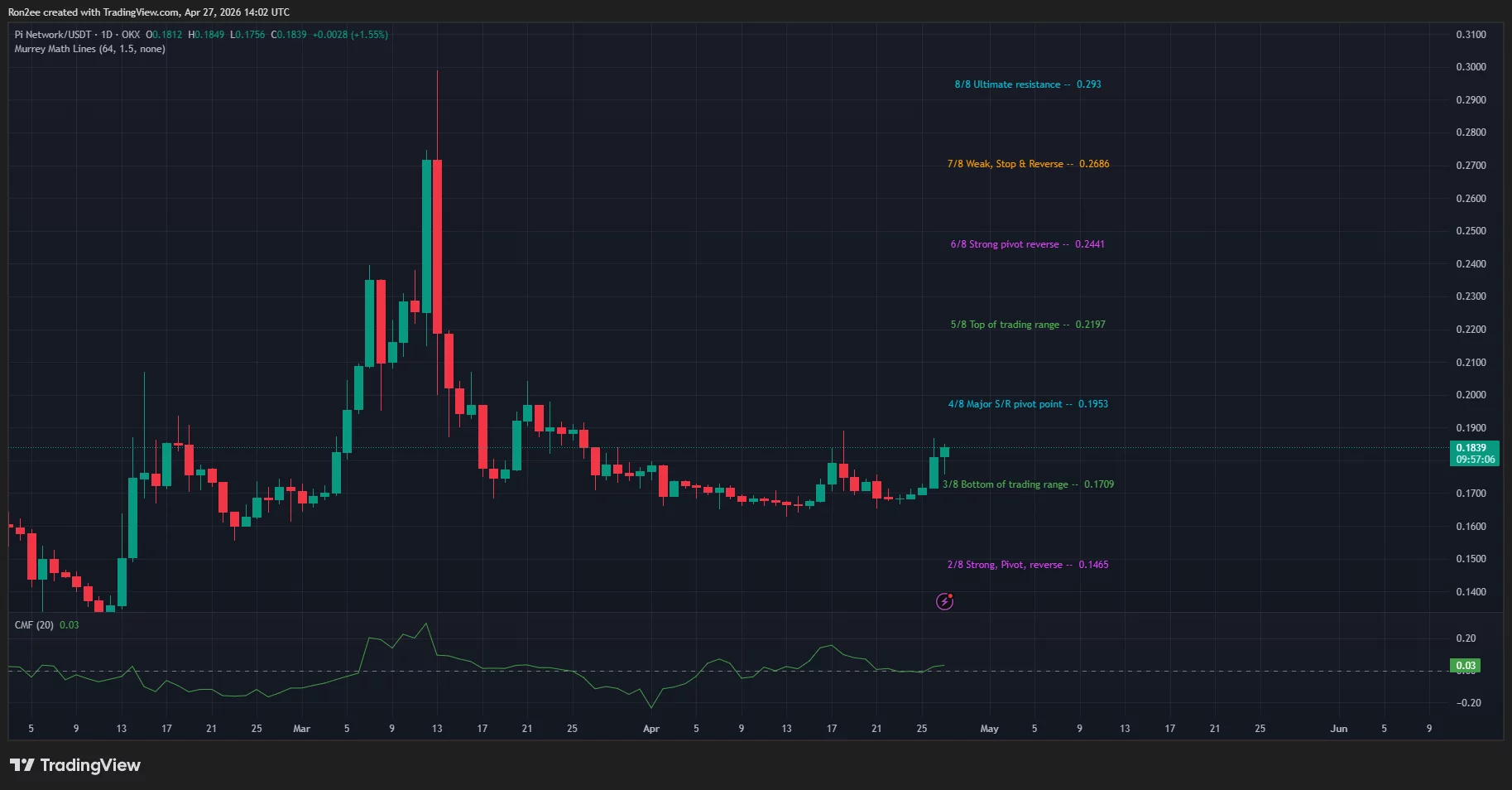
Pi Network price rallied over 6% in the past week as anticipation for its upcoming mainnet upgrades spurred demand for the token.
Summary
- Pi Network price rose over 6% this week to $0.186 as demand increased ahead of its Protocol 22 mainnet upgrade.
- Upgrade roadmap and upcoming Consensus 2026 appearance by co-founders boosted sentiment around scalability, security, and ecosystem expansion.
- Technical indicators show strengthening momentum, with potential upside toward $0.20, while loss of $0.170 support could trigger a pullback toward $0.155.
According to data from crypto.news, Pi Network (PI) price rallied from a weekly low of $0.166 to $0.186 on Friday, bringing the token’s total market cap to over $1.89 billion.
Pi Network price rose as investor demand for the token rose ahead of its mainnet upgrade to version 22 or Protocol 22, which will reportedly streamline transaction processing and enhance the network scalability for decentralized applications. This technical leap is a major step toward the Open Mainnet phase that the community has long awaited.
The upgrade also prepares the network for Protocol 23, which is expected in May and would mark the completion of critical security audits and enable cross-chain interoperability for the first time. This transition is seen as the final bridge before the ecosystem opens up to the broader crypto market.
The token’s price has also gained traction as the team prepares for a high-profile appearance at Consensus 2026 in Miami. As per reports, the project’s two co-founders, Nicolas Kokkalis and Chengdiao Fan, will speak at the event with a core focus on Pi’s blockchain infrastructure, digital identity, artificial intelligence, and future application development.
Pi Network price analysis
On the daily chart, Pi Network price has broken above the 3/8 Murrey Math line and therefore signals that the bulls have regained control of the immediate trend.
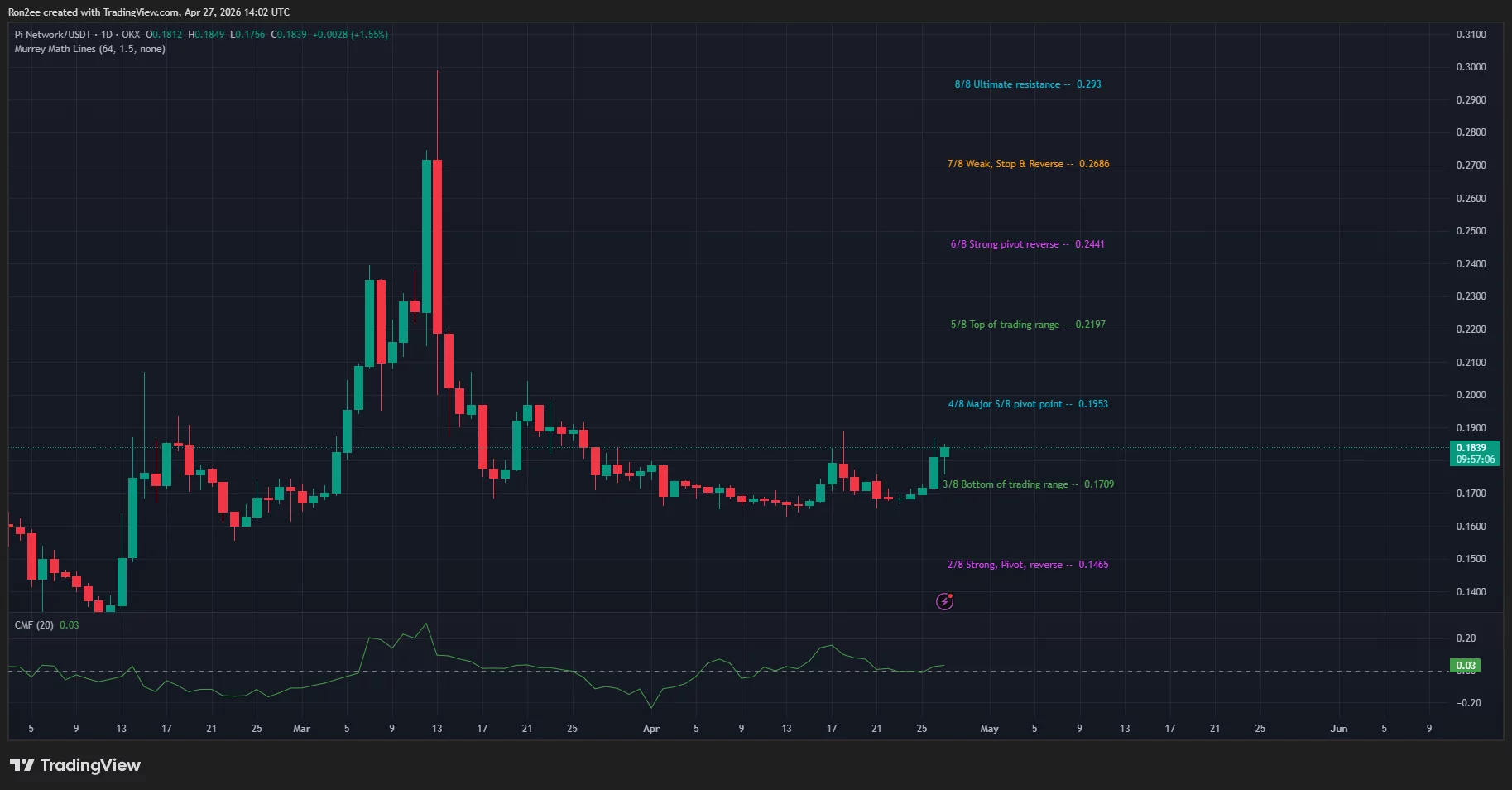
The Chaikin Money Flow index, which indicates whether capital is flowing into or out of the asset, has also turned positive, confirming that buyers are accumulating at current levels.
Hence, Pi Network price is positioned to rise toward $0.195 next and potentially push past the major psychological resistance at $0.20 if the positive news cycle continues through the week.
However, if the token loses the $0.170 support, then the bullish momentum would likely fade, leading to a period of consolidation or a retracement toward $0.155.
Disclosure: This article does not represent investment advice. The content and materials featured on this page are for educational purposes only.


Michael Saylor’s Strategy bought 3,273 Bitcoin for $255 million between April 20 and 26, bringing total holdings to 818,334 BTC.
Birmingham bin strike ‘end in sight’

Stokes pursues classic spring blueprint for Deakin in 2026

Unforgotten’s Nicola Walker’s new series receives release date and it’s not far away

Manchester United reach agreement with Casemiro over contract clause amid transfer speculation

US brings back mandatory military draft registration

Steven Gerrard disagrees with Gary Neville over ‘shock’ Chelsea and Arsenal claim | Football


-

 Politics7 days ago
Gary Stevenson delivers timely reminder to register to vote as deadline TODAY
-

 Fashion3 days ago
Weekend Open Thread – Corporette.com
-
 Crypto World2 days ago
Hyperliquid $HYPE Rally Builds Momentum as AI Sector Enters Prove-It Phase
-
Crypto World7 days ago
Bank of Hawai’i (BOH) Q1 2026: Net Income Drops to $57.4M as Net Interest Margin Expands
-

 Politics5 days ago
Making troops accountable for war crimes threatens US alliance, ex-SAS colonel warns
-

 Politics5 days ago
Disabled people challenge government SEND proposals over segregation concerns
-

 Business5 days ago
Rolls-Royce Voted UK’s Most Iconic Trade Mark as IPO Register Hits 150
-

 Business4 days ago
Patterson-UTI Energy, Inc. (PTEN) Q1 2026 Earnings Call Transcript
-

 Politics5 days ago
Zack Polanski responds to home secretary’s taser threat
-
 Crypto World6 days ago
Five Value Stocks with Recovery Potential in 2026: PayPal (PYPL), Nike (NKE), and More
-

 Politics5 days ago
Starmer handler McSweeney to be dragged from shadows by Foreign Affairs Committee
-
 Sports1 day ago
IPL 2026: Ruturaj Gaikwad registers slowest fifty of the season, enters all-time unwanted list | Cricket News
-
Politics5 days ago
Wings Over Scotland | How To Get Away With Crimes
-

 Crypto World6 days ago
New York sues Coinbase, Gemini over prediction market offerings
-
Entertainment6 days ago
Sydney Sweeney cameo cut from “The Devil Wears Prada 2”, source explains why (exclusive)
-
 Business5 days ago
HCL Tech share price tank over 9% after weak Q4. JPMorgan, HSBC & 3 others cut target price
-

 Politics5 days ago
‘Iran is still a nuclear threat’
-

 Crypto World6 days ago
Crypto’s great hope in Senate’s Clarity Act still has a path to survive tight calendar
-
 Sports5 days ago
Tim Bradley names the current best in the world: “Better than Inoue and Usyk”
-

 NewsBeat1 day ago
LK Bennett closes all stores after entering administration
You must be logged in to post a comment Login