

Crypto World
Bitcoin Faces Correction as Institutional Demand Weakens Amid Macro Pressure: Bitfinex


The United States and the broader global economy are facing an increasingly fragile macroeconomic backdrop. U.S. inflation has risen to 3.8% year-over-year, per April consumer price index (CPI) data, and real wages have turned negative with long-term Treasury yields climbing to multi-year highs.
Amid a hostile macro environment, bitcoin (BTC) has pulled back and erased the gains from its early-month rally. This correction is further driven by weakening institutional demand and outflows from spot exchange-traded funds (ETFs).
Weakening Institutional Demand
According to this week’s Bitfinex Alpha report, the U.S. macro backdrop has shifted toward a “higher-for-longer inflation environment.” Market expectations for Federal Reserve rate cuts have been removed, with rate hikes becoming a more likely scenario as the year progresses.
With the possibility of renewed tightening rising, bitcoin is losing momentum and becoming more vulnerable to exogenous shocks and to a high-for-longer interest rate regime. Unfortunately, this development comes at a time of deteriorating liquidity conditions – the worst since February.
Analysts said the two primary engines of marginal demand, which are spot ETFs and yield-bearing products like Strategy’s STRC, are currently under duress. ETFs ended their six-week inflow streak last week, recording almost $1 billion in net outflows. On-chain capital flows currently sit at $2.8 billion, far below the $10 billion historically associated with durable bull phases.
“As market sentiment transitions from acute fear toward persistent uncertainty, analysts say the validity of the current recovery now hinges almost entirely on whether fresh net capital continues entering the market,” analysts explained.
Market Vulnerable to Further Downside
As Bitfinex warned two weeks ago, the Bitcoin market is not positioned for sustained upside. Despite the rally toward $82,000, institutional conviction has remained insufficient to absorb macro shocks and rate volatility, leaving the market vulnerable to further correction. Bitcoin is already trading at a two-week low, reflecting a significant structural problem that could worsen due to hostile macro conditions.
At the time of writing, BTC was trading around $76,700, roughly 6.5% below its weekly opening of $82,160. While the asset is testing levels near the monthly open, analysts expect the price to fluctuate between $72,000 and $80,000. Net capital flows, as measured by the Realized Cap 30-Day Net Position Change, will determine whether the broader recovery structure remains intact in the coming weeks.
The post Bitcoin Faces Correction as Institutional Demand Weakens Amid Macro Pressure: Bitfinex appeared first on CryptoPotato.


Crypto exchange Kraken is adding AI-powered financial tools to its mobile app as exchanges increasingly compete to offer personalized investing tools beyond basic trading features.
According to a company announcement, users will begin by setting financial goals and preferences, allowing the app to tailor its interface and recommendations around those objectives rather than requiring customers to navigate complex trading tools. The company said the redesigned platform will help users pursue goals such as buying a home, saving for retirement or building an emergency fund.
Kraken said its “financial intelligence” continuously monitors markets, identifies investment opportunities and recommends trades, but does not execute transactions autonomously. Every recommendation requires the user’s approval before a trade is placed, with the company positioning the technology as a decision-support tool rather than an automated trading system.
According to CNBC, the app then uses that information, along with a user’s risk tolerance, funding preferences and financial profile, to generate a suggested portfolio for users to review and adjust before investing. Once invested, it provides personalized portfolio updates and investment suggestions tailored to each user’s holdings.
Speaking to CNBC, Kraken chief data officer Kamo Asatryan said the technology is designed to give everyday investors the same market awareness as the exchange’s most active traders by continuously monitoring markets, identifying opportunities and recommending trades.
“[T]here’s an opportunity for everyday people to become high-frequency traders and do so using plain English,” he said.
Related: Bitcoin miners’ AI pivot faces investor scrutiny over insider sales
AI agents spread across crypto platforms
Crypto exchanges and fintech firms are increasingly embedding AI into their trading platforms, allowing users to analyze markets, manage portfolios and place trades through conversational interfaces.
In June, OKX launched a beta marketplace where AI agents can transact autonomously, complete onchain tasks and build blockchain-based reputations. In the same month, Coinbase introduced a tool that lets AI agents make payments and trade cryptocurrencies on behalf of users using its x402 payments protocol.
Adoption is also accelerating. Last month, Chainalysis reported that agentic payment activity on Coinbase’s Base network had surpassed 100 million transactions. The report found that while transaction growth has stabilized, higher-value transfers have become more common, suggesting AI-driven payments are moving beyond micropayments and early experimentation.

Source: Coinbase
On Friday, fintech firm Revolut launched an upgrade to its Revolut X exchange, allowing customers to connect AI assistants, including Claude, Gemini, Cursor and OpenClaw, to analyze markets, backtest trading strategies and place orders through natural-language prompts. Like Kraken’s platform, users must review and approve every trade before execution.
Magazine: Bitcoin’s quantum dilemma: Bigger blocks or STARK proofs?


Ledger’s Donjon security team has disclosed a hardware attack that can reset the password on a Tangem wallet card.
Summary
- Ledger researchers reset Tangem card passwords using a targeted laser pulse against secure element firmware.
- The attack requires physical possession, specialist skills, invasive preparation and laboratory equipment costing around $250,000.
- Tangem called everyday risk virtually nonexistent but advised users to keep their wallet cards physically secure.
The method could allow an attacker to sign transactions and move funds linked to the card.
However, the attack requires physical possession of the wallet, specialist knowledge and laboratory equipment worth about $250,000. Tangem said those conditions make the risk to ordinary users “virtually non-existent.”
Laser attack bypasses Tangem password check
According to Ledger Donjon’s technical report, researchers used a nanosecond laser pulse against a specific area of the card’s secure element. The pulse disrupted a check inside Tangem’s firmware during a password reset command.
Tangem cards normally require the current password before accepting a new one. A recovery process can also reset the password when a user has another backup card linked to the same wallet.
The researchers said their attack bypassed the check that confirms whether the card had entered an approved recovery state. This allowed them to set a new password without knowing the original password or holding a backup card.
Ledger Donjon repeated the process on three cards. After the initial research, each test reportedly took about two hours to prepare and complete. The team disclosed the flaw to Tangem on Feb. 10.
Current Tangem cards cannot receive a patch
Ledger said the issue affects Tangem cards currently in circulation. The cards do not support firmware updates, meaning Tangem cannot distribute a software patch to devices already held by customers.
To perform the attack, researchers cut open the plastic card and removed shielding to expose the chip. They then rewired the device to custom equipment before carrying out power analysis and laser fault injection.
The invasive preparation damages the physical card. Ledger Donjon said an attacker could not secretly perform the procedure and return the card in its original condition.
“What this means for users: there’s no patch, but the attack is physical and invasive,” the researchers said. They added that the main risk applies when a card becomes lost or stolen.
Tangem disputes practical risk to users
In its response on X, Tangem did not dispute that the laboratory team completed the attack. However, it questioned whether the findings represent a practical threat to customers.
Tangem said the method needs “physical possession of the card, expensive laboratory equipment, and highly specialized expertise.” It described the everyday risk as “virtually non-existent.”
The company also noted that Ledger Donjon operates within Ledger, one of Tangem’s main hardware wallet competitors. Tangem said readers should consider that commercial relationship when assessing the report.
Still, Ledger’s researchers said the issue shows that an EAL6+ certified secure element does not protect against every attack. The certification covers the chip’s resistance to physical threats, but security also depends on the firmware running inside it.
Physical control remains the main safeguard
The disclosed attack does not work remotely. An attacker cannot use it through the Tangem mobile app, an internet connection or an NFC interaction alone.
Tangem users can reduce exposure by keeping every card secure and treating a lost card as a security event. Moving funds to a new wallet would remove the risk linked to a missing device.
The finding follows earlier research into Tangem’s security. Ledger Donjon previously disclosed an Android genuine-check bypass and a separate brute-force method targeting the card’s authentication process.
As reported by crypto.news, Ledger researchers also found a MediaTek chip flaw that could expose passwords and wallet data on some Android devices. Unlike the Tangem card attack, MediaTek later issued a patch for the affected mobile chips.
The latest Tangem finding remains limited by cost, access and technical difficulty. However, users whose cards remain in their possession are not exposed to the physical attack described by Ledger Donjon.

U.S. prosecutors have brought fresh criminal charges against Rossen Iossifov, a Bulgarian national already serving a federal prison sentence, alleging he helped move and launder roughly $290,000 in cryptocurrency tied to a court forfeiture order. The Department of Justice says the alleged conduct took place in January 2024, after a federal court had ordered the assets forfeited following Iossifov’s earlier conviction.
According to the DOJ, the crypto was stored in a Kraken account registered to Iossifov that had been restrained during the investigation. Prosecutors allege that he and others withdrew and transferred the assets using mixing services and crypto exchanges to obscure the trail—before the government could take possession.
Key takeaways
- Federal prosecutors say Iossifov attempted to remove about $290,000 in crypto subject to a forfeiture order after his 2021 conviction.
- The DOJ alleges the funds were moved through mixing services and exchanges, which prosecutors view as steps to defeat seizure.
- Authorities previously linked Iossifov to laundering millions in crypto tied to an online auction fraud network.
- If convicted, the latest charges carry a maximum penalty of 25 years, underscoring how forfeiture-related violations can trigger new cases.
Why forfeiture-evading conduct can lead to new charges
The DOJ’s announcement frames the alleged conduct as more than simple asset movement. Prosecutors contend that once a court orders forfeiture and investigators restrain the relevant holdings, efforts to relocate those assets can become a separate criminal matter—potentially even when the defendant is already serving time for related offenses.
In this case, the government alleges the crypto at issue was held in an account registered to Iossifov on Kraken, and that it had been restrained during the underlying investigation. The DOJ did not state in its Thursday filing how the account was accessed or whether the government ultimately recovered the transferred funds.
That detail gap matters for investors and builders monitoring enforcement trends: while the DOJ alleges illicit steps, the public record so far leaves open operational questions such as whether the defendant maintained control through authorized access, exploited weaknesses in account controls, or used intermediaries to move assets.
The allegations and the alleged laundering path
Prosecutors said Iossifov conspired in January 2024 to withdraw and transfer cryptocurrency that a federal court had ordered forfeited. The DOJ alleges the transactions involved illicit mixing services and crypto exchanges, steps prosecutors say were intended to conceal the origin and destination of the funds.
Mixing is frequently cited by law enforcement in crypto laundering cases because it can increase the difficulty of linking incoming funds to outgoing transfers. In the DOJ’s account, the mixing-and-exchange flow is treated as a tactic to keep assets out of reach of government seizure.
The indictment also includes counts tied specifically to avoiding forfeiture, including removing property to prevent seizure, aiding and abetting, and conspiracy to commit money laundering. Prosecutors previously described similar behavior in earlier portions of the case, including the use of crypto rails to convert and move criminal proceeds.
How this fits into Iossifov’s broader criminal history
The new charges follow Iossifov’s prior conviction. According to the DOJ, he was previously convicted of racketeering conspiracy and money laundering conspiracy connected to an online auction fraud network that victimized at least 900 Americans.
Prosecutors said he owned and operated RG Coins, a crypto exchange that converted criminal proceeds into cryptocurrency and cash for the fraud network. Earlier evidence referenced by prosecutors indicated that Iossifov laundered nearly $5 million in crypto in less than three years.
After the earlier case, a court ordered Iossifov to pay more than $2.6 million in restitution and to forfeit cryptocurrency assets. The latest criminal filing adds alleged conduct aimed at frustrating that forfeiture process. In other words, the government is not only pursuing the original wrongdoing, but also the alleged efforts to preserve proceeds by attempting to move restrained assets.
Wider enforcement pressure on laundering infrastructure
The Iossifov case arrives amid broader international scrutiny of cryptocurrency infrastructure used to conceal illicit funds. On Thursday, Interpol said a wallet linked to a suspected romance-scam money launderer processed more than $122 million in ten months, using cross-chain swaps to shift proceeds tied to online fraud.
Interpol described the effort as part of a larger operation involving 97 countries and territories. That operation reportedly resulted in 5,811 arrests and the interception of $293 million in assets connected to fraud and money laundering.
While the Iossifov matter is specific to U.S. forfeiture and the alleged movement of restrained assets, these parallel enforcement efforts highlight a recurring theme in crypto crime prosecutions: governments increasingly target not only the original fraud but also the tools and workflows used to obscure fund flows—particularly when investigators can identify wallets, exchanges, and service patterns.
What happens next for the defendant and the case
An indictment is an allegation, and Iossifov is presumed innocent unless proven guilty. Still, the DOJ’s filing signals that attempts to relocate assets subject to a forfeiture order can draw additional prosecution, potentially compounding exposure well beyond the original sentence.
Readers should watch for whether the government can demonstrate how the Kraken holdings were accessed or controlled despite being restrained, and whether any transferred funds were recovered or linked back to the alleged mixing-and-exchange transactions—details that could shape both the evidentiary record and the broader lessons for compliance around custodial accounts and forfeiture freezes.

Key Takeaways
- Elon Musk declared on X that SpaceX’s value could exceed “the rest of Earth” if the company realizes its objectives
- Following its historic June 12 IPO at $135 that generated $86 billion, SpaceX reached a peak of $225.64 before pulling back
- Shares have declined 26% from their all-time high, recovering to approximately $152; premarket trading Friday showed SPCX at $149.96, down 1.5%
- Wall Street’s price projections span dramatically from $75 (bearish scenario) to $900 (Citi’s optimistic case), averaging near $240
- Financial analysts forecast SpaceX requiring approximately $150 billion in additional capital from 2026 through 2031 for orbital AI infrastructure development
Elon Musk delivered his most audacious valuation forecast yet Thursday evening, declaring on X that SpaceX’s worth will surpass “the rest of Earth” should the aerospace company achieve its ambitious objectives.
Musk’s statement emerged during a discussion about a reportedly contentious arrangement involving Anthropic, xAI, and SpaceX centered on artificial intelligence computing resources. An X platform user characterized the partnership as potentially “the biggest unforced error of the AI era” for Anthropic. Musk redirected the dialogue toward SpaceX’s expansive long-term vision.
Premarket trading Friday saw SpaceX shares (SPCX) at $149.96, representing a 1.5% decline. Meanwhile, S&P 500 futures remained unchanged while Dow futures advanced 0.2%.
Space Exploration Technologies Corp., SPCX
This isn’t Musk’s inaugural venture into hyperbolic forecasting. During 2022, he projected Tesla’s market capitalization could exceed the combined worth of Apple and Saudi Aramco — companies collectively valued at approximately $4.4 trillion then. Tesla’s current market cap hovers around $1.8 trillion.
Musk frequently invokes the Kardashev Scale, a scientific framework categorizing civilizations based on their energy utilization capacity. His ultimate aspiration involves humanity capturing solar energy at planetary scales — vastly exceeding capabilities of Earth-based enterprises.
SpaceX launched its public offering June 12 at $135 per share, securing $86 billion in history’s most substantial IPO. Trading commenced at $150 and skyrocketed 50% to reach $225.64 on June 16, momentarily propelling the company’s market capitalization toward $3 trillion.
The euphoria proved temporary. Investor anxiety regarding bond issuance, substantial Terafab data center capital expenditures, and approaching insider share lockup expirations pressured the stock significantly. SPCX tumbled 26% from its zenith, bottoming at $145.20, before finding support around $152.
July 7 marked SpaceX’s inclusion in the Nasdaq-100 index, generating approximately $4.3 billion in passive investment flows as index-tracking funds acquired positions.
Wall Street’s Assessment
Over a dozen financial analysts published initial coverage following the public debut. The variance in price targets reveals divergent perspectives. Raymond James established the highest target at $800. Citi’s bullish scenario extends to $900, suggesting a potential $12 trillion valuation. Morgan Stanley positions its base case at $300, with optimistic and pessimistic scenarios at $600 and $75 respectively — the latter assuming Starship operational delays until 2029.
According to FactSet data, the consensus analyst price target approximates $240.
Wall Street forecasts indicate SpaceX generating revenues exceeding $630 billion by 2031, climbing from roughly $39 billion anticipated in 2026. Operating profitability is projected to surpass $340 billion by 2031, compared with approximately $1 billion in the current year.
Financing Requirements
Achieving this trajectory demands substantial capital infusion. Financial analysts calculate SpaceX requiring roughly $150 billion in supplementary financing throughout 2026-2031 to construct its orbital artificial intelligence infrastructure.
Regarding revenue generation, Anthropic currently compensates SpaceX $1.25 billion monthly for Colossus 1 AI supercluster access — encompassing over 220,000 NVIDIA GPUs and 300 MW power capacity — through an agreement potentially totaling $30 to $40 billion.
SpaceX simultaneously completed its 80th Falcon 9 launch this week, maintaining its aggressive satellite deployment schedule.


Key Takeaways
- Tesla shares have declined approximately 10% in 2026, currently hovering around $408 after briefly touching $420 on Miami autonomous taxi announcement
- Tesla has registered roughly 100 self-driving taxis in Texas versus Waymo’s approximately 600 units
- The stock commands a valuation of ~210x projected 2026 earnings — dramatically exceeding the S&P 500’s ~21x multiple
- Analyst consensus stands at “Hold” with a $406.87 average price target
- Ibex Wealth Advisors reduced its TSLA holdings by 28.9% during the first quarter of 2026
Tesla’s recent trading pattern reveals a frustrating reality for shareholders: the company’s autonomous taxi initiative isn’t scaling quickly enough to support its premium market valuation.
Shares of Tesla began Friday’s session at $406.55. The stock briefly climbed to $420 earlier in the week following the announcement of an unsupervised robo-taxi launch in Miami. However, that momentum faded quickly, with the price retreating to the upper $300s territory that has become familiar ground.
As of Friday’s open, TSLA has surrendered roughly 10% since the beginning of 2026. Throughout the past year, shares have oscillated between a floor of $297.82 and a ceiling of $498.83 — volatility spanning almost $200.
Tesla officially kicked off its autonomous taxi service in Austin, Texas during June 2025. Yet more than twelve months later, the expansion remains disappointingly modest.
Gordon Johnson from GLJ Research highlighted in a Thursday analysis that the actual number of operating autonomous vehicles remains minimal. Tesla’s registration records show approximately 100 robo-taxis throughout Texas. Meanwhile, Alphabet’s Waymo operates close to 600 units within the same market.
This disparity carries significant weight for investors who have built substantial autonomous driving expectations into the stock price.
Premium Pricing Demands Flawless Execution
Tesla’s current valuation sits at approximately 210 times forward 2026 earnings estimates. For context, the broader S&P 500 index trades at roughly 21 times earnings. Even the remainder of the Magnificent Seven technology stocks command around 26 times earnings.
This enormous valuation premium creates minimal margin for disappointment — and current autonomous taxi progress isn’t strong enough to validate the multiple.
During the first quarter of 2026, Tesla reported earnings of $0.41 per share, narrowly surpassing Wall Street’s $0.39 forecast. Quarterly revenue reached $22.39 billion, falling slightly short of the $22.96 billion consensus estimate. Year-over-year revenue growth registered at 15.8%.
Full-year analyst projections call for earnings of $1.29 per share.
Institutional Activity and Wall Street Views
Ibex Wealth Advisors scaled back its Tesla allocation by 28.9% during Q1, divesting 2,661 shares and maintaining a remaining position valued at approximately $2.44 million.
However, not all institutional players are retreating. Kestra Advisory Services expanded its holdings by 11% in the first quarter, while Capstone Capital Management dramatically increased its stake by more than 2,100%, accumulating an additional 13,376 shares.
Institutional investors and hedge funds collectively control 66.20% of outstanding TSLA shares.
Among Wall Street analysts, opinions diverge significantly. Deutsche Bank and Roth Capital maintain buy recommendations. JPMorgan holds a neutral stance. Phillip Securities rates the stock as a sell with a $215 price target. Needham assigns a hold rating.
Aggregating 46 analyst opinions produces a “Hold” consensus with an average price target of $406.87 — essentially matching current trading levels.
Company insiders divested 32,015 shares valued at approximately $12.38 million during the most recent quarter. Notable transactions include CFO Vaibhav Taneja selling 3,000 shares at $450 on May 13, and Director Kathleen Wilson-Thompson offloading 26,409 shares at $378.11 on April 30.
Tesla maintains a market capitalization of $1.53 trillion, featuring a beta coefficient of 1.80 and a trailing P/E ratio of 372.98.

Key Highlights
- Shares of WD-40 surged 15% in pre-market trading Friday following impressive fiscal Q3 results
- Quarterly revenue increased 24% year-over-year to $195.1 million, significantly surpassing the $172.8 million consensus
- Earnings per share reached $2.33, substantially exceeding the Street’s $1.56 projection
- Regional performance showed Americas up 29%, Asia-Pacific climbing 24%, and EIMEA gaining 17%
- Management elevated full-year EPS outlook to $6.05–$6.35 from previous guidance of $5.75–$6.15
Shares of WD-40 (WDFC) rallied 15% in Friday’s pre-market session following the release of fiscal third-quarter financials that significantly exceeded analyst projections across all key performance indicators.
The company reported quarterly revenue of $195.1 million, marking a 24% increase compared to the same period last year and comfortably beating the analyst consensus of $172.8 million from FactSet.
Earnings per share landed at $2.33, crushing the Street’s $1.56 forecast. Management also increased its full-year EPS outlook to a range of $6.05–$6.35, moving up from the previous guidance of $5.75–$6.15. The consensus estimate had been $6.01.
The revenue growth showed strength across all geographic segments. Sales in the Americas jumped 29%, the Asia-Pacific region posted a 24% gain, and EIMEA — representing Europe, India, the Middle East and Africa — recorded a 17% increase.
Chief Executive Steven Brass attributed the Americas momentum to broader distribution channels, robust e-commerce results, and strategic promotional campaigns.
Brass also called attention to a special edition “King of the Hill” branded product developed through collaborations with Disney (DIS) and Home Depot (HD). The creative origins of that partnership remain an open question.
Worldwide Momentum
What makes this quarter particularly noteworthy is that growth wasn’t driven by a single region. The 24% revenue expansion reflected simultaneous strength across WD-40’s three global operating segments, lending credibility to the sustainability of these results.
The company has also been integrating artificial intelligence into its supply chain operations and back-office functions. This represents the practical, infrastructure-focused application of AI technology — less attention-grabbing than consumer-facing AI products, but potentially offering longer-term competitive advantages.
This quarter’s performance follows an 11% sales increase in the previous period, suggesting the company is building momentum rather than posting a one-time anomaly.
Beating the Tech Rally
While the Nasdaq advanced 1.3% during Thursday’s regular session and AI names captured renewed investor attention, WD-40 was outpacing those high-profile technology stocks on Friday.
Heading into Friday’s session, WDFC had already gained more than 20% year-to-date in 2026, before tacking on another 15% following the earnings announcement.
That performance trajectory is remarkable for a company whose core product is a household lubricant. There are no semiconductors involved, no massive data infrastructure, no multi-billion dollar AI training operations — simply a product with consistent global demand and a management team executing an effective growth strategy.
The stock maintained its sharp gains after the opening bell, continuing to significantly outperform broader market indices.
With revised full-year guidance of $6.05–$6.35 EPS now exceeding analyst expectations, the stock has a positive tailwind as the company moves through the remainder of its fiscal year.
Crypto World
Strategy or Binance: Who’s Sitting on More Unrealized Bitcoin Losses? CryptoQuant Weighs In

As the business intelligence and Bitcoin treasury company Strategy just carried out its largest BTC sale this week, analysts are comparing just how deeply the firm is underwater.
CryptoQuant analyst Darkfost reviewed Strategy’s Bitcoin unrealized losses compared to those of the world’s largest crypto exchange, Binance, in their latest report. This is because both entities are major BTC holders, with hundreds of thousands of digital assets sitting in their reserves.
Underwater Comparisons Between Strategy and Binance
According to Darkfost’s report, crypto exchanges collectively hold about 8 million BTC, with roughly 30% concentrated on Binance alone. Bitfinex, Gemini, Kraken, and OKX follow suit with more than 5% of the holdings each.
It is worth mentioning that Binance’s bitcoin reserves are mostly owned by investors. This is because the exchange liquidated about 94% of its proprietary BTC reserves and converted them into stablecoins in early 2025 during a major restructuring. So, since then, it has not actively engaged in selling its own BTC; the bitcoin in question now belongs to investors.
Although Binance accounts for the largest exchange reserves with 656,561 BTC, Strategy still tops the platform with 843,775 units. This feat is despite Strategy executing two batches of BTC sales within less than two months. The first was in late May – 32 BTC for $2.5 million – while the second was earlier this week – 3,588 BTC for $216 million. These sales have been aimed at funding security dividends and corporate liquidity needs. Darkfost said Strategy’s moves reflect the company’s need for liquidity rather than a market conviction.
Strategy In Deeper Losses
Strategy’s 843,775 BTC stash has an average acquisition price of $75,476, but the sales have been taking place around the $60,000 level. So, the business intelligence giant has realized roughly 20% sales losses.
On the other hand, all the BTC sitting on Binance has an estimated realized price of $60,900, well below Strategy’s $75,476. This indicates that the latter’s reserves are still deeper underwater than Binance’s – the treasury firm is sitting on more unrealized losses.
Moreover, Strategy has more BTC holdings than Binance, so the firm has a significantly larger unrealized loss margin than the exchange. If Saylor’s company makes any more sales while BTC hovers around $60,000, it is bound to realize even more losses.
The post Strategy or Binance: Who’s Sitting on More Unrealized Bitcoin Losses? CryptoQuant Weighs In appeared first on CryptoPotato.
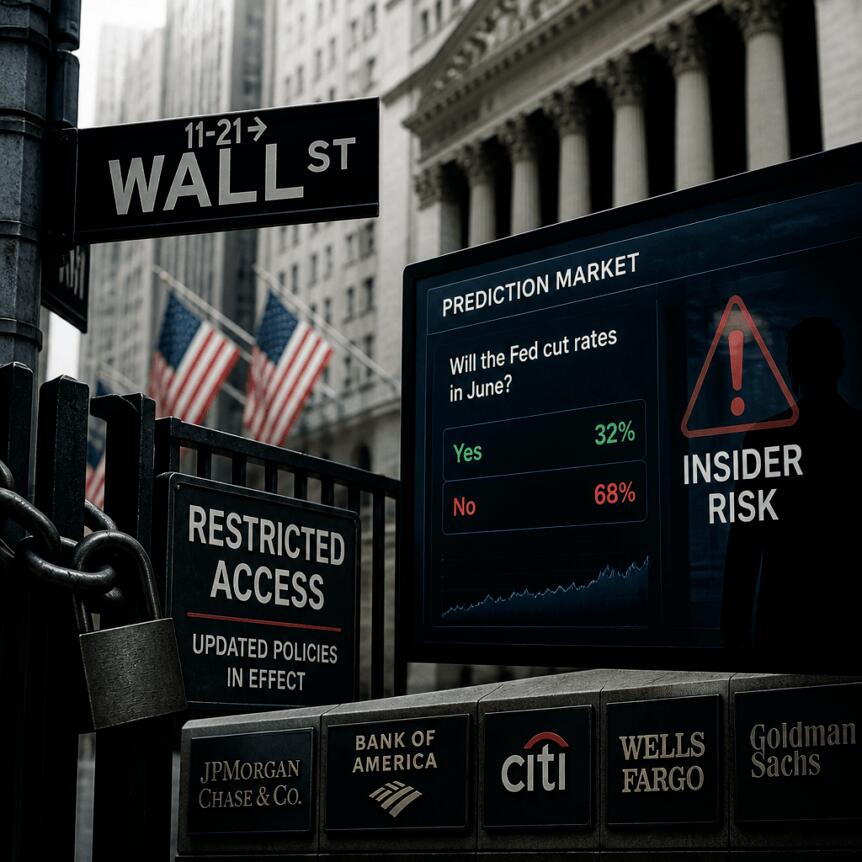
Major US investment banks are tightening internal rules around prediction market trading, according to reporting by CNBC. The move is driven by concerns that employees could use nonpublic information when trading event-based contracts—an issue that has increasingly drawn regulatory and political scrutiny in the United States.
CNBC said Goldman Sachs has reportedly banned employees from trading certain event contracts tied to the bank, including those related to financial markets, macroeconomic developments, elections, and geopolitics. Meanwhile, Morgan Stanley and Bank of America have also outlined or are preparing employee restrictions, reflecting how quickly predictive markets have moved from a niche concept to an area regulators and policymakers are willing to investigate.
Key takeaways
- Goldman Sachs has reportedly restricted employee trading on bank-specific event contracts after insider-trading concerns resurfaced.
- Other large banks are also implementing or updating internal prediction market policies, signaling a broader compliance shift.
- US oversight pressure has been building through enforcement actions and proposed legislation targeting political prediction market activity.
- Polymarket is seeking regulatory permission for margin trading for US users, which could expand participation but also raise compliance considerations.
Why banks are moving to restrict prediction market trading
Prediction markets allow participants to buy and sell contracts tied to real-world outcomes, including political and macroeconomic events. The very structure that makes these platforms useful—payoffs linked to information—also creates a perceived risk when traders have access to material nonpublic information through their day jobs.
CNBC’s report frames the banking restrictions as a response to that risk. In Goldman Sachs’ case, the reported ban covers event contracts “specific to the bank,” spanning topics such as financial markets, macroeconomic events, elections, and geopolitics. CNBC attributed the details to people familiar with the matter, and said Goldman declined to comment when approached by Cointelegraph.
Morgan Stanley reportedly has policies governing employees’ prediction market activity, according to unnamed sources cited by CNBC. Bank of America, according to the same report, is in the process of issuing additional prohibitions for employees regarding trading on prediction markets.
Regulators and lawmakers have been escalating insider-trading concerns
The banking clampdown comes amid heightened attention on insider trading risks in prediction markets. Earlier this year, the US Justice Department and the Commodities Futures Trading Commission (CFTC) said in a case involving Google software engineer Michele Spagnuolo that she profited $1.2 million on Polymarket after accessing nonpublic information at work, according to Cointelegraph coverage.
At the same time, political institutions have begun focusing on whether certain government-connected participants should be allowed to trade on outcomes connected to public policy. Cointelegraph also reported that White House attention and US lawmakers’ activity led to proposed legislation aimed at restricting political prediction market trading by government officials.
In mid-June, Wisconsin Representative Bryan Steil introduced a law intended to prevent certain public officials from “wagering on public policy issues and political outcomes,” according to Cointelegraph reporting. The proposal, as described in the coverage, does not single out lawmakers in the White House.
One earlier flashpoint underscored how quickly these platforms can intersect with real-world political events. In January, Cointelegraph reported that a soldier was charged over an alleged bet of roughly $400,000 on Polymarket tied to the removal of Venezuelan President Nicolás Maduro—a case that, while distinct from bank policies, helped intensify scrutiny of betting activity around consequential political outcomes.
Polymarket pushes for US margin trading approval
While banks focus on restricting internal trading, the prediction market ecosystem itself continues to pursue broader access in the US. Polymarket is seeking regulatory approval to offer margin trading to US users, a feature that would allow participants to place trades with less upfront capital, potentially increasing volume and market participation.
According to a July 3 filing with the National Futures Association (NFA), Polymarket applied to become a futures commission merchant through its affiliate, Coming Home GBA LLC. This step is part of the platform’s effort to expand its US footprint. Cointelegraph reported reaching out to Polymarket for comment on the proposal.
The filing process reflects a key regulatory distinction: Polymarket also needs authorization from the CFTC to enable non-fully collateralized trading for users. Until those approvals are in place, the ability to scale using margin remains conditional.
Polymarket’s competitor has already moved ahead on this specific capability. Cointelegraph reported that Kalshi’s affiliate, Kinetic Markets LLC, received an NFA authorization in March, allowing it to offer margin trading in the US. That earlier grant may shape expectations among users and market participants for how quickly Polymarket’s own application could progress.
Market activity keeps setting records as oversight tightens
Regulatory scrutiny has not stopped growth in prediction market usage. Data cited by Dune shows Polymarket hit a record $713 million in daily taker volume on June 20. Cointelegraph reported that the milestone arrived more than a week after the June 11 start of the World Cup, highlighting how major televised events can drive demand for outcome-based trading.
Other venues have also recorded strong figures tied to the same global tournament cycle. Cointelegraph reported that Kalshi posted a record monthly trading volume of nearly $9.4 billion in June, again attributing activity to the 2026 FIFA World Cup’s role in fueling participation across prediction markets.
Importantly, these growth indicators illustrate a tension that market participants will likely need to navigate: demand continues to rise, yet institutions—both regulators and traditional finance firms—are increasingly focused on information risk, conflicts of interest, and compliance controls.
For traders and builders, the next signal to watch is whether Polymarket’s margin-trading application advances in the NFA/CFTC process and how banks operationalize their restrictions in practice—particularly which categories of contracts and employee roles are treated as higher risk. As enforcement remains on the table and lawmakers continue to consider targeted rules around political outcomes, internal bank policies may become an increasingly common feature of the market landscape.


Key takeaways
- Ethereum (ETH) is extending its recovery, trading near $1,800, a key technical resistance level.
- Despite improving momentum, ETH remains below its 50-day, 100-day, and 200-day EMAs, keeping the broader trend cautious.
- Technical indicators, including the RSI and MACD, suggest bullish momentum is strengthening.
Ethereum price nears $1,800 as recovery momentum builds
Ethereum (ETH) continued its recovery on Friday, climbing to around $1,790 as buyers pushed the cryptocurrency closer to the important $1,800 resistance level.
Although recent gains have improved short-term sentiment, Ethereum remains below several major moving averages, indicating that the broader trend has yet to shift decisively in favor of the bulls.
Ethereum’s recovery is approaching a significant technical hurdle at the 50-day Exponential Moving Average (EMA) near $1,800.
The asset continues to trade below all of its major trend indicators, including the 50-day EMA at $1,800, the 100-day EMA ($1,956), and the 200-day EMA ($2,235)
This cluster of moving averages continues to cap upside momentum and suggests that the broader market remains in a corrective phase despite the recent rebound.
Momentum Indicators Turn More Constructive
Technical indicators point to improving buying momentum. The Relative Strength Index (RSI) is hovering around 60, moving above the neutral 50 level and indicating that buyers are gradually regaining control.
Meanwhile, the Moving Average Convergence Divergence (MACD) remains in positive territory, signaling strengthening bullish momentum as Ethereum attempts to build on its recent recovery.
While both indicators support additional upside in the short term, a confirmed breakout above the major resistance levels is still needed to establish a stronger bullish trend.
The immediate resistance remains the 50-day EMA near $1,800. A successful daily close above this level could allow Ethereum to target the 100-day EMA around $1,956, followed by the important $2,000 psychological resistance.
Beyond that, the 200-day EMA near $2,236 represents the next major obstacle for bulls.

On the downside, the primary support level sits around $1,385. A break below this area would signal renewed bearish pressure and could revive the broader downtrend.
As long as Ethereum remains above its key support while momentum indicators continue to improve, the possibility of further consolidation—and eventually a breakout above the $1,800 resistance zone—remains intact.
Crypto World
Bitcoin (BTC) price challenges Monday’s rejection level as ether (ETH) looks to break its streak of lower highs

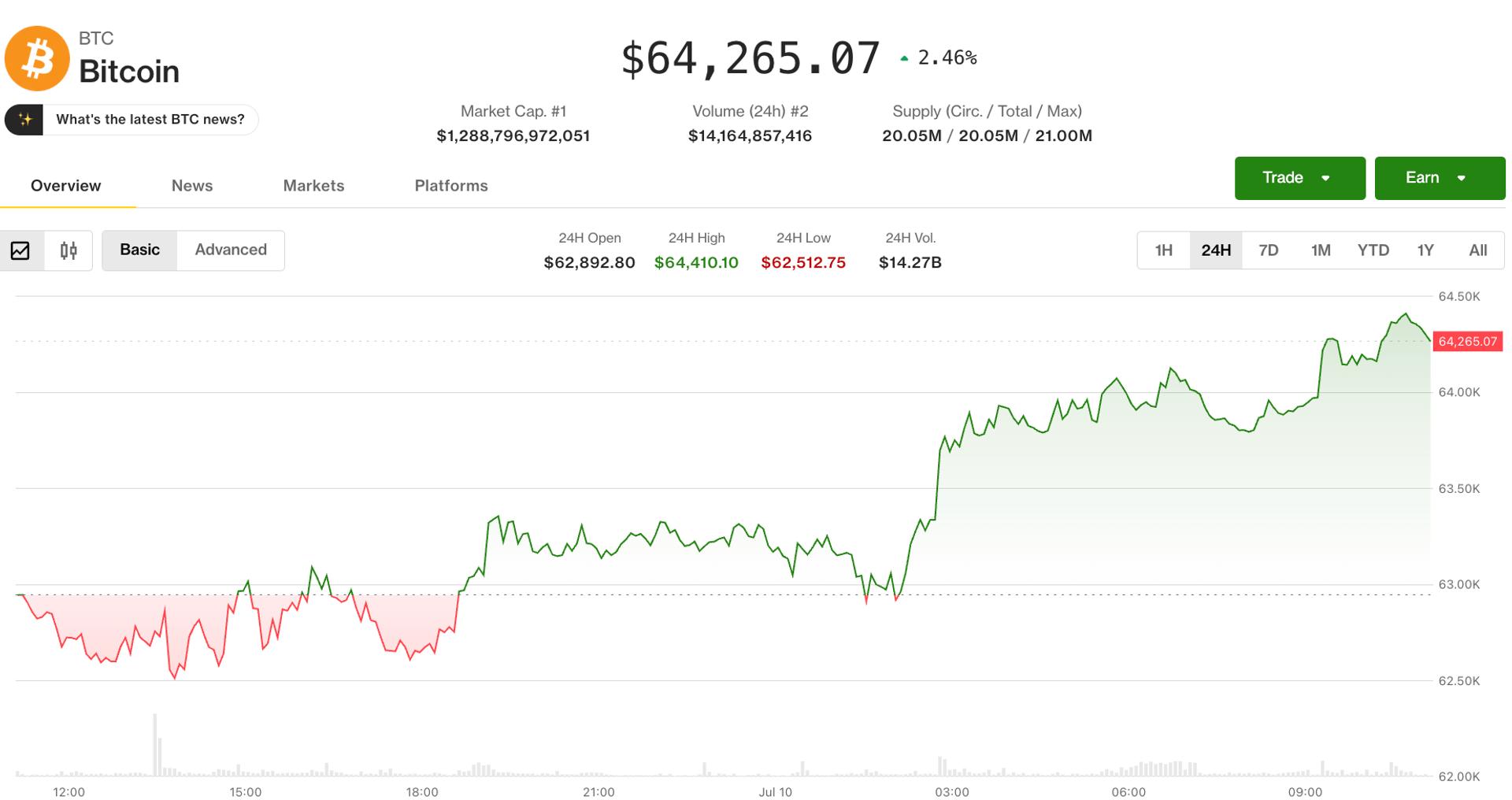
The crypto market took another leg higher on Friday with bitcoin trading at $64,400, up by 2% since midnight UTC.
The largest cryptocurrency is currently at the price it failed to penetrate on Monday. If it can break past this level, it will likely advance toward the June 15 high of $67,250.
Ether (ETH) outperformed bitcoin, rising 2.6% to $1,790 as it looks to snap a trend of sequential lower highs and lower lows.
There were also notable gains across the altcoin sector ahead of the weekend, typically a period of lower liquidity. Zcash (ZEC) and aave both rose by around 5% as optimism is slowly crept back into more speculative bets after months of waning sentiment.
Crypto diverged from U.S. equities, with S&P 500 index futures and Nasdaq 100 futures falling 0.1% and 0.4%, respectively.
Derivatives positioning
- Crypto derivatives markets are showing signs of stabilization, with speculation easing and longer-term positioning increasing.
- Volume over 24 hours fell 7% to $140 billion, while open interest (OI) rose 3% to $110.52 billion. This shift suggests the recovery is being driven more by strategic positioning than by high‑frequency speculative activity.
- Cumulative OI in bitcoin’s USD- and USDT-denominated futures on major exchanges has picked up slightly, from 262K to 272K, as the spot price topped $64,000. When read alongside positive funding rates and positive 24-hour OI-adjusted cumulative volume delta (CVD), the OI increase indicates a growing bias for bullish bets.
- Ether has yet to see a meaningful rise in futures OI, a sign that traders are still staying away from leverage.
- In the broader market, most tokens have positive 24-hour CVDs, a sign that buyers are becoming more aggressive, trading market orders rather than passive limit orders. This set expectations for continued price rises ahead.
- Confirmatory signals come from options-based implied volatility indexes tied to BTC and ETH, which continue to drop. It’s a sign of traders expecting market calm, a feature of rallies. BTC’s index, BVIV, fell to 38.5 early today, the lowest since June 6.
- In the options market on Deribit, put skews continue to weaken as the price rally eases downside concerns. Calls at $62,000, $65,000, and $67,000 are among the most-traded instruments, along with the $56,000 put. A call represents a bullish bet on the market.

Colombia’s outgoing environment minister warns of climate action setbacks

Lakeland Industries: A Trade That Lives Or Dies On One Number (NASDAQ:LAKE)

Kraken Plans AI-Powered Trading App Overhaul, CNBC Reports


-
 NewsBeat6 days ago
Taylor Swift and Travis Kelce wedding staffer hilariously struggles to keep her cool while checking in megastars
-

 Fashion4 days ago
Open Thread: What Great Books Have You Read Recently?
-

 Fashion2 days ago
Loro Piana Fall 2026 Enters Houston’s Art Scene
-

 News Videos4 days ago
Whats Hidden Inside This Cash Register? #treasure #reselling #money
-
 Tech4 days ago
Anthropic’s new “J-lens” reveals a silent workspace inside Claude that mirrors a leading theory of consciousness
-

 Business4 days ago
AXT Shares Jump Nearly 14% as Semiconductor Materials Maker Rebounds on AI-Linked Indium Phosphide Demand
-

 Sports3 days ago
Joshua Pacio ‘more complete’ ahead of ONE rematch vs Malachiev
-

 Crypto World5 days ago
South Africa proposes crypto tax guidance under existing rules
-
 Crypto World4 days ago
SK hynix (000660.KS) Stock Dips as $28B Nasdaq ADR Offering Drives AI Memory Expansion
-

 News Videos4 days ago
Best Time to Enter Small Caps Right Now? Another Bull Run? | Financially Free
-

 Tech5 days ago
Lenovo laptops are now shipping with YMTC SSDs, a sign of Chinese NAND entering the mainstream
-
Sports3 days ago
We have punished the disrespect
-

 News Videos4 days ago
Avoid entering in FOMO #bitcoin #cryptocurrency #trading #scalping
-

 Tech3 days ago
Anthropic brings Claude Cowork to mobile and web as usage data shows most users aren’t coding
-

 Crypto World4 days ago
$1,000 Credit Alert! BlockDAG X Exchange Pre-Registration Now Officially Open, Polkadot Dips & Zcash Rebounds
-

 Tech6 days ago
Neuralink Threads Its Way Straight Through the Brain’s Armor
-

 Crypto World4 days ago
Binance lists Strategy’s STRC stock as company expands Bitcoin funding
-

 Sports7 days ago
Game #88: Marlins at A’s Game Thread
-
 Crypto World6 days ago
Bitcoin Miner IREN Falls After $700 Million CEO Stock Award
-

 Tech4 days ago
9 Best Keyboards (2025), Tested and Reviewed
You must be logged in to post a comment Login