
Crypto World
Bitcoin flat near $63,500, but the flows have quietly turnedurned

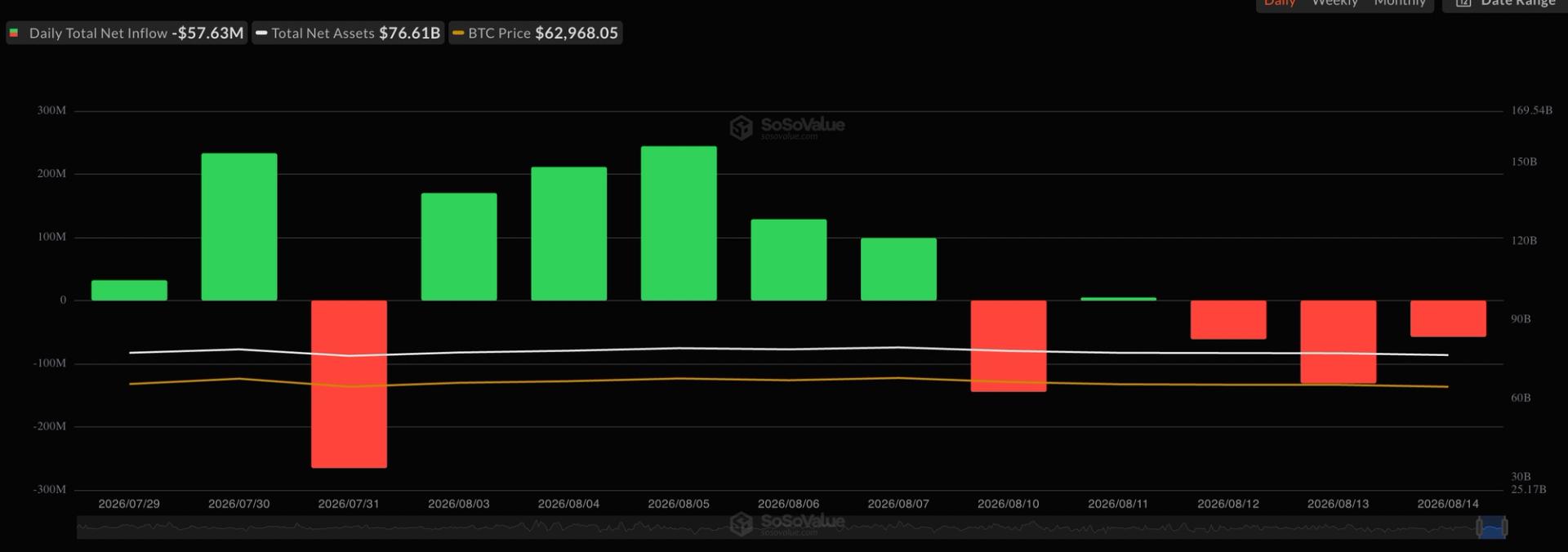
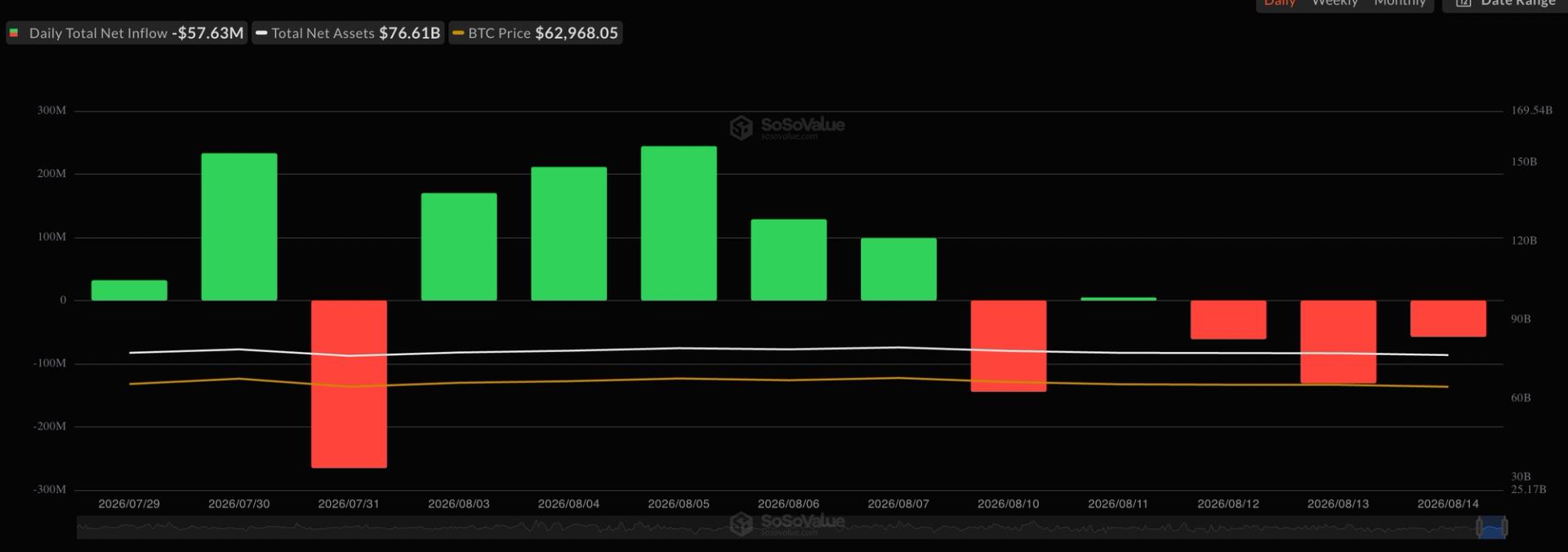
Bitcoin near $63,500 looks like more summer torpor, capped below $64,000 and holding above the low-$60,000s, but the flow picture underneath has reversed, said Yusuf Fakhro, partner at ARP Digital, in a note to CoinDesk.
US spot ETFs took in more than 14,000 BTC over five days into August 7, he said, the strongest stretch since May, and Q3 has drawn roughly 11,000 BTC of net inflows against 110,000 BTC of outflows in the back half of Q2. The institutional selling that defined the second quarter has flipped to buying.
Spot volumes have fallen to two-and-a-half-year lows, perpetual volumes to three-year lows, and volatility sits near multi-year troughs, Fakhro said.
Fresh demand arriving into the thinnest tape in years, when nobody is watching, is how durable bottoms tend to form. He reads bitcoin’s six months stuck between $60,000 and $80,000, holding near a 50% drawdown rather than grinding lower the way the 2014, 2018 and 2022 bear markets did, as apathy rather than deterioration, with on-chain data starting to show bottoming characteristics as sentiment shifts from panic to caution.
The risk sits on both sides. Bitcoin is as stuck below $64,000 as it is above $62,000, a box rather than a launchpad, and leverage sharpens it. Perpetual open interest has held above 300,000 BTC through the summer, elevated against its average while volumes collapsed, which leaves the market exposed to a sharp liquidation move in either direction.

As an AI-fueled supply squeeze grips copper, Freeport-McMoRan (FCX) is emerging as the standout among copper stocks.
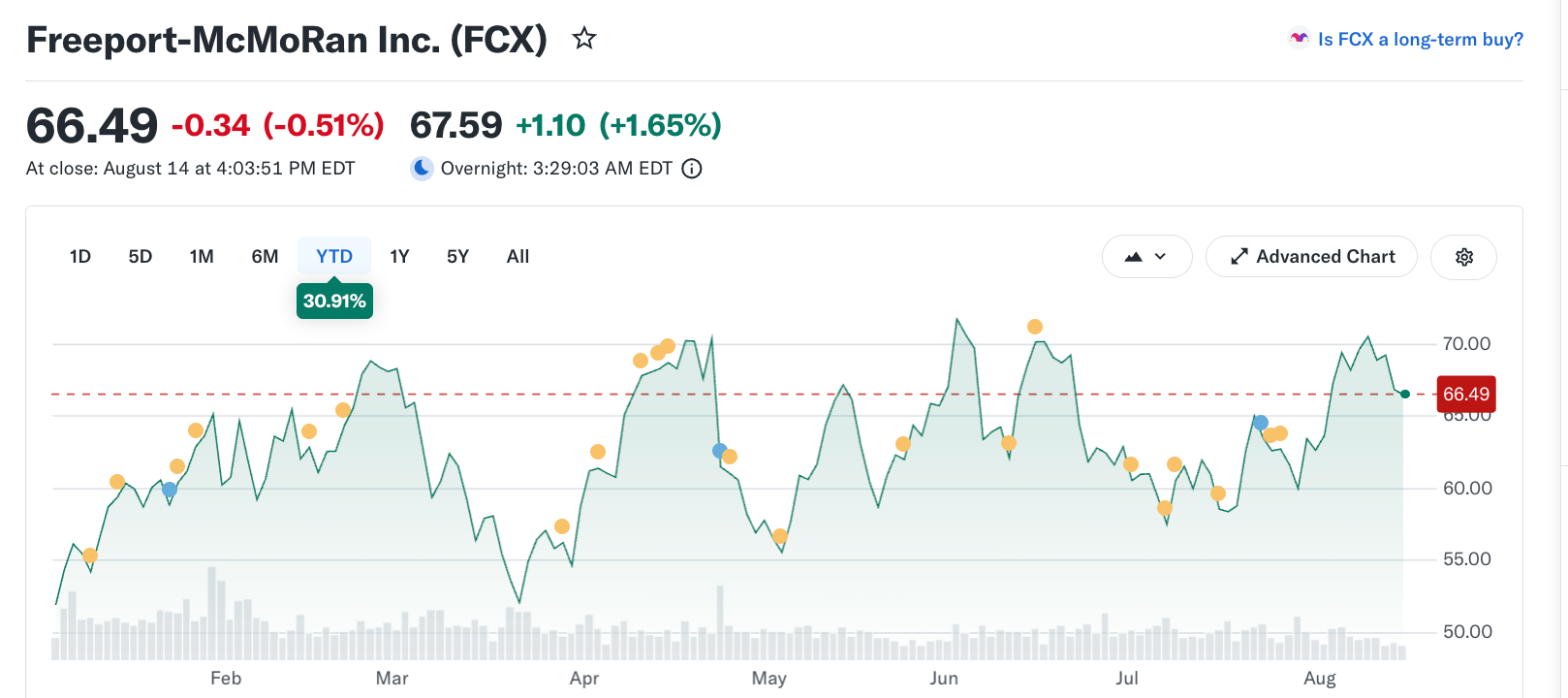
The largest US copper miner trades near $66.50 after a sharp year-to-date run, its chart is showing a bullish continuation pattern that points toward $87, and Wall Street still rates it a Strong Buy. Behind the setup sits a simple idea, that the AI boom needs far more copper than the market can supply.

What Is Driving the Squeeze?
The squeeze is severe and current. Copper hit an all-time high on COMEX on August 12, while the London Metal Exchange front-month spread blew out to a $370-a-ton premium, the widest since 2021, with inventories down for 42 straight days.
The demand side is where AI enters. A single one-gigawatt AI data center needs roughly 50,000 tonnes of copper, and the power grid built to feed the AI data center boom needs even more, which is why data centers alone are projected to add hundreds of thousands of tonnes of fresh demand a year.
Want more insights like this? Sign up for Editor Harsh Notariya’s Daily Newsletter here.
S&P Global and the International Copper Study Group both name AI and electrification as the force pushing the market into a structural deficit, and the same rising copper demand is spilling into digital-asset markets too. The near-term spike also owes to US tariffs and Chinese smelter cuts, so copper is tight now for tactical reasons and getting tighter for a strategic one. That strategic driver is AI, and the producers who own the supply are positioned to gain.
Why Freeport Leads the Copper Stocks
Among copper stocks, Freeport is the purest large-cap way to own that supply. It is the biggest US copper producer, and its first-half net income rose 65% year over year, driven by its US mines, as copper firmed.
Miners also carry operating leverage, which means a 10% rise in copper can lift profits far more, because mining costs stay largely fixed while revenue climbs. That is why a metal squeeze tends to reward the digger more than the tech giant that has to buy the metal.
What Do Analysts Say About Freeport Stock?
Wall Street is firmly onside. TipRanks data shows a Strong Buy, built on 10 Buy and 3 Hold ratings with no Sells, and an average 12-month target of $75.33, about 13% above the current price, with a high call of $82.

The recent moves lean bullish, with Barclays lifting its target to $82 and Stifel to $80 in late July. JPMorgan’s Bill Peterson, a top-ranked analyst with a strong track record on the stock, keeps a Buy at $77. Big money is positioning too. The copper-miner ETF COPX has quadrupled in assets in six months on heavy inflows, a sign funds are crowding into the group.
Is Money Rotating From Big Tech to Miners?
This is the part that makes the timing interesting. On August 4, copper rallied on Chinese demand and supply fears. Additionally, the copper ETF CPER rose about 1.3%. Yet, the miners ran far harder. Southern Copper jumped 4.98% and Freeport gained 5.75% that day.

The crowded side of the market, meanwhile, has started to cool. After leading the market all year, semiconductors have begun pulling back from their highs. The leader, Nvidia, was seen flashing bearish chart signals and was even overtaken by AMD on money flow. Also, on August 14 the chip names led the market lower with Broadcom off more than 5%.
A simple BeInCrypto proprietary gauge of copper miners against big tech makes the turn visible. It bottomed in mid-July, then crossed above its trend line and has held a rotation-into-miners signal through August.

On the panel, green up-arrows mark each flip into the miners and red down-arrows each flip back to tech, and after months of red-tinted chop the signal has stayed green, right as the copper squeeze intensified.

Freeport has moved in step, climbing more than 10% over the past month. In comparison, Copper Futures have just gained a modest 6%.
What Does Freeport’s Chart Say?
The technical setup backs the story. Freeport ran about 27% from its July 17 low to a peak on August 10. It then drifted into a tight, falling consolidation. The selling volume has been fading now, which resembles the classic conditions of a bull flag and pole.

A daily close above $68 would confirm the breakout and, on the measured move, project the roughly 27% pole toward $87. The floor is $65, and a slip below $63 would break the flag and cool the setup toward $58.

Analyst’s View: The case for copper stocks is certainly strong, with the FCX getting the Wall Street nod. The Strong Buy and the roughly 13% path to the average target are the best validations. Yet, the $87 figure is the chart’s stretch target. The honest risks are that part of this squeeze is traders front-running US copper tariffs. Copper is deeply cyclical and the whole thesis needs Freeport to clear $68 first.
For investors weighing gold, silver, or copper, the metal with the clearest AI tailwind may be the one already in a squeeze. Clear $68, and the shovel may out-run the chips for a while.
The post Why the Copper Squeeze May Reward This Mining Stock More Than Nvidia appeared first on BeInCrypto.
The crypto market will welcome tokens worth more than $556.7 million in the third week of August 2026. Major projects, including LayerZero (ZRO), KAITO (KAITO), and Soon (SOON), will release significant new token supplies.
These unlocks could introduce market volatility and influence short-term price movements. So, here’s a breakdown of what to watch.
1. LayerZero (ZRO)
- Unlock Date: August 20
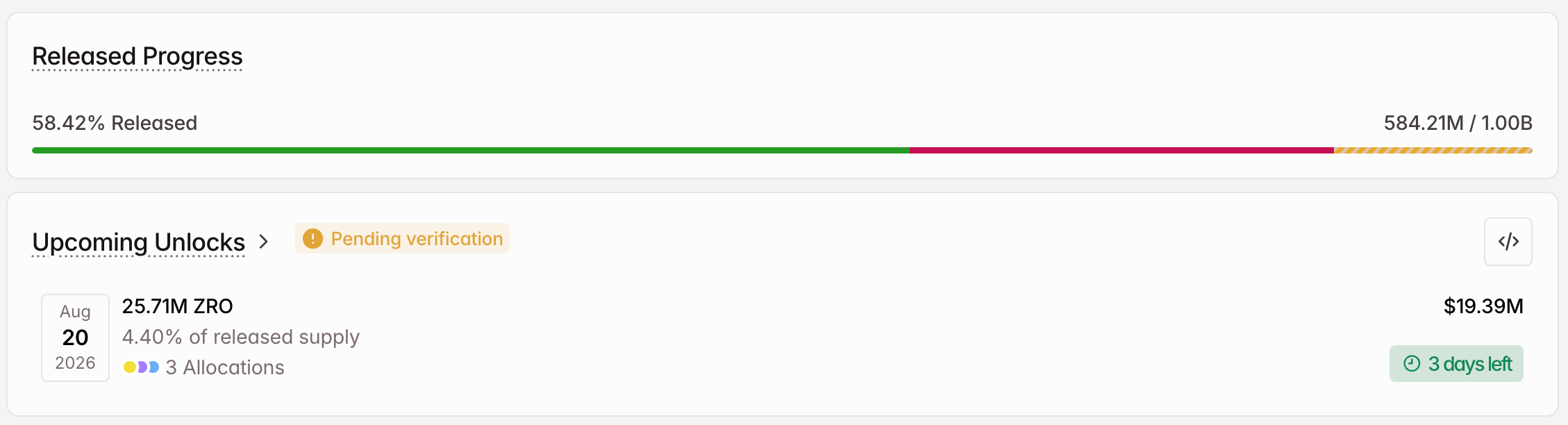
- Number of Tokens to be Unlocked: 25.71 million ZRO
- Released Supply: 584.2 million ZRO
- Total Supply: 1 billion ZRO
LayerZero is an interoperability protocol that connects different blockchains. Its primary goal is to facilitate seamless cross-chain communication. Thus, it enables decentralized applications (dApps) to interact across multiple blockchains without relying on traditional bridging models.
The team will unlock 25.71 million tokens on August 20, representing 4.4% of the released supply. Moreover, the supply is worth approximately $19.39 million.

LayerZero will award 13.42 million altcoins to strategic partners. Core contributors will get 10.63 million ZRO. Lastly, 1.67 million ZRO are for tokens repurchased by the team.
2. Kaito (KAITO)
- Unlock Date: August 20
- Number of Tokens to be Unlocked: 32.6 million KAITO
- Released Supply: 427.07 million KAITO
- Total Supply: 1 billion KAITO
Kaito is an artificial intelligence (AI)-powered Web3 information platform that aggregates and analyzes cryptocurrency market data from diverse sources like social media, governance forums, news, and more. The KAITO token serves as a medium of exchange, governance tool, and incentive mechanism within the platform.
On August 20, the team will unlock 32.6 million tokens, representing 7.63% of the current released supply. The supply is worth approximately $11.48 million.

The foundation will receive 1.19 million tokens. Early backers will gain 2.31 million KAITO. Furthermore, core contributions will get 6.94 million tokens.
The team will direct 7.16 million KAITO for ecosystem and network growth. Finally, Kaito has earmarked 15 million tokens for long-term creator incentives.
3. Soon (SOON)
- Unlock Date: August 23
- Number of Tokens to be Unlocked: 20.24 million SOON
- Released Supply: 538.4 million
- Total Supply: 1 billion (Y2035)
SOON is a high-performance Solana Virtual Machine (SVM) Rollup, designed to implement the Super Adoption Stack. It includes three main components: SOON Mainnet, SOON Stack, and InterSOON.
The network will unlock 20.24 million worth around $3.85 million. The unlocked supply accounts for 3.76% of the current released supply.

The network will direct 6.67 million tokens to SOON Squad. The team will also award 4.17 million coins to the ecosystem and 2.78 million SOON to the team and co-builders.
Furthermore, it will allocate 2.22 million tokens each to SOON Pill and community incentives for future products. The remainder covers 1.67 million SOON for the foundation and treasury, and 520,830 tokens for airdrop and liquidity.
In addition to these, other prominent unlocks investors can look out for in the third week of August include MBG by Multibank Group (MBG), ZKsync (ZK), Solv Protocol (SOLV), and more, which will contribute to the overall market-wide releases.
The post 3 Token Unlocks to Watch in the Third Week of August 2026 appeared first on BeInCrypto.
Crypto World
The Economics of Decentralized Compute: Building a New Market for Global Computing Power
Artificial intelligence, Web3, scientific research, gaming, and increasingly sophisticated applications all share one critical requirement: compute.
For decades, computing power has largely been controlled by centralized cloud providers and hyperscale data centers. Companies rent servers, GPUs, and storage from a relatively small number of providers, while those providers manage the infrastructure, pricing, capacity, and geographic distribution.
But a new economic model is emerging: decentralized compute.
Instead of concentrating computing resources in a handful of massive data centers, decentralized compute networks connect independent hardware providers and make unused or underutilized computing capacity globally accessible.
The technology is interesting—but the economics may be even more important.
What Is Decentralized Compute?
Decentralized compute is a model in which computing resources are supplied by a distributed network of independent participants rather than by a single centralized provider.
These resources can include:
- GPUs
- CPUs
- Storage
- Bandwidth
- Specialized AI accelerators
- Gaming hardware
- Data-center capacity
- Edge devices
A decentralized compute marketplace can match compute suppliers with compute consumers.
The basic economic relationship is straightforward:
Providers supply computing capacity → networks coordinate that capacity → users pay for computation → providers earn rewards.
Blockchain and smart contracts can add another layer by enabling transparent accounting, automated payments, reputation systems, and programmable incentives.
The result is potentially a global marketplace where computing power becomes something that can be bought, sold, and coordinated much like other digital resources.
Why Compute Is Becoming a Scarce Resource
The rise of AI has dramatically changed the economics of computing.
Training and running advanced AI models can require enormous amounts of GPU capacity. At the same time, demand is expanding across inference, video generation, autonomous systems, scientific computing, gaming, simulations, and enterprise applications.
This creates a supply-demand problem.
Large centralized providers can invest billions in infrastructure, but building data centers and acquiring advanced GPUs takes time. Hardware shortages, energy requirements, cooling constraints, and geographic limitations can further restrict supply.
Decentralized networks approach the problem differently.
Instead of asking:
“How do we build another massive data center?”
the decentralized model asks:
“How much computing power already exists but isn’t being fully utilized?”
That is a very different economic question.
Turning Idle Hardware Into an Economic Asset
One of the most interesting ideas behind decentralized compute is resource utilization.
A gaming PC may sit idle for most of the day.
A workstation may only use its GPU heavily for a few hours.
A data center may have unused capacity.
A business may own infrastructure that is underutilized during certain periods.
Decentralized compute networks can potentially aggregate this unused capacity and make it available to customers.
This creates a new economic relationship:
Idle capacity → marketplace → revenue opportunity.
For hardware owners, the network creates a way to monetize an asset they already own.
For compute buyers, it potentially creates another source of capacity outside traditional cloud infrastructure.
And for the network itself, every additional provider can increase available supply.
The Core Economics: Supply, Demand, and Price
At the center of decentralized compute is a marketplace.
Compute providers want higher utilization and better returns on their hardware.
Compute buyers want reliable capacity at competitive prices.
The market therefore needs to find an equilibrium between the two.
If demand for GPUs increases faster than supply, compute prices can rise.
If large amounts of unused hardware enter the market, prices may fall.
This dynamic creates an important competitive advantage for decentralized networks: they can potentially respond to demand by aggregating additional supply instead of relying exclusively on centralized infrastructure expansion.
However, cheaper compute is not automatically better compute.
Price is only one part of the equation.
The Real Cost of Decentralized Compute
The headline price of a GPU hour doesn’t tell the whole story.
Providers have to consider:
- Electricity
- Hardware depreciation
- Cooling
- Maintenance
- Internet connectivity
- Hardware failures
- Capital expenditure
- Opportunity cost
- Network fees
- Operational risk
A provider earning $0.50 from an hour of computation isn’t necessarily profitable if that hour costs $0.60 in electricity and hardware depreciation.
This means decentralized compute networks need sophisticated pricing mechanisms.
A sustainable marketplace must eventually answer:
What is the true cost of supplying compute?
That cost can vary dramatically depending on geography, energy prices, hardware generation, utilization rates, and workload type.
GPUs Are Not Commodities
Another economic challenge is that compute capacity isn’t perfectly interchangeable.
A high-end GPU isn’t equivalent to an older GPU.
A GPU optimized for AI workloads isn’t necessarily ideal for gaming or rendering.
Even two identical GPUs can produce different economics depending on electricity prices and network connectivity.
This makes decentralized compute more complicated than a simple commodity market.
Compute marketplaces may eventually develop highly granular pricing based on:
GPU model + performance + availability + location + reliability + workload + duration.
In other words, the market could begin treating compute capacity as a differentiated financial resource rather than a generic commodity.
The Role of Blockchain
Blockchain isn’t required to build a distributed computing network.
But it can provide useful economic infrastructure.
A blockchain-based system can potentially handle:
1. Automated Payments
Providers can receive compensation based on completed workloads.
Smart contracts can automate payment flows without requiring a centralized intermediary to manually reconcile every transaction.
2. Transparent Accounting
On-chain records can make payments, rewards, and certain network activities auditable.
3. Incentive Design
Tokens can be used to coordinate participants by rewarding providers for supplying valuable resources.
4. Reputation
Networks can create reputation mechanisms that reward reliable providers and penalize poor performance.
5. Global Participation
Crypto-native payment systems can make it easier for participants in different regions to interact with the same marketplace.
But tokenization alone doesn’t create a viable economy.
The underlying compute must actually be useful.
That distinction is critical.
The Token Incentive Trap
One of the biggest risks facing decentralized compute networks is excessive dependence on token incentives.
Imagine a network paying providers highly attractive token rewards.
More providers join.
Hardware supply increases.
The network appears to grow rapidly.
But if real customers aren’t paying for computation, the economics may be artificial.
Once token emissions decline, providers may leave.
This creates a crucial distinction between:
subsidized supply and real economic demand.
A sustainable decentralized compute network needs customers who are willing to pay because the compute itself provides value—not simply because participants are speculating on a token.
The strongest networks will therefore be those where revenue from actual compute demand can eventually support provider economics.
Decentralized Compute vs. Traditional Cloud
Traditional cloud computing has several major advantages.
Centralized providers offer:
- Predictable performance
- Standardized hardware
- Professional support
- Established security
- High availability
- Mature developer tooling
Decentralized networks face challenges in each of these areas.
However, decentralized compute can compete in different ways.
Potential advantages include:
- Access to otherwise idle hardware
- More diverse geographic distribution
- Potentially lower prices
- Permissionless participation
- Flexible supply
- Alternative infrastructure for developers
- Reduced dependence on a handful of providers
The future may not be about centralized compute versus decentralized compute.
It could be about a hybrid market where businesses use centralized infrastructure for mission-critical workloads while decentralized networks provide additional capacity for suitable workloads.
The Importance of Verification
There is one major problem with decentralized compute:
How do you know the work was actually completed correctly?
A centralized cloud provider can control the entire execution environment.
A decentralized network cannot necessarily assume every provider is honest.
Providers could potentially:
- Return incorrect results
- Fail to complete workloads
- Manipulate performance reports
- Disappear during computation
- Attempt to exploit workloads
Therefore, decentralized compute requires economic and technical mechanisms for verification.
These could include:
- Redundant computation
- Proof systems
- Reputation scores
- Random audits
- Staking and slashing
- Trusted execution environments
- Cryptographic verification
This introduces another economic layer.
Verification has a cost.
The network must balance security against efficiency. If verifying every computation costs almost as much as performing the computation itself, decentralization loses some of its economic advantage.
Reliability Becomes an Economic Product
Centralized cloud providers effectively sell more than computing power.
They sell reliability.
A decentralized compute marketplace therefore needs to make reliability measurable.
Imagine two providers:
Provider A: cheap but unreliable.
Provider B: slightly more expensive but consistently available.
A rational market may pay Provider B a premium.
This creates the possibility of a compute reputation economy where providers build valuable histories based on:
- Uptime
- Speed
- Accuracy
- Latency
- Successful workloads
- Hardware quality
- Response time
Over time, reputation itself could become an economic asset.
Geography Matters
Compute economics are increasingly tied to geography.
Electricity costs differ dramatically between countries and regions.
Cooling requirements differ by climate.
Internet connectivity varies.
Regulatory environments differ.
Some locations may therefore become natural hubs for decentralized compute.
A network capable of intelligently routing workloads toward economically efficient locations could reduce costs.
For example, compute-intensive workloads might favor regions with inexpensive electricity, while latency-sensitive applications may prioritize geographic proximity to users.
This creates an interesting future possibility:
Compute markets could become geographically optimized in real time.
The Energy Question
Decentralized compute also raises an unavoidable question:
Who pays for the electricity?
Every computation consumes energy.
For AI and GPU-heavy workloads, energy can represent a significant portion of operating costs.
If decentralized compute grows dramatically, networks will increasingly compete not just for GPUs but also for cheap and reliable energy.
This could create new relationships between:
- Renewable energy producers
- Data centers
- Mining facilities
- AI infrastructure
- Compute marketplaces
- Distributed GPU networks
In the long term, energy and compute markets may become increasingly interconnected.
From Compute Marketplace to Compute Economy
The biggest opportunity may extend beyond simply renting GPUs.
A mature decentralized compute ecosystem could develop multiple economic layers.
Hardware Providers
Supply GPUs, CPUs, storage, and other resources.
Compute Aggregators
Combine fragmented capacity into usable infrastructure.
Developers
Build applications that consume decentralized resources.
Verification Providers
Ensure workloads are executed correctly.
Network Operators
Coordinate supply, demand, reputation, and payments.
Investors
Finance hardware deployment and infrastructure expansion.
Users
Pay for applications powered by decentralized compute.
Together, these participants create something larger than a marketplace.
They create a compute economy.
The Future of AI May Be More Distributed
AI is one of the strongest potential drivers of decentralized compute.
Inference demand could eventually become enormous as AI moves into:
- Personal assistants
- Autonomous applications
- Gaming
- Robotics
- Financial systems
- Content creation
- Scientific research
- Consumer devices
Not every AI workload needs to run inside a hyperscale data center.
Some workloads can potentially be distributed across a network of specialized machines.
This creates an opportunity for decentralized infrastructure to become an alternative layer underneath the expanding AI economy.
What Will Determine Success?
The decentralized compute sector won’t be won simply by whoever has the most GPUs.
The winning networks will likely be those that solve the economic coordination problem.
They need to answer five fundamental questions:
1. How do we attract reliable compute supply?
Providers need attractive and sustainable economics.
2. How do we attract real customers?
Demand must come from useful applications rather than speculation.
3. How do we verify computation?
Users need confidence that workloads were executed correctly.
4. How do we price compute efficiently?
Pricing must reflect hardware, energy, reliability, latency, and demand.
5. How do we make the experience simple?
Developers should not need to understand the underlying complexity of the network.
The best decentralized infrastructure may eventually feel almost identical to centralized cloud infrastructure from the user’s perspective.
The decentralization happens underneath the surface.
The Bigger Picture
The economics of decentralized compute are ultimately about turning fragmented resources into coordinated infrastructure.
There are millions of machines around the world with computing capacity that is not being fully utilized. At the same time, demand for computing continues to expand through AI, Web3, gaming, scientific research, and digital applications.
The opportunity is to connect these two sides.
But decentralization isn’t magic.
A successful network must make the numbers work for everyone involved.
Providers need profitable economics.
Users need competitive prices.
Developers need reliable infrastructure.
Networks need sustainable revenue.
And verification needs to remain affordable.
If these pieces come together, decentralized compute could evolve from an experimental Web3 concept into a genuine infrastructure market.
The most important shift may not be the creation of another blockchain token.
It may be the transformation of compute from a centralized service into an open, programmable, globally traded resource.
And in an economy increasingly powered by artificial intelligence, that resource could become one of the most valuable commodities of the digital age.
REQUEST AN ARTICLE


Disclosure: This article does not represent investment advice. The content and materials featured on this page are for educational purposes only.
Bitcoin cloud mining offers investors an alternative to buying BTC directly, allowing users to access mining power without owning or maintaining physical rigs.
Summary
- Bitcoin cloud mining offers investors an alternative to buying BTC directly by accessing mining power without owning physical rigs.
- ASDeFi highlights cloud mining as a simpler way to access Bitcoin mining without the costs of equipment, electricity, and maintenance.
- As Bitcoin mining becomes more specialized, ASDeFi uses managed infrastructure to make cloud-based hashrate services more accessible.
There’s one question every Bitcoin investor eventually asks: Aside from buying BTC directly at market price, are there other ways to earn Bitcoin? The answer is yes — Bitcoin cloud mining.
Cloud mining offers a way for users to participate in Bitcoin mining by purchasing cloud computing power, without having to own or maintain their own mining rigs. This article will explain the basic principles of Bitcoin cloud mining, the equipment and operational barriers associated with home mining, and how ASDeFi uses centralized infrastructure to provide users with a more convenient Bitcoin mining experience.
Part 1: Understanding Bitcoin and mining
Bitcoin is a decentralized cryptocurrency that is not controlled by a central bank or any single entity; instead, transactions are collectively verified and recorded through a global network of computers.
Mining is a crucial mechanism for maintaining network security and the accuracy of the ledger. Miners solve complex mathematical problems through computation; upon successful completion, they can add a new block to the blockchain and receive a Bitcoin reward. Currently, the reward per block is 3.125 BTC, and a new block is generated approximately every 10 minutes on average.
Part 2: Why Bitcoin has a fixed supply — and why it matters
One of Bitcoin’s most important economic characteristics is that its total supply is capped at 21 million coins. This rule is hard-coded into its protocol, and the rate at which new Bitcoins are issued is gradually reduced through a “halving” mechanism that occurs approximately every four years. A fixed supply and a gradually decreasing rate of new issuance are key economic features of Bitcoin, but this does not guarantee that prices will rise; its market price remains subject to a variety of factors, including demand, macroeconomic conditions, and the regulatory environment.
Part 3: Issues with buying Bitcoin directly
Buying Bitcoin directly requires careful consideration of the timing of the purchase, and since Bitcoin prices are highly volatile, it’s easy to end up buying at the peak or selling out of panic. Cloud mining, on the other hand, offers an alternative approach: users can gradually accumulate BTC through ongoing hashrate services, eliminating the need to constantly assess the best time to buy and thereby reducing the pressure associated with market timing.
Part 4: Why home mining is no longer feasible
Bitcoin mining has become highly specialized and large-scale. Individual miners not only need to purchase expensive ASIC miners but also bear costs related to electricity, space, cooling, equipment maintenance, and round-the-clock operations, while also requiring a certain level of technical expertise. In today’s highly competitive mining environment, the cost of residential electricity often cannot compete with the low-cost energy available to large-scale mining farms, further increasing the financial burden on individual miners.
Part 5: What is cloud mining?
Cloud mining is a model that allows individual investors to participate in Bitcoin mining through the computing power of professional data centers, without the need to purchase and operate ASIC mining rigs themselves. The platform handles the procurement, deployment, power supply, cooling, maintenance, software updates, and mining pool management of the mining rigs, while users receive mining rewards based on the computing power shares they purchase and can view relevant data through their accounts.
Part 6: Introduction to ASDeFi Cloud Mining and guide to getting started
Founded in 2020 and headquartered in the United Kingdom, ASDeFi is a cryptocurrency mining platform specializing in AI-powered cloud computing power. Leveraging global green energy mining facilities and an AI-powered computing power scheduling system, it automates computing power allocation and revenue settlement.
The sign-up process is very straightforward:
1. Visit official ASDeFi website and complete the account registration.
Registered users receive a $15 in cash for free; they can earn $0.60 per day through mining.
2. Complete Account Setup
Deposit cryptocurrency and link the cryptocurrency wallet address for withdrawals.
3. Select a Hashrate Contract
Go to the Contracts page and, based on your budget and investment plan, select a hashrate contract with the desired term, amount, and returns.
4. View Operation Status
Once the contract purchase is complete, the system runs automatically. View account and earnings data via the web or mobile app, and manage earnings.
Example of a hashrate contract:
| Contract | Purchase Amount | Term | Daily Return | Total Return |
| Daily Check-in Contract | $15 | 1 day | $0.60 | $15.60 |
| New User Experience Contract | $100 | 2 days | $4.00 | $108.00 |
| Basic Hashrate Contract No. A2317 | $500 | 5 days | $6.50 | $532.50 |
| Basic Hashrate Contract No. A2312 | $3,500 | 15 days | $54.25 | $4,313.75 |
| Stable Hashrate Contract No. S3177 | $12,000 | 25 days | $204.00 | $17,100.00 |
| Stable Hashrate Contract No. S3170 | $23,000 | 30 days | $425.50 | $35,765.00 |
Summary
As Bitcoin mining becomes increasingly specialized, individual investors who purchase mining rigs on their own face multiple costs related to equipment, electricity, cooling, and technical maintenance. Cloud mining, on the other hand, lowers the barrier to entry for individuals by leveraging professional infrastructure, allowing users to participate in Bitcoin hashrate services without owning physical mining rigs. Through hashrate resource management and automated operations, ASDeFi offers users interested in this model an alternative way to participate in the Bitcoin ecosystem.
For more information, visit the official website.
Disclosure: This content is provided by a third party. Neither crypto.news nor the author of this article endorses any product mentioned on this page. Users should conduct their own research before taking any action related to the company.
Crypto World
Bitcoin (BTC) price tracks equity bounce while $390 million ETF outflow week restrains the bulls
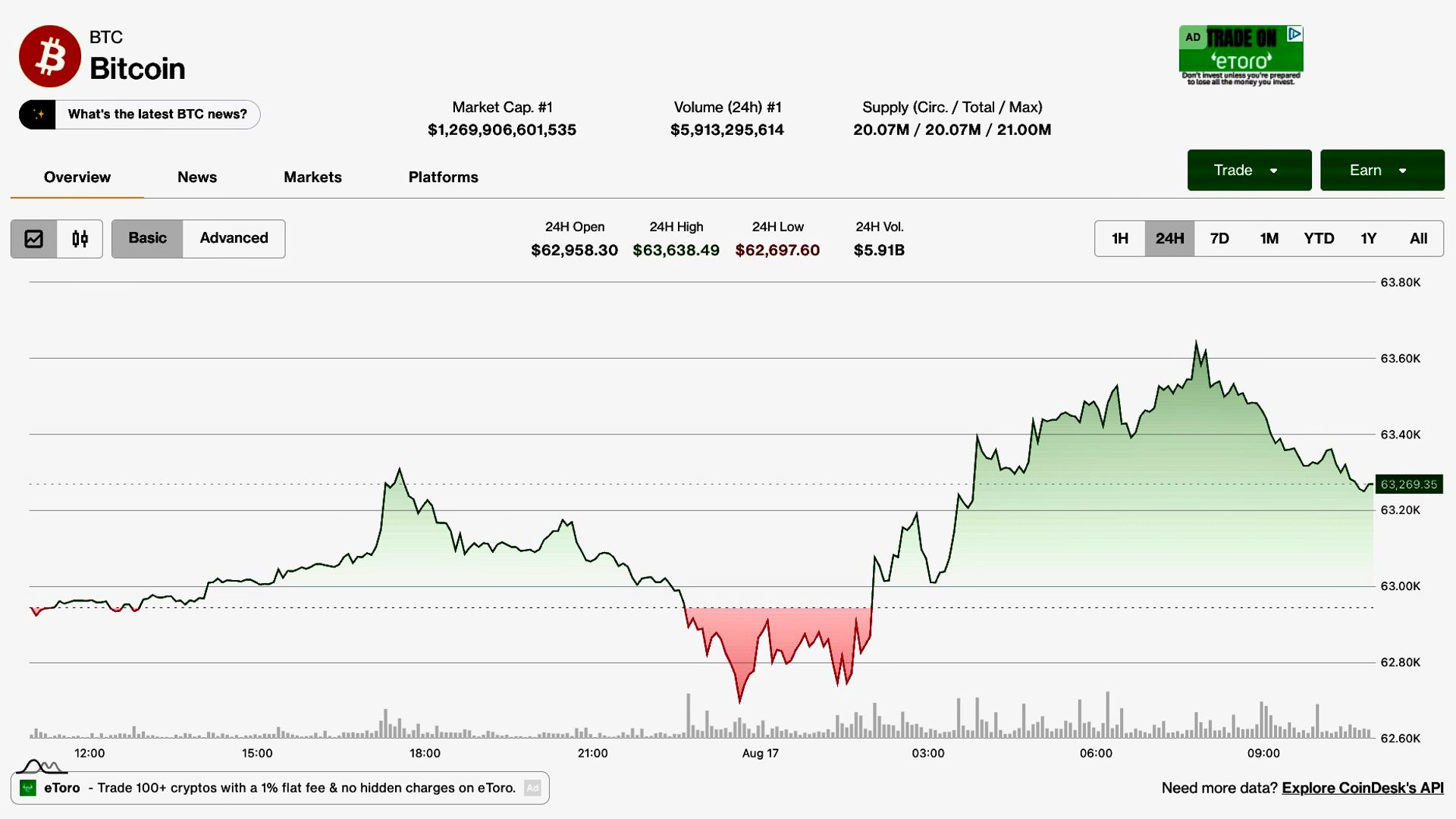
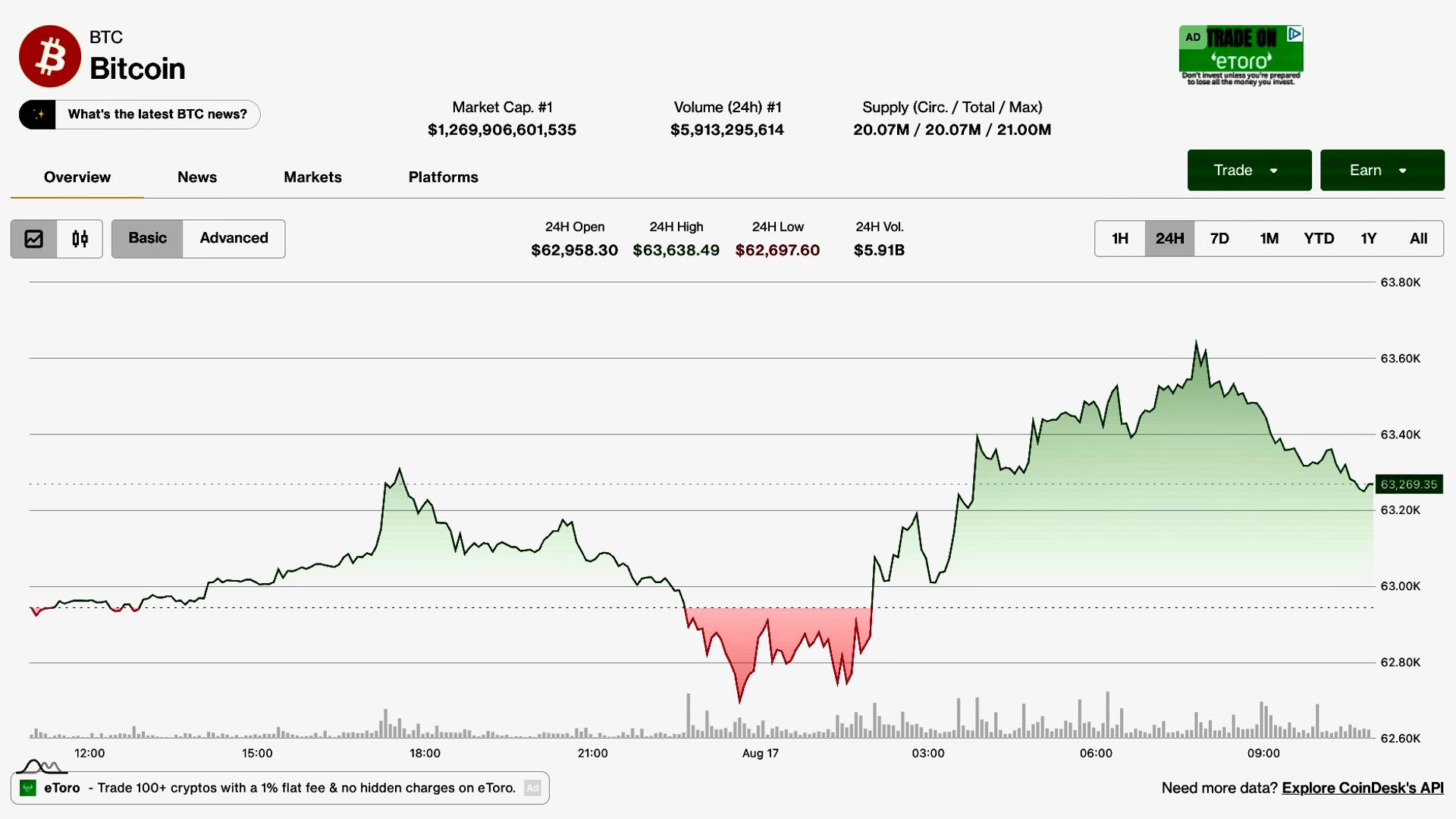
Bitcoin steadied above $63,000 on Monday, clawing back a fraction of last week’s losses with a 0.8% gain since midnight UTC.
Without an obvious catalyst, the largest cryptocurrency appears to be tracking U.S. equities. Nasdaq 100 index futures are up 0.5% to their highest point since July 2.
Any positive reading will need to take into account last week’s net $390 million outflow from spot exchange-traded funds, including the first three-day stretch since the end of July. That was the largest weekly withdrawal from U.S. spot bitcoin products in six weeks.
Ether ETFs flows were limited, and solana (SOL) ETFs bucked the trend with their strongest weekly inflows since mid-May.
The bigger picture is the Clarity Act. Galaxy Research’s head of research, Alex Thorn, cut his odds of the landmark crypto bill becoming law in 2026 to roughly 10% on Aug. 14, joining prediction markets that now put the probability at around 17%. A cloture vote is scheduled for Sept. 15 when the Senate returns from recess, although market observers are expecting another delay.
Derivatives positioning
- Taker ratio stays balanced: the 24-hour long-short volume ratio for takers hangs in balance again, extending Friday’s trend. Takers are entities that pull liquidity from the order book by trading at available prices.
- Thin liquidity raises swing risk: BTC’s notional open interest, at $48 billion, is now nearly double its 24-hour trading volume. XRP’s market shows a similar pattern. That gap means any mass liquidation event could run into thin liquidity, raising the odds of wild price swings.
- BTC OI pulls back, XRP holds firm: in contract terms, BTC’s open interest (OI) has pulled back to 750,000 BTC from Friday’s 760,000 BTC. That’s been a pattern since April, with spikes above 750,000 BTC often proving short-lived. XRP futures show the opposite dynamic, with OI holding steady at 10-month highs. Positioning in ETH and SOL remains relatively light in comparison.
- CC shows bearish buildup: Canton Network’s CC token has dropped over 1.5% in 24 hours, making it one of the biggest losers among the top 100 coins by market value. OI in futures tied to the token has risen more than 5% over the same period. That combination points to shorts, or bearish bets, being built up. Negative annualized perpetual funding rates and a negative OI-adjusted 24-hour cumulative volume delta (CVD) both support that read, indicating bears are leading the market.
- ZEC bucks the trend: Privacy-focused ZEC is also an OI gainer. In this case, a positive 24-hour CVD, is a sign bulls are being more aggressive, taking longs via market orders rather than passive limit orders. ZEC’s funding rate is also positive at +10%, indicating a growing bias toward bullish bets.
- Volatility and fear stay low: Bitcoin and ether’s 30-day implied volatility indexes remain pinned near year-to-date lows, suggesting fear levels and demand for options-based insurance against price swings are both muted. Wall Street’s VIX tells a similar story, sitting at its lowest level since January.
- Options positioning leans bullish near-term: On Deribit, the skew for BTC and ETH shows a bid for calls, or bullish bets, at the front end of the curve. The implied volatility term structure shows no signs of short-term stress either, despite Wednesday’s scheduled release of the Fed minutes.
- Volume rankings show a split: 24-hour volume rankings show a mixed profile, with both BTC calls and puts among the top five most-traded instruments. The same holds for ether.
Token talk
- Pump.fun is one of the standout performers on Monday, adding 7.80% since midnight UTC with daily trading volume rising 55% to $90 million.
- ZEC has gained 4.70% since midnight at $508, extending a notable stretch for privacy coins following XMR’s strong run last week.
- MORPHO advanced by 5% at $2.07, reversing some of Friday’s weakness and leading the DeFi names higher.
- HYPE rose 3.53% to $59.08, continuing its steady grind and now up around 2% on the week.
- FET is one of the weakest altcoins on Monday, down 1.56% since midnight at $0.1196, giving back some of last week’s gains as AI-adjacent tokens lose momentum.
- CoinMarketCap’s “Altcoin Season” indicator is at 46/100, recovering from the Aug. 7 low of 36/100 as optimism slowly returns to the altcoin sector. CoinMarketCap’s Fear and Greed index sits at 38/100, a “fear” reading.
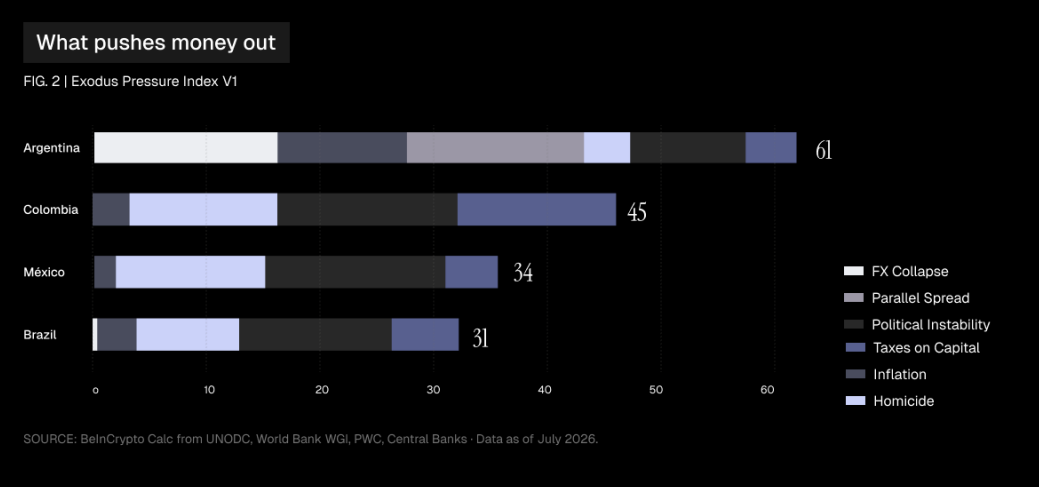
An Argentine who kept the equivalent of $10,000 in peso cash from 2016 to 2026 ended the decade with about $114 in US-dollar value.
That nearly 99% loss explains why the dollar has entered everyday financial life across Latin America. Workers receive salaries in stablecoins, while businesses use digital dollars to collect revenue and pay foreign suppliers.
The Exodus Economy, a new report from BeInCrypto Intelligence, describes this as bottom-up dollarization. People remain at home while more of their financial activity moves beyond domestic banks. The protection behind those dollar balances varies widely.

The Dollar Has Become Working Money
More than 99% of tracked stablecoin withdrawal volume moved onward within 30 days. On Argentine wallet Lemon, the median withdrawal ranged from $150 to $270 during the first half of 2026. The average was $544 across 215,597 transfers.
Separately, Bitso’s tracked stablecoin corridor was running at an annualized $31.5 billion in 2026. The figure measures gross, bidirectional movement rather than money permanently leaving the region.
The activity looks more like a payment network than a savings vault. The money arrives, then moves toward spending or operating costs.
Antônia Souza, Visa’s digital-currency director for Latin America and the Caribbean, said institutions still account for the largest flows.
“The huge numbers that we are seeing on stablecoins are from institutional transactions and cross-border transactions, mainly B2B transactions.”
A Dollar Balance Can Hide Different Risks
BeInCrypto audited 12 dollar-account products available to Latin American customers. Only two placed customer balances in insured US bank deposits. Five used stablecoins.
The dollar label reveals little about the protection underneath it. A balance could represent an insured deposit, a stablecoin claim or an investment product.
Reza Bundy, CEO of Atlas Capital Team, says savers must separate currency protection from wealth preservation.
“For a Latin American saver, nominal dollar exposure and preservation of real purchasing power are separate questions,” Bundy told BeInCrypto. “A stablecoin, bank deposit, Treasury bond and US equity can all be denominated in dollars while carrying very different risks.”
Holding dollars can protect against local-currency depreciation. US inflation can still reduce what those dollars buy. Stablecoins can add issuer, platform and custody risks.
Moving Into Treasuries Creates Another Decision
Some savers move beyond digital cash and buy US government bonds. The maturity of the bond can materially change the outcome.
“Long-duration Treasuries are particularly sensitive to changes in inflation expectations, interest rates and the term premium,” Bundy said. “When yields rise, the market value of a long bond can decline substantially, even though the US government continues making its payments.”
A saver holding the bond to maturity may receive the promised payments. Someone selling earlier could take a loss because bond prices generally fall when rates rise.
Bundy also warns that cap-weighted US technology indices concentrate money in a small group of companies. He favors shorter-duration bonds and assets that respond differently to inflation, while acknowledging that each introduces new risks.
Bottom-up dollarization gives Latin Americans access to a currency that can hold its value better than a weakening local currency. What they hold after making that switch determines the legal protection, liquidity and purchasing power they receive.
Disclosure
Bundy leads Atlas Capital Team, adviser to the Atlas America Fund, and Atlas AI Labs, the planned issuer of USAFi. Atlas has commercial interests connected to asset classes discussed above. USAF is an ETF and may lose value. USAFi remains pre-launch and requires a full VARA licence before issuance. His comments are general market views, not investment advice. The USAF prospectus lists its fees and risks.
The post Latin Americans are Moving Into Digital Dollars. Are Their Funds Safe? appeared first on BeInCrypto.

“We are devastated by what happened. They were among Antonello da Messina’s most important and best-known works. It is a tremendous loss for the museum, the city, the community and the art world,” MuMe director Marisa Mercurio told Italian news agency ANSA on Sunday.
“Messina without Antonello is deprived of the very essence of the greatest artist of the European Renaissance,” Enzo Caruso, Messina culture councillor, told broadcaster Sky Italia.
The theft is the latest high-profile heist in the art world. Days before, Italian police said they recovered three artworks by Renoir, Cézanne, and Matisse that had been stolen from Parma’s Magnani Rocca Foundation in March. Five people were detained in connection with the theft.
MuMe was closed to the public on Sunday amid ongoing investigations.
Here’s what we know so far about the heist.
How the theft happened
At least three masked people approached the museum at around 9:50 p.m. on Saturday, Italian media reported, citing museum officials and preliminary investigative materials. The theft took place during the Vara procession marking the Ferragosto holiday, which commemorates the feast of the Assumption of the Virgin Mary.
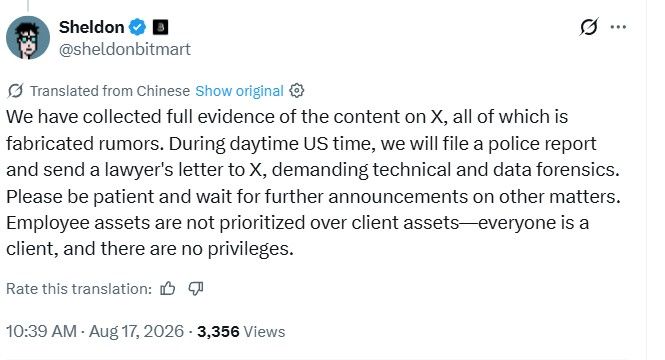
BitMart chief executive Sheldon Lee dismissed accusations circulating on X as fabricated rumors on Monday, hours after a public campaign gave him until August 19 to explain where customer money went.
BitMart announced an orderly wind-down of its trading platform in July. Many users still report blocked withdrawals, and former employees say last month’s salaries remain unpaid.
Why BitMart Users Want Proof of Reserves
A Chinese-language account posting as BitMart 币市 published a five-point accountability demand on Monday. It asks Lee and business partner Yi Li to disclose wallets, assets, liabilities, and usable reserves that a third party can verify.
The account also questions who ordered the withdrawal limits. Moreover, it asks when management first knew the platform could no longer process requests normally.
Strain showed up on-chain almost immediately. Ethereum withdrawals surged to a 2026 high within days of the notice, while BMX crashed 46% as the announcement landed.
The July 26 notice stopped deposits and new Bitmart registrations at once. It also switched futures accounts to reduce-only mode, which lets traders close positions but not open fresh ones.
Staff pay sits at the center of the complaint. Rank-and-file employees never decided how company funds were managed, the account argues, so they should not absorb the cost of that decision.
“Let the fund flows be traced clearly. Let users know where their money is. Let employees get back the pay they deserve.”
BitMart said on X
Legal Threats Replace a Repayment Plan
Lee skipped the demands point by point. Instead, he said the company had gathered evidence and would file a police report and send a lawyer’s letter to X requesting technical forensics.

He added that employee assets carry no priority over client assets. Meanwhile, the reply offered no reserve figures, no liability total, and no repayment timeline.
The campaign wants a repayment plan with an order of priority, a start date, and an independent audit. So far, BitMart has published none of that.
On-chain investigator ZachXBT pushed back within minutes.
“If you actually have the liquidity then simply return the funds to everyone instead of posting vague statements?”
via ZachXBT
The official notice sets August 26 as the final trading day and the recommended cutoff for withdrawal requests. Login access runs until January 31, 2027.
BitMart is one of several venues to exit this year. Analysts read closures as a healthy reset, though staff cuts at Luno pointed to wider stress. European regulators, meanwhile, opened a custody review under MiCA after an earlier exchange collapse.
Wednesday’s deadline now sets the next test. Verifiable reserve data would answer the question quickly, while another statement without numbers likely will not.
The post BitMart CEO Calls Accusations Fabricated as Users Report Frozen Withdrawals appeared first on BeInCrypto.

So, was it a success or a failure? In the final calculation, it was a success for several reasons. First, it engaged people in the importance of physical activity. Second, it proved my hypothesis: setting and declaring a goal takes you further than you would have gone without one. And third, even if you fall short of the destination, the goal—and the journey—will change you.
After my injury, one of my key takeaways was that I had nevertheless made remarkable progress as a runner. So, I set myself another goal: could I run a marathon again—something I hadn’t done in two decades—and do so at a reasonable pace, given my age? This time, I stuck to my training plan, avoided injury, and the answer was an emphatic yes.
In 2025, I ran the London Marathon in 3 hours, 37 minutes and 40 seconds, a time that put me in the top 20% of all finishers. I could never have achieved that time 20 years ago, let alone before my 2022 challenge. This had a positive knock-on effect: my result in London meant I qualified for the Boston Marathon, and I ran an even faster time in that race.


There’s something uniquely irritating about being forced to listen to whatever a stranger has decided to watch on their phone. Suddenly, the airport gate has a soundtrack—and it’s a tinny succession of TikToks, action scenes, and FaceTime chatter that no one else signed up for.
As Sammie Walker Herrera, a communication coach, puts it, you might be screaming internally: “When I said I listen to all kinds of music, I didn’t mean your music.”
Still, it’s one thing to object internally—and another to ask the person to turn it down. What if they get angry, ignore you, or turn up the volume out of spite? We asked etiquette and communication experts how to make the request without turning an annoying situation into an altercation.
First, decide whether you need to say anything at all
Sometimes the easiest solution is simply to get out of earshot. Nicole Del Valle Rose, an etiquette coach and founder of the Las Vegas consultancy Poised & Proper, says the most gracious response is often the least confrontational one.
“Etiquette isn’t about correcting every behavior that bothers us,” she says. “It’s about choosing the response that creates the best outcome for everyone.”
If there’s another table open at the coffee shop or plenty of room elsewhere in the train car, relocate. You’ll solve the problem in seconds and spare both of you an awkward exchange. Save the conversation for situations where you’re truly stuck, like on a plane, in a waiting room, or aboard a packed bus.
Talk about the sound—not the person
It can be tempting to make sure the offender knows they’re being rude. Resist the urge.
“You don’t want to immediately put this person on the defensive,” says Walker Herrera, who runs Speak Y’all, a communication coaching business. “Frame how it’s impacting you, rather than that they’re doing something ‘wrong.’”
Plus, you don’t know why their phone is so loud. They might be hard of hearing, or they may not realize how far the sound is carrying. Treating it as a solvable volume problem—not evidence of a glaring character defect—makes it more likely that they’ll cooperate.
Ask a question instead of making a demand
If you’re comfortable engaging for a moment, it can help to open with a little friendliness. Larry Schooler, an assistant professor of communication studies at the University of Texas at Austin, suggests first asking what the person is listening to. After they answer, he recommends saying: “Oh, cool. I was just wondering if you could maybe lower the volume or listen to it privately; I needed to concentrate on something and was just finding it hard to do.”
Showing interest softens the interaction, Schooler says. Most people would feel uncomfortable if the first words they ever heard from a stranger were instructions to stop what they were doing or change their behavior. Giving a reason for the request also helps them understand where it’s coming from, instead of concluding that you simply dislike their music, video, or podcast.
If you’d rather skip the small talk, Michelle Retsky, a speech-language pathologist and founder of Words in Motion Therapy in New Port Richey, Fla., teaches social communication for a living. She suggests starting with a genuine question: “Excuse me, do you happen to have headphones? I’m having trouble focusing, and the sound is carrying over pretty loudly over here.”
That frames the situation as a problem the two of you can solve together, which “takes pressure off of them,” Retsky says. If they do have headphones and agree to use them, problem solved. If they don’t, follow up with: “Would you mind turning it down?”
Keep it short
There’s no need to deliver a closing argument about the deterioration of public etiquette. The longer you talk, the more uncomfortable—and potentially charged—the exchange can become.
“Short-and-to-the-point requests can be incredibly effective,” says Claudia Johnson, a licensed marriage and family therapist in Seattle. Her preferred script is just five words: “Would you mind using headphones?”
Tone matters more than finding the perfect wording. Ask politely, Johnson says, and assume the person simply didn’t realize they were bothering anyone. Most people will be happy—or at least willing—to turn down the volume.
And if they refuse? Just walk away; don’t argue or try to teach them a lesson. “We can’t change how others act; we can only ask nicely,” Johnson says. “If they say no or act immaturely about it, that says something about them and not if it was OK for you to ask.”
If the noise is making a flight, train ride, or restaurant visit genuinely unbearable, ask an employee to intervene rather than escalating the interaction yourself, Del Valle Rose suggests. And if the person seems agitated or unpredictable, skip the direct request altogether. Your peace and quiet isn’t worth jeopardizing your safety.
Above all, don’t become fixated on finding a magical combination of words that will guarantee a pleasant response. Healthy communication “doesn’t come down to saying the ‘right’ things,” Johnson says. “It’s about having the courage to say what you need in a respectful manner, while giving others the dignity of deciding how they will react.”

Cause of large woodland fire at Coundon Grange unknown

Why Ministry Brands Is Setting the Standard for Technology That Helps Churches Grow and Thrive

Why the Copper Squeeze May Reward This Mining Stock More Than Nvidia


-

 Fashion3 days ago
Weekend Open Thread: Ann Taylor
-
 NewsBeat5 days ago
Communication cards help banking customers access services or report scams
-
 Business6 days ago
Oil Price Today (August 11): Crude oil rises to $88 after Trump’s compensation demand dents Hormuz opening. Here’s why
-

 Crypto World6 days ago
Revolut wins French banking licence, creates second EU banking hub
-
 Sports3 days ago
This U.S. Amateur is a glimpse into golf’s future in more ways than you think
-
 Crypto World7 days ago
Why Did Nvidia Stock Fall on Monday Despite a $500 Billion Wall Street AI Deal?
-

 Sports2 days ago
Birmingham 2026: Day 6 Timetable for Irish Athletes
-
 NewsBeat2 days ago
Myanmar says over 300,000 Rohingya refugees verified for repatriation as exodus enters ninth year
-

 Politics2 days ago
SEQ Code: The Three Letter Boarding Pass Code That Could Give You The Worst Seat
-
 Entertainment5 days ago
Keke Palmer Subtly Hints At Sean Evans Drama With Cryptic Post
-
 Crypto World7 days ago
Grayscale quietly drops Cardano, Polkadot and Hedera ETF plans
-

 Fashion7 days ago
Can You Wear Double Cloth Gauze Clothing To Your Office?
-

 Fashion6 days ago
Coffee Break: The Fonteyn Jane Flat
-

 Crypto World6 days ago
Bitcoin's BIP Editors Remove Luke Dashjr Two Days After BIP-110 Fork Stalled
-
 Entertainment6 days ago
57 Years Later, the Best Sitcom Ever Made Still Deserves a Reboot
-

 Tech6 days ago
Zoom Screen-Sharing Bug Let People Fully Take Over Other Devices On A Call
-
 Crypto World7 days ago
Hormuz Nerves Cost Bitcoin $65,000 Mark Despite Solid Institutional Flows
-

 Fashion6 days ago
Claire Life: Kicking Off MVAAFF With the C Suite Luncheon Featuring Phylicia Rashad, Letoya Luckett, and More!
-

 Fashion6 days ago
Should you refinance your debt? Pros, cons, and real numbers
-
 Crypto World5 days ago
XRP bridge drained after software mistook fake deposits for real ones
You must be logged in to post a comment Login