

Crypto World
Bitcoin Funding Hits 2-week High: Are Bulls Back?

Key takeaways:
- The Bitcoin funding rate climbed to 7%, showing confidence, but spot ETF outflows keep a $70,000 breakout on hold for now.
- Strong order-book bids and lower oil prices helped, but weakness across stocks, bonds, and gold signals a preference for cash.
Bitcoin (BTC) flirted with the $65,500 level on Monday after US Vice President JD Vance said that the Strait of Hormuz remains open amid “encouraging progress” on talks with the Iranian delegation in Switzerland. Bitcoin traders showed signs of optimism through growing demand for bullish leveraged positions, raising the question of whether $70,000 is next.
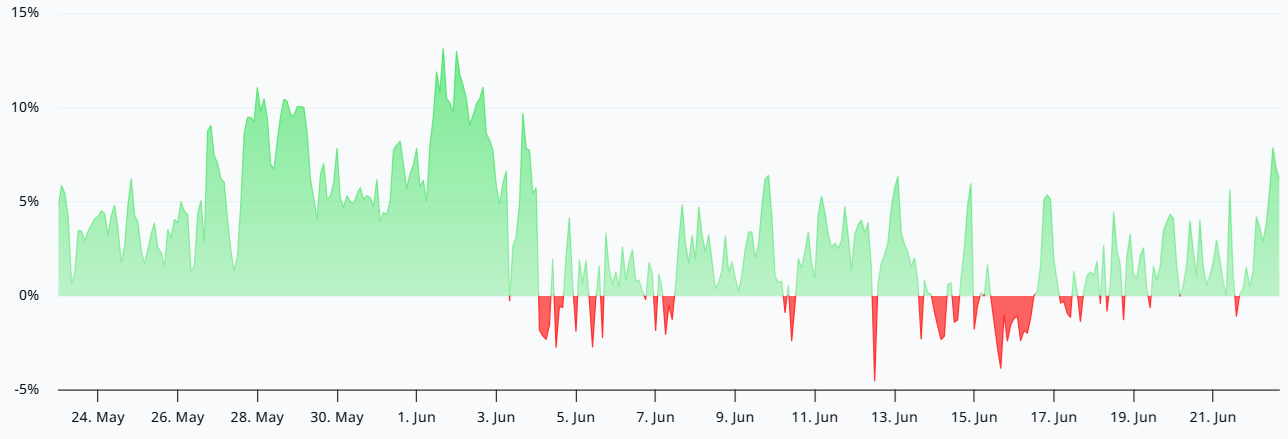
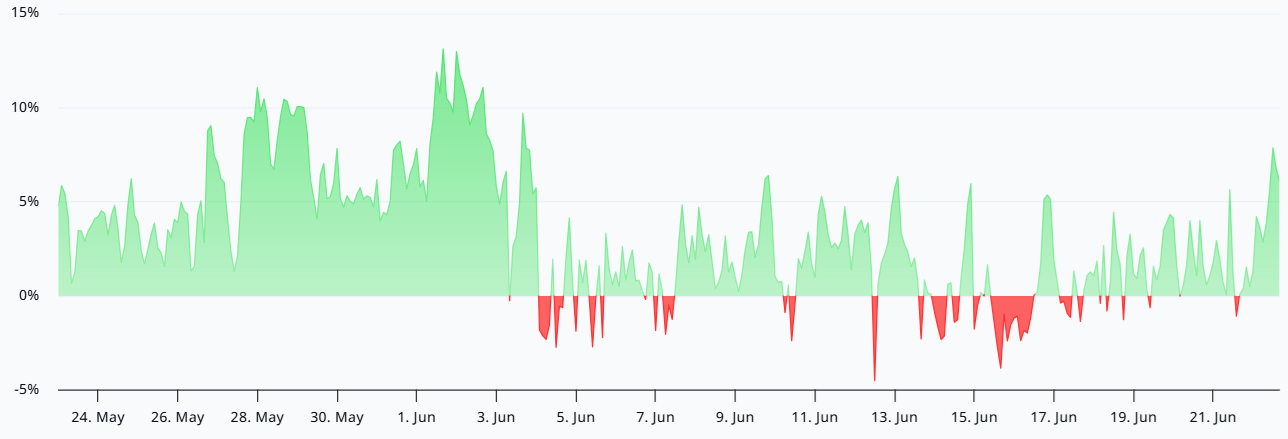
Bitcoin perpetual futures annualized funding rate. Source: Laevitas
The Bitcoin perpetual futures annualized funding rate jumped to 7% on Monday, its highest level in nearly three weeks. Although still within the neutral 6%-12% range, the indicator reflects growing confidence among bulls. Part of the optimism likely stemmed from Brent crude oil prices declining to $77.50, their lowest level since March.
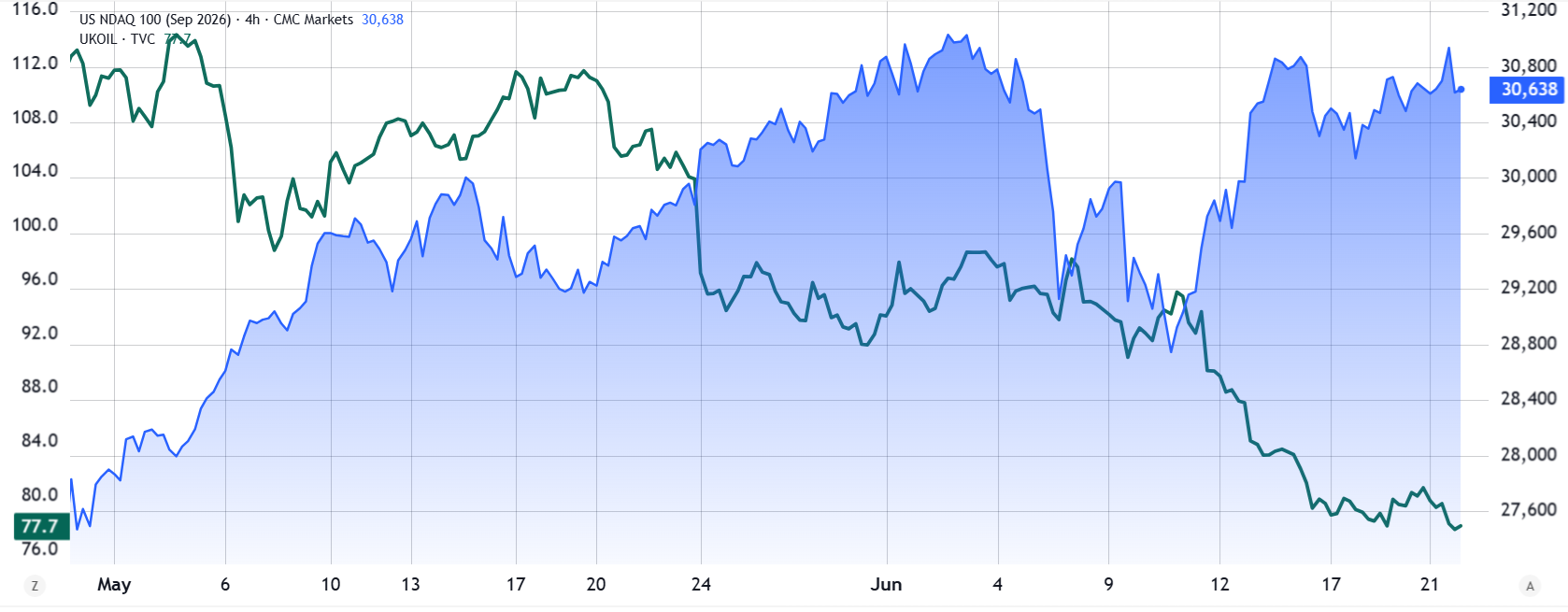
Crude Brent oil, USD (left) vs. Nasdaq 100 futures (right). Source: TradingView
The Nasdaq 100 Index posted a modest 1% decline as artificial intelligence stocks weakened. SpaceX (SPCX US) shares dropped 13% after the company announced plans to raise debt despite holding more than $100 billion in cash. Investors fear the sector will need higher investments for longer before turning profitable.
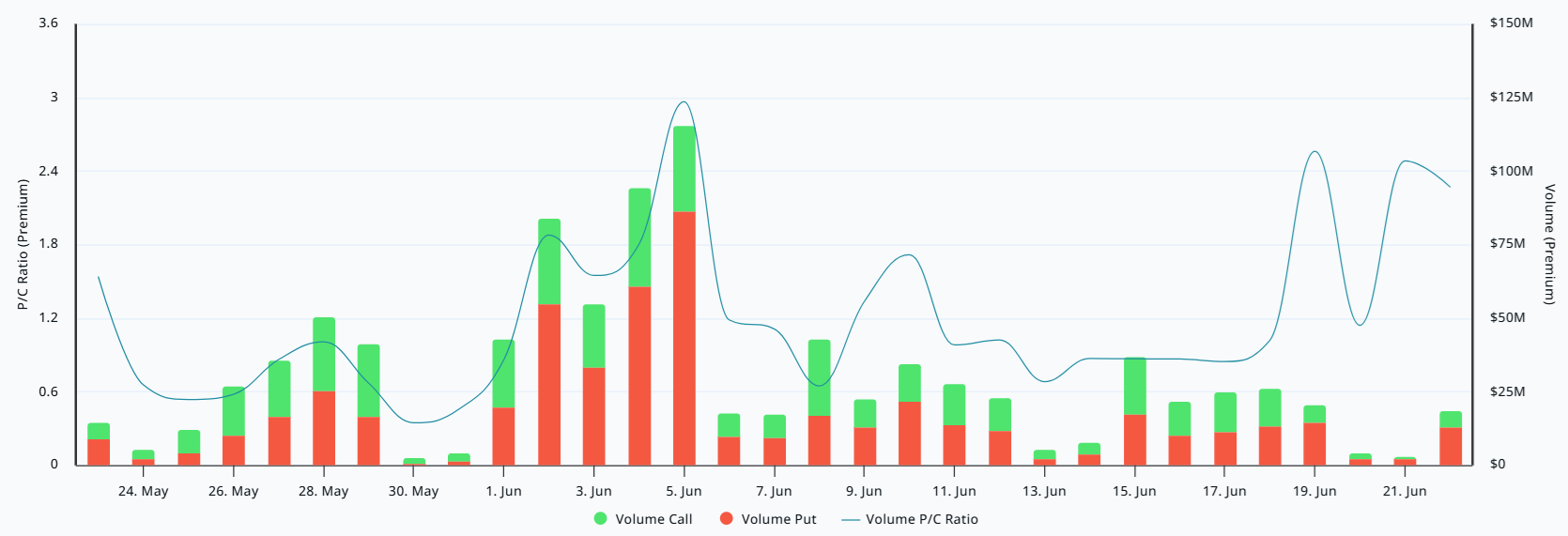
Bitcoin options premium put-to-call ratio at Deribit, USD. Source: Laevitas
Demand for put (sell) options outpaced call (buy) instruments by over two times on Monday, signaling stronger demand for downside price protection. The indicator has leaned toward bearish strategies since Friday, reversing the trend from the prior week.
Strategy eases concerns, but stocks and bonds signal increased risk
Part of traders’ concerns stemmed from weakness in Strategy’s (STRC US) valuation. Shares of Strategy traded 13% below the $64.1 billion cost to acquire BTC 847,363. Despite holding a comfortable $6.75 billion in debt, investors feared the company would need to sell reserves. Those concerns eased somewhat as Strategy announced a $300 billion additional cash position.
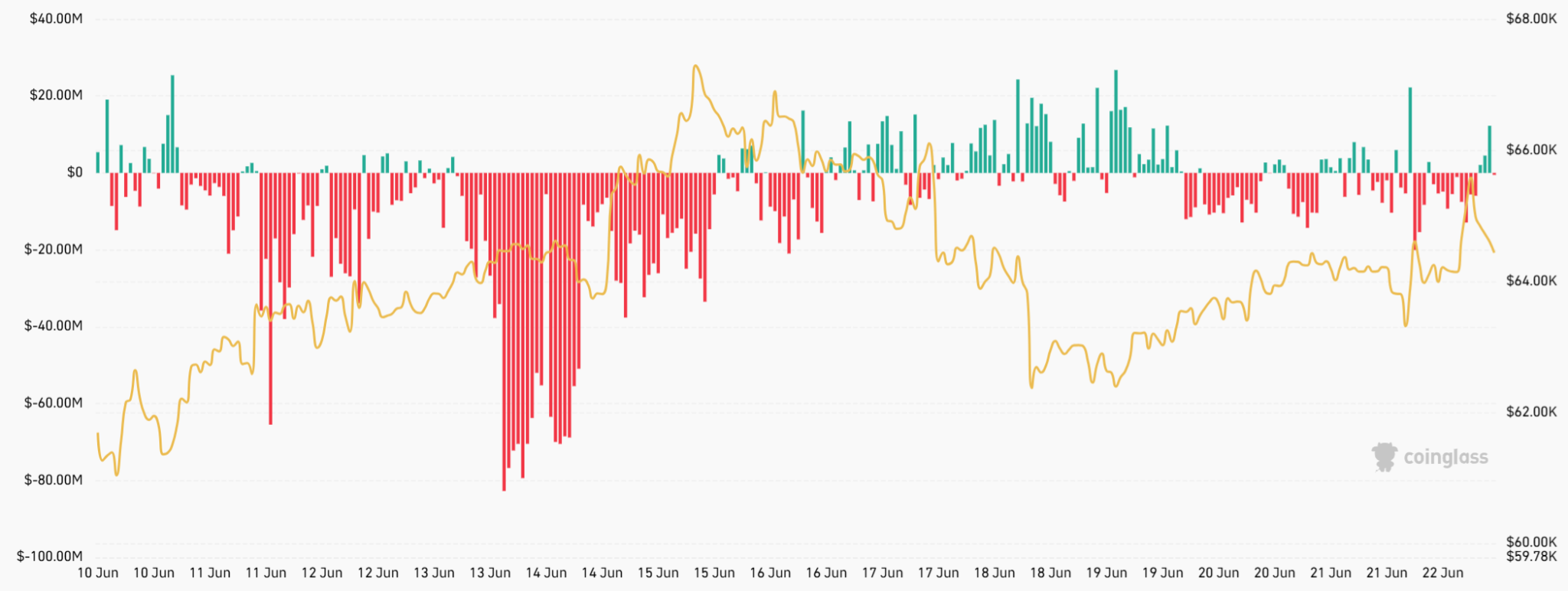
Aggregated Bitcoin orderbook 1% liquidity delta, USD. Source: CoinGlass
Bids on major exchanges’ Bitcoin order books exceeded offers by $12 million on Monday, reversing the weekend trend. Consequently, Bitcoin’s failure to hold the $65,000 level should not signal weakness, especially since gold traded down 0.9% on Monday while investors sold US government bonds.
Related: Bitcoin tipped for $66K top as trader flags ‘suspicious’ BTC price gains
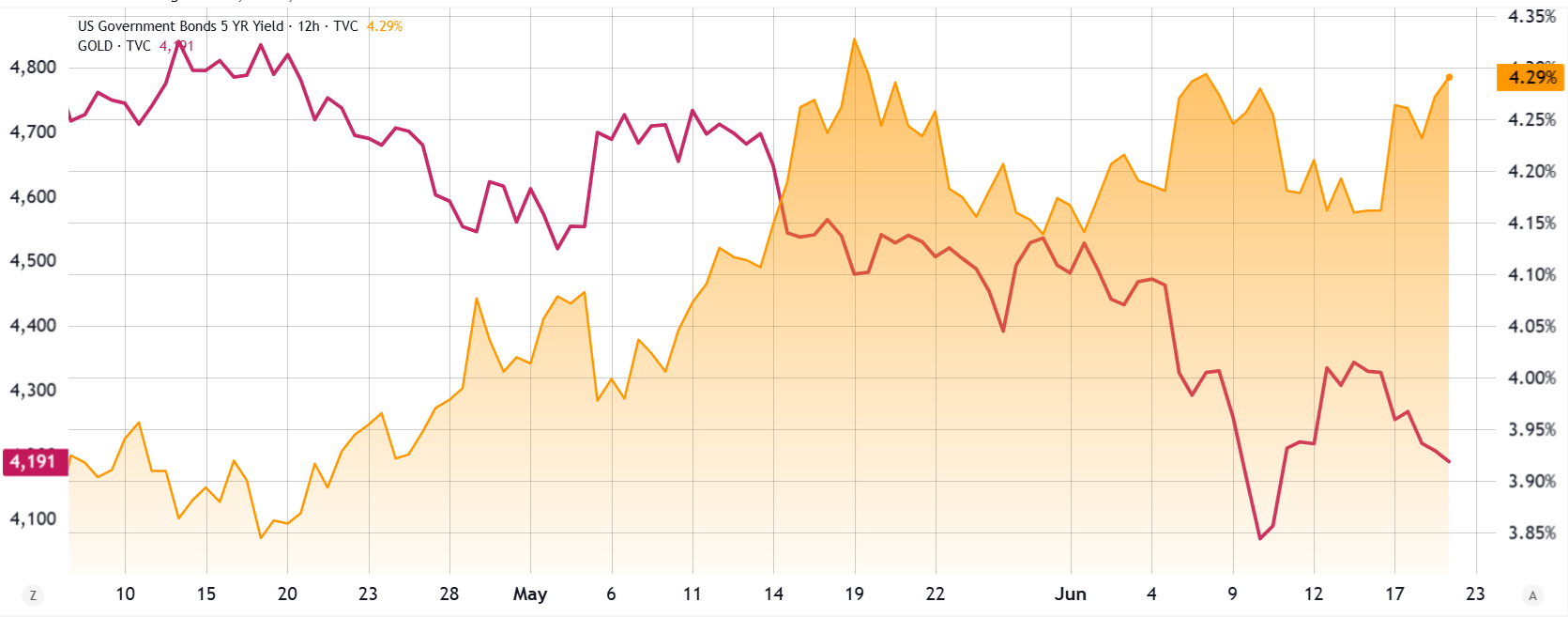
Gold/USD (left) vs. US 5-year Treasury yield (right). Source: TradingView
Higher yields on US Treasuries signal that investors demanded higher returns to hold those bonds, whether driven by inflation or by the anticipation of dilution from rising US government debt levels. The simultaneous weak performance across stocks, bonds, and gold points to a preference for cash positions, creating a cautious backdrop for Bitcoin.
Weak demand for US-listed Bitcoin exchange-traded funds (ETFs) continues to weigh on investor sentiment after six weeks of outflows. Bitcoin spot ETFs saw $228 million in net outflows the prior week, according to CoinGlass data. Consequently, the odds of a short-term Bitcoin rally to $70,000 look limited.



Franklin Templeton completed its acquisition of 250 Digital on June 22, 2026, formally launching Franklin Crypto as its dedicated active digital asset management division.
The $1.78 trillion asset manager is integrating crypto-native active strategies with its institutional infrastructure to meet growing demand from large investors.
Acquisition Closes with Targeted Integration
The deal transfers the full 250 Digital investment team and all liquid cryptocurrency strategies previously managed under CoinFund.
Franklin Templeton will invest capital directly into these strategies.
This closes the transaction announced on April 1, 2026. The move underscores Franklin Templeton’s multi-year commitment to digital assets, building on its early experiments with blockchain infrastructure since 2018, including launching one of the first U.S. registered funds to use public blockchains for transactions and share ownership.
Leadership Team Anchors New Division
Christopher Perkins serves as Head of Franklin Crypto, with Seth Ginns as Chief Investment Officer. They partner with Franklin Templeton Digital Assets veteran Tony Pecore. The division reports to Sandy Kaul, Head of Innovation.
CEO Jenny Johnson stated:
“This is an exciting addition for Franklin Templeton, and we’re pleased to welcome Chris, Seth and the 250 Digital team to our firm. Together, their investment talent and differentiated strategies strengthen our capabilities in digital assets and position us among a small group of global asset managers with a dedicated, institutional-grade crypto investment management team.”
Follow us on X to get the latest news as it happens
Institutional Scale Meets Active Crypto Capabilities
Franklin Templeton reported $1.78 trillion in assets under management as of May 31, 2026.
Franklin Crypto builds directly on the firm’s existing dedicated digital asset unit, which focuses on fundamental research, active portfolio construction, and institutional-grade risk oversight.
The new division targets institutional clients seeking actively managed cryptocurrency exposure within a regulated, globally distributed framework.
It combines specialized crypto execution with Franklin Templeton’s established infrastructure and client base.
Franklin Crypto will roll out actively managed cryptocurrency strategies to institutional investors worldwide.
The integration positions the firm to capture demand for sophisticated digital asset solutions as institutions allocate more capital to the asset class through established managers.
The post Franklin Templeton Bets Bigger on Crypto After Major Acquisition appeared first on BeInCrypto.
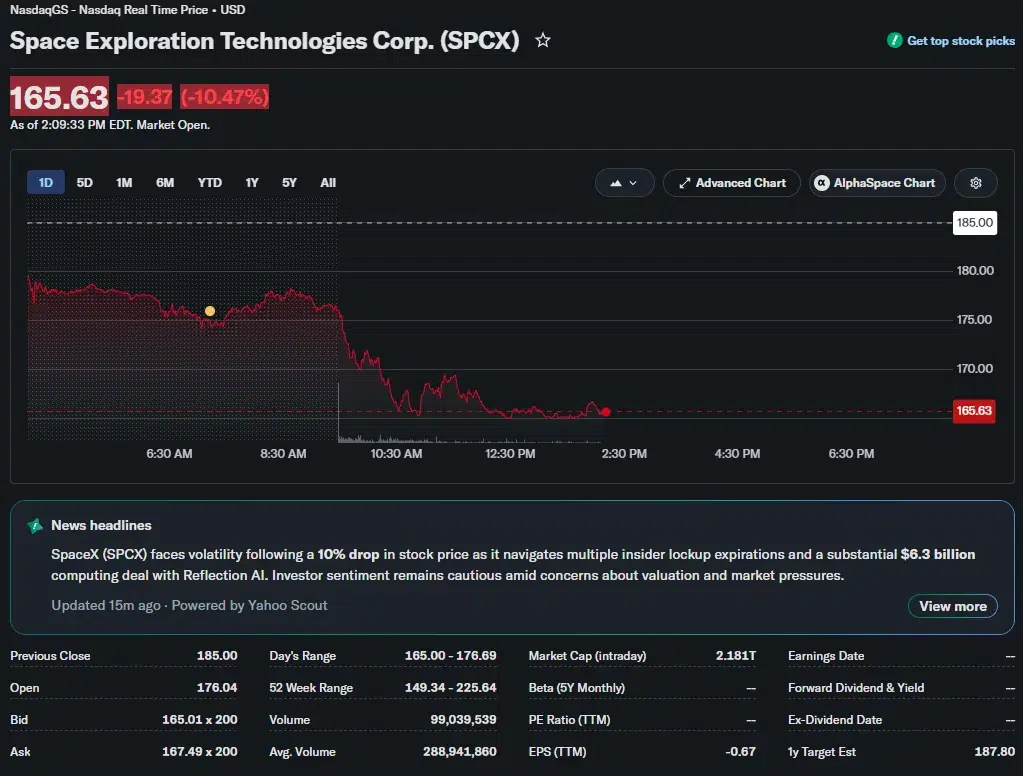
SpaceX stock has fallen more than 10% in early U.S. trading after analysts initiated coverage without assigning a price target, adding to investor concerns about the company’s valuation following its record-breaking market debut.
Summary
- SpaceX stock fell more than 10% after KeyBanc initiated coverage with a neutral rating and no price target.
- KeyBanc cited balanced risk-reward despite strong growth prospects from Starlink and AI-related opportunities.
- The decline coincided with SpaceX’s first bond offering as investors weighed valuation concerns after its blockbuster IPO.
According to a June 22 report from Barron’s, analysts at KeyBanc began coverage of SpaceX with a “Sector Weight” rating while declining to provide a target price for the stock.
The brokerage firm said SpaceX is likely to remain the dominant force in the space launch industry for years, but argued that much of the company’s future growth may already be reflected in its current valuation.
“SpaceX possesses significant disruptive growth avenues, though we believe this is reflected in current valuation and risk/reward appears balanced, in our view.”
SPCX shares traded around $165.63 at the time of writing, extending losses after one of the most successful public offerings in market history.
The pullback has drawn attention because it follows a sharp post-listing surge that helped push SpaceX’s valuation to levels that some analysts consider difficult to justify.
Analysts point to valuation concerns despite growth outlook
In its coverage note, KeyBanc identified Starlink as one of SpaceX’s most important revenue engines and said advances in artificial intelligence could support future expansion. Even so, the firm maintained a cautious position, citing what it described as a balanced risk-reward profile at current prices.
Similar concerns have emerged elsewhere. As previously reported by crypto.news, analysts at Morningstar estimated a fair value of $63 per share and argued that SpaceX stock may be trading above levels supported by fundamentals.
The debate over valuation comes only weeks after the company’s blockbuster public debut generated enormous wealth for shareholders. Earlier reporting by crypto.news noted that the IPO pushed Elon Musk’s net worth above $1 trillion while creating a new group of billionaires among early investors, executives, and institutional backers tied to the company.
Investor attention has increasingly shifted from the scale of the listing toward whether the business can deliver enough growth to support its market capitalization.
Bond sale adds another layer to investor focus
While analysts weighed valuation questions, SpaceX also entered the debt market for the first time.
Barron’s also reported that the company is issuing senior unsecured notes as part of its first bond offering. The report stated that SpaceX currently holds approximately $100.8 billion in cash and intends to use proceeds from the sale primarily to repay bridge financing, with additional funds allocated for general corporate purposes.
The debt offering arrives shortly after the company’s June 12 IPO, which reportedly raised over $85 billion after underwriters exercised the greenshoe option.
Recent reports have also suggested that SpaceX could pursue significantly larger fundraising plans. Last week, reports indicated that the company was exploring a bond raise worth as much as $20 billion, highlighting continued demand from investors seeking exposure to Elon Musk’s space and artificial intelligence businesses.
With analysts split between long-term confidence in SpaceX’s market position and concerns over its valuation, traders are now assessing whether the stock’s latest decline represents a temporary reset after an extraordinary rally or the beginning of a longer adjustment period.
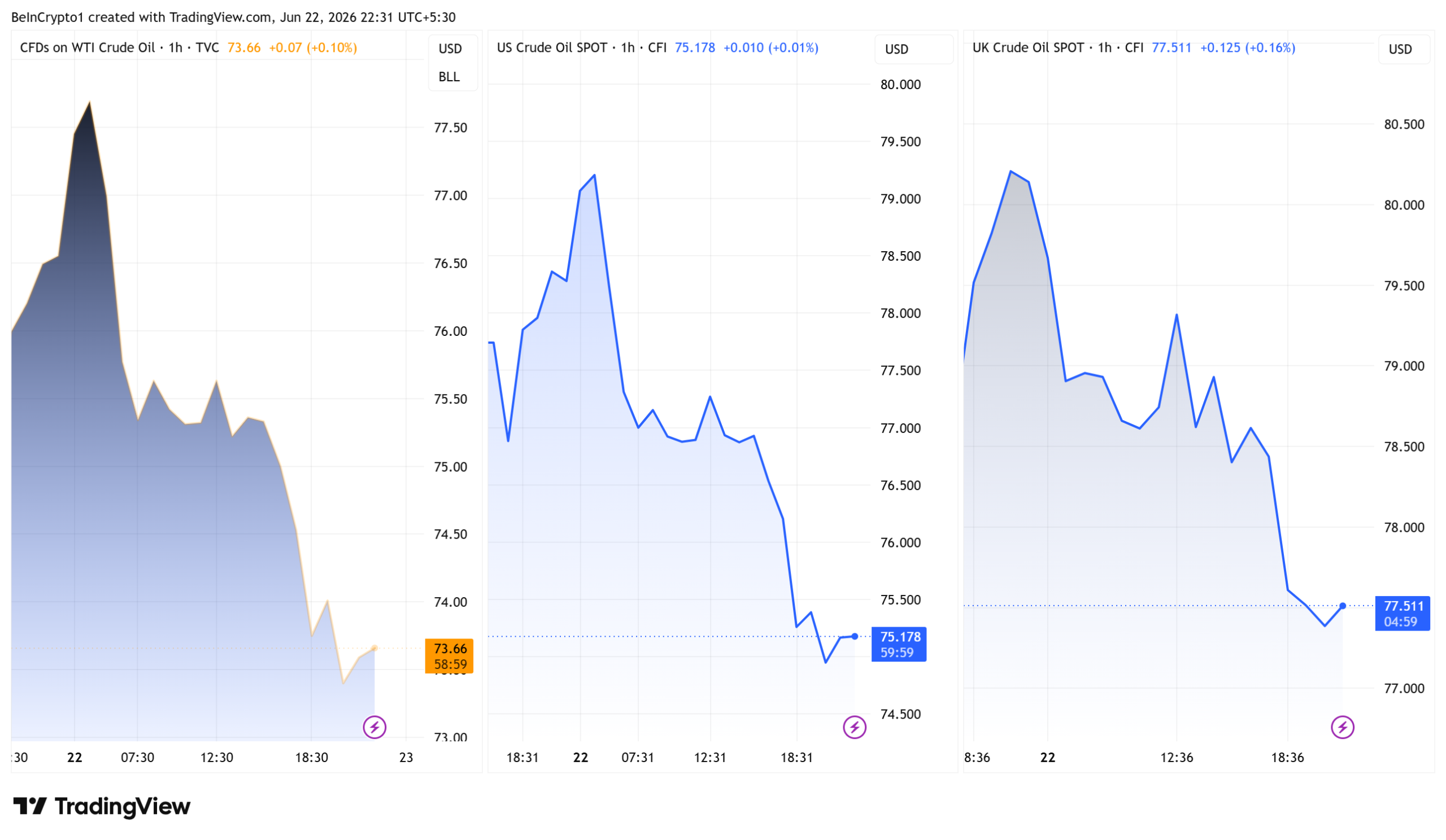
The US Treasury issued an oil license to Iran, allowing the production, sale, and delivery of Iranian crude for 60 days. Crude fell as traders priced in fresh barrels and a fading war premium. Iranian crude can reach mainstream buyers again for the first time since Washington reimposed sanctions in 2018.
The move ends four months of war that choked the Strait of Hormuz and sent oil prices sharply higher. For markets, the bigger question is what cheaper energy means for inflation and the global economy.
Crude Slips as the Iran Oil License Takes Effect
The Treasury license authorizes oil, petrochemical, and petroleum sales through August 21. An earlier license in March covered only cargoes already at sea, making this the widest opening in years.
Oil reacted fast. Brent fell more than 3% to about $77 a barrel, and West Texas Intermediate (WTI) dropped to near $74. The move extends oil’s month-long retreat on easing tensions.

The supply at stake is real. Before a US naval blockade in April, Iran exported over 1.5 million barrels a day. That fell to roughly 260,000 by May. Most feed Chinese refiners, and the lifted blockade lets them flow again.
The ramp-up will be gradual. Shipping, insurance, and buyer trust take time to rebuild. Still, the relief unwinds a first-quarter spike that drove Brent to $118 and stoked deeper supply-squeeze fears.
A Relief Valve for the Global Economy
Cheaper oil works like a tax cut for energy importers. The Strait of Hormuz carries about a fifth of the world’s oil, and most of it goes to Asia.
China, India, Japan, and South Korea spend less on fuel, freeing up household budgets and business costs.
Lower pump and heating prices act quickly to support consumer spending. Emerging market importers also gain room on energy bills and currencies.
Exporters feel the other side. Gulf producers and Russia earn less per barrel, while Iran regains a major revenue stream. OPEC+ may weigh output cuts to defend prices.
The clearest channel is inflation. US prices rose 4.2% in May, the highest in three years, with energy up 23.5%. The Federal Reserve held its rate at 3.50% to 3.75% on June 17.
Its new projections point to a hike, not a cut, this year.
That makes the oil license pivotal. Energy has driven the price surge, so cheaper crude is the fastest way to cool May’s inflation jump.
Markets now watch rate-cut odds and inflation expectations for a dovish turn.

Stocks Rotate as Inflation Bets Cool
Equities read de-escalation as risk-on. US stocks rallied to fresh records through June, with the S&P 500 briefly moving above 7,500 and the Dow topping 51,000.

Beneath the surface, leadership rotated. Energy shares lagged as oil majors fell with crude.
Airlines, shipping, and consumer names benefited from cheaper fuel.
Cyclicals and the Dow led, while rate-sensitive tech wobbled amid the Fed’s hawkish lean.
What it Means for Bitcoin and Risk Assets
Crypto sits at the crossroads. The Bitcoin (BTC) price traded near $64,499, after briefly reclaiming the $65,000 threshold on hype infused by JD Vance and MicroStrategy on Monday.
But it has slipped from $67,000 since the hawkish Fed meeting. Lower oil helps risk appetite, while higher-for-longer rates work against it.
The relief could prove brief. The license expires on August 21, and a failed deal would quickly restore the war premium.
Real export volumes and OPEC+ decisions will show whether it lasts. For now, cheaper oil softens the macro backdrop, even if the Fed has not.
The post Iran Oil License Sends Crude Lower: Will Inflation Follow? appeared first on BeInCrypto.


OKX and Intercontinental Exchange have appointed Andrew Cuomo to co-chair a tokenization venture that would give users access to ICE futures and NYSE-linked digital equities.
Summary
- OKX and ICE have appointed Andrew Cuomo to co-chair a new venture focused on tokenized financial products.
- The proposed platform would give OKX users access to ICE futures and NYSE-linked tokenized equity markets, subject to approval.
- The announcement comes as institutions expand tokenization efforts, with Citigroup projecting the market could reach $8.2 trillion by 2030.
According to a joint June 22 announcement released by OKX and Intercontinental Exchange (ICE), the companies are forming a venture focused on infrastructure for tokenized and digitally native financial assets. The project remains subject to regulatory approval.
Under the proposed structure, OKX users would gain access to ICE futures products and tokenized equity markets connected to the New York Stock Exchange, which operates under ICE ownership.
The companies said the initiative is intended to support the development of blockchain-based financial products that can interact with established market infrastructure.
Cuomo will serve as co-chair of the venture. His appointment brings back a political figure who has maintained ties to the crypto sector since joining OKX in 2023.
Traditional finance and crypto infrastructure move closer together
The latest announcement builds on a relationship established earlier this year. In March, ICE disclosed a strategic partnership with OKX and invested an undisclosed amount in the exchange at a reported $25 billion valuation.
Beyond its involvement with OKX, ICE has also increased its exposure to digital asset markets through a $2 billion investment commitment to prediction platform Polymarket.
The venture arrives as large financial institutions continue exploring tokenization. Earlier reporting by crypto.news noted that the market for tokenized real-world assets has expanded rapidly as banks, exchanges, and asset managers test blockchain-based versions of traditional financial products.
According to Citigroup, the tokenized asset market could reach $5.5 trillion by 2030 under its base-case forecast. The bank’s bullish scenario projects the sector could exceed $8.2 trillion before the end of the decade.
Citigroup stated that tokenization is progressing beyond pilot programs and becoming part of mainstream financial infrastructure as regulatory frameworks mature and major institutions integrate blockchain technology into their operations.
Cuomo returns to crypto spotlight after election defeat
The appointment also places Cuomo back in the public conversation following his unsuccessful 2025 campaign for New York City mayor.
During that race, Cuomo pledged to make New York City the “global capital for cryptocurrency” and received backing from the crypto-focused Innovate NY political action committee. Despite that support, Democratic candidate Zohran Mamdani secured more than 50% of the vote and won the election.
Since taking office on Jan. 1, Mamdani has not announced major cryptocurrency or blockchain-related policy initiatives. The mayor also confirmed in January that he does not personally hold digital assets.
Meanwhile, political activity tied to the crypto industry continues ahead of the 2026 election cycle. On June 24, voters in New York, Utah, and Maryland are set to participate in congressional primaries that will determine candidates for U.S. House and Senate races in November.
According to public campaign disclosures, crypto-backed political action committees, including Fairshake, have continued spending on advertising and election efforts to support candidates viewed as favorable to the digital asset industry.

TLDR
-
Security patches deployed following formal verification audit
-
Version 3.2.0 addresses vulnerabilities discovered by Common Prefix
-
Enhanced validation protocols implemented for Payment Engine
-
Security analysis extended to upcoming vault and lending features
-
Network improvements proceed amid ongoing escrow distribution discussions
The XRP Ledger network has implemented critical security patches following an independent audit that revealed vulnerabilities in its fundamental infrastructure. These corrections were integrated into the XRPL 3.2.0 release, resolving computational anomalies and irregular system responses. This enhancement fortifies the platform as development teams advance new financial capabilities and decentralized finance infrastructure.
Independent Audit Reveals Vulnerabilities in Network Infrastructure
The XRP Ledger Foundation engaged blockchain security specialist Common Prefix to conduct a comprehensive examination of the platform’s consensus architecture. The security firm employed formal verification techniques to validate whether the underlying software adhered to its documented technical specifications. This methodology utilized mathematical modeling and machine-verified proofs beyond conventional software testing approaches.
Throughout the examination, analysts constructed detailed models encompassing multiple XRP Ledger elements and cross-referenced them against actual system performance. These analytical frameworks revealed problematic scenarios within xrpld, the software powering validator nodes and enabling network operations. Investigators additionally discovered computational irregularities and behavioral discrepancies under particular operational circumstances.
Engineering teams remedied the flagged vulnerabilities and incorporated the corrections into XRP Ledger version 3.2.0. The foundation confirmed that the network currently operates with the relevant modifications implemented throughout its upgraded software infrastructure. Nevertheless, this examination represents one component of an ongoing security evaluation process rather than an isolated assessment.
Payment Engine Documentation Undergoes Continuous Maintenance
Common Prefix has committed to maintaining the XRP Ledger Payment Engine technical documentation throughout subsequent software iterations. The security firm will ensure the formal specification remains synchronized with forthcoming xrpld versions and protocol modifications. This initiative should minimize discrepancies between documented protocols and the operational software processing network transactions.
The Payment Engine orchestrates value movements throughout the XRP Ledger ecosystem and facilitates numerous transaction categories. It processes multi-currency payments, decentralized exchange operations, automated market maker functionality, and rippling mechanisms. Consequently, defects within this infrastructure could compromise multiple financial operations across the platform.
Sustaining current documentation also provides engineering teams with authoritative references when implementing new capabilities. Security professionals can validate software modifications against established protocols before deployment to the production network. This methodology supports uniform testing procedures as the XRP Ledger broadens its integrated financial services.
Formal Verification Process Extends to DeFi Proposals
Engineering teams are now expanding formal verification procedures to proposed vault and lending frameworks. Common Prefix alongside XRP Ledger contributors will assess the Single Asset Vault specification, designated XLS-65. They will additionally scrutinize the Lending Protocol specification, identified by developers as XLS-66.
The vault specification would enable asset custody frameworks designed for broader decentralized finance implementations. The lending specification would introduce protocol-native instruments for borrowing and credit-based operations. Both specifications demand rigorous evaluation because they would control assets directly through network protocols.
This security initiative emerges as the XRP Ledger expands tokenization and decentralized finance functionalities. Development teams have elevated testing standards as additional financial mechanisms integrate into the protocol layer. The network currently employs code audits, mathematical verification, validation procedures, and ongoing software surveillance.
Token Distribution Discussions Persist Alongside Technical Upgrades
Concurrent conversations persist regarding Ripple’s scheduled XRP distributions and the remaining tokens secured in escrow arrangements. Commentator Bill Morgan recently suggested that Ripple should decrease the quantity of unlocked tokens returned to escrow. He contended that accelerated distribution could eliminate ambiguity concerning XRP’s prospective circulating supply.
Nevertheless, certain market observers resist expanded monthly distributions because increased supply could generate heightened selling pressure. Others concentrate on the volume Ripple maintains following each unlock rather than the predetermined one-billion-token distribution. These perspectives illustrate persistent disagreement regarding how escrow administration influences XRP’s market dynamics.
The escrow mechanism has functioned parallel to the XRP Ledger’s technical evolution and network enhancements. Ripple consistently unlocks XRP monthly and transfers unutilized quantities into fresh escrow agreements. Development teams remain concentrated on software security, protocol dependability, and infrastructure supporting sophisticated financial applications.

Key Highlights
-
BoE finalizes regulatory framework for sterling stablecoins targeting 2027 deployment
-
£40 billion temporary ceiling imposed on systemically important tokens
-
Reserve composition permits 70% allocation to UK sovereign debt instruments
-
Individual user holding restrictions removed following industry consultation
-
Joint regulatory oversight model established between BoE and FCA
The Bank of England has published a comprehensive regulatory framework governing sterling-denominated stablecoins, positioning the United Kingdom for a supervised launch in 2027. The proposed guidelines establish stringent requirements for reserve management, redemption processes, and token issuance specifically targeting digital currencies deemed systemically significant. Notably, the framework abandons previously suggested individual holding thresholds in favor of aggregate issuance limitations.
Enhanced Flexibility for Interest-Generating Reserves
Under the updated Stablecoin Rules, token issuers may allocate up to 70% of backing reserves into short-dated UK government securities. This represents an increase from the earlier 60% threshold proposed during initial consultations, with the remainder required in central bank deposits. The adjustment provides operators with enhanced yield opportunities while maintaining sufficient liquidity for user withdrawals.
A minimum 30% allocation to central bank deposits remains mandatory for all systemically designated issuers. This requirement ensures immediate access to liquid capital necessary for processing redemption requests and maintaining market confidence. Regulators believe this dual-layer approach achieves an optimal balance between economic sustainability and consumer protection.
The modified framework emerged from extensive industry commentary received following the November 2025 consultation period. Market participants expressed concerns that overly restrictive reserve mandates would disadvantage UK-issued tokens compared to international competitors. Nevertheless, the Bank maintained direct reserve oversight given the potential systemic implications for payment infrastructure and broader financial stability.
Aggregate Issuance Ceiling Supersedes Individual Restrictions
Authorities have eliminated previously proposed holding limits of £20,000 for retail users and £10 million for institutional participants. The revised framework instead implements a £40 billion aggregate issuance threshold applicable to each systemically important token. This approach removes account-level restrictions while still controlling overall market exposure.
The issuance ceiling aims to prevent rapid capital flight from traditional banking deposits into stablecoin reserves. Substantial fund migrations could diminish bank liquidity and constrain lending capacity for consumers and enterprises. The temporary guardrail will persist until regulators determine that associated credit risks have adequately subsided.
The regulatory framework mandates periodic reassessment of the £40 billion threshold and its macroeconomic consequences. Officials intend to lift the restriction once systemic concerns regarding bank funding stability and credit provision are satisfactorily mitigated. Industry representatives continue advocating for more definitive timelines and differentiated risk assessments based on varying operational models.
Implementation Timeline Points to Late 2027 Rollout
The central bank has established September 22, 2026 as the deadline for public commentary on the draft Code of Practice. Finalization of the comprehensive regulatory framework is scheduled for completion before year-end 2026. Authorized systemically important stablecoins could commence operations under the new British regulatory regime throughout 2027.
Supervisory responsibilities will be distributed between the Bank of England and the Financial Conduct Authority across the stablecoin ecosystem. The Bank will assume oversight for systemically designated payment tokens, while the FCA will govern non-systemic variants and exchange-traded products. HM Treasury retains authority to designate which tokens warrant systemic classification.
The framework additionally establishes transition protocols for entities migrating from FCA jurisdiction into systemic supervision. Supplementary guidance documents will accompany the FCA’s finalized standards and implementation materials expected later this year. This comprehensive regulatory architecture represents a cornerstone of Britain’s strategic initiative to advance digital payment systems and tokenized financial infrastructure.

British asset manager Baillie Gifford has launched a tokenized fixed income fund, adding another entry into the list of products that use blockchain for access to conventional yield products. The fund operates on both Ethereum and Solana blockchains, while BNY is responsible for tokenizing and providing digital wallet services. The news was shared via CoinMarketCap’s X post, which included some initial information about the launch.
Tokenized Fund Structure Across Ethereum and Solana
The Baillie Gifford investment fund was designed to be used on both the Ethereum and Solana blockchains. Using two large blockchain networks with smart contracts and settlement of digital assets would allow the fund to interact with the two blockchain environments.
Ethereum is one of the most popular environments where decentralized apps work. Solana offers high transaction speeds and reduced fees. It allows the fund to operate across different technological platforms within the blockchain space.
BNY Role in Tokenization and Digital Infrastructure
BNY provides the tokenization protocol that transforms conventional financial assets into tokens through blockchain. The company also offers wallet services that will facilitate custody and processing of transactions. This places a regulated financial institution in the operational layer of the fund’s blockchain deployment.
This infrastructure enables the issuance and transfer of tokenized assets in a secure way. It also facilitates interoperability between the conventional finance system and blockchain.
Market Reaction and Social Media Disclosure
The launch received attention when CoinMarketCap posted an article on X. This article discussed Baillie Gifford’s entry into the realm of tokenized fixed income products and also mentioned Ethereum, Solana, and BNY.
The topic highlights the growth of tokenized real-world assets within prominent blockchain networks. This post added fuel to interest in tokenization models for fixed income instruments.
The official White House account teased a cryptic “Q posting,” then clarified the Q stood for quantum. The post turned a dry policy area into a viral moment and reignited debate over Bitcoin’s quantum risk.
The account told followers to “stay tuned,” previewing a quantum push from President Donald Trump’s administration. For crypto, the timing struck a long-running nerve about Bitcoin’s cryptography.
Why the Quantum Push Matters for Bitcoin
The teaser was deliberately cryptic.
“White House will be Q posting today… And by Q we mean Quantum. Stay tuned”
The official White House account posted the line on Monday, drawing attention and criticism before the quantum reveal.
Behind the meme, however, sits real policy. The tease previews an executive order expected this week, reported by Nextgov.
It would task the FBI and intelligence agencies with shielding quantum research from foreign spying.
The same order would direct the Energy and Defense departments to build a quantum computer. Reporting points to a second-order speeding post-quantum cryptography migration, plus a Commerce plan to expand investment in quantum firms.
The push extends Trump’s own record. He signed the National Quantum Initiative Act in 2018, though key parts lapsed in 2023.
That progress cuts both ways for Bitcoin. Stronger machines edge closer to Q-Day, when a quantum computer could break the cryptography securing wallets.
The math is moving. In 2019, Google researcher Craig Gidney estimated breaking RSA-2048 encryption would need about 20 million qubits. His May 2025 update cut that below 1 million.
A Global Risk Institute survey now puts even odds on a capable machine within 15 years. The fix is to adopt quantum-resistant cryptography, but coordinating it across the network takes years.
CZ Reignites the Satoshi Coin Debate
The teaser landed days after Binance founder Changpeng Zhao (CZ) floated freezing Satoshi’s dormant coins. He raised it with Galaxy Research’s Alex Thorn, calling it a community decision rather than a personal plan.
The stakes are concrete. By March 1, more than 34% of all Bitcoin had exposed a public key on-chain, according to BIP-361. That leaves those coins open to a future quantum attack.
The draft, from Jameson Lopp and five co-authors, would block sends to quantum-vulnerable Bitcoin addresses. It would void legacy signatures two years later.
Critics say any forced lock breaks Bitcoin’s rule that no one can seize another’s coins.
CZ has urged calm on quantum risk before, arguing the network can upgrade in time.
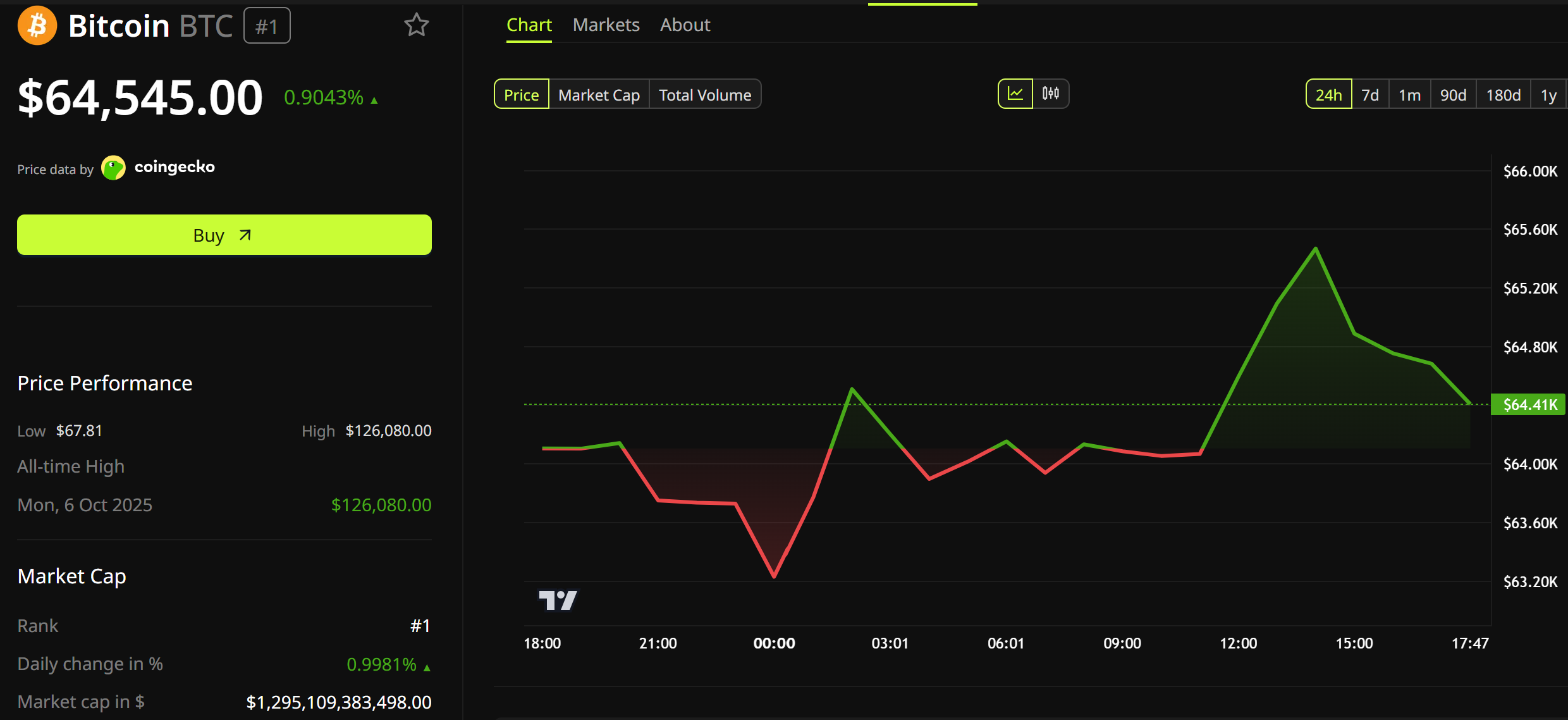
Satoshi Nakamoto’s estimated 1.1 million BTC, traced through the Patoshi pattern, is the highest-profile target. At Bitcoin’s market price near $64,545, that hoard is worth roughly $71 billion.

“Washington made two things clear. America intends to build the most capable quantum systems in the world, and it intends to defend the infrastructure and data those systems can break,” Matt Cimaglia, founder of Quantum Coast Capital, in remarks to Nextgov.
The White House has offered a meme and a promise. Whether the coming order turns Bitcoin’s quantum risk into crypto’s next defining narrative depends on what it mandates.
The post Trump’s White House Teases Quantum Push: Is Bitcoin’s Next Big Narrative Here? appeared first on BeInCrypto.


Ethereum has added a new independent research organization backed by Joe Lubin, Bitmine, and Sharplink, bringing together five former Ethereum Foundation researchers.
Summary
- Ethlabs launches with backing from Joe Lubin, Bitmine, Sharplink, and other Ethereum ecosystem contributors.
- Five former Ethereum Foundation researchers have joined the nonprofit to focus on core protocol research.
- The organization will study scaling, settlement, interoperability, and infrastructure for institutional adoption.
According to an announcement from Ethlabs, the newly launched nonprofit research group has secured support from Bitmine, Sharplink, Anchorage, Octant, SNZ, and other Ethereum ecosystem participants.
The organization did not disclose how much funding it has received.
Founded by former senior Ethereum Foundation researchers Ansgar Dietrichs, Barnabé Monnot, Caspar Schwarz Schilling, Josh Rudolf, and Julian Ma, Ethlabs has been created as an independent institution focused on technical research for the Ethereum network. The group said its work will cover areas including settlement speed, network capacity, native asset issuance, cross-chain interoperability and Ethereum’s monetary design.
The launch comes as Ethereum’s development ecosystem increasingly relies on independent organizations alongside the Ethereum Foundation.
Ethlabs said the structure gives researchers a dedicated home with long-term funding while allowing them to continue working on core protocol issues.
Ethlabs focuses on infrastructure needed by institutions
Among its founding members are researchers who have previously contributed to Ethereum’s work on scaling, finality, data availability, protocol economics, and virtual machine development.
In a statement accompanying the launch, executive director Ansgar Dietrichs said Ethlabs was established to advance Ethereum’s core technology and support infrastructure used by institutions, developers and autonomous AI systems.
“As longtime contributors to the core protocol, we are establishing an independent non-profit organization to advance Ethereum’s core technology and the shared standards and infrastructure builders depend on.”
The organization said its research priorities are tied to growing blockchain activity involving stablecoins, tokenized assets, investment products and AI-driven commerce. According to Ethlabs, improvements in these areas are needed as more financial activity moves onto public blockchain networks.
Commenting on the initiative, Ethereum co-founder Joe Lubin said Ethlabs would operate as another stewardship organization alongside the Ethereum Foundation and other independent groups working on Ethereum’s development.
Institutional supporters expand Ethereum commitments
Support from public companies arrives as some corporate backers continue increasing their exposure to Ethereum. As previously reported by crypto.news, Bitmine recently acquired another 52,203 ETH worth approximately $90 million, lifting its holdings to about 4.7% of Ethereum’s total supply.
Addressing the need for additional research investment, Bitmine Chairman Tom Lee said Ethereum could experience substantial adoption from institutions and AI agents, increasing demand for protocol research and technical expertise.
Sharplink CEO Joseph Chalom linked the funding decision to what he described as “the beginning of an institutional supercycle on Ethereum”. According to Chalom, supporting core protocol researchers represents a direct way for the company to contribute to the network’s long-term development.
Despite receiving funding from companies and ecosystem participants, Ethlabs said research decisions will remain independent. Contributions will be handled through an external grants administrator responsible for evaluating, screening, and distributing funds.
Under the structure outlined by Ethlabs, contributors will receive quarterly reporting and annual independent audits, but they will not have authority over research priorities, technical roadmaps, or organizational decisions.
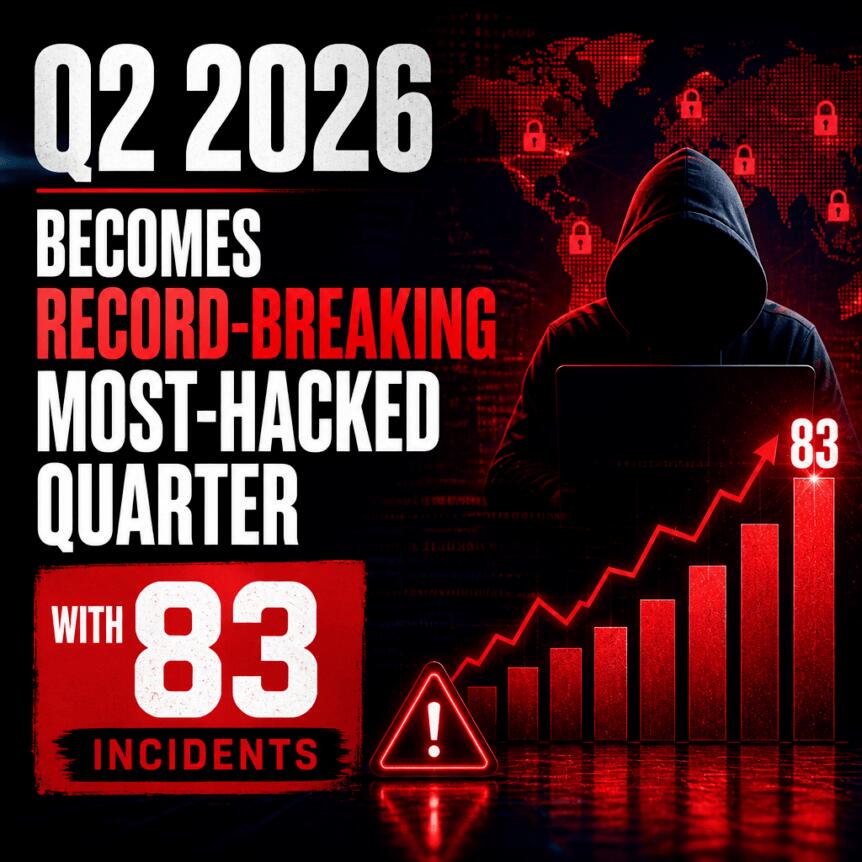
Cryptocurrency security continues to deteriorate into 2026’s second quarter, with incident counts already marking the period as the most-hacked quarter on record. Unfolded’s analysis—based on DefiLlama hack data—tracks 83 exploits targeting crypto protocols so far in Q2 2026.
Even with the spike in attacks, the quarter’s total losses of $755.3 million are still far below the record loss quarter of Q4 2020, when hacks totaled $3.56 billion. The contrast between rising exploit frequency and comparatively lower aggregate damage is becoming a defining feature of the current cycle.
Key takeaways
- Q2 2026 has logged 83 protocol exploits already, the highest incident count for any quarter in the dataset cited by Unfolded.
- Total stolen value so far stands at $755.3 million—materially lower than Q4 2020’s $3.56 billion, which remains the costliest quarter on record.
- Bridge attacks drove the quarter’s losses, with $351 million stolen via cross-chain bridges—led by the LayerZero OFT-related KelpDAO incident.
- Industry risk experts point to a mismatch between faster protocol redesign and the complexity of robust risk controls.
- Some security stakeholders argue attacker capabilities are improving amid a broader shift in the cyber landscape, while DeFi value appears to be smaller than in prior peaks.
More hacks, less value stolen than the 2020 high
The numbers underscore a persistent problem: crypto remains an attractive target, but the payoff per exploit may be changing. Unfolded’s incident-based tally shows the quarter is already number one by frequency, while the $755.3 million in stolen funds so far remains below the all-time high-water mark from Q4 2020.
At the top end of Q2’s damage, two single incidents dominate the current quarter’s storyline. KelpDAO’s $293 million hack and Drift Protocol’s $280 million exploit were the largest attacks reported so far, together accounting for a substantial portion of the quarter’s total losses.
Exploit activity appearing “more frequent” with lower total losses has also been attributed to the size of the available target pool. Dmytro Tarasiuk, product director at risk intelligence platform CORE3 and crypto security rating platform CER.live, suggested to Cointelegraph that total value locked (TVL) in DeFi appears to have fallen sharply—citing a drop from $164 billion before the Oct. 10 liquidation event to about $73 billion at the time of reporting. If less value is deployed, attackers can still run exploits, but the maximum extractable value may be constrained.
Tarasiuk also pointed to a structural vulnerability in how protocols are built. In his view, the industry’s most urgent weakness is that teams often re-engineer systems faster than they can properly align them with the underlying complexity of risk management. He described operational practices that can multiply exposure, including setups where a three-of-six multisig exists alongside key storage arrangements that concentrate risk—such as keeping multiple keys on the same device—creating additional attack surface beyond pure smart-contract logic.
Bridge exploits take the lead as the primary attack vector
Cross-chain bridges were the dominant technique in Q2 2026. According to the DefiLlama hack breakdown used in Unfolded’s analysis, $351 million in value was hacked through bridges during the quarter.
Within that category, the LayerZero OFT bridge exploit tied to the KelpDAO incident accounts for more than 38% of all value stolen in Q2. The same DefiLlama-based breakdown attributes 37% of losses to compromised admin attacks and fake token price manipulation, while private key compromises represented 5.66%.
This allocation is important for investors and protocol operators because it helps narrow where defenses must be strengthened first. If bridges remain the largest source of stolen value, then monitoring and hardening of cross-chain verification, administrative pathways, and token integrity mechanisms becomes a priority—not just after an exploit, but as part of ongoing control design.
The quarter also shows that bridge risk is not confined to a single ecosystem. Earlier coverage noted that Ethereum layer-2 network Taiko was the latest to experience a bridge-related incident, where hackers stole $1.7 million after compromising Taiko’s chain state verification mechanism.
Notable incidents highlight recurring weaknesses across ecosystems
Beyond bridges, the quarter included several high-profile thefts that point to the breadth of attack methods across DeFi. Cointelegraph reports that Humanity Protocol lost $36 million on June 8, while THORChain suffered an exploit of $10.7 million on May 15. The pattern suggests attackers are willing to probe different protocol architectures—from liquidity networks to cross-chain integrations—rather than concentrating exclusively on one style of vulnerability.
More examples from the same period also reinforce how adversaries can monetize weaknesses that extend beyond active code paths. Cointelegraph noted two exploits targeting Aztec Connect’s abandoned smart contracts, with $2.1 million stolen in one incident and $1.3 million stolen in another tied to decentralized exchange Raydium earlier in June. These cases matter because they indicate that “abandoned” or legacy components still have security implications, particularly when they remain discoverable or externally reachable.
Security debate turns to AI-enabled attacker advantage
As exploit frequency rises, the industry is continuing to debate whether recent advances in artificial intelligence have changed how attacks are conducted. Cointelegraph reports that Mitchell Amador, CEO of bug bounty platform Immunefi, told the outlet in a recent interview that the proliferation of new AI models shifted the cybersecurity playing field in favor of attackers.
Amador described this as a “vulnerability apocalypse,” linking the resurgence in exploits to the increased ability to identify and exploit weaknesses more efficiently. While that framing is not quantified in the figures cited here, it provides context for why Q2 2026’s incident count can rise even if total stolen value does not track proportionally with frequency.
For participants in crypto markets—whether traders managing exposure to risky venues, users choosing custody and on-chain interactions, or builders deciding where to spend engineering time—the takeaway is that risk is evolving on multiple fronts. DeFi’s shrinking TVL may reduce the size of the loot in aggregate, but attacker persistence and rapid exploitation cycles can still produce outsized disruption, especially where bridge infrastructure or operational controls are fragile.
Going forward, readers should watch whether bridge-related losses remain dominant in subsequent quarters, and whether any recovery in DeFi TVL leads to both higher incident counts and larger absolute losses—or if the current “more frequent, less total value” pattern persists as protocols adapt and security budgets shift.

Man jailed for smuggling cannabis wins legal battle to reduce his sentence

Tech giant Oracle cuts 21,000 jobs as it embraces AI

Franklin Templeton Bets Bigger on Crypto After Major Acquisition

No Jackpot Winner as $257 Million Prize Rolls Over to $269 Million Monday Draw

Blockchain.com files with SEC for U.S. IPO

Israel says it has killed new Hamas military leader in Gaza City airstrikes

BITCOIN ALERT!! | WHY BITCOIN DUMPING ? CRYPTO NEWS HINDI | BITCOIN PRICE UDPDATE | CRYPTO NEWS

MBA Finance ROI Proven | Placed as Fund Accountant at CITCO

XRP & DTCC (4,7 Billiarden) – Das EINZIGE Video das Du kennen musst!
-

 Fashion3 days ago
Weekend Open Thread: Miami – Corporette.com
-
 Tech6 days ago
The Adder At The Heart Of Intel’s 8087 FPU
-

 Entertainment2 days ago
Renter of Home in Anne Heche Crash Denies Settlement With Son
-

 Tech14 hours ago
Microsoft accidentally kills epic Outlook email threads
-

 Business2 days ago
Soccer-U.S. defends Iran World Cup travel restrictions, says discussions ongoing
-

 Politics4 days ago
BBC Reporter Discusses Cross Party Criticism Of Trumps Iran Deal
-
 Business3 days ago
Wall Street Week Ahead: Investors see Micron earnings as pulse check of AI rally momentum
-

 Tech5 days ago
AWS enters the context layer race with a graph that learns from agents, not manual curation
-

 Crypto World3 days ago
HIVE shares jump as $220M AI deal speeds Bitcoin mining pivot
-
 Crypto World3 days ago
Can Charles Hoskinson Really Rescue Cardano?
-

 Crypto World3 days ago
Jake Chervinsky accuses CME of protecting derivatives monopoly
-

 Tech7 hours ago
Nearly 7,000 fake Amazon domains registered ahead of Prime Day 2026, researchers warn
-

 Business2 days ago
MHP SE 2026 Q1 – Results – Earnings Call Presentation (OTCMKTS:MHPSY) 2026-06-20
-

 Sports4 days ago
FIFA World Cup 2026: Canada beat 9-men Qatar 6-0 to register first ever win | FIFA World Cup 2026
-

 Politics3 days ago
Andy Burnham and the meaning of Makerfield
-
 Tech2 days ago
Signal’s Meredith Whittaker says AI chatbots ‘are not your friends’ and calls Copilot agents a backdoor
-

 Crypto World5 days ago
Anthropic’s Dario Amodei Urged AI Unity at G7, Even as US Banned His Models
-

 Business4 days ago
Brexit cost 6% of UK economy, Bank of England company data suggests
-

 Tech5 days ago
Weeks Of In-The-Field Testing And A Verdict
-

 Tech5 days ago
Adobe adds its AI assistant to Premiere, Illustrator and InDesign
You must be logged in to post a comment Login