
Crypto World
Bitcoin is digital energy, Michael Saylor says



Michael Saylor renewed his case for Bitcoin on Aug. 23, describing the asset as a mechanism for converting economic value into a digital form that individuals, companies and governments can control.
Summary
- Michael Saylor described Bitcoin as digital economic energy that entities can securely control and preserve.
- Strategy reported holding 840,447 Bitcoin, representing roughly 4% of Bitcoin’s fixed 21-million maximum supply worldwide.
- Strategy’s preferred shares are conventional securities, not blockchain tokens collateralized directly by specific Bitcoin holdings.
- At $77,175 Bitcoin prices, Strategy’s holdings exceeded aggregate acquisition cost by approximately $1.5 billion on Sunday.
- Strategy held $4.80B cash reserve after raising $333.7M through common share sales last week alone.
“Bitcoin represents the breakthrough of converting economic energy into digital form and securely binding it to a person, family, company, machine, or state,” Saylor wrote on X.
“Digital energy” is Saylor’s metaphor for transferable and durable value. It is not an accounting, legal or technical classification. His statement also expresses an investment thesis rather than establishing Bitcoin’s definitive purpose.
Bitcoin as digital energy remains Saylor’s thesis
Saylor has repeatedly compared money and capital with stored energy. Under that framework, Bitcoin’s capped supply and decentralized settlement system allow owners to move value without relying on a single bank or government.
That argument does not remove Bitcoin’s price risk. Its dollar value can change rapidly, while companies holding it must still meet salaries, debt payments and shareholder distributions in conventional currencies.
Strategy has put Saylor’s thesis into practice through the largest publicly disclosed corporate Bitcoin treasury. Its latest SEC filing reported 840,447 BTC as of Aug. 16.
Strategy’s 840,447 BTC moves above acquisition cost
Strategy acquired its remaining Bitcoin for $63.36 billion, including fees. That equals an average cost of $75,385 per coin. The position represents approximately 4% of Bitcoin’s 21 million maximum supply, although that comparison includes coins that have not yet been mined.
Bitcoin traded near $77,175 on Aug. 23. At that price, Strategy’s holdings were worth approximately $64.86 billion. That placed the position about $1.50 billion above its aggregate acquisition cost.
The figure is a market-based estimate, not a fixed company profit. It can change immediately with Bitcoin’s price and does not account for Strategy’s debt, preferred dividends, operating expenses or taxes. As crypto.news reported, the treasury only recently crossed its $75,385 average cost during Bitcoin’s recovery.
Strategy’s digital credit products are preferred shares
Strategy calls its capital-markets platform “Digital Credit.” The category includes exchange-listed preferred shares such as STRC, STRF, STRK and STRD. These instruments are not tokens issued on a blockchain.
STRC is a variable-rate perpetual preferred stock listed on Nasdaq. It has a $100 stated amount and pays cash dividends when declared by Strategy’s board. Its prospectus warns that management may fail to keep its market price near $100.
Strategy has nevertheless used repurchases and dividend adjustments to support STRC. Its Aug. 17 filing showed that the company spent $132.2 million repurchasing 1.39 million STRC shares during the previous week.
The company financed those purchases with MSTR common-share sales, not tokenized Bitcoin obligations. In the preceding week, however, Strategy sold 1,690 BTC for $108.6 million and used those proceeds for STRC repurchases, as previously reported.
What Strategy investors should watch next
Strategy raised $333.7 million by selling approximately 3.46 million MSTR shares between Aug. 10 and Aug. 16. It allocated $52.4 million to STRC dividends, $132.2 million to repurchases and $149.1 million to its dollar reserve.
That reserve reached $4.80 billion. Strategy says it is intended to support preferred dividends and interest payments. The company reported no Bitcoin purchases or sales during that week.
Chief Executive Phong Le has said Strategy expects to resume accumulating Bitcoin after STRC recovers toward its $100 stated amount. No purchase date or binding schedule has been announced. Future SEC filings will show whether the company buys more Bitcoin, sells additional common shares or continues directing capital toward STRC.

A new working paper from the Federal Reserve Bank of Cleveland argues that the main reason cryptocurrencies don’t behave like other financial assets may have less to do with demographics and more to do with beliefs. According to the authors, Americans who own crypto—and those who plan to buy—often hold sharply different expectations about what digital assets will return, and those expectations help explain who participates in the market in the first place.
The paper also presents experimental evidence suggesting that information about Bitcoin’s recent performance can meaningfully change what households say they want to hold, and can translate into higher actual purchases. If those findings are broadly applicable, they offer a mechanism for why crypto can stay volatile and why rallies can pull in new buyers in a reinforcing loop.
Key takeaways
- Beliefs about future crypto returns explain participation better than standard demographics, according to a Cleveland Fed study using large household survey waves.
- Most non-owners report they don’t know what crypto returns to expect, while crypto owners forecast substantially higher returns.
- In an information experiment, showing households Bitcoin’s past 12-month return increased desired allocation and subsequent purchases.
- The study frames crypto volatility as partly driven by disagreement and learning, not only fundamentals.
Return expectations are the clearest predictor of ownership
Researchers Michael Weber, Bernardo Candia, Olivier Coibion, and Yuriy Gorodnichenko analyze repeated surveys of up to 25,000 U.S. households per wave. Their central finding is straightforward: expectations about crypto returns account for more of the differences in who owns cryptocurrency than a wide range of demographic characteristics.
In the paper, the authors highlight that the typical person outside the crypto market struggles to form a return forecast at all. In a 2021 Federal Reserve survey referenced by the authors, 87% of people who did not own crypto said they didn’t know what return to expect over the following year. Among crypto owners, the share who didn’t know was still high at 54%. The gap in knowledge is large, but the gap in forecasts that do exist is even larger.
For people willing to estimate returns, crypto ownership aligns with materially higher expectations. The study reports that crypto owners expected an average 22% return over the next year, versus 7% among non-owners. Owners also tended to judge crypto as less risky than non-owners did.
Most importantly for understanding market behavior, the authors show that these expectations are unusually powerful statistically. They find that a one-percentage-point increase in an individual’s expected crypto return is associated with a 0.8-percentage-point increase in the probability of owning cryptocurrency. When return expectations and perceived risk are considered together, they explain far more variation in ownership than observable characteristics such as age, income, and gender.
The researchers argue this makes crypto an outlier relative to other asset classes. For stocks, bonds, and gold, standard demographic and financial factors typically have more explanatory power than differences in expected returns. In crypto, the direction of explanatory power appears to flip.
Crypto participation still looks demographic—but beliefs dominate
Even with expectations taking center stage, the paper does not claim ownership is entirely divorced from who people are. The demographic pattern remains distinct after controlling for other variables. People under 40 are reported as 13 percentage points more likely to own cryptocurrency than those over 60.
Gender and household wealth also show up in the data. The study finds that men are about 4 percentage points more likely than women to own crypto, and that higher-income and wealthier households participate at higher rates. But the authors’ comparison is that these effects—distinct as they may be—are secondary to the role of beliefs about returns and risk.
This matters because it reframes a common debate. Instead of treating crypto’s unusual ownership pattern as mainly a story about who is “more risk tolerant,” the paper pushes investors to focus on what market participants think crypto will do—and how those beliefs differ from one another.
Information about recent Bitcoin returns can change behavior
The paper’s most actionable evidence comes from a randomized information experiment described by the authors. In 2025, households were randomly assigned to receive information that included Bitcoin’s previous 12-month return, alongside other choices that related to stocks and topics such as GameStop or inflation. The paper reports that participants shown Bitcoin’s recent performance increased both what they wanted to hold and what they went on to buy.
Specifically, the treatment increased desired crypto allocation by about 2 percentage points—roughly a 47% increase relative to the 4.3% desired allocation among the control group. The authors also report an increase in subsequent crypto purchases of about 2.5 percentage points.
The paper describes the result as induced demand: “providing information about recent Bitcoin returns induces some households to start buying cryptocurrency.” The effect is not uniform, however. It is concentrated among individuals who said they did not own crypto because they lacked sufficient information. Those who already believed crypto was a bad investment did not meaningfully respond to the information treatment.
In practical terms, the study suggests that crypto participation can be changed by what people are told about what happened recently—not just by long-term narratives or individual risk preferences. For traders and market observers, that implies that retail demand may be unusually sensitive to framing, past performance information, and perceived signal quality during momentum periods.
Why volatility may persist: learning, disagreement, and “past gains”
Beyond ownership and demand, the paper connects its survey and experimental findings to a broader market question: why crypto markets can produce persistent volatility. The authors describe a mechanism often discussed in behavioral finance—past positive returns can attract new participants, whose purchases can push prices higher and potentially draw still more buyers.
They present the logic explicitly, writing that “positive returns attract new participants, which raises the price further.” The authors further argue that this dynamic may be particularly relevant because crypto remains poorly understood by a large share of the population, and beliefs about future returns are therefore likely to be fragmented.
The study also examines whether crypto gains show up in household spending in a way consistent with lasting wealth effects. It reports that when a household’s entire financial portfolio was in crypto, a doubling of Bitcoin’s price increased the probability of buying a durable good by 1.4 percentage points—about a 7% increase relative to the unconditional likelihood of such a purchase. However, the effect did not persist into everyday spending.
That pattern leads the authors to a sharp interpretation: crypto gains appear to be treated more like gambling income or lottery winnings than as a stable increase in wealth. If the market consistently attracts new entrants based on recent performance, the resulting buying-and-repricing cycle could reinforce the very uncertainty and disagreement that make volatility more likely.
What to watch next
Investors will likely want to monitor whether crypto demand remains highly responsive to messages about recent performance—and how quickly beliefs converge or diverge after price moves. The Cleveland Fed paper’s central warning is that if disagreement and learning continue to shape participation, volatility may remain one of crypto’s defining features for the foreseeable future.
The winds have changed in the cryptocurrency markets, and this is particularly evident in the exchange-traded funds tracking several assets, such as Ripple’s native token.
Although they were mostly in the green, the spot XRP ETFs struggled for months with little to no actual demand, especially in August. However, this changed for the better last week.
XRP ETFs See Local High
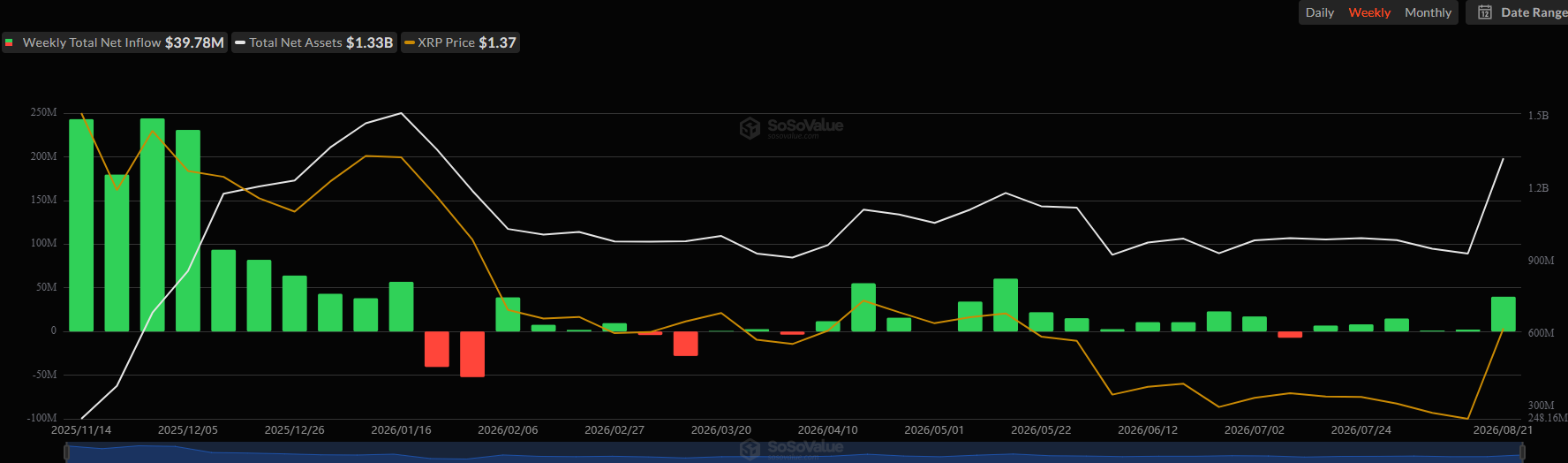
Monday began on a similar dull note for the funds, as SoSoValue shows $0.00 in actual flows. This continued a painful streak that began at the start of the month, in which seven out of the 11 trading days saw no action. However, investors returned on August 18, pouring $5.81 million into the funds. This was the biggest daily net inflow for the month.
Interestingly, the ETFs gained just $2.35 million on Wednesday, which was the day everything changed in the crypto markets. As reported extensively, the US Treasury Department announced a major monetary pivot, while Trump hosted a Crypto Summit in the White House, which were considered the main catalysts for the price revival.
Perhaps that’s why XRP was a little late to the party, but more on that in the second paragraph. The inflows picked up the pace on Thursday, at $13.24 million, and on Friday, at $18.38 million, the single-best day since May 14. Overall, the ETFs gained $39.78 million last week, which was the most since the one that ended on May 15.
The cumulative total net inflows hit a new all-time high of $1.55 billion, while Bitwise’s XRP fund extended its lead as the largest of the bunch. It holds $542.69 million in cumulative net inflows, followed by Canary Capital’s XRPC ($468.12 million) and Franklin’s XRPZ ($434.16 million).
XRP Price Pump
Although XRP didn’t quite explode alongside BTC and many other alts on Wednesday, once it did, it blew the roof off the place. After successfully defending the $1.00 support, the asset went on a wild run that pushed it to $1.70 by Saturday morning. This meant that it had skyrocketed by 70% in less than 72 hours.
However, it was rejected there and pushed south hard to $1.42. The bulls stepped up once again and helped it recover a lot of ground, as XRP currently trades at just over $1.50. Nevertheless, analysts are convinced that the token has to reclaim the $1.65-$1.70 resistance before it can change the broader trend.
The post Ripple ETFs See Best Week Since May as XRP Exploded to 7-Month High appeared first on CryptoPotato.
A new working paper from researchers at the Federal Reserve Bank of Cleveland argues that much of crypto’s unusual behavior may come down to how people form beliefs about digital assets—more than standard demographic or financial factors. In their analysis of household survey data and a randomized information experiment, the authors find that expectations about future crypto returns strongly track who owns cryptocurrency, and that learning about recent Bitcoin performance can meaningfully change both planned allocations and actual buying.
The work, titled “Do You Even Crypto, Bro? Cryptocurrencies in Household Finance”, also points to a mechanism that could help explain crypto’s persistent volatility: when prices rise, they may reinforce bullish expectations, drawing in additional buyers and further amplifying movements.
Key takeaways
- Return expectations explain crypto ownership better than demographics. The paper finds expected returns and perceived risk account for more variation in ownership than age, income, or gender.
- Many non-owners lack clear beliefs about crypto returns. In a 2021 Fed survey, most non-owners reported they did not know what return to expect over the following year.
- Information about recent Bitcoin performance changes behavior. In a 2025 randomized trial, showing households Bitcoin’s past 12-month return increased desired crypto allocations and subsequent purchases.
- Crypto gains may be treated like “gambling income,” not durable wealth. The study links BTC price increases to more durable-good spending, but not lasting increases in consumption.
Beliefs, not just backgrounds, shape who buys crypto
The researchers—Michael Weber, Bernardo Candia, Olivier Coibion, and Yuriy Gorodnichenko—use repeated survey waves covering up to 25,000 U.S. households per wave. Their central finding is that what people think crypto returns will be does a far better job of explaining ownership than observable characteristics.
According to the paper, expected returns are particularly influential: a one-percentage-point increase in an individual’s expected crypto return corresponds to a 0.8-percentage-point rise in the probability of owning cryptocurrency. When expectations about returns are combined with expectations about risk, the explanatory power rises further—surpassing the impact of factors like age, income, and gender.
This makes crypto an outlier compared with traditional asset categories such as stocks, bonds, and gold. For those markets, demographic and financial characteristics tend to matter more for ownership patterns than differences in return expectations. The paper’s implication is that crypto participation is driven less by “who you are” and more by “what you believe crypto will do.”
Large gaps in understanding may widen the volatility loop
The study also highlights how uneven knowledge and beliefs are across the population. In a 2021 Federal Reserve survey referenced by the authors, 87% of respondents who did not own crypto said they did not know what return to expect from it over the following year. Among crypto owners, the figure was still high—54% reported not knowing what return to expect.
For those who were willing to make a forecast, the study describes a substantial divergence. Crypto owners expected an average 22% return over the next year, compared with 7% among non-owners. Owners also tended to perceive crypto as less risky than non-owners did.
The authors connect this belief gap to a potentially self-reinforcing market dynamic. If rising prices strengthen optimistic expectations, those expectations can attract new participants whose buying then supports higher prices. In the paper’s words, “Positive returns attract new participants, which raises the price further.”
Notably, this mechanism does not require the underlying asset fundamentals to be the only driver of price action. Instead, it suggests that disagreement and learning—how investors update beliefs based on past outcomes—can become a major source of volatility.
Experimental evidence: showing Bitcoin’s past performance moves allocations and purchases
The paper’s most actionable part for market participants comes from a randomized information experiment. In 2025, the researchers randomly assigned households to receive information comparing Bitcoin with other topics, including stocks, GameStop, and inflation. Participants who were shown Bitcoin’s previous 12-month return increased their desired crypto portfolio allocation by roughly 2 percentage points.
The authors report this as about a 47% increase relative to a 4.3% desired allocation in the control group. They also find an increase in actual subsequent crypto purchases of about 2.5 percentage points.
Crucially, the effect was concentrated among people who said they did not own crypto because they felt they lacked sufficient information. Those who already believed crypto was a bad investment did not respond in the same way to the informational treatment.
Framed for readers, the experiment implies that retail demand may not be driven solely by price headlines or broad narratives. It may also be driven by what people are prompted to focus on—specifically, whether they are given recent performance data that reshapes expectations about future returns.
What happens to consumption when crypto wealth rises?
Beyond trading behavior, the paper examines whether crypto gains translate into broader spending patterns. The authors report a spillover effect from crypto price changes into household consumption, particularly for durable goods. When BTC doubled in price, a household whose entire financial portfolio was in crypto became 1.4 percentage points more likely to buy a durable good.
They describe this as roughly a 7% increase relative to the unconditional probability of such a purchase. However, the effect did not persist into ordinary spending, and the pattern leads to a sharper interpretation: crypto gains appear to function more like “gambling income” or lottery winnings than as a steady, confidence-building increase in long-term wealth.
That distinction matters because it suggests crypto’s influence may be episodic. Even if price surges provide short-term boosts to certain spending categories, they may not reshape households’ longer-term financial behavior in the same way as more stable forms of wealth.
For investors and builders, the study’s core warning is uncomfortable but practical: if participation is belief-driven and information-sensitive, volatility may remain structurally high. Readers should watch next for how new retail entrants interpret Bitcoin’s recent performance, and whether changes in public messaging or access to return information amplify the feedback loop the paper describes.
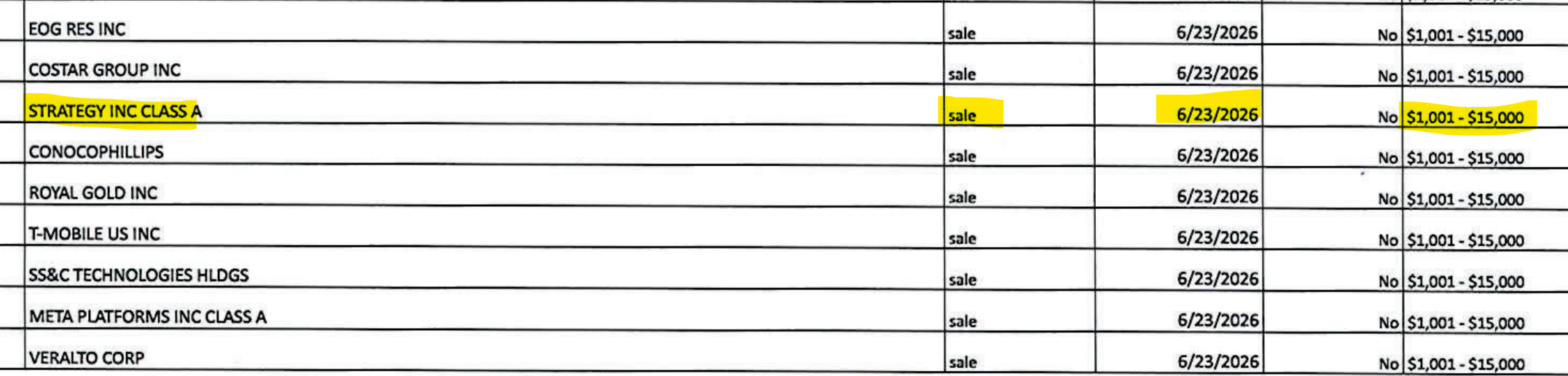
President Donald Trump’s June financial disclosure lists more than 1,000 securities transactions. Only 7 involved crypto companies, and most of those were sales, according to a financial disclosure published Saturday.
The Office of Government Ethics published the periodic transaction report.
Coinbase and Strategy Lead a Short List
Coinbase Global appears four times in the filing. Three sales were dated June 12, 18, and 23, totaling $116,003 to $315,000. A single purchase followed on June 24 in the $50,001-$100,000 band.
Strategy Inc, the largest corporate holder of Bitcoin (BTC), drew two sales on June 23 and 24. Those totaled $16,002 to $65,000. The filing records no Strategy purchases during the month.
Robinhood Markets rounds out the list with one line, a June 3 purchase of $1,001 to $15,000.

No spot Bitcoin ETFs, mining companies, or Trump Media shares appear anywhere in the document. The filing does list iShares, SPDR, and Vanguard funds throughout, so fund holdings were reported.
Follow us on X to get the latest news as it happens
Trading Contrasts With Trump’s Crypto Income
Total June transactions ranged from $78.1 million to $263.1 million, Bloomberg reported. The single biggest transaction in the filing was the sale of between $5 million and $25 million of shares in a Vanguard Group Inc. exchange-traded fund on June 22.
On the buy side, Berkshire Hathaway, Visa, Mastercard, and Cintas stand out. Crypto lines don’t account for much of the activity.
On the other hand, crypto ventures make up a meaningful portion of Trump’s personal earnings. His 2025 annual disclosure showed around $1.4 billion in crypto-related income.
The White House has repeatedly affirmed that independent financial institutions manage the President’s investments and that no conflicts exist.
Subscribe to our YouTube channel to watch leaders and journalists provide expert insights
The post Donald Trump Sold MicroStrategy and Bought Two Other Crypto Stocks appeared first on BeInCrypto.
Crypto World
XRP on track for biggest weekly gain in 21 months as Treasury buyback spurs 'curve control' hopes
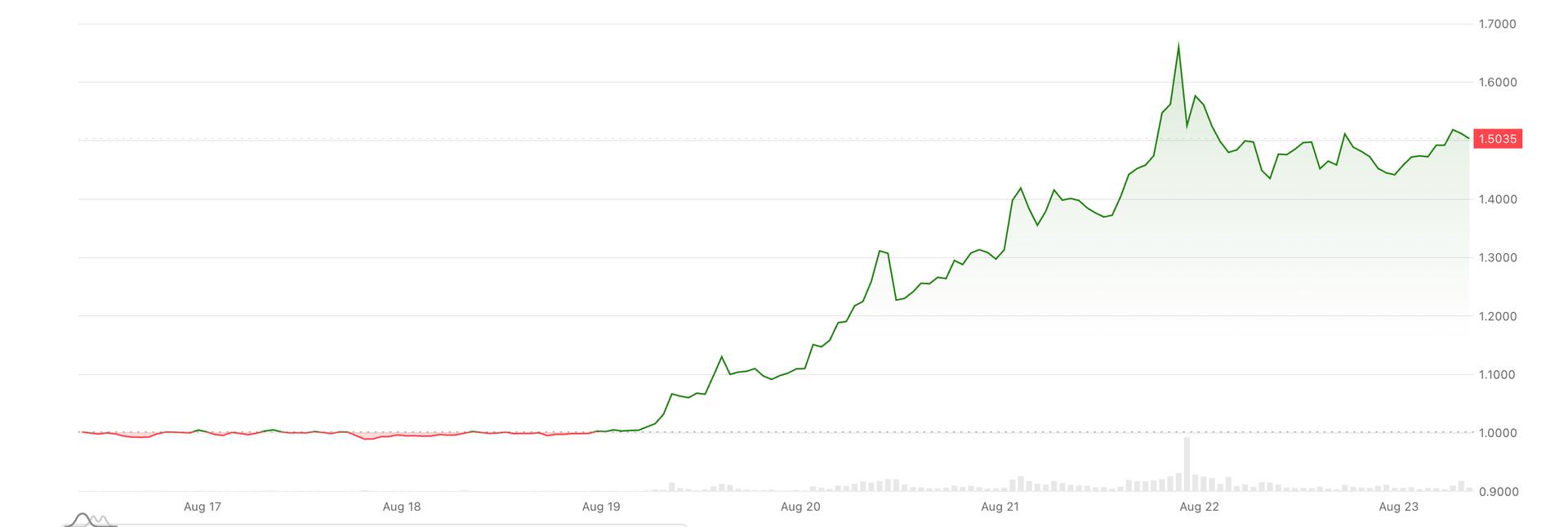
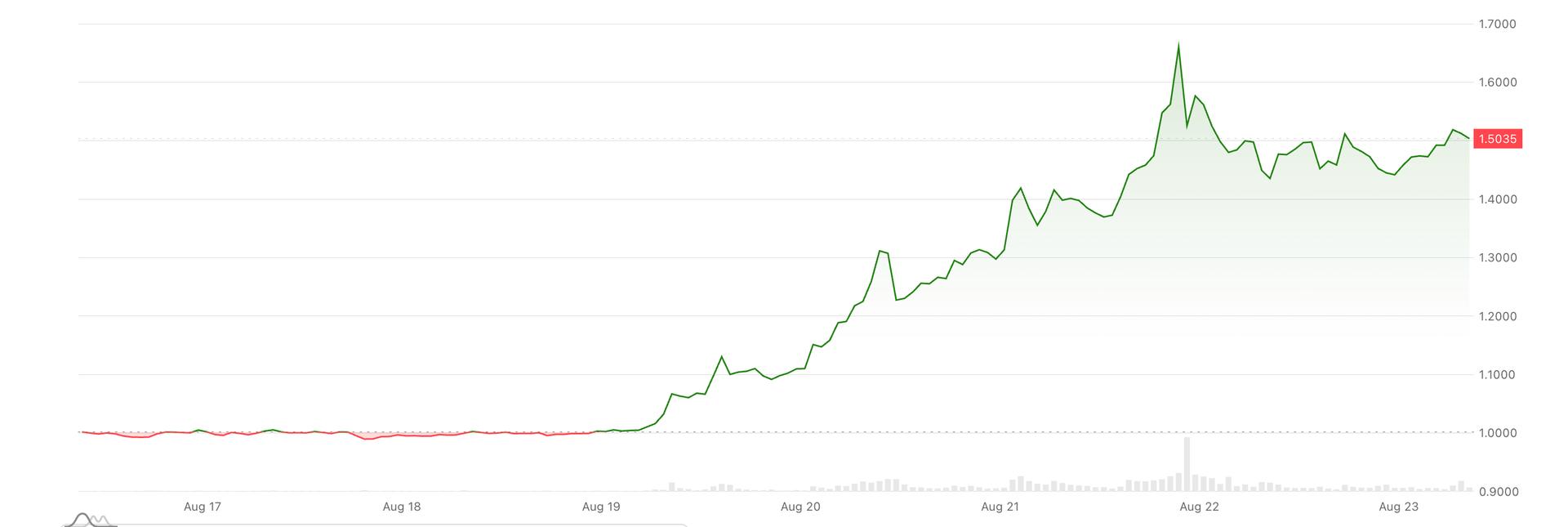
XRP’s price has surged by 50% this week, the best performance since November 2024. Here’s what’s driving the rally.
A new Federal Reserve Bank of Cleveland working paper offers a provocative explanation for why cryptocurrency behaves so differently from traditional financial assets: Americans who buy crypto don’t simply have different demographics or risk appetites, they have radically different beliefs about digital assets’ future returns.
The finding could help explain both crypto’s persistent volatility and the way rallies can attract new buyers, potentially creating a feedback loop in which rising prices reinforce bullish expectations and pull more investors into the market.
Using repeated surveys of as many as 25,000 US households per wave, researchers Michael Weber, Bernardo Candia, Olivier Coibion and Yuriy Gorodnichenko found that expectations about crypto returns explain more of the variation in who owns cryptocurrency than a broad range of demographic characteristics.
The paper, titled “Do You Even Crypto, Bro? Cryptocurrencies in Household Finance,” also uses a randomized information experiment to show that simply giving people information about Bitcoin’s (BTC) recent performance can increase both their desired crypto allocation and their subsequent purchases.
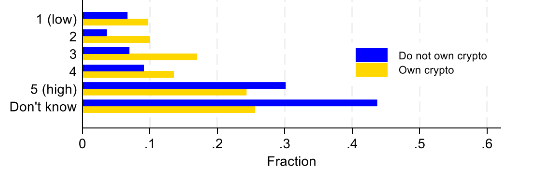
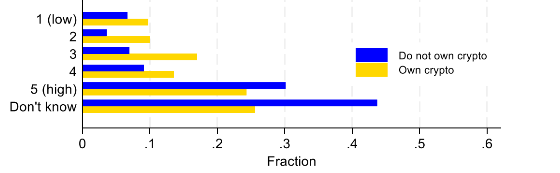
Perceived risk of crypto by ownership. Source: Federal Reserve Bank of Cleveland
The researchers say the results point to a potential mechanism behind speculative bubbles: past gains can attract new investors, whose purchases push prices higher and potentially attract still more buyers.
“Positive returns attract new participants, which raises the price further,” the authors write
That dynamic is particularly striking because cryptocurrency remains poorly understood by a large share of the population. In the researchers’ 2021 survey, 87% of people who did not own crypto said they didn’t know what return to expect from it over the following year. Among crypto owners, the figure was still 54%.
Related: Canadian crypto ownership increases to 25%: Ontario survey
Ownership linked to double-digit returns expectations
For those willing to make a forecast, however, the gap was enormous. Crypto owners expected an average 22% return over the following year, compared with just 7% among non-owners. Owners also tended to view crypto as less risky than non-owners did.
The researchers found that expected returns were unusually powerful in determining ownership. A one-percentage-point increase in an individual’s expected crypto return was associated with a 0.8-percentage-point increase in the probability of owning cryptocurrency. Expectations about returns and risk together explained considerably more variation in crypto ownership than observable characteristics such as age, income and gender.
That makes crypto an outlier compared with stocks, bonds and gold. For traditional assets, demographic and financial characteristics generally have much more explanatory power than differences in expected returns. Crypto reverses that relationship.
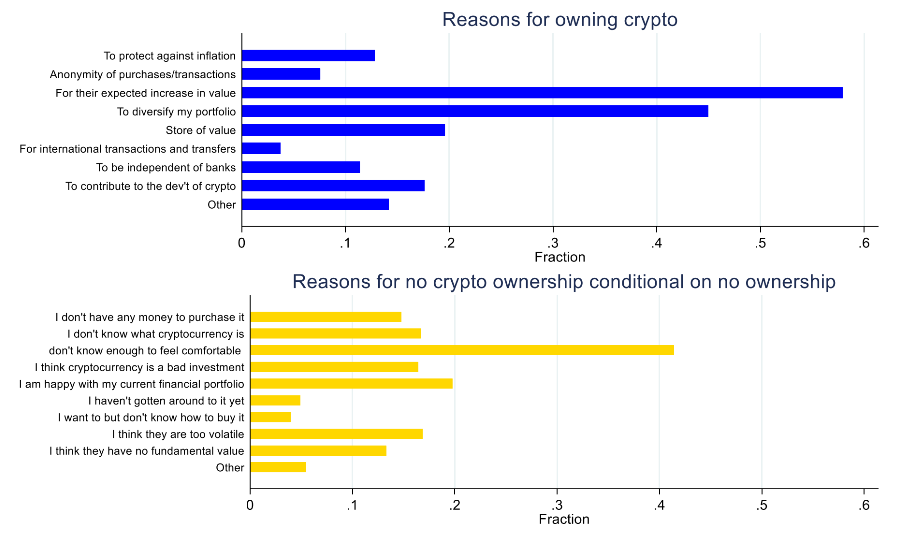
Source: Federal Reserve Bank of Cleveland
The demographic profile of crypto investors nevertheless remains distinctive. People under 40 were 13 percentage points more likely to own cryptocurrency than those over 60, even after controlling for other characteristics. Men were about 4 percentage points more likely than women to own crypto, while higher-income and wealthier households were also more likely to participate.
The experiment provides perhaps the paper’s most consequential finding for crypto markets.
In 2025, researchers randomly assigned households to receive information about BTC, stocks, GameStop or inflation. Participants who were shown Bitcoin’s previous 12-month return increased their desired crypto portfolio allocation by roughly 2 percentage points, or about a 47% increase relative to the 4.3% desired allocation among the control group. Actual subsequent crypto purchases also rose by about 2.5 percentage points.
The authors describe the result as “providing information about recent Bitcoin returns induces some households to start buying cryptocurrency.”
The effect was concentrated among people who said they didn’t own crypto because they lacked sufficient information. Those who already believed crypto was a bad investment generally did not respond to the information treatment.
The paper also finds that crypto wealth can spill into household consumption. A doubling in BTC’s price made a household whose entire financial portfolio was in crypto 1.4 percentage points more likely to buy a durable good, equivalent to roughly a 7% increase relative to the unconditional probability of such a purchase. But the effect did not persist into ordinary spending.
That led the researchers to a stark comparison: crypto gains appear to be treated more like “gambling income” or lottery winnings than a permanent increase in wealth.
The broader implication is that crypto’s volatility may be rooted partly in disagreement and learning rather than simply market fundamentals. The authors conclude that cryptocurrency stands out because it is poorly understood, investors form sharply different views about its prospects, and new information about past returns can change both expectations and behavior.
“The absence of common information and beliefs about crypto across investors,” they write, “suggests that price volatility will continue to be one of the most defining characteristics of this new asset for the foreseeable future.”
For crypto markets, that suggests a potentially uncomfortable conclusion: the next wave of retail demand may depend not only on Bitcoin’s price, but on what investors are told about the price that came before it.
Magazine: The 100x obsession: Fundamentals grow in importance as crypto matures


According to Coinbase’s head of AI product, we’re currently in the “Napster/LimeWire era” of agentic payments.


BitMart said on Aug. 21 that it was exploring a restructuring plan involving creditor distributions and the phased restart of selected operations, less than four weeks after announcing a complete wind-down.
Summary
- BitMart appointed White & Case while evaluating creditor distributions and a phased operational restart plan.
- September 9 is BitMart’s deadline for another update, not a guaranteed restructuring completion date yet.
- Existing notices still schedule all trading to end August 26 at 01:00 UTC unless revised.
- BitMart has not published creditor eligibility, payout percentages, reserve data or a court filing publicly.
- BMX trades near $0.06 after losing roughly 80% over one month, according to trackers currently.
The exchange appointed White & Case as restructuring counsel. It promised another update by Sept. 9 but did not cancel its existing Aug. 26 trading cutoff or Jan. 31, 2027, closure date.
The announcement marks BitMart’s first public reference to creditors. It does not explain which customers or counterparties fall within that category.
BitMart restart remains under assessment
BitMart said the proposed plan could combine an orderly resumption of certain services with distributions to creditors. Any restart remains subject to legal, financial, operational and regulatory reviews.
“The potential plan may include the phased resumption of certain operations,” BitMart said. The company has not approved or launched that plan.
White & Case will evaluate available options with BitMart’s other advisers. The law firm’s appointment does not establish that BitMart has entered bankruptcy or another court-supervised process.
No verified bankruptcy petition, restructuring case number or creditor-claim portal had been published when this report was prepared. BitMart also has not identified the legal entity or jurisdiction that would administer distributions.
The exchange said it expects to consult its community after a business resumption plan launches. It has not explained how customers would participate or whether any creditor vote would be required.
August 26 trading deadline remains active
BitMart’s closure notice still schedules all spot, futures and other trading to end at 01:00 UTC on Aug. 26.
Futures accounts have entered reduce-only mode, while spot markets stopped accepting new orders. New registrations and cryptocurrency and fiat deposits began closing on July 26.
Any futures positions remaining at the deadline may be settled using the applicable mark price, index price or platform settlement rules. BitMart said it would publish separate settlement arrangements, but the restructuring update did not provide them.
The exchange previously recommended completing verification and submitting withdrawal requests before 05:00 UTC on Aug. 26. Withdrawals officially remain available, although additional identity, sanctions, transaction-history and wallet checks may delay processing.
As crypto.news reported, the shutdown announcement sent BMX down more than 60% within the surrounding 24-hour period. The possible restructuring does not currently change the withdrawal guidance.
Creditor language raises unanswered questions
BitMart did not disclose why customer or counterparty balances may require creditor distributions rather than ordinary withdrawals. Its July notice cited operating conditions, the market environment and future strategy without describing a shortfall.
The latest statement includes no balance sheet, liability total, reserve report or recovery percentage. It also does not establish whether user assets and unsecured commercial claims would receive different treatment.
Earlier concerns about BitMart’s reserves and custody position were based partly on third-party wallet tracking and customer reports. Those observations do not independently establish the exchange’s complete assets or liabilities.
Onchain balances cover only publicly identified wallets. They cannot show undisclosed addresses, fiat holdings, offchain liabilities or assets held through custodians. A reliable recovery assessment therefore requires audited financial information or verified court disclosures.
September roadmap must clarify payouts
BitMart said it would “endeavour” to provide another update no later than Sept. 9. The wording commits the exchange to further communication rather than a finalized restructuring agreement.
The next announcement needs to identify which operations could restart, which legal entities owe creditors and how claims will be valued. Customers also need information about payout timing, available assets and the treatment of pending withdrawals.
Unless BitMart formally changes its schedule, trading will stop two weeks before the restructuring update. The wider platform remains scheduled to terminate at 15:59 UTC on Jan. 31, 2027.
BMX was trading near $0.061 on Aug. 23, according to CoinGecko. The token remained approximately 80% below its price one month earlier despite recovering modestly over the preceding week.
The Sept. 9 update will determine whether BitMart has a viable restart proposal or continues with its original wind-down. Until then, the phased restart and creditor distributions remain possible components rather than confirmed outcomes.
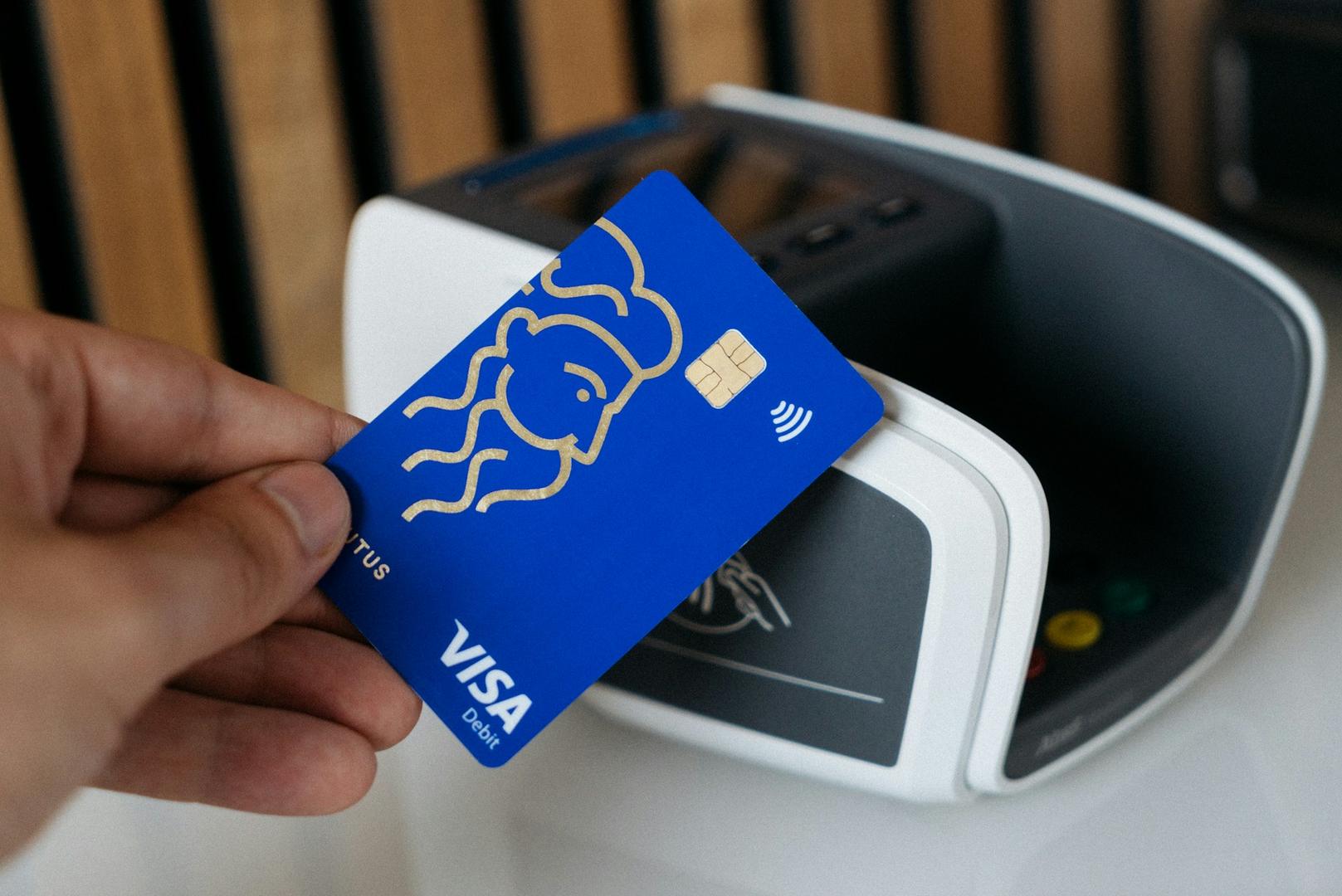
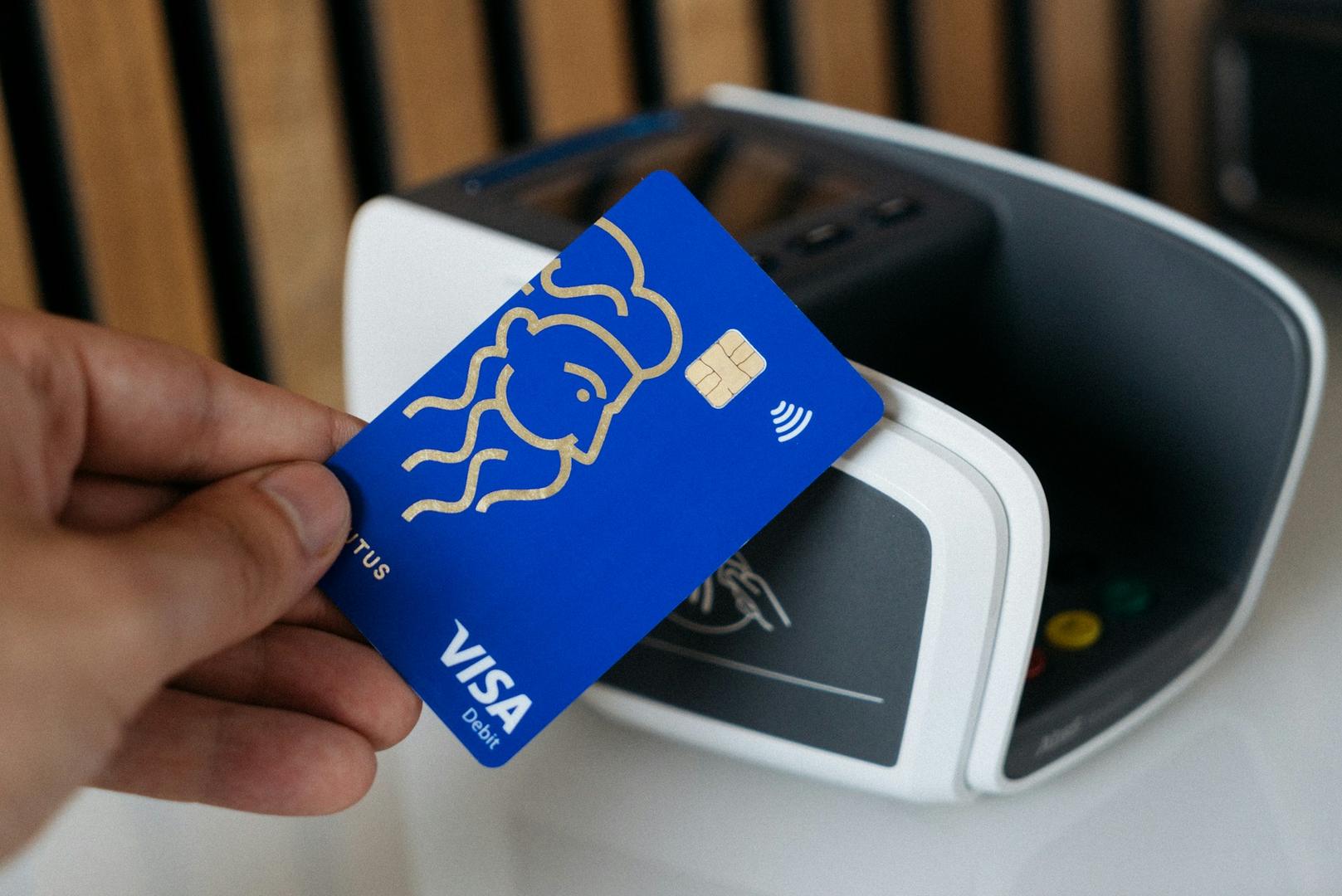
Tracked card volume more than tripled in a year, with USDC and USDT funding over 70% of spending as users increasingly paid for groceries, rides and subscriptions.

The cryptocurrency market was essentially muted for many, many weeks. Ever since the May surge from BTC to over $82,000 and the subsequent crash to under $58,000 on July 1, the market has remained dull with little to no movement from the larger caps.
Then it all changed within hours on Wednesday afternoon as something unusual happened. Essentially all crypto assets exploded suddenly to new local peaks (some to ATHs, such as HYPE), with BTC leading the pack with a surge from under $65,000 to almost $80,000 before it pulled back slightly.
The speed of the rally and the subsequent decline suggest that leverage, rather than a single fundamental catalyst, has played a big role.
From Calm to $500B+ Rally
The analysts at the Kobeissi Letter weighed in on the recent market change, indicating that crypto was effectively “frozen” for 110 consecutive days – between May 1 and August 19. That might be a bit of an exaggeration since BTC experienced some volatility within this period, including the aforementioned surge above $80,000 and the crash that followed.
Nevertheless, the real change happened abruptly at around 8:30 AM ET on August 19, when the entire market went on a tear. Less than a day later, the market had experienced what the Kobeissi Letter described as its “seventh-largest liquidation event on record.”
This unexpected recovery didn’t die immediately, as many of the previous attempts did. Just the opposite; the deleveraging was followed by another surge. Within a day and a half, the total crypto market cap had increased by around $500 billion as BTC approached $80,000 for the first time since mid-May.
There was no single crypto-specific announcement large enough to explain the entire move. However, it coincided with Trump’s Crypto Summit in the White House and was boosted by the Treasury Department’s decision to increase purchases of longer-dated government debt.
According to the analysts, though, Treasury yields subsequently erased their initial decline within a day while the crypto market remained substantially higher, suggesting another force was at work.
Institutional demand returned as well, with $2.6 billion entering the spot Bitcoin and Ethereum ETFs.
Leverage Made It a Rollercoaster
The other big argument that can be made, the analysts continued, is that speculation, in the form of leverage, was rebuilt rapidly. After BTC neared $80,000 and many alts posted massive double-digit gains, traders piled into leveraged longs.
The consequences became obvious during Saturday’s sudden flash crash as roughly $500 million in late longs were wrecked within minutes when BTC dipped by $2,000, and ETH dropped by 5%. Many alts suffered even worse short-term losses.
The Kobeissi Letter’s analysts said that at 12:30 AM ET on Saturday, about $110 billion disappeared from the total cap in just 20 minutes, which helps explain the market’s erratic behavior.
After months of dull price action, the initial breakout forced bearish positions to close, accelerating most assets higher. However, the rapid surge attracted FOMO leveraged longs, leaving the market vulnerable to equally violent liquidation cascades in the opposite direction.
The post Crypto Market Went From ‘Frozen’ to Chaos in Days: What Is Really Happening? appeared first on CryptoPotato.

ECB launches investigation into Brydon Carse after England pacer seen in handcuffs outside nightclub | Cricket News

TechCrunch Mobility: The custom chip driving Waymo’s robotaxi ambitions

Emily Atack is married! Actress ties the knot with Alistair Garner in intimate UK ceremony before a celebration at home complete with a McDonald’s truck – ahead of their Spanish nuptials





-

 Fashion2 days ago
Weekend Open Thread: Madewell – Corporette.com
-

 Crypto World2 days ago
anatomy of crypto’s biggest liquidation event since 2021
-

 Business5 days ago
SMA Solar Technology AG (SMTGY) Q2 2026 Earnings Call Transcript
-

 Tech6 days ago
Qwen3.8-27B runs frontier-class coding agents and reasoning locally, no cloud API required
-

 Crypto World6 days ago
OCC Greenlights Trump Family Crypto Firm for Trust Charter
-

 Politics1 day ago
6 months on, Irish renters crushed by effects of government housing bill
-
 NewsBeat1 day ago
The ‘Lucky Dip Gang’ causing carnage for clicks: After five thugs were killed speeding in the wrong direction on a motorway, GUY ADAMS investigates a sick new trend… and why police aren’t even allowed to pursue them
-

 Crypto World6 days ago
NAVI Prime launches institutional lending framework on Sui
-

 News Videos4 days ago
Don’t Leave Your Financial Future To Chance | August 19, 2026
-

 Crypto World7 days ago
Data of 54K Wallet Users Leaked, Clarity Odds Just 10%: Hodler’s Digest, Aug. 16
-

 Tech4 days ago
GLM-5.3 hits the API at $1.4/$4.4 per million tokens
-

 Business5 days ago
Stock Market Today: Tech Futures Slide As Treasury Yields Jump; Nvidia, Micron, Sandisk Sell Off
-
 Crypto World6 days ago
Dow’s 3-Year Winning Run Isn’t a Crash Signal, Still 49% Odds of Double-Digit Gains
-
Tech6 days ago
5 Of The Most Reliable Car Brands To Consider If You’re Buying A Used SUV
-

 Tech5 days ago
Keychron K8 Ultra 8K review: a great value keyboard with comfort issues
-

 Tech6 days ago
Straight Up the Cliff, Yunnan’s New Fuyao Ladder Turns a Three-Hour Climb Into a 50-Second Ride for Students
-
 Tech6 days ago
Nvidia discloses $21B stake in SpaceX
-
 Tech7 days ago
OpenAI’s new ChatGPT feature logs your keystrokes and stores them in plain text
-

 Business3 days ago
Five Below: Kids Discount Retailer Reaps Rich Rewards
-
 NewsBeat6 days ago
Trump explodes at CNN reporter after question about young blonde aide who wrote him besotted letters
You must be logged in to post a comment Login