

Crypto World
Bitcoin Liquidity Balance Signals Potential Rally Toward $80K


Bitcoin is treading near a critical price frontier around $80,000, as a confluence of derivative pressure and technical signals hints at a potential shift in the risk balance. Data tracked by CoinGlass indicate that the lion’s share of leveraged exposure sits above the current price, with more than $4 billion in short positions exposed to a move into the $80,000 area. That looming container of risk sits against a backdrop of support around $76,100 that BTC defended for two consecutive days, while bullish signals emerged on shorter timeframes.
In recent sessions, Bitcoin briefly retested the $78,000 mark after hovering near the $76,100 support level. On the chart, a bullish divergence between price action and the relative strength index on the one-hour timeframe has appeared, accompanied by higher lows that hint at underlying buying strength. Traders will be watching whether BTC can clear the $78,000 threshold and push toward the $80,000 region, where the literature suggests a cluster of liquidity could be exposed and a potential shift in the near-term trajectory could unfold.
Key takeaways
- More than $4 billion in short positions sit above the current price, meaning a move toward $80,000 would likely trigger substantial short-liquidation pressure.
- A downside risk exists as roughly $3 billion in long liquidations could be triggered if BTC slides toward $75,000, underscoring asymmetric risk around the current range.
- The price action is forming patterns that traders interpret as a possible pre-breakout setup—an inverse head-and-shoulders under a descending trendline with a $78,000 threshold to clear before testing higher levels.
- Liquidity appears split: weak spot demand alongside rising futures activity, characteristic of leveraged-driven upside in the near term.
- Futures-driven momentum may dominate near-term moves, but the confluence of FVGs and liquidity clusters at the $79.5k–$80.3k zone suggests a defined near-term retest area that bears watching for a sustainable breakout or a rejection.
Liquidity cliff at the $80,000 mark
The near-term risk landscape centers on how large a move into the $80,000 zone could become for liquidations. CoinGlass data show the largest concentration of leveraged risk sits above current price levels; a move toward $80,000 would expose more than $4 billion in cumulative short liquidations. By contrast, a drop toward $75,000 would expose roughly $3 billion in long liquidations, presenting a skew toward downside pressure as well, but with a potentially sharper upside impulse if a short squeeze develops.
The technical setup reinforces the narrative. On the one-hour chart, Bitcoin formed a bullish divergence between price and RSI, with momentum improving as price held above the $76,100 support. The market has also been shaping an inverse head-and-shoulders pattern beneath a descending trendline, a structure that market participants often interpret as a softening bearish bias before a breakout. A sustained move above $78,000 could bring the fair-value gap (FVG) in the range of $79,500 to $80,300 into focus—a low-liquidity territory created during a previous selloff that price could revisit to fill before continuing its next leg.
In practical terms, a climb into the high $70s and into the $80k zone would test short positions with a potentially rapid unwind, while a move lower could trigger additional long liquidations. The dynamic highlights the asymmetric risk the market faces in the near term: a relatively small move in BTC price could force outsized liquidations on one side of the book depending on direction.
Derivatives activity versus spot behavior
Derivatives markets appear to be driving the recent upside more than immediate spot demand. In the latest 24-hour window, liquidations accelerated markedly, with CoinGlass data showing 103,963 traders liquidated and total liquidations amounting to $286.08 million. Short positions accounted for nearly $175 million of that total, underscoring the magnitude of risk concentrated in the short side of the book. The largest single liquidation hit Binance’s BTC/USDT pair at $3.04 million.
Open interest data from CryptoQuant painted a picture of risk posture shifting as volatility spiked. Bitcoin-denominated open interest stood near 116,800 BTC, down from roughly 120,000 BTC a day earlier. The drop suggests that traders were trimming leveraged exposure during the recent volatility, a sign that risk is being managed rather than aggressively escalated at current levels.
Spot market participation remained comparatively tepid as price reclaimed the $78,000 vicinity. The aggregated spot volume delta (CVD), which measures net buying versus selling pressure, registered at about -$483 million, signaling a degree of selling pressure in the spot arena. Conversely, the futures CVD nudged into modest positive territory, around +$34 million, complemented by persistently elevated funding rates that imply a short-term bullish tilt in the futures market. Taken together, the data indicate a liquidity split: fewer buyers in the spot market and a contingent, levered buyer presence in the futures space that has helped push prices higher in the near term.
The confluence of a cooling open interest, a quantifiable tilt toward futures-driven upside, and the looming $80,000 liquidity stack suggests traders should prepare for a decision point at the upper boundary of the current range. If price action can decisively clear the $78,000–$80,000 zone and sustain it, the market could test the FVG-retransmission zone and possibly push toward new highs in the current cycle. If, however, the bid support fails to materialize, a retest of the mid-$70s could reintroduce the risk-off dynamic that characterized earlier weeks.
For context, reports and data from market analytics providers corroborate the scene: liquidations and open-interest dynamics are consistent with a transition in momentum from cautious accumulation to a more aggressive, levered move when price passes key levels. The broader takeaway is that while spot demand remains spotty, the pull of the futures market—and the liquidity patch around $80k—could determine the near-term path for BTC.
What this means for traders and builders
From an investor and trader perspective, the current configuration emphasizes two themes. First, liquidity concentration at the $80,000 zone makes it a high-stakes battleground for leveraged traders. A break above that level could unleash a sizable short squeeze, given the $4 billion exposure to shorts, while a rejection could provoke an equally rapid unwind in long positions that now sit at risk around the mid-$70s.
Second, the divergence between futures activity and spot participation signals that a subset of market participants remains willing to deploy leverage to chase upside, while broader flow remains cautious. This dynamic can sustain a volatility regime where prices drift higher on a thin bid in spot while futures sustain the move and liquidations discipline risk management in both directions. For developers building on-chain risk analytics or traders constructing hedges, the current environment offers a meaningful test case for the reliability of funding-rate signals and the predictive value of short-term chart patterns such as the inverse head-and-shoulders and the FVG framework.
As ever, readers should monitor price action through the near-term lens of $78,000 as a pivot. A clear breakout above $80,000, supported by robust spot demand and a balanced liquidations profile, could open room for further upside. Conversely, failure to sustain momentum at that zone may invite a reevaluation of long exposure and a reversion toward key supports around $76,000–$77,000, where demand historically re-emerges during risk-off spells.
For ongoing context, traders and enthusiasts can track liquidation data and funding signals across industry analytics outlets, with CoinGlass highlighting the current concentration of risk above the price level and CryptoQuant offering a view of open-interest shifts that accompany moves in BTC pricing.
What remains uncertain is whether the upcoming price action will be primarily driven by macro sentiment, retail positioning, or continued leverage in the futures market. The next few sessions will be decisive in uncovering whether the $80,000 barrier acts as a cap or becomes a doorway to the next leg higher.

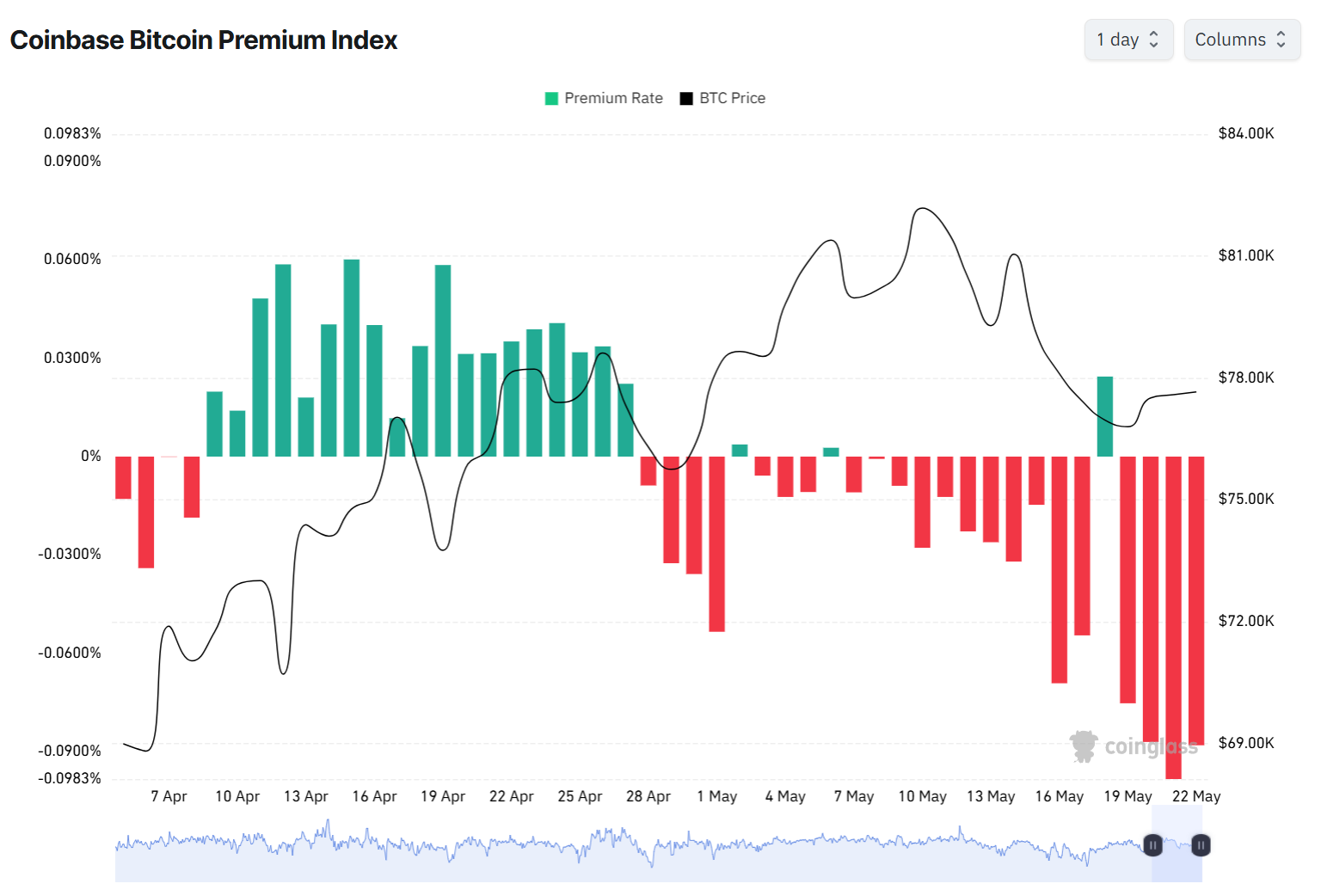
A key indicator of institutional crypto market participation, the Coinbase premium has fallen deeper into negative territory, indicating increased selling pressure from institutions.
The Coinbase premium has been mostly negative since late April, but it has fallen much faster over the past seven days and recorded its lowest level this month at -0.0983% on May 21.
“Institutional selling pressure has intensified recently,” CryptoQuant analyst Darkfost said on Thursday.
“This suggests that the population of institutional and professional investors trading on Coinbase Advanced is selling more aggressively than investors trading on Binance.”
Institutional investors are also shying away from store-of-value assets such as gold, which is down 5.8% over the past month, favoring stocks with the S&P500 and Dow Jones indexes trending up since the beginning of April.
Analyst Axel Adler said the results suggest “zero confirmation from US spot demand.”
The Coinbase premium is a measure of the difference between Bitcoin prices on Coinbase, which is used more by US institutions, and Binance, favored more by retail investors.
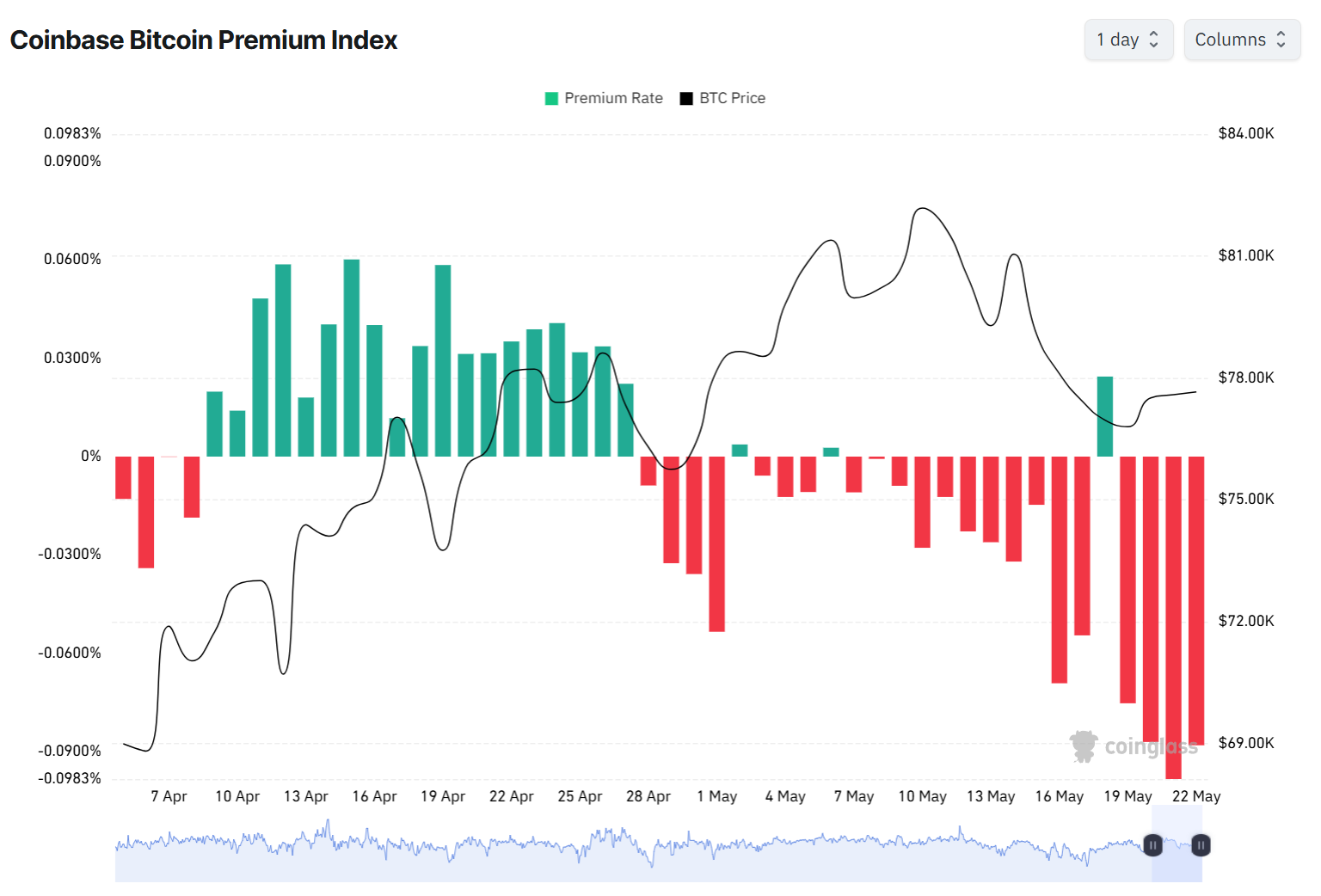
Coinbase premium falls to its lowest level this month. Source: Coinglass
Institutions are repositioning
“The uncertainty surrounding the current macro environment appears to be pushing institutions toward hedging strategies while waiting for greater clarity,” Darkfost said.
LVRG research director Nick Ruck told Cointelegraph the decline of the Coinbase premium could also reflect the “emergence of net selling pressure from larger holders,” and suggest institutions are taking profits or repositioning, which “could weigh on near-term price momentum across major crypto assets.”
Bitcoin ETF outflows accelerate, derivatives decline
Another signal of institutional selling pressure is US spot Bitcoin exchange-traded funds, which have seen four trading days of outflows totaling $1.3 billion since May 14, according to CoinGlass.
Related: Bitcoin longs soar despite weak US macroeconomic data: Is $82K BTC next?
Derivatives demand also appears to be weakening, with open interest, or the value of open Bitcoin futures or perpetual contracts, dropping by around $1.5 billion this week, “clearing much of the leverage built up during Bitcoin’s move toward $82,000,” said Bitfinex.
“With short-side fuel exhausted and long positioning reset lower, the next major move likely depends on spot demand,” it added.
Bitcoin has declined 4.5% over the past week, hitting a monthly low just above $76,000 on Tuesday. It was flat on the day at $77,621 at the time of writing, down 38% from its October peak.
Magazine: Crypto scammers face death, Aussie CGT makes Asian hubs attractive: Asia Express


Bitcoin traded near $77,733 by midday Hong Kong time, according to CoinDesk data, little changed over the past 24 hours, after sliding as low as $76,685 and failing to hold above $78,000 during U.S. trading hours.
Derivatives positioning suggested the recent selloff may have been more of a leverage flush than the start of a broader market breakdown. Open interest, a measure of outstanding leveraged futures positions, held relatively steady while funding rates stayed low or negative, a sign that traders were not aggressively piling into bullish bets before the drop.
“There was no massive accumulation of leveraged longs prior to this, meaning most of those liquidated in this drop were leveraged funds attempting short-term bottom-fishing. Second, this signals that we are not in the middle of a structural trend reversal downward. The temporary bottom of $75,000–$77,000 remains well-defined,” Tim Sun, senior researcher at HashKey Group, told CoinDesk
The bigger problem, he said, is macro: investors are de-risking as long-term yields rise, oil and inflation risks remain in focus, and there is “currently no compelling reason for new capital to enter the market.”
CoinGlass data showed $200 million in crypto liquidations over the past 24 hours, split almost evenly between long and short positions, suggesting the move was less a one-sided capitulation than a volatile market whipping both directions.
Sun pointed to the U.S. 30-year Treasury yield, which recently pushed above 5%, as the more important pressure point. Higher long-term yields tend to weigh on speculative assets by raising the opportunity cost of holding non-yielding assets like bitcoin while tightening broader financial conditions.
The next catalyst may come from geopolitics.
Sun said a meaningful de-escalation in U.S.-Iran tensions could cool oil prices and inflation expectations, easing pressure on yields and giving bitcoin room to rebound.
But if yields remain elevated and geopolitical risks persist, bitcoin may stay stuck in what he described as a defensive, range-bound market, with the $75,000 to $77,000 zone serving as the key near-term support level.
Crypto World
Nexpace Announces NXPC Buyback Program to Reinforce User-Centered Ecosystem Growth in MapleStory Universe

[PRESS RELEASE – Abu Dhabi, UAE, May 22nd, 2026]
Up to $10 million buyback program designed to strengthen long-term token circulation structure and support sustainable ecosystem operations.
Nexpace, the Abu Dhabi-based blockchain company behind MapleStory Universe (MSU), today announced the launch of an NXPC buyback program of up to $10 million.
The initiative is intended to reinforce a token circulation structure centered around real users and participation, while supporting long-term ecosystem sustainability. NXPC is the native token of MSU, the blockchain-powered expansion of Nexon’s iconic MapleStory IP, powering user engagement, including contribution rewards and item unlocks.
Under the program, Nexpace will conduct open market purchases of up to $10 million worth of NXPC across global digital asset exchanges. To minimize potential market impact, open market purchases will be executed progressively over a three-month period through multiple tranches and delegated to an external execution partner.
The initiative was developed based on insights gathered during MSU’s first year of live operations. Over the past year, more than 850,000 wallets engaged with the platform, with approximately two-thirds spending NXPC on a monthly basis, contributing to 49.1 million NXPC in ecosystem revenue, equivalent to $31 million. By Q1 2026, player spending had outpaced rewards distributed, reflecting the depth of organic engagement across the ecosystem.
Combined with the 8.32 million NXPC burned to date, the buyback program is designed to support healthy token circulation as MSU evolves into a broader IP-powered ecosystem driven by active onchain participation. It also reinforces the long-term ecosystem alignment of NXPC for users who actively participate in and contribute to the ecosystem.
Sun Young Hwang, Chief Executive Officer at Nexpace said, “As MapleStory Universe continues to evolve, our focus remains on building an ecosystem where participation and utility remain closely connected. This program reflects our ongoing commitment to supporting healthier long-term ecosystem dynamics as engagement continues to grow. Year one gave us confidence that we are on the right path, and we want to ensure long-term users, builders, and contributors are meaningfully rewarded for what they help build.”
NXPC acquired through the program will be retained within the treasury for future use in supporting long-term ecosystem sustainability. For more information, users can visit Nexpace’s IR page.
About Nexpace
Nexpace, an innovative blockchain company based in Abu Dhabi, pioneers an IP-expansion initiative powered by blockchain technology and NFTs to build a community-driven ecosystem. With a mission to redefine interactive entertainment, Nexpace creates a vibrant space for exploring, sharing, and engaging with diverse content and gameplay crafted by community members.
At the heart of Nexpace’s ecosystem are principles of transparency, security, and trust, empowering builders to freely share their ideas and enabling users to enjoy immersive experiences. By fostering a culture of creative expression, Nexpace envisions a secure, collaborative environment that unites ecosystem participants in a thriving digital community.
Disclaimers: This press release contains forward-looking statements regarding MapleStory Universe, MSU 2.0, and related plans. Nothing herein constitutes an offer, solicitation, or recommendation to buy or sell NXPC or any digital asset; availability may be restricted in certain jurisdictions. All metrics are based on internal data or third-party sources as indicated and measured under the definitions and periods specified.
The post Nexpace Announces NXPC Buyback Program to Reinforce User-Centered Ecosystem Growth in MapleStory Universe appeared first on CryptoPotato.

US President Donald Trump made some bold and bullish promises during his election campaign in 2024 for the cryptocurrency industry, but the actual implementation has been controversial to say the least.
Although his team has launched certain digital asset projects and initiatives, such as accumulating BTC for one of their companies, they continue to sell crypto, sometimes even at a loss.
The latest example was reported by Lookonchain. The analytics resource noted that Trump Media, the entity behind the Truth Social media platform, majority owned by the Donald J. Trump Revocable Trust, had sent over $200 million worth of BTC to Crypto.com, with which they have collaborated in the past.
Four months ago, they had transferred $175 million worth of the asset at an average price of $87,378. Today’s reported transfer comes as BTC struggles below $78,000.
However, their accumulation came during the cryptocurrency’s impressive surge when the asset stood close to $120,000. This means the group’s total BTC holdings are down to just $455 million, a significant decline from the $1.37 billion it spent to acquire them last year.
Trump Media just sold 2,650 $BTC($205M)?
Trump Media bought 11,542 $BTC($1.37B) at an average cost of $118,522.
4 months ago, they transferred out 2,000 $BTC($175M) at $87,378.
An hour ago, they deposited another 2,650 $BTC($205M) into https://t.co/INIxikglp6.
Trump Media is… pic.twitter.com/unfYm1o70m
— Lookonchain (@lookonchain) May 22, 2026
This is far from the first example of Trump-linked cryptocurrency entities disposing of their tokens. Most recently, reports indicated that WLFI holders had dumped 1.8 billion coins. Before that, the teams behind the TRUMP and MELANIA meme coins had sold off the majority of their holdings, as both assets’ prices tumbled by over 90% from their all-time highs.
The post Is Trump Media Dumping Bitcoin at a Loss Again? appeared first on CryptoPotato.


The reported attempt to kidnap the wife of The Sandbox co-founder Sébastien Borget has shifted attention to the physical side of crypto security.
Summary
- Neighbors stopped the abduction before attackers fled, with two suspects later arrested in an Uber.
- France has recorded dozens of crypto-linked kidnappings, pushing police toward prevention platforms and tighter protocols.
- Security experts urge privacy, family awareness, multi-signature wallets, and stronger physical safeguards against wrench attacks.
The attack took place on May 20 at Borget’s home in Seine-et-Marne, France, according to Le Journal du Dimanche. The report said one suspect arrived dressed as a delivery worker before five masked accomplices entered the courtyard and tried to force Borget’s wife into a car.
Neighbors heard her cries and intervened. Four suspects fled in a vehicle, while two others escaped on foot and later ordered an Uber. Police from the Meaux Anti-Crime Brigade stopped the ride-hail car soon after. Officers allegedly found a fake handgun, cable ties, and balaclavas.
Crypto motive remains under police review
JDD reported that early evidence suggested the attempted kidnapping “would be linked to cryptocurrencies.” That wording leaves the motive under investigation, and authorities have not said the case is closed.
Borget’s wife was not injured, according to the report. Two suspects were taken into custody, while four others remained wanted.
Related coverage noted that French police had recorded 41 crypto-linked abductions since Jan. 1, making France a key center of the latest wrench-attack wave.
France moves from warnings to prevention
The case came as France prepared new measures against crypto kidnappings. An earlier market update said Interior Ministry representative Jean-Didier Berger had announced a prevention platform for digital asset holders and was working with Interior Minister Laurent Nuñez on a wider plan.
French authorities have also pursued suspects more aggressively. Prosecutors had charged at least 88 people over alleged wrench attacks by late April, including ten minors. Authorities also warned crypto holders and their relatives to reduce online exposure, which can help criminals identify targets.
Wrench attacks are becoming global
The problem is not limited to France. TRM Labs said recent wrench attacks have appeared in the United States, Canada, the United Kingdom, and other markets. The firm said attackers often target crypto executives, traders, and family members because crypto transfers can be fast, hard to reverse, and tied to public wealth signals.
Security firms now advise crypto holders to treat privacy as part of custody. TRM Labs recommends limiting public disclosure of holdings, improving home and travel security, using multi-signature wallets, and educating family members.
Jameson Lopp’s public list of physical Bitcoin and crypto attacks also includes the May 20 Borget case and says the tracker is not complete because many attacks go unreported.

Around 20,500 Bitcoin options contracts will expire on Friday, May 22, with a notional value of roughly $1.5 billion. This event is smaller than usual, so it is unlikely to have any impact on spot markets.
Crypto markets have been in decline all week, with around $50 billion leaving the space as Bitcoin continues to weaken. Positive news appears to have zero impact as investors remain under macroeconomic rain clouds.
Bitcoin Options Expiry
This week’s batch of Bitcoin options contracts has a put/call ratio of 0.69, meaning that there are more sellers of longs than shorts. Max pain is around $79,000, according to Coinglass, which is a little higher than current spot prices, so some could be out of the money on expiry.
Open interest (OI), or the value or number of Bitcoin options contracts yet to expire, remains highest at the $80,000 strike price on Deribit, with $1.65 billion, but short sellers still have $1.2 billion in OI at $60,000. Total BTC options OI across all exchanges has been steadily climbing this month and is at $37.6 billion, according to Coinglass.
Options Expiry Alert.
At 08:00 UTC tomorrow, over $1.8B in crypto options are set to expire on Deribit.bitcoin:native : $1.53B notional | Put/Call: 0.69 | Max Pain: $79,000
ethereum:native : $264M notional | Put/Call: 1.03 | Max Pain: $2,200BTC traders continue targeting… pic.twitter.com/fv5dDrPx6M
— Deribit (@DeribitOfficial) May 21, 2026
Traders have been using the recent rebound to establish defensive positions for the final ten days of the month, said crypto derivatives provider Greeks Live this week.
“Overall, the market is positioning itself to defend against price pullbacks but does not anticipate a market collapse.”
It added that May and June have long been viewed as unfavorable trading months, and in May, major investors have been “steadily increasing their defensive positions: buying effective protection, selling margin calls at the tail end, and controlling costs.”
In addition to today’s batch of Bitcoin options, around 123,000 Ethereum contracts are also expiring, with a notional value of $263 million, max pain at $2,200, and a put/call ratio of 1. Total ETH options OI across all exchanges is around $6.9 billion.
“ETH positioning has shifted from strongly call-biased last week to nearly balanced, suggesting conviction has cooled as traders await fresh catalysts,” said Deribit.
Spot Market Outlook
Crypto markets have retreated again today, with total capitalization dropping to $2.67 trillion. Bitcoin failed to break above $78,000 and fell back to an intraday low of $76,750 before a minor recovery on Friday morning. It appears to have resumed its downtrend, which is dragging the rest of the market down with it.
Ether and the rest of the altcoins have been mostly flat over the past 24 hours, with very little activity after a largely bearish week.
The post Crypto Traders Brace for $1.5B Bitcoin Options Expiry Today appeared first on CryptoPotato.


Disclosure: This article does not represent investment advice. The content and materials featured on this page are for educational purposes only.
AI day trading bots are reshaping stock trading in 2026 with faster signals, automation, and real-time analysis.
Summary
- BulkQuant joins leading AI day trading bot platforms as traders seek faster stock analysis tools in 2026.
- AI-assisted stock trading platforms like BulkQuant aim to simplify intraday market monitoring and execution.
- BulkQuant targets beginner traders with AI-driven stock monitoring and strategy execution support tools.
Stock day trading in 2026 is becoming more data-driven, faster, and more difficult to manage manually. Intraday price movements can be influenced by earnings updates, inflation reports, Federal Reserve expectations, AI-sector momentum, ETF flows, analyst ratings, and sudden changes in market liquidity. For traders watching multiple tickers, the challenge is not only finding opportunities, but also reacting with discipline when markets move quickly.
This is one reason AI-assisted trading tools are attracting more attention. Some platforms help traders scan stocks in real time. Others focus on technical alerts, strategy testing, broker execution, or custom algorithm development. These tools are often described as AI day trading bots, but their functions can vary widely.
A useful day trading bot does not simply promise speed. It should help traders build a clearer workflow: monitoring stocks, filtering signals, testing rules, managing alerts, and supporting execution decisions. At the same time, traders should remember that AI tools do not remove market risk. Intraday trading can lead to losses, especially when strategies are poorly tested or used during volatile conditions.
This guide looks at eight AI day trading bot platforms for stocks in 2026, including BulkQuant, Trade Ideas, TrendSpider, StockHero, Tickeron, SignalStack, Alpaca, and QuantConnect. The goal is not to declare one platform as suitable for everyone, but to compare how each tool may fit different trading styles.
Quick comparison: AI day trading bot platforms for stocks in 2026
| Platform | Primary Use Case | Automation Focus | Suitable For |
| BulkQuant | AI-assisted trading workflow | Market monitoring and strategy execution support | Beginners and users exploring simplified automation |
| Trade Ideas | Real-time stock scanning | AI-driven intraday alerts and trade ideas | Active day traders |
| TrendSpider | Technical analysis automation | Chart alerts, strategy triggers, and webhook workflows | Technical traders |
| StockHero | No-code stock bot building | Bot setup, paper testing, and broker-connected workflows | Traders who prefer no-code tools |
| Tickeron | AI stock signals and pattern recognition | AI robots, forecasts, and signal discovery | Signal-based traders |
| SignalStack | Alert-to-order workflow | Connecting alerts to broker orders | Traders with existing signal systems |
| Alpaca | Trading API infrastructure | Custom execution and market data access | Developers and algo traders |
| QuantConnect | Algorithmic research and testing | Backtesting, research, and live strategy deployment | Advanced traders and quants |
1. BulkQuant — AI-assisted trading workflow and strategy execution support
BulkQuant is included in this list for traders who want to explore AI-assisted market monitoring and simplified trading workflow support. Instead of focusing only on stock alerts or chart signals, BulkQuant presents itself as a platform that helps users access AI-driven strategy tools across different markets, including stocks, crypto, and forex.
For stock day traders, the appeal of a platform like BulkQuant is its attempt to reduce some of the repetitive work involved in monitoring market conditions. Intraday trading often requires traders to follow price movement, react to changing volatility, control position exposure, and avoid emotional decision-making. A system that organizes these steps into a more structured workflow may be useful for users who do not want to build everything manually.
BulkQuant may be especially relevant for users who are new to AI-assisted trading tools and want a simpler entry point. Rather than requiring users to code strategies or configure complex technical indicators from the beginning, the platform focuses on accessibility, market monitoring, and strategy execution support.
That said, traders should still review the platform carefully before using real capital. Important details include risk controls, account terms, supported markets, cost structure, withdrawal rules, and how the platform handles strategy execution. Trial access or promotional credits can help users explore the interface, but they should not be interpreted as proof of future performance.
Where BulkQuant may fit
BulkQuant may suit traders who want:
- A more guided AI-assisted trading workflow
- Exposure to stock trading automation tools
- Market monitoring support
- Strategy execution features
- A beginner-friendly interface
- Access to multiple asset classes from one platform
BulkQuant is not necessarily the right choice for traders who want full control over every line of strategy logic. Developers or highly technical traders may prefer platforms such as Alpaca or QuantConnect. But for users who want a more accessible way to explore trading automation, BulkQuant is one of the platforms worth reviewing.
New users can register and receive rewards
2. Trade Ideas — real-time AI stock scanning for active traders
Trade Ideas is widely known among active stock traders for real-time market scanning and AI-assisted trade discovery. It is not designed as a simple one-click trading tool. Instead, it helps traders identify stocks that may be moving, forming setups, or matching certain intraday conditions.
For day traders, scanning speed is important. During the first hour of the trading session, hundreds of stocks may show unusual volume, price gaps, momentum changes, or breakout attempts. Manually watching every ticker is unrealistic. Trade Ideas helps users filter the market more efficiently and focus on stocks that meet specific conditions.
Its AI assistant, Holly, is often discussed as one of the platform’s better-known features. The tool can generate trade ideas and signal-based suggestions, but users still need to evaluate whether those ideas match their own strategy, risk tolerance, and trading plan.
Where Trade Ideas may fit
Trade Ideas may be useful for traders who want:
- Real-time stock scanning
- Intraday trade alerts
- AI-generated stock ideas
- Entry and exit signal references
- A research-heavy workflow for active trading
Compared with BulkQuant, Trade Ideas generally requires more active decision-making from the trader. It may be better suited to users who already understand day trading setups and want a faster way to discover opportunities.
The platform may feel overwhelming for beginners because it is built around active market participation. Traders need to know how to interpret alerts, manage risk, and decide whether a signal is worth acting on.
3. TrendSpider — Technical analysis automation and strategy alerts
TrendSpider focuses on technical analysis automation. It is useful for traders who rely on chart patterns, trendlines, indicators, price levels, and multi-timeframe conditions.
Instead of manually drawing levels or constantly checking whether a stock has reached a technical setup, traders can use TrendSpider to automate parts of the chart-monitoring process. This can be especially helpful in day trading, where timing matters, and conditions can change quickly.
TrendSpider also supports alert-based workflows. Traders can create alerts based on technical criteria, and those alerts may be connected to other execution tools through webhooks. This makes the platform useful for traders who already have a defined strategy and want to reduce manual chart watching.
Where TrendSpider may fit
TrendSpider may suit traders who want:
- Automated technical analysis
- Chart-based alerts
- Multi-factor trade conditions
- Strategy testing features
- Webhook-supported workflows
- A structured approach to technical setups
TrendSpider is not necessarily a beginner-first platform. It is most useful when the trader already understands technical analysis and knows which conditions they want to monitor. Automating a weak or unclear strategy will not improve the strategy itself.
For traders who are comfortable with charts and want more automation around technical signals, TrendSpider can be a practical part of an intraday trading workflow.
4. StockHero — No-code bot building for stock traders
StockHero is designed for traders who want to create stock trading bots without writing code. This makes it different from developer-first platforms such as Alpaca or QuantConnect.
For users who have a basic trading idea but do not want to build a system from scratch, StockHero provides a more visual way to create and test bot logic. Traders can set up strategies, connect supported brokers, and test ideas through paper trading before considering live use.
Paper trading is particularly important for day trading. A strategy that looks promising in theory may behave differently in live conditions because of spreads, slippage, delayed reactions, or sudden price reversals. Testing a bot in a simulated environment can help users understand how the rules behave before exposing real capital.
Where StockHero may fit
StockHero may be useful for traders who want:
- No-code bot creation
- Paper trading and strategy testing
- Broker-connected trading workflows
- A more visual way to build automated stock strategies
- A middle ground between manual trading and coding
StockHero still requires user judgment. Traders need to define strategy rules, review bot behavior, and understand when a setup may not be suitable for live trading. The platform can reduce technical barriers, but it does not remove the need for risk management.
5. Tickeron — AI stock signals and pattern recognition
Tickeron focuses on AI-generated stock signals, pattern recognition, trading robots, forecasts, and market idea discovery. It may appeal to traders who want AI-assisted research rather than a complete trading workflow.
For day traders, signal discovery can be useful because it helps narrow down the market. Instead of manually searching through many stocks, traders can review AI-generated signals and pattern-based ideas. This may help users find potential setups faster, especially during active trading sessions.
However, signal-based platforms should be used carefully. A signal is not the same as a trading plan. Traders still need to consider entry timing, position size, stop-loss levels, broader market conditions, and whether the trade fits their strategy.
Where Tickeron may fit
Tickeron may suit traders who want:
- AI-generated stock signals
- Pattern recognition tools
- Forecast-style market ideas
- Trading robot categories
- Decision support for stock research
Tickeron may be less suitable for users who want simplified execution support or a more guided trading workflow. It is better understood as an AI-assisted research and signal platform.
For traders who like to compare multiple signals and use them as part of a broader decision process, Tickeron may be worth reviewing.
6. SignalStack — Alert-to-order automation for existing trading systems
SignalStack is different from most other platforms in this list. It is not mainly an AI stock picker or charting platform. Instead, it helps traders connect alerts from other platforms to live broker orders.
This can be useful for traders who already have a signal source. For example, a trader may use TradingView, TrendSpider, or another alert system to identify a setup. SignalStack can help convert that alert into an order workflow, reducing the delay between signal and execution.
For day trading, this matters because timing can affect results. If a trader receives an alert but takes several minutes to place an order manually, the setup may change. An alert-to-order tool can help create a more consistent execution process.
Where SignalStack may fit
SignalStack may suit traders who want:
- Alert-to-order automation
- Broker-connected execution workflows
- No-code order routing from alerts
- Faster response to existing trading signals
- A bridge between chart alerts and trade execution
SignalStack should not be confused with a complete AI trading bot. It does not replace strategy development or signal generation. Traders still need a reliable source of trade logic, clear risk parameters, and a plan for monitoring execution.
It may be most useful for traders who already have a working alert system and want to reduce manual steps in the execution process.
7. Alpaca — API infrastructure for custom stock trading bots
Alpaca is a developer-focused trading API platform. It is not a ready-made AI day trading bot for beginners, but it can be used as infrastructure for building custom trading systems.
Developers and algorithmic traders may use Alpaca to connect strategy logic, market data, and order execution. This gives users more flexibility than many no-code tools, but it also requires more technical skill.
For AI-assisted stock trading, Alpaca can serve as the execution layer. A trader or developer may build a machine learning model, signal engine, or rule-based intraday strategy, then connect it to Alpaca for order placement.
Where Alpaca may fit
Alpaca may suit users who want:
- Trading API access
- Custom bot development
- Market data integration
- Paper trading environments
- Developer control over strategy logic
- Broker execution infrastructure
Alpaca is not ideal for traders who want a simple interface and guided setup. Users need to handle coding, testing, error management, order logic, risk controls, and monitoring.
For developers, however, Alpaca can be a flexible foundation for building AI-assisted or rule-based stock trading systems.
8. QuantConnect — Algorithmic research and strategy testing
QuantConnect is designed for algorithmic trading research, backtesting, and live strategy deployment. It is one of the more advanced platforms in this list and is generally better suited to users with coding or quantitative trading experience.
For day traders, QuantConnect can be useful because it allows users to test intraday strategies before using them in live markets. Traders can research momentum systems, mean reversion strategies, opening range breakouts, volatility filters, or other systematic approaches.
The platform gives users significant control, but that control comes with complexity. A trader needs to understand data quality, strategy assumptions, backtesting limitations, execution behavior, and live trading risks.
Where QuantConnect may fit
QuantConnect may suit users who want:
- Algorithmic strategy research
- Historical backtesting
- Custom trading models
- Live strategy deployment
- Multi-asset strategy development
- A more technical quant environment
QuantConnect is not the easiest choice for beginners. It may be more appropriate for traders who already understand coding, data analysis, and systematic strategy design.
For advanced users, however, it can be a powerful environment for testing and refining stock day trading systems.
How to choose an AI day trading bot for stocks
Choosing an AI day trading bot should depend on a trading style, technical ability, and risk tolerance.
A beginner may prefer a platform with simpler onboarding, clearer workflow support, and fewer technical barriers. In that case, BulkQuant or StockHero may be easier to review than developer-heavy platforms.
An active trader who already understands intraday setups may prefer Trade Ideas for scanning or TrendSpider for technical alerts.
A trader who already has alerts but wants faster execution may consider SignalStack.
A developer or quant trader may be more interested in Alpaca or QuantConnect because these platforms offer more control over strategy logic and execution design.
The key is to avoid choosing a platform only because it uses the word “AI.” Traders should ask practical questions:
- Does the platform provide signals, execution, or both?
- Can strategies be tested before live use?
- Are risk controls clearly explained?
- Does the platform support the trader’s broker or preferred workflow?
- Is the user expected to build the strategy manually?
- Are fees, limitations, and order behavior transparent?
- Does the platform match the trader’s experience level?
A good tool should support a trading process, not replace basic judgment.
What makes a useful AI day trading bot in 2026?
A useful AI day trading bot should help traders manage speed, structure, and risk. In fast markets, the value of automation is not just about placing trades quickly. It is about creating a repeatable workflow.
Important features include:
Real-time market monitoring
Day traders often need to track many stocks at once. AI-assisted scanning tools can help filter the market and highlight stocks that match certain conditions.
Clear signal logic
A trading tool should help users understand why a signal appears. Black-box signals may be difficult to evaluate, especially for beginners.
Testing tools
Paper trading, backtesting, or trial access can help users observe how a strategy behaves before using real funds.
Execution support
Some traders need alerts, while others need order-routing tools. The right choice depends on whether the user wants research support or execution workflow support.
Risk controls
Stop-loss rules, exposure limits, position sizing, and drawdown awareness are important for intraday trading. A platform that ignores risk management may encourage poor trading habits.
Usability
A platform may be powerful but still unsuitable for a beginner. Traders should choose tools that match their knowledge level.
Transparency
Users should understand costs, limitations, supported markets, account rules, and how the platform handles trades or alerts.
Risks of using AI day trading bots
AI day trading tools can support faster analysis and more structured workflows, but they also introduce risks.
False signals
Intraday markets are noisy. A stock may appear to break out and then reverse quickly. AI tools and technical scanners can still misread short-term price action.
Overtrading
Automation can make it easier to take too many trades. Without strict rules, this may increase transaction costs and losses.
Slippage
The price shown when a signal appears may differ from the actual execution price, especially during volatile periods.
Overfitting
A strategy may perform well in historical tests but fail in live trading because market conditions change.
Technical issues
API errors, broker delays, platform outages, or incorrect settings can affect execution.
User misunderstanding
Some traders may rely too heavily on automation without understanding order types, drawdowns, position sizing, or market conditions.
For these reasons, traders should test carefully, start small, review performance regularly, and avoid treating any AI trading bot as a guaranteed solution.
Platform-by-platform summary
| Platform | How Traders May Use It | Key Consideration |
| BulkQuant | Explore AI-assisted market monitoring and strategy execution support | Review risk settings, terms, and platform workflow before live use |
| Trade Ideas | Scan stocks quickly and review AI-generated intraday ideas | Better suited to active traders who can interpret signals |
| TrendSpider | Automate technical analysis and chart-based alerts | Requires understanding of technical setups |
| StockHero | Build and test no-code stock trading bots | Strategy logic still depends on the user |
| Tickeron | Review AI-generated stock signals and pattern ideas | Signals should be evaluated, not followed blindly |
| SignalStack | Connect alerts to broker order workflows | Requires a separate signal source |
| Alpaca | Build custom trading bots through APIs | Requires coding and technical risk management |
| QuantConnect | Research, backtest, and deploy algorithmic strategies | More suitable for advanced users |
FAQs
What are AI day trading bots for stocks?
AI day trading bots for stocks are software tools that may help traders scan markets, generate signals, automate alerts, test strategies, or support order execution. Some tools are beginner-friendly, while others are designed for developers or advanced traders.
Can AI day trading bots remove trading risk?
No. AI tools do not remove market risk. Stock prices can move unpredictably, and automated systems can still produce losses. Traders should use risk controls, test strategies, and avoid relying entirely on any tool.
Is BulkQuant suitable for beginners?
BulkQuant may be worth reviewing for beginners who want a more accessible AI-assisted trading workflow. It focuses on market monitoring, strategy execution support, and simplified access, but users should still review all terms, risks, and platform settings before trading.
Which platform is better for active day traders?
Active day traders may prefer Trade Ideas for real-time stock scanning or TrendSpider for technical analysis automation. The better choice depends on whether the trader relies more on market scanning or chart-based setups.
Which platform is better for developers?
Developers may prefer Alpaca or QuantConnect. Alpaca provides API infrastructure for building custom trading systems, while QuantConnect offers a more advanced environment for backtesting and algorithmic strategy research.
Are no-code trading bots useful?
No-code trading bots can be useful for traders who want to test rule-based strategies without programming. However, users still need to understand trading logic, risk controls, and market behavior.
Final thoughts
AI day trading bots are becoming part of the modern stock trading workflow, but they are not all built for the same type of user. Some platforms help traders find intraday ideas. Some automate chart alerts. Some support order execution. Others provide infrastructure for custom algorithmic systems.
BulkQuant may be considered by users who want a more accessible AI-assisted trading workflow with market monitoring and strategy execution support. Trade Ideas and TrendSpider may appeal to more active traders who prefer scanning and technical analysis. StockHero may fit users who want no-code bot creation, while Tickeron focuses more on AI-generated signals. SignalStack, Alpaca, and QuantConnect are more specialized tools for execution workflows, API-based systems, and advanced algorithmic research.
The right platform depends on the trader’s experience level, preferred workflow, technical ability, and risk tolerance. In 2026, the more practical approach is not to look for a tool that claims to do everything, but to choose one that supports a clear, disciplined, and testable trading process.
Disclosure: This content is provided by a third party. Neither crypto.news nor the author of this article endorses any product mentioned on this page. Users should conduct their own research before taking any action related to the company.


U.S. lawmakers have introduced ARMA, a new bill that seeks to create a Treasury-run Strategic Bitcoin Reserve with a 20-year holding rule.
Summary
- ARMA would create a Treasury-run Bitcoin reserve and separate stockpile for other federal digital assets.
- The bill would keep federal Bitcoin locked for 20 years, unless sold to reduce debt.
- Lawmakers also want quarterly audits, proof-of-reserve reports, and reviews of budget-neutral Bitcoin acquisition methods ahead.
Rep. Nick Begich introduced the American Reserve Modernization Act of 2026 alongside co-lead Rep. Jared Golden. Begich’s office said the bill would create a Strategic Bitcoin Reserve within the U.S. Treasury and a separate Digital Asset Stockpile for non-Bitcoin assets held by the federal government.
The bill builds on the Strategic Bitcoin Reserve framework created by executive order in March 2025. That order directed Treasury officials to manage government Bitcoin obtained through forfeiture and other lawful proceedings, while also creating a stockpile for other seized digital assets.
Bitcoin holdings face 20-year lock
ARMA would require Bitcoin held in the reserve to remain there for at least 20 years. Begich’s office said the bill also protects the right of Americans to own, transfer, and self-custody digital assets.
The proposal also calls for quarterly proof-of-reserve reports, third-party audits, congressional oversight, and a full accounting of federal digital asset holdings. It directs a study into budget-neutral acquisition methods that would avoid higher taxes, deficit spending, or new national debt.
Lawmakers cite need for federal policy
Golden said the U.S. already holds Bitcoin but lacks a clear policy for managing it. He said “digital currencies are not the fringe phenomenon they once were,” adding that Congress had not set federal rules for what the government should do with those assets.
Begich said ARMA would protect taxpayer interests, support financial sovereignty, and extend private property rights into the digital space. Other supporters framed the bill as a way to stop the government from selling strategic digital assets without a long-term plan.
Bill follows White House reserve push
The bill arrives after renewed White House attention on the reserve. Recent crypto.news coverage noted that Patrick Witt, from the President’s Council of Advisors for Digital Assets, said officials were working through the legal structure needed to manage government-held Bitcoin.
Fox Business reported that Begich wants the U.S. to hold about 1 million Bitcoin, equal to roughly 5% of Bitcoin’s fixed supply. The proposal builds on earlier BITCOIN Act language for up to 200,000 BTC a year over five years.
For now, ARMA remains a bill, not law. Its next steps depend on committee action, House support, and Senate alignment with broader crypto legislation. The proposal places Bitcoin reserve policy back in Washington’s crypto debate as lawmakers weigh custody, debt, and property-rights rules.
Two of the six men accused of attempting to kidnap the wife of Sébastien Borget, the co-founder of The Sandbox, were arrested after calling an Uber to flee the scene, according to local reports.
One of the attackers, disguised as a delivery driver, allegedly convinced Borget’s wife to open the gate at their home in the Île-de-France region in northern France. Then five masked accomplices rushed into the courtyard and tried to force her into a nearby car, Le Journal du Dimanche reported Thursday.
Neighbors intervened, forcing the attackers to flee. Four escaped in the vehicle, while two others fled on foot and ordered an Uber, which was then intercepted by the Meaux Anti-Crime Brigade, according to Le Journal du Dimanche. The two suspects were allegedly found with a replica handgun, cable ties and balaclavas.
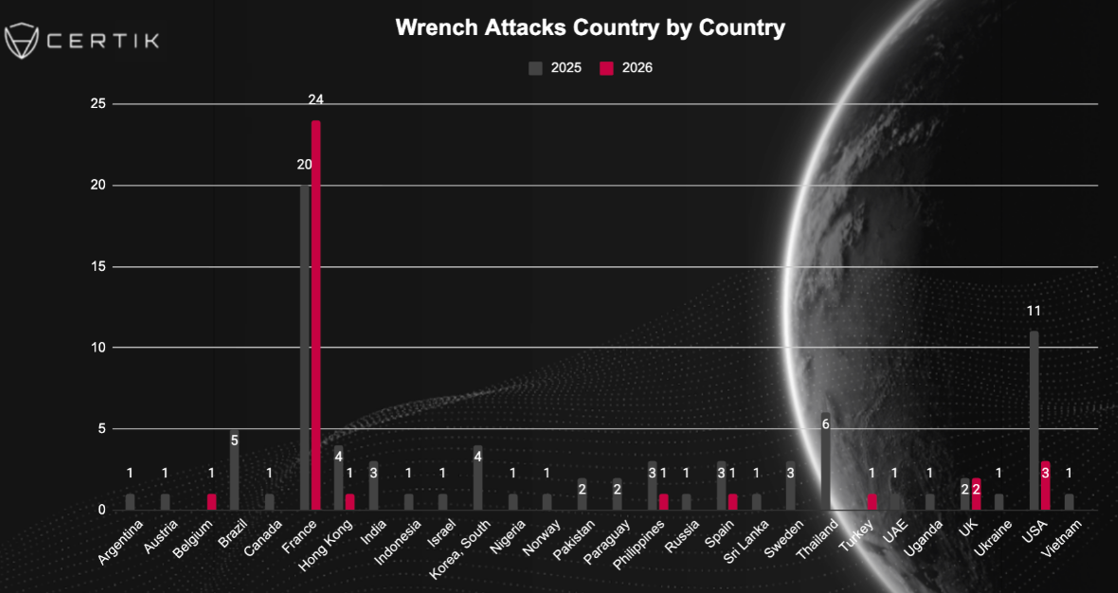
Preliminary police investigations have linked the attack to crypto. It comes amid a rise in crypto wrench attacks since 2025, with Web3 security company CertiK flagging Europe as a hotspot in a report earlier this month, with most attacks occurring in France.
CertiK added that most of these attacks are carried out by “complete amateurs” recruited through messaging apps like Telegram or Snapchat, with orchestrators located outside the country.
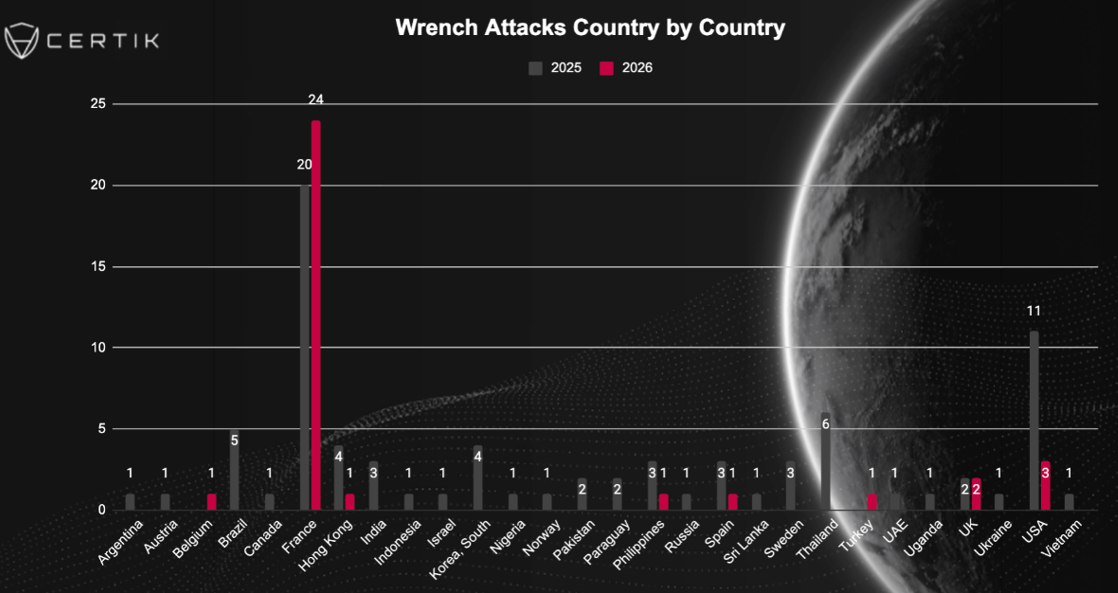
Countries across Europe, particularly France, have recorded a large number of wrench attacks this year. Source: CertiK
Four suspects still on the run
Borget’s wife was reportedly uninjured, and the four other members of the group are still on the run.
Blockchain intelligence company TRM Labs reported in May last year that wrench attacks have been on the rise because of the perceived pseudonymity of crypto transactions, the public visibility of wealth, and the ease with which bad actors can gather personal data online.
Related: Law enforcement freezes $41M connected to $150M crypto Ponzi collapse
The firm also said it is becoming common for bad actors to target family members of crypto holders. Last May, four men tried to abduct the daughter and grandchild of French exchange executive Pierre Noizat in Paris. In the same month, French police rescued the kidnapped father of a crypto entrepreneur who was being held for ransom.
Casa chief security officer Jameson Lopp has recorded 38 crypto-wrench attacks so far this year, according to his list of incidents dating back to 2014.
Magazine: Bitcoin ETFs bleed $1B, Aave’s $71M ETH unfreeze bid delayed: Hodler’s Digest, May 10 – 16
Crypto World
California Governor Acts on AI Workforce Disruption as Silicon Valley Sheds 114,000 Jobs


California Governor Gavin Newsom signed a “first-in-the-nation executive order” on Thursday to tackle artificial intelligence (AI) workforce disruption.
The order directs California to prepare workers, small businesses, and communities for economic impact from AI.
What the California Governor’s Order Covers
The order convenes a broad group of universities, economists, labor specialists, state agencies, and industry executives. They will draft new policies and track signals of where AI is cutting jobs.
The goal is to help California workers, not just tech firms, share in AI’s productivity gains. The policy menu includes new severance rules, employment insurance, and transition payments for displaced workers.
Other ideas under study include worker-owned company structures, universal basic capital programs, and broader job training. The order also seeks better hiring and payroll data so the state can spot layoff trends sooner.
“California has never sat back and watched as the future happened to us… Today is just the first step as we rewrite policy and direction, creating a future of work that works for all,” Newsom said.
Follow us on X to get the latest news as it happens
The Employment Development Department (EDD) will build a public dashboard tracking AI impact by sector. The Labor and Workforce Development Agency must recommend updates to the California Worker Adjustment and Retraining Notification (WARN) Act within 180 days.
The order also creates an AI playbook for job training and a single online portal for exploring government services.
Why California Is Acting Now
The action arrives as tech layoffs accelerate across Silicon Valley. Layoffs.fyi has tracked more than 114,000 job cuts at 150 tech companies in 2026.
ClickUp slashed 22% of its staff on Thursday. CEO Zeb Evans tied the cuts to his vision of a “100x organization.” Intuit announced 3,000 layoffs the same week.
Meta cut 8,000 jobs this week. Standard Chartered also plans to slash more than 15% of corporate function roles by 2030.
California, home to 33 of the world’s top 50 private AI companies, sits at the center of the disruption.
Subscribe to our YouTube channel to watch leaders and journalists provide expert insights
The post California Governor Acts on AI Workforce Disruption as Silicon Valley Sheds 114,000 Jobs appeared first on BeInCrypto.

Coinbase Premium Hits Monthly Low on Institutional Selling

10 Greatest Sci-Fi Thrillers of the Last 15 Years, Ranked

Airport workers back strike action during World Cup and peak holiday season


-

 Crypto World6 days ago
BloFin War of Whales 2026 Grand Prix opens registration for $5M trading championship
-

 Fashion7 days ago
Weekend Open Thread: Theory – Corporette.com
-

 Crypto World6 days ago
E-Estate Announces 1 Year Live: Washington DC Summit as Real Estate Tokenization Enters Its Next Phase
-

 Tech6 days ago
Google reimburses Register sources who were victims of API fraud
-

 Business7 days ago
H&R Real Estate Investment Trust (HR.UN:CA) Q1 2026 Earnings Call Transcript
-

 Entertainment7 days ago
David Letterman Returns to Late Show, Blasts Cancellation
-

 Sports6 days ago
Napoleonic enters 2026 Doomben 10,000 field via Abounding withdrawal
-

 Crypto World6 days ago
BeInCrypto 100 Institutional Awards Nomination: KAST for Best Digital Assets Neobank and Best Digital Assets Fintech
-
 Crypto World6 days ago
Bitcoin Battles US Bond Nerves With BTC Price Dip Toward New May Lows
-

 Crypto World6 days ago
ICE and CME urge US regulators to curb Hyperliquid energy trading
-
 Crypto World6 days ago
Wall Street’s Boldest Gold Prediction Has Russians Rushing to Buy
-

 Fashion6 days ago
Trending Western Style Vests Perfect for Summer
-

 Fashion5 days ago
On the Scene at Gucci’s Cruise Show in New York City: Mariah Carey, Kim Kardashian, Lindsay Lohan, Iman, and More!
-
 Crypto World6 days ago
IREN closes $3 billion convertible notes deal amid AI infrastructure expansion
-

 Politics6 days ago
Watch: far-right flag-fanatics run over victim, attack locals – Setup By the Left wing for your entertainment
-

 Fashion7 days ago
Creative Ideas for Custom T-Shirts
-

 Fashion5 days ago
Amazon Sundays: Memorial Day Hosting
-

 Crypto World12 hours ago
Blockchain.com files with SEC for U.S. IPO
-
 Fashion7 days ago
Philip Jones Wedding Jewellery For Women
-

 Crypto World6 days ago
Crypto Market Structure Bill Clears Committee; Senate Vote in Focus
You must be logged in to post a comment Login