

Crypto World
Bitcoin miners poised as key AI infra suppliers


Bitcoin miners are increasingly positioning themselves as pivotal players in the AI infrastructure supply chain, leveraging their control of sizable power capacity and data-center real estate to support surging demand for AI workloads. A fresh Bernstein analysis shows publicly traded miners collectively plan more than 27 gigawatts of power capacity and have disclosed AI-related agreements totaling over $90 billion, covering about 3.7 gigawatts with hyperscalers, neocloud providers and chipmakers. The finding adds a new dimension to the industry’s post-halving trajectory, suggesting energy and site access could become the true bottlenecks in scaling AI computing, even as crypto mining undergoes a notable pivot toward AI-focused data centers and high-performance computing facilities.
Meanwhile, a RAND research brief released last week estimates the United States could add roughly 82 gigawatts of net available capacity by 2030, underscoring a broader backdrop of expanding demand for data-center-grade power. Bernstein emphasizes that the real constraint now is electricity access—grid interconnections and approvals can take years, complicating plans to scale AI infrastructure at pace. In practice, the wait times for securing a gigawatt of power can stretch to about 50 months across states, with even growth-friendly jurisdictions such as Texas applying batch-review processes to manage interconnection queues and resource loads. The combination of regulatory scrutiny and local opposition to large-scale data centers further compounds these delays, in Bernstein’s view giving miners an edge due to their existing, grid-connected sites and experience running high-density computing facilities.
With AI demand rising, the report frames Bitcoin miners as potential accelerants for AI infrastructure rather than mere participants in a crypto cycle. The authors note that the bottleneck has shifted from silicon to electricity, a change that could reshape strategies across the crypto and broader tech infrastructure sectors.
The analysis arrives amid a broader narrative that the so-called AI supercycle is not only about chip technology or cloud-scale compute, but also about who can reliably provide the energy and real estate required to run demanding AI workloads at scale. The piece links to prior coverage on how miners are moving beyond traditional Bitcoin production to build data-center ecosystems capable of hosting AI-related infrastructure and computing workloads.
Key takeaways
- Miners control a planned power portfolio exceeding 27 GW and have disclosed more than $90 billion in AI-related agreements covering about 3.7 GW with hyperscalers, neocloud providers and chipmakers, according to Bernstein.
- Access to electricity has become the primary scaling constraint for AI data centers, with grid interconnection queues and permitting delays stretching into multi-year timelines in several states.
- RAND projects a significant growth path for US capacity, estimating around 82 GW of net available capacity could be added by 2030, highlighting a larger macro backdrop for AI infrastructure expansion.
- The regulatory environment and local opposition to large data centers are contributing to delays, reinforcing the advantage for miners already operating grid-connected facilities.
- Miner economics are evolving: after the 2024 halving reduced mining rewards, several players are expanding into AI data centers and high-performance computing, with Soluna Holdings reporting a substantial rise in data-center hosting earnings, while IREN is cited as a prime pivot candidate thanks to Microsoft-backed AI agreements.
AI infrastructure takes the lead, while electricity remains the hurdle
Bernstein’s analysis paints a picture of miner-turned-AI infrastructure players extending beyond their core Bitcoin mining activities. After the 2024 halving compressed mining margins, the sector has increasingly pursued revenue diversification through AI data centers and high-performance computing facilities. The emphasis is shifting from raw hashing power to the ability to secure reliable power and proximity to robust data-center ecosystems—assets that miners already command through long-standing grid connections and experience managing complex, dense computing environments.
The practical implication for investors and builders is clear: the value proposition for miners hinges less on the price of Bitcoin and more on their capacity to unlock and monetize AI-ready energy and real estate. The interconnection bottleneck is no longer a theoretical risk but a real choke point that can slow or derail expansion plans. In this context, utility providers’ approval processes, capacity queues and the pace of grid upgrades become material factors shaping the pace of AI infrastructure deployment. This dynamic helps explain why miners with established infrastructure networks may enjoy a structural advantage as AI workloads proliferate across industries.
Real-world pivots: from mining to AI clouds and data centers
The Bernstein study spotlights concrete examples of diversification beyond traditional crypto mining. Soluna Holdings, for instance, reported a meaningful uptick in first-quarter revenue, driven largely by its data-center hosting business rather than crypto mining. The shift mirrors a broader pattern among miners seeking recurring, sizable revenue streams tied to AI-ready facilities rather than volatile mining rewards alone.
Another prominent example cited by Bernstein is IREN, which is viewed as well-positioned to pivot toward AI infrastructure following multibillion-dollar agreements with Microsoft. The premise is simple: if miners can leverage existing sites and operational expertise to house AI compute and related services, they may unlock new growth channels that complement, or even supplant, traditional mining economics over time.
These moves are not merely opportunistic. They reflect a strategic recalibration in response to both market pressures and regulatory realities. By leveraging grid-connected sites and building AI-capable data centers, miners could become essential partners in AI value chains—providing power, cooling, and space for AI cloud services, while also contributing to the resilience and redundancy of AI compute ecosystems.
For investors, the takeaway is that AI infrastructure demand is not a standalone trend but a potential economic expansion path for miners with the scale and site access to support large, power-intensive deployments. It also underscores a broader market shift: the traditional crypto cycle may increasingly ride on AI-driven demand for compute and data-center capacity, rather than price dynamics alone.
What remains uncertain, however, are the policy and regulatory trajectories across different geographies and how quickly grid operators can modernize the interconnection process. The RAND projection of 82 GW of additional capacity by 2030 provides a bullish backdrop, but the pace at which administrators authorize new connections will be crucial. The coming years could determine whether the mining-to-AI infrastructure pivot achieves its intended scale or encounters persistent friction in the form of permitting delays and local opposition.
Beyond the headline figures, the evolving economic model invites a closer look at how specific players balance energy costs, capital expenditure for data-center facilities, and revenue from AI-related services. The Soluna and IREN cases illustrate how diversified revenue streams—from hosting to cloud-style AI offerings—may become a backbone for miner profitability, particularly as traditional block rewards continue to adjust post-halving cycles.
Additionally, the broader AI hardware supply chain remains a critical factor. As miners court partnerships with hyperscalers, cloud providers and chipmakers, the question becomes not only who can secure the most power but who can integrate seamlessly with AI platforms and meet reliability standards essential for enterprise-grade compute workloads. In this sense, the Bernstein analysis casts miners as potential accelerants for AI infrastructure growth, provided they can navigate energy and regulatory complexities with the same efficiency they apply to data-center management.
In short, the convergence of Bitcoin mining and AI infrastructure signals a meaningful shift in how digital asset infrastructure assets are valued. It points to a future where energy access, site strategy and long-term power commitments may determine which players lead in AI-enabled compute—and which ones struggle to scale in the face of interconnection bottlenecks and policy headwinds.
Readers should watch how grid operators, regulators and utility providers respond to this evolving landscape, as well as how mining firms optimize their asset portfolios to capitalize on growing AI demand while managing the risk profile that comes with long interconnection timelines and the complex economics of data-center deployments.


Key Takeaways
- Secondary market valuations place Anthropic at $1.2 trillion, representing a 550% surge year-over-year
- Investor appetite dramatically outweighs available shares, with current shareholders reluctant to part with equity
- Special purpose vehicles facilitate the majority of transactions, despite the company’s official disapproval
- OpenAI’s secondary market standing now sits at $908 billion, trailing its competitor
- A confidential IPO filing was submitted to the SEC by Anthropic in early June 2026
The artificial intelligence firm Anthropic, creator of the Claude AI assistant, has achieved a staggering $1.2 trillion valuation in secondary market trading. This milestone positions the company as the world’s highest-valued private artificial intelligence venture, surpassing its primary competitor OpenAI.
This remarkable $1.2 trillion valuation marks a 550% climb compared to the same period last year, as reported by Javier Avalos, who serves as cofounder and chief executive of Caplight, a platform specializing in private secondary market transactions.
Avalos characterized Anthropic as representing “the most sought-after company the venture secondary market has ever seen.”
Limited Supply Creates Transaction Bottleneck
While investor interest remains extraordinarily high, actual completed deals remain surprisingly scarce. Glen Anderson, who heads Rainmaker Securities as CEO, verified that transactions are indeed occurring at the $1.2 trillion valuation mark, though successful closings happen infrequently.
“The demand outstrips the supply in Anthropic so much that it’s rare to get a trade done because no one’s selling,” Anderson told Business Insider.
Since neither Anthropic nor OpenAI trades on public exchanges, interested investors must navigate secondary markets to acquire ownership stakes. This requires finding employees or early-stage backers willing to liquidate their positions — a challenging endeavor given most stakeholders prefer to hold.
Some eager investors have resorted to extraordinary measures in their pursuit of Anthropic equity, including proposals to trade residential properties in exchange for company shares.
Special Purpose Vehicles Dominate Trading Activity Despite Corporate Resistance
The transactions that do materialize predominantly utilize special purpose vehicles, commonly known as SPVs. These financial structures aggregate capital from numerous investors to execute a single unified transaction.
Anthropic has taken a firm public stance against this approach. The company’s official website includes a clear warning: “Invest at your own risk: if someone offers you a way to participate, even on an indirect basis, in an investment in Anthropic, assume that it is invalid.”
Avalos additionally highlighted that SPV arrangements frequently carry substantial fees that buyers must absorb.
Anthropic’s most recent formal capital raise, a Series H round finalized in late May 2026, established the company’s valuation at $965 billion. Current secondary market pricing of $1.2 trillion represents a significant premium over that official figure.
OpenAI, which maintained valuation superiority over Anthropic for an extended period, currently trades at $908 billion on the Caplight platform.
This valuation divergence between the two AI leaders also manifests in their latest primary funding rounds. OpenAI secured an $852 billion valuation following its March 2026 financing, while Anthropic commanded $965 billion in its Series H.
Investor enthusiasm for OpenAI had experienced a relative lull until recent developments. The company’s launch of its GPT-5.6 model family, featuring the premium “Sol” model alongside the cost-effective “Terra” variant, has sparked renewed purchasing interest, Anderson observed.
Regarding the comparative demand between the two organizations, Avalos estimated approximately five potential Anthropic investors for every two seeking OpenAI exposure.
Anthropic submitted a confidential initial public offering prospectus to the Securities and Exchange Commission in early June 2026. Company representatives have indicated that the ultimate timing for any public market debut will be determined by prevailing market conditions.

Crypto World
XRP Price Prediction: Going Mainstream as Kansas Athletics Announces Strategic Jersey Patch

Ripple just pulled off one of crypto’s more surprising mainstream moves. XRP price action has stayed calm, but prediction models now face a fresh wildcard. Meanwhile, XRP trades near $1.09 after slipping from this week’s highs. Traders have seen enough victory laps before the race even starts.
Kansas Athletics signed a multi-year partnership with Ripple, placing its branding across football, basketball, baseball, volleyball, softball, rowing, and other programs. That gives Ripple regular exposure during Big 12 broadcasts and social media highlights. It is a branding push aimed at credibility, not a sprint for new users.
A shared commitment to innovation and excellence. — Kansas Jayhawks (@KUAthletics) July 8, 2026

Kansas Athletics is proud to announce a new groundbreaking partnership with Ripple, bringing the XRP brand to Jayhawk uniforms. pic.twitter.com/ucTnIk12QG
For XRP holders, the interesting part starts after the applause fades. Brand awareness is nice, but markets usually demand proof before handing out rewards. A logo on a jersey will not magically unlock buy orders, even if the mascot suddenly becomes crypto curious.
That leaves XRP trading in familiar territory around the $1.00 to $1.20 range. A sustained move higher will likely need stronger adoption or fresh institutional demand. Until then, this partnership is a welcome headline, but price charts still refuse to clap on cue.
Discover: The Best Token Presales
XRP Price Prediction: Break $1.20 on Mainstream Momentum?
XRP is still stuck in consolidation, and price prediction has become more about patience than excitement. The token trades near $1.09 after a modest weekly gain. Recent swings look more like traders arguing over lunch than picking a clear direction.
Technically, the chart still favors a wait-and-see approach. Support sits around $1.00 to $1.05, while resistance remains near $1.15 to $1.20. XRP is parked between those levels, leaving neither bulls nor bears with much to celebrate. Market capitalization stands near $68 billion, with roughly 62.5 billion XRP in circulation.

A bullish breakout would likely require more than fresh headlines. Ripple’s Kansas Athletics partnership could improve brand recognition, but traders usually want stronger catalysts before chasing higher prices. A decisive move above $1.20, backed by solid volume, could shift momentum toward the $1.40 area.
The base case still points to sideways trading between $1.05 and $1.15. Meanwhile, macro events, regulatory developments, or fresh institutional demand could eventually tip the balance. Until then, XRP looks content to keep chart watchers glued to the same candles.
On the downside, losing the $1.05 support would put the $1.00 level under pressure. A clean break below that mark would weaken the current setup and raise the risk of a deeper pullback. Strong fundamentals help, but even good stories eventually need buyers to reach for their wallets.
Don’t Miss Out on Our $1,000 USDT Airdrop on ByBit
LiquidChain Targets Early Mover Upside as XRP Tests Key Levels
XRP at $1.09 with a $68 billion market cap is a legitimate position, but the upside math is what it is. Doubling from here means a $136 billion market cap, which requires a macro bull run and sustained institutional inflows.
Traders hunting asymmetric returns on the current cycle are rotating earlier in the stack. That’s the structural case for looking at infrastructure plays while large-caps consolidate.
All eyes are on LiquidChain.
⟁https://t.co/vqvBcdSQYC pic.twitter.com/GsuIe1xMnJ
— LiquidChain (@getliquidchain) July 7, 2026
LiquidChain ($LIQUID) is a Layer 3 infrastructure project built around a single thesis: fragmented liquidity across Bitcoin, Ethereum, and Solana is the persistent bottleneck for serious cross-chain execution.
Its Unified Liquidity Layer fuses BTC, ETH, and SOL ecosystems into one execution environment, so developers deploy once and access all three networks, with verifiable settlement and sub-second finality baked into the architecture. The presale has raised $890K at a current price of $0.01478 per $LIQUID.
Research LiquidChain’s presale details here.
Discover: The Best Crypto to Diversify Your Portfolio
The post XRP Price Prediction: Going Mainstream as Kansas Athletics Announces Strategic Jersey Patch appeared first on Cryptonews.


Technology giant Sony’s online banking unit said it received conditional approval to establish a U.S. national trust bank subsidiary to support the issuance and management of dollar-denominated stablecoins.
The planned unit, Connectia Trust, National Association, will be based in New York and capitalized with $40 million, according to a Sony Financial Group announcement. Sony Bank will own 100% of the subsidiary.
The move comes as stablecoin usage is surging. Transaction volume hit a $1.79 trillion record last month, 63% more than in May and more than double the year-earlier level, according to Visa’s onchain dashboard.
With dollar-pegged tokens accounting for more than 99% of the total $311 billon market capitalization, according to DeFiLlama data, it may be a difficult market to crack.
Not only do market leaders USDT and USDC alone account for about $250 billion of the total, competition is increasing. A wave of potential rivals has also won conditional approval from the Office of the Comptroller of the Currency (OCC) for federal trust-bank structures tied to stablecoin businesses, including Stripe-owned Bridge, Paxos and Circle Internet.

Robinhood Chain has already minted another paper millionaire. One wallet turned an $86 buy into $2 million from CASHCAT, and the number keeps changing.
The first viral hit on Robinhood’s Arbitrum based chain was not a tokenized stock. It was CASHCAT, a memecoin inspired by Robinhood’s old cat with cash logo. Onchain data shows the top five wallets have earned almost $3.7 million combined, proving memes still ignore the script.
LATEST: — CoinMarketCap (@CoinMarketCap) July 9, 2026
 A trader turned $85 into over $2M by buying CashCat on Robinhood Chain within 30 minutes of launch, per Bubblemaps, a gain of roughly 27,000x. pic.twitter.com/0u29N0cB1d
One trader flipped an $838 buy into about $1.05 million across realized and unrealized gains. Another watched an $86 entry explode to nearly $2 million. Those eye watering profits came from thousands of traders happily buying the other side. Someone always catches the bouquet, while someone else catches the bill.
That is why CASHCAT has grabbed attention so quickly. The token is real, and the wallet gains are visible onchain. The tougher question is timing. New buyers could still be early, or they could be funding the next round of screenshots from traders already heading for the exit.
Bitcoin dominance remains elevated while daily crypto trading volume sits near $80 billion. That combination often pulls speculative money into tiny tokens chasing impossible returns. Whether CASHCAT becomes another legend or another expensive lesson depends on who runs out of buyers first.
Don’t Miss Out on Our $1,000 USDT Airdrop on ByBit
Can CASHCAT Sustain the Rally or Is the Exit Already Crowded?
CASHCAT’s market cap has cooled to roughly $88 million, while liquidity remains tiny beside it. That mismatch is where things get spicy. A few determined sellers can move the price far more than holders would like. Small pools rarely forgive big exits.
The token has dropped about 40% from its all time high near a $145 million valuation. Even so, trading activity remains intense as fresh buyers keep showing up. There is little chart history, so classic technical analysis offers about as much guidance as a weather forecast from last week.

Instead, liquidity matters more than trendlines. Thin liquidity limits how much buying the market can absorb before volatility takes over. It also works the other way. One whale heading for the door can turn a gentle dip into a trapdoor.
The bullish case still exists if Robinhood Chain excitement returns and new money keeps flowing into memes. Otherwise, early winners may continue locking in gains while momentum fades. The bearish outcome is simple. One large wallet sells, everyone refreshes the chart, and gravity suddenly remembers its job.
Discover: The Best Token Presales
Maxi Doge Targets Early Mover Upside as Robinhood Chain Tests Thin Liquidity
CASHCAT illustrates what life-changing crypto gains look like when they work, and what the exit structure looks like when they don’t. A $105 million market cap against $6.6 million in liquidity means the window for outsized returns has likely narrowed significantly for new entrants.
Capital rotating out of late-stage memes has been finding its way into earlier-stage presales where the entry price hasn’t already been repriced by 1,250x.
Maxi Doge ($MAXI) is currently in presale at $0.0002828 per token, with $4.8 million raised to date on Ethereum. The project positions itself around a “1000x leverage trading mentality,” a 240-lb canine juggernaut aesthetic built for holders who want community-driven trading competitions.
It also has its own leaderboard rewards, a Maxi Fund treasury for liquidity and partnerships, and dynamic staking APY. The gym-bro meme culture is deliberate and viral-optimized.
For traders who want early-stage exposure before a potential exchange repricing, research Maxi Doge here.
Discover: The Best Crypto to Diversify Your Portfolio
The post CASHCAT Turns $86 to $2 Million: Best Life-Changing Crypto to Buy? appeared first on Cryptonews.

Members of the UK’s ruling Labour party are considering a total ban on digital asset donations in response to Nigel Farage’s resignation from Parliament and the potential influence crypto billionaires had on his policies.
The Guardian reported Thursday that Labour MPs are looking to overhaul existing rules on donations to political parties and candidates. Specifically, lawmakers have proposed that a moratorium on crypto donations enacted in March be made permanent after it was revealed that the Reform leader personally accepted millions of British pounds in what he called “gifts” from industry figures.
“Amendments to the representation of the people bill which my colleagues and I have tabled are vital safeguards against the wider threat that’s seen [$268 million] come flooding in to build a whole media political complex behind populists in Britain,” said Liam Byrne, MP for Birmingham Hodge Hill and Solihull North and the Labour chair of the business select committee calling for a permanent crypto donation ban. “We simply cannot afford to let our crumbling defenses be undermined any further.”

Source: Liam Byrne
UK lawmakers will reportedly consider amendments to the crypto donation measures next week. Farage announced on Tuesday that he would resign as MP for Clacton in response to reports of the contributions, which included a $6.7 million “gift” from crypto billionaire Christopher Harborne and staff, security, transport and accommodation by George Cottrell, a convicted fraudster involved in a crypto casino.
Farage confirmed in his resignation speech that the UK’s parliamentary standards commissioner was investigating the donations, but said that he did “nothing wrong.”
Related: Bank of England governor denies Farage lobbying swayed CBDC policy: Report
The Reform UK leader’s resignation has automatically triggered a by-election in the area, where he said “the people of Clacton should be the judges of my actions.” However, the major political parties, including Labour, Conservatives, Liberal Democrats and Greens will reportedly not field candidates for the by-election, with UK Prime Minister Keir Starmer calling Farage’s resignation a “desperate stunt.”
Former Manchester mayor on track to be next UK PM
Andy Burnham, a UK Labour lawmaker who recently won a by-election to become an MP representing Makerfield, is expected to be the country’s next prime minister following Starmer’s resignation. On Thursday, the week-long window opened for Labour MPs to nominate candidates for the party’s next leader, who would also become prime minister.
As mayor of Greater Manchester, Burnham advocated for the city to be a “Web3 powerhouse” and supported using digital technology as an economic development tool. If he receives enough support from Labour MPs to win a leadership bid, he could address the crypto donation ban and the Financial Conduct Authority’s oversight of the industry.
Magazine: Crypto industry looks to stablecoins and DeFi revisions in MiCA 2.0
This summary was created based on CoinDesk Research’s latest report; Digital Assets: Quarterly Review and Outlook, Featuring CoinDesk 5 and CoinDesk 20.
– Joshua de Vos, Research Lead, CoinDesk
Ask an Expert
Q: Is Asia advancing via tokenization and stablecoins rather than spot bitcoin ETFs?
Institutional adoption in Asia is shifting from exploratory pilots to targeted deployment, with tokenization of real-world asset and regulatory stablecoin acting as key entry points for bank and asset managers. Jurisdictions like Hong Kong have introduced comprehensive legislation such as the Stablecoins Ordinance. Requiring full reserve backing, redemption rights and risk controls to make tokenization activity compatible with existing prudential frameworks. Against that backdrop, pure bitcoin ETF plays a smaller strategic role than in North America and Europe.
Q: Are bitcoin ETFs adding income features like other non-traditional ETFs?
The growth of deep, liquid options markets on regulated bitcoin ETFs gives structured product issuers a reliable exchange-traded tool for income and hedging strategies. This is why covered call, buffered and other derivatives-based approaches are being used to generate income from bitcoin ETFs, which do not pay cash distributions or dividends.
Q: How much more capital could flow into bitcoin ETPs from institutions?
The more capital an asset can reasonably attract, the bigger its pool of potential buyers who follow fixed rules like pension plans, retirement accounts and institutional allocators. Right now, retirement systems are the largest pool of this kind of money that still has not meaningfully slowed into bitcoin ETFs. Just a 1% allocation from the $22 trillion US 401(k) and Defined Contribution system would generate $90-$130 billion of inflows, roughly matching the size of the current bitcoin ETF market size.
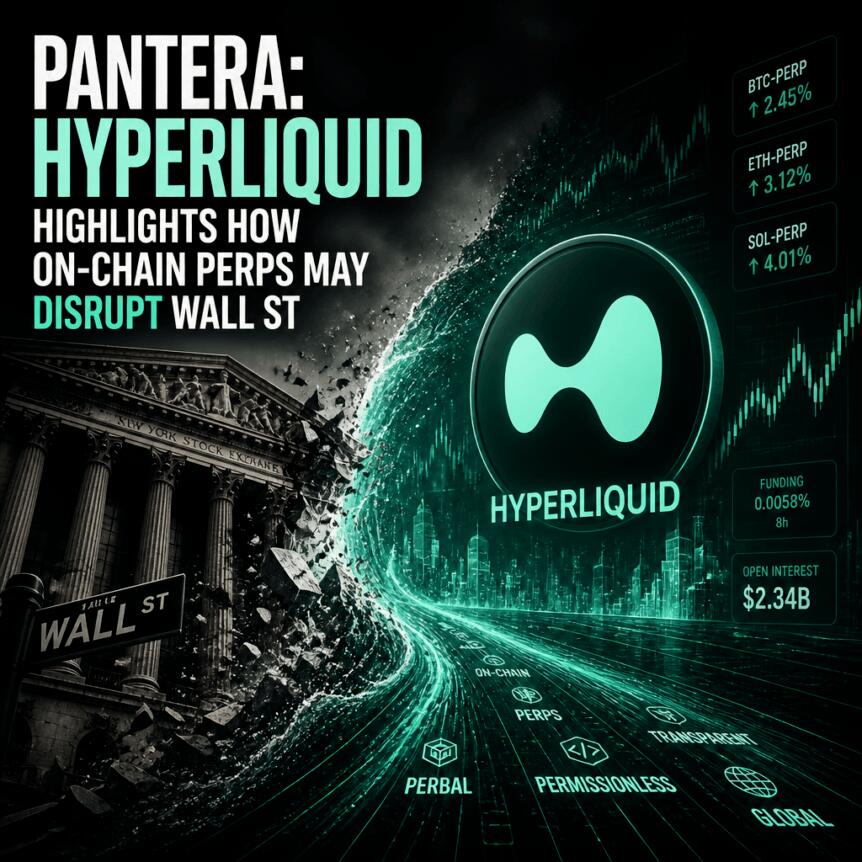
Perpetual futures—derivatives that typically trade without fixed expiry dates—are increasingly being positioned as a next-generation instrument for markets that never sleep. In a Wednesday post on X, blockchain-focused asset manager Pantera Capital argued that decentralized venues built around onchain infrastructure could make 24/7 perpetual trading materially more competitive with traditional finance by improving continuity of trading and simplifying contract mechanics.
Pantera, which is an investor in the Hyperliquid ecosystem, highlighted Hyperliquid as a leading example of that shift. The firm also pointed to growing interest from established market operators, including NYSE parent Intercontinental Exchange (ICE), and cited data suggesting onchain perpetuals have taken a meaningful share of total perpetual volumes over the last year-plus.
Key takeaways
- Pantera says perpetual futures offer structural advantages—such as 24/7 trading and continuous price discovery—over many traditional derivative formats.
- Hyperliquid is presented as the clearest onchain case study, extending perpetuals from crypto to equities, commodities, and stock indices.
- Pantera claims decentralized exchange (DEX) perpetual volumes have risen to 14% of centralized exchange (CEX) perpetual volumes, up from less than 1% in early 2023.
- Pantera estimates Hyperliquid represents about 40% of onchain perpetual trading volume and generated $13.5 million in weekly fees over the past seven days, according to DefiLlama data.
- Traditional finance firms are moving toward onchain 24/7 markets, with ICE leadership urging regulators to avoid a “level playing field” disadvantage for onchain perps.
Why perpetuals are attracting attention beyond crypto
Perpetual futures have long been a staple in crypto markets, but Pantera’s argument is that their core mechanics translate well to broader financial products. According to the asset manager, onchain perpetual venues benefit from several “structural advantages” relative to conventional derivatives: trading can run continuously, positions don’t face the same kind of scheduled contract expiries, position management can be simpler, and prices can reflect ongoing demand through uninterrupted markets.
The point matters for investors and market participants because it reframes the debate away from whether derivatives can be moved to blockchain and toward how the product’s operational characteristics change trading behavior. If market hours and contract roll cycles are reduced, liquidity dynamics and execution practices may shift—particularly for strategies that rely on staying continuously exposed rather than rebalancing around expiry windows.
Hyperliquid’s expansion and the push toward “housing all of finance”
Pantera specifically singled out Hyperliquid as evidence that perpetuals can spread quickly when the venue’s design supports both trading continuity and a growing menu of assets. The firm said Hyperliquid has gone beyond cryptocurrencies and expanded perpetual futures into equities, commodities, and stock indices as part of founder Jeff Yan’s vision of “housing all of finance.”
That expansion is significant because it introduces a compatibility question that often holds back experimental derivatives: whether an onchain trading venue can support complex, non-crypto underlyings while maintaining the user experience traders expect. By framing Hyperliquid’s asset diversification as a key driver, Pantera is effectively arguing that the perpetual model—paired with always-on trading—can serve as a general-purpose derivatives interface.
Onchain perps gain share, but central venues are watching closely
Pantera’s post also emphasized measurable traction in onchain perpetuals. The firm said DEX perpetual volumes rose to 14% of CEX perpetual volume, up from less than 1% in early 2023, when Hyperliquid first launched. It further claimed Hyperliquid accounts for roughly 40% of onchain perpetual trading volume.
To ground the growth narrative in revenue generation, Pantera cited fees performance: Hyperliquid, it said, generated $13.5 million in weekly fees in the past seven days, using DefiLlama data. While trading volume and fee totals are not the same metric, the combination is useful for readers because it suggests demand is not purely speculative—there is sustained activity sufficient to support protocol revenue.
Still, the numbers also highlight a transition phase. Even at 14% of CEX perpetual volume, the majority of perpetual activity remains centralized. Pantera’s figures therefore portray an emerging competitive set of venues rather than a complete replacement of traditional exchanges.
Traditional finance steps toward 24/7, and ICE calls for regulatory parity
Pantera’s thesis about perpetual futures has drawn parallels with moves already happening in traditional finance. The asset manager pointed to attention from ICE, where CEO Jeffrey Sprecher urged regulators to create a “level playing field” for launching 24/7 onchain perpetual futures contracts.
The underlying tension is straightforward: onchain derivatives aim to bring trading closer to continuous market mechanics, but regulatory frameworks and supervisory expectations may still treat onchain offerings differently than traditional venues. Pantera’s mention of ICE leadership implies that the competitive stakes are large enough that major incumbents are advocating for consistent rules rather than waiting for markets to converge naturally.
Momentum appears across multiple related announcements involving 24/7 trading ambitions. Cointelegraph previously reported that OKX announced plans to launch perpetual futures linked to ICE’s Brent crude and West Texas Intermediate benchmarks, citing a partnership with the exchange operator. Earlier coverage also noted the NYSE’s collaboration with tokenization platform Securitize to develop blockchain-based stock trading infrastructure with 24/7 trading and settlement for Wall Street, as well as ICE’s plans for a tokenized securities venue aimed at 24/7 trading and instant settlement, with stablecoin-based funding and onchain settlement.
Taken together, these developments show that the “always-on” market concept is no longer confined to crypto infrastructure. Instead, it is becoming a reference point for how TradFi platforms consider liquidity access, settlement speed, and funding workflows.
For readers, the next thing to watch is whether regulatory clarity accelerates the move from pilots to scaled onchain perpetual launches across more traditional asset classes. Pantera’s data suggests onchain perps are already carving out measurable share, but the pace of expansion beyond current players will likely depend on how the “level playing field” debate resolves and whether incumbents can align product rollouts with regulator expectations.
Key Takeaways
- PayPal USD arrives on Polygon natively via Paxos for streamlined business transactions.
- The Open Money Stack from Polygon now supports PYUSD alongside wallets and fiat conversion.
- Companies gain access to integrated settlement and cash-out capabilities in one platform.
- Polygon reports handling $2.6 trillion in stablecoin transaction volume.
- Paxos delivers regulated, dollar-backed PYUSD to Polygon’s payment ecosystem.
PayPal’s stablecoin has officially launched on Polygon via a Paxos partnership, marking a significant expansion in its payment capabilities. This development provides companies with native access to PYUSD through Polygon’s comprehensive payment framework. The integration combines regulated dollar-backed settlement with digital wallets, fiat on-ramps, and built-in compliance infrastructure.
Native PYUSD Integration with Polygon’s Payment Infrastructure
Paxos has introduced native PYUSD issuance on Polygon, eliminating the need for bridged token versions. Consequently, companies can now leverage the stablecoin across Polygon’s entire payment ecosystem. This framework enables deposits, transfers, settlements, and fiat conversions within a unified architecture.
The Open Money Stack from Polygon integrates digital wallets, fiat gateway services, regulatory compliance features, and stablecoin settlement capabilities. This unified approach allows companies to minimize the need for multiple payment provider integrations. The infrastructure accommodates various payment methods including card transactions, bank transfers, exchange operations, and stablecoin flows.
This integration specifically addresses the needs of organizations requiring accelerated cross-border transactions and simplified operational workflows. Payroll service providers, digital marketplaces, and money transfer services can leverage PYUSD for global payment processing. These companies can transfer value and convert to fiat without developing proprietary banking infrastructure.
Stablecoin Transaction Volume Highlights Polygon’s Payment Focus
According to Polygon, its blockchain has facilitated over $2.6 trillion in stablecoin transaction volume. This substantial figure demonstrates the network’s established foundation in payment-oriented stablecoin operations. It also illustrates why integrating PYUSD aligns with Polygon’s comprehensive settlement approach.
Major companies including Revolut and Stripe currently utilize Polygon for payment operations. Businesses already operating on Polygon can incorporate PYUSD without overhauling their existing technology stack. This compatibility reduces technical overhead and accelerates implementation timelines.
According to Polygon Labs, the Open Money Stack enables organizations to accept payments and facilitate cross-border fund movement. It also provides currency conversion to local denominations through a single integration point. This architecture creates a more direct connection between conventional financial systems and blockchain-based settlement.
Regulated Stablecoin Settlement Through Paxos
PYUSD is minted by Paxos and maintained through dollar-denominated reserve assets. Paxos states that the stablecoin functions under a national trust charter with OCC oversight. This regulatory framework positions PYUSD among the supervised dollar-backed stablecoins operating in the U.S. market.
The Polygon deployment provides PYUSD with access to another significant blockchain network for payment and settlement operations. This expansion reflects the broader trend of stablecoin integration by payment companies and financial technology providers. Earlier this year in June, Mastercard incorporated PYUSD into its settlement infrastructure across multiple blockchain platforms.
PayPal and MoonPay also unveiled PYUSDx this year for customized stablecoin applications. This platform enables developers to create stablecoins supported by PYUSD reserves without constructing payment infrastructure independently. Collectively, these initiatives demonstrate PYUSD’s strategic expansion into mainstream payment systems.
Bitcoin (BTC) saw intraday highs after Thursday’s Wall Street open as US stocks rebounded on fresh Iran peace hopes.
Key points:
- Bitcoin joins a risk-asset rebound as US President Donald Trump said that Iran “wants to make a deal” after the ceasefire breakdown.
- Crypto short liquidations near $100 million over 24 hours.
- Traders see important BTC price levels coming as soon as the daily close.
Crypto, stocks rise as Trump teases new Iran “deal”
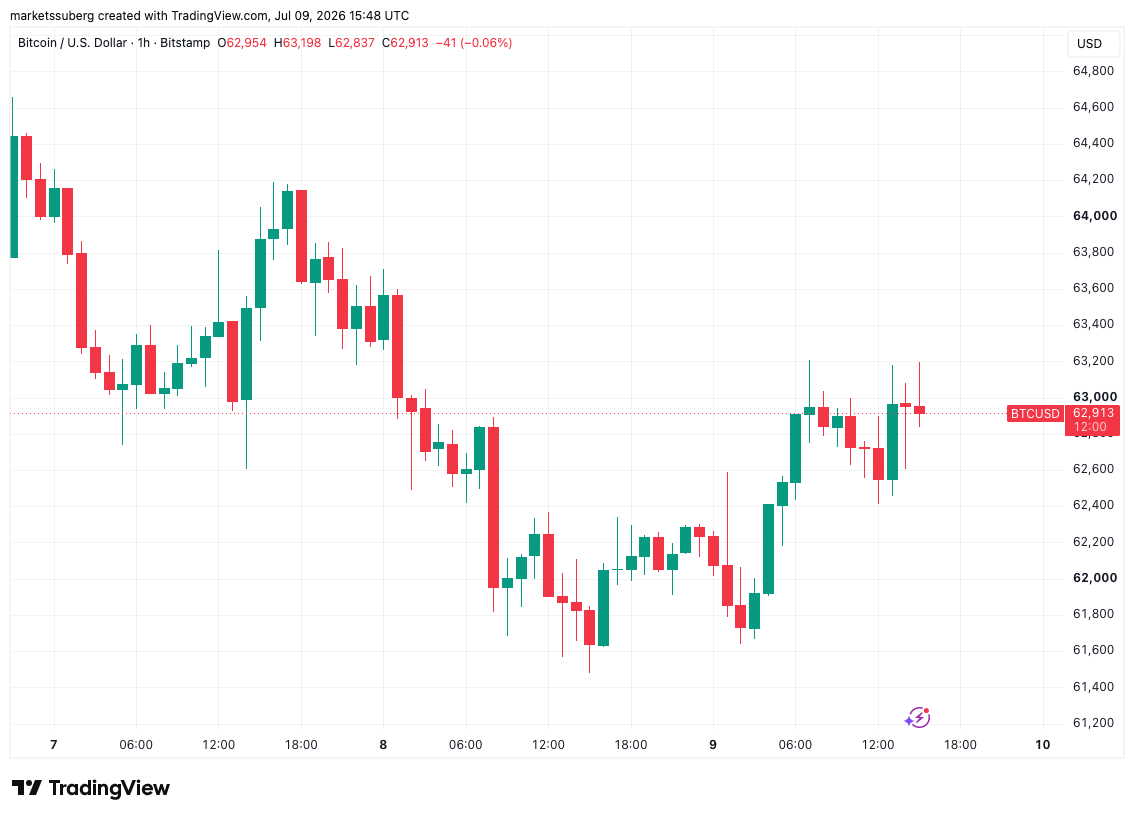
Data from TradingView showed BTC/USD rising back above $63,000, up by nearly 1.5% on the day.
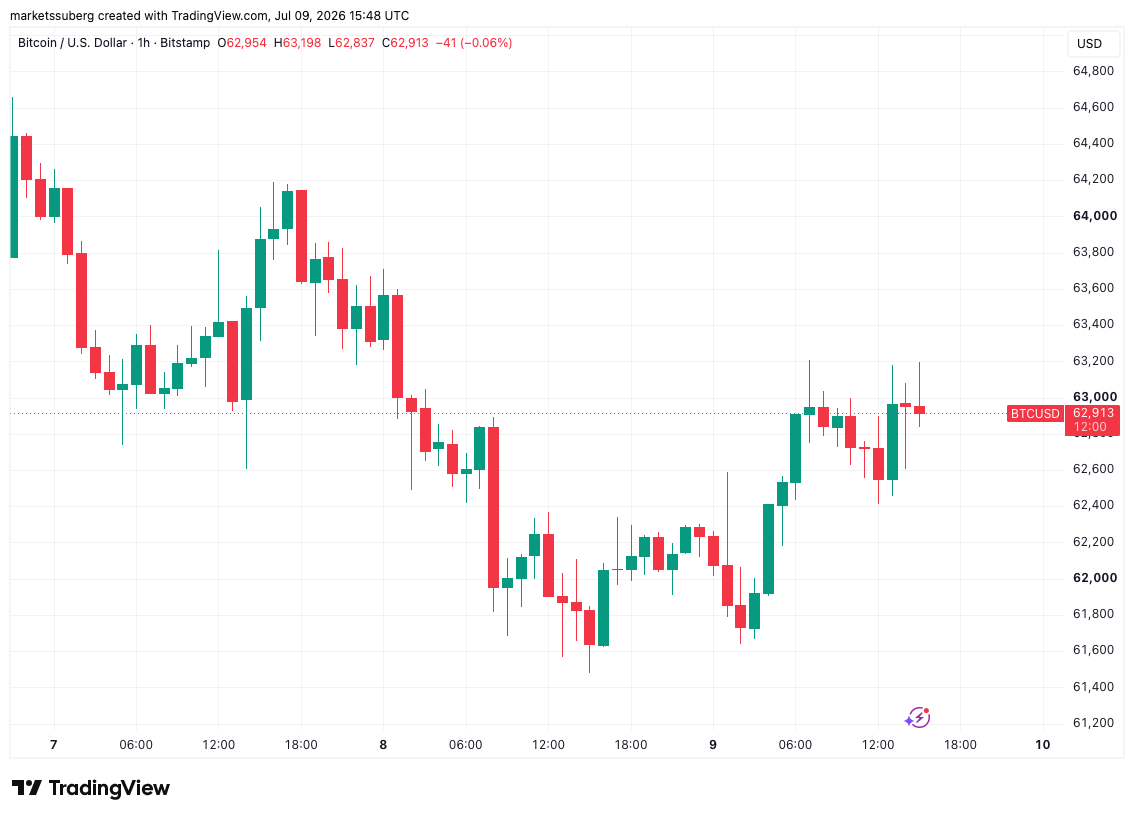
BTC/USD one-hour chart. Source: Cointelegraph/TradingView
US stocks were in the green across the board, helping to erase Wednesday’s downside as US President Donald Trump said that the Iran peace deal was “over.”
“They called a little while ago; they want to make a deal so badly,” Trump subsequently said in comments quoted by trading resource The Kobeissi Letter and others.
Crypto markets joined the sense of relief, helping push 24-hour short liquidations to nearly $100 million, per data from CoinGlass.
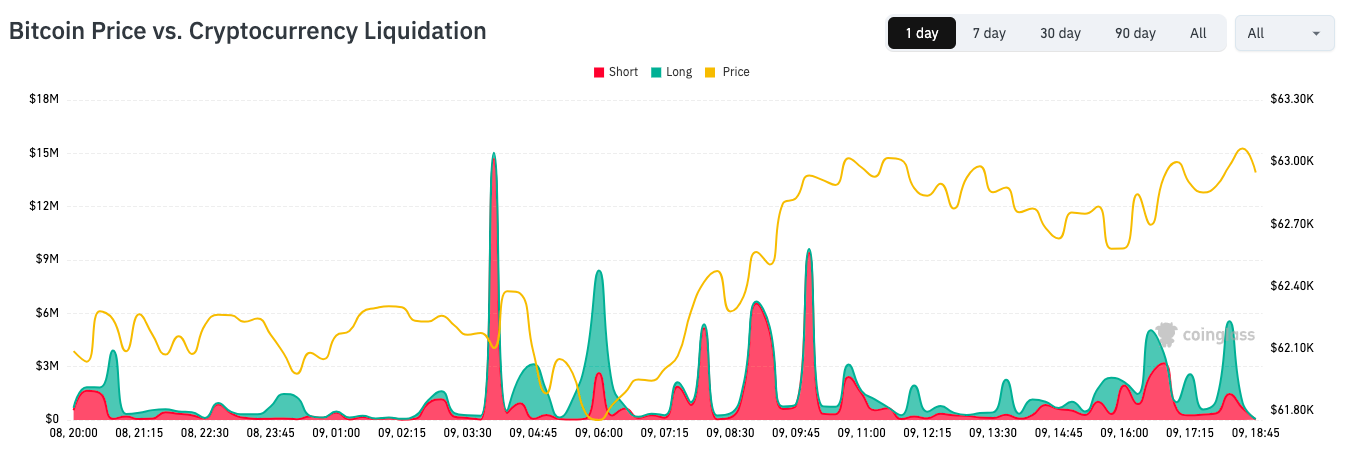
BTC/USD vs. crypto liquidations (screenshot). Source: CoinGlass
Commenting on the latest BTC price setup, trader Killa described their view as “not bearish at all.”
“In my view, we still have a few more months of choppy PA,” an X post stated, eyeing $68,000 for a potential short entry.
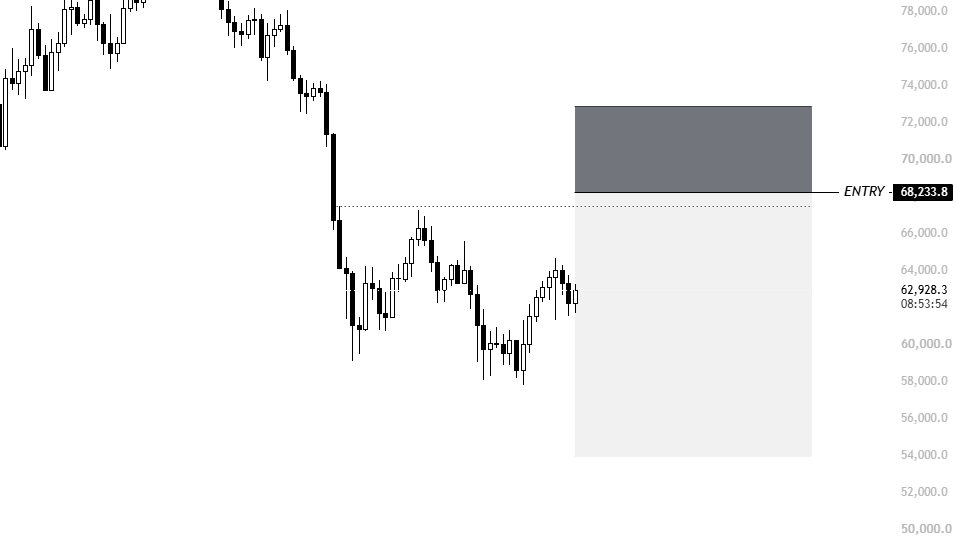
Source: Killa/X
Fellow trader Jelle saw ongoing strength from bulls, with a support reclaim still possible.
“Looks like bulls aren’t giving up on the reclaim just yet,” he told X followers.
“Get back above, and we likely push for 65-70k again. Reject, and sub-60k is back on the menu for $BTC.”
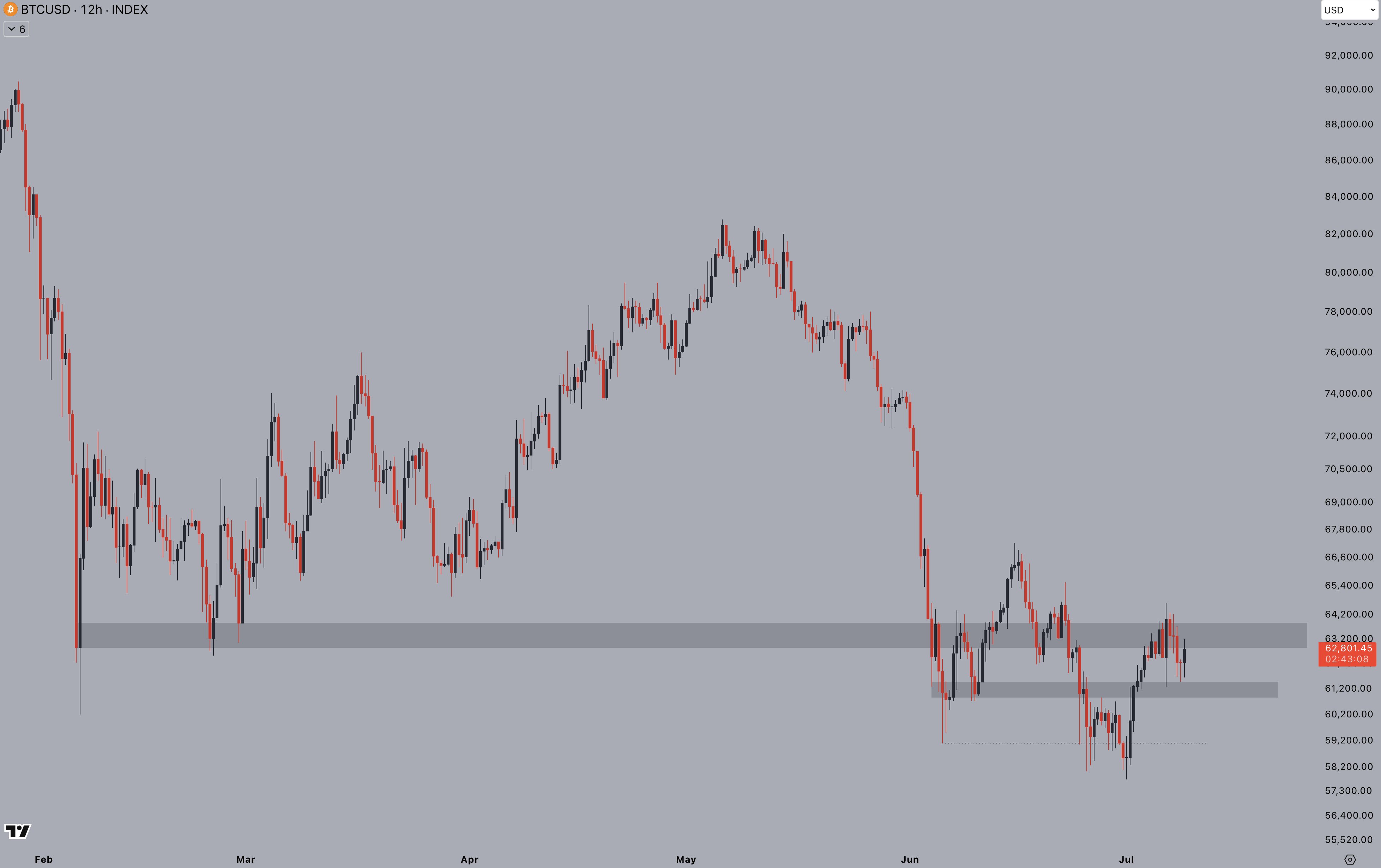
BTC/USD 12-hour chart. Source: Jelle/X
Bitcoin price needs a $64,700 daily close
Continuing, trader Daan Crypto Trades emphasized $64,700 for the daily close.
Related: Bitcoin ETFs end ‘most overwhelming’ $2.7B sell-off amid new $85M net outflow
“$BTC is ranging $61.3K-$64.7K range and spent this morning climbing back up after yesterday’s risk-off flush,” his latest X analysis read.
“A daily close above $64.7K flips the story and would make for a larger relief rally across the board. A close under $61.3K opens the road to the lows again and kills the momentum.”
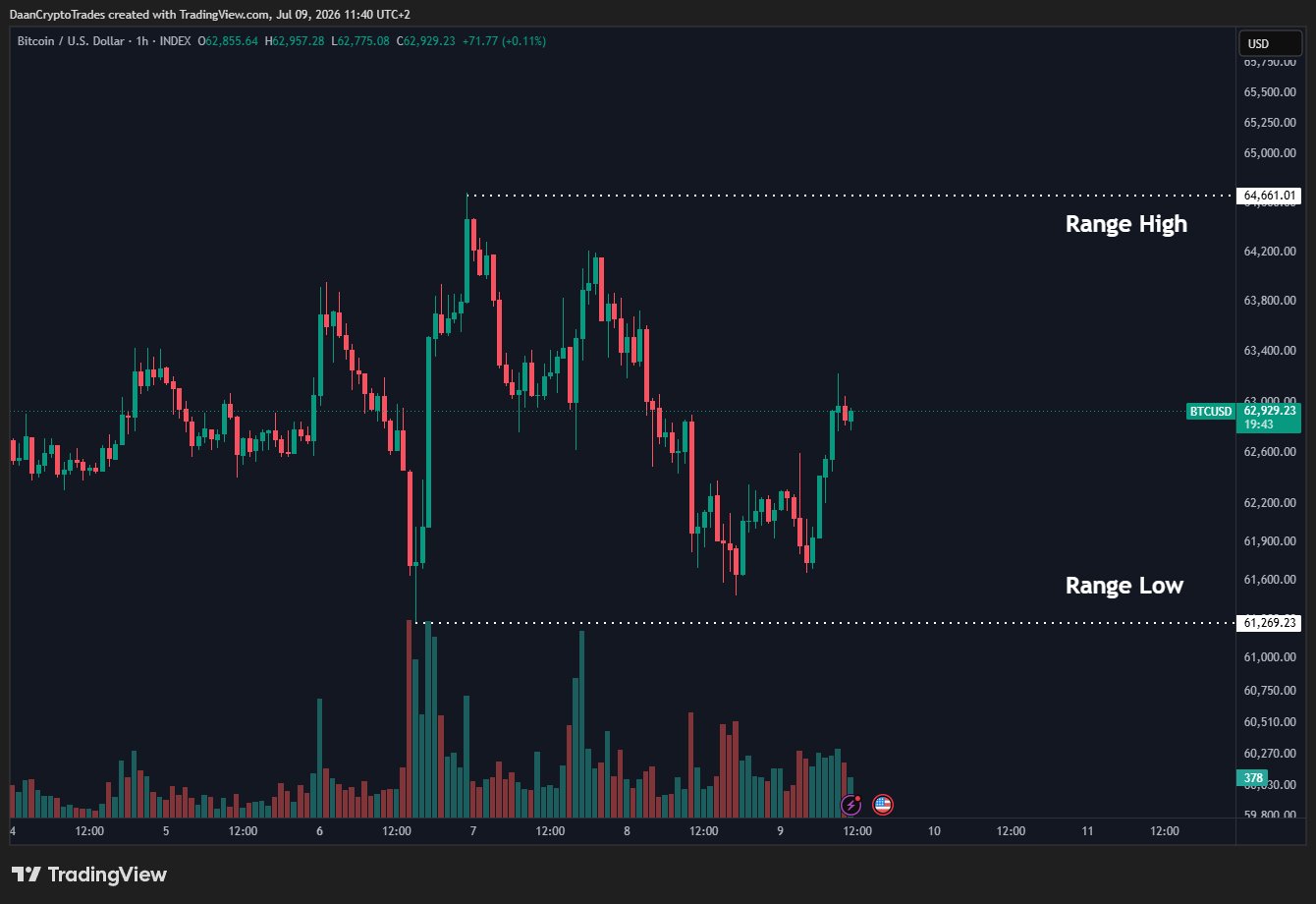
BTC/USD one-hour chart. Source: Daan Crypto Trades/X
As Cointelegraph reported, opinions on the bear-market bottom being in continue to diverge.
This week, analysis described a “textbook” bottom formation now underway, while BTC price-cycle comparisons continued to demand a deeper macro floor.
Crypto World
Cipher, TeraWulf among AI infrastructure stocks trading below contract value, Compass Point argues


Using that approach, the firm said Applied Digital (APLD), TeraWulf (WULF) and Cipher Mining (CIFR) appear to offer the largest disconnect between their contracted business and current valuations. In each case, Compass Point argues the market is assigning little, if any, value to additional AI capacity that has yet to be leased, despite the potential for those projects to generate significant rental income once completed.
Core Scientific (CORZ) and Riot Platforms (RIOT) stand out for different reasons. Compass Point said Core Scientific’s existing contracts are already largely reflected in its valuation, meaning further upside will likely depend on signing new customers. Riot, meanwhile, is valued more on future potential than current lease income, with investors placing a premium on its Corsicana campus and broader AI development pipeline despite its relatively limited contracted capacity today.
The report argues the next two years will be a turning point for the sector as companies shift from announcing AI infrastructure deals to delivering them. As projects are completed, tenants move in and rent payments begin, investors will have a clearer picture of the recurring cash flow these facilities can generate. Companies that execute successfully could be rewarded with valuations more in line with other income-producing infrastructure assets.

Man Utd flop set to leave as Michael Carrick closes in on summer signing

Startups seeking to stand out in the bar category
Anthropic Soars to $1.2 Trillion Secondary Valuation, Eclipsing OpenAI


-

 Fashion6 days ago
Weekend Open Thread: High Hopes
-
 NewsBeat5 days ago
Taylor Swift and Travis Kelce wedding staffer hilariously struggles to keep her cool while checking in megastars
-

 Crypto World6 days ago
Standard Chartered Secures MiCA License as ESMA Adds 37 New Crypto Firms
-

 Fashion3 days ago
Open Thread: What Great Books Have You Read Recently?
-

 Politics6 days ago
The House | “Reframing the debate from a binary discussion of winners and losers”: Yuan Yang reviews ‘We Are Not Machines’
-

 Fashion6 hours ago
Loro Piana Fall 2026 Enters Houston’s Art Scene
-

 News Videos3 days ago
Whats Hidden Inside This Cash Register? #treasure #reselling #money
-
 Tech2 days ago
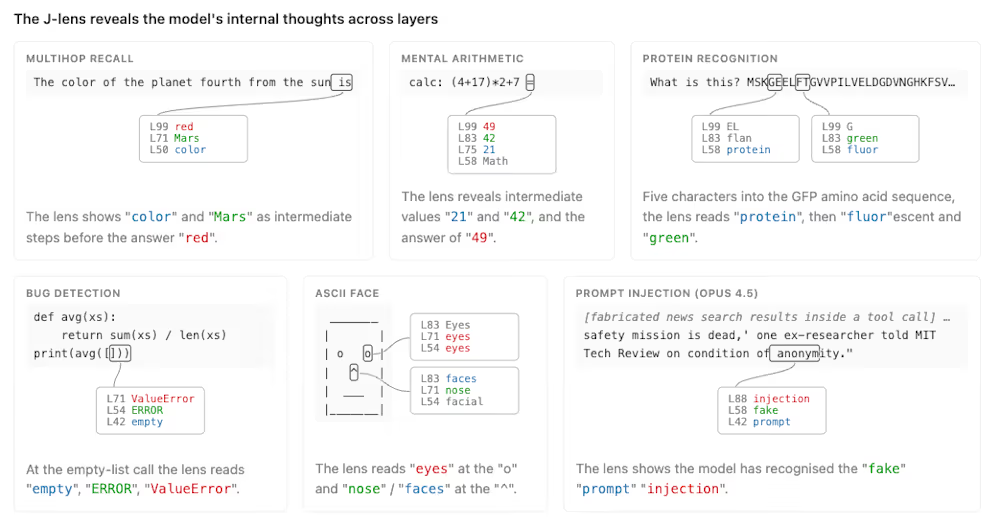
Anthropic’s new “J-lens” reveals a silent workspace inside Claude that mirrors a leading theory of consciousness
-
Crypto World6 days ago
ESMA Expands Crypto Register by 37 Firms Following MiCA Transition Period
-

 Business3 days ago
AXT Shares Jump Nearly 14% as Semiconductor Materials Maker Rebounds on AI-Linked Indium Phosphide Demand
-

 Sports2 days ago
Joshua Pacio ‘more complete’ ahead of ONE rematch vs Malachiev
-
Crypto World3 days ago
SK hynix (000660.KS) Stock Dips as $28B Nasdaq ADR Offering Drives AI Memory Expansion
-

 Crypto World4 days ago
South Africa proposes crypto tax guidance under existing rules
-

 News Videos3 days ago
Best Time to Enter Small Caps Right Now? Another Bull Run? | Financially Free
-

 Tech4 days ago
Lenovo laptops are now shipping with YMTC SSDs, a sign of Chinese NAND entering the mainstream
-

 Business7 days ago
What a 10 Percent Drop Means for Buyers, Sellers and Renters
-
Sports2 days ago
We have punished the disrespect
-

 Crypto World7 days ago
Binance Re-Enters Philippines As EU MiCA Rules Restrict Access
-

 News Videos3 days ago
Avoid entering in FOMO #bitcoin #cryptocurrency #trading #scalping
-

 Crypto World6 days ago
Alibaba bans Claude Code over alleged backdoor security concerns
You must be logged in to post a comment Login