
Crypto World
Bitcoin Miners’ Position Index Hits Historic Low: Strength Signal or Early Warning Sign?

TLDR:
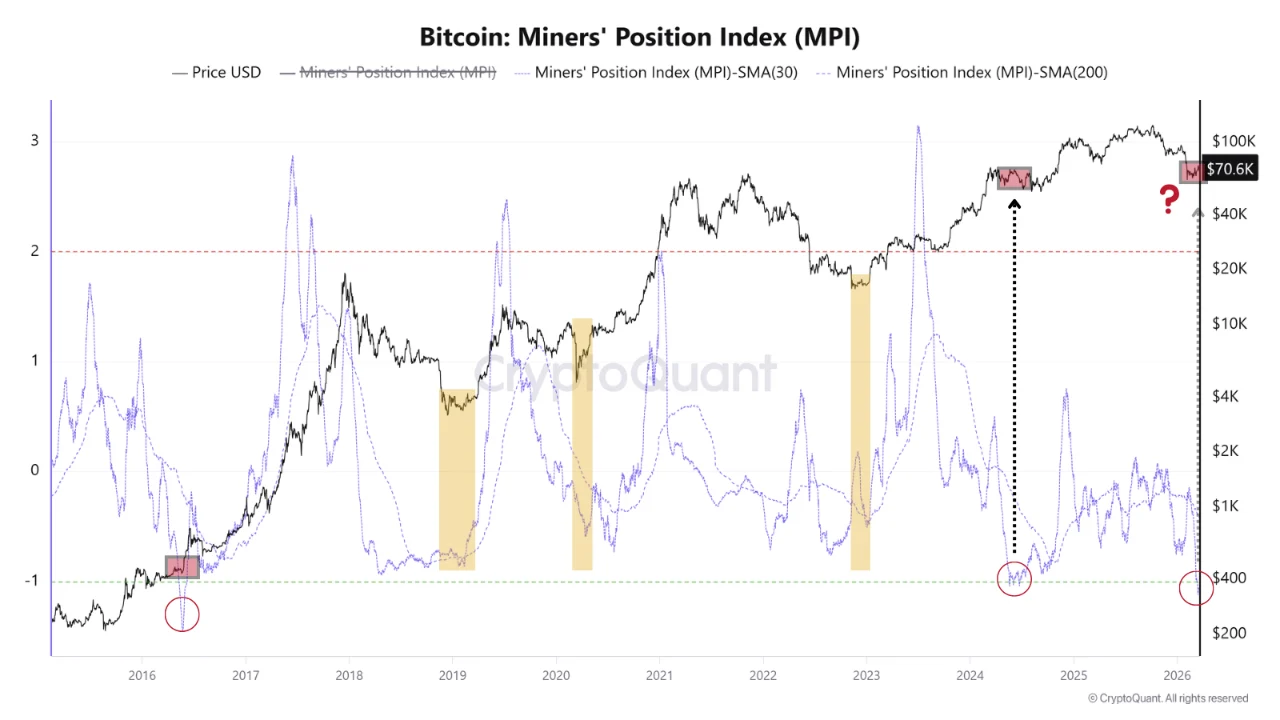
- Bitcoin Miners’ Position Index has dropped to -1.04, marking one of the lowest readings in its recorded history.
- Extreme low MPI reflects minimal miner selling pressure, suggesting miners may be holding rewards in anticipation of higher prices.
- Historically, Bitcoin price recoveries emerged as MPI rose from depressed levels, not at the moment it hit its floor.
- Low MPI removes a key structural headwind, but sustained price movement still depends on demand-side confirmation signals.
Bitcoin’s Miners’ Position Index (MPI) has fallen to -1.04, one of the lowest readings ever recorded in its history. This is only the third time the 30-day moving average has neared the -1 threshold.
At this level, miners are sending far fewer coins than their one-year average reflects. The sharp drop in outflows raises a critical question across the market: does extreme miner inactivity signal quiet accumulation and strength ahead, or does it mask a deeper structural warning?
The Case for Hidden Strength Behind Miner Inactivity
When miners hold block rewards rather than move them to exchanges, sell pressure from one of Bitcoin’s most consistent natural sellers drops sharply.
The Miners’ Position Index measures outflows against a one-year historical average, and a reading of -1.04 places current miner behavior near the bottom of its entire recorded range. That level of restraint does not happen frequently.
Analyst MorenoDV_ noted the reading publicly, describing it as one of the lowest MPI prints in Bitcoin’s history. He pointed out this is only the third time the 30-day moving average has approached the -1 mark.
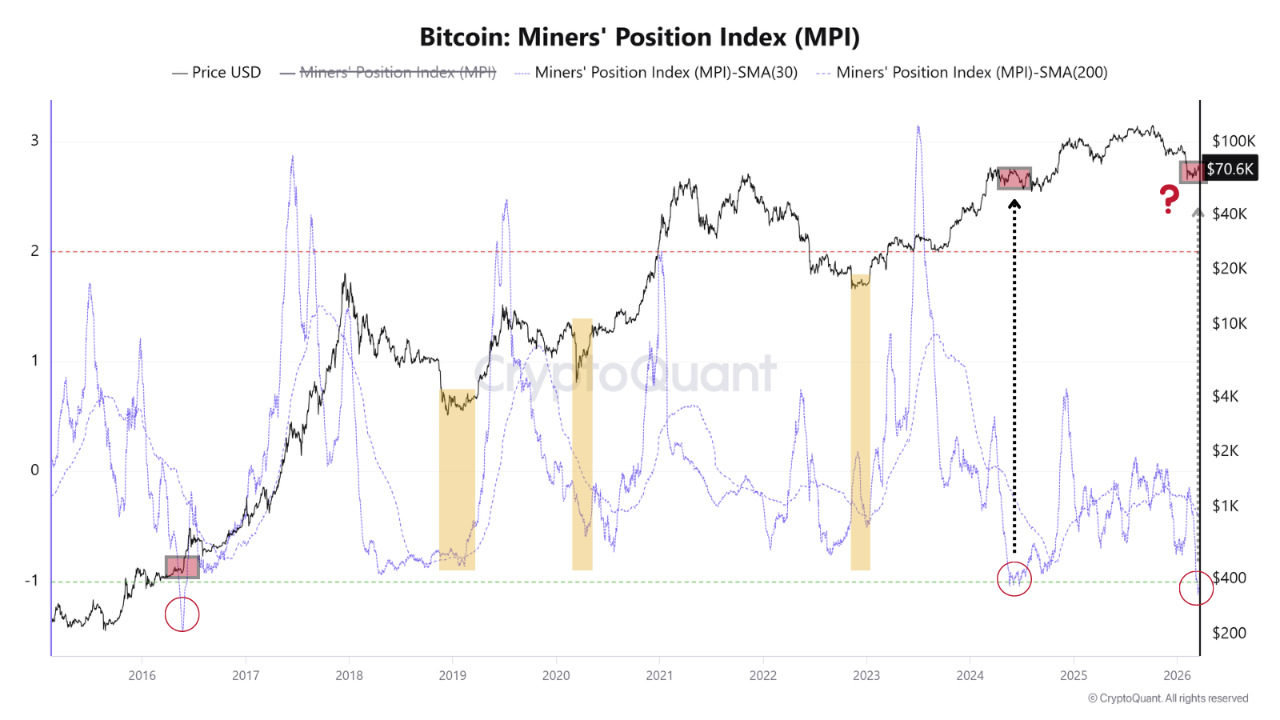
Source: Cryptoquant
According to his analysis, miners appear to be either accumulating block rewards or anticipating higher prices ahead.
From a supply perspective, reduced miner distribution removes a persistent structural headwind. Miners have long represented a consistent source of selling in the market, given their need to cover operational costs. When that flow dries up at this scale, available sell-side supply contracts meaningfully.
That contraction does not guarantee price appreciation on its own. However, it does create conditions where demand-side forces face less resistance.
In that context, extreme miner inactivity can reasonably be read as a quiet form of market strength rather than passive behavior.
The Silent Warning Embedded in Extreme Low MPI Readings
Historical patterns complicate any straightforward bullish reading of extreme low MPI levels. Most Bitcoin cyclical price lows did not form precisely at the moment MPI hit its floor.
Instead, price recoveries tended to emerge as the metric began rising from those depressed levels, not while it sat at the bottom.
Extreme low MPI readings have also historically coincided with periods of miner stress, compressed margins, and macro uncertainty.
That context matters. Inactivity at this scale can reflect miners unable or unwilling to sell, rather than miners confidently holding in anticipation of gains.
MorenoDV_ acknowledged this nuance directly in his analysis. He noted that the absence of miner selling alone cannot sustain upward momentum without clear demand expansion.
Spot flows, ETF inflows, and derivatives positioning all remain necessary catalysts that MPI does not capture.
The signal becomes more actionable when MPI begins recovering from these lows alongside improving market conditions.
Until that recovery takes shape, extreme miner inactivity sits in an ambiguous space. It reduces one headwind, but it does not confirm the demand-side engagement needed to drive a sustained directional move.



SBI Holdings has moved to expand its crypto presence by opening talks with Bitbank on a possible share acquisition. The planned deal could bring Bitbank under SBI as a consolidated subsidiary, strengthening its exchange network in Japan.
While key terms remain undecided, the discussions come soon after SBI’s Bitpoint merger, signaling faster consolidation in the country’s digital asset market as firms prepare for regulatory changes.
Move Follows SBI’s Bitpoint Merger
The talks come soon after another SBI crypto move. In April 2026, SBI VC Trade absorbed Bitpoint Japan through a merger.
That deal added another exchange business to SBI’s crypto operations. The Bitbank talks now show further expansion in the same market.
Japan’s crypto sector is also moving through a period of change. Regulators are discussing how crypto assets should be handled under financial market rules.
SBI’s latest step comes as large firms prepare for tighter oversight. It may also help the group combine exchange services under one structure.
If the deal is completed, SBI would control several major crypto platforms. That would increase its presence in Japan’s digital asset market.
Bitbank’s IPO Path Remains in Focus
Bitbank had earlier prepared for a Tokyo Stock Exchange listing. Reports said the company aimed to list by mid-2025.
The company also raised about 7 billion yen in 2021. That funding came through a capital and business alliance with Mixi.
Mixi became a major shareholder with a 26.2% stake. The investment helped Bitbank build an independent growth plan.
The new SBI talks may affect Bitbank’s listing path. Investors will watch how the share talks develop from here.
Bitbank has also promoted its security record since its founding. The company has said it has had zero hacking incidents.
Its stated vision is “realizing an open and fair society.” SBI may see that record as useful for wider financial services.

JPX is moving closer to a possible crypto ETF launch in Japan, with 2027 seen as the earliest target. CEO Hiromi Yamaji said preparations can begin once legal reforms and tax rules become clear.
The move comes as Japan reviews how crypto assets are classified and taxed, while asset managers show growing interest in regulated crypto investment products.
Jpx Waits for Legal Clarity Before Etf Launch
Japan Exchange Group may move ahead with crypto ETFs once the legal process is complete. The company operates Japan’s main securities markets. So, its role could shape future crypto investment products.
Yamaji told Bloomberg that JPX is ready to prepare when laws and taxes are clear. He said, ‘If the legal framework is in place and tax treatment is clear, it can be done anytime.’
The earliest listing could happen in 2027. However, the timing may shift to 2028 if law changes take longer.
Japan has not yet approved spot crypto ETFs in the same way as some other markets. For that reason, market operators are waiting for clear rules before listing such products.
Japan Reviews Crypto Tax Treatment
Japan is also reviewing how crypto gains should be taxed. Current rules treat many crypto gains as miscellaneous income. That can lead to tax rates as high as 55%.
A new tax proposal may place some crypto assets under financial product rules. If passed, certain gains could face a flat 20% tax rate. This would be closer to the system used for stocks.
The proposal may also allow losses to be carried forward for up to three years. That rule already applies to some financial products in Japan. It could help investors manage losses from market swings.
However, the plan may not cover every crypto activity. Staking, lending rewards, and NFTs may still need separate treatment. Final details will depend on future legislation.
Asset Managers Show Interest in Crypto ETFs
Yamaji said many asset managers have shown interest in crypto ETFs. These funds could give investors exposure to crypto through regulated markets. They may also offer a familiar structure for retail and institutional buyers.
Japan’s Financial Services Agency has supported wider debate on crypto reclassification. The move could bring crypto closer to traditional financial products. It may also support rules on market abuse and investor protection.
Still, the process remains unfinished. Lawmakers must decide how crypto assets should be defined and taxed. Regulators must also decide which assets can qualify for ETF products.
JPX is now watching the pace of reform. A 2027 launch remains possible, but the schedule depends on final rules. The next stage will decide how Japan opens its listed market to crypto ETFs.
Brazil’s central bank, Banco Central do Brasil (BCB), has barred the use of virtual assets in certain regulated international payment and transfer services, tightening rules for cross-border payment providers operating under the country’s eFX framework.
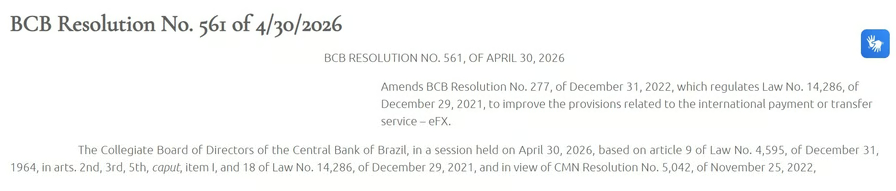
On Thursday, BCB published Resolution BCB No. 561, amending existing rules for eFX, a regulated category covering international payments and transfers. The resolution states that payments or receipts between an eFX provider and its foreign counterparty must be carried out exclusively through a foreign exchange transaction or movement in a non-resident Brazilian real account, with the use of virtual assets prohibited.
The restriction also applies under transitional rules for eFX providers that are not yet listed among approved provider categories. Those firms may continue providing eFX only if they apply for authorization from the central bank by May 31, 2027, but their payments and receipts must still use foreign exchange transactions or non-resident real accounts, not virtual assets.
The rule does not amount to a blanket ban on crypto transfers in Brazil. Instead, it closes off the use of crypto and stablecoins inside the regulated eFX channel, reinforcing the central bank’s effort to keep cross-border payment flows within supervised foreign exchange rails.

English translated excerpt of the BCB Resolution No. 561. Source: BCB
Brazil tightens oversight of crypto-linked cross-border flows
Brazil has been moving to fold virtual assets into its financial and foreign exchange rulebook as stablecoins become a larger part of the country’s crypto activity.
In November 2025, the central bank detailed new rules for virtual asset service providers, including authorization requirements and rules for services involving virtual assets in the foreign-exchange market.
The central bank’s push follows concern over the use of stablecoins for payments and cross-border transfers. In February, Reuters reported that BCB Governor Gabriel Galipolo said that crypto use had surged in the country over the previous two to three years, with about 90% of flows linked to stablecoins. He said that raised concerns around taxation, money laundering and asset backing.
Related: Spain emerges as leading EURC retail market in Europe, Brighty data shows
The eFX rule comes as Brazil’s central bank has also signaled concern over stablecoins issued by companies outside its regulatory perimeter. In a technical note sent to Congress and seen by Cointelegraph Brasil, the central bank said stablecoins issued by entities not subject to BCB supervision could face a ban or strict conditions in the domestic market.
The document said real-denominated stablecoins issued outside BCB supervision may pose risks to regulatory equality and monetary sovereignty, while foreign-currency stablecoins raise concerns around jurisdiction, capital flows and fragmentation of the payments system.
Magazine: AI-driven hacks could kill DeFi — unless projects act now
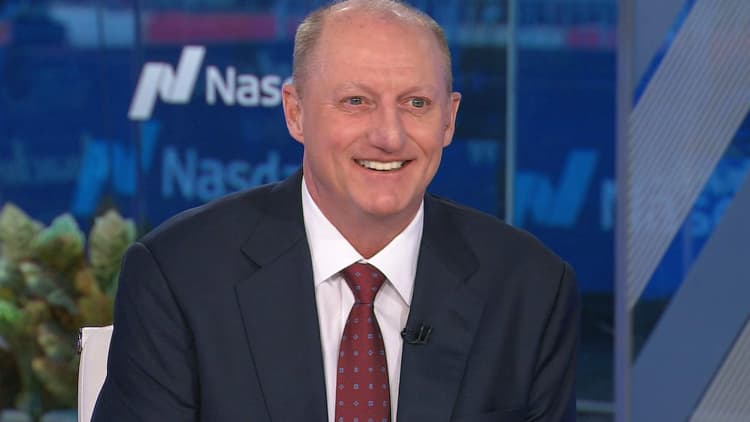

For decades, Berkshire Hathaway‘s annual meeting has doubled as a kind of financial Woodstock, drawing tens of thousands to hear Warren Buffett dispense homespun wisdom, crack jokes and field hours of questions.
This year will be different.
For the first time, the 95-year-old Buffett won’t be the central figure on stage, marking a new era for one of the investing world’s most closely watched rituals. The shift puts a spotlight on Greg Abel, who took over as CEO at the start of 2026, and raises a question hanging over Omaha: what does Berkshire look like without the man who defined it?
Investors and analysts said the tone is likely to move away from Buffett’s signature mix of investing philosophy and life advice toward a more business-focused discussion of operations, capital allocation and a more granular view into the conglomerate’s inner workings.
“Clearly, nobody can replace Warren on the stage,” said Macrae Sykes, a portfolio manager at Gabelli Funds. “But I think the continuity with Greg … brings definitely confidence in the continuation of the operating component to conglomerate.”
Abel, 63, and insurance chief Ajit Jain will lead the first question-and-answer session, followed by a second panel including the heads of Berkshire subsidiaries: Katie Farmer, CEO of BNSF Railway, and Adam Johnson, CEO of NetJets and president of consumer products, services and retailing.
Big underperformance
That shift reflects both the realities of leadership transition and the challenges facing the conglomerate itself. After a period of strong results driven largely by its insurance operations, growth has stalled as of late. Operating earnings fell nearly 30% in the fourth quarter of 2025 due to a 54% drop in insurance underwriting profits. Berkshire’s first-quarter earnings will be released at 8 am E.T. Saturday.

Berkshire Hathaway one year
Shares of Berkshire have fallen more than 5% year to date, lagging the S&P 500’s 4% gain. Zooming out, the gap is even wider — Berkshire has trailed the index by more than 30 percentage points since Buffett signaled plans to step down last May.
“I think part of it is really hard to expect a whole lot of earnings growth this year,” said Bill Stone, chief investment officer at Glenview Trust. “The insurance was so big, and they have tough comparisons year over year, so I’m kind of penciling in … little to no growth and earnings. And you know, that’s what drives stocks.”
Buybacks resume
The underperformance came even after Berkshire resumed buybacks in March for the first time since 2024. Berkshire repurchased roughly $226 million of stock as of the announcement. Meanwhile, Abel revealed he used his entire after-tax salary of $15 million to personally buy Berkshire shares, and plans to keep doing so every year for as long as he’s CEO.
“With BRK shares now trading at an even greater discount to their intrinsic value since the announcement, we believe the company’s level of activity in executing additional share repurchases will be a critical factor influencing investor sentiment,” UBS analyst Brian Meredith said in a note.
UBS estimates Berkshire is trading at about an 8% discount to its intrinsic value, and the firm expects the conglomerate to repurchase roughly $1.7 billion worth of stock this year. With the stock cheap relative to underlying assets, investors may press Abel on whether the pace of repurchases will accelerate in coming months.
Equity portfolio
Another area likely to draw scrutiny is Berkshire’s sprawling equity portfolio, and how it’s being managed in the post-Buffett era.
Abel is already moving to put his stamp on the roughly $300 billion basket, reportedly unwinding positions tied to former investment manager Todd Combs after his departure for JPMorgan at the end of 2025. Combs had been one of two deputies, alongside Ted Weschler, tasked by Buffett with helping oversee Berkshire’s equity holdings.
The early moves suggest a more centralized approach under Abel. Weschler continues to manage a small slice of the portfolio — about 6%, according to Abel’s first annual letter — while the new CEO takes direct oversight of the bulk of Berkshire’s investments, even as he runs its vast collection of operating businesses.
“What I’d like to hear more about is the management of Berkshire’s investments,” said Steve Check, founder of Check Capital Management. “Why has it been decided that Greg will be managing 90-plus percent of the investments while also overseeing the operating companies? Will he be able to do this well?”
AI and tech question
Investors said one other topic likely to surface is artificial intelligence, both as a risk and an opportunity across Berkshire’s diverse portfolio of businesses, which span insurance, railroads, energy and consumer brands.
“There will be an AI question,” Sykes said. “In terms of durability, what will be disrupted, what could benefit? And, what are their thoughts about how they’re approaching, kind of, this dynamic economic component through AI.”
Abel may also be questioned about Berkshire’s approach to technology broadly, an area where the company has historically been cautious. As artificial intelligence reshapes industries and capital spending across corporate America, shareholders are expected to probe how the chief executive plans to position Berkshire.
“Considering BRK’s historical underinvestment in technology, we expect discussions to center around how the company is approaching technology and AI under Mr. Abel’s leadership,” UBS’ Meredith said.
Berkshire quietly added a stake in Alphabet late last year, a sign the company may be getting more comfortable dipping further into the sector.
For longtime attendees, the atmosphere may evolve, but the core appeal remains.
“I still think we’ll still have a good atmosphere and a good camaraderie. … We’re all there for one thing … to talk about Berkshire Hathaway and all that’s going on,” Stone said.
— CNBC’s Sarah Min contributed reporting.
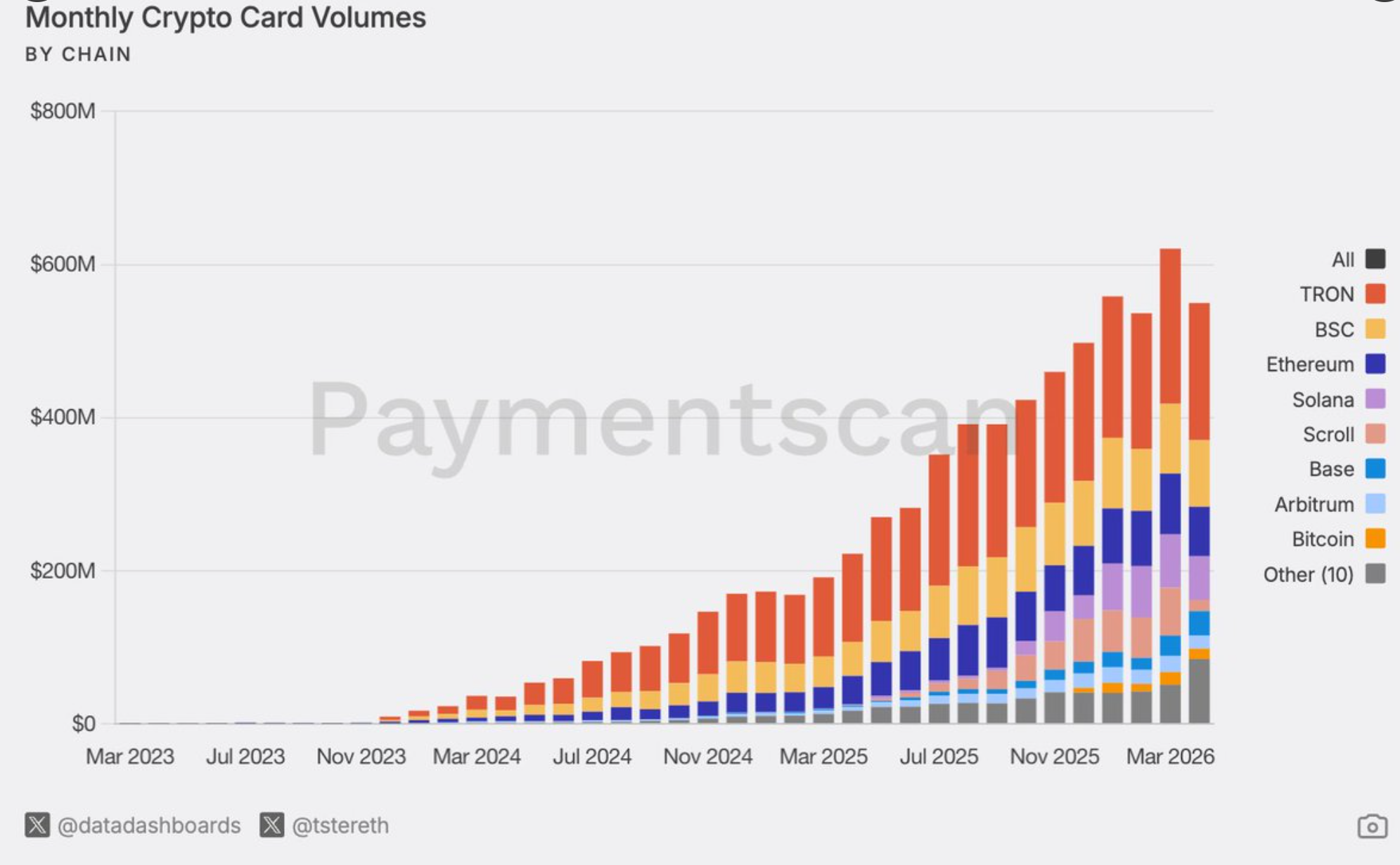
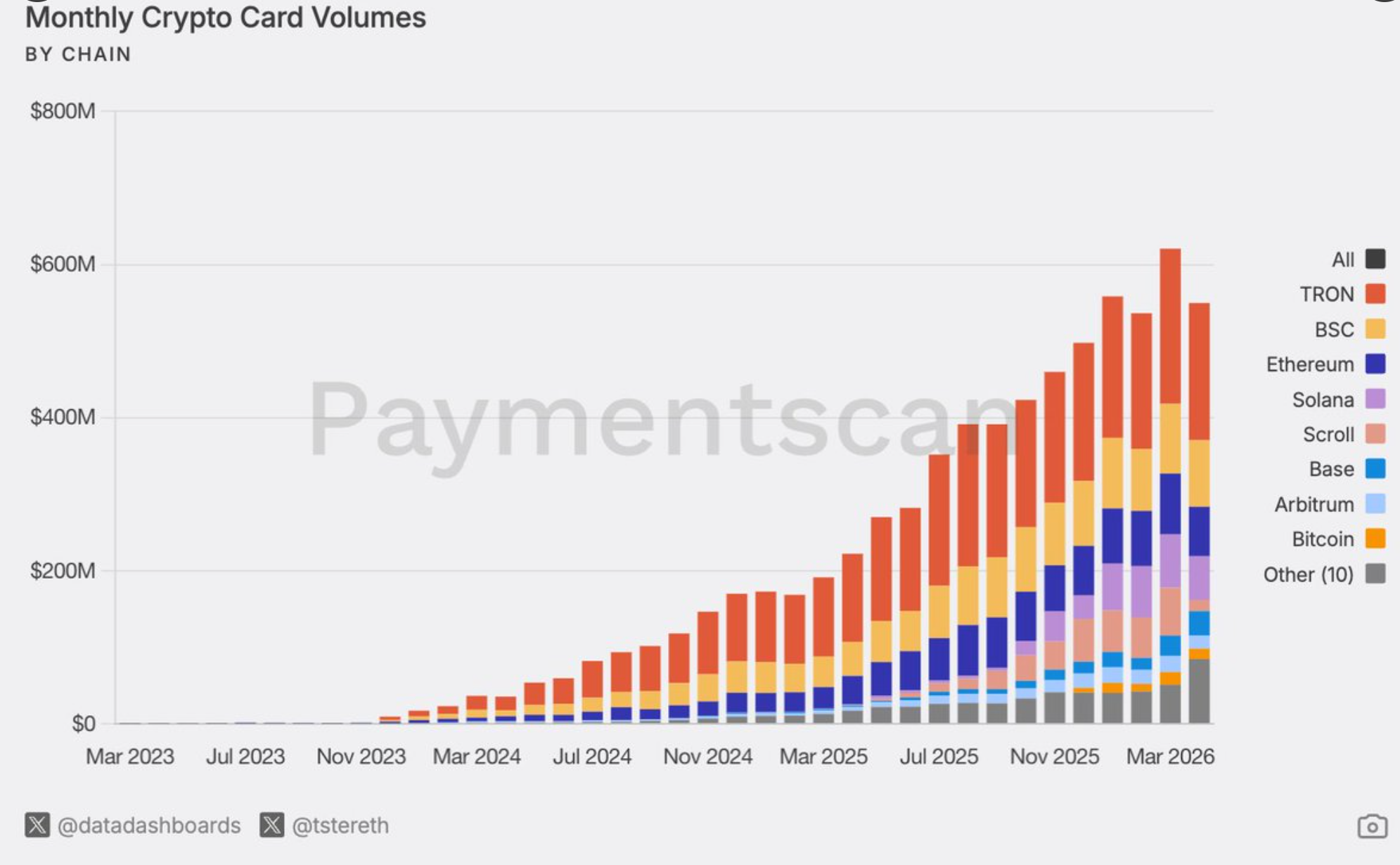
Crypto card spending volume has surged 500% since September 2024 to roughly $600 million per month. Visa (V) processes 90% of those on-chain transactions.
The data marks a sharp shift in how stablecoins reach consumers, moving from wallet balances into everyday spending. Stablecoin-linked card programs now rank among the fastest-growing businesses on public blockchains.
Visa Anchors Stablecoin Card Growth
Visa has built its lead through partnerships with crypto-native infrastructure providers, reducing reliance on traditional sponsor banks.
The strategy mirrors its Bridge stablecoin card rollout, which expands to new regions through 2026.
Meanwhile, partner programs such as Wirex push stablecoin payouts to billions of cards via Visa Direct. Visa processed roughly 97% of crypto card volume in March.
Jupiter and the Distribution Pitch
Newer entrants are also stretching the cashback model. Among them is Jupiter’s Solana-based Visa card. The product returns 4% to 10% cashback by tier and posted 660% month-over-month volume growth in April. Rewards are paid in stablecoins rather than airline points.
Tron founder Justin Sun framed the trend as the next phase of stablecoin distribution. His comment echoed earlier stablecoin policy remarks.
“Crypto cards are not a trend. They are the next evolution of distribution. Stablecoins have already moved beyond wallets into everyday spending at global scale. The next phase is seamless access. Digital assets integrated directly into how people pay, anywhere,” Justin Sun stated.
Separately, industry commentator Marty Party predicted Visa-issued stablecoin cards on Apple Pay and Android Tap will onboard 10 million users. He sees that happening before merchants adopt native stablecoin settlement.
The figures suggest stablecoins are competing for consumer wallets, not just on-chain liquidity.
Whether rival networks match Visa’s reach may decide if the debit card surge becomes a dominant crypto onramp.
The post Crypto Card Spending Surges 500% to $600 Million Monthly, Visa Captures 90% Share appeared first on BeInCrypto.

TLDR
- Japan Exchange Group aims for 2027 cryptocurrency ETF debut contingent on regulatory completion
- FIEA reform positions digital assets as financial instruments enabling ETF framework
- Growing institutional appetite drives expansion of crypto ETF product lineup
- Bitcoin ETF products attract capital while Ethereum offerings face redemptions
- Japan Exchange Group mirrors worldwide institutional adoption patterns
Japan Exchange Group is pushing forward with cryptocurrency ETF development plans, establishing 2027 as its deployment target while regulatory transformations continue. This effort signals rising institutional appetite for compliant digital asset investment vehicles throughout Japan. Simultaneously, policymakers are refining taxation structures and legal parameters necessary for domestic exchange crypto ETF listings.
Legal Framework Development Influences Crypto ETF Schedule
Japan Exchange Group is synchronizing its cryptocurrency ETF blueprint with emerging legal and taxation policy changes. The bourse operator intends to roll out crypto ETF offerings following complete regulatory framework establishment. Nonetheless, launch schedules remain adaptable based on legislative processes and governmental policy modifications.
The Financial Instruments and Exchange Act currently classifies digital currencies as regulated financial instruments. This regulatory evolution establishes the foundational legal infrastructure necessary for cryptocurrency ETF deployment in Japan. As such, oversight bodies can now incorporate crypto ETF mechanisms into established securities regulatory systems.
Taxation frameworks represent another pivotal element affecting cryptocurrency ETF authorization schedules. Government officials are continuously evaluating appropriate tax treatment for crypto ETF investment returns among domestic market participants. Accordingly, conclusive taxation policy determinations will significantly impact cryptocurrency ETF market availability timing.
Strategic Vision Propels Crypto ETF Portfolio Growth
Japan Exchange Group has embedded cryptocurrency ETF innovation into its mid-range strategic roadmap. This blueprint emphasizes portfolio diversification extending past conventional stock listings and futures contracts. Consequently, the exchange seeks to reinforce its competitive standing across international capital markets.
Investment management firms have already demonstrated considerable enthusiasm for introducing crypto ETF investment vehicles. Such enthusiasm underscores escalating institutional requirements for regulated digital currency market access. The bourse has established operational capabilities supporting crypto ETF onboarding following regulatory green lights.
The cryptocurrency ETF initiative additionally complements objectives for income stream diversification. Japan Exchange Group persistently develops emerging investment categories to sustain market competitiveness. Introducing crypto ETF instruments may boost investor engagement and transaction activity levels.
International Patterns Reinforce Crypto ETF Development
Worldwide cryptocurrency ETF investment flows demonstrate varied yet substantial participation throughout principal financial centers. Bitcoin-focused investment products lately attracted fresh capital, demonstrating revitalized investor confidence in crypto ETF vehicles. Ethereum-associated funds encountered persistent withdrawals, revealing divergent market attitudes.
Such international dynamics inform Japan’s cryptocurrency ETF preparation initiatives. Regulatory authorities seek to introduce crypto ETF products within secure and supervised market conditions. Japan’s methodology represents equilibrium between financial innovation encouragement and system-wide stability preservation.
Institutional participation momentum persistently fuels crypto ETF expansion across global markets. Japan Exchange Group aims to capitalize on this movement through local cryptocurrency ETF offerings. Should regulatory modernization advance according to projections, inaugural crypto ETF products may arrive by 2027.
Crypto World
Cardano Whales Are Accumulating and Volume Just Spiked 28%: Is ADA Finally Ready to Break $0.30?

Cardano is quietly doing something interesting. ADA trades near $0.249, up roughly 0.64% in 24 hours, a subdued number that buries the real news signal.
Daily volume surged to $275.9M against a $9.2B market cap, a healthy participation ratio that rules out a stale order book.
The April 30 session saw volume spike 28% to over $296M, coinciding with Input Output’s progress report confirming 16 of 18 treasury-funded deliverables for Q4 2025 and Q1 2026.

Community sentiment ranks ADA #6 most bullish across all tracked cryptocurrencies on CoinMarketCap.
Whale accumulation signals are flashing, and the Leios mainnet rollout targeting 1,000+ TPS is on the 2026 calendar. The chart, though, tells a more complicated story.
Can Cardano Price Break $0.30 Before the Next News Catalyst Hits?
ADA is stuck in a tight $0.24–$0.25 range, and right now it is showing relative weakness compared to the broader market, which is not a great sign.
The key issue is structure. The 200-day average is acting as resistance, not support, and derivatives data is leaning bearish with shorts increasing while open interest drops.
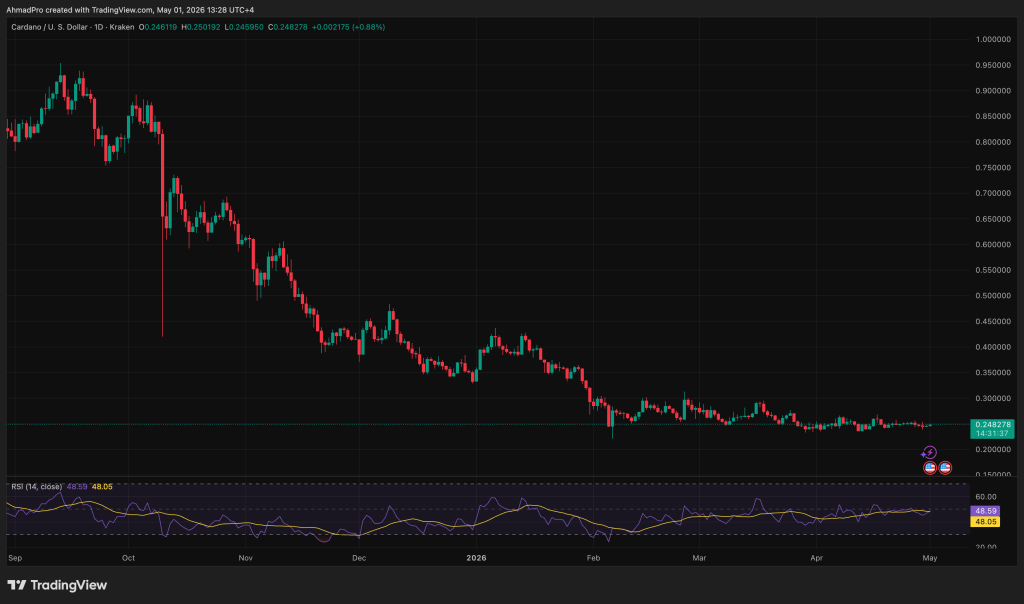
$0.24 is the floor. If that breaks on volume, downside opens quickly toward $0.20–$0.22.
On the upside, ADA needs to reclaim $0.28 first, and then $0.30 is the real level that changes the narrative.
More likely for now, it keeps ranging between $0.24 and $0.26 while the market waits for direction.
So this is a weak consolidation, not accumulation yet, and until $0.28–$0.30 breaks, the edge is still slightly to the downside.
Why LiquidChain Could Be Set To Replace Cardano This Cycle
ADA being 92% below its peak puts things in perspective. Even a move back to $0.30 is a decent gain, but not the kind of upside that justifies high risk at this stage, especially while price is stuck in a range.
That is why some investors start looking earlier in the cycle, where the upside is not already limited by market cap.
LiquidChain is targeting that space, focusing on cross-chain liquidity by connecting Bitcoin, Ethereum, and Solana into one execution layer. The idea is to remove fragmentation so developers and users can operate across ecosystems more efficiently.
The presale is still early, at around $0.01455 with just over $700K raised, suggesting steady interest rather than a one-off spike.
But it is also unproven. Execution, adoption, and liquidity after launch are all unknowns, which is the trade-off with early-stage infrastructure.
So the contrast is simple: ADA offers a more established but capped upside in the near term, while something like LiquidChain offers earlier positioning with higher potential, but also higher risk.
The post Cardano Whales Are Accumulating and Volume Just Spiked 28%: Is ADA Finally Ready to Break $0.30? appeared first on Cryptonews.


Ethereum traded at $2,280.47 at press time, with 24-hour volume at $10.18 billion, according to crypto.news data.
Summary
- Ethereum’s exchange supply ratio has dropped, but price has not yet formed a matching bottom.
- Binance ETH funding rates remain negative, showing traders still favor downside positions.
- Rising short liquidations may add buying pressure if Ethereum continues its recent recovery.
ETH gained 0.75% in the past day but remained down 1.56% over the last seven days. Its market cap stood at $275.23 billion, based on a circulating supply of 120 million ETH.
The price action comes as analysts track opposing signals from exchange supply and derivatives data.
Exchange supply ratio signals dip risk
CryptoQuant analyst PelinayPA said Ethereum may still face downside risk. The analyst pointed to a sharp fall in the exchange supply ratio.
In past cycles, a falling ratio often appeared near price bottoms. Lower exchange supply can mean reduced selling pressure, but the analyst said the current setup shows a gap.
PelinayPA said the ratio has dropped to low levels, but ETH has not formed a matching price bottom. The analyst said this could mean the market has not fully priced in the supply move.
The analyst added that “a delayed downward move” remains possible. The view suggests ETH may still need to close the gap between price and exchange supply behavior.
Negative funding raises squeeze debate
Another CryptoQuant analyst, Darkfost, gave a different view. The analyst said Ethereum’s short-side positioning has become crowded.
According to the analysis, Binance funding rates have stayed negative for an extended period. Darkfost compared the duration of negative funding to levels last seen during the FTX collapse period in November 2022.
The analyst said Ethereum has recovered more than 30% from its February 6 low. Still, many traders continue to hold short positions despite the rebound.
Darkfost said the monthly average Binance funding rate stands at -0.0018. This points to strong demand for downside bets among traders.
Short liquidations may support recovery
Darkfost said rising short liquidations show that some bearish traders are already under pressure. If ETH keeps moving higher, more short positions may close.
Forced short closures can add buying pressure in the market. This can support price recovery when many traders hold the same bearish position.
However, this setup does not remove downside risk. Ethereum still faces a mixed market structure, with spot supply data warning of a possible dip.
The current Ethereum outlook remains divided. One on-chain signal points to a possible delayed move lower, while derivatives data shows the risk of a short squeeze.
Disclosure: This article does not represent investment advice. The content and materials featured on this page are for educational purposes only.
The crypto market ticked higher on Friday. Bitcoin rose 1.25% since midnight UTC to trade at $77,250, and the CoinDesk 20 Index (CD20) added 0.7% with 14 members in the green.
The increase comes after bitcoin found support at $75,000, a price it had earlier found difficult to climb above, on Wednesday. It has now been trapped between $75,000 and $80,000 since April 19. Negative funding rates on futures exchanges indicate that traders are generally positioned for a decline.
U.S. equity index futures were little changed. Nasdaq 100 futures cooled after the week’s Big Tech earnings, while S&P 500 futures are marginally in the black, up 5 points.
Precious metals fell, with gold and silver losing 1% and 0.7%, respectively, and the altcoin market is a mixed bag; AXS and HYPE rose by around 3%, but DeFi tokens MORPHO and AAVE are both in the red.
Derivatives positioning
- Open interest in bitcoin futures holds at $19 billion, roughly unchanged week-over-week, with speculative activity showing little conviction.
- Funding rates are broadly negative across multiple venues at around -2% annualized, except on Deribit, which saw a spike to 37%. The three-month annualized basis sits at 1.5%, also flat on the week, pointing to continued institutional caution.
- Options sentiment leans bullish: put/call volume over the past 24 hours is 58% in favor of calls, and the one-week delta skew has eased to 8.6% from 9.5%, indicating moderating demand for downside protection.
- The implied volatility term structure is in contango, with the front-end around 29% rising to ~45% at the March ’27 tenor, suggesting the market is pricing longer-dated uncertainty rather than immediate tail risk.
- CoinGlass data shows $149 million in 24-hour liquidations, with a 30-70 split between longs and shorts. BTC ($50 million) and ETH ($29 million) led in terms of notional liquidations.
- The Binance liquidation heatmap indicates $75,400 as a core liquidation level to monitor in the event of a price drop.
Token talk
- The CoinDesk Memecoin Index (CDMEME) was the best-performing benchmark, surging by 1.8%, followed by the CoinDesk Computing Select Index (CPUS), which added 1.4%.
- CoinDesk’s DeFi Select Index (DFX) lagged its peers, and was recently unchanged despite broader market optimism.
- Monad (MON) led the altcoin market on Friday, rallying by 6.7% over 24 hours. There were also notable gains for PENDLE, RAY and TAO, all up between 4.2% and 5.35%.
- The same can’t be said for , the DeFi token linked to President Donald Trump’s family. That dropped by more than 2.6% since midnight following a governance vote on token lock-ups. It has now lost more than 77% since it was introduced in September.
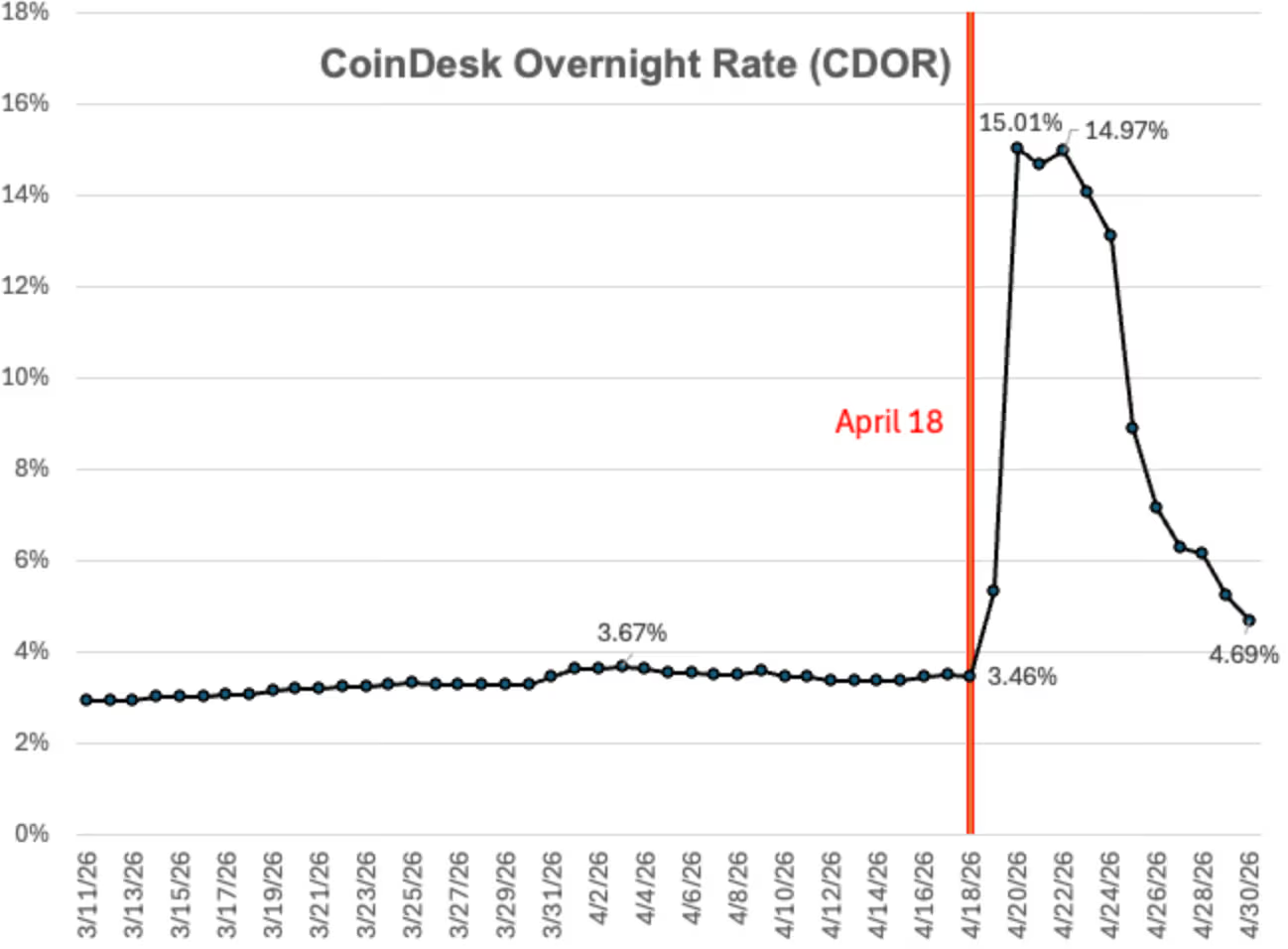
- CoinDesk’s Overnight Rate (CDOR), which tracks lending and borrowing rates on Aave, has returned to normal market conditions after the KelpDAO hack, a sign of strength in the DeFi sector.


If traditional finance is a well-regulated city, DeFi’s experimental edge is the desert just beyond the walls—lawless, creative, and occasionally full of gold. This is where protocols stop copying TradFi and start inventing entirely new financial primitives. It’s also where things break… a lot.
Let’s get into it.
The Rise of New Primitives
Experimental DeFi isn’t about slightly improving lending or swapping—it’s about redefining what those things even mean.
You’ll see:
- Liquidity as a game mechanic (protocols turning LPing into PvP strategy)
- Time-based finance (locking assets into future yield markets)
- Reflexive token systems where price feeds back into utility
- Protocol-owned liquidity (POL) replacing mercenary capital
A classic example is Olympus DAO, which introduced bonding as a way for protocols to own liquidity instead of renting it. It sounded insane at first—until half the market copied it.
Then there’s Yearn Finance, which turned yield farming into a set-it-and-forget-it strategy engine—now a core building block across DeFi.
The pattern? Today’s “weird experiment” becomes tomorrow’s standard—if it survives.
What Fails vs What Sticks
Most experimental DeFi projects fail. Not because the ideas are bad—but because the execution, incentives, or timing are off.
What Usually Fails:
- Unsustainable yields (APYs that rely purely on token emissions)
- Overly complex mechanics (if users need a PhD, they’re out)
- Reflexive death spirals (price down → confidence down → liquidity gone)
- Narrative-only protocols (hype without real usage)
We’ve seen entire ecosystems collapse under this weight—think of the fallout from Terra collapse, where experimental stablecoin mechanics unraveled at scale.
What Actually Sticks:
- Clear utility + real demand
- Simple UX wrapped around complex logic
- Aligned incentives between users and protocol
- Composable design (others can build on it)
Protocols that win don’t just innovate—they integrate into the broader DeFi stack.
How to Analyze Early-Stage Protocols
Looking at experimental DeFi is less about reading dashboards—and more about reading intent.
Here’s a sharper framework:
1. What’s the Core Innovation?
Is this actually new—or just a remix of existing primitives?
2. Where Does Yield Come From?
If the answer is “token emissions,” be careful. If it’s real fees, arbitrage, or productivity, now we’re talking.
3. Who Benefits Most?
Early insiders? The protocol treasury? Or long-term users?
4. Can It Survive Without Growth?
If the system collapses when new users stop coming in, that’s not DeFi—that’s musical chairs.
5. Is It Composable?
Can other protocols plug into it? If not, it may never escape its own sandbox.
The “Would You Actually Use This?” Test
This is where most experimental DeFi falls apart.
Forget the whitepaper. Forget the tokenomics. Ask one simple question:
Would you use this if there were no rewards?
If the answer is no, then the protocol is likely:
- Subsidizing behavior, not creating value
- Dependent on hype cycles
- One market downturn away from irrelevance
But if the answer is yes—even without incentives—that’s where things get interesting.
That’s how you spot early conviction plays before the crowd arrives.
The Trade-Off: Innovation vs Risk
Experimental DeFi is where the highest upside lives—but it comes with:
- Smart contract risk
- Economic design flaws
- Governance attacks
- Liquidity shocks
It’s not about avoiding risk—it’s about understanding which risks are worth taking
Final Thought
Experimental DeFi is messy, chaotic, and often irrational.
But it’s also where the future gets prototyped in real time.
Most ideas will fail. A few will reshape the entire industry.
Your edge isn’t predicting which one wins—it’s recognizing why something might.
Because in the Wild West of DeFi, survival isn’t luck.
Its design.
REQUEST AN ARTICLE.

Every Disney Era of Animation, Ranked

Matthew McCallan: PSNI to take 40 more statements about Co Tyrone teen’s death
AutoNation beats profit estimates but revenue falls short

Manchester United reach agreement with Casemiro over contract clause amid transfer speculation

US brings back mandatory military draft registration

Steven Gerrard disagrees with Gary Neville over ‘shock’ Chelsea and Arsenal claim | Football

Adolf Hitler attempted to ruin the British financial system by saturating the Un…

Shiyas Kareem is facing serious allegations of financial fraud | celebrity news | kerala police

The Other Side of the Bitcoin: Crypto & Corruption w/Ben McKenzie | The Weekly Show with Jon Stewart
-

 Tech4 days ago
Register Renaming | Hackaday
-

 Fashion7 days ago
Weekend Open Thread – Corporette.com
-
Crypto World6 days ago
Hyperliquid $HYPE Rally Builds Momentum as AI Sector Enters Prove-It Phase
-

 Politics4 days ago
Drax board avoid their own AGM, accused of greenwashing & environmental racism
-

 Tech4 days ago
Images of Samsung’s rumored smart glasses have leaked
-
 Sports5 days ago
IPL 2026: Ruturaj Gaikwad registers slowest fifty of the season, enters all-time unwanted list | Cricket News
-

 Tech4 days ago
Why Blue Badges Disappeared From Toyota Hybrids
-

 NewsBeat5 days ago
LK Bennett closes all stores after entering administration
-

 Fashion3 days ago
Kylie Jenner’s KHY Enters a New Era with ‘Born in LA’
-
 Entertainment6 days ago
Mariah Carey Slams Deposition Claims In Brother’s Lawsuit
-

 Business3 days ago
Most Commercial Energy Audits Miss the Real Losses
-

 Business4 days ago
(VIDEO) Charlize Theron Climbs Times Square Billboard to Promote New Netflix Thriller ‘Apex’
-
 Business7 days ago
Jeanine Pirro announces closure of Federal Reserve building cost probe
-

 Tech5 days ago
Microsoft to roll out Entra passkeys on Windows in late April
-

 Crypto World3 days ago
CFTC’s AI will review U.S. crypto registration applications, chairman tells CoinDesk
-
 Crypto World7 days ago
Nvidia (NVDA) Stock Jumps 5% as Intel Earnings Ignite Semiconductor Rally
-

 Tech5 days ago
OpenAI’s Sam Altman apologizes for not reporting ChatGPT account of Tumbler Ridge suspect to police
-

 Business2 days ago
Barclay Brothers Avoid Bankruptcy: HSBC Drops High Court Petitions After IVA Deal
-

 Tech7 days ago
Apple’s Next CEO Has a Different Battle Ahead
-

 Tech3 days ago
Get Ready for More Brain-Scanning Consumer Gadgets
You must be logged in to post a comment Login