

Crypto World
Bitcoin Mining: MARA’s Reported $1.5B Bitcoin Sale Puts Corporate Treasury Conviction in Focus

Marathon Digital Holdings, the largest Bitcoin Mining miner in America, has reportedly sold approximately $1.5 billion in Bitcoin, offloading roughly 20,880 BTC at an average price near $70,137 per coin, and announced it will not purchase additional mining hardware, pivoting instead toward AI infrastructure.
MARA stock was up 0.24% at the time of reporting, while BTC-USD was down 1.39%. Bearish signal for corporate Bitcoin treasury models.
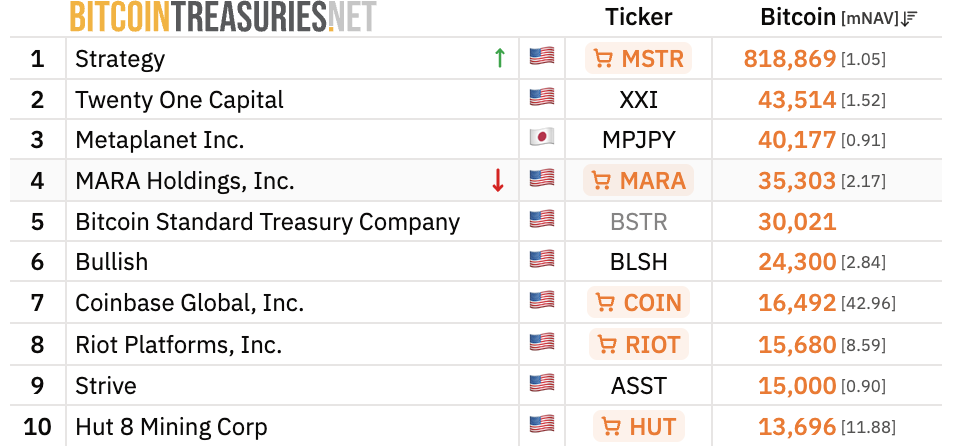
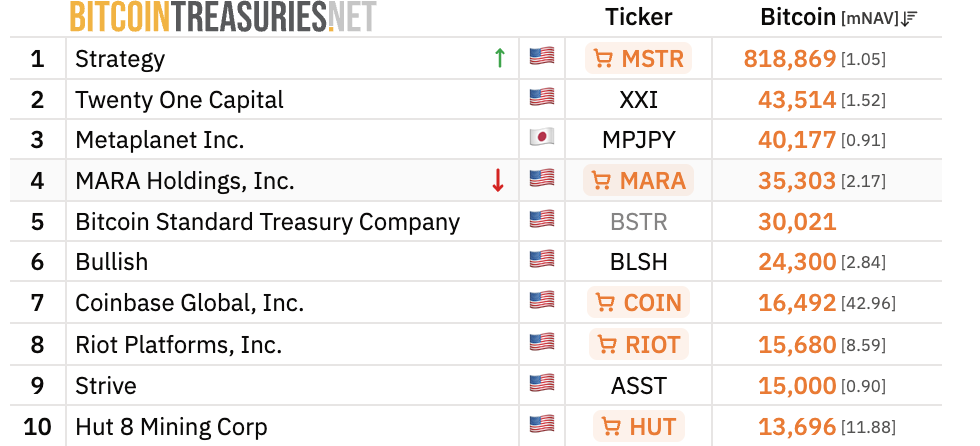
The sale reduces MARA’s holdings from 38,689 BTC to approximately 35,303 BTC, ranking the company fourth among public Bitcoin holders.
Proceeds were used to repurchase convertible notes at a discount, cutting total debt from $3.3 billion to $2.3 billion, a 30% reduction, and generating a $71 million accounting gain. Q1 revenue fell 18% year-over-year to $174.6 million amid a $1.26 billion net loss.
How a $1.5B Bitcoin Mining Sale Works Mechanically, and Why the Timing Matters
MARA’s reported sale represents roughly 54% of its former Bitcoin stack by coin count, executed in tranches with 15,133 BTC ($1.1 billion) sold between March 4 and March 25, 2026.
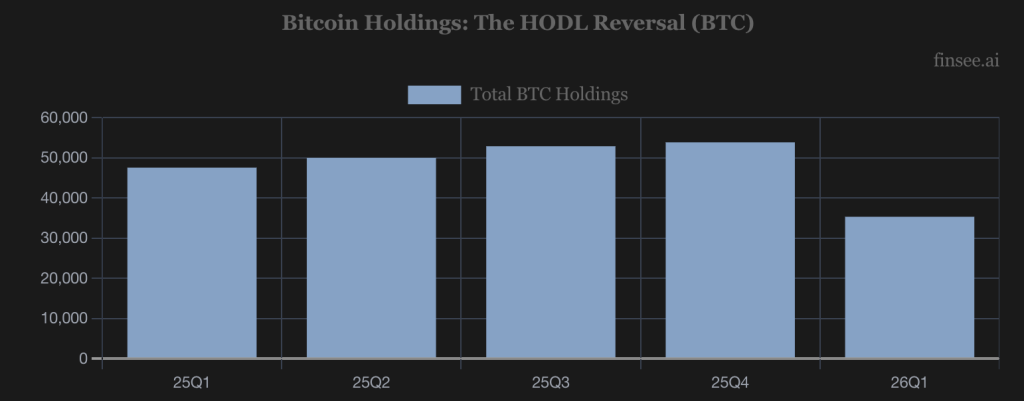
At current market prices, the remaining 35,303 BTC is valued at approximately $2.84 billion. That is a meaningful reserve. It is not the treasury-first posture the company was signaling 12 months ago.
The mechanics of the debt repurchase matter here. By retiring convertible notes at a discount, MARA locked in a $71 million accounting gain while simultaneously removing the interest burden that made the Saylor-style treasury model increasingly fragile at post-halving mining margins.
CEO Fred Thiel did not abandon Bitcoin. He used it as liquidity to stabilize a balance sheet that $3.3 billion in convertible notes had stretched thin.
That distinction is worth naming. Selling Bitcoin to service debt is operationally rational under margin pressure. It is not the same as abandoning a thesis. Those are not the same thing, and conflating them leads to the wrong analytical conclusion.
Does a $1.5B Sale Signal a Break in MARA’s Bitcoin Conviction – or Operational Cash Management?
Two readings compete here. The bearish read: MARA raised a convertible note explicitly to emulate Michael Saylor’s Bitcoin treasury accumulation strategy, then reversed course and liquidated a substantial portion of its stack within two earnings cycles.
If the conviction were genuine, the company would have found alternative debt service mechanisms rather than selling BTC near cycle lows.
The pivot to AI is a rebranding exercise covering a treasury model that failed stress testing.
The operational read: MARA produced 2,247 BTC in Q1 while simultaneously boosting its energized hashrate 33% year-over-year to 72.2 EH/s. It is still mining aggressively.
The $1.5 billion in AI infrastructure spending – anchored by a ~$1.5 billion acquisition of Long Ridge Energy’s 505-MW natural gas plant in Hannibal, Ohio, expected to yield $144 million in annual EBITDA – is not a retreat from hard assets. It is a rotation from one capital-intensive physical infrastructure play to another, with better margin economics in the current rate environment.
Scott Melker, host of The Daily Wolf on Yahoo Finance, framed the industry trajectory bluntly: “Bitcoin miners are no longer Bitcoin miners, they are AI companies that will also mine Bitcoin.”
That is not an indictment of Bitcoin conviction. It describes where the capital returns are. Bitcoin Society recent pause on Bitcoin treasury acquisition reflects a similar dynamic, corporate conviction around BTC holdings is being stress-tested across multiple balance sheets simultaneously, not just MARA’s.
The provisional conclusion: MARA’s sale is primarily a debt management event with a strategic pivot embedded inside it. The treasury model stress is real. The conviction collapse narrative is overstated.
The post Bitcoin Mining: MARA’s Reported $1.5B Bitcoin Sale Puts Corporate Treasury Conviction in Focus appeared first on Cryptonews.


TLDR
- Blockchain.com has launched crypto-backed loans for users worldwide.
- The product allows clients to borrow against Bitcoin, Ethereum, and USDC without selling their assets.
- Loan rates start at 1.9% per year, making the offering competitive in the market.
- The service targets large crypto holders seeking liquidity for property, business, and tax needs.
- CEO Peter Smith said crypto-backed lending has been one of the most requested products on the platform.
- Blockchain.com stated it will use its existing liquidity, infrastructure, and risk systems to support the rollout.
Blockchain.com has introduced crypto-backed loans for clients worldwide. The company now allows users to borrow against Bitcoin, Ethereum, and USDC without selling holdings. Loan rates start at 1.9% per year, and the product targets large digital asset holders seeking liquidity.
Blockchain.com Expands Lending Access for Bitcoin, Ethereum, and USDC
Blockchain.com confirmed global availability of its crypto-backed loans product. The service enables clients to pledge Bitcoin as collateral and secure cash for major expenses. Borrowers can fund property purchases, business investments, and tax obligations through structured loans.
The company stated that rates begin at 1.9% annually, positioning the offer competitively. It is designed for high-value accounts seeking larger borrowing limits. It also structured the loans to let clients maintain market exposure while accessing capital.
Blockchain.com included Ethereum in the approved collateral list at launch. Clients can lock Ethereum holdings and receive liquidity without executing a sale. The structure supports long-term holders who prefer to retain digital assets during financing.
The firm also approved USDC as eligible collateral under the program. Users can pledge USDC to unlock funding for various permitted uses. However, the company said loan purposes may differ depending on the jurisdiction.
CEO and founder Peter Smith addressed the demand for the new product. He said, “Crypto-backed lending has been one of the most requested products on our platform.” He added that the company plans to compete aggressively in the category.
Smith emphasized existing operational strength within the company. He said Blockchain.com does not enter the lending market from a standing start. He pointed to established liquidity, infrastructure, and risk management systems.
The company stated that these systems already support institutions and wealth clients. It will now extend those capabilities to a broader customer base. The rollout forms part of its consumer and wealth expansion strategy.
Company Targets High Net Worth Clients as Crypto Lending Tops $70 billion
Blockchain.com launched the product as the crypto-backed lending market surpassed $70 billion. The company cited growing demand from holders seeking structured liquidity solutions. It aims to provide competitive pricing and higher borrowing capacity.
The firm said it operates across more than 70 jurisdictions worldwide. It reported processing over $1.2 trillion in transactions to date. It will leverage this footprint to distribute the lending product globally.
Blockchain.com also plans to expand into lending transfers for high-net-worth individuals. The company said it will use blockchain infrastructure to streamline crypto-backed credit. It aims to position its platform as a financial hub for digital asset users.


A U.S. federal judge in the Southern District of New York has delivered a sentencing ruling in the Celsius Network saga, with Roni Cohen-Pavon, the platform’s former chief revenue officer, receiving time served plus one year of supervised release for his role in manipulating the CEL token price and defrauding Celsius users. The decision reinforces the ongoing emphasis by U.S. authorities on market integrity and investor protection within the crypto landscape.
During the sentencing before Judge John Koeltl, Cohen-Pavon had initially entered a not-guilty plea to four counts in September 2023, before changing course to plead guilty about a week later. He is an Israeli citizen who was abroad at the time of the indictment and later reentered the United States for arraignment, posting a $500,000 bond with travel restrictions while the case proceeded toward sentencing. The Celsius matter was pursued alongside former Celsius CEO Alex Mashinsky in July 2023, in the wake of Celsius’s 2022 collapse that precipitated substantial losses for investors and platform users.
As the sentencing moves to closure for Cohen-Pavon, the broader Celsius prosecutions remain active but are winding down. Mashinsky, already serving a 12-year sentence in related criminal proceedings, faces separate financial penalties in connection with the case. The court ordered Mashinsky to forfeit $48 million; Cohen-Pavon agreed to pay more than $1 million and a $40,000 fine. In a letter to the judge submitted before sentencing, Cohen-Pavon acknowledged the long path ahead and asserted a commitment to personal reform, framing the sentence as only one facet of a broader obligation to his family and community.
Background coverage indicates that Celsius’s collapse—not only the losses borne by investors and users but also the governance failures implicated in the company’s management—has drawn intensified regulatory attention. Cointelegraph has reported on related developments, noting that the Mashinsky case remains a focal point of enforcement activity in the crypto sector and highlighting ongoing scrutiny of corporate conduct within crypto lending platforms.
Tornado Cash co-founder still potentially facing SDNY retrial
In a separate but parallel enforcement thread, Roman Storm, the co-founder of the crypto-mixing service Tornado Cash, may face a retrial in the Southern District of New York after a jury failed to reach a verdict on multiple counts in a prior trial. Prosecutors have sought a retrial date in October to re-try Storm on money-laundering and sanctions-conspiracy charges that the jury could not unanimously resolve. The procedural posture underscores the breadth of regulatory and criminal risk associated with crypto privacy technologies and sanction evasion concerns.
Storm remains on bail, subject to a $2 million bond and travel limitations that confine movement to certain jurisdictions in New York, Washington, and California. A separate development saw a federal judge grant him permission to attend his niece’s high school graduation in El Dorado Hills, California, illustrating the balancing act between individual circumstances and high-profile enforcement cases in the SDNY ecosystem.
Prosecutors have signaled continued diligence in the Tornado Cash matter. In court filings—and as summarized by coverage outlets—the government is seeking to proceed with a retrial in the autumn window, aiming to resolve the deadlock that characterized the earlier proceedings. This case, alongside Celsius, contributes to a broader pattern of DOJ actions targeting crypto services that facilitate illicit activity or evasion of sanctions, with potential implications for mixers, privacy-enhancing tools, and related business models.
Related reporting emphasizes the broader regulatory and enforcement context surrounding these developments. For instance, coverage related to the Celsius matter has highlighted coordination with other enforcement actions against Celsius’s leadership, while the Tornado Cash case illustrates how sanctions regimes intersect with evolving cryptographic techniques and governance models. The cumulative effect is a clearer demonstration of the legal and regulatory expectations that crypto firms, exchanges, and ancillary service providers must meet to operate within U.S. law, especially in matters touching market integrity, sanctions compliance, and consumer protection.
Regulatory context and industry implications
Viewed together, the Celsius and Tornado Cash proceedings illuminate the current regulatory environment for crypto companies operating in the United States. The Department of Justice and allied agencies have sharpened their focus on criminal conduct linked to price manipulation, fraud, and sanctions violations, particularly when such activities undermine market integrity or enable illicit activity. For exchanges, lenders, and other crypto service providers, the evolving enforcement landscape underscores the necessity of robust internal controls, comprehensive governance, clear disclosure practices, and rigorous AML/KYC frameworks to withstand heightened regulatory scrutiny.
From a policy perspective, these cases contribute to ongoing discussions about the appropriate boundaries for crypto-asset products, the role of centralized management versus decentralized mechanisms, and how traditional financial-law principles apply to novel digital-asset ecosystems. They also intersect with broader regulatory efforts at the national and international levels, including licensing regimes, cross-border supervision, and the alignment of U.S. enforcement priorities with global standards. The Celsius and Tornado Cash matters, taken together, illustrate the practical implications of enforcement actions for institutional participants—ranging from settlement planning and risk management to compliance program design and board governance.
Closing perspective
As authorities continue to pursue accountability in high-profile crypto cases, the Celsius and Tornado Cash trajectories underscore the centrality of compliance, governance, and risk controls for institutions operating in or alongside crypto markets. The evolving legal landscape suggests that the coming years will feature continued attention to market manipulation, sanctions compliance, and consumer protection—with significant implications for licensing, cross-border operations, and ongoing industry reform.
Crypto World
Some short sellers are seeing opportunity in this tech mania. How they’re spotting fake AI stocks

Panida Wijitpanya | Istock | Getty Images
Short sellers are increasingly hunting for cracks beneath the stock market’s artificial-intelligence frenzy, betting that some of the speculative excesses, copycat “AI” branding and vulnerable legacy business models could eventually unravel.
As billions of dollars flood into data centers, semiconductors and AI software, some short sellers argue the rally is beginning to resemble previous speculative manias, where weaker companies rushed to attach themselves to the hottest market theme in hopes of attracting capital and retail traders.
“A rising tide lifts all boats, and a twisting tide takes down a lot of names in the same neighborhood,” Joyce Meng, founder of Fact Capital, said during a panel discussion at Sohn Investment Conference this week in New York. “Especially in the market where you have an AI frenzy, everyone trying to go jump into that, one of our favorite themes is fake AI.”
Meng said she likes to run screens to identify companies that abruptly rebranded themselves to capitalize on the boom, including firms that suddenly changed their names to include the word “AI.”
One target that Meng identified using the “AI name change” screen is Rezolve AI, which changed its name from Rezolve Group Limited in 2023. After digging deeper into the company, Meng said she saw multiple red flags around the business and predicted the stock to fall 60%.
Meng also pointed to a Chinese landscaping company that later reinvented itself as an AI server business. During her firm’s research, she said the company appeared to have photoshopped products into marketing materials on its website and claimed to have hired employees listed on LinkedIn that turned out, according to Fact Capital’s checks, to not actually work there.
The examples echo some of the increasingly surreal corporate pivots emerging during the AI boom. Allbirds, the struggling shoemaker, said last month it would rebrand itself as “NewBird AI” and shift toward compute infrastructure. The stock initially surged 582% following the announcement powered by massive retail flows before giving back most of those gains within weeks.
The Allbirds initial surge and the overall jump in stocks shows what these short sellers are up against and why their numbers have dwindled as this bull market marches on. They get their name because they borrow stock and then sell those shares, in the hopes of buying back at lower prices and returning them, capturing the difference. If a name moves higher, it can force them to buy back the stocks in order to avoid big losses.

Allbirds year to date
“Trying to find more excess, where people are claiming they have it but they actually don’t — for us, that’s a really rich ideation opportunity,” Meng said.
Fact Capital has generated positive returns from short positions since launching in 2019. Meng said she likes pairing speculative “fake AI” shorts with secular decliners across the technology industry that tend to be less volatile. She also highlighted business-process outsourcing firms and contact-center operators, particularly in India, as areas potentially vulnerable to AI disruption.
Rezolve AI declined to comment. The company reported $60 million in first-quarter revenue, surpassing its total revenue for all of 2025.
Nvidia bears
Some bearish investors are beginning to directly challenge the market’s biggest winners. Culper Research disclosed a short position Wednesday in Nvidia, arguing the chipmaker faces underappreciated risks tied to China exposure.
“We recognize the stakes. Nvidia holds the single largest market capitalization on the planet, while CEO Jensen Huang has been celebrated as a generationally talented operator,” Culper wrote in its report. “We are short Nvidia for one reason: the company has a significant China problem.”
The short seller alleged that despite U.S. export restrictions imposed in April 2025, more than 20% of Nvidia’s fiscal 2026 compute revenue remained tied to China through illegal GPU diversion and intermediaries in Southeast Asia. Nvidia has publicly said its China business effectively dropped to zero following the restrictions.
Nvidia didn’t immediately respond to CNBC’s request for comment.
Nvidia year to date
Still, short selling in a bull market is no easy task. Major U.S. stock indexes have repeatedly climbed to record highs despite the ongoing war in the Middle East and broader macroeconomic uncertainty, as investors continue pouring money into semi makers and megacap companies tied to the AI boom.
These short sellers joined Michael Burry, who has emerged as one of Wall Street’s most vocal AI skeptics. The famed investor recently warned that investors should “reject greed” and for any stocks going parabolic “reduce positions almost entirely.”
Historical echoes
Many are drawing parallels between today’s AI-driven rally and the speculative excesses that preceded the collapse of many internet stocks during the dotcom era. Blue Orca Capital CIO Soren Aandahl said investors often confuse transformative technologies with guaranteed investment success.
“Railroads changed the world. The internet changed the world,” Aandahl said at the panel moderated by Jim Chanos. “But many of the early purveyors of these technologies went completely bust.”
Chanos, one of Wall Street’s best-known short sellers, pointed to the dot-com era as a cautionary example. Chanos said U.S. economic growth and corporate profit growth in the decade following Netscape’s 1995 debut were little changed from the prior decade despite the internet’s transformative impact.
“There’s no doubt the internet changed many, many things,” Chanos said. “It didn’t have a super huge impact” on aggregate economic growth.
Netscape, a pioneering web browser, was one of the defining symbols of the dot-com bubble before being acquired by AOL in 1999.
Crypto World
XRP edges higher while bitcoin, ether and dogecoin slip, keeping focus on $1.49 breakout zone
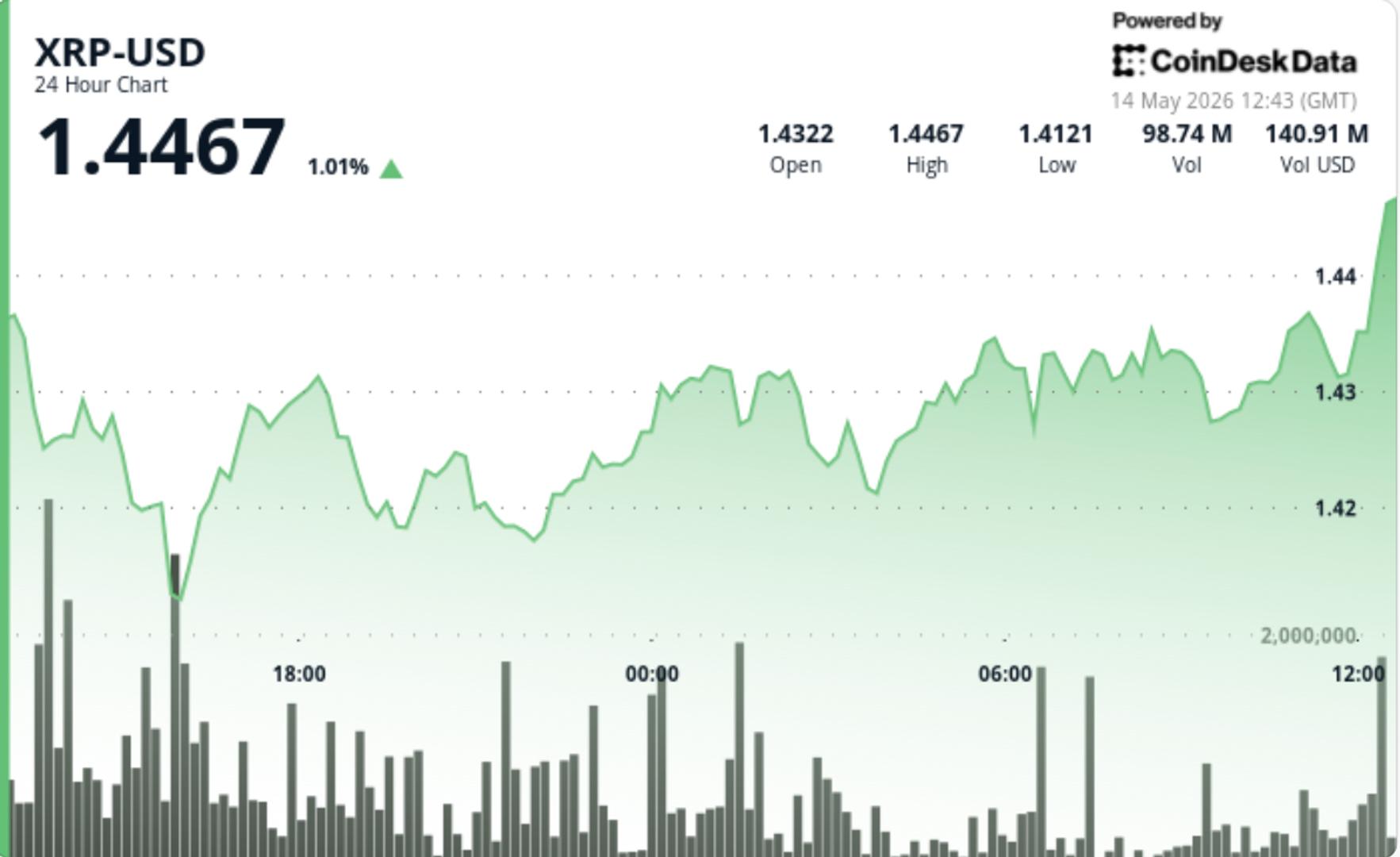
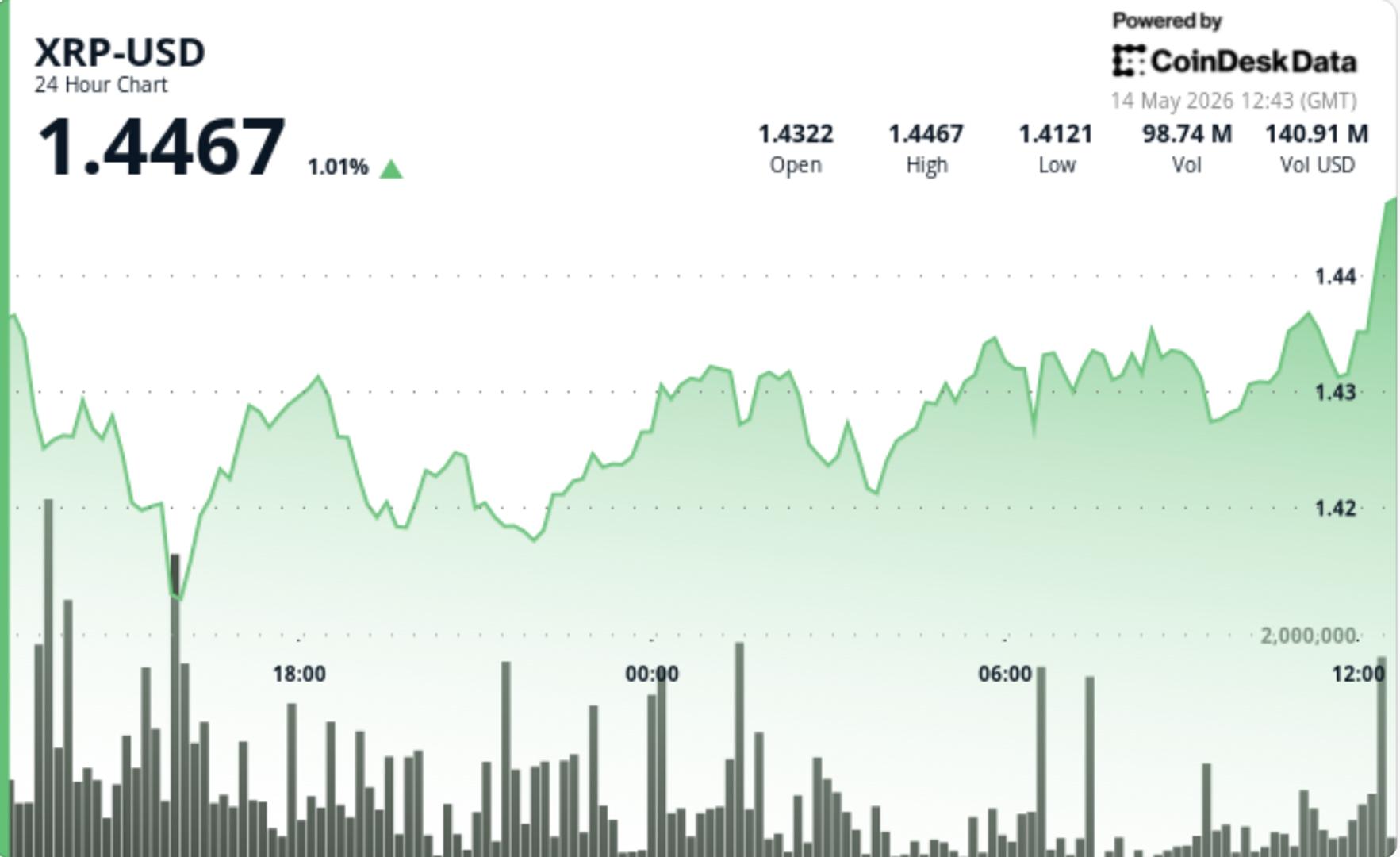
XRP outperformed major tokens during a volatile session, with a late volume burst pushing price back toward resistance that has capped rallies for weeks.


Crypto wallet infrastructure firm Turnkey has raised $12.5 million backed by Circle Ventures and Sequoia Capital.
Summary
- The round brings Turnkey’s total funding to over $65 million and will primarily support development of Turnkey Verifiable Cloud ahead of its public launch.
- Verifiable Cloud is designed to let companies run sensitive crypto operations including transaction signing and policy decisions in a verifiable environment.
- Turnkey was founded by former Coinbase Custody employees and serves Flutterwave, Polymarket, and World App among its customers.
Turnkey announced the raise on May 14, with participation from Archetype, Bain Capital Crypto, Lightspeed Faction, Galaxy Ventures, and Variant alongside Circle Ventures and Sequoia Capital.
The New York-based company builds key management infrastructure for crypto applications, including non-custodial wallets, automated onchain transactions, and policy-controlled signing. The raise follows a $30 million Series B led by Bain Capital Crypto in mid-2025.
“Stablecoins are transforming how value moves online, and AI agents are upending traditional security assumptions,” said Bryce Ferguson, CEO and co-founder of Turnkey. “Verifiable Cloud is our answer to the security and compliance demands of the next wave of crypto applications.”
What Verifiable Cloud is designed to solve
Verifiable Cloud targets organisations that need to run sensitive operations, including transaction visibility, policy decisions, and agent-driven wallet activity, in a computing environment that can be independently verified.
The product addresses the growing segment where automated AI agents execute onchain transactions on behalf of users and businesses, creating security demands that traditional key management was not built to handle.
Sequoia Capital has been building its exposure to stablecoin and crypto infrastructure through its portfolio. Circle Ventures, the investment arm of USDC issuer Circle, is expanding its backing of stablecoin payment infrastructure across the stack.
Their combined participation signals institutional confidence in the private key management layer as crypto moves into enterprise payments and AI-driven financial applications. Turnkey’s customer base, which includes stablecoin-focused platforms like Polymarket and Anchorage Digital, positions it within the fastest-growing segments of institutional crypto in 2026.


The new capital will primarily fund the development and public launch of Turnkey Verifiable Cloud, a secure computing product for digital assets.


The Shariah-compliant digital bank is part of a growing wave of fintech startups building banking and payments services on top of blockchain and stablecoin rails.
Key Highlights
-
ASST stock climbs as Strive introduces daily SATA dividend structure alongside bitcoin treasury expansion.
-
Company’s SATA preferred shares transition to daily cash distributions beginning June 16.
-
ASST advances following complete debt retirement and enhanced bitcoin accumulation strategy.
-
Strive now controls 15,009 BTC while ASST rallies on innovative income structure announcement.
-
New daily payout mechanism positions Strive distinctively within bitcoin treasury company landscape.
Shares of Strive (ASST) climbed after the firm combined balance sheet improvements with an innovative income-generating offering. ASST reached $17.97, posting a 7.32% gain, while maintaining strength throughout the trading session. The upward movement coincided with regulatory filings detailing debt elimination and modifications to preferred share terms.
Strive announced that its subsidiary, Semler Scientific, finalized the buyback and cancellation of all outstanding 2030 convertible notes. This transaction eliminated liabilities associated with the 4.25% Convertible Senior Notes scheduled to mature in 2030. Furthermore, the trustee validated that all indenture requirements were met and discharged.
Eliminating this debt provides Strive with increased financial flexibility for its capital allocation initiatives. Additionally, the firm currently maintains a minimal debt-to-equity ratio of 0.01, based on InvestingPro metrics. This metric underscores the company’s recent deleveraging efforts and improves its overall financial positioning.
SATA Preferred Shares Transition to Daily Payment Model
Strive revised the conditions governing its Variable Rate Series A Perpetual Preferred Stock, designated as SATA. The firm submitted the modified certificate to Nevada’s Secretary of State on May 13. Accordingly, these revisions alter the methodology for computing and distributing preferred share dividends.
Beginning June 16, 2026, SATA will distribute cash dividends on every business day. Shareholders registered on the preceding business day will be eligible for each distribution. Nevertheless, dividend declarations will continue on a monthly basis for subsequent monthly dividend cycles.
The board preserved SATA’s yearly dividend rate at 13.00% for monthly intervals commencing after May 16. Moreover, any unpaid regular dividends will generate additional accumulating dividends if Strive fails to make scheduled distributions. The revised provisions also address dividend postponements, notification procedures, and restrictions on specific payments.
Bitcoin Accumulation Strategy Generates Investor Attention
Strive disclosed the dividend modification concurrent with its first-quarter financial results and bitcoin treasury report. The company purchased 6,001 bitcoin throughout the first quarter. This amount comprised 5,048 bitcoin obtained through Semler Scientific and 953 bitcoin acquired via open-market transactions.
Between April 1 and May 12, Strive accumulated an additional 1,381 bitcoin for its holdings. As a result, the firm’s aggregate bitcoin position reached 15,009 bitcoin. This figure establishes Strive among publicly traded entities employing bitcoin as a primary treasury reserve.
This approach also amplified earnings volatility during the reporting period. Strive disclosed a GAAP net loss of $265.9 million for the quarter ending March 31. The majority of this loss stemmed from fair-market value adjustments to its bitcoin position.
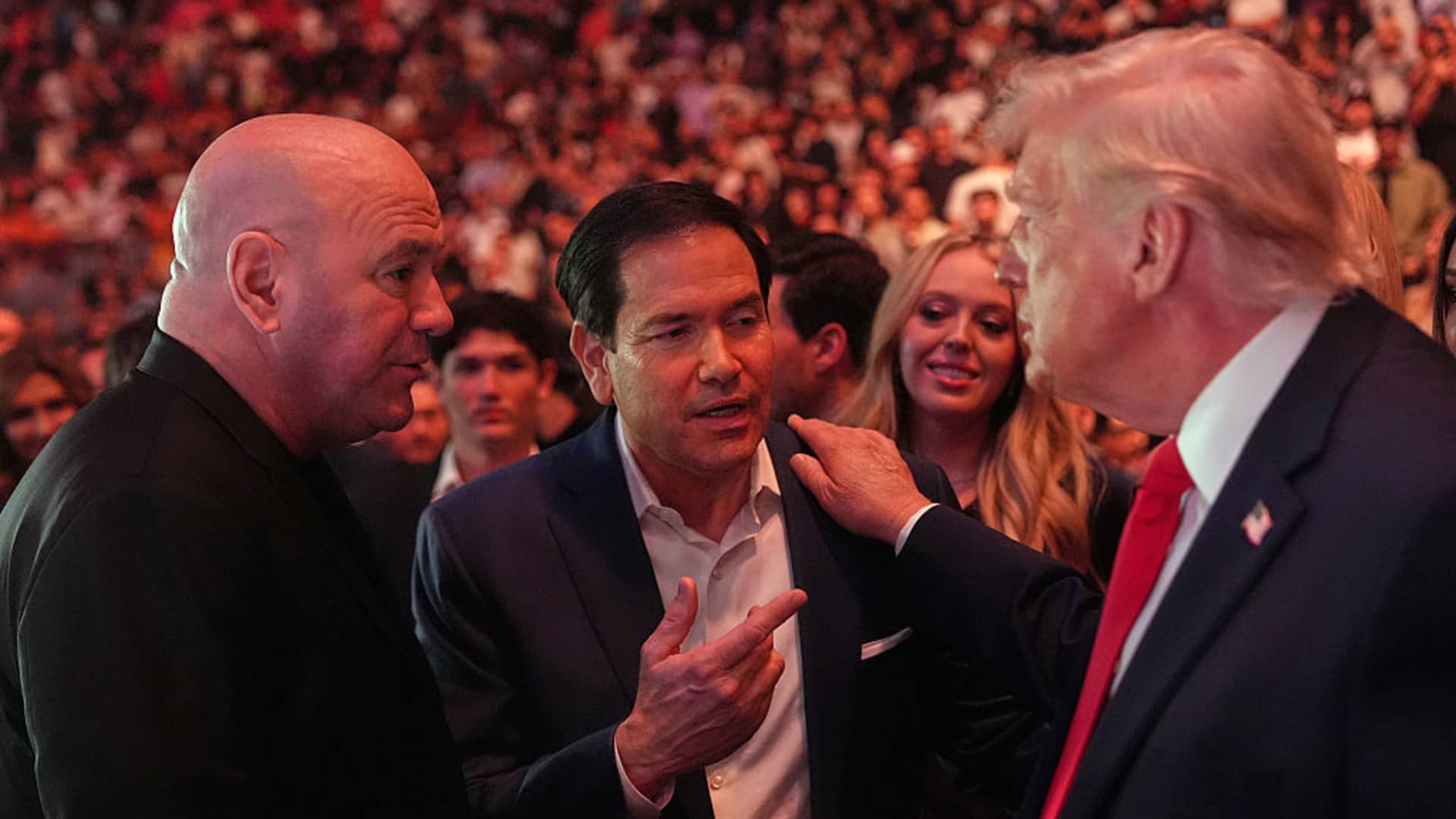
U.S. President Donald Trump speaks with Secretary of State Marco Rubio and UFC CEO and President Dana White during UFC 327 at Kaseya Center on April 11, 2026 in Miami, Florida.
Julia Demaree Nikhinson | Getty Images
UFC President Dana White penned a letter to President Donald Trump pleading for him to reverse a provision of his signature tax law.
White asked the president to undo a 90% cap on gambling loss deductions that was approved as part of his “big beautiful bill,” according to a letter first reported by an independent journalist. ESPN reported that the organization independently confirmed the authenticity of the letter.
Traders on prediction market platform Kalshi don’t think the law will be repealed this year, but White’s letter moved the odds. After the first report of the letter, chances that the cap will be repealed this year jumped to 37% from 20%. They have since fallen back to 29%.
The provision limits how much taxpayers can deduct from their taxable winnings from gambling. Before, if someone won both $5,000 through gambling and lost $5,000, they wouldn’t pay any tax. Now, a taxpayer is only able to deduct $4,500, and thus is left with $500 of taxable winnings.
In his letter, White praised Trump’s tax law, but said this provision in the package is already causing problems.
“The current law makes it irrational to bet in the United States because you could end up owing taxes even when you lose or having a tax bill that exceeds your winnings for the year,” he wrote, according to a screenshot of the letter. “When legal betting is discouraged, it hurts the ecosystem we’ve spent years building in partnership with state regulators and licensed operators.”
The change was included to allow the tax law to satisfy procedural rules in the U.S. Senate so the overall package could be approved with only Republican votes, according to Tax Foundation think tank.
In a statement, the American Gambling Association praised White for raising the salience of the issue. Nevada politicians — where the UFC is headquartered — praised the letter. Sen. Catherine Cortez Masto, D-Nev., has a bill to reverse the provision with Sen. Ted Cruz, R-Texas.
“It’s hurting players, our gaming and tourism industry, and the workers who count on them for their livelihoods,” she said in a post on X. “I agree with Dana White, the President needs to join us and fix this now.”
Disclosure: CNBC and Kalshi have a commercial relationship that includes customer acquisition and a minority investment.

XRP (XRP) continued its rebound from April’s low near $1.26, climbing to around $1.50 over the weekend and signaling a potential breakout setup. The move comes as on-chain activity and investor positioning align behind a possible upside move, with the price wrestling to flip the key $1.50 level into support.
Analysts are watching a confluence of signals: a recent surge in XRP whale activity, rising XRP Ledger (XRPL) transactions, and a technical pattern that could unlock further upside if resistance at $1.50 is convincingly breached. While the path forward remains contingent on breaking through near-term hurdles, the combination of on-chain momentum and traditional chart levels provides a framework for how this week might unfold for XRP.
Key takeaways
- XRP whale addresses—wallets holding at least 10,000 XRP—rose to an all-time high of about 332,230, signaling growing accumulation among larger holders.
- XRP Ledger monthly transactions reached a record 71 million in April, up from 43 million a year earlier, representing roughly 65% year-over-year growth.
- A sustained move above the $1.50 resistance is seen as a potential catalyst for the next leg higher, with a measured path toward roughly $1.98 intra-triangle and beyond if buyers can sustain momentum.
Whales and on-chain conviction
Market data provider Santiment has highlighted a notable uptick in the number of XRP wallets classified as mid-to-large holders, a sign that institutional-leaning investors continue to accumulate even amid volatility. The count of wallets holding at least 10,000 XRP reached a record high of around 332,230, reflecting a broader pattern of persistent accumulation that analysts view as meaningful for longer-term positioning.
Santiment described this trend as part of a broader growth trajectory that has been visible since mid-2024, suggesting that larger holders are adopting a more patient stance, potentially signaling conviction beyond short-term price swings. In the context of XRP’s price action, the rising wallet count dovetails with renewed on-chain activity and a price structure that appears to be forming a bullish continuation pattern.
XRPL activity and institutional utility
On-chain activity on the XRP Ledger also surged in April, with monthly XRPL transactions climbing to 71 million—the highest figure on record and well above 43 million a year earlier. Evernorth attributes this jump to expanding institutional utility tied to XRPL-enabled services and partners such as Bitstamp, RLUSD, Braza Bank, and various DeFi protocols. The growth is framed as part of XRPL’s broader push to enhance compliance-oriented infrastructure while broadening use cases for institutions and developers alike.
The sustained increase in activity underscores a broader adoption narrative for XRPL beyond speculative trading. As the ecosystem adds liquidity rails and increasingly institutional-friendly tooling, the ledger’s utility could reinforce demand dynamics for XRP, particularly if the network’s compliance and interoperability capabilities continue to mature.
Technical picture: chart patterns, EMAs, and targets
From a chart perspective, XRP has been navigating an ascending triangle that has capped upside since February. In such patterns, a breakout above the resistance line—confluent with near-term moving averages—often precedes a sustained upward move. The immediate objective, if bulls can push decisively through $1.50, points toward the next resistance band near $1.67-$1.70, where the 200-day exponential moving average sits.
Analysts emphasize that the $1.50 zone is pivotal. A clean breakout above this level would align with the triangle’s measured move, projecting a target near $1.98—roughly 36% higher than current levels. By contrast, failure to sustain above $1.50 could see bears reasserting control and delaying a longer-term rally.
Chart observers also note that XRP has defended its daily 20-day EMA since reclaiming the level in early May around $1.42, providing a foundation for the recent advance. Still, the broader hurdle remains the $1.50 area, and some analysts caution that a sustained push above $1.60 would be a more meaningful bullish signal in the near term.
Looking further out, NeelMacro flagged that a decisive break above $1.60 would be required to sustain any meaningful short-term rally, with momentum likely intensifying only if bids push beyond the $2.00 mark. In a complementary view, other analysts have flagged that clearing the $1.50-$1.60 range could unlock momentum toward higher targets, potentially rekindling interest in a move toward the mid-$2s territory if broader market conditions cooperate.
These technical considerations align with broader expectations that a sustained move above the near-term resistance could catalyze a renewed Bitcoin-like impulse across the market, but they also underscore that the path is contingent on a credible breakout rather than a shallow bounce.
As previously reported by Cointelegraph, the $1.50–$1.60 range is a critical inflection zone for XRP in the near term. A breakout beyond this corridor could reframe market sentiment and draw new buyers into the fold, highlighting the potential for a more meaningful rally toward the $2.40 area if momentum continues to build.
What to watch next
Investors and traders will be watching whether XRP can convert the $1.50 resistance into a sturdy new support level. If successful, the chart suggests a clear path toward the $1.70 area and beyond, with the triangle’s measured move pointing toward approximately $1.98. A sustained break above $2.00 could bring additional momentum, but that outcome will depend on continued on-chain support and a broader appetite for risk in crypto markets.
Beyond price, the expanding XRPL ecosystem—especially with institutional utility and enhanced compliance features—could help sustain demand for XRP even in choppier times. As always, developments from XRPL’s partners and ongoing upgrades to the ledger’s infrastructure will be important to monitor for potential shifts in demand dynamics and network activity.
Readers should keep an eye on how the on-chain and on-ledger signals evolve in the weeks ahead, particularly as the market tests the $1.50 level and watches for follow-through above $1.60. The balance between large-holder accumulation, real-world utility, and technical breakout potential will likely shape XRP’s trajectory into the next phase of the year.

Bolton’s Green councillor posts videos driving gas-guzzling Lambo

Blockbusters and Breakouts Dominate Charts
Blockchain.com Launches Crypto-Backed Loans Worldwide

Manchester United reach agreement with Casemiro over contract clause amid transfer speculation

US brings back mandatory military draft registration

Steven Gerrard disagrees with Gary Neville over ‘shock’ Chelsea and Arsenal claim | Football

Find lost crypto wallet #bitcoin #cryptocurrency #crypto #cryptotab #uk

Asante Akyem North MP Detained in Netherlands: Alleged Financial Crime Probe Sparks National Debate

Crypto wallet search #bitcoin #crypto #cryptocurrency #bitcoinwalletlookup
-
 Crypto World6 days ago
HarrisX Poll Found 52% of Registered Voters Support the CLARITY Act
-

 Fashion6 days ago
Weekend Open Thread: Marianne Dress
-

 Fashion3 days ago
Coffee Break: Travel Steam Iron
-

 Fashion4 days ago
What to Know Before Buying a Curling Wand or Curling Iron
-

 Tech5 days ago
Auto Enthusiast Carves Functional Two-Stroke Engine from Solid Metal
-

 Politics3 days ago
What to expect when you’re expecting a budget
-
 Business5 days ago
Ignore market noise, India’s long-term story intact, say D-Street bulls Ramesh Damani and Sunil Singhania
-

 Politics6 days ago
Politics Home Article | Starmer Enters The Danger Zone
-

 Tech4 days ago
GM Agrees To Pay $12.75 Million To Settle California Lawsuit Over Misuse Of Customers’ Driving Data
-

 Crypto World5 days ago
PROS explodes 48% as Upbit and Bithumb listings ignite demand
-

 Crypto World4 days ago
CZ says US crypto rivals tried to block Trump pardon
-

 Sports7 days ago
Bayern Munich vs PSG UEFA Champions League SF2 live match time, streaming | Football News
-

 Entertainment6 days ago
YNW Melly Denied Bond Again Ahead Of Double Murder Retrial
-

 Tech3 days ago
GM agrees to $12.75M California settlement over sale of drivers’ data
-
Entertainment7 days ago
Hantavirus — cause of death for Gene Hackman's wife — at the center of Dutch cruise outbreak
-
Crypto World6 days ago
The Hantavirus Danger: Can a Potential Outbreak Spark a New Meme Coin Frenzy?
-

 Politics7 days ago
David Attenborough ‘Overwhelmed’ By Love Shown Ahead Of 100th Birthday
-
Tech6 days ago
The Most Exciting Apple Products In The Pipeline For 2026 And Beyond
-

 Sports6 days ago
After Waka Waka, Shakira now drops first teaser for FIFA WC 2026 song | FIFA World Cup 2022
-

 Sports7 days ago
Ibom Air Anniversary Football Tournament Begins May 9 in Uyo
You must be logged in to post a comment Login