

Crypto World
Bitcoin Near Low-Risk Zone as Holders Absorb 125K BTC in June

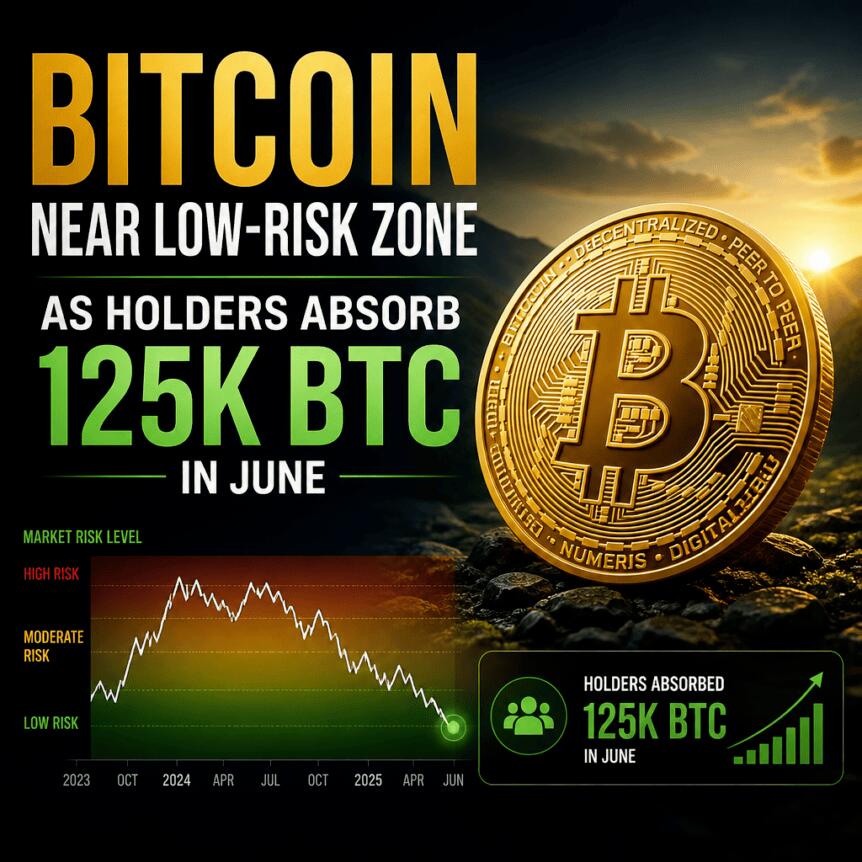
Bitcoin’s onchain and risk metrics are pointing toward a renewed accumulation-style phase, with a particularly notable signal emerging from its risk-adjusted return profile. According to CryptoQuant data, Bitcoin’s Sharpe ratio — a measure that compares returns to volatility — has fallen back toward the -20 zone that has historically lined up with major market bottoms.
At the same time, exchange balances have continued to drift lower, while wallets identified as “accumulator” addresses have shown stronger absorption behavior in early June, suggesting that supply leaving trading venues is increasingly being taken up rather than sitting idle.
Key takeaways
- CryptoQuant reports Bitcoin’s Sharpe ratio returning to -20 on June 11, a threshold that has appeared around major cycle lows in past bear markets.
- Exchange reserves have declined by roughly 80,000 BTC since February, with balances around 2.71 million BTC as of Monday.
- Accumulator address demand has risen sharply in early June, with CryptoQuant showing absorption of about 125,000 BTC between June 1 and June 14.
- Bitcoin remains below its 100-week simple moving average (SMA) for 133 straight days, and prior cycles suggest this can persist for additional months.
Sharpe ratio signals a bottom-aligned risk regime
CryptoQuant data shows Bitcoin’s Sharpe ratio reached -20 on June 11. The metric first slipped below that level on Jan. 5, 2015, and stayed there until June 12, when Bitcoin formed what the source describes as a durable bottom and moved into a recovery phase.
Similar behavior has played out in other drawdowns. From Dec. 8, 2018 through March 7, 2019, the Sharpe ratio remained under -20 for much of the bear market floor. The same pattern also appeared from Oct. 7, 2022 through Jan. 7, 2023, before Bitcoin transitioned into its next sustained bullish stretch.
Importantly, the article’s underlying data-driven claim is not that -20 precisely predicts the exact day a bottom occurs. Instead, periods when the Sharpe ratio spends time below -20 have tended to coincide with prolonged accumulation behavior — a dynamic where risk-adjusted returns look unfavorable but supply is gradually absorbed.
Exchange reserves down as accumulator wallets absorb more BTC
Onchain balance movements reinforce the risk-metric story. The analysis notes that BTC held on exchanges fell to 2.71 million on Monday, down from 2.79 million BTC in February. While exchange reserves briefly bounced to 2.73 million BTC from a late-April/early-June low of 2.65 million BTC, the source says balances have since dropped again by about 12,000 BTC over the past two weeks.
In other words, the supply available on trading venues did not simply stabilize after a brief rebound — it has continued to thin. That matters because persistent outflows from exchanges often align with less immediate selling pressure, especially when those coins are not immediately reintroduced into markets.
CryptoQuant’s “accumulator” cohort further supports that interpretation. The analysis says these accumulator addresses absorbed 125,000 BTC between June 1 and June 14. It also highlights an earlier comparison from the first two weeks of June: demand from accumulator wallets reportedly rose to 240,000 BTC from 115,000 BTC across that period, indicating that absorption accelerated rather than staying flat.
While exchange reserve decreases can be driven by many factors, the presence of stronger absorption from long-term-leaning wallets typically suggests coins are being retained. The source frames this as growing interest from wallets with a history of holding rather than distributing.
Staying under the 100-week SMA: consolidation may take time
Beyond onchain metrics, the current chart structure also fits a “build-up before trend resumption” narrative. The analysis states that Bitcoin has spent 133 consecutive days below its 100-week simple moving average (SMA). At the time of writing, that 100-week SMA is near $88,466, according to the source’s referenced calculation.
Historically, Bitcoin has often traded below the 100-week SMA for extended periods before reclaiming it. After the 2013 peak, BTC spent 378 days under the indicator while consolidating between $200 and $400. During the 2018–2019 bear market, Bitcoin remained below the 100-week SMA for 175 days and traded in a $3,000 to $6,000 range.
The longest stretch cited by the source occurred after the 2022 decline. In that cycle, Bitcoin stayed below the 100-week SMA for 532 days while trading between $16,000 and $25,000. Averaging across the three examples provided, Bitcoin spent roughly 362 days under the 100-week SMA before reclaiming it and establishing a more sustained uptrend, with those periods described as prolonged accumulation rather than immediate recoveries.
Given that the current cycle has logged 133 days below the 100-week SMA, the analysis argues that the market may still be early in a longer consolidation process. Prior examples suggest that reclaiming the trendline often comes months after the initial breakdown phase, not immediately.
What to watch next for confirmation
For investors and traders, the most important question is whether the current clustering of signals persists: the Sharpe ratio hovering around the -20 zone, continued declines in exchange reserves, and ongoing absorption by accumulator addresses. The longer Bitcoin remains under the 100-week SMA, the more likely this resembles a multi-month accumulation cycle rather than a quick mean-reversion bounce — but confirmation will depend on whether these metrics stabilize into a clear shift rather than fading back.



Robinhood is cutting roughly 10% of its full-time employees in a corporate restructuring CEO Vlad Tenev has framed as a push for a "high performance culture." In a Form 8-K filed Tuesday with the SEC, Robinhood Markets said the reduction in force covers approximately 10% of full-time staff, plus… Read the full story at The Defiant


A coalition of federally recognized tribes and Indian regulatory bodies filed amicus briefs in two federal cases this month, arguing that allowing Kalshi and the CFTC to override state gaming laws would equally nullify tribal-state gaming compacts and strip tribes of authority to regulate… Read the full story at The Defiant
Hyperliquid’s HYPE token has surged to a new all-time high near $76.70 after a combination of ETF-related buying, rising platform activity, and a wave of short liquidations pushed the asset through key resistance levels.
Summary
- HYPE hit a new all-time high of $76.70 after ETF-related buying, short liquidations, and rising demand on Hyperliquid.
- Bitwise purchased 77,100 HYPE tokens worth about $5.2 million, adding fresh spot demand as the protocol continued its buyback-and-burn program.
- SpaceX perpetual futures generated roughly $1.2 billion in weekly volume, helping Hyperliquid capture 8.3% of global perpetual futures open interest.
According to data from crypto.news, Hyperliquid (HYPE) rose nearly 10% over the past 24 hours to a new all-time high of $76.70 on June 16 before stabilizing around $75.50 at press time. The token was up roughly 46% over the past week and more than 90% over the past month as growing platform activity, ETF-related demand, and protocol buybacks continued to support the rally.
Hyperliquid price rallied as asset manager Bitwise purchased approximately 77,100 HYPE tokens worth about $5.2 million to support its newly launched Bitwise Hyperliquid ETF.
The purchase arrived as HYPE was already trading near a major breakout zone, adding fresh spot demand to a market where supply has been steadily reduced through Hyperliquid’s protocol buyback system.
For the uninitiated, Hyperliquid directs 97% of trading fees toward buying and burning HYPE, creating persistent demand for the token. As prices moved above the closely watched $70 level, traders holding leveraged bearish positions were forced to cover, triggering a rapid liquidation cascade that accelerated the rally toward a record high.
Platform activity has strengthened demand
Beyond the ETF purchase, trading activity on Hyperliquid has continued to expand at a rapid pace.
The platform’s SpaceX pre-IPO perpetual futures contract generated roughly $1.2 billion in trading volume during the past week. The contract has attracted substantial trader interest and helped boost overall activity across the exchange.
Growing volumes have translated into higher market share. According to data from CoinGlass, Hyperliquid recently captured about 8.3% of global perpetual futures open interest, with total open interest climbing above $9.6 billion. The same figures indicate annualized protocol revenue has exceeded $1 billion.
Those revenues feed directly into the buyback mechanism that continuously purchases HYPE from the market. As a result, investors have increasingly focused on platform usage metrics alongside token price action.
Recent trading activity has also helped absorb concerns surrounding a scheduled token unlock earlier this month. Roughly $700 million worth of HYPE entered circulation during the event, yet demand generated by exchange activity and protocol purchases proved sufficient to prevent prolonged selling pressure.
Technical structure points to higher resistance levels
Technical indicators have remained supportive despite the sharp advance.
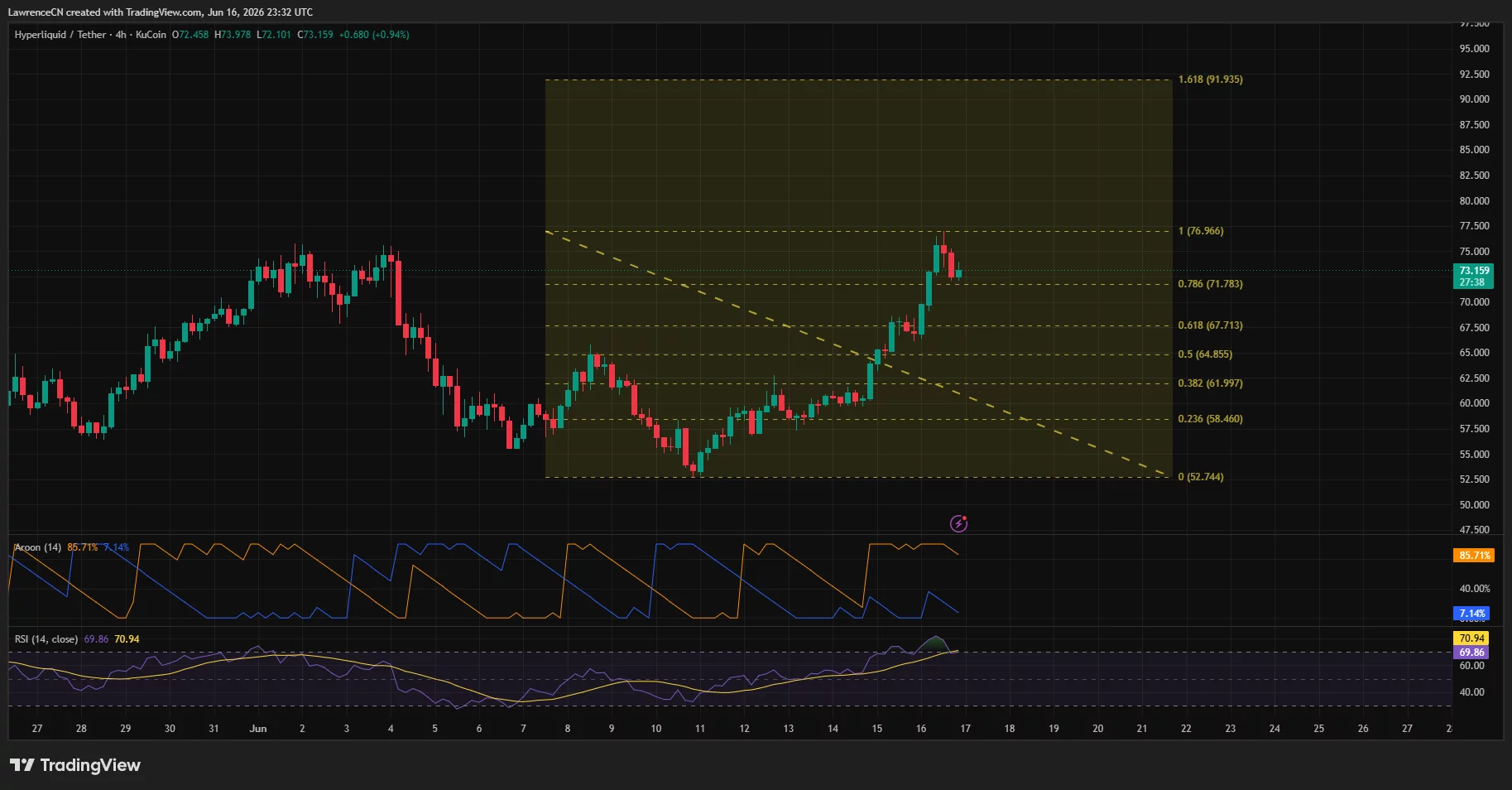
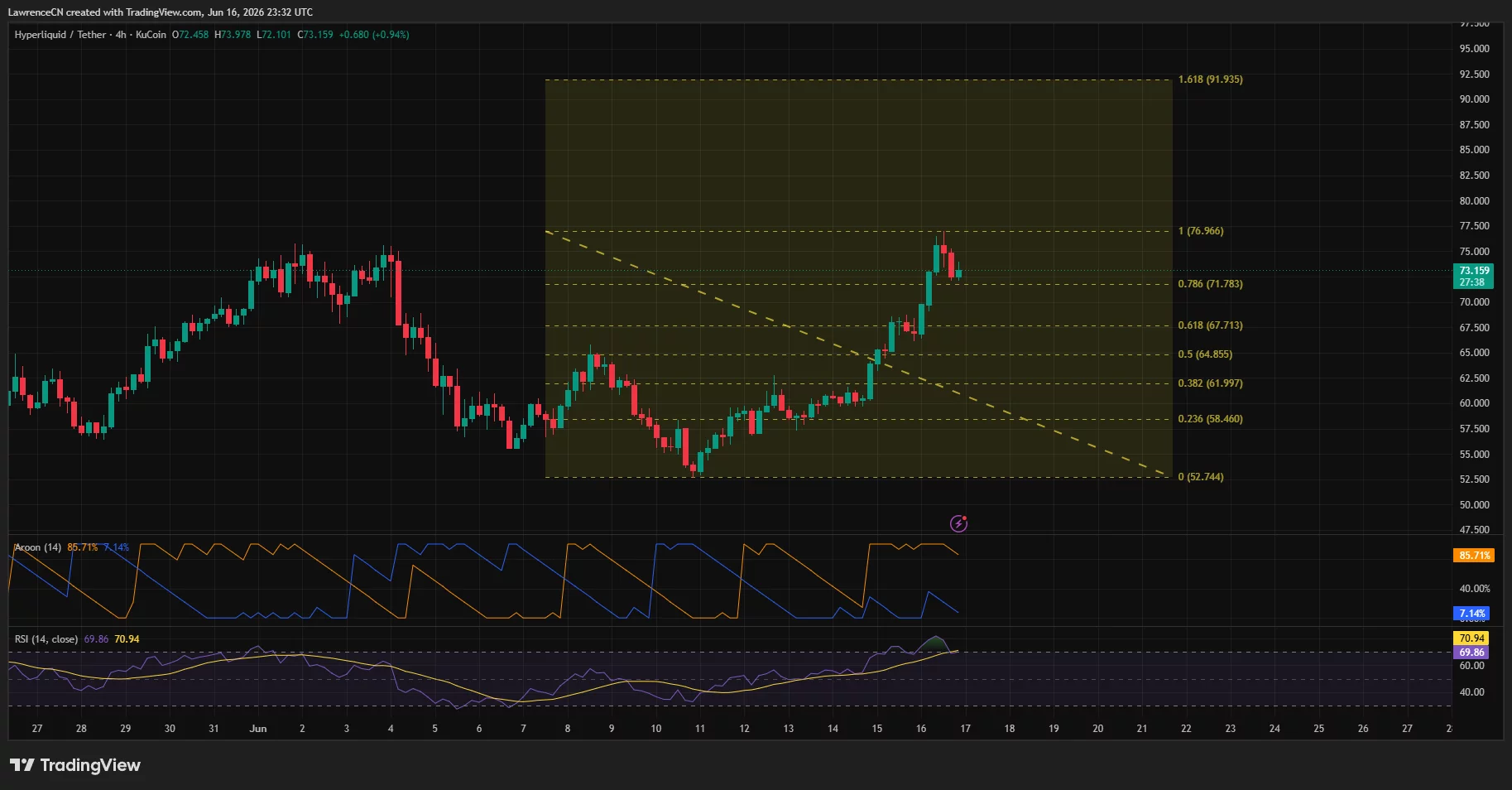
On the four-hour chart, HYPE broke above the 0.618 and 0.786 Fibonacci resistance levels near $67.7 and $71.8 before reaching the 1.0 extension around $77. The next major Fibonacci target is located near $91.9, while former resistance around $71.8 and $67.7 has become an important support area.
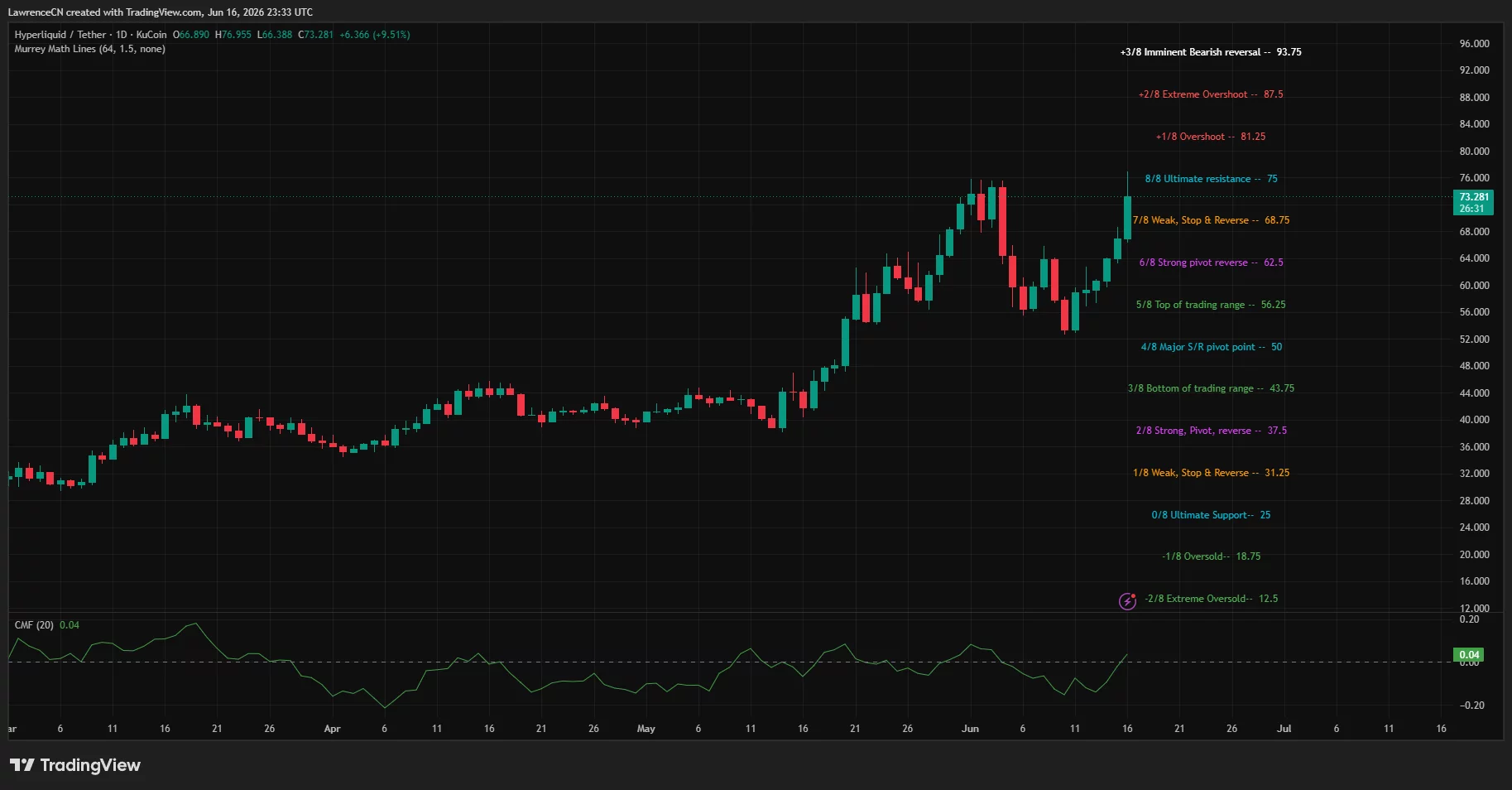
Daily charts show HYPE testing the Murrey Math 8/8 resistance level at $75. A sustained move above that zone could expose the next resistance levels near $81.25 and $87.50, according to the indicator framework. Meanwhile, positive Chaikin Money Flow readings suggest capital continues entering the asset despite profit-taking following the breakout.
Support for the rally has also come from regulatory developments. Commodity Futures Trading Commission Chair Michael Selig recently defended the approval of perpetual futures products through regulated U.S. venues, a position that several market participants interpreted as constructive for decentralized derivatives platforms.
While Bitcoin has been trading in a relatively narrow range ahead of the Federal Reserve’s policy decision under Chair Kevin Warsh, traders have continued allocating capital toward Hyperliquid. The move has helped HYPE separate from the performance of many larger cryptocurrencies and push into the ranks of the market’s largest digital assets by valuation.
Disclosure: This article does not represent investment advice. The content and materials featured on this page are for educational purposes only.

Ripple is taking a deeper bet on Africa’s cross-border payments market by buying an equity stake in Flutterwave, according to Bloomberg. The investment positions Ripple as a shareholder in one of Africa’s best-known fintechs while also setting up closer integration between Flutterwave’s payment rails and Ripple’s stablecoin and blockchain infrastructure.
Flutterwave CEO Olugbenga Agboola said the undisclosed round values the company at $3.3 billion, as reported by Bloomberg. While the financial terms were not fully detailed, the strategic direction is clear: Flutterwave will embed Ripple’s RLUSD stablecoin, Ripple Payments, and the XRP Ledger to support faster and more cost-effective international transfers.
Key takeaways
- Ripple’s equity investment in Flutterwave makes it a shareholder rather than a commercial partner.
- Flutterwave plans to integrate RLUSD, Ripple Payments, and the XRP Ledger for cross-border transactions.
- Both companies are aligning around stablecoin-based payments, reflecting broader growth in Africa’s remittance market.
- Prior Ripple moves—such as custody partnerships—suggest a sustained strategy to serve institutional and enterprise needs in the region.
Equity stake plus payments integration
The deal combines two different layers of involvement. On one hand, Ripple is investing in Flutterwave, giving it direct exposure to the fintech’s growth across Africa. On the other, Flutterwave is set to integrate Ripple’s stablecoin and payments tooling to improve the performance of cross-border transfers.
Flutterwave operates in 35 African countries, and the company has been expanding its digital asset services. As part of this broader expansion, Flutterwave has been building stablecoin payment capabilities—an approach consistent with the market demand for lower-cost international transfers.
In the latest step, Flutterwave will incorporate RLUSD alongside Ripple Payments and the XRP Ledger. The stated goal is to make cross-border payments both quicker and cheaper. For users and businesses, the practical impact is the promise of more efficient settlement for remittances and international transactions, particularly where traditional rails can be slow or expensive.
Ripple’s move also adds a governance-and-incentives angle. Equity exposure can change how companies think about long-term scaling, especially in markets where partnerships and integrations often require substantial engineering and operational investment.
Why Africa is becoming a stablecoin battleground
Ripple’s stake in Flutterwave comes as stablecoins gain traction in Africa’s payments landscape, driven largely by remittance demand and persistent pressure to cut transaction fees. Chainalysis reported in September 2025 that crypto adoption in sub-Saharan Africa rose 52% over a 12-month period, with more than $205 billion in onchain transactions recorded. At the time, the region ranked as the world’s third-fastest-growing crypto market.
That growth matters for payment networks because stablecoins are often easier to integrate into commercial flows than highly volatile crypto assets. By using dollar-denominated tokens, providers can reduce the friction of pricing and settlement, while also potentially lowering transfer costs.
The competitive field is already crowded. Circle, for example, has partnered with African fintech Sasai to expand USDC-based payment services across the region, with an emphasis on remittances. Ripple’s Flutterwave integration shows that this ecosystem building is not limited to a single issuer or blockchain—different networks are converging on similar customer needs.
Cost comparisons help explain the urgency. The World Bank estimates that sending a typical $200 remittance to sub-Saharan Africa costs recipients between $13 and $17 in fees. In contrast, the World Bank estimates that transfers using USDt (USDT) on Tron can cost as little as $0.50, while USDC on Ethereum can cost around $2.
These figures don’t guarantee outcomes for every corridor or user—fees depend on rails, liquidity, compliance, and provider pricing—but they underscore why stablecoin-enabled transfers are appealing in markets where fee compression has been a longstanding problem.
Ripple’s Africa strategy: from custody to payments rails
This investment appears to fit a larger pattern in Ripple’s Africa push. Last October, Ripple partnered with South Africa’s Absa Bank to provide digital asset custody solutions to institutional clients. That earlier effort targeted a different segment of the market—institutions needing custody—rather than day-to-day cross-border transfers.
By moving from custody to direct payments integration, Ripple is effectively broadening its route to adoption. Institutional custody can be a prerequisite for some enterprises, but consumer- and SME-focused payment experiences are what ultimately drive transaction volume. Flutterwave’s footprint across 35 African countries gives Ripple a path to scale stablecoin-based rails through an established payments distribution network.
For Flutterwave, the approach also looks like a way to upgrade infrastructure rather than only add new features. Integrating RLUSD, Ripple Payments, and the XRP Ledger suggests a more foundational change to how cross-border transfers are executed, with potential implications for speed, settlement efficiency, and operational cost.
What to watch next
The immediate question for market participants is how quickly Flutterwave will roll out the RLUSD and Ripple Payments integrations and what performance improvements users and merchants experience in practice. Beyond the technical integration, the key watch item is whether stablecoin-enabled transfers continue gaining share in African remittance corridors as competitors expand similar services and pricing pressure intensifies.


The CLARITY Act has advanced toward a potential July Senate vote, though negotiations over conflict-of-interest provisions continue to divide lawmakers.
Summary
- David Nage says the CLARITY Act could reach a Senate floor vote in mid-to-late July if lawmakers resolve ethics provisions.
- Debate has shifted from stablecoin yield rules to conflict-of-interest restrictions for government officials.
- The bill includes $150 million for crypto crime enforcement and protections for blockchain developers and validators.
According to David Nage, managing director and portfolio manager at Arca, discussions with Senate offices and staff members in Washington left him convinced that most of the work surrounding crypto market structure legislation has already been completed.
In a recent report, Nage wrote that the industry and policymakers are roughly “80–85%” aligned on the substance of the bill despite public disagreements that continue to generate headlines.
The legislation, formally known as the Digital Asset Market Clarity Act, has already secured bipartisan support in committee and now awaits further Senate consideration. While several procedural steps remain, Nage argued that the primary obstacle is no longer market structure policy itself.
Ethics language has become the central dispute
Following meetings with congressional staff, Nage said stablecoin yield provisions no longer appear to be a major point of contention. Although banking industry critics, including JPMorgan Chief Executive Officer Jamie Dimon, have continued opposing parts of the legislation, Nage stated that Senate offices largely view the issue as settled.
Instead, debate has narrowed around conflict-of-interest rules that would restrict government officials from benefiting from crypto-related business activities while serving in office.
According to Nage, lawmakers are now focused on how such restrictions would be enforced rather than whether they should exist. He described the disagreement as a political challenge centered on implementation and public perception rather than a dispute over digital asset policy.
To break the deadlock, Nage suggested applying a uniform prohibition on crypto business activity across the President, Vice President, executive branch officials, and members of Congress without creating exemptions for specific individuals.
His base-case scenario assumes lawmakers reach agreement on ethics provisions and reconcile competing Senate proposals in the coming weeks. Under that outcome, Nage expects the bill to reach the Senate floor after Congress returns from recess on July 13.
Enforcement and developer protections remain in focus
While negotiations continue, supporters of the bill have pointed to several provisions designed to strengthen oversight of the digital asset industry.
As previously reported by crypto.news, Senator Cynthia Lummis said the CLARITY Act would allocate $150 million to law enforcement agencies for investigations into cryptocurrency fraud and other digital asset crimes. The legislation would also allow exchanges and stablecoin issuers to temporarily freeze suspicious transactions for up to 30 days, with authorities able to seek extensions of as much as 180 days through written orders.
Additional provisions would subject digital asset businesses to Bank Secrecy Act requirements, including Anti-Money Laundering programs and Suspicious Activity Report obligations similar to those imposed on traditional financial institutions. Supporters have argued that these measures would help investigators trace illicit funds while providing stronger consumer protections.
Elsewhere, industry groups are pressing senators to preserve language tied to the Blockchain Regulatory Certainty Act. Kristin Smith, president of the Solana Institute, said the provision would clarify that blockchain developers, node operators, and validators who do not custody customer assets should not be treated as money transmitters under U.S. law.
Smith said the language would provide legal certainty for open-source software developers and network operators while maintaining a distinction between infrastructure providers and businesses that directly control customer funds. She added that founders, executives, and investors across the crypto industry have urged Senate leaders not to weaken those protections.
Nage also outlined a downside scenario. If lawmakers fail to resolve ethics provisions before the upcoming recess, he warned that the opportunity to pass the legislation during the current Congress could narrow considerably. Senator Cynthia Lummis has similarly cautioned that failure to advance the bill this session could delay action until 2030.


The market for tokenized real-world assets has continued expanding rapidly, with Citigroup projecting the sector could reach as much as $8.2 trillion by 2030 under its bullish scenario.
Summary
- Citigroup projects the tokenized asset market could reach $5.5 trillion in its base case and as much as $8.2 trillion by 2030.
- Token Terminal data shows tokenized assets have surpassed $43 billion, rising about 37% over the past six months.
- Financial advisors are increasingly focused on tokenization and stablecoins as institutions expand blockchain-based financial products.
According to Citigroup, tokenization is moving beyond experimental programs and into mainstream financial infrastructure as regulatory clarity improves and major market institutions integrate blockchain technology into their operations.
The bank estimates the market could reach $5.5 trillion in its base-case outlook, while stronger adoption could push the figure above $8 trillion before the end of the decade.
Recent on-chain data suggests growth is already accelerating. According to Token Terminal, tokenized assets now account for more than $43 billion in market value, representing an increase of roughly 37% over the past 180 days.
The platform’s estimate exceeds figures reported by RWA.xyz, which currently values the market at under $33 billion, a difference likely tied to how each provider classifies tokenized financial products.
Tokenized funds remain the largest category
Data from Token Terminal shows tokenized funds account for nearly 80% of the sector’s total market capitalization. Commodities represent 16.6% of the market, while tokenized stocks contribute about 3.8%.
Network activity remains concentrated on Ethereum, which hosts 57.8% of all tokenized asset value tracked by Token Terminal. BNB Chain follows with 8.5%, while zkSync Era holds 7.5%. XRP Ledger and Stellar account for 5.8% and 5.4%, respectively.
Issuer rankings show Sky holding the largest share of tokenized assets at $6.1 billion. According to Token Terminal, Securitize and Ondo Finance each manage approximately $3.6 billion in tokenized assets.
Institutional interest has continued to build alongside these figures. In a recent memo, Bitwise Chief Investment Officer Matt Hougan said conversations with teams representing more than 40 financial advisors revealed growing interest in tokenization and stablecoins.
Hougan wrote that advisors appeared more focused on practical blockchain applications in payments, markets, and real-world assets than on Bitcoin itself.
Bitwise’s 2026 survey conducted with VettaFi found that 56% of financial advisors personally own crypto, while 42% can purchase crypto on behalf of clients. Hougan noted that advisors collectively oversee more than $175 trillion in assets.
Financial firms are expanding tokenization efforts
Several major institutions have publicly outlined expectations for continued growth in the sector.
Earlier this week, Standard Chartered initiated coverage of Uniswap and argued that tokenized assets could become a major driver of decentralized finance adoption. The bank projected the DeFi sector could reach $2.7 trillion by 2030 as more financial products move onto blockchain-based systems.
Citigroup identified organizations including the Depository Trust & Clearing Corporation, the New York Stock Exchange, and Nasdaq as important participants in the tokenization process. According to the bank, adoption by these institutions could accelerate the use of blockchain infrastructure in asset issuance and settlement.
Outside of tokenized funds and private credit, tokenized equities are also attracting attention. Platforms such as Ondo Markets and xStocks have expanded access to blockchain-based stock products as demand for tokenized financial instruments increases.
Supporting that trend, Binance Research said in a report released earlier this month that tokenization is no longer centered solely on U.S. Treasury products. According to the report, the sector is developing into a more diversified ecosystem that includes multiple asset classes and income-generating opportunities.

Ripple has made a strategic investment in Flutterwave, a leading payments company in Africa.
The deal aims to expand stablecoin-powered payments across the region, with Ripple’s RLUSD, Ripple Payments, and the XRP Ledger set to be integrated into Flutterwave’s infrastructure.
The funding round values the African payment rails provider at $3.2 billion, while the company said it has raised over $500 million and processed over 1 billion transactions worth over $50 billion.
RLUSD Moves Deeper into Payment Rails
According to the official release, the partnership focuses on using RLUSD as a settlement asset across Flutterwave’s payment rails and Send App remittance corridors, while XRPL will be used for faster transaction clearing.
The goal is practical settlement – both companies said the integration will combine Flutterwave’s local payment methods, including bank transfers, mobile wallets, cards, and more, with Ripple’s existing blockchain infrastructure.
Commenting on the matter was Reece Merrick, Managing Director, MEA at Ripple, who said:
“Our investment will establish RLUSD within that infrastructure, with Flutterwave driving stablecoin flows over the XRPL and deepening its role as a settlement layer for real-world payments across the continent. Together we also plan to bring Ripple Payments’ speed and efficiency to cross-border transactions in the region, opening up faster, lower-cost financial services to businesses and consumers at scale.”
Broader Alignment
The move also fits Ripple’s broader push to position RLUSD as an enterprise-grade stablecoin rather than just a retail trading asset.
As CryptoPotato recently reported, XRP and RLUSD are also being positioned for new XRPL-based payment applications tied to autonomous AI agents.
Moreover, RLUSD has also appeared amid a broader institutional push for stablecoin. Recall that not so long ago, Mastercard expanded its stablecoin strategy through partnerships with Ripple and other crypto-oriented firms.
The post Important Ripple (XRP) Update: June 16 appeared first on CryptoPotato.
Crypto World
Binance Could Face EU Exit as Reports Say Greek Regulator is Set to Reject MiCA License
Greece's financial watchdog is preparing to reject Binance's application for a pan-European crypto license, according to Reuters, putting the world's largest exchange on course to lose access to European Union clients as soon as July 1. Binance disputes the characterization and says its application… Read the full story at The Defiant

TLDR:
- Anchorage Digital Prime now supports SWEEP subscriptions, redemptions, custody, and settlement services.
- SWEEP transactions can settle through Atlas within Anchorage Digital Bank’s regulated framework.
- Planned margin financing would allow institutions to borrow against SWEEP without redeeming holdings.
- The update focuses on operational infrastructure supporting institutional tokenized fund adoption.
Tokenized money market funds continue to attract institutional interest as firms focus on the infrastructure required to support them. Anchorage Digital has unveiled a broader operational role for the State Street Galaxy Onchain Liquidity Sweep, known as SWEEP.
The company said its Prime platform now handles several key functions tied to the tokenized fund. Those services include subscriptions, redemptions, custody, and settlement support for institutional participants.
Anchorage Digital Prime Adds Core Infrastructure for SWEEP
The latest update centers on the operational layer surrounding SWEEP rather than the tokenized asset itself. Institutions often require more than issuance and custody before deploying capital at scale.
According to Anchorage Digital, Prime now facilitates stablecoin-based subscriptions and redemptions for the fund. The service allows institutions to move supported stablecoins into and out of SWEEP through a regulated framework.
The company said this process aims to simplify access for institutional allocators. It also creates a standardized route for entering and exiting positions within the tokenized fund.
Anchorage Digital noted that many tokenization initiatives focus primarily on asset issuance. However, firms increasingly seek integrated settlement and financing capabilities alongside custody services.
SWEEP was developed through collaboration involving State Street and Galaxy. The fund represents another step in the growing market for tokenized financial products designed for institutional use.
SWEEP Settlement and Margin Financing Plans Move Forward
Anchorage Digital also confirmed that SWEEP transactions between institutional counterparties can settle through its Atlas Settlement Network. The network operates within the regulatory perimeter of Anchorage Digital Bank N.A.
The company stated that Atlas supports settlement while helping institutions manage operational workflows. It also aims to reduce counterparty exposure during transactions involving the tokenized fund.
Custody services form another part of the arrangement. Institutions holding SWEEP through Anchorage Digital Bank can maintain the asset alongside spot crypto positions, derivatives exposures, and other holdings.
According to the announcement, SWEEP functions as a reward-generating reserve asset within those custody accounts. That structure gives institutions an alternative to holding idle balances in non-reward-generating accounts.
Anchorage Digital also disclosed plans to introduce margin financing backed by tokenized reserve assets, including SWEEP. The offering remains under development and has not yet launched.
Once available, eligible institutions will be able to access working capital while maintaining their SWEEP positions. Anchorage Digital said access will be limited to entities that satisfy eligibility standards, including qualification as an Eligible Contract Participant.
The development highlights how tokenized fund providers are increasingly pairing blockchain-based assets with institutional-grade settlement, custody, and financing services as adoption expands across financial markets.


Key Takeaways
- PLTR shares declined 2% to $131.94 Tuesday, now down 26% year-to-date and 36% off November 2025’s peak of $207.18.
- Wolfe Research raised its rating from Underperform to Peer Perform without issuing a price target.
- Analysts acknowledged Palantir as “the most applied enterprise AI software company” while warning it’s “the most expensive in software.”
- UBS held its Buy rating with $200 target despite growing concerns about rivals like OpenAI, Anthropic, and Databricks.
- Among 32 Wall Street analysts tracked by FactSet, the consensus rating is Overweight with an average target of $189.87, suggesting 44% upside potential.
Palantir Technologies (PLTR) received a rating boost from Wolfe Research on Tuesday. The shares declined anyway, dropping 2%.
That dynamic speaks volumes about current market sentiment toward the AI software maker.
Palantir Technologies Inc., PLTR
Shares closed at $131.94 Tuesday, continuing a difficult period that has erased 26% of the stock’s value in 2026. June alone has brought a 16% decline, leaving PLTR trading 36% beneath its all-time closing high of $207.18 reached on November 3, 2025.
Meanwhile, broader indices tell a different story: the S&P 500 has climbed 10% this year, while the Nasdaq Composite has advanced approximately 14%.
Wolfe Research analysts Alex Zukin and Joshua Tilton reinstated coverage of PLTR with a Peer Perform designation, an improvement from their previous Underperform stance. The firm did not provide a specific price target alongside the upgrade.
Their analysis presents a nuanced picture. While they recognize Palantir as the preeminent applied enterprise AI software provider with industry-leading growth rates, they simultaneously caution that the stock’s valuation “is still the most expensive in software.”
PLTR currently commands a forward price-to-earnings multiple of approximately 77.4x, dramatically higher than the S&P 500’s 21.07x ratio.
“We love the business,” Zukin stated, “and if growth trends closer to our upside scenario we could find ourselves looking at an entry point too good to ignore.” However, the analysts believe the current premium already reflects much of the anticipated growth and margin expansion.
The Ontology Advantage
The Wolfe analysts highlighted Palantir’s Ontology platform as its critical competitive edge. This proprietary database infrastructure bridges AI capabilities with human decision-making to automate enterprise operations. Zukin observed that Ontology sales momentum and backlog are gaining speed in 2026, which he views as an encouraging indicator.
Separately on Tuesday, UBS analyst Karl Keirstead reaffirmed his Buy rating alongside a $200 price target. Keirstead maintained his bullish position following discussions with Palantir leadership that centered largely on competitive dynamics.
The Competitive Landscape
The primary concern raised during the UBS meeting involved whether competitors such as OpenAI, Anthropic, and Databricks — each developing field deployment capabilities and data context infrastructure — might erode Palantir’s ontology advantage.
Palantir executives countered these concerns, emphasizing that their operating system extends far beyond simply deploying large language models or data ingestion. Management expressed confidence that LLM providers would struggle to gain significant traction in the data infrastructure layer.
With an 84% gross profit margin, Palantir demonstrates substantial pricing power and competitive strength, according to UBS.
InvestingPro data reveals that 21 analysts have recently increased their earnings projections for the company.
Additional recent analyst activity includes Rosenblatt reaffirming its Buy rating after client wins and a Google Cloud collaboration unveiled at AIPCon 10. Baird similarly upheld its Outperform rating with a $200 target following investor discussions with Palantir leadership.
On the regulatory front, the UK government has announced plans to review Palantir’s existing contract with the National Health Service.
Among the 32 firms monitored by FactSet, PLTR maintains an average Overweight recommendation with a mean price target of $189.87, implying 44% upside from current trading levels.

Behind the scenes with the Shinnecock Hills maintenance crew

Smart Bulb WiFi Server Hosts “Banned” Literature

Yorkshire seaside town cafe’s plan for hotel approved


-

 Business2 days ago
No Jackpot Winner as $257 Million Prize Rolls Over to $269 Million Monday Draw
-

 Crypto World5 days ago
Oppenheimer backs SpaceX as $70 billion retail frenzy builds
-

 Fashion4 days ago
Weekend Open Thread: Tuckernuck – Corporette.com
-

 Crypto World5 days ago
Markets Rally as SpaceX IPO Looms Amid Iran Tensions and Inflation Surge
-
Crypto World2 days ago
Zimbabwe Requires Crypto Businesses to Register Annually Under New FIU Regulations
-

 Business7 days ago
Thailand Ranks Second Worldwide for AI Adoption Growth, Microsoft Reports
-

 Tech4 days ago
NanoClaw integrates JFrog registries to secure AI agent downloads
-

 Tech4 days ago
This Week In Security: Microsoft On Microsoft, Register Your Domains, Linux On ARM, And FreeBSD Joins The File Cache Club
-

 Crypto World4 days ago
Bitget enters Argentina’s regulated crypto market through PSAV registration
-
 Tech5 days ago
Dutton Ranch star claims they ‘didn’t see any disruption’ on set following Chad Feehan’s exit from Yellowstone spinoff fueled by Taylor Sheridan clash rumors
-

 NewsBeat5 days ago
El Nino has formed in the Pacific and could set records, forecasters say
-

 Politics5 days ago
Politics Home | Healey Resignation Is “Colossal Failure Of Government”, Says Former Labour Defence Secretary
-

 Tech7 days ago
‘This is Seattle’s position on AI’: City Council votes unanimously to pause big new data centers
-
 Entertainment5 days ago
Donnie Wahlberg & More Heat Up Las Vegas at Circa’s Barry’s Downtown Prime
-
 Tech5 days ago
Opendoor Ends India Operations, Fueling a Bigger Conversation About AI and Outsourcing
-

 Sports6 days ago
First Time Since 1971: Australia Register Historic Low In ODI Cricket
-

 Politics5 days ago
Belfast burns, while Met chief points finger at Iran and Russia
-

 NewsBeat4 days ago
FBI searches office of Ohio voter registration group
-

 Business5 days ago
AT&T: Verizon's 27% Outperformance Sets Up A Solid Entry Point
-

 Politics5 days ago
Modi thanks Trump for wishes as US attacks Indian seafarers
You must be logged in to post a comment Login