

Crypto World
Bitcoin Nearing a Bottom? Key Indicators Flash Mixed Signals After $59K Drop


Bitcoin’s recent crash began with a violent rejection at $82,000 that drove it south to $59,000 on Friday, which became its lowest price tag since before the US presidential elections in November 2024.
Following such a painful decline, the asset has dropped into a critical zone where long-term indicators and historical patterns begin to converge. Perhaps that’s why many analysts have started to debate whether the bottom is just around the corner or another leg down could be in the making.
The Rainbow Chart
Popular analyst Crypto Rover noted recently that BTC had declined below the ‘rainbow chart’ (seen in the embedded video below), which was just the second such occurrence in its recent history. The reason for this long-term valuation model’s rarity is that it comes during extreme market conditions.
The last time it happened, BTC dumped toward $15,000 during the 2022 bear market. For many long-term bitcoin holders, it signals that the cryptocurrency is entering deeply undervalued territory; hence, it could be close to the bottom. For now, though, the asset remains firmly below it even after managing to rebound from the $59,000 low.
$BTC just fell below the rainbow chart.

Historically, this has happened 2 times.
• 2022: $15,500
• 2026: $63,000Most Bitcoin OG’s remember this. pic.twitter.com/SkOQrIDXBT
— Crypto Rover (@cryptorover) June 5, 2026
Another key level now in focus is the 200-week exponential moving average (EMA), which was brought up by fellow analyst CRYPTOWZRD. They noted that it has historically served as a reliable support during bear markets, and in most previous cycles BTC has bottomed either at or very close to it.
Bitcoin is currently testing it, and if it manages to hold above it and reclaim momentum, it could strengthen the case for a bottom forming in the low-$60,000 range. A clean breakdown, though, would likely open the door for deeper losses and extend the correction phase.
Maybe Not Complete?
Rekt Capital compared the current bear phase to the 2022 landscape and concluded that there’s a major discrepancy in the divergences from the previous all-time highs. In 2022, BTC deviated 22% below its 2017 all-time high, while it has not gone just 12% under the 2021 all-time high.
“Bitcoin is getting close to a bottom but it’s not there quite yet and there’s still time left,” the analyst concluded.
For now, the main signals remain mixed as long-term valuation models and key technical levels suggest BTC is getting close to a bottom, but it’s not necessarily there yet. As volatility remains elevated, the market seems to be entering a ‘make-or-break’ phase that could define the next major trend.
The post Bitcoin Nearing a Bottom? Key Indicators Flash Mixed Signals After $59K Drop appeared first on CryptoPotato.



Zcash (ZEC) has faced fresh scrutiny after a patched Orchard Pool vulnerability sparked a dispute over whether the privacy coin’s users and investors still face hidden risks.
Summary
- Zcash faces fresh scrutiny after developers patched a critical Orchard Pool vulnerability.
- Dragonfly partner Haseeb Qureshi said the market may be overstating the immediate risks.
- Qureshi argued that counterfeit ZEC would likely remain limited to the shielded pool.
Dragonfly partner Haseeb Qureshi said the market may be treating the bug as a larger immediate threat than the available evidence supports. He also said Dragonfly continues to hold ZEC, even as developers, investors, and privacy advocates debate what the flaw could have allowed before it was fixed.
Qureshi says ZEC fears look overstated
According to Qureshi, the critical issue was not whether the vulnerability was serious, but where its impact would likely have stayed. He said the bug could have allowed someone to create counterfeit ZEC inside the Orchard shielded pool, but he argued that those coins would face a major obstacle once an attacker tried to sell them.
In Qureshi’s view, an attacker would eventually need to move counterfeit shielded ZEC into transparent ZEC before using major exchanges. Since transparent ZEC can be checked against the public supply, he said any attempt to move inflated amounts into visible circulation would be easier for the network to catch.
For that reason, Qureshi said regular exchange users and many traders likely had limited direct exposure. He placed the largest risk on users who kept funds inside the shielded pool while the vulnerability existed.
Qureshi also cited recent Zcash network data to support his argument. He said the shielded pool’s share of supply fell from 31% to 30% over 48 hours after the disclosure.
To Qureshi, that small drop did not show a rush by privacy-focused users to leave the pool. He described the move as modest rather than a sign of panic, while still acknowledging that the bug created a serious debate around Zcash’s private transaction system.
Wei Dai warns attack could be harder to trace
Meanwhile, Zcash creator Wei Dai argued that a successful attacker may not have needed to empty the Orchard Pool. Dai said a careful attacker could have kept fake ZEC inside the shielded environment and moved it slowly through private transfers.
Under that scenario, Dai said the pool itself could have helped hide the movement of counterfeit coins. He also raised another possible risk. If someone discovered the flaw early, Dai said that person could have opened a large short position against ZEC before the bug became public.
Because ZEC trades on liquid perpetual futures markets, Dai argued that a trader could have profited from the later price reaction without leaving clear on-chain evidence of the original exploit.
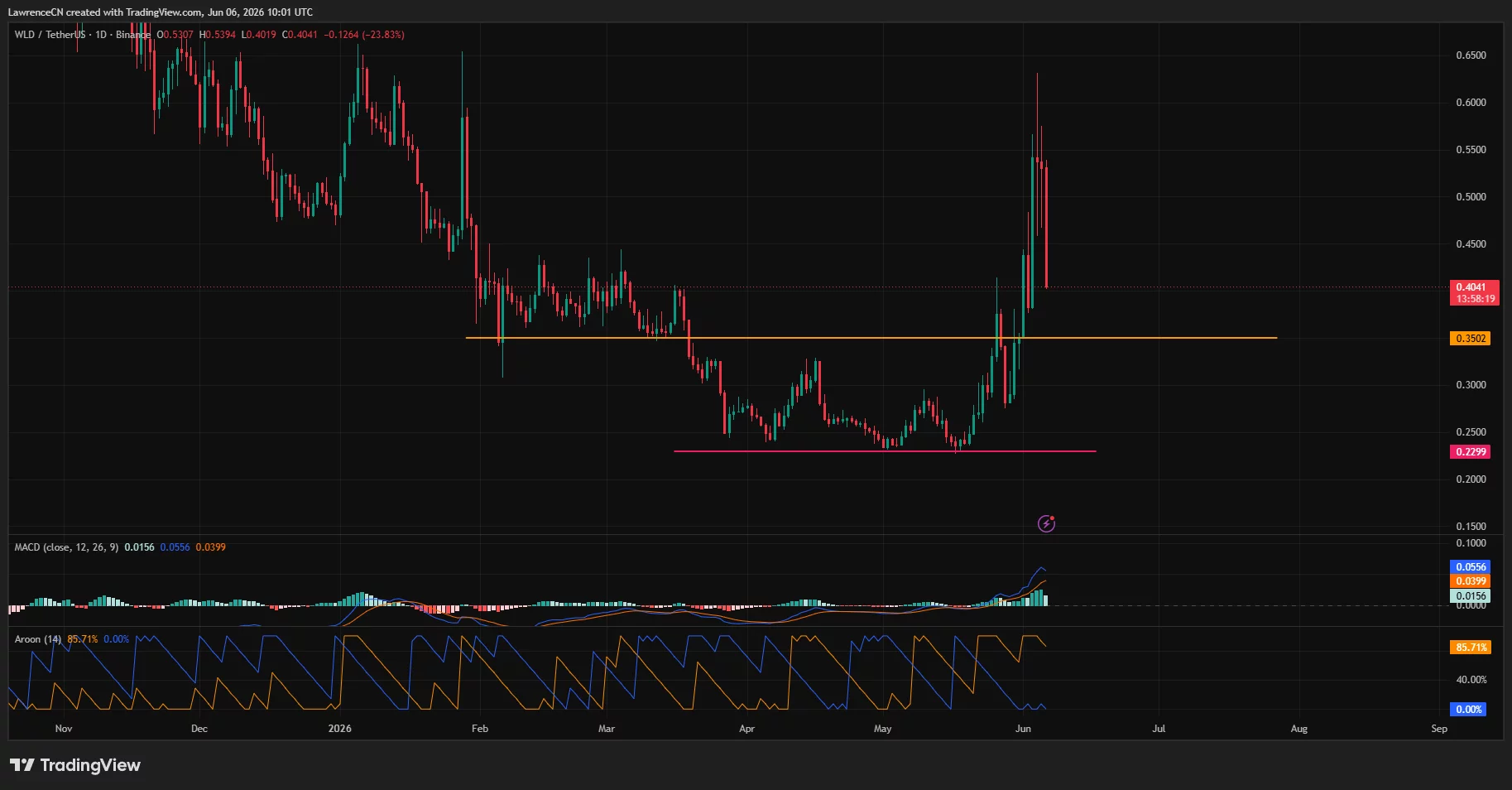
Worldcoin price has plunged more than 25% after Arthur Hayes closed his entire WLD position, triggering a sharp reversal in one of the crypto market’s strongest AI-linked trades.
Summary
- Worldcoin price plunged 28% after Arthur Hayes disclosed that Maelstrom had exited its entire WLD position.
- Key support sits at $0.35, with a breakdown potentially opening the door to a retest of $0.23.
- CoinGlass data shows major liquidation clusters at $0.45-$0.48 and near $0.60, creating key levels for traders.
According to data from crypto.news, Worldcoin (WLD) price plunged 28% from above $0.56 to around $0.40 on June 6, wiping out a significant portion of the token’s recent rally. The decline left WLD roughly 35% below its recent peak near $0.62 as selling accelerated after Arthur Hayes disclosed that Maelstrom had exited its entire position just days after publicly defending the trade.
The BitMEX co-founder announced the sale in an X post earlier today.
“This chart is going in the wrong direction. Dumped $WLD. I’m out. See y’all at the clerb.”
The decision represented another major portfolio reduction after Hayes recently disclosed exits from HYPE, NEAR, and Zcash.
Hayes had previously argued that Worldcoin could benefit from enthusiasm surrounding artificial intelligence-related assets and upcoming AI IPOs. By Friday, however, he had abandoned the thesis and cited a changing macro backdrop that included higher energy prices linked to the Iran conflict and growing uncertainty surrounding AI-focused investments.
The reversal came as speculative sentiment weakened across crypto markets. Bitcoin (BTC) briefly slipped below the $60,000 support area this week, triggering broad risk reduction among traders and contributing to heavy liquidations across altcoins.
Zcash provided an early warning of Hayes’ changing stance. As reported by crypto.news earlier, ZEC crashed nearly 50% from its recent high to an intraday low of $264.80 on June 5 after disclosure of the Orchard shielded pool vulnerability. Hayes subsequently liquidated his entire ZEC position, followed by exits from HYPE, NEAR, and finally WLD.
Technical structure keeps $0.35 as the key battleground
The daily chart shows WLD retreating sharply after failing to hold above the recent breakout area near $0.53. Despite the selloff, WLD price remains above a major support zone around $0.35, a level that acted as resistance throughout February and March before turning into support during the latest advance.
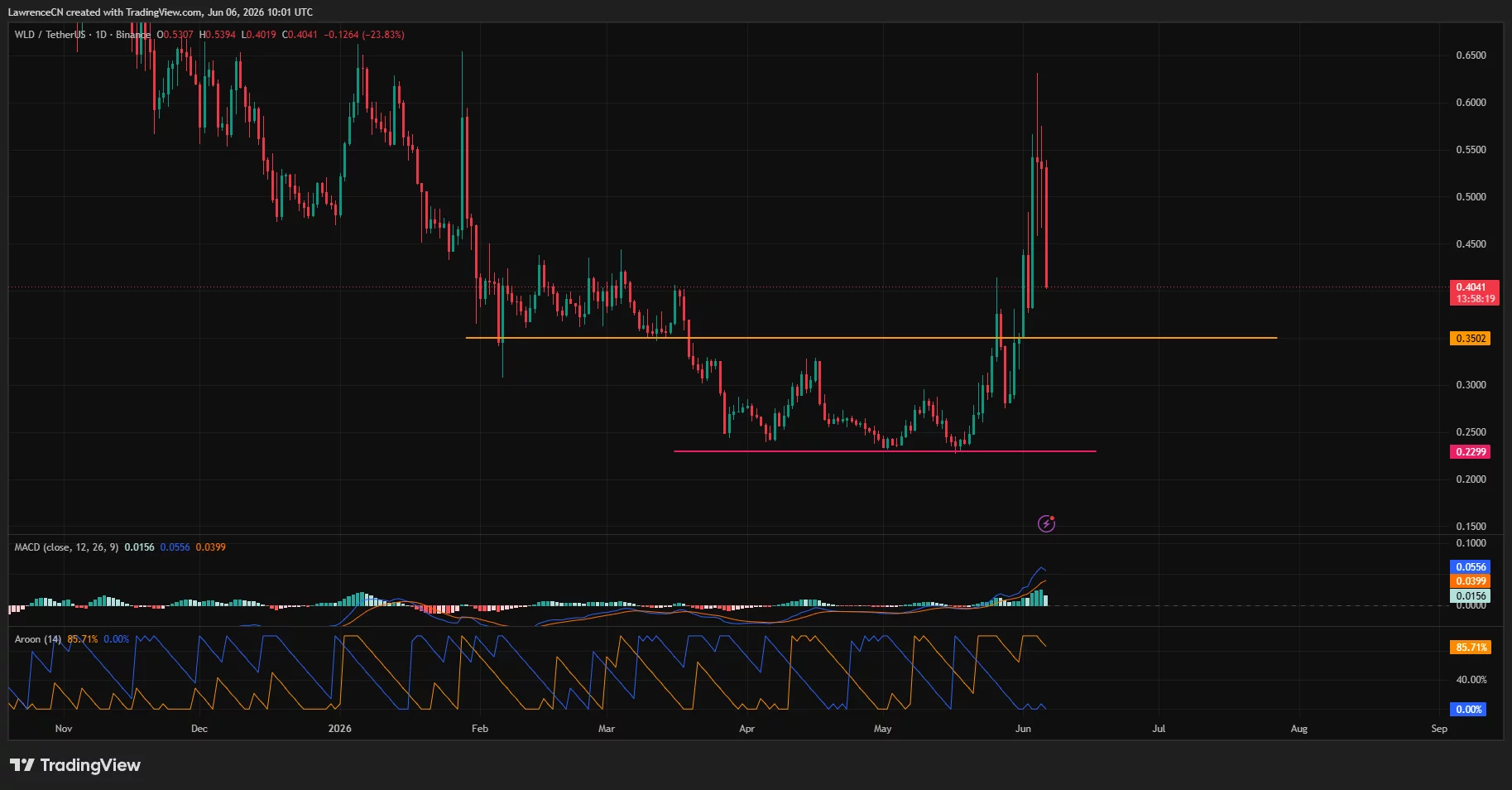
Buyers successfully defended that area multiple times earlier this year, making it the most important level on the chart. A decisive break below $0.35 could expose the next major support near $0.23, where Worldcoin formed its spring bottom.
Momentum indicators present a mixed picture. The MACD remains in bullish territory, with the signal line still above the zero axis following last month’s breakout. At the same time, the Aroon indicator shows Aroon Up near 86 while Aroon Down sits at 0, suggesting the longer-term uptrend has not been fully invalidated despite the recent correction.
Volume expanded significantly during the recent rally, pushing WLD from roughly $0.23 to above $0.60 in less than two weeks. Such rapid advances often lead to sharp retracements as traders lock in profits and leveraged positions unwind.
Liquidation clusters reveal the next major risk zones
CoinGlass liquidation heatmap data shows a dense concentration of liquidity between $0.45 and $0.48, an area likely to act as the first resistance zone if buyers attempt a recovery. Larger liquidation pools remain stacked near $0.59 and $0.60, close to this week’s local high.
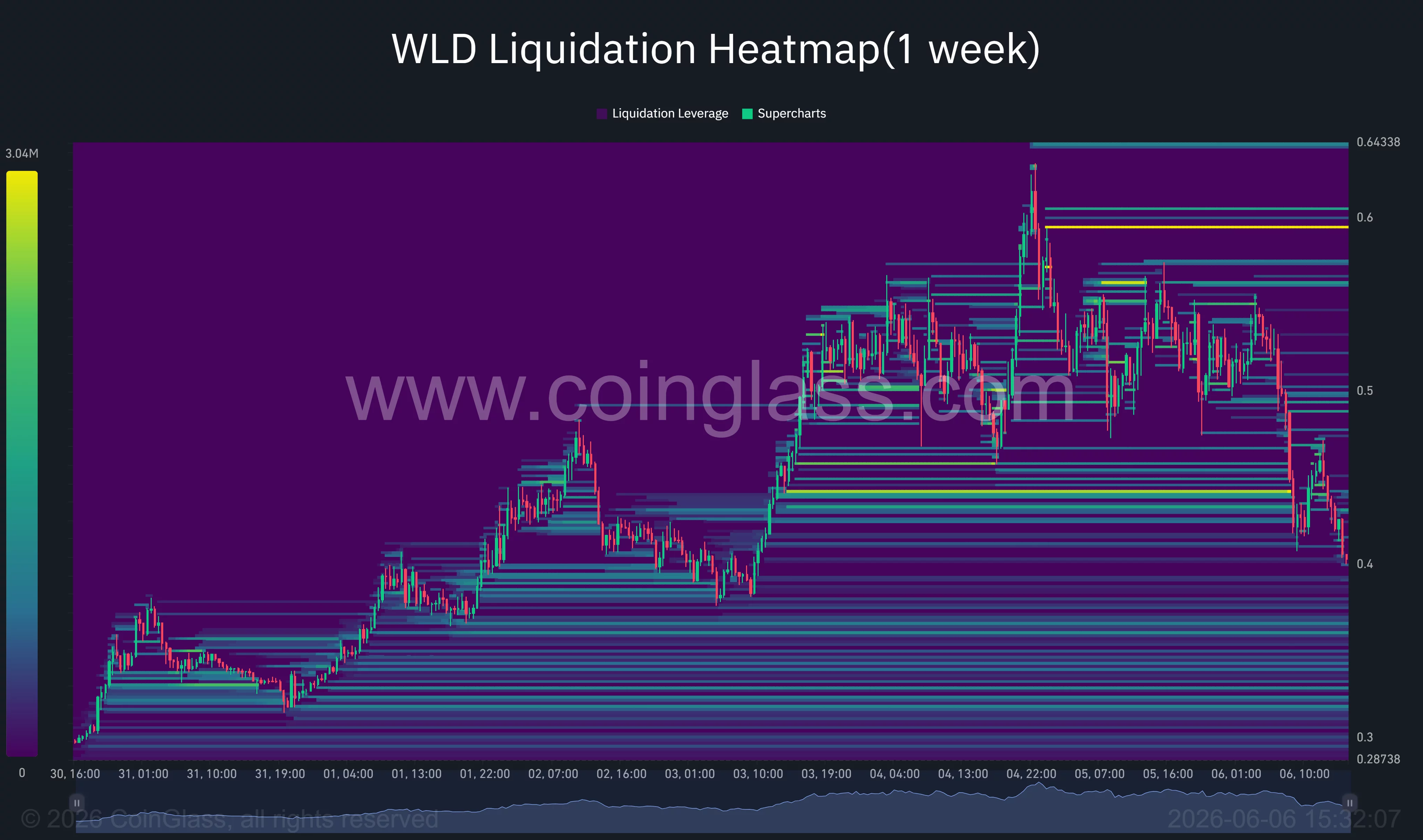
On the downside, leveraged positions are concentrated around the $0.38 to $0.40 region. Price has already entered that area, increasing the risk of additional volatility if sellers continue pressing lower.
Macro conditions remain another source of uncertainty. Stronger-than-expected U.S. labor data has reduced expectations for short-term Federal Reserve easing, while geopolitical tensions in the Middle East have pushed energy prices higher. Both developments have weighed on speculative assets during the past week.
For bulls, defending $0.35 remains the primary objective. Holding above that level would preserve the higher-low structure established since April and keep the possibility of a rebound toward $0.45 alive. A breakdown below support, however, could open the door to a deeper retracement toward the $0.23 base that launched Worldcoin’s recent rally.
Disclosure: This article does not represent investment advice. The content and materials featured on this page are for educational purposes only.
Crypto World
XRP Plunges to 2024 Lows With Risk of a 23% Drop: Will Ripple Ex-CTO’s Roadmap Help Boost the Price?
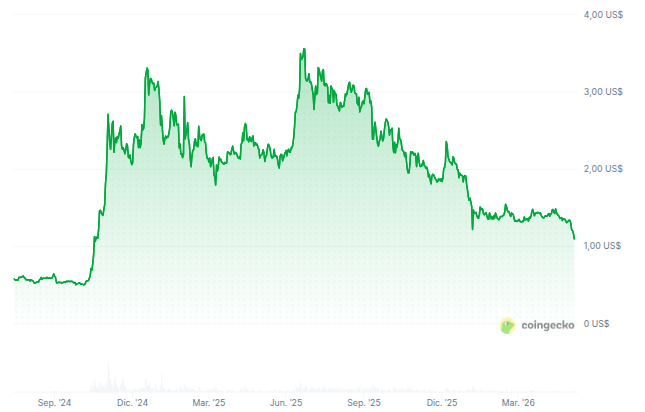
XRP dropped below $1.10 for the first time since 2024, with analysts warning of a possible further 23% decline, even as Ripple’s CTO emeritus David Schwartz unveiled an ambitious XRP Ledger roadmap.
We break down the price action, the bearish technical setup, and whether Schwartz’s new vision can realistically lift the price.

XRP Plunges Below $1.10: 23% Drop Still Possible
The Ripple’s token fell nearly 4% in the past 24 hours and 18% over the past week, trading between $1.05-$1.09 early on June 6, according CoinGeckos’s data.
That puts XRP roughly 70% below its all-time high near $3.65 set in July 2025. The drop aligns with broader weakness across major crypto assets, including Bitcoin’s recent slide below $60,000.
The decline has been notably steep for XRP. Traders point to technical breakdowns, with the price sweeping below key regression bands on monthly charts and triggering automated selling across leveraged trading platforms worldwide.
Analyst ChartNerdTA highlighted that such moves historically target the middle regression band. That zone sits around $0.84, which would mean a further 23% drop from current levels if the bearish setup plays out fully.
“Over the last 4 months $XRP spent the majority of its time hovering just above its upper regression band. That changed in June. Price is now sweeping below ($1.35), which historically points towards the middle regression band for a potential low ($0.84),” ChartNerd said.
Follow us on X to get the latest news as it happens

Meanwhile, Credible Crypto sees the move differently. He noted that local range lows have been taken and suggested XRP could bounce in the short term before potentially heading toward higher-time frame demand zones, possibly dipping below $1.
He views the correction as a healthy digestion of last year’s impulsive 7x move from sub-$0.50 levels. That framing reframes the current weakness as cyclical rather than structural for committed long-term holders watching closely.
On-chain data also shows significant holdings now in loss, approaching levels seen during prior bear market capitulations. With June historically challenging for crypto, the risk of testing $0.84 remains firmly on the table.
“Absolute capitulation printing on the $XRP 4h chart as a fresh buy confirmation signal locks in right at the 9 exhaustion count. The relentless vertical cascade has crushed the RSI down into deep oversold conditions near 25 while price action attempts to find a floor in the low,” one holder noted.
Can Schwartz’s Roadmap Help Lift the XRP Price?
Against this backdrop, David Schwartz, Ripple’s CTO emeritus and a key architect of the XRP Ledger, shared a forward-looking vision in his recent “XRP in a Minute” video, emphasizing the network’s evolution beyond payments.
Schwartz noted that enterprises are already using the XRPL for tokenized assets. He projected rapid expansion into tokenized securities, stocks, money market funds, repos, and loans across institutional and retail channels.
He framed this as a clear bridge from Bitcoin’s native asset model to a broader ecosystem of issued assets. The XRPL, in his view, can help decentralized finance eventually supplant traditional finance through enterprise-led adoption that pulls in retail users later.
“The XRP Ledger followed soon after, providing both the native digital asset, similar to Bitcoin, as well as issued assets that could represent things like stablecoins or tokenized assets of any kind,” he stated.
The timing is notable. Tokenization fundamentals and institutional pilots show real promise, yet they have so far failed to insulate the XRP price from macro pressures and the profit-taking after last year’s powerful surge across the broader market.
Spot XRP ETFs approved in late 2025 have offered some structural support. However, they have not stemmed the current tide of liquidations and broader risk-off sentiment now dominating global crypto markets across daily sessions.
The disconnect between Schwartz’s roadmap and current price action highlights a familiar crypto dynamic. Technological progress does not always translate into immediate price appreciation, especially during sharp corrections across the broader risk asset complex.
For now, XRP’s long-term thesis hinges on whether the XRPL can capture meaningful real-world asset and DeFi volume amid intensifying competition. Recovery likely requires broader market stabilization plus tangible on-chain growth metrics to validate the roadmap’s promise.
Subscribe to our YouTube channel to watch leaders and journalists provide expert insights
The post XRP Plunges to 2024 Lows With Risk of a 23% Drop: Will Ripple Ex-CTO’s Roadmap Help Boost the Price? appeared first on BeInCrypto.


Online speculation has tied Bitcoin’s latest drop to retail demand for SpaceX’s record IPO, but crypto flow data has not shown clear evidence of a mass cash exit.
Summary
- Online speculation linked Bitcoin’s recent drop to retail demand for SpaceX’s record IPO.
- CryptoQuant data showed no unusual USDC or Tether outflows during the selloff.
- Bitcoin and Ether saw large exchange withdrawals, which often show buyers moving coins to private wallets.
CryptoQuant data reviewed in the report showed no unusual withdrawals of USDC or Tether from exchanges during the selloff. The same data showed stablecoin movements stayed within the range seen since February.
The debate started after Bitcoin price fell about 16% during the same period that SpaceX began marketing its planned public listing. Bitcoin briefly traded below $60,000 before moving back near $61,000, according to market data cited in the report.
Stablecoin flows do not show cash rush
Stablecoins usually offer the clearest public view of crypto traders moving into dollars. A trader who sells Bitcoin to prepare cash for a brokerage account may convert funds into USDC or Tether before redemption.
CryptoQuant data did not show a sharp break in that pattern. The report said the largest recent single-day stablecoin outflows came before the latest Bitcoin decline, with $2.5 billion in USDC on May 22 and $3.6 billion in Tether on May 20.
At the same time, the report said Bitcoin and Ether saw large exchange withdrawals on Friday. CryptoQuant data showed 66,470 Bitcoin and about 2.49 million Ether left exchanges, among the largest single-day totals this year.
Such withdrawals do not usually match panic selling. Coins moving off exchanges often show that buyers took delivery into private wallets after purchases. Sellers usually move coins onto exchanges before selling.
SpaceX IPO draws heavy retail attention
Reuters reported that SpaceX plans to raise $75 billion through its IPO at a $135 share price. Reuters also reported that the company is seeking a valuation near $1.75 trillion, based on sources familiar with the matter.
The listing has drawn attention because retail investors could receive an unusually large share of the offering. Reports said platforms including Robinhood, Fidelity, and Charles Schwab are expected to give individual investors access.
Reuters reported that demand had already reached about $150 billion, or roughly twice the target size of the offering. Final allocations may still change before pricing.
The report said SpaceX is expected to price the IPO on June 11 and begin trading on Nasdaq under the ticker SPCX on June 12.
Brokerage data remains the missing piece
On-chain data cannot show everything. The report noted that a customer can sell crypto inside a Robinhood or Coinbase account and keep the dollars there without moving coins on a public blockchain.
Due to that blind spot, the crypto-to-SpaceX theory may not be settled until brokerages release their own figures. Robinhood reports monthly trading data, while Coinbase reports retail activity in its quarterly results.
Fund data gave the clearest evidence of crypto selling. Public ETF-flow reports showed spot Bitcoin ETFs lost more than $4.3 billion across a record 13-session outflow streak through June 3.
Ether ETFs also posted a 17-session outflow run before the streak ended. In those products, redemptions require issuers to sell the underlying coins, making ETF exits the clearest confirmed source of selling pressure.


Taylor Hornby, the security engineer who used Anthropic’s Opus 4.8 AI model to find a critical bug in Zcash, says privacy coin Monero is among the tokens he intends to audit next.
Asked on X whether he could look for flaws in Monero and other private cryptocurrencies, Hornby replied, “Absolutely! I’ll add Monero to my queue of things to audit.”
Monero, which trades under the ticker XMR, is among the largest privacy-focused cryptocurrency and hides transaction details by default compared to Zcash, where users can either either transparent or shielded addressed.
Hornby found the Zcash flaw on May 29. The bug, in the blockchain’s Orchard privacy pool, had gone undetected since May 2022 and could have let an attacker mint unlimited, undetectable counterfeit ZEC. Shielded Labs, a nonprofit developer on the network, disclosed it on Thursday and pushed through an emergency fix by June 1.
Zcash fell 38% over the following 24 hours amid fallout and concerns about a hacker possibly stealing money from the shielded pool – without leaving any detectable trace – over the past few years.
Hornby, hired by Shielded Labs in April to find protocol bugs before attackers could, said he reported the flaw rather than exploit it because the Zcash developers were “like family” and he could “not live with that kind of betrayal.”
He plans to apply for a Zcash coinholder grant to fund further work.
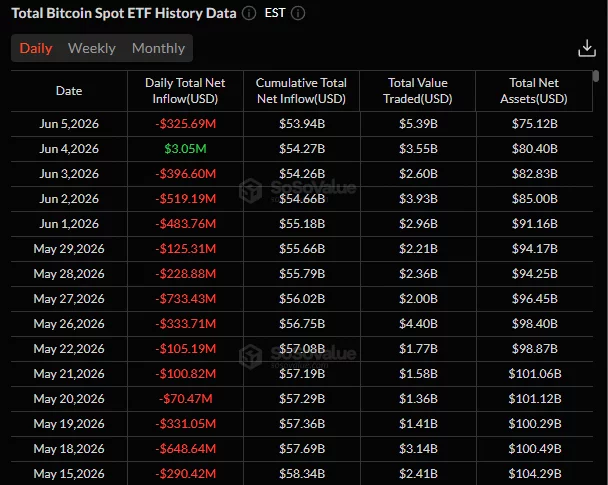
U.S. spot Bitcoin ETFs returned to net outflows on Friday after briefly snapping a record withdrawal streak, with BlackRock’s IBIT leading the declines as Bitcoin fell below the key $60,000 support level and investor sentiment deteriorated.
Summary
- Bitcoin ETFs posted $325.7 million in outflows, led by BlackRock’s IBIT with $213.7 million withdrawn..
- Bitcoin price fell below $60,000 to a low near $59,100, while analysts linked continued ETF outflows and a more hawkish Federal Reserve outlook to the market decline.
- Analysts say $60,000 remains key support, with downside risk toward $55,000.
According to data from SoSoValue, the ETFs recorded $325.69 million in net outflows on June 5, reversing the modest $3.05 million inflow posted a day earlier.
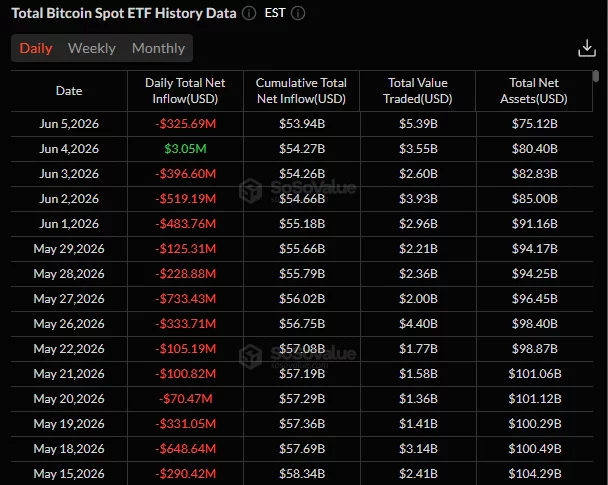
The latest withdrawals pushed cumulative net inflows across the category down to $53.94 billion and highlighted continued pressure on institutional Bitcoin demand after nearly three weeks of persistent redemptions.
BlackRock’s IBIT accounted for the largest share of the losses, recording $213.65 million in outflows on June 5. Fidelity’s FBTC and Grayscale’s GBTC followed with withdrawals of $59.69 million and $60.84 million, respectively. VanEck’s HODL and Morgan Stanley’s MSBT were the only products to attract fresh capital, bringing in a combined $8.5 million.
The renewed ETF selling coincided with a sharp decline in Bitcoin prices. According to data from crypto.news, Bitcoin (BTC) price plunged to an intraday low near $59,100 before rebounding above $61,000 at the time of writing. The move pushed the asset to its lowest level since October 2024 and extended a broader correction that has erased more than $15,000 from recent highs.
Why are Bitcoin ETFs seeing renewed outflows?
Recent ETF flow trends have attracted growing attention from Wall Street analysts. In a recent note, Citigroup argued that investors may be underestimating the role ETF demand plays in Bitcoin’s price performance.
The bank also pushed back against the narrative that Bitcoin’s recent decline was primarily driven by Strategy’s decision to sell 32 BTC for preferred stock distributions, arguing that sustained ETF outflows have played a much larger role in weakening prices.
As reported by crypto.news earlier, spot BTC ETFs recorded $2.43 billion in net ETF outflows during May and another $1.40 billion during the first three days of June, which played a major factor behind Bitcoin’s recent weakness. The latest $325.69 million redemption suggests institutional demand still remains fragile despite Thursday’s brief interruption in the outflow trend.
Pressure has also become visible in ETF holdings. Data from CheckonChain shows U.S. spot Bitcoin ETFs currently hold approximately 1.277 million BTC. While that figure remains slightly above February levels, it is still roughly 7.2% below the record high reached in October, indicating that funds have not yet recovered the Bitcoin sold during recent redemptions.
Broader market conditions have added to the pressure. Stronger-than-expected U.S. labor market data this week reduced expectations for Federal Reserve rate cuts and prompted traders to scale back risk exposure across digital assets.
The shift in sentiment intensified after BNP Paribas abandoned its previous forecast for stable monetary policy and projected three Federal Reserve rate hikes beginning in December, effectively reversing the three rate cuts delivered in 2025.
The bank cited persistent inflation pressures and a resilient labor market as reasons policymakers may need to tighten policy again, helping trigger a wave of selling that pushed Bitcoin below major technical support levels.
This bearish forecast helped trigger a wave of selling that pushed Bitcoin below major technical support levels.
Where could Bitcoin price head next?
Technical indicators suggest Bitcoin is approaching an important decision point after reaching deeply oversold conditions.
On the daily chart, BTC briefly dropped below the Murrey Math support zone near $60,000 before recovering. The daily RSI has entered oversold territory while the MACD continues to trend lower, reflecting strong bearish momentum but also increasing the probability of a relief rally.
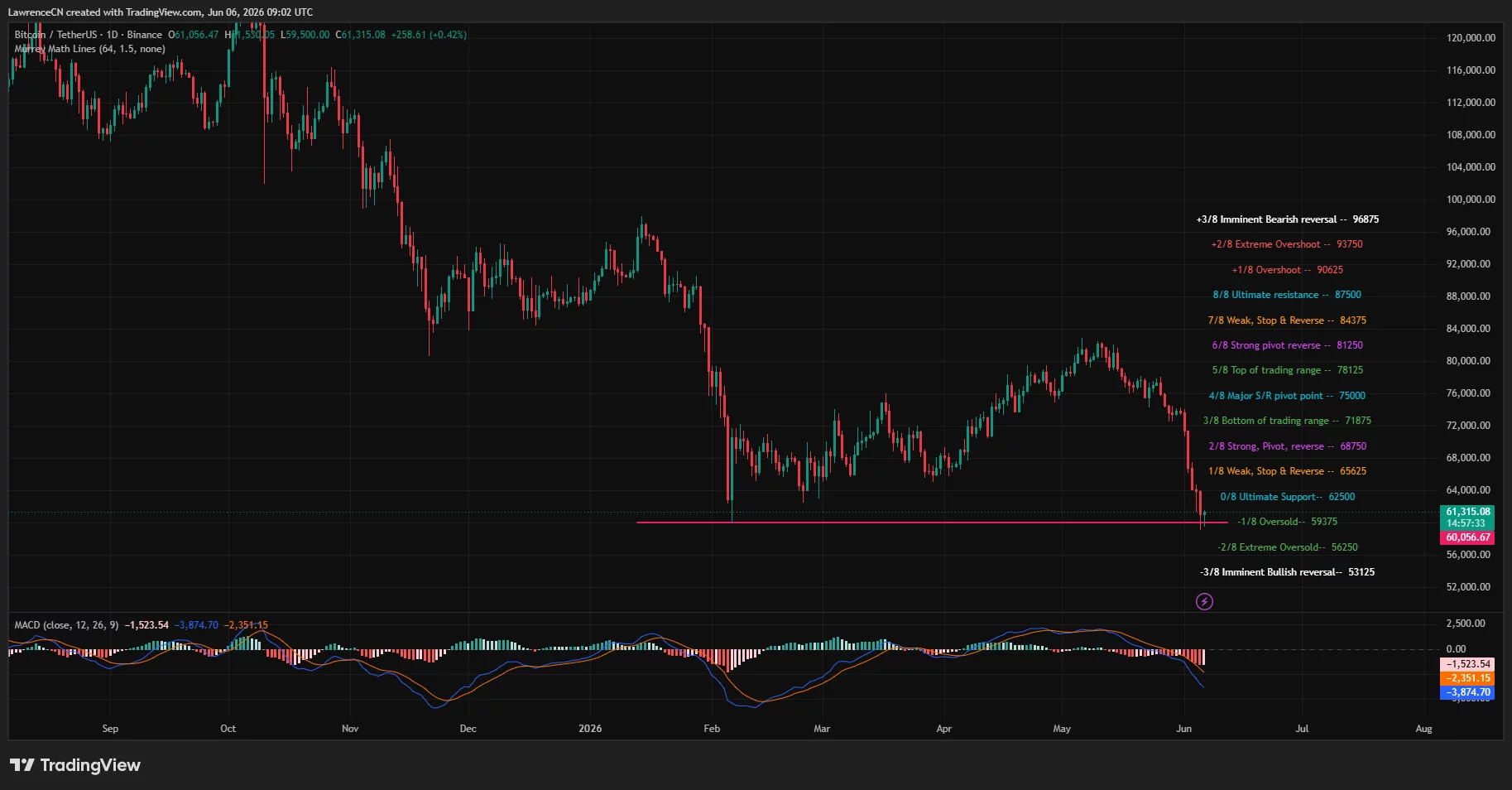
According to analyst Kamile Uray, buyers need to defend the current area to prevent a deeper decline.
“BTC experienced a sharp decline along with all markets. It has reached 60,000, which we’ve long referred to as an important level. A strengthening of buyers at this level could at least bring about a rise in the form of a correction to the drop.”
According to Uray, the first resistance level sits around $67,500, followed by a broader resistance zone between $74,000 and $75,000. However, he warned that failure to hold the $60,000 area could expose Bitcoin to a deeper decline toward the $55,000-$50,000 range.
Derivatives positioning also points to heightened volatility ahead. CoinGlass liquidation heatmap data shows large clusters of leveraged positions concentrated between $67,000 and $75,000. If Bitcoin stages a recovery, those levels could become liquidation targets that accelerate upside momentum.
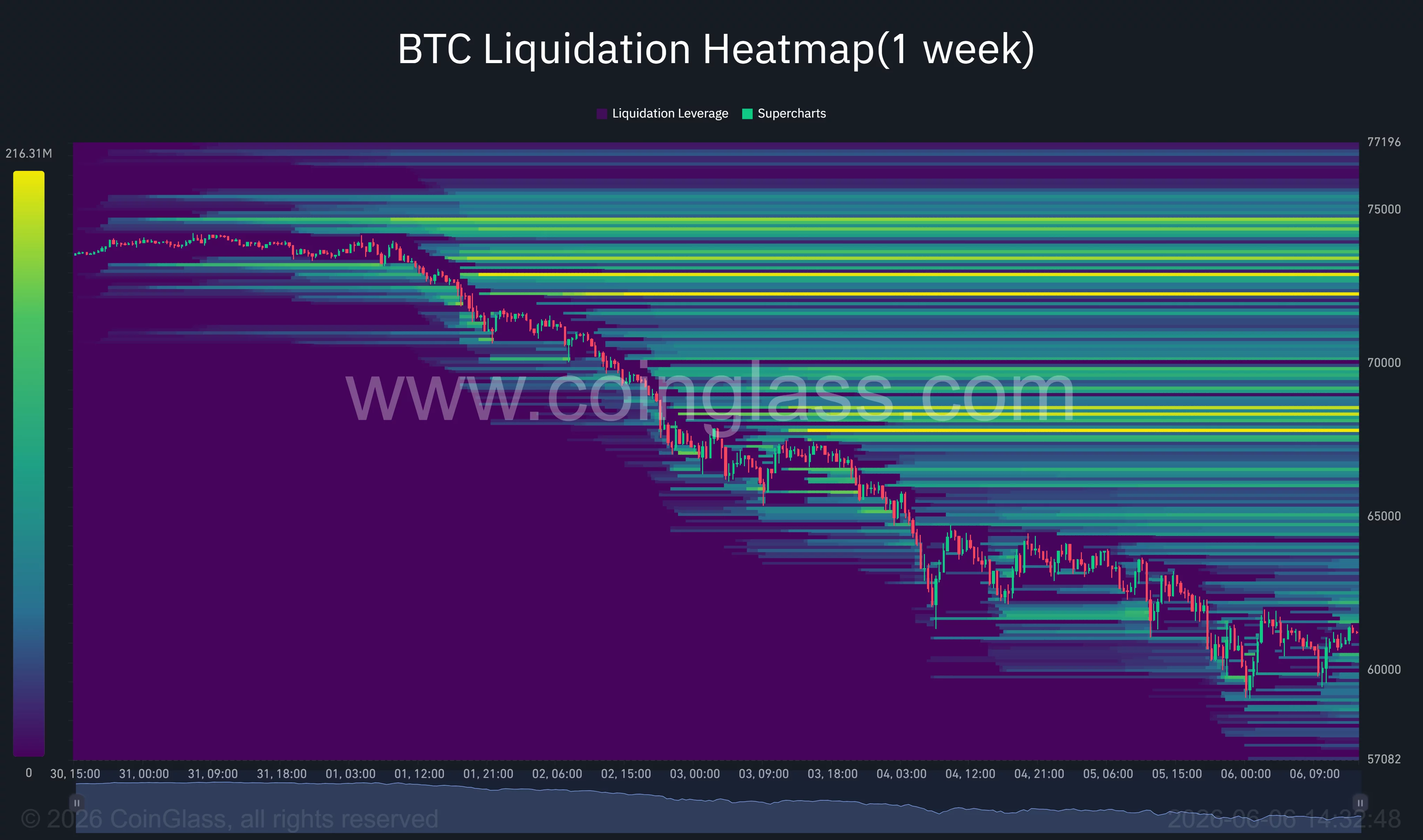
On the downside, analyst Ali Martinez noted that Bitcoin’s 1.0 and 0.8 MVRV pricing bands currently sit at approximately $53,900 and $43,130, respectively, levels he described as historically attractive risk-reward zones during major market corrections.
At the time of writing, Bitcoin was trading near $61,300, leaving traders closely watching whether support around $60,000 can hold as ETF outflows continue to weigh on market sentiment.
Disclosure: This article does not represent investment advice. The content and materials featured on this page are for educational purposes only.

TLDR:
- Russia’s central bank limits non-qualified investors to Bitcoin, Ethereum, and USDT only.
- A 300,000-ruble annual cap per broker applies to retail crypto purchases under the draft law.
- USDT remains on the approved list despite central bank warnings over freezing and burn risks.
- Russia’s digital currency law is set to take full effect on July 1, 2026, after summer passage.
Russia’s central bank has drawn a firm line on crypto access for retail investors. First Deputy Governor Vladimir Chistyukhin confirmed the Bank of Russia will restrict non-qualified investors to three assets: Bitcoin, Ethereum, and USDT.
The decision reflects the regulator’s cautious stance toward digital assets amid high volatility concerns. An annual investment cap of roughly 300,000 rubles, or about $4,100, through a single broker will also apply.
Three Assets, Strict Limits, No Near-Term Expansion
The Bank of Russia has been consistent in its position on retail crypto access. Chistyukhin reiterated that the regulator views cryptocurrencies as high-risk, highly volatile instruments unsuitable as priority investments for everyday Russians. The three-asset list — Bitcoin, Ethereum, and USDT — reflects the most liquid options currently available.
The 300,000-ruble limit per professional participant was also defended by Chistyukhin. He noted the figure already exceeds the average balance on most Russian brokerage and trust management accounts. From the regulator’s view, this threshold covers exposure without enabling runaway losses.
The central bank also acknowledged requests to expand the list beyond these three assets. Those requests came primarily from parties interested in listing domestically issued stablecoins.
However, the bank made clear that such expansion will only make sense once those assets formally exist and operate at scale.
Chistyukhin was direct on the timeline: “We will start with three currencies, then we will see how the situation develops.”
He added that while the law permits future expansion, no immediate moves are planned. “So they will act,” he said, referring to the three approved assets.
USDT Risks and the Stablecoin Debate
Even as USDT makes the approved list, the central bank did not shy away from flagging its vulnerabilities. Chistyukhin reminded stakeholders that USDT wallets can be frozen or burned by the issuer at any time.
“They can be blocked today, in fact, they can be burned — their owners can be deprived of the right to use these stablecoins,” he said. That risk, he argued, justifies keeping the stablecoin investment cap unchanged.
The stablecoin debate has drawn input from other officials as well. Deputy Finance Minister Ivan Chebeskov argued that stablecoins from friendly jurisdictions should also be considered.
“It is important for us that stablecoins of friendly jurisdictions are also available,” he said, citing a ruble-pegged token issued in Kyrgyzstan as one example.
Moscow Exchange head Viktor Zhidkov suggested regulators could eventually approve up to five coins for non-qualified investors.
“Our investor buys the main, most popular three to five coins,” he said. Any additions, however, remain subject to regulatory review and formal admission criteria.
The draft law governing digital currency circulation and digital rights passed its first State Duma reading in late April. Lawmakers plan to adopt it before summer, with the full regulatory framework set to take effect on July 1, 2026.
Both qualified and non-qualified investors will be required to pass a knowledge test before purchasing any approved digital assets.

After plunging by several grand in the span of less than 12 hours, bitcoin finally rebounded from its multi-year low and now sits at around $61,000.
Although most altcoins are still in the red on a daily scale, they have managed to recover some of the losses. This is particularly true for ZEC, which bled out heavily yesterday, and PI, which marked consecutive all-time lows.
Bitcoin Recovers $2K
What a week it has been for bitcoin, and mostly for the bears. In fact, what a painful three-week period. The asset stood above $82,000 in mid-May before its calamity began, and it dumped to $74,000 at the end of the month. But that was just the start, as June, in just five days, brought a lot more pain.
Bitcoin quickly lost the $70,000 support, and then the bears were really in control. They started pushing it below one key support level after another. Thus, $68,000, $65,000, and $62,000 gave in before the asset came inches away from the $60,000 bottom that managed to hold it during the February crash.
Although the buyers successfully defended it at first, that level finally gave in yesterday, and bitcoin plunged to just over $59,000. This became its lowest price since before the November 2024 US presidential elections. After losing about $23,000 in weeks, BTC finally showed signs of a minor recovery and has bounced to $61,000 as of now.
Its market cap is up to $1.225 trillion on CG, while its dominance over the alts has reclaimed the 56% level.

ZEC, PI Rebound
Although most crypto assets plunged yesterday, Zcash became the worst performer after a vulnerability in its code was uncovered and Arthur Hayes dumped his entire stash. At one point, ZEC had dropped by over 50%, going from $630 to under $300. However, it has reacted swiftly and now trades above $370.
Pi Network’s native token marked several consecutive all-time lows after it dumped below $0.15 earlier this week. The latest, according to CoinGecko data, sits at under $0.12. However, it has managed to reclaim that level since then and now trades about 7% above the ATL.
ETH dumped to $1,500 yesterday but stands close to $1,600 now. BNB is back to $580, while XRP has returned to $1.10. XLM and CC are among the few alts in the green today.
The total crypto market cap dipped to $2.1 trillion yesterday, and although it has recovered some of its losses, it still sits below $2.2 trillion on CG.

The post Pi Network’s PI Token Rebounds After New ATL, BTC Quickly Reclaims $60K: Weekend Watch appeared first on CryptoPotato.


Arthur Hayes has closed his entire Worldcoin position after turning cautious on WLD and other high-beta altcoins within days of publicly defending the trade.
Summary
- Arthur Hayes sold his entire WLD position on June 6 after recently backing the AI-linked token.
- Hayes had earlier exited HYPE, NEAR, and ZEC within two days.
- Stacy Muur said WLD had gained about 68% while the market dropped nearly 10%.
Hayes said in posts on X that he sold the full WLD position on June 6 after earlier arguing that the token could benefit from renewed interest in artificial intelligence-linked assets. The BitMEX co-founder had outlined a bullish case for WLD on June 3, then reiterated the view on June 4, linking the token to expected AI IPO activity and shifting liquidity conditions.
Hayes Cuts WLD After Rapid Rally
Worldcoin had gained strongly during the previous three weeks, even as several altcoins struggled to hold momentum. Crypto analyst Stacy Muur said on June 5 that WLD had advanced about 68% while the crypto market fell roughly 10%. She attributed part of that gap to Hayes and his fund, Maelstrom.
By June 6, Hayes had reversed course and shared a chart to explain why he had sold the full position. His exit turned WLD from one of his preferred AI-related trades into another token removed from his book during a sharp round of risk reduction.
The sale came after WLD became more volatile in early June. Hayes did not describe the move as a slow portfolio adjustment. Instead, his public posts showed a quick move from conviction to a complete exit.
HYPE, NEAR, ZEC Sales Came First
Worldcoin was not the first token Hayes dropped during the week. On June 4, he said he had sold his full HYPE and NEAR holdings and told followers that he would explain the decision in an essay titled “Reality Test,” expected the following Tuesday.
In the same macro note, Hayes cited higher energy prices tied to the Iran conflict, three expected AI IPOs before early Q3, and his view that President Trump could adopt an anti-AI stance before the midterms. Hayes presented those issues as reasons to reassess positions linked to AI and speculative liquidity.
A day later, Hayes also exited Zcash after the Orchard shielded-pool vulnerability became public. He wrote that the trade no longer worked for him because the bug could not be formally proved to prevent unauthorized minting. Hayes added that the “privacy from AI, govt, big tech narrative demands perfection.”
As previously covered on crypto.news ZEC sale ended what Hayes had called his “Holy Trinity” of HYPE, NEAR, and ZEC. WLD then became the final major position he removed.
Hayes remains a closely followed crypto investor, and his trades often shape debate even when they do not directly move prices. His decision to sell WLD, HYPE, NEAR, and ZEC within two days gave traders a clearer view of his current caution toward altcoins outside Bitcoin and Ether.
The key question for WLD holders is whether the token’s earlier premium can hold without Hayes as a public backer. Stacy Muur’s June 5 comments showed how far WLD had moved ahead of the market before the exit.
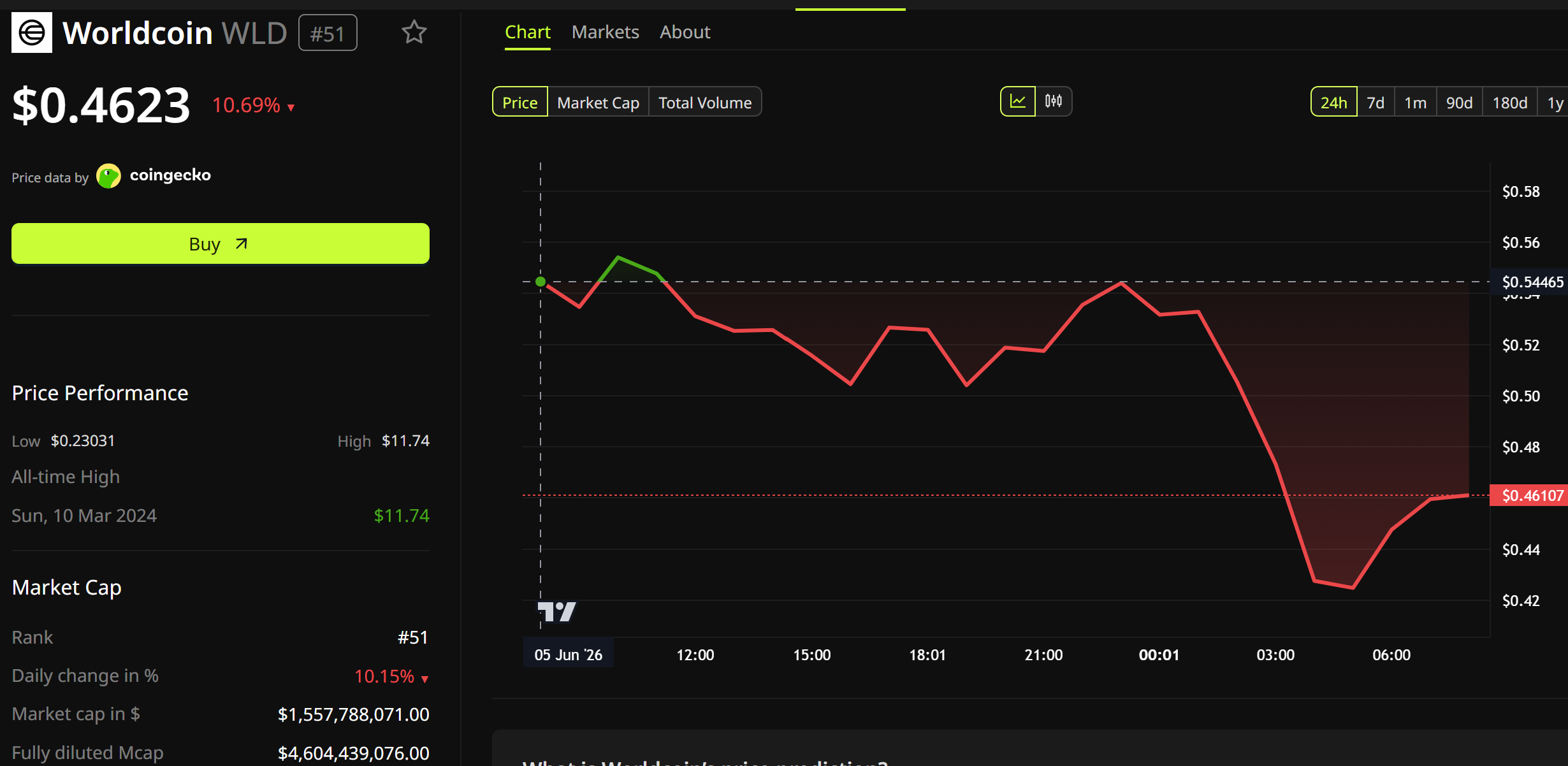
Arthur Hayes said he sold his Worldcoin (WLD) position on June 6, only days after publicly promoting the token, drawing accusations that he built exit liquidity for his own followers.
The reversal capped a week in which the BitMEX co-founder unwound four high-conviction altcoin bets. WLD traded near $0.46, down about 11% over 24 hours after a sharp weekly run.

Arthur Hayes Moves From Bullish Thread to Sudden Exit
Hayes announced the sale on X (Twitter) early Saturday, alongside a falling price chart.
“This chart is going in the wrong direction. Dumped $WLD. I’m out. See y’all at the clerb,” he said.
The timing fueled the anger. Days earlier, Hayes had urged followers to hold WLD through an expected SpaceX listing and framed it as a high-beta bet on artificial intelligence.
WLD had climbed roughly 55% over the prior week before the pullback.
Worldcoin, since rebranded World, is the iris-scanning identity project co-founded by OpenAI chief Sam Altman. Its token has drawn heavy retail interest, which critics say magnifies the impact of influential traders.
WLD still ranks near 51st by market value at roughly $1.55 billion. The single-day drop trimmed about $190 million from that figure, even after the token gained around 55% over the prior seven days.
Critics Allege a Repeated Pattern
The backlash widened after crypto sleuth ZachXBT tied the WLD exit to earlier reversals.
“How much exit liquidity was created from your followers over the past couple days? First NEAR HYPE ZEC Now WLD,” wrote ZachXBT.
Follow us on X to get the latest news as it happens
Indeed, Hayes dumped his Hyperliquid stack and NEAR Protocol (NEAR) on June 4, days after a $150 HYPE price target and a public charity wager.
He exited Zcash (ZEC) next, then WLD, despite having kept holding Worldcoin as his last AI proxy.
“…no redemption for you [Arthur Hayes] ever… Just leave to some remote island and beg for forgiveness for 50 years and never show your face in this crypto-space ever again,” another user lashed.
Hayes carries a contested history. He pleaded guilty in 2022 to a Bank Secrecy Act violation tied to BitMEX and paid a $10 million fine. This history deepens the distrust behind the Worldcoin price manipulation claims now circulating.
In his defense, Arthur Hayes says he “sold to a willing buyer at a price, highlighting that he would have suffered the loss had prices moved higher.
“I just happened to call it right this time as it regards to my trading goals,” wrote Hayes.
Whether the episode reshapes how followers treat his calls, or simply fades like prior cycles, may become clear in the coming weeks.
“ZEC, NEAR, and WLD are back to where they were before his calls,” Lookonchain indicated.
The post Arthur Hayes Sparks Fury After Abrupt Worldcoin Exit, WLD Price Falls 10% appeared first on BeInCrypto.

Ctrl-Alt-Speech: Generous To A Default

Trump Just Started The Biggest Money Reset Since WW2

Pope travels to Spain where the Catholic Church has a complex legacy



-

 Business5 days ago
Jade Biosciences, Inc. (JBIO) Discusses Positive Interim Results From JADE101 Phase I Healthy Volunteer Study and Development Plans Transcript
-
 Tech7 days ago
SpaceX just won a second Golden Dome contract. This one is $4.16 billion.
-

 Sports4 days ago
French Open 2026 results: Alexander Zverev beats Rafael Jodar and will play Jakub Mensik in semi-finals
-

 Fashion17 hours ago
Weekend Open Thread: Evereve – Corporette.com
-
 Crypto World21 hours ago
Jensen Huang Approves Samsung, SK Hynix, and Micron for NVIDIA (NVDA) HBM4 Memory Supply
-

 Tech4 days ago
CryZENx Releases Fresh Playable Content Deep Inside Jabu-Jabu for His Ocarina of Time Remake
-

 Business7 days ago
Is the Spurs Phenom Already Better Than Prime Diesel?
-

 Business3 days ago
Trump Taps Housing Chief Bill Pulte as Acting Intelligence Director After Gabbard Exit
-
Crypto World1 day ago
LBank Surpasses 25 Million Users Worldwide as AFA Partnership Continues to Drive Global Growth
-
 Entertainment7 days ago
One of the Greatest Sitcoms of All Time Shoots Up Apple TV’s Charts 11 Years Later
-
 NewsBeat7 days ago
Everything you need to know as Cambridge’s Strawberry Fair returns after cancelled year
-
 Crypto World4 days ago
Seagate (STX) Stock Surges to Record High on AI Boom and Legal Settlement
-
 NewsBeat4 days ago
Republicans balk at Trump’s attempt to appoint a MAGA enforcer to lead National Intelligence
-
Crypto World3 days ago
EU AI Data Center Project Faces Delays as Funding Gaps Grow
-

 Entertainment3 days ago
Did The Mandalorian And Grogu Already Ruin The Next Star Wars Movie?
-

 Tech7 days ago
Acer’s Swift Air 14 is a peppy MacBook Neo rival with some cool upgrades and a $699 ask
-

 Business3 days ago
Aehr Test Systems Stock Soars 17% Amid Surging AI Demand and Conference Spotlight
-

 Business3 days ago
Relay Therapeutics Shares Surge 20% on ASCO Momentum for Zovegalisib Breast Cancer Program
-
Business7 days ago
Algoma Steel gains 63% as Fair Value models spot opportunity
-
 Business4 days ago
Claude AI Down Today Reason: Why Anthropic’s AI is not working today? What’s the latest quota update
You must be logged in to post a comment Login