

Crypto World
Bitcoin network activity drops to a 7-year low as price weakens



Bitcoin has seen its network use fall to its weakest level in more than seven years as selling pressure and lower on-chain activity weigh on market confidence.
Summary
- Bitcoin active addresses dropped near 2019 bear market levels, according to Bitcoin Magazine’s 60-day moving average data.
- Bitcoin network use has declined since the 2021 bull market, as ETFs reduced direct on-chain transaction demand.
- The Genius Act helped stablecoin activity expand on Ethereum, Solana, and Tron, adding pressure on Bitcoin utilization.
Bitcoin Magazine data showed that the 60-day moving average of active Bitcoin addresses stood slightly above 600,000 on June 4. The reading placed Bitcoin’s address activity near levels last seen during the 2019 bear market, according to the same data.
Bitcoin active addresses return to 2019 levels
According to Bitcoin Magazine, the decline in active addresses has continued since the end of the 2021 bull market. The data showed a steady drop in wallet activity over several years, even as Bitcoin became more accessible through regulated investment products.
Spot Bitcoin exchange-traded funds changed how many investors gain exposure to BTC. After the products received approval, some investors moved toward ETF shares instead of direct on-chain transactions, according to the report. These products offered regulated access and deeper trading liquidity, which reduced the need for some investors to move Bitcoin across the network.
At the same time, Bitcoin has faced stronger competition from other layer-one networks. Ethereum, Solana, and Tron have continued to host stablecoin payments and frequent settlement activity, while Bitcoin remains mostly used as a store-of-value asset.
The report also linked part of the decline to the Genius Act, a U.S. law signed in July 2025 that created federal rules for stablecoin issuers. After the law took effect, institutional stablecoin activity expanded across chains built for faster and cheaper payments.
According to the report, more firms have used Ethereum, Solana, and Tron for stablecoin transfers, while Bitcoin has seen less frequent transactional demand. The trend has added pressure to Bitcoin’s active-address count, which remains one of the key measures used to track network participation.
BTC price slides as sentiment weakens
Bitcoin traded near $63,950 at the time of reporting, down more than 26% since the start of the year. The decline has kept market attention on the February 2026 support area, where traders previously watched for buyer interest.
As previously reported by crypto.news, Bitcoin had rebounded from an intraday low near $61,500 after weaker-than-expected U.S. labor market data raised expectations that the Federal Reserve could still cut interest rates later in 2026.
The U.S. Department of Labor reported that initial jobless claims for the week ended May 30 rose by 13,000 to 225,000. Economists had expected 215,000 claims, while the prior week’s reading was revised higher to 212,000.
Labor data offers limited relief
Additional Labor Department figures showed final labor costs rose 1.8% in the first quarter, below economists’ estimate of 2.5%. Continuing jobless claims fell by 8,000 to 1.777 million for the week ended May 23.
Market participants often view weaker labor data as supportive for risk assets because it can give the Federal Reserve more room to lower interest rates if economic conditions soften further.
However, the report warned that Bitcoin’s network activity may remain under pressure if capital continues moving into artificial intelligence-related stocks. A recovery in active addresses could support bullish sentiment, but Bitcoin’s current on-chain data shows participation remains weak compared with previous market cycles.



Bitcoin continues to lose ground and the price is fast closing on $60,000 amid record ETF outflows.
The $60,000 level has been widely cited by analysts as a major support, below which the selloff could get even uglier.
Jean-David Péquignot, the chief commercial officer at leading crypto options exchange Deribit said that price is critical not just because it’s a round-number psychological level. More importantly, it’s a structural threshold with real consequences for institutions and derivatives market participants.
The cost basis problem
According to Péquignot, a significant chunk of institutional money — comprising ETF buyers, large holders and short-term speculators — bought bitcoin at prices between $60,000 and $67,000 over the past year.
With the largest cryptocurrency now trading within that range, these buyers are sitting at or near their cost basis, essentially at break-even. If prices drop further, unrealized or paper losses will mount and holding becomes expensive, especially when AI stocks and other parts of the traditional market are rallying like there is no tomorrow.
“As price undercuts their cost basis, the resulting unrealized losses may incentivize rushed selling, especially as the opportunity cost of holding BTC rises against a surging AI equity sector,” he said.
Michael Saylor, the high-profile executive chairman of Strategy (MSTR), the largest publicly traded bitcoin holder, also blamed capital rotation for recent BTC losses.
The derivatives problem
Things become mechanical after that.
On Deribit, there is over $1.2 billion in notional open interest sitting at the $60,000 strike put options, which pay out if prices fall below that level. Investors have bought these as a hedge against a protracted selloff.
The problem, however, is that market makers, who are on the opposite side of the investors, are now short puts, or more precisely, “short gamma.”
So, as BTC nears $60,000, market makers and dealers will be forced to sell spot BTC or futures to balance their books. Other things being equal, this hedging can accelerate the selloff, turning an orderly decline into a chaotic one, Péquignot said.
He also pointed out that there are too many leveraged longs in the system, and a break below $60,000 could lead to more liquidations, adding to downside momentum.
“With leverage still not fully flushed from the system, a break of $60K could rapidly worsen collateral metrics, triggering a cascading wave of automated long liquidations,” he said.
Note that billions of dollars of leveraged longs, or bullish plays tied to BTC and other tokens, have already been liquidated this week.
Crypto World
Forward Industries (FORD) Transfers $32M in Solana to Coinbase Amid Massive Unrealized Losses

Key Takeaways
- Forward Industries transferred 455,784 SOL (approximately $31.87M) to Coinbase Prime following 30 days of wallet dormancy
- The transaction has sparked widespread speculation about a possible liquidation event
- Since September 2025, Forward Industries accumulated 6.83 million SOL for approximately $1.59 billion
- With an average entry price of $232.08 per token, the portfolio is currently valued at roughly $458.6 million
- Forward Industries faces an unrealized deficit approaching $1.13 billion on its Solana investment
Forward Industries has transferred 455,784 SOL tokens to Coinbase Prime, representing approximately $31.87 million in current market value. Blockchain analytics platform Lookonchain identified the transaction, which occurred after 30 consecutive days without any on-chain activity from the company’s wallet.
Forward Industries, Inc., FWDI
When institutional holders move substantial cryptocurrency amounts to centralized trading platforms, market observers typically interpret this as preparation for liquidation. Forward Industries has remained silent on the reasoning behind this transfer.
The firm initiated its Solana accumulation program in September 2025, deploying approximately $1.59 billion to acquire 6.83 million SOL tokens at a mean cost of $232.08 each.
SOL currently trades significantly beneath that acquisition average. The aggregate portfolio value stands at approximately $458.6 million, resulting in an unrealized deficit nearing $1.13 billion.
This represents a substantial paper loss for an investment approach centered on strategic accumulation and long-term positioning.
An Aggressive Strategy Meets Harsh Reality
Forward Industries positioned itself among the most bullish institutional Solana accumulators in the public markets. The company’s approach closely resembled MicroStrategy’s Bitcoin playbook — systematic purchasing with conviction through market cycles.
However, SOL’s price action has remained unfavorable. The cryptocurrency hasn’t reached the price levels necessary to restore the position to profitability.
While the Coinbase Prime deposit doesn’t definitively indicate liquidation, it establishes the operational framework to execute such a transaction with minimal delay.
Blockchain Analytics Reveal the Details
Lookonchain’s blockchain surveillance confirmed the 455,784 SOL moved in one transaction following a complete month without meaningful wallet activity.
Such abrupt movements from recognized institutional wallets frequently influence market dynamics. Solana market participants and technical analysts have maintained close surveillance on this wallet since the transfer was detected.
Wu Blockchain reported on X that this positions Forward Industries as the largest corporate SOL holder to have potentially liquidated — or prepared to liquidate — a portion of its holdings.
It’s important to understand that Coinbase Prime serves as both a custody solution and trading infrastructure for institutional clients. While asset transfers to the platform don’t guarantee immediate sales, such moves typically serve specific strategic purposes.
Forward Industries deployed roughly $1.59 billion constructing this position. Today, its complete 6.83 million Solana holdings carry a market value of approximately $458.6 million.
The differential between acquisition cost and present valuation represents the central narrative.
The company has issued no official statement clarifying whether this deposit signals the beginning of portfolio liquidation or constitutes standard treasury operations.
As of June 5, the 455,784 SOL transfer to Coinbase Prime represents the latest verified on-chain transaction from Forward Industries.

Crypto World
Planet Labs (PL) Stock Tumbles Despite 42% Revenue Surge and Expanding AI Satellite Network

Key Takeaways
- PL shares decline despite achieving 42% quarterly revenue expansion and AI advancement
- Stock retreats overnight as expanding losses overshadow impressive revenue performance
- Company achieves best-ever quarterly sales but shares slip following earnings announcement
- PL experiences downward pressure as AI satellite deployment accelerates amid growing deficit
- Backlog soars 72% year-over-year while shares face post-earnings selloff
Shares of Planet Labs (PL) experienced overnight declines despite the company delivering exceptional quarterly sales figures and robust backlog expansion. Trading closed at $43.53, gaining 0.93%, before retreating to $41.77, declining 4.04%, following the earnings release. The downturn reflected investor concerns despite the company’s advancing revenue metrics and expanding AI-powered satellite operations.
Company Delivers Best-Ever Quarterly Sales Alongside Expanded Deficit
Planet Labs disclosed fiscal 2027 first-quarter revenue totaling $94.2 million for the three-month period concluding April 30, 2026. Sales climbed 42% compared to the corresponding period last year, driven by improved performance from both sales teams and delivery operations. Additionally, the organization maintained 99% recurring annual contract value by quarter’s end.
The satellite imaging provider recorded an expanded net deficit of $138.9 million throughout the reporting period. This compares unfavorably to the $12.6 million loss registered during the matching quarter in fiscal 2026. The company attributed a substantial portion of the increase to a $106.5 million non-cash loss stemming from warrant liability revaluation.
Additionally, Planet disclosed an adjusted EBITDA deficit of $1.0 million for the three-month period. Free cash outflow measured negative $2.5 million, whereas operational cash generation reached $15.4 million. The organization concluded the quarter holding $730.8 million across cash accounts, equivalents, and short-dated investment instruments.
Defense and Government Agreements Drive Future Revenue Visibility
The company announced backlog expansion of 72% on a year-over-year basis, surpassing $906 million. This metric provides enhanced predictability for upcoming revenue recognition periods. Furthermore, contract additions and renewals demonstrated sustained appetite from governmental and defense sector clients.
Throughout the reporting period, Planet executed an eight-figure annual agreement with an overseas defense and intelligence organization. This arrangement provides the client with extensive high-resolution tasking capabilities and analytical platform access. The firm additionally obtained National Geospatial-Intelligence Agency contracts supporting maritime monitoring and emergency response operations.
The organization secured a six-month extension valued at $7.5 million from the U.S. Navy. This contract facilitates vessel identification and tracking throughout critical Pacific regions. Additional partnerships were established with governmental entities including Greece, the Czech Paying Agency, Scotland, and various other international partners.
Artificial Intelligence Satellite Deployment Strengthens Technology Portfolio
Planet Labs advanced both its orbital constellation and artificial intelligence product initiatives throughout the quarter. During May, three supplementary AI-capable Pelican satellites launched via SpaceX transportation. This deployment elevated the company’s operational high-resolution Pelican satellite count to nine.
The launch mission incorporated Sweden’s inaugural sovereign reconnaissance satellite. The company noted this satellite reached orbit merely four months following contract execution. This achievement underscored the organization’s accelerated production timeline for defense-oriented satellite programs.
The firm additionally introduced a private beta artificial intelligence application enabling natural language-based satellite imagery queries. This technology empowers users to explore Planet’s extensive archive, conduct temporal analysis, and produce automated reports. Concurrently, SuperRes and Pelican-11 capabilities provided additional enhancement to the company’s high-resolution imaging development pipeline.


7RCC Global has launched trading of BTCK, an exchange-traded fund that allocates 80% to Bitcoin and 20% to regulated carbon credit futures, bringing one of the crypto industry’s earliest ESG-focused ETF concepts to the public market.
Summary
- 7RCC’s BTCK ETF has begun trading on NYSE Arca with an allocation of 80% Bitcoin and 20% regulated carbon credit futures.
- The fund provides exposure to Bitcoin alongside carbon markets linked to the EU ETS, California Cap and Trade, and RGGI programs.
- BTCK launches as ETF issuers continue expanding crypto investment products beyond traditional spot cryptocurrency exposure.
According to a press release shared with crypto.news, the 7RCC Spot Bitcoin and Carbon Credit Futures ETF began trading on NYSE Arca under the ticker BTCK, giving investors access to Bitcoin and carbon credit futures through a single listed product. The fund tracks the 7RCC Kaiko Bitcoin Carbon Credit Index and is structured to follow daily changes in the value of both asset classes, minus expenses.
Under the fund’s investment framework, approximately 80% of assets are allocated to Bitcoin, while the remaining 20% is invested in carbon credit futures tied to regulated emissions markets, including the European Union Emissions Trading System, California Cap-and-Trade, and the Regional Greenhouse Gas Initiative.
The launch arrives as competition among crypto ETF issuers continues to intensify. In recent weeks, firms including Grayscale, 21Shares and Bitwise have expanded offerings linked to digital assets such as Hyperliquid’s HYPE token, while issuers have increasingly sought differentiated strategies beyond traditional spot cryptocurrency exposure.
Bitcoin ETF adds carbon market exposure
Unlike conventional spot Bitcoin ETFs, BTCK combines exposure to the cryptocurrency market with regulated environmental commodities. According to 7RCC Global, Bitcoin adoption trends and monetary factors influence one side of the portfolio, while emissions policies and compliance demand drive the carbon credit allocation.
“We started 7RCC because we believed digital assets would become a permanent part of the global financial system and that investors would want them in familiar, regulated structures built for the long term,” said Rali Perduhova, co-founder and chief executive officer of 7RCC Global.
Perduhova said the product combines “two asset classes driven by distinct market forces” and provides investors with a transparent way to access exposures that have historically been difficult to hold within a single investment vehicle.
As previously reported by crypto.news, nearly two and a half years ago, 7RCC filed plans with the U.S. Securities and Exchange Commission for an ESG-oriented Bitcoin ETF built around the same 80/20 allocation model. At the time, industry observers, including ETF analyst Nate Geraci, viewed the proposal as one of the first attempts to merge spot Bitcoin exposure with environmental market investments.
Carbon credits gain institutional attention
Interest in carbon-related financial products has also expanded among major financial institutions. In July 2025, Bloomberg reported that JPMorgan’s blockchain division, Kinexys, partnered with S&P Global Commodity Insights, EcoRegistry and the International Carbon Registry to test the tokenization of carbon credits on blockchain infrastructure.
According to Bloomberg, the project explored ways to improve transparency and record-keeping in carbon markets by converting registry-held credits into blockchain-based tokens. JPMorgan said the effort formed part of its work in climate finance and carbon market infrastructure.
For BTCK, carbon credit exposure remains tied to regulated futures contracts rather than tokenized credits. Still, the fund enters a market where both digital assets and environmental commodities have attracted growing institutional interest.
According to 7RCC Global, investors can access BTCK through brokerage accounts that support listed ETFs without opening cryptocurrency exchange accounts or maintaining digital asset wallets.
BTCK is a series of Teucrium Commodity Trust, sponsored by Teucrium Trading LLC, with PINE Distributors LLC serving as marketing agent. Gemini Trust Company holds the fund’s Bitcoin, while U.S. Bank acts as cash custodian and administrator. The index is administered by Kaiko and calculated by Solactive AG.

A newly discovered vulnerability in Zcash’s Orchard privacy pool sent shockwaves through the market on June 5, prompting BitMEX co-founder Arthur Hayes to exit his entire ZEC position just hours after details of the flaw became public.
The selloff has reignited a long-running debate around privacy-focused cryptocurrencies, which is whether users can fully trust systems where certain types of supply-related exploits may remain hidden until long after they occur.
Hayes Exits as Zcash Team Races to Reassure Users
In a post on X, Hayes said, “The Holy Trinity is dead” and confirmed he had sold his entire ZEC holding following reports of the Orchard Pool vulnerability. The issue was first disclosed by Zcash founder Zooko Wilcox and members of the Shielded Labs, who explained that security researcher Taylor Hornby discovered the flaw on May 29.
The team said that a hacker could have used this weakness to make endless fake ZEC in Orchard, Zcash’s protected transaction area, without getting caught right away.
Developers quickly sprang into action, fixing the issue by June 1. Still, there was a major concern: due to Orchard’s private design, there’s no cryptographic method to show if the bug had been used before it got resolved. That uncertainty appeared to be the deciding factor for Hayes.
“While I think it’s extremely unlikely of any minting, it cannot be formally cryptographically proved impossible,” he wrote, adding that privacy-focused assets require “perfection not improbability.”
The market reacted swiftly, with CoinGecko data showing ZEC fell more than 35% in the last 24 hours to around $386 after trading as high as $611 during the same period.
The token is also down nearly 27% over the last week and more than 40% across two weeks, with trading activity spiking by nearly 46% as investors rushed to reassess risk, leading to daily spot volume topping $1.7 billion.
CoinGlass data shows the volatility triggered nearly $49 million in liquidations during the past day, with long positions accounting for more than $41 million of those losses.
This is the second time in recent days that Hayes has exited a position shortly after making bullish statements. Just yesterday, he revealed that he’d sold his HYPE and NEAR holdings, having previously suggested HYPE could reach $150.
Old Concerns Return as Supply Questions Linger
News of the vulnerability drew different reactions from the crypto community, with investor Udi Wertheimer arguing that privacy coins face a different category of risk than transparent blockchains because counterfeit issuance may remain hidden for extended periods. He pointed to a previous Zcash inflation bug that was disclosed years after it existed.
Others took a more measured view, including Helius CEO Mert Mumtaz, who noted that major software bugs have appeared across crypto, including Bitcoin. He added that the immediate concern is whether exploitation occurred before the patch.
Furthermore, he pointed out that Zcash developers are already working on a future network upgrade that could verify the integrity of the supply through migration to a new shielded pool.
Barry Silbert, founder of Digital Currency Group, also pushed back against the negative reaction, arguing that the disclosure demonstrated the effectiveness of Zcash’s security process rather than a failure of it.
“The AI-enabled assault on blockchains is here and I’m proudly on Team Zcash,” he wrote.
The post Arthur Hayes Dumps Entire Zcash (ZEC) Position After Major Flaw Emerges appeared first on CryptoPotato.

Around 26,000 Bitcoin options contracts will expire on Friday, June 5, with a notional value of roughly $1.6 billion. This is smaller than last week’s end-of-month event, so it is unlikely to impact spot markets.
Crypto markets have been in sharp decline all week, with more than $300 billion leaving the space as Bitcoin continues to weaken and Ether and the altcoins get smashed.
Military strikes between the US and Iran have continued, a deal still seems elusive, and global inflationary pressures are rising.
Bitcoin Options Expiry
This week’s batch of Bitcoin options contracts has a put/call ratio of 0.56, meaning that sellers of long contracts far outweigh short contract sellers. Max pain is around $71,000, according to Coinglass, which is much higher than current spot prices, so most could be out of the money on expiry.
Open interest (OI), or the value or number of Bitcoin options contracts yet to expire, remains highest at the $80,000 strike price on Deribit, with $1.6 billion, but short sellers still have $1.1 billion in OI at $60,000. Total BTC options OI across all exchanges has been declining recently, and is at $31.6 billion, according to Coinglass.
BTC spot is trading around $8,000 below max pain after a brutal week that saw $1.5 billion in liquidations and a brief flush under $62,000 while its positioning skews heavily call-side, said Deribit.
Meanwhile, crypto derivatives provider Greeks Live said, “With the price breaking below $70K, bears have become more aggressive, with significant increases in put positions at $68K, $65K, and $60K.”
Options Expiry Alert
At 08:00 UTC tomorrow, ~$1.81B in crypto options are set to expire on Deribit.$BTC: $1.56B notional | P/C: 0.56 | Max Pain: $71K$ETH: $252M notional | P/C: 0.97 | Max Pain: $2KBTC spot is trading ~$8K below max pain after a brutal week that saw… pic.twitter.com/qmXv8uhHFr
— Deribit (@DeribitOfficial) June 4, 2026
In addition to today’s batch of Bitcoin options, around 153,500 Ethereum contracts are also expiring, with a notional value of $266 million, max pain at $2,000, and a put/call ratio of 0.97. Total ETH options OI across all exchanges is around $5.7 billion.
This brings the total crypto options expiry notional value to around $1.85 billion, a relatively small event.
Spot Market Outlook
It has been the worst week for crypto markets since early February, with total capitalization tanking to a four-month low of $2.26 trillion.
Bitcoin bottomed at $61,300 on Thursday and has not recovered much above this level on Friday morning. The asset remains down over 50% from its peak and is at the bottom of its range-bound channel, where key support lies.
Ether has been mauled, dropping to a 14-month low of $1,730, where it currently trades. Further losses are looking likely as we enter a red weekend for digital assets.
The post Will Markets Continue to Fall When $1.8B Crypto Options Expire Today? appeared first on CryptoPotato.

Key Takeaways
-
LULU tumbles as margin compression overshadows revenue gains
-
Athleisure retailer downgrades 2026 forecast amid Americas headwinds
-
Stock plunges after hours as profitability weakens and outlook dims
-
Q1 revenue climbs but shrinking margins trigger investor concern
-
Lululemon faces extended selloff following disappointing guidance cut
Shares of Lululemon (LULU) experienced a significant decline after the athletic apparel company delivered first-quarter results that featured revenue growth but revealed troubling margin deterioration and a downgraded full-year forecast. The stock closed regular trading at $124.92, slipping 0.88%, then plummeted to $110.82 in after-hours trading, representing an 11.29% drop. Investor sentiment turned negative due to profitability challenges, declining North American sales, and a more cautious 2026 projection.
Lululemon Athletica Inc., LULU
Top-Line Growth Masks Regional Weakness in Americas Segment
Lululemon posted first-quarter fiscal 2026 sales of $2.5 billion, representing a 4% year-over-year increase. When adjusted for currency fluctuations, revenue growth moderated to just 2%. While the headline number indicated expansion, underlying regional performance revealed significant disparities.
North America emerged as the company’s most challenging geography throughout the period. Americas segment net revenue contracted 3%, with constant currency sales declining 4%. Furthermore, comparable store sales in the Americas fell 5%, or 6% when currency-adjusted, signaling softening consumer demand in this critical market.
International markets provided a counterbalance to domestic weakness. International net revenue surged 22%, with constant currency growth reaching 16%. Comparable sales in international territories climbed 13%, demonstrating robust momentum in regions beyond North America.
Profitability Under Pressure as Bottom Line Contracts
Lululemon’s earnings quality deteriorated in the first quarter even as sales expanded. Gross profit decreased 3% to $1.3 billion, while the gross margin compressed by 410 basis points to 54.2%. Rising costs and an unfavorable product mix contributed to the operational headwinds.
Operating income plunged 37% to $276.9 million during the three-month period. The operating margin contracted by 730 basis points to 11.2%. As a result, diluted earnings per share fell to $1.69, down substantially from $2.60 in the prior-year quarter.
Despite earnings challenges, the company maintained its capital return program. Lululemon bought back 2.2 million shares totaling $358.3 million during the quarter. The retailer also added five net new company-operated locations, bringing the total store count to 816 at quarter-end.
Company Reduces Full-Year Forecast Following Multiple Challenges
Lululemon concluded the quarter with cash and cash equivalents of $1.5 billion. The company also maintained $593.6 million in available capacity under its committed revolving credit arrangement. Inventory levels increased 2% to $1.7 billion, though physical unit counts actually decreased 4%.
Looking ahead to the second quarter, Lululemon projects revenue in the range of $2.450 billion to $2.475 billion. This guidance implies a year-over-year decline of 2% to 3%. The company anticipates diluted earnings per share between $1.76 and $1.81 for the period.
For the full fiscal 2026 year, Lululemon revised its revenue outlook to a range of $11.000 billion to $11.150 billion. This forecast suggests performance ranging from a 1% decline to flat growth compared to the prior year. The reduced guidance intensified investor concerns regarding margin pressure, tariff uncertainties, macroeconomic challenges, and continued weakness in the Americas market.


South Korean police have launched the country’s first known investigation into domestic Polymarket users, with authorities examining whether participation in the prediction market platform violated local gambling laws.
Summary
- South Korean police have opened the country’s first known investigation into Polymarket users over alleged illegal gambling activity.
- Authorities are examining whether bets placed on the prediction market platform violated local gambling laws that prohibit most private betting services.
- The case follows a series of crypto enforcement actions in South Korea and could help define how decentralized prediction markets are treated under existing laws.
According to a Chosun Biz report, the Gangwon Provincial Police Agency is investigating South Korean users of Polymarket on suspicion of illegal gambling, opening what is believed to be the first official probe focused on users of the blockchain-based prediction platform.
The investigation began after a request from the national police headquarters. The inquiry covers users living across South Korea, including Gangwon Province.
Polymarket allows users to buy and sell positions tied to the outcomes of real-world events, including elections, sports competitions, economic data releases, and geopolitical developments. Operating on the Ethereum blockchain, the platform uses smart contracts to settle markets without a central intermediary.
Under South Korean law, betting activity is tightly restricted. According to Chosun, aside from government-authorized Sports Toto products that carry a ₩100,000 (approx. $65) betting limit, placing wagers through other betting platforms is generally considered illegal.
Authorities are therefore examining whether participation on Polymarket falls under Article 246 of the Criminal Act, which covers gambling and habitual gambling offenses and carries penalties of up to ₩10 million in fines.
Investigation could test South Korea’s approach to prediction markets
Representing some of the users under investigation, attorney Ahn Chang-bo told Chosun Biz that the legal elements required for a gambling offense appear to be present. At the same time, he noted that no domestic precedent exists involving punishment for Polymarket use, making the potential outcome difficult to predict.
Although regulators have not blocked access to Polymarket, South Korean users have reportedly been able to access the platform directly and place trades using dollar-backed stablecoins.
According to Chosun, markets tied to the country’s June 3 local elections attracted betting activity worth hundreds of billions of won.
Because Polymarket operates through decentralized infrastructure rather than a traditional operator-controlled system, enforcement efforts are likely to focus on individual users rather than the platform itself.
Recent actions by South Korean authorities suggest regulators and prosecutors have become more willing to apply existing laws to activities taking place on decentralized networks.
In May, prosecutors charged several individuals over the CATFI meme coin rug pull, a case described by Digital Asset as the country’s first arrest and prosecution involving a decentralized exchange under the Virtual Asset User Protection Act.
Prosecutors alleged the group created and promoted the Solana-based token through misleading social media posts before executing a rug pull that left investors with substantial losses. Authorities said the case demonstrated that enforcement efforts were no longer confined to centralized exchanges or locally listed tokens.
More Polymarket users under scrutiny
Outside South Korea, prediction markets have also drawn attention from regulators. U.S. authorities recently charged Google software engineer Michele Spagnuolo with insider trading linked to Polymarket, alleging he used confidential company information to profit from event contracts tied to Google’s annual search rankings.
Alongside that criminal case, the Commodity Futures Trading Commission filed a civil complaint and reiterated that insider trading laws apply to prediction markets.
The platform has also faced legal disputes and regulatory scrutiny across several U.S. states as policymakers continue debating whether such markets should be treated as derivatives products or gambling activities.
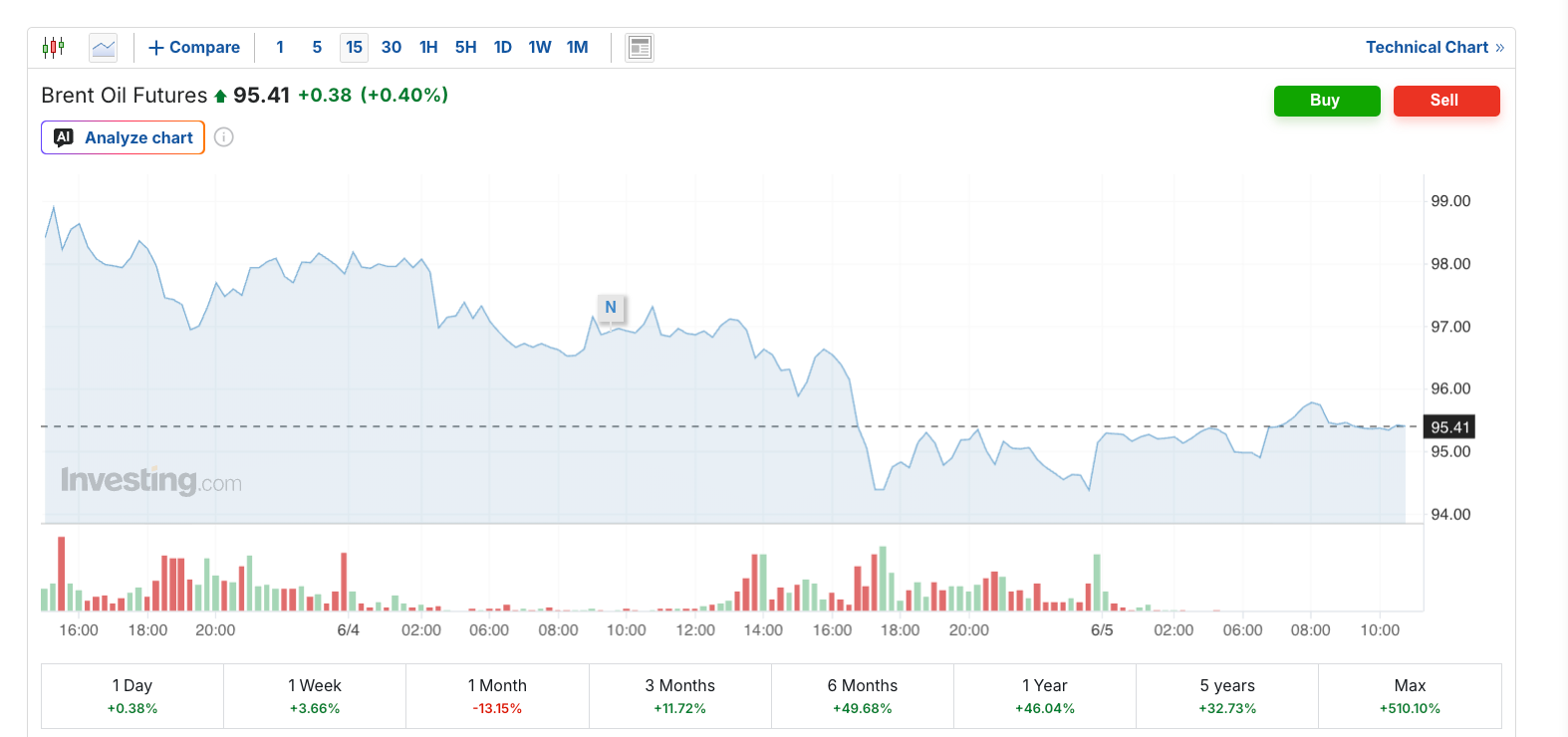
The Brent crude oil price holds near $95 a barrel, climbing for a second straight week even after a 13% monthly drop, as an IMF warning on oil-driven inflation pulls investors back toward the long side.

The clearest sign sits in options markets, where traders are buying calls against the falling month-on-month trend. Speculative funds and perpetual traders, however, are leaning the other way, and the split sets up the next move.
IMF Warns the Oil Price Sits Above Its Growth Baseline
The case for higher oil prices starts with supply. The International Monetary Fund flagged that the global oil price sits about 3% above the level built into its April growth forecast, a gap it traces to the Iran conflict.
Want more insights like this? Sign up for Editor Harsh Notariya’s Daily Newsletter here.
The IMF estimates Iran-related disruptions have cut roughly 14 million barrels per day of production. It also expects global oil reserves to fall to a five-year low near 7.5 billion barrels in July, down from 8 billion before the war.
That risk centers on the Strait of Hormuz, the route for about a fifth of global oil flows. The price path now turns on whether the waterway fully reopens.
The same supply squeeze is already feeding the next pressure point, which is US inflation.
Hot Services Inflation Strengthens the Bull Case
Rising energy costs are showing up in business surveys. The ISM Services Prices index, a gauge of input costs across the service economy, rose to 71.3 in May from 70.7 in April, its highest reading since August 2022.
Survey respondents named diesel, gasoline, and oil among the items rising in price, the first month panelists tied petroleum directly to higher costs. No commodities were reported as falling.
The Kobeissi Letter noted the index has climbed 8.3 points since February and argued the trend points to CPI inflation possibly rising above 5%, up from 3.8% in April. Services prices have historically led consumer prices by about three months.
Hotter inflation gives oil bulls a reason to add exposure, which explains how investors are now positioning.
Why Investors Are Quietly Buying Oil Calls
Here the buying turns contrarian. Even as the oil price fell 13% on the month, options traders moved against the trend and loaded up on upside bets.
The put-call ratio for the United States Brent Oil Fund (BNO), which weighs bearish puts against bullish calls, dropped to 0.06 on volume and 0.11 on open interest as of June 4. Both sit well below the May 26 readings of 0.12 and 0.15.

A falling ratio means fewer downside puts per call. This is a quiet vote that the Iran premium and inflation surge will lift prices. The move is easy to miss because it runs beneath a falling monthly price.
That options conviction, however, clashes with what the larger futures players are doing.
The Catch: Speculative Shorts and Flat Funding
The latest Commitments of Traders report from the CFTC, dated May 26, shows speculative funds positioned the opposite way. Non-commercial traders held about 58,110 long contracts against 90,924 short, a net short stance.
Over that week, these traders cut oil longs by 1,703 and added 6,145 shorts. They deepened the bearish bet even as the price rose in the weekly timeframe.
Commercial traders moved the opposite way. These hedgers, often read as the smart money, added 4,319 longs and trimmed 907 shorts, buying into the dip in the same direction as the call buyers. Their move backs the inflation-driven bull case the options market is pricing.

Perpetual traders look undecided. The Hyperliquid funding rate for the Brent oil-USDC pair, a fee that signals whether longs or shorts dominate, sits near neutral at -0.0013% on the 30-day view after a sharp negative swing faded.

That hesitation and a slightly negative tilt reflects a real ceiling. Venezuela’s crude exports surged 61% year over year to 1.25 million barrels per day in May. It is the highest in seven years, as eased US sanctions added fresh barrels and capped how far the bulls can run.
The setup leaves the oil price caught between two forces. The Iran supply shock and the hottest services inflation since 2022 pull prices higher. This is the case call buyers and commercial longs are betting on. Venezuela’s return of 1.25 million barrels a day pulls the other way, and until one side wins out, the speculative shorts and flat funding signal a market unwilling to commit.
The post IMF Warning and Hot Inflation Pull Investors Into Bullish Oil Bets as Price Holds $95 appeared first on BeInCrypto.


Bitcoin slid to $62,715 in Asian hours on Friday, down 1.9% on the day and 14.5% on the week, as the artificial-intelligence trade that has powered global risk assets through 2026 ran out of breath.
Ether dropped a sharper 4.8% to $1,696 and is now down more than 15% on the week, while Solana fell 5.4% to $66.51, taking its seven-day loss to 18.5%.
The selloff was led from outside crypto. Broadcom’s quarterly AI-chip outlook missed elevated expectations on Wednesday, pausing a months-long advance in semiconductor stocks from their war-driven lows.
Nasdaq 100 futures slipped 0.9% on Friday, extending the index to a third straight day of declines. South Korea’s KOSPI, the best-performing major equity index this year and the cleanest tape on the AI buildout, tumbled 4.7%, with chipmaker SK Hynix off 8%. MSCI’s Asia-Pacific equities gauge fell 1.4%.
Currency markets carried their own stress signal. The Korean won extended a slide to a 2009 low. The Indonesian rupiah traded near its record low against the dollar as foreign investors yanked billions from local bond markets.
The Indian rupee bucked the trend after the Reserve Bank of India announced fresh measures to attract capital inflows. The picture across Asia is a coordinated risk-off shift that’s been quietly building all week.
Crypto sat squarely inside that picture. Hyperliquid’s HYPE, which had been the only top-10 token holding green on a weekly basis, dropped 14.8% to $62.14, erasing nearly all of its recent outperformance and leaving only a thin 1.5% gain on the week.
The narrative that high-cash-flow tokens were rotating into a bid while the rest of crypto bled lasted less than a single trading session. Zcash, the other lone green dot from yesterday’s leaderboard, has now given back its weekly outperformance and then some.
The structural backdrop hasn’t softened. U.S. spot bitcoin ETFs have now logged 13 straight sessions of net outflows totaling roughly $4.4 billion since mid-May.
Strategy filed its first disclosed bitcoin sale since 2022 earlier this week, offloading 32 BTC to fund preferred stock dividend obligations. Combined, those two flows have removed a structural bid that supported bitcoin through most of the past 18 months.
The next test is Friday’s U.S. nonfarm payrolls report. A soft print would revive expectations for Federal Reserve cuts under newly confirmed chair Kevin Warsh, push real yields lower and likely send the AI trade back up, taking crypto with it.
A hot print does the opposite. Until the data lands, the path of least resistance for both stocks and crypto is the one they’re already on.

2026 – BITCOIN WILL BE BACK ! CRYPTO SUPER CYCLE COMING ? TIME TO RESTRUCTURE YOUR PORTFOLIO
Raspberry Pi stock surges 20% on upgraded 2026 profit outlook

Here’s what could happen if bitcoin breaks below $60,000



-

 News Videos7 days ago
This is BROKEN! INSANE 5x MONEY CAR WASH WEEK! The NEW GTA Online UPDATE Today! (GTA5 New Update)
-

 Business3 days ago
Jade Biosciences, Inc. (JBIO) Discusses Positive Interim Results From JADE101 Phase I Healthy Volunteer Study and Development Plans Transcript
-
 Tech6 days ago
SpaceX just won a second Golden Dome contract. This one is $4.16 billion.
-

 News Videos6 days ago
SHE IS KILLING XRP!!! WATCH URGENT AND ACT FAST
-

 Sports2 days ago
French Open 2026 results: Alexander Zverev beats Rafael Jodar and will play Jakub Mensik in semi-finals
-
 NewsBeat6 days ago
FIRST NIGHT REVIEW: Take That bring the Circus back to life in spectacular sun-soaked style
-

 Business6 days ago
Is the Spurs Phenom Already Better Than Prime Diesel?
-

 Tech3 days ago
CryZENx Releases Fresh Playable Content Deep Inside Jabu-Jabu for His Ocarina of Time Remake
-
 NewsBeat7 days ago
Novak Djokovic v Joao Fonseca LIVE: French Open latest scores and results after Jannik Sinner’s shocking collapse
-

 Politics6 days ago
The House | Inside Andy Burnham’s Makerfield Campaign: “Nobody Thinks This Is In The Bag”
-
Crypto World7 days ago
CFTC Has Approved the First Regulated Bitcoin Perpetual Contract in the U.S.
-

 Entertainment7 days ago
Maddox Jolie-Pitt Legally Requests to Drop Brad’s Surname
-
 Entertainment6 days ago
Weak ‘Supergirl’ Box Office Tracking Amid Milly Alcock Backlash
-
 Entertainment6 days ago
Bruce Willis’ Generosity Resurfaces Amid His Dementia
-
 Crypto World7 days ago
Snowflake (SNOW) Stock Rallies on Strong Q1 Results and AI Product Growth
-
 Entertainment6 days ago
One of the Greatest Sitcoms of All Time Shoots Up Apple TV’s Charts 11 Years Later
-

 Business6 days ago
Demand Conditions Improve In Chemicals Sector In April 2026
-

 Tech7 days ago
This Week In Security: Ubiquiti Fixes, And FreeBSD Joins The Club You Don’t Want To Join
-
 Crypto World6 days ago
MicroStrategy Moves $30 Million in BTC to Coinbase Prime: Is the Bitcoin Sell-Off Already Here?
-
 Crypto World3 days ago
Seagate (STX) Stock Surges to Record High on AI Boom and Legal Settlement
You must be logged in to post a comment Login