

Crypto World
Bitcoin News: Iran Integrates Bitcoin for Shipping Insurance: Sovereign Settlement Rail


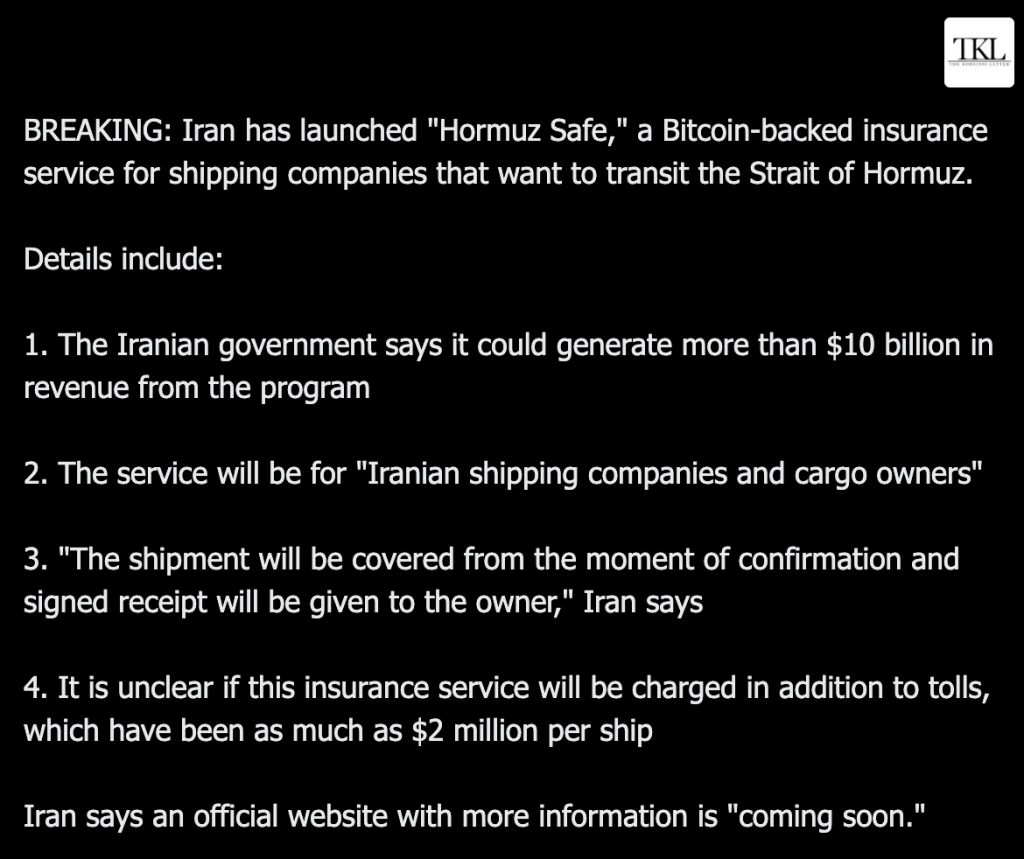
Bitcoin News: Iran has launched a Bitcoin-settled shipping insurance program called Hormuz Safe, developed under the Ministry of Economy and Financial Affairs, allowing vessel operators to pay premiums and receive claims entirely in BTC through a system that activates coverage immediately upon blockchain confirmation.
The program targets the Strait of Hormuz, the chokepoint handling roughly 20% of global seaborne crude, and represents the most structurally significant sovereign Bitcoin integration in the sanctions-evasion context to date.
The strategic implication is not incremental. Iran is not simply accepting Bitcoin for a single transaction, it is constructing a self-contained trade settlement loop that replaces SWIFT, USD-denominated premiums, and bank-backed claims processing in one move.
The unanswered question is whether any international shipping company will publicly use it, and whether that moment triggers OFAC secondary sanctions enforcement.
JUST IN:
Iran launches Bitcoin-backed insurance service for shipping companies wanting to transit the Strait of Hormuz. pic.twitter.com/kFHz14ZJfB
— Watcher.Guru (@WatcherGuru) May 18, 2026
Discover: The best pre-launch token sales
Bitcoin News: How Hormuz Safe Actually Works, and Why the Insurance Mechanism Is the Real Story
The mechanism here is worth understanding precisely. Traditional maritime shipping insurance runs through Lloyd’s of London-style syndicates and P&I clubs, all of which operate on USD or major fiat rails with counterparty exposure to Western correspondent banks.
For any vessel owner operating near Iran, that structure creates dual exposure: the physical risk of the transit and the financial risk of triggering bank-level secondary sanctions just by purchasing coverage.
Hormuz Safe eliminates the second exposure by settling entirely on-chain. When a shipping company pays the premium in Bitcoin, the system issues a signed digital receipt to the vessel owner, and coverage activates immediately after blockchain confirmation, no intermediary bank, no SWIFT message, no USD clearing.
The sanction resistance built into this model is not incidental; it is the product.

Reports circulating across research desks indicate the Ministry of Economy had been developing the framework since late April 2026, and that initial coverage is focused on Iranian shipping companies and cargo owners before any broader rollout.
That narrower scope matters, it means the first phase is less about onboarding international partners and more about proving the claims infrastructure works at a sovereign level before marketing sanction-resistant coverage to third-party operators.
The Kobeissi Letter has described the move as a deliberate effort to deepen crypto’s role in energy trade, while also flagging the obvious compliance risk for any non-Iranian entity that participates.
Those are not the same thing: using Bitcoin for domestic Iranian logistics and offering Bitcoin-settled insurance to international tankers transiting Hormuz carry categorically different OFAC exposure profiles.
The program’s initial domestic focus suggests Iran understands this distinction and is sequencing accordingly.
Iran’s government has framed Hormuz Safe as a potential $10 billion revenue source, though no official timeline has been attached to that figure.
For Bitcoin’s market structure, this is a non-speculative demand source. Each premium payment is a real-economy BTC transaction tied to trade settlement, not a leveraged long or an ETF inflow.
As Bitcoin trades near two-week lows following a drop from $82,000 to $76,900, a 6% decline driven by ETF outflows and derivatives selling pressure, sovereign adoption events like this represent the floor-building utility thesis that long-term holders reference against short-term price weakness.
Discover: The best crypto to diversify your portfolio with
The post Bitcoin News: Iran Integrates Bitcoin for Shipping Insurance: Sovereign Settlement Rail appeared first on Cryptonews.


Prediction market platform Kalshi is partnering with compliance software provider StarCompliance to roll out a monitoring system aimed at helping financial firms oversee employee activity tied to prediction market trading. The announcement, made this week, comes as regulators and lawmakers in the United States intensify scrutiny over whether insiders can exploit non-public information through event contracts.
Kalshi and StarCompliance say the new platform is built to detect patterns that may indicate misuse, using signals such as transaction volume, trading behavior, market categories, and even whether activity occurs during work hours. It also positions firms to centralize investigations and maintain audit records covering prediction market exposure across both onchain and offchain environments.
Key takeaways
- Kalshi is adding prediction market monitoring to StarCompliance’s employee compliance tooling used by financial institutions.
- The system targets potential risks related to material non-public information, including how employee trading patterns could be tied to workplace activity.
- Regulatory pressure is rising across the U.S., with multiple states challenging or restricting prediction market operations and federal agencies pursuing jurisdiction fights.
- Recent high-profile insider-trading allegations involving prediction markets have increased the focus on auditability and internal controls.
Why Kalshi is expanding compliance monitoring
StarCompliance said its new capability is designed to reduce risks involving material non-public information—an issue that can arise when employees at financial companies may have access to sensitive business or market developments. In that context, prediction markets can create a mechanism for trading event contracts that may reflect information not yet public.
According to the partnership announcement, the monitoring framework is intended to flag employee activity that stands out against expected patterns. This includes volume and trading behavior analytics, category-based review of which event markets employees participate in, and work-hour activity signals that may help firms distinguish ordinary behavior from potentially suspicious timing.
For financial institutions, the added value is less about tracking “whether” trading happened and more about creating a defensible audit trail—something that can matter in both internal investigations and regulatory discussions. The partners also emphasized centralized investigation management and record-keeping tied to prediction market exposure.
The announcement extends StarCompliance’s existing employee compliance platform, which already tracks traditional securities and digital asset activity, by incorporating prediction market trading through Kalshi.
Insider-trading allegations raise the stakes
The monitoring launch lands shortly after a federal judge set a December trial date for US Army Master Sgt. Gannon Ken Van Dyke. Prosecutors allege Van Dyke used non-public information concerning a military operation targeting Venezuelan President Nicolás Maduro to profit—earning more than $400,000—through Polymarket.
Van Dyke has pleaded not guilty to the charges. Still, the case has become a prominent reference point for policymakers and regulators attempting to determine how existing insider trading expectations apply to prediction market structures.
From an investor and compliance perspective, the practical takeaway is that regulators are not treating prediction markets as a separate universe from other financial trading risks. Instead, they appear to be pushing the industry toward greater transparency, stronger surveillance, and more consistent internal controls.
Regulatory friction in the U.S. keeps intensifying
Kalshi’s compliance-focused move also reflects a broader environment where prediction markets continue to face legal challenges at both state and federal levels. The article notes that at least 11 states have taken legal or regulatory action against platforms such as Kalshi and Polymarket.
At the heart of many disputes is whether event contracts should be governed as gambling under state law or treated as federally regulated derivatives under the oversight of the Commodity Futures Trading Commission (CFTC). This tension has produced a patchwork of lawsuits, cease-and-desist orders, and proposed state legislation.
Nevada, for example, became the first state to temporarily block Kalshi’s operations earlier this year. Arizona has also accused Kalshi of operating an illegal gambling business by offering event contracts to residents. Meanwhile, Kalshi and the CFTC have argued against state-level restrictions.
In late May, Kalshi sued Minnesota after Minnesota enacted what CFTC Chair Michael Selig characterized as the first outright ban on prediction markets in the country. Around the same time, the CFTC joined Kalshi in a separate legal challenge involving Rhode Island officials over event contract regulation.
More recently, the CFTC sued New Mexico officials over allegations that Kalshi offered unlicensed sports betting. The case was described as the eighth state targeted by the agency as it attempts to curb state-level restrictions.
Industry debate: courts, federal primacy, and the Supreme Court possibility
Disputes over jurisdiction are increasingly framed as a multi-year legal process. Speaking on a panel at Bitso’s Stablecoin Conference in Mexico City on June 16, Digital Chamber CEO Cody Carbone said the conflict between federal regulators and state authorities is likely to play out in court and could ultimately reach the US Supreme Court.
Carbone also suggested that the Trump administration has broadly backed efforts to position the CFTC as the primary regulator for prediction markets, while still expecting ongoing clashes with state gambling regulators. He added that lawmakers are also discussing what kinds of event contracts should be permitted, including markets related to politics and war.
Importantly for market participants, insider trading concerns are expected to remain a focus of future oversight. The combination of compliance tooling and high-profile legal cases suggests regulators may keep pressing for clearer guardrails around information access, trading surveillance, and enforcement pathways.
Within that broader context, Representative James Comer recently asked CEOs of Kalshi and Polymarket for information about their responses to insider trading after “suspiciously timed trades” related to US military actions against Iran were highlighted in the political debate. While the details of that inquiry are tied to the specifics of the allegations, the episode underscores that prediction markets are now firmly embedded in mainstream regulatory and political scrutiny—not just niche enforcement.
For readers watching what comes next, the key issue is whether courts will ultimately resolve the federal-versus-state jurisdiction question fast enough to reduce uncertainty for compliant operators—or whether new compliance expectations will continue to evolve case-by-case as insider trading allegations and investigations accumulate. The Kalshi–StarCompliance monitoring partnership signals that, regardless of the legal outcome, firms are preparing for tighter scrutiny of trading behavior tied to potential access to non-public information.
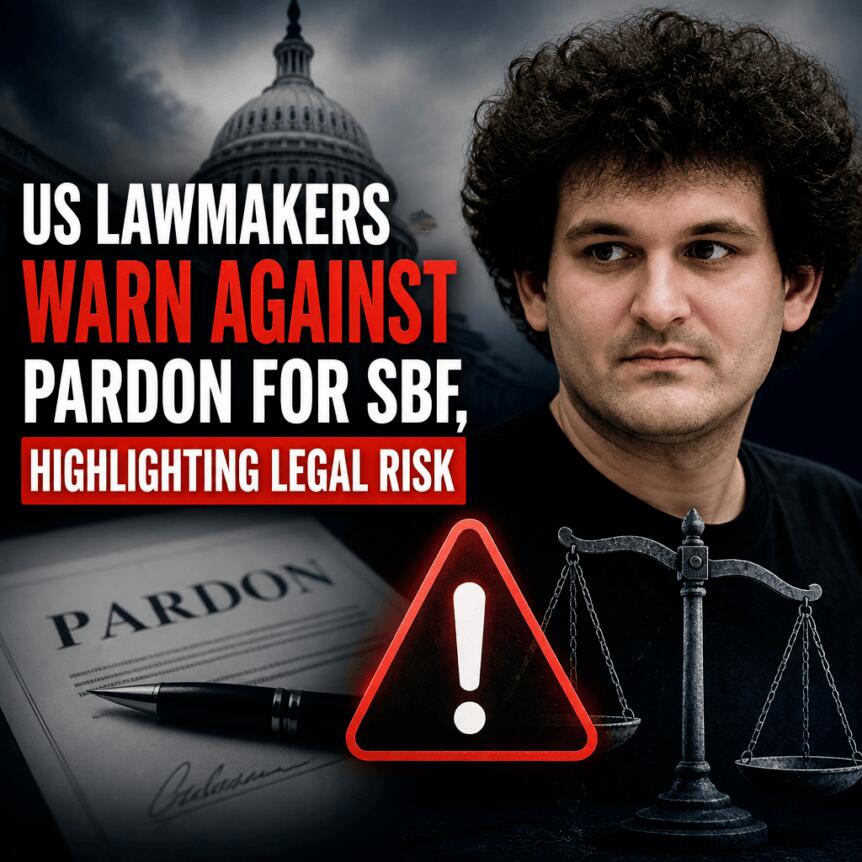
Two US senators—Cynthia Lummis, a Republican, and Rubén Gallego, a Democrat—are co-sponsoring a congressional resolution urging President Donald Trump to deny any request for executive clemency for convicted FTX founder Sam Bankman-Fried. The move highlights how high-profile enforcement outcomes in the cryptocurrency sector are increasingly becoming part of the broader political and compliance landscape around financial fraud and accountability.
The proposed resolution, to be introduced Wednesday, is framed as non-binding, while acknowledging that clemency decisions remain constitutionally within the president’s authority. Still, the senators argue that granting a pardon or commutation would undermine deterrence and could be read as a signal that large-scale financial misconduct can avoid lasting consequences.
Key takeaways
- Lummis and Gallego plan to introduce a non-binding Senate resolution discouraging any executive clemency for Sam Bankman-Fried.
- The resolution argues that Bankman-Fried’s 25-year sentence reflects the scale and deliberateness of the crimes and supports justice and deterrence.
- The proposal follows formal steps by Bankman-Fried to seek a presidential pardon after an appeals court upheld his conviction and sentence.
- The case remains politically and compliance significant, given its connection to the misuse of FTX customer funds and the resulting broader scrutiny of crypto-related governance and AML-type controls.
Senate resolution targets any clemency for Bankman-Fried
According to the draft resolution, the Senate would “affirm” that Bankman-Fried’s 25-year prison sentence appropriately reflects what the lawmakers characterize as the extraordinary scale and deliberate nature of his offenses, along with the alleged absence of remorse and the “catastrophic harm” to victims.
The senators’ core concern is prospective: if a pardon were granted, they argue it would effectively erase the conviction, weaken deterrence, and send what they describe as a “deeply damaging message” regarding accountability for large-scale financial fraud.
While such resolutions do not alter the legal effect of a presidential pardon, they can still influence how institutions—exchanges, banks, custodians, and compliance officers—interpret enforcement risk and the perceived stability of consequences following convictions.
Why the timing matters after appeals and a clemency request
The resolution comes after Bankman-Fried formally applied to President Trump for a pardon following the upholding of his conviction and 25-year sentence by a federal appeals court. With the appeals process having concluded in his favor only in part—leaving him no clear standard route besides further review at the Supreme Court or a presidential pardon—clemency becomes the central remaining legal channel.
The underlying criminal case dates to the collapse of the cryptocurrency exchange FTX in 2022. Bankman-Fried was convicted in November 2023 on seven felony counts connected to the misuse of FTX user funds. He was subsequently sentenced to 25 years in prison.
In practical compliance terms, the post-conviction phase is where governance lessons can solidify into policy expectations. For financial institutions evaluating crypto counterparties, the posture of enforcement—particularly where misuse of customer assets is alleged—often becomes part of risk assessments and supervisory scrutiny under broader fraud, AML/CFT, and consumer protection frameworks, even when the primary legal theory arises under criminal statutes rather than market-structure rules.
Cointelegraph previously reported on Bankman-Fried’s clemency bid and on the appeals court’s decision to uphold the sentence. The congressional resolution further underscores that the outcome is not only a judicial matter but also a regulatory and institutional signal.
Non-binding, constitutional clemency power—and the message problem
The resolution’s non-binding nature reflects the separation of powers in the US system. The president’s pardon power is constitutionally established, meaning that a Senate resolution cannot compel a specific outcome.
However, the lawmakers contend that a pardon would carry consequences beyond the individual case by reshaping deterrence perceptions. This “message” argument is particularly salient in the crypto context, where regulators and supervised entities are still working to translate lessons from high-profile failures into durable compliance controls—such as segregation of customer assets, effective custody arrangements, transaction monitoring, and accountability for executive conduct.
For institutional readers, the unresolved question is how presidential decision-making will be evaluated relative to enforcement outcomes. Even if clemency is legally permissible, supporters and opponents may read it as either a correction of perceived severity or as a precedent-like event affecting future compliance risk calculations across the sector.
Other FTX-related sentences and continuing legal exposure
Bankman-Fried is not the only prominent figure from the FTX ecosystem whose criminal case has continued to shape the sector’s compliance narrative. Several former executives and associates have already received sentences that range from cooperation-based outcomes to longer terms.
Cointelegraph’s reporting notes that Caroline Ellison, former CEO of Alameda Research, received a two-year sentence in 2024 and was released early in January after 14 months. Nishad Singh, a former engineering director, and Gary Wang, an FTX co-founder, were sentenced to time served, with both having testified against Bankman-Fried at trial.
Other individuals have faced additional consequences. Ryan Salame, co-CEO of FTX Digital Markets, was sentenced to 90 months in prison related to unlawful political contributions and conspiracy to operate an unlicensed money-transmitting business. Separately, reporting also indicates that Salame’s wife, Michelle Bond, was indicted in connection with alleged illegal campaign financing tied to her 2022 run for Congress.
These proceedings collectively matter to compliance teams because they span multiple enforcement categories—fraud, financial services licensing, and campaign finance allegations—demonstrating that crypto-related misconduct can implicate different regulatory regimes simultaneously.
Closing perspective: what to monitor next
As the Senate resolution proceeds, the key variable will remain the timing and substance of any presidential action following Bankman-Fried’s clemency application. Even without legal effect on a pardon’s enforceability, the political and institutional response to any decision is likely to influence how banks, custodians, and exchanges calibrate compliance programs and risk frameworks for customer-asset protection and executive accountability.

US prosecutors have proposed a timetable that would keep the legal fight over Tornado Cash co-founder Roman Storm alive into late 2026, after a jury was unable to reach a verdict on two of three charges in his case. Separately, a federal judge set a response schedule for Celsius ex-CEO Alex Mashinsky’s bid to vacate his prison sentence, while another court ordered December 2026 trial dates for a US soldier accused of insider trading involving a Polymarket event contract.
Key takeaways
- Roman Storm’s retrial schedule hinges on a pending Rule 29 acquittal request, with prosecutors proposing a late-October or November 2026 path.
- Alex Mashinsky’s motion to vacate his 12-year sentence faces a mid-August government response deadline after a judge granted time for prosecutors to reply.
- A judge set pretrial motion timelines leading to jury selection on Dec. 7, 2026, for Gannon Ken Van Dyke in the Polymarket insider trading case.
- All three matters underline how US courts are increasingly focused on individual criminal exposure tied to crypto-adjacent conduct, code, and trading activity.
Prosecutors press for late-2026 retrial in Roman Storm case
Federal prosecutors submitted a proposed schedule on Monday for a potential retrial of Tornado Cash co-founder and developer Roman Storm, whose earlier trial ended without a complete conviction. Storm was found guilty on one of three charges connected to illegal money transmitting in 2025, but the jury deadlocked on the remaining two counts, setting up the possibility of a new trial on those charges.
The filing, submitted in the Southern District of New York (SDNY), included a proposed Oct. 20 date for a final pretrial conference. That milestone would point to a potential trial start in late October or November 2026, depending on how the court handles a defense motion.
Critically, prosecutors noted the timeline is contingent on a Rule 29 motion filed by Storm requesting acquittal on the unresolved charges. If the court denies that request, the retrial scheduling would move forward under the proposed plan.
The outcome of the next phase could carry significant implications for the crypto industry, particularly for developers and teams concerned about the scope of criminal liability tied to software code. If a retrial is scheduled, Storm could again face two remaining counts: conspiracy to commit money laundering and conspiracy to violate sanctions.
Earlier coverage from Cointelegraph noted that Storm’s initial verdict stemmed from charges tied to illegal money transmission conduct, with the jury’s partial deadlock now shaping what comes next.
Mashinsky sentence-vacate request: prosecutors get until mid-August
In a separate SDNY proceeding, Judge John Koeltl granted a request that effectively sets a deadline for the government to respond to Alex Mashinsky’s pro se motion to vacate his sentence. Mashinsky, the former CEO of Celsius, sought to overturn his 12-year prison term that was imposed following a May 2025 sentence.
According to a Saturday filing in the US District Court for SDNY, prosecutors have until mid-August to file their response. With that window set, the judge indicated the court could receive the government’s answer before the end of the year, depending on further scheduling.
The timing matters because Mashinsky’s request comes after he reported to federal prison following the May 2025 sentence. Mashinsky had been indicted in 2023 alongside Roni Cohen-Pavon on charges related to fraud and market manipulation, and Celsius filed for bankruptcy in 2022 during a market downturn that preceded the collapse of several major crypto firms.
As reported previously by Cointelegraph, Mashinsky’s motion asks the court to vacate the sentence that led to his imprisonment. In the criminal case, the former CEO was ordered to pay $48 million in forfeiture. Cohen-Pavon, meanwhile, received a time-served sentence and was ordered to pay more than $1 million plus a $40,000 fine.
Cointelegraph’s earlier reporting covered the filing that prompted the court’s current procedural steps.
SDNY sets December 2026 trial in Polymarket insider trading case
In the Polymarket-related insider trading matter, Judge Margaret Garnett has set a December 2026 trial timetable for Gannon Ken Van Dyke, a US soldier charged after prosecutors allege he used nonpublic information to profit from a prediction-market contract connected to events involving Venezuela President Nicolás Maduro.
In a June 10 SDNY filing, the judge ordered the parties to complete pretrial motions, with jury selection scheduled for Dec. 7. The structure of the schedule points to a trial in December 2026.
Prosecutors say Van Dyke allegedly made more than $400,000 on a Polymarket event contract tied to the capture of Maduro. The charges relate to alleged trading around January, when US forces entered his Caracas residence and extradited him to the United States to face criminal charges.
The case also appears to intersect with broader political and regulatory scrutiny aimed at prediction markets. Earlier coverage from Cointelegraph noted that US lawmakers have raised concerns about whether elected officials should be barred from betting on events when they may have classified or nonpublic information. The Van Dyke matter is being watched through that lens, because it centers on alleged information asymmetry in a market designed to price outcomes.
Van Dyke has pleaded not guilty to all charges.
Earlier coverage from Cointelegraph detailed lawmakers’ attention on the intersection between political roles and prediction markets.
What to watch next across the three cases
With Storm’s retrial timing dependent on a Rule 29 acquittal request, Mashinsky’s sentence-vacate process now moving into a government-response phase, and Van Dyke’s case heading toward Dec. 7, 2026 jury selection, investors and builders should watch closely for procedural rulings that determine whether these disputes accelerate toward full retrials or shift through appeals and motion practice.

A reported MOU between the United States and Iran gave global markets a calmer opening after weekend talks focused on the Strait of Hormuz. The accord points to a possible reopening of key shipping lanes that had lifted concern over energy supply. Markets reduced the premium attached to a longer regional disruption, although the conflict has not been settled.
S&P futures opened more than 100 points above Friday’s close and moved beyond previous record levels as traders adjusted risk exposure. Crude oil opened lower and traded below $75 as the market priced a lower chance of sustained supply disruption. The move suggested that energy traders were reassessing near-term risks tied to shipping and sanctions.
Under the expected framework, both sides would lift blockades around the Strait of Hormuz before entering a 60-day negotiation period. Talks are expected to focus on nuclear issues, sanctions relief, and the release of frozen Iranian funds. The arrangement reduced one acute market risk, while leaving several diplomatic questions unresolved.
Key Insights
- QCP says Strategy dividend funding concerns continue to weigh on Bitcoin despite stronger macro sentiment.
- Markets rallied after the reported US-Iran MOU reduced fears around Strait of Hormuz disruption risks.
- Warsh faces his first Fed meeting with inflation elevated after the recent oil price shock.
- SpaceX’s low float and strong demand kept shares above IPO levels after its debut rally.
- Strategy’s share issuance may extend runway, but Bitcoin traders still track dividend cash needs closely.
Warsh Begins Fed Tenure With Inflation Pressures
Kevin Warsh is set to lead his first Federal Reserve meeting as chair during a period of renewed inflation pressure. The US-Iran conflict helped push headline inflation to 4.2% year over year after oil prices rose globally. That backdrop has changed expectations around a chair previously viewed as more open to rate cuts.
The meeting will carry attention beyond the policy rate because the Board remains divided over the direction of monetary policy. Warsh is expected to seek support from Powell and other officials while presenting himself as independent from political pressure. Investors will watch his tone for evidence of how the central bank plans to handle energy-driven inflation.
The quarterly Dot Plot will also be released with inflation expected to remain elevated over the next quarter. Markets are already pricing roughly half a rate increase in 2026, which reflects expectations for restrictive policy. The Fed’s guidance may shape whether the equity rally can continue without renewed pressure from yields.
QCP Flags Strategy Dividend Overhang for Bitcoin
Risk appetite also received support from SpaceX’s market debut after shares reached $225, well above the $135 IPO price. The rally placed SpaceX among the world’s largest companies by market value, with demand supported by a low trading float. Its post-IPO move to acquire Cursor for $60 billion reinforced investor focus on AI and infrastructure.
Bitcoin has not followed the broader risk rally and remains below the $66,000 level despite stronger sentiment across equities. QCP framed the main digital asset concern as market worries that Strategy may need to sell more Bitcoin to pay dividends. That concern has limited Bitcoin’s response to improved macro conditions and lower energy-market stress.
Strategy has bought back $1.5 billion of its 2029 Convertible Senior Notes and has raised about $200 million through MSTR share sales. The company continues to buy BTC with the proceeds, which has extended its dividend payment runway to roughly 7.5 months. QCP’s angle remains focused on whether further share issuance can ease the overhang before Bitcoin joins the broader rally.

Efforts to verify identity without exposing sensitive personal data are moving from theory into patent filings and public funding applications. In a new European filing, The Hashgraph Group, operating within the Hedera ecosystem, and Italian ultra-wideband sensing firm Truesense describe a framework they call Continuous Identity Trust Infrastructure (CITI), designed to link physical presence events to decentralized digital identity credentials.
The companies also say they have applied for €74.3 million in EU funding to help deploy the system across sectors such as transport, smart-city infrastructure, and enterprise environments. While the initiative remains at the application stage, it signals growing interest in “continuous” identity models, where verification is based on auditable events rather than static credentials.
What CITI is designed to do
According to the filing and funding request described in the announcement, CITI aims to create high-assurance evidence that a specific individual was physically present at a specific location at a specific time, while keeping underlying location and personal data private.
The approach combines three components:
- Ultra-wideband (UWB) spatial sensing to detect presence within a defined zone.
- Decentralised identifiers (DIDs) and verifiable credentials (VCs) to represent identity and attestations in a standards-aligned digital format.
- Zero-knowledge proofs (ZKPs) to enable verification by third parties without revealing the full set of underlying data.
The companies describe a workflow in which a UWB presence event is cryptographically bound to a person’s decentralized identifier stored in an identity wallet. A presence binding token and related elements, including a timestamp and credential hash, are then anchored to a distributed ledger network. They further state that selective disclosure via ZKPs would allow verifiers to confirm validity without accessing sensitive personal or location information.
Patent coverage and timing
The announcement states that the European patent application was filed on 4 April 2026 with the European Patent Office, designating 44 or more European countries. The document also indicates an ongoing path toward submission to the United States Patent and Trademark Office.
In practical terms, patent filings do not guarantee commercialization or adoption, but they often provide a window into where companies are placing technical and legal bets. In this case, the emphasis is on cryptographically linking real-world events to verifiable digital records in a way that can be checked by outside parties.
Why privacy-preserving presence attestation matters
Identity verification in regulated environments typically faces a trade-off between auditability and privacy. Organizations want evidence that an access event, participation, or entitlement claim is legitimate. At the same time, regulators and users increasingly expect that systems minimize exposure of personal data, especially location data.
CITI’s stated goal is to reduce that friction by using zero-knowledge cryptography for selective disclosure and by issuing verifiable credentials that can be independently validated. This aligns with a broader direction in the industry: moving from “credential sharing” toward cryptographic attestations that can be verified without disclosing raw identity attributes.
However, adoption will depend on implementation details that are not fully specified in the public summary, including how UWB sensing is calibrated in different environments, how wallets are managed at scale, and what verifiers need to integrate to validate proofs reliably and efficiently.
Hedera ecosystem context
The companies characterize the solution as being anchored on distributed ledger technology within the Hedera ecosystem. For industry watchers, this reflects a continued effort to position enterprise-grade identity and compliance tooling as an application layer for public or permissioned ledgers, rather than identity sitting entirely off-chain.
In these architectures, the ledger is typically used to anchor cryptographic commitments or hashes so that later audits can detect tampering. The key question for buyers is usually whether the system reduces operational cost and compliance workload compared with established identity and audit systems, and whether integrations can meet performance, reliability, and governance requirements.
Regulatory alignment and EU policy backdrop
The announcement ties CITI to multiple EU initiatives and regulatory frameworks, including requirements that push organizations toward secure and digitally identifiable processes. It also references the EU’s digital identity wallet framework, which is scheduled for rollout by member states by the end of 2026, and it describes alignment with standards used for decentralized identity and verifiable credentials.
It also places the funding application within the IPCEI-CIC program context, which is intended to support important projects of common European interest in areas such as compute and related digital infrastructure. If selected, projects like this would likely be assessed on technical feasibility, security posture, interoperability, and measurable deployment plans.
Potential use cases, and the limits of announcements
From the described architecture, plausible deployments include controlled physical access, ticketing and event entry validation, and onboarding or access for regulated facilities. The companies also suggest transport and smart-city use where presence credentials could support compliance and reduce certain forms of fraud associated with transferable digital proofs.
Still, it is important to distinguish between technical possibility and real-world rollout. Systems that combine hardware sensing, identity wallets, cryptographic proofs, and ledger anchoring require multi-stakeholder coordination. They also depend on user acceptance, clear governance for who can verify credentials, and rigorous security testing to ensure that privacy-preserving claims remain robust against misuse.
What to watch next
With a decision expected in early 2027, the next phase will likely focus on whether the funding request is approved, how deployment partners are selected, and what interoperability approach is taken for credentials and wallets across different jurisdictions and organizations.
For the broader market, CITI is part of a larger push toward verifiable credentials backed by cryptography, where identity verification is increasingly event-based and privacy-preserving. If the approach can demonstrate reliable presence attestation and practical integration pathways, it could influence how enterprises and public entities think about physical-digital identity assurance in Europe.
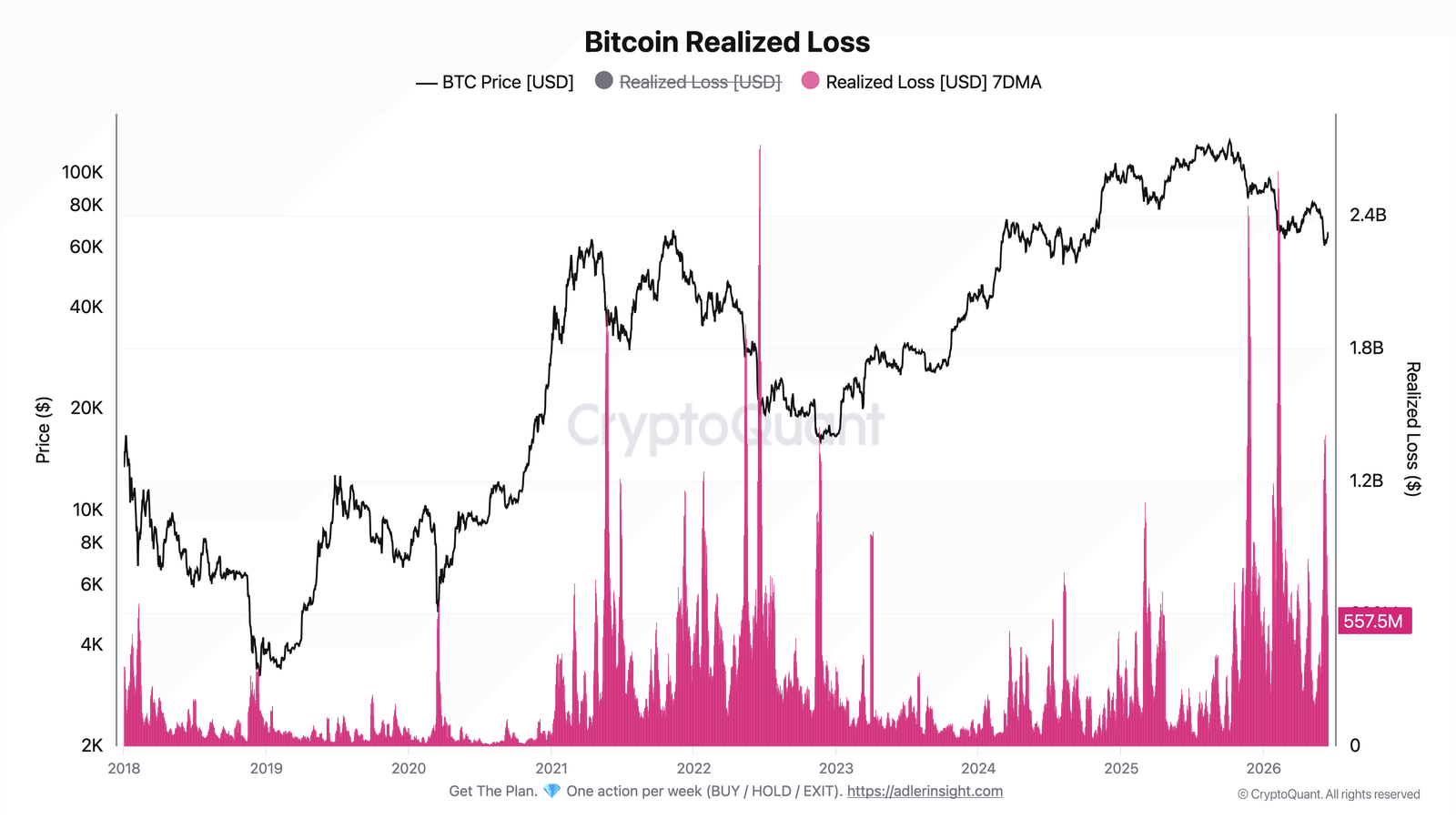
Bitcoin’s (BTC) latest bout of panic selling produced significantly smaller realized losses than those seen during the February correction. Realized losses peaked at $1.4 billion during the June decline, compared to $2.6 billion in February, while the buy-side liquidity on Binance strengthened above recent lows at $60,000, according to Glassnode.
BTC realized drop 46% from February highs
Bitcoin’s realized profit-to-loss ratio has fallen into capitulation territory, signaling that loss-taking continues to outweigh profit-taking across the market. The 30-day smoothed ratio currently sits near 0.28, one of the lowest readings of the year.
However, the magnitude of those losses tells a different story. Bitcoin’s seven-day moving average realized loss peaked at $2.6 billion during February’s sell-off. The June decline reached $1.4 billion before cooling to approximately $558 million.
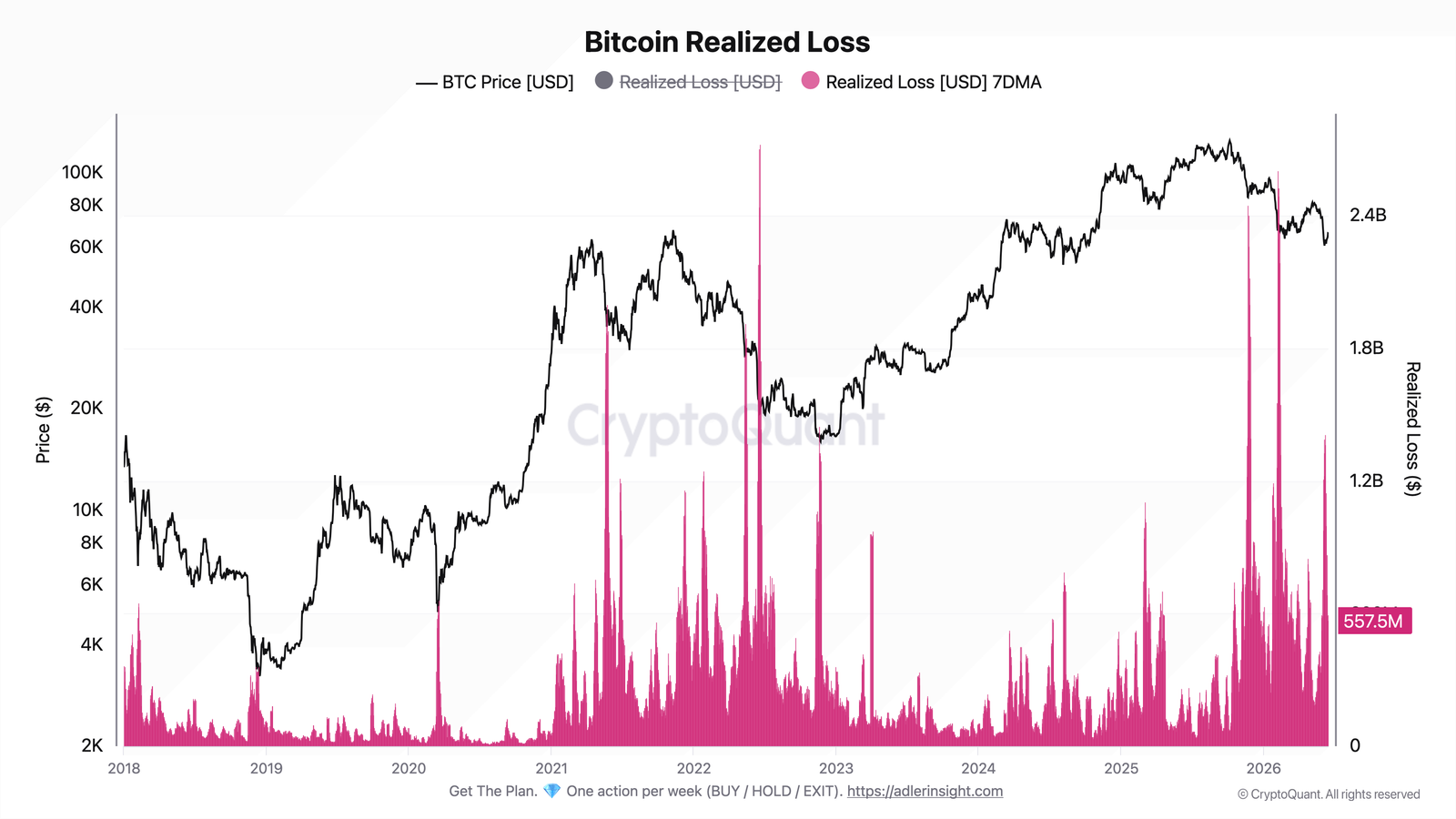
Bitcoin Realized Loss. Source: CryptoQuant
The gap between the two events highlights a notable shift in traders’ behavior. Fewer investors are choosing to sell at a loss despite another period of market stress, where BTC prices range near identical levels.
Crypto analyst Axel Adler Jr. described the current episode as the second wave of panic selling in 2026. The analyst noted that realized loss data shows the latest capitulation is “almost twice as low” as February’s event.
Glassnode’s capital flow metrics also show pressure easing on the price. The realized cap, which measures the aggregate cost basis of all circulating Bitcoin, stands at $1.07 trillion. The metric has declined by 1.45% over the past 90 days, indicating a steady withdrawal of capital.
The realized cap’s seven-day change has narrowed to -0.18%, indicating that capital outflows have nearly stalled compared to Q1.
Related: Bitcoin price sets $64.5K week-to-date low as Strategy selling worries return
Bitcoin spot orderbooks turn supportive
According to Glassnode, Binance’s spot orderbook depth imbalance has shifted decisively toward bids, with a ratio of 0.8, with buy-side liquidity exceeding resting sell orders by the widest margin since December 2025. The change signals a stronger demand to absorb supply during pullbacks rather than distribute into rallies.
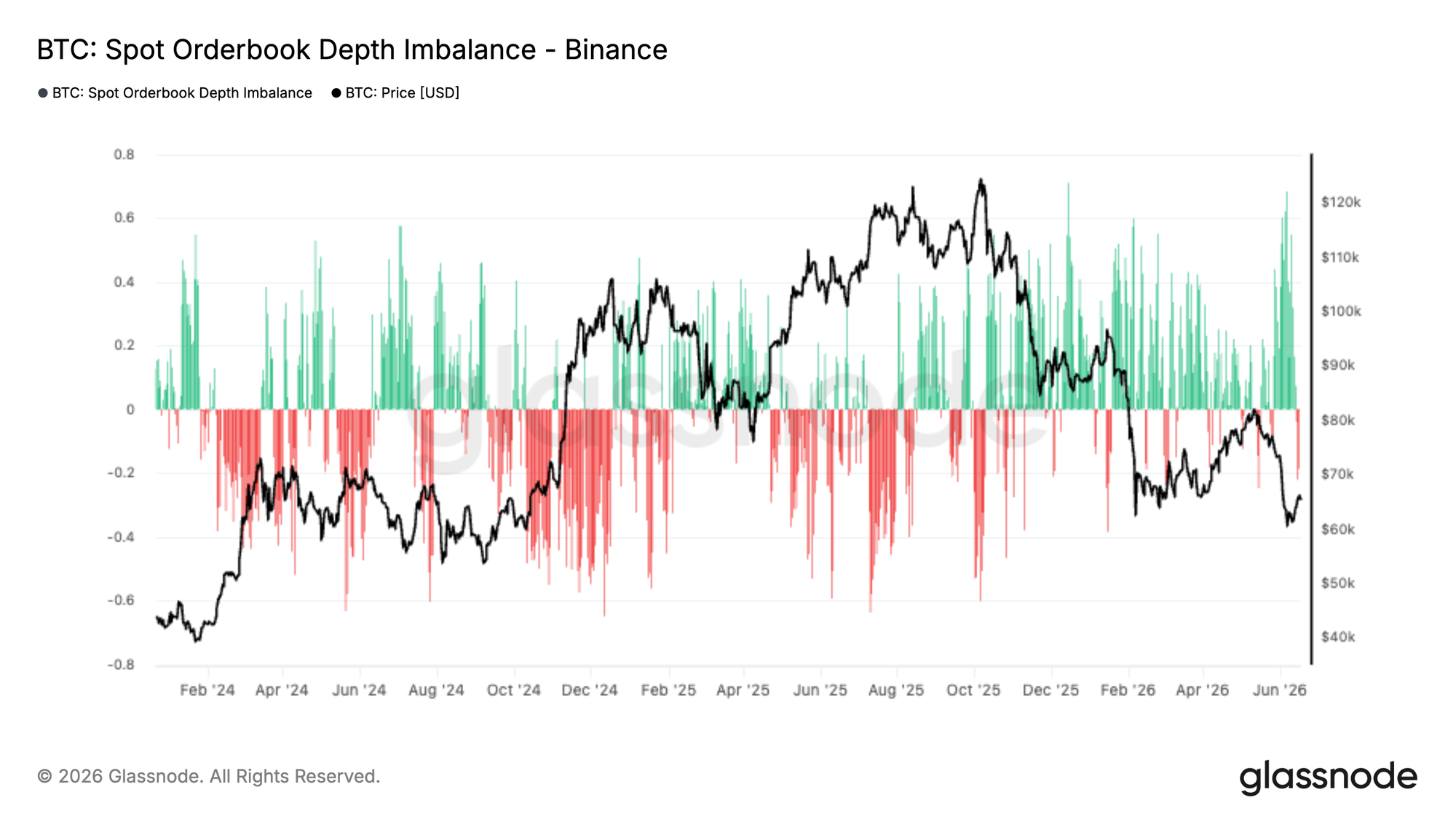
BTC: spot orderbook depth imbalance. Source: Glassnode
At the same time, the derivatives positioning has become less aggressive. Bitcoin’s open interest (OI) on Binance recorded one of its largest daily reversals since April. Open interest shifted to -$620 million, from $258 million over the past 24 hours, marking a net reversal of nearly $878 million.
For now, the strongest improvement is visible in spot liquidity. Glassnode added,
“Although this alone is insufficient to confirm a durable bottom, the emergence of strong buy-side depth suggests spot market participants are becoming more willing to defend current price levels.”
Related: Bitcoin is setting up ‘meaningful floors’ in $60K–$70K range: Analyst

Key Takeaways
- In June 2026, SpaceX launched its IPO with a $1.77 trillion valuation, rapidly surpassing the $2 trillion market capitalization threshold
- Despite generating $18.67 billion in 2025 revenues, SpaceX continues operating at a loss with $4.94 billion in net deficit
- Following a June 17 SpaceX launch, AST SpaceMobile expanded its orbital constellation to nine BlueBird satellites
- AST SpaceMobile’s Q1 2026 financials show $14.7 million revenue with $3.5 billion cash reserves and projected 2026 revenues between $150-$200 million
- Analyst sentiment on AST SpaceMobile skews negative with a Reduce consensus and $81.33 average target price
The space industry witnessed a monumental event in June 2026 when SpaceX entered the public markets with a staggering $1.77 trillion valuation. Trading activity quickly pushed the company’s market capitalization beyond $2 trillion, positioning it among the planet’s most valuable enterprises.
Space Exploration Technologies Corp., SPCX
Financial results from 2025 revealed revenues of $18.67 billion, representing substantial growth from the previous year’s $14.02 billion. However, aggressive capital deployment in rocket technology and infrastructure resulted in a $4.94 billion net deficit.
SpaceX has evolved far beyond its original rocket-launching mission. Today’s operations encompass launch services, reusable rocket technology, and the Starlink satellite internet division. Reuters characterizes the company as a comprehensive “space, satellite and AI provider.”
The Starlink division provides SpaceX with predictable, subscription-based income that distinguishes it from traditional aerospace competitors. This broadband operation has achieved meaningful scale, with future expansion tied to Starship advancement, government procurement, and global Starlink deployment.
Investors must grapple with valuation concerns. The current price reflects extraordinary growth expectations despite ongoing profitability challenges.
AST SpaceMobile Expands Its Orbital Infrastructure
AST SpaceMobile pursues an alternative strategy. This company develops satellite infrastructure enabling direct communication with standard mobile devices without specialized equipment.
A SpaceX launch on June 17 deployed three additional AST BlueBird satellites, expanding the operational constellation to nine units. The company projects having 45 satellites operational before 2026 concludes.
First-quarter 2026 financial results showed $14.7 million in revenue alongside a -$0.66 earnings per share. The balance sheet reflects $3.5 billion in cash reserves, with management reaffirming annual revenue projections of $150-$200 million for 2026.
The investment narrative remains speculative. Market participants are wagering on eventual commercialization rather than existing scale.
Despite the recent launch success, uncertainties persist. Barron’s highlighted that investors await confirmation of complete satellite deployment and operational functionality.
Fundamental Differences Between These Space Investments
The chasm separating these companies centers on operational validation. SpaceX operates an established, revenue-generating commercial space enterprise. AST SpaceMobile continues demonstrating its direct-to-device concept can achieve global viability.
SpaceX delivers greater predictability. It possesses established revenue streams, developed infrastructure, and proven execution. AST SpaceMobile presents superior upside potential should its network achieve commercial maturity, though execution risks remain substantially elevated.
Analyst coverage mirrors this distinction. Eleven analysts track AST SpaceMobile with a Reduce consensus: one buy rating, seven hold recommendations, and three sell ratings. Their average price objective sits at $81.33.
SpaceX’s recent public debut precludes comprehensive analyst consensus, though its immediate post-IPO valuation demonstrates significant investor confidence in its market dominance.
While both organizations operate within the broader space sector, their developmental stages differ dramatically.
Investor selection ultimately hinges on preference: established operations versus speculative growth potential.

Wall Street just reminded itself that artificial intelligence cannot run without memory. Deutsche Bank lifted its Micron stock price target to $1,500 this week, and it was not alone.
At least six banks raised their targets in the past few days, each ahead of the June 24 earnings. The buyers are already there, and the whole case rests on one chip that most people cannot name.
Six Banks Raised Their Micron Targets in One Week
Deutsche Bank set the tone on June 17, lifting its Micron price target to $1,500 from $1,000. It was not alone.
On June 15, TD Cowen more than doubled its target to $1,500 from $660. Cantor Fitzgerald did the same from $700, while RBC Capital moved to $1,200 and Wolfe Research to $1,250.
In all, at least six banks raised targets in a week, every one ahead of Micron’s June 24 earnings.
Every note points to the same driver. AI-driven DRAM demand is outrunning supply, and the shortage is expected to last well into 2028.
DRAM is the fast working memory that AI models run on. When demand grows faster than chipmakers can build it, prices stay high. Micron (MU) is one of only three big makers and the only US maker of AI memory, so it keeps much of that upside.
Want more insights like this? Sign up for Editor Harsh Notariya’s Daily Newsletter here.
The sharpest shortage sits in one specific chip, HBM, or high-bandwidth memory. It is the premium memory stacked next to AI processors.
Micron’s operations chief told a JPMorgan conference that HBM consumes more than three times as many wafers per bit. That makes new supply slow and expensive to add, exactly why analysts expect the squeeze to last.
The banks add a bigger point. They argue memory’s role in AI is structural, not just another boom-and-bust cycle. That is the case for higher earnings for years, not quarters.
Micron Leads the Entire Chip Sector
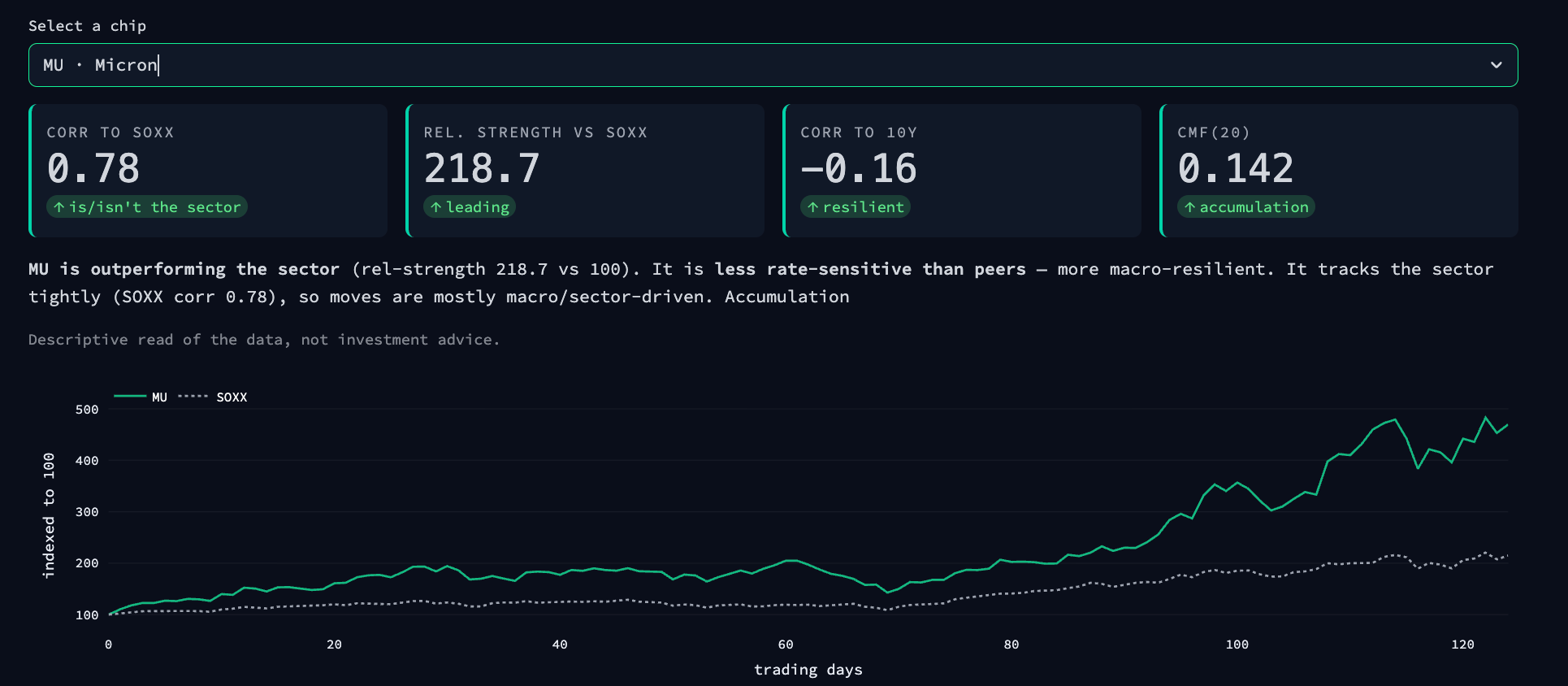
The market already agrees with the banks. Against the SOXX semiconductor index, Micron’s relative strength reads 218.7, the highest of any major chip.

It leads the group by a wide margin, even ahead of Marvell (one of the segment leaders) at 167.8 and Nvidia at just 56.6.

The money is following the same path. Chaikin Money Flow, a proxy for whether big investors are buying or selling, reads a positive +0.142 on Micron. That is the second-strongest accumulation in the whole chip group, behind only AMD.

The simple read is that institutions are still buying, not selling, and Micron is outrunning almost every peer. Strong demand, strong relative strength, and steady buying are driving the targets higher.
Crypto Traders See a Pause Coming
Not every market is positioned for more upside right now. On Nansen, crypto smart money holds a near-term short against Micron. It is the second-largest chip short on the board, near $21 million, behind only Nvidia.

The logic is simple. Crypto perpetual traders bet on fast moves. Micron’s run has been close to parabolic, up more than 250% this year. After a move like that, they are positioned for a short-term cooldown, not a change in the story.
A run that steep usually needs to be digested before the next leg. With earnings due June 24, a near-term pause would surprise no one.
The Levels That Decide Micron’s Next Move
Now the levels. MU stock trades near $1,058 after its run. The stock broke out of a bull flag on June 11, but volume has since cooled. Until buying volume on that breakout day tops, more consolidation is possible.
The bull case starts with a push back above $1,074. Reclaiming $1,126 would mark a fresh local high and open the path to $1,199, then $1,293.
The bear case rests on $1,023. That level has acted as strong support, and it is where the crypto short sits. A break below it brings $959 into view if profit-taking deepens.

For now, $1,126 separates a fresh leg higher in Micron stock from an extended pause near support.
The post Deutsche Bank and the Smart Money are at War Over Micron (MU) Stock appeared first on BeInCrypto.


Illinois has approved a new 0.2% tax on crypto transactions that state officials estimate could generate up to $60 million annually, prompting public criticism from Strategy co-founder Michael Saylor and several industry groups.
Summary
- Michael Saylor called Illinois’ new 0.2% crypto transaction tax a “Big Mistake” after it became law.
- Industry groups warned the tax could hurt crypto businesses and push innovation outside Illinois.
- The law requires broker registration and monthly reporting and applies to some out-of-state firms serving Illinois users.
In a June 17 X post, Saylor called Governor J.B. Pritzker’s decision to sign the Digital Asset Privilege Tax Act into law a “Big Mistake.” The measure, which takes effect on Jan. 1, 2027, imposes a 0.2% levy on covered digital asset transactions, including transfers between wallets.
State lawmakers approved the tax as part of Illinois’ budget package. Alongside the crypto provisions, the legislation also includes a 1.75% tax on sports bets placed through prediction market platforms such as Polymarket.
The law arrives as lawmakers in Washington continue discussing digital asset taxation at the federal level. Earlier this month, the House Ways and Means Committee released seven discussion drafts covering various aspects of crypto tax policy.
Industry groups warn the law could drive firms away
Opposition to the Illinois measure began shortly after it cleared the legislature. In a joint letter, the Digital Chamber and the Illinois Blockchain Association urged state officials to reject the proposal, arguing that it could harm the state’s digital asset sector.
According to the groups, no other U.S. state currently imposes a comparable tax on crypto transactions. They also criticized the legislative process, noting that the proposal was inserted into a 1,624-page budget bill rather than advancing as standalone legislation.
Separately, the Crypto Council for Innovation sent a letter to Governor Pritzker requesting a veto. The organization argued that the tax departs from traditional tax systems because it applies to digital asset activity itself rather than gains, profits, or income.
CCI also stated that the legislation does not include exceptions for routine transactions or a de minimis threshold that would exempt small transfers from taxation. The group warned that the framework could place an outsized burden on Illinois residents using digital assets and discourage companies from building in the state.
Adding to those concerns, Miles Jennings, head of policy and general counsel at a16z Crypto, wrote that there is “no comparable state financial transaction tax” on stocks, bonds, or derivatives anywhere in the United States.
Brokers face new registration and reporting requirements
Beyond the tax itself, the legislation creates new compliance obligations for digital asset brokers.
According to tax advisory firm BDO, the rules can apply not only to Illinois-based businesses but also to out-of-state brokers that generate at least $100,000 in annual receipts from Illinois customers.
BDO noted that state sourcing rules are broad and may rely on customer location data, account records, mailing addresses, IP addresses, or other indicators showing Illinois as the primary place of use.
Under the law, brokers must collect the tax as a separate line item, maintain records, and file monthly reports covering the previous month’s activity. Registration requirements must also be completed before the Jan. 1, 2027, start date, with registrations renewing automatically unless canceled or revoked.
Compliance questions remain unresolved. Commenting on the legislation, litigator Joe Carlasare pointed to uncertainty around wallet transfers and sales, asking whether moving Bitcoin from self-custody to Coinbase and immediately selling it would create one taxable event or two.
The Illinois measure has also intensified existing tensions between the state and parts of the crypto industry. Illinois is already facing a lawsuit from the CFTC over prediction markets after state regulators attempted to restrict platforms including Polymarket and Kalshi.
With the tax now signed into law, attention has turned from legislative debate to how brokers and users will prepare for the new rules before 2027.

Ready, a self-custodial wallet and crypto payments company, has reportedly disabled USDC-related card functionality for users located outside the European Economic Area (EEA), according to multiple user reports shared on social media.
Users say they received an in-app warning that their “Ready Card will be deactivated within the next hour,” with the message indicating the change affects users “primarily outside the EEA” after what appears to be a card-provider update.
Key takeaways
- Multiple users report Ready disabled Ready Card access outside the EEA with only a short notice period.
- The company linked the change to a card-provider shift, but it has not yet publicly clarified the new provider or the reason for the restriction.
- Screenshots shared by users indicate automatic refunds would be issued for remaining subscription time, within 10 business days.
- Ready’s card functionality centers on USDC spending, while users can still custody and transfer USDC onchain.
Short notice, sudden loss of card access
The reports describe a rapid transition: at least some users say they lost card access within hours of receiving the in-app notice.
One user, posting under the handle TapSatoshi, said the timing left them frustrated, pointing to what they characterized as delays in features such as Apple Pay support and the prioritization of additional product elements like a “Rewards” section. Other screenshots circulating online show the notice framing the deactivation as a change affecting users mostly outside the EEA.
According to those same screenshots, Ready stated that automatic refunds would be processed for any remaining subscription period, with the refund window described as within 10 business days.
Provider change reported, details still unclear
While users attribute the restriction to a change in Ready’s card provider, it remains unclear which provider will be responsible for the Ready Card moving forward, or what specifically triggered the shift.
Public documentation previously associated the program’s issuer-side partner with Kulipa. However, it was not possible to confirm from the user reports whether Kulipa remains involved in any capacity, or whether the restriction is tied to a broader contractual or compliance update.
Cointelegraph reached out to Ready for comment but did not receive a response by the time of publication.
How Ready Card works around USDC
Ready is a wallet designed for the Starknet ecosystem, an Ethereum layer-2 network that uses zero-knowledge rollups. While the wallet supports multiple assets—including Bitcoin (BTC) and Ether (ETH)—the Ready Card functionality is reported to be built primarily around USDC.
Ready documentation states that when a purchase is made, the system checks a user’s USDC balance in real time. Transactions are then processed via Mastercard’s payment network, with crypto converted to fiat at the point of sale. In that design, the card acts as a spending interface layered on top of the user’s self-custody.
That distinction is important for what the restriction likely means for users: if card access is limited, users can still hold and transfer USDC onchain without interruption. The deactivation appears to affect the payment rail connected to the card rather than the underlying ability to transfer funds.
Broader lesson for crypto-linked payments
For users, the reports raise a practical question: how quickly can access to crypto-linked payment cards be curtailed when issuer-side or provider-side arrangements change?
In this case, the combination of a short deactivation window and an as-yet unclear explanation from the issuer highlights a recurring risk in the “self-custody + off-chain spending” model—while the wallet may remain under user control, card availability can depend on external counterparties and their operational or regulatory constraints.
Moving forward, the key items readers should watch are whether Ready publishes an official explanation for the provider change and restriction, how refunds and any future card availability in the EEA are handled, and whether additional regions are affected in subsequent notifications.

Mike Phillips set for Gilas debut vs Australia, New Zealand

Stop Killing Games lost its biggest battle despite 1.3 million signatures, but the fight isn’t over

Tropical Cyclone Arthur degenerates to a low pressure area along the upper Texas coast


-

 Business4 days ago
No Jackpot Winner as $257 Million Prize Rolls Over to $269 Million Monday Draw
-

 Fashion5 days ago
Weekend Open Thread: Tuckernuck – Corporette.com
-

 Crypto World6 days ago
Oppenheimer backs SpaceX as $70 billion retail frenzy builds
-

 Crypto World6 days ago
Markets Rally as SpaceX IPO Looms Amid Iran Tensions and Inflation Surge
-
 Crypto World3 days ago
Zimbabwe Requires Crypto Businesses to Register Annually Under New FIU Regulations
-

 Tech5 days ago
NanoClaw integrates JFrog registries to secure AI agent downloads
-

 Crypto World5 days ago
Bitget enters Argentina’s regulated crypto market through PSAV registration
-

 Tech6 days ago
This Week In Security: Microsoft On Microsoft, Register Your Domains, Linux On ARM, And FreeBSD Joins The File Cache Club
-

 NewsBeat6 days ago
El Nino has formed in the Pacific and could set records, forecasters say
-
 Tech7 days ago
Dutton Ranch star claims they ‘didn’t see any disruption’ on set following Chad Feehan’s exit from Yellowstone spinoff fueled by Taylor Sheridan clash rumors
-

 Politics7 days ago
Politics Home | Healey Resignation Is “Colossal Failure Of Government”, Says Former Labour Defence Secretary
-
 Entertainment6 days ago
Donnie Wahlberg & More Heat Up Las Vegas at Circa’s Barry’s Downtown Prime
-
 Tech6 days ago
Opendoor Ends India Operations, Fueling a Bigger Conversation About AI and Outsourcing
-

 Politics7 days ago
Belfast burns, while Met chief points finger at Iran and Russia
-

 Sports7 days ago
First Time Since 1971: Australia Register Historic Low In ODI Cricket
-

 NewsBeat5 days ago
FBI searches office of Ohio voter registration group
-

 Business6 days ago
AT&T: Verizon's 27% Outperformance Sets Up A Solid Entry Point
-
 Tech6 days ago
Anthropic is spending $150M to embed 1,000 AI fellows inside nonprofits. No degree required.
-

 Politics7 days ago
Modi thanks Trump for wishes as US attacks Indian seafarers
-
 Entertainment6 days ago
‘The Pitt’s Fan-Favorite Doctor Confirms Noah Wyle Gave His Blessing to Return [Exclusive]
You must be logged in to post a comment Login