

Crypto World
Bitcoin price falls below $60K as hot U.S. jobs report crushes rate cut hopes

Bitcoin price has fallen below $60,000 after a stronger-than-expected U.S. jobs report prompted traders to scale back expectations for Federal Reserve rate cuts and price in a higher probability of policy tightening later this year.
Summary
- Bitcoin fell below $60,000 after a stronger-than-expected U.S. jobs report reduced expectations for Fed rate cuts and increased odds of rate hikes later this year.
- More than $1.7 billion in crypto positions were liquidated as leveraged traders rushed to exit after BTC lost a key support level.
- Despite the selloff, spot Bitcoin ETFs recorded net inflows for the first time in 13 trading days, while on-chain data suggests capitulation among short-term holders may be reaching extremes.
According to data from crypto.news, Bitcoin (BTC) price fell to an intraday low of around $59,100 on June 5 before stabilizing near $59,400 at press time. The move extended a 10-day decline of roughly $19,000 from recent highs and pushed the cryptocurrency below the closely watched $60,000 support area for the first time since 2024.
Fresh labor market data triggered the latest wave of selling. The U.S. economy added 172,000 nonfarm payrolls in May, far above expectations of 85,000, while the unemployment rate held steady at 4.3%. Revised data also added 93,000 jobs to the previous two months, reinforcing the view that labor conditions remain resilient despite slowing growth elsewhere.
BNP Paribas added to the hawkish narrative this week after abandoning its expectation for stable monetary policy and forecasting three Federal Reserve rate hikes beginning in December. The bank cited persistent inflation risks, firm employment conditions, and the potential impact of the ongoing U.S.-Iran conflict on energy prices.
Following the jobs report, Polymarket assigned a 52% probability to a Fed rate increase before year-end, while CME FedWatch showed a 42.7% chance that rates will be higher by December.
Derivatives markets amplified the selloff as leveraged positions unraveled. CoinGlass data showed that more than $155 million in crypto long positions were liquidated within a single hour, while total liquidations topped $1.7 billion over the past 24 hours. Forced selling accelerated after Bitcoin lost the $60,000 level, triggering liquidation engines across major exchanges.
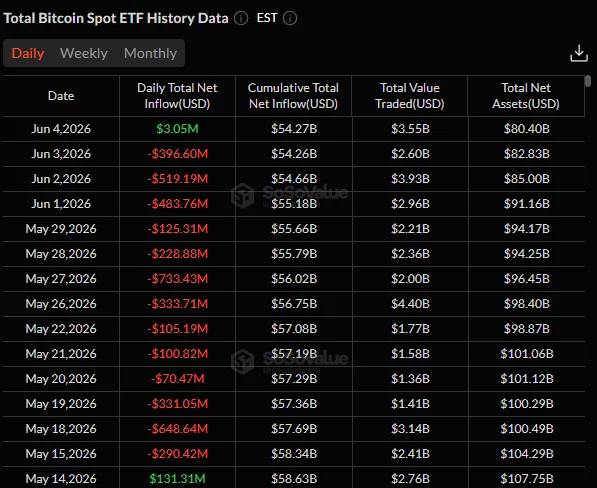
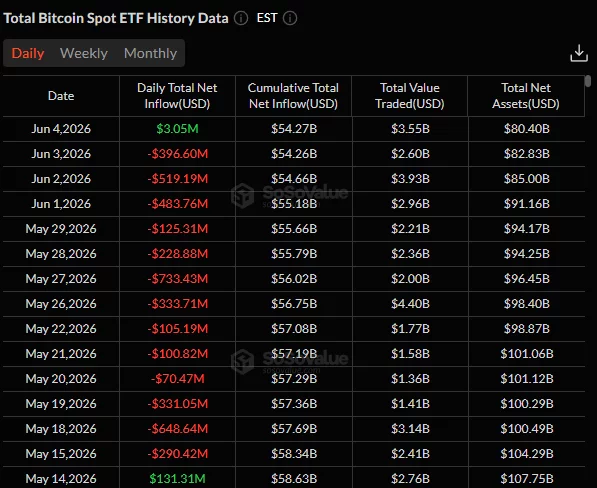
Institutional flows offered one of the few signs of stabilization. U.S. spot Bitcoin ETFs recorded roughly $3 million in net inflows on June 4, ending a 13-day streak of withdrawals that had drained $4.37 billion from the funds, per data from SoSoValue. Although the inflow was modest, it interrupted the longest period of sustained selling pressure from ETF investors this year.
Meanwhile, traditional safe-haven assets failed to attract buyers during the risk-off move. Gold fell roughly 3.5% while silver dropped 7.5%, suggesting investors were reducing exposure across multiple asset classes rather than rotating capital into precious metals.
Strategy also returned to the spotlight as Bitcoin traded below the firm’s average acquisition cost. The company’s unrealized losses have climbed above $12.7 billion, renewing debate around corporate Bitcoin treasury strategies.
CryptoQuant chief executive Ki Young Ju pushed back against concerns surrounding Strategy’s position, arguing that long-term whales have been a much larger source of supply.
“Strategy bought over 700K BTC from OG whales and only sold 32 BTC,” Ju wrote, adding that the firm’s purchases helped absorb coins that might otherwise have entered the market.
Bitcoin derivatives and on-chain data suggest capitulation may be nearing
Options positioning around the $60,000 strike has become a major focus for traders. According to Deribit Chief Commercial Officer Jean-David Péquignot, more than $1.2 billion in notional open interest is tied to put options at that level.
A sustained move below $60,000 could force market makers to hedge short gamma exposure by selling spot Bitcoin or futures contracts. Combined with elevated leverage across perpetual futures markets, that process may increase volatility if sellers remain in control.
On-chain metrics, however, are beginning to show conditions often associated with late-stage capitulation.
According to analyst Seth, the percentage of Bitcoin holders in profit has reached a long-term trendline that has coincided with major cycle lows in previous drawdowns. The analyst noted that the depth of those drawdowns has decreased with each cycle and argued that a bottom could be near if historical behavior repeats.
Additional data shared by market commentator Scott Melker highlighted growing stress among newer Bitcoin investors.
“$BTC short-term holders are now realizing losses at the biggest level in history. The short-term holder realized profit/loss ratio just hit a new all-time low, deeper than any previous drawdown.”
Melker added that long-term holders now control roughly 5.3 million BTC at a loss, a figure that exceeds post-FTX levels and represents the highest amount of underwater long-term supply since the COVID-era market crash.
Technical breakdown puts $55K support zone in focus
The daily chart shows Bitcoin trading well below the Supertrend indicator, which now sits near $69,700 and acts as immediate resistance. A failed recovery attempt beneath that level has left sellers firmly in control of the short-term trend.
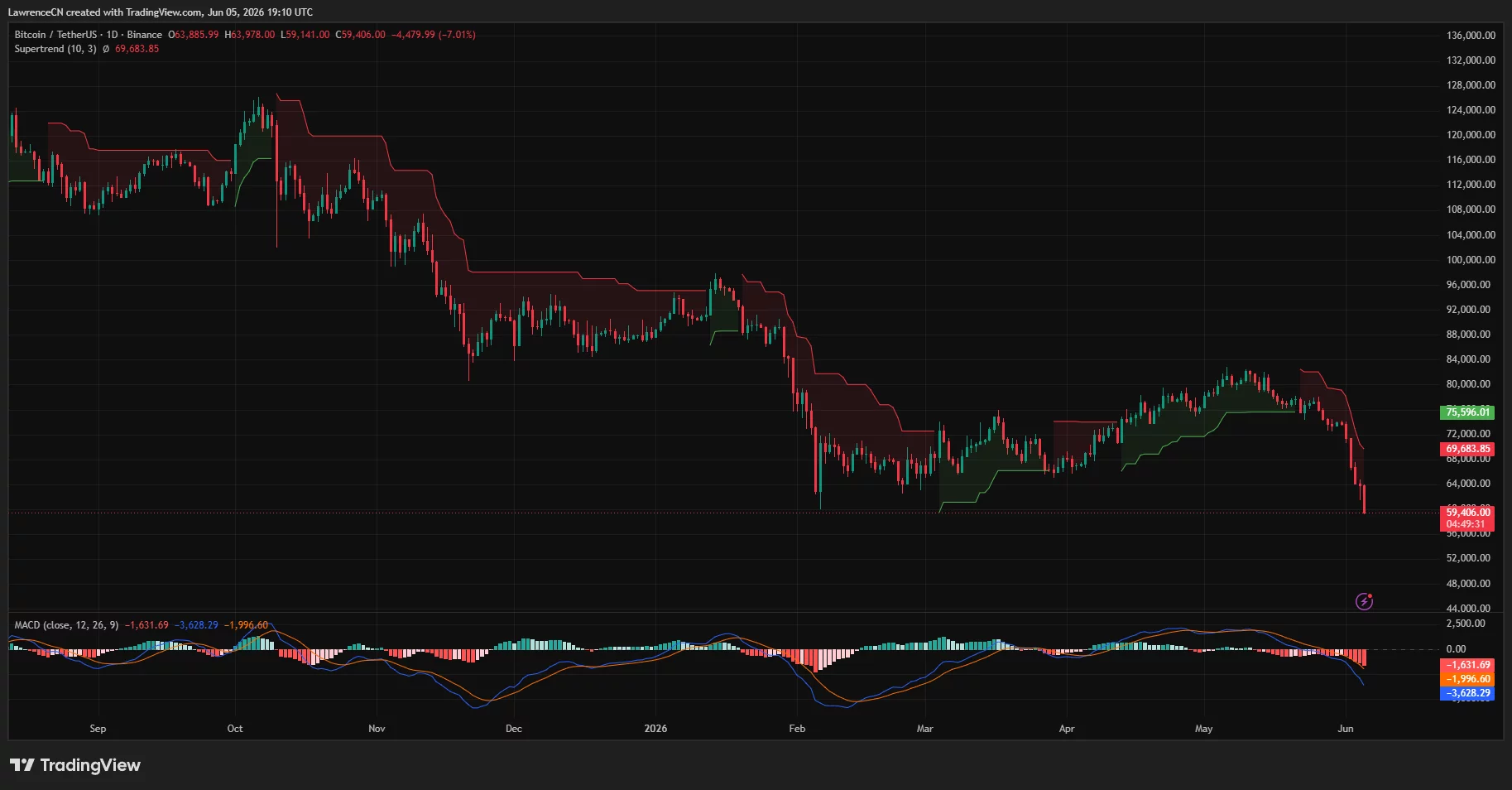
Momentum indicators also remain weak. The MACD line has dropped sharply below the signal line while the histogram continues to expand in negative territory, showing persistent downside momentum after the breakdown from the $72,000-$75,000 range.
The loss of $60,000 leaves the February low near $55,000 as the next major support zone. A decisive break below that area could expose the psychological $50,000 level and trigger another round of liquidation-driven selling.
Bulls would need to reclaim $60,000 quickly to ease immediate pressure. A recovery above the Supertrend resistance near $69,700 would invalidate the current bearish structure and reopen the path toward the $75,000 area. Until then, stronger-than-expected economic data, rising rate-hike expectations, and heavy derivatives positioning remain key risks for Bitcoin.
Disclosure: This article does not represent investment advice. The content and materials featured on this page are for educational purposes only.


TLDR
- XRP Ledger prepares version 3.2.0 with a software rebrand to XRPLd.
- Ripple engineer hints at performance upgrades, including reduced memory usage.
- Developers plan a playbook to guide operators through the upgrade process.
- The XRPL EVM Sidechain goes live with RLUSD integration for developers.
- RLUSD expands across chains using Wormhole NTT for native transfers.
XRP infrastructure is preparing for a new software release as developers confirm upcoming changes and a system rebrand. The update includes performance improvements and operational adjustments for network participants. At the same time, engineers have hinted at further refinements expected in the release cycle.
XRP Ledger Upgrade Signals Core Software Shift
The XRP Ledger operations account confirmed that version 3.2.0 will launch soon with system-level updates. The release also introduces a rebrand of the core software from Ripple to XRP Ledger. This change reflects a broader alignment with XRP Ledger naming standards.
Developers stated that infrastructure operators may need to adjust configurations during the transition process. Therefore, the team is preparing a structured playbook to guide node operators through the upgrade. The documentation will outline required steps and expected system changes.
XRP Gains Utility as RLUSD Expands Across Chains
Ripple’s stablecoin RLUSD continues to expand its reach through a multichain framework enabled by Wormhole’s NTT standard. This setup allows RLUSD to move natively across supported blockchains without relying on wrapped assets. As a result, users interact with a unified version of the stablecoin across networks.
The XRPL EVM Sidechain has also gone live, integrating RLUSD within its framework for broader developer access. The sidechain maintains compatibility with Ethereum-based tools while staying connected to the XRP Ledger. This approach supports developers building decentralized applications using familiar environments.
Payment integrations have also expanded as Mastercard confirmed support for settlement using regulated stablecoins, including RLUSD. The network spans platforms such as Ethereum, Solana, Polygon, and XRPL. Meanwhile, RedotPay added RLUSD support, allowing users to spend the stablecoin through its payment system.
Engineers continue to highlight improvements expected in the upcoming release, focusing on efficiency and system performance.
An XRPL validator stated, “This version has even more bangers, btw, like memory footprint reduction.”
This indicates efforts to reduce resource usage across nodes.
The development updates follow ongoing work to improve network performance and maintain compatibility across ecosystems. As the release approaches, developers continue to share updates through official channels. The upgrade timeline remains tied to internal testing and deployment readiness.



Chainlink’s Cross-Chain Interoperability Protocol (CCIP, the messaging layer that moves assets and data between blockchains) drew over $1.1 billion in token value this week, according to Chainlink, as Virtuals Protocol, Pleasing Market, and Zest Protocol announced integrations in the same seven-day… Read the full story at The Defiant
Pump.fun, the dominant meme-coin launchpad on Solana, launched GO on Wednesday, a bounty marketplace that lets users post paid tasks and pay anyone worldwide to complete them, with rewards held in escrow until the platform approves a submission. The platform generated its first controversy within… Read the full story at The Defiant
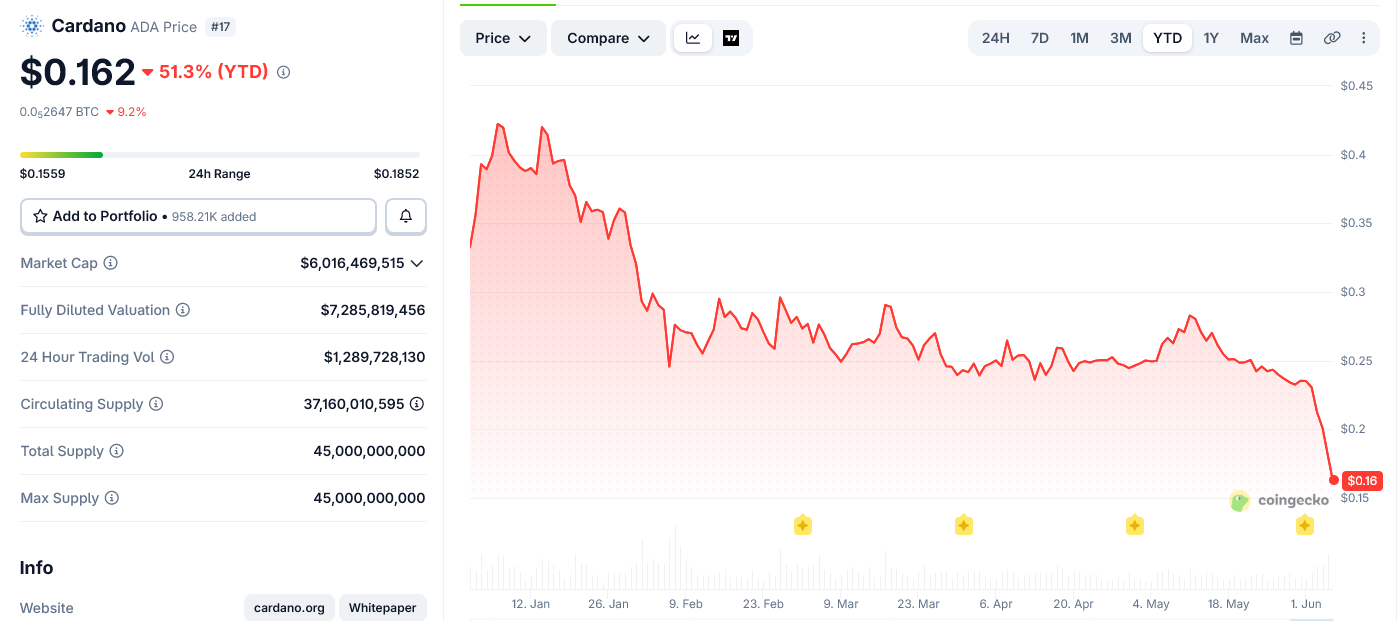
On June 3, 2026, Cardano founder Charles Hoskinson posted “I’m taking a break. TTYL” on X, triggering a fresh 10% ADA sell-off. This came just one day after he warned about a wave of failures in the ecosystem, following the collapse of analytics platform TapTools. The token sank to $0.15 for the first time in more than five years.
What is happening at Cardano is not a bad week in a down market. It is a full-scale network breakdown. And it is forcing uncomfortable questions about the structural health of other major blockchains, including XRP and Ethereum.
Governance Became the Real Emergency for Cardano
Cardano is facing a perfect storm of governance failures, project closures, treasury disputes, and a founder stepping back from public view. It all happened in a single devastating week.
ADA is down nearly 70% over the past year and more than 93% from its all-time high of $3.09, set in September 2021.

The collapse of TapTools was the match that lit the fire. Its shutdown was actually the second major exit in just six weeks. Earlier, NFT marketplace JPG.Store — the leading platform for Cardano NFTs since 2021 — had already entered restricted mode in April before shutting down entirely in May.
For many participants, the simultaneous loss of two flagship platforms raised a question that price charts alone cannot answer: is the Cardano ecosystem still capable of sustaining the infrastructure it needs to function?
Hoskinson addressed that directly and with unusual candor: “I don’t have any governance keys. I don’t have any ability to even initiate a hard fork. I don’t have access to the treasury.”
“I keep getting criticized relentlessly online. People every single day post on my Twitter feed the price of ADA and blame me for it collapsing. And I’d really like to know what my agency is here,” added.
Follow us on X to get the latest news as it happens
The market priced in those closures immediately. Everstake described the moment as one of the most severe downturns in the ecosystem’s history, noting that ADA had dropped to $0.15 — a level last seen in late 2020 — effectively erasing most gains from the previous cycle.
“As a reaction to this shocking news, both on-chain activity and social attention have spiked to historically high levels. The below chart shows $ADA reaching a 2026 high of approximately 0.52% social dominance, meaning more than one out of every 190 crypto-related discussions across social media has been focused on Cardano,” Santiment noted on X.
The Concentrated Risk of XRP
For XRP, the surface picture looks reassuringly different from Cardano’s. Ripple CEO Brad Garlinghouse has maintained a consistent and confident public message throughout 2026, framing XRP as neutral financial infrastructure for a world increasingly fragmented by sanctions and geopolitical tension.
There are no cascading project closures, no treasury standoffs, no co-founders warning publicly about ecosystem survival. By those measures, XRP appears structurally sound.
But stability and resilience are not the same thing. XRP’s governance is concentrated almost entirely within Ripple as a corporate entity. This structure minimizes internal friction but also creates a single point of failure that mirrors Cardano’s founder-dependency problem more than most XRP holders care to acknowledge.
“[…] XRP is even worse than Cardano,” one user pointed out.
At the height of the ADA collapse, Cardano was underperforming Bitcoin, Ethereum, XRP, and Solana simultaneously, confirming that macro conditions amplify rather than cause network-specific crises.
XRP is not immune to that amplification effect if Ripple’s leadership narrative ever breaks down.
The numbers underline the point: despite three major positive catalysts in 2026 — the CLARITY Act advancing through committee, a joint SEC-CFTC commodity classification covering XRP, and more than 1.42 billion dollars in cumulative spot ETF inflows — XRP is still down around 29% on the year. Institutional tailwinds matter.
They just do not override sentiment when the broader market turns, and they do nothing to address the governance concentration that sits quietly beneath XRP’s bullish narrative.
Ethereum: A Deliberate Restructuring With Open Questions
Ethereum’s situation is more structural than operational — and in some ways more instructive to examine. Vitalik Buterin recently announced that the Ethereum Foundation would pursue “longevity over breadth,” reduce its ETH sales, and narrow its focus to five core principles: censorship resistance, capture resistance, openness, privacy, and security.
The strategic shift signals a healthier long-term posture. But it also opens a question the market has not fully priced: who absorbs the influence gap as Buterin deliberately reduces his own centrality in the foundation’s decision-making?
Buterin noted that the Ethereum Foundation holds roughly 0.16% of all ETH — far below the 10% to 50% common in the central foundations of other blockchains. That restraint is genuinely healthy from a decentralization standpoint.
Yet the community’s reaction to the announcement — public questions about board composition, governance transparency, and who sets priorities going forward — showed that the market still equates Buterin’s personal involvement with Ethereum’s institutional credibility. That is a dependency, even if it looks nothing like Cardano’s.
Buterin has also flagged a structural technical concern: heavy reliance on Ethereum’s Layer-2 networks puts user funds at risk if those off-chain systems fail.
He argued that a consensus failure followed by a hard fork is “less bad” than users quietly losing money through broken L2 infrastructure.
That unresolved tension — between scaling through L2s and protecting users from their failure modes — is a real governance challenge with direct financial consequences, and it is one Ethereum has not yet answered definitively.
What Could be Next for Cardano, XRP, and Ethereum?
The critical difference between Cardano and both networks lies in ecosystem depth. Ethereum has thousands of active developers and the deepest DeFi liquidity in the market. XRP benefits from disciplined corporate messaging and regulatory tailwinds.
“It’s clear that the technological and market risks in the search for a better Bitcoin have proven the thesis absurd. Cardano was sold as the best dead BTC. Zcash: Best dead Bitcoin. Others missing: ETH, XRP, SOL, KASPA, etc”, crypto analyst David Battaglia highlighted.
Cardano has been losing foundational layers one by one: the NFT marketplace, the analytics platform, community trust in treasury governance.
When those layers erode simultaneously, no founder can hold an ecosystem together through social media alone. That is the warning the rest of the market needs to hear clearly.
Subscribe to our YouTube channel to watch leaders and journalists provide expert insights
The post After Cardano’s Meltdown, Could XRP and Ethereum Be Next? appeared first on BeInCrypto.
Crypto World
Altcoin Massacre Triggers $1.2B in Liquidations as ETH Tanks Below $1.7K and ZEC Gets Smashed
The wild cryptocurrency market moves continue as most assets have produced even higher fluctuations in the past several hours, which has inevitably harmed over-leveraged traders.
The most significant price fluctuation in the past day came from the recent high-flyer Zcash, which crashed after some community members found a vulnerability in its code. This prompted intense backlash including from popular crypto experts, such as Arthur Hayes, who said he had disposed of his entire ZEC position.
The combination of these factors led to a massive and immediate price crash for the privacy token. It went from over $630 yesterday to under $300 earlier today before it recovered some ground and reclaimed the latter.
Naturally, this intense price move led to substantial liquidations with $100 million worth of ZEC longs getting wrecked on a daily basis, according to CoinGlass.
However, ZEC is far from the only crypto asset affected by the overall market-wide wildness. Ethereum continues to underperform, especially since it lost the $2,000 support earlier this week. It plunged to under $1,650 earlier today, which became a new 14-month low.
SOL has dumped by over 7%, HYPE has plummeted by 9%, while ADA is down by another 16% after Cardano’s founder, Charles Hoskinson, said he would be taking a break.
Bitcoin dumped to $61,000 earlier today, but managed to rebound by almost $2,000. The altcoins’ massacre, though, has helped its recovery in terms of market share.
Bitcoin’s dominance, the index that shows how much of the total market cap belongs to BTC, has risen by over 0.5% in just a day after it had dumped from 58% to 55.5% in a week.
The overall liquidation data shows that more than 255,000 over-leveraged traders have been wrecked in the past 24 hours, with total wipe-out value of $1.21 billion. Longs are once again responsible for the lion’s share with $935 million.

The post Altcoin Massacre Triggers $1.2B in Liquidations as ETH Tanks Below $1.7K and ZEC Gets Smashed appeared first on CryptoPotato.

Key Takeaways
- BlockchAIn Digital Infrastructure (AIB) plunged 21% Friday following disclosure of a $55 million equity raise
- AIB sold 33.3 million shares at a price of $1.65 apiece
- Funds will be allocated toward working capital, capital investments, and general operations
- Lucid Capital Markets serves as sole book-runner; underwriters hold a 45-day option for approximately 5 million additional shares
- The transaction is set to finalize around June 8, 2026
Shares of BlockchAIn Digital Infrastructure (AIB) tumbled 21% Friday following the company’s disclosure of a $55 million public equity raise.
BlockchAIn Digital Infrastructure, Inc., AIB
AIB sold 33,333,334 shares at $1.65 per share, a pricing decision that triggered immediate selling pressure and pushed the stock significantly lower.
The equity raise dilutes current shareholders, which typically drives these types of sudden selloffs. When more shares enter the market, each individual share claims a reduced ownership percentage in the company.
AIB intends to deploy the capital across three key areas: working capital needs, capital spending related to business expansion, and general corporate operations.
The firm specializes in AI hosting and high-performance computing infrastructure — developing and maintaining the digital systems that power AI workloads.
Deal Structure and Terms
Lucid Capital Markets is serving as the sole book-running manager overseeing the offering.
The underwriting team also secured a 45-day over-allotment option allowing them to buy up to 4,999,999 extra shares at the offering price, net of discounts and fees. Full exercise of this option would increase total proceeds beyond the $55 million mark.
The SEC approved the Form S-1 registration statement on June 4, 2026 — merely one day prior to the pricing disclosure.
This rapid progression from approval to pricing indicates the company acted swiftly after securing regulatory authorization.
The transaction is projected to conclude on or around June 8, 2026, subject to standard closing requirements.
Understanding the Selloff
A 21% intraday decline represents a substantial move, though it’s typical when companies issue new equity below prevailing market prices.
The $1.65 offering price now establishes a psychological support level — market participants view this figure as a key benchmark.
AIB positions its infrastructure as merging dependable power sources with flexible, modular systems built to expand computing power for advanced AI development.
Every share in this offering comes directly from the company’s treasury, indicating no insider selling is taking place.
The complete prospectus will be submitted to the SEC and made accessible through the SEC’s online portal at sec.gov.
Interested parties may also obtain copies by contacting Lucid Capital Markets at 570 Lexington Avenue, 40th Floor, New York, NY 10022.
The stock’s 21% retreat demonstrates how quickly markets price in shareholder dilution following such announcements.
Uniswap has recorded its largest daily UNI burn under the UNIfication mechanism as Hayden Adams renewed his bullish view on DeFi and Ethereum.
Summary
- Uniswap recorded a new daily burn high after 134,000 UNI tokens were burned in 24 hours.
- Hayden Adams said he is “extremely bullish on DeFi and Ethereum” despite weak market sentiment.
- Uniswap governance expanded fee collection and UNI burns to BNB Chain, Polygon, and Celo through Proposal 96.
Hayden Adams, the creator of Uniswap, said on X that he is “extremely bullish on DeFi and Ethereum,” while comparing current market sentiment to the 2018 bear market that preceded Uniswap’s launch.
Adams said Ethereum sentiment was also very low during that cycle, but builders used the period to create products that later helped drive the DeFi summer of 2020.
Uniswap Burn Hits Record Daily Level
The UNI Burn Bot reported that 134,000 UNI tokens were burned in one 24-hour period, setting a new daily high for the UNIfication program. The record came one day after trackers showed stronger burn activity tied to fees collected through Uniswap’s on-chain contracts.
Under UNIfication, protocol fees are first collected and held in TokenJar contracts. Users who want to claim those fees must burn an equal value of UNI through a contract called Firepit. After the process is completed, the burned UNI is sent to Ethereum’s 0xdead address, removing the tokens from circulation permanently.
Uniswap Labs and the Uniswap Foundation approved the UNIfication plan in late 2025. After the proposal was announced, UNI rose from $4.95 to $9.25 within one week, based on the figures cited in the proposal’s market reaction.
Proposal 96 Expands Fee Burns Across Chains
In May, Uniswap governance approved Proposal 96, which expanded fee collection and UNI burns to BNB Chain, Polygon, and Celo. The decision increased the number of chains using the burn mechanism to 11, including Ethereum.
The expansion matters because Uniswap now operates across more than 40 chains. Data cited by Uniswap shows the protocol holds $2.86 billion in total value locked. Ethereum accounts for $1.96 billion of that total, while Base holds $416 million and Arbitrum holds $198 million.
Since launch, Uniswap has generated $5.59 billion in cumulative fees. However, the amount directed to UNI holders through the burn mechanism stands at $14.15 million in total. Annualized fees currently sit near $882 million, according to the figures provided.
Product Updates Target Everyday Users
Uniswap Labs also announced four product updates that focus on user access across chains. The updates include in-app wallets, cross-chain swaps, portfolio tracking, and multichain portfolio views.
The company said all four features are live and carry zero interface fees on swaps. Uniswap Labs also said its internal research found that 49.9% of new traders on Ethereum, Arbitrum, and Base who swapped in 2026 made their first-ever swap on Uniswap.
Despite the latest burn record and new product releases, UNI still trades at $2.47. The token remains more than 92% below its May 2021 all-time high of $44.97.
UNI’s market capitalization stands at $1.54 billion, with 622.71 million tokens in circulating supply. The latest data places the burn mechanism at the center of Uniswap’s current token strategy, while Adams’ comments tie the protocol’s latest activity to a longer DeFi-building cycle.
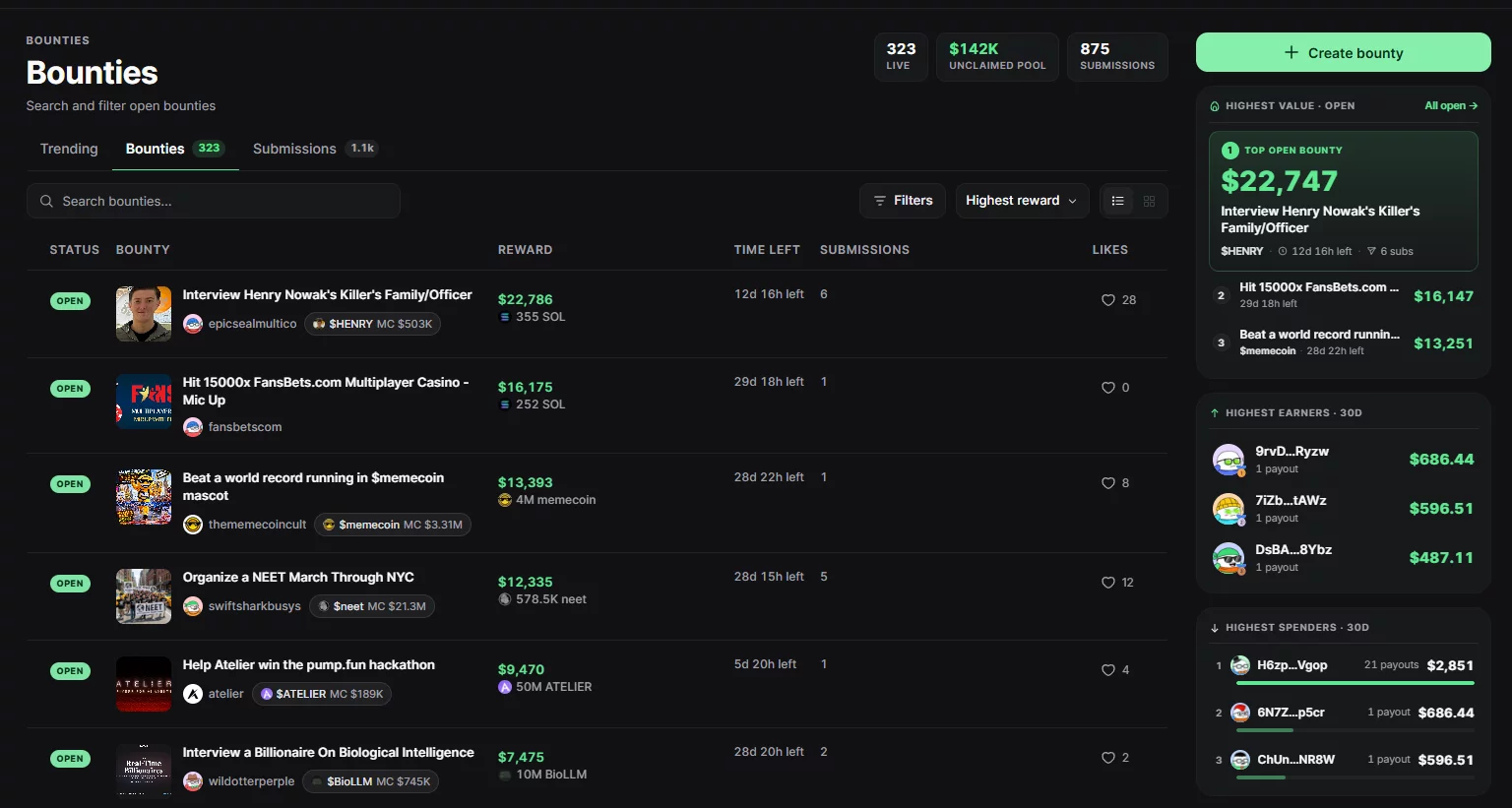
Pump.fun has launched a new bounty marketplace that has attracted more than 1,100 submissions and listed over 320 active tasks within hours of going live.
Summary
- Pump.fun launches GO, a bounty marketplace with over 320 active tasks and $144,000 in unclaimed rewards.
- Users are offering crypto payouts for unusual challenges, including tattoos, public stunts, and interviews.
- Despite five-figure advertised rewards, the largest payout so far is under $700.
According to Pump.fun, the Solana-based meme coin platform introduced GO on June 5 as a marketplace where users can create and complete bounties by locking rewards in escrow.
The platform launched with the slogan “Pay ANYONE to do ANYTHING,” allowing participants to connect an X account and crypto wallet before posting or completing tasks with rewards starting at $5.
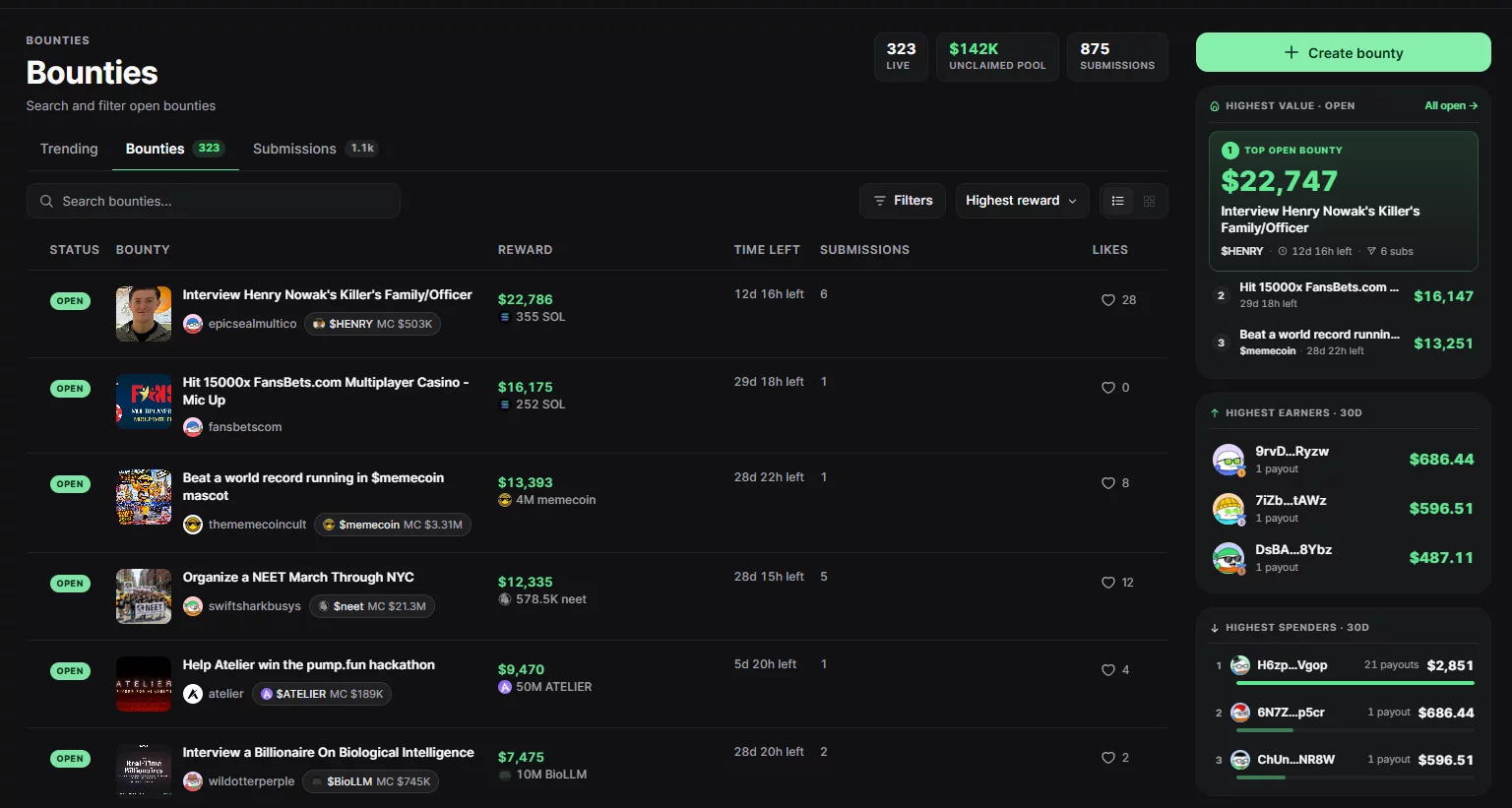
Data displayed on the platform at the time of writing showed more than $144,000 sitting in unclaimed rewards. Hundreds of listings appeared shortly after launch, ranging from marketing campaigns and public stunts to unusual personal challenges.
One bounty offered approximately $2,650 for a participant willing to tattoo a token ticker on their forehead. Another listing sought footage of a branded vehicle being set on fire, while separate rewards were offered for streaking an NBA Finals game, pouring milk over oneself, getting a token noticed by Elon Musk on X, and even helping bail someone out of jail.
High-value rewards remain largely unclaimed
Among the largest rewards initially listed on GO was a bounty worth up to $50,000 for skydiving into a FIFA World Cup match while dressed as a meme coin mascot. The task required footage verified by a media organization and specifically stated that AI-generated content would not be accepted.
By the time of writing, however, the listing was no longer available. A notice on the platform stated that the bounty may have been removed, closed by its creator, or never published.
Several high-paying tasks remained active. The largest visible reward, worth roughly $23,525, requested an interview with either a family member of the person responsible for Henry Nowak’s death or the lead police officer involved in the case.
The listing called for at least two minutes of unedited footage and stated that greater online engagement would increase its value.
Other notable rewards included approximately $16,159 for completing a FansBets casino challenge, $13,319 for breaking a running world record, $12,288 for organizing a “NEET March” in New York City, and $9,103 for securing an interview with a billionaire about biological intelligence. A separate listing offered nearly $4,000 to organize a “best butt contest.”
Payouts remain small despite large advertised rewards
Although some rewards advertise five-figure payouts, data from GO showed that actual earnings have so far remained modest. The platform’s highest-paid participant had received $686.44 from a single bounty, while the next two largest payouts stood at $596.51 and $487.11.
Activity on the platform has nevertheless been intense. One participant pursuing a bounty worth about $2,876 for quitting a job on camera streamed the attempt on Kick and claimed in the submission that they were fired from another job during the process, adding that the outcome was “worth it for the sol.”
The launch extends Pump.fun’s push into internet-driven incentive systems beyond meme coin creation. Last month, crypto.news reported that a trader turned a $341 investment in World Cup Coin, a meme token launched through Pump.fun, into roughly $48,000 in realized gains after a series of rallies pushed the token’s market capitalization to $12.2 million.
However, such outcomes remain uncommon. As per earlier reports, nearly half of Pump.fun traders lost money in March this year, while about 96% of wallets either recorded losses or generated less than $500 in profit.
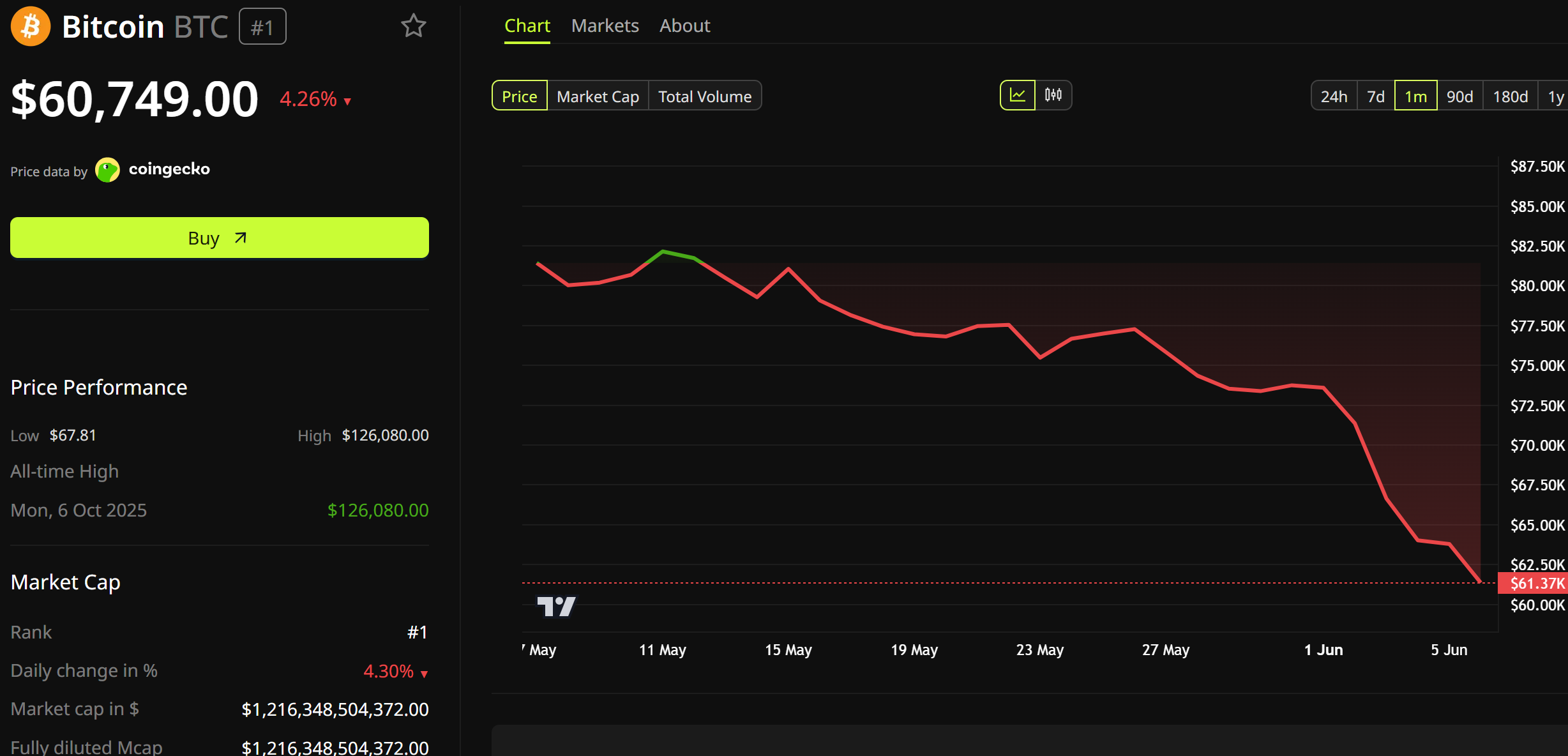
Morgan Stanley Wealth Management has agreed a referral arrangement with Galaxy Digital. Eligible clients can lend cryptocurrency in exchange for shares in spot crypto exchange-traded products, including the Morgan Stanley Bitcoin Trust (MSBT).
The structure lets investors move existing crypto holdings into regulated brokerage products without selling them. It also lowers the entry threshold and shortens onboarding, widening access for qualified wealth clients who already hold digital assets.
How the In-Kind Referral Works
A client lends specified assets such as Bitcoin (BTC), Ether (ETH), or Solana (SOL) to Galaxy. Once Galaxy confirms it can settle the loan in ETP shares, it coordinates an in-kind creation with an authorized participant.
The shares then land in the client’s chosen account. Because the crypto is lent rather than sold, the process avoids a taxable disposal and the execution risk of converting to cash.
MSBT, which launched in April as the cheapest US Bitcoin ETF, anchors the product set. The bank had already cleared its wealth advisors to recommend Bitcoin funds to clients.
Lower Minimums Meet a Falling Market
Galaxy will drop its lending minimum for Morgan Stanley referrals from $25 million to $5 million. Onboarding, which can currently exceed four weeks, may shrink by up to 75% in some cases.
The timing is notable. Bitcoin trades near $60,749 after slipping about 4% in a day, while Ether sits around $1,588 and Solana near $65, both down sharply over the past month.

Follow us on X to get the latest news as it happens
Bridging Traditional Finance and DeFi
The deal builds on Galaxy’s New York license and its earlier work launching European crypto ETPs with DWS.
“This referral arrangement represents a significant step forward in bridging traditional finance and decentralized finance, providing more investors with streamlined opportunities to diversify,” read an excerpt in the announcement, citing Alison Nest, Head of Investment Solutions Products at Morgan Stanley Wealth Management.
Meanwhile, Galaxy framed the appeal around convenience for clients balancing both worlds.
“Streamlined onboarding and lowered transaction minimums make it easier for clients to integrate digital assets alongside traditional investments, supporting a holistic approach to wealth management,” the press release added, citing Zane Glauber, Global Head of Distribution at Galaxy.
The arrangement keeps client assets and fees inside Morgan Stanley’s ecosystem while handing Galaxy the lending and creation work.
Whether lower minimums translate into steady ETP inflows during a softer market is the question the coming weeks may answer.
The post Morgan Stanley Opens New Crypto-to-ETF Path With Galaxy Digital appeared first on BeInCrypto.
Crypto World
Zcash price plunges 50% amid bug fallout and Hayes selloff, can whales reverse the trend?
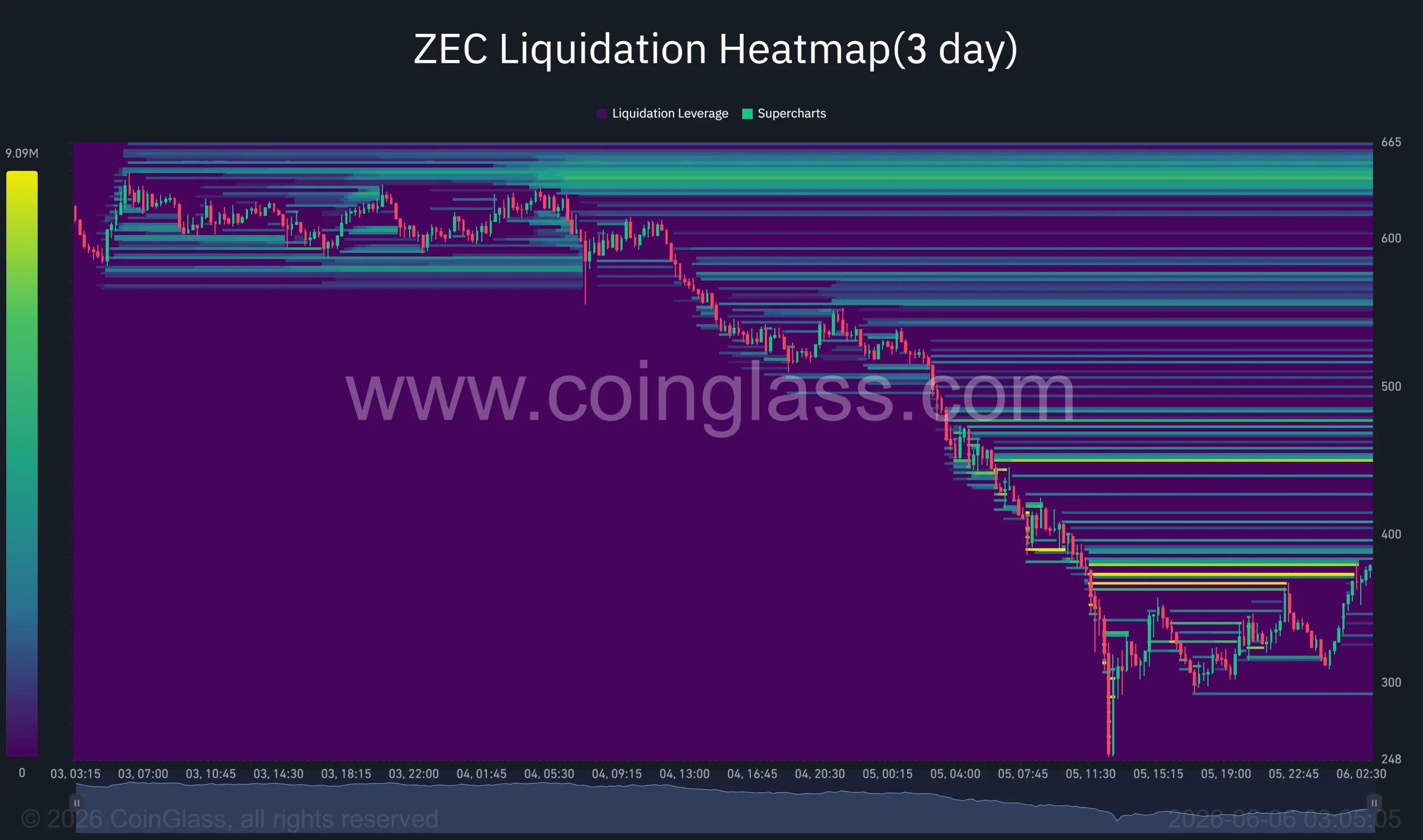
Zcash has plunged nearly 50% from its recent high after disclosure of a critical network vulnerability triggered panic selling, forced liquidations, and the exit of one of the privacy coin’s most prominent supporters.
Summary
- Zcash plunged nearly 50% after disclosure of a critical Orchard pool vulnerability and Arthur Hayes’ exit from the asset.
- Lookonchain data showed a whale withdrew 37,316 ZEC worth $13.1 million from Binance, suggesting some investors are buying the dip.
- Technical indicators remain bearish despite the rebound, with key resistance levels sitting at $420, $471, and $523.
According to crypto.news market data, Zcash (ZEC) crashed to an intraday low of $264.80 on June 5 before rebounding toward $380.
The selloff followed confirmation from Shielded Labs that a flaw in the network’s Orchard shielded pool could have allowed unlimited counterfeit ZEC to be created before an emergency fix was deployed.
Selling pressure for the privacy token also intensified as BitMEX co-founder Arthur Hayes disclosed that he had sold his entire ZEC position. In a post on X, Hayes acknowledged that exploitation appeared “extremely unlikely” but argued that privacy-focused assets require a higher standard of certainty.
“The privacy from AI, govt, big tech narrative demands perfection not improbability. I read about the exploit yday, and didn’t appreciate how it violated my narrative mental map. The…dump, made me rethink, and I had to take profit on the entire position.”
Not everyone rushed for the exit, however. Lookonchain data showed a newly created wallet withdrew 37,316 ZEC worth approximately $13.1 million from Binance shortly after the crash, suggesting at least some large investors viewed the decline as a buying opportunity rather than a reason to abandon the asset.
Whale accumulation emerges as traders target oversold conditions
On-chain activity shows a sharp divide between long-term believers and traders reducing exposure. While Hayes exited his position, the large Binance withdrawal arrived near the bottom of the selloff, coinciding with ZEC’s recovery from the $260 region.
Derivatives markets experienced one of the most violent resets in months. CoinGlass data cited earlier by crypto.news showed ZEC liquidations reached nearly $82 million during the crash as leveraged positions were wiped out across exchanges.
The three-day liquidation heatmap suggests much of the downside liquidity below $300 has already been cleared. Following the rebound, the largest concentration of short liquidation leverage sits between $370 and $390, with another significant cluster visible around the $450 region. If buyers maintain momentum above current levels, those zones could become magnets for price action as short sellers are forced to close positions.
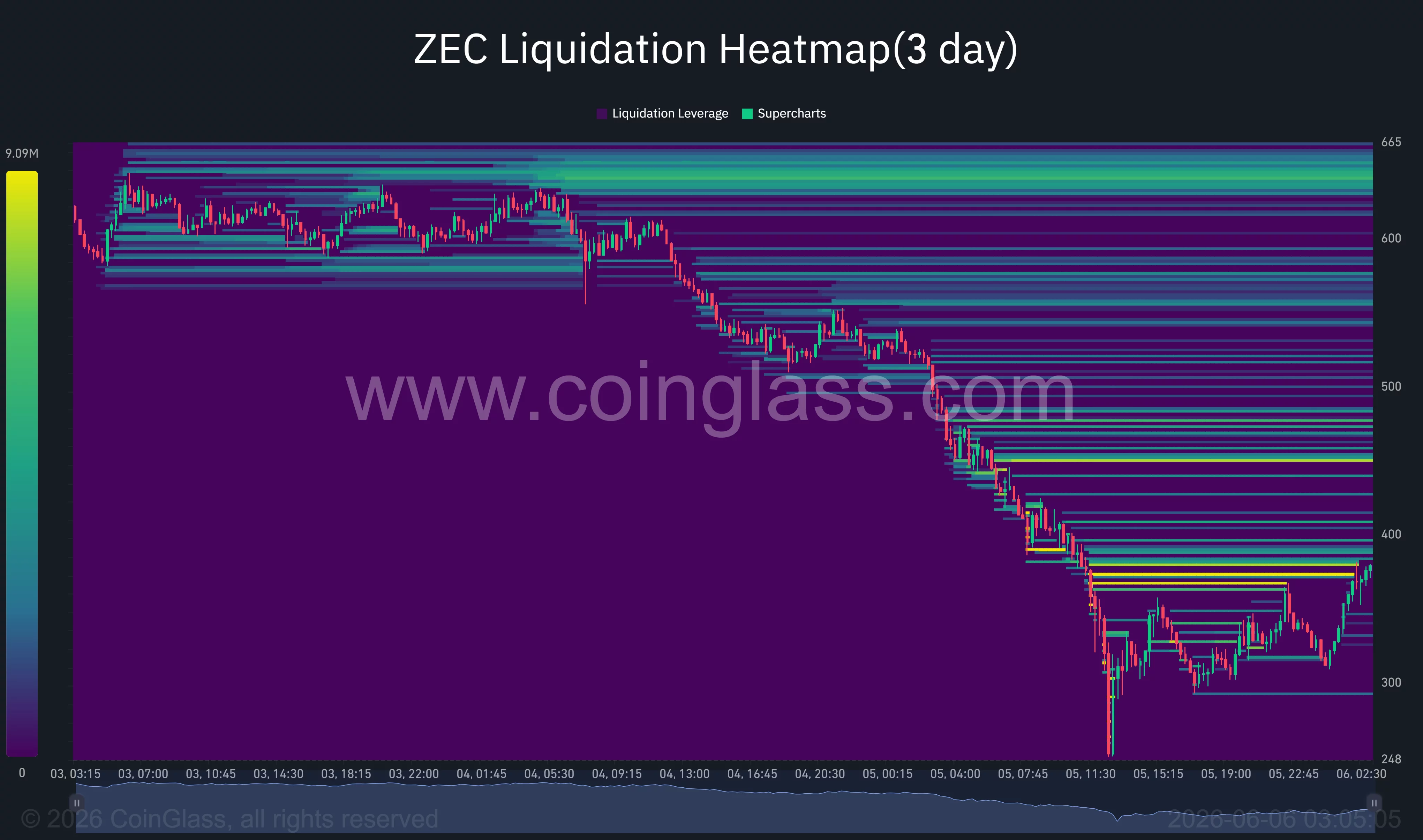
Market participants are also watching whether fresh accumulation continues. The recent whale purchase occurred after one of the largest single-day declines in Zcash’s recent history, creating conditions that often attract opportunistic traders seeking oversold assets.
Technical structure remains damaged despite rebound
The four-hour chart shows ZEC plunging through several key Fibonacci support levels after news of the Orchard vulnerability triggered heavy selling. The decline briefly pushed the token to an intraday low near $265, just above the 0% Fibonacci retracement level at $253, where buyers stepped in and sparked a sharp rebound.
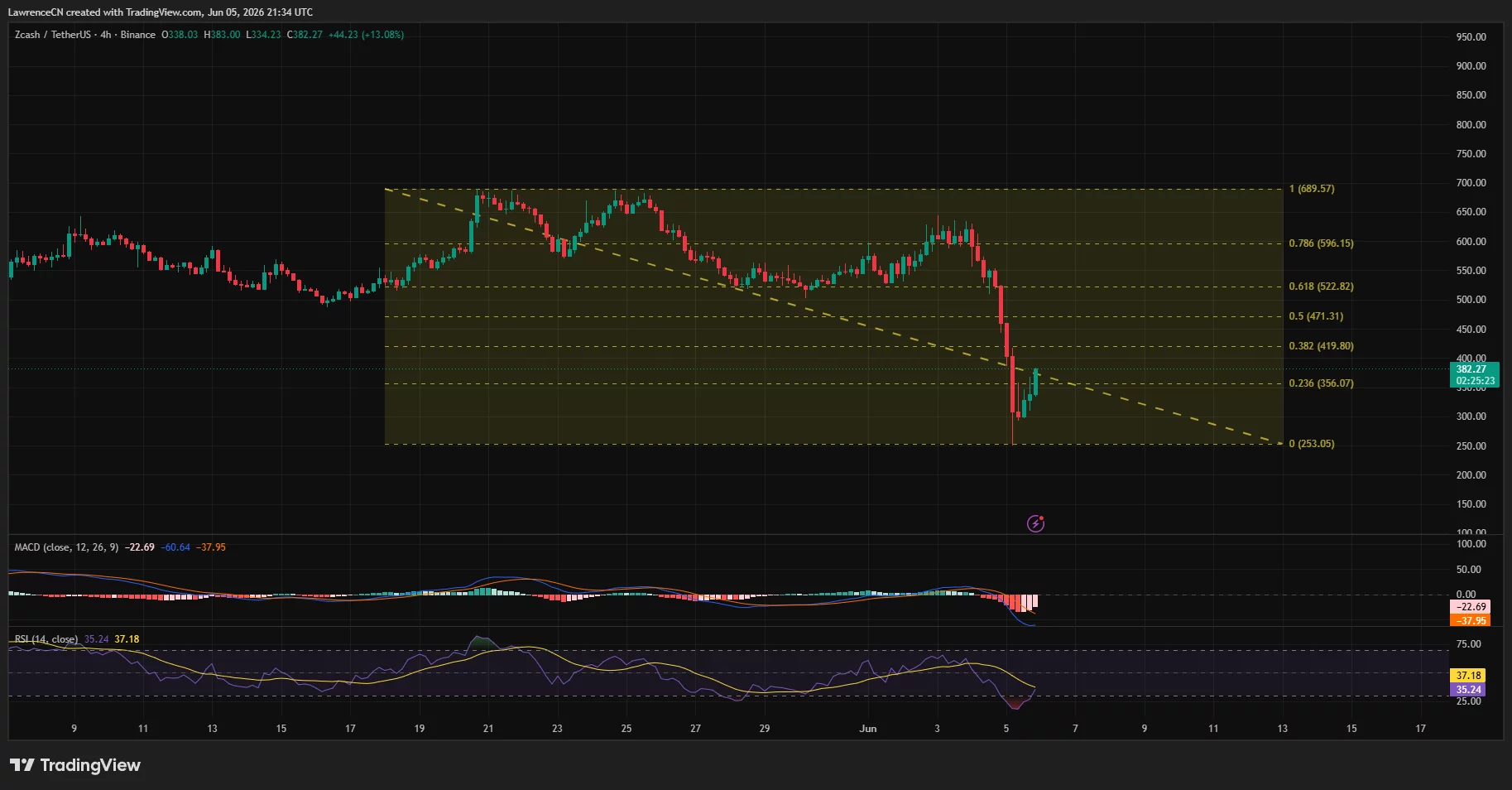
Recovery has since pushed the token back above the 23.6% Fibonacci retracement level near $356. A successful hold above that area could open the door toward the next resistance zone at $420, which aligns with the 38.2% retracement level. Beyond that, traders are watching $471 and $523, corresponding to the 50% and 61.8% retracement levels.
Momentum indicators remain mixed. The Relative Strength Index has recovered from deeply oversold conditions but remains below the neutral 50 level, showing that buyers have regained some control without fully reversing the trend.
Meanwhile, the MACD remains below the zero line even as bearish momentum begins to ease. The histogram has started contracting after reaching its most negative reading during the selloff, suggesting that selling pressure has moderated following the liquidation cascade.
As such, if Zcash price fails to hold above the $356 support zone could expose ZEC to another test of the $300 area and potentially the recent low near $253. Such a move would likely invalidate the current recovery attempt and place attention back on the unresolved uncertainty surrounding the Orchard vulnerability.
Disclosure: This article does not represent investment advice. The content and materials featured on this page are for educational purposes only.

M62 updates RECAP as crash sees two lanes closed near Eccles – latest updates

B&M European Value Retail plc 2026 Q4 – Results – Earnings Call Presentation (OTCMKTS:BMRRY) 2026-06-05
XRP Ledger Prepares Major Release as Engineer Teases Upgrades



-
 Business4 days ago
Jade Biosciences, Inc. (JBIO) Discusses Positive Interim Results From JADE101 Phase I Healthy Volunteer Study and Development Plans Transcript
-
 Tech7 days ago
SpaceX just won a second Golden Dome contract. This one is $4.16 billion.
-

 Sports3 days ago
French Open 2026 results: Alexander Zverev beats Rafael Jodar and will play Jakub Mensik in semi-finals
-
 NewsBeat7 days ago
FIRST NIGHT REVIEW: Take That bring the Circus back to life in spectacular sun-soaked style
-

 Business6 days ago
Is the Spurs Phenom Already Better Than Prime Diesel?
-

 Tech3 days ago
CryZENx Releases Fresh Playable Content Deep Inside Jabu-Jabu for His Ocarina of Time Remake
-

 Politics7 days ago
The House | Inside Andy Burnham’s Makerfield Campaign: “Nobody Thinks This Is In The Bag”
-
Crypto World14 hours ago
LBank Surpasses 25 Million Users Worldwide as AFA Partnership Continues to Drive Global Growth
-

 Business3 days ago
Trump Taps Housing Chief Bill Pulte as Acting Intelligence Director After Gabbard Exit
-
 Entertainment7 days ago
Weak ‘Supergirl’ Box Office Tracking Amid Milly Alcock Backlash
-
 Entertainment6 days ago
One of the Greatest Sitcoms of All Time Shoots Up Apple TV’s Charts 11 Years Later
-

 Business7 days ago
Demand Conditions Improve In Chemicals Sector In April 2026
-
 Crypto World3 days ago
Seagate (STX) Stock Surges to Record High on AI Boom and Legal Settlement
-
 NewsBeat6 days ago
Everything you need to know as Cambridge’s Strawberry Fair returns after cancelled year
-

 Fashion6 hours ago
Weekend Open Thread: Evereve – Corporette.com
-
 Entertainment7 days ago
Britney Spears Shares Troubling Update After Hard Year
-
Crypto World3 days ago
EU AI Data Center Project Faces Delays as Funding Gaps Grow
-
 NewsBeat3 days ago
Republicans balk at Trump’s attempt to appoint a MAGA enforcer to lead National Intelligence
-

 Business3 days ago
Aehr Test Systems Stock Soars 17% Amid Surging AI Demand and Conference Spotlight
-
 Business7 days ago
US-led AI investments risk capital destruction: Chris Wood
You must be logged in to post a comment Login