
Crypto World
Bitcoin price news: BTC eyes $90,000 as leverage is building

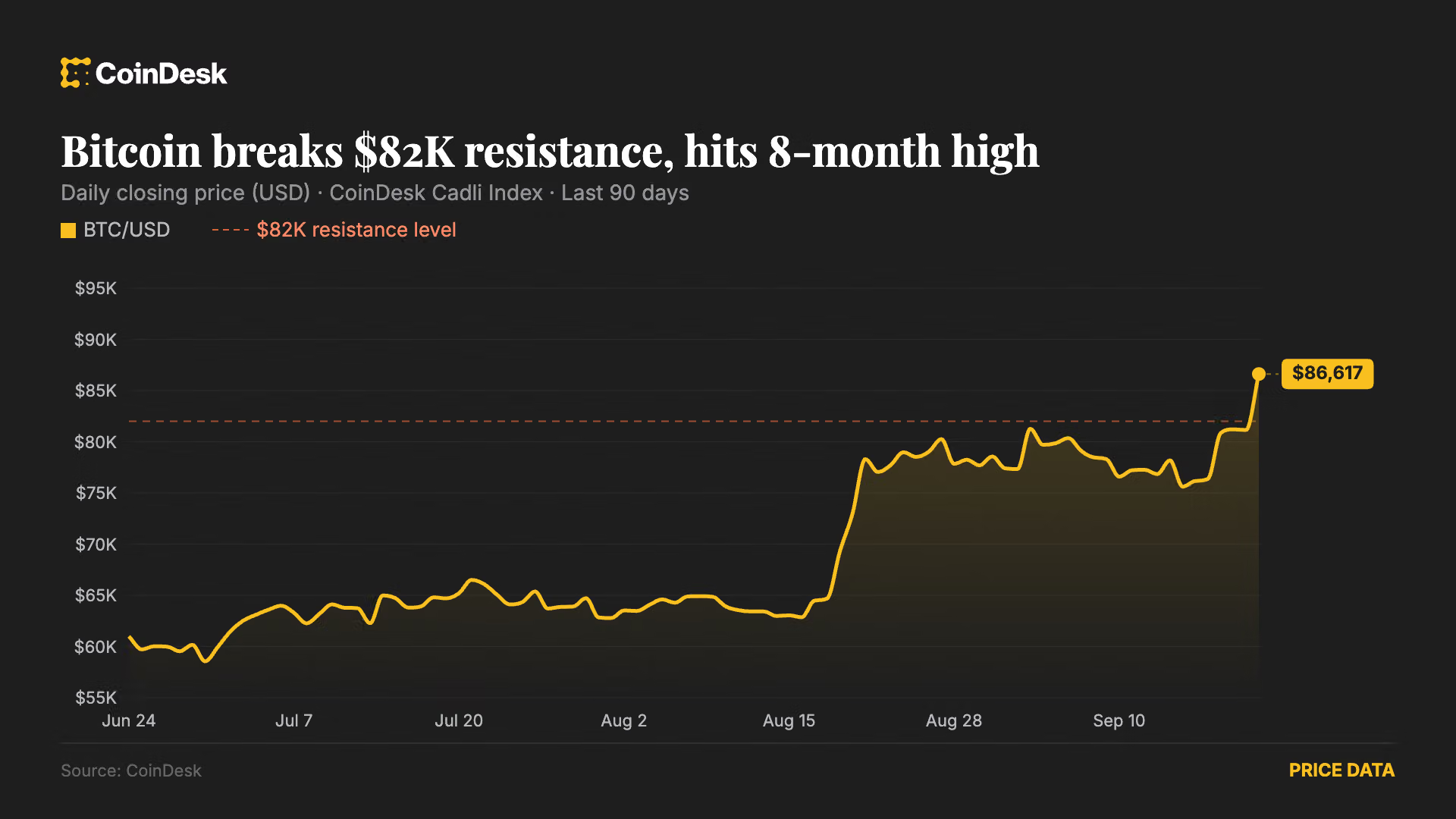
Bitcoin has broken out to $86,000, but analysts say the next leg depends on whether spot buyers continue to show up as leverage builds.
Source link


Coinbase has opened initial public offering access to eligible U.S. retail customers, starting with Oura’s $2.2 billion offering, as COIN shares gained more than 5% on Sep. 21.
Summary
- Coinbase users can request Oura shares at the IPO price before public trading begins.
- Oura is offering 50 million shares at an expected price of $40 to $44.
- Selling allocated shares within 30 days may trigger a 60-day IPO access restriction.
- COIN rose 5.7% to $205.38 following the announcement.
Coinbase IPO access starts with Oura
Coinbase said in a Sep. 21 announcement that eligible U.S. retail customers can request IPO allocations through its mobile application, beginning with smart-ring maker Oura’s public offering this week.
Customers can open the IPO section of the Coinbase app, select an active deal, and fund their accounts to cover the requested shares. Once an expected price range becomes public, users can submit a conditional offer to buy the stock.
Investors may change or cancel an offer while the order book remains open. Coinbase said customers must submit another request if the IPO price rises above a limit attached to the original offer.
After the order book closes, Coinbase will distribute the available shares using its allocation system. Demand and the number of shares provided by the underwriters will determine whether each request receives a full allocation, a partial allocation, or no shares.
Allocated stock will enter the customer’s account at the final IPO price. Trading through Coinbase will start when the shares begin changing hands on the public market.
Oura and its existing shareholders are offering 50 million shares at between $40 and $44 each, according to Reuters. At the top of the range, the deal would raise as much as $2.2 billion and give the company a fully diluted valuation of about $15.62 billion.
The maker of wearable rings plans to list on Nasdaq under the ticker OURA. Goldman Sachs, Morgan Stanley and JPMorgan are serving as the lead underwriters, while Eli Lilly has expressed interest in buying up to $100 million of shares and Dragoneer may purchase up to $300 million, Reuters reported.
Oura generated $1.21 billion in revenue during the nine months through June 30, representing a 74% increase from the same period a year earlier, according to the report.
Allocation rules favor longer holding periods
Coinbase said its allocation method will favor customers who appear more likely to retain their shares instead of selling shortly after an IPO begins trading.
Investors who dispose of allocated shares during the first 30 days may lose access to upcoming IPOs for 60 days. Repeated early sales could also result in smaller allocations or fewer opportunities compared with users who hold their shares longer.
“Our allocation algorithm prioritizes investors who believe in what they’re purchasing for the long haul,” the company said.
IPO shares will be offered through Coinbase Capital Markets, the exchange’s Financial Industry Regulatory Authority-registered broker-dealer. Securities accounts and crypto accounts will remain separate, and Securities Investor Protection Corporation coverage will not apply to digital assets or cash held with Coinbase’s crypto business.
Before requesting shares, each customer must complete a standard FINRA questionnaire designed to identify people who may face restrictions on participating in an offering.
Coinbase Capital Markets will act as a best-efforts selling-group member, collecting customer requests and sending them to Apex Clearing Corporation. The broker will act as an agent rather than an underwriter, meaning it will not purchase inventory or take the opposite side of customer orders.
Execution, custody, and clearing will be handled by Apex. Coinbase said additional IPOs will become available when its broker-dealer receives allocations from future selling groups.
IPO investing adds to Coinbase’s Everything Exchange
The IPO service adds another U.S. securities product to Coinbase’s plan to combine crypto, stocks, derivatives and other investments in one application.
“This new feature is yet another step toward growing the Everything Exchange, as our US customers now gain early exposure to high-interest companies before they hit public exchanges,” Coinbase said.
During a June product event, the company introduced an SEC-registered automated investment adviser alongside stock options, crypto options, prediction markets and equity index products. As crypto.news previously reported, Coinbase also disclosed plans for private-company derivatives tied to OpenAI and Anthropic.
Unlike the new IPO service, those pre-IPO perpetual contracts do not give investors company shares. The derivatives provide price exposure to a private business without ownership, voting rights, or a direct claim on its stock.
Coinbase began offering such contracts outside the United States with a SpaceX-linked perpetual before adding planned products connected to OpenAI and Anthropic. A June report on the contracts noted that pricing private-company derivatives can be difficult because the underlying businesses do not trade continuously on public exchanges.
Within the United States, Coinbase has also submitted registrations related to single-stock perpetual contracts. Two filings dated Sep. 1 seek to register Coinbase Derivatives as a security futures exchange and Coinbase Financial Markets as a limited-purpose security futures broker-dealer, according to a report on the filings.
Single-stock futures fall under the joint authority of the SEC and Commodity Futures Trading Commission. Coinbase has not provided a launch date, leverage limits or a final list of shares for the proposed U.S. contracts.
Outside the country, the company has already issued tokenized versions of U.S. stocks backed by securities held through an offshore structure and a regulated American broker. The products remain unavailable to U.S. persons under the current Regulation S offering, although verified overseas holders can request redemption. Coinbase CEO Brian Armstrong has said the structure is based on real underlying shares rather than synthetic exposure or unsecured debt.
COIN stock gains more than 5%
Coinbase shares rose 5.7% to $205.38 during U.S. trading on Sep. 21, adding $11.13 from the previous close. COIN opened at $205.05 and traded between $196.48 and $208.28 during the session.
Trading volume had reached 7.73 million shares by 3:15 p.m. UTC, while the company’s market capitalization stood at approximately $54.1 billion.
Join Our Telegram channel to stay up to date on breaking news coverage
Halloween Mask (HMASK), a Solana-based meme coin inspired by the RuneScape nostalgia, recently came into the spotlight after seeing strong price action that attracted the attention of one of the crypto industry’s analysts, Jacob Crypto Bury.
Jacob, who is very popular on Discord and YouTube, spoke at length about the token in a series of posts on X, highlighting it as an asset to keep an eye on and potentially the best crypto to buy now.
The token exploded 1430% on the daily timeframe to hit the $0.0001 level, easily making it one of the strongest gainers in today’s broad-based rally
At the same time, its market cap has surged from $10k to $148k at press time, delivering nearly 14x returns to early buyers.
Jacob feels HMASK’s performance is a signal that the RuneScape meme coin narrative remains alive ahead of a new bull market.
GM crypto😎
20X for early buyers – INSANE
Woke up and saw $HMASK absolutely flying today, what a surprise!
Spotted this gem at $5-10k MC and naturally with a meme coin you get sceptical for a while
The RuneScape meme coin narrative remains strong @HMASKonchain is rallying… pic.twitter.com/AD58Q0MquH
— Jacob Crypto Bury (@BuryCrypto) September 21, 2026
What is Halloween Mask?
Halloween Mask is a meme coin that draws its identity from RuneScape, a gaming culture known for its deep-rooted nostalgia and iconic virtual economy.
This narrative has existed for decades before meme coin projects began to adopt it, tapping into its established internet community to gain traction.
So, it’s clear that much of Halloween Mask’s popularity comes from this phenomenon.
And like many other RunScape-themed meme coins such as $GNOME, $GP and $BOND, $HMASK doesn’t promise any practical utility.
Rather, its value is heavily influenced by social media trends and community sentiment.
One more unique advantage is that the project is built entirely for holders – no team allocation at launch, no dev buy.
The official mint and every market move are public on Solana, an attribute that has helped broaden its appeal within the investing community. Its contract address is EPJQWq9AUPsAEnT9ZU1vdj7mk1woAHt4QwaYdZLoPprb.
Halloween Mask Price Prediction
Halloween Mask has been on fire today, registering some of the strongest bounces amid the broad-based rally.
It is currently trading at $0.0001, up by 138% on the four-hour timeframe.
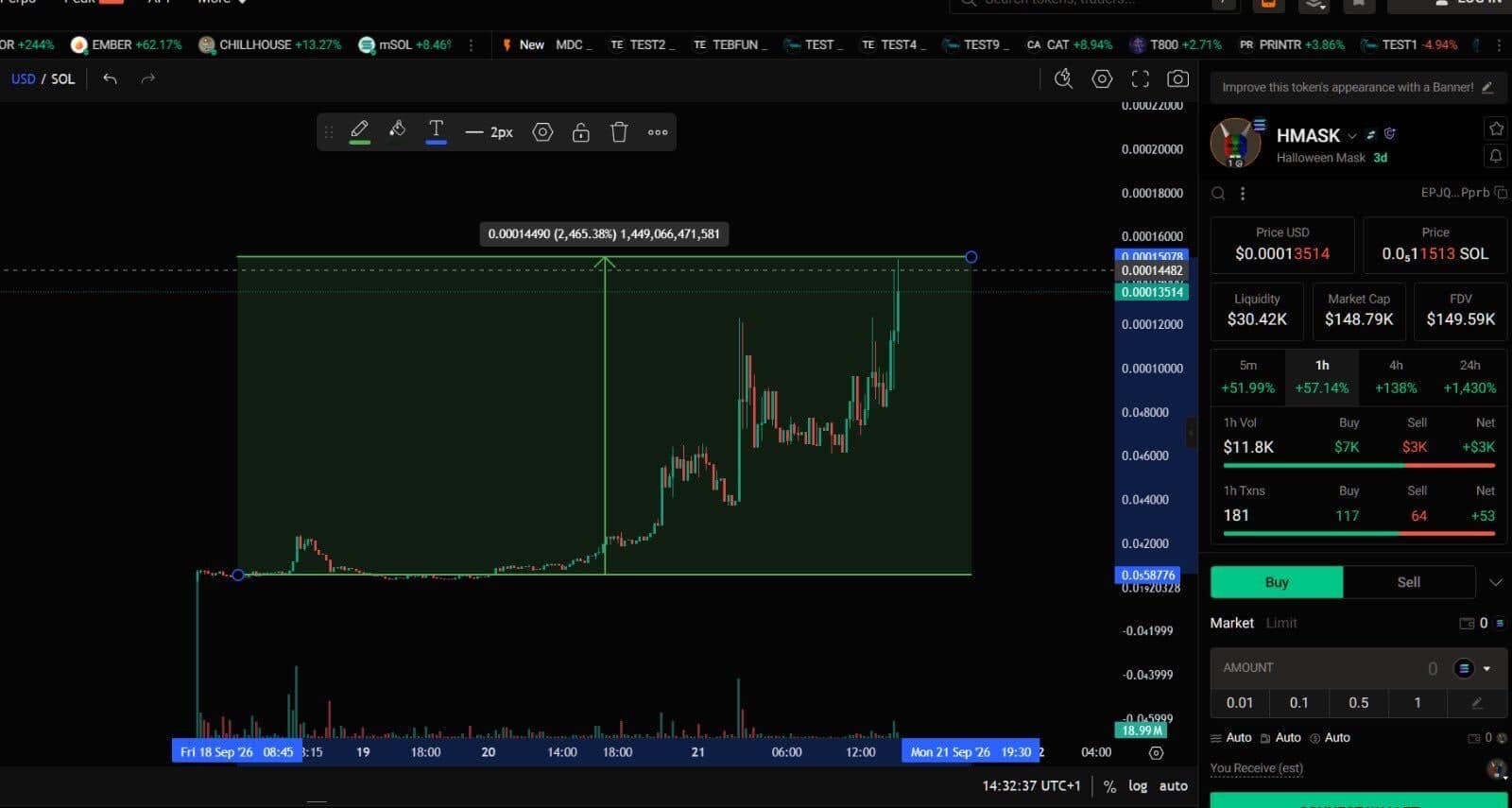
The meme coin’s recent rally is marked by soaring token holders and heavy whale investment. According to data from Birdeye, it boasts 428 holders at press time, an impressive figure for a relatively new token.
A breakout above its current level could pave the way for new highs. A rejection could result in more downside volatility, which could offer a better entry point for sidelined investors.
Unsurprisingly, prominent analysts are optimistic about its prospects. Popular Discord analyst Jacob Bury projects that the meme coin could be a top project to watch in 2026, considering its relatively small market cap.
All eyes will also be on Bitcoin, which has already crossed the $87k level and is targeting $90k. In the event that it sustains its bullish trajectory, there is a strong possibility that Halloween Mask will hit the $500k market cap milestone before the end of September.
What this means is that new buyers at today’s price would see 8x returns on their investments, which underscores its attractiveness to whales and retailers alike.
Is HMASK the Best Crypto to Buy Now?
Given Halloween Mask’s potential for growth in terms of value, it could be listed as the best crypto to buy now, particularly for short-term returns.
Smart money investors could also bet on other high-potential low-caps, out of which Bitcoin Hyper stands out.
A high-performance Layer-2 network, this project seeks to tackle the network congestion issues on Bitcoin without sacrificing security.
So far, it has raised nearly $35 million in its ICO, thanks to continuous investments from both short and long-term investors.
Crypto experts believe it is highly undervalued during its presale and could offer substantial returns when it eventually arrives on exchanges.
Join Our Telegram channel to stay up to date on breaking news coverage

Strategy has spent $174 million repurchasing STRC preferred shares and $75.7 million buying Bitcoin, directing 2.3 times more cash toward its stock buyback even as it resumed BTC accumulation.
Summary
- Strategy spent $174 million on STRC shares and $75.7 million on 950 BTC.
- The company used existing cash while making no sales through its stock offering programs.
- Bitcoin holdings reached 846,000 BTC, acquired for a combined $63.80 billion.
- Strategy also paid $57.4 million in preferred dividends and debt interest.
Strategy divides $307.1 million among three uses
Strategy’s Sep. 21 Form 8-K, filed with the U.S. Securities and Exchange Commission, showed that the company deployed $307.1 million across Bitcoin, preferred-share repurchases, dividends and interest between Sep. 14 and Sep. 20.
Of that amount, $174 million went toward repurchasing STRC shares, while $75.7 million funded the purchase of 950 BTC. Another $57.4 million came from the company’s USD Reserve to cover preferred-stock dividends and interest on outstanding debt.
The transactions mean nearly 57% of the disclosed weekly spending went to STRC repurchases. Bitcoin accounted for about 25%, while dividends and interest represented the remaining 19%.
Strategy bought 1,751,480 STRC shares during the period at an average price of approximately $99.34 each. The variable-rate Series A perpetual Stretch preferred stock carries a $100 stated amount and trades on the Nasdaq Global Select Market.
After the latest transactions, $876 million remained available under the company’s digital credit securities repurchase program. Strategy also retained its separate authorization to repurchase up to $1 billion of MSTR common stock.
The company made no sales through its MSTR, STRF, STRC, STRK, or STRD at-the-market offering programs during the week. As a result, it financed both the Bitcoin acquisition and STRC buyback with existing cash rather than proceeds from newly issued shares.
STRC remains the larger cash commitment
Strategy has continued buying back STRC after spending $139.3 million on 1,420,467 shares between Sep. 8 and Sep. 13. The company paid an average of about $98.06 per share during that earlier period, according to its previous SEC filing.
Combined, the two latest weekly disclosures show $313.3 million spent repurchasing STRC shares. Bitcoin purchases over the same two periods totaled $75.7 million because the company made no BTC transactions during the first week.
As previously reported by crypto.news, Strategy entered the latest reporting period after two weeks without buying or selling Bitcoin or issuing shares. Instead, the company had used cash to reduce the amount of STRC outstanding.
The latest filing changes part of that position because Bitcoin purchases have resumed. STRC, however, continued to receive more than twice as much cash as BTC during the reporting week.
Strategy’s February financing plans presented preferred stock as a way to raise money for additional Bitcoin purchases while offering a dividend-based product to investors. The company’s preferred-stock funding plan added another financing route beyond common-stock sales and convertible debt.
Its more recent filings show cash moving in the opposite direction through STRC repurchases. Each share bought back reduces the amount of preferred stock on which Strategy may need to pay future dividends.
The company’s SEC filings identify STRC as variable-rate perpetual preferred stock. Because the security has no maturity date, its dividend obligation can continue for as long as the shares remain outstanding, subject to the terms of the offering.
Strategy buys 950 Bitcoin without issuing shares
Alongside the STRC transaction, Strategy acquired 950 BTC for $75.7 million, including fees and expenses. The average purchase price was $79,670 per coin.
The acquisition lifted its Bitcoin holdings from 845,050 BTC to 846,000 BTC. Strategy reported an aggregate acquisition cost of $63.80 billion and an average purchase price of approximately $75,416 per BTC.
Bitcoin’s price recovery placed the latest acquisition above the company’s total cost basis but below BTC’s subsequent market price. Bitcoin traded above $85,000 during Monday trading after rebounding from lows near $75,000 earlier in September.
At $85,000 per coin, Strategy’s 846,000 BTC would carry a market value of about $71.91 billion. The position’s value changes with Bitcoin’s market price and does not represent realized proceeds.
Before the latest transaction, Strategy last purchased Bitcoin on Aug. 31. The company acquired 4,603 BTC for approximately $370 million at an average price of $80,318, ending a buying pause that had lasted about ten weeks.
The company has also sold Bitcoin during 2026 under a capital plan that allows BTC to be used for funding obligations and managing liquidity. During the week ending Aug. 3, Strategy sold 1,638 BTC for $104.73 million while raising $290.6 million through MSTR sales and repurchasing $81.2 million of STRC.
That earlier Bitcoin sale lowered its holdings to 842,138 BTC at the time. Purchases made since then have taken the position to a new disclosed total of 846,000 BTC.
Strategy’s cash balances fall after weekly spending
Following the Bitcoin and STRC purchases, Strategy’s USD Cash balance declined from $1.30 billion on Sep. 13 to $1.05 billion on Sep. 20. The approximately $250 million reduction corresponds with the $174 million STRC repurchase and $75.7 million Bitcoin acquisition.
Its separate USD Reserve fell from $5.10 billion to $5.04 billion after the company used $57.4 million for dividends and interest. Strategy maintains the reserve to support payments on its preferred stock and outstanding debt.
USD Cash serves a different role under the company’s capital framework. Management may use it to acquire Bitcoin, add money to the USD Reserve, repurchase securities, or cover other corporate purposes.
For U.S. investors, the weekly filing separates the financial exposure carried by Strategy’s Nasdaq-listed securities. MSTR holders own common equity, while STRC and the company’s other preferred shares carry their own dividend rates, payment terms, and positions within the capital structure.
The filing lists MSTR, STRC, STRF, STRK and STRD as securities registered under Section 12(b) of the Securities Exchange Act. All five classes trade on the Nasdaq Global Select Market.
The Zcash Foundation has denied any connection to two third-party products, ZRC-20 and the CASH token, after a post published through its X account described them as additions to the Zcash network.
Summary
- The Zcash Foundation says ZRC-20 and CASH have no official connection to the organization.
- ZRC-20’s draft specification relies on shielded memos and off-chain indexers.
- The proposed standard requires no Zcash protocol change or formal ZIP approval.
- U.S. investors must distinguish third-party tokens from products endorsed by a network’s developers.
Zcash Foundation says it had no prior knowledge
The Zcash Foundation said in a statement that it had not known about the ZRC-20 project or the related CASH token before the matter emerged publicly. According to the organization, both products come from an independent third party and are not official parts of the Zcash protocol.
The clarification followed an X post published through the Foundation’s account that announced a token standard for Zcash. The post said ZRC-20 would soon allow users to deploy, mint, and transfer tokens on the privacy-focused blockchain, with CASH presented as the first token using the system.
“Zcash now has a token standard,” the post said before directing users to the project’s website.
In its later response, however, the Foundation rejected any association with the products and urged users to conduct their own research before interacting with them. The statement identified ZRC-20 as a privately developed system rather than a feature created, approved, or operated by the nonprofit.
No public explanation has established how promotional material for an unrelated project appeared through the Foundation’s account. Without confirmation from the organization, the incident cannot be described as an account compromise or hack.
Public information about the team operating ZRC-20 also remains limited. The project has released technical documentation and promotional pages, but the reviewed material does not clearly identify a company, legal entity, or group of named developers responsible for the system.
ZRC-20 uses Zcash memos without changing its protocol
According to the project’s technical documentation, ZRC-20 is a draft fungible-token specification that stores JSON instructions inside encrypted memo fields attached to shielded Zcash outputs. Independent indexers would read the instructions in block order and calculate token balances outside the Zcash consensus system.
The documents describe three operations: deploy, mint, and transfer. A deployment would create a ticker and set its maximum supply, minting would issue units up to that limit, and transfers would move balances between accounts recognized by the indexer.
ZRC-20 borrows its basic structure from Bitcoin’s BRC-20 format, but the proposed data carrier differs. BRC-20 records token instructions through Bitcoin inscriptions, while the ZRC-20 draft would place them in the 512-byte memo field available in shielded Zcash outputs.
The specification states that ZRC-20 is not a consensus change and does not require smart contracts. Zcash nodes would neither validate nor reject its token instructions because the indexer, rather than the blockchain protocol, would maintain the balance sheet.
As a result, Zcash consensus would only confirm the underlying transactions. Recognition of CASH balances would depend on software following the third party’s indexing and validation rules.
The project also would not provide automatic privacy for publicly traded tokens. According to its documentation, an indexer needs access to the memos before it can calculate balances. One proposed design sends operations to a common protocol address and publishes its incoming viewing key, allowing indexers to decrypt the token instructions even though other parts of the transaction remain shielded.
Ownership would rely on signatures embedded in each payload because a Zcash shielded address does not publicly reveal who created an output. The draft proposes separate account identifiers and Ed25519 signatures to authorize minting and transfers at the indexing layer.
Several features remain unresolved. The documentation lists atomic trading, payloads exceeding 512 bytes, structured memos, and possible naming conflicts among its open questions. Early exchanges would also need to be custodial because the draft does not contain an atomic trading method comparable with tools used by some Bitcoin markets.
Official Zcash changes follow a separate process
The official Zcash Improvement Proposal system provides the established route for proposing protocol features, publishing implementation details, gathering community feedback, and recording design decisions. ZRC-20 does not appear as an adopted protocol feature under that process.
A third-party application can use Zcash transactions without gaining approval from the Foundation or becoming part of the network’s consensus rules. The Foundation’s statement makes that distinction central to the dispute: ZRC-20 may attempt to build on Zcash infrastructure, but its use of the blockchain does not make it an official Zcash token standard.
The name carries another source of possible confusion. ZetaChain already uses ZRC-20 for its omnichain fungible-token format, while members of the Zcash community discussed the same label years earlier when considering how token functionality could increase activity involving ZEC.
Recent Zcash development has instead centered on formal network changes. Planned NU7 proposals have included reducing the block target from 75 seconds to 25 seconds while adjusting block rewards to retain the existing issuance schedule. Unlike the independent token system, such protocol changes require coordination among network developers, node operators and other participants.
U.S. token buyers face separate issuer questions
For U.S. users, a third party’s use of an established blockchain does not settle how regulators may treat its token offering or sale. The legal assessment can depend on how the asset is issued, marketed and sold, rather than whether the underlying network’s foundation endorsed it.
In August, the U.S. Securities and Exchange Commission proposed crypto-asset rules covering certain investment contracts involving digital assets. The proposal included possible exemptions for offerings of up to $5 million over four years and up to $75 million during a 12-month period, subject to the proposed conditions.
The SEC proposal does not classify CASH or determine its status under U.S. law. It does, however, make the identity of a token’s operator, the terms of its distribution, and the claims made to purchasers relevant details for American participants reviewing a new launch.
The Foundation’s warning also arrived while ZEC was experiencing large price swings. As crypto.news reported on Sep. 7, ZEC gained about 43% during the first week of September and traded near $1,197 after breaking above $1,000.
By Sep. 14, the privacy coin had retreated toward $1,139 after touching a multi-year high near $1,290. Futures open interest fell by about 20% over 24 hours during the pullback, while roughly $17.2 million in long positions were liquidated.
ZEC then rose more than 20% to approximately $1,337 on Sep. 16, having reached an intraday high near $1,385. The move followed renewed attention on the NU7 vote and came as traders monitored resistance around $1,375 and $1,500.

Bitcoin Core developers have moved version 32.0 into release-candidate testing, with the stable software scheduled for a possible Oct. 10 release after weeks of public checks.
Summary
- Bitcoin Core 32 entered release-candidate testing on Sep. 14 following an August feature freeze.
- Parallel database reads could reduce block-validation times without changing Bitcoin’s block production rate.
- Four wallet commands will use PSBT version 2 by default while retaining the older format.
- Security fixes address unsafe wallet names and unauthenticated HTTP requests that caused heavy memory use.
Bitcoin Core 32 targets an Oct. 10 release
Bitcoin Core’s official release schedule shows that developers created the version 32 branch and started the release-candidate cycle on Sep. 14. The first candidate, known as v32.0rc1, is now available for testing before developers decide whether to tag the stable release.
The project set Oct. 10 as the intended date for version 32.0, though the schedule describes it as a target rather than a confirmed deadline. Problems found during candidate testing could require additional releases and delay the final version.
Preparations began months earlier. Developers opened translations and introduced a soft freeze on translation changes on Aug. 6, followed by a feature freeze on Aug. 20. From that date, the version 32 branch accepted bug fixes but no new features ahead of final testing.
When the branch separated from the main codebase on Sep. 14, development of Bitcoin Core 33 also began on the main branch. The split allows contributors to test and repair the upcoming release without stopping work on the next version.
Release candidates give node operators, wallet developers and other users time to find bugs under different hardware and software conditions. Bitcoin Core’s testing process covers functions including block validation, peer-to-peer communication, wallet operations and remote procedure calls used by applications connected to a node.
Parallel database reads speed up block checks
One of the main performance changes allows Bitcoin Core to read data from its database in parallel while checking blocks. The method can shorten validation time because the software no longer has to complete every relevant database read one after another.
Faster validation does not mean Bitcoin will produce blocks more quickly. Miners still compete to add blocks under Bitcoin’s proof-of-work rules, which target an average interval of roughly 10 minutes. Version 32 changes how a node processes required information rather than the network’s issuance schedule or block timing.
The distinction matters because Bitcoin Core is node software, not a centrally managed update to the Bitcoin network. Operators decide which version to install, and the release does not automatically replace the software running on every node.
Version 32 also does not introduce a new consensus rule or require a soft fork. Its release process differs from protocol changes that need coordination among miners, node operators, and other network participants.
As previously reported by crypto.news, LayerTwo Labs CEO Paul Sztorc said every proposed Bitcoin soft fork since Taproot has failed to activate. BIP-110, a disputed proposal linked to transaction-relay policy, received 2.53% miner support before its enforcing branch stalled after two blocks.
Bitcoin Core 32 can therefore improve software performance without depending on the activation process required for a consensus change. Node operators remain free to test the candidate, continue using an older release, or install the stable version after publication.
Wallet commands adopt the newer PSBT format
Wallet functions account for another set of changes in version 32. Four commands will create partially signed Bitcoin transactions using PSBT version 2 by default, according to details shared by Bitcoin News.
A PSBT lets separate wallets, devices, or participants exchange the information needed to build and sign a Bitcoin transaction without exposing private keys. The format is commonly used with hardware wallets, offline signing setups, and transactions that require more than one signature.
PSBT version 2 changes how transaction information is organized and permits participants to update parts of a transaction without first creating a complete unsigned transaction. The older PSBT format will remain available when users or connected applications require it.
Keeping both versions reduces the chance of abruptly breaking wallets and services that have not adopted the newer format. Developers integrating Bitcoin Core with other software will still need to check whether their systems expect the previous default.
For individual holders, the change does not alter Bitcoin balances, private keys or the rules governing valid transactions. Its practical effect falls on wallet workflows and applications that call the affected commands.
Security fixes reduce command and memory risks
Version 32 also includes a patch for custom wallet names that could cause commands to run on non-Windows nodes. The issue concerned how specially constructed names interacted with command execution, rather than a change to Bitcoin’s underlying cryptography.
A separate fix addresses memory growth caused by unauthenticated HTTP activity. In one test cited by Bitcoin News, memory use reached about 3.2 gigabytes before the patch, compared with roughly 3 megabytes after developers applied the change.
Remote interfaces allow other programs to communicate with Bitcoin Core, making memory controls relevant to operators who expose node services to connected applications. Access settings, firewalls and authentication remain separate parts of securing a deployment.
For U.S. users, the candidate is most relevant to node operators, wallet providers, exchanges, miners and infrastructure companies that run Bitcoin Core in their systems. The release does not change the SEC’s treatment of spot Bitcoin exchange-traded products, investor tax rules or the legal status of BTC.
American financial firms have also increased their support for Bitcoin’s open-source security work. In July, Anchorage Digital, ARK Invest, BlackRock, Block, Blockstream, Coinbase, Fidelity Digital Assets, Galaxy and Strategy formed the Bitcoin Security Consortium with $15 million in pledges over three years.
According to the consortium’s announcement, each member will direct its funding independently rather than placing the money in a shared pool. The group said it will not control Bitcoin development, take positions on specific protocol proposals or speak for the project’s contributors.
Mike Schmidt, executive director of Bitcoin developer-funding nonprofit Brink, coordinates the consortium’s daily work in a volunteer role. Its initial focus is research into long-term security issues, including protections against future quantum-computing risks.

Crypto-backed super PAC Fairshake has prepared an expenditure of at least $30 million to oppose former Sen. Sherrod Brown’s return to the U.S. Senate following the failure of the CLARITY Act.
Summary
- Fairshake reportedly plans its largest expenditure of the 2026 election cycle against Brown.
- Brown is challenging Republican Sen. Jon Husted in Ohio’s November special election.
- Brown previously chaired the Senate Banking Committee and opposed several crypto-backed proposals.
- Fairshake and its affiliates had accumulated more than $193 million by January.
Fairshake prepares its largest 2026 expenditure
Eleanor Terrett, host of Crypto in America, reported on X that Fairshake plans to spend at least $30 million against Brown, citing an initial report from The New York Times and confirmation from a spokesperson for the political action committee.
If completed, the allocation would become Fairshake’s largest expenditure during the current election cycle. The decision arrived after the Senate rejected a procedural motion on the Digital Asset Market Clarity Act, an industry-backed bill intended to divide federal oversight of digital assets between the Securities and Exchange Commission and the Commodity Futures Trading Commission.
Brown is seeking an Ohio Senate seat in a special election against Republican Sen. Jon Husted. Describing the campaign as a re-election bid would be inaccurate because Brown lost his former seat to Republican Bernie Moreno in November 2024.
Husted, Ohio’s former lieutenant governor, joined the Senate in January 2025 after Gov. Mike DeWine appointed him to the seat vacated by JD Vance. Vance left the chamber to serve as vice president. The winner of the November 2026 election will complete the remaining portion of Vance’s term, which runs through January 2029.
According to Reuters, election analysts moved the contest from “likely Republican” to “lean Republican” after Brown entered the race in August 2025. Brown had represented Ohio in the Senate for 18 years before Moreno defeated him 50.1% to 46.5%.
CLARITY Act defeat raises the political stakes
The proposed spending follows the failed Senate vote on Sep. 15, when the motion to begin debate on the CLARITY Act received 50 votes to 49. Advancing the measure required support from 60 senators.
Several lawmakers involved in the negotiations voted against the motion, including Democratic Sens. Ruben Gallego, Kirsten Gillibrand and Angela Alsobrooks. Republican Sens. Susan Collins, Josh Hawley, Jerry Moran and Thom Tillis also withheld support.
Disagreements over presidential ethics, stablecoin rewards, protections for decentralized software developers and state authority prevented senators from reaching a final deal. Democrats had sought tighter limits on crypto businesses connected to President Donald Trump and his family, while banking groups pressed lawmakers to restrict rewards offered through stablecoin products.
A revised version would have assigned the CFTC authority over qualifying digital commodities and registered spot-market intermediaries. The SEC would have retained jurisdiction over assets and transactions governed by federal securities laws.
Hours before the vote, Democrats presented a counterproposal through talks involving Senate Minority Leader Chuck Schumer’s office. Republicans rejected it, saying their 635-page bill already included 126 changes requested during bipartisan negotiations.
Fairshake had supported the legislation before the vote through a national television advertising campaign. The PAC’s move into the Ohio race places its election spending behind the same policy campaign after the bill failed to secure enough Senate support.
Public pressure had also grown before the vote. Ripple Chief Legal Officer Stuart Alderoty urged undecided senators to speak with individual token holders, while a National Cryptocurrency Association survey estimated that 67 million Americans owned cryptocurrency in 2026.
Brown’s possible Banking Committee return concerns Fairshake
Brown’s record on the Senate Banking Committee has made his comeback bid important to the crypto industry. As committee chairman from 2021 until January 2025, he raised concerns about illicit finance, money laundering and consumer risks linked to digital assets.
Politico reported in August 2025 that Brown had blocked or resisted several Republican proposals supported by crypto companies while leading the committee. Fairshake spokesperson Josh Vlasto responded at the time by promising continued spending against candidates the group considered hostile to the sector.
“We will continue to support pro-crypto candidates and oppose anti crypto candidates, in Ohio and nationwide.”
A Brown victory would not automatically return him to the chairmanship or make him the committee’s senior Democrat. Senate Democratic rules generally treat service as interrupted when a former member leaves the chamber and later returns, meaning Brown would not necessarily retain the seniority accumulated during his previous 18 years.
Democratic leaders could change their caucus rules or grant Brown an exception, according to Politico. Control of the committee would also depend on whether Democrats win enough seats to take the Senate majority.
Husted has supported legislation favored by the crypto industry since entering the chamber. Politico reported that he backed relevant measures on the Senate floor and supported the sector’s policy goals while serving as Ohio lieutenant governor, although he had not made digital assets a central issue during his early months in Congress.
Crypto PAC enters an expensive Ohio contest
Fairshake has enough available funding to make the reported $30 million commitment. Axios reported in January that Fairshake and its affiliated committees had accumulated more than $193 million for the 2026 midterm elections, almost $60 million above the network’s total spending during the 2024 cycle.
Coinbase and Ripple each contributed another $25 million, while venture capital firm a16z supplied $24 million, according to Axios. Fairshake operates alongside two affiliated groups: Protect Progress, which participates in Democratic races, and Defend American Jobs, which focuses on Republican contests.
The network supports candidates from both parties based on their positions on digital-asset policy. Federal rules allow super PACs to raise and spend unlimited amounts, but they cannot coordinate expenditures directly with candidates or their campaign committees.
Ohio has already drawn heavy outside spending. Reuters reported on Sep. 18 that approximately $298 million in advertising had been spent or reserved for the race, placing it among the most expensive Senate contests of 2026.
Recent surveys cited by Reuters placed Brown three to five percentage points ahead of Husted. Brown’s campaign had raised $38.6 million, compared with $14.3 million for Husted, while Republican organizations launched a separate $14 million advertising campaign supporting the incumbent.
Fairshake previously made Ohio its most expensive target. During the 2024 election, the network spent more than $40 million supporting Moreno against Brown, exceeding its spending in every other race it entered. Moreno defeated Brown by about 207,000 votes and later joined the Senate Banking Committee.
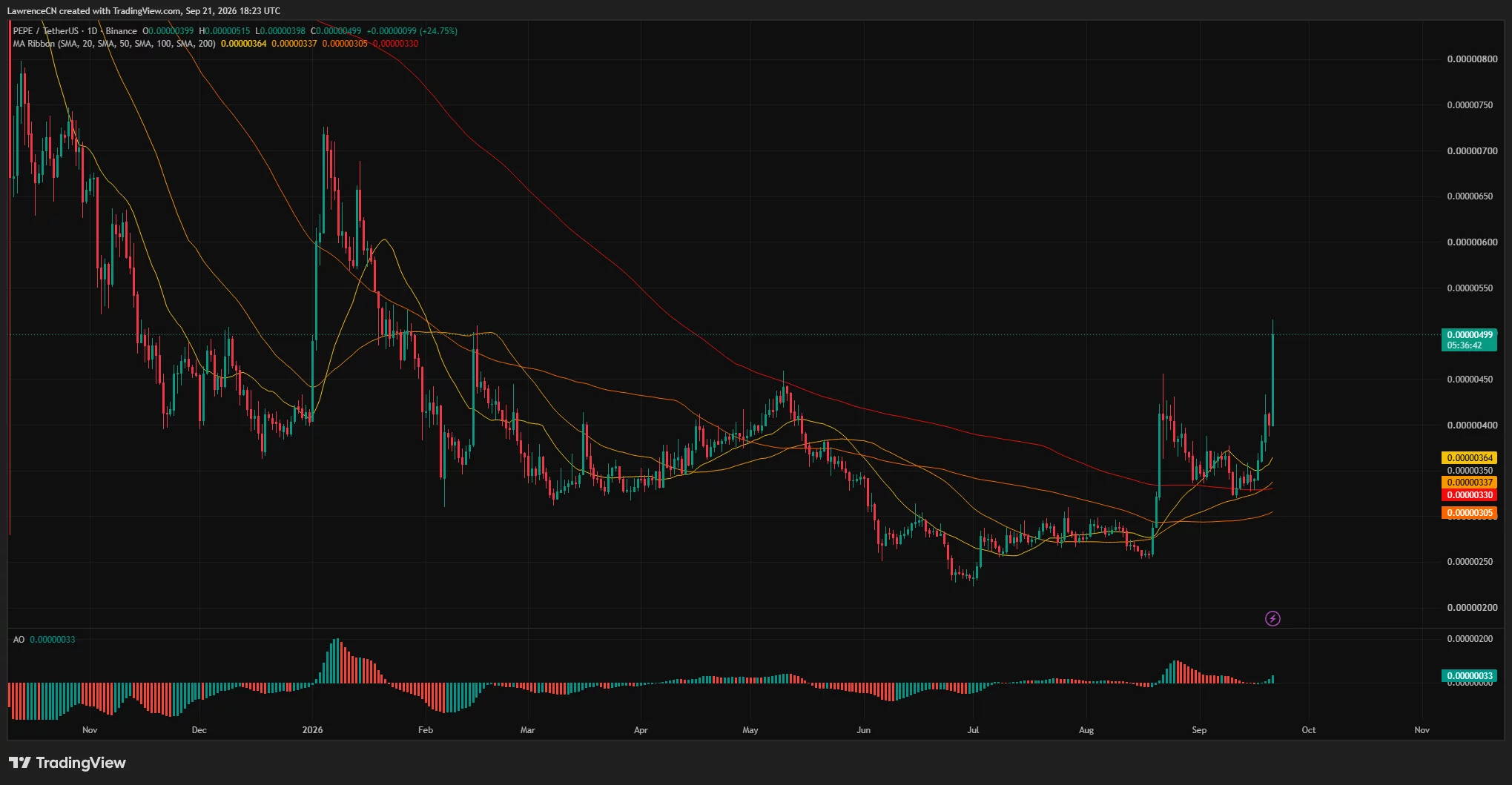
Pepe price surged nearly 25% on Sep. 21 as the meme coin cleared a major resistance level, although an overbought 4-hour reading raises the risk of a short-term pullback.
Summary
- PEPE price rose 24.75% on the daily chart and traded near $0.00000499.
- Price broke above $0.00000458, a level identified as a key structural barrier.
- The 4-hour RSI reached 82, placing PEPE deep in overbought territory.
- Liquidation data show large leverage clusters below the market near $0.00000360.
According to data from crypto.news, Pepe (PEPE) price traded around $0.00000499 at the time of writing after reaching an intraday high of $0.00000515. The rally lifted the meme coin by 24.75% during the daily session and extended its seven-day gain to nearly 40%, according to CoinGecko.
The token’s market capitalization climbed above $2 billion, while its 24-hour trading volume approached $900 million.
PEPE’s advance came alongside a wider crypto rally led by Bitcoin, which crossed $85,000 for the first time in eight months. Bitcoin exchange-traded funds operated by firms including BlackRock and Fidelity received about $433 million on Friday, according to JPMorgan data cited by the Wall Street Journal.
Broader demand for risk assets helped PEPE accelerate beyond the gradual recovery visible earlier in the week. However, its latest technical readings suggest that buyers may struggle to maintain the same pace without a period of consolidation.
Pepe price clears its major moving averages
The daily PEPE/USDT chart shows that the token has moved above its 20-day, 50-day, 100-day and 200-day simple moving averages.
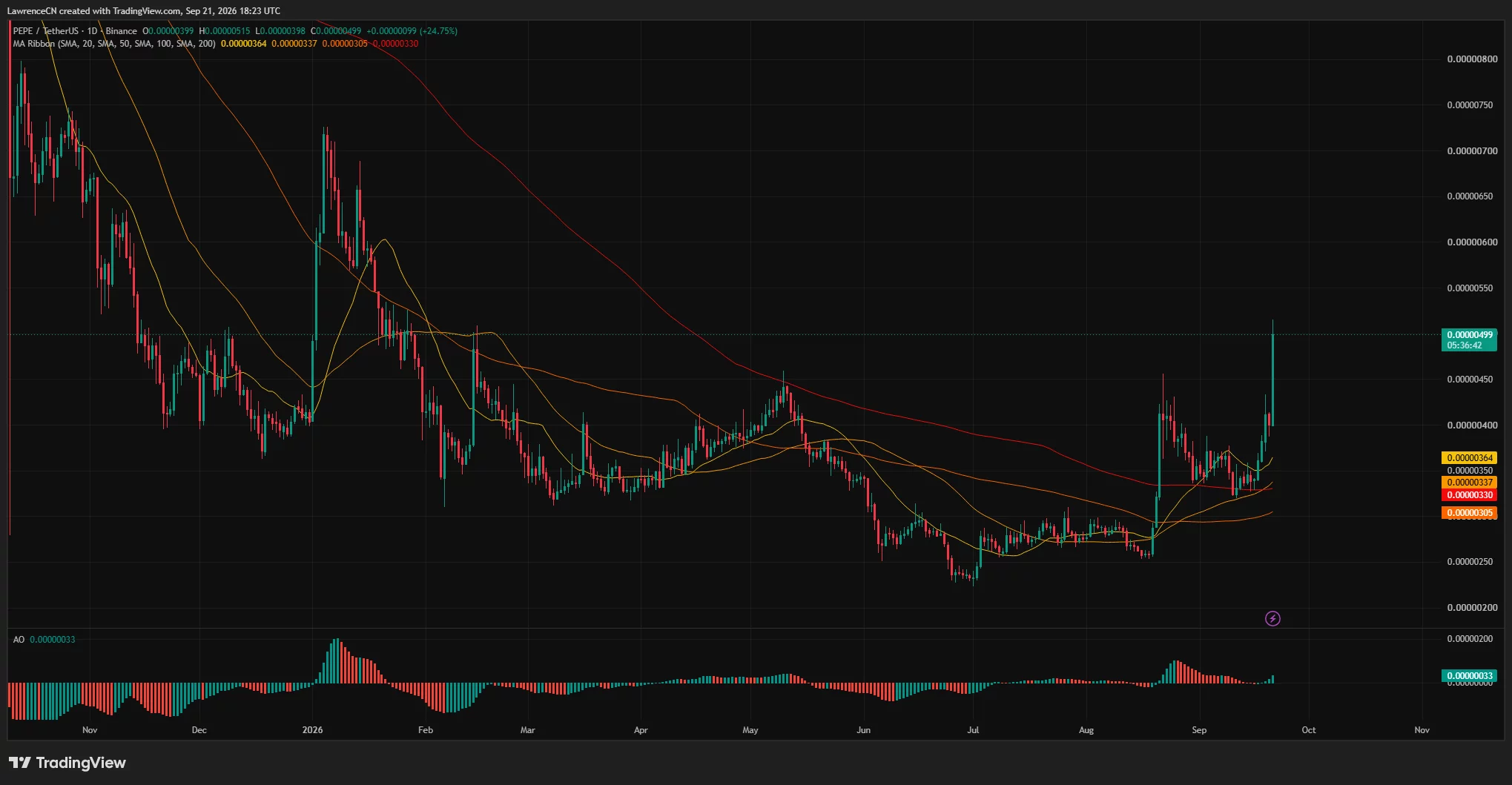
PEPE’s 20-day SMA stood near $0.00000364, while the 50-day and 100-day averages were located around $0.00000337 and $0.00000330, respectively. The 200-day SMA remained lower at approximately $0.00000305.
Trading above all four averages marks a sharp change from the bearish structure that controlled the market during the first half of 2026. Price had fallen from above $0.000007 in late 2025 to a June low near $0.00000220 before forming a base.
The daily Awesome Oscillator also moved into positive territory at approximately 0.00000033. A positive reading means short-term momentum is stronger than longer-term momentum, supporting the current bullish setup.
The next technical test sits between $0.00000515 and $0.00000550. PEPE briefly touched the lower end of that area during the rally but had not produced a confirmed daily close above it at the time the chart was captured.
4-hour RSI warns of an overheated rally
Shorter-term readings show greater pullback risk after the rapid price increase.
The 4-hour Relative Strength Index rose to 82.05, well above the 70 level commonly used to identify overbought conditions. Its RSI-based moving average stood at 70.13, confirming that momentum accelerated sharply during the breakout.
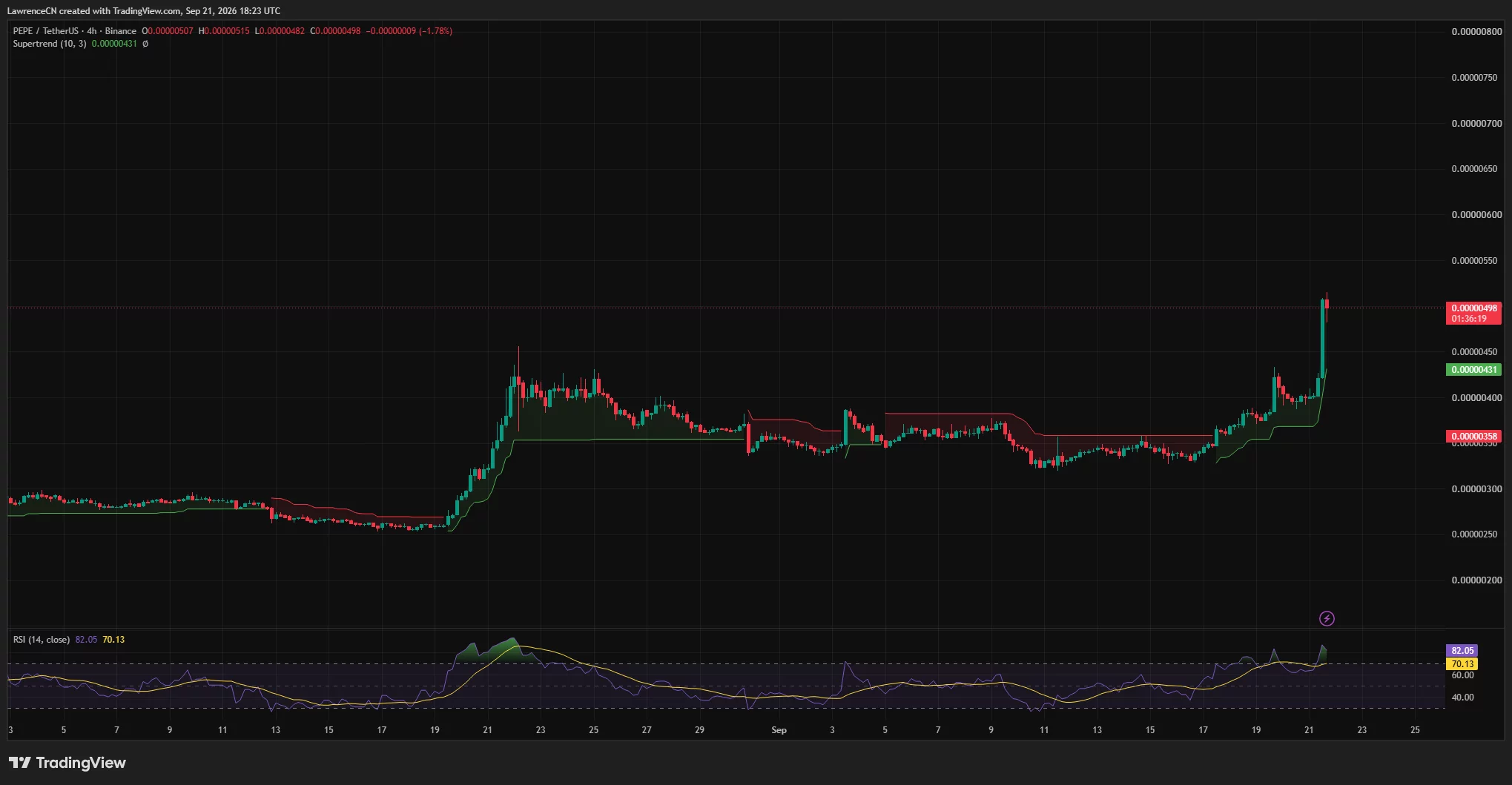
An overbought RSI does not guarantee an immediate fall, but it can indicate that buyers have already committed substantial capital over a short period. PEPE’s latest 4-hour candle had declined 1.78% from its opening price after reaching $0.00000515, showing early profit-taking near the session high.
The 4-hour Supertrend remained bullish, with its support line near $0.00000431. Holding above that level would preserve the current short-term trend and could allow buyers to retest $0.00000515.
A drop below $0.00000431 would weaken the breakout and expose the former resistance area around $0.00000400. Deeper support sits near the 20-day moving average at $0.00000364.
PEPE liquidation clusters increase pullback risk
CoinGlass’s one-week liquidation heatmap shows that PEPE’s rally moved through several concentrations of leveraged positions between $0.00000410 and $0.00000450.
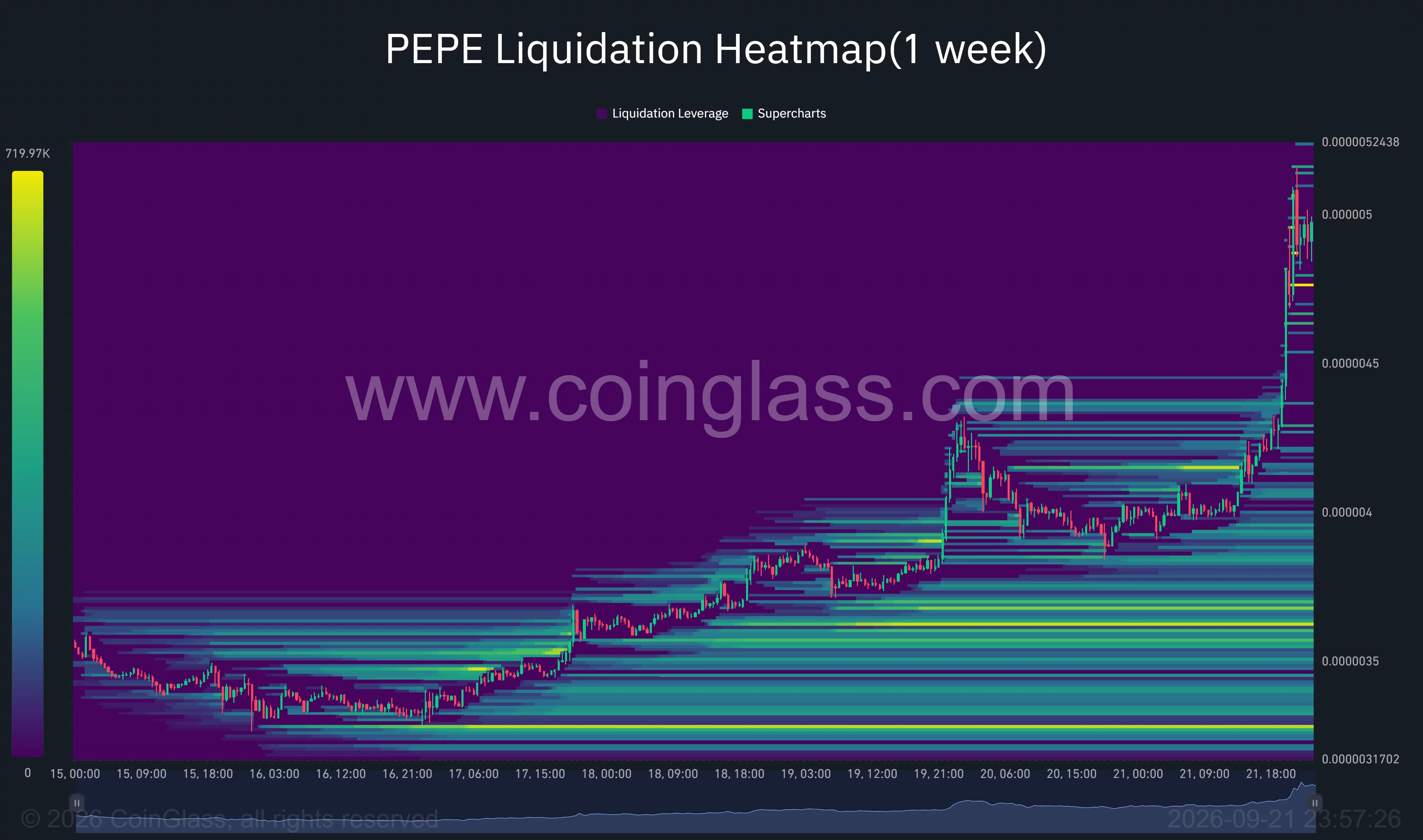
The largest remaining liquidity concentrations appear below the current price. Dense bands are visible around $0.00000355–$0.00000370, with another strong cluster near $0.00000320.
Liquidation heatmaps show where leveraged positions could face forced closure if the market reaches certain prices. They do not establish that price must move toward those zones, but concentrated leverage can add volatility when a reversal begins.
Smaller clusters also sit above PEPE near $0.00000510–$0.00000524. A renewed move through the intraday high could force additional short liquidations and extend the rally before the market tests higher resistance.
PEPE breakout puts $0.00001 back in focus
Crypto analyst Crypto Patel said PEPE has risen about 97% from a higher-time-frame accumulation zone between $0.00000200 and $0.00000270.
“The accumulation move is already underway. The next trigger is the breakout.”
Patel identified $0.000004583 as the level PEPE needed to reclaim and convert from resistance into support. The market has now traded above that threshold, but a daily close and successful retest would provide stronger confirmation than the initial intraday break.
The analyst listed $0.000010, $0.0000,16 and $0.000027 as possible longer-term targets if PEPE also breaks its higher-time-frame downtrend. Those levels remain projections rather than confirmed destinations, with the first target requiring the token to roughly double from its current price.
PEPE’s immediate outlook depends on whether buyers can defend $0.00000458 after the 25% daily advance. Holding that level would keep $0.00000515 and $0.00000550 in view, while losing it could send the token toward Supertrend support at $0.00000431 or the larger liquidation zone near $0.00000360.
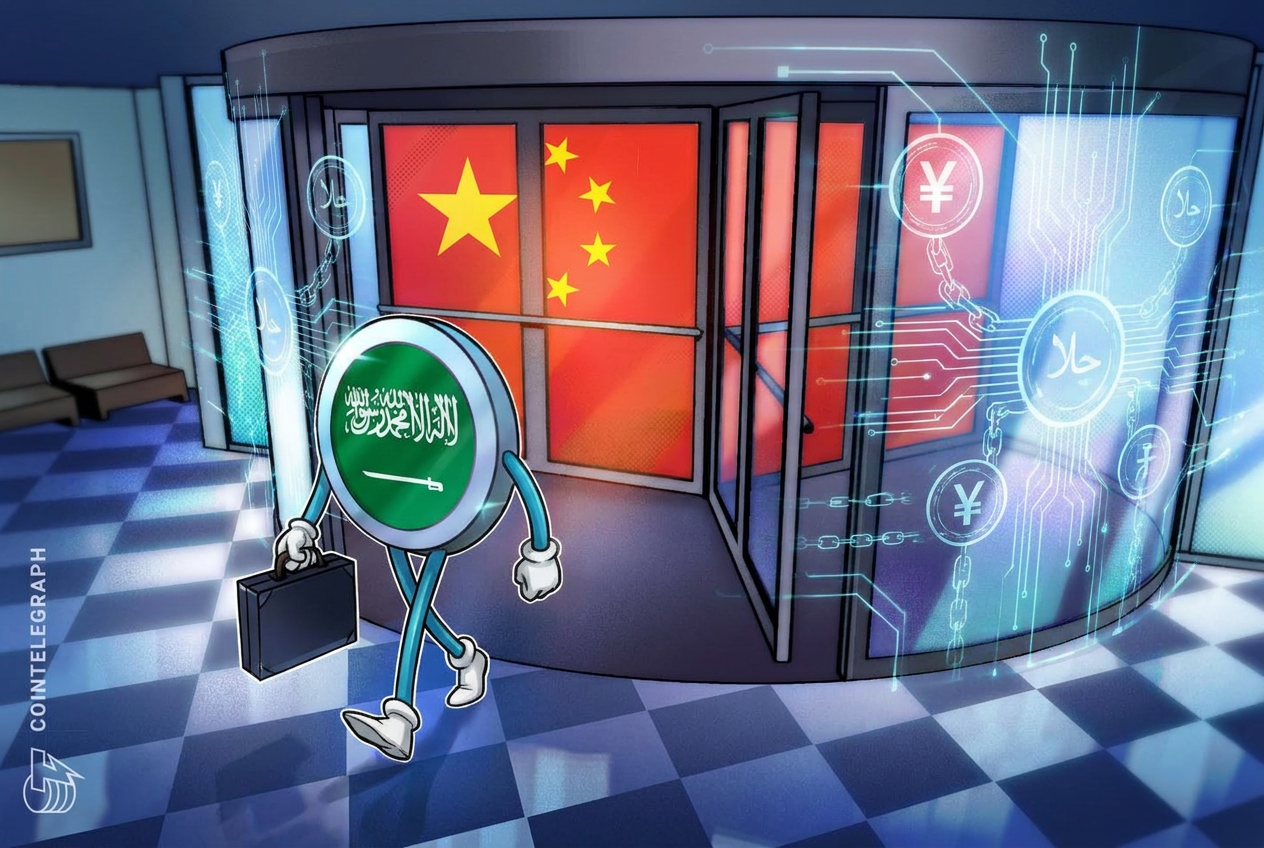
Saudi Arabia has withdrawn from mBridge, a China-backed cross-border digital currency project designed to enable direct transactions between central banks, according to the Financial Times.
SAMA, Saudi Arabia’s central bank, joined mBridge as a full participant in June 2024 and ended its participation after completing a proof of concept on May 13, 2025, FT reported, citing a statement from the central bank. SAMA said it had planned to end its participation.
MBridge was established in 2021 through a collaboration between the Bank for International Settlements (BIS) Innovation Hub and the central banks of China, Hong Kong, Thailand and the United Arab Emirates, with the aim of making cross-border payments faster and cheaper.
Rather than using a single stablecoin, the platform allows participating central banks to issue and transact in their own digital currencies on a shared ledger, including for cross-border payments and foreign exchange transactions.
The project continued to develop under the BIS until October 2024, when the organization handed it over to the participating central banks after mBridge reached its minimum viable product stage. Then-BIS General Manager Agustín Carstens said the BIS departure was not politically motivated.
The project has nevertheless drawn scrutiny from US policymakers. A 2024 report from the US-China Economic and Security Review Commission said mBridge could eventually provide an alternative cross-border settlement system for countries seeking to evade US sanctions.
Cointelegraph contacted the Saudi Central Bank for comment but did not receive a response by the time of publication.
Related: Chinese newspaper warns of Bitcoin extortion scam using its name
China weighs digital currencies’ role in cross-border payments
China’s central bank, meanwhile, has increasingly focused on the role stablecoins could play in cross-border payments as their use expands globally.
In June, People’s Bank of China Research Bureau director General Wang Xin called for closer monitoring of stablecoins and central bank digital currencies in cross-border payments, along with greater international coordination.
His comments came months after Chinese authorities restricted the unauthorized issuance of renminbi-pegged stablecoins and tokenized real-world assets, including by foreign entities.
Magazine: Who needs CLARITY anyway? ARB could see 70X increase: Hodler’s Digest
The SEC has opened a five-year route for tokenized U.S. stock trading, but TD Cowen has found that domestic investors, institutions, and listed companies show little appetite for the products.
Summary
- TD Cowen expects limited adoption among U.S. retail and institutional investors.
- Figure recorded 99.9% of examined trading through its conventional Nasdaq-listed shares.
- SEC relief requires stock tokens to preserve economic, dividend, voting, and liquidation rights.
- Nvidia perpetual futures generated 96% of related notional volume in a Binance snapshot.
TD Cowen said U.S. investors already have efficient access to listed shares, leaving tokenized venues under pressure to offer benefits that outweigh thin liquidity and added operational work.
Reid Noch, vice president of U.S. equity market structure at TD Cowen, wrote in a Friday paper that both retail and institutional demand will likely remain limited during the market’s early stage.
“U.S. investors already have efficient access to the underlying shares,” Noch wrote, adding that tokenized platforms need a compelling benefit to offset their operational complexity and restricted liquidity.
The assessment followed the U.S. Securities and Exchange Commission’s five-year tokenized stock exemption, announced on Sep. 17. The conditional relief lets qualifying Tokenized Securities Venues use permissioned automated market makers and liquidity pools to trade tokenized National Market System stocks.
Eligible liquidity providers can also receive temporary relief from certain dealer-registration requirements. Each participating venue remains subject to limits on the number of stocks it supports and the trading volume processed through the system.
Tokenized stocks must compete with efficient U.S. markets
For American investors, TD Cowen’s concern centers on whether tokenization improves a market that already offers deep liquidity, low-cost brokerage services and fast electronic execution.
Blockchain-based venues could extend stock trading into nights, weekends and holidays. Their automated market makers, or AMMs, would price transactions through asset pools and preset rules instead of matching buyers and sellers in a conventional order book.
In practice, Noch warned that continuous access does not guarantee favorable execution. A pool with limited assets may produce weaker prices, especially when fewer traders and liquidity providers are active outside the main U.S. session.
AMM pricing also places more weight on the amount and composition of assets deposited in each pool. Although a venue may remain technically open around the clock, TD Cowen’s analysis indicates that investors could still prefer established exchanges if the onchain market offers less liquidity or higher trading costs.
U.S. exchanges generally operate their main sessions between 9:30 a.m. and 4 p.m. Eastern Time on weekdays. Several brokers already provide premarket and after-hours access, reducing the value that some domestic traders may place on a separate blockchain venue.
The SEC has attached investor protections to its experiment. Approved tokens must represent NMS stocks and preserve the economic interest, dividends, voting power, and liquidation rights associated with the underlying shares.
Synthetic products that merely follow a company’s stock price do not qualify. As previously covered by crypto.news, the agency’s investor-rights requirements separate qualifying stock tokens from offshore products that may offer economic exposure without making the buyer a shareholder.
Issuer objections could restrict tokenized stock listings
Before a third party tokenizes a company’s shares, the SEC framework requires the proposed venue to notify the issuer. The company then has 30 days to object, according to the TD Cowen paper.
Listed businesses therefore retain some control over whether unrelated operators create blockchain versions of their securities. Trading cannot proceed under the exemption when an issuer objects.
According to Noch, discussions with dozens of issuers found little interest in offering tokenized shares. The group included several companies with large retail investor bases, although crypto-linked businesses such as Figure showed more interest.
“Our conversations with dozens of issuers” revealed minimal demand outside crypto-adjacent companies, Noch wrote.
Figure provides an existing comparison between traditional and blockchain-based shares. Its Nasdaq-listed FIGR stock trades alongside blockchain-native FGRS shares carrying the same economic exposure and voting rights.
During the 24-hour period studied by TD Cowen, conventional FIGR shares accounted for 99.9% of the company’s notional trading. The finding suggests that equal economic and governance rights have not been enough to move meaningful activity away from the Nasdaq-listed security.
Other SEC conditions may also limit how quickly venues can add markets. Smart contracts must be public and auditable, while operators must disclose trading activity, related-party transactions, and key details about their systems.
A venue must also halt a tokenized stock whenever the primary exchange stops trading the underlying shares. As a result, round-the-clock availability would not override an official halt related to volatility, company news or a regulatory issue.
In early September, the SEC also proposed a transfer-agent rule overhaul covering digital ownership records, cybersecurity, asset protection and third-party technology providers. Transfer agents maintain the official shareholder register used for voting, dividends, stock splits and other corporate actions, making their records important when a token claims to represent legal ownership.
Stock perpetuals show stronger demand than tokenized shares
For crypto traders seeking exposure to public companies, TD Cowen found more activity in perpetual futures than in spot stock tokens.
A snapshot of Nvidia-related trading on Binance showed that perpetual futures generated 96% of notional volume, while spot products accounted for 4%. Perpetuals track the price of an asset without transferring ownership of the referenced shares.
The contracts have no fixed expiration date and use recurring funding payments to keep their prices close to the underlying stock. They may also offer leverage, which lets traders control a larger position with less capital but increases liquidation risk when prices move against them.
“As we continue to outline, we see perpetual futures as the stronger demand story,” Noch wrote.
TD Cowen expects platforms to keep adding the products inside and outside the United States, citing retail demand for leverage.
Recent filings support the comparison. On Sep. 18, Coinbase submitted proposals for 50-plus stock perpetuals tied to companies including Nvidia, Microsoft and Tesla. The exchange plans to offer 24-hour trading from Monday through Friday if U.S. regulators clear the contracts.
Coinbase’s proposed products would provide leveraged price exposure without voting rights, dividends or ownership of the referenced shares. Their listing remains subject to regulatory review, and the company has not announced a launch date or complete contract specifications.
Earlier in September, Ondo Finance also asked the SEC and Commodity Futures Trading Commission to apply existing security-futures rules to stock perpetuals. Its Panama-based affiliate had processed $8 billion in cumulative volume within about six weeks, according to Ondo’s regulatory submissions.
Ondo said the offshore platform settles contracts in stablecoins and remains unavailable to American users. Many of its perpetuals reference U.S.-listed companies, allowing eligible non-U.S. traders to follow their stock prices without opening a conventional brokerage account.
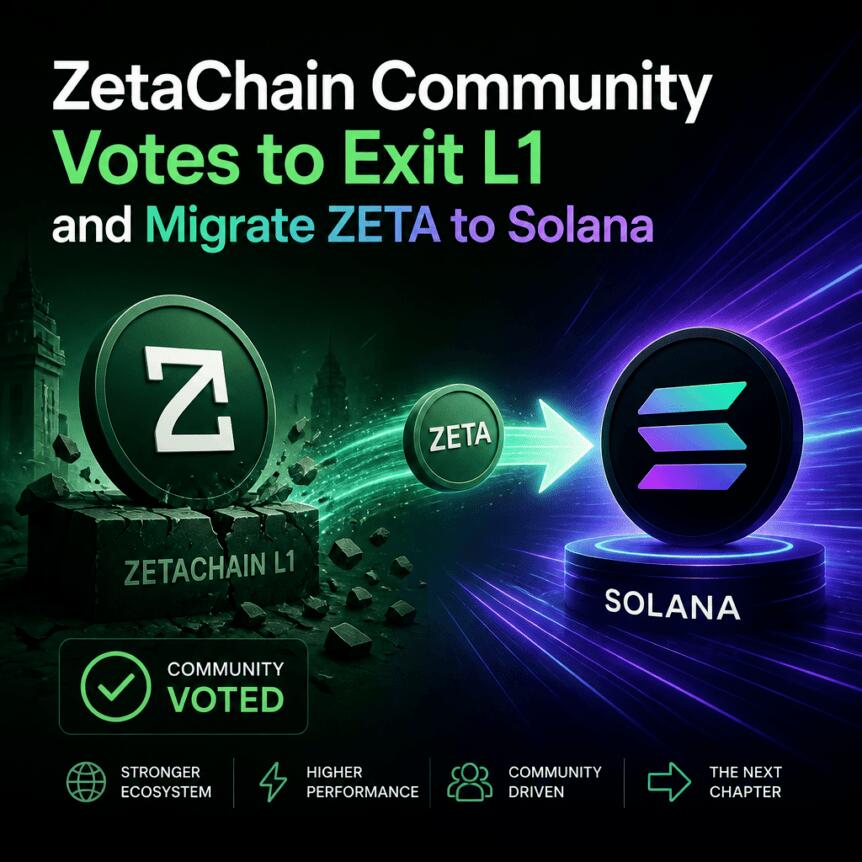
ZetaChain’s token community has voted to wind down its own layer-1 blockchain and migrate its native ZETA token to Solana. The change was approved via governance proposal 68, with 99.4% of votes supporting the plan and participation at 58%, surpassing the network’s 40% quorum requirement.
While the vote clears the way for the transition, ZetaChain said it will not immediately trigger a full shutdown or migration. A second proposal is expected to lay out the practical details—timing, asset withdrawal windows for cross-chain holdings, token snapshot mechanics, and the conversion process duration.
Key takeaways
- Governance proposal 68 passed with 99.4% approval and 58% participation, clearing the first step toward ZetaChain’s layer-1 shutdown.
- ZETA will move to Solana as an SPL token via a 1:1 conversion, keeping the same ticker and total supply.
- The initial vote does not start the shutdown immediately; a follow-up proposal will specify withdrawal and conversion windows.
- Validators are expected to remain operational during the transition, with staking rewards continuing.
- ZetaChain cites a strategic shift toward its Anuma AI application and encrypted “Private Memory Layer,” reducing the need for a standalone Cosmos SDK chain.
Governance approval clears the path to a Solana token migration
According to the terms outlined in proposal 68, ZETA will become an SPL token on Solana through a 1:1 conversion. The migration is designed to preserve continuity for tokenholders: the ticker remains ZETA and the total supply stays unchanged.
The proposal also clarifies what comes next. It does not itself dictate an immediate cessation of ZetaChain’s layer-1 operations or the start of token migration. Instead, core contributors will bring a second proposal that covers operational specifics, including how and when tokenholders can withdraw assets related to other blockchains, the snapshot block height used to determine entitlements, the shutdown timetable, and the claim and exchange conversion period.
ZetaChain also indicated that validators will continue running, and staking rewards will continue through the transition. That matters for holders who rely on staking income, because it suggests there is intended continuity rather than an abrupt end to network participation.
Why ZetaChain is winding down: focus shifts to Anuma and private AI memory
ZetaChain framed the shutdown as a strategic realignment. The project said that maintaining its own layer-1—built on the Cosmos SDK—no longer fits its current priority around Anuma, its private-focused artificial intelligence application.
In the project’s view, moving the ZETA token to Solana will let it redirect resources away from blockchain maintenance and toward Anuma and the “Private Memory Layer.” The Private Memory Layer is positioned as a way for users to carry encrypted context across AI models, which would be difficult to support without dedicated product and infrastructure investment.
For tokenholders, the core question is how the token’s role changes when the layer-1 network is retired. The proposal keeps supply and ticker consistent, but it leaves open—pending the follow-up documentation—how governance, staking, and token utility will function after migration.
A broader pattern: other crypto projects retreat from standalone chains
ZetaChain’s decision aligns with a wider trend in crypto where teams choose to shut down standalone networks and migrate tokens elsewhere. The article notes that BounceBit and Harmony have both announced plans to retire their own layer-1 infrastructure.
BounceBit reportedly decided to retire its standalone blockchain after an authorization flaw was exploited to steal approximately $3 million in BB tokens. Instead of restarting its layer-1, BounceBit migrated its token to BNB Smart Chain at a 1:1 ratio.
Harmony’s approach has also centered on a pivot away from its layer-1. Earlier coverage cited that Harmony proposed shutting down its layer-1 and migrating its ONE token to Ethereum as an ERC-20, as part of a broader pivot toward an AI video initiative. That proposal followed a period of disruption tied to an exploit that created unauthorized ONE tokens and prompted a rollback plan affecting more than 109,000 transactions.
Security history and the settlement mechanics tokenholders should watch
ZetaChain’s migration comes with additional context around security. The project previously faced a $334,000 exploit in April targeting its cross-chain gateway contract, which drained funds from ZetaChain-controlled wallets across multiple networks including Ethereum, Arbitrum, Base, and BNB Smart Chain.
After the incident, ZetaChain acknowledged that it had dismissed an earlier bug bounty report, claiming it was intended behavior. That decision triggered a review of security processes.
In this light, the operational content of the second governance proposal becomes especially important. Tokenholders and users with assets tied to cross-chain functionality will want clarity on several items that proposal 68 did not specify: the precise withdrawal window for assets connected to other blockchains, how the snapshot block height will be determined, and the mechanics and timeline for token claims and conversion to Solana.
Investors and traders will likely also pay close attention to whether the transition period maintains staking participation and rewards as promised, and whether any changes to token administration accompany the migration.
Going forward, the key thing for ZetaChain stakeholders is the follow-up proposal that defines the shutdown and claim details. Until the network publishes the timeline, snapshot parameters, and conversion window, holders should treat the Solana migration as approved in principle—but not operationally complete.

Andros Townsend: Being run over by pitch roller was ‘terrifying’

Constellation Software: Great Buying Opportunity

Coinbase opens US IPO access with Oura listing

Weekend Open Thread – Corporette.com

Weekend Open Thread: Talbots – Corporette.com

Memory prices are slowing because buyers ran out of money

OMFG MAJOR CLARITY ACT COMEBACK!!!! XRP WE’RE BACK!!!!!!!!!!!!!!!!!

Ripple XRP Is Going To $32 A Coin This Is Going To Shock The Daylights Out Of You

The UNTHINKABLE is About to Happen to the Dollar (& Why Gold and Silver are Next)
-
 Fashion3 days ago
Weekend Open Thread: Talbots – Corporette.com
-

 Tech23 hours ago
Researchers escape OpenAI Codex sandbox to run commands on host
-

 Crypto World7 days ago
Revolut Attackers Warn of Ongoing Daily Customer Data Leaks
-

 Crypto World3 days ago
Circle launches Arc Studio AI agent for building onchain apps
-

 Crypto World6 days ago
Robinhood engineers charged over $50K crypto scheme
-
 NewsBeat3 days ago
Trump says US has reached an agreement to take permanent control of Greenland’s security
-

 Crypto World7 days ago
Kraken Lets xStocks Holders Earn Yield Through DeFi
-

 Crypto World3 days ago
Bitcoin price breaks channel as RSI climbs to 63
-

 Crypto World5 days ago
US Charges Robinhood Engineers Over Crypto Listing Trades
-

 Crypto World6 days ago
What Is the Status of the U.S.-Iran Peace Talks? Here's What Both Sides Are Saying
-

 Crypto World7 days ago
NVIDIA Analysis: Attempted Rising Wedge Breakout Amid Pressure on the AI Sector
-

 Tech6 days ago
Webb’s IC 348 Mosaic Includes Two-Jupiter Dwarfs, Twin Jets, and a Nursery Still Making Worlds
-

 Crypto World3 days ago
World Money launches in 150+ countries with Stripe
-

 Crypto World23 hours ago
Who Needs CLARITY Anyway? ARB Could See 70X Increase: Hodler’s Digest
-

 Crypto World3 days ago
Silver prices recover quickly, hitting weekly high today
-

 Crypto World3 days ago
Trading Bitcoin on Robinhood? Why 2% Spread Has Traders Worried
-
Crypto World7 days ago
Can Circle’s Arc Repeat Robinhood Chain’s Meme Coin Boom?
-

 Entertainment6 days ago
Big Brother Update: Melody Explodes at Drew as Illness Sweeps BB28 House
-
 NewsBeat3 days ago
US was ‘on brink of war’ with China over false AI report of nukes moving in Middle East
-

 Crypto World7 days ago
DOJ Seeks to Seize $61M in Iran Oil Funds From Binance Accounts It Vouched For
You must be logged in to post a comment Login