

Crypto World
Bitcoin price outlook amid 9-day streak of ETF outflows



- Bitcoin held near $73,000 but risks crashing lower as risks linger.
- Spot Bitcoin ETFs saw net outflows of $229 million for a nine-day negative streak.
- On-chain metrics show whale balances flat for months, signaling reduced accumulation.
Bitcoin traded near $73,200 on Thursday after failing to sustain a rebound amid broader cryptocurrency selling.
While BTC struggled, US stock futures edged slightly higher following reports of a potential US-Iran agreement to reopen the Strait of Hormuz, easing some geopolitical risk and supporting broader risk assets outside the crypto market.
Bitcoin’s ETF outflows extend negative streak
Spot Bitcoin exchange-traded funds continued to see withdrawals, extending a record nine-day streak of net outflows.
US spot Bitcoin ETFs recorded net redemptions of $229 million on May 28, bringing weekly net outflows to roughly $1.3 billion.
According to SoSoValue data, this would mark the third consecutive week of capital leaving BTC investment products.
Notably, the sustained outflows have coincided with price pressure on Bitcoin, undermining short-term liquidity and market sentiment.
On-chain analytics add further nuance to the picture. CryptoQuant data indicates that major Bitcoin holders have halted accumulation.
Dolphin balances, representing mid-sized holders, have printed successive lower highs since September 2025, while whale balances have remained largely flat since February 2026.
Historically, when both cohorts simultaneously pause or reduce accumulation, the market often experiences prolonged weakness as demand at higher price levels fades.
What next for Bitcoin price?
Analysts continue pointing to a mix of technical, options-market, and on-chain signals to assess Bitcoin’s near-term direction.
Glassnode observed that Bitcoin recently retested the $75,000 “strike,” a high gamma zone where options positioning can amplify price moves. This contributed to the pullback below $73,000, with BTC briefly falling near $72,500.
According to Greeks.live, the selloff occurred ahead of a major options expiry.
May 29 Options Expiration Data
84,000 BTC options expired, with a put-call ratio of 0.88, a maxpain point of $75,000, and a notional value of $6.2 billion.
639,000 ETH options expired, with a put-call ratio of 0.81, a maxpain point of $2,200, and a notional value of $1.28… pic.twitter.com/NNnFMy3tgx— Greeks.live (@GreeksLive) May 29, 2026
Analysts continue pointing to a mix of technical, options-market, and on-chain signals to assess Bitcoin’s near-term direction.
Glassnode observed that Bitcoin recently retested the $75,000 “strike,” a high gamma zone where options positioning can amplify price moves. This contributed to the pullback below $73,000, with BTC briefly falling near $72,500.
According to Greeks.live, the selloff occurred ahead of a major options expiry.
The on-chain analytics provider noted that the decline failed to fully extend after at-the-money implied volatility (ATM IV) briefly spiked during the drop, while longer-dated implied volatilities eased. This suggests many market participants still view the move as contained rather than the beginning of a broader structural trend reversal.
Despite this, risks remain asymmetric. Options markets continue implying the potential for larger moves than spot markets have so far produced, leaving room for renewed volatility around expiries and macroeconomic developments.
“The market’s next focus is on whether capital will flow back in, and whether BTC can reclaim $75,000 and ETH can retake $2,100. The settlement appears more like a “bearish unwinding”—large positions have expired—but the fact that both BTC and ETH are trading below their key resistance levels indicates that the dominant force this week has not been chasing rallies, but rather risk aversion and a retreat by longs. The market’s bullish sentiment is currently very fragile,” analysts at Greeks.live noted.
Technically, analysts have identified $70,000 as a key downside level.

A break below that zone could trigger deeper weakness and accelerate outflows. Meanwhile, a sustained recovery above $80,000 would likely signal renewed conviction and could attract fresh inflows into both spot products and derivatives markets.


On May 29, the world’s largest corporate holder of Bitcoin Strategy transferred 411.48 BTC, worth over $30 million, to Coinbase Prime, a move that immediately drew attention across the crypto community as traders tried to read the intent from the on-chain activity.
The timing was especially hard to ignore considering that on Polymarket, the probability that Strategy will sell some of its Bitcoin before December 31, 2026 has now hit 84%.
What the Transfer Could Mean
Depositing BTC to an exchange does not automatically mean that the holder is looking to sell. This was noted by pseudonymous crypto analyst COINBOY, who pointed out that funds moved to Coinbase Prime could be for OTC trading, collateral arrangement, or institutional fund management rather than outright liquidation. Keep that distinction in mind before reading too much into a single on-chain transaction.
However, what gave Strategy’s move more weight is the context around it, with the company’s Executive Chairman Michael Saylor recently declining to rule out selling some BTC before year-end, a notable departure from the hold-at-all-cost image he’s spent years building.
That change in mindset was revealed on Strategy’s Q1 2026 earnings call, where the firm reported $12.5 billion in net losses for the period. During the call, Saylor suggested that the company could liquidate part of its BTC stash to pay dividends, a position that was defended by Bitcoin maximalist Samson Mow, who said that the “never sell” mantra long associated with Saylor should not be taken as some kind of corporate oath but as guidance for individual holders, since any BTC treasury company that completely rules out selling would be handing a roadmap to short sellers that could hurt it.
There’s also the question of what Strategy did earlier this week when, instead of buying more Bitcoin as is the tradition, it repurchased approximately $1.5 billion of its own 0% convertible senior notes that were due in 2029. Analyst Darkfost framed the move as a balance sheet cleanup rather than the company rethinking its BTC plan, although Saylor himself had once again hinted in an interview that one of the options Strategy had considered to fund the repurchase was Bitcoin sales.
Interestingly, hours before on-chain tracking platform Lookonchain reported on Strategy’s 411 BTC deposit on Coinbase Prime, the executive posted a one-word tweet on X that simply read, “HODL.”
Where Bitcoin Stands
While speculation about Strategy’s intention was running rife, BTC itself was being buffeted by geopolitical developments, with the OG cryptocurrency losing more than $2,000 from its value after hostilities between the USA and Iran resumed. That session was quite rough, as it saw crypto markets shed over $100 million in total capitalization, with liquidations across derivatives topping $1 billion.
Today, at the time of writing, BTC was about $300 short of $74,000, having dipped by almost 5% in 7 days and nearly the same percentage in the last month. For Strategy, whose 843,738 BTC were purchased at around $75,700 per coin, the current price range puts its overall position modestly in the red on paper.
The post Strategy Moves $30 Million in BTC to Coinbase Amid Sell Speculation appeared first on CryptoPotato.
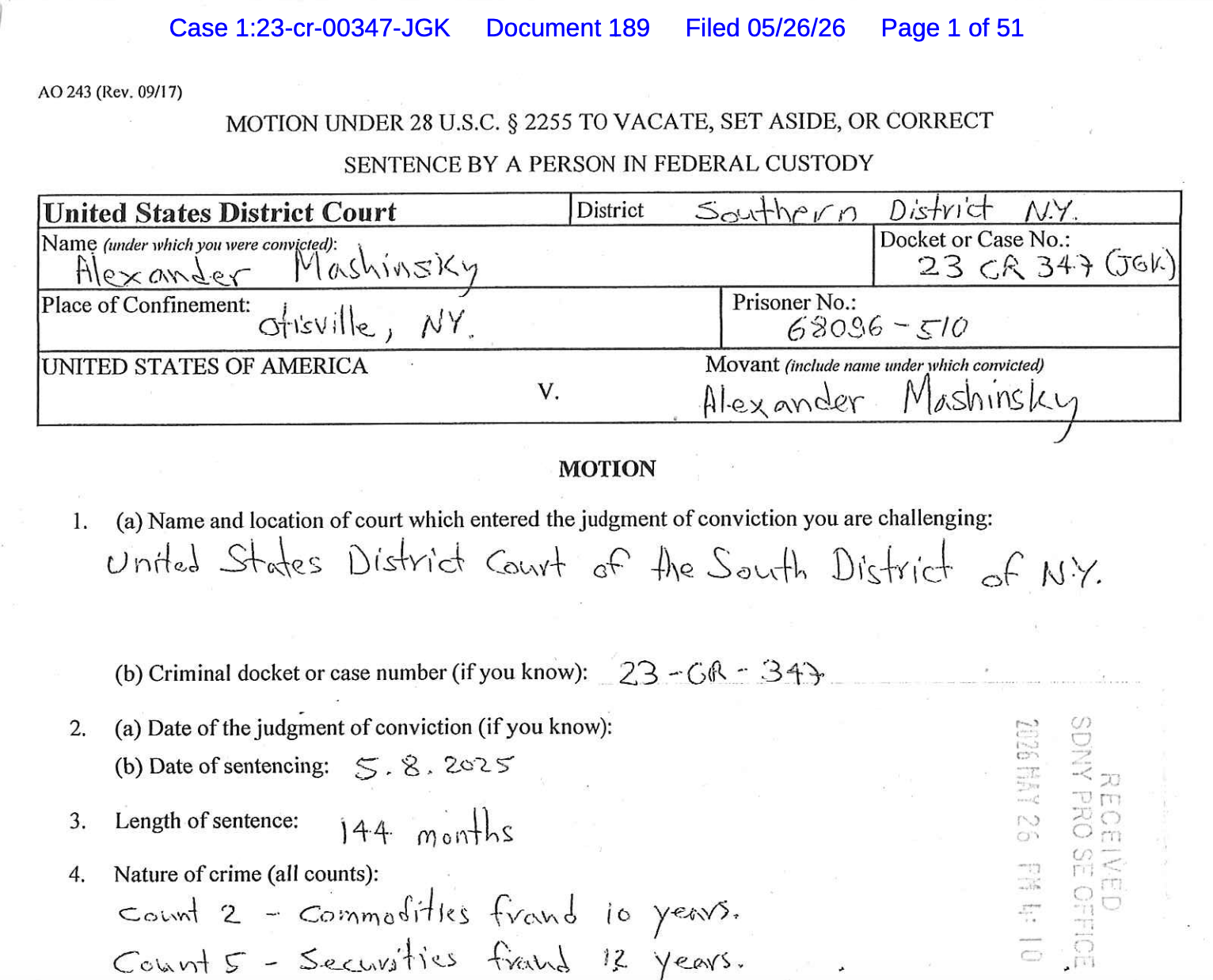
Alex Mashinsky, the former CEO of defunct cryptocurrency lending platform Celsius, has filed a motion in a New York court to vacate his 12-year sentence for fraud and market manipulation.
In a Tuesday filing in the US District Court for the Southern District of New York, Mashinsky filed a motion to vacate his 144-month sentence, set by Judge John Koeltl in May 2025. The former Celsius CEO filed the paperwork without additional counsel, having announced on May 5 that he would be proceeding pro se in his case.
Although Mashinsky pleaded guilty to commodities fraud and securities fraud related to “manipulative and deceptive devices,” he filed a motion to vacate on the grounds that he had ineffective counsel and “fruit of [the] poisinous [sic] tree,” a legal doctrine referring to evidence tainted by authorities’ misconduct.
“I did not discharge my counsel at this time but they stopped communication with me so I had no choice but to file my reply directly with the court,” said Mashinsky.
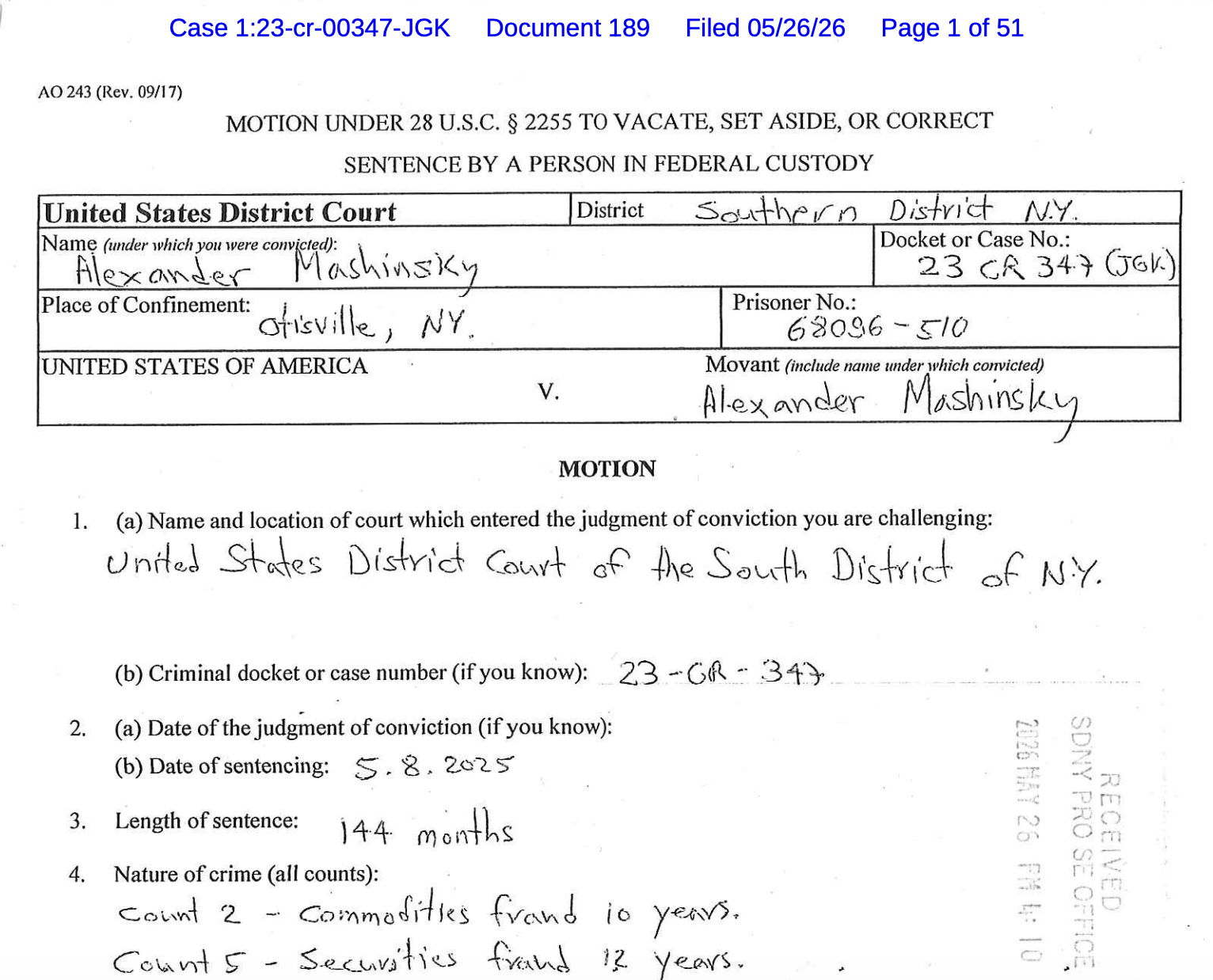
Source: Courtlistener
In documents attached to his motion to vacate, Mashinsky said former FTX CEO Sam Bankman-Fried intended to “destroy Celsius,” blaming him for much of the market manipulation of the network’s CEL tokens on the crypto exchange. He asked that the judge deny any FTX trust request, and provided text messages with Celsius’ former chief revenue officer Roni Cohen-Pavon, claiming he had attempted a “hostile takeover” of the platform.
Celsius filed for bankruptcy in 2022 amid a market downturn that saw the collapse of many crypto exchanges, including FTX. US authorities indicted Mashinsky and Cohen-Pavon in July 2023 on charges related to fraud and market manipulation, with both men later pleading guilty.
Related: Acting AG Todd Blanche confirms ‘code is not a crime’ in DOJ pivot
Cohen-Pavon was sentenced to time served after pleading guilty in September 2023, with prosecutors citing his “substantial assistance” to the government, including being prepared to testify against Mashinsky. His sentencing followed the court officially closing the criminal cases against the Celsius executives.

Alex Mashinsky at the Bitcoin 2021 conference in Miami. Source: Cointelegraph
Financial penalties against Celsius execs
Although the court may still consider Mashinsky’s motion to vacate, the former CEO was already ordered to pay $48 million as part of a forfeiture in his criminal case settled in 2025. He also agreed to pay $10 million as part of a settlement with the US Federal Trade Commission in a mostly suspended $4.72 billion monetary judgment.
Cohen-Pavon, sentenced to time served, agreed to pay more than $1 million and a $40,000 fine.
Magazine: HYPE chases $100 target, ETH could dump below $1800: Market Moves


U.S. Treasury Secretary Scott Bessent announced today that America has now seized a cumulative total of approximately $1 billion in Iranian cryptocurrency assets under its escalating sanctions campaign.
Cumulative Total Hits $1 Billion
The figure represents the running total seized to date, not a single new action announced today.
It builds on earlier milestones, including a major April 2026 freeze of $344 million in USDT on the Tron blockchain.
Bessent had previously reported nearly $500 million in late April, with today’s update reflecting additional freezes accumulated since then.
Operation Economic Fury Accelerates
Launched in March 2025, Operation Economic Fury targets Iran’s sanctions-evasion networks. Iran has relied on stablecoins, particularly USDT on Tron, to move funds for oil sales and IRGC operations.
The U.S. works with issuers like Tether and blockchain analytics firms to identify and immobilize wallets.
Bessent noted Iran previously moved $400–500 million per month through crypto channels before intensified pressure.
Assets are held “on behalf of the Iranian people” and some face claims from terrorism victims.
Expect continued OFAC wallet designations and potential forfeitures in coming months. Iran’s economy already grapples with rial devaluation, banking strains, and reduced oil revenue.
This cumulative milestone marks a significant escalation in financial warfare, showing how traceable blockchain activity can be weaponized against sanctions evasion.
The post US Reaches $1 Billion Seized Iran Crypto to Date: Bessent’s Big Update appeared first on BeInCrypto.

The Sui layer-1 blockchain experienced another disruption on Friday, causing a “network stall” that temporarily halted block production, before normal activity resumed, according to the Sui team.
Network activity “may be paused,” the Sui team said. The network disruption lasted for over three hours and 30 minutes at the time of publication, according to the Sui network’s uptime dashboard.

Sui’s mainnet validators experienced disruptions on both Thursday and Friday. Source: Sui
The last block before the disruption was produced at about 11:51 UTC on Friday, according to the Suiscan block explorer. Network activity on the Sui mainnet resumed at about 3:30 UTC. The Sui team said in an update:
“Both today’s and yesterday’s halts are due to the interaction of the 1.72 release, which introduced address balances and gas charging logic. Yesterday’s implemented fix was an interim measure designed to restore functionality to the network.”
The interim fix had a “low probability” of causing a network disruption, and the long-term software fix has now been implemented by a majority of Sui validators.
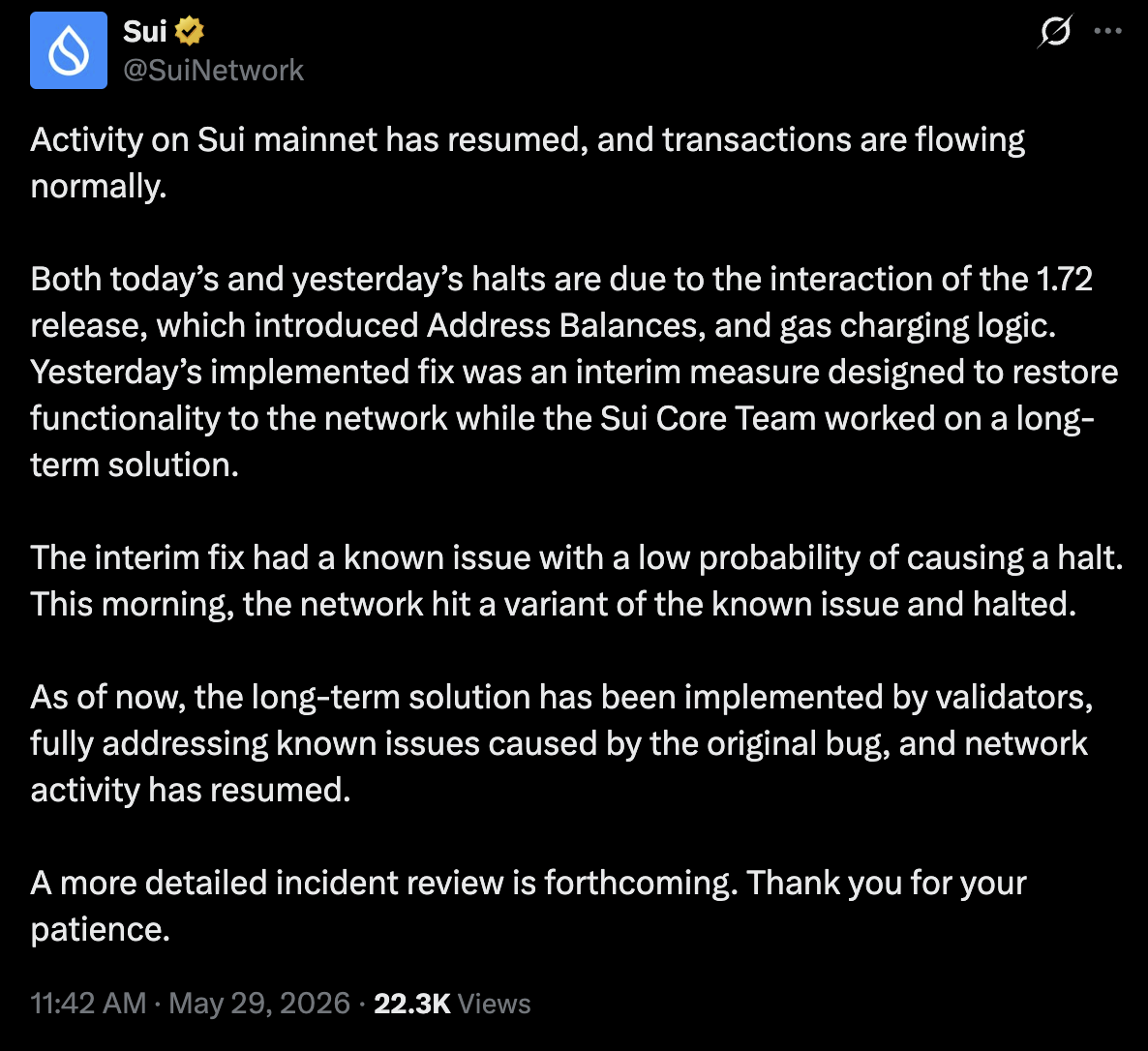
Source: Sui
The incident follows several major disruptions and network outages, including Thursday’s outage, which caused a nearly six-hour outage due to a “crash bug in the gas charging logic,” according to the team. The crash was the second major network disruption in 2026.
Related: SUI spikes 50% amid staking moves, zero-fee stablecoins, privacy push
The Sui network went down in January due to a consensus bug
In January, the network went offline for over six hours, halting block production due to a consensus bug. Validators submitted conflicting transactions to the protocol’s checkpoint mechanism, and the network was unable to reach the necessary threshold for consensus, according to the post-mortem report.
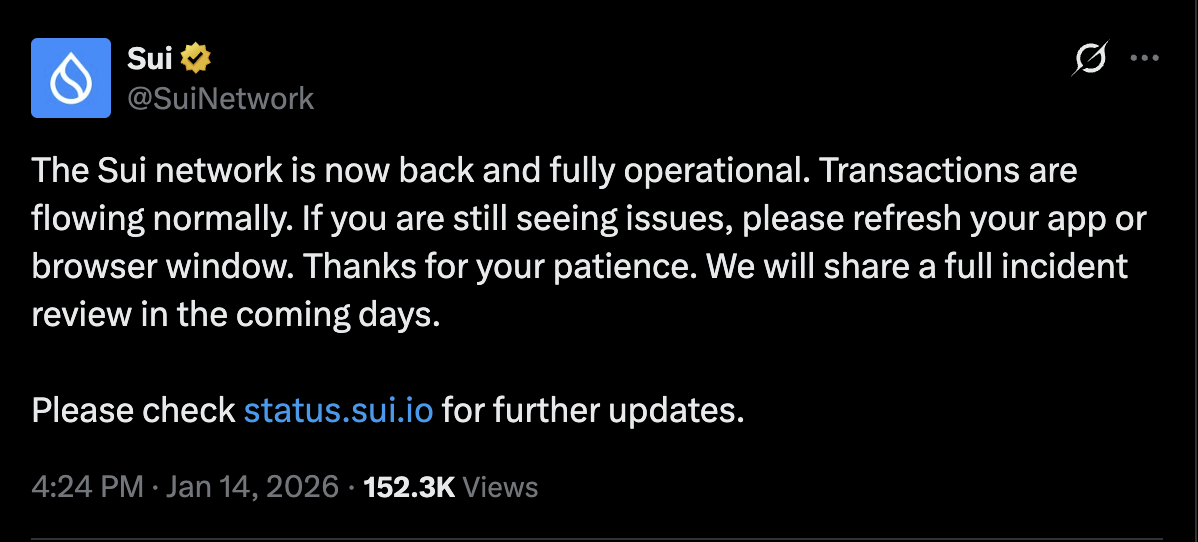
Source: Sui
January’s disruption was not caused by network congestion, user funds were “never at risk,” and no “certified transactions” were rolled back, the Sui team said at the time.
“The issue was detected and contained by Sui’s checkpoint certification and quarantine mechanisms, which prevented any user-visible fork at the cost of halting progress,” according to the post-mortem report.
High-throughput smart contract blockchain networks feature several layers, including data availability, transaction execution and validator consensus, which introduce more potential points of failure.
However, network outages in crypto also impact centralized service providers, including exchanges, which have fewer coordination challenges than decentralized blockchain networks.
In May, crypto exchange Coinbase suffered a temporary service disruption due to an Amazon Web Services (AWS) outage, forcing it to switch markets to an “auction” mode before restoring full service.
Magazine: AI-driven hacks could kill DeFi — unless projects act now


JPMorgan Chase CEO Jamie Dimon has said banks will oppose the Clarity Act unless lawmakers change provisions that he says give crypto firms bank-like powers without bank-level safeguards.
Summary
- Jamie Dimon said banks will oppose the Clarity Act unless lawmakers add stronger safeguards for stablecoin rewards.
- Dimon argued that crypto firms should not offer bank-like products without AML and Bank Secrecy Act protections.
- SoFi’s stablecoin launch shows how digital tokens and traditional deposit products are starting to overlap.
Fox Business reported that Dimon made the comments on Friday during an interview focused on pending legislation on crypto market structure. The JPMorgan chief said the bill, as written, would allow crypto companies to offer rewards tied to stablecoins or similar products without protections attached to traditional banking.
Dimon says banks reject the current crypto bill
According to Jamie Dimon, the Clarity Act does not go far enough on legal protections, anti-money laundering rules, and Bank Secrecy Act requirements. He said banks would not accept the legislation in its current form because it creates risks around products that resemble deposits.
The dispute has pitted banks and crypto companies against each other in one of Washington’s most closely watched digital asset debates. Banks argue that stablecoin rewards could pull customer money away from regulated deposits. Crypto firms, including Coinbase, have pushed back against restrictions that would limit customer incentives on dollar-linked tokens.
Dimon told Fox Business that firms offering products with deposit-like features should face rules comparable to banks. He said the government must handle stablecoin regulation carefully because poor design could create serious problems later.
Coinbase lobbying draws sharp attack
During the same interview, Jamie Dimon criticized Coinbase CEO Brian Armstrong over the exchange’s political spending. Dimon claimed Armstrong has spent hundreds of millions of dollars in Washington to help move the legislation forward.
“No one is going to bow down to this guy,” Dimon said in the interview, before using an expletive to describe Armstrong. Fox Business noted that Dimon made similar comments about the Coinbase executive earlier this year at the World Economic Forum in Davos, Switzerland.
The fight comes as the Clarity Act faces pressure from several directions. Crypto industry groups want clear rules for digital assets, while banks want tighter limits on stablecoin-related rewards. The bill also faces scrutiny due to President Donald Trump’s crypto interests and the approaching 2026 midterm elections.
Stablecoins move closer to bank deposits
As previously reported by crypto.news, SoFi Technologies launched SoFiUSD, which the company described as the first stablecoin issued by a U.S. national bank. The launch came alongside an earnings beat that helped lift short-term optimism in SOFI shares.
SoFi has longer-term plans for tokenized deposits that could offer interest and FDIC insurance. Those plans show how stablecoin products and bank deposit products are beginning to overlap in practice.
For banks such as JPMorgan, that overlap sits at the center of the current fight. Dimon said he supports blockchain technology and sees stablecoins as useful for cross-border payments. However, he told Fox Business that stablecoin rules must include proper safeguards before Congress moves ahead.
JPMorgan keeps acquisition option open
Away from the crypto bill, Jamie Dimon also said JPMorgan could spend between $10 billion and $20 billion on an acquisition if the right opportunity appears. He made the comments on Wednesday during a fireside chat at the Bernstein Strategic Decisions Conference.
According to Jamie Dimon, JPMorgan may have room to buy another company over the next two years. His comments came as the bank prepares to fight crypto legislation that, in his view, could change how financial firms compete for customer deposits.


SPACEX, a popular perpetual futures contract (perp) on the Hyperliquid leveraged crypto exchange that is loosely connected to the valuation of Elon Musk’s rocket company, lost nearly half its value within 7 minutes yesterday, then recovered almost all of that loss 10 minutes later.
Overnight, some crypto influencers tried to link the flash-crash to the Blue Origin New Glenn explosion that lit up Cape Canaveral later that night. The timing, however, did not align.
The SpaceX market on Hyperliquid is deployed by Ventuals, a pre-IPO perpetuals protocol. Perps are allegedly priced at one billionth of the valuation of the private company.
At 11:37 AM New York time and prior, the unofficial SpaceX contract traded near $2,286, implying a valuation of $2.3 trillion. By 11:44 AM, the perp had crashed to $1,299.10. By 11:54 AM it had snapped back to $2,225.30.
The perp is denominated in USDH, Hyperliquid’s own stablecoin.
A similar SpaceX Ventuals perp listed on BingX denominated in USDT, the world’s most popular stablecoin, dropped harder. It was trading at $2,524.70 at 11:37 AM, then collapsed to $1,269.70 seven minutes later, before recovering to $2,208.40 by 11:54 AM.
Ventuals acknowledges its SPACEX flash-crash
Ventuals acknowledged the incident on X about an hour after the bottom. “The offchain data provider used as a component of the oracle price returned incorrect data, which caused the market’s oracle and mark price to move dramatically.”
According to Ventuals’ documentation, the name of that provider is Notice, whose possibly corrected chart does not contain the flash-crash data that Ventuals used today.
Ventuals said it had taken steps to prevent recurrence across its pre-IPO perps and was evaluating compensation. Hours later, it vowed to pay for its mistake. “Quick update – affected users will be compensated within the next 48 hours.”
By Hyperliquid’s own data, 1,393 positions held by about 400 wallets were force-liquidated for $1.51 million in notional value.
The Blue Origin coincidence that wasn’t
The Hyperliquid-listed SPACEX perpetual contract bottomed at 11:44 AM New York time. In contrast, Blue Origin’s New Glenn rocket exploded around 9:00 PM New York time, during a hot-fire test. More than nine hours separated the two events.
Jeff Bezos posted on X late that night. “It’s too early to know the root cause but we’re already working to find it. Very rough day, but we’ll rebuild whatever needs rebuilding and get back to flying. It’s worth it.”
The two events share a date and a corporate-rival framing, but little else.
Read more: Outdated algorithm caused $650M excess losses on Hyperliquid, report
SpaceX perp broke on Hyperliquid
Ventuals lists the SpaceX token under HIP-3, Hyperliquid’s builder-deployed perpetuals standard. Third parties can spin up new perp tokens on its matching engine.
Because SpaceX is privately held and has no public price, Ventuals constructs its own oracle. The recipe blends a feed from private-markets vendor Notice with a two-hour moving average of the contract’s mark price. Notice’s feed earns one-third weight, although traders are free to weight its feed by any amount when making trading decisions. The Exponential Moving Average (EMA) of Hyperliquid trading prices earns two-thirds weight.
When the Notice feed returned a bad number Thursday morning, both the oracle and the mark price jolted lower. The contract collapsed inside the 20% downward price band Ventuals enforces relative to the oracle. Then it collapsed again as the oracle itself kept moving. Retail traders running 3x leverage — the max leverage available under the perp at the time — were blindsided.
Ventuals’ own documentation is direct about what these markets are. Holders, it states, “do not have any underlying economic ownership in the company – you’re merely speculating on its valuation change.” SpaceX has not authorized the contract, receives no proceeds from it, and has no formal relationship with Ventuals or Hyperliquid.
Protos previously documented how the same Ventuals architecture briefly charged Anthropic-perp longs annualized funding rates of 8,700% over a weekend.
The mechanics of a flash crash are similar. When crypto adds financial leverage to opaque data oracles, even small errors can liquidate markets worth millions of dollars.
Got a tip? Send us an email securely via Protos Leaks. For more informed news and investigations, follow us on X, Bluesky, and Google News, or subscribe to our YouTube channel.

TLDR:
- FalconX confidentially filed a draft S-1 with the SEC, targeting a public listing no earlier than late 2026.
- The crypto prime broker was last valued at $8 billion in its 2022 Series D round, raising $150 million.
- Cantor and other Wall Street banks have been hired to advise FalconX on its potential IPO process.
- Cooling market sentiment and weak post-listing performances have delayed crypto IPO plans across the sector.
FalconX, a crypto brokerage and trading firm, has confidentially filed a draft S-1 registration statement with the U.S. Securities and Exchange Commission.
The California-based company also hired Cantor and other Wall Street banks to advise on its potential initial public offering.
However, the listing is not expected before the end of 2026, as market conditions remain challenging for crypto firms seeking public listings.
FalconX Eyes Public Markets Amid Tough Conditions
FalconX was founded in 2018 and operates as a digital asset prime broker. It serves institutional clients such as hedge funds, asset managers, and market makers. The firm offers services including trade execution, liquidity access, credit, and clearing.
The company was last valued at $8 billion during its 2022 Series D funding round. That round raised $150 million and marked the firm’s peak private valuation. According to a source familiar with the matter, both FalconX and Cantor declined to comment on the filing.
A person with knowledge of the matter, who spoke on condition of anonymity, confirmed the confidential S-1 filing.
The same source noted that the IPO is not expected until the end of the year, given current market conditions. CoinDesk had previously reported that Cantor was among the firms pitching FalconX for its potential listing.
Cooling investor sentiment has pushed the expected listing toward year-end. Weaker trading volumes and lukewarm post-listing performances from recent crypto IPOs have also played a role. The firm is waiting for more stable market conditions before moving forward.
Broader Crypto IPO Sector Faces Delays
The crypto industry entered 2026 expecting a strong IPO year. Successful listings by Circle and Bullish in 2025 had renewed investor interest in digital asset businesses. That optimism has since faded considerably.
Companies like BitGo have seen lackluster trading after going public, cooling enthusiasm across the sector. Several major players, including Kraken’s parent Payward, Consensys, Ledger, and Grayscale, have all postponed their IPO plans. Each is waiting for conditions to stabilize before reengaging.
Blockchain.com said last week that it had confidentially filed for a U.S. IPO with the SEC. That move shows some firms are still pressing ahead despite the broader headwinds. The crypto IPO pipeline remains cautious but active in select cases.
Securitize has taken a different route, agreeing to merge with Cantor Equity Partners II. That deal would make Securitize one of the few publicly traded firms focused on tokenized real-world assets.
FalconX’s confidential filing, meanwhile, keeps its options open while the firm monitors how conditions evolve through the rest of 2026.



Congress has advanced a major crypto market bill that would give the CFTC new power over digital commodities despite fresh concerns about the agency’s staffing and funding.
Summary
- Congress has advanced the CLARITY Act, which would give the CFTC primary oversight of spot digital commodity markets.
- Brookings fellow Tonantzin Carmona warned that the CFTC may lack enough staff and funding to handle the new crypto mandate.
- The bill would require crypto exchanges, brokers, dealers, and custodians to register with the CFTC under new rules.
Brookings fellow Tonantzin Carmona has warned that the Digital Asset Market Clarity Act could create a large regulatory system without giving its main watchdog enough resources to run it. Her concern centers on the Commodity Futures Trading Commission, which would become the chief regulator for spot trading in most digital commodities under the bill.
The legislation, known as the CLARITY Act or H.R. 3633, cleared the House in July 2025. The Senate Banking Committee advanced the measure on May 14, 2026, after bipartisan negotiations over digital asset market rules.
Supporters of the bill say it would end years of conflict between the Securities and Exchange Commission and the CFTC over crypto oversight. Critics, including Carmona, say Congress may be assigning one of the largest new financial-market jobs in years to an agency with limited staff.
CFTC faces resource questions
According to the CFTC’s budget documents, the agency’s FY2026 enacted budget was approximately $365 million. The agency later requested $410 million and 650 full-time equivalent staff for FY2027.
Carmona has argued that those numbers matter because the CLARITY Act would shift significant portions of crypto spot-market supervision to the CFTC. She compared the scale of the new duties to major post-crisis financial rules, while noting that the agency has never operated with the same retail-facing structure as the SEC.
The SEC’s budget remains much larger than the CFTC’s. The comparison has become central to the debate because the bill would reduce the SEC’s role in many crypto markets while giving the smaller commodities regulator a new mandate.
What the CLARITY act would change
Under the CLARITY Act, the CFTC would receive exclusive authority over spot transactions involving digital commodities. Crypto exchanges, brokers, dealers, and custodians handling those assets would have to register with the agency.
The bill gives regulators 360 days to complete rulemaking. It also sets a 270-day effective date for registration requirements, as described in the legislative framework of the proposal.
The Senate Banking Committee said the bill is designed to establish clear rules for digital assets. Committee Republicans, led by Chairman Tim Scott, described the markup as a step toward a national market structure for crypto.
Retail market oversight draws scrutiny
Carmona’s criticism focuses on the difference between derivatives markets and spot crypto markets. The CFTC has long supervised futures, swaps, and options, which are mostly used by professional and institutional traders.
Spot crypto markets involve many retail users. Brookings research has warned that retail-heavy crypto markets raise consumer protection concerns, including fraud, manipulation, and investor losses.
The SEC has historically handled retail investor protection through disclosure rules, enforcement programs, and investor education. Carmona’s argument is that those functions do not move automatically to the CFTC simply because Congress changes the legal label attached to crypto assets.
The proposed framework would treat many crypto assets as digital commodities, placing them outside the SEC’s main trading oversight once they meet the bill’s conditions.
That classification would affect assets such as Bitcoin, Ether, Solana, and XRP if regulators apply the proposed taxonomy in final rules. For crypto firms, the bill offers a clearer path to registration.


U.S. treasuries climbed while the dollar bond index dropped to an intraday low of 98.8, signaling a notable swing in risk sentiment across global markets.
Summary
- Gate data shows U.S. Treasury bond prices rising as the DXY falls intraday
- The dollar index touched 98.8, slipping below the 100 base level for the benchmark
- Moves come as markets reassess Fed policy, inflation path and demand for safe assets
According to Gate market data, U.S. Treasury bonds “continue to rise” while the U.S. dollar index, DXY, “has fallen to an intraday low,” currently quoted at 98.8 against a base value of 100. The move underlines a familiar macro trade: investors buying Treasuries as a haven while the dollar softens against a basket of major currencies.
The DXY is a reference index that tracks the dollar against six peers, including the euro, yen and pound, with 100 set as the benchmark level when the index was created in 1973. A reading of 98.8 implies the dollar is trading roughly 1.2% below that base, extending a decline that recently saw the index oscillate around the 99 to 101 range as traders reacted to shifting Federal Reserve expectations.
Bonds bid as dollar slips
Rising U.S. Treasury prices imply falling yields, a notable shift from earlier in May when the 10 year benchmark climbed toward 4.75%, its highest level of the quarter, pulling capital into the dollar. More recent bond market commentary has highlighted how inflation data and geopolitical shocks had pushed the 10 year yield into the 4.40 to 4.60% band, with moves now reversing as demand for duration returns.
Historically, surges in Treasury yields have tended to strengthen the dollar as higher returns attract foreign capital, helping push the dollar index up from levels near 90 to more than 92 during past cycles. The current pattern flips that script: as bond prices rise and yields ease back, the DXY’s slide toward 98.8 reflects reduced yield support for the greenback and a modest rotation into other currencies.
Macro backdrop and crypto link
The latest leg lower in the dollar index comes against a backdrop of investors debating whether the Fed will keep rates at 5.25 to 5.50% for longer or begin cutting later in 2026, a debate that has already roiled risk assets. In recent weeks, some banks have delayed their expected first rate cut to September 2026 while nudging inflation forecasts nearer 2.9%, a trajectory that keeps policy restrictive but leaves room for yields to drift lower if growth slows.
For digital assets, the dollar’s move matters because DXY has historically shown a negative correlation with bitcoin (BTC), with weaker dollar stretches often coinciding with stronger performance in top cryptocurrencies. As bond markets lean toward lower yields and the dollar softens, traders will be watching whether this creates breathing room for ethereum and broader crypto markets, especially after earlier bouts of volatility tied to Fed repricing.
In a previous crypto market analysis, delayed rate cuts and sticky inflation were flagged as key risks for digital assets, tightening liquidity conditions and pressuring valuations. Other reporting on bitcoin correlation with macro benchmarks and the impact of Treasury market turbulence on crypto suggests DXY’s retreat to 98.8 and a bid in Treasuries could mark an early phase of a more supportive macro backdrop, if it persists.
Coinbase Financial Markets has begun offering US institutional clients access to global crypto options and perpetual futures markets through a regulated futures commission merchant, including connectivity to Deribit’s crypto options platform.
Coinbase said the launch follows guidance from the Commodity Futures Trading Commission (CFTC) that allows a regulated futures commission merchant to connect US clients with global crypto derivatives liquidity. The company said Coinbase Financial Markets is the first CFTC-regulated futures commission merchant to offer such access.
Deribit, which Coinbase acquired in August 2025 as part of its expansion into crypto derivatives, is the largest crypto options exchange by open interest.
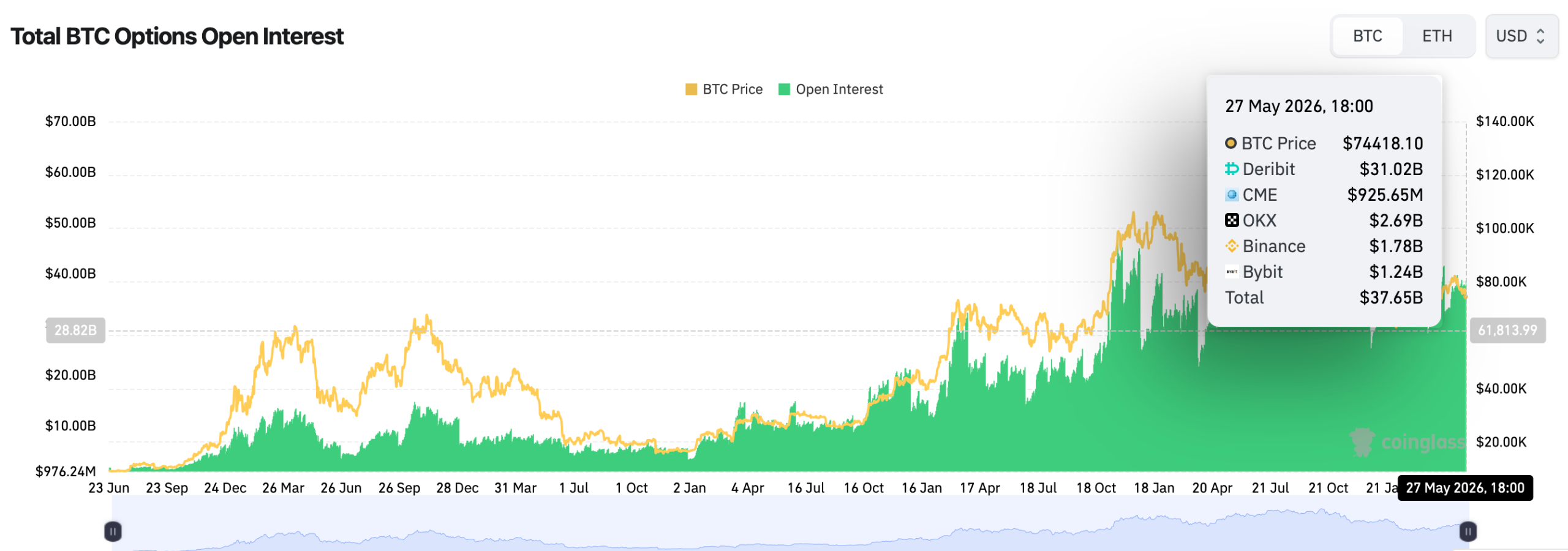
CoinGlass data shows Deribit held roughly $31 billion in Bitcoin options open interest on May 27, compared with $2.7 billion on OKX, $1.8 billion on Binance and $1.2 billion on Bybit.
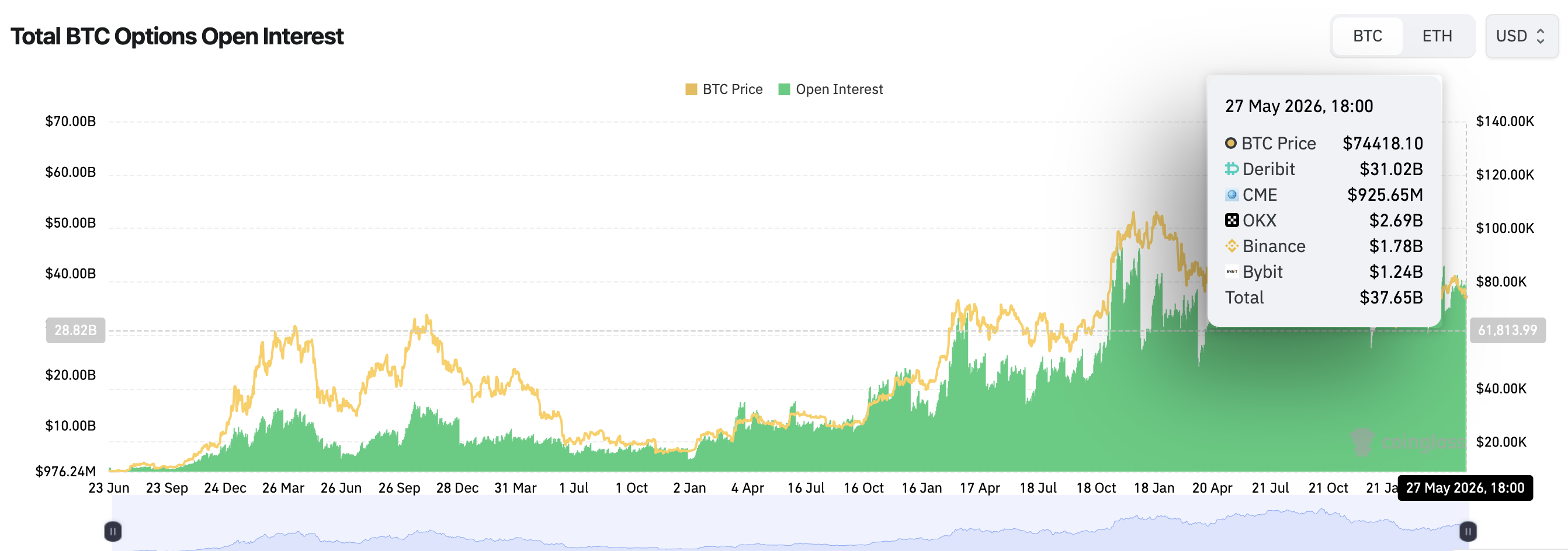
Bitcoin options open interest. Source: CoinGlass
According to Friday’s announcement, institutional clients can begin onboarding immediately, while broader access, including retail, is expected to follow later.
Related: Coinbase CEO’s finance wishlist mirrors company’s product roadmap
Crypto derivatives move deeper into regulated US markets
The launch comes months after the US Securities and Exchange Commission and CFTC said they would explore ways to bring perpetual futures trading onshore. In a joint statement published in September 2025, the agencies said perpetual contracts had been largely confined to offshore crypto markets due to regulatory and jurisdictional constraints.
The agencies added that they could consider steps to “onshore perpetual contracts” and bring activity “now flowing exclusively to foreign platforms” back to regulated US markets.

Source: SEC/CFTC
Since then, US derivatives venues have steadily expanded their crypto offerings. Earlier this month, CME Group announced plans to launch a crypto index futures contract tracking a basket of seven cryptocurrencies, including Bitcoin (BTC), Ether (ETG), Solana (SOL) and XRP (XRP).
The announcement came days after Chicago-based CME unveiled Bitcoin Volatility futures, a regulated crypto derivatives product scheduled to launch on June 1. The futures will settle to a 30-day measure of expected Bitcoin volatility derived from CME options markets.
Other US crypto exchanges have also been expanding their derivatives businesses. In May, Kraken parent Payward completed its acquisition of Bitnomial, a CFTC-regulated derivatives platform that earlier this year launched the first US-regulated futures contracts tied to Injective’s INJ (INJ) token, following a similar launch for Aptos (APT) in January.
On Friday, CFTC staff issued guidance on 24/7 trading, clearing and settlement, saying crypto asset derivatives may be particularly well suited to round-the-clock markets.
Magazine: HYPE chases $100 target, ETH could dump below $1800: Market Moves

Bold and the Beautiful: Wyatt & Shauna’s Secret Romance Exposed in Shocker!

TRUMP ANNOUNCEMENT XRP XLM HOLDERS SHOCKED

The Funniest Posts From Parents This Week (May 23-29)


-

 Business5 days ago
NYT Strands Answers May 24 2026 Revealed for Puzzle No. 812 Theme Summer Essentials
-

 Politics4 days ago
Bridgerton Season 5: Cast, Release Date And Everything We Know So Far
-

 Crypto World6 days ago
Robinhood crypto COO Tanya Denisova exits
-

 Tech4 days ago
Microsoft’s quiet Claude Code retreat and the real cost of enterprise AI
-

 Business3 days ago
Selena Gomez Reportedly Upset Over Benny Blanco’s Comments on Her ‘Terrible’ Diet
-
Crypto World3 days ago
Micron Crosses $1 Trillion Market Cap as AI Demand Reshapes Memory Sector
-

 Business4 days ago
BTS Sells Out Four Las Vegas Shows at Allegiant Stadium for ARIRANG World Tour
-
Tech2 days ago
The Samsung pay deal is the moment Korean unions changed register
-

 Tech4 days ago
Westone Audio and Etymotic Acquired by Fidelity Collective in Major IEM Market Move
-

 Tech15 hours ago
Waymo dominates autonomous vehicle registrations as Tesla trails behind
-

 Tech3 days ago
Millions of AI agents imperiled by critical vulnerability in open source package
-
 Crypto World4 days ago
Nvidia (NVDA) CEO Calls on Super Micro to Strengthen Export Controls Amid Smuggling Probe
-
 Tech4 days ago
China assigns ID codes to 28,000+ humanoid robots
-
Crypto World2 days ago
SpaceX’s $2 Trillion IPO: Why Tech Giants Nvidia (NVDA), Apple (AAPL), and Microsoft (MSFT) May Face Pressure
-

 Tech3 days ago
NASA taps Blue Origin to deliver lunar rovers for Moon Base initiative
-
 Entertainment4 days ago
‘Breaking Bad’ Star’s Easy-to-Binge 6-Part Crime Series Spin-Off Is Finally Heading to Free Streaming
-
Crypto World5 days ago
Brian Armstrong Outlines Crypto Vision for the Future Financial System
-

 Business4 days ago
Yatra Online, Inc. 2026 Q4 – Results – Earnings Call Presentation (NASDAQ:YTRA) 2026-05-25
-

 Crypto World3 days ago
Spain blocks prediction markets Polymarket Kalshi
-

 NewsBeat2 days ago
Israel says it has killed new Hamas military leader in Gaza City airstrikes
You must be logged in to post a comment Login