
Crypto World
Bitcoin Price Prediction: $80K Coming to Wreck Bears

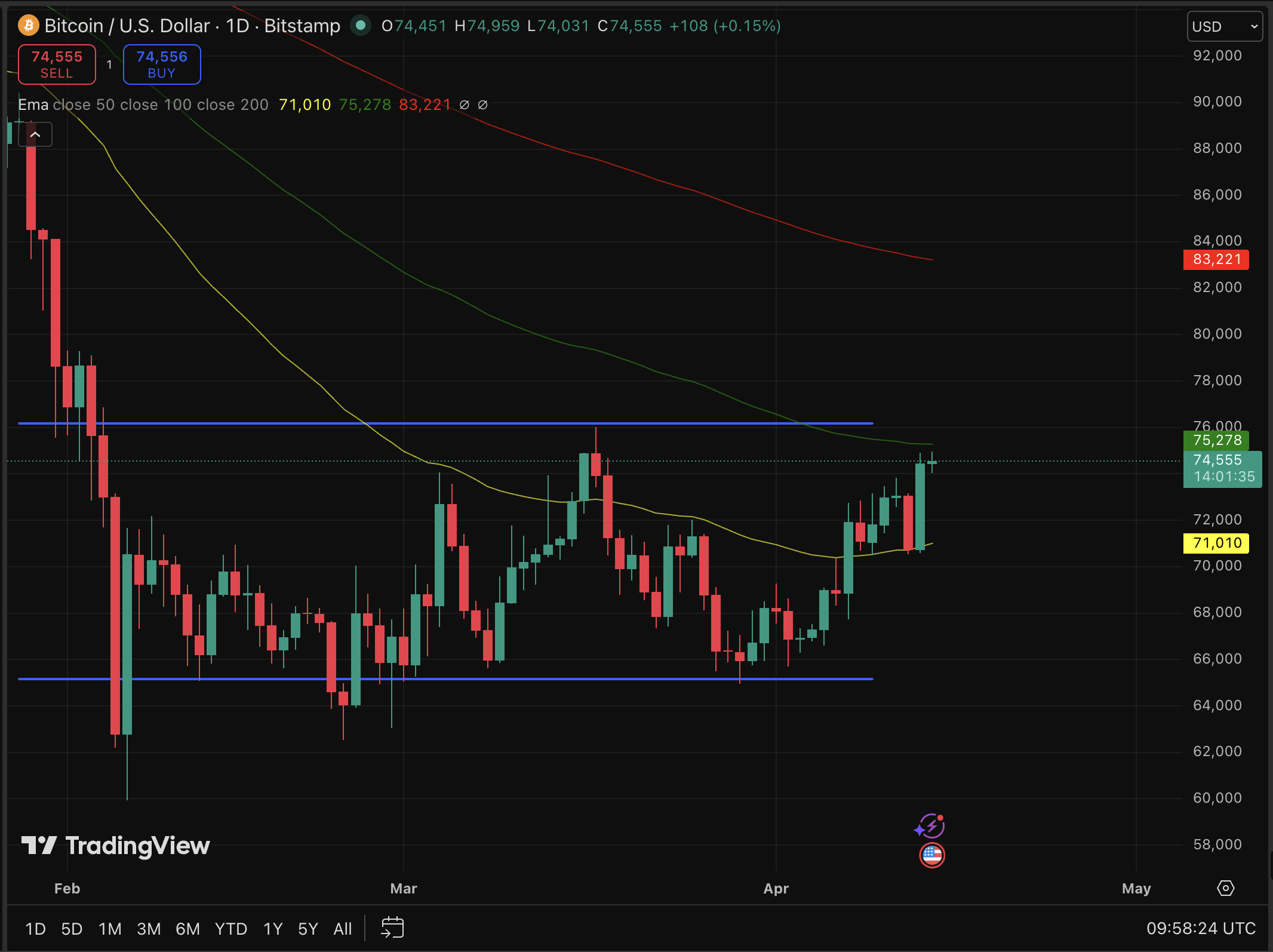
Bitcoin price is approaching $75,000 right now as the bears are running out of room, and our prediction model still says that the rally might not be over just yet. The move represents a sharp reversal from Sunday’s $70,000 capitulation low, a 6% swing in under 24 hours that caught overleveraged shorts badly offside.
The catalyst came at this AM. US President Donald Trump claims that Iran reached out for potential peace talks, even as a naval blockade of the Strait of Hormuz remained active. Risk assets rallied hard on the news, Asian equities climbed, oil expectations eased, and Bitcoin led the charge.
“Bitcoin is following the rally in broader risk assets,” said Damien Loh, chief investment officer at Ericsenz Capital, adding that BTC “continues to trade better than broader risk assets.” Ethereum joined the move, up 5.5% to over $2,370.
Bitcoin has now outperformed significantly since the US-Iran conflict began in late February, up more than 10%, while gold has shed nearly 10% and the S&P 500 sits roughly flat. The macro setup is shifting.
Discover: The best crypto to diversify your portfolio with
Bitcoin Price Prediction: $80,000 in the Picture
Bitcoin is at $74,600, still the strongest bounce in a month. The 24-hour structure shows conviction: analysts had identified roughly $6 billion in leveraged shorts clustered between $72,200 and $73,500, and the move through that band likely triggered a cascade of forced buying.
We flag $80,000 as the defining resistance test for the next major leg. Above that sits the 200-day moving average, just above $83,000. The technical line separates the downtrend from confirmed recovery.
Current price sits just 10% below the $80K level and 15% below the 200-DMA. Prior attempts at $80K have stalled under selling pressure, making a clean break structurally significant.
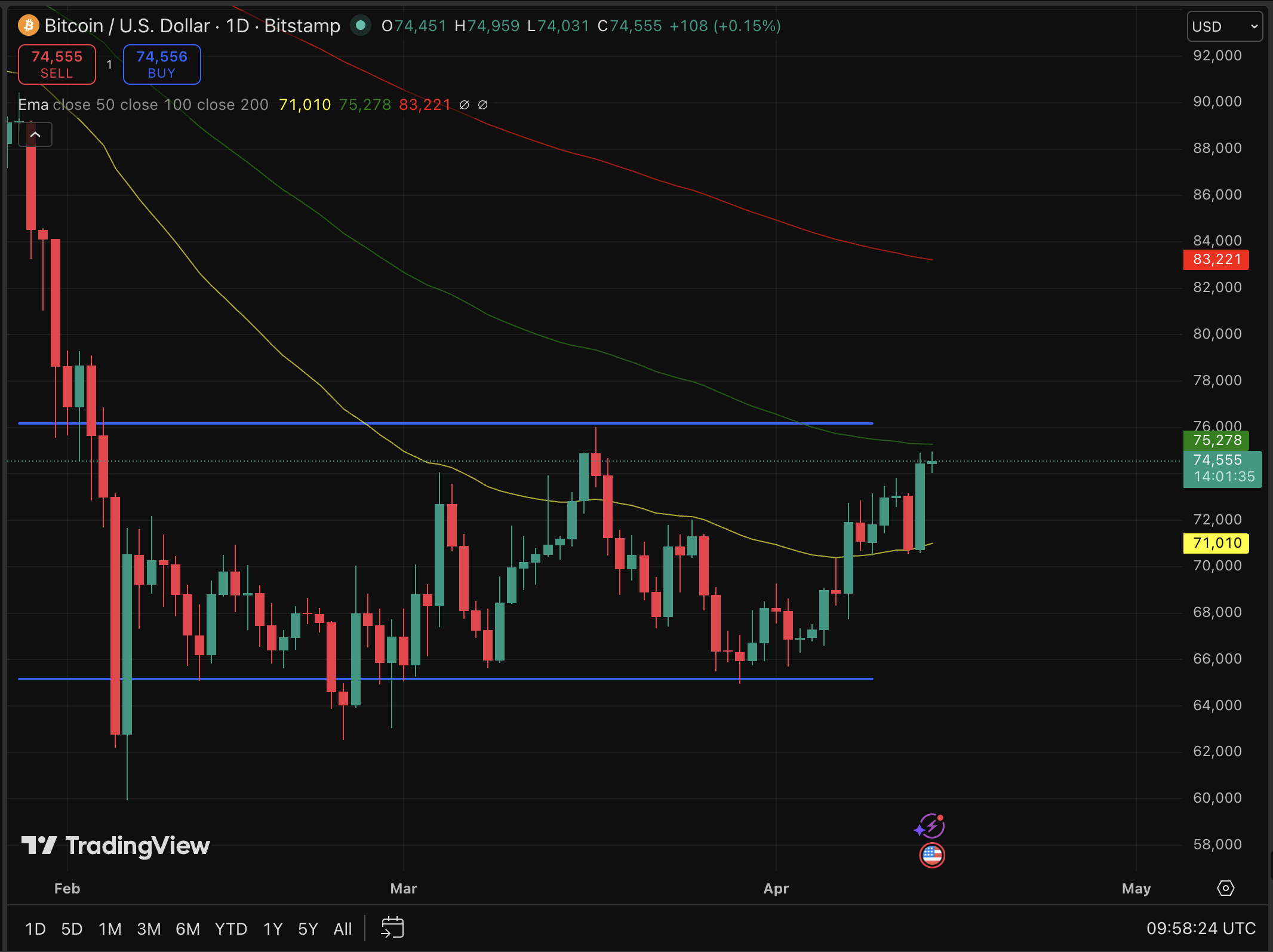
If Geopolitical de-escalation holds, shorts might continue to get squeezed, and BTC could clear $80K and target $83,000–$94,000. Standard Chartered and Bernstein both target $150,000 by year-end.
The next seven days appear decisive. Macro conditions remain fragile, and a “significant move higher” may not materialize until the US passes the Clarity Act regulatory framework. Price could move fast in either direction.
Discover: The best pre-launch token sales
Bitcoin Hyper With Early-Mover Upside Potential as BTC Breaks Resistance
Bitcoin at $74,000+ sounds bullish, until you price in the math and look at your capital size. A return to the $126K all-time high from here still requires a 69% move.
Institutional capital chasing that return at the current market cap faces diminishing leverage. Early-stage exposure to Bitcoin’s infrastructure layer is where asymmetric upside has historically lived.
Bitcoin Hyper ($HYPER) is positioning directly inside that infrastructure gap. It claims the title of the first-ever Bitcoin Layer 2 with Solana Virtual Machine (SVM) integration, targeting the core limitations that have held Bitcoin back: slow transactions, high fees, and near-zero programmability.
The pitch is sub-Solana latency on a Bitcoin-secured network, with a decentralized canonical bridge handling BTC transfers natively.
The presale numbers are concrete. $HYPER is currently priced at $0.0136, with $32 million raised to date. Staking is live with a high 36% APY bonus. The project has sustained momentum through Bitcoin’s recent volatility as a signal worth watching.
For traders monitoring Bitcoin’s $80K test, research Bitcoin Hyper here before the next price stage activates.
The post Bitcoin Price Prediction: $80K Coming to Wreck Bears appeared first on Cryptonews.

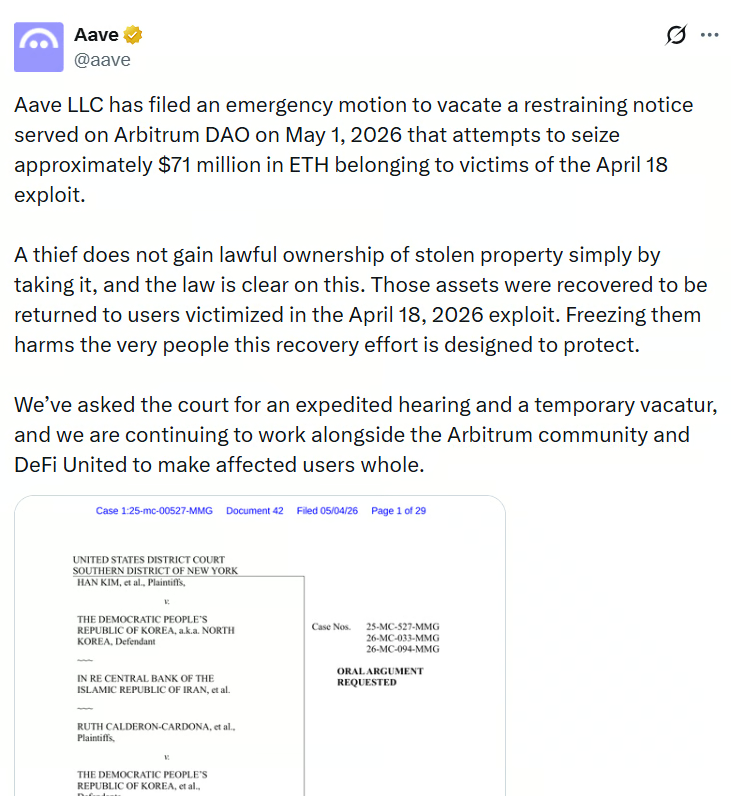
Decentralized finance protocol Aave filed an emergency motion on Monday in New York to vacate a restraining notice from a US law firm aimed at blocking Arbitrum DAO from transferring 30,766 Ether to the victims of the Kelp exploit.
Gerstein Harrow LLP served Arbitrum DAO with a restraining notice on Friday, arguing its clients are owed over $877 million in default judgments against North Korea. The law firm claims the North Korean hacker group behind the Kelp exploit had possession of the tokens, giving its clients a legal claim over the Ether.
Aave filed the emergency motion in a New York district court, arguing that a thief doesn’t gain lawful ownership of property by stealing it. It also argued that North Korea is only suspected of being part of the theft, and that the law firm’s argument “defies logic, common sense and the law.”
The Arbitrum DAO has been voting on whether to release the Ether to assist DeFi United, an industrywide coordination effort to make rsETH holders whole and help restore rsETH’s backing following the $292 million Kelp DAO hack on April 18. Voting ends May 7.
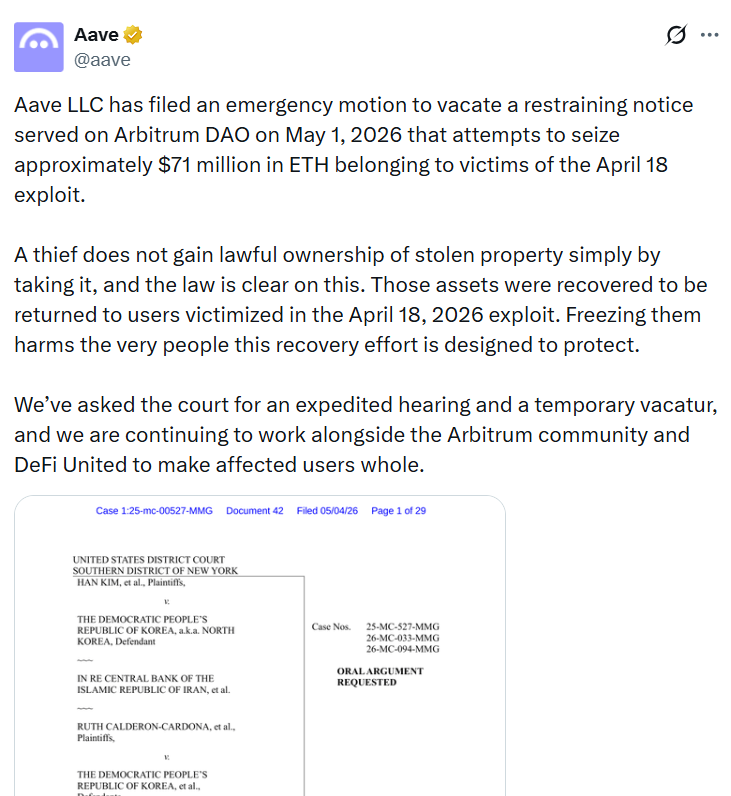
Source: Aave
Delay will cause “irreparable harm” to Aave, crypto ecosystem
Aave argued that if the court upholds Gerstein Harrow’s notice, it could deter future recovery efforts for North Korea-related hacks because of the possibility of additional legal challenges to recover funds. It further argued that it could incentivize bad actors to target more crypto protocols.
Aave’s lawyers also warned that the delay is causing “irreparable harm” to the protocol, its users and the wider DeFi community, “none of which can be later cured by monetary damages.”
“If the immobilized assets remain subject to a freeze and are not made available to restore value to Aave protocol users, the entire DeFi ecosystem risks being destabilized,” Aave’s lawyers said.
“While Aave protocol users cannot retrieve their assets from the Aave protocol, if those assets were being used for collateral for other positions elsewhere then continued restraint on the immobilized assets may render those users unable to meet their related collateral obligations.”

Aave said that if a court upholds Gerstein Harrow’s notice, it could incentivize bad actors to target more crypto protocols. Source: CourtListener
They further argued against Gernstein Harrow’s claim that its clients have a right to the frozen Ether and also said the case is based on unsupported conjecture that the thief is North Korea.
“Plaintiffs in this case showed up, contending – based on conjecture from posts on the internet – that the thief was North Korea, and that by stealing the assets for a few hours, North Korea somehow became the rightful owner of those assets such that Plaintiffs here could restrain them for their own purposes,” lawyers for Aave said.
“The immobilized assets do not belong to North Korea or any affiliated entities. Instead, the immobilized assets belong to the users of the Aave protocol who were victimized when a third-party thief effectively stole their assets during a cyber exploit April 18, 2026.”
Related: Google Cloud flags North Korea-linked crypto malware campaign
If the court can’t immediately vacate the notice, Aave’s lawyers are requesting that Gerstein Harrow pay a $300 million bond to maintain the restraining notice until a decision is reached.
A judge hasn’t ruled on the emergency motion yet, and a hearing date hasn’t been scheduled.
Gerstein Harrow has filed similar cases in the past, arguing its clients have a claim to funds stolen by North Korea and frozen by crypto firms, including assets from the 2023 Heco Bridge hack and the 2025 Bybit exploit.
Magazine: DeFi’s billion-dollar secret: The insiders responsible for hacks
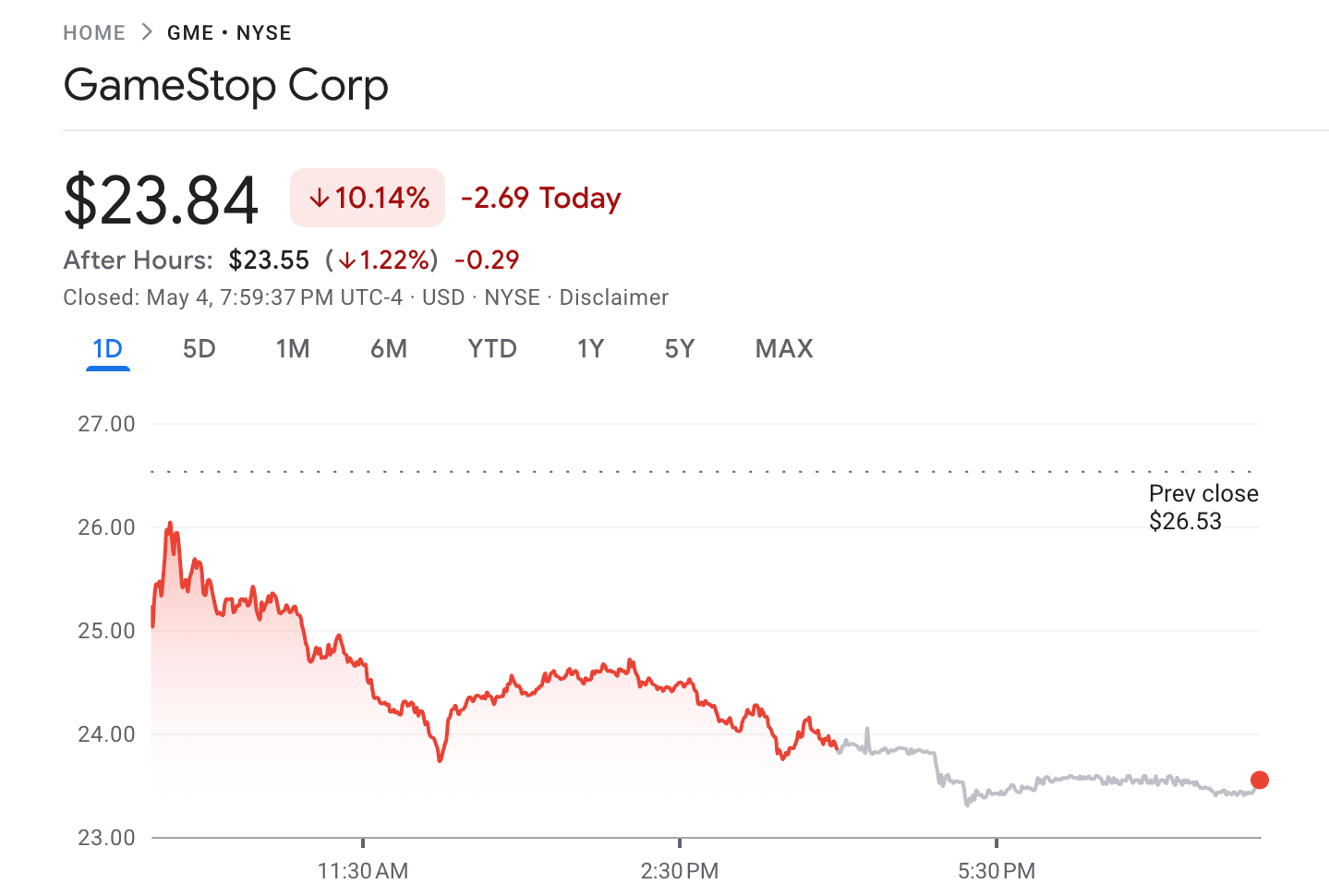
GameStop (GME) shares dropped after “The Big Short” investor Michael Burry sold his entire stake.
The investor announced the move on his Substack post. He revealed that the GameStop sale is his first divestment since launching the blog.
Follow us on X to get the latest news as it happens
Michael Burry Exits Entire GameStop Stake
GameStop stock ended Monday at $23.84, down 10.14%. GME continued lower in after-hours trading, dipping 1.22% to $23.55, Google Finance data shows.

Burry’s exit followed GameStop’s non-binding $55.5 billion proposal to acquire e-commerce platform eBay at $125 per share. The offer splits the payment evenly between cash and stock, with Ryan Cohen taking the chief executive role at the combined retailer.
The investor first disclosed his GameStop position in January. However, Cohen’s acquisition push prompted him to walk away.
“I may not last the week with my GameStop position fully intact,” he wrote in a note. “I will certainly sell to an extent, perhaps all or some, but alas, no, not none.”
Burry wrote that his Berkshire Hathaway-style blueprint for GameStop was incompatible with the leverage Cohen needs to close the eBay deal.
Subscribe to our YouTube channel to watch leaders and journalists provide expert insights
The post GameStop Stock Drops as Michael Burry Dumps Stake on eBay Bid appeared first on BeInCrypto.


Bitmine Immersion Technologies Chairman Tom Lee declared that the crypto spring has commenced.
In late April, Lee pushed back against the consensus view that crypto winter would drag through fall, arguing the downturn was nearing its end.
“Crypto Spring, in our view, has commenced, and like past cycles, investor sentiment and conviction are muted and bearish even as crypto prices strengthen,” he said.
Follow us on X to get the latest news as it happens
The executive explained that either outcome on the CLARITY Act, whether it passes or even fails, would “confirm the arrival of crypto spring.”
Senators Thom Tillis and Angela Alsobrooks finalized a bipartisan compromise on stablecoin rewards in the CLARITY Act. The text bans stablecoin yield on reserves while preserving activity-based rewards.
Lee called the framework acceptable, signaling hope for passage this year. Polymarket traders now price the odds of 2026 passage above 60%, the strongest reading in more than a month.
Two Structural Drivers Supporting Ethereum
Looking at what could drive the next leg of crypto gains, Lee pointed to two structural forces working in Ethereum’s favor. He cited the migration of Wall Street tokenization onto the chain, alongside growing demand from agentic AI systems that require neutral, open infrastructure to operate.
Lee positioned Ethereum as the dominant smart contract network for tokenization and well-placed to support the rise of agentic commerce. He added that ETH is increasingly being treated as both a store of value and a medium of exchange.
“This role for ETH has arguably been demonstrated by its outperformance since the Iran War commenced. ETH has outperformed the S&P 500 by 1,380 basis points since the war started and remains one of the top performing assets in the world (beside crude oil prices),” stated Lee.
The Ethereum treasury firm also announced its holdings on May 4. Total crypto and cash now stand at $13.1 billion, including 5.18 million ETH, equal to 4.29% of the supply.
Subscribe to our YouTube channel to watch leaders and journalists provide expert insights
The post Crypto Spring Has Officially Begun, Says Bitmine’s Tom Lee appeared first on BeInCrypto.

Western Union has taken a formal step into blockchain-enabled payments by launching USDPT, a US dollar-denominated stablecoin, on the Solana network. The pilot rollout targets Bolivia and the Philippines, with the company aiming to extend USDPT to more than 40 countries in 2026. The stablecoin is issued by Anchorage Digital, described as the first federally regulated crypto bank in the United States, and Fireblocks is providing the wallet and settlement rails that underpin the on-chain payments component. Western Union also intends to list USDPT on licensed crypto exchanges, integrating them with its broader payments and liquidity infrastructure.
Industry observers view the move as a notable milestone in regulated digital assets entering core remittance rails, particularly as the GENIUS Act fosters a more accommodating regulatory landscape for stablecoins. Other remittance firms have begun dabbling in stablecoins, including MoneyGram’s USDC rollout in Colombia and Zelle’s announced plans for stablecoin-powered cross-border transfers.
Key takeaways
- Western Union launches USDPT on the Solana blockchain, with initial availability in Bolivia and the Philippines and a plan to expand to more than 40 countries in 2026.
- USDPT is issued by Anchorage Digital, the first federally regulated crypto bank in the United States, while Fireblocks provides the wallet and settlement infrastructure.
- The company intends to list USDPT on licensed crypto exchanges and connect them to Western Union’s payments and liquidity network, signaling a move toward regulated digital-asset rails for cross-border payments.
- The deployment arrives amid a broader shift toward stablecoins in remittances, bolstered by regulatory developments and activity from other players in the space.
A regulated stablecoin enters mainstream remittance rails
USDPT’s issuance by Anchorage Digital anchors the stablecoin within a regulated framework, with Fireblocks handling the critical wallet and settlement infrastructure that enables on-chain settlement for cross-border payments. Western Union said the initiative marks a broader evolution in how global payments are built, integrating stablecoins into regulated, enterprise-grade infrastructure. The rollout on Solana emphasizes the balance between transaction speed, cost efficiency, and regulatory compliance that Western Union seeks for scale.
Western Union indicated that USDPT would be deployed first in Bolivia and the Philippines, a choice that aligns with its strategy to serve large, underserved corridors where traditional rails can be expensive or slow. The company notes these markets collectively reach about 130 million people, illustrating the potential reach of a regulated digital asset-enabled remittance channel. The move also positions USDPT as a test case for how licensed exchanges and traditional payments networks can interoperate in a hybrid payments ecosystem.
For context, Western Union has publicly framed this launch as part of a broader shift toward regulated digital assets as core infrastructure. The initiative follows supportive signals from the regulatory environment, including discussions around the GENIUS Act, which aims to advance stablecoins within a more workable regulatory framework. The broader industry trend includes MoneyGram’s rollout of USDC services in Colombia and Zelle’s announced plans for stablecoin-powered cross-border transfers, signaling growing acceptance of tokenized rails in mainstream remittances.
Targeted corridors reshape LATAM and APAC remittances
The initial rollout in Bolivia and the Philippines centers on two very different, high-potential remittance corridors. Bolivia represents South America’s Andean region where crypto rails could simplify informal flows, while the Philippines is a major recipient market with significant outbound remittance activity to relatives abroad. By launching in these markets, Western Union is testing how a regulated USD-backed stablecoin can complement or replace parts of the traditional FX and payment chain for cross-border transfers.
Industry voices highlight the potential for underserved routes in the Americas to benefit from crypto-enabled rails. Claudia Wang, formerly the head of marketing at Bybit, has argued that money transmitters could unlock numerous remittance corridors that remain largely untouched by crypto rails, particularly within LATAM. She pointed to US–Central America corridors and intra-Latin American routes, such as Argentina-to-Bolivia, as examples where a regulated stablecoin layer could lower costs and increase transparency for both senders and recipients.
Western Union serves a vast global network, facilitating transfers for more than 150 million customers across more than 190 countries. USDPT’s deployment could create a blueprint for how legacy remittance networks integrate tokenized assets without sacrificing regulatory and consumer protections, potentially accelerating adoption among financial institutions that want an auditable, on-chain settlement layer for cross-border payments.
Regulation, competition, and the push for compliant rails
The momentum behind USDPT sits within a broader regulatory and market context. The GENIUS Act, which has been cited as a catalyst for stablecoin clarity, creates a path for regulated digital assets to play a more central role in payments infrastructure. In parallel, traditional payment networks are experimenting with stablecoins—MoneyGram’s expansion into USDC in Colombia and Zelle’s cross-border plans illustrate the competitive impulse among incumbents to harness tokenized money while staying within regulated rails.
On the market scale, stablecoins have grown into a sizable segment of the crypto economy. CoinGecko data shows the stablecoin market cap at roughly $317.3 billion, underscoring the size of the asset class that Western Union and its partners are seeking to leverage. Meanwhile, analysts and policymakers have noted that stablecoin supply could rise sharply in the coming years, with some estimates from governmental and financial institutions projecting trillion-dollar potential by 2030, depending on regulatory alignment and adoption dynamics. The USDPT project therefore sits at the intersection of regulatory clarity, institutional adoption, and the digital-asset payments modernization trend.
Anchorage Digital’s role as the issuer and Fireblocks’ role as the settlement backbone are critical to the project’s credibility and reliability. Anchorage’s status as a federally regulated institution provides a level of oversight that is often cited as a prerequisite for enterprise adoption, while Fireblocks’ custody and settlement infrastructure is designed to meet the stringent risk controls required by large-scale payments networks. Western Union’s stated plan to bring USDPT to licensed exchanges reinforces the interoperability goal: a stablecoin that can move seamlessly across on-chain and off-chain rails within a compliant framework.
What makes the USDPT rollout particularly telling is not just the technology, but the intention to connect on-chain activity with traditional financial rails. If successful, Western Union could demonstrate a replicable model for other regulated payment operators seeking to balance the speed and efficiency of blockchain with the protections and settlement guarantees of conventional finance. The next few quarters will reveal how quickly USDPT is adopted by partner banks, fintechs, and licensed exchanges, and whether the 2026 target for tens of jurisdictions becomes a turning point for regulated stablecoins in cross-border payments.
Readers should watch for updates on the geographic expansion plan, regulatory feedback from supervising authorities, and the pace at which USDPT gains liquidity and usage across partner exchanges and Western Union’s own payment network. While the path to full-scale rollout remains subject to regulatory decisions and market demand, USDPT’s launch signals a clear appetite among a major global payments player to test stablecoins as a regulated, scalable settlement layer for everyday remittances.
Source references: Western Union press materials and statements on USDPT, Anchorage Digital and Fireblocks collaboration details, Bybit alumna Claudia Wang’s commentary on remittance corridors, and CoinGecko market data on stablecoins. For a broader regulatory backdrop, see the GENIUS Act coverage and industry reports on stablecoin adoption in remittances.


Nasdaq-listed DeFi Development Corp has launched a $200M at-the-market equity program, pledging to issue stock only when it boosts “SOL per share” and fuels its Solana reserve strategy.
Summary
- Nasdaq-listed Solana treasury vehicle DeFi Development Corp has launched a $200 million at-the-market (ATM) equity program to fund further SOL accumulation.
- The company says proceeds will primarily support its Solana reserve strategy and that it will only issue shares when doing so is “accretive” to the value of each shareholder’s SOL holdings.
- DeFi Development has previously used equity raises to scale its SOL treasury toward a long-term target of one SOL per share by 2028.
DeFi Development Corp, a Nasdaq-listed digital asset treasury company focused on Solana (SOL), has entered a sales agreement with broker R.F. Lafferty that allows it to sell up to $200 million of common stock from time to time through an at-the-market offering.
ATM facility tied directly to SOL reserve strategy
According to the 8-K and prospectus supplement, shares will be issued under an effective shelf registration, with the agent earning up to 0.75% of gross proceeds as commission while using “commercially reasonable efforts” to place stock into the market.
The company said net proceeds will go primarily toward “continuing to execute its Solana reserve strategy,” alongside working capital and other strategic initiatives, reiterating that SOL is the principal asset in its digital asset treasury reserve.
Management has emphasized that it intends to sell stock only when doing so has a positive impact on “SOL per share,” stressing that the ATM is designed to be accretive by raising capital above the look-through value of existing SOL holdings and then deploying that capital into additional Solana.
In an April investor briefing, DeFi Development outlined a “North Star” target of reaching one SOL per share by December 2028, saying its strategy is to “acquire as much SOL as possible, as quickly as possible, in a way that compounds value per share.”
Building a listed Solana treasury vehicle
DeFi Development has already used equity capital to grow its SOL reserves.
In August 2025, the firm closed a $125 million equity offering at $12.50 per share, saying the transaction was expected to be “NAV/share accretive” because it allowed the company to buy both spot SOL and discounted locked SOL, thereby expanding its treasury while capturing discounts.
By mid-2025 the company had accumulated around 1 million SOL worth roughly $190 million, and by September that year it reported holdings above 2.02 million SOL — about $412 million at the time — after purchasing 196,141 SOL at an average of $202.76 with the intention of staking the entire amount.
DeFi Development positions itself as “the first public Digital Asset Treasury built to accumulate Solana,” running its own validator infrastructure and deploying roughly 15% of its treasury on-chain to earn what CEO Joseph Onorati has described as an 8%–11% annualized “organic” yield from staking and ecosystem participation.
In a recent crypto.news feature, Onorati said an earlier raise “allows us to add a significant amount of SOL to our balance sheet while still driving NAV/share accretion,” underscoring that every financing step is evaluated through the lens of SOL per share growth.
Another crypto.news overview highlighted how the company has already pushed its SOL treasury toward the $200 million mark, using a mix of credit facilities and equity issuance to scale what it calls a “Solana reserve strategy” for public-market investors.
A separate crypto.news analysis noted that by standardizing reporting around SOL per share and treating Solana as its core reserve asset, DeFi Development is effectively operating as a listed Solana proxy, with this new $200 million ATM providing fresh ammunition to keep expanding that bet.


DTCC has formed a tokenization working group for U.S. markets and tapped Ondo alongside BlackRock, Goldman, JPMorgan, Circle, and others to help design how equities and Treasuries move on-chain.
Summary
- DTCC has formed an industry working group to design tokenization standards for U.S. capital markets, with Ondo joining members spanning both Wall Street and DeFi.
- Participants include BlackRock, Goldman Sachs, JPMorgan, Franklin Templeton, Morgan Stanley, Bank of America, Citadel Securities, the New York Stock Exchange, Circle, Fireblocks, and Robinhood.
- DTCC, which sits on more than $114 trillion in assets and processes around $3.7 quadrillion in annual transactions, is building a tokenization service to move core market processes on-chain.
The Depository Trust & Clearing Corporation has launched an industry working group to push forward tokenization in U.S. capital markets, with tokenization specialist Ondo Finance confirming it has been selected to participate.
DTCC pulls Ondo into the heart of tokenization design
According to Ondo’s announcement, the group brings together heavyweights from traditional finance and crypto, including asset managers like BlackRock and Franklin Templeton, banks such as Goldman Sachs, JPMorgan, Morgan Stanley, and Bank of America, market makers Citadel Securities, market operators like the New York Stock Exchange, and crypto-native firms Circle, Fireblocks, and Robinhood.
The mandate is to help DTCC define common standards for how real-world assets such as U.S. equities and Treasuries are represented, settled, and serviced on permissioned and public blockchains, ensuring that tokenized instruments remain interoperable with existing post-trade infrastructure.
DTCC, which provides custody and settlement plumbing for nearly all U.S. securities, oversees more than $100–$114 trillion in assets and processes roughly $3.7 quadrillion in transactions annually, giving any technical standard it backs outsized influence over the future of on-chain markets.
In prior commentary, Nadine Chakar, global head of DTCC Digital Assets, described the “$75 trillion tokenization opportunity” in mature markets, saying that “bringing the benefits of tokenization to mature markets which collectively are over $75 trillion is a tremendous opportunity.”
DTCC’s on-chain pivot and La Salla’s vision
DTCC’s push comes after the U.S. Securities and Exchange Commission issued a no-action letter in late 2025, clearing its DTC subsidiary to operate a controlled tokenization service for DTC‑custodied assets, with rollout expected in the second half of 2026.
In a DTCC explainer, the firm said it plans to use a platform suite called ComposerX to tokenize U.S. Treasuries and other securities and to “bring the core processes of the U.S. capital markets on-chain” while preserving existing investor protections and regulatory oversight.
DTCC president and CEO Frank La Salla has argued that “tokenization will significantly change the way markets operate,” promising it will bring “new levels of liquidity, transparency, and efficiency to investors” by making assets programmable and settlement closer to real time.
He has also framed the initiative as less about speculative tokens and more about “tokenizing financial infrastructure,” saying the goal is to bridge traditional finance and DeFi so that “institutionally custodied equities and Treasuries can gain blockchain-native liquidity, programmability, and near-real-time settlement.”
A recent crypto.news overview described the SEC’s green light for DTCC’s tokenization service as a “historic crypto pivot by a $100 trillion custodian,” noting that the first wave will focus on highly liquid equities and government debt.
Another crypto.news analysis highlighted DTCC’s partnership with Digital Asset to tokenize U.S. Treasuries, arguing that adoption could “generate significant operational and financial efficiencies across market participants.”
A separate crypto.news feature stressed that by pulling in specialists like Ondo alongside BlackRock and major banks, DTCC is signaling that tokenization is moving from pilots to the core of U.S. market structure.


World Liberty Financial, the crypto project co-founded by President Trump and his family, filed a defamation lawsuit against Tron founder Justin Sun on May 4 in Miami-Dade County, Florida, alleging a “coordinated media smear campaign” after Sun sued the project for fraud in April.
Summary
- World Liberty Financial alleges Sun conducted straw purchases of WLFI tokens to conceal his identity, engaged in short selling of the token, and made false statements on social media after his tokens were frozen in violation of his terms of sale.
- Sun fired back immediately, calling the suit “a meritless PR stunt” and saying he stands by his actions, while WLFI CEO Zach Witkoff said he looks forward to “the truth coming out in court.”
- The WLFI token rose approximately 12% on the day of the filing, though the token is still down roughly 85% since its September 2025 launch.
World Liberty Financial sued Justin Sun for defamation in Florida state court on May 4, one day after Consensus 2026 opened in Miami. The filing came in direct response to Sun’s April 21 federal lawsuit in California, in which he accused WLFI of embedding a secret “backdoor blacklisting function” in its smart contract that allowed the project to freeze, restrict, and effectively confiscate investor tokens.
As crypto.news reported, Sun said the project froze all of his tokens, removed his voting rights, and threatened to burn his holdings without cause, and that he had $75 million invested in WLFI since 2024. In Monday’s countersuit, World Liberty alleged that Sun made “straw purchases” by acquiring WLFI tokens on behalf of undisclosed third parties, may have engaged in short selling of the token, and then launched a false public narrative to cover the conduct. “Sun has launched a coordinated media smear campaign against World Liberty Financial and refused to stop even when confronted with the truth,” the project said in a statement on X.
Fortune reported that Sun had written on X: “Every action taken by the WLFI team to secretly implant backdoor controls over user assets, to freeze investor funds without disclosure or due process, and to treat the crypto community as a personal ATM, someone must be held personally accountable for these actions.” WLFI’s suit called those statements false or defamatory and said Sun was “well aware” that the project had the right to freeze his tokens under its terms of sale. Sun responded the same day: “The alleged defamation lawsuit that World Liberty announced on X today is nothing more than a meritless PR stunt. I stand by my actions and look forward to defeating the case in court.”
As crypto.news documented, the dispute escalated in April when Sun accused WLFI of hiding blacklist controls while the project simultaneously faced scrutiny over its use of self-issued tokens as loan collateral and a near-93% utilisation rate in its USDC pool. As crypto.news tracked, Sun’s frozen WLFI wallet had already lost approximately $60 million in value before the lawsuits were filed, tracking the token’s broader 85% decline from its September 2025 highs. Neither lawsuit has reached trial, and no allegations have been proven in court.


Coinbase CEO Brian Armstrong posted a three-word response on X on May 1 after Senators Thom Tillis and Angela Alsobrooks released the final stablecoin yield compromise text for the CLARITY Act: “Mark it up,” urging the Senate Banking Committee to advance the bill that Armstrong himself put on ice in January.
Summary
- The Tillis-Alsobrooks compromise bans crypto firms from offering any interest or yield that is “economically or functionally equivalent” to a bank deposit.
- Coinbase Chief Policy Officer Faryar Shirzad said banks secured tighter restrictions on rewards but the deal protected “the ability for Americans to earn rewards, based on real usage of cryptocurrency platforms and networks,” which he framed as the core issue throughout negotiations.
- Polymarket odds of the CLARITY Act becoming law in 2026 jumped from 46% to 64% within hours of the deal, with Galaxy Research head Alex Thorn saying a Senate Banking markup could come as soon as the week of May 11.
Brian Armstrong’s endorsement carries unusual weight on this specific bill. As crypto.news reported, it was Armstrong who pulled Coinbase’s support hours before a scheduled January 14 committee markup, causing Banking Committee Chair Tim Scott to postpone the vote indefinitely. The bill has not reached markup since. Armstrong’s January withdrawal also followed a contentious moment in March when Coinbase and Stripe rejected a separate draft — one so unacceptable that Circle’s stock fell 20% in a single session. The May 1 deal, authored by Tillis and Alsobrooks after months of negotiations with the White House, banking groups, and crypto firms, draws a firm line at passive yield while leaving open a regulatory runway for rewards tied to actual platform participation.
Benzinga reported that the SEC, CFTC, and Treasury are directed to jointly issue rules within one year defining a non-exhaustive list of permitted reward activities. Armstrong’s company reported $1.35 billion in stablecoin revenue in 2025, making the yield provisions a direct financial variable rather than a policy preference.
As crypto.news documented, JPMorgan analysts described CLARITY Act passage by midyear as a “key positive catalyst” for digital asset markets, and the stablecoin yield question was the single largest obstacle remaining before the deal landed. Shirzad acknowledged the trade-off: “In the end, the banks were able to get more restrictions on rewards, but we protected what matters.” Crypto Council for Innovation CEO Ji Kim expressed residual concern about the text’s breadth, urging the committee to proceed to markup regardless.
As crypto.news tracked, Galaxy Digital had put overall 2026 passage odds at roughly 50-50 before the deal, with Thorn warning that if the markup slips past mid-May, the probability of enactment drops sharply. The bill still needs to pass the Banking Committee, clear the Senate floor at 60 votes, reconcile with the Agriculture Committee version, and reconcile with the July 2025 House text before reaching Trump’s desk.
Disclosure: This article does not represent investment advice. The content and materials featured on this page are for educational purposes only.
Bitcoin and XRP regain focus as rising volatility drives trading activity and renewed market participation.
Summary
- Rising crypto volatility puts Bitcoin and XRP in focus, with platforms like XRP Power offering structured participation options.
- As trading activity grows, XRP Power attracts attention for simplifying entry for users avoiding frequent trading.
- Market volatility is driving interest in Bitcoin and XRP, while XRP Power offers a clearer, lower-barrier participation model.
With the recent resurgence of volatility in the crypto market, Bitcoin and XRP have once again become the focus of market attention. Trading volume has rebounded, and discussion has increased, attracting not only new users but also bringing back some previously absent participants.
However, as the market heats up again, a less obvious but noteworthy change is occurring — more and more users are beginning to rethink “how to participate,” rather than just “when to buy and sell.”
The limitations of traditional trading are becoming more apparent
For a long time, buying and selling has been the primary way most people participate in the crypto market. However, in practice, many users find it difficult to grasp market rhythms, and emotional fluctuations can also affect decision-making.
In rapidly changing market conditions, some users often face the following situations:
- Difficulty in judging entry timing
- Instable holding periods
- Overreaction to short-term fluctuations
With accumulated experience, some participants are beginning to look for more stable and predictable participation methods.
From “predicting the market” to “structured participation”
In recent years, a different approach to participation has gradually gained attention. Compared to frequent trading, this approach emphasizes structured participation — that is, clearly defining rules, cycles, and processes before participation, thereby reducing reliance on short-term market fluctuations.
This shift doesn’t mean users are abandoning trading altogether, but rather that they are seeking a balance among various methods. Some users are choosing to shift their focus from continuous market monitoring to a more rhythmic participation mode.
The emergence and changing trends of the XRP Power platform
Against this backdrop, some platforms have begun offering more structured participation solutions. For example, the XRP Power platform.
Such platforms are gradually being mentioned by some users.
This platform allows users to understand the overall structure before entering by setting clear participation logic and processes. For users who do not wish to trade frequently, this approach lowers the barrier to entry to some extent.
It is important to note that different platforms have different designs, and users typically understand and assess their operation through publicly available information before participating.
User behavior is changing
Market activity does not mean everyone is chasing short-term fluctuations.
Conversely, some users are beginning to focus more on:
- The stability of participation methods
- Time cost control
- The sustainability of the participation experience
This shift reflects the evolution of the crypto market from a “single transaction-driven” model to a “multi-faceted participation model.”
For readers who wish to learn more about structured participation methods, please refer to the publicly available information of relevant platforms, including their operational logic and participation processes, visit the official website.
Conclusion
With the resurgence of BTC and XRP, the market’s focus is gradually changing.
For a growing number of participants, the question is no longer simply “whether there are opportunities in the market,” but rather “how to participate in them in a more appropriate way.”
Disclosure: This content is provided by a third party. Neither crypto.news nor the author of this article endorses any product mentioned on this page. Users should conduct their own research before taking any action related to the company.
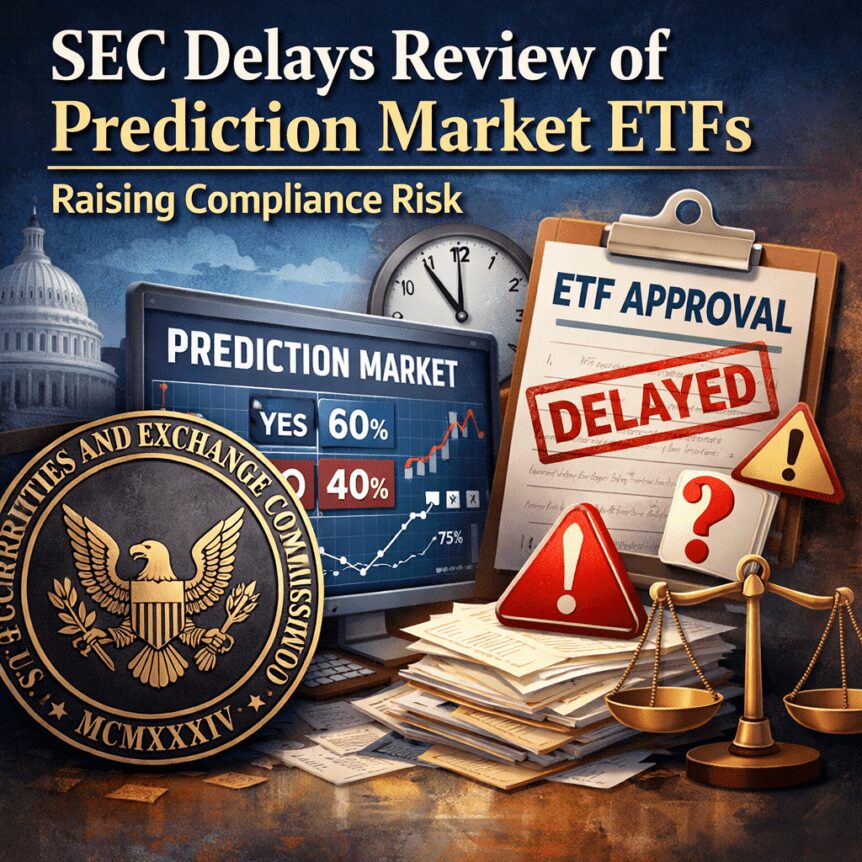
The U.S. Securities and Exchange Commission has paused the anticipated rollout of the first exchange-traded funds linked to prediction-market event contracts, delaying more than two dozen proposed ETFs from Roundhill Investments, GraniteShares, and Bitwise. The agency requested additional information about product structure and disclosures, according to Reuters, citing people familiar with the matter. The funds, filed in February, would provide exposure to binary outcomes tied to events such as elections, economic data releases, and market prices, without requiring investors to trade on explicit prediction-market platforms like Kalshi. The postponement underscores ongoing regulatory scrutiny of prediction markets in the United States, a space that has raised concerns about insider trading, ethics, and potential market manipulation.
The review pause arrives in a regulatory environment where authorities continue to drill into how prediction-market exposure should be structured, disclosed, and safeguarded for mainstream investment vehicles. The delay comes after a 75-day review period and ahead of what had been expected to be the launch window for the spectrum of funds.
Key takeaways
- The SEC has issued a temporary delay to the rollout of the first ETFs tied to prediction-market event contracts, seeking further information on product structure and disclosures from the issuers.
- The proposed funds aim to track binary event outcomes by using derivatives that mirror odds on underlying contracts traded on CFTC-regulated platforms, with settlements typically at $1 if the event occurs and $0 if it does not.
- Issuers emphasize that these investments carry risks that differ from traditional futures, options, or securities and may involve significant losses, valuation uncertainty, and deviations from stated investment objectives.
- Analysts had anticipated an imminent launch, with Bloomberg ETF strategist commentary suggesting an effective filing date of early May and talks of event-contract outcomes such as party control in the U.S. Congress.
- The delay highlights ongoing regulatory considerations for how such funds should be governed, disclosed, and monitored for market integrity, including potential settlement ambiguities and data-definition disputes.
Regulatory review and launch timeline
According to Reuters, the SEC’s request for more information appears to be a procedural step rather than a fundamental policy shift. The agencies’ actions indicate a careful, information-gathering approach to determine whether the funds’ structure, disclosures, and risk management align with investor protections and securities laws. The timing of the delay, which affects more than two dozen ETFs from the three sponsors, suggests that authorities are weighing the appropriateness of offering publicly traded access to prediction-market exposure at a broader scale.
Market observers had expected a rollout to proceed in the near term, with linkage to event-contract outcomes such as whether one political party controls the House or Senate, or other binary results. Bloomberg ETF analyst Eric Balchunas noted that the ETFs were anticipated to launch on the originally scheduled date, while James Seyffart indicated that Roundhill’s filing had an effective date around May 5. The reports underscore a convergence of regulatory review with market timing expectations, even as the SEC seeks clarifications that could shape the ultimate design of these vehicles.
Structure, mechanics, and risk disclosures
Prediction-market ETFs are designed to provide investors with exposure to binary event contracts without requiring direct participation in specialized prediction-market venues. While the exact features vary across the more than 20 proposed funds, the general design centers on derivatives intended to track the odds of a “yes” or “no” outcome on underlying contracts traded on platforms regulated by the CFTC. In practice, settlement would occur at $1 if the referenced event takes place and $0 if it does not.
In February filings, Roundhill highlighted significant risk factors associated with the proposed ETFs, noting that investments in event contracts carry “unique risks that differ from those associated with traditional futures, options or securities.” The disclosures point to substantial volatility and the possibility of material losses, valuation uncertainty, and deviations from the fund’s stated investment objective. Related considerations include potential settlement issues tied to interpretations of event outcomes, data sources, and timing—areas that could lead to disputes or mispricing if not well defined.
Implications for institutions, compliance, and market integrity
The SEC’s delay has practical implications for institutional access to predictive-market exposure. For banks, asset managers, and other regulated entities, the move reinforces the importance of rigorous governance, robust risk controls, and transparent data sourcing when dealing with unconventional assets. The disclosures emphasize that investors may face valuation challenges and uncertainties around how underlying event outcomes are determined, a factor that could influence internal risk ratings, capital treatment, and compliance reviews.
From a regulatory perspective, the development sits at the intersection of securities law, market integrity, and consumer protection. Prediction markets have historically attracted scrutiny regarding insider information, manipulation, and ethical concerns around market design. The current pause suggests that the SEC remains vigilant about ensuring that any tradable exposure to binary outcomes is accompanied by clear definitions, objective data sources, and robust dispute-resolution mechanisms.
For firms seeking to offer or participate in such products, the episode highlights the continuing relevance of AML/KYC considerations, licensing, and regulatory oversight across multiple agencies. As the landscape evolves, issuers and counterparties will likely need to align product disclosures with evolving standards for disclosure quality, risk articulation, and operational resilience in the event of ambiguous or contested outcomes.
Policy and market-structure context
The unfolding review mirrors broader regulatory dynamics surrounding forecast-based and outcome-contingent instruments in the United States. As authorities assess how to balance innovation in financial products with safeguards against systemic risk and market abuse, expect continued attention to how prediction-market ETFs are structured, how data feeds are validated, and how settlements are determined in edge cases. The review also intersects with cross-cutting regulatory themes, including the delineation of custody responsibilities, valuation methodologies, and the integrity of price discovery in derivative-linked products.
Looking ahead, observers should monitor whether the SEC’s information requests yield a clarified, harmonized framework for predictive-market ETFs or whether additional delays and refinements will extend the timeline. The outcome could influence product design choices, the pace of market access for institutional investors, and the regulatory posture toward prediction markets as a class of financial instruments.
The current pause does not indicate a permanent withdrawal of these investment vehicles but rather a measured, regulatory-driven pause to ensure that disclosures, risk management, and operational structures meet institutional standards. As reviews progress, issuers will need to address any ambiguities in event definitions, data sources, or timing determinations to maintain alignment with securities-law requirements and compliance expectations.
For market participants, the episode signals the importance of ongoing risk governance and transparent communication with investors about the unique characteristics and potential downsides of prediction-market exposure. As regulatory dialogue continues, institutions should prepare for evolving standards around disclosure quality, settlement mechanics, and oversight of event-based derivative instruments.
In sum, the SEC’s delay of the first prediction-market ETFs—while likely temporary—highlights the policy and risk-management complexities at the frontier of innovative financial products. The coming weeks will reveal how issuers adapt disclosures and how regulators calibrate the balance between investor access and safeguards against abuse in event-driven markets.
Aave Challenges Law Firm’s Freeze on Kelp Exploit Ether

10 Prime Video Shows That Will Keep You Hooked From Start to Finish

The NBA’s playoff blocks record has added confusion because of Wilt Chamberlain, Bill Russell

Manchester United reach agreement with Casemiro over contract clause amid transfer speculation

US brings back mandatory military draft registration

Steven Gerrard disagrees with Gary Neville over ‘shock’ Chelsea and Arsenal claim | Football


-

 Business6 days ago
Most Commercial Energy Audits Miss the Real Losses
-

 Fashion6 days ago
Kylie Jenner’s KHY Enters a New Era with ‘Born in LA’
-

 NewsBeat1 day ago
Channel 5 – All Creatures Great and Small series 7 new post
-
 Tech3 days ago
Trump’s 25% EU auto tariff breaches Turnberry Agreement that also covers semiconductors and digital trade
-
 Sports3 days ago
Paul Scholes issues Marcus Rashford reality check as agreement emerges over Man United star
-

 Crypto World7 days ago
CFTC’s AI will review U.S. crypto registration applications, chairman tells CoinDesk
-

 Business6 days ago
Barclay Brothers Avoid Bankruptcy: HSBC Drops High Court Petitions After IVA Deal
-
 Business5 days ago
Tesla Officially Registers Elon Musk’s Stock: What Investors Need to Know
-
 Crypto World7 days ago
Robinhood Phishing Scam Exploits Gmail Dot Feature to Bypass Security
-

 Tech7 days ago
Get Ready for More Brain-Scanning Consumer Gadgets
-

 Crypto World7 days ago
Gmail Dot Trick Underpins Robinhood Phishing, Sending Real-Looking Emails
-

 Business4 days ago
Two Powerball Tickets Split $143 Million Jackpot in Indiana and Kansas
-

 Tech5 days ago
Texas Instruments made a new flagship graphing calculator: the TI-84 Evo
-
 Crypto World4 days ago
CoreWeave (CRWV) Stock Climbs 8% Despite $45M Insider Share Dump
-
Business2 days ago
Winning Numbers Drawn as Jackpot Resets to $20 Million
-

 Tech7 days ago
Bambu Lab H2C review: the Cadillac of 3D printers
-

 Tech7 days ago
Robinhood account creation flaw abused to send phishing emails
-

 Business7 days ago
General Motors (GM) earnings Q1 2026
-
 Crypto World7 days ago
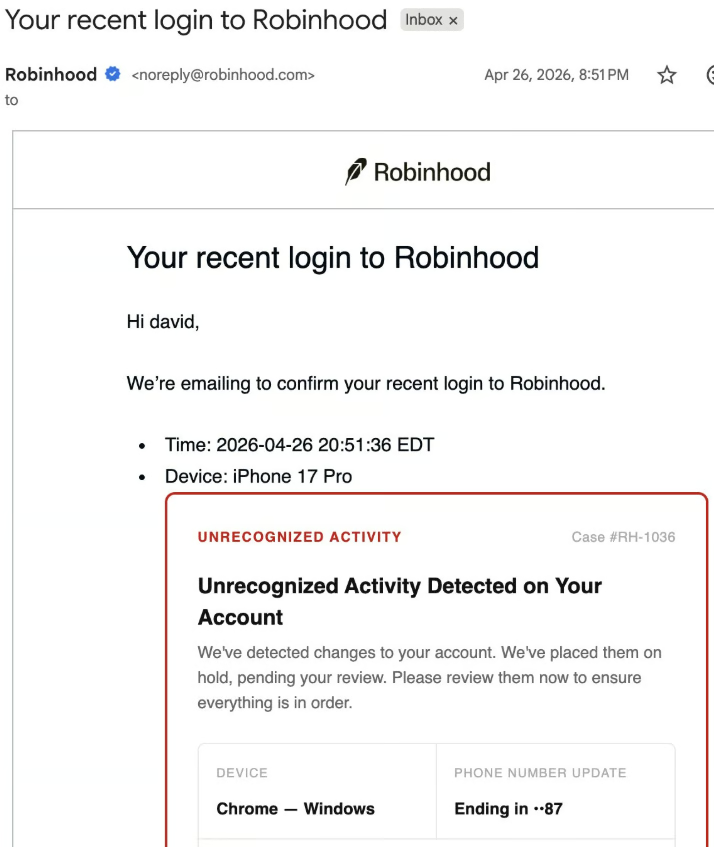
Robinhood Phishing Scam Uses Gmail Dot Trick to Send Real Emails
-

 Tech7 days ago
‘Stop Killing Games’ Got Its EU Parliament Hearing
You must be logged in to post a comment Login