

Crypto World
Ondo joins DTCC tokenization working group for U.S. markets



DTCC has formed a tokenization working group for U.S. markets and tapped Ondo alongside BlackRock, Goldman, JPMorgan, Circle, and others to help design how equities and Treasuries move on-chain.
Summary
- DTCC has formed an industry working group to design tokenization standards for U.S. capital markets, with Ondo joining members spanning both Wall Street and DeFi.
- Participants include BlackRock, Goldman Sachs, JPMorgan, Franklin Templeton, Morgan Stanley, Bank of America, Citadel Securities, the New York Stock Exchange, Circle, Fireblocks, and Robinhood.
- DTCC, which sits on more than $114 trillion in assets and processes around $3.7 quadrillion in annual transactions, is building a tokenization service to move core market processes on-chain.
The Depository Trust & Clearing Corporation has launched an industry working group to push forward tokenization in U.S. capital markets, with tokenization specialist Ondo Finance confirming it has been selected to participate.
DTCC pulls Ondo into the heart of tokenization design
According to Ondo’s announcement, the group brings together heavyweights from traditional finance and crypto, including asset managers like BlackRock and Franklin Templeton, banks such as Goldman Sachs, JPMorgan, Morgan Stanley, and Bank of America, market makers Citadel Securities, market operators like the New York Stock Exchange, and crypto-native firms Circle, Fireblocks, and Robinhood.
The mandate is to help DTCC define common standards for how real-world assets such as U.S. equities and Treasuries are represented, settled, and serviced on permissioned and public blockchains, ensuring that tokenized instruments remain interoperable with existing post-trade infrastructure.
DTCC, which provides custody and settlement plumbing for nearly all U.S. securities, oversees more than $100–$114 trillion in assets and processes roughly $3.7 quadrillion in transactions annually, giving any technical standard it backs outsized influence over the future of on-chain markets.
In prior commentary, Nadine Chakar, global head of DTCC Digital Assets, described the “$75 trillion tokenization opportunity” in mature markets, saying that “bringing the benefits of tokenization to mature markets which collectively are over $75 trillion is a tremendous opportunity.”
DTCC’s on-chain pivot and La Salla’s vision
DTCC’s push comes after the U.S. Securities and Exchange Commission issued a no-action letter in late 2025, clearing its DTC subsidiary to operate a controlled tokenization service for DTC‑custodied assets, with rollout expected in the second half of 2026.
In a DTCC explainer, the firm said it plans to use a platform suite called ComposerX to tokenize U.S. Treasuries and other securities and to “bring the core processes of the U.S. capital markets on-chain” while preserving existing investor protections and regulatory oversight.
DTCC president and CEO Frank La Salla has argued that “tokenization will significantly change the way markets operate,” promising it will bring “new levels of liquidity, transparency, and efficiency to investors” by making assets programmable and settlement closer to real time.
He has also framed the initiative as less about speculative tokens and more about “tokenizing financial infrastructure,” saying the goal is to bridge traditional finance and DeFi so that “institutionally custodied equities and Treasuries can gain blockchain-native liquidity, programmability, and near-real-time settlement.”
A recent crypto.news overview described the SEC’s green light for DTCC’s tokenization service as a “historic crypto pivot by a $100 trillion custodian,” noting that the first wave will focus on highly liquid equities and government debt.
Another crypto.news analysis highlighted DTCC’s partnership with Digital Asset to tokenize U.S. Treasuries, arguing that adoption could “generate significant operational and financial efficiencies across market participants.”
A separate crypto.news feature stressed that by pulling in specialists like Ondo alongside BlackRock and major banks, DTCC is signaling that tokenization is moving from pilots to the core of U.S. market structure.


Quick Overview
- Palo Alto Networks delivered Q3 adjusted earnings of $0.85 per share, surpassing Wall Street’s forecast of $0.80.
- Total revenue reached $3 billion, marking a 31% year-over-year increase and exceeding projections of $2.94 billion.
- Backlog expanded 36% to reach $18.4 billion, outpacing analyst predictions.
- PANW shares surged more than 10% after hours before retreating as market participants recognized acquisition contributions to growth.
- Multiple Wall Street firms increased their price targets, including Evercore ISI to $375 and Stifel to $330.
Palo Alto Networks (PANW) unveiled its fiscal 2026 third-quarter performance on Tuesday, exceeding expectations across all key financial indicators.
Adjusted profit per share registered at $0.85, outperforming analyst projections of $0.80 and improving from $0.80 during the corresponding period last year. Total sales hit $3 billion, surpassing the anticipated $2.94 billion.
Shares initially spiked over 10% during after-hours trading Tuesday evening. However, by Wednesday’s premarket session, most gains had evaporated, with the stock declining approximately 4.8%. Recent trading placed shares around $297.18, hovering just beneath the 52-week peak of $302.95.
Palo Alto Networks, Inc., PANW
Total sales advanced 31% compared to the prior year. When excluding acquisitions, organic revenue expansion came in at 14%.
The company’s order backlog climbed 36% to $18.4 billion, also exceeding analyst consensus forecasts. Next-Generation Security annual recurring revenue expanded 60% on a year-over-year basis.
Chief Executive Nikesh Arora attributed the strong performance to “an acceleration in organic bookings momentum, the sustained tailwinds from our platformization strategy, and surging cybersecurity needs as AI transitions from experimental stages to enterprise-wide production.”
M&A Activity Fuels Expansion
The difference between total and organic growth numbers highlights the impact of multiple acquisitions being integrated simultaneously. The most significant transaction involved identity security company CyberArk, which Palo Alto purchased through a combination of cash and stock that finalized in February, valuing CyberArk at approximately $25 billion.
Product sales climbed 31%, powered by firewall orders, XSIAM solutions, artificial intelligence offerings, and SASE products, alongside contributions from both CyberArk and Chronosphere acquisitions.
Executives increased fiscal 2026 fourth-quarter guidance beyond the magnitude of the quarterly beat. Management indicated that both organic and acquisition-related expectations for Q4 rose above the beat amount, although specific organic versus inorganic breakdowns were not disclosed.
Wall Street Upgrades Price Forecasts
Several brokerage firms elevated their price objectives after reviewing the quarterly results.
Evercore ISI boosted its target to $375 from $320. Cantor Fitzgerald increased its objective to $340 from $285. Wells Fargo adjusted upward to $325 from $285, while Citizens lifted its target to $320 from $250 alongside a Market Outperform rating. Stifel raised its price target to $330 from $275 while maintaining a Buy recommendation, highlighting robust execution across both organic initiatives and acquisition-driven expansion.
The CyberArk transaction incorporates identity security capabilities into Palo Alto’s comprehensive platform. AI agents — applications leveraging AI models to execute sophisticated tasks — need access to confidential information and external communications, establishing new vulnerability points. Identity management is viewed as a critical defensive mechanism.
Okta, a rival in the identity security space, witnessed its stock surge 30% following its earnings release last week as investors reacted positively to agent-identity software opportunities. CyberArk unveiled comparable software in late 2024, which is now being integrated into Palo Alto’s expanded ecosystem.

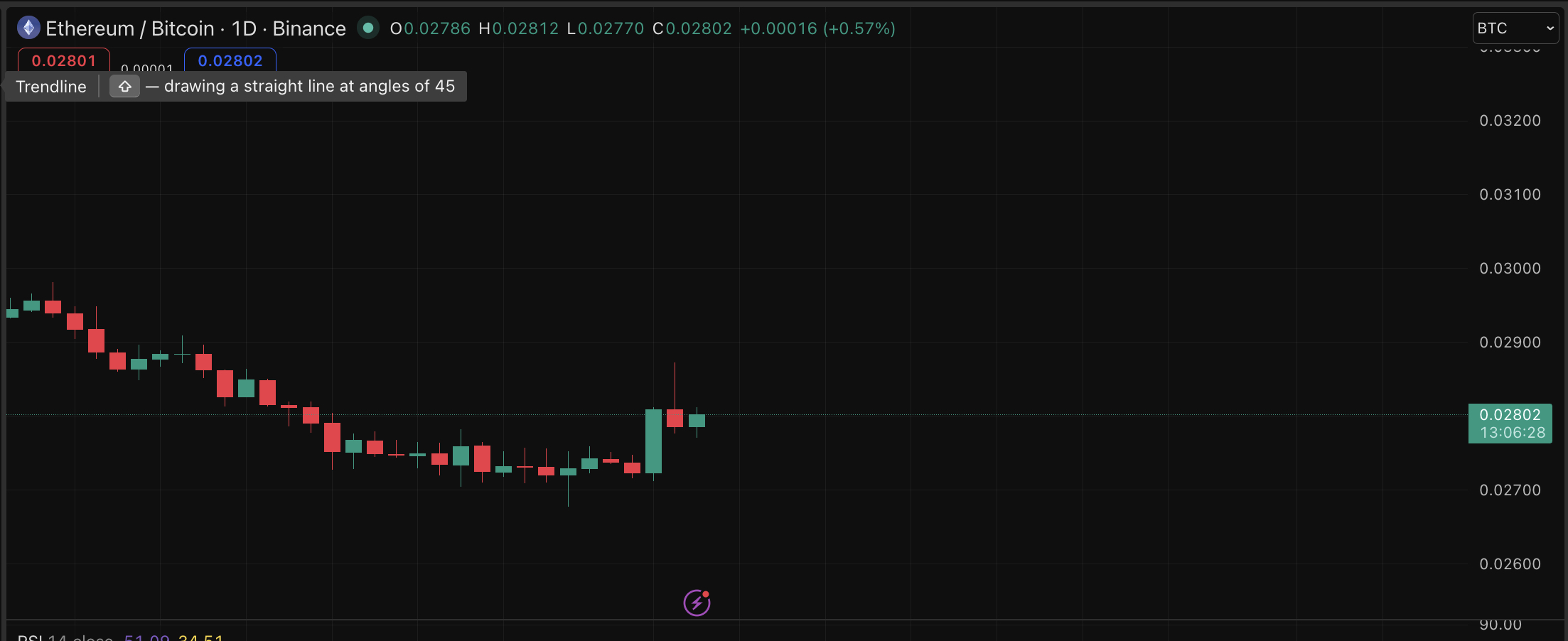
Ethereum is staging a quiet comeback, even as the price is falling. ETH is dropping under $1,900, well off its late-2024 highs, while Bitcoin continues to show cycle-wide underperformance that Standard Chartered says is now working directly in Ethereum’s favor.
Standard Chartered’s head of digital assets research, Geoffrey Kendrick, told clients this week that Strategy’s disclosure of a 32 BTC sale worth $2.5 million may mark a structural turning point for the ETH/BTC ratio.
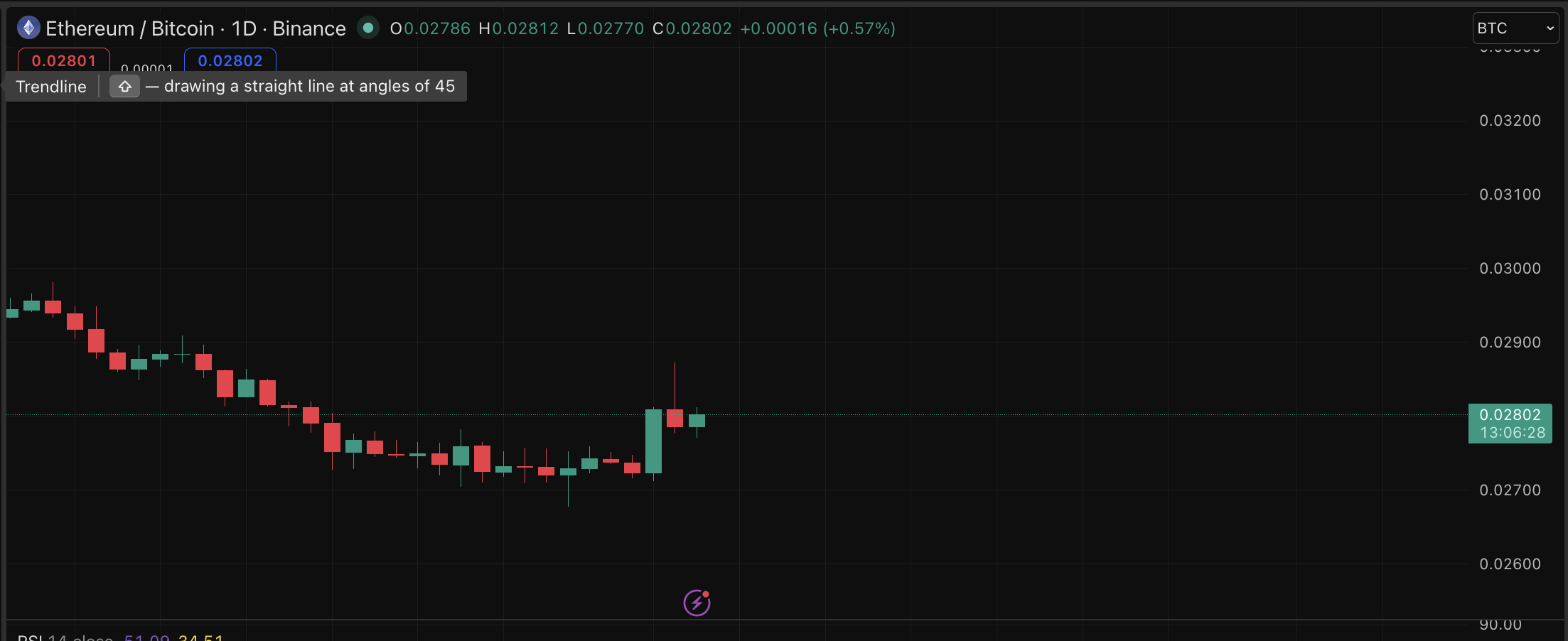
On the day of the announcement, ETH posted one of its largest single-day outperformance moves versus BTC in recent years, an event that has occurred just 23 times since the start of 2024. Kendrick projects the ETH/BTC ratio to climb from 0.028 to 0.04 by year-end, implying over 40% relative outperformance for Ethereum.
His Ethereum price target is at $2,700 near-term, assuming flat BTC at under $70,000, $4,000 by year-end, and an eyebrow-raising $40,000 by 2030.
Discover: The Best Crypto to Diversify Your Portfolio
Can Ethereum Price Hit $4,000 This Year as the ETH/BTC Ratio Turns?

Ethereum is trading under $1,900, or 62% below its August peak of nearly $5,000. The ETH/BTC ratio sits at approximately 0.028, down sharply from its high of 0.042.
Kendrick’s thesis rests on a structural argument: Ethereum-holding treasury companies can stake ETH to generate yield, funding operations without forced coin sales. Bitcoin treasury firms have no equivalent cash-flow mechanism, and Strategy’s sale illustrated this friction in real time.
This, he argues, supports a higher modified net asset value for ETH-based treasuries and reduces selling pressure on the asset itself. It’s a point the market has been slow to price in, which may be exactly why the opportunity exists.
For bull, they want ETH/BTC to reclaim 0.04 by Q4, with ETH trading toward $4,000 as RWA tokenization volume accelerates upward. However, a broad risk-off event drags both ETH and BTC lower; leveraged long flushes similar to recent Bitcoin liquidation cascades could reset ETH below $1,600 and delay the ratio recovery well into 2026.
Standard Chartered isn’t alone in flagging ETH’s structural undervaluation; multiple analysts have compared the current ETH discount to Amazon’s post-dot-com trough before its decade-defining recovery.
Discover: The Best Token Presales
Bitcoin Hyper Targets Early Mover Upside as Ethereum Staking Narrative Heats Up
The staking yield argument driving Kendrick’s ETH thesis reflects a broader market shift: infrastructure that generates native yield is being revalued faster than passive-hold assets. Bitcoin, historically locked out of that dynamic, may be changing.
Traders rotating within the Bitcoin ecosystem are eyeing a project that brings programmable yield infrastructure directly to BTC.
Bitcoin Hyper is positioning itself as the first Bitcoin Layer 2 with full Solana Virtual Machine (SVM) integration, delivering sub-second finality and smart contract execution on Bitcoin’s security layer faster than Solana itself.
The presale has raised $32.7 million at a current token price of $0.013681, with a high 36% APY staking already live for early participants. Core infrastructure features include a Decentralized Canonical Bridge for BTC transfers, extremely low-latency L2 processing, and high-speed low-cost transaction execution that targets Bitcoin’s three core limitations: slow throughput, high fees, and zero native programmability.
Research Bitcoin Hyper here before the next pricing stage closes.
The post Ethereum Could Outperform Bitcoin Despite Recent Price Weakness: Standard Chartered appeared first on Cryptonews.
HYPE price has climbed to fresh record highs amid growing demand for Hyperliquid investment products and a high-profile short squeeze that forced a major bear to abandon a $110 million position.
Summary
- HYPE price hit a record high near $75 after Grayscale launched its Hyperliquid Staking ETF.
- Hyperliquid ETFs from Bitwise and 21Shares have attracted over $136 million in net inflows.
- Bullish technicals and whale capitulation put the $100 level in focus for HYPE.
According to data from crypto.news, Hyperliquid (HYPE) price traded near $69.70 at press time on June 3, up more than 12% over the past week and nearly 70% over the past month. The token briefly climbed to a new all-time high near $75 yesterday as traders responded to a string of institutional developments surrounding the ecosystem.
Grayscale’s launch of the Hyperliquid Staking ETF has emerged as the latest catalyst. The product arrived after intense competition among issuers seeking exposure to HYPE, with Grayscale reportedly undercutting rivals through a 0.29% management fee.
The launch followed earlier entries from the 21Shares Hyperliquid ETF and Bitwise Hyperliquid ETF, which together have attracted more than $136 million in net inflows, according to SoSo Value data.
Those funds now collectively hold roughly 1% of HYPE’s total market capitalization, highlighting growing institutional participation in the asset. Recent SEC filings have added to the narrative after major financial firms disclosed exposure to Hyperliquid-related investment products, reinforcing the perception that HYPE is increasingly attracting traditional capital.
Hyperliquid’s tokenomics continue to amplify the impact of those inflows. The protocol allocates over 97% of platform revenue toward buying back HYPE from the open market, creating persistent demand as trading activity expands.
Rising volumes across crypto, commodities and prediction markets have increased the size of those purchases, tightening available supply even as investor interest accelerates.
Institutional demand and platform activity support the rally
Trading activity on Hyperliquid has expanded well beyond cryptocurrency perpetual futures. Recent growth in crude oil perpetual contracts and macro-linked prediction markets has attracted traders seeking around-the-clock exposure while traditional markets remain closed.
Platform adoption has translated directly into stronger fundamentals. Per DefiLlama, the total value locked on the Hyperliquid network has climbed to approximately $5.82 billion, one of the highest levels in the protocol’s history. Higher platform usage generates additional fees, which in turn feed the protocol’s buyback system and reinforce demand for HYPE.
A major sentiment shift unfolded in derivatives markets this week after a well-known whale known as Loracle closed his entire short position at a realized loss of roughly $46.46 million. Shortly after exiting the trade, he opened a 2x leveraged long position worth approximately $5.73 million.
The reversal removed one of the market’s largest public bearish bets and reinforced the view among traders that institutional demand and buyback activity continue to overpower selling pressure.
Technical setup places $100 within reach
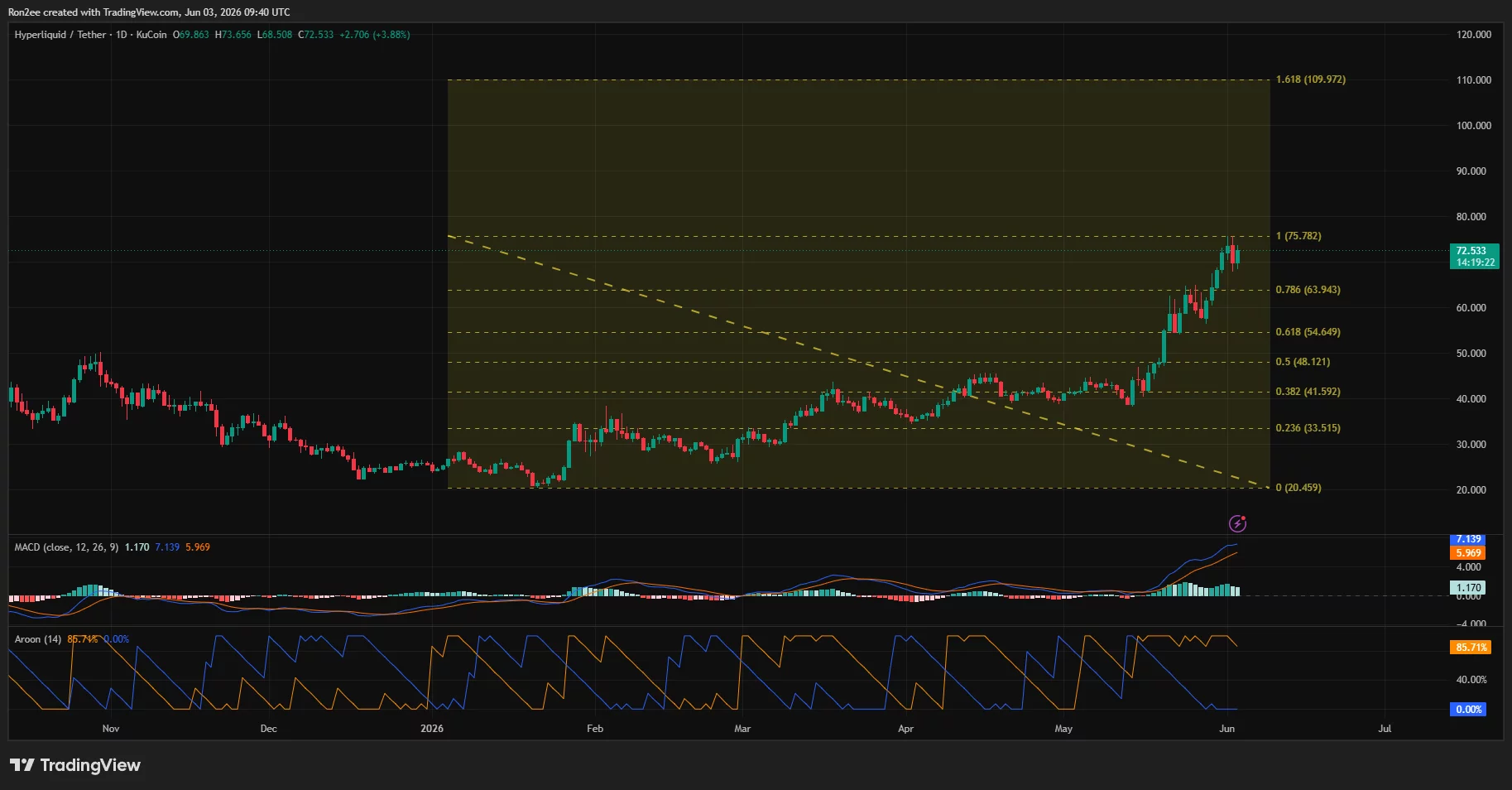
On the daily chart, HYPE has entered price discovery after breaking above its previous record high near $75.8. The move completed a major continuation breakout and pushed the token beyond the upper boundary of its recent trading range.
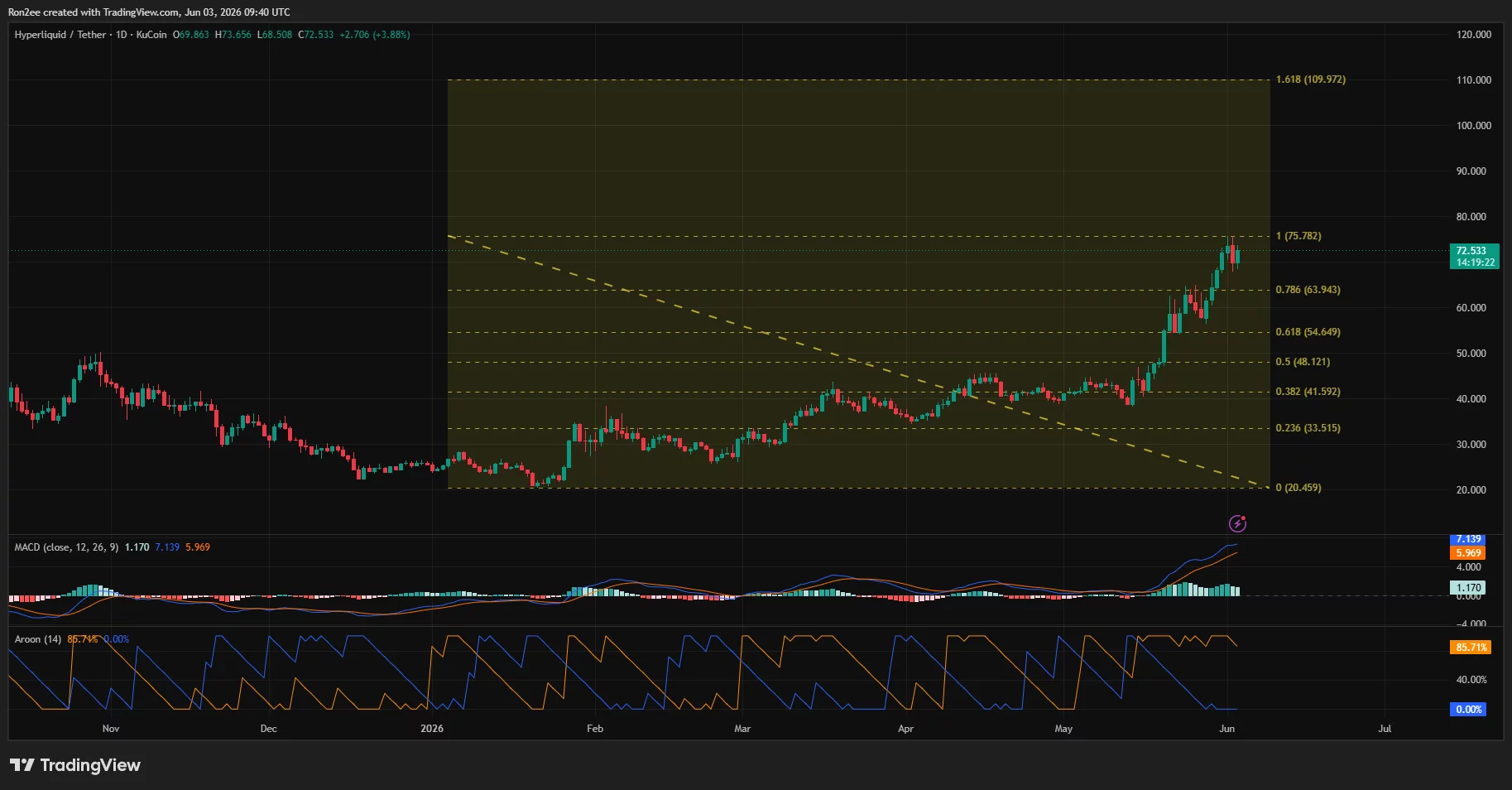
Momentum indicators remain firmly bullish. The MACD continues to print a positive crossover while the histogram has expanded to its highest level in months. At the same time, the Aroon Up indicator stands above 85% while Aroon Down has fallen to zero, highlighting the strength of the current uptrend.
According to crypto analyst Ali Martinez, HYPE has invalidated earlier sell signals and may have room to extend its rally toward higher levels.
“With prior sell signals invalidated, I’m watching $97 and $163 as potential upside targets.”
Fibonacci extension levels also support the bullish outlook. Measuring the advance from the January low near $20.5 to the recent breakout places the 1.618 extension at approximately $110, giving bulls a clear technical path beyond the psychologically important $100 level.
On the downside, traders will be watching the former breakout zone around $75 as the first major support. A drop below that level could expose the next support areas near $64 and $55, corresponding to the 0.786 and 0.618 Fibonacci retracement levels.
Disclosure: This article does not represent investment advice. The content and materials featured on this page are for educational purposes only.
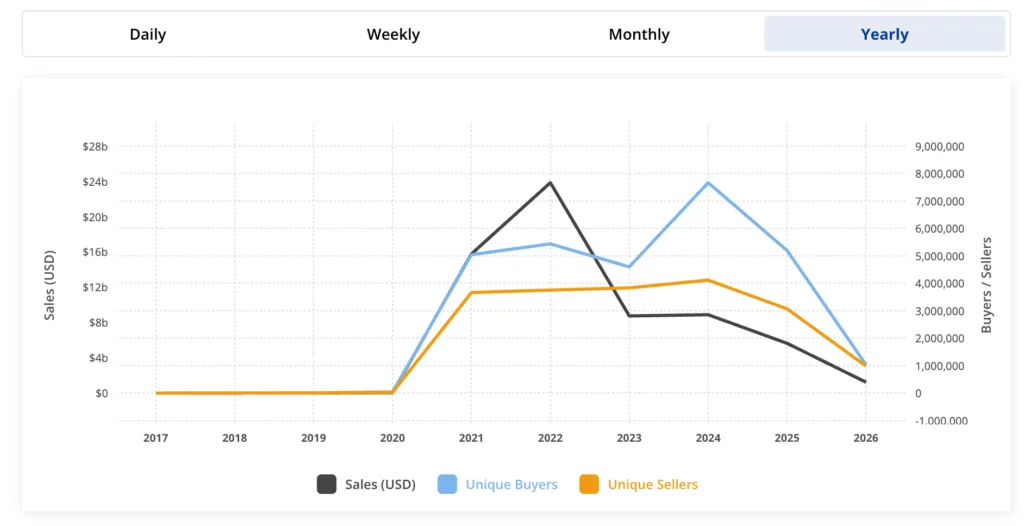
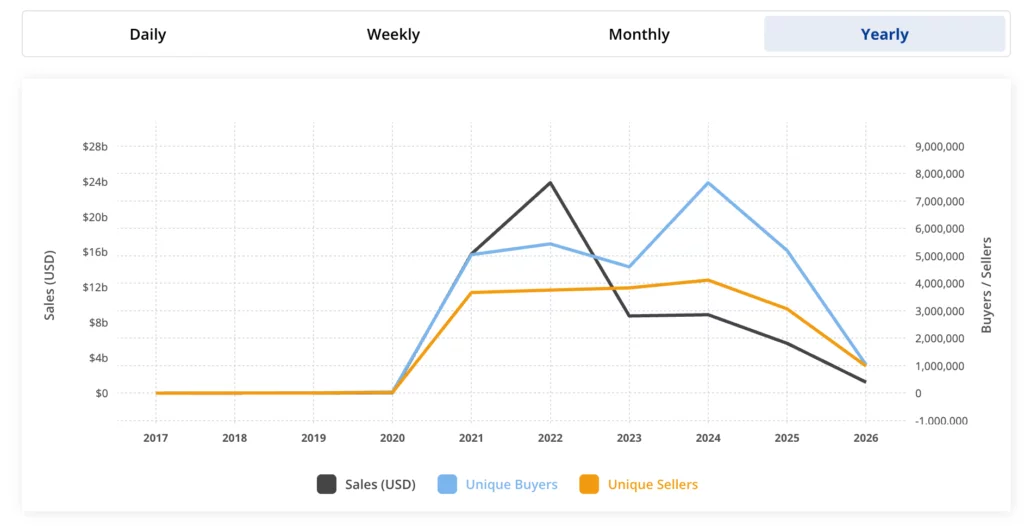
Binance has announced the closure of its NFT platform, ending support for a service that once operated during a period when annual NFT trading volumes exceeded $50 billion but now serves a market that generated about $5.5 billion in 2025.
Summary
- Binance will shut down its NFT platform on July 3 and has asked users to withdraw eligible NFTs before access ends.
- Users who transfer supported NFTs to Binance Wallet can receive reimbursement for withdrawal fees under a limited-time program.
- The closure comes as NFT trading volumes remain far below 2022 levels and Binance expands into stock trading and tokenized assets.
According to the June 3 announcement, users must withdraw transferable NFTs from the exchange before 23:59 UTC on July 3, 2026, or they will no longer be able to access those assets through the platform.
The exchange described the move as an upgrade and directed users to transfer eligible NFTs to Binance Wallet or another compatible external wallet.
For users holding non-transferable NFTs, including completion certificates issued through Binance Academy, withdrawals will not be possible. Binance said those NFTs will become inaccessible after the deadline, while Academy users will receive replacement certificates in PDF format.
Under the exchange’s announcement, up to 100,000 users who transfer eligible non-CR7 NFTs through BNB Smart Chain or Ethereum between June 3 and June 17 will receive 1 USDC.
Binance said the payment is intended to cover the cost of a typical onchain withdrawal transaction and will be credited by July 3.
Separate arrangements apply to holders of CR7 NFTs. Binance said withdrawal fees for those collections completed on BNB Smart Chain before July 3 will be refunded, with credits scheduled for distribution by July 19.
NFT platform joins growing list of discontinued services
Earlier decisions had already reduced Binance’s NFT-related offerings. In April 2024, the exchange ended support for Bitcoin Ordinals, and in September 2023 it removed Polygon network support from its NFT marketplace.
Market conditions have also deteriorated sharply from the sector’s peak years. According to CryptoSlam, annualized NFT trading volume across all blockchains totaled roughly $5.5 billion in 2025, far below the more than $50 billion recorded during 2022.
CryptoSlam data also showed Q4 2025 NFT volume reached $1.25 billion, down 28% from the previous quarter. December contributed only $303 million in trading activity.
Several NFT businesses exited the market during the same period. Platforms including Nifty Gateway, Kraken NFT and X2Y2 shut down their NFT operations as trading activity continued to contract, according to previously reported industry data.
Binance expands into stocks and tokenized assets
While Binance is winding down its NFT marketplace, the company has recently expanded into traditional financial products.
As previously reported by crypto.news, the exchange has started offering more than 7,000 U.S.-listed stocks and ETFs for eligible users outside the United States. The service allows fractional purchases from $5 and operates around the clock on weekdays.
Details released by Binance and Alpaca showed that the exchange holds a minority stake in Alpaca, the brokerage infrastructure provider supporting the stock trading product. Alpaca Securities handles execution, clearing, settlement, and custody, while Binance said it does not custody the securities traded through the service.
Binance has also stated that its planned bStocks product will allow eligible users to convert supported equity holdings into onchain assets in the coming weeks.

Key Highlights
-
160 former national security and law enforcement officials endorse CLARITY Act.
-
Senate leaders receive letter urging advancement of digital asset legislation.
-
Industry advocates frame crypto bill as enforcement and security tool.
-
Blockchain Association launches multi-office Senate advocacy campaign.
-
Bill awaits floor debate after clearing Banking Committee with bipartisan support.
A major crypto industry group has secured endorsements from 160 former national security and law enforcement professionals for digital asset legislation currently pending in Congress. The Blockchain Association delivered the letter to key Senate figures Tuesday, positioning the CLARITY Act as essential infrastructure for both market regulation and security enforcement.
Security Veterans Endorse Digital Asset Framework
Senate Majority Leader John Thune and Senate Democratic Leader Charles Schumer received the correspondence directly from the trade organization. The letter emphasized how establishing regulatory clarity for digital assets would enhance capabilities for financial crime investigators and law enforcement agencies working on emerging technology cases.
Signatories emphasized that comprehensive digital asset regulations would bring more cryptocurrency operations within U.S. regulatory reach. The former officials contended that such oversight would enhance consumer safeguards while creating stronger accountability mechanisms across crypto markets. Their argument connected regulatory framework development directly to broader national security objectives.
The letter highlighted specific compliance mechanisms embedded within the proposed legislation. Key provisions include expanded Bank Secrecy Act requirements and enhanced sanctions enforcement protocols. Furthermore, the measure would facilitate information exchange between Treasury Department officials, other federal agencies, and private industry participants.
Legislation Awaits Full Senate Consideration
The digital asset bill received approval from the Senate Banking Committee through a bipartisan vote during the previous month. It currently sits on the Senate Legislative Calendar, positioned for potential floor discussion. Senate leadership has yet to determine when the full chamber will take up the measure for formal consideration.
Lawmakers are still negotiating potential ethics requirements related to cryptocurrency business involvement by government officials. This discussion emerged partly due to President Donald Trump’s documented involvement in digital asset ventures. The legislation may undergo additional modifications during the legislative process before reaching a final vote.
Proponents believe the measure could resolve ongoing jurisdictional disputes between the Securities and Exchange Commission and Commodity Futures Trading Commission. They maintain that defining agency responsibilities more precisely would simplify compliance for businesses while empowering regulators to enforce standards effectively. Consequently, the CLARITY Act represents a cornerstone of Washington’s effort to establish comprehensive crypto market rules.
Industry Group Escalates Capitol Hill Outreach
The trade association announced plans to expand its Washington advocacy operations significantly. Organization representatives will conduct meetings with staff and members across 18 different Senate offices as legislative deliberations progress. Additionally, the group scheduled a virtual town hall focusing specifically on security and enforcement dimensions of crypto regulation.
The online event will feature Senator Cynthia Lummis, Representative Tom Emmer, and Patrick Witt as speakers. Witt currently leads the President’s Council of Advisors for Digital Assets. Participants will discuss how the proposed legislation could improve coordination among enforcement agencies tackling cryptocurrency-related crimes.
This intensified advocacy effort increases pressure on Senate leadership to schedule floor action on the bill. It also repositions the legislative debate around enforcement capabilities and national security considerations rather than purely economic concerns. The CLARITY Act currently stands as Congress’s primary legislative vehicle for establishing federal digital asset regulations.
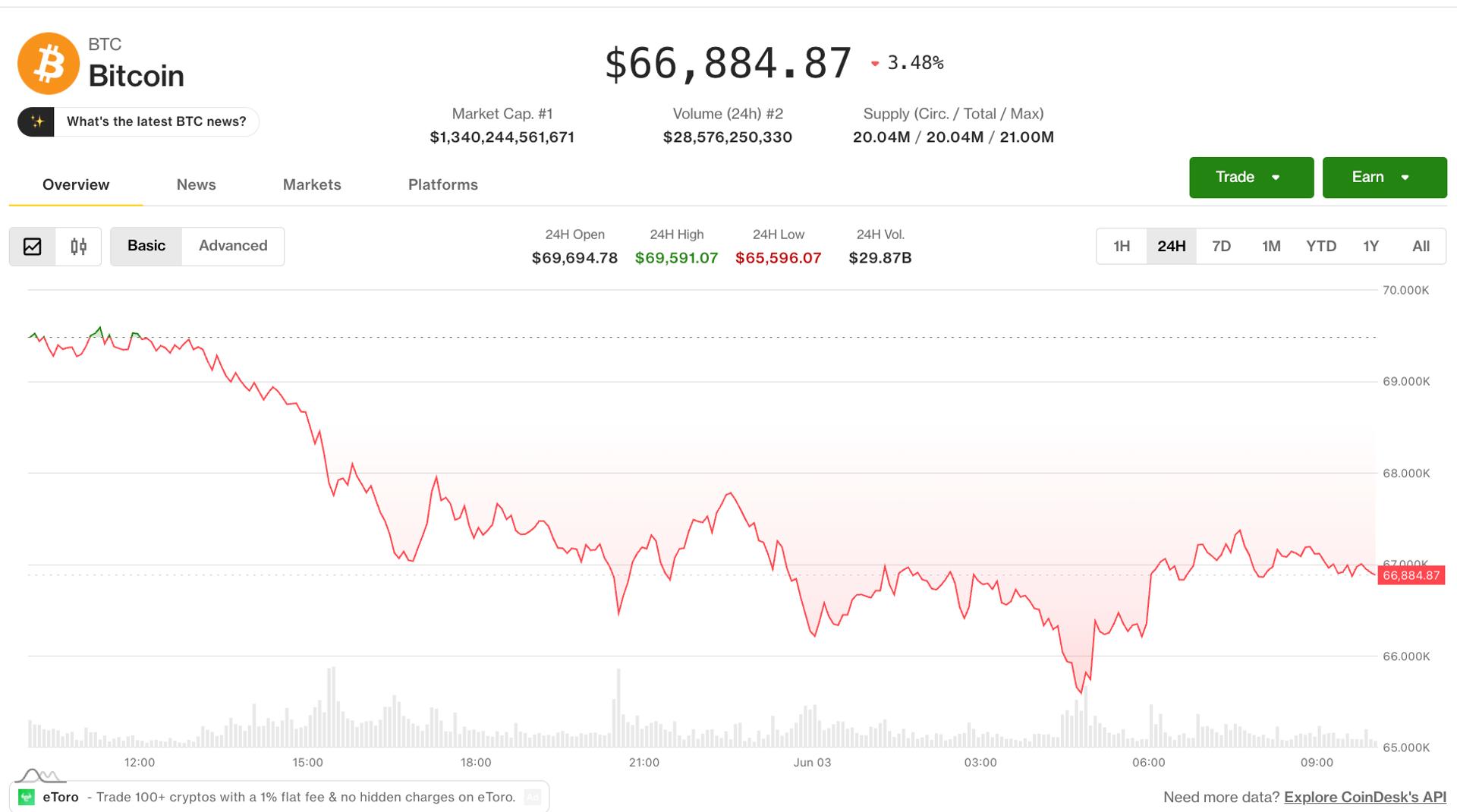
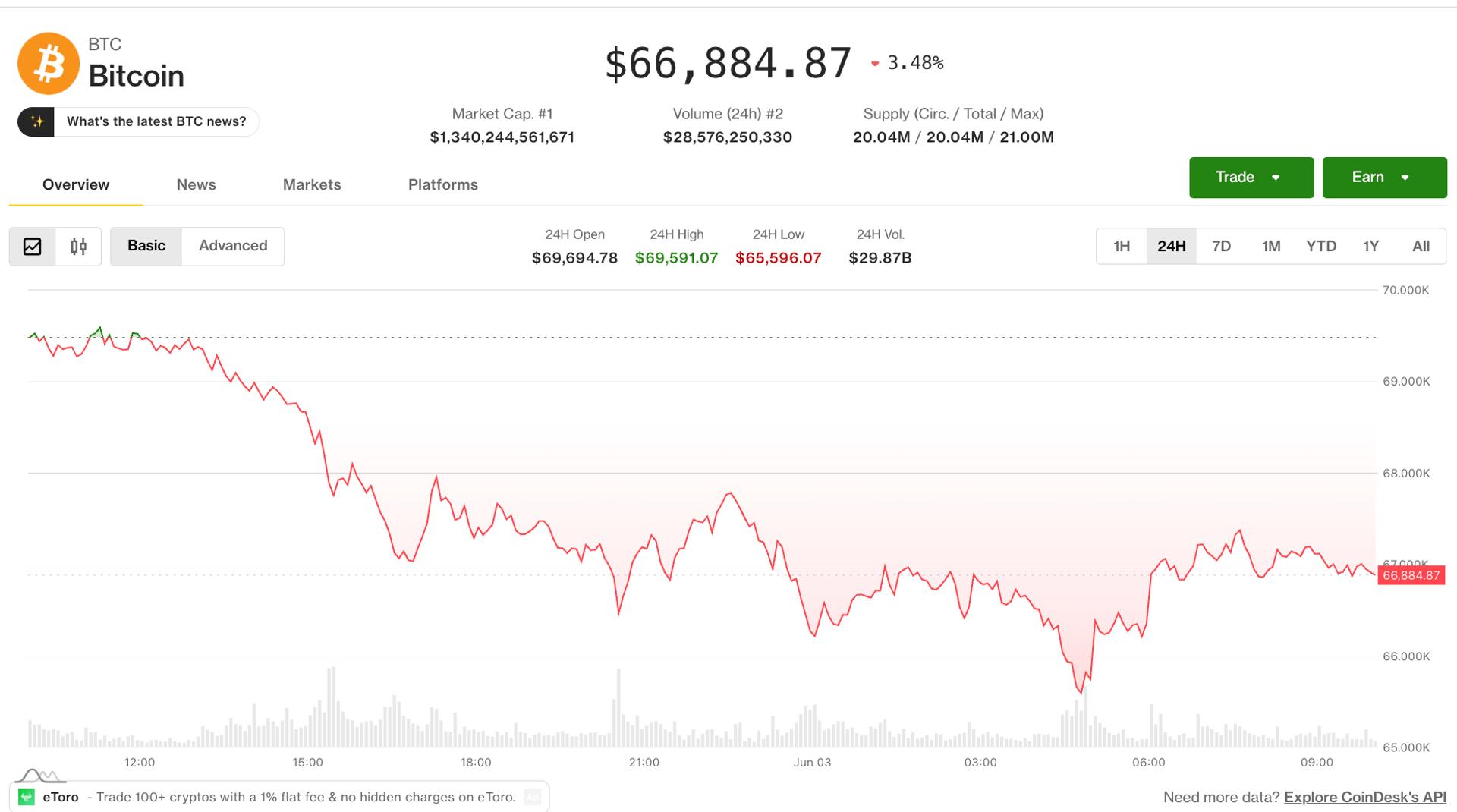
Bitcoin recovered 0.7% on Wednesday, but remains at a crucial crossroads after a 9.5% decline since Sunday.
The largest cryptocurrency traded recently near $67,000, firmly in the middle of a range that persisted between February and April after a failed breakout attempt above $81,000 last month.
If bitcoin tumbles below $60,000 it would probably trigger a wave of liquidations and a possible slide to as low as $54,000, a level of support dating back to both 2024 and 2021.
Ether (ETH), meanwhile, trades at $1,870 after rising by 0.9% since midnight UTC, although the bounce comes after a selloff that saw it tumble to its lowest point since February.
The U.S. stock market rallied to record highs again on Tuesday. The divergence is starting to trigger concerns among some crypto investors because the two asset classes have historically moved in tandem.
AI crypto tokens continued to outperform the peers. NEAR, RENDER and FET all rose by around 9% on Wednesday following Tuesday’s market-wide selloff.
Derivatives positioning
- Over $1.7 billion in leveraged crypto futures bets were liquidated in the past 24 hours, double the day-earlier amount.
- Most liquidations were bullish long positions after BTC slumped to $65,500 earlier today. The 24-hour volume surged 27% to nearly $300 million while cumulative industry-wide notional open interest (OI) fell just over 2%.
- The combination of large liquidations and falling open interest suggests aggressive crowding out of leveraged bullish plays and a reduction in new leveraged exposure.
- Open interest in bitcoin futures hovers at record highs above 800K BTC, up for the third straight day even as spot prices decline. That validates the downtrend and points to an influx of new shorts or bearish positioning.
- The seven-day OI-adjusted cumulative volume delta is negative, indicating bears are leading price action by actively shorting with market orders rather than using passive limit orders.
- Most major tokens, including ETH, ADA, SUI, XRP and SOL, also show negative seven-day and 24-hour cumulative volume deltas, signaling bear leadership across markets. Funding rates for these tokens remain slightly positive to slightly negative, implying the bearish side is not overcrowded and there’s room for further downside.
- Open interest in ZEC futures, however, has risen for the third straight day to 2.43 million ZEC as the token has gained 6.3% over seven days, bucking the broader malaise. ZEC also shows a positive 24-hour CVD alongside HYPE, indicating bullish sentiment.
- Fear is creeping back in. BTC and ETH 30-day implied volatility indices (BVIV and EVIV) jumped sharply Tuesday, posting their largest single-day gains since the Feb. 5 crash. Continued increases in the measure could presage further market pain.
- Options flow on Deribit shows traders paying up for downside protection. The one-week put-call skew climbed to nearly 20% early today, reflecting an outsized demand for puts. The most traded instruments in the past 24 hours were the $70K put expiring June 5 and the $55K put expiring June 26.
- In block flows, BTC call spreads and ETH put spreads were the most favored bets.
Token talk
- Ethena (ENA) is one of Wednesday’s top-performing altcoins, rising by 9.3% since midnight UTC and more than 20% in 24 hours after Coinbase (COIN) said it will integrate Ethena features in a new savings account product.
- There was a notable gain for privacy coin zcash (ZEC). The token has risen 2% since midnight and 12% in the past 24 hours as it attempts to steer itself away from danger.
- CoinMarketCap’s “Altcoin Season” indicator is now at 53/100, the highest since early March as investor appetite for high-risk altcoins remains despite weakness among the crypto majors.
- Humanity protocol (H) appears to be entering a corrective phase after it lost a quarter of its value in 24 hours following a 200% rally in the past week, with clear profit-taking occurring. Daily trading volume dropped 55% to $314 million.


- Ethena (ENA) jumped nearly 20% after the Coinbase open-market token purchase news.
- Anchorage deal expands Ethena into institutional lending markets.
- The next key resistance level sits at around $0.1367.
Ethena’s ENA token has recorded a sharp intraday jump of about 19.5%, pushing the price to roughly $0.1025 at press time.
The sudden rebound has brought Ethena back into focus, especially as trading activity surged to more than $410 million in 24-hour volume, signalling a clear spike in market participation.
While the broader trend remains down over longer timeframes, the short-term price action reflects a strong shift in sentiment tied to recent ecosystem developments.
Coinbase Ventures’ investment in Ethena
A major driver behind the latest rally is Ethena’s deepening relationship with Coinbase.
Coinbase Ventures made its first-ever investment in Ethena by purchasing ENA directly on the open market, a move that immediately stood out to traders because it signalled direct alignment rather than a private funding allocation.
Coinbase Ventures is proud to back @Ethena through an open market purchase of ENA.
Ethena is a critical player in onchain finance, and we are excited for the closer partnership with Coinbase and USDC.
— Coinbase Ventures 🛡️ (@cbventures) June 2, 2026
More importantly, Coinbase is not treating Ethena as a passive investment. The two are working on a broader rollout of on-chain savings and financial products designed for Coinbase’s user base of more than 100 million accounts.
This includes integration of Ethena’s synthetic dollar ecosystem into Coinbase-linked savings products, with early initiatives expected to launch within days of the announcement.
The market reaction reflects how distribution can shift valuation expectations.
Access to Coinbase’s retail and institutional ecosystem introduces a potential pathway for Ethena’s USDe and related yield products to reach users far beyond crypto-native platforms.
That potential expansion is a key reason ENA saw a sharp repricing in such a short window.
Anchorage Digital partnership
Alongside Coinbase, Ethena has also expanded its infrastructure reach through a partnership with Anchorage Digital.
The collaboration introduces a framework for institutional off-chain lending using Anchorage’s Atlas platform, which handles collateral custody, risk monitoring, and liquidation controls.
This setup allows institutions such as asset managers and trading firms to access crypto credit markets without taking direct custody of assets.
Anchorage holds collateral within a regulated structure while Ethena manages capital deployment into lending operations.
The lending system is designed to unlock new yield streams beyond Ethena’s existing synthetic dollar mechanics.
It also marks a shift in strategy, as Ethena moves from purely DeFi-based yield generation toward a hybrid model that includes institutional credit exposure.
Ethena’s underlying technicals remain stable
While ENA has been volatile, the technical analysis shows no signs of instability.
And looking at the Ethena charts, technical indicators show a mixed signal environment with a majority in the neutral zone.
Oscillators lean slightly bearish, while moving averages are evenly split between buy and sell signals.
The 14-day RSI sits at 39.56, placing it in a neutral zone where neither buyers nor sellers dominate momentum.
ENA currently trades below all its exponential moving averages (EMAs), including the 10-day, 20-day, 50-day, 100-day, and 200-day EMAs, suggesting the broader structure remains bearish.

Outlook for ENA price movement
Despite the strong daily move, Ethena remains in a broader downtrend when viewed over longer periods.
The token is still trading significantly below previous highs, and the technical structure remains mixed.
Short-term indicators show momentum returning, with price action recently breaking above multiple resistance levels during the intraday rally.
However, the presence of resistance from shorter-term exponential moving averages suggests that the move is still developing rather than fully confirmed as a trend reversal.
At the same time, total value locked within the Ethena ecosystem remains above $4.5 billion, indicating that usage levels have not collapsed alongside price.
This divergence between protocol activity and token valuation is now one of the central points of market focus.
Future price movement is likely to depend on whether upcoming product launches tied to Coinbase integration translate into measurable user adoption.
If onboarding through Coinbase and institutional lending flows begin to scale meaningfully, Ethena’s valuation could continue to re-rate alongside its expanding financial infrastructure footprint.
If ENA holds above the $0.10 breakout level and the onboarding through Coinbase and institutional lending flows begin to scale meaningfully, a move toward the next resistance near $0.1367 is plausible.
However, there is a risk of a “sell the news” reaction after the launch, or if the broader market sell-off intensifies, it could potentially push the price back to test support at $0.095.
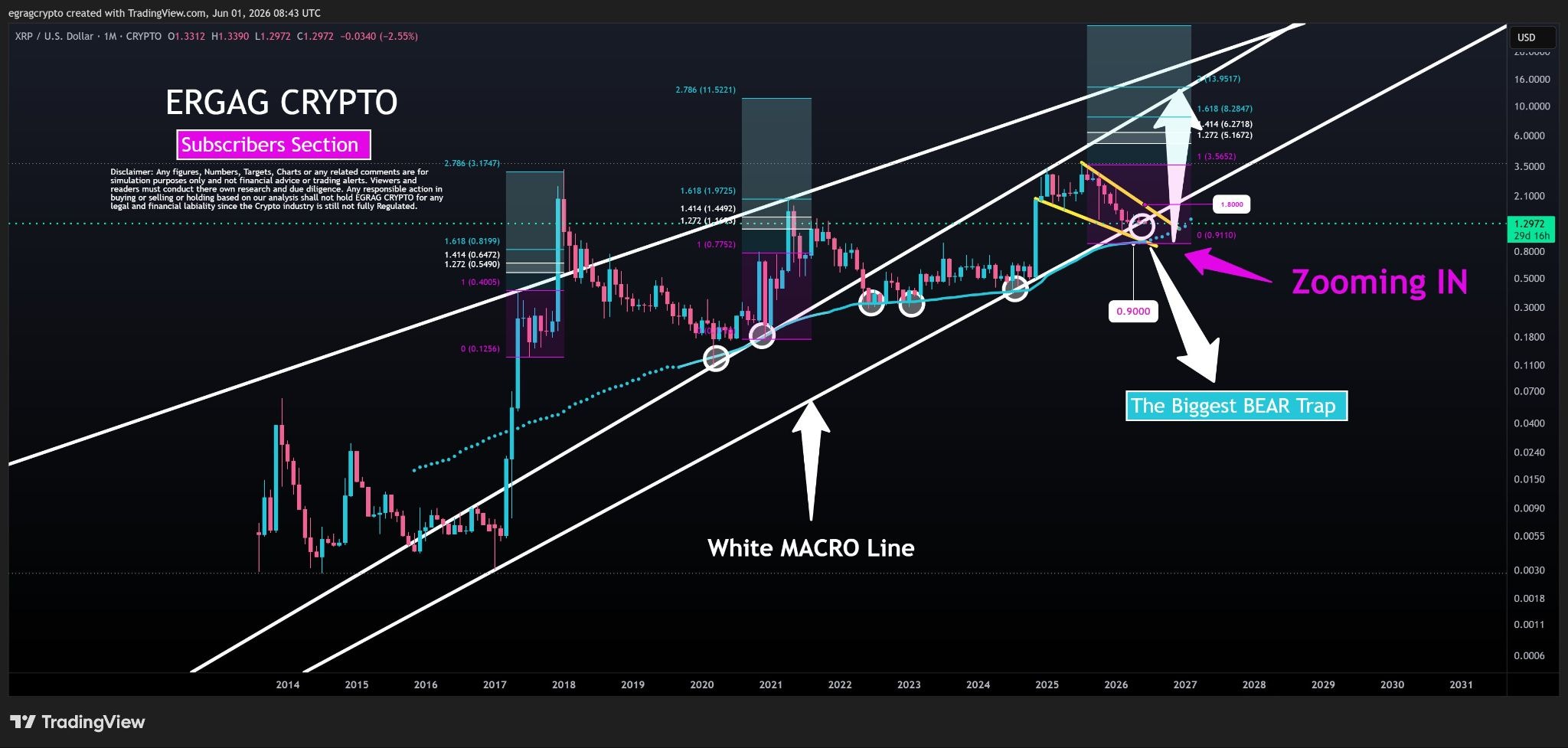
XRP (XRP) dropped to $1.25 on Tuesday after a market-wide sell-off, erasing all the gains made since early February.
Key takeaways:
- XRP fell to $1.25 after a broader market sell-off, testing a long-term trend line and the 50-month exponential moving average support area.
- Support weakness has traders looking at $1 and under next, while optimists see a “bear trap” forming.
- June has historically been a weak month for XRP, with traders increasing bets on a drop below $1.20.
XRP price action teases “bear trap”
Data from TradingView shows that the XRP price opened June at $0.33, just below the 50-month exponential moving average (EMA).
More importantly, XRP is also trading “directly on/slightly below the White MACRO Trend Line,” analyst Egrag Crypto said in a Monday post on X, referring to the multi-year ascending trend line that has supported the price since 2017.
Related: Three key XRP metrics suggest ‘explosive price expansion’ is next
In previous instances, when XRP opened the month below the 50 EMA during macro drawdowns, the “structure often begins to form a bottoming zone,” as shown in the chart below. Currently, the price is trading below the macro trend line. The price might wick below it before recovering, as seen in 2020, 2023 and 2024.
“The market is leaning heavily bearish,” Egrag Crypto said, adding:
“If XRP reclaims the 50 EMA and the Macro trend line, this setup could become one of the biggest bear traps of the cycle.”
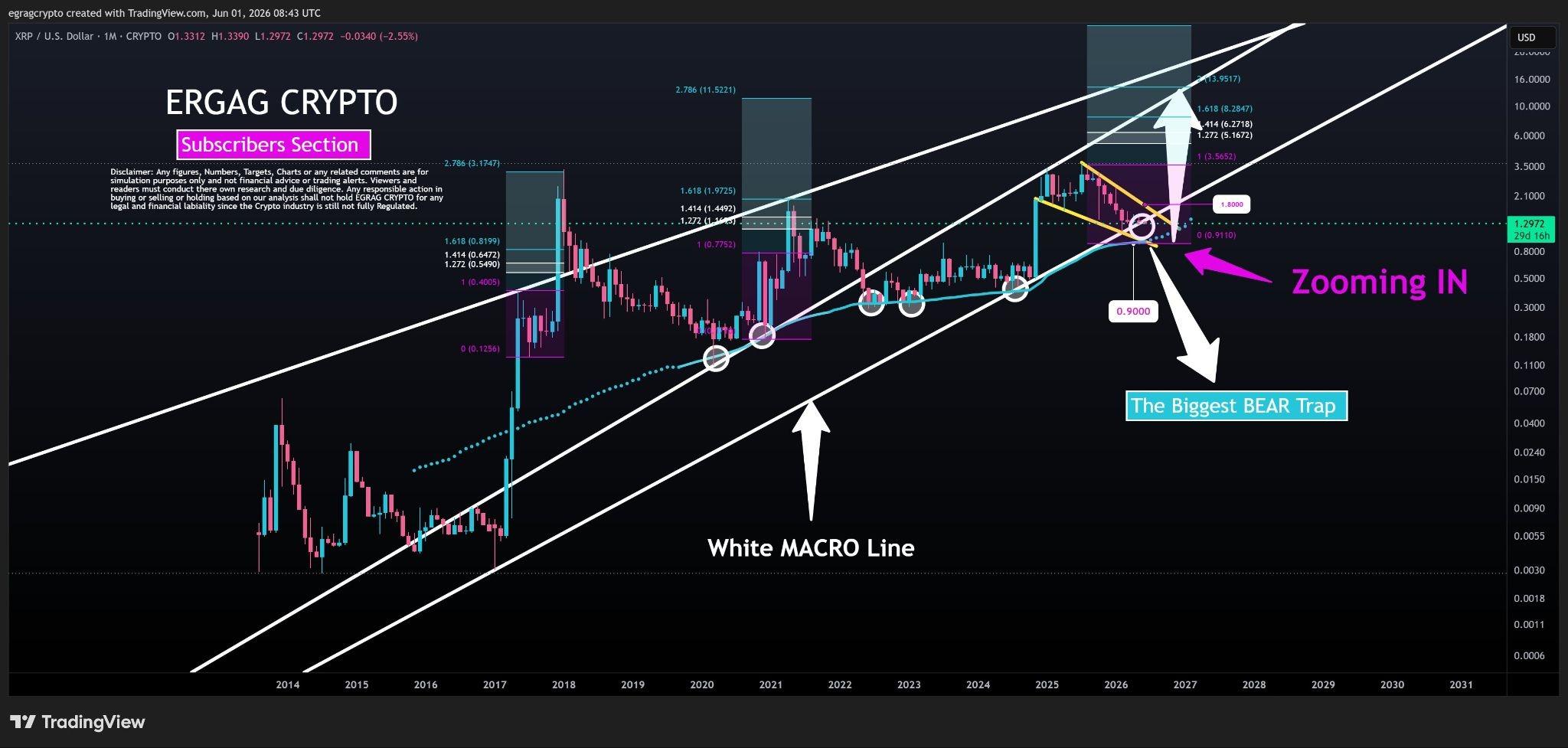
XRP/USD one-month chart. Source: X/Egrag Crypto
For analyst ChartNerd, a target for new local lows lay at around $0.70-$0.90.
“Many of you admire this beautiful $XRP fractal, which leaves the door open to a $0.90/$0.70 XRP before any major reversal,” the trader summarized alongside a chart showing a potential bottoming zone for XRP.
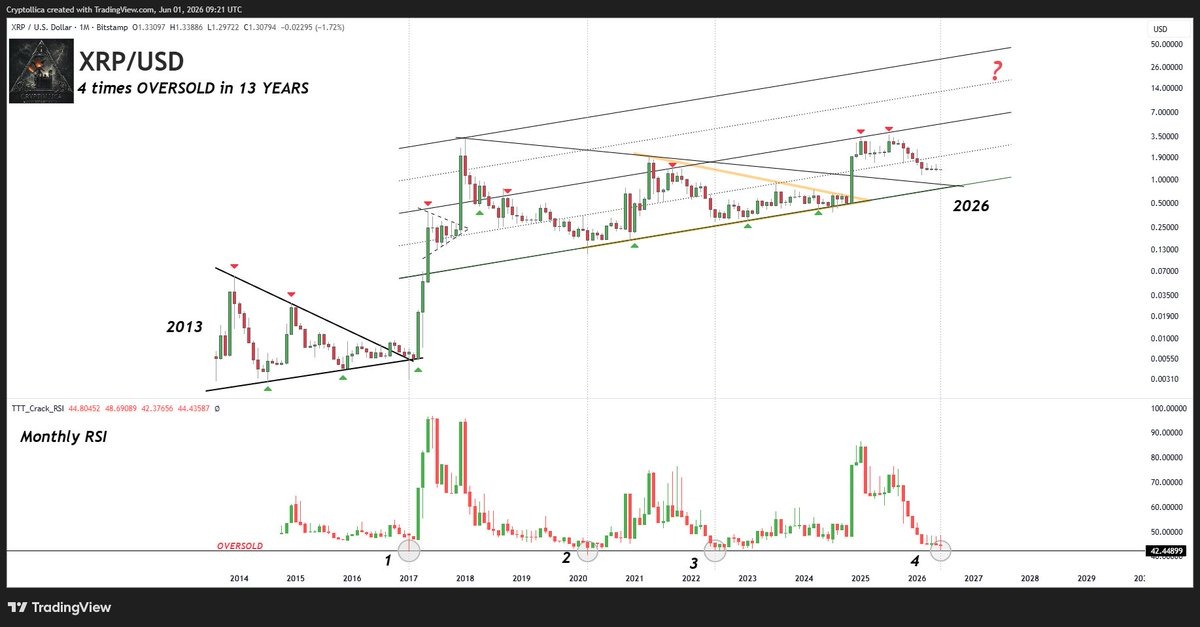
XRP/USD monthly chart. Source: X/ChartNerd
Fellow analyst Kamile Uray said $1.26-$1.30 was an important support zone, which bulls were required to defend to prevent a deeper correction toward $0.94-$1.11.
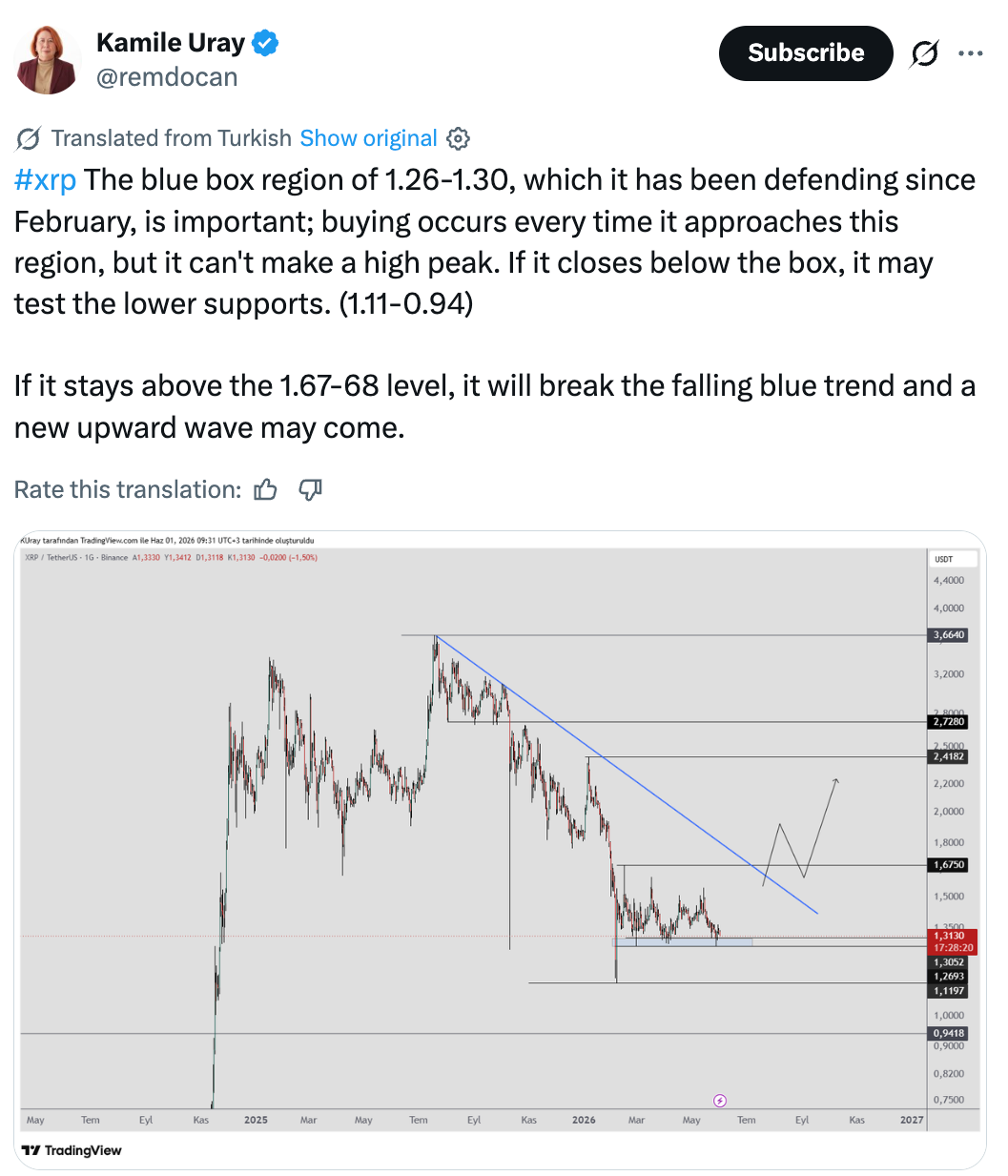
XRP/USD daily chart. Source: X/Kamile Uray
As Cointelegraph reported, XRP could drop to retest the Feb. 6 low of $1.11 and then the psychological support at $1 after the $1.27 support was broken.
June is usually a bad month for XRP
Unfortunately for the bulls, XRP tends to struggle in June. Since 2014, the price has closed in the red for eight of the past 12 months, with average returns of about −5%.
The June losses were even more pronounced in years where XRP closed May in the red, according to data from Cryptorank.
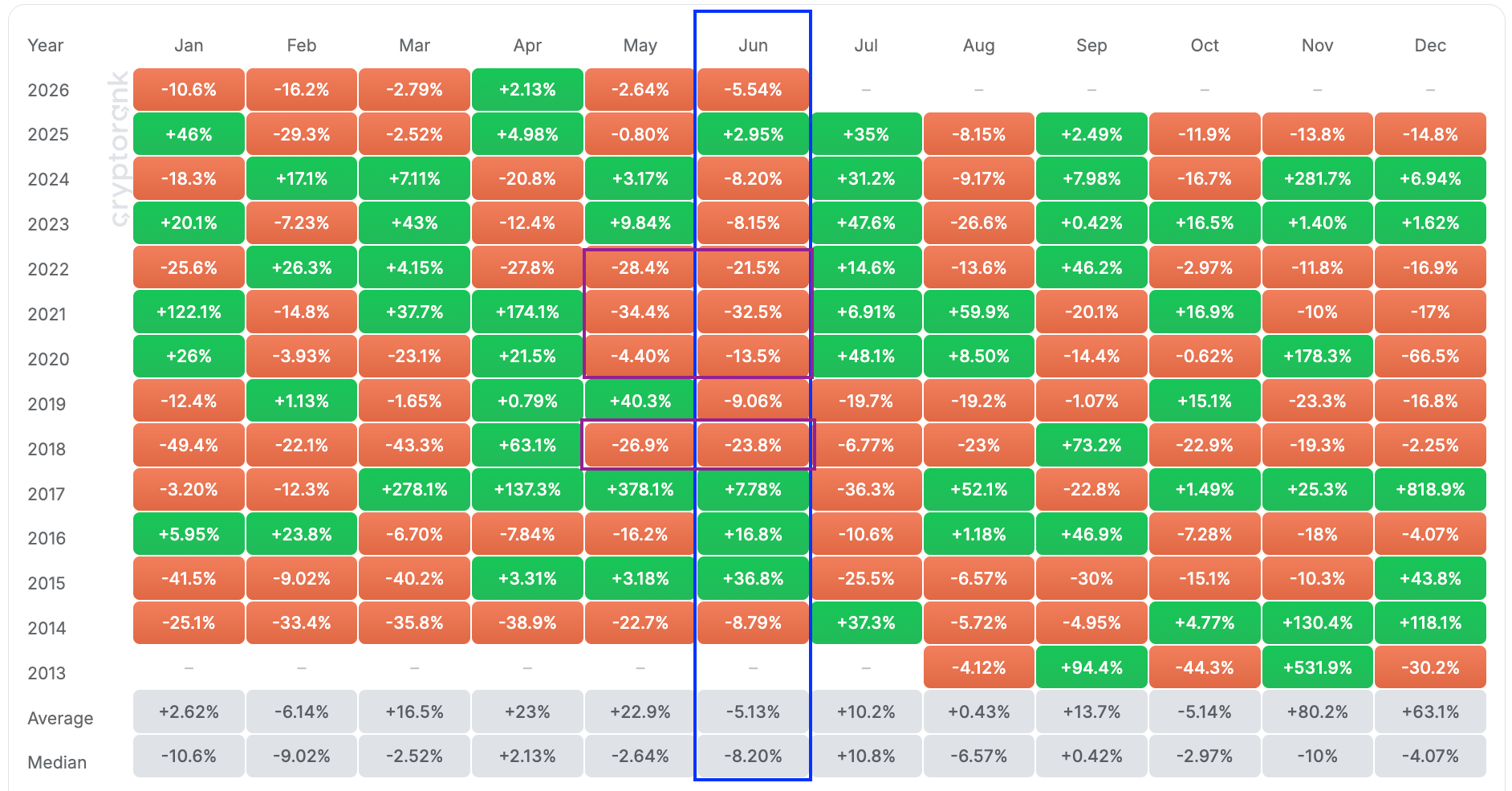
XRP monthly returns. Source: Cryptorank
The chart above shows that the losses are significantly higher in bear cycles, such as 2018’s -23.8% and 2022’s -21.5%.
The -34.4% drop in June 2021 is an outlier due to the US Securities and Exchange Commission’s lawsuit against Ripple, which took a toll on XRP price for years.
If history is anything to go by, XRP’s price action could continue trending lower in June, with a possible recovery beginning in July.

Key Highlights
- ALAB shares climb 11.14% following enhanced Taiwan operations announcement
- Company expands Cloud-Scale Interop Lab to accelerate rack-scale AI validation
- Stock surge linked to strengthened partnerships with AMD, NVIDIA, Arm, and major Taiwan ODMs
- Enhanced Taiwan presence aimed at reducing AI platform deployment timelines
- Expansion positions Astera Labs closer to global AI hardware supply chain
Shares of Astera Labs (ALAB) experienced significant upward momentum following the semiconductor company’s announcement of expanded Taiwan facilities and enhanced Cloud-Scale Interop Lab capabilities. The stock finished trading at $355.76, representing an 11.14% gain, before experiencing modest pre-market retreat to $354.20, a decline of 0.44%. This slight pullback suggested investors took some profits after the substantial intraday advance driven by AI infrastructure growth prospects.
Astera Labs, Inc. Common Stock, ALAB
Company Strengthens Taiwan Operations for AI System Development
Astera Labs announced its enhanced Taiwan presence will bolster engineering capabilities, operational efficiency, and collaboration with key ecosystem partners throughout the AI hardware value chain. The expanded Cloud-Scale Interop Lab facility aims to accelerate platform validation processes. This strategic positioning brings Astera Labs into closer proximity with leading semiconductor manufacturers, server producers, and contract manufacturers.
Taiwan occupies a critical position in global AI system manufacturing, as the region serves as a primary hub for rack-scale platform assembly and integration. Astera Labs’ enhanced local presence seeks to minimize bottlenecks in debugging processes, diagnostic procedures, and qualification workflows. Furthermore, the company anticipates that increased on-site support will enable customers to transition systems from development to production environments more efficiently.
This expansion complements Astera’s recent enhancements to its Scorpio fabric switch product line. The updated portfolio accommodates flexible 32-to-320-lane configurations designed for advanced rack-scale AI infrastructure. Therefore, the expanded Taiwan operations provide additional resources to address sophisticated connectivity requirements across distributed AI computing clusters.
Strategic Partnerships Accelerate Platform Validation Cycles
Astera Labs identified key technology partners including AMD, Arm, Intel, and NVIDIA as collaborators benefiting from the enhanced Taiwan operations. The company also maintains active relationships with prominent Taiwan-based original design manufacturers such as GIGABYTE, Ingrasys, Inventec, Quanta Cloud Technology, and Wiwynn. This comprehensive partner network facilitates integrated validation spanning chip architecture, system design, and volume manufacturing.
Contemporary AI infrastructure initiatives demand accelerated coordination among semiconductor vendors and system integrators. Training platforms and inference deployments require thorough testing protocols before entering large-scale production. Accordingly, Astera’s expanded laboratory provides collaborative space for early-stage platform verification among multiple stakeholders.
The company indicated its Taiwan-based team will expand expertise across hardware engineering disciplines, technical support functions, quality assurance, and operational management. These competencies help minimize development cycle duration during product refinement and platform certification processes. They enable more responsive troubleshooting when customers encounter design challenges or integration complications.
Stock Performance Reflects Growing AI Infrastructure Focus
The 11.14% closing gain for ALAB demonstrated robust investor interest following the Taiwan expansion disclosure. The modest pre-market decline indicated short-term position adjustments after the significant single-day advance. However, the stock retained the majority of its gains, maintaining investor attention on Astera’s strategic position within AI infrastructure development.
Astera’s core business operates within the rapidly expanding semiconductor connectivity sector serving AI data center applications. Rack-scale architectures demand high-performance interconnects among GPUs, CPUs, memory subsystems, switching fabric, and networking components. Consequently, validation efficiency has emerged as a critical determinant in AI computational capacity deployment timelines.
The Taiwan facility expansion strengthens Astera’s geographic positioning within the ecosystem responsible for advanced AI system production. It also facilitates enhanced customer engagement at industry events like Computex 2026, where AI infrastructure continues as a prominent focus area. Thus, the ALAB share price rally reflects heightened investor interest in companies positioned to enable AI infrastructure scaling and deployment.


Best Buy has begun selling Tangem’s crypto hardware wallets across more than 200 US stores. The move puts the Swiss firm’s cold storage devices on mainstream electronics shelves for the first time at this scale.
It is Tangem’s largest US retail expansion to date, adding to its presence at Walmart and Amazon. The rollout lands as more holders move crypto off exchanges and into self-custody.
Crypto Hardware Wallet Demand Climbs After a Record Theft Year
Hardware wallets keep private keys offline, away from exchanges and internet-connected apps. That design has drawn buyers who now grasp the importance of self-custody as platforms keep losing customer funds.
Stolen crypto reached $3.4 billion in 2025, according to Chainalysis. The $1.5 billion Bybit breach ranked as the largest single hack in the industry’s history. That total topped the prior year and renewed scrutiny of how exchanges guard deposits.
Theft also reached individuals, with roughly 158,000 personal wallet compromises last year. Stricter platform rules and identity checks have pushed more users toward self-held keys.
Analysts at Mordor Intelligence expect the hardware wallet market to reach $2.25 billion by 2031. They value it near $720 million in 2026, with retail shoppers driving most sales. That demand has widened the field of best hardware wallets competing for shelf space.
Two Tangem products are on Best Buy shelves. One is a credit card-sized NFC card. The other is the Tangem Ring, a ceramic wearable.
Both keep private keys on a secure chip rather than on a server or phone. Tangem uses backup cards in place of a written recovery phrase, though owners can still import one.
Tangem is not alone in the push. Trezor is simplifying crypto self-custody for newcomers, while Block Inc. has taken its own self-custody Bitcoin wallet to a wide market. Whether big-box distribution turns casual shoppers into self-custody users is the question the industry will watch next.
The post Tangem Pushes Offline Crypto Hardware Wallets Into 200 US Stores appeared first on BeInCrypto.

‘Ted Lasso’ Secrets Emerge As Jason Sudeikis Faces Heat

Trinidad and Tobago’s stance on US imperialism could upend trade bloc

MSTR SOLD BITCOIN… Here’s The REAL Story #crypto #mstr #bmnr #cryptocurrency



-

 NewsBeat7 days ago
Israel says it has killed new Hamas military leader in Gaza City airstrikes
-

 Tech5 days ago
Waymo dominates autonomous vehicle registrations as Tesla trails behind
-

 News Videos5 days ago
This is BROKEN! INSANE 5x MONEY CAR WASH WEEK! The NEW GTA Online UPDATE Today! (GTA5 New Update)
-
 Tech4 days ago
SpaceX just won a second Golden Dome contract. This one is $4.16 billion.
-

 News Videos5 days ago
SHE IS KILLING XRP!!! WATCH URGENT AND ACT FAST
-
 NewsBeat4 days ago
FIRST NIGHT REVIEW: Take That bring the Circus back to life in spectacular sun-soaked style
-

 Business2 days ago
Jade Biosciences, Inc. (JBIO) Discusses Positive Interim Results From JADE101 Phase I Healthy Volunteer Study and Development Plans Transcript
-

 Tech7 days ago
The Samsung pay deal is the moment Korean unions changed register
-
Crypto World5 days ago
CFTC Has Approved the First Regulated Bitcoin Perpetual Contract in the U.S.
-

 Business4 days ago
Is the Spurs Phenom Already Better Than Prime Diesel?
-
 NewsBeat5 days ago
Novak Djokovic v Joao Fonseca LIVE: French Open latest scores and results after Jannik Sinner’s shocking collapse
-
 Crypto World5 days ago
Snowflake (SNOW) Stock Rallies on Strong Q1 Results and AI Product Growth
-
 Entertainment4 days ago
Weak ‘Supergirl’ Box Office Tracking Amid Milly Alcock Backlash
-

 Business4 days ago
Demand Conditions Improve In Chemicals Sector In April 2026
-
 Crypto World5 days ago
MicroStrategy Moves $30 Million in BTC to Coinbase Prime: Is the Bitcoin Sell-Off Already Here?
-

 Politics4 days ago
The House | Inside Andy Burnham’s Makerfield Campaign: “Nobody Thinks This Is In The Bag”
-

 Tech5 days ago
This Week In Security: Ubiquiti Fixes, And FreeBSD Joins The Club You Don’t Want To Join
-
 Entertainment4 days ago
One of the Greatest Sitcoms of All Time Shoots Up Apple TV’s Charts 11 Years Later
-

 Entertainment5 days ago
Maddox Jolie-Pitt Legally Requests to Drop Brad’s Surname
-

 Entertainment7 days ago
Marshals Stars Address Possible Exit From Yellowstone Spinoff
You must be logged in to post a comment Login