
Crypto World
Bitcoin Price Prediction: Decoupling From Tech Stocks, Reshaped by War and AI


Bitcoin price is doing something it hasn’t done in months by moving on its own terms, breaking the recent bearish prediction. Trading near $68,500 and dropping by 2% today, BTC is quietly separating from the tech equity complex that dragged it lower through most of early 2026.
The catalyst isn’t a halving narrative or ETF inflow. It’s war, and the AI valuation crisis that is hitting software stocks. The full implications for price haven’t been priced in yet.
Since the outbreak of the U.S.-Iran conflict on Feb. 28, Bitcoin’s correlation with the iShares Expanded Tech-Software Sector ETF (IGV) collapsed from near-perfect alignment at close to 1.0 to just 0.13, a level signaling near-total decoupling, before partially recovering to around 0.7.
WOW all eyes on $IGV capitulating now – almost a 1-1 correlation to Bitcoin, does this mean the BTC bottom is in? tick tock, tick tock — Satoshi Flipper (@SatoshiFlipper) February 27, 2026

 https://t.co/BOzHMkMne3
Over that same period, Bitcoin has risen more than 5% while IGV has dropped more than 2%. The gap is widening. Investors appear to be rotating out of software equities, where AI-driven margin compression is hammering SaaS multiples, and treating Bitcoin as a macro hedge instead, a role gold has occupied for decades. Geopolitical shock has a way of accelerating these thesis shifts.
The 1 year chart still shows both assets deeply underwater, Bitcoin down 10%, IGV off 15%, but the divergence since late February suggests the relationship is fundamentally changing.
Discover: The best crypto to diversify your portfolio with
Bitcoin Price Prediction: Reclaim $75K as the Tech Decoupling Deepens?
At current levels, Bitcoin is trading roughly 30% below its October all-time high after a peak-to-trough decline of approximately 50%. IGV peaked slightly earlier and fell about 35% from its own top, a shallower drawdown, but one now accelerating as AI disruption fears mount across enterprise software. The divergence in recovery trajectories is stark.
The key technical level to watch is the $67,000 range. The level has flipped from resistance to support following this week’s move. A hold above that level keeps the bull case intact. The next meaningful resistance cluster sits near $74,000–$75,000, where prior consolidation and moving average confluence converge.
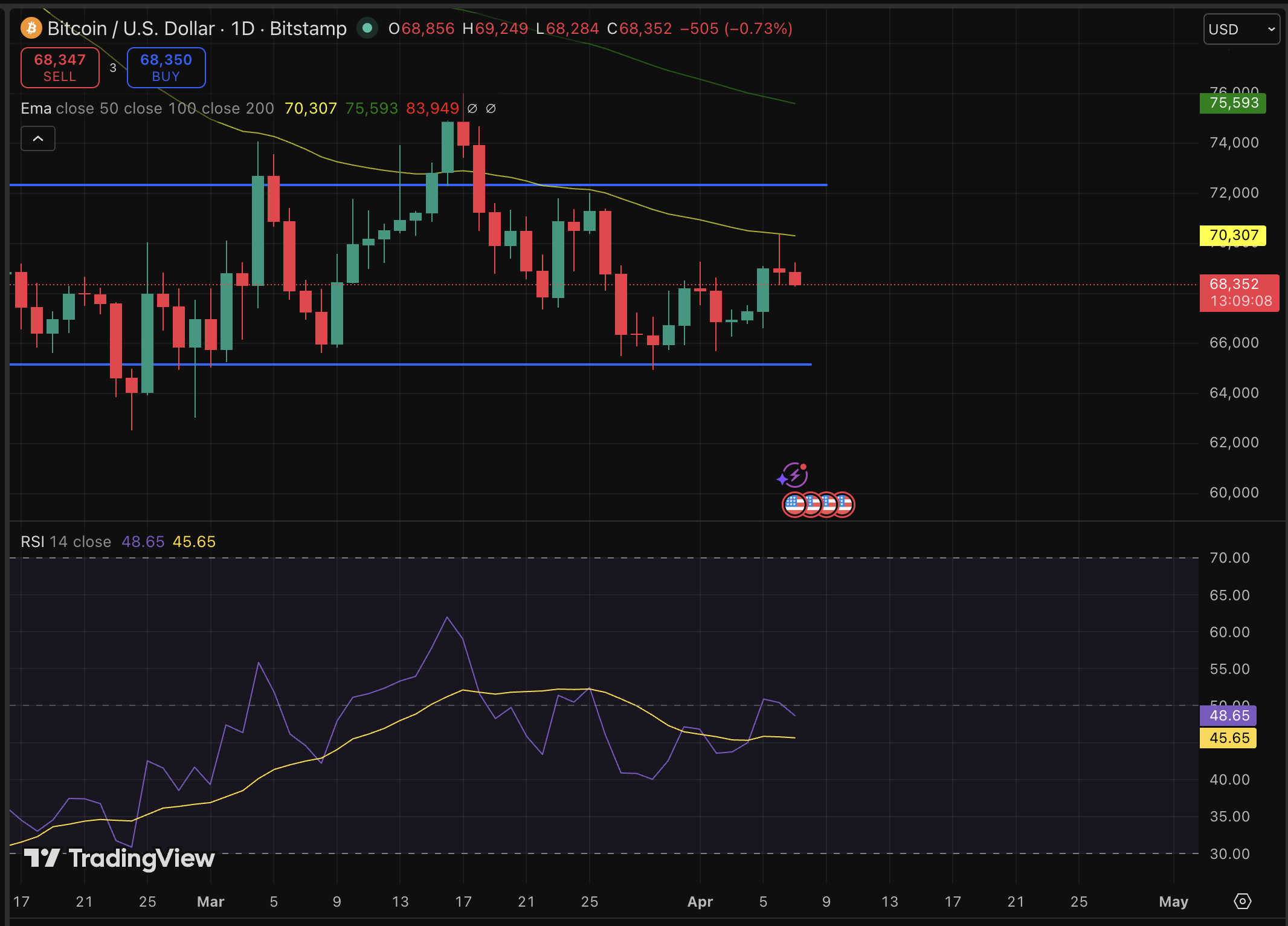
For the bulls, geopolitical tension that sustains macro-hedge demand will keep IGV’s correlation suppressed near 0.3–0.5, and BTC breaks toward $75,000–$78,000 over the next 2–4 weeks.
But, correlation can drift back toward 0.7 as markets stabilize; BTC consolidates between $67,000 and $72,000 while macro catalysts remain ambiguous. A breakdown below $67,000, or a re-coupling with equities if risk-off sentiment deepens, reopens a path toward the $54,000 level flagged by more bearish technicals.
Year-to-date, Bitcoin remains down roughly 10%, matching IGV’s losses almost exactly. That symmetry is now breaking. Whether this week’s move is a structural shift or a head-fake is the only question that matters right now.
Discover: The best pre-launch token sales
Bitcoin Hyper Targets Early Mover Upside as Bitcoin Tests Key Levels
Bitcoin at $68,500 is recovering, but a spot BTC position from here still means waiting on macro catalysts, regulatory timelines, and a 30%-plus move just to return to all-time highs. Early-stage infrastructure in the Bitcoin ecosystem offers a different risk profile entirely.
Bitcoin Hyper ($HYPER) is positioning itself at the intersection of two converging trends: Bitcoin’s resurgence as a macro asset and the explosive demand for scalable smart contract infrastructure. The project claims to be the first Bitcoin Layer 2 integrating the Solana Virtual Machine (SVM), delivering sub-second finality and low-cost smart contract execution while anchoring security to Bitcoin’s base layer.
The presale has raised $32 million at a current price of $0.0136, with 36% APY staking rewards live for early participants. The Decentralized Canonical Bridge enables native BTC transfers into the ecosystem without custodial risk.
For traders who believe Bitcoin’s decoupling thesis has legs, research Bitcoin Hyper as a higher-beta way to express that conviction at the infrastructure layer.
The post Bitcoin Price Prediction: Decoupling From Tech Stocks, Reshaped by War and AI appeared first on Cryptonews.


TLDR
- Voltage conducted a 30-day pilot that processed 88.2 BTC over the Bitcoin Lightning Network for an iGaming operator.
- The pilot handled 237,000 payments with a 99.94% success rate and an average settlement time of 1.86 seconds.
- The report found that 80% of deposits and withdrawals came from Cash App users using Lightning.
- Bitcoin Lightning reduced transaction fees to about 0.0029% per payment during the trial period.
- Lightning transactions removed chargeback risk because payments settle instantly and remain irreversible
Bitcoin’s Lightning Network is moving deeper into online gambling payouts, according to a new report from Voltage. The company released fresh pilot data that shows instant withdrawals and near-zero fees for operators. The findings position Lightning as a working payment rail for real-time betting markets.
Voltage based its report on a 30-day pilot with a single iGaming operator. During that period, the platform routed 88.2 BTC through Lightning and processed 237,000 payments. The system recorded a 99.94% success rate and averaged 1.86 seconds for settlement.
The company stated that 80% of deposits and withdrawals came from Cash App users. That figure shows that mainstream wallets already support large Lightning volumes. Voltage said this dynamic brings Bitcoin closer to daily payment use inside gambling platforms.
Bitcoin Lightning Cuts Fees and Settlement Times
Voltage compared on-chain Bitcoin transfers with Bitcoin Lightning transactions in the report. On-chain payments can take minutes or hours, and fees can rise during congestion. By contrast, Lightning routes payments through peer-to-peer channels and settles later on the base chain.
The pilot showed that operators paid fees of under one cent per transaction. Voltage calculated that the average fees reached about 0.0029% of the transaction value. The report said Lightning runs about 1,000 times cheaper than card processors on a percentage basis.
Traditional card networks usually charge between 2.9% and 5% per payout. They also allow chargebacks weeks after funds leave an account. Lightning transactions are final and irreversible, which removes chargeback exposure.
Voltage wrote, “Operators do not need to trust a separate governance structure or bridge.” The company added that Lightning inherits Bitcoin’s proof-of-work security when channels close. As a result, operators can move funds without relying on external validator groups.
The report stated that instant settlement reduces reserve balances held for processing risk. Operators can free capital that would otherwise sit in clearing accounts. That shift increases capital velocity inside live betting platforms.
Bitcoin Lightning Gains Traction in iGaming
Voltage-linked payout speed is directly tied to player retention metrics. Surveys cited in the report showed that 72% of players rank payout speed among their top three loyalty drivers. The data also showed that 71% left a platform due to slow withdrawals.
The company argued that instant Bitcoin Lightning payouts create a direct link between gameplay and wallet balance updates. A winning bet can reflect in seconds inside a supported wallet. That speed reinforces user trust in platform operations.
The report also compared Lightning with other blockchain networks. Ethereum mainnet can move ERC-20 tokens but uses 15-second blocks and a shared global state. Fees on Ethereum can rise to $10 or $30 during congestion periods.
Voltage said Tron and Solana offer lower fees and higher throughput. However, it pointed to smaller validator sets and past outages on those networks. The company presented Bitcoin’s network effect as a differentiating factor.
Public Lightning capacity now stands in the thousands of BTC, according to the report. Mobile Lightning wallets number in the millions worldwide. Voltage also references Taproot Assets, which allow stablecoins like USDT to move over Lightning rails.
Tether has announced support for Lightning-based transfers using this framework. That setup combines dollar-linked balances with Bitcoin infrastructure. The report closed by stating that operators can now process instant BTC or USDT payouts over the same network.

Crypto World
Who’s pledging to Aave’s $300 million DeFi recovery effort after massive Kelp DAO exploit
In the often-fractured world of decentralized finance, crises tend to expose fault lines. This time, they’re also revealing an unusual level of coordination.
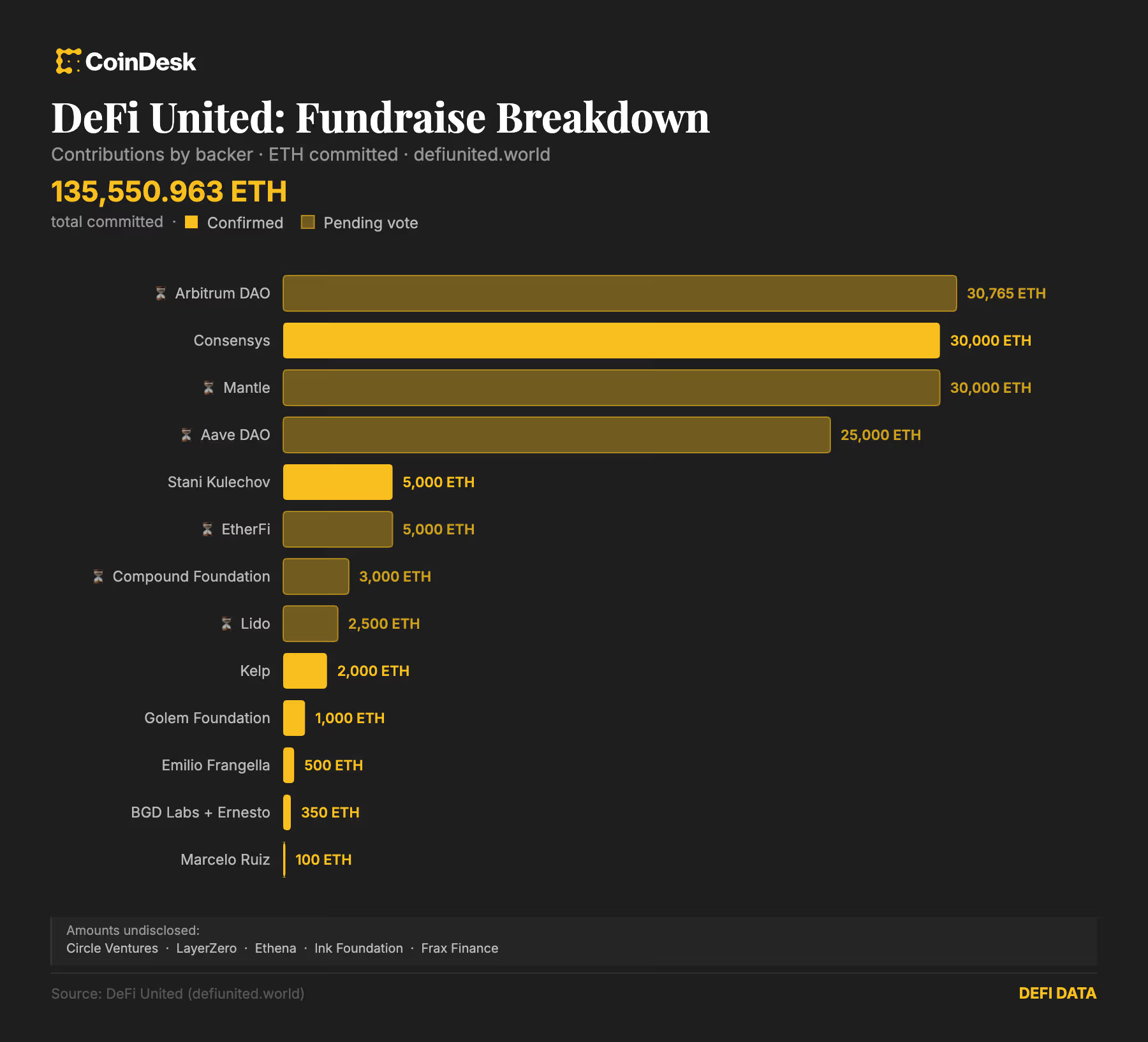
Aave, one of DeFi’s largest lending protocols, is at the center of a broad recovery effort following losses tied to the Kelp DAO exploit, drawing in capital and credit commitments from across the industry. The effort, informally dubbed “DeFi United,” has raised about $303 million in commitments as of Monday, according to its website, with much of the capital still pending governance approval.
The exploit, which rippled into rsETH markets and created risk across lending positions on Aave, has prompted what is shaping up to be one of the most coordinated industry responses to a DeFi incident.
“There’s a shared priority around supporting users and restoring normal market conditions,” an Aave Labs spokesperson told CoinDesk. “Many of these participants are deeply connected to DeFi, whether through infrastructure, capital, or user access, and have a direct interest in ensuring markets function as expected.”

At the core of the effort is Aave itself. A governance proposal outlines a plan for the DAO to allocate up to 250,000 ETH as part of the recovery. Founder Stani Kulechov has separately indicated he would donate 5,000 ETH personally. Other contributors within Aave’s orbit are also stepping in, including Aave’s Emilio Frangella (500 ETH), BGD Labs’ Ernesto Boado (100 ETH), BGD Labs (250 ETH), and KPK’s Marcelo Ruiz de Orlano (100 ETH).
‘Long-standing’ relationships
But the response has quickly extended beyond Aave, and in some cases began with direct outreach.
Following the April 18 bridge hack that impacted rsETH, Kulechov reached out to Consensys and other ecosystem participants early to help coordinate a response, according to a Consensys spokesperson.
The firm, alongside its founder Joseph Lubin, agreed to commit up to 30,000 ETH in financial support to help advance the recovery and protect users. Sharplink played a strategic advisory role in those discussions, the spokesperson said.
“The Ethereum ecosystem has always been at its best when it moves together,” Lubin said in a statement. “DeFi United is exactly that, a broad, coordinated response to protect users and strengthen the infrastructure we’ve all helped build. Consensys is proud to contribute alongside other stewards in the ecosystem.”
The effort has also drawn smaller contributions from across the community.
Lido has put forward a proposal to allocate up to 2,500 stETH, while EtherFi is discussing a 5,000 ETH plan aimed at supporting users and limiting bad debt across DeFi. Mantle has proposed a 30,000 ETH credit facility loan, adding to a growing pool of backstop liquidity. Compound also put forward a proposal to give up to 3000 ETH to the fund.
Other contributions are taking the form of deposits into Aave itself. Babylon Foundation plans to deposit $3 million in USDT, while Renzo has supplied more than $10 million from its treasury. Circle Ventures is purchasing AAVE tokens, and additional deposits have come from entities including Avalanche Foundation, Solana Foundation, and Justin Sun, according to Aave Labs.
The list of participants continues to grow. Entities that have not publicly specified the size of their commitments include Ethena, LayerZero, Frax Finance, and Ink Foundation, alongside Tyro.
“These are long-standing Aave relationships across the ecosystem,” the Aave Labs spokesperson added. “Teams like Consensys, Sharplink, and others have been in close contact throughout.”
Not all contributions are structured the same way. Some participants are offering grants, others deposits, and several are extending credit lines, highlighting different approaches to balancing support with risk management.
In parallel, Aave Labs has put forward a proposal asking Arbitrum governance to approve the release of roughly 30,765.67 ETH immobilized by the network’s Security Council into the coordinated remediation effort, with the goal of “making affected rsETH holders whole” and restoring rsETH’s backing.
Much of the capital remains subject to governance approval, and several proposals are still under discussion. Even so, the breadth of participation underscores how widely the exploit’s impact has been felt across DeFi.
“The Ethereum ecosystem has always been at its best when it moves together,” Lubin said. “DeFi United is exactly that: a broad, coordinated response to protect users and strengthen the infrastructure we’ve all helped build.”
Ian Allison contributed reporting.
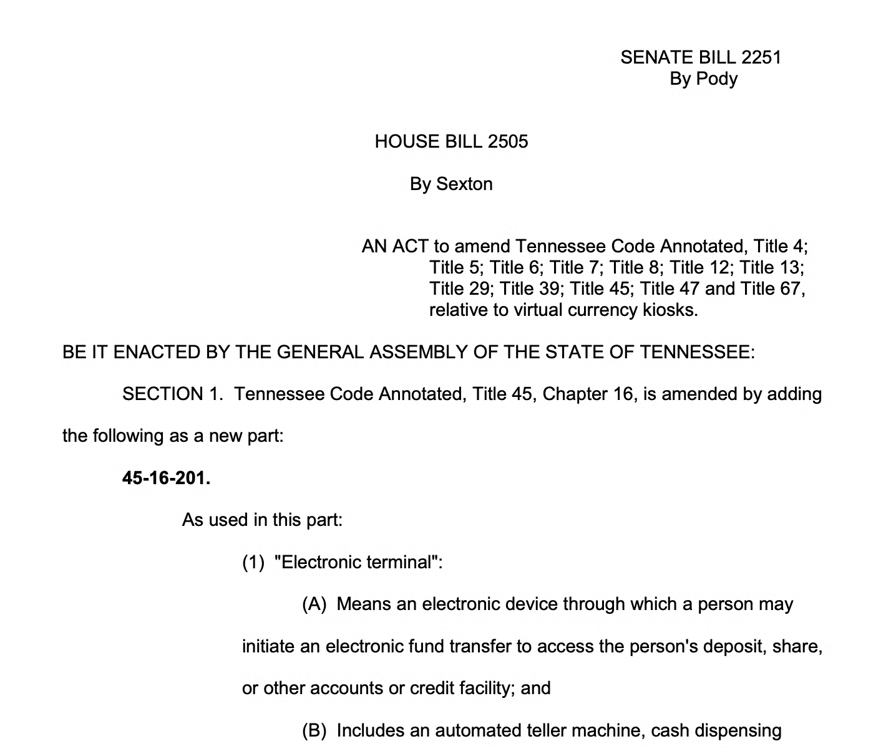
Tennessee Governor Bill Lee has signed a bill into law that will officially ban the use and installation of cryptocurrency ATMs and kiosks in the southeastern US state, leaving only a matter of weeks for companies to be in compliance.
Lee signed Tennessee House Bill 2505 into law on April 13, making the installation of a cryptocurrency kiosk a Class A misdemeanor starting on July 1. The reclassification of the machines as illegal under state law would potentially put operators and businesses hosting the machines at risk of up to 11 months and 29 days in prison and a $2,500 fine.
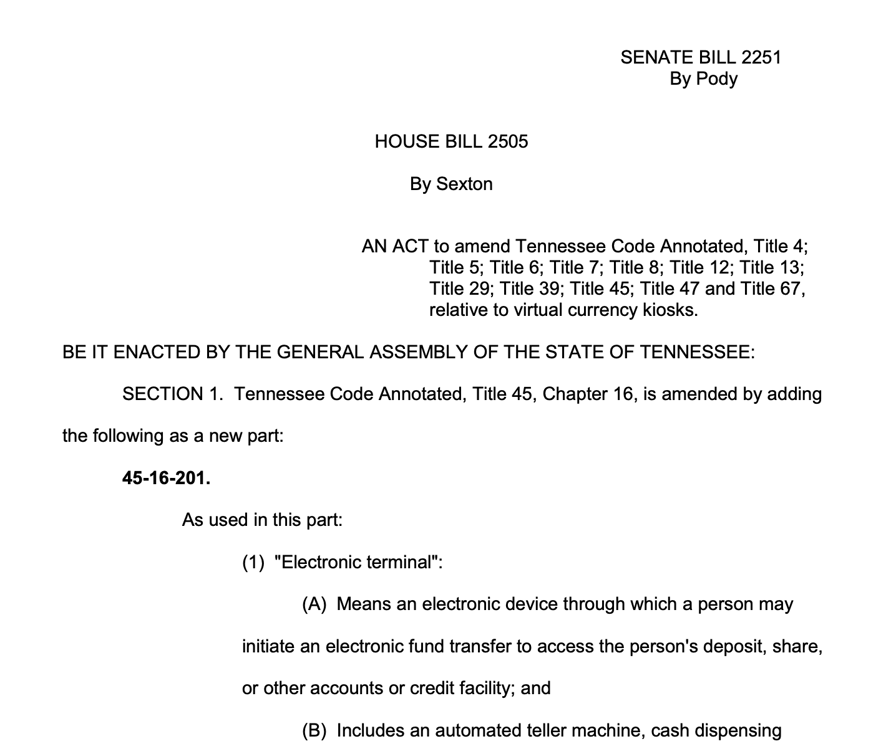
Source: Tennessee General Assembly
According to data from CoinATMRadar, there were more than 570 crypto kiosks and ATMs as of Monday, with operators including Bitcoin Depot and CoinFlip. Cointelegraph reached out to a Bitcoin Depot spokesperson for comment but did not receive an immediate response. The kiosk operator’s Nasdaq-traded shares closed down about 6.9% on Monday, according to Yahoo Finance.
The Tennessee law is just one of many state-level actions in the US targeting crypto kiosks in response to its residents being the victims of scams and other illegal activities. A Massachusetts town banned the machines earlier this month, and Minnesota’s State Senate recently advanced a bill that could ban crypto kiosks across the state.
Related: Massachusetts city to weigh crypto ATM ban, citing financial risks
“Virtual currency kiosks have become a gateway for scammers to exploit Tennesseans, especially our seniors, with little hope of recovering their money once it’s gone,” said Tennessee House Speaker Cameron Sexton, who sponsored the bill.
FBI reported Americans lost $11B to crypto scams in 2025
The US Federal Bureau of Investigation (FBI) said that cryptocurrency and AI-related scams were “among the costliest” for Americans in 2025. Its annual internet crime complaint report released in April cited more than 13,000 complaints related to crypto ATMs and kiosks last year, resulting in more than $389 million in losses.
Some of the types of scams involving ATMs include tricking people into sending Bitcoin (BTC) or other cryptocurrencies to an address by pretending to be a family member in need of assistance, or an authority figure claiming the individual needs to send money to avoid arrest or pay off a debt.
Magazine: AI-driven hacks could kill DeFi — unless projects act now
Crypto World
Crypto Market Alert: Best Cryptos to Buy Now as DOGEBALL Presale Closes Soon with TRON and Cardano in Focus

The biggest profits in crypto are often made before the crowd arrives—so where is that opportunity right now among the best cryptos to buy now?
As the market shifts toward utility-driven projects, opportunities with clear ROI potential are closing faster than ever. In this breakdown, we compare DOGEBALL crypto presale 2026 with TRON (TRX) and Cardano (ADA)—but one project is creating urgent momentum as 2nd May approaches and its presale nears its final cutoff.
With over $228K raised and 820+ participants already in, DOGEBALL is not early-stage speculation anymore—it’s a live opportunity nearing its final phase. The closer we get to 2nd May, the tighter the entry window becomes.
DOGEBALL Is Surging Fast: Why It’s Among the Best Cryptos to Buy Now Before Presale Closes
DOGEBALL is a utility-first ecosystem built on DOGECHAIN, a custom Ethereum Layer 2 designed for speed, scale, and real-world usage. It merges GameFi and PayFi, allowing users to send crypto while recipients receive fiat directly into bank accounts—globally, instantly, and without intermediaries.
What makes this stand out is execution. DOGEPAY enables crypto-to-fiat transfers across 30+ currencies with zero FX fees and near-instant settlement. For gaming, players can earn rewards and cash out instantly, eliminating traditional delays and fees.
For anyone evaluating the best cryptos to buy now, this combination of real payment infrastructure + gaming integration creates continuous token demand. $DOGEBALL is used for transaction fees, staking, and ecosystem access—ensuring utility-driven value rather than passive holding.
$0.0004 Entry vs $0.015 Launch: ROI Window Closing Fast in DOGEBALL Crypto Presale 2026
At its current price of $0.0004, DOGEBALL is expected to launch at $0.015. That translates to a potential ROI exceeding 3,600% within the presale phase alone.
This isn’t theoretical—it’s based on defined launch pricing. Add to that the PAY35 bonus code, which instantly boosts holdings by 35%, and the numbers become even more compelling.
Then there’s the VIP incentive: Buyer of the Week. Top buyers receive a 100% bonus on their entire weekly spend. The competition is real—recently, a $2131 buy at 23:58 UTC was overtaken by a $2320 purchase at 23:59 UTC to claim the top spot. That level of last-minute activity signals serious investor intent.
With 2nd May near, the remaining allocation at $0.0004 is shrinking fast.
How to Secure Your DOGEBALL Before the Final Cutoff
Don’t Wait for 2nd May—Position Yourself Now
- Go to the official DOGEBALL presale site
- Connect your wallet securely
- Choose your investment amount
- Apply code PAY35 for +35% bonus tokens
- Confirm purchase and monitor your dashboard
With the presale ending on 2nd May, waiting means risking higher entry—or missing out entirely.
TRON Price Outlook: Forecast Signals Controlled Growth, Not Explosive Upside
TRON (TRX) continues to show strong network usage, especially in stablecoin transfers, where it handles a significant share of USDT transactions globally. This consistent activity supports price stability and gradual growth.
Recent forecasts suggest TRX could trade within a moderate range, with incremental upside rather than sharp spikes. Its strength lies in adoption and throughput—but that maturity also limits rapid ROI potential compared to early-stage entries like DOGEBALL.
For investors, TRON represents reliability—but not urgency.
Cardano Forecast Update: Gradual Climb Expected as Ecosystem Expands
Cardano (ADA) remains focused on long-term scalability through upgrades and ecosystem development. Its layered architecture continues to attract developers building decentralized applications.
Price predictions indicate steady upward movement rather than short-term surges. ADA’s value proposition is rooted in long-term adoption, which positions it differently from presale opportunities offering immediate upside.
Compared to DOGEBALL crypto presale 2026, Cardano offers stability—but lacks the time-sensitive entry advantage currently available before 2nd May.

Final Call: DOGEBALL Presale Is Closing—Best Cryptos to Buy Now Before Price Jumps to $0.015
When comparing all three, DOGEBALL stands out clearly among the best cryptos to buy now—not just for its utility, but for its timing.
- Entry price: $0.0004
- Launch price: $0.015
- Raised: $228K+
- Participants: 820+
- Bonus: +35% with PAY35 + 100% weekly reward
The numbers are clear. The demand is visible. And the deadline—2nd May—is near.
The DOGEBALL presale is not open-ended. Once it closes, the opportunity to enter at this level disappears.
Act now. Secure your position. And enter before the price gap becomes reality.

Find Out More Information Here
Website: https://dogeballtoken.com/
X: https://x.com/dogeballtoken
Telegram Chat: https://t.me/dogeballtoken
FAQs for Best Cryptos to Buy Now
1. Which crypto is best to invest now?
DOGEBALL is among the best cryptos to buy now due to its low $0.0004 entry and expected $0.015 launch. The DOGEBALL crypto presale 2026 offers strong ROI potential before 2nd May closes.
2. Which crypto has 1000x potential?
Presale projects like DOGEBALL show higher upside due to early pricing, strong utility, and demand. Its payment and gaming ecosystem supports scalable growth beyond launch.
3. What is the best crypto presale to invest in now?
DOGEBALL crypto presale stands out with $228K+ raised, 820+ participants, and bonuses like PAY35 and 100% weekly rewards, making it a strong opportunity before the presale ends on 2nd May.
Disclaimer: This is a Press Release provided by a third party who is responsible for the content. Please conduct your own research before taking any action based on the content.
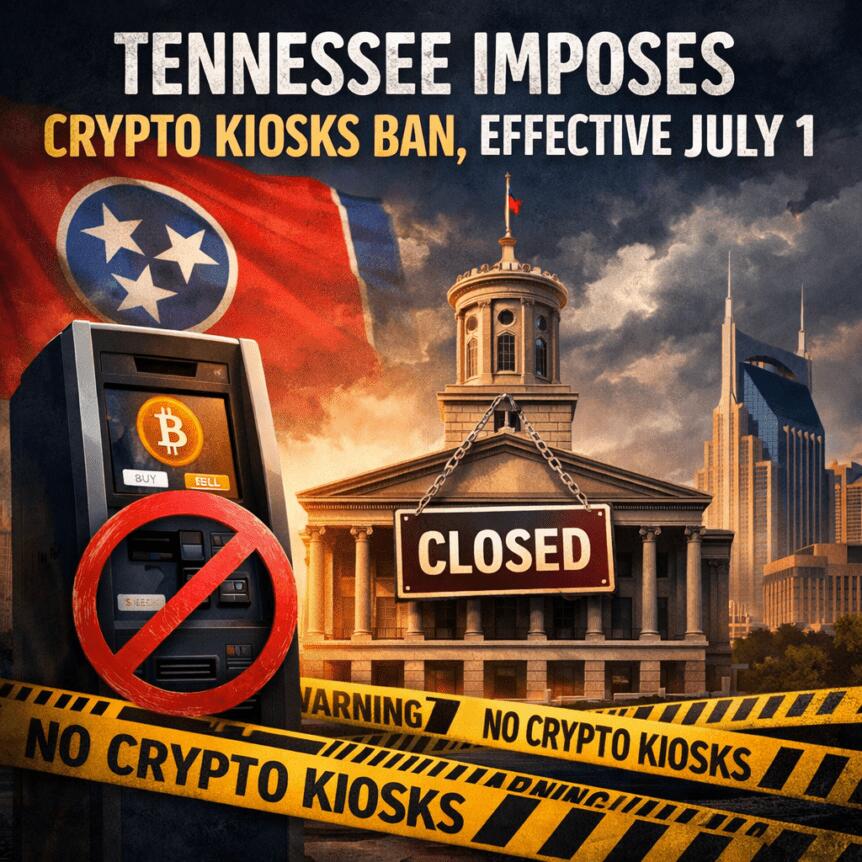
Tennessee Governor Bill Lee signed into law a bill that effectively curtails the deployment of cryptocurrency kiosks and ATMs in the state, setting a rapid compliance timeline for operators. House Bill 2505, enacted on April 13, reclassifies the installation of a crypto kiosk as a Class A misdemeanor beginning July 1, exposing operators and hosting venues to penalties of up to 11 months and 29 days in jail and a $2,500 fine for violations.
Industry data show Tennessee is home to more than 570 crypto kiosks and ATMs, with operators including Bitcoin Depot and CoinFlip active in the state. Market data reflected the regulatory development, as Bitcoin Depot’s Nasdaq-traded shares closed down roughly 6.9% on Monday, per Yahoo Finance, underscoring investor sensitivity to policy shifts affecting the on‑ramp sector.
The Tennessee measure sits within a broader pattern of state‑level actions aimed at crypto kiosks, particularly after episodes in which residents reported scams and other illicit activity linked to these machines. A Massachusetts town recently moved to ban the machines, and Minnesota’s State Senate advanced legislation that could extend a statewide prohibition.
“Virtual currency kiosks have become a gateway for scammers to exploit Tennesseans, especially our seniors, with little hope of recovering their money once it’s gone,” said Tennessee House Speaker Cameron Sexton, the sponsor of the bill.
Key takeaways
- HB 2505, signed by Governor Lee, bans the installation of cryptocurrency kiosks in Tennessee starting July 1, making violations a Class A misdemeanor with penalties up to 11 months and 29 days in prison and a $2,500 fine.
- Current data indicate Tennessee hosts more than 570 crypto kiosks and ATMs, operated by players such as Bitcoin Depot and CoinFlip.
- Bitcoin Depot’s stock performance reflected the regulatory environment, with shares down about 6.9% on the day of the law’s enactment.
- This move is part of a wider U.S. crackdown, with Massachusetts and Minnesota weighing or advancing restrictions on crypto kiosks in recent weeks.
- Federal data underline the risk environment: the FBI’s 2025 Internet Crime Report highlighted crypto and AI scams as costly, with more than 13,000 complaints about crypto ATMs and kiosks and losses topping $389 million.
Legislation tightens the screws on crypto on-ramps in Tennessee
The core of HB 2505 is a redefinition of what constitutes permissible activity around crypto-onramps within the state. By classifying the installation of a crypto kiosk as a Class A misdemeanor starting July 1, Tennessee suppliers and venues hosting these machines face meaningful criminal exposure for enabling such services. The policy rationale, as cited by supporters, centers on safeguarding residents—particularly seniors—from scams facilitated by kiosk-based crypto transfers. The bill’s sponsor, House Speaker Cameron Sexton, characterized the measure as a necessary response to escalating concerns about consumer protection in the digital currency space.
Industry landscape and market reaction
With more than 570 kiosks and ATMs reported in Tennessee, operators have built a sizable footprint in the state. The presence of major players like Bitcoin Depot and CoinFlip underscores the commercial importance of these machines even as regulators move to constrain their proliferation. The immediate market response—Bitcoin Depot’s stock decline on the day of the bill’s signing—illustrates the sensitivity of public markets to state regulatory shifts that could affect the economics of kiosk deployments, maintenance, and consumer trust.
Beyond Tennessee, the regulatory weather in the United States is increasingly heterogeneous. Massachusetts, for example, has seen local jurisdictions weigh bans on crypto kiosks, and Minnesota’s legislature has considered measures to ban or restrict the machines at the state level. Operators and investors alike are watching how these state-level actions might converge or diverge, potentially pushing the sector toward more centralized or alternative on-ramp channels.
Regulatory backdrop and the risk landscape for kiosk operators
The crackdown on crypto kiosks is taking place against a backdrop of rising enforcement activity in the broader crypto and digital‑asset sector. The FBI’s 2025 Internet Crime Report underscored that crypto and AI‑related scams were among the costliest threats to Americans online. The report documented more than 13,000 complaints tied to crypto ATMs and kiosks, resulting in losses of at least $389 million. Authorities point to scam modalities that exploit social engineering, including impersonation of family members or authorities to induce transfers to crypto wallets, highlighting why regulators view on‑ramp points as high-risk channels for illicit behavior.
The Tennessee measure also aligns with a broader policy trajectory that treats crypto kiosks as a potential vector for fraud, money laundering, and other illegal activities. As policymakers weigh additional restrictions, the on‑ramp sector could experience accelerated consolidation, relocation, or pivot toward regulated, compliant configurations that emphasize consumer protections and transparent fee structures. The coming weeks will likely determine which operators, if any, reconfigure their footprints in Tennessee and how other states respond to similar concerns.
For readers watching policy developments, the immediate question is how many more jurisdictions will introduce bans or tighter controls on crypto kiosks and what alternative on-ramps will emerge to serve users while balancing safety and innovation. The next regulatory moves in Minnesota, Massachusetts, and other states will be telling indicators of the sector’s trajectory in 2026.

Ripple Advances Cross-Border Payment Testing
Ripple has strengthened its presence in Asia through a fresh collaboration with K-Bank in South Korea. The agreement focuses on testing blockchain-based remittance systems between multiple financial networks. This initiative reflects a broader push toward faster and more transparent global payments.
XRP Gains Utility Through Institutional Use Cases
The partnership highlights growing institutional interest in XRP as a bridge asset for cross-border settlements. Ripple’s payment network often uses XRP to facilitate liquidity between different fiat currencies. Therefore, this collaboration strengthens its relevance in real-world financial applications.
The remittance tests will cover corridors such as the United Arab Emirates and Thailand. These regions provide active payment routes with strong demand for efficient cross-border transfers. As a result, the pilot program targets meaningful transaction flows instead of isolated testing scenarios.
Meanwhile, Ripple continues to expand its network through additional partnerships across financial services sectors. Earlier collaborations in South Korea included work with insurance and settlement platforms. This consistent expansion supports XRP’s positioning within regulated financial ecosystems.
Wallet Integration and Compliance Focus
K-Bank is also developing internal digital wallet solutions to support blockchain-based financial services. These wallets aim to manage digital assets while meeting strict compliance requirements. However, in-house development requires additional time and resources for certification processes.
Ripple offers an alternative through its software-based wallet infrastructure designed for institutional use. The platform includes built-in compliance tools such as security modules and layered authorization systems. Therefore, it can reduce development time while maintaining regulatory standards.
Both approaches highlight the importance of compliance in blockchain adoption within traditional banking systems. Anti-money laundering checks and sanctions screening remain critical for large-scale deployment. As a result, the partnership emphasizes secure and compliant integration of new technologies.
Regulatory Context and Market Expansion
South Korea continues to explore regulatory frameworks for digital assets and stablecoins within its financial system. K-Bank has indicated plans to align its blockchain initiatives with upcoming legislation. This approach ensures that new technologies remain compatible with future legal requirements.
Ripple’s broader strategy also aligns with regulatory developments across global markets. The company works with financial institutions that require secure and compliant infrastructure for digital payments. Consequently, partnerships like this one support gradual adoption within regulated environments.
The collaboration reflects a wider trend of banks testing blockchain systems before full-scale deployment. Institutions increasingly explore distributed ledger technology to improve efficiency and transparency. As a result, initiatives like this signal steady progress toward modernized global payment systems.
Key points:
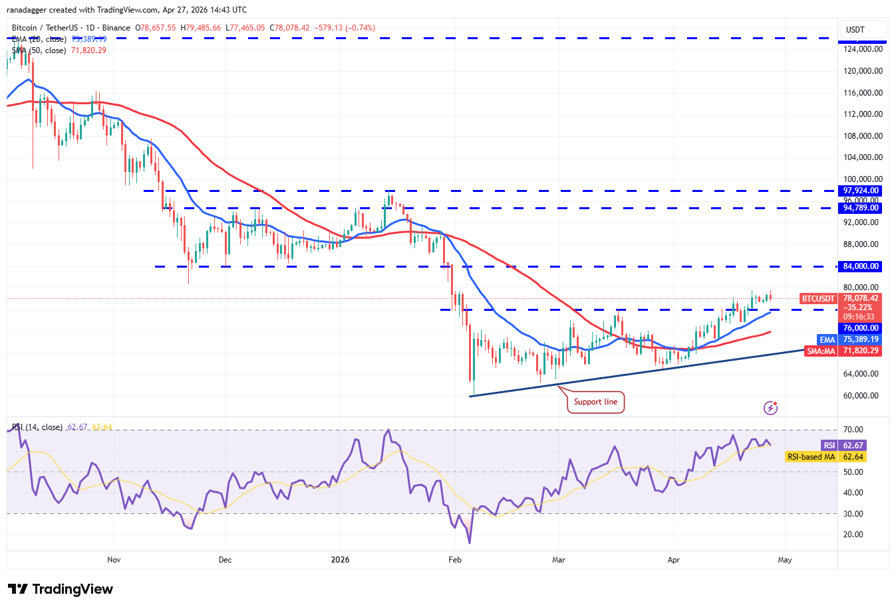
- Bitcoin continues to face resistance near $79,500, but the trajectory remains up as long as the price holds above $76,000.
- Most major altcoins are not showing any directional bias, suggesting a near-term consolidation.
Bitcoin (BTC) attempted to rise above $79,500, but the bears held their ground. BTC investor and author Michael Terpin told Cointelegraph that BTC risks falling to $57,000 in October 2026, based on a study of the “historical average” drawdown of about 1 year from a market-cycle top. Terpin added that BTC will have to rise above $100,000 for the bull market to resume.
Another negative view came from Bitcoin analyst Matthew Hyland, who said in a post on X that the “larger expected consensus outcome for BTC is another leg lower by October.” Veteran trader Peter Brandt also opined in an X post that BTC may form “an investable low” in September or October.
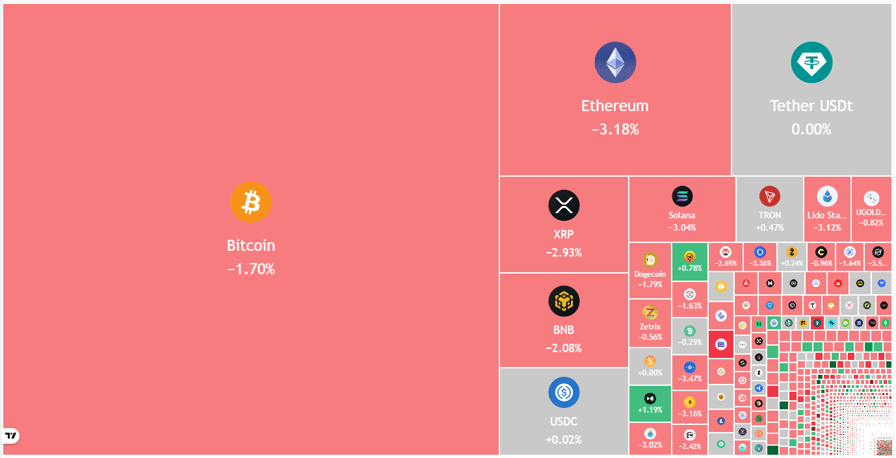
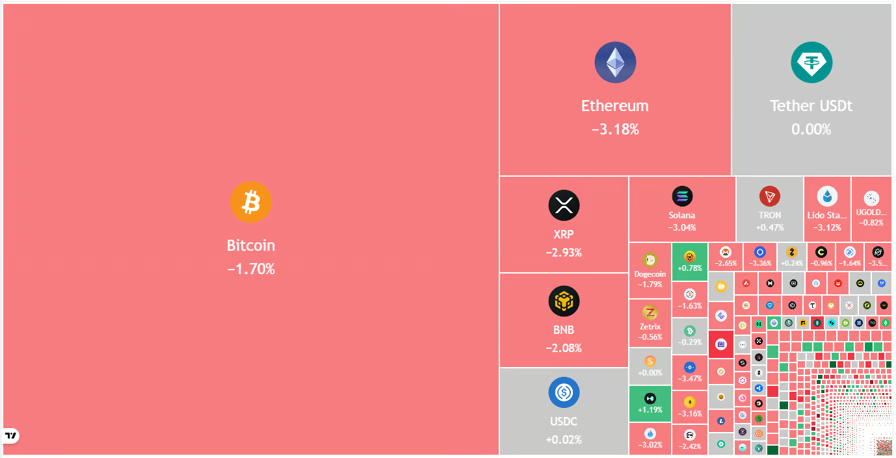
Crypto market data daily view. Source: TradingView
While several analysts expect a fall in BTC, crypto sentiment platform Santiment has a different view. Santiment said in a post on X that BTC wallets holding between 10 and 10,000 BTC have added 40,967 BTC since April 10, while retail investors holding less than 0.1 BTC have accumulated 46 BTC during the same period. If whales continue to buy and retail investors book profits, that may signal a long-term bull run.
Could BTC and the major altcoins rebound off the support? Let’s analyze the charts of the top 10 cryptocurrencies to find out.
S&P 500 Index price prediction
The S&P 500 Index (SPX) rose to a new all-time high on Friday, indicating that the bulls are in command.
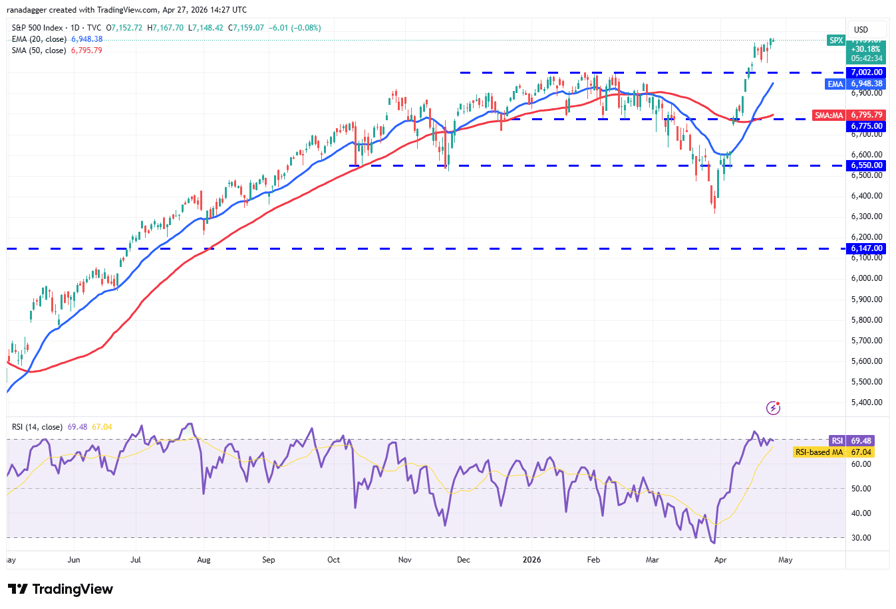
SPX daily chart. Source: Cointelegraph/TradingView
The upsloping 20-day exponential moving average (6,948) and the relative strength index (RSI) near the overbought zone suggest the up move may continue. The next levels to watch on the upside are 7,500 and then 7,877.
Sellers will have to swiftly yank the price back below the 20-day EMA to weaken the bullish momentum. If they manage to do that, the index may tumble to the 50-day simple moving average (6,795).
US Dollar Index price prediction
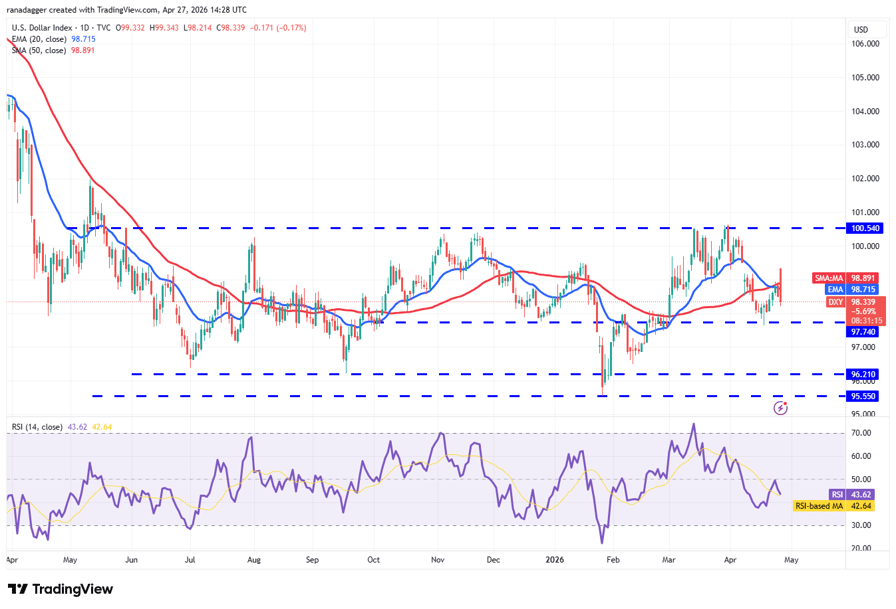
The US Dollar Index (DXY) reached the moving averages, where the bears are posing a stiff challenge.
DXY daily chart. Source: Cointelegraph/TradingView
The bears will attempt to push the price toward the 97.74 level, where buyers are expected to step in. However, if the bears push the price below the 97.74 level, the index may sink toward the 96.21-95.55 support zone.
On the upside, the bulls will need to sustain prices above the moving averages to increase the likelihood of a rally toward the 100.54 level. The bears will attempt to keep the index inside the 95.55 to 100.54 range by selling near the overhead resistance.
Bitcoin price prediction
BTC has been sustaining above the breakout level of $76,000, indicating that the bulls are not hurrying to book profits.
BTC/USDT daily chart. Source: Cointelegraph/TradingView
The upsloping moving averages and the RSI in the positive zone signal that the path of least resistance is upward. If buyers thrust the price above $80,000, the BTC/USDT pair may skyrocket to $84,000.
Time is running out for the bears. They will have to quickly pull the BTC price below the 20-day EMA to gain the upper hand. The pair may then decline to the 50-day SMA ($71,820), signaling that the bears are active at higher levels.
Ether price prediction
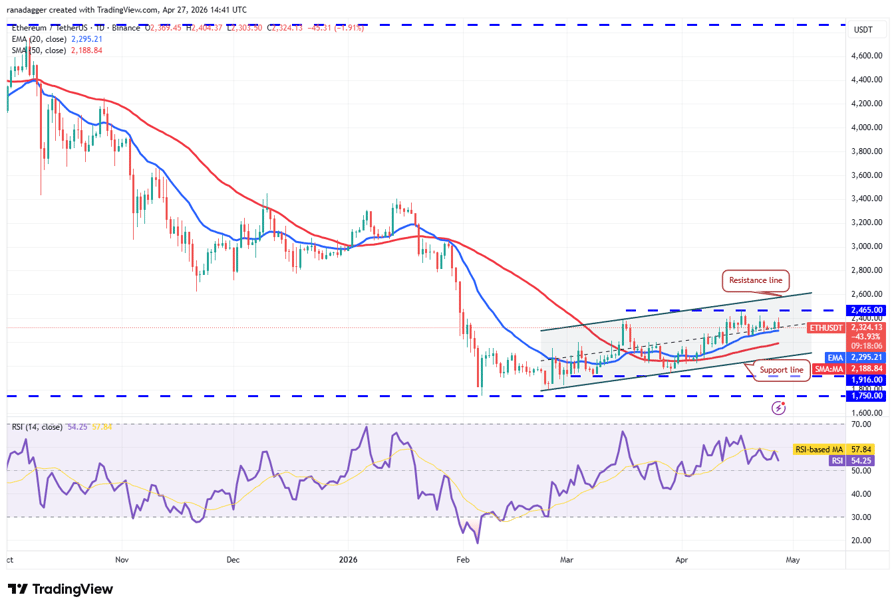
Ether (ETH) remains above the 20-day EMA ($2,295), but bulls have failed to push it above the $2,465 resistance.
ETH/USDT daily chart. Source: Cointelegraph/TradingView
Sellers will attempt to strengthen their position by pulling the ETH price below the 20-day EMA. If they succeed, it suggests the ETH/USDT pair may remain within the ascending channel for a while longer.
Buyers will have to thrust the price above the resistance line to seize control. The pair may then soar to $3,050. Sellers will be back in the driver’s seat on a close below the support line.
XRP price prediction
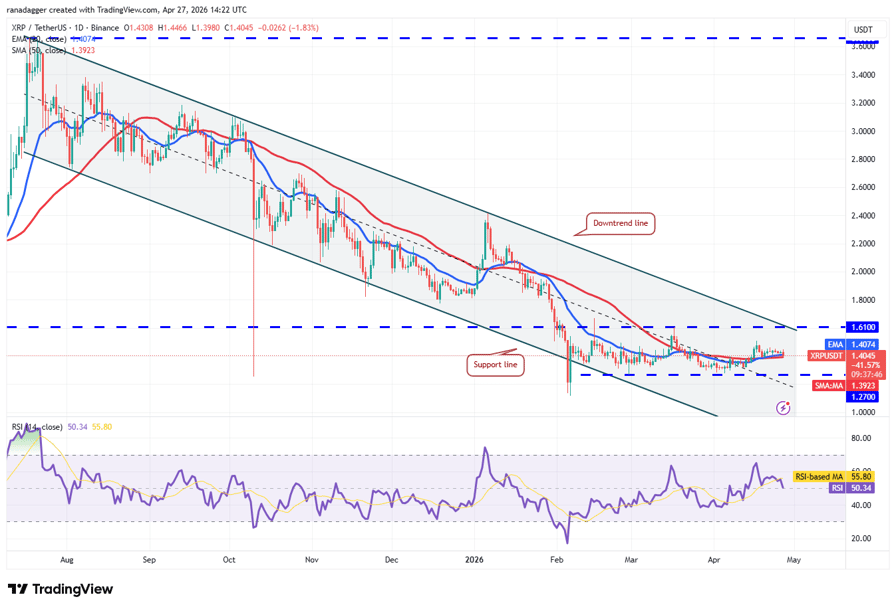
XRP (XRP) remains stuck inside the $1.27 to $1.61 range, indicating buying on dips and selling on rallies.
XRP/USDT daily chart. Source: Cointelegraph/TradingView
The 20-day EMA ($1.40) has started to turn up gradually, and the RSI is near the midpoint, indicating that the bulls have a slight edge. There is minor resistance at $1.51, but if it is crossed, the XRP/USDT pair may reach the downtrend line. A break and close above the downtrend line signals a potential trend change. The pair may then rally to $2.
Sellers are likely to have other plans. They will attempt to pull the XRP price back below the moving averages, retaining the pair inside the range.
BNB price prediction
BNB (BNB) is finding support at the moving averages, but the bulls have failed to trigger a strong bounce off them.
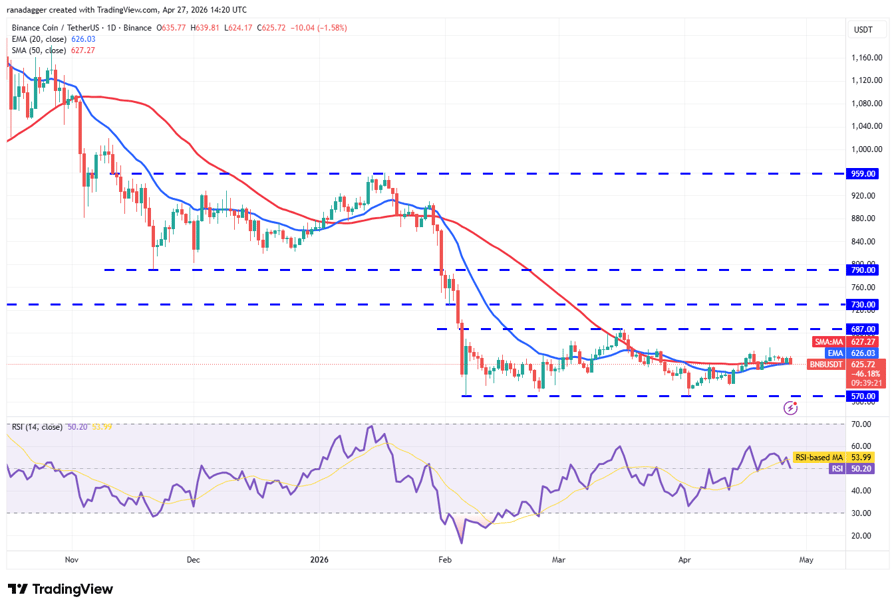
BNB/USDT daily chart. Source: Cointelegraph/TradingView
Buyers will need to drive the BNB price above $654 to signal strength. The BNB/USDT pair may then test the $687 resistance level, a critical level to watch. If buyers pierce the $687 level, the pair may jump to $730 and then to $790.
Instead, if the price turns down from the current level or the overhead resistance and breaks below the moving averages, it suggests the pair may remain within the $570 to $687 range for a few more days.
Solana price prediction
Solana (SOL) continues to trade near the moving averages, indicating a balance between supply and demand.
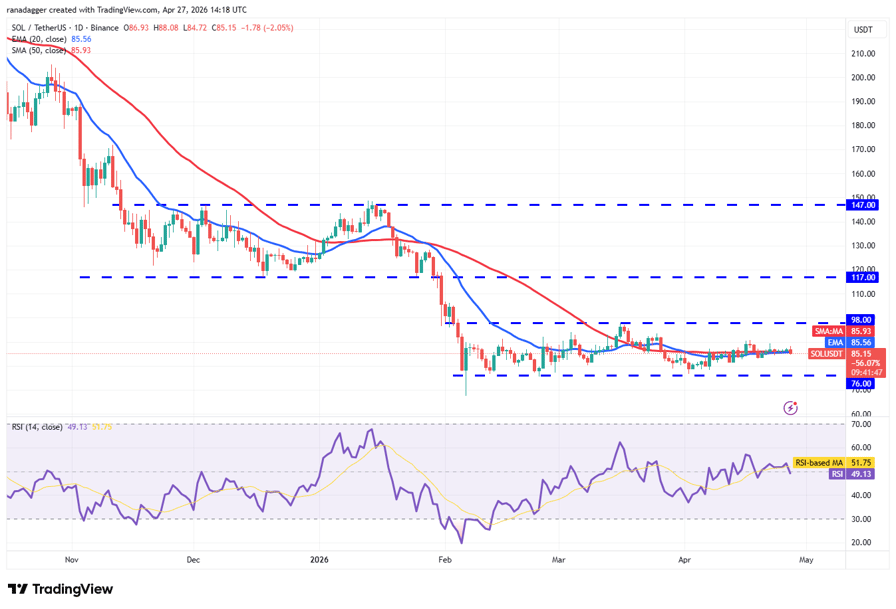
SOL/USDT daily chart. Source: Cointelegraph/TradingView
There is a minor obstacle at $90.73, but if that level is broken, the SOL/USDT pair may reach the $98 resistance. Sellers are expected to defend the $98 level with all their might, as a close above it opens the doors for a rally to $117.
Alternatively, if the SOL price turns down from the current level or the overhead resistance and breaks below $82.94, it suggests that the bears are attempting to take charge. The pair may then collapse to the $76 support.
Related: First 21-week trend line reclaim since October 2025: Five things to know in Bitcoin this week
Dogecoin price prediction
Dogecoin (DOGE) has been gradually moving higher but is expected to face selling in the $0.10 to $0.11 zone.
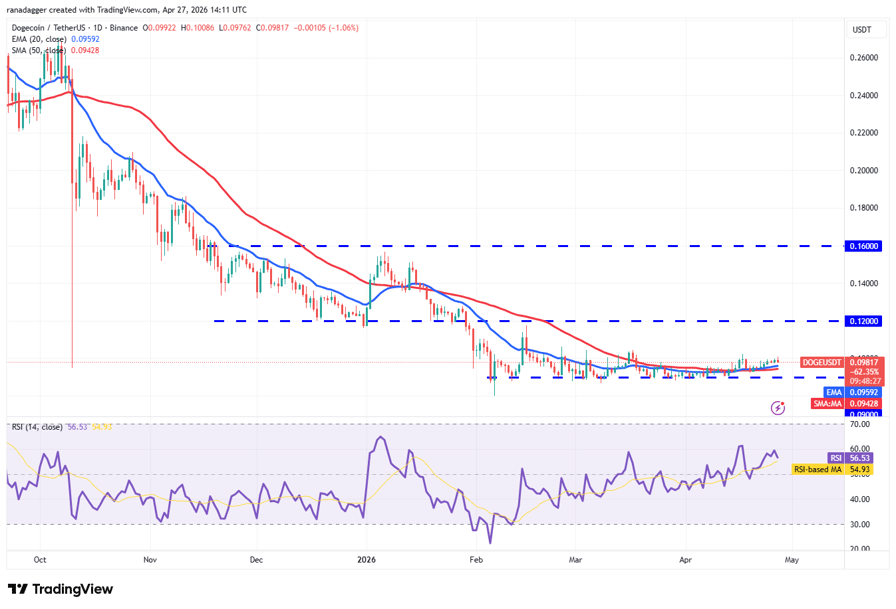
DOGE/USDT daily chart. Source: Cointelegraph/TradingView
If the DOGE price turns down from the overhead resistance zone, it is expected to find support at the moving averages. A sharp bounce off the moving averages increases the possibility of a rally to the $0.12 level.
Contrarily, if the price turns down and breaks below the moving averages, it signals that the bears remain sellers on rallies. The DOGE/USDT pair risks resuming the downtrend if the $0.09 support breaks down.
Hyperliquid price prediction
Hyperliquid (HYPE) resumed its northward march after breaking above the $41.88 resistance on Sunday.
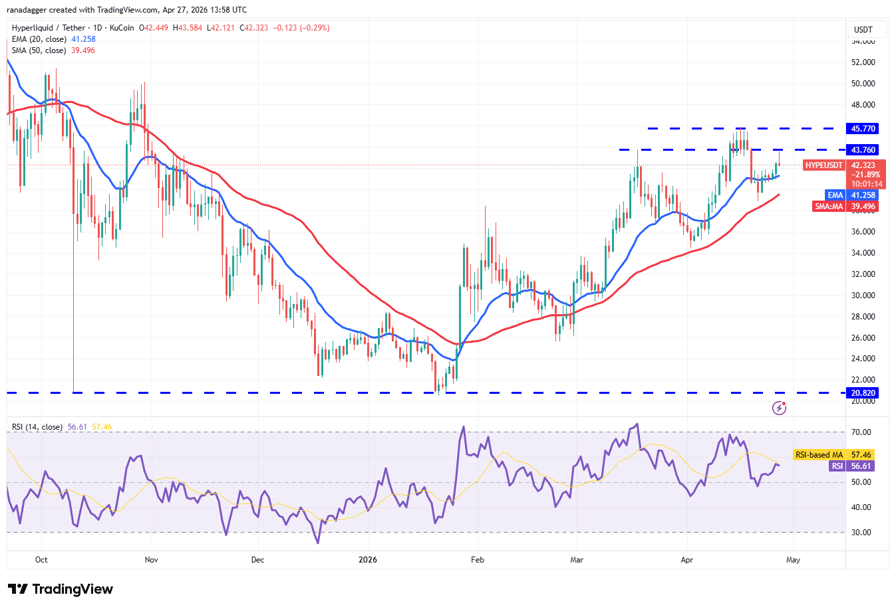
HYPE/USDT daily chart. Source: Cointelegraph/TradingView
The uptrend is facing selling pressure in the $43.76 to $45.77 zone, as seen in the long wick on the candlestick. Sellers will attempt to sink the HYPE price below the 20-day EMA ($41.25), opening the door to a drop toward the 50-day SMA ($39.50).
Conversely, if the price rises above the current level or the 20-day EMA and breaks above $45.77, it signals that the bulls remain in control. That may propel the HYPE/USDT pair toward the $50-$51.43 resistance zone.
Cardano price prediction
Cardano (ADA) has been clinging to the moving averages for several days, improving the prospects of an upside breakout.
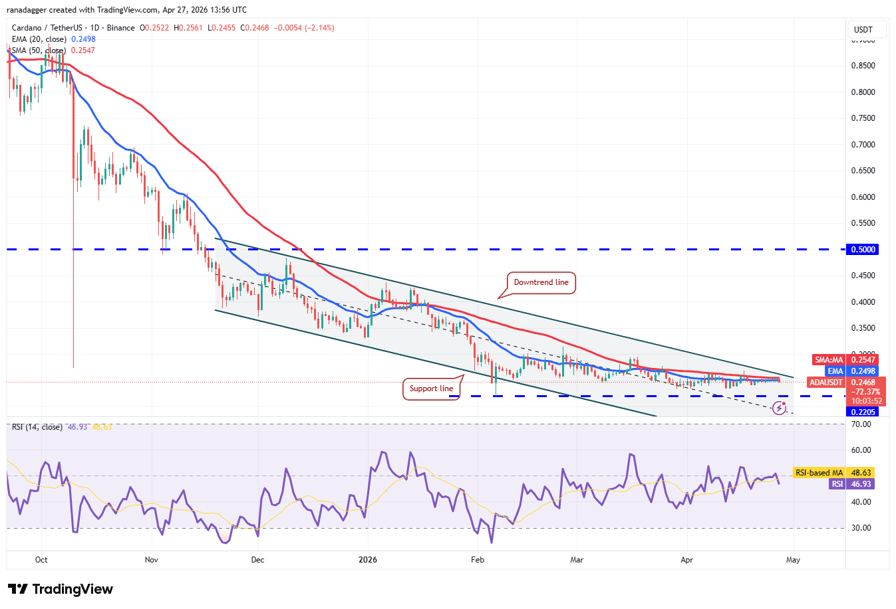
ADA/USDT daily chart. Source: Cointelegraph/TradingView
The downtrend line is the crucial resistance to watch out for as a close above it signals a potential short-term trend change. The ADA/USDT pair may surge to $0.32, then to $0.37.
On the contrary, if the ADA price turns down sharply from the downtrend line, it suggests that the bears are aggressively defending the level. The pair may then slump to the $0.22 support.
TLDR
- MARA Holdings launched a new foundation to strengthen the Bitcoin network resilience.
- CEO Fred Thiel announced the initiative at the Bitcoin Conference in Las Vegas.
- The foundation will focus on addressing quantum computing risks to Bitcoin.
- MARA aims to support a sustainable transaction fee market for long-term security.
- The initiative will fund open source development across scaling and mining tools.
MARA Holdings introduced a new foundation in Las Vegas to strengthen bitcoin’s long-term resilience. CEO Fred Thiel announced the plan during the Bitcoin Conference on Monday. He said the effort will address quantum risks and reinforce the network’s economic model.
MARA Targets Bitcoin Security and Quantum Preparedness
Thiel said Bitcoin remains the most important decentralized system in operation today. However, he warned that the network’s future depends on active stewardship. He stated, “Bitcoin is the most important decentralized system ever created, but its future is not guaranteed.”
He described Bitcoin as a public utility that no single entity controls. Yet he stressed that participants must share responsibility for its survival. He added, “Decentralization doesn’t mean it runs on itself; it means responsibility is distributed.”
The MARA Foundation will focus on protecting Bitcoin’s core properties as sound and durable money. It will support research on emerging threats, including quantum computing. The foundation will also study ways to sustain the network’s security budget.
Thiel said transaction fees must eventually replace declining block rewards. Therefore, the foundation will encourage the development of a sustainable fee market. It will also examine technical measures that strengthen network defense.
MARA Expands Open Source Support and Global Access
MARA confirmed it will fund open source developers working on scaling and mining tools. The company will also back improvements to the user infrastructure. These steps aim to increase network reliability and efficiency.
The foundation will promote self-custody solutions across different regions. It plans to expand multilingual resources for global users. It will also provide technical education programs for developers and operators.
Policy engagement will form another part of the initiative. MARA intends to work with regulators through structured outreach. The company said it will provide educational materials to support informed discussions.
As part of the launch, MARA pledged $100,000 to one nonprofit organization. Three groups will compete for the award through a community vote. The company said this process reflects its commitment to shared ecosystem responsibility.
Thiel reiterated that distributed systems require collective effort. He framed the foundation as a long-term commitment beyond mining operations. He confirmed the initiative will operate independently from MARA’s bitcoin and AI mining units.
The announcement took place during a keynote address at the Bitcoin Conference. MARA did not disclose a fixed annual budget for the foundation. The company confirmed the $100,000 grant marks the first public allocation.
MARA stated that further funding details will follow in later updates. The foundation will begin operations immediately after the conference. Community voting for the nonprofit award will open in the coming weeks.


Stablecoins have “quietly become core financial plumbing” and pushed on‑chain finance past a “point of no return,” according to a new a16z crypto framework that recasts programmable dollars as the base layer for a multi‑chain, banking‑as‑a‑service stack and a coming wave of on‑chain credit.
Summary
- a16z crypto’s report, “The New Stack of Global Finance: The Stablecoin Edition,” argues that stablecoins have evolved from niche trading tools into a global settlement layer and “banking‑as‑a‑service” stack for programmable dollars.
- The paper slices today’s chains into general‑purpose, payment‑specific, and institutional networks, all increasingly tethered by stablecoins as the common settlement asset, from consumer wallets to permissioned bank rails.
- a16z says payments are only “the first act,” predicting large‑scale stablecoin issuance will support a parallel on‑chain credit system and extend US dollar reach into emerging markets via any internet‑connected wallet.
Stablecoins have quietly become core financial plumbing and pushed on-chain finance past the “point of no return,” according to a new framework report from a16z crypto. Titled “The New Stack of Global Finance: The Stablecoin Edition,” the analysis argues that what started as a niche trading tool has morphed into a global settlement layer and a new kind of “banking as a service” stack that is already reshaping how money moves.
In the report, a16z crypto writes that stablecoins have evolved into “fundamental financial pipelines,” with programmable dollars now embedded in consumer apps, fintech platforms, and institutional workflows. The firm describes a new BaaS model in which on-chain issuers and infrastructure providers offer “instant, API‑native balance sheet services” that sit beneath wallets, exchanges, neobanks, and even traditional institutions.
“The transition to on-chain finance has crossed the point of no return,” the authors conclude, arguing that even if prices correct, the underlying rails will continue to scale in volume and sophistication.
The report slices today’s blockchain landscape into three core categories: general-purpose chains like Ethereum, Solana, and layer‑2 networks; payment‑specific chains such as Stripe’s Tempo; and institutional networks like Canton, which target regulated participants and permissioned workflows.
Each category, a16z says, is increasingly tethered together by stablecoins that act as the common settlement asset, whether the end user is a retail gamer or a global bank.
On the banking side, a16z pushes back on the idea that regulatory bottlenecks are still insurmountable. “The bottlenecks in the banking industry are easing,” the report notes, pointing to a growing roster of crypto‑friendly banks actively wiring on‑chain infrastructure into fiat payment systems.
At the same time, the competitive frontier for issuers has shifted from raw market share to regulatory positioning, with leading stablecoin firms “vying to obtain OCC national trust charters” and other licenses that would anchor them more firmly inside the U.S. banking perimeter.
Crucially, the paper frames payments as only “the first act.” The more important “second act,” in a16z’s view, will be credit.
“The large‑scale issuance of stablecoins will give rise to a new on‑chain credit market, allowing capital to form outside the traditional banking system,” the report says, predicting that on‑chain collateral, reputation systems, and programmable covenants will underpin a parallel credit stack layered on top of stablecoin rails.
Finally, the authors stress that this is not just a crypto story, but a geopolitical one.
Stablecoins, they argue, “enhance the dominance of the dollar” by exporting dollar access into any app or wallet with an internet connection, while simultaneously giving emerging‑market users a more direct, censorship‑resistant channel into the U.S. currency than their domestic banking systems typically provide.
TLDR
- DeFi United has raised more than 132,000 ETH, valued at over $300 million, to address losses from the Kelp DAO exploit.
- Consensys and Ethereum co-founder Joseph Lubin pledged 30,000 ETH to support the coordinated recovery effort.
- Circle Ventures confirmed it is purchasing AAVE tokens to help stabilize the protocol after the exploit.
- The exploit involved unbacked rsETH minted through a compromised LayerZero bridge and used as collateral on Aave.
- Aave service providers proposed allocating 25,000 ETH from the DAO treasury to support the recovery plan.
DeFi United has secured more than 132,000 ETH valued at over $300 million to address losses from the Kelp DAO exploit. Consensys and Ethereum co-founder Joseph Lubin pledged 30,000 ETH to support the recovery. Circle Ventures also confirmed AAVE token purchases to reduce pressure on the lending protocol.
DeFi Coalition Accelerates Funding Drive
Circle Ventures announced it is buying AAVE tokens to support market stability. The firm stated, “Strong DeFi infrastructure does not build itself.” It added that Aave helps shape onchain finance and supports its broader community.
At the same time, Consensys and Joseph Lubin committed 30,000 ETH to the coordinated recovery plan. Aave confirmed the pledge on Monday and credited the contribution for accelerating progress. It said, “The recovery would not be progressing as it is without them.”
Consensys-backed treasury firm Sharplink will also provide strategic advice to the initiative. The combined effort has now raised more than 132,000 ETH. That amount equals over $300 million at current market prices.
Aave and Partners Target rsETH Shortfall
The exploit occurred after an attacker minted unbacked rsETH through a compromised LayerZero bridge. The attacker then used the tokens as collateral on Aave to borrow assets. This sequence left Aave with bad debt tied to the unbacked rsETH.
DeFi United directs contributions to close the remaining shortfall linked to rsETH. Last week, Aave service providers proposed allocating 25,000 ETH from the protocol’s DAO. That allocation equals nearly $58 million based on recent prices.
As of Monday, the broader effort had raised roughly $235 million worth of Ethereum before the latest pledges. Lido DAO proposed contributing up to 2,500 ETH to the plan. Ether.fi also proposed up to 5,000 ETH to support the recovery.
Kelp DAO pledged 2,000 ETH to help restore rsETH backing. Dozens of individuals have also transferred smaller amounts of ETH and stablecoins. X user DCF GOD estimated that the funding gap had already been filled if all proposals passed.
Data from The Block shows total value locked across DeFi protocols stands at nearly $82 billion. That figure reflects a decline of over 25% from $110 billion at the start of the year.

GlassWorm malware attacks return via 73 OpenVSX “sleeper” extensions

Lady Gaga and Doechii strut in new music video for Devil Wears Prada 2 song

Gladstone Land’s 7.2% Yielding Preferreds Benefitting From Buybacks (NASDAQ:LAND)

Manchester United reach agreement with Casemiro over contract clause amid transfer speculation

US brings back mandatory military draft registration

Steven Gerrard disagrees with Gary Neville over ‘shock’ Chelsea and Arsenal claim | Football

Hearing about XRP was like Moses Coming Down. #xrp #crypto #bitcoin #ethereum @digitalassetinvestor

Paisa kamane wala app 2026 || NEW UPI MONEY EARNING APP | New Earning App Today | Ajio App Shein App

Crypto Gold Live Trading 27 APRIL – stock_learners
-

 Fashion3 days ago
Weekend Open Thread – Corporette.com
-
Crypto World2 days ago
Hyperliquid $HYPE Rally Builds Momentum as AI Sector Enters Prove-It Phase
-

 Tech5 hours ago
Register Renaming | Hackaday
-

 Politics5 days ago
Making troops accountable for war crimes threatens US alliance, ex-SAS colonel warns
-

 Politics5 days ago
Disabled people challenge government SEND proposals over segregation concerns
-

 Business4 days ago
Patterson-UTI Energy, Inc. (PTEN) Q1 2026 Earnings Call Transcript
-

 Business6 days ago
Rolls-Royce Voted UK’s Most Iconic Trade Mark as IPO Register Hits 150
-
 Crypto World6 days ago
Five Value Stocks with Recovery Potential in 2026: PayPal (PYPL), Nike (NKE), and More
-
 Sports1 day ago
IPL 2026: Ruturaj Gaikwad registers slowest fifty of the season, enters all-time unwanted list | Cricket News
-

 Politics5 days ago
Starmer handler McSweeney to be dragged from shadows by Foreign Affairs Committee
-

 Politics5 days ago
Zack Polanski responds to home secretary’s taser threat
-
Politics5 days ago
Wings Over Scotland | How To Get Away With Crimes
-

 Crypto World6 days ago
New York sues Coinbase, Gemini over prediction market offerings
-
Entertainment6 days ago
Sydney Sweeney cameo cut from “The Devil Wears Prada 2”, source explains why (exclusive)
-
 Business6 days ago
HCL Tech share price tank over 9% after weak Q4. JPMorgan, HSBC & 3 others cut target price
-

 Politics5 days ago
‘Iran is still a nuclear threat’
-

 Crypto World6 days ago
Crypto’s great hope in Senate’s Clarity Act still has a path to survive tight calendar
-
 Sports5 days ago
Tim Bradley names the current best in the world: “Better than Inoue and Usyk”
-

 Fashion6 days ago
Kilkenny Design New Beauty Arrivals for Spring 2026
-

 NewsBeat2 days ago
LK Bennett closes all stores after entering administration
You must be logged in to post a comment Login