
Crypto World
Bitcoin price tests $83K support as 4-hour MACD turns bearish

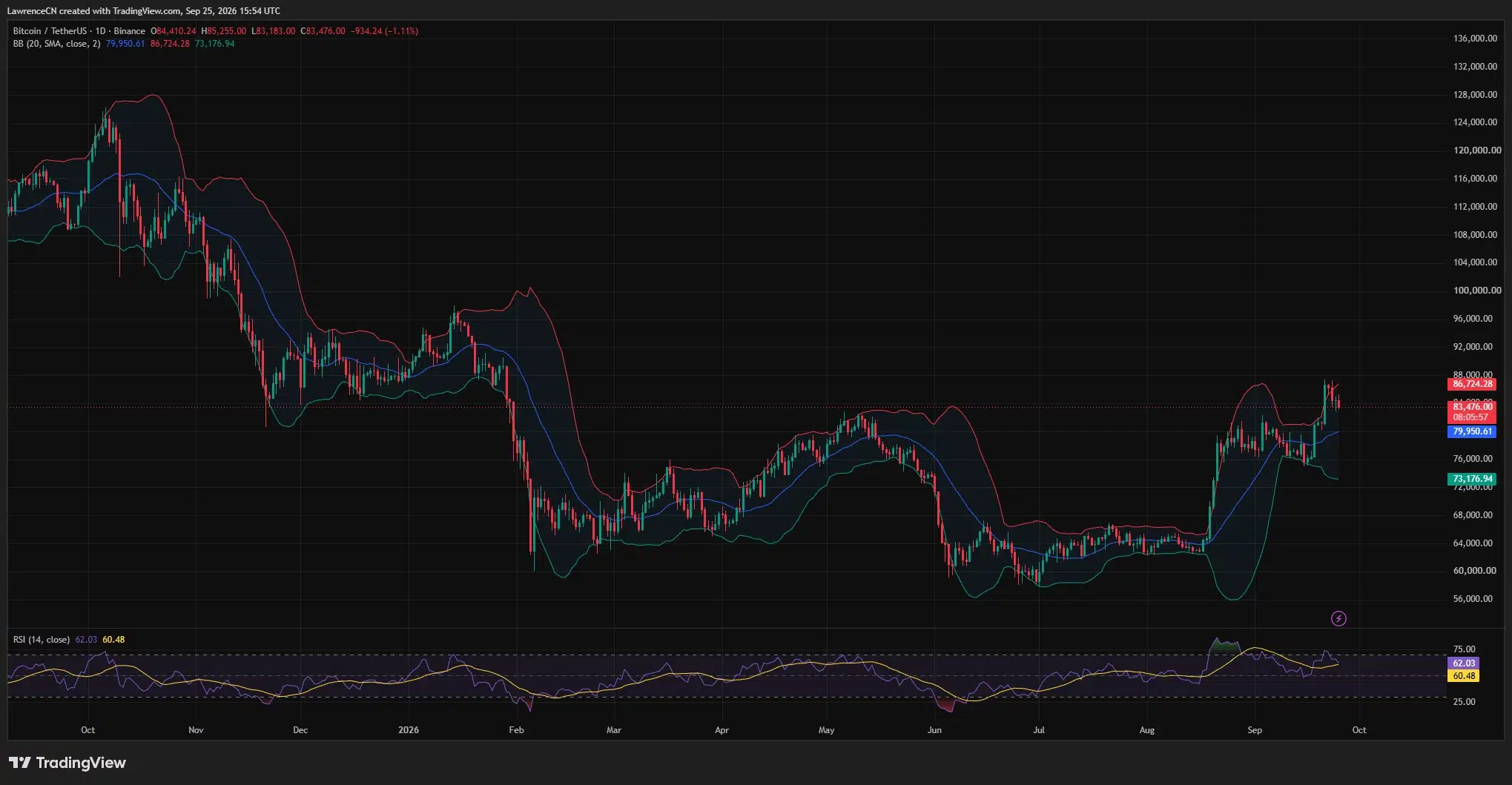
Bitcoin price fell to about $83,450 on Sep. 25 after a rally above $87,000 earlier in the week gave way to a narrower trading range. The pullback comes as traders weigh a quarterly options expiry against higher U.S. Treasury yields.
Summary
- Bitcoin’s daily chart showed a 1.1% decline, with the price near $83,476.
- The 4-hour MACD turned negative as the rally from below $76,000 lost momentum.
- CoinGlass’s three-day heatmap showed liquidation clusters near $83,300 and above $85,000.
- LVRG Research’s Dan Khus said Treasury yields, ETF flows, and oil prices remain in focus.
According to the daily Bitcoin price chart, BTC traded near $83,476 after reaching $85,255 during the Sep. 25 session. The price was still above the chart’s 20-day Bollinger Band midpoint at $79,951, despite retreating from an upper band near $86,724.
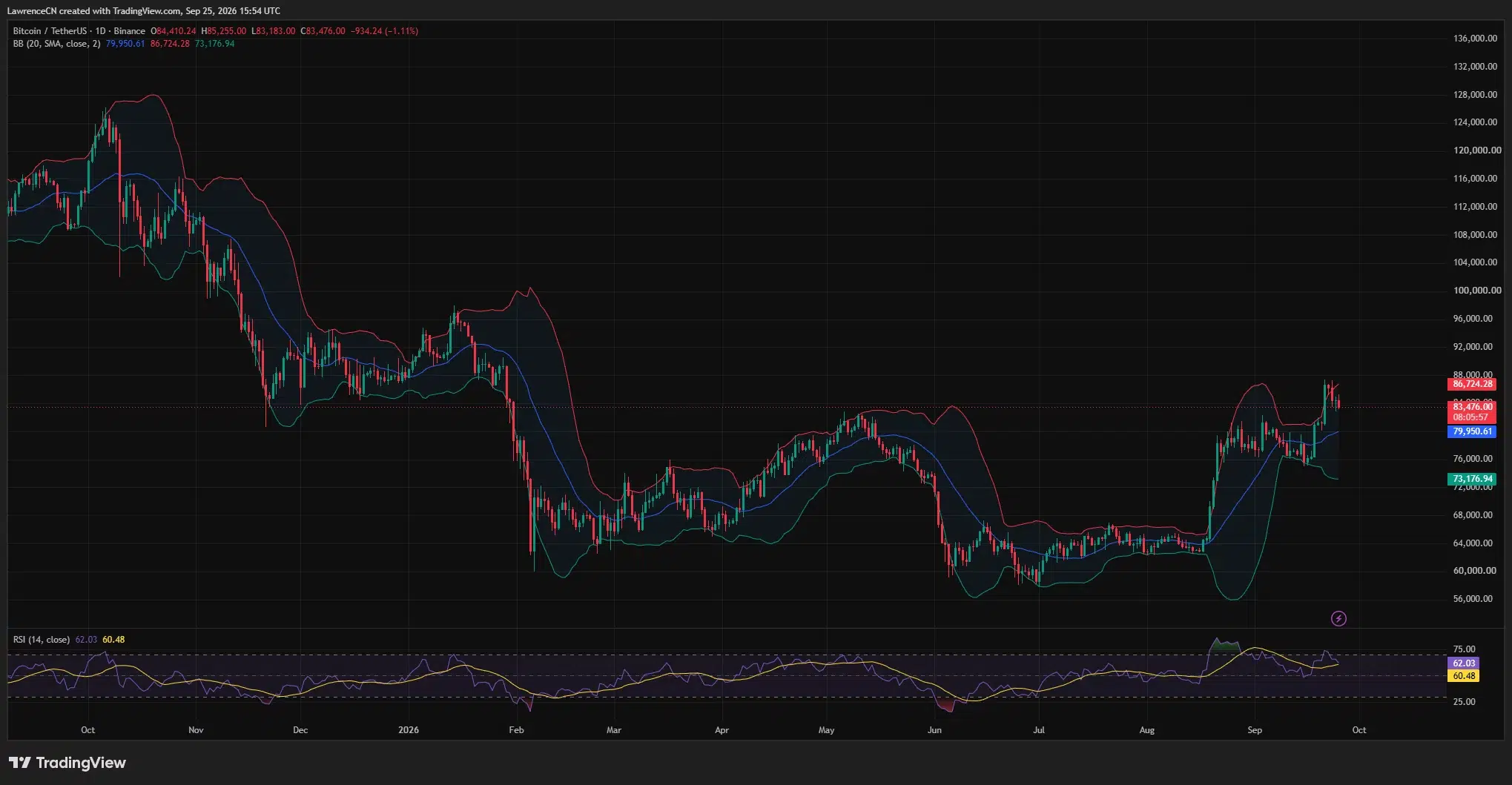
The decline followed a sharp move earlier in the week that carried Bitcoin above $87,000. The daily chart showed the relative strength index at 62.03, down from the higher readings reached during the rally but still above the neutral level of 50.
Bitcoin holds above $83K as the 4-hour MACD weakens
Bitcoin’s 4-hour chart showed the price falling from the $86,000–$87,000 area and then trading mostly between $83,000 and $85,000. Its latest candle on the chart opened at $84,583, fell to $83,183, and traded near $83,454.
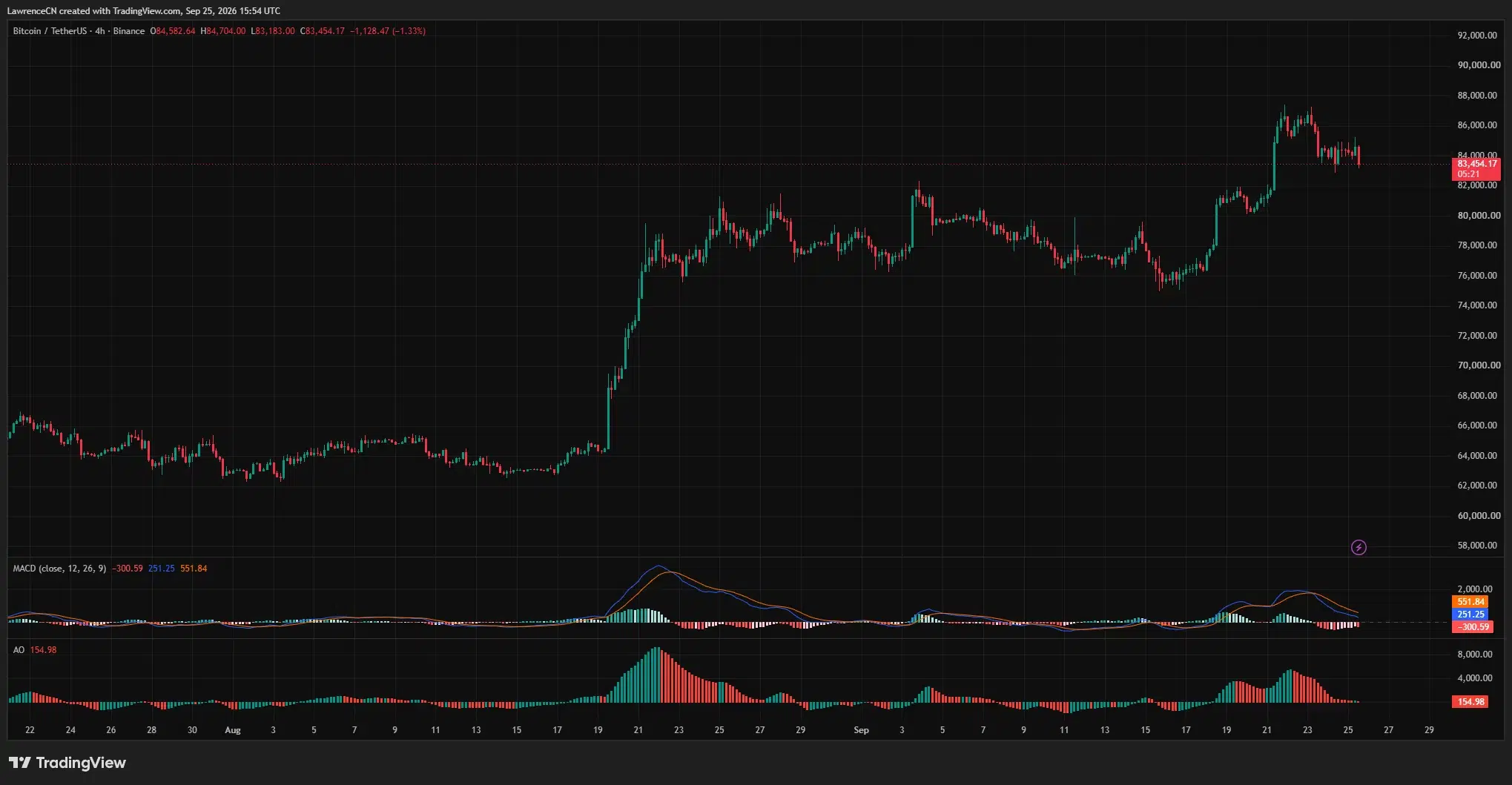
The 4-hour MACD line stood at 251.25, below its signal line at 551.84. Its histogram reading of minus 300.59 showed that short-term momentum had weakened after the earlier advance. The Awesome Oscillator remained positive at 154.98, although its bars had narrowed toward zero.
Trader Ardi described $83,000 as local range support and a former May high. In a Sep. 25 market post, Ardi said a loss of that level could put $81,000 back in view, while reclaiming $85,200 as support could open another test of the $87,000 highs. Trader Daan Crypto Trades separately identified $83,500 to $85,000 as the range Bitcoin had occupied over the previous two days.
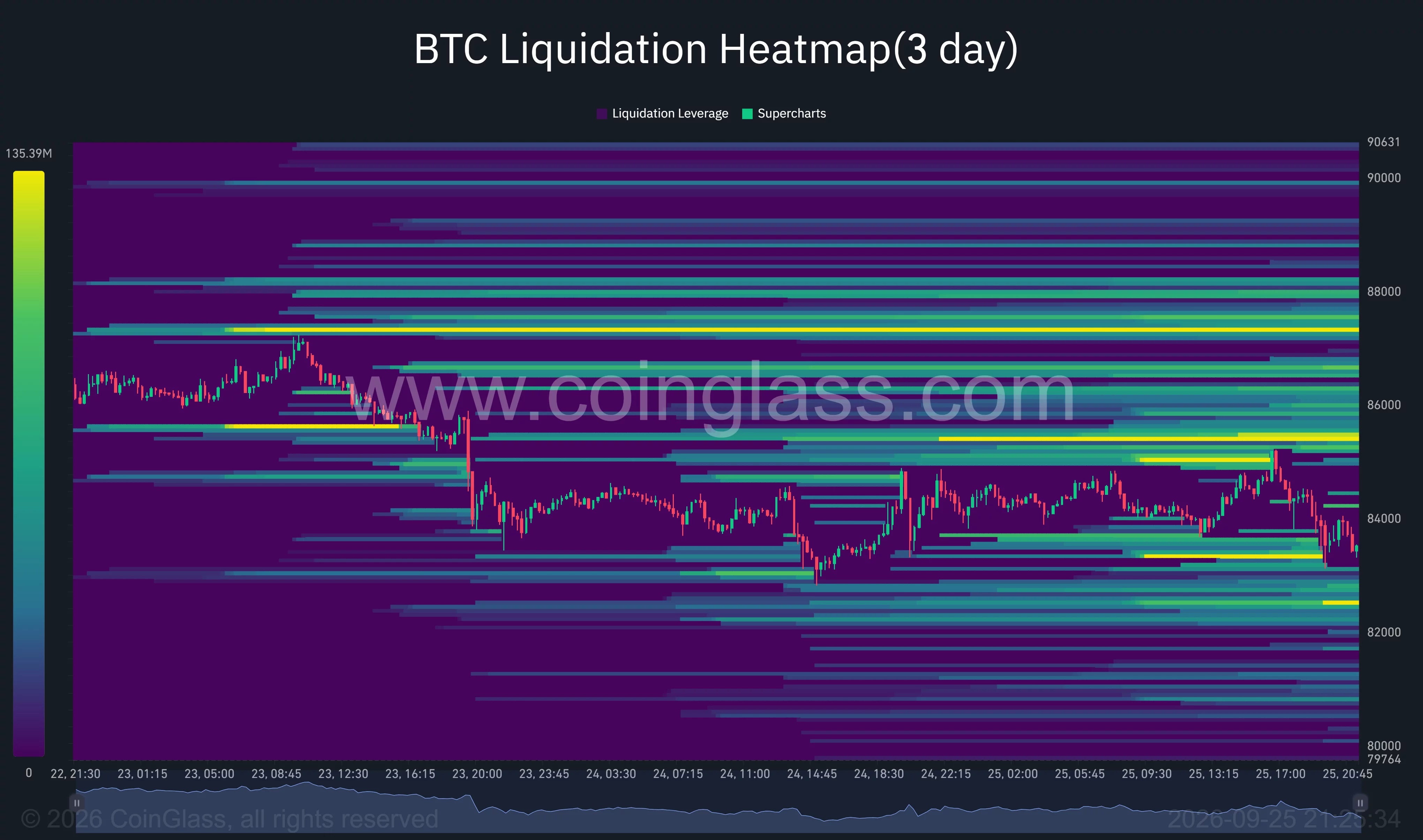
The levels are close to concentrations on CoinGlass’s three-day Bitcoin liquidation heatmap. The chart showed a bright band near $83,300, with further liquidity around $82,500. Above the market, clusters appeared near $85,200–$85,500 and around $87,300. The heatmap shows where leveraged positions may face liquidation if price reaches those levels; it does not establish which direction Bitcoin will move next.
Options expiry meets a rise in U.S. Treasury yields
A large quarterly options expiry has added another event for derivatives traders to navigate. Options positions can affect hedging and trading around settlement, although the expiry alone does not establish what caused Bitcoin’s decline.
The U.S. bond market has also moved into focus. Dan Khus, chief analyst at LVRG Research, told crypto.news that Bitcoin and Ether were holding support as the Treasury sell-off eased slightly. His comments put the 10-year yield near 5.19% after a 30-basis-point rise.
“Bitcoin and ether are maintaining in support as the Treasury sell-off cooled slightly with the 10-year easing back toward 5.19% after a 30-basis-point surge. Looking ahead, focus is on whether yields stay elevated, October Fed hike odds hold above 70%, and if spot ETF flows can absorb weekend options expiry, along with any further oil-driven inflation shock from developments in the US-Iran conflict.”
The Federal Reserve raised its target rate by a quarter percentage point to 3.75%–4.00% on Sep. 16. Khus’s October figure refers to market expectations for another increase, rather than a decision already made by the Fed. Oil prices and developments in the U.S.-Iran conflict could affect those expectations through their impact on inflation.
ETF demand and $83K support frame Bitcoin’s next test
U.S. spot Bitcoin exchange-traded fund flows offer a separate measure of demand as the market absorbs the price reversal. Khus identified those flows, alongside yields and the options expiry, as factors to watch. Farside Investors’ ETF flow table tracks the funds’ daily net subscriptions and redemptions.
For the near-term chart setup, the first test is whether Bitcoin can hold the $83,000–$83,500 range cited by the traders and visible on the 4-hour chart. A move below it would bring the heatmap’s lower liquidity bands and Ardi’s $81,000 level into focus. On the upside, a sustained move back above $85,000–$85,200 would put the higher liquidation clusters and the recent $87,000 peak back in view.
Bitcoin’s daily RSI remained above 50, and its price remained above the Bollinger Band midpoint, while the 4-hour MACD showed weaker short-term momentum. Those readings leave the next move tied to the range boundaries as traders assess the expiry, U.S. yields, and ETF flows.
Disclosure: This article does not represent investment advice. The content and materials featured on this page are for educational purposes only.

Strategy (formerly MicroStrategy) is proposing daily dividends across STRF, STRC, STRK, and STRD. The company wants its preferred shareholders to earn cash income every calendar day, a model that is unusual in the US stock market.
A dividend is simply money a company pays investors for owning its stock. Under MicroStrategy’s proposal, that income would build up every day, including weekends and holidays, with payment made on the next business day.
The total return would stay the same. The change is mainly about how often investors receive it.
Note: Preferred stock is a special type of company share designed mainly to pay investors regular income. Regular stock, like MSTR, gives investors more exposure to the company’s gains and losses, so its price can move much more.
STRC is Becoming an Income Product, Not a Bitcoin Stock
STRC currently pays a 12% annual dividend on its $100 stated value. In simple terms, an investor holding one $100 share would receive around $12 a year at the current rate.
Daily dividends would not increase that amount. They would spread the same income across much smaller, more frequent payments.
Think of it like getting part of your monthly salary every working day instead of receiving one larger payment at the end of the month.
That could make STRC more attractive to investors who care about regular income. Strategy also says the change could support liquidity and price stability.
There are Risks
STRC is designed very differently from MSTR, the company’s flagship stock that tracks Bitcoin movements.
MSTR can rise or fall sharply because investors largely treat it as a leveraged bet on Bitcoin. STRC is built around income and Strategy’s effort to keep its price close to $100.
Daily dividends could reinforce that difference, but they cannot remove the risk.
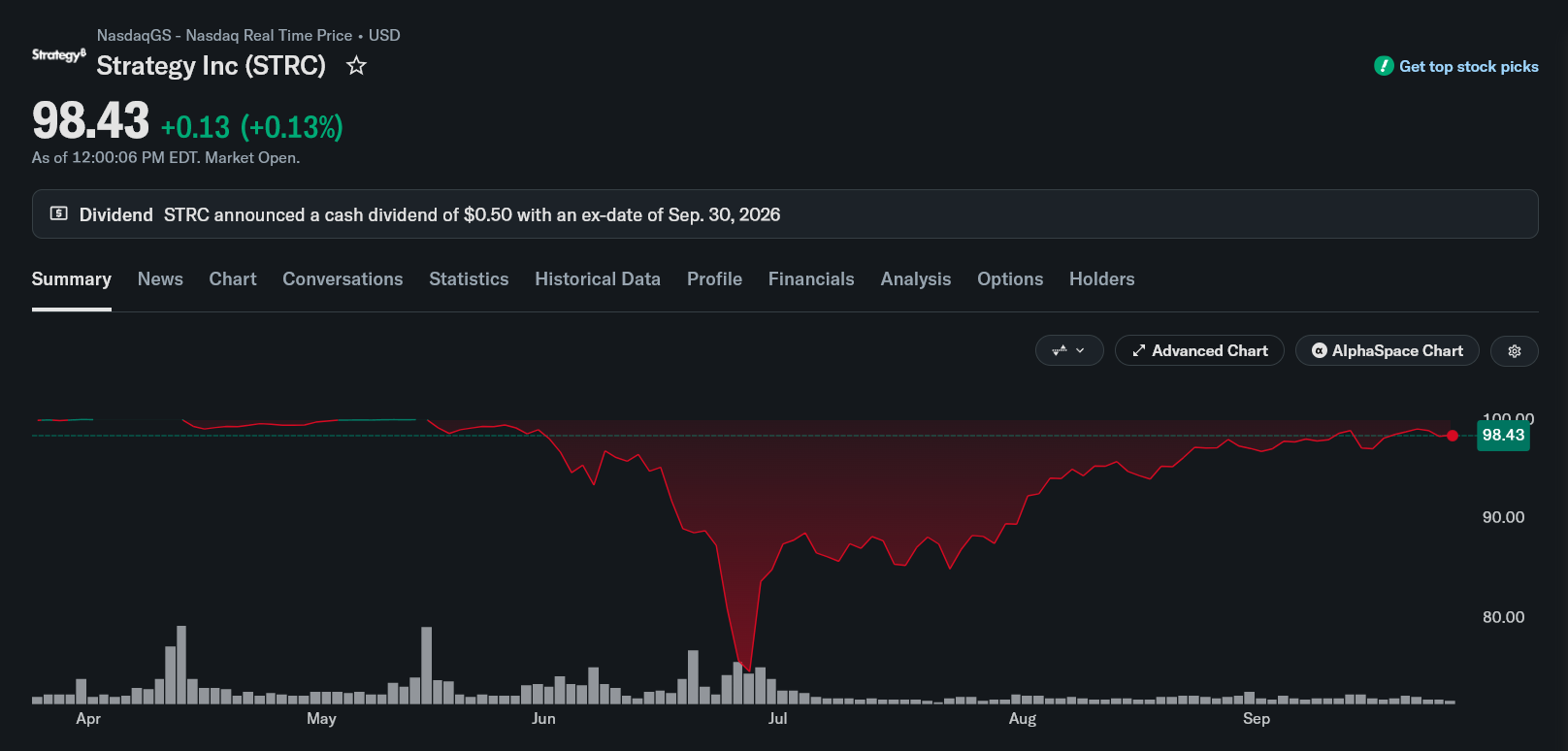
If Bitcoin falls sharply and investors become concerned about Strategy’s finances, STRC can still trade well below $100. It happened in June, when Bitcoin dropped below $60,000, and STRC dropped to $75.

Its dividend also depends on Strategy having enough cash to keep paying it.
What It Means for MSTR Investors
For MSTR shareholders, the impact is more indirect.
Preferred shareholders sit ahead of MSTR holders in Strategy’s capital structure and must be paid before common shareholders receive anything.
So, the difference between the two products is becoming clearer.
MSTR remains the higher-volatility Bitcoin-linked trade. STRC increasingly looks like Strategy’s income product: lower upside, regular cash payments and a structure designed to keep the price relatively stable.
The post MicroStrategy Has a New Proposal To Pay Its Investors Every Day appeared first on BeInCrypto.

Crypto’s boundary with traditional finance is getting harder to define—fast. This week’s Crypto Biz roundup highlights a shared push by crypto firms and legacy institutions toward the same battleground: stable value transfer, tokenized assets, and the plumbing that moves money and securities.
From Binance deepening its USDC relationship with Circle to Canada’s largest banks testing tokenized deposits, and the New York Stock Exchange pairing with Blockchain.com for tokenized US stocks, the common theme is clear: both sides want to capture distribution and control as financial rails increasingly run on-chain.
Key takeaways
- Binance is investing $100 million in Circle and expanding a USDC deal through a new multi-year commercial agreement tied to USDC balances on Binance infrastructure.
- Canada’s six biggest banks are jointly exploring tokenized Canadian dollar deposits, initially focusing on transfers between participating banks.
- Chainalysis data shows cross-border stablecoin flows rose nearly 78% year through June even as total crypto market cap fell 37%.
- The NYSE is moving toward on-chain distribution of tokenized US stocks and ETFs via a planned alternative trading system with Blockchain.com.
Binance expands USDC ties through Circle investment
Binance is strengthening its partnership with Circle via a combination of equity investment and expanded commercial terms around USDC. According to a report linked to a filing discussed by Cointelegraph, Binance will make a $100 million investment in Circle alongside a five-year agreement intended to expand USDC adoption across the exchange.
In a Tuesday filing referenced in that coverage, Circle reportedly issued Binance 1,237,011 shares of Class A common stock at $80.84 per share as part of a private placement dated Sept. 17. The purchase price was described as below Circle’s market price before the transaction closed, and Cointelegraph noted that Circle’s shares rose after the announcement.
The deal also includes incentives designed to tie Binance’s economics to USDC usage. As described, Circle will pay Binance a monthly incentive fee based on the amount of USDC held through the exchange’s Modular Smart Contract Wallet infrastructure.
Regulatory and governance constraints are part of the structure as well. Binance is reportedly restricted from selling or transferring the Circle shares for up to two years, though the lockup could end earlier under certain termination provisions. During the restriction period, Binance retains voting rights.
For investors and traders, the practical takeaway is that stablecoin distribution is increasingly being treated like strategic market infrastructure rather than a standalone product. Equity alignment plus volume-linked incentives suggest Binance is positioning itself not just as a marketplace for USDC, but as a long-term channel for stablecoin settlement and custody patterns that can follow users across the market.
Canadian banks test tokenized deposits—without changing the legal character
While stablecoins often dominate headlines, Canada’s largest banks are experimenting with a different on-chain narrative: tokenized representations of bank deposits. Cointelegraph reported that the country’s six largest banks are jointly exploring tokenized Canadian dollar deposits—a payment rail that could let digital representations of deposits move between financial institutions.
The banks involved—Bank of Montreal, CIBC, National Bank of Canada, Royal Bank of Canada, Scotiabank, and TD Bank Group—plan to start with a limited scope. The first phase, as described, focuses on transfers between participating banks, with the possibility of connecting to other digital asset networks later.
A key detail is regulatory treatment. Cointelegraph noted that Canada’s Office of the Superintendent of Financial Institutions clarified on Sept. 10 that tokenized deposits are “not legally distinct from traditional deposits.” In other words, blockchain or other technology would not change their underlying legal classification.
That distinction matters because it separates tokenized deposits from the way many fiat-backed stablecoins are typically structured. Tokenized deposits remain liabilities of the issuing banks, whereas stablecoins are not treated the same way under the same liability framework. The banks also argue the model could support faster and programmable payments, and that other deposit-taking institutions may join in the future.
This approach may be especially relevant for Canada’s evolving stablecoin rules. As mentioned in the coverage, the framework applies to non-financial institution issuers, while regulated banks and credit unions fall outside its scope—meaning tokenized deposit experiments can progress while still fitting into how regulators already categorize traditional banking liabilities.
Stablecoins keep moving as crypto market value contracts
Even as broader crypto market capitalization has weakened, stablecoins appear to be gaining momentum—particularly in cross-border usage. Cointelegraph cited Chainalysis data showing cross-border stablecoin flows climbed nearly 78% to $220.3 billion over the year through June, while total crypto market cap dropped 37% to $2.1 trillion.
According to the same Chainalysis-referenced analysis, cross-border stablecoin flows increased 77.5%, and Chainalysis identified 4,708 new cross-border corridors carrying $2.64 billion. Importantly, the largest corridors still dominated value, accounting for 96.1% of total transfer value.
Chainalysis also attributed much of the growth to transfer sizes and patterns that look less like speculation. The firm noted that transfers averaged around $3,000, aligning with use cases like trade, remittances, and savings rather than high-frequency speculative behavior.
Cointelegraph further reported commentary from Tether economist Philip Gradwell, who described the activity as a “steady rhythm” typical of business usage. StraitsX CEO Tianwei Liu pointed to the role of stablecoins in providing dollar access, offering inflation protection, and potentially offering routes around capital controls outside Asia.
There’s also a regulatory undertone to the data. The coverage referenced stablecoin oversight tightening in major jurisdictions, including the US’s GENIUS Act enacted in July 2025, along with the EU’s MiCA framework and Hong Kong’s licensing regime. The implication is that even during periods when overall crypto valuations fall, stablecoin rails may keep attracting demand where traditional settlement systems are slower, less flexible, or more constrained.
NYSE and Blockchain.com pursue tokenized US stocks via a new trading venue
For tokenized assets, the story is shifting from concept to market access. Cointelegraph reported that Blockchain.com and the New York Stock Exchange (NYSE) are teaming up to bring tokenized US stocks and exchange-traded funds to crypto users through a planned alternative trading system (ATS).
The companies reportedly signed a memorandum of understanding covering this digital ATS, which remains subject to regulatory approval. The agreement also includes a market-data partnership between Blockchain.com and NYSE parent Intercontinental Exchange’s ICE Data Services.
In commentary highlighted by the report, TD Securities’ Reid Noch framed the initiative as a bid to capture retail trading activity—particularly as tokenized markets enable 24-hour and weekend trading. Talos’ Tanay Ved also argued that crypto venues are increasingly evolving into multi-asset platforms rather than staying isolated within purely digital-asset categories.
Demand signals cited in the coverage point to growing participation: RWA.xyz reported that tokenized stocks have reached $3.14 billion in value and that the number of holders rose 72% to 3.87 million.
The partnership also arrives alongside regulatory scaffolding for tokenized securities. Cointelegraph noted that the US Securities and Exchange Commission introduced a five-year Innovation Exemption for certain tokenized securities venues. The coverage described eligible tokenized stocks as representing actual shares that carry the same economic and governance rights as traditional counterparts.
For market participants, this development matters less as a “tokenization trend” and more as a distribution question: which platforms and venues will allow tokenized equities to reach everyday investors. If the ATS receives approval, it could accelerate how quickly tokenized products shift from niche issuance toward usable liquidity with established market-data infrastructure.
Across these stories, the next watch-item is the same: whether on-chain rails—stablecoins, tokenized deposits, and tokenized equities—can scale under real-world compliance constraints without fragmenting liquidity. Investors should track the practical rollout timelines, especially where regulatory approvals and lockups determine how quickly access expands.

Jumper has scheduled its JUMP token sale on Legion for Sep. 29 at 13:00 UTC, with the three-day offering set to close on Oct. 2 at the same time.
Summary
- Eligible participants can submit pledges through Legion, but a pledge does not guarantee a JUMP allocation.
- Legion excludes US and UK persons from the sale, along with users in several other jurisdictions.
- Jumper says the offering is its first independent fundraising effort and that it has no company equity.
In its Sep. 25 announcement, Jumper said eligible participants will be able to review the sale terms on Legion, submit a pledge, and request a JUMP allocation during the sale window. Final allocations will depend on eligibility, the terms of the offering, demand, and Legion’s allocation process.
If requests exceed the available tokens by a substantial amount, allocations may be adjusted to let more eligible participants take part.
Jumper described the sale as its first time raising funds independently. The company said there is no equity in Jumper and presented JUMP as the route for users, contributors and investors to participate in its growth. The announcement did not turn a pledge into a confirmed purchase: participants must still receive an allocation under the final sale terms.
JUMP sale excludes US and UK participants
For American users, the immediate consequence is an access restriction. Legion lists the United States and the United Kingdom among the jurisdictions excluded from the sale. Its exclusion list also includes the United Arab Emirates, Russia, Iran, Syria, North Korea, Cuba, and sanctioned regions of Ukraine.
Within the European Union, access to the sale terms is restricted to fewer than 150 eligible people in each member state, according to Jumper. The company’s notice also says that completing eligibility or identity checks does not guarantee access to the offering or an allocation. Any offer to acquire JUMP will be made separately through Legion to selected eligible people.
The US restriction comes while domestic rules for crypto fundraising remain under review. In August, crypto.news covered an SEC proposal that would create exemptions for certain token offerings, including one allowing qualifying issuers to raise up to $75 million in a 12-month period without full registration. The proposed routes carry disclosure requirements and have been opened for public comment; Jumper has not said its Legion sale will use either route.
Legion has also supported other crypto fundraising campaigns. In December 2025, Superform reported $4.7 million in commitments for an UP token sale conducted on Cookie.fun, a platform powered by Legion. Superform said the commitments exceeded its initial target, a separate result that does not indicate how much demand Jumper’s sale will receive.
Jumper plans to add trading products to its app
Jumper currently offers swaps and transfers between blockchains through one interface. It says users can also access yield products and view assets that include cryptocurrencies, tokenized stocks, and other real-world assets. CEO Marko Jurina leads the team, according to the announcement.
The company claims more than $41 billion in lifetime transaction volume and over 100,000 monthly active users. Jumper calls itself the largest aggregator by bridging volume, while describing the $41 billion figure as lifetime activity across bridging and swapping. Its announcement uses both “more than $41 billion” in the main text and “more than $40 billion” in its company description.
Jumper is building out four product lines: Earn, Advanced, real-world assets, and perpetual futures. Earn, which offers access to on-chain yield opportunities across blockchains, recently reached $10 million in attributed total value locked, according to the company. Advanced is designed to add trading tools such as limit orders, time-weighted average price orders and recurring purchases.
For tokenized assets, Jumper points to an interface for trading tokenized stocks and other real-world assets. The company also says its Perps product will bring together perpetual futures venues and launch with JUMP token and USD incentives with Ondo. Those plans concern products beyond the existing swap and bridge functions; the announcement does not say that access to them depends on receiving an allocation in the token sale.
Other trading interfaces have been adding tokenized securities alongside crypto assets. In June, Bitget Wallet expanded its trading API to route orders from cryptocurrencies into tokenized stocks and other real-world assets. The company named Ondo Finance and xStocks among its early integrations. Jumper’s announcement describes its own real-world asset interface, without claiming that the Bitget product forms part of the JUMP sale.
Allocation requests remain subject to Legion’s process
A participant who can view Jumper’s terms may submit a pledge during the period beginning Sep. 29 at 13:00 UTC and ending Oct. 2 at 13:00 UTC. Jumper says the amount requested may differ from the final allocation, particularly if demand leads Legion to adjust individual allotments.
The company’s sale notice specifies that its announcement is for general information and is not itself an offer to acquire JUMP. It says tokens cannot be purchased, reserved, or pledged through the announcement; eligible participants must use the separate offering process on Legion.
Strategy is seeking shareholder approval to move its four preferred stocks, including STRC, to daily dividend payments without changing their dividend rates or the total amount paid.
The company’s board approved the proposal on Thursday, according to a Friday filing with the US Securities and Exchange Commission. Shareholders are scheduled to vote on the amendments at a virtual special meeting on Oct. 28.
If approved, each calendar day would become a dividend record date, with the corresponding payment made on the next business day. STRC would move to the new schedule first, with its initial daily dividend payment expected on Nov. 2.
STRF, STRK and STRD would follow in January, with their first payments under the daily schedule expected on Jan. 4. The amendments would take effect after Strategy files updated certificates governing the preferred stocks with the state of Delaware.
Related: Strategy buys 950 Bitcoin for $76M, repurchases $174M in STRC
Strategy follows Strive into daily dividends
Strategy’s proposal comes several months after fellow Bitcoin treasury company Strive moved its SATA preferred stock to daily dividend payments, becoming the first public company to adopt the model.
Strive announced in May that SATA would begin paying dividends every business day on June 16 at a 13% annual rate, and also reported that it eliminated its outstanding debt in the first quarter.
Unlike Strive’s business-day schedule, Strategy’s proposal would make every calendar day a record date, with the corresponding dividend payable on the following business day.
Strive holds 26,355 Bitcoin, compared with Strategy’s 846,000 BTC, according to BitcoinTreasuries.NET.
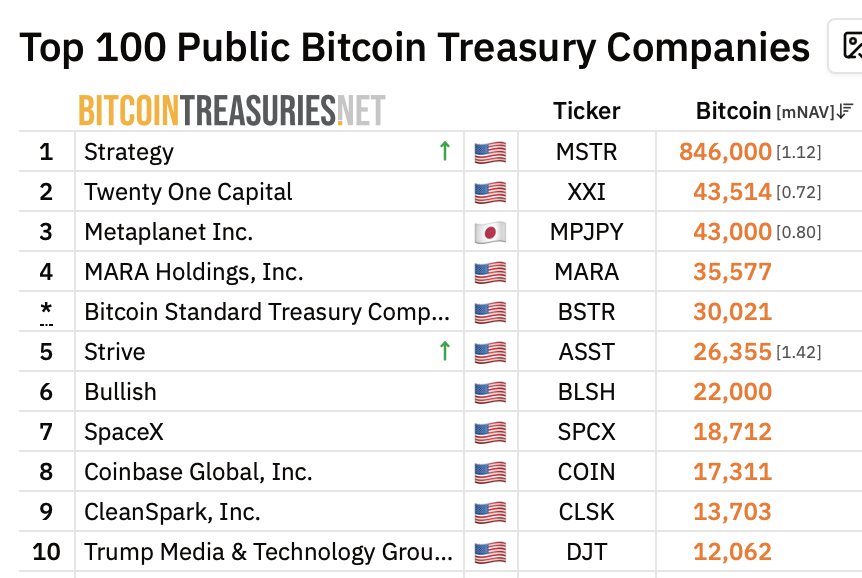
Top 10 Bitcoin treasury companies. Source: BitcoinTreasuries.NET
Strategy CEO says leverage drove STRC below $100
While Strive was the first public company to offer daily dividends, Strategy pioneered what it calls “digital credit,” preferred securities designed to generate income from a capital structure built around the company’s Bitcoin treasury.
STRC, a key part of Strategy’s digital credit strategy, has seen significant price swings this year. In June, the stock fell sharply below its $100 stated amount, hitting an intraday low of $71.25 on June 26, according to Yahoo Finance data.
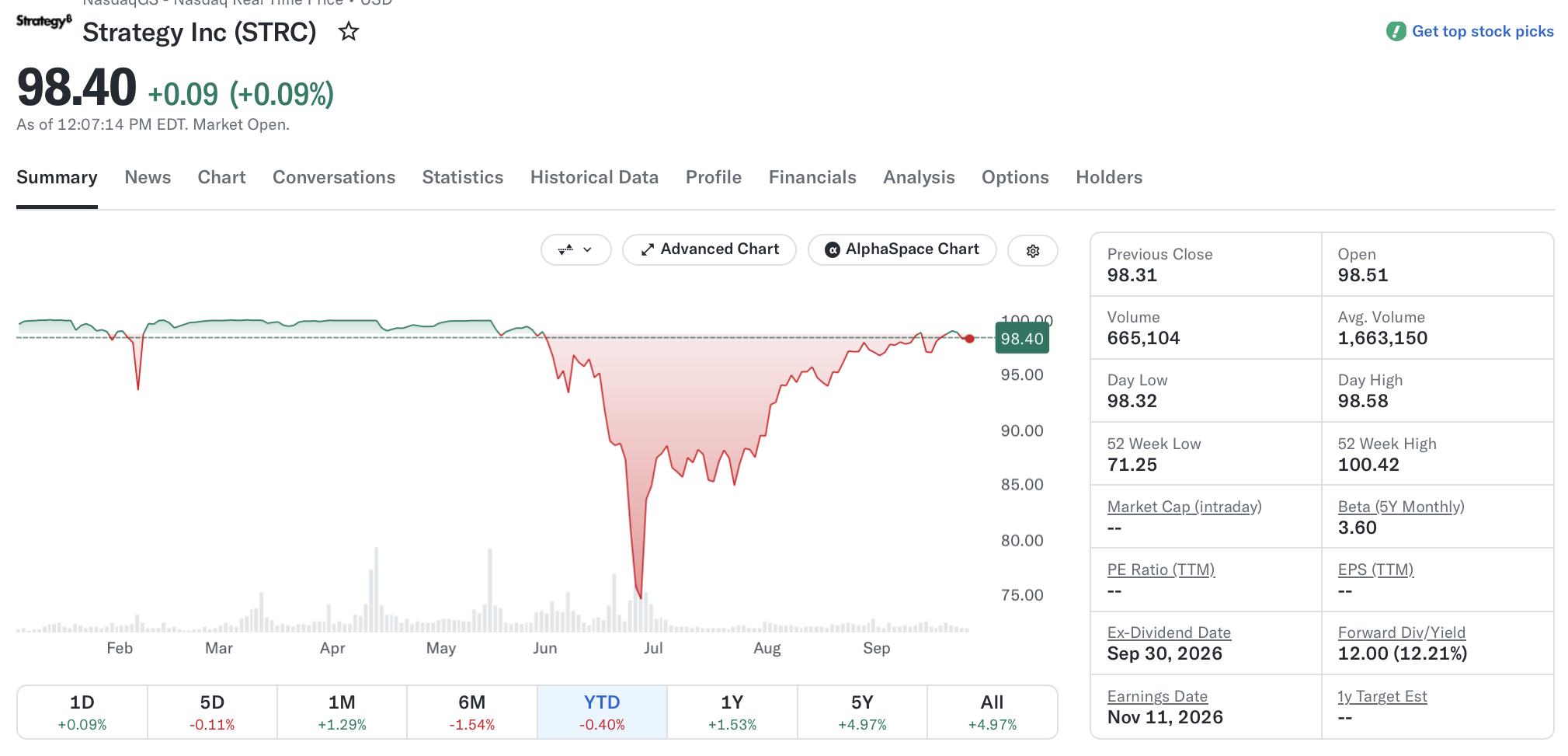
STRC stock price year-to-date. Source: Yahoo Finance
Speaking on Natalie Brunell’s Coin Stories podcast earlier this week, Strategy CEO Phong Le attributed the decline to more leverage entering the market for STRC than the company had anticipated. He said some investors borrowed against Bitcoin at lower rates to buy STRC and capture the spread between their borrowing costs and STRC’s dividend yield.
When Bitcoin’s price fell, investors who had borrowed against their holdings faced pressure to either add more collateral or sell STRC, according to Le.
“We did not expect the amount of leverage that came into the system,” Le said. “And so that’s a lesson learned, next time around.”
Le said Strategy is seeking to prevent another such unwind by maintaining a strong US dollar reserve and having a policy that allows the company to repurchase STRC when it trades below its $100 stated amount. He also said the company wants to attract more long-term holders, particularly institutional investors.
STRC has since recovered to about $98.41, close to Strategy’s stated goal of keeping the security between $99 and $100. It currently carries a 12% variable annual dividend rate.
Magazine: Exchanges reporting crypto gains to IRS becomes tax nightmare

The line between crypto companies and traditional finance is blurring. Binance is buying a $100 million stake in Circle, Canada’s six largest banks are exploring tokenized deposits and the New York Stock Exchange is working with Blockchain.com to bring US stocks and ETFs onchain.
Crypto companies want a bigger role in payments and traditional assets, while banks and exchanges are bringing those markets onchain without giving up their place at the center of the financial system.
This week’s Crypto Biz highlights how stablecoins and tokenized assets put crypto companies and traditional finance on increasingly overlapping turf, with both sides vying for control over how money and assets move.
Binance bets $100 million on Circle in expanded USDC deal
Binance is deepening its ties to Circle with a $100 million investment in the stablecoin issuer and a five-year agreement to expand USDC adoption across the exchange.
According to a Tuesday filing with the US Securities and Exchange Commission, Circle issued Binance 1,237,011 shares of Class A common stock at $80.84 apiece in a Sept. 17 private placement. The purchase price was below Circle’s market price before the deal closed. CRCL shares rose following the announcement.
The investment comes with a broader commercial agreement around USDC. Circle will pay Binance a monthly incentive fee based on the amount of USDC held through the exchange’s Modular Smart Contract Wallet infrastructure.
Binance is restricted from selling, transferring, pledging or otherwise disposing of the Circle shares for up to two years, although the lockup can end earlier under certain termination provisions. Binance retains voting rights on the shares during that period.
Canada’s biggest banks test tokenized deposits
Canada’s six largest banks are jointly exploring tokenized Canadian dollar deposits, a potential new payment rail that would allow digital representations of bank deposits to move between financial institutions.
The initiative brings together Bank of Montreal, CIBC, National Bank of Canada, Royal Bank of Canada, Scotiabank and TD Bank Group. The first phase will focus on transfers between participating banks, with the system potentially connecting to other digital asset networks later.
The project comes after Canada’s Office of the Superintendent of Financial Institutions clarified on Sept. 10 that tokenized deposits are “not legally distinct from traditional deposits,” meaning the use of blockchain or other technology does not change their underlying legal treatment.
Unlike fiat-backed stablecoins, tokenized deposits remain liabilities of the banks that issue them. The participating banks say the model could enable faster, programmable payments, with other deposit-taking institutions potentially joining in the future.
The distinction is particularly relevant as Canada develops its stablecoin rules. The country’s framework applies to non-financial institution issuers, while regulated banks and credit unions fall outside its scope.
Stablecoin payments surge as crypto market shrinks
Cross-border stablecoin flows surged nearly 78% to $220.3 billion in the year through June, even as the broader crypto market lost more than a third of its value.
According to Chainalysis, cross-border stablecoin flows increased 77.5% while total crypto market capitalization fell 37% to $2.1 trillion. The analytics firm identified 4,708 new cross-border corridors carrying $2.64 billion, although the largest corridors still accounted for 96.1% of total value.
Chainalysis said much of the growth came from transfers averaging about $3,000, a pattern more consistent with trade, remittances and savings than speculative activity. Tether economist Philip Gradwell described the activity as having a “steady rhythm” typical of business use, while StraitsX CEO Tianwei Liu pointed to demand for dollar access, inflation protection and ways around capital controls outside Asia.
Stablecoin adoption has also coincided with greater regulatory clarity. The US enacted the GENIUS Act in July 2025, while the European Union’s MiCA framework and Hong Kong’s licensing regime have brought stablecoins under more formal oversight.
NYSE, Blockchain.com team up on tokenized US stocks
Blockchain.com and the New York Stock Exchange are teaming up to bring tokenized US stocks and exchange-traded funds to crypto users through a planned alternative trading system.
The companies signed a memorandum of understanding covering the new digital ATS, which remains subject to regulatory approval. The agreement also includes a market-data partnership between Blockchain.com and NYSE parent Intercontinental Exchange’s ICE Data Services.
TD Securities’ Reid Noch described the partnership as a bid for retail trading activity, particularly as tokenized markets open the door to 24-hour and weekend trading. Talos’ Tanay Ved said crypto venues are increasingly evolving into multi-asset platforms.
Demand is also growing. The value of tokenized stocks has reached $3.14 billion, while the number of holders has climbed 72% to 3.87 million, according to RWA.xyz.
The partnership follows the US Securities and Exchange Commission’s introduction of a five-year Innovation Exemption for certain tokenized securities venues. Eligible tokenized stocks must represent actual shares carrying the same economic and governance rights as their traditional counterparts.
Crypto Biz is your weekly pulse on the business behind blockchain and crypto, delivered directly to your inbox every Thursday.
Sequans Communications has sold its remaining 314 Bitcoin and fully exited its BTC treasury strategy after using earlier sales to cut debt and reshape its balance sheet.
Summary
- Sequans sold its remaining 314 BTC, completing its Bitcoin treasury exit and leaving no cryptocurrency on its balance sheet.
- The company had already used earlier Bitcoin sales to redeem convertible debt and now plans to focus its resources on its semiconductor business.
- Empery Digital, Nakamoto, Strategy and Smarter Web have sold portions of their Bitcoin holdings in 2026, mainly for debt payments and other financing needs.
- Unlike Sequans, several of those companies continue to hold Bitcoin, while Strategy returned to buying in September and raised its holdings to 846,000 BTC.
Sequans said on Sept. 24 that the sale covered all Bitcoin held on its balance sheet as of June 30, leaving the semiconductor company with no cryptocurrency holdings. The exit completes a process that had already accelerated this year as the company sold BTC and redeemed its convertible debt.
The decision represents a substantial change from Sequans’ position less than a year ago. In November 2025, the company said its long term conviction in Bitcoin remained unchanged after selling 970 BTC to reduce its debt from $189 million to $94.5 million.
At the time, CEO Georges Karam described the sale as a tactical decision and said it would put Sequans in a better position to expand its Bitcoin holdings later.
The company’s position changed further during 2026 as more Bitcoin was used to meet financial obligations.
Sequans Bitcoin sales accelerated in 2026
During the first quarter, Sequans sold another 1,025 BTC as revenue fell and losses grew. Its holdings had dropped to 1,114 BTC by April 30 from 2,139 BTC at the end of 2025.
Of the remaining holdings, 817 BTC were pledged as collateral against $35.9 million of convertible debt. Sequans recorded $11.7 million in realized losses from Bitcoin sales during the quarter, with the proceeds mainly going toward convertible debt redemption and its American depositary share buyback program.
The company had already sold 970 BTC in November 2025, cutting its holdings from 3,234 BTC to 2,264 BTC. That transaction halved its debt from $189 million to $94.5 million.
By May 2026, Sequans had redeemed its remaining convertible debt and outlined plans to wind down the Bitcoin treasury strategy. The final 314 BTC have now been sold.
Sequans said it has no outstanding debt apart from obligations connected to government financed research and development projects. Its balance sheet now consists of a stronger cash position without cryptocurrency exposure.
Karam said the company had eliminated its convertible debt while monetizing its remaining Bitcoin “in a measured and opportunistic manner.”
“With this transition complete, we are focused on capitalizing on the strong momentum across our semiconductor business,” Karam said.
Other Bitcoin treasury firms have been selling BTC
Sequans’ complete exit follows Bitcoin sales by several other public companies during 2026, although many of those firms have continued to hold substantial BTC reserves.
Empery Digital, for instance, has used Bitcoin sales to raise cash while reducing its debt burden. The company sold 1,400 BTC for approximately $87.1 million between May 7 and July 10, according to company disclosures previously covered by crypto.news.
Its regulatory filings show that 1,167 BTC were sold during the first six months of 2026 for $80.1 million. The original cost of the Bitcoin resulted in a realized loss of $56.8 million.
Selling continued after the end of the quarter. Empery disposed of another 1,635 BTC between July 1 and Aug. 6 and received $102.2 million in proceeds. During the same period, it repaid $20 million in borrowings and received 585 BTC that had been held by a lender as collateral.
Nakamoto took a similar approach to part of its holdings during the second quarter. The company generated approximately $48 million in net proceeds from the sale of roughly 600 BTC and certain Bitcoin derivative positions, using most of the money to repay 45 million USDT of a Bitcoin backed loan.
Nakamoto still held 4,467 BTC at the end of June, with an aggregate fair value of approximately $261.5 million, meaning the transaction represented a reduction rather than an exit from its Bitcoin strategy.
The Smarter Web Company used 177.89 BTC to repay an $11.7 million convertible instrument in July. The company sold the Bitcoin at an average price of $65,762 and completed the repayment around two weeks before the instrument matured.
Smarter Web retained 2,700 BTC following the transaction and said its long term Bitcoin strategy remained in place.
Strategy has sold Bitcoin while retaining its large treasury
Strategy, the largest corporate Bitcoin holder, has moved away from its previous pattern of near continuous accumulation at several points this year.
The company sold roughly $218 million worth of Bitcoin earlier in 2026 to help meet preferred stock dividend obligations and replenish its dollar reserves. Reuters reported in July that Strategy had authorized up to another $1.25 billion in Bitcoin sales as part of a plan that included share repurchases.
Its sales continued into the following weeks. Strategy sold Bitcoin for four consecutive weeks through early August, including 1,638 BTC for approximately $104.7 million between July 27 and Aug. 2.
Unlike Sequans, Strategy has not abandoned Bitcoin as a treasury asset. Its holdings remained above 840,000 BTC after the sales, and the company later returned to buying.
Strategy purchased 950 BTC for $75.7 million in September, taking its total holdings to 846,000 BTC. The transaction showed that corporate Bitcoin sales this year have not followed a single pattern, with some companies using portions of their reserves for financing needs while continuing their accumulation strategies.
MARA Holdings has taken another route. The Bitcoin miner sold about 23,093 BTC for roughly $1.63 billion during the first half of 2026 to fund operations, investments and liquidity needs. It still held 35,577 BTC at the end of June.
Sequans returns its focus to semiconductor business
With its Bitcoin position now at zero, Sequans said its financial and strategic resources will be directed toward its cellular IoT and software defined radio semiconductor operations.
The company reported product revenue growth of more than 80% year over year during the second quarter. Its six month product backlog at quarter end was more than three times the level recorded a year earlier.
Work is continuing on Sequans’ 5G eRedCap platform as the cellular IoT industry moves from 4G toward 5G connectivity.
Sequans is developing another business line around its recently launched RF transceiver for software defined radio applications. The company secured its first drone design win during the second quarter and said it is seeing customer interest across defense, drone and space markets.
Karam said Sequans is seeing product growth, customer adoption and licensing opportunities while continuing work on its 5G eRedCap and software defined radio platforms.

A survey of US crypto investors has found that about one in five who filed or planned to file a tax extension received an incomplete 1099-DA or were unsure whether the form matched their trades.
Summary
- Awaken Tax surveyed 1,000 US crypto investors in August about the 2025 filing season.
- Among respondents who filed or planned to file an extension, 21% were still waiting for exchange information.
- Brokers generally reported 2025 sale proceeds, while taxpayers had to calculate their own cost basis.
- Taxpayers with an extension have until Oct. 15 to file their federal returns.
Awaken Tax’s August survey found that another 21% of respondents who had filed, or planned to file, an extension were still waiting for information from an exchange or crypto platform. The findings concern a group of taxpayers trying to finish 2025 returns during the first filing season for Form 1099-DA, which brokers use to report certain digital asset transactions to the Internal Revenue Service.
The IRS says brokers generally had to report gross proceeds from covered 2025 transactions. Proceeds show what a customer received in a sale, but most forms for that tax year do not show what the customer originally paid. Taxpayers need both figures to calculate a gain or loss, and the agency says they must report digital asset income, gains, and losses even if no 1099-DA arrives.
Crypto tax forms can show a sale without its cost
For a taxpayer who bought Bitcoin for $9,000 and sold it for $10,000, the gain would be $1,000 before any applicable adjustments. A 2025 Form 1099-DA could report the $10,000 in proceeds without listing the $9,000 purchase price.
Chris Herbst, managing director of CountDeFi tax reporting, said gross proceeds can be many times an active trader’s actual gain because the form counts each sale at its full value without subtracting the asset’s cost. Taxpayers must then match the reported sales with their own purchase records.
According to the IRS, taxpayers should use Form 1099-DA together with their other records and calculate their basis before filing. Someone who bought an asset on one exchange, moved it through a private wallet and sold it on another may need records from all three places to establish what they paid.
Herbst said a complete exchange history should include trades, fees, deposits, withdrawals, and transaction identifiers. A missing record can affect a later calculation when an asset has moved between platforms or remained in a wallet for years.
In its earlier guide to 1099-DA, crypto.news reported that brokers had to send forms covering 2025 gross proceeds by Feb. 17, 2026, while reporting cost basis remained voluntary for that first year. The IRS had warned taxpayers that most of the statements would leave them to calculate basis themselves.
Exchange records are proving hard to reconcile
Sharon Yip, founder of Crypto Tax Advisors, said her firm has found differences between clients’ 1099-DAs and the tax reports it prepared from their transaction histories. Some exchange forms omitted trades made in 2025, while customer statements arrived in different formats. Exchanges also included cost basis for some trades but left it off others, she said.
One client’s exchange activity included more than $300,000 in stablecoin trades during 2025, according to Yip. The exchange’s 1099-DA listed less than $100,000 in total stablecoin proceeds. The discrepancy left her firm comparing the form against the client’s transaction records to work out what should appear on the return.
Andrew Duca, founder of Awaken Tax, said some customers received their forms late in the filing season. He cited Kraken as an example, saying the exchange sent forms to users roughly two weeks before the April 15 tax deadline. Duca also pointed to a Kraken 1099-DA from around that period that contained no reported transaction information.
Under IRS guidance for incorrect forms, recipients can request a corrected 1099-DA from the issuer and keep both the corrected form and their correspondence. The agency says taxpayers should not wait for a correction before filing and should use their records to report the transactions accurately.
Duca urged taxpayers to compare any 1099-DA with their complete transaction history rather than copy its figures into a return. “The IRS expects your return to reflect your actual gains and losses,” he said, “not necessarily what’s printed on a form that the exchange may have worked out incorrectly.”
Manual entries add work before the October deadline
Andrew Gordon, executive director of Digital Asset Tax Action, said taxpayers have repeatedly struggled to reconcile 1099-DAs with their own records this filing season. According to Gordon, most crypto tax software cannot import and reconcile the new form, while the tools that can still require manual input because brokers did not supply machine-readable 2025 forms.
For active traders, that can mean entering hundreds of transactions, Gordon said. He called for brokers to provide a machine-readable file with each 1099-DA and maintain histories that show acquisition dates, purchase amounts, fees and transfers.
The IRS extension guidance gives taxpayers who obtained an extension until Oct. 15 to file their 2025 federal return. The extension applies to filing; any balance due was generally payable by the original deadline.
Crypto tax recordkeeping has also drawn attention in Congress. In September, House crypto tax legislation included a proposed exemption for certain network transaction fees of up to $10.
During an earlier House Ways and Means hearing, Coinbase tax executive Lawrence Zlatkin told lawmakers that calculating gains and losses on routine stablecoin payments and blockchain fees creates substantial compliance work. The proposal has not changed the filing rules for 2025 returns.
Which crypto sales get basis reporting in 2026?
The next stage of Form 1099-DA reporting applies to transactions made in 2026. Under IRS instructions for brokers, basis reporting is mandatory for certain covered assets bought in a custodial broker account after 2025 and held there until sale. Reporting basis for noncovered assets remains voluntary.
The IRS classifies assets acquired before 2026 and assets transferred into a broker from elsewhere as noncovered for this purpose. Its instructions also allow certain stablecoin and NFT sales to be reported using optional methods that do not require basis. For those transactions, taxpayers may still need purchase and transfer records from outside the selling broker’s account to calculate their gains or losses.

The United States’ first crypto tax filing season under upgraded broker reporting requirements is bringing a familiar problem into sharp focus: more data for the IRS, but still a heavy lift for taxpayers. Under the newer Form 1099-DA rules applying to 2025 activity, brokers generally report the gross proceeds from certain digital asset sales—information that is new (or at least more visible) for the tax authority—yet cost basis is generally not included, leaving taxpayers to reconstruct their gains and losses from their own records.
That mismatch between what exchanges report and what returns require is showing up in real-world filing experiences. In an August survey of 1,000 US crypto investors conducted by Awaken Tax, 21% of respondents who had filed—or planned to file for an extension—said they were still waiting for information needed from an exchange or platform. A further 20% said their 1099-DA was incomplete or that they were unsure whether it accurately reflected their transactions.
Key takeaways
- For 2025, broker reporting generally covers gross sale proceeds, while cost basis is typically not provided—so taxpayers must compute gains and losses themselves.
- A survey by Awaken Tax found filing friction remains high: 21% of respondents reported waiting on exchange/platform information, and 20% questioned the completeness or accuracy of their 1099-DA.
- Professionals say reconciling 1099-DAs with full trade histories is difficult, especially when activity spans multiple platforms and years.
- Some exchanges have been reported to deliver 1099-DAs late in the filing season or with transaction details that appear inconsistent with customer records.
- Cost basis reporting is slated to expand in 2026 for covered assets, but transfers into broker accounts from outside sources may still create gaps.
More reporting visibility—without the full calculation
To understand why taxpayers still struggle, it helps to look at what 1099-DA is designed to tell the IRS. In a basic example, if an investor buys Bitcoin for $9,000 and sells it for $10,000, the taxable gain is $1,000. But a 2025 1099-DA can show the $10,000 in proceeds without providing the $9,000 cost basis needed to calculate that $1,000 outcome.
The IRS’s approach effectively increases how much sale information the tax authority receives, while taxpayers remain responsible for the arithmetic. That structure can turn record-keeping into a more complex, multi-step process—particularly for anyone who traded frequently, used several platforms, or moved assets between wallets and exchanges during the year.
According to Chris Herbst, managing director at CountDeFi tax reporting, the issue is amplified for active traders. Each sale is counted at full value while the basis-side math still needs to be assembled separately. “For an active trader, that number can be many times their real gain,” Herbst said, summarizing how gross proceeds visibility can mislead the intuitive sense of profit.
Reconciling forms with transaction histories is proving error-prone
While taxpayers are expected to keep their own records, the filing workflow becomes harder when the documents they receive don’t line up cleanly with the trading history they track. Tax professionals interviewed in the reporting describe discrepancies that can make reconciliation a time-consuming (and sometimes confusing) exercise.
Sharon Yip, founder of Crypto Tax Advisors, says her firm has seen differences between the 1099-DAs clients receive and the crypto tax reports her team prepares. In some cases, she says, forms omitted trades. She also points to format differences across exchanges, and notes that some exchanges included cost basis for certain trades but not others—despite basis reporting not being mandatory for 2025.
Yip also highlights a stablecoin-related example: one client conducted more than $300,000 worth of stablecoin trades on an exchange in 2025, yet the exchange’s 1099-DA showed less than $100,000 in total stablecoin proceeds. Even where the underlying activity is recorded correctly somewhere, mismatched reporting can force taxpayers to spend additional time validating what the form actually represents.
Timing has been another friction point. Andrew Duca, founder of Awaken Tax, said the firm has seen customers receiving 1099-DAs relatively late in the filing season. Duca pointed to exchanges such as Kraken as an example, citing an account that Kraken reportedly did not send forms to users until about two weeks before the April 15 tax deadline. He also referenced a Kraken 1099-DA from that period showing no reported transaction information.
Kraken did not respond to the publication’s request for comment.
Why taxpayers still can’t “just copy the numbers”
The core practical takeaway for investors is that 1099-DAs are not meant to replace a taxpayer’s own reporting work. Even when a form is complete, the IRS still expects returns to reflect actual gains and losses. Where cost basis is not included in broker reporting, taxpayers must fill in the missing elements using their records.
Herbst emphasized that what matters is the “full transaction history from the day the account opened,” including trades, fees, deposits, withdrawals, and transaction identifiers such as wallet information. He added that basis generally follows the asset across transfers. That means a missing piece of history can distort gain calculations later—possibly years after a trade occurred—if the asset was moved between platforms in the meantime.
Andrew Duca similarly argued that the updated visibility does not automatically create a finished calculation for taxpayers. As he framed it, “Visibility without basis produces the zero-basis problem.” The issue is straightforward: if a taxpayer relies on a form that shows proceeds but lacks acquisition-cost information, the return may fail to capture the true economic outcome.
Duca’s advice to taxpayers is to compare 1099-DA information against their complete transaction history rather than treating the form as authoritative on gain and loss. In his view, the IRS expects returns to show actual gains and losses—even if an exchange’s reporting may contain errors or omissions.
What changes in 2026—and what may remain unsolved
Looking ahead, broker reporting requirements are expected to expand. From 2026, brokers must generally report cost basis for covered digital assets, which should reduce—but not necessarily eliminate—the “proceeds without basis” problem. That would give taxpayers more of the inputs needed to compute taxable results without manually reconstructing acquisition costs for every covered transaction.
However, the reporting picture is not guaranteed to be seamless. The rules do not necessarily cover every scenario—for example, assets transferred into a broker from another exchange or wallet may fall outside certain requirements. That means gaps can still arise depending on where assets originated and how transactions are structured across custody providers.
In the near term, the broader lesson from the 2025 filing season is that increased IRS visibility doesn’t remove the need for strong internal records. As reporting improves, the key question for taxpayers and tax software providers will be whether transaction history can be reconciled accurately, quickly, and with enough detail to compute real gains and losses—not just gross sales totals.
As the industry transitions into 2026’s cost-basis phase, readers should watch how reliably brokers supply the additional fields and whether late or incomplete forms continue to create mismatches—especially for users who move assets between exchanges, wallets, and brokers.
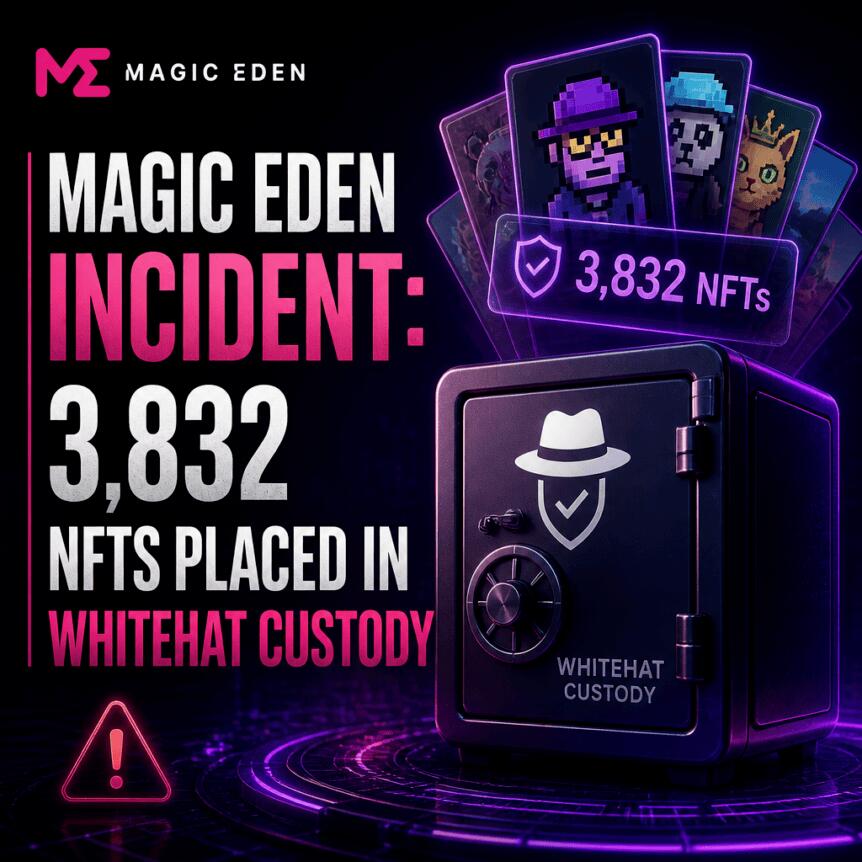
NFT holders tracking activity tied to Magic Eden reported what appeared to be a large-scale “rescue” transfer on Friday: a whitehat account moved 3,832 non-fungible tokens from hundreds of wallets after concerns surfaced about a potential vulnerability affecting the marketplace’s listings.
As questions spread across the community, Yuga Labs’ blockchain vice president, a pseudonymous account known as 0xQuit, said the movement was part of a controlled white-hat operation and that the NFTs in the destination wallet are safe and would be returned once they are no longer considered at risk. Magic Eden later narrowed the issue to a specific component connected to the Limit Break protocol and issued targeted instructions for affected former users.
Key takeaways
- A whitehat moved 3,832 NFTs from many wallets after community members flagged suspicious activity resembling Magic Eden sales.
- Yuga Labs executive 0xQuit characterized the transfers as a rescue operation, saying the assets will be returned when risk is reduced.
- Magic Eden linked the exploit to Limit Break’s Payment Processor V2 and said it stopped using the related system in October 2024.
- Magic Eden advised former users to revoke Ethereum, Polygon, and Base contract approvals, noting this will not bring back tokens already moved.
- Magic Eden said no live Magic Eden listings were impacted, while NFT listings on its EVM marketplace from roughly February to October 2024 could be affected.
Community flags transfers resembling Magic Eden sales
According to NFT community member Cirrus, activity on Friday looked like a coordinated set of transactions where a single wallet appeared to route NFTs out from many holders. In posts on X, Cirrus said the transfers involved 3,832 NFTs moved from hundreds of wallets and that the on-chain transactions appeared to be tied to trades executed through Magic Eden.
Cirrus also recommended a precautionary step: revoke token permissions/approvals to reduce exposure if the underlying issue still allowed unauthorized movement. The guidance resonated quickly within NFT circles, particularly because “approval” patterns are a common weakness when third-party contracts can move assets that owners have already authorized.
Yuga Labs describes a white-hat rescue in progress
Not long after the community’s warnings, 0xQuit—described by Yuga Labs as its pseudonymous vice president of blockchain—responded that the transfers were part of a white-hat operation. He said the NFTs held in the receiving wallet are safe and would be returned once they are no longer at risk.
0xQuit has previously participated in NFT recovery efforts. In June, coverage by Cointelegraph described a rescue after an exploit targeted Flooring Protocol, where 0xQuit helped recover 68 NFTs valued at more than $500,000. Those assets were later held with the goal of returning them to affected users.
Separately, Yuga Labs CEO Michael Figge indicated a vulnerability had been discovered earlier and that additional details would follow, signaling that the company was aware of the issue and coordinating on next steps.
Magic Eden ties the problem to Limit Break’s Payment Processor V2
Magic Eden provided its own account of what happened, stating on X that the exploit involved Limit Break’s Payment Processor V2. The marketplace said it stopped using that payment processor as part of its integration timeline, noting that it closed its EVM marketplace in the first quarter of 2026.
In Magic Eden’s framing, the key distinction for investors and collectors is that the company did not believe ongoing listings were being targeted in real time. “No live Magic Eden listings were impacted in this exploit,” Magic Eden said. However, it warned that NFTs listed on its EVM marketplace from approximately February to October 2024 could be exposed.
This time window matters because it points to which approvals and integrations were likely in place during the period when the affected payment processor could still be reachable. If a holder interacted with Magic Eden’s EVM marketplace during those months—especially if they granted blanket approvals—permissions may still linger even after a platform changes or sunsets its tooling.
Actions for former users: revoke approvals across networks
Magic Eden urged former users to revoke approvals for the relevant contract on Ethereum, Polygon, and Base. The company emphasized that revoking approvals would not reverse transfers that have already occurred, but it could help prevent additional token movement for remaining assets under the same approval setup.
In parallel, Magic Eden said it was contacting Limit Break—the protocol owner and maintainer—about further mitigations. The company specifically referenced efforts aimed at pausing transfers, suggesting that technical controls on the protocol side may still play a role in limiting harm while the rescue process unfolds.
Magic Eden also noted that it was providing guidance to those potentially affected rather than issuing a blanket alert that all users were at risk. Cointelegraph reported contacting Magic Eden for comment but did not receive a response by publication beyond the statements already posted.
What to watch next
For holders, the immediate focus is whether token approvals tied to the affected integration remain in place and whether Limit Break implements additional transfer-pausing measures. For the broader market, this episode underscores how quickly “approval-based” vulnerabilities can outlast marketplace support windows—making rescues possible, but also leaving many users to verify permissions across chains long after a protocol’s usage has changed.

Circle Foundation has announced two grants to help the United Nations Development Programme and World Food Programme test digital payments for development work and humanitarian aid.
Summary
- UNDP will create a Digital Asset Innovation Pool to help country offices use lessons from earlier payment pilots.
- WFP will test two to three country payment corridors over the next three years.
- The WFP grant will fund risk controls, payment records, compliance tools and links to local financial providers.
- Circle Foundation’s funding comes from an equity commitment by U.S.-listed Circle Internet Group.
Circle Foundation said in its Sep. 25 announcement that the separate grants will help UNDP and WFP examine whether digital payments, including regulated payment stablecoins, can get funds to recipients faster and at lower cost.
UNDP will focus on making payment methods tested in individual projects available to more country offices. WFP will build the controls needed to test stablecoin payments alongside local financial services.
The grants fund different stages of that work. UNDP has already tested digital payment methods in several countries and will use its grant to support their use in regular programs. WFP’s grant, made to World Food Program USA, will pay for systems and partnerships needed before it tests payments across two to three country corridors.
How Circle Foundation will support UNDP payments
UNDP will establish and operate a Digital Asset Innovation Pool under the grant. Circle Foundation said the pool will help country offices use regulated payment stablecoins where they suit a development program, with guidance on local rules, day-to-day operations and safeguards for people receiving funds.
The pool will also give UNDP tools to measure how long payments take, what they cost and how many people they reach. UNDP said the mechanism will provide another option when ordinary payment systems create high costs, delays or barriers to access. It will continue using established banking channels.
Earlier pilots give UNDP a starting point. In Aleppo, Syria, the agency tested digital payments for a cash-for-work project. In Haiti, it tested disbursements designed for limited connectivity. A Guatemala project linked remittances to community investment, while work in The Gambia connected mobile wallets to existing cash-agent networks.
In July, crypto.news covered UNDP’s expanded Stellar partnership after 16 months of blockchain payment tests. UNDP reported that the Syria pilot reduced distribution costs from 10% to 2%. It also said a Haiti pilot kept processing payments during a cellular network outage. Those results came from earlier projects; the new pool will help country offices decide how to apply lessons from them.
Robert Pasicko, team lead at UNDP’s Alternative Finance Lab, said the pool will support payments that are “faster, more affordable and easier to access,” particularly for people underserved by conventional banking. The lab led the agency’s Sustainable Development Goals Blockchain Accelerator, through which the earlier payment solutions were tested.
What WFP will test over three years
WFP’s grant will support the payment infrastructure behind its proposed trials. According to Circle Foundation, WFP and its Innovation Accelerator will develop governance and risk rules, treasury and reconciliation systems, and compliance tools that can work across multiple country operations.
Reconciliation matters when an aid organization needs to match money sent through a payment system with its own records and the amounts received locally. WFP will also connect the planned payment systems with local fintech firms and mobile-money providers, so a digital transfer can reach people through services available in their markets.
Over the next three years, WFP plans to test two to three country corridors linking its payment system with local financial providers and markets. Circle Foundation said the tests will produce evidence on payment efficiency, transparency and resilience. The grant will also support independent research into costs, speed and whether stablecoin payments can work in humanitarian operations.
Bernhard Kowatsch, director of WFP Global Accelerator and Ventures, said the funding will let WFP explore regulated stablecoin payments in “real-world contexts.” WFP will use the trials to develop the evidence, partnerships and systems needed to assess their use.
How the grants fit Circle’s UN payment work
The two grants follow Circle Foundation’s first international award, announced in January for the Digital Hub of Treasury Solutions. UNHCR launched that shared UN platform in 2021 to modernize financial operations. Circle said 15 organizations participate, including UNDP and WFP.
Circle’s January funding supported work on cross-border transfers, conversion into local currencies and links between financial systems. As previously reported by crypto.news, the foundation announced its first U.S. grants on Sep. 22, awarding funds to Accion Opportunity Fund and Pacific Community Ventures for lending and data tools serving small businesses.
The U.S. connection also runs through Circle Internet Group, which is listed on the New York Stock Exchange under CRCL and supports the foundation through a commitment of about 1% of its equity. Circle’s filings, cited in the earlier report, show that its board reserved up to 2,682,392 Class A shares for foundation contributions over ten years. Circle Foundation operates as a donor-advised fund managed by Fidelity Charitable.
That equity commitment describes how Circle funds the foundation. The Sep. 25 announcement identifies World Food Program USA as the recipient of the WFP-related grant and says its funding will support WFP and the WFP Innovation Accelerator’s payment work.

F1 Azerbaijan GP LIVE: Race start time, schedule and qualifying results with Russell on pole
US Federal Reserve plans to raise bank oversight thresholds, sources say

MicroStrategy Has a New Proposal To Pay Its Investors Every Day




-

 Fashion7 days ago
Weekend Open Thread: Talbots – Corporette.com
-

 Crypto World3 days ago
Goldman Sachs and Deutsche Bank Agree: The S&P 500 Rally Isn't Over
-

 Tech5 days ago
Researchers escape OpenAI Codex sandbox to run commands on host
-

 Fashion1 day ago
8 iPhone Accessories That Add Personality
-

 Crypto World5 days ago
Who Needs CLARITY Anyway? ARB Could See 70X Increase: Hodler’s Digest
-

 Crypto World7 days ago
Circle launches Arc Studio AI agent for building onchain apps
-

 Crypto World7 days ago
Trading Bitcoin on Robinhood? Why 2% Spread Has Traders Worried
-
 NewsBeat7 days ago
Trump says US has reached an agreement to take permanent control of Greenland’s security
-

 Tech6 days ago
Trump suggests rebranding AI with a new name, says he’s also creating an AI Force
-

 Business5 days ago
Analog Devices (ADI) Bets $1.35 Billion on Chips that Let Machines Think for Themselves
-

 Crypto World7 days ago
Bitcoin price breaks channel as RSI climbs to 63
-

 Tech4 days ago
Google’s $899 Googlebook is a bet that you’ll buy a new laptop for Gemini
-

 Crypto World3 days ago
Trump-Xi Polymarket Odds for Handshake Hit 50%
-

 Crypto World5 days ago
Coinbase, Robinhood, Circle Seen as Tokenized-Stock Winners
-

 Crypto World3 days ago
This Bearish Netflix Stock Trade Can Cash In On Video Streaming Giant’s Woes
-
 Business3 days ago
Oil Price Today (September 23): Crude oil below $100 on hopes of US-Iran talks. What did Trump say?
-

 Crypto World2 days ago
Crude Oil Prices Pressured by Diplomatic Hopes in the Middle East
-

 Entertainment2 days ago
These 17 Fall Amazon Dresses Seriously Look Like Anthropologie
-

 Crypto World7 days ago
World Money launches in 150+ countries with Stripe
-

 Crypto World2 days ago
Bitcoin Threatens Sub-$84,000 Breakdown as Long Liquidations Spike
You must be logged in to post a comment Login