

Crypto World
Bitcoin Recovery Hinges on Breakout Above $72K Resistance (BTC Price Analysis)

Bitcoin is attempting to build a short-term recovery after weeks of sustained selling pressure. Although buyers have defended a key support zone, the broader trend remains fragile as price continues to trade beneath major technical resistance levels that must be cleared first to expect a genuine recovery.
Bitcoin Price Analysis: The Daily Chart
The daily chart continues to reflect a bearish market structure, with BTC trading around $62.1K. The price remains well below both the 100-day and 200-day moving averages, which are now acting as dynamic resistance around the $71K to $75K region. As long as BTC remains beneath these averages, sellers are likely to maintain control.
Following the sharp breakdown below the 100-day moving average near $72K earlier this month, the market found demand within the $60K support zone. This area has once again prevented a deeper decline and is currently fueling a modest rebound. The RSI has also formed a bullish divergence, with higher lows while price recorded lower lows, indicating that bearish momentum is fading and a short-term recovery is possible.
However, the broader trend remains bearish. Even if buyers extend the current bounce, the first major obstacle lies between $72K and $75K, where previous support has turned into resistance alongside both moving averages. A successful recovery above this region would improve the medium-term outlook, while rejection could expose the $60k support once again. Losing that area would likely open the door toward the next major demand zone around $55K.
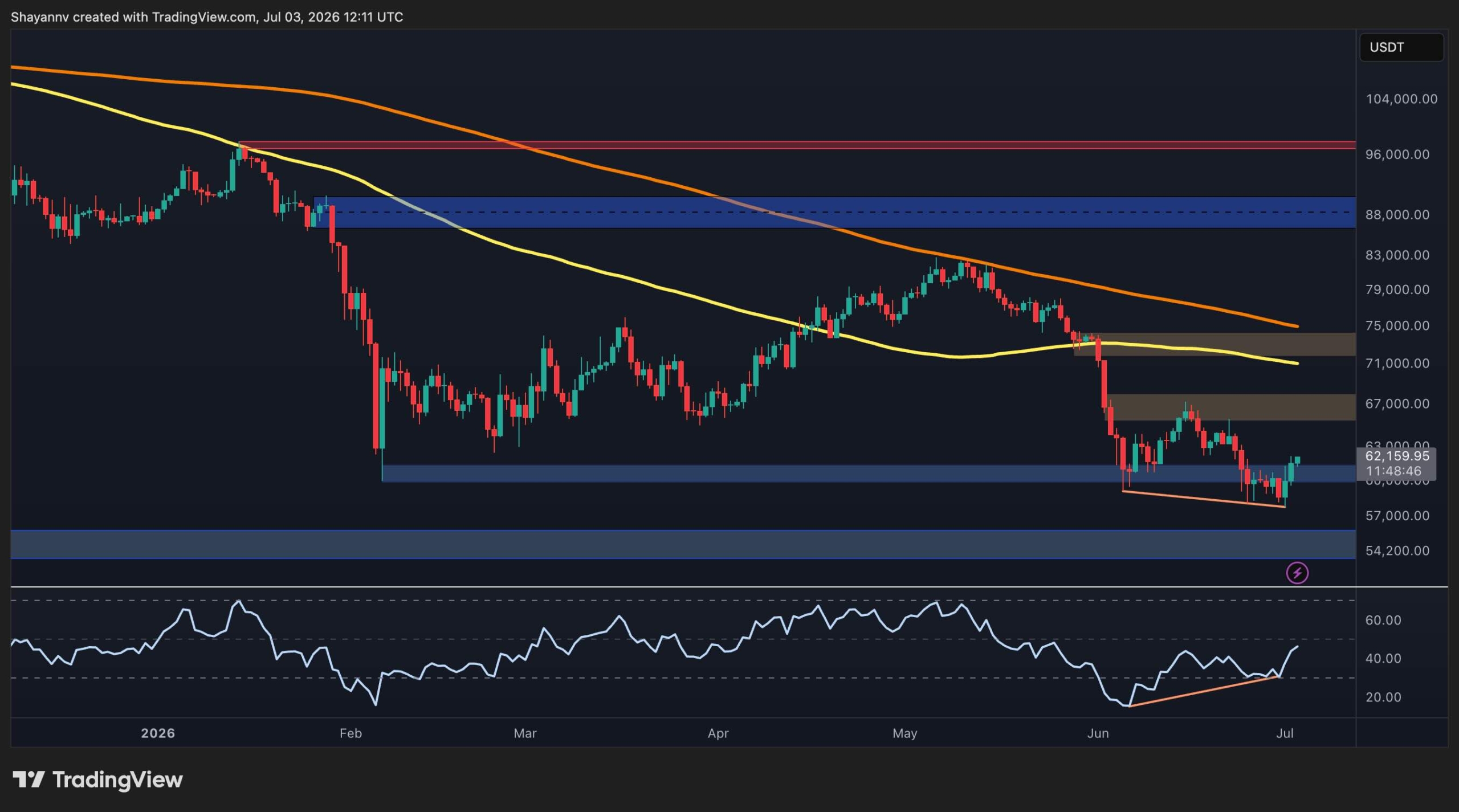
BTC/USDT 4-Hour Chart
The 4-hour timeframe presents a more constructive picture. Bitcoin has been trading inside a broad falling wedge following the sharp June sell-off, a pattern that often precedes bullish reversals when confirmed by a breakout.
Price has recently rebounded from the wedge’s lower boundary and the $60K support zone. At the same time, the RSI has produced another bullish divergence, reinforcing the idea that selling pressure is gradually weakening.
The next important hurdle lies near the wedge’s descending upper trendline, which currently aligns with the $62K level. A breakout above this resistance could trigger a stronger recovery toward the $66K to $68K supply zone. Beyond that, the much larger resistance area between $72K and $74K remains the key barrier to any meaningful trend reversal.
Failure to break the wedge would keep the broader bearish structure intact and increase the probability of a drop below the $60K support.

Sentiment Analysis
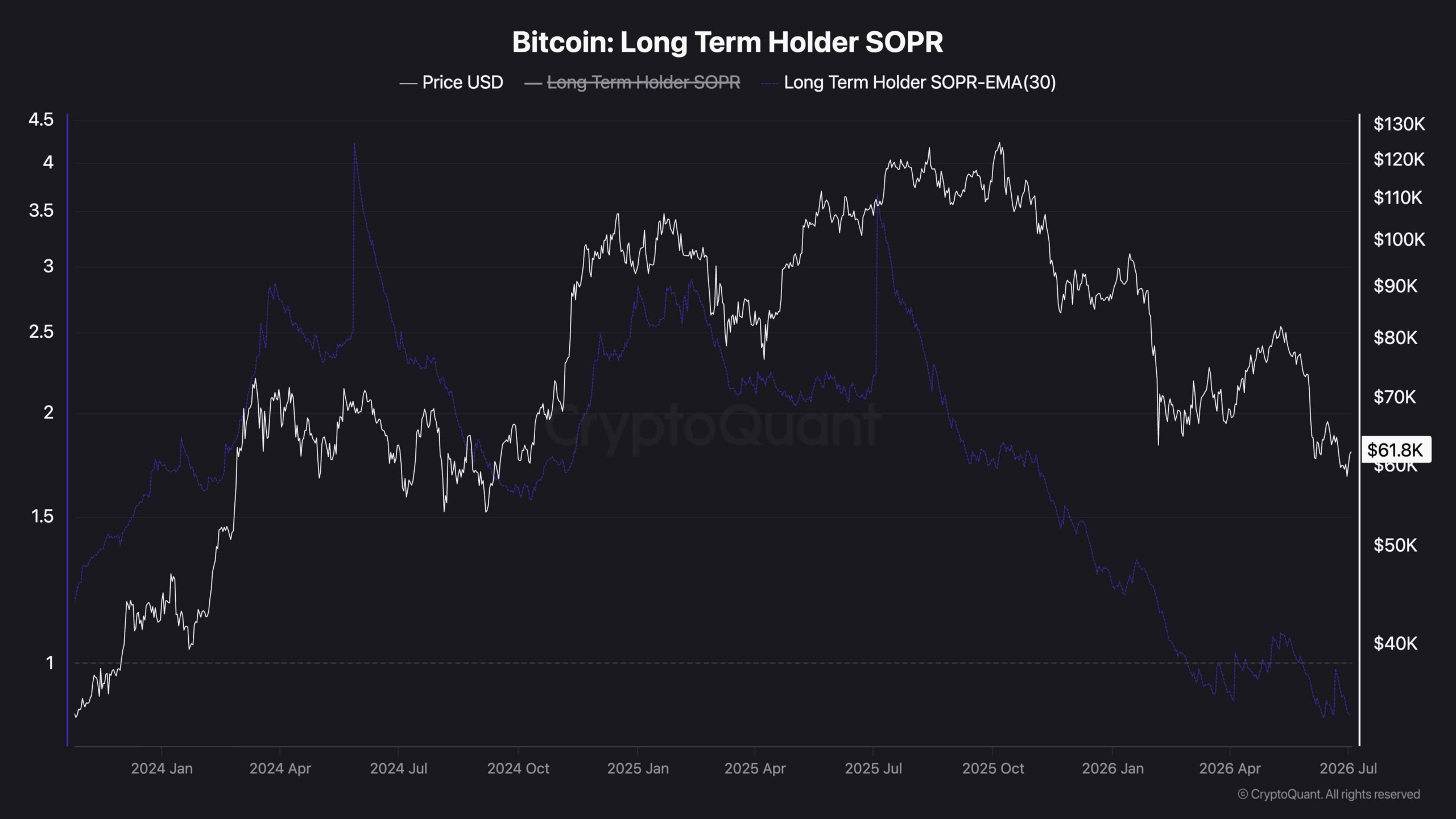
The Long-Term Holder SOPR (Spent Output Profit Ratio) continues to trend below the critical 1.0 threshold, indicating that long-term holders are, on average, realizing losses when spending their coins. Historically, sustained readings below 1.0 reflect periods of market stress, where even experienced investors begin distributing coins at a loss rather than taking profits.
The 30-day EMA of the metric has continued to weaken and now sits below the neutral level, suggesting this behavior has become persistent rather than temporary. This points to subdued investor confidence and confirms that long-term holders have yet to return to meaningful profit-taking.
While this reflects ongoing bearish sentiment, prolonged periods of LTH SOPR below 1.0 have often coincided with the later stages of market corrections, as weaker conviction is gradually exhausted. A recovery of the metric back above 1.0 would signal that long-term holders are once again spending coins in profit, a shift that has historically aligned with improving market conditions and a healthier uptrend. Until then, the on-chain data suggests the broader market remains in a phase of capitulation and recovery rather than a confirmed bullish reversal.
The post Bitcoin Recovery Hinges on Breakout Above $72K Resistance (BTC Price Analysis) appeared first on CryptoPotato.


The world’s largest crypto exchange has run into serious trouble with EU financial regulators, and the uncertainty has triggered concern among its user base.
Despite its issues in Europe, however, Binance has strengthened its global presence after officially entering the Philippines.
The Push in Asia
Several hours ago, Binance’s co-founder and chief customer service officer, Yee He, revealed the news on her personal X account. She cited a document stating that the Securities and Exchange Commission (SEC) has granted final approval to Blockshoals Technologies Inc. to begin testing its financial products and services within the watchdog’s regulatory sandbox.
Under the crypto-asset intermediary model, the Blockshoals Stratbox will give Filipino users access to a range of offerings provided through its global CASP partner Binance.
The development was also highlighted by Binance’s founder, Changpeng Zhao (CZ), who shared He’s post and said: “Real liquidity for Philippines.”
Some users described the expansion into the Asian country as a solid win for crypto adoption, while others were less supportive, claiming the news is only meant to shift attention away from the company’s problems in the European Union.
No MiCA License… for Now
The exchange recently decided to withdraw its MiCA license application from the Hellenic Capital Market Commission (HCMC) in Greece, leaving it without the necessary approval to operate in the EU after July 1.
Binance assured its local users that their assets are safe and asserted that Europe remains an important region for its operations, adding that it hopes to obtain the permit in the coming months. Meanwhile, some clients have revealed on X that they have received withdrawal instructions from the company, while others appear unaffected for the moment.
Adding to its regulatory challenges in Europe, a group of 1,700 UK investors has filed a collective lawsuit in London’s High Court targeting Binance and CZ. The claimants argue that the exchange offered unregulated products and led to severe financial losses. The lawsuit also accuses Binance of failing to provide adequate protection for its clients.
The post Major Binance Announcement Concerning Many Users: Details appeared first on CryptoPotato.


Gnosis Pay has revealed that a software flaw dating back to October 2023 enabled the $1.5 million exploit of its card safe infrastructure, while confirming that all affected users have been fully reimbursed.
Summary
- Gnosis Pay traced its $1.5 million hack to a Zodiac software flaw that had existed since October 2023.
- The company reimbursed all affected users, restored services within days, and continues recovering about $300,000.
- The incident adds to growing scrutiny of crypto security as firms and governments respond to rising cyber threats.
According to a postmortem published by Gnosis Pay on Friday, the vulnerability was traced to version 3.4.0 of the Zodiac smart contract framework and had remained undiscovered since Oct. 30, 2023.
The company said the weakness was exploited on June 1, allowing attackers to gain control of about $1.5 million in digital assets held across its decentralized self-custodial payment network.
The report states that Gnosis Pay’s monitoring systems, operated by treasury manager NOCA, detected the first unauthorized transfer at 06:17 UTC on June 1. Engineers identified the root cause within two hours of the initial alert, after which the company suspended card services, temporarily halted its bridge to Gnosis Chain, and shared attacker wallet addresses with stablecoin issuers to help trace the stolen funds. Gnosis Pay also notified external projects that could have been exposed to the same vulnerability.
Funds restored after staged recovery
Following the incident, Gnosis Pay restored customer access in several phases. The company said the first affected accounts regained access to their balances and payment cards by the night of June 3 after new card-safe modules had been deployed. Installation continued over the following days, restoring service for 99% of users by June 6, while the remaining accounts were recovered shortly afterward.
Gnosis Pay said it absorbed the financial losses itself, leaving customers with no losses from the exploit. According to the postmortem, the attackers stole mostly GNO, EURe, USDC.e, and several other digital assets. The company added that roughly $300,000 worth of assets had not yet been recovered and recovery efforts remain ongoing.
The report also disclosed that 5,281 wallets holding at least $1 were affected by the exploit. Gnosis Pay published the attacker’s wallet address used during the incident, identifying it as 0x5a7…7a35, while explaining that the exploit targeted two components within its card safe infrastructure, the Delay Module and the Roles Module.
Smart contract exploits continue to pressure crypto platforms
The disclosure comes as security incidents continue to affect crypto infrastructure providers. As crypto.news reported earlier, Humanity Protocol recently confirmed it is repositioning toward enterprise artificial intelligence products after a $36 million exploit accelerated an internal restructuring that had already been under consideration for several months.
During an interview, Humanity Protocol founder Terence Kwok said the company had been reviewing its long-term direction for six to nine months before the breach. He explained that the exploit sped up those plans, while adding that digital identity will remain central because enterprise AI systems will require reliable ways to verify people and credentials.
Meanwhile, concerns over crypto-related cybercrime have also reached government leaders. Earlier, G7 leaders issued a joint statement after their summit in Evian-les-Bains, France, calling for coordinated action against North Korea’s cryptocurrency thefts and cybercrimes.
The statement linked the issue to long-standing concerns that stolen digital assets have helped finance Pyongyang’s nuclear and ballistic missile programs under international sanctions, a claim repeatedly supported by Western governments and blockchain analytics firms.

XRP just recorded higher trading volume than Bitcoin on Upbit. The altcoin now trades above a recently reclaimed resistance level.
As a result, analysts are watching whether XRP holds enough momentum to challenge the next major zone. The surge in activity places the $1.15 level squarely at the center of trader attention.

Renewed Interest in XRP?
Trading volume measures the amount of an asset exchanged over a specific period. Rising volume is often seen as a sign of increasing market participation. It typically reflects stronger investor interest across both retail and institutional trading channels.
The altcoin generated roughly 113.18 million XRP in trading volume on Upbit over the past 24 hours. As a result, the token surpassed Bitcoin and became one of the exchange’s most actively traded digital assets.
The move drew immediate attention across South Korean crypto markets.
The timing is notable for the token. XRP recently moved above $1.10. That area had repeatedly capped previous recovery attempts.
Moreover, holding above the zone has improved the short-term technical structure and reinforced expectations of continued buying interest.
Analysts note that the latest move built a more constructive market setup. XRP is now attempting to form a sequence of higher lows and higher highs. That pattern is commonly associated with strengthening bullish momentum across major crypto assets.
The breakout has clearly attracted attention. However, traders remain focused on whether the token can maintain support above former resistance levels. As a result, sustained demand will likely be necessary to maintain the current upward trend.

Why the $1.15 Level Is Drawing Attention
The next major area under observation sits between $1.14 and $1.15. This range combines short-term selling pressure with a widely monitored long-term moving average. It now represents a potentially significant obstacle for the token.
A successful move above $1.15 could strengthen confidence among market participants. Furthermore, it would likely shift attention toward higher price levels. Conversely, failure to break through the area may lead to additional consolidation before another attempt.
Analysts also note the importance of XRP holding above $1.09 during any short-term pullback. In technical analysis, a former resistance level that becomes support often confirms a more sustainable breakout. That flip strengthens the broader bullish case.
Beyond $1.15, the next notable target remains the $1.20 to $1.30 zone. That area has repeatedly rejected previous rallies. Furthermore, it remains one of the most important resistance regions on the entire XRP chart.
Supporting the bullish narrative, XRP remains above its breakout level as market activity continues to expand. The token is currently trading around $1.11 after surging 2.25% over the last 24 hours, according to BeInCrypto data.
Buyers appear to have maintained control since the move above the resistance level.
Subscribe to our YouTube channel to watch leaders and journalists provide expert insights
The latest recovery also follows a period of prolonged weakness. XRP’s monthly RSI recently reached its most oversold reading on record. That extreme prompted some observers to consider the possibility of a broader trend reversal across the coming sessions.
The post XRP Trading Volume Tops Bitcoin on Upbit appeared first on BeInCrypto.
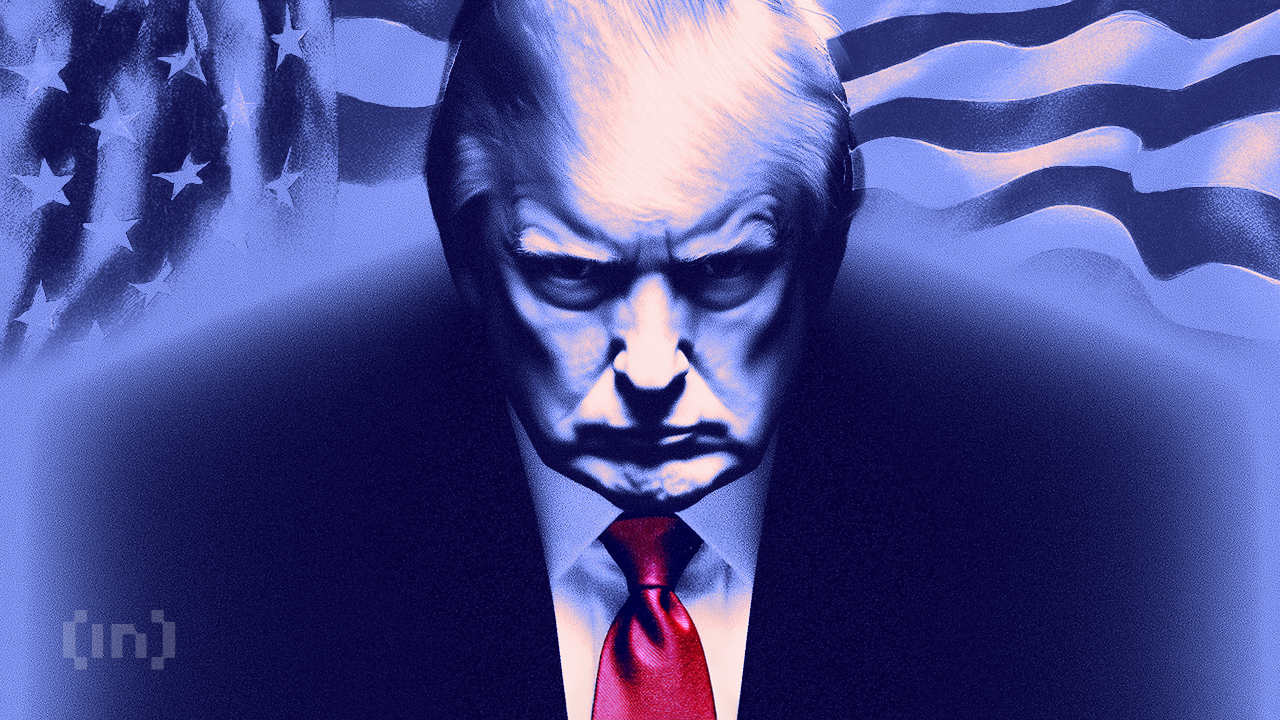

President Donald Trump is privately weighing clemency for Sean “Diddy” Combs while Sam Bankman-Fried (SBF) remains shut out. The SBF pardon application sits untouched even as Trump signed six emissions-related pardons on Friday.
Sources say a Friday White House meeting focused on Clean Air Act cases only. High-profile requests remain under private discussion.
Diddy Clemency Talks Reach the Oval Office
Sources told CBS News that Trump has been privately discussing clemency requests, including one from Combs. The music mogul is serving just over four years at Fort Dix after his 2025 conviction on two prostitution-related transportation counts.
Jurors acquitted him of sex trafficking and racketeering conspiracy. Trump told the Times in January that Combs had written him a letter seeking a pardon, though he said he was not considering it then.
However, Combs was not expected on the pardons team’s Friday list. Reports in May said Trump was weighing 250 pardons to mark America’s 250th birthday.
Friday’s signings deepen an established pattern instead. Trump pardoned Wyoming mechanic Troy Lake last year over similar emissions charges, and a June 29 executive order told the EPA to deprioritize tampering enforcement.
Trump confirmed the new pardons in a Friday post on Truth Social.
“It is my Great Honor to have just signed Pardons for six people who were persecuted by the Biden Administration, and were in, or being sent to, prison, for ‘fixing their car.’ … I AM SETTING THEM ALL FREE, RIGHT NOW!”
Follow us on X to get the latest news as it happens
Where Does the SBF Pardon Stand?
The FTX founder filed a formal pardon application with the Justice Department on June 8, requesting relief after completing his 25-year sentence. The petition remains pending.
Trump has shown no movement on it. In the same January interview, he said he had no intention of pardoning Bankman-Fried. A federal appeals court then crushed his retrial bid in June, leaving the sentence intact.
The contrast with Changpeng Zhao (CZ) is instructive. Trump granted the Binance founder a full pardon on October 21, 2025. CZ had served four months for an anti-money laundering compliance failure, while Binance paid $4.3 billion to settle.
SBF’s case reads differently in Washington. Prosecutors put the FTX fraud at $8 billion, and Senators Cynthia Lummis and Ruben Gallego introduced a resolution opposing any pardon.
Even strong recoveries have not softened that stance. The FTX Recovery Trust has returned roughly $10 billion, with smaller claims recovering up to 120% of 2022 values.
Meanwhile, his market takes from prison revived pardon chatter this week without changing his legal position.
The pattern suggests a firm line in Trump’s clemency thinking. Convictions he frames as regulatory overreach win relief quickly, while large-scale customer fraud stays frozen.
Whether the July Fourth window produces additional names could show how far that distinction stretches.
The post Trump Could Pardon Diddy: Is There a Chance for Sam Bankman-Fried? appeared first on BeInCrypto.
Crypto World
Defendant Files to Dismiss New York Lawsuit Seeking Ownership of 39,069 Bitcoin Wallets
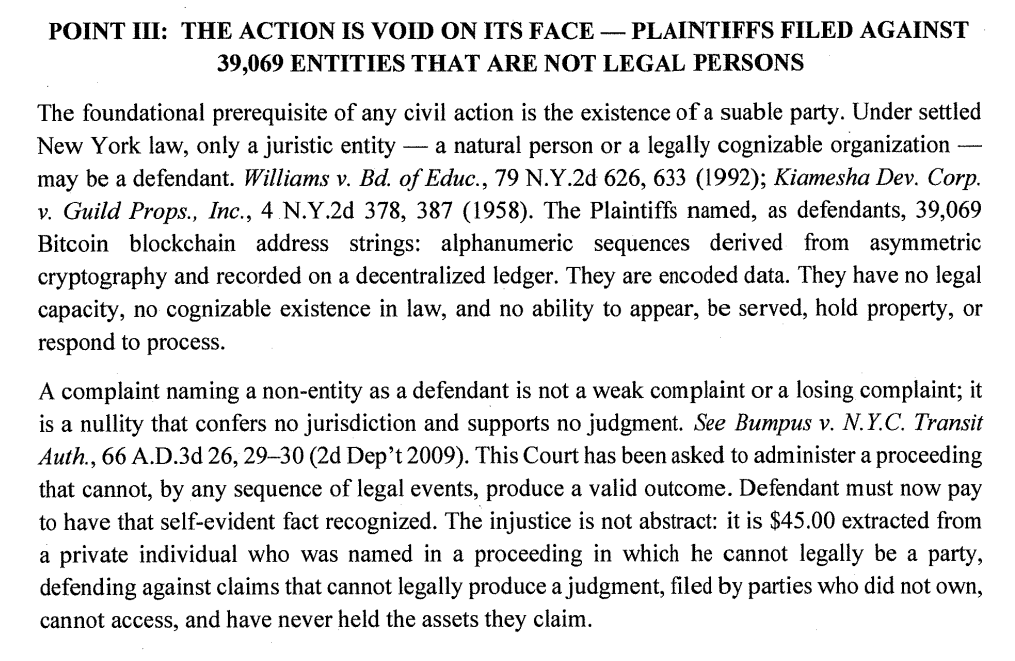
A pseudonymous defendant has moved to dismiss a New York lawsuit seeking ownership of 39,069 dormant Bitcoin addresses, arguing that Bitcoin addresses are merely data strings that cannot be sued.
The defendant, identifying themselves as “John Doe 33,” filed a notice of appearance and motion to dismiss on Thursday, claiming they control one of the dormant wallets named in the lawsuit.
According to the motion, the lawsuit is legally defective because Bitcoin address strings are neither persons nor legal entities subject to the court’s jurisdiction. The filing argues that a public Bitcoin address cannot itself be “found” under New York’s lost-property law because it has always been publicly visible on the blockchain.
The filing challenges the lawsuit filed in May by plaintiff “Noah Doe” and two Wyoming-based LLCs, ABC Company and XYZ Company. The plaintiffs claim the Bitcoin tied to the listed addresses constitutes abandoned property that they reported to the New York Police Department and claimed under New York lost-property law.
Regardless of how the court rules on ownership, it remains unclear how the plaintiffs could recover any Bitcoin without possessing the private keys needed to access the wallets.
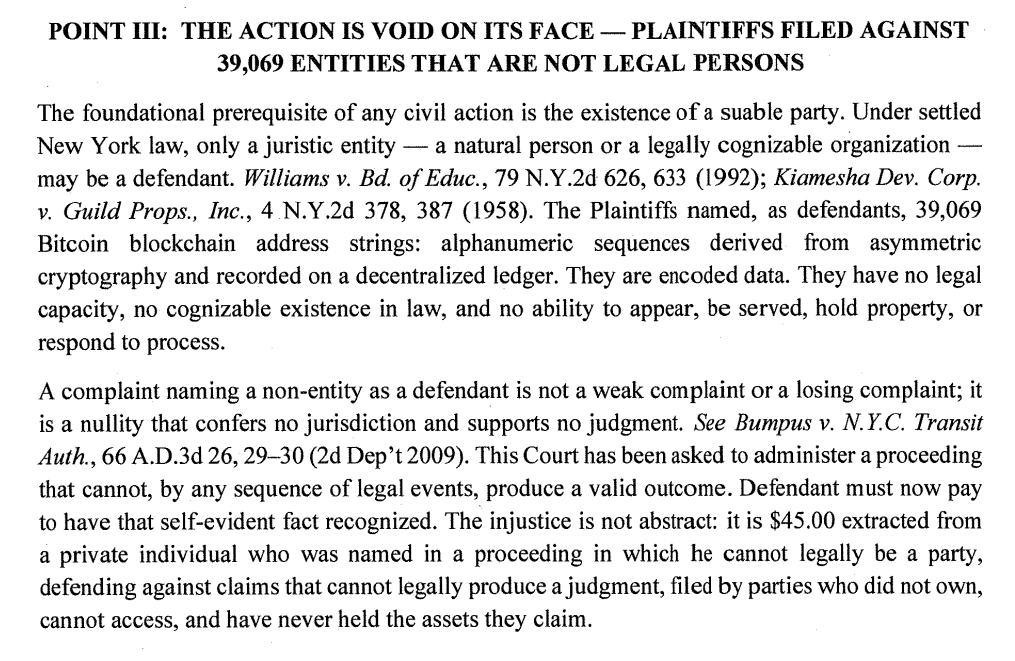
Defendant files a motion to dismiss the case seeking ownership of 39,069 Bitcoin wallets. Source: iapps.court.state.ny.us
The complaint lists 39,069 Bitcoin addresses, including wallet addresses widely associated with Bitcoin creator Satoshi Nakamoto and the Mt. Gox hacker. The listed wallets collectively hold an estimated 3.7 million BTC (worth about $234 billion), according to Sani, founder of Bitcoin analytics platform Timechain Index.
Related: Bitcoin miner MARA spent $4.3M on CEO security in 2025 as crypto attacks rise
Defendant appears to control $300 million Bitcoin wallet
Blockchain data suggests that “John Doe 33” controls a wallet holding 5,000 BTC received in April 2014 that has remained untouched for more than 12 years, making it worth more than $300 million at current prices, according to a Friday X post from Galaxy Digital head of research Alex Thorn.
“That’s ~100x the median defendant address. This is a real holder with real standing choosing to fight, not a bystander.”
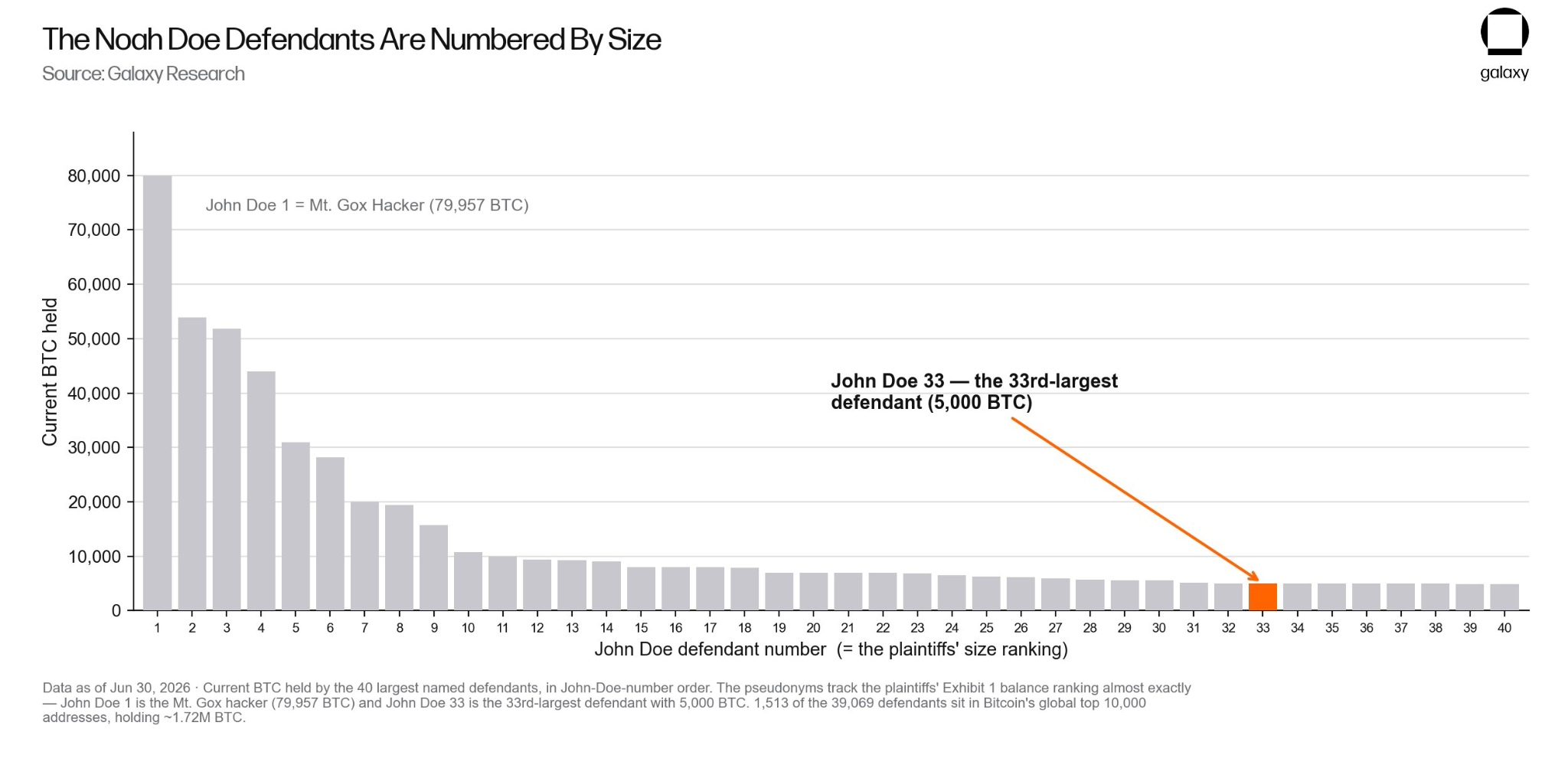
Source: Alex Thorn
Thorn added that the filing prevented what had been a “near-certain” default judgment and challenged jurisdictional and statutory defects in the plaintiffs’ case.
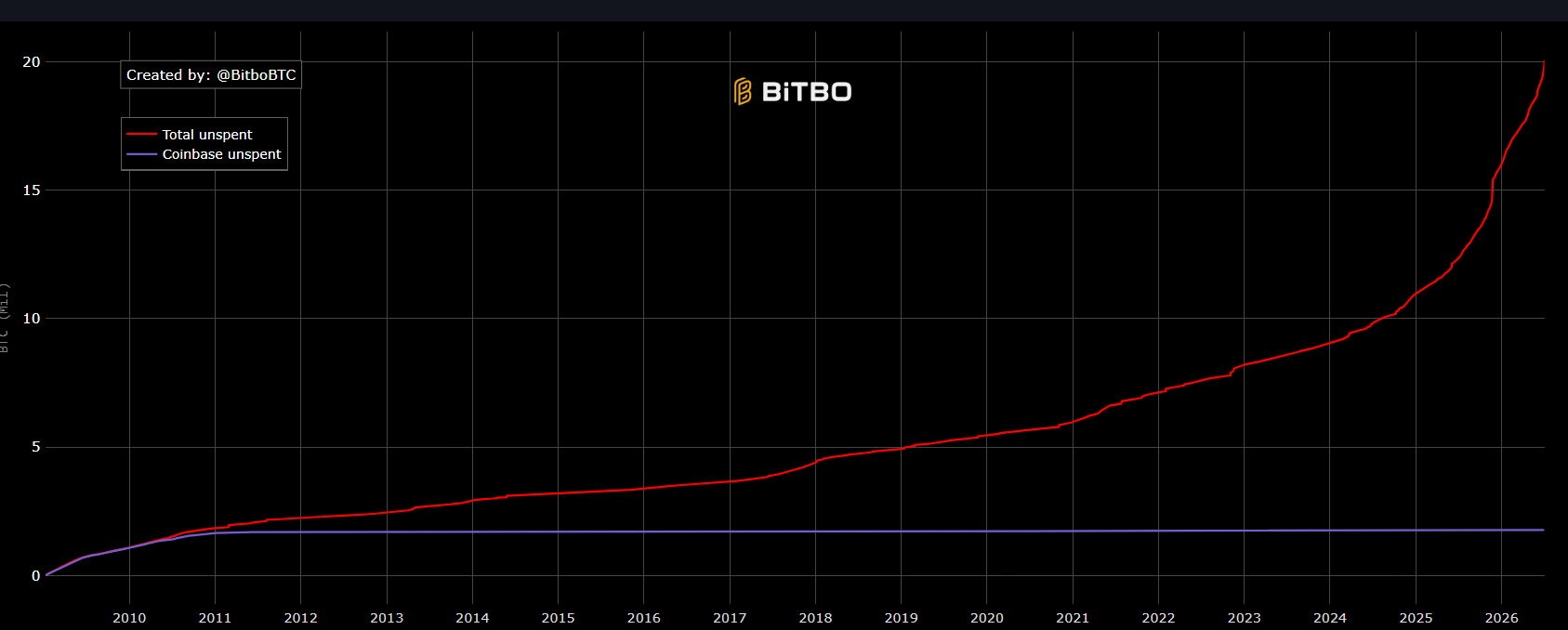
The supply of Bitcoin has been dormant for the past five and 10 years. Source: Bitbo
There are currently 3.5 million BTC, worth about $215 billion, that have been dormant for the past 10 years and another 6.6 million coins, worth around $406 billion, that have been dormant for over five years, Bitbo data shows.
Magazine: How crypto laws changed in 2025 — and how they’ll change in 2026

TLDR
- European regulator expands MiCA registry with 37 additional crypto service providers.
- Major financial institution Standard Chartered receives EU crypto authorization.
- Total licensed crypto asset service providers in EU reaches 280.
- Cyprus emerges as top contributor with six newly approved CASPs.
- EU regulatory framework transitions from development to active enforcement phase.
Europe’s securities watchdog has expanded its MiCA-compliant crypto registry with 37 additional firms following the conclusion of the transition window. This expansion brings the total number of authorized providers to 280. The development marks a pivotal shift from regulatory development to active market oversight.
European Crypto Registry Receives Significant Update
ESMA released its initial registry revision following the conclusion of MiCA’s transitional window on Wednesday. The Friday announcement included companies that successfully obtained crypto-asset service provider authorization. Consequently, the registry now offers enhanced transparency regarding licensed European Union operators.
ESMA’s previous registry update, issued on June 26, documented 243 crypto-asset service providers. The current revision increased this figure to 280. This expansion means 37 additional companies have entered the European Union’s structured crypto regulatory framework.
Notable additions to the registry include Standard Chartered, FalconX, Sygnum Europe, and Ronin EM. Furthermore, the electronic money token section welcomed Crédit Agricole’s CACEIS division. Notably, ESMA did not document any new asset-referenced token issuers during this update cycle.
Major Bank Secures European Crypto Authorization
Standard Chartered emerged as one of the most prominent additions in ESMA’s recent registry expansion. Luxembourg’s financial authorities granted the banking institution MiCA authorization on June 25. This approval establishes a compliant pathway for the bank’s cryptocurrency operations throughout Europe.
The financial institution simultaneously obtained an Electronic Money Institution license from Luxembourg authorities. This credential enables electronic money issuance and payment processing services. Combined, these authorizations facilitate custody operations, token-related services, and payment-integrated digital asset activities.
Standard Chartered indicated these licenses align with its broader European digital asset strategy. The institution has previously expanded digital asset custody capabilities across Asian and Middle Eastern markets. MiCA provides a unified regulatory structure for comprehensive EU market participation.
Mediterranean Nation Dominates Recent Authorization Cycle
Cyprus emerged as the frontrunner in the latest ESMA registry expansion, contributing six newly authorized crypto-asset service providers. France, Italy, and Malta each contributed five companies. The Czech Republic and Spain registered four providers respectively.
Luxembourg contributed three new registrations, while the Netherlands added two companies. Germany, Liechtenstein, and Latvia each registered one licensed provider. This geographic distribution demonstrates how individual national authorities contribute approvals to the centralized ESMA registry.
Cyprus has now issued 21 MiCA authorizations through its securities regulatory body. Germany maintains the overall leadership position with 58 authorizations under BaFin supervision. Nevertheless, smaller jurisdictions remain competitive by offering streamlined and transparent licensing procedures.
Regulatory Framework Transitions to Enhanced Oversight
The most recent ESMA registry update reveals inconsistent advancement across MiCA’s different categories. The asset-referenced token registry remains without any approved issuers. The non-compliant entities roster stayed static at 162 companies.
This disparity indicates that service provider licensing is advancing more rapidly than certain token issuance approvals. Exchanges, brokers, custodial services, and financial institutions now have established pathways. However, token issuers continue facing more stringent requirements and extended approval processes.
The registry now functions beyond a simple compliance database. It influences market access decisions, counterparty verification processes, and institutional risk assessment procedures. ESMA has transformed MiCA into an operational gateway for European Union crypto market participation.

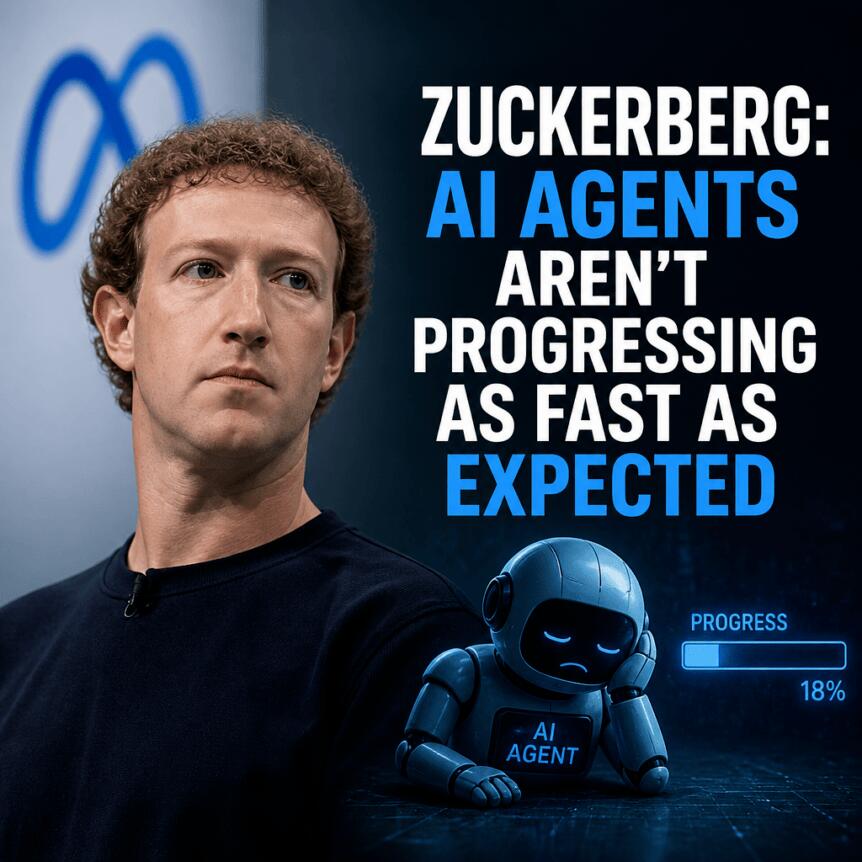
Meta CEO Mark Zuckerberg has sounded a note of caution on the pace of “agentic” AI development, telling employees that progress on autonomous agents has not accelerated as quickly as expected despite heavy investment by major technology and crypto firms.
Speaking during a company meeting on Thursday, Zuckerberg said the “trajectory of the agentic development over at least the last four months hasn’t really accelerated in the way that we expected,” Reuters reported after reviewing a recording of the call. He added that the broader bet on agent adoption “hasn’t come to fruition yet,” even as leadership pushed harder into agent-focused infrastructure earlier this year.
Key takeaways
- Zuckerberg said Meta’s agentic AI progress has not matched expectations over the past four months, according to Reuters.
- Meta executives accelerated agent-focused infrastructure plans in January due to concerns they were moving too slowly.
- Meta still expects returns from its AI spending within three to six months, Zuckerberg said.
- Meta expanded its Meta Business Agent globally for businesses across Instagram, Messenger, and WhatsApp.
- Blockchain data suggests AI-agent transaction activity remains limited, including only about $2 million in x402-facilitated volume over the last 30 days, per Artemis.
Meta’s AI agents: expectations versus delivery
Zuckerberg’s remarks highlight a growing mismatch between the industry’s timeline for autonomous AI agents and how quickly real-world systems can scale and deliver value. While agentic AI has captured attention from both software giants and crypto-adjacent companies, Zuckerberg indicated that even within a company widely positioned for rapid experimentation, momentum has been slower than planned.
Reuters reported that Zuckerberg pointed to a lack of acceleration in the “last four months,” despite a push intended to close perceived speed gaps. He acknowledged that an aggressive January push into agentic infrastructure was driven by fears that Meta wasn’t advancing “fast enough,” while also framing the current state as not yet reaching the level of adoption leadership expected.
At the same time, Zuckerberg said he believes Meta’s AI investments will start paying off within the next three to six months. That timeframe matters for investors and teams because it signals management still expects near-term results—even if the broader agent ecosystem remains behind schedule.
Business Agent rollout across Meta’s messaging and social apps
Meta’s comments came alongside new product deployment. On Thursday, the company expanded its Meta Business Agent globally, aiming to bring agent capabilities to businesses operating across Instagram, Messenger, and WhatsApp.
According to Meta, the Business Agent is designed to handle customer inquiries, make product recommendations, and close sales without requiring human intervention. For businesses, the appeal is straightforward: agent systems can reduce response times and staffing pressure while enabling commerce flows inside channels where customers already interact.
Zuckerberg also previously said in March that he was building a personal AI agent to support CEO decision-making, reinforcing Meta’s view that agent tooling can move beyond customer-facing automation into internal workflows.
Crypto’s agent payments thesis faces measured on-chain activity
Zuckerberg’s reality check lands amid a crypto industry that has largely embraced the idea that AI agents could become major users of blockchain payments. Executives including Coinbase CEO Brian Armstrong and Circle CEO Jeremy Allaire have previously predicted that AI agents may become dominant users of blockchain-based payment rails in the coming years, as noted in coverage referenced by Cointelegraph.
In support of that narrative, several integrations have been announced in recent months. Cointelegraph previously reported that Amazon Web Services integrated Coinbase’s x402 payments protocol into Amazon Bedrock AgentCore in May, enabling agents to transact using the USDC stablecoin. Other examples cited include a Visa-supported virtual card for AI agents from Oobit launched in April for purchases in USDt (USDT).
However, the gap between “capability” and “usage” is showing up in on-chain volume. Artemis data cited by Cointelegraph suggests that AI-agent transaction activity facilitated through the x402 protocol remains comparatively small: only $2 million in trading volume over the past 30 days.
This matters because the crypto payments story around autonomous agents depends not just on integrations being possible, but on consistent demand emerging from actual agent behavior. Low volume can indicate early-stage adoption, experimentation without sustained deployment, or limitations in how agents currently interact with payment endpoints.
What to watch next for agentic AI and stablecoin payments
Zuckerberg’s comments suggest the industry may need to plan for a slower-than-hoped transition period as agentic systems mature and as businesses learn where automation genuinely outperforms human-led workflows. At the same time, Meta’s investment outlook—expecting payback within three to six months—signals continued pressure to convert AI spending into operational results.
For the blockchain segment, the next checkpoint should be whether on-chain payment volume tied to agent infrastructure increases materially from current levels, and whether new business-facing deployments like Meta Business Agent lead to measurable downstream demand for stablecoin payment rails.
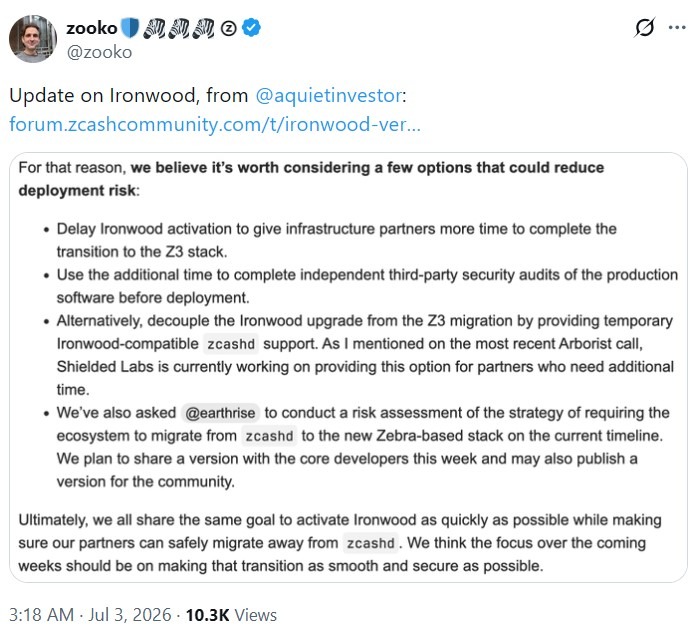
Shielded Labs has raised the possibility of delaying Zcash’s Ironwood network upgrade, warning that ecosystem participants like exchanges, mining pools and wallets may not have enough time to prepare their systems for the planned activation in late July.
Jason McGee, executive director of Shielded Labs, said in a Zcash community forum post that two major projects are moving forward at the same time. Alongside Ironwood, infrastructure providers are being asked to replace Zcash’s longstanding node and wallet software, zcashd, with a new collection of tools known as the Z3 stack.
The concerns highlight the trade-off between quickly restoring confidence in Zcash’s shielded supply and giving ecosystem participants enough time to deploy and audit the new infrastructure safely.
Ironwood was proposed after researchers discovered an “infinity” bug in Orchard, Zcash’s main private transaction pool. The flaw could theoretically have allowed an attacker to create an unlimited amount of counterfeit ZEC tokens inside the pool without detection. Developers said there was no evidence that the pool had been exploited. However, Orchard’s privacy features make it impossible to prove that no fake coins were created.
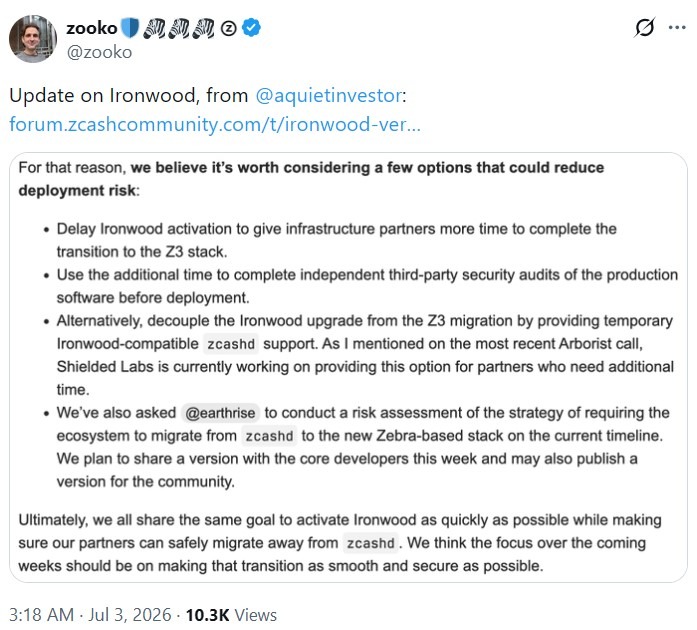
Source: Zooko Wilcox
Ironwood rollout collides with Zcash software migration
Ironwood would open a replacement private pool and prevent new activity inside the existing Orchard pool. Funds leaving Orchard would have to pass through an accounting checkpoint that prevents more ZEC from exiting than what originally entered. This would allow users to verify that the circulating supply remains within Zcash’s intended limits.
At the same time, Zcash is retiring zcashd, the software used by many ecosystem participants to connect to the network and process transactions. Its replacement stack includes Zebra for operating a network node, Zaino for supplying blockchain data to applications and Zallet for wallet functions.
The network’s official guidance documents said operators may need to modify their systems as some zcashd functions will not have direct replacements.
Related: Why ZEC fell 40% even after Zcash patched a shielded pool bug
McGee said Zallet and Zaino were still under development and not ready for production use. Feedback gathered from infrastructure providers suggested that some expect to be ready by late July, while others need more time, he added.
McGee said no delay has been finalized.
Zcash founder Zooko Wilcox said security reviews had found no additional serious bugs so far and that developers are also working to verify the new system before Ironwood activates.
Magazine: Bitcoin decouples from tech stocks, Ether eyes ‘selling wave’: Market Moves
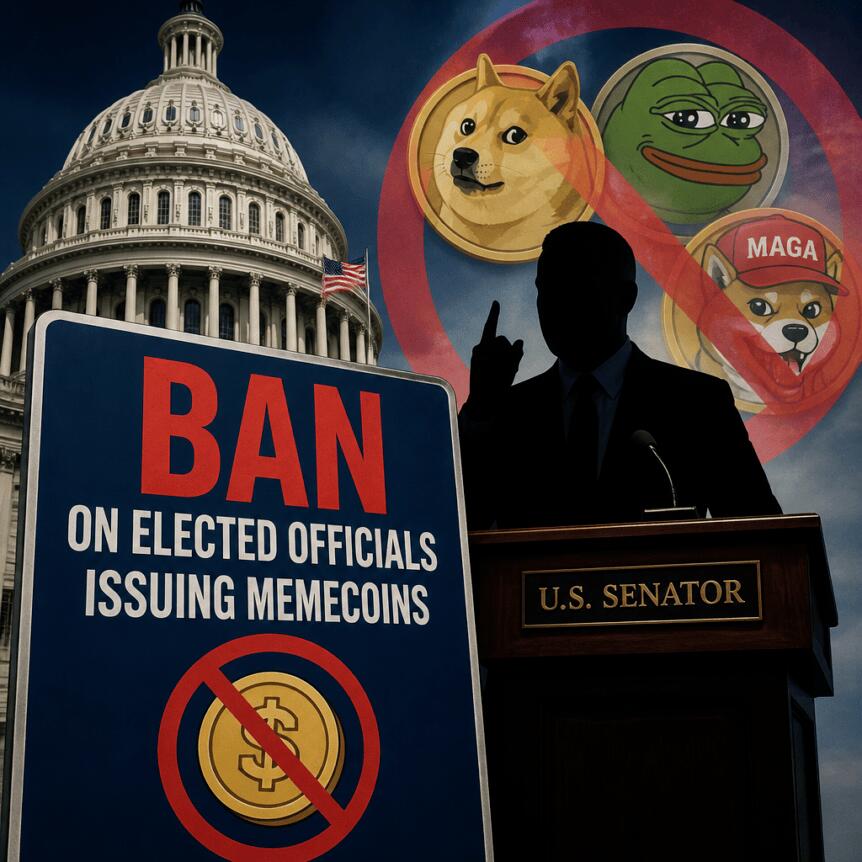
Senator Kirsten Gillibrand has renewed her push for tighter ethics rules around digital assets, proposing that elected officials—and the president and their spouse—be barred from issuing or sponsoring their own tokens. Her latest remarks explicitly referenced President Donald Trump and First Lady Melania Trump’s memecoin activity.
Gillibrand, a New York Democrat involved in negotiations over US digital asset legislation, said in a Friday announcement that Congress should consider measures preventing public officials from using their position to promote or benefit from token launches. The proposal focuses on “issuing or sponsoring” digital assets, and would apply to a president and their spouse; it did not spell out whether similar restrictions should cover the vice president’s office or other relatives.
Key takeaways
- Senator Kirsten Gillibrand proposed banning presidents and elected officials from issuing or sponsoring their own tokens, including memecoins.
- The restriction would clearly cover the president and their spouse, but the scope for vice presidents or other family members was not specified.
- Gillibrand links the idea to concerns about self-dealing, consumer protection, and efforts to curb illicit finance.
- Her comments come amid broader Senate work on digital asset market-structure and stablecoin legislation that has faced ethics-related scrutiny.
- The proposal follows shifting approaches in earlier legislation consideration around Trump-related crypto involvement.
Why Gillibrand is targeting token sponsorship by officials
In her Friday statement, Gillibrand argued that “public officials and their spouses should not be issuing memecoins,” framing the move as basic conflict-of-interest prevention rather than a partisan effort. She said the goal is to stop self-dealing from undermining consumer protections and complicating efforts against illicit finance.
The senator’s remarks emphasize the potential for elected officials to benefit from token-related projects that could be influenced by their access to policymakers, regulators, and legislative timelines. In her view, such concerns are especially urgent in markets that are still developing guardrails for disclosure, investor protections, and anti-manipulation enforcement.
Connection to the CLARITY Act and ethics as a gating issue
Gillibrand is also one of the lawmakers involved in negotiations on the Digital Asset Market Clarity (CLARITY) Act in the Senate. According to prior reporting, progress on the bill has been slowed by worries that extend beyond token rules themselves—particularly concerns about ethics, tokenization practices, and stablecoin reward structures.
Gillibrand previously indicated that the chamber could not move forward without addressing ethics questions, pointing to the risk that elected officials could “get rich” from insider access. In that context, the token-sponsorship proposal aligns with her broader stance that ethics constraints should be treated as foundational, not optional.
The senator’s framing also highlights a recurring legislative tension in the US crypto policy debate: how to extend oversight to new financial products while limiting opportunities for lawmakers to profit from the very markets they help shape.
How stablecoin and memecoin provisions were handled in earlier legislation
During consideration of the Guiding and Establishing National Innovation for US Stablecoins Act (GENIUS Act), Gillibrand said senators had removed provisions that specifically targeted Trump’s ties to the crypto industry, including his memecoin Official Trump. In her account at the time, the memecoin was likely “illegal based on current law,” but she suggested that trying to fully cover Trump-related ethics issues would require a “very long and detailed bill.”
Eventually, Trump signed the GENIUS Act into law in July 2025. Gillibrand’s new proposal suggests that even after that outcome—when lawmakers reportedly narrowed focus on Trump-specific provisions—ethics concerns have not gone away. Instead, she appears to be seeking a more general rule that would constrain future token issuance by officials and their spouses.
Notably, Gillibrand’s proposed memecoin restriction did not appear to be designed as a blanket ban covering all family members. The difference matters politically and legally: it shapes how broadly the rule could reach beyond a president’s spouse, while still addressing the most direct relationship that can be tightly linked to official influence.
Trump’s response and the wider conflict-of-interest debate
Gillibrand’s renewed comments arrive as Trump has continued to dismiss perceived conflicts of interest involving his crypto investments. This week, he reported that he earned about $1.4 billion from crypto ventures in the year he took office, while also holding the power to influence legislation that affects digital assets, including both the GENIUS Act and the CLARITY Act.
According to Trump, there was “nothing illegal” and “nothing wrong” with profiting from investments while serving as president, and he did not directly answer questions about the perceived conflicts. The contrast with Gillibrand’s position is stark: she argues that legality alone does not resolve the underlying ethical risk when public officials’ influence intersects with markets where their own token or sponsorship interests could be monetized.
The broader backdrop also includes criticism of involvement by Trump’s sons in crypto-adjacent ventures, including their connection to World Liberty Financial and a Bitcoin mining company described as American Bitcoin. While Gillibrand’s new proposal does not explicitly extend to those broader family circumstances, it reinforces that lawmakers and watchdog voices remain focused on whether personal ties to crypto create unfair advantages or distort policy incentives.
For investors and builders, the practical significance of Gillibrand’s proposal is straightforward: if adopted, a ban on token issuance or sponsorship by officials (and a president’s spouse) could reduce expectations of politically driven token promotion. It may also shape how exchanges, issuers, and intermediaries approach compliance and disclosure when influential figures are involved.
Still, much remains uncertain. Key questions include how “sponsoring” would be defined in law, whether enforcement would rely on existing securities and commodities frameworks, and—if a rule passes—how much legislative time it would take to harmonize it with the ongoing CLARITY Act process. Readers should watch how ethics language evolves in both the market-structure and stablecoin bills, and whether lawmakers treat conflict-of-interest guardrails as a prerequisite rather than an afterthought.

Several major South Korean companies have said they have not formally joined the newly announced Open USD (OUSD) consortium, despite being listed among its participating organizations.
Open Standard, the independent entity behind the stablecoin, previously said it had assembled over 140 businesses to launch OUSD, a dollar-pegged stablecoin, later this year.
Korean Companies Push Back
The lineup featured some of the world’s largest companies across multiple industries, such as Visa, Mastercard, BlackRock, Google, Ripple, and Standard Chartered, among the high-profile names. The list of South Korean participants included Samsung Electronics, Dunamu, Shinhan Financial Group, KakaoBank, K Bank, Hyundai Card, KB Kookmin Card, BC Card, Hana Card, Samsung Card, Woori Card, NH Nonghyup Card, and Hanwha.
However, several of those companies have now disputed the nature of their involvement.
According to a report by Chosun Biz, a Samsung Electronics representative told the publication that there had been no official discussions with the OUSD issuer and that the company did not know what role it would play in the consortium. Meanwhile, Shinhan Financial Group, Dunamu, and K Bank similarly said Open Standard had only asked whether they were interested in participating in OUSD and that they had simply responded that they would review the proposal.
Their names were reportedly later included in the consortium list despite no formal commitment.
One company representative also said the firm only discovered it had been identified as an alliance member after reading domestic media reports. The representative added that the company had merely indicated it would consider participation if circumstances aligned and was puzzled to find itself listed as a member.
No Contracts, Only Discussions
The report was later echoed by the founder of digital asset firm Pointsville, Gabor Gurbacs, who said he spoke with several companies listed in the OUSD consortium, and they told him they had never signed or agreed to participate. He added that either the media had significantly distorted the situation or the published participant list was misleading.
The claims also prompted debate across X. One user described listing companies before deals are finalized as a “classic legitimacy-borrowing” move, while another said the situation represents a major credibility risk.
The post Open USD Membership Claims Challenged After Samsung, Others Dispute Participation appeared first on CryptoPotato.

Apple Plans New iPad Pro and Redesigned MacBook Pro for Spring 2027 With Faster M7 Chip That Skips M6 Pro
Major Binance Announcement Concerning Many Users: Details

What The Three Lions On England’s Football Crest Really Mean


-

 Tech6 days ago
Claude Code turned every engineer into three. Now companies need more product thinkers
-

 Crypto World4 days ago
Strategy authorizes up to $1.25B in Bitcoin sales under new capital plan
-

 Politics10 hours ago
The House | “Reframing the debate from a binary discussion of winners and losers”: Yuan Yang reviews ‘We Are Not Machines’
-

 News Videos5 days ago
MAJOR BITCOIN & MARKET UPDATE!!!! (MUST WATCH ASAP!!!)
-

 Tech6 days ago
Bluekit phishing kit adopts browser-in-the-middle for login theft
-

 Tech4 days ago
Anonymous researcher drops 0-day ‘exploitarium’ repo
-

 Crypto World6 days ago
Coinbase, Circle Deepen Crypto Stock Losses Despite Resilient S&P 500
-

 Business4 days ago
Australia treasurer says alleged access of prime minister’s bank data ’incredibly concerning’
-

 Crypto World7 days ago
Kraken's xStocks Opens Bending Spoons IPO Registration to EEA Retail
-

 Fashion4 hours ago
Weekend Open Thread: High Hopes
-

 Tech6 days ago
Russian hackers now target Signal backup recovery keys
-
 Business4 days ago
The AI boom won’t burst all at once. It will pop in ‘rolling bubbles’: Macquarie
-

 Sports2 days ago
Broncos roster: OL Ben Powers (No. 74) entering final year of contract
-

 NewsBeat3 days ago
Presenter Caroline Flack’s brother Paul Flack dies aged 55
-

 Tech6 days ago
Silicon Valley paid to kill AI regulation, now it wants the rules back
-

 Crypto World2 days ago
Binance stock trading tops $1B in first month after launch
-

 Tech6 days ago
OpenAI mulls delaying IPO over valuation concerns
-
 NewsBeat2 days ago
New exhibition reflects five decades of movement between island of Ireland and GB
-

 Crypto World2 days ago
Alibaba-affiliate Ant Group enters the humanoid robot market with 12 deals
-

 News Videos3 days ago
How to Build INSANE Live Financial Dashboards With Claude
You must be logged in to post a comment Login