
Crypto World
Bitcoin Set to Retake $125K by Late 2026, Near Cycle Peak

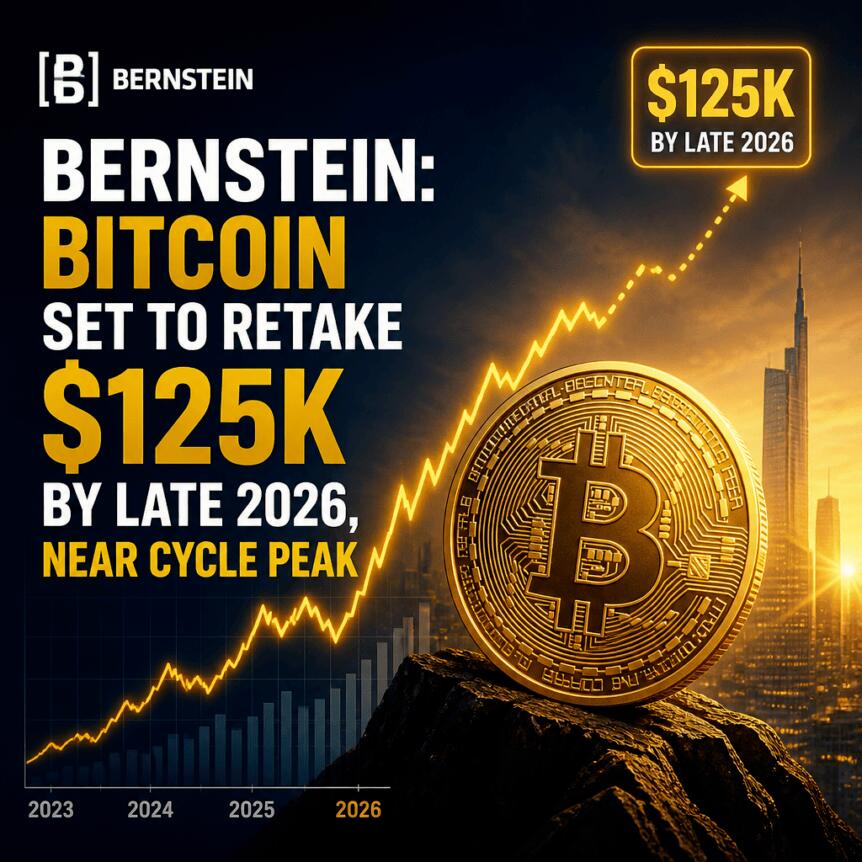
Wall Street research firm Bernstein is forecasting a rebound in Bitcoin, arguing that the recent selloff could mark the transition away from the current bear phase and toward a new advance driven by institutional and corporate participation.
In a research report published Wednesday and seen by Cointelegraph, Bernstein expects Bitcoin to retake its 2025 high and push into fresh cycle highs over the next several years, with targets ranging from $125,000 by late 2026 to as high as $500,000 by the end of the decade under a bull case.
Key takeaways
- Bernstein expects Bitcoin to recover toward $125,000 by late 2026, positioning that level as a milestone tied to the firm’s cycle framework.
- The base case targets $150,000 by mid-2027 and a cycle peak of about $300,000 in 2029; the bull case ranges up to $500,000 in 2029.
- Bernstein maintains a longer-term Bitcoin target of roughly $1 million by 2033 in both scenarios.
- The firm links the forecast to Bitcoin’s historical four-year cycle phases and to the relationship between price and miners’ marginal production costs.
- Bernstein’s view is also intended to support its outlook on Strategy (the largest corporate Bitcoin holder), suggesting stronger conditions could enable further BTC accumulation.
Why Bernstein thinks the downturn is nearing an end
Bernstein’s argument is rooted in Bitcoin’s historical cycle behavior. The firm said Bitcoin gained 28% over the preceding 10 days after falling roughly 50% from its October 2025 peak, a rebound it says could indicate the end of the present bear cycle.
The report also points to changes in the market’s participant mix. Bernstein said institutional investors and corporate Bitcoin buyers have been playing a larger role, which it argues has provided greater downside support than in earlier cycles. As a result, it cited a smaller drawdown than the roughly 75% to 90% declines seen in previous turnarounds.
For investors, that matters because the cycle thesis implies the timing and character of drawdowns may not repeat identically. Bernstein is not only forecasting higher prices—it is also asserting that the depth of weakness may be structurally different when large, persistent buyers are part of the backdrop.
Cycle-based targets: from $125,000 to as high as $500,000
Bernstein’s pricing model is built on Bitcoin’s historical four-year cadence, which the firm ties to the halving event that reduces the amount of new BTC awarded to miners approximately every four years.
In its framework, each cycle is split into four phases: breakout, hype, drawdown, and accumulation. Bernstein then estimates likely price levels across those phases by comparing Bitcoin’s market pricing to the estimated marginal cost of producing new coins—specifically, the cost for the least efficient miners to mine Bitcoin.
Under the base case, Bernstein expects:
- Bitcoin to reach $125,000 by late 2026
- $150,000 by mid-2027
- about $300,000 at a cycle peak in 2029
Under the bull case, the firm raises the targets to:
- $200,000 by mid-2027
- $500,000 at a cycle peak in 2029
Bernstein also maintained a long-term target of about $1 million by 2033 under both scenarios.
How marginal production costs are folded into the forecast
Central to Bernstein’s approach is an assumption about the “price-to-marginal cost multiple,” meaning how many times Bitcoin’s price trades relative to miners’ estimated marginal production costs.
The firm said it expects that multiple to behave similarly to previous four-year cycles. In its base-case path, Bernstein projected the multiple falling from 1.4 times at a 2025 peak around $125,000 to roughly 1.25 times at a projected 2029 peak around $300,000, and to about 1.2 times by the $1 million mark in 2033.
This is a key nuance for readers: the forecast doesn’t rely only on generic “cycle hype” or momentum. It attempts to formalize the relationship between network economics and market pricing, which—if the assumptions hold—can help explain why the firm expects higher peaks even as valuation multiples compress over time.
Still, that compression is an assumption. Traders and long-term holders watching this thesis may want to track whether market conditions allow marginal-cost dynamics to remain a meaningful reference point, especially if demand growth, regulatory changes, or changes in miner behavior alter cost structures.
Strategy’s potential to buy more Bitcoin if prices firm up
Bernstein’s report also ties its Bitcoin recovery expectations to Strategy, describing a scenario in which continued strength could improve conditions for additional BTC purchases.
The firm noted that Strategy holds 840,447 BTC, representing about 4% of Bitcoin’s maximum supply of 21 million coins. Bernstein maintained an “Outperform” rating on the company but adjusted its MSTR price target down to $350 from $450, citing accelerated equity dilution and its updated view of the Bitcoin cycle.
Bernstein said that if Bitcoin stays strong—and if Strategy’s Stream (STRC) preferred stock recovers to around $100 (STRC was reported at $97.15 on Tuesday)—the firm believes Strategy could “go kinetic again” with additional Bitcoin buying. Bernstein pointed to a selloff of about 7,000 BTC in 2026 as part of its broader framework.
At the same time, Bernstein’s view is not only about upside. The report referenced analysis from Regime Intelligence arguing that Strategy’s Bitcoin treasury may be less threatened by a market crash than by a prolonged loss of capital-market access. That risk, Regime Intelligence said, could impair Strategy’s ability to fund roughly $1.76 billion in annual obligations without selling BTC.
Put differently, Bernstein is effectively forecasting that the next leg up could improve Strategy’s operational flexibility—but that access to funding channels could still determine how aggressively corporate buyers add to their holdings.
What to watch next
Bernstein’s model puts major milestones—$125,000 in late 2026 and substantially higher cycle targets later—at the center of its thesis. Investors should watch whether Bitcoin’s rebound broadens into sustained strength rather than a short-lived rally, and whether corporate buyers like Strategy can continue adding BTC without being constrained by financing conditions and dilution pressures.



Polymarket odds collapsed from 82 percent to 16 percent. The Senate returns September 14 with 14 working days and three unresolved disputes. Meanwhile the SEC, FASB, and OCC are writing rules that do not need a single congressional vote.
Summary
- Polymarket odds on the Clarity Act becoming law in 2026 fell from 82 percent in February to 16 percent by August 7, with Galaxy Digital cutting its estimate to 10 percent in an August 14 note citing the Senate calendar as the primary reason.
- The Senate Banking Committee advanced the bill 15 to 9 on May 14, but three disputes remain unresolved: stablecoin yield provisions affecting $1.35 billion in annual Coinbase USDC rewards revenue, DeFi protocol classification, and ethics requirements targeting presidential crypto income.
- The SEC proposed Regulation Crypto Assets on August 14, creating a framework for digital asset offerings that does not require congressional action, while FASB proposed treating qualifying stablecoins as cash equivalents on August 18 with a November 19 comment deadline.
- The OCC expects to finalize GENIUS Act stablecoin rules by November 2026, four months past the statutory deadline, covering who can issue payment stablecoins and what reserves must back them.
- If the Clarity Act fails, crypto regulation defaults to a patchwork of agency rulemaking: SEC for securities classification, CFTC for commodities, OCC and Treasury for stablecoins, and FASB for accounting treatment, with no unified framework.
The Clarity Act was supposed to be the answer. One bill, one framework, one set of rules covering every digital asset in the United States. The House passed it with 294 votes in July 2025. The Senate Banking Committee advanced it in May 2026. Polymarket bettors priced passage at 82 percent as recently as February. Then the bill ran into three disputes that consumed every working day between May and August, the Senate left for recess without voting, and the odds collapsed to levels that price failure as the base case.
But regulation did not wait for Congress. While legislators argued about stablecoin yield provisions and ethics clauses, three federal agencies moved independently. The SEC proposed its own crypto offering rules. FASB proposed treating certain stablecoins as cash equivalents on corporate balance sheets. The OCC began writing the rules required by the GENIUS Act, which became law in July 2025 but whose implementing regulations missed their own statutory deadline. The question is no longer whether crypto gets regulated. It is whether regulation arrives as a coherent statute or as a collection of agency actions that no single body coordinates.
What the Clarity Act was supposed to do
The Digital Asset Market Clarity Act classifies every digital asset as a security, digital commodity, or stablecoin and assigns regulatory authority accordingly. Securities go to the SEC. Commodities go to the CFTC. Stablecoins fall under joint oversight with prudential regulators. The bill also defines when a token transitions from one classification to another, creates disclosure requirements for token issuers, and sets rules for decentralized protocols that do not have a traditional corporate issuer. The House version passed with 294 votes, including 70 Democrats, making it one of the most bipartisan pieces of financial legislation in the 119th Congress. The breadth of that vote created an expectation that the Senate would follow with amendments and a conference committee would reconcile the two versions by year end. That expectation collapsed in three stages. The Senate Banking Committee vote on May 14 passed 15 to 9, but two of the Democrats who voted yes immediately qualified their support, stating that their committee votes did not guarantee floor votes without progress on outstanding issues. The July 17 hearing exposed the depth of disagreement. And Senate Majority Leader John Thune acknowledged on August 6 that the chamber lacked time for debate, amendments, and a 60 vote cloture threshold before the August 7 recess.
The three disputes that killed the timeline
Each of the three unresolved issues involves real money and real political stakes, which is why none has been resolved through staff level negotiations.
Stablecoin yield. The current Clarity Act text would prohibit offering yield “directly or indirectly” on stablecoin balances and ban anything “economically or functionally equivalent to bank interest.” This provision directly threatens Coinbase’s $1.35 billion in annual revenue from USDC rewards, which the exchange shares with Circle under their commercial agreement. Coinbase has lobbied aggressively against the provision. Banks have lobbied for it, arguing that stablecoin yield without deposit insurance creates an unlevel playing field. Citigroup CEO Jane Fraser backed the Clarity Act publicly but warned that stablecoin rewards could undermine traditional banking deposit bases.
DeFi protocol classification. The bill must define when a decentralized protocol is sufficiently decentralized to avoid SEC registration. The House version created a “decentralization test” based on governance token distribution, code immutability, and the absence of a controlling entity. Senate Democrats have argued the test is too easy to game, pointing to protocols that claim decentralization while a small team controls upgrade keys and treasury wallets. The disagreement is not about whether DeFi should be regulated but about where the line between a decentralized protocol and a company with a token sits.
Ethics requirements. Senate Democrats want state attorneys general to serve as secondary enforcers of the bill’s ban on government officials operating crypto businesses. Republicans and the White House prefer the Justice Department as the sole enforcer. This dispute has become personal because it implicates President Trump’s $1.4 billion in crypto income from World Liberty Financial and the TRUMP memecoin. Neither side has proposed a compromise that addresses both the enforcement mechanism and the political dimension. Galaxy Digital’s August 14 note cited the calendar, not policy disagreements, as the primary reason for cutting passage odds to 10 percent. The Senate returns September 14 and has 14 working days before midterm campaign season dominates the floor schedule. Even if all three disputes were resolved tomorrow, the procedural steps required to bring the bill to a vote, including debate time, amendment votes, and a 60 vote cloture threshold, would consume most of those 14 days. The math does not work.
The SEC moved first
On August 14, the SEC proposed Regulation Crypto Assets, a new framework for digital asset offerings that creates an exemption pathway for qualifying crypto projects to raise capital without triggering full SEC registration. The three member commission, all Republicans appointed by President Trump, opened the proposal for public comment. The timing was deliberate. The SEC announced the proposal one week after the Senate confirmed it would not vote on the Clarity Act before recess. Chairman Paul Atkins framed Regulation Crypto Assets as complementary to legislation, but the effect is substitutive. If the SEC can define how securities laws apply to digital asset offerings through rulemaking, the urgency of passing legislation that does the same thing diminishes. Regulation Crypto Assets builds on the commission’s March 2026 interpretation clarifying how existing securities laws apply to certain crypto assets and transactions. The March document was guidance. The August proposal is rulemaking, which carries the force of law once finalized. The distinction matters because guidance can be reversed by a future commission with a different composition. Rulemaking requires a formal notice and comment process to undo, making it more durable. The proposal also preempts state authority in certain areas, a provision that state regulators have already opposed. If finalized, projects that qualify under Regulation Crypto Assets would face federal rules only, eliminating the 50 state compliance burden that has driven some companies offshore. The scope of Regulation Crypto Assets is narrower than what the Clarity Act covers. The SEC proposal addresses offerings and secondary trading of tokens that qualify under its framework but does not create the comprehensive classification system that the Clarity Act envisions. It does not define digital commodities, does not assign CFTC authority, and does not address DeFi protocol classification. In that sense, it fills one piece of the regulatory puzzle while leaving the rest to other agencies or future legislation. For crypto projects, the immediate practical effect is significant. A company that has delayed token launches because of SEC registration uncertainty now has a potential pathway. The comment period will shape the final rule, and the industry is expected to submit hundreds of responses. The question is whether the SEC finalizes quickly enough to provide certainty before a potential change in commission composition after the 2026 midterms alters the political dynamics.
FASB rewrites the accounting
On August 18, FASB released a proposed Accounting Standards Update that defines when stablecoins qualify as cash equivalents on corporate balance sheets. The three tests are specific: a qualifying stablecoin must carry an on demand contractual redemption right, provide a direct claim on the issuer for a known cash amount (not just secondary market liquidity), and be backed by segregated reserves held at no less than a one to one ratio in short term, highly liquid assets. The board explicitly rejected a looser standard. Secondary market liquidity alone does not qualify. If you cannot walk up to the issuer and demand your cash, the asset fails the test. This means USDC and RLUSD likely qualify. Algorithmic stablecoins and tokens with lock up periods do not. The practical impact is significant. Under current accounting rules, companies holding stablecoins must mark them as intangible assets and take impairment losses when the price dips below cost, even temporarily. Reclassifying qualifying stablecoins as cash equivalents eliminates that friction. Corporate treasurers who avoided stablecoins because of accounting treatment now have a path to hold them without balance sheet distortion. The comment period runs 90 days, closing November 19. If adopted, the standard would apply to fiscal years beginning after December 15, 2027, giving companies roughly a year to prepare. The Clearing House tokenized deposit network, which includes JPMorgan, Bank of America, Citi, and Wells Fargo, is targeting a launch in the first half of 2027, timed to coincide with the new accounting treatment.
The GENIUS Act fills the stablecoin gap
The GENIUS Act became law on July 18, 2025, but its implementing regulations missed the one year statutory deadline on July 18, 2026. The OCC expects to finalize its rules by November 2026, four months late. The Treasury published proposed rules on August 17 and opened a 60 day comment period. The Blockchain Association submitted a letter supporting the proposed framework on August 25. The GENIUS Act defines who can issue payment stablecoins, what reserves must back them, and how holders can redeem them. It requires stablecoins to be fully backed by dollars or similarly liquid assets and mandates annual audits for issuers above $50 billion in market capitalization. The law exists. The rules implementing it are being written. This is happening regardless of whether the Clarity Act passes. The overlap between the GENIUS Act stablecoin provisions and the Clarity Act stablecoin yield provisions creates a potential conflict. If the Clarity Act bans stablecoin yield but the GENIUS Act framework does not explicitly prohibit it, issuers face contradictory guidance. If the Clarity Act fails, the GENIUS Act stands alone as the governing stablecoin law, and the yield question remains open until regulators address it through rulemaking or enforcement. The missed statutory deadline itself carries a signal. Congress set a one year implementation timeline because it expected the rules to be straightforward. They were not. The OCC, Treasury, and FDIC each needed to coordinate on reserve requirements, custodial standards, and the treatment of non bank issuers. The complexity of writing rules for an asset class that did not exist when most banking statutes were written consumed the full year and then some. The Blockchain Association’s August 25 letter supporting the proposed rules is notable because the trade group represents both crypto native companies and traditional financial institutions entering the space. Agreement between those constituencies on reserve requirements and redemption standards suggests the November finalization timeline is realistic. Disagreement on those points would have triggered extension requests and additional comment periods. The absence of major industry opposition to the GENIUS Act implementing rules contrasts sharply with the three blocking disputes that have paralyzed the Clarity Act.
What regulation by rulemaking looks like
If the Clarity Act does not pass in 2026, the regulatory landscape defaults to agency action. The shape is already visible: The SEC defines which tokens are securities and what exemptions apply, through Regulation Crypto Assets and existing enforcement. The CFTC retains authority over digital commodities through its existing Commodity Exchange Act powers, exercised through enforcement rather than bespoke crypto rules. The OCC and Treasury implement the GENIUS Act for stablecoins. FASB determines how crypto assets appear on corporate balance sheets. State regulators retain authority wherever federal rules do not preempt. This patchwork has two advantages and three problems. The advantages: it moves faster than legislation (three agency proposals in one month versus 14 months of congressional inaction), and it can be tailored to specific asset classes without the compromises that a comprehensive bill requires. The problems: no single body coordinates the overall framework, creating gaps and overlaps. Rulemaking is vulnerable to changes in administration, since a future SEC chair with different views could reverse Regulation Crypto Assets through a new rulemaking. And the lack of a legislative foundation means courts, not Congress, become the ultimate arbiters of classification disputes, producing case by case precedent rather than clear rules. The coordination problem is not hypothetical. Consider a token that starts as a security under the SEC’s framework, transitions to a commodity under CFTC oversight as it decentralizes, and is used to collateralize a stablecoin governed by OCC rules. Under the Clarity Act, one statute would define each transition point. Under rulemaking, three agencies must independently agree on where their authority begins and ends. History suggests they will not agree. The SEC and CFTC have disputed jurisdiction over crypto assets since at least 2018, and agency rulemaking does not resolve turf disputes. It formalizes them. The international dimension adds pressure. The European Union’s MiCA framework is fully operational. Singapore, Japan, and the United Kingdom have finalized their own comprehensive regimes. United States companies operating globally must comply with foreign frameworks that assume a single domestic regulator. A patchwork of five federal agencies and 50 state regulators creates compliance costs that a unified statute would eliminate. The longer the Clarity Act stalls, the more entrenched the patchwork becomes, as each agency finalizes rules that create constituencies opposed to being overridden by legislation.
The market has already priced failure
Crypto markets have not waited for legislative certainty. Bitcoin broke $80,000 on August 25 despite the Clarity Act sitting at 16 percent passage odds. XRP ETF inflows hit record levels the same week. Solana staking ETFs crossed $1 billion in cumulative flows. If regulatory clarity were a prerequisite for institutional participation, these flows would not exist. The explanation is that markets have priced in the rulemaking substitute. The SEC’s Regulation Crypto Assets provides enough clarity for ETF issuers to launch products. The GENIUS Act provides enough stablecoin certainty for institutional treasurers. FASB’s cash equivalent proposal provides enough accounting clarity for corporate balance sheets. Each agency action removes one layer of uncertainty that previously required legislation to address. This creates a paradox for the Clarity Act’s proponents. The more effective agency rulemaking becomes at reducing uncertainty, the less urgent legislation feels to the market participants who would benefit from it. And the less urgency the market signals, the less pressure Congress feels to resolve its three disputes. The rulemaking track may not just be a substitute for legislation. It may be the mechanism that prevents legislation from ever being necessary enough to pass. The counterargument is durability. Rulemaking can be reversed. A new administration in 2029 could install an SEC chair who withdraws Regulation Crypto Assets and returns to enforcement by litigation. The GENIUS Act implementing rules could be rewritten. Only legislation provides the permanence that long term institutional allocators need to build multi decade strategies. Whether that permanence matters enough to overcome 14 working days and three intractable disputes is the question the September 15 vote will begin to answer.
What would prove this thesis wrong
Two conditions would invalidate the “regulation by rulemaking” thesis. First, if the Senate returns September 14 and moves immediately to cloture on the Clarity Act, resolving the three disputes in the first week, the bill could pass before midterm politics consume the floor. The probability is low but not zero. Second, if the SEC withdraws or significantly delays Regulation Crypto Assets in deference to congressional action, the rulemaking substitute narrative weakens. The more likely outcome is a hybrid. The Clarity Act passes in a reduced form that addresses classification and DeFi but defers stablecoin provisions to the GENIUS Act framework. This outcome would satisfy the market’s demand for a legislative signal without requiring resolution of the three blocking disputes. But “likely” and “certain” remain separated by 14 working days and a 60 vote threshold.
What to watch
September 15 procedural vote. Senate Majority Leader Thune scheduled this date for a cloture motion. If the vote is postponed or fails to reach 60 votes, the Clarity Act is effectively dead for 2026.
Regulation Crypto Assets comment period. The SEC’s proposed rule will attract hundreds of comments. The volume and content of industry opposition or support will signal whether the SEC feels empowered to finalize without waiting for Congress.
GENIUS Act final rule timeline. The OCC’s November 2026 target for finalizing stablecoin rules will confirm or deny whether the rulemaking track is moving at the pace agencies claim.
FASB comment submissions. If major accounting firms and corporate treasurers submit supportive comments by November 19, adoption becomes more likely, accelerating the accounting pathway for institutional stablecoin use.
Polymarket odds recovery. A sustained move above 30 percent would indicate that new information, likely a bipartisan compromise on one of the three disputes, has changed the legislative calculus.
What is the Clarity Act?
The Digital Asset Market Clarity Act is federal legislation that classifies every digital asset as a security, digital commodity, or stablecoin and assigns regulatory authority to the SEC, CFTC, or joint oversight accordingly. The House passed it with 294 votes in July 2025, and the Senate Banking Committee advanced it 15 to 9 in May 2026.
Why did the Clarity Act not pass before the August recess?
Three unresolved disputes blocked the vote: stablecoin yield provisions affecting Coinbase’s $1.35 billion USDC rewards revenue, DeFi protocol classification rules, and ethics requirements targeting government officials’ crypto income. The Senate calendar also lacked sufficient working days for the debate and amendment process required before a 60 vote cloture threshold.
What is Regulation Crypto Assets?
Regulation Crypto Assets is an SEC proposed rulemaking announced August 14, 2026, that creates a framework for digital asset offerings. It would allow qualifying crypto projects to raise capital without full SEC registration and preempt certain state regulations. It does not require congressional approval.
What are FASB’s three tests for stablecoins as cash equivalents?
A qualifying stablecoin must carry an on demand contractual redemption right, provide a direct claim on the issuer for a known cash amount, and be backed by segregated reserves at no less than a one to one ratio in short term liquid assets. Secondary market liquidity alone does not qualify.
What is the GENIUS Act?
The GENIUS Act became law on July 18, 2025, creating rules for payment stablecoin issuers including reserve requirements, redemption rights, and audit mandates. Its implementing regulations missed the statutory deadline and the OCC expects to finalize them by November 2026.
Can crypto regulation happen without Congress?
Yes. Federal agencies can write rules under existing statutory authority. The SEC, CFTC, OCC, Treasury, and FASB are all currently exercising this power. However, agency rulemaking is more vulnerable to reversal by future administrations and lacks the permanence of legislation.
What happens if the Clarity Act fails entirely?
Crypto regulation defaults to a patchwork of agency rulemaking and enforcement actions. The SEC handles securities classification, the CFTC covers commodities, the OCC implements stablecoin rules under the GENIUS Act, and FASB determines accounting treatment. No single body coordinates the framework.
Will the Clarity Act pass in 2026?
The Senate returns September 14 with 14 working days and a scheduled procedural vote on September 15. Polymarket prices passage at approximately 16 percent. Galaxy Digital cut its estimate to 10 percent. The math requires resolving three disputes and clearing a 60 vote threshold in under two weeks, which most observers consider unlikely. This is educational analysis, not investment advice.
Disclaimer. This article was written on August 26, 2026. All figures reflect data available on that date and may have changed. This is educational analysis and does not constitute investment advice. Legislative timelines and regulatory proposals are subject to change.


The Bank of Korea raised its interest rate by 25 basis points to 3% on Thursday. The move marked a second consecutive increase.
Policymakers had already flagged more tightening in July. Firm core inflation and a renewed jump in Seoul housing prices strengthened the case for another move.
Bank of Korea Hikes Rates to 3%
The hike came as consumer price inflation eased to 2.8% in July. However, core inflation, which strips out volatile food and energy prices, moved the other way. It came in at 2.6% in July, the highest since December 2023.
Korea’s policy turn is recent. The central bank cut its benchmark rate by a full percentage point between October 2024 and May 2025. It then left the rate at 2.5%.
That pause ended last month. The BOK lifted the rate to 2.75% in July, its first increase in three and a half years.
Thursday’s move returns borrowing costs to where they stood before the BOK’s February 2025 cut. It also settles a close call among forecasters. 18 of 35 economists surveyed by Reuters expected the hike.
The board had already flagged its direction at the July meeting.
“Therefore, it is judged that it will be necessary to continue a policy stance consistent with further rate hikes, and the Board will determine the timing and pace of further increases in the Base Rate while assessing the extent of inflationary pressure, the improvement trend in the domestic economy, and financial stability,” the statement read.
Follow us on X to get the latest news as it happens
Housing and Inflation Keep the Pressure On
In July, Korea’s central bank built the case for a rate hike on three pressures: growth, inflation, and financial stability. The BOK said consumer prices would run above the 2% target for “a considerable time.”
The financial stability argument rests on housing. Seoul apartment transaction prices rose 2.50% in June from May, the steepest monthly gain since June 2021. The growth argument rests on chips.
“Korea is benefiting as a key player in the global AI value chain during the process of global AI diffusion. Accordingly, exports and investment are expected to grow strongly, and unprecedented expansion in nominal GDP resulting from the surge in semiconductor prices is likely to support domestic demand through higher corporate profits, increased investment, and gains in wages and tax revenues,” it added.
What Tighter Policy Means for Korean Risk Appetite
Higher rates reach markets already under strain. The KOSPI lost 22% in July, its worst month since 2008, before the won rallied below 1,400 per dollar in August. Leveraged chip funds shed close to $1 billion this month, their first outflow since launch in late May.
Retail capital in South Korea rotates quickly between equities, structured products, and digital assets. Whether a 3% policy rate slows that rotation should become clearer once September flows settle.
Subscribe to our YouTube channel to watch leaders and journalists provide expert insights
The post Bank of Korea Doubles Down With Back-to-Back Hikes as Core Inflation Bites appeared first on BeInCrypto.


Congress gave agencies one year to write stablecoin rules. They missed it by four months and counting. The OCC expects a final rule by November, Tether still lacks a reciprocity determination, and the effective date keeps sliding.
Summary
- The GENIUS Act became law on July 18, 2025, with a one year deadline for implementing regulations that all federal agencies missed on July 18, 2026.
- The OCC expects to finalize its stablecoin rule by November 2026, which would push the effective date to approximately March 2027 under the 120 day implementation window.
- Tether requires a Treasury reciprocity determination to continue serving United States businesses under the foreign issuer pathway, and as of August 2026, that determination has not been issued.
- The proposed rules require every stablecoin issuer serving United States users to be licensed, maintain 100 percent reserves in Treasury bills or insured deposits, report weekly to regulators, and publish monthly disclosures.
- Three parallel rulemaking tracks are active: the OCC for prudential standards, FinCEN and OFAC for anti money laundering and sanctions compliance, and the FDIC and NCUA for institutions under their supervision.
Congress wrote a law. Regulators missed the deadline to implement it. Now they are writing the rules anyway, on their own timeline, with their own interpretations. The GENIUS Act was supposed to create certainty for stablecoin issuers by July 2026. Instead it created a gap: a signed statute without implementing regulations, leaving every issuer in the United States operating under a law whose specific requirements have not been defined.
The delay is not a failure of political will. The agencies agree on the law’s goals. The complexity of writing rules for an asset class that did not exist when most banking statutes were drafted consumed the full year and more. Reserve requirements that sound simple in legislation become complicated when applied to non bank issuers, foreign stablecoins, and tokens that cross multiple regulatory jurisdictions.
What the GENIUS Act requires
The Guiding and Establishing National Innovation for United States Stablecoins Act defines who can issue payment stablecoins, what those tokens must be backed by, and how holders can redeem them. The law applies to any entity issuing a stablecoin to United States users, whether that entity is a national bank, a state chartered institution, or a non bank company seeking federal licensing. Every token in circulation must be backed dollar for dollar by United States dollars, Treasury bills, insured bank deposits, or Treasury repurchase agreements. The law does not permit backing by corporate bonds, money market funds with credit exposure, or other assets that carry default risk. This is stricter than what some issuers currently hold. Circle’s USDC reserves include Treasury bills and money market funds, but the GENIUS Act framework may require Circle to restructure the money market fund component depending on how the OCC defines “qualifying reserves” in the final rule. Issuers above $50 billion in market capitalization must submit to annual audits. All issuers must report weekly to their primary regulator and publish monthly disclosures. The disclosure requirements go beyond what any stablecoin issuer currently provides voluntarily, creating a transparency standard that matches or exceeds what the SEC requires of money market funds. The law takes effect on either January 18, 2027 (18 months after signing), or 120 days after final rules are issued, whichever comes first. Since no agency has finalized its rules, the 120 day clock has not started. If the OCC finalizes in November 2026, the effective date slides to approximately March 2027. If finalization extends into 2027, the entire timeline shifts further.
Why the deadline was missed
Congress set a one year implementation timeline because it expected the rules to be straightforward. They were not. Three agencies needed to coordinate on overlapping requirements, each operating under different statutory authorities and different rulemaking procedures. The OCC handles prudential standards for national banks and federally licensed non bank issuers. Its proposed rule covers reserve backing requirements, risk management frameworks, capital and liquidity standards, custody requirements, and regulatory examination procedures. The draft mirrors obligations placed on traditional depository institutions but adapts them for entities that hold crypto assets and issue tokens on public blockchains. FinCEN and OFAC handle anti money laundering and sanctions compliance under a separate rulemaking coordinated with the Treasury Department. Their proposed rule requires stablecoin issuers to implement Bank Secrecy Act programs, file suspicious activity reports, and screen transactions against OFAC sanctions lists. The complexity here involves applying traditional banking compliance frameworks to blockchain transactions, where pseudonymous addresses and cross chain bridges create monitoring challenges that do not exist in wire transfer systems. The FDIC and NCUA are advancing parallel proposals for state chartered banks and credit unions under their respective supervision. Each agency must align its rules with the OCC framework while accounting for institutional differences in capital requirements and supervisory approaches. The coordination problem explains the delay more than any single technical challenge. Each agency published its proposed rule on a different timeline, accepted comments on different schedules, and is finalizing at different speeds. The OCC leads. The FDIC follows. FinCEN’s AML rules may not finalize until early 2027. The result is a staggered implementation where different requirements take effect at different times, creating compliance uncertainty that the law was designed to eliminate. The staggering creates a specific operational problem. A stablecoin issuer that receives its federal license under the OCC rule may begin operations while the FinCEN AML rule is still in proposed form. That issuer must decide whether to build its compliance program against the proposed AML rule, which may change in the final version, or wait until both rules are final and operate with a compressed implementation window. Neither option is attractive, and both carry risk that a simultaneous finalization would have avoided. The OCC has publicly acknowledged the issue. Acting Comptroller Michael Hsu stated the agency is “very intent on moving quickly and getting a final rule out by November so that we will be able to start processing applications within the new year.” The explicit commitment to processing applications by January 2027 is more operationally meaningful than the November finalization date alone, because it signals that the OCC will not wait for FinCEN to finish before beginning to license issuers. The practical effect is a two track system where prudential licensing proceeds ahead of AML rule finalization.
The Tether problem
Tether presents the most consequential unresolved question in the GENIUS Act implementation. USDT is the largest stablecoin by market capitalization, with roughly $140 billion in circulation as of August 2026. Tether Limited is incorporated in the British Virgin Islands and has never been licensed as a financial institution in the United States. The GENIUS Act creates a foreign issuer pathway that allows non United States companies to serve American businesses, but only if the Treasury Department issues a “reciprocity determination” confirming that the issuer’s home jurisdiction provides comparable regulatory oversight. As of August 2026, that determination has not been issued for any jurisdiction, including the BVI. Without a reciprocity determination, Tether cannot legally offer USDT to United States businesses once the GENIUS Act takes effect. The practical enforcement of that prohibition is complex because USDT trades on global markets accessible to anyone with an internet connection, but the legal prohibition would prevent United States exchanges, custodians, and financial institutions from supporting USDT directly. Tether has responded with two strategies. First, it announced plans to register USDT under the foreign issuer pathway, which requires the reciprocity determination it does not yet have. Second, it launched USAT, a new United States focused stablecoin designed for GENIUS Act compliance from day one, with reserves held in Treasury bills at a United States custodian. The dual strategy hedges against both outcomes: reciprocity granted (USDT stays) or reciprocity denied (USAT replaces it for US markets). The market has noticed. USDT’s share of United States exchange trading volume has declined from 72 percent in January 2026 to approximately 64 percent in August, while USDC’s share has grown from 18 percent to 26 percent over the same period. The shift is gradual but directional, and the GENIUS Act timeline is the primary driver. The timeline matters because digital asset service providers have until July 2028, three years after the law’s signing, before they are prohibited from offering non compliant stablecoins. That grace period gives Tether time but creates a two class market where compliant stablecoins like USDC and RLUSD operate under full regulatory oversight while USDT continues serving United States users under the transitional provision.
Who is already compliant
Circle’s USDC is the closest to full compliance. The company holds reserves primarily in Treasury bills and is regulated as a money transmitter in multiple states. The GENIUS Act framework may require Circle to restructure its reserve portfolio to eliminate any money market fund exposure that does not meet the “qualifying reserves” definition, but the adjustment is incremental rather than structural. Ripple’s RLUSD, which crossed $2 billion in market capitalization during August 2026, is designed for GENIUS Act compliance. Its reserves are held in United States denominated assets with a regulated custodian. RLUSD’s growth on the XRP Ledger has positioned it as the institutional stablecoin for cross border settlement, with nearly $1 billion of supply on XRPL directly. PayPal’s PYUSD, issued through Paxos Trust, operates under New York Department of Financial Services oversight and holds reserves in Treasury bills and cash deposits. The transition to GENIUS Act compliance involves obtaining federal licensing on top of existing state authorization, a process that requires additional capital and compliance infrastructure but no fundamental restructuring. The common thread is that issuers who designed their products with regulatory compliance in mind face incremental adjustments. Issuers who designed for speed and market share face structural changes or market exit. The GENIUS Act is a filter, and the compliance cost is the price of remaining in the United States market.
The institutional pipeline waiting on final rules
The delay in finalization has created a bottleneck for institutional products that depend on regulatory certainty. The Clearing House tokenized deposit network, which includes JPMorgan, Bank of America, Citi, and Wells Fargo, is targeting a launch in the first half of 2027. That timeline assumes GENIUS Act rules are final and the effective date is known. If finalization slips past November, the launch date slips with it. FASB’s August 18 proposal to treat qualifying stablecoins as cash equivalents on corporate balance sheets is directly connected to the GENIUS Act timeline. The accounting treatment requires stablecoins to carry an on demand redemption right and segregated one to one reserves, requirements that overlap almost exactly with the GENIUS Act framework. If both the GENIUS Act rules and the FASB standard finalize on schedule, corporate treasurers will have simultaneous regulatory certainty and accounting clarity for holding stablecoins. If either slips, the institutional adoption timeline extends. The OUSD revenue sharing stablecoin consortium, which includes Visa, Mastercard, Stripe, and BlackRock among its 140 plus partners, has positioned itself to capitalize on this convergence. A stablecoin that qualifies as a cash equivalent under FASB and meets GENIUS Act reserve requirements becomes functionally equivalent to a Treasury bill on a corporate balance sheet, with the added benefit of programmable settlement on blockchain rails. The pipeline is real and the capital is committed. What is missing is the final rule that converts proposed requirements into enforceable standards. Every month of delay is a month of stalled product launches, deferred treasury allocations, and competitive advantage flowing to jurisdictions where the rules are already final.
The dollar defense argument
The GENIUS Act is not primarily about consumer protection, despite the disclosure and reserve requirements that serve consumer interests. The law’s strategic logic is about maintaining the dollar’s dominance in digital payments. Stablecoins denominated in United States dollars represent approximately $170 billion in circulating supply as of August 2026. Every dollar held in stablecoin reserves is a dollar invested in Treasury bills or deposited at insured banks, creating demand for United States government debt. If the stablecoin market grows to $1 trillion, as several projections suggest by 2030, the reserve requirement becomes a meaningful source of Treasury bill demand. Foreign stablecoins denominated in euros, yuan, or other currencies compete directly with this dynamic. The reciprocity determination framework in the GENIUS Act is designed to ensure that foreign issuers serving United States markets operate under comparable rules, preventing regulatory arbitrage that could redirect reserve demand away from United States government debt. This logic explains why the missed deadline has not generated significant political backlash. The law’s strategic objectives are served by the rulemaking process itself, which signals to global markets that the United States is building a comprehensive stablecoin framework. The specific effective date matters less than the trajectory, and the trajectory is clearly toward finalization. The European Union’s MiCA framework, fully operational since January 2026, requires similar reserve backing for euro denominated stablecoins. But MiCA explicitly prohibits yield payments on stablecoin balances, a provision that has driven some DeFi activity offshore. The GENIUS Act’s silence on yield gives the United States a potential competitive advantage: if the OCC permits reserve income sharing, dollar stablecoins become more attractive to holders than euro stablecoins, reinforcing dollar demand. The geopolitical dimension extends beyond Europe. China’s digital yuan operates as a central bank digital currency without the reserve backed stablecoin model. If private dollar stablecoins reach $1 trillion in circulation while operating under a credible regulatory framework, they become a de facto extension of United States monetary influence in digital commerce, operating on rails that the Federal Reserve does not control but that United States regulators oversee. The GENIUS Act, for all its implementation delays, is the legal foundation for that strategic position.
What the final rules will decide
Several questions remain open until the OCC publishes its final rule, expected in November. First, the precise definition of “qualifying reserves.” The law names Treasury bills, insured deposits, and Treasury repos. The question is whether the final rule permits any additional asset classes, such as agency mortgage backed securities or overnight reverse repurchase agreements, that carry negligible credit risk but are not explicitly named in the statute. Second, the capital requirements for non bank issuers. Banks have existing capital frameworks. Non bank stablecoin issuers do not. The proposed rule would require non bank issuers to maintain capital buffers that absorb operational losses without touching reserves, but the size and composition of those buffers remained subject to comment. Third, the examination framework. The OCC proposed regular on site examinations for federally licensed stablecoin issuers, mirroring its bank supervision model. Non bank issuers have never been subject to on site federal examination. The operational burden and cost of preparing for OCC examiners will affect the economics of stablecoin issuance, potentially favoring larger issuers who can amortize compliance costs across a bigger asset base. Fourth, the treatment of stablecoin yield. The GENIUS Act itself does not explicitly prohibit interest payments on stablecoin balances. However, the Clarity Act’s proposed stablecoin yield ban would apply if it passes. If it does not, the GENIUS Act rules govern, and the OCC must decide whether issuers can share reserve income with holders. This question has direct implications for Coinbase’s $1.35 billion annual USDC rewards revenue and for every DeFi protocol that generates yield on stablecoin deposits. The OCC’s final rule on yield could reshape the competitive landscape for stablecoins more than any other single provision. Fifth, the interoperability standard. The proposed rule addresses how stablecoins issued by different licensed entities interact when transferred across blockchains. A USDC token on Ethereum and a USDC token on Solana are technically different assets bridged by Circle’s infrastructure. The final rule must define whether each chain instance requires separate regulatory treatment or whether the issuer’s federal license covers all instances regardless of the underlying blockchain.
What would prove this thesis wrong
Two conditions would change the trajectory. First, if the OCC misses its November target and finalization extends into mid 2027, the staggered implementation problem worsens and market participants may begin operating under their own interpretations of the statute, creating enforcement risk. Second, if Congress passes the Clarity Act with stablecoin provisions that override or modify the GENIUS Act framework, the entire rulemaking track becomes moot and agencies would need to restart the process under new statutory authority. The Blockchain Association’s August 25 letter supporting the proposed rules suggests the industry considers the current rulemaking track acceptable. Major industry opposition would have signaled a risk of extended comment periods and revision cycles. Its absence suggests November finalization is realistic.
What to watch
OCC final rule publication date. November 2026 is the stated target. Any delay past December pushes the effective date into mid 2027 and extends the compliance uncertainty period.
Treasury reciprocity determinations. The first country to receive a reciprocity determination sets the precedent for foreign stablecoin issuers. If the BVI receives one, Tether’s USDT can stay. If it does not, USDT faces a United States market exit by July 2028.
USDC reserve restructuring. If Circle announces changes to its reserve composition in response to the proposed rules, it signals that the final rule definition of “qualifying reserves” is narrower than current industry practice.
USAT adoption rates. Tether’s United States focused stablecoin is a hedge against reciprocity denial. Its adoption rate on exchanges and in DeFi protocols will indicate whether the market is preparing for a post USDT scenario.
FinCEN AML rule timeline. The anti money laundering rulemaking is running behind the OCC prudential rule. A significant gap between the two creates a period where stablecoin issuers must meet prudential standards but lack finalized AML guidance.
What is the GENIUS Act?
The Guiding and Establishing National Innovation for United States Stablecoins Act is a federal law signed on July 18, 2025, that creates a regulatory framework for payment stablecoins. It defines who can issue stablecoins, what reserves must back them, and how holders can redeem them.
Why did regulators miss the GENIUS Act deadline?
Three federal agencies needed to coordinate overlapping rules under different statutory authorities. The OCC handles prudential standards, FinCEN and OFAC handle anti money laundering and sanctions, and the FDIC handles state chartered institutions. The complexity of applying banking compliance frameworks to blockchain based assets consumed more time than the one year timeline allowed.
When will the GENIUS Act rules take effect?
The law takes effect on January 18, 2027, or 120 days after final rules are issued, whichever comes first. If the OCC finalizes in November 2026, the effective date would be approximately March 2027.
What reserves must stablecoin issuers hold?
The GENIUS Act requires 100 percent backing in United States dollars, Treasury bills, insured bank deposits, or Treasury repurchase agreements. No corporate bonds, equities, or higher risk assets are permitted.
Can Tether continue operating in the United States?
Tether requires a Treasury reciprocity determination confirming that its home jurisdiction provides comparable regulatory oversight. That determination has not been issued. Without it, Tether cannot legally offer USDT to United States businesses once the law takes effect. Digital asset service providers have until July 2028 before non compliant stablecoins are prohibited.
Is USDC already GENIUS Act compliant?
Circle’s USDC is close to full compliance given its Treasury bill reserves and state money transmitter licenses, but may need to restructure any money market fund holdings that do not meet the final rule’s qualifying reserves definition.
How does the GENIUS Act affect DeFi stablecoins?
The law applies to any entity issuing stablecoins to United States users. Algorithmic stablecoins that are not backed by qualifying reserves cannot meet the 100 percent backing requirement. Decentralized protocols that issue stablecoins without a licensed entity face classification and enforcement questions that the final rules must address.
What happens if the GENIUS Act rules are never finalized?
The statute itself is law regardless of whether implementing regulations are finalized. Issuers would need to comply with the statutory text directly, which creates uncertainty because many provisions reference regulatory definitions that only exist in final rules. Courts would likely resolve ambiguities through enforcement actions and litigation. This is educational analysis, not investment advice.
Disclaimer. This article was written on August 26, 2026. All figures reflect data available on that date and may have changed. This is educational analysis and does not constitute investment advice. Regulatory timelines and proposed rules are subject to change.
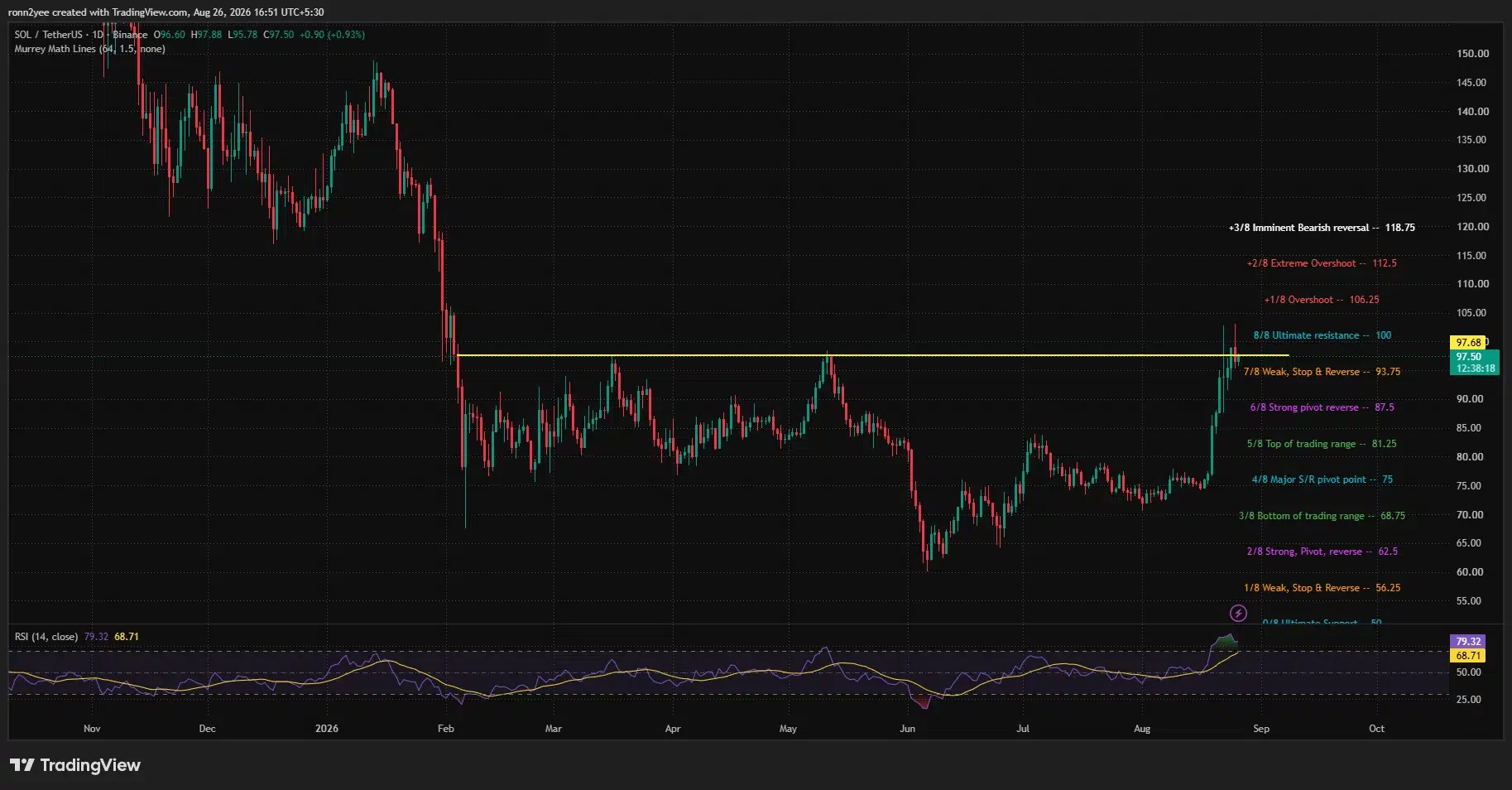
Solana price traded near $97.50 on Aug. 26 after gaining about 14% over seven days, as improving risk appetite, short liquidations, ETF inflows, and network developments pushed SOL above several resistance levels.
Summary
- Solana price climbed from $85.37 on Aug. 20 to a weekly high above $102.
- Price remains below the $100 resistance while the daily RSI stands at an overbought 79.
- 4-hour buying pressure remains positive, with CMF at 0.14.
- Analysts are divided between a rally toward $120 and a correction below $92
Solana price breaks out but stalls below $100
Solana (SOL) price rose from an Aug. 20 opening price of $85.37 to an intraday high above $102.59 on Aug. 25. The move represented an increase of more than 20% at its peak, although profit-taking later pulled SOL back toward $97.50.
SOL was still up about 14% over the seven-day period at the time of writing. The rally allowed the token to break above the $87.50 and $93.75 Murrey Math levels, both of which had previously acted as important resistance zones.
The daily chart shows that the price briefly crossed the $100 “ultimate resistance” level before sellers forced it lower. SOL also tested the $102–$103 area twice, but buyers were unable to secure a daily close above that range.
The pullback has not yet reversed the broader breakout. Solana remains above $93.75, while its recent candles show buyers returning whenever the price approaches $95.
However, the daily Relative Strength Index has climbed to 79.32, well above the commonly used overbought threshold of 70. Its moving average stands at 68.71, confirming that momentum accelerated rapidly during the latest rally.
An overbought RSI does not automatically signal an immediate decline, but it shows that SOL may need to consolidate before attempting another sustained move above $100.
Macro shift and short squeeze drive the rally
Solana’s advance occurred alongside a broader crypto market rally after liquidity actions by the U.S. Treasury pushed government bond yields lower and weakened the U.S. dollar.
Lower yields reduced pressure on risk assets and forced traders who had positioned for another market decline to close bearish bets. More than $4 billion in crypto short positions were reportedly liquidated over several days, creating forced buying across major digital assets.
Solana benefited from that market-wide squeeze because of its higher volatility relative to Bitcoin. Once SOL broke through the upper-$80 range, short covering and momentum buying helped carry the token through the psychological $100 barrier.
Improving U.S. regulatory expectations added to the change in sentiment. Investors responded to the Securities and Exchange Commission’s proposed crypto framework and renewed congressional attention on the Digital Asset Market Clarity Act.
Solana-specific developments also supported the move. The network community opened voting on a Resource Fee Proposal that would separate inclusion fees from compute resource fees and burn the latter in full.
Supporters expect the proposal to connect periods of high network use with higher SOL burns, although its final effect on supply would depend on adoption and future activity.
Institutional demand also strengthened during the week. Spot Solana exchange-traded funds recorded approximately $65.74 million in net inflows so far this week, their highest weekly inflows in 2026.
Network activity provided another source of support after Solana overtook Base in daily x402 micropayment transactions. Ramp’s integration of AI-agent wallet support on Solana also expanded the network’s potential role in automated payments.
4-hour chart shows buyers defending $96.67
Solana’s 4-hour Bollinger Bands show the price consolidating after a sharp expansion in volatility. SOL traded at $97.53, above the 20-period middle band at $96.67.
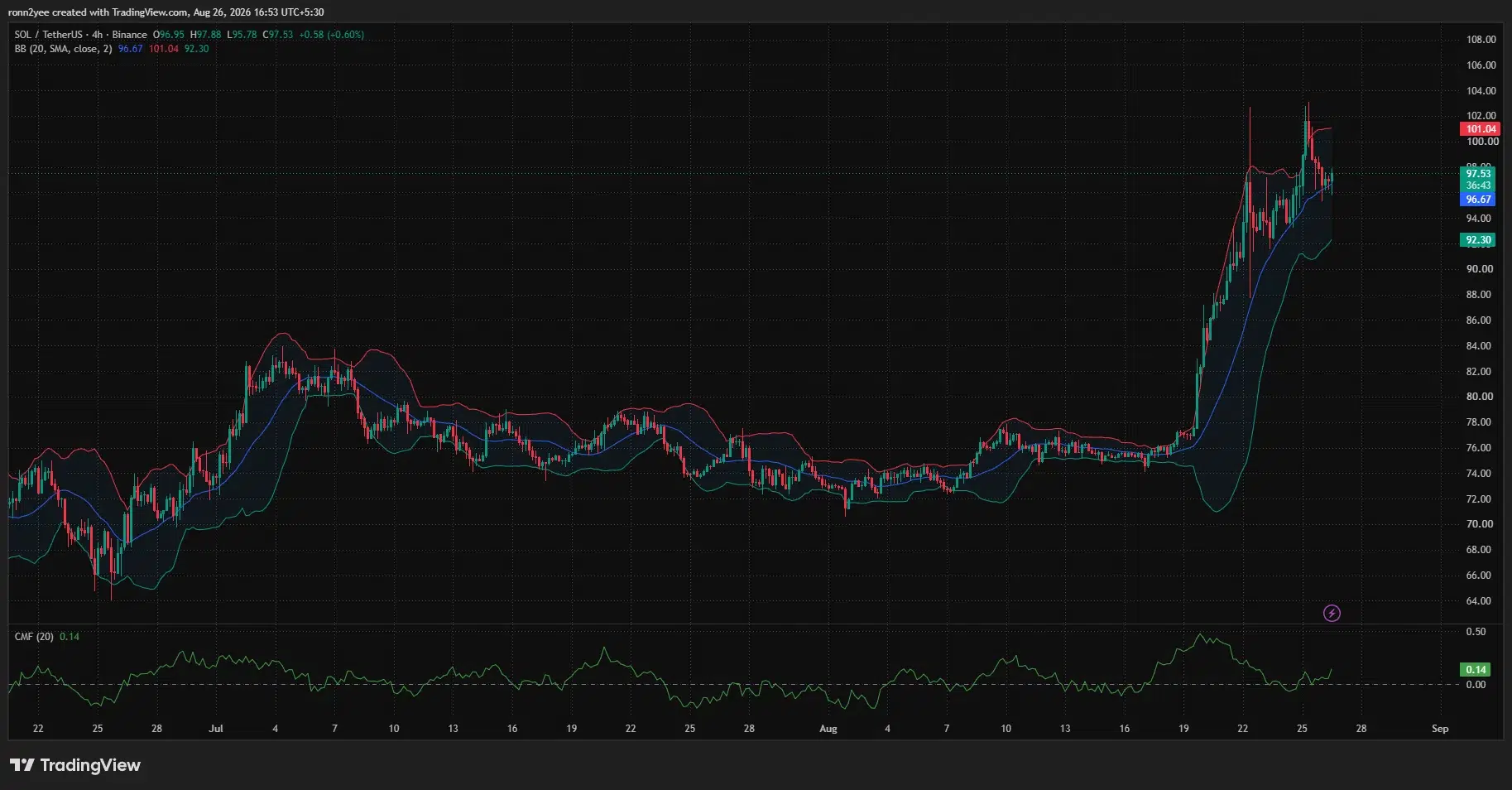
Remaining above the middle band keeps the short-term structure tilted toward buyers. The upper band at $101.04 represents the immediate technical barrier, closely matching the psychological $100 level and the recent rejection zone.
A 4-hour close above $101.04 could strengthen the case for another test of $102.59–$103.08. Clearing that area would leave $106.25, the next Murrey Math overshoot level, as a possible upside target.
The Chaikin Money Flow indicator stood at 0.14 on the 4-hour chart. A reading above zero suggests that buying pressure continues to exceed selling pressure despite SOL’s pullback from its weekly high.
The lower Bollinger Band at $92.30 forms the main short-term downside level. A break below the middle band could initially expose $93.75, followed by $92.30.
The daily chart places the next stronger support at $87.50. Losing that level would weaken the breakout and reopen the possibility of a move toward $81.25, which marked the top of SOL’s previous trading range.
Liquidation heatmap points to liquidity near $99
CoinGlass’ 24-hour liquidation heatmap shows dense leveraged positions immediately above Solana’s current price.
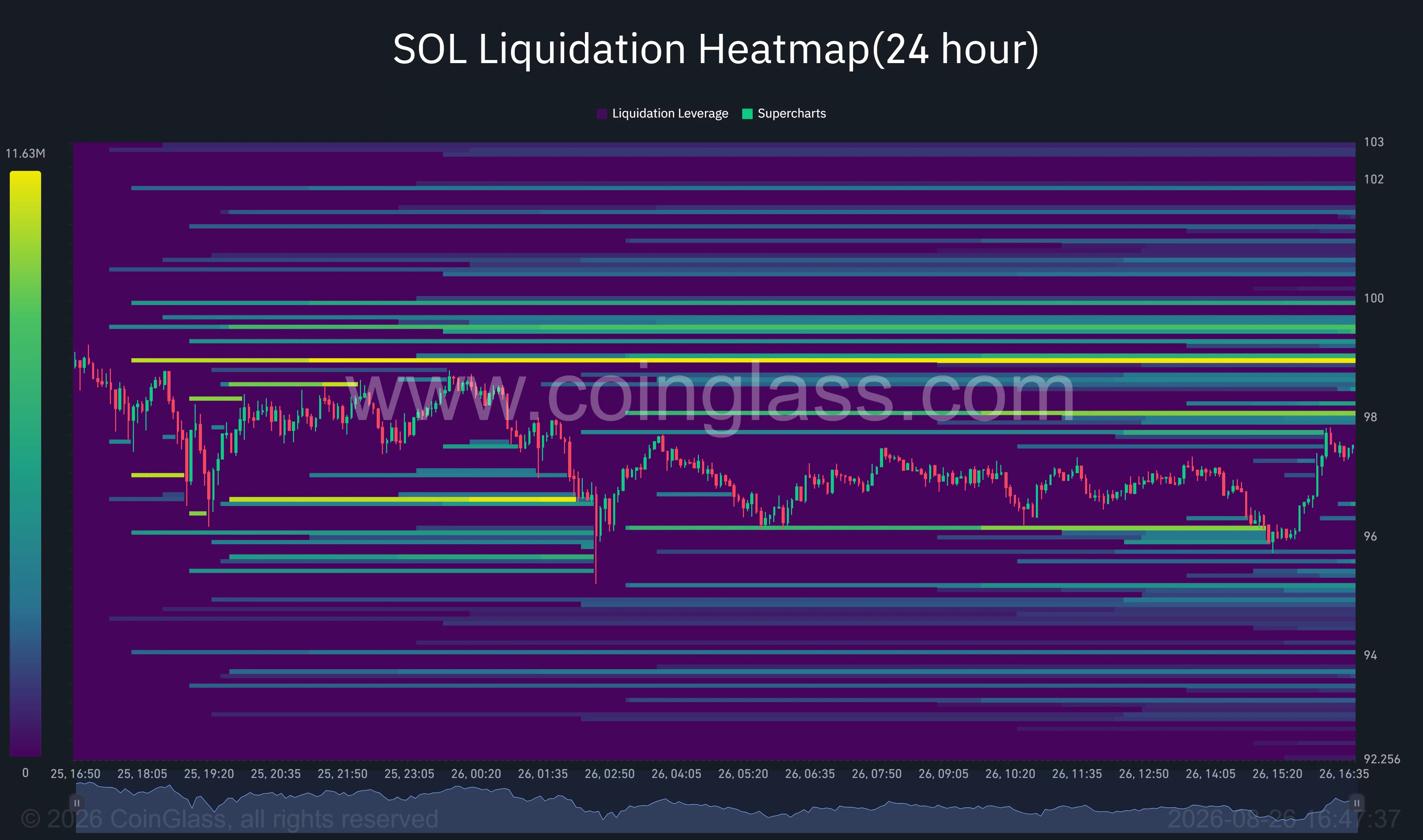
The strongest nearby concentration appears around $98.90–$99.10, with additional liquidity visible near $99.50 and $100. Such clusters can attract price because a move into them forces leveraged short positions to close.
If SOL crosses $99, liquidations could help accelerate another push toward $100–$103. However, the previous rejection above $102 shows that sellers are also active within that range.
Liquidity is visible below the market near $96, $95, and $94. A failure to break through the overhead cluster could therefore send SOL back toward lower-leveraged positions.
The heatmap supports a two-sided short-term setup: a break above $99 could generate another squeeze, while a rejection leaves $96 and $94 exposed.
Analysts split on $120 rally and $88 correction
Pseudonymous trader Altcoin Sherpa expects Solana’s advance to continue if conditions across the wider crypto market remain supportive.
“This goes to $120+ in the coming weeks as long as BTC is still stable/strong. Inflation going down, risk conditions going up, etc.”
A move to $120 from $97.50 would represent an increase of about 23%. Before reaching that target, SOL would need to clear resistance at $100, $103.08, $106.25, and $112.50.
Crypto analyst Haris offered a more cautious assessment, describing the current structure as a possible bull trap because of repeated resistance between $98 and $102.
“Price bounced hard, but $98–$102 is still rejecting. If SOL comes back there and gets rejected again, I will open a short.”
Haris identified $92 as the first downside target. According to the analyst, failure to hold that level could lead to a deeper decline toward $80–$88.
Solana’s immediate direction therefore depends on whether buyers can turn $100–$103 into support. Holding above $96.67 preserves the short-term bullish structure, while a drop through $92.30 would favor a broader retest of the breakout.
Disclosure: This article does not represent investment advice. The content and materials featured on this page are for educational purposes only.


Digital asset infrastructure provider Taurus has connected its tokenization and custody platforms to Swift’s blockchain-based shared ledger, giving financial institutions a route to use bank-issued tokenized deposits for round-the-clock cross-border payments.
Summary
- Taurus has connected its custody and tokenization platforms to Swift’s blockchain ledger.
- The first client integrations are expected within days, followed by initial DLT transactions within weeks.
- Banks can use the connection for cross-border payments involving bank-issued tokenized deposits.
- Swift’s ledger has already processed its first live cross-border transaction between Standard Chartered and HSBC.
Taurus said Wednesday that the integration connects Swift smart contracts with Taurus-CAPITAL and Taurus-PROTECT on clients’ permissioned blockchain infrastructure, with the first client connections expected within days and initial distributed ledger transactions planned within weeks.
Existing Taurus clients can add the connection to infrastructure already running in production, while banks without their own blockchain systems can use managed Hyperledger Besu infrastructure and Ethereum Virtual Machine connectivity supplied by Taurus. The company also supports institutions that already operate Besu or another EVM-compatible system by connecting its tokenization and wallet tools to their existing nodes.
Taurus gives banks a route into Swift’s tokenized deposit ledger
Under the integration, Taurus-PROTECT provides programmable wallet and key-management functions, including governance rules, approval workflows and API-based automation. Taurus-CAPITAL handles the issuance and management of bank-issued tokenized money while allowing deposits to remain on the issuing bank’s balance sheet.
For banks that do not already operate blockchain infrastructure, Taurus said it can deploy and manage the permissioned Hyperledger Besu environment required to connect with Swift’s system. Existing Taurus customers can have their infrastructure extended for ledger connectivity within a matter of days.
The arrangement gives financial institutions another way to access a network that Swift moved into initial deployment in July after about nine months of development. As crypto.news previously reported, 17 banks across six continents were preparing to test tokenized deposit payments when the ledger entered its first controlled rollout on July 9. Participants included HSBC, Citi, BNP Paribas, UBS, ANZ, DBS and Standard Chartered.
More than 40 financial institutions were involved in designing the system, according to Taurus, while Swift’s existing network connects more than 11,500 financial institutions and companies across more than 200 markets.
Taurus co-founder and managing partner Lamine Brahimi said financial institutions need digital asset infrastructure that can work securely with systems they already operate. He said the Swift connectivity allows banks to extend their digital asset capabilities into tokenized deposits and cross-border payments while retaining control over their infrastructure.
Swift’s ledger keeps tokenized deposits on bank balance sheets
Swift’s shared ledger is designed as an orchestration layer between participating institutions, coordinating transfers of tokenized deposits before final settlement takes place through established payment arrangements.
Bank-issued deposits remain on each institution’s own ledger, while Swift coordinates their movement between participants. Payments can operate overnight and on weekends, extending availability beyond the overlapping business hours that can restrict traditional cross-border transfers.
Final settlement still takes place through existing mechanisms, including real-time gross settlement systems, meaning participating banks do not need to replace their current settlement arrangements to use the blockchain-based layer.
A July tokenized deposit explainer detailed how such instruments represent commercial bank deposits on a blockchain while retaining a one-to-one relationship with money held on the issuing bank’s balance sheet. The structure differs from stablecoins because the underlying money remains within the commercial banking system and under the banking regulatory framework.
Swift’s ledger applies that model across multiple institutions. Each participating bank can issue or operate its own tokenized deposits, while the shared infrastructure provides a common layer for coordinating payments between otherwise separate systems.
The model has already moved past its initial development stage. Standard Chartered and HSBC have completed the ledger’s first live cross-border transaction, connecting separate tokenized deposit systems through Swift’s infrastructure.
Taurus expands infrastructure already used by financial institutions
The Swift connection adds another institutional function to Taurus’ digital asset stack, which already combines custody, tokenization, blockchain connectivity and staking services for financial institutions.
During June, Taurus added institutional staking through an integration with P2P.org. The arrangement gave banks using Taurus-PROTECT access to validator infrastructure while allowing them to keep custody and control of their assets within existing workflows.
Ethereum staking was included at launch, while connectivity also covered proof-of-stake networks including Solana, Polkadot, Cosmos, NEAR, Cardano and Tezos. P2P.org reported more than $10 billion in delegated assets across over 50 networks at the time.
Taurus has said its institutional client base includes State Street, Deutsche Bank, Santander and CACEIS. The company also opened a New York office in October 2025 as it expanded its presence in the U.S. market.
Its relationship with Deutsche Bank extends into the German lender’s digital asset plans. Deutsche Bank backed Taurus in a $65 million funding round and has continued working with the Swiss company as part of its institutional crypto custody infrastructure.
Taurus has also built its products across multiple blockchain environments. Taurus-CAPITAL was expanded to Solana in February 2025, allowing banks and financial institutions to issue programmable tokenized assets while Taurus-PROTECT provided custody and staking support.
Banks continue testing tokenized financial infrastructure
Swift’s ledger is entering use as major financial institutions continue experimenting with blockchain-based deposits, securities, and settlement systems.
HSBC completed its first blockchain issuance of a digitally native structured product in July, using tokenized U.S. dollar-denominated notes through a private placement for institutional investors in Hong Kong. The HSBC tokenization pilot used Marketnode to issue the notes on blockchain and manage digital payment flows between the bank and the investor.
Swift’s July rollout placed tokenized deposits specifically at the payment layer. The system was developed to preserve existing compliance, credit, risk, and control standards while making cross-border payments available around the clock, including outside normal banking hours.
Taurus now offers three routes into that infrastructure. Banks without Besu infrastructure can use a managed service operated by Taurus, institutions with their own compatible nodes can connect those systems directly, and existing Taurus-PROTECT customers can extend infrastructure already in production.
The company said Swift smart contracts are integrated with its custody and tokenization products across those configurations, with programmable wallets and compliance controls running above the underlying blockchain infrastructure.
For institutions already using Taurus, connectivity can be established within days. The company expects the first clients to connect shortly, followed by the first DLT transactions using its Swift ledger integration within weeks.


DeFi Development Corp. has launched State of Solana, a public real-time research platform that tracks Solana market, network, staking, validator, yield and ecosystem data through a single dashboard.
Summary
- DeFi Development has launched State of Solana to track market, network, staking, validator and yield data.
- The company held more than 2.29 million SOL and SOL equivalents as of Aug. 10.
- State of Solana will receive additional datasets, visualizations and research tools over time.
- DeFi Development shares are down about 16% year to date and more than 70% over the past 12 months.
According to a Wednesday press release from the Nasdaq-listed company, State of Solana was built to give investors, builders and ecosystem participants access to network-level data alongside SOL price information, with more datasets, visualizations and research tools planned over time.
The platform currently tracks SOL returns across several periods, including 24 hours, three months, year to date, one year and five years. It also provides interactive price history, daily and year-to-date network snapshots, cross-chain comparisons and yield opportunities available across Solana.
Live network information includes epoch progress, slot times, block height and throughput, while users can also monitor current and historical transactions per second. Staking yield, inflation, validator distribution, the Nakamoto coefficient, network uptime and upcoming Solana upgrades are included in the dashboard.
DeFi Development Chief Marketing Officer Pete Humiston said the company’s case for Solana goes beyond the market value of SOL.
“We have spent a lot of time explaining why we believe Solana is one of the most important networks in crypto, but that thesis extends far beyond the price of SOL,” Humiston said.
“State of Solana gives investors and ecosystem participants a way to see the underlying data for themselves,” he added.
State of Solana tracks network activity beyond SOL price
DeFi Development said the platform will continue to expand with more datasets, visualizations, research tools and ecosystem information.
Network activity is particularly relevant to the company because its Solana strategy covers more than holding the token on its balance sheet. DeFi Development also operates validator infrastructure, stakes SOL and deploys part of its treasury across onchain protocols.
Recent network data has provided additional context for that strategy. A May Solana network report covered by crypto.news showed that Solana generated $342.2 million in Chain GDP during the first quarter of 2026, according to Messari.
PumpFun remained the network’s largest revenue-generating application during the quarter with $124.7 million in revenue. Solana’s real-world asset market capitalization also increased 43% quarter over quarter to $2.01 billion.
Real economic value, a measure of transaction fees and maximum extractable value tips paid to validators, fell 1% during the quarter to $89.5 million. Messari ranked Solana second among blockchain networks by the metric, behind Hyperliquid.
Development work on Solana’s Alpenglow upgrade was also progressing during the period. In May, Anza said the new consensus system had entered community validator testing, with the proposed design targeting transaction finality of roughly 150 milliseconds.
DeFi Development holds more than 2.29 million SOL
DeFi Development held 2,294,576 SOL and SOL equivalents as of Aug. 10, according to company figures cited in the announcement. At current prices, the holdings are worth about $208 million.
The company has built the position since adopting a treasury strategy centered on accumulating and compounding SOL, while management has used SOL per share as one of its main measurements for assessing the program.
During a May financial update, DeFi Development reported fully converted SOL per share of 0.0670 as of May 13, up 108% from 0.0322 a year earlier.
Fully converted shares outstanding stood at about 34.2 million at the time, while the company kept its December 2028 target of reaching 1.0 SOL per fully converted share.
Validator operations also remain part of the treasury structure. DeFi Development said in May that its validators were producing about a 7.5% yield, compared with roughly 3.9% from staking SOL on Coinbase.
More than 25% of the company’s treasury had also been deployed across onchain protocols at the time.
Chief Executive Joseph Onorati said during the May update that the company did not view its strategy as a direct copy of the corporate Bitcoin treasury model.
“The MSTR playbook is a starting point, not a ceiling,” Onorati said, adding that “SOL is a different asset than BTC.”
Alongside its own validators, DeFi Development has used validator partnerships and its Treasury Accelerator program as part of its Solana strategy.
Equity sales have funded further SOL purchases
Capital raising has supported much of DeFi Development’s SOL accumulation.
The company established a $200 million equity program in May, giving it the ability to sell common shares through an at-the-market offering.
DeFi Development said proceeds from the program would primarily be used to support its Solana treasury strategy. Management also said it planned to issue shares when doing so increased SOL per share for existing shareholders.
The company has used that metric to assess whether equity financing improves the amount of SOL backing each fully converted share.
Its treasury growth has occurred while reported earnings remain heavily affected by changes in digital asset valuations.
Unaudited first-quarter financial results released in May showed total revenue of $2.66 million, up from $287,000 during the same quarter a year earlier.
Digital asset treasury revenue accounted for $2.40 million of that total.
Net loss widened to $83.4 million from $778,000 a year earlier as lower digital asset valuations affected the company’s holdings. Diluted earnings per share came to negative $3.18, compared with negative $0.08 during the same period in 2025.
During the same update, DeFi Development said it had repurchased about $4.4 million of convertible notes due in July 2030 for approximately $2.6 million in cash, representing a 41% discount to par.
Solana treasury companies have continued accumulating SOL
Other publicly traded companies have also built large Solana positions, with Forward Industries holding one of the largest corporate SOL treasuries.
Forward Industries said in July that it had expanded its treasury by purchasing more than 500,000 SOL during its fiscal third quarter.
The purchases took its holdings to 7.55 million SOL as of June 30. Forward said the newly acquired tokens had been purchased at an average price of about $79 per SOL during the quarter.
SOL per fully diluted share increased to 0.0729 from 0.0669 at the end of the previous quarter, according to the company.
A month earlier, Forward had transferred 455,784 SOL worth about $31.9 million to Coinbase Prime after roughly one month of wallet inactivity.
Forward did not say the transfer represented a sale. Coinbase Prime can be used by institutional clients for custody, liquidity management, collateral and trading.
The company began its Solana treasury strategy in September 2025 after receiving backing from investors and partners including Galaxy Digital, Jump Crypto and Multicoin Capital.
Forward has also used staking and validator operations to generate income from its holdings. Its treasury strategy covers buying, holding, staking, trading and investing in SOL-related assets and projects.
DeFi Development shares currently trade near $4.50, giving the company a market capitalization of about $140 million. DFDV has fallen roughly 16% year to date and more than 70% over the past 12 months.


Nvidia’s second-quarter earnings beat Wall Street estimates and guidance topped $108 billion, yet Seaport Research Partners analyst Jay Goldberg says the results still are not “impressive enough” to move the stock.
Goldberg is the lone Wall Street analyst with a sell rating on Nvidia. He argues its sold-out chip supply leaves little room for upside surprises this year.
Nvidia Beats, But The Market Shrugs
Nvidia (NVDA) reported second-quarter revenue that beat Wall Street estimates by roughly $4 billion. Revenue nearly doubled from a year earlier.
Guidance for the current quarter came in at $108 billion, above the $103.9 billion analysts expected.
Goldberg, speaking on Bloomberg Technology, said the beat itself will not be enough.
“I think my initial impression is that’s a really impressive quarter and nobody’s going to care.”
Jay Goldberg, Bloomberg
He said Nvidia CEO Jensen Huang could still move the stock through his tone on the earnings call. Huang is a persuasive speaker, though his recent track record on that front has been mixed.
Sold Out, With No Room To Surprise
Goldberg’s argument centers on supply, not demand. Nvidia’s chip allocations are already locked in for the year, he said. That limits how far the results can move the stock.
“They’re sold out and where do you get upside when you’re sold out? That’s not going to change this year.”
Jay Goldberg, Bloomberg
He pointed to Nvidia’s dependence on Taiwan Semiconductor Manufacturing Company. That reliance, he said, is a constraint that will not ease soon.
Groq, which he called an Nvidia acquisition, could add volume next year outside that limit, he said. Software and neocloud revenue could add further growth as well.
He also flagged mounting competition from AMD’s Instinct chips, Google’s TPU, and in-house chip efforts at OpenAI and Anthropic. Still, he expects Nvidia to keep the largest market share.
A Bull Case On The Other Side
Not every analyst agrees. UBS analyst Tim Arcuri said the numbers should boost confidence in Nvidia’s earnings path into 2027 and 2028. He treats the results as more important than the market’s muted reaction.
Nvidia shares briefly erased an early after-hours dip. That pattern has repeated across the company’s longest losing streak since 2022 heading into earnings.
Whether that holds may decide if Goldberg’s sold-out thesis keeps capping the stock.
The post Nvidia's Record Results Aren't ‘Impressive Enough' Because It's Sold Out, Analyst Says appeared first on BeInCrypto.

Tesla raised the prices for two versions of the Cybertruck by $5,000 on Tuesday. The price hike comes as Cybertruck sales have fallen sharply since initial demand following their release in 2023. The all-wheel-drive version of the Cybertruck Dual Motor now runs $74,990 up from $69,990, while the Premium all-wheel-drive trim is now listed at $84,990 compared to its previous…
Copyright ©2026 Investor’s Business Daily, LLC. All rights reserved. 87990cbe856818d5eddac44c7b1cdeb8


The U.S. Securities and Exchange Commission has sent a proposed overhaul of crypto custody rules for investment advisers and investment companies to the White House for review.
Summary
- The SEC sent its proposed crypto custody rule to the White House Office of Management and Budget on Aug. 25.
- The proposal would clarify how investment advisers and investment companies can hold crypto assets for clients.
- The SEC could remove some existing custody requirements it considers outdated under current market practices.
- The full proposal will become public after White House review and an SEC commission vote.
The White House Office of Management and Budget received the proposal on Aug. 25, placing the planned rule changes under executive review before the SEC can release the full text and seek a commission vote.
The proposal would clarify how investment advisers and investment companies can hold crypto assets for clients while complying with existing SEC custody requirements. The agency said firms have raised questions about how digital assets can be held under rules written before crypto became part of regulated investment products and advisory portfolios.
Alongside the provisions covering digital assets, the SEC is considering removing some existing custody requirements it considers outdated because of changes in financial markets and current trading and asset-holding practices.
Full details of the proposal will remain unavailable until the Office of Management and Budget completes its review. Once the proposal is returned to the SEC, potentially with revisions, the commission’s three current Republican members would vote on whether to publish it for public comment.
SEC crypto custody rule would modernize existing requirements
The proposed amendments would apply to rules under both the Investment Advisers Act of 1940 and the Investment Company Act of 1940, according to the SEC’s regulatory agenda.
Under the existing investment adviser custody framework, registered advisers with custody of client funds or securities generally must keep the assets with a qualified custodian unless an exception applies. Crypto has raised additional questions over how those requirements work when ownership and control can depend on private keys and blockchain-based custody systems.
The SEC said its planned rule would clarify the custody framework for crypto assets while making other changes to regulations covering advisory client and fund assets. Some existing requirements could also be eliminated where the agency determines that changes in markets and current asset-holding practices have made them unnecessary.
The commission has already considered a different approach to the issue. In June 2025, crypto.news reported that the SEC had withdrawn its safeguarding proposal introduced during former Chair Gary Gensler’s tenure.
First proposed in March 2023, the Safeguarding Advisory Client Assets rule would have expanded custody requirements for registered investment advisers to cover a larger range of client assets, including cryptocurrencies. It would also have required those assets to be maintained with qualified custodians in most circumstances.
Crypto custody providers faced uncertainty under the plan because many did not meet the proposed definition of a qualified custodian. Industry participants had warned that the requirements could leave investment advisers with fewer options for holding digital assets on behalf of clients.
When the SEC withdrew the safeguarding proposal and several other unfinished Biden-era rules in June 2025, the agency said any future regulatory action in the affected areas would require a new proposal.
The custody amendments now moving through the White House review process constitute a separate rulemaking effort under Chair Paul Atkins. Specific requirements covering qualified custodians, custody arrangements and the treatment of crypto assets will not be known until the SEC publishes the proposal.
Atkins has put crypto rules on the SEC agenda
Custody is one of several digital asset issues the SEC has moved into formal rulemaking under Atkins.
In July, the commission placed three crypto rule proposals on its 2026 regulatory agenda, covering crypto assets, broker-dealers and market structure.
One proposal would consider exemptions and safe harbors for crypto assets, while another would examine how broker-dealer rules should apply to companies dealing with digital assets. A separate market structure proposal covers the trading of crypto assets through alternative trading systems and national securities exchanges.
The agenda placed the projects within a regulatory program running alongside congressional work on digital asset legislation. Atkins has said the SEC can address issues falling within its existing statutory powers while lawmakers work on legislation covering areas that require congressional action.
Crypto also received a dedicated place in the SEC’s 2026 to 2030 strategy released in June. The draft plan identified digital assets, blockchain infrastructure and tokenized financial products among areas the agency intends to address under its regulatory mandate.
The plan also called for clearer treatment of digital assets under federal securities laws and continued coordination between the SEC and Commodity Futures Trading Commission. Congress has separately been considering legislation that would formally divide responsibilities between the two regulators.
Regulatory work has already moved beyond planning in some areas. The SEC has issued guidance and pursued proposed rules covering crypto asset classifications and transactions while considering additional rules governing issuance, custody and trading.
Custody proposal moves forward as Congress debates market structure
The custody proposal reached the White House while the Senate continues work on the Digital Asset Market Clarity Act, legislation designed to establish a statutory structure for U.S. crypto markets.
The House passed its version of the CLARITY Act in 2025, while Senate lawmakers have spent 2026 negotiating their approach to issues including the division of authority between the SEC and CFTC.
Atkins has said the SEC does not need to stop all crypto rulemaking while the legislation remains unresolved. In July, the chairman said the commission was prepared to use its existing powers if Congress failed to finish the market structure bill.
As Atkins discussed the CLARITY Act, he said the SEC was “ready, willing and able” to act in areas under its authority while maintaining that legislation would provide a more durable framework for issues requiring action from Congress.
Certain parts of crypto regulation cannot be settled by the SEC alone. Giving the CFTC authority over digital commodity spot markets, for example, requires legislation because the SEC cannot grant another federal regulator jurisdiction through its own rules.
Rules covering registered investment advisers and investment companies fall directly within the SEC’s existing responsibilities. The custody proposal can therefore move through the agency’s rulemaking process separately from congressional negotiations over market structure legislation.
White House review comes before public comment
The Office of Management and Budget must complete its review before the custody proposal can return to the SEC for the next stage of the process.
Once returned, commissioners would vote on whether to issue the proposal. The SEC currently has three Republican commissioners, and approval would make the full text available to the public for the first time.
A proposed rule would then normally remain open for public comment for at least 60 days, allowing investment advisers, investment companies, custodians, crypto firms and other interested parties to submit responses.
SEC staff would review those comments and could change parts of the proposal before preparing a final version. Any completed rule would then have to return to the commission for another vote before it could take effect.
The process follows the commission’s decision to discard several unfinished crypto-related proposals inherited from the previous administration and restart rulemaking where it wants to pursue new requirements.
Among the measures withdrawn in 2025 was an attempt to expand the definition of securities exchanges, alongside the safeguarding proposal covering investment advisers. The SEC said at the time that new regulatory action in the abandoned areas would begin through fresh proposals instead of continuing the earlier proceedings.
The custody proposal is classified as economically significant on the federal regulatory agenda. The SEC said it would evaluate the expected costs, benefits, and other economic effects while developing the rule, with its provisions set to address both advisory client assets and assets held by investment companies.

Blockstream CEO Adam Back may have long played down the immediacy of quantum threats, but the company he leads is moving forward with concrete work on how Bitcoin could upgrade if sufficiently powerful quantum computers ever become a practical reality. That progress just received a fresh milestone: a Bitcoin Improvement Proposal (BIP) for the company’s experimental post-quantum signature scheme, SHRINCS, was published on the project’s GitHub repository.
The development matters because Bitcoin’s current elliptic-curve signature system (used for spending authorization) is widely understood to be vulnerable to the key-recovery capabilities of future quantum machines. While the exact timeline remains debated, cryptographers agree the worst-case scenario would allow attackers to derive private keys from public keys and steal funds—making migration planning an industry priority rather than a reactive scramble.
Key takeaways
- Blockstream published a BIP for SHRINCS, positioning it as an actionable candidate for Bitcoin’s post-quantum signature upgrade path.
- SHRINCS is designed to be “Bitcoin-native” and smaller than many NIST-aligned post-quantum signature alternatives, helping it fit Bitcoin’s block and witness constraints.
- The proposal’s approach is more “stateful,” which can reduce on-chain size but introduces wallet/device recovery and interoperability risks.
- Blockstream’s ongoing research explores complementary ideas—like signature-size reduction and potential ZK proof aggregation—while keeping governance and deployment decisions separate.
From quantum skepticism to BIP-level implementation
Adam Back has been associated with a cautious stance toward quantum timelines—arguing in earlier comments that the threat may not materialize for decades. Yet, Blockstream’s work shows how even a “farther away” threat can justify engineering now: building, testing, and documenting cryptographic changes before the political and technical window closes.
Blockstream Research has previously demonstrated SHRINCS as an experimental post-quantum signature scheme operating in production on Liquid, a Bitcoin sidechain. The new BIP—published earlier today in the SHRINCS repository—takes that experimental work and frames it explicitly for Bitcoin improvement discussions.
Jonas Nick, a Blockstream Research researcher, characterized the BIP as “the first concrete proposal” for a post-quantum signature scheme built specifically around Bitcoin’s needs. He also cautioned that SHRINCS is not presented as Bitcoin’s “final” signature design and is not optimal on every dimension—an important distinction for investors and builders trying to evaluate how close a proposal is to consensus-level readiness.
Why signature size is the core Bitcoin constraint
In most post-quantum signature designs, public parameters and signature payloads are substantially larger than Bitcoin’s current elliptic-curve signatures. According to the article’s cited comparison, NIST-endorsed post-quantum hash- and lattice-based signature schemes are between 38 and 123 times larger than Bitcoin’s ECDSA and Schnorr signatures. The practical consequence is straightforward: larger signatures mean more data per transaction, which can reduce throughput.
The same reporting notes that deploying those larger NIST-style signatures directly in Bitcoin could push performance down to a fraction of a transaction per second. Ethereum’s post-quantum team, as referenced in the article, has discussed addressing the blockspace problem by aggregating signatures using a small zero-knowledge proof per block—an approach that, if feasible, can reduce on-chain footprint. Bitcoin, however, would face a different social and technical hurdle: adding ZK proof aggregation would represent a major change to the system’s validation and activation politics.
Blockstream’s alternative is to shrink the signature payload itself. The approach discussed here aims to reduce Bitcoin-relevant signature sizes by about 13.23 times compared with baseline NIST-aligned hash-based post-quantum signatures, while retaining enough compatibility with Bitcoin’s operational constraints to keep the upgrade conversation realistic.
What SHRINCS targets—and what trade-offs it makes
The SHRINCS design was unveiled by Blockstream researchers in December 2025, with an opcode proposal published in May. It is a hash-based post-quantum signature scheme built to work within Bitcoin’s signature-size realities. The scheme is reported as having a minimum size of 548 bytes plus a 48-byte public key, with maximum sizes that can reach 4,619 bytes.
A key selling point is “Bitcoin-native” construction: one cited explainer describes the scheme as real code signing real transactions on Liquid mainnet and as an attempt to address post-quantum migration without breaking Bitcoin’s block economics. That said, it remains early-stage research. The article references a warning embedded in the BIP text that a formal security proof is “TODO,” indicating the cryptography is promising but not yet fully validated at the level Bitcoin-style upgrades normally demand.
Even with SHRINCS’s improvements, the scheme is still described as significantly larger than current Bitcoin signatures—about nine times larger than Schnorr signatures (64 bytes). The report also emphasizes that the impact is not as simple as a “9x blocksize increase,” because Bitcoin’s Segregated Witness changes how signature bytes are accounted for in block weight.
Where SHRINCS makes a more controversial engineering choice is in its state management. Traditional stateless designs can store everything required to verify and update signatures in the public structure, but they often require large signature artifacts. The article describes SHRINCS as intentionally reducing those artifacts by using one-time keys and keeping track of “used keys” on the device—meaning the scheme behaves in a stateful way.
This can affect users in concrete ways. Each time a signature is used, it adds roughly 16 bytes to the signature. More importantly, if a device is lost, the fallback mechanism can require a very large transaction (the article cites about 5,777 bytes) to recover. Additionally, the BIP warning cited in the article notes that different SHRINCS implementations may not interoperate safely if they use incompatible stateless-component settings—raising the risk of lost funds during key import.
That tension—smaller signatures in exchange for operational fragility—is likely to shape governance debates more than raw cryptographic novelty. Bitcoin’s consensus rules are permanent maintenance obligations, and wallet-side assumptions can become user failure modes.
Iterating for deployment: hardware wallets, SHRIMPS, and options for aggregation
Blockstream says it has continued refining SHRINCS through 2026 and recently demonstrated that SHRINCS and other post-quantum signature schemes can run on common hardware wallets. That is not a trivial detail: even well-designed cryptography can stall adoption if it cannot fit the performance and memory constraints of real wallet environments.
The article also references work on a companion backup/derivation concept. Earlier in March, Blockstream introduced “SHRIMPS” to support signing by backup devices initialized from the same seed in a way that aligns with SHRINCS signing behavior. In the BIP update described here, the SHRIMPS naming is dropped and the scheme is incorporated as a built-in stateless path under the same 48-byte public key, optimized with a non-standard parameter set to be about 26% smaller.
Beyond hash-based signatures, Blockstream’s research also experiments with lattice-based signature approaches, which are often smaller but described as less proven and less reliable than hash-based designs in the current literature. The article further notes Blockstream’s consideration of zero-knowledge proof aggregation. According to its estimates, pairing ZK aggregation with SHRINCS could potentially double Bitcoin’s speed in this modeled scenario.
Notably, Blockstream is reported to have separated signature-choice work from the separate, more contentious questions of block size increases and ZK aggregation. That decision reflects a pragmatic recognition: pairing multiple disruptive changes at once can make it harder to build consensus. If Bitcoin is to migrate to post-quantum security, the pathway likely needs modular governance milestones rather than one all-at-once overhaul.
As one explained perspective cited here puts it, the “binding constraint” may not be cryptography alone but governance—how Bitcoin chooses among a growing menu of engineering options (including references to other proposals like BIP-360, BIP-361, and STARKs) before an upgrade clock runs out.
For readers, the next signal to watch is whether the SHRINCS BIP gains traction in the broader Bitcoin development and review ecosystem—particularly around its stateful design risks, key recovery/fallback behavior, and interoperability guarantees between wallet implementations. The proposal’s publication is a meaningful step from experimentation toward deployment planning, but the hard part will be convincing the network that the trade-offs are acceptable and the security path is complete enough for consensus.

Bitcoin – the next safe haven? #crypto #cryptocurrency #bitcoin #btc #cryptotrading

Tottenham ratings vs Charlton: Savio enjoys perfect debut as Mikey Moore shows threat

Greens MP demands apology over antisemitic accusation




![Qkyou - MONEY ft O-Neang [VIDEO LYRICS]](https://wordupnews.com/wp-content/uploads/2026/02/1770711855_maxresdefault-80x80.jpg)
-

 Fashion5 days ago
Weekend Open Thread: Madewell – Corporette.com
-

 Crypto World1 day ago
SpaceX stock could rise 75% to $240, JPMorgan says
-

 Business5 days ago
Musk’s Tesla, SpaceX Confirm $16.8 Billion ‘Terafab’ Chip Plant as World’s Largest Building in Texas
-

 Crypto World5 days ago
anatomy of crypto’s biggest liquidation event since 2021
-

 Crypto World2 days ago
A $30 Billion AI Fund Implodes, Now the SEC Is Investigating Wall Street’s Role
-

 Politics5 days ago
6 months on, Irish renters crushed by effects of government housing bill
-

 Crypto World24 hours ago
Did Trump Just Move SpaceX Stock With One Truth Social Post?
-
 NewsBeat5 days ago
The ‘Lucky Dip Gang’ causing carnage for clicks: After five thugs were killed speeding in the wrong direction on a motorway, GUY ADAMS investigates a sick new trend… and why police aren’t even allowed to pursue them
-

 Business4 days ago
Mystery AI Model ‘Ox Alpha’ Draws Developers With Free Access as Chinese Lab Origins Remain Debated
-

 News Videos7 days ago
Don’t Leave Your Financial Future To Chance | August 19, 2026
-

 Business6 days ago
Five Below: Kids Discount Retailer Reaps Rich Rewards
-

 Business2 days ago
Moderna CEO warns China is pouring state money into mRNA technology
-

 Business2 days ago
NVIDIA Stock Drops Nearly 2 Percent to $210 on Seventh Losing Day Ahead of Critical AI Earnings
-

 Sports4 days ago
Deshaun Watson fires back at Browns fans after being booed: ‘It’s a disrespectful thing’
-

 Business6 days ago
UK firms in critical financial distress rise 9% to 53,756
-

 Crypto World7 days ago
Optimism-funded team's deciding vote shifts $49 million in OP tokens away from users
-
 Crypto World4 days ago
Google Gemini AI Predicts Ethereum Could Become the Trade Retail Misses in 2026
-

 Tech7 days ago
OpenAI confirms ChatGPT is down as logins and signups fail
-

 Tech5 days ago
Unitree’s New Superman Robot Claims to Outjump and Outrun Every Human, Usain Bolt Included
-
 Crypto World5 days ago
Nvidia Stock Suffers Longest Losing Streak Since 2022: Will Q2 Earnings End It?
You must be logged in to post a comment Login