

Crypto World
Bitcoin Shorts are up for a Squeeze as Traders Eye $80,000 Reclaim

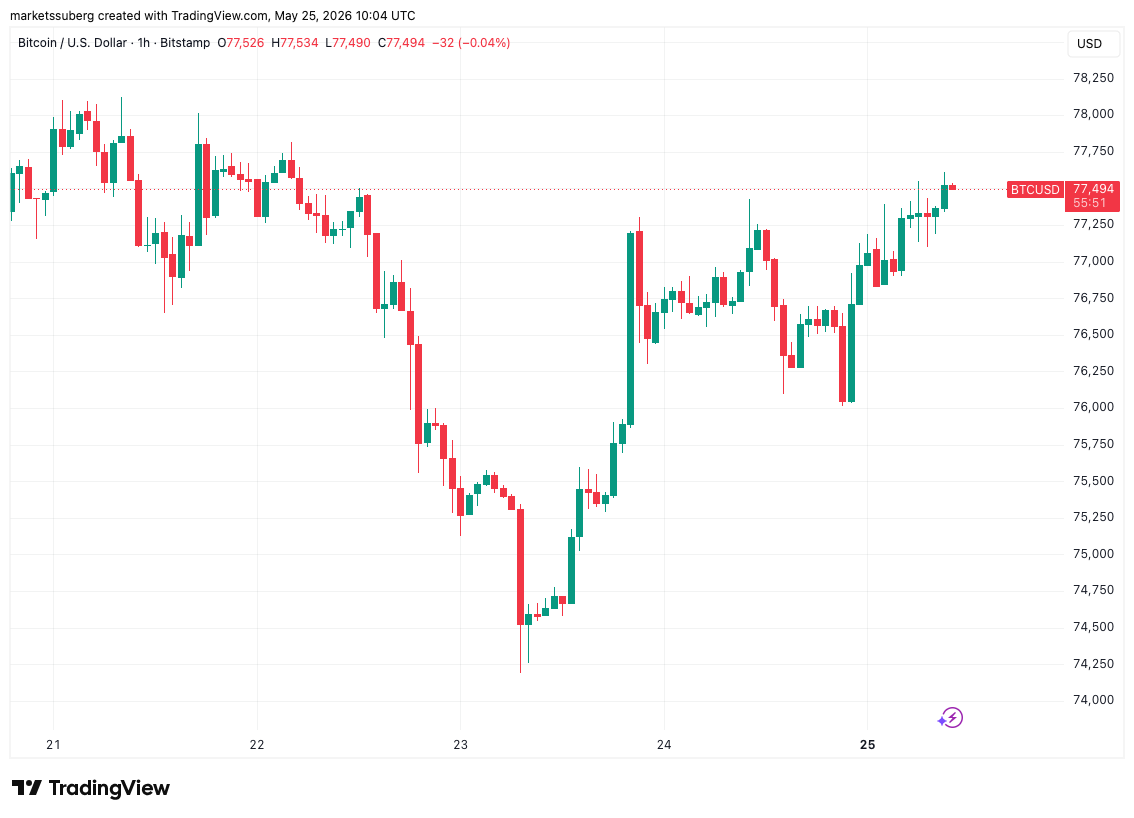
Bitcoin (BTC) starts the final week of May with traders optimistic about an $80,000 rebound — will it end up as a liquidity grab?
- Bitcoin recovers from its trip to monthly lows as shorts above $80,000 could get squeezed next.
- Excitement is growing over a US-Iran peace deal, and stock markets are already heading to record highs.
- Inflation pressures remain a headache for the Federal Reserve as PCE data for April is released.
- Binance has seen conspicuously high net BTC inflows over the past ten days and has added 16,000 BTC in a month.
- Bitcoin faces multiple bearish catalysts, research warns, predicting a “large liquidation event” as a result.
Bitcoin shorts face “significant” pressure at $80,000
Bitcoin price action struggled over the weekend, dipping below $75,000 to its lowest levels since mid-April, per data from TradingView.
A rebound then brought $77,000 back into focus in line with optimism around a US-Iran peace deal.
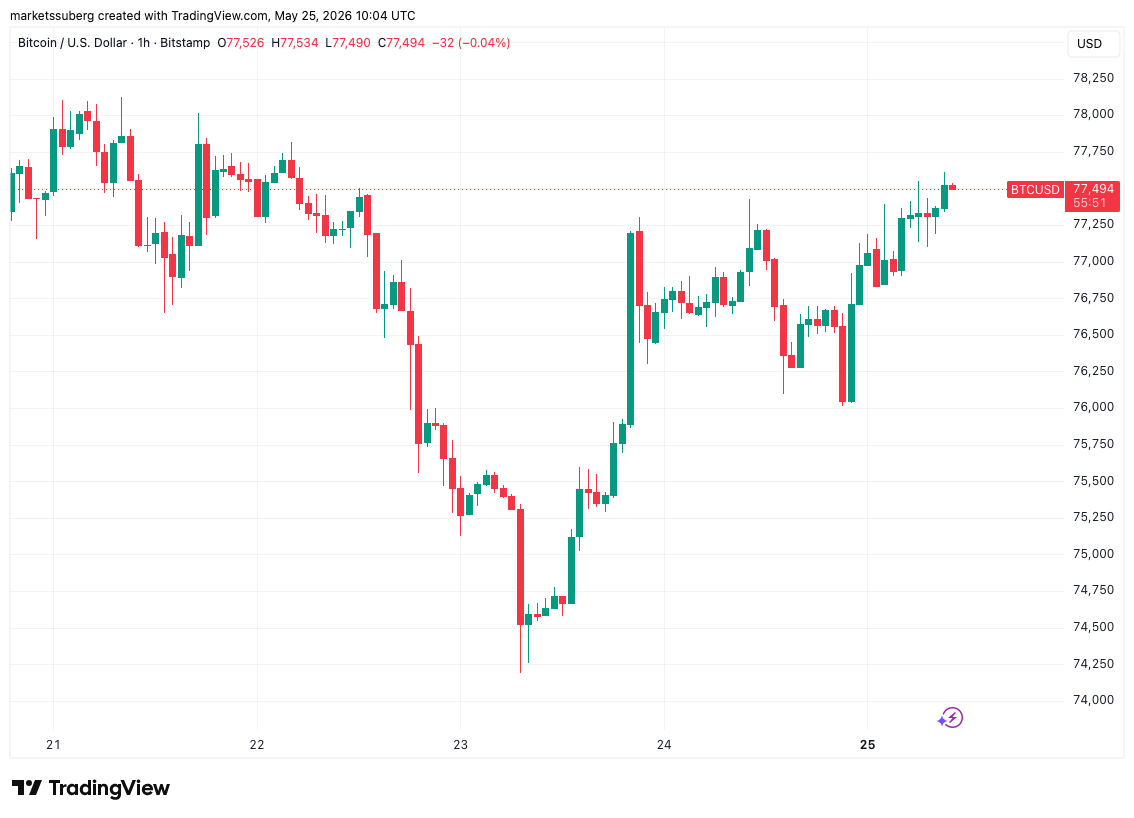
BTC/USD one-hour chart. Source: Cointelegraph/TradingView
In its latest market commentary, X analytics account Cryptic Trades called the dip a “fakeout,” noting its proximity to Bitcoin’s lowest levels of 2025, also seen in April that year.
“We saw a brief deviation below the high-timeframe support range aligning with the April 2025 bottoming formation,” it summarized.
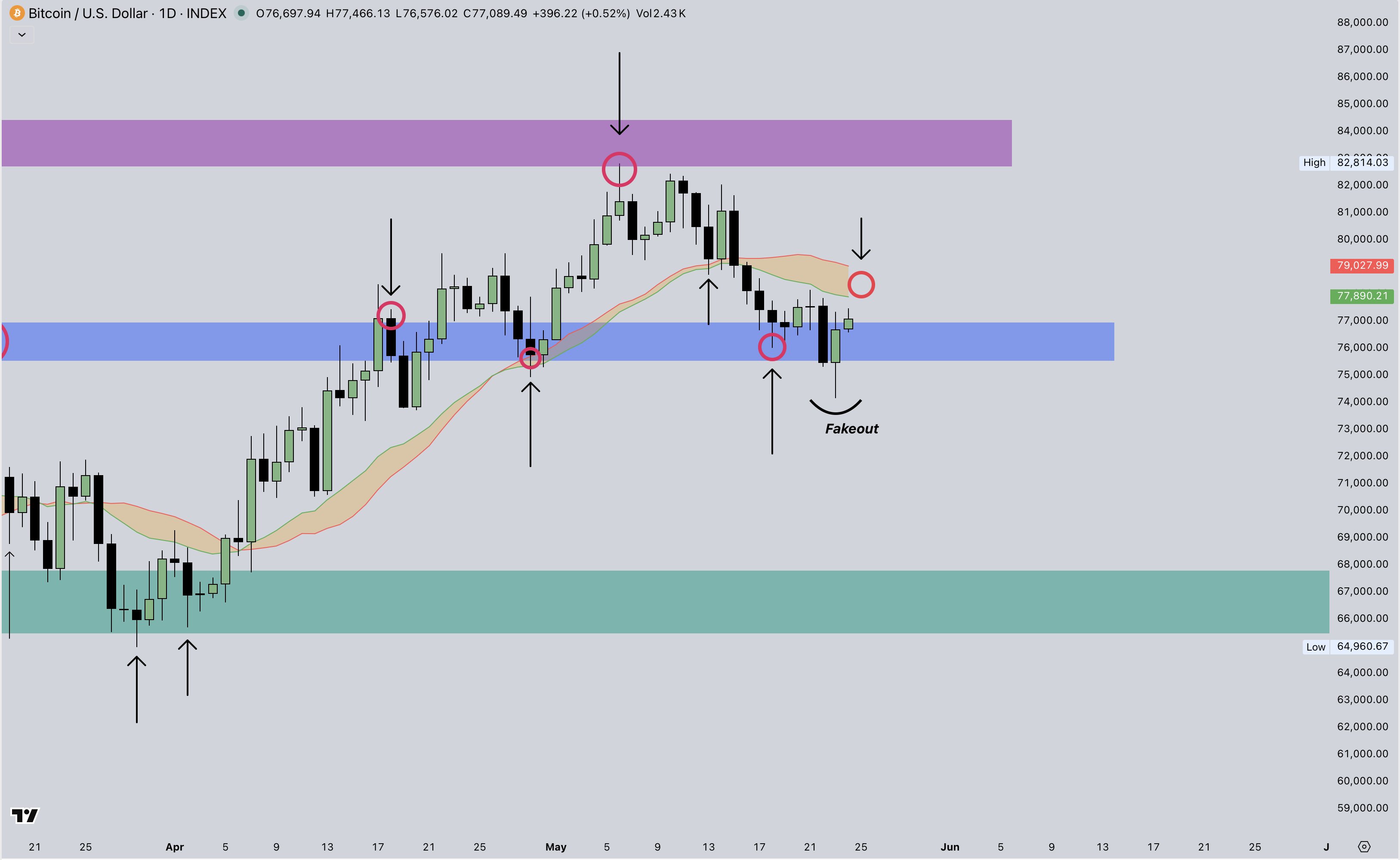
BTC/USD one-day chart. Source: Cryptic Trades/X
Cryptic Trades said that BTC/USD needed to reclaim its daily bull market support band — a “strong reversal zone over the last couple of months” — in order to have a bullish bias on low time frames.
“Bulls need to keep holding this area to keep this short/mid timeframe momentum in their favor,” trader Daan Crypto Trades agreed.
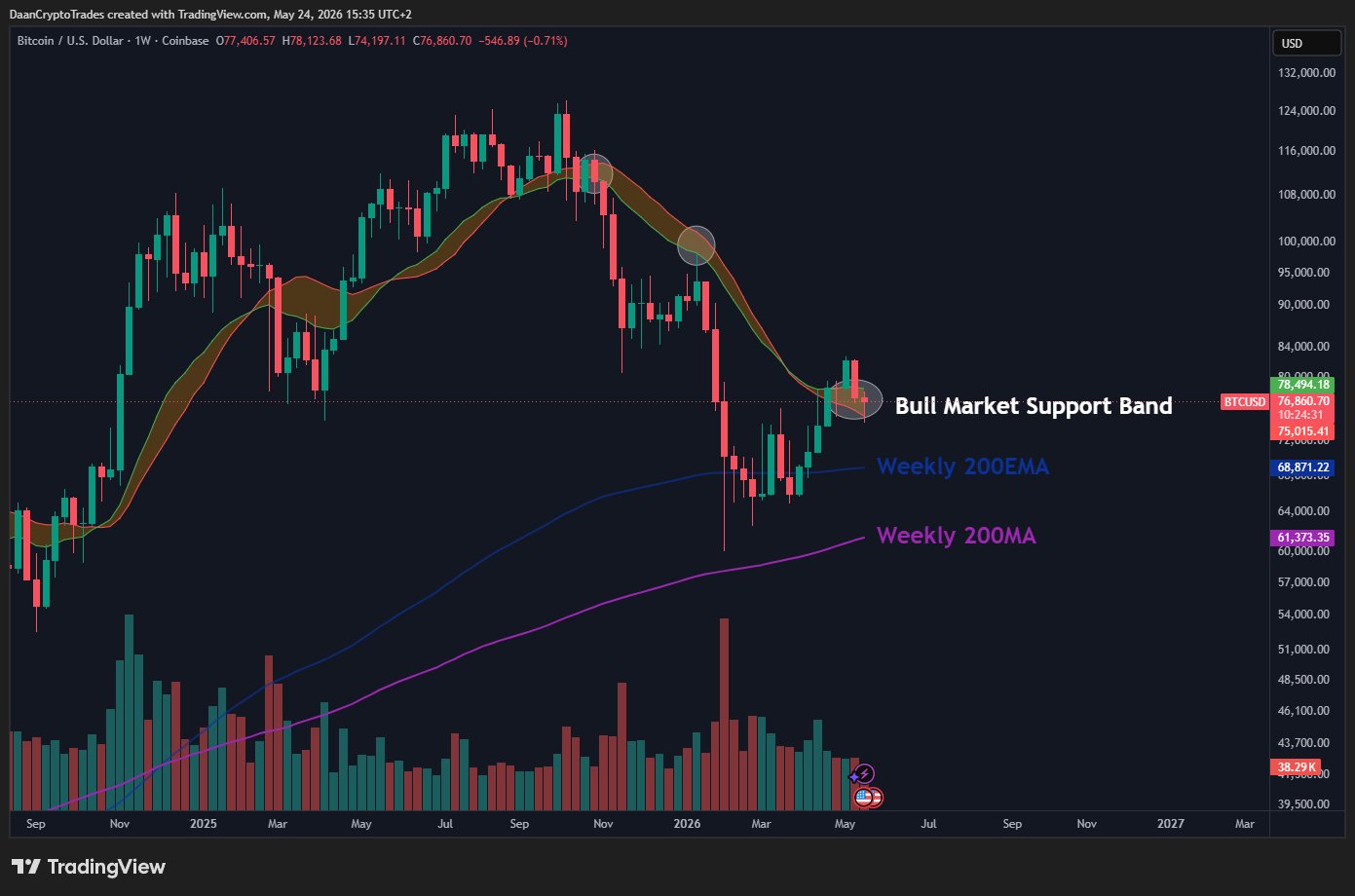
BTC/USD one-week chart. Source: Daan Crypto Trades/X
Trader and analyst Lennaert Snyder referred to Bitcoin’s trip below $75,000 as a “very nice liquidity sweep.”
“Strong daily close after the sweep and price is taking out the previous daily highs,” he told X followers.
“I’m intraday bullish on Bitcoin, and I’m still eyeing that 79/80 level to retest. Would be great if the 74.2K low could get us there, I’ll watch 79/80K closely for quality shorts after my trigger.”
Trader CW also eyed exchange order-book liquidity for clues as to how high the price might go next.
“$BTC has risen to just before the high-leverage short position zone. The upcoming rise will be a liquidation process for short positions,” they predicted.
“There is a significant amount of short position pressure until 80.5k.”
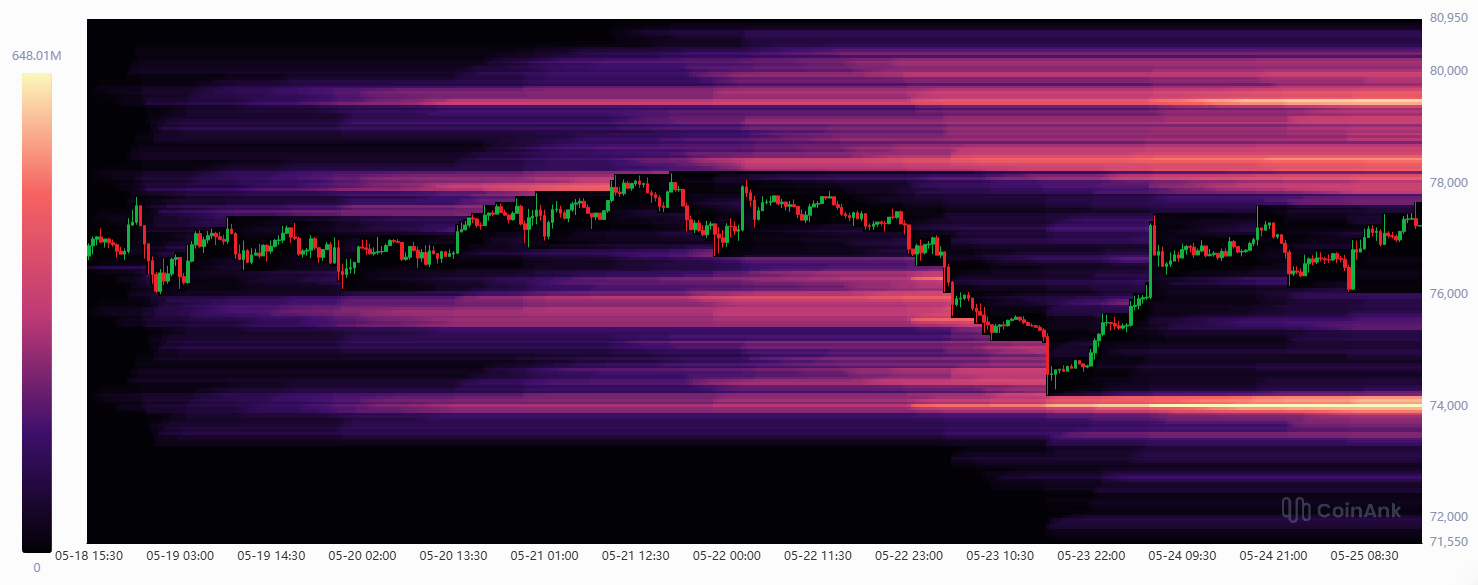
BTC liquidation heatmap. Source: CW/X
Iran peace deal bets send stocks to new highs
There may finally be some good news for risk assets when it comes to the US-Iran war this week.
A peace deal between the two sides seems closer than ever, and markets are already pricing in the end of the conflict.
US stocks futures surged at the weekly open, with both the S&P 500 and Nasdaq 100 hitting new all-time highs. Japan’s stock market gained 3.5%.
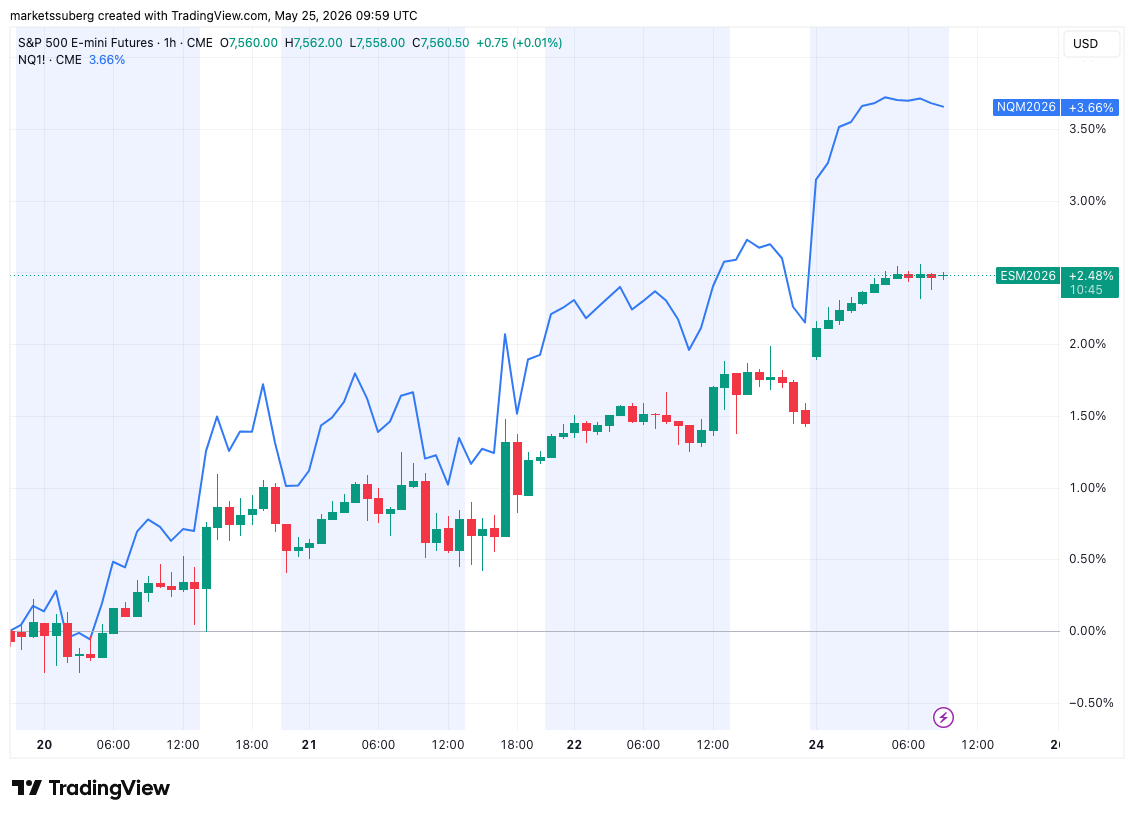
S&P 500 futures vs. Nasdaq 100 futures one-hour chart. Source: Cointelegraph/TradingView
Oil, by contrast, began to fall, with WTI crude nearing $90 per barrel.
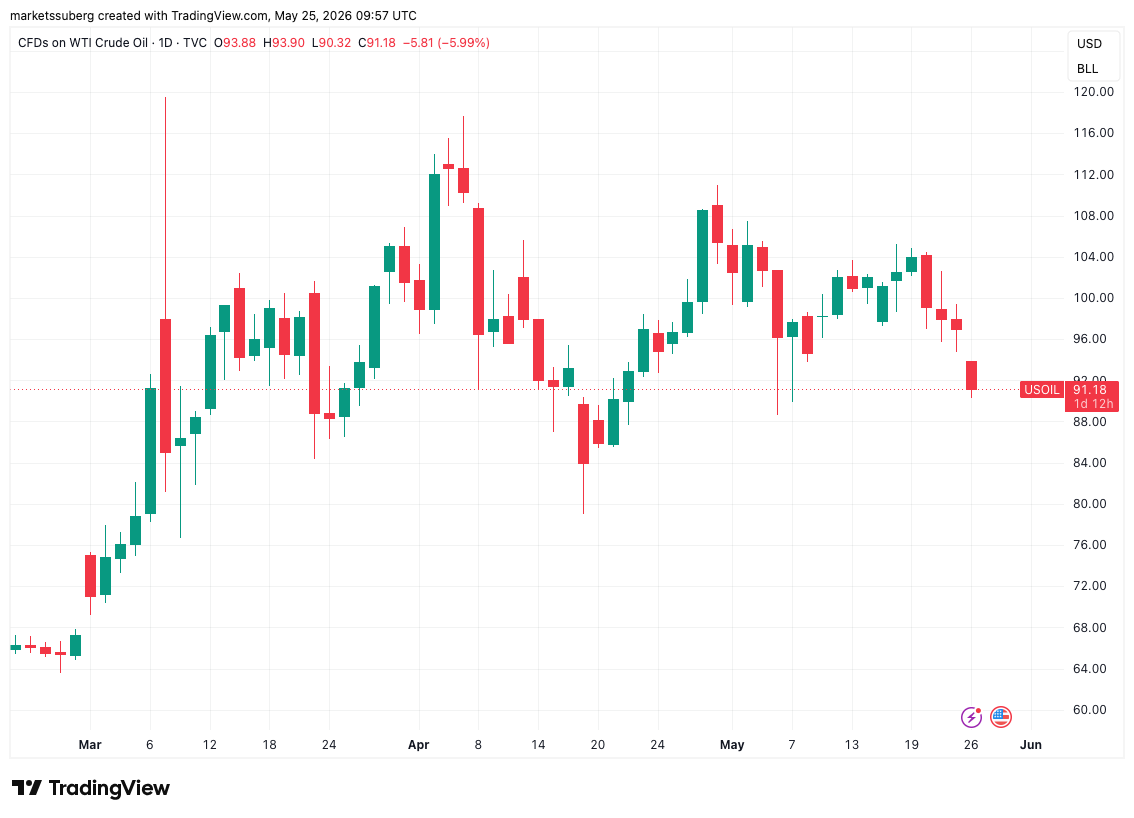
CFDs on WTI crude oil one-day chart. Source: Cointelegraph/TradingView
In a post on Truth Social, US President Donald Trump pledged to make a deal that was “good and proper.”
“Unlike those before me who should have solved this problem many years ago, I don’t make bad deals!” he wrote.
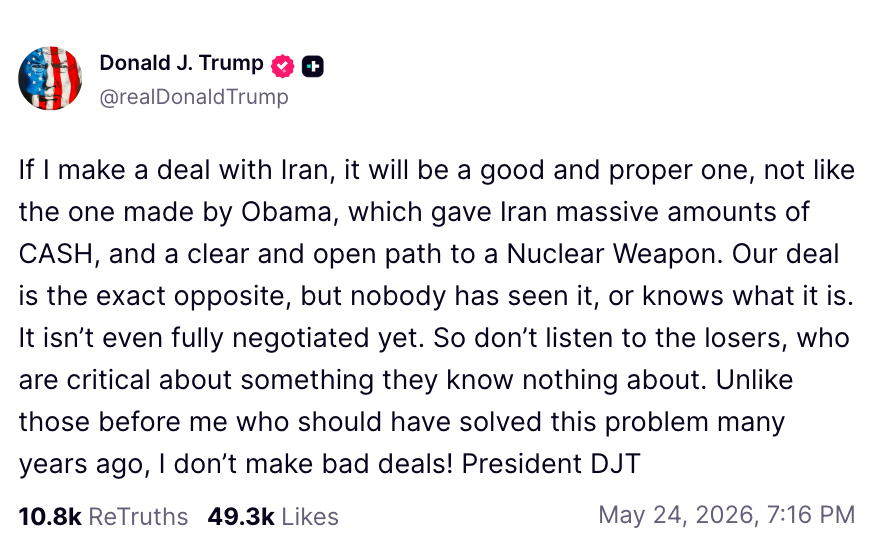
Source: Truth Social
Bitcoin’s response was more muted, continuing a trend from last week where stock market records failed to ignite upward momentum for crypto.
Nonetheless, market participants are already betting on the peace deal acting as the next tailwind.
“I think Bitcoin is ready for higher grounds,” trader and analyst Michaël van de Poppe commented on X.
Van de Poppe saw BTC/USD rising above $80,000 should a deal take effect.
“That is likely the plan,” he concluded, seeing risk assets performing strongly across the board.
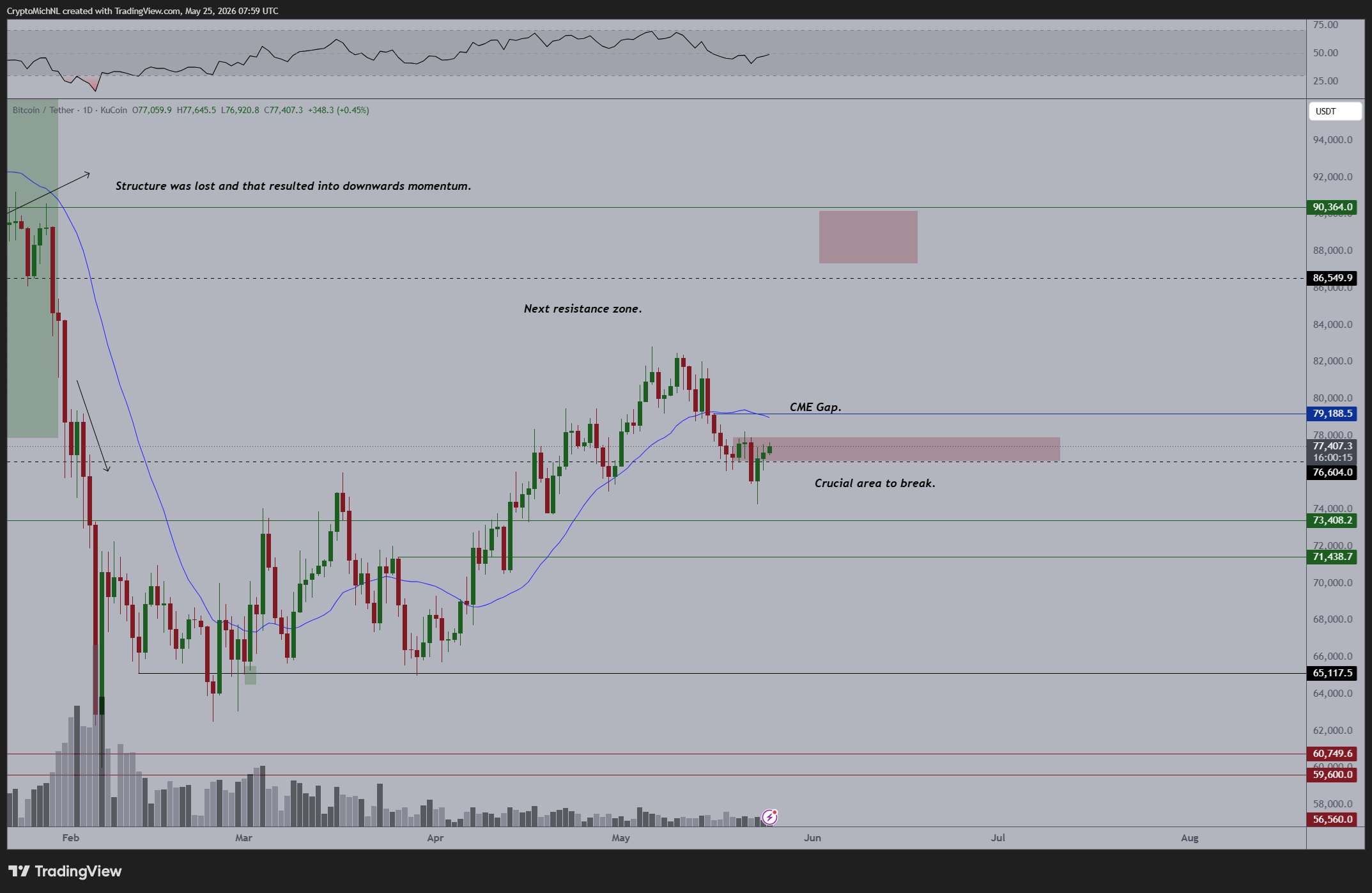
BTC/USDT one-day chart. Source: Michaël van de Poppe/X
Inflation flips Fed hawkish ahead of PCE data
The deal would also mean good news for US inflation trends, which have surged on the back of high oil prices.
This week, however, both markets and the Federal Reserve will have to contend with April’s Personal Consumption Expenditures (PCE) Index print, which will reflect the full impact of the Iran conflict.
PCE, known as the Fed’s “preferred” inflation gauge, will be the first for its new Chair, Kevin Warsh.
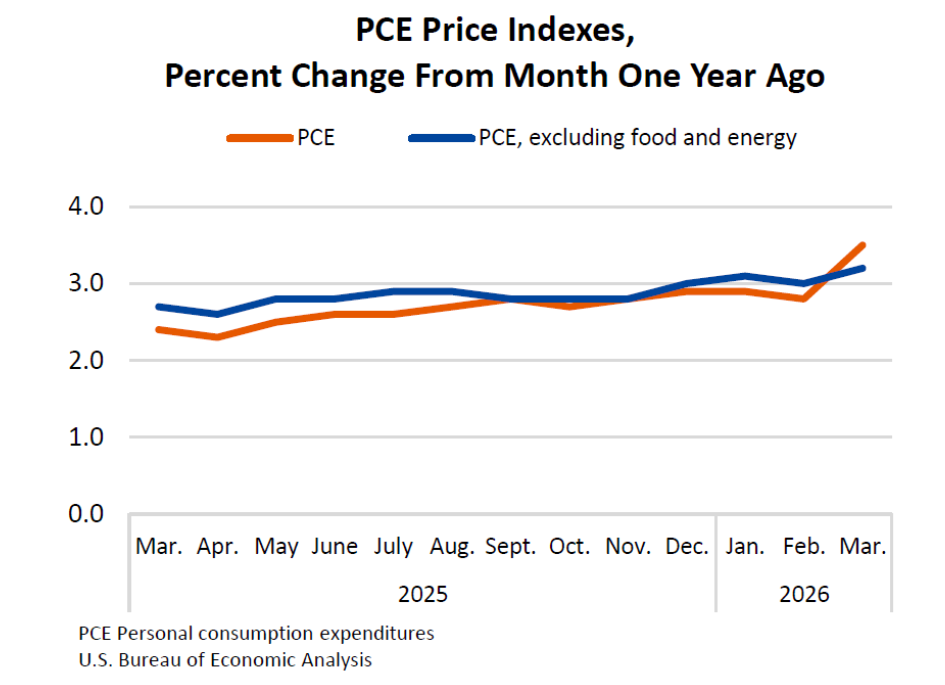
US PCE % change (screenshot). Source: Bureau of Economic Analysis
Expectations remain that policy could tighten to contain inflationary pressures this year. In the latest edition of its regular newsletter, “The Market Mosaic,” trading resource Mosaic Asset Company noted that even Fed officials themselves were changing their tone.
“In a speech last week, Christopher Waller stated that ‘inflation is not moving in the right direction’ and can ‘no longer rule out rate hikes further down the road,’” it reported, referring to a member of the Fed Board of Governors.
“Waller previously was a leading proponent for cutting rates on labor market concerns.”
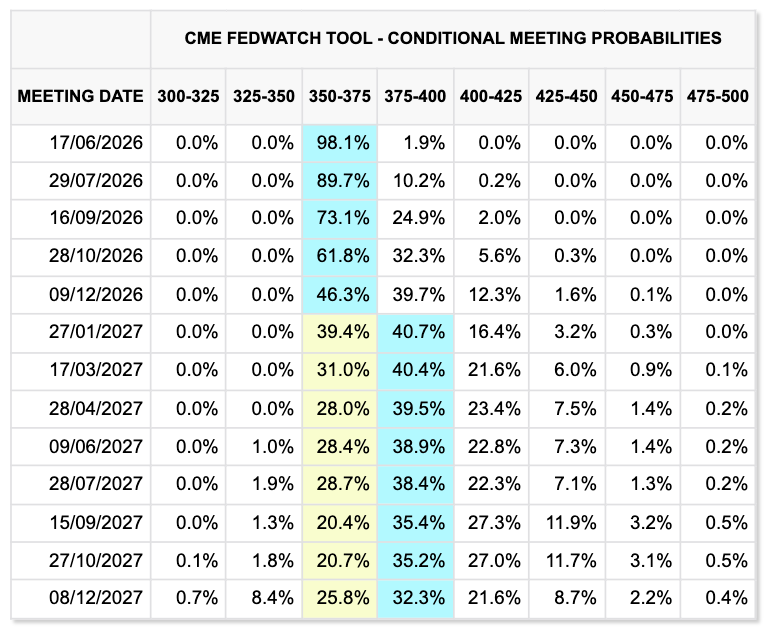
Fed target rate probabilities (screenshot). Source: CME Group
Data from CME Group’s FedWatch Tool likewise underscores the lack of optimism when it comes to interest-rate cuts before 2027.
While that is ostensibly a headwind for crypto, Mosaic acknowledged that Iran-based inflation upticks could be “temporary,” with stocks primed for further gains.
Binance inflow “intensity” causes alarm
Geopolitical uncertainty has led onchain analytics platform CryptoQuant to warn about a Bitcoin “sell signal.”
In one of its QuickTake blog posts on Sunday, contributor Darkfost flagged nearly 10 days of BTC inflows to the largest global exchange, Binance.
“On May 16th, the weekly average of inflows on Binance stood at 378 BTC. It now reaches 1,190 BTC today, representing a more than 3x increase in less than 10 days,” he revealed.
“The largest single day recorded over 3,600 BTC on May 18th, a relatively high level for a single day that clearly illustrates the intensity of the movement.”
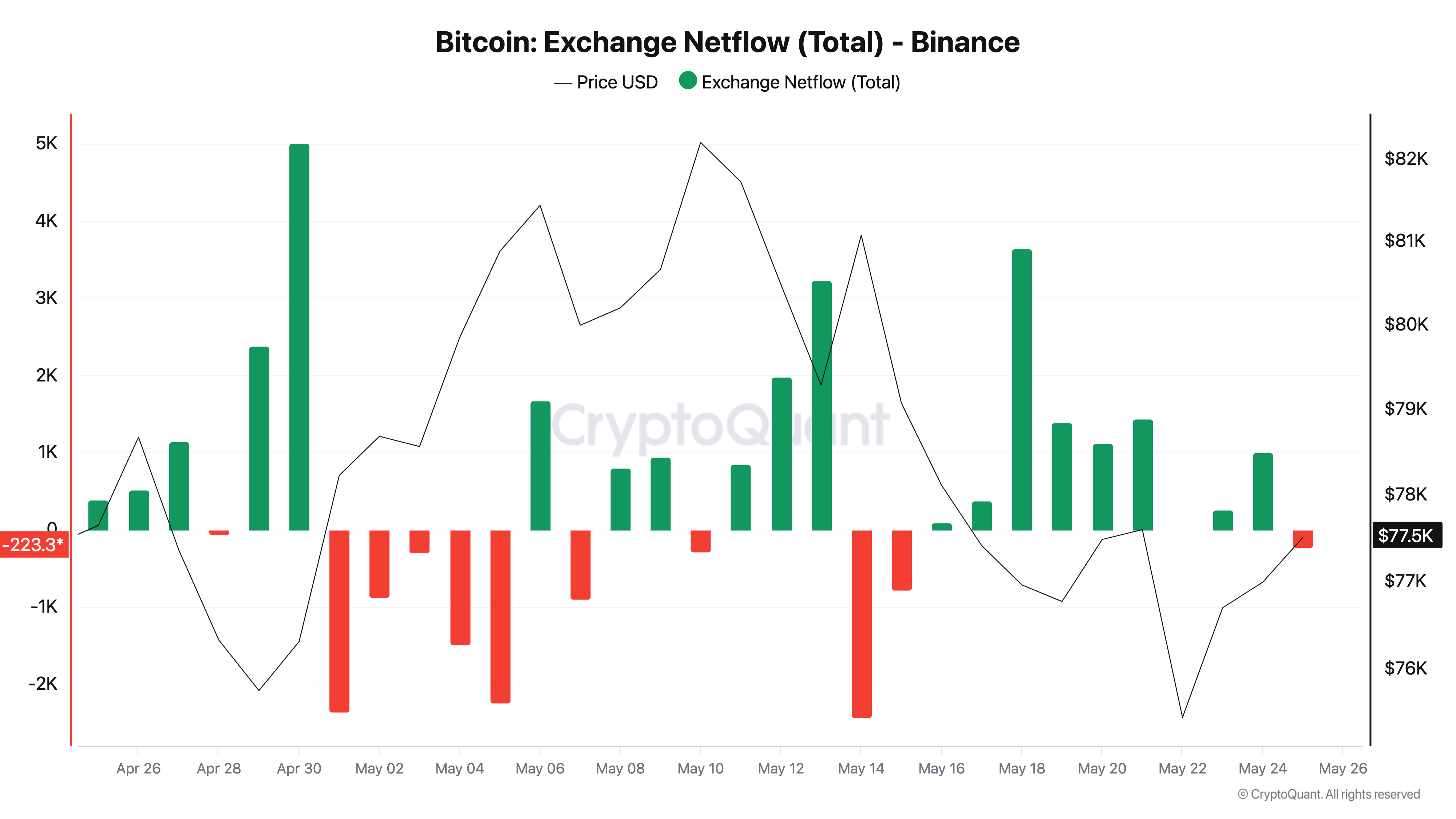
Bitcoin netflows for Binance. Source: CryptoQuant
Darkfost noted that Binance’s Bitcoin reserves had increased by 16,000 BTC in a single month.
“When inflows become dominant and consistent on a platform like Binance, this is traditionally interpreted as a potential sell signal,” he continued.
“Holders transferring their BTC to an exchange most often do so with the intent to sell, whether it be profit taking, reducing exposure, or a more defensive repositioning.”
Last week, Cointelegraph reported on weak US demand causing consistent downside price pressure after the Wall Street open. The Coinbase Premium Index, which measures the difference in price between Coinbase’s BTC/USD and Binance’s BTC/USDT pairs, hit its largest negative values in several months.
Analysis warns of “large liquidation event”
In further bad news for Bitcoin bulls, CryptoQuant contributor XWIN Japan described a cocktail of hurdles that remain unconquered.
Related: Bitcoin price record 90-day uptrend ‘resembles bull market rally:’ New analysis
In addition to the weak demand, institutional capital has been exiting the US spot Bitcoin exchange-traded funds (ETFs).
“US spot Bitcoin ETFs have now seen more than $1.74 billion in cumulative outflows, while the Coinbase Premium has turned deeply negative. Since this metric is often viewed as a proxy for US institutional spot demand, it suggests that large investors are becoming less active buyers,” a QuickTake post read.
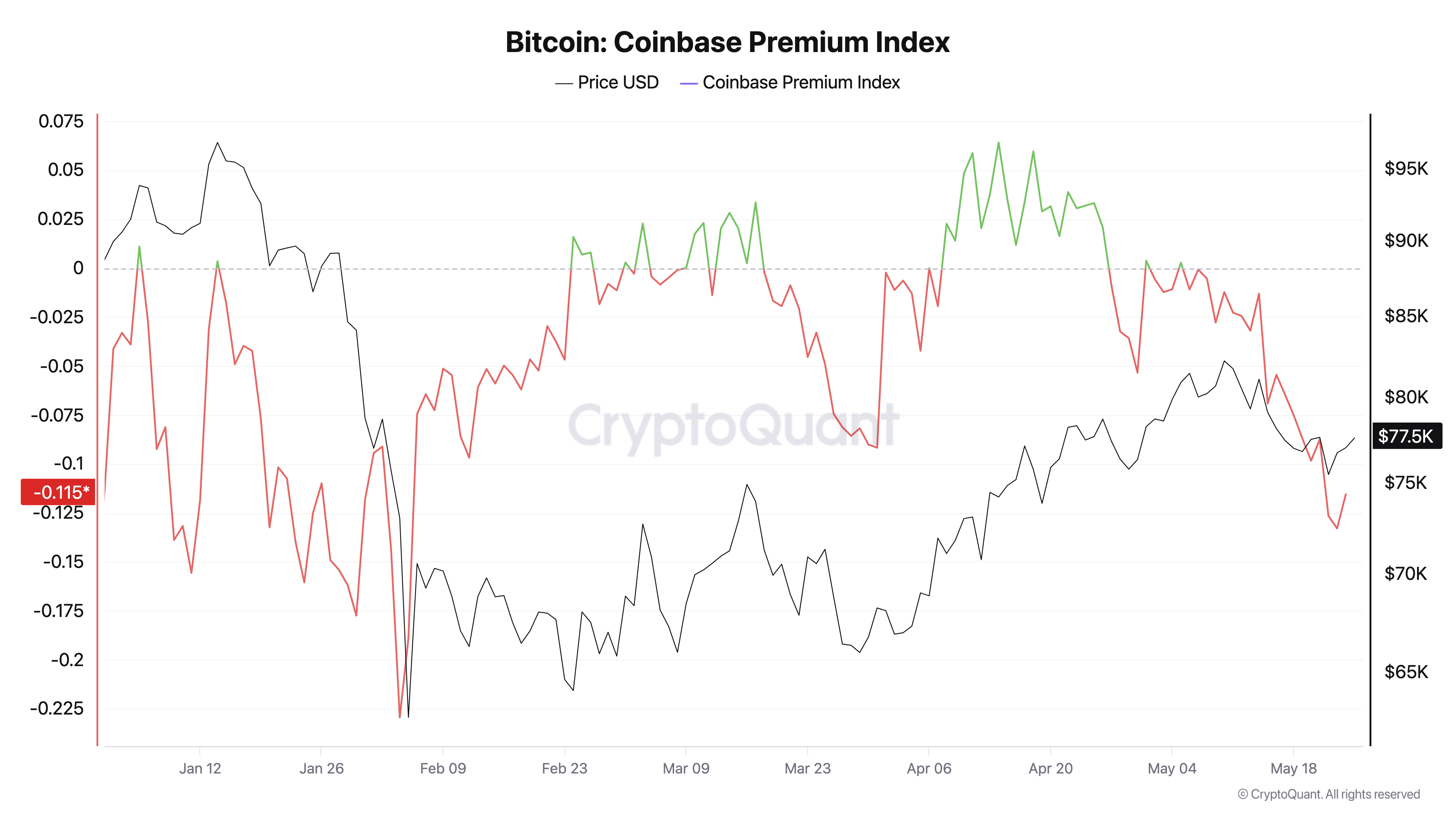
Bitcoin Coinbase Premium Index. Source: CryptoQuant
Binance’s netflows, meanwhile, come as stablecoin volumes decrease — a sign of waning liquidity and reduced risk appetite.
Traders who remain active, by contrast, are “aggressively long,” and positive funding rates imply that leverage is becoming more popular.
“The problem is that Open Interest remains well below late-2025 highs. This suggests the recent rebound is being supported more by leveraged futures activity than by strong spot demand,” XWIN explained.
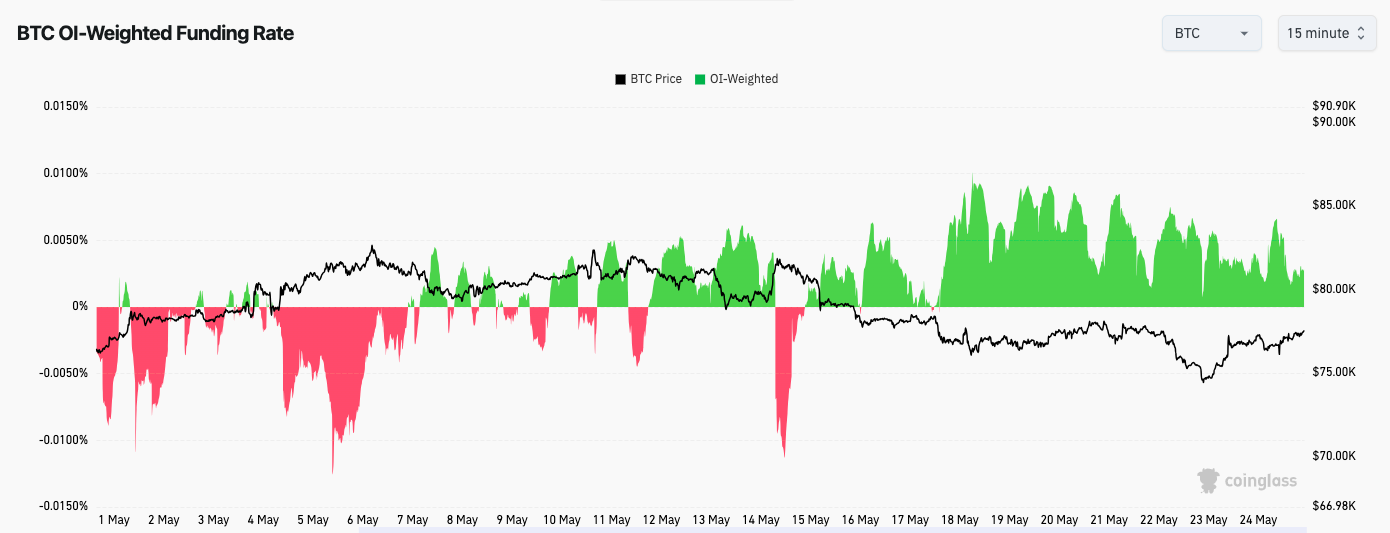
Bitcoin open interest-weighted funding rate (screenshot). Source: CoinGlass
Looking ahead, this combination of factors suggests that the market is due for a shakeout.
“Historically, periods with ETF outflows, negative Coinbase Premium, weak spot demand, and crowded longs have often preceded large liquidation events,” the post concluded.
“For now, Bitcoin looks less like a healthy bull market and more like a fragile rebound driven by leverage rather than real demand.”


[PRESS RELEASE – Willemstad, Curaçao, June 11th, 2026]
1win is inviting users to compete for a total of 5,000,000 USDT in rewards during the FIFA World Cup 2026. The new Football World Cup tournament by 1win will run between June 11 and July 19, 2026, allowing thousands of users to compete for prizes while enjoying the biggest football event of the year.
In the Football World Cup tournament, registered users can participate in online games and place bets on their favorite teams to compete for rewards of up to 500,000 USDT for top-ranked players. With a total prize pool of 5,000,000 USDT, thousands of participants will have the opportunity to win prizes based on their positions on the leaderboard.
How to Participate
- A minimum bet of 1 USDT (or the equivalent in the account currency) with odds of 1.5 or higher on any FIFA World Cup 2026 match is required.
- Points continue to accumulate through eligible games or qualifying sports bets.
- The leaderboard determines rankings and eligibility for rewards.
Points are awarded based on wager amounts and tournament multipliers. The more points a user earns, the higher their position on the leaderboard.
The Football World Cup tournament is available in selected regions where 1win services are offered, and participation is permitted by local laws and regulations. Regional restrictions apply to users from Australia, the United Kingdom, Hong Kong, Israel, Iran, Kazakhstan, Malaysia, North Korea, Singapore, the United States, Taiwan, and the Philippines.
Winners will be announced no later than August 7, 2026, following the completion of the tournament and verification of results. Full tournament rules, participation requirements, prize distribution details, and applicable restrictions are available on the official 1win website.
About 1win
Founded in 2016, 1win is a global crypto-focused online entertainment platform. 1win offers a wide range of gaming products adapted to regional audiences. The brand has active collaborations with international public figures, including actor Johnny Sins, martial artist Jon Jones, and Olympic champion and UFC fighter Gable Steveson. In 2026, 1win welcomed UFC champion Ilia Topuria and rapper Tyga as new members of the 1win VIP community.
The post Football, Crypto and $5 Million of Rewards in 1win’s World Cup Mega Tournament appeared first on CryptoPotato.
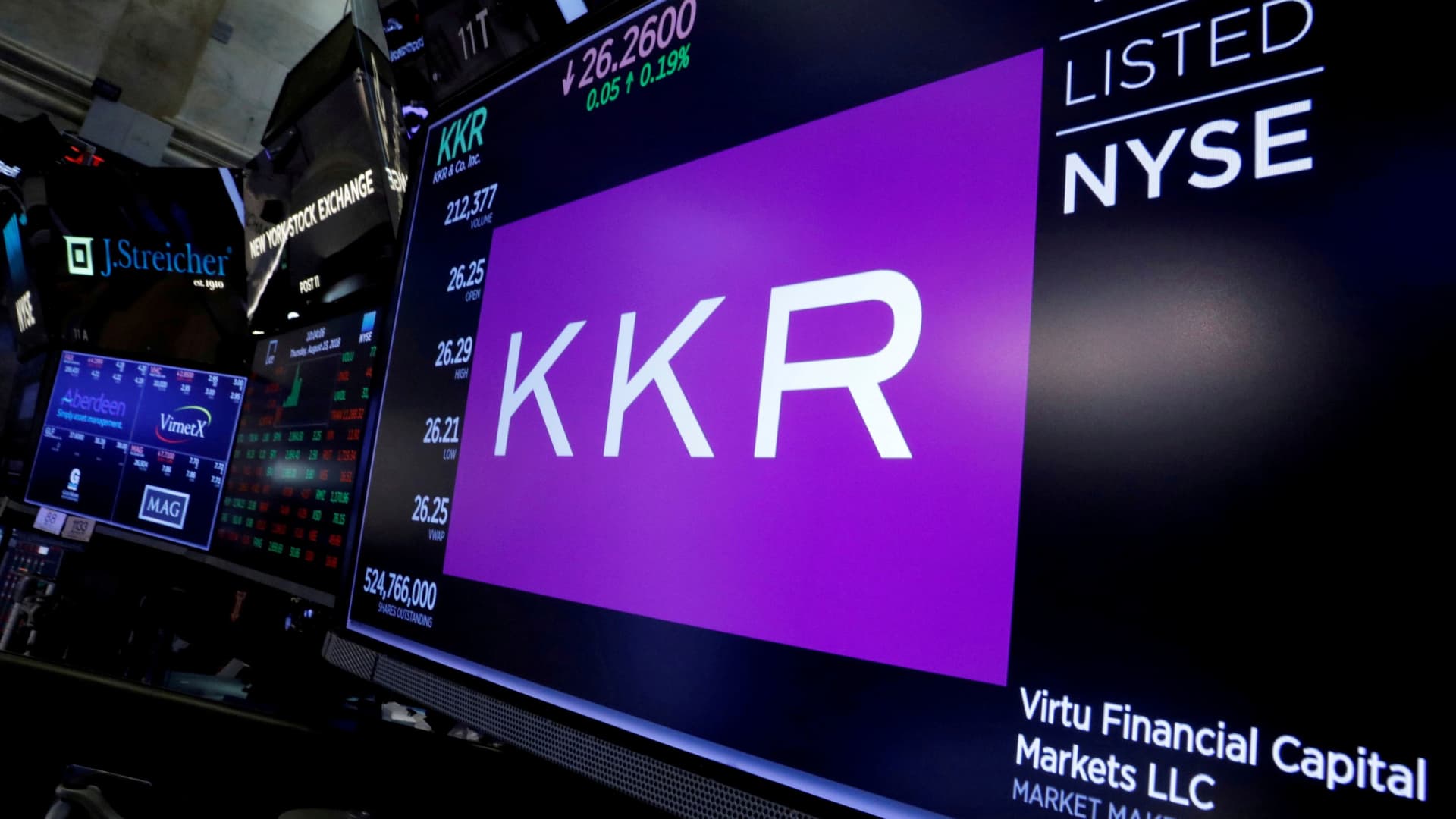
A KKR logo displayed on the floor of the New York Stock Exchange on Aug. 23, 2018.
Brendan McDermid | Reuters
U.S.-based investment giant KKR expects the AI-driven productivity boom is only just getting started, but said it could mean growth is concentrated in just a few sectors.
That’s according to the firm’s mid-year report distributed Thursday.
While AI-driven productivity gains will play out in coming years, “the offset is that intensifying strategic competition will likely make economic growth more concentrated across fewer industries and, at times, more extreme than anything we have seen since the start of the second industrial revolution in the 1870s,” wrote Henry H. McVey, head of global macro and asset allocation and CIO of KKR balance sheet.
McVey described an investing landscape where some parts of the economy and markets are “starved,” while others are “flush.” Technology, high-end services and government spending are areas of “enormously concentrated” growth, he noted.
KKR said the defense and power sectors are the most likely winners when it looked at broader long-term trends. “There is a broad-based and growing focus on the security and resiliency of supply chains across nations and industries, despite higher costs for inputs,” the report said.
Here are three of McVey’s other key takeaways for investors:
Asia will continue to outperform in public and private markets
“We think Japan and Korea still look cheap, as earnings are likely to surprise on the upside in both 2026 and 2027,” McVey said. He noted China’s property drag is the main reason KKR still isn’t overly optimistic on the country’s assets.
Chinese yuan strengthens
However, KKR forecasts the Chinese currency will strengthen as the U.S. dollar peaks, with a forecast of about 6.5 yuan per greenback by 2027.
Wheat
“Agriculture is increasingly joining energy security, defense, and critical minerals as a strategic, policy-backed sector likely to attract sustained investment,” McVey said, noting the USDA forecasts U.S. wheat production for 2026 to 2027 will be the lowest since 1972, with prices rising to three-year highs.


The New York State Department of Financial Services and the European Banking Authority signed a memorandum of understanding on Tuesday establishing the first formal supervisory information-sharing channel between the regulator that licenses the largest US dollar stablecoin issuers and the EU… Read the full story at The Defiant
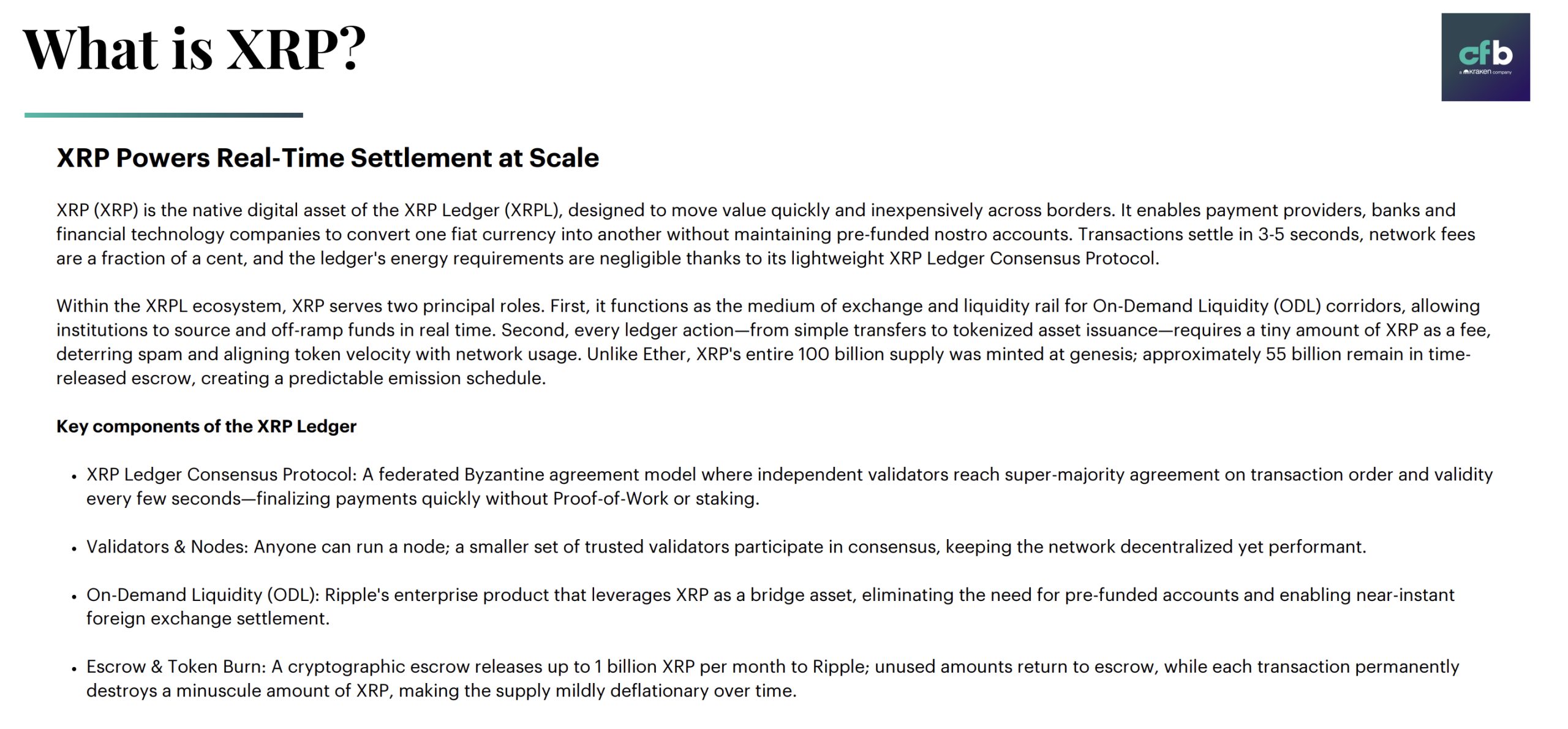
Jesse of Apex Crypto is in the news as he argues that XRP is being deliberately held down in price. His primary exhibit is a 2021 Citibank document that originally used the phrase “Regulated Internet of Value” before the terminology was quietly shifted to “Regulated Liability Network.” According to him, this change was made because the original wording made the connection to Ripple too obvious.
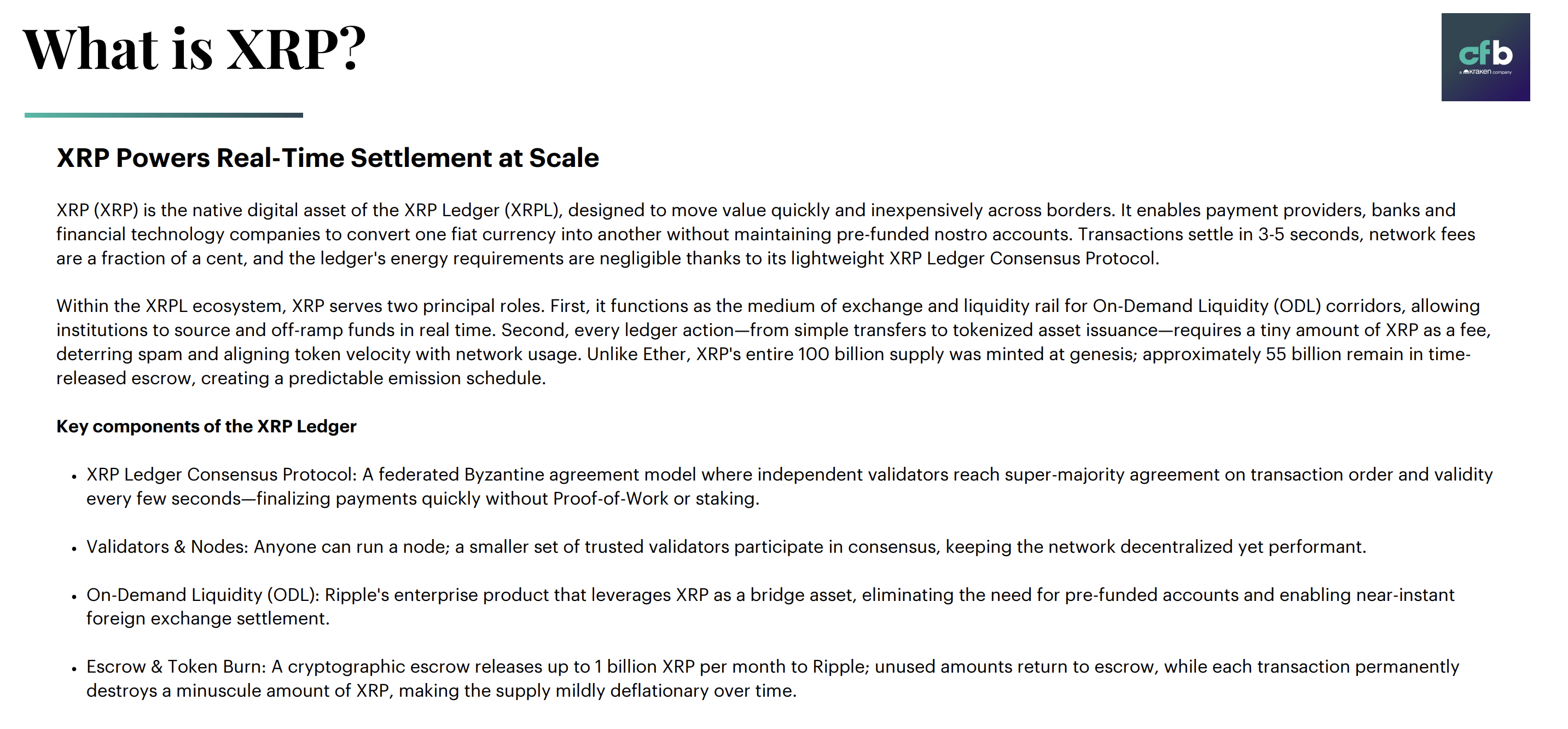
XRP’s price history gives the argument its surface credibility. The token reached $3.84 during the 2018 bull run and touched $3.60 earlier in the current cycle. Between those two peaks, it spent the better part of a decade moving sideways while Bitcoin compounded far higher.

For a token with Ripple’s institutional reach and the Interledger Protocol’s design ambitions, this flat trajectory is, at minimum, a question worth asking. The Regulated Liability Network, as described by Citibank’s Tony McLaughlin, is a shared ledger framework for tokenized bank deposits. It’s a concept that sits structurally close to what Ripple has been building toward since the company’s founding.
Discover: The Best Crypto to Diversify Your Portfolio
Beyond XRP News: The Citibank Document and the Institutional Incentive Logic
Jesse’s argument runs as a causal chain: Citibank published a 2021 document using the “Regulated Internet of Value” phrase that maps directly onto Ripple’s own Internet of Value thesis and the Interledger Protocol. Later, Citi reissued the concept under the name “Regulated Liability Network,” stripping the Ripple association in the process.
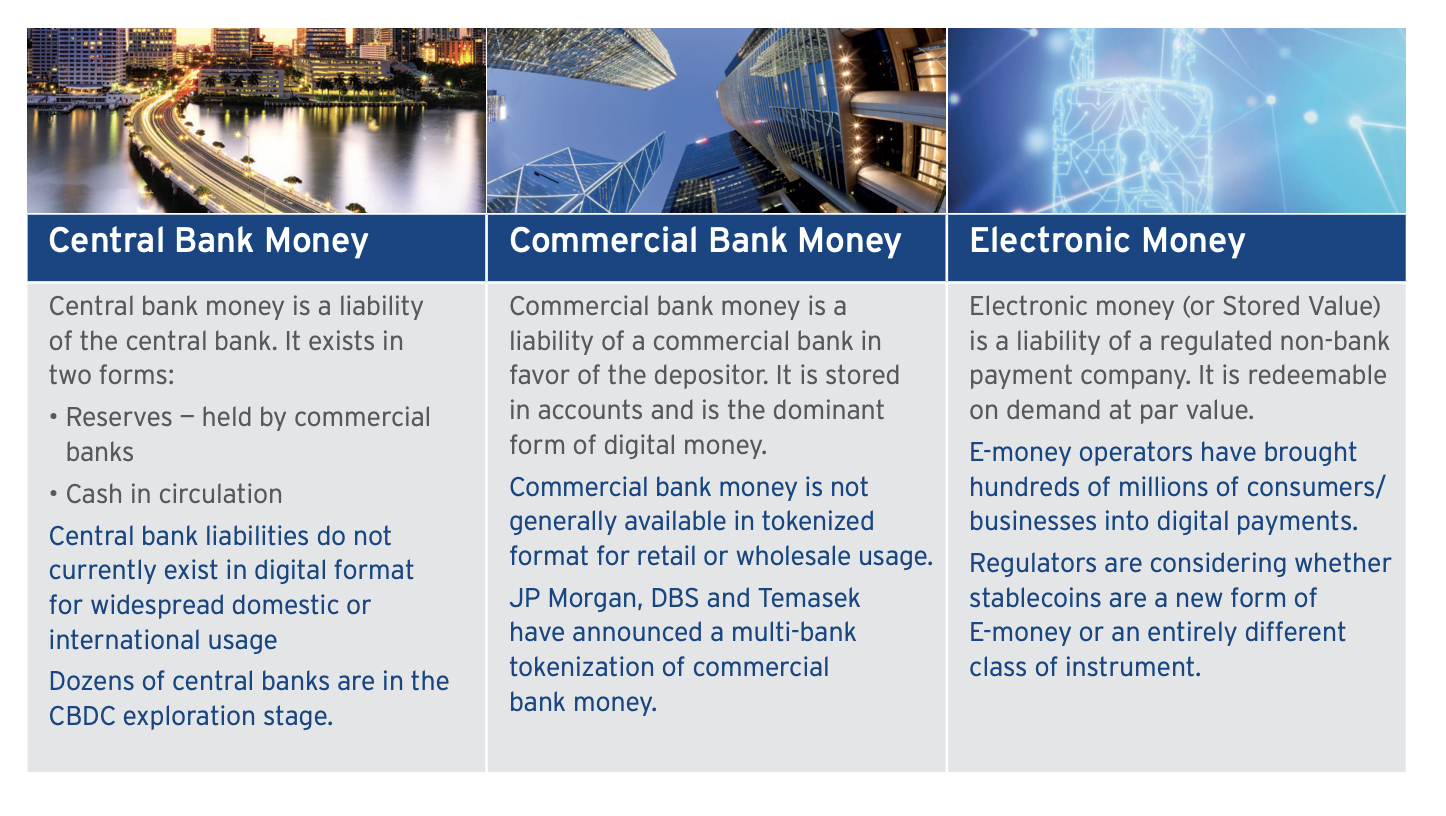
The chain extends further. McLaughlin has publicly described the Regulated Liability Network and the shared ledger concept as the same idea. The Bank for International Settlements has separately discussed a unified ledger architecture that could replace correspondent banking infrastructure and eventually displace SWIFT as the backbone of cross-border settlement.
Jesse’s logic: if XRP or a derivative of Ripple’s protocol sits underneath that infrastructure, the last thing institutional architects want is a wildly volatile asset.
Ripple CEO Brad Garlinghouse has publicly stated in the news that XRP multi-billion-dollar daily volume makes it too liquid for any single entity to control, and Ripple CTO David Schwartz has pointed out that XRP’s performance tracks other large-cap altcoins.
— STEPH IS CRYPTO (@Steph_iscrypto) December 20, 2025
 BREAKING:
RIPPLE CEO BRAD GARLINGHOUSE: “NOBODY IS IN A POSITION TO MANIPULATE $XRP PRICES.” pic.twitter.com/p511UTtR3S
Crucially, the SEC’s roughly 18-month investigation before its 2020 enforcement action produced no findings of price manipulation by Ripple. Jesse does not present hard evidence of coordinated suppression; his case rests on document interpretation and circumstantial institutional linkages, not disclosed trading records or regulatory filings.
The question, as Jesse himself frames it, remains unresolved. But the crypto research community has taken note: pattern-matching between institutional settlement infrastructure and XRP’s decade of flat performance is no longer a fringe exercise.
Discover: The Best Token Presales
The post XRP News: Price Being Suppressed? Researcher Reveals Why Ripple Token Isn’t Soaring appeared first on Cryptonews.

TLDR:
- Senate negotiators failed to resolve a major ethics dispute tied to the Clarity Act this week.
- White House officials met law enforcement groups over concerns about blockchain crime enforcement.
- Democratic support hinges on stronger ethics provisions linked to Trump’s crypto ventures.
- House lawmakers reviewed crypto tax reforms as Congress races against a tight calendar.
The Senate’s push to advance the Clarity Act encountered fresh resistance this week as lawmakers failed to resolve a key ethics dispute tied to the legislation. Negotiators left a closed-door meeting without an agreement, raising new questions about the bill’s path to a floor vote.
At the same time, the White House stepped up efforts to address concerns from law enforcement organizations. The developments arrive as Congress faces a shrinking legislative window before the August recess.
Clarity Act Ethics Debate Delays Senate Progress
A bipartisan group of senators met Tuesday alongside White House Crypto Council Executive Director Patrick Witt to revisit an ethics agreement discussed before the Senate Banking Committee markup in May.
The talks included Senators Kirsten Gillibrand, Ruben Gallego, Bernie Moreno, and Cynthia Lummis. However, participants failed to reach a new consensus.
According to reporting cited by Eleanor Terrett and Crypto In America, Republicans and White House officials withdrew support for parts of a tentative agreement discussed earlier.
One disputed provision would have allowed state attorneys general to challenge the Department of Justice over failures to enforce ethics rules involving President Donald Trump.
Republican negotiators raised concerns that the mechanism could create broader legal risks for members of Congress. Legal questions also emerged regarding whether state officials could compel federal enforcement actions.
Democratic lawmakers viewed the revisions as a departure from previous discussions. As a result, negotiations ended without a breakthrough, and participants reportedly described the process as difficult.
The negotiating group plans to meet again Thursday. Ethics provisions remain a central issue for Democrats seeking stronger safeguards related to Trump’s crypto business interests.
Clarity Act Law Enforcement and Crypto Tax Issues Gain Focus
Beyond ethics concerns, lawmakers continue to debate how the Clarity Act could affect criminal investigations involving blockchain technology.
The White House Crypto Council scheduled a meeting with representatives from the National Sheriffs’ Association, Fraternal Order of Police, National District Attorneys’ Association, and federal agencies.
Discussions will focus on Section 604, also known as the Blockchain Regulatory Certainty Act. The provision seeks to clarify that non-custodial software developers are not responsible for third-party misuse of their code unless they intentionally support illegal activity.
Some law enforcement groups fear the language could complicate efforts to pursue criminals operating through blockchain networks. Administration officials plan to argue that existing enforcement tools would remain intact.
Support from law enforcement remains critical. Senators Mark Warner and Catherine Cortez Masto have indicated that unresolved enforcement concerns could affect support for the legislation.
Meanwhile, the House Ways and Means Committee turned its attention to crypto taxes. During a hearing Tuesday, lawmakers reviewed six Republican-backed bills and a discussion draft covering digital asset taxation.
The proposals address mining rewards, staking income, reporting requirements, crypto donations, tax treatment parity, and disclosure programs. Industry participants welcomed several measures but noted the absence of a de minimis exemption for small Bitcoin transactions.
With only 31 Senate session days remaining before the August recess, lawmakers face increasing pressure to resolve both regulatory and tax issues tied to the broader crypto framework.



The Federal Reserve, the Office of the Comptroller of the Currency and the Federal Deposit Insurance Corporation on Tuesday jointly reissued 15 interagency supervisory documents with every reference to "reputation risk" stripped out — the latest piece of a methodical Trump-era dismantling of the… Read the full story at The Defiant


Crypto caught a modest bid on Thursday after Wednesday’s inflation report showed underlying price pressures staying contained. Bitcoin rose about 1.9% over 24 hours to roughly $62,600, leading the majors, per CoinDesk data.
Headline inflation rose 0.5% on the month and 4.2% over the year, the fastest annual pace since April 2023, but energy did most of the work, climbing 3.9% on the month and accounting for more than 60% of the increase as oil rose on the Iran conflict.
Core inflation, which strips out food and energy and is the gauge the Federal Reserve leans on, rose just 0.2% on the month, below the 0.3% forecast, and 2.9% over the year.
The bounce is shallow and concentrated in bitcoin. BTC is down less than 1% over the past seven days, holding its 200-week average, while the rest of the top tokens remain deep in the red on the week. Ether is off about 6.5% at roughly $1,651, XRP down 7.5% near $1.12, Solana down 7.4% around $65, and dogecoin off 7%. BNB held up better at a 2.1% weekly loss.
Traders now await Fed’s June 17 meeting, where markets expect no change to rates. The hot headline gives hawks cover to stay restrictive, while the soft core gives doves room to argue the pressure is narrow and energy-driven.
Another widely-cited catalyst is the public offering of Elon Musk-owned satellite, rockets and AI company SpaceX, which prices later Thursday and is expected to start trading on Friday at a $1.8 trillion valuation.
Shares for the company are already four times oversubscribed, with some singular entities bidding as much as $10 billion for the stock, per Bloomberg.
TLDR
- Anchorage submitted a public comment letter supporting Treasury’s GENIUS AML proposal.
- The firm backed classifying stablecoin issuers as financial institutions under the Bank Secrecy Act.
- Anchorage urged clarity on secondary-market sanctions liability tied to smart contract transactions.
- It argued issuers should not face strict liability for unknown sanctioned users on open networks.
- The proposal was issued jointly by FinCEN and the Office of Foreign Assets Control.
Anchorage Digital has backed the US Treasury’s proposed GENIUS AML framework while urging targeted clarifications. The federally chartered crypto bank submitted a public comment letter supporting core compliance provisions. However, it asked regulators to refine secondary-market sanctions exposure and enterprise-wide AML expectations.
Anchorage and GENIUS AML Framework Alignment
Anchorage stated that Treasury’s proposal places AML duties on regulated stablecoin issuers in a workable manner. The firm said the structure balances compliance standards with operational certainty for issuers. It added that clear rules will support payment innovation while maintaining oversight under existing law.
The letter responded to rules issued in April by the Treasury and the Financial Crimes Enforcement Network. The proposal would classify payment stablecoin issuers as financial institutions under the Bank Secrecy Act. As a result, issuers would face AML, customer due diligence, and suspicious activity reporting obligations.
Treasury’s Office of Foreign Assets Control joined FinCEN in issuing the proposed rule. The framework would align stablecoin issuers with US sanctions compliance standards. It would also impose enhanced monitoring and recordkeeping duties across issuer operations.
Anchorage wrote that “a final rule that is clear and workable gives regulated institutions the certainty they need to build.”
The firm said such clarity strengthens US leadership in payments and settlement infrastructure. It therefore endorsed the proposal’s general direction while requesting precise adjustments.
Secondary-Market Sanctions and Compliance Scope
Anchorage urged Treasury to clarify liability tied to secondary-market transactions on public blockchains. It argued that issuers should not bear strict liability for unknown sanctioned users. The firm said smart contract interactions may occur without issuer knowledge or direct customer relationships.
Anchorage stated that issuers cannot independently identify all sanctioned actors transacting through open networks. It therefore asked regulators to define limits around secondary-market sanctions exposure. The letter also sought guidance on enterprise-wide AML programs and correspondent account requirements.
The firm requested clarity on how AML obligations apply across affiliated entities. It asked Treasury to outline expectations for correspondent relationships under the proposed framework. According to the letter, defined boundaries would reduce uncertainty for regulated institutions.
Support for the GENIUS AML proposal has varied across the crypto industry. Hyperliquid and Paradigm also submitted a joint comment letter addressing similar concerns. However, they expressed a more critical view of the sanctions perimeter.
The groups argued that OFAC’s draft language extends issuer liability beyond practical visibility. They said the framework treats smart contract use as an ongoing service provision.
“OFAC sweeps secondary market activity into the issuer’s compliance perimeter,” the letter stated.
They added that the draft could impose sanctions duties without direct user relationships. The comment letter said issuers may lack visibility into parties transacting on secondary markets. Treasury has not yet issued a final rule following the April proposal.
Crypto has moved deeper into the 2026 election debate after a new DCG-Harris Poll showed rising voter interest in digital asset policy.
Summary
- DCG says 40% of voters now view crypto as a major issue in 2026 midterms.
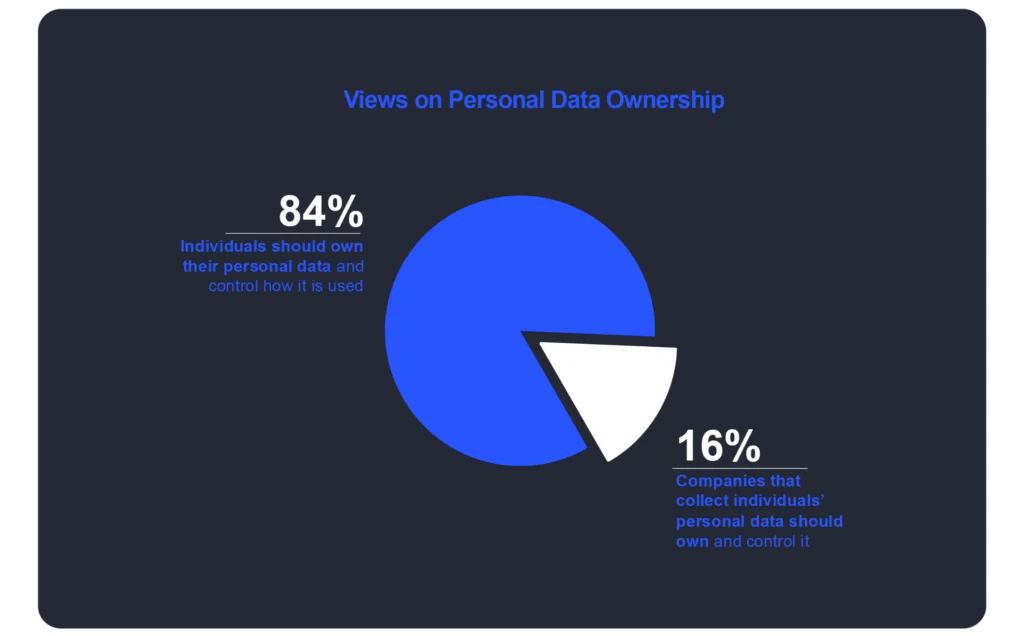
- Privacy stands central, with 84% saying individuals should own their personal data, not companies.
- Congressional debates and rising crypto PAC activity continue influencing the broader 2026 election landscape.
The survey found that 40% of voters now view crypto as a major election issue, up from 20% in 2024.
The poll surveyed 1,874 registered voters from May 8 to May 18. It also included oversamples in Arizona, Georgia, Michigan, Nevada, North Carolina, Ohio, Pennsylvania and Texas.
Crypto support doubles ahead of midterms
DCG said the results show a larger voter bloc watching how candidates discuss digital assets. The company released the findings as Congress debates major crypto rules, including the CLARITY Act.
Julie Stitzel, DCG’s chief policy officer, said voter interest already exists across key races. “Candidates who champion digital asset policy and financial privacy don’t have to look far for voter support. It’s already there,” she said.
Privacy becomes a central voter issue
The survey found that 84% of Americans believe individuals, not companies, should own their personal data. DCG said the result links digital asset policy with wider concerns about financial privacy and data control.
The poll also found that 55% of registered voters are more likely to use a service that does not use their personal data. That finding places privacy near the center of the crypto policy debate, especially as AI and digital finance expand.
Congress faces pressure over crypto rules
The timing matters because lawmakers are still debating how to regulate digital assets. The CLARITY Act has become one of the main bills under review, with supporters saying it would define oversight roles for crypto markets.
As previously reported by crypto.news, Coinbase, Ripple and more than 200 crypto groups urged Senate leaders to schedule a vote on the bill. Other reports said Galaxy Digital lowered its 2026 approval odds to 60% as the Senate calendar tightens before the August recess.
Polling shows mixed voter signals
The DCG poll points to stronger crypto interest, but other surveys show the issue still competes with broader economic concerns. A previous crypto.news report cited a Politico and Public First survey that found only 4% of Americans said a candidate’s crypto stance would shape their vote.
Pew Research Center data also showed that 19% of U.S. adults have used or invested in cryptocurrency. Republican usage rose from 16% in 2021 to 22% in 2026, while overall adoption stayed close to earlier levels.
Crypto-backed political spending adds another layer to the election debate. As crypto.news reported, Fairshake-linked groups have already spent millions in primaries as digital asset policy becomes a sharper dividing line in Congress.


Amazon has expanded its trucking service to businesses beyond its own logistics network.
Summary
- Amazon expanded its less-than-truckload shipping service to businesses beyond its own logistics network.
- Freight carrier stocks fell after the announcement, including Old Dominion, ArcBest, Saia, XPO and FedEx Freight.
- Amazon is turning more of its logistics network into outside services through Amazon Supply Chain Services.
The move sent shares of several major freight carriers lower on Wednesday. The company will now offer less-than-truckload shipping to businesses across the United States.
Amazon opens LTL service to more businesses
Amazon said it will offer less-than-truckload shipping to all businesses through Amazon Supply Chain Services. The service previously supported companies shipping goods into Amazon warehouses and fulfillment centers.
Less-than-truckload shipping lets carriers move freight from several customers on one trailer. The model differs from full truckload shipping, where one customer fills the trailer. Amazon said the service can deliver freight to any destination in the United States. The company is using its logistics network to reach more business customers.
Jim Ruiz, director of Amazon Freight, said sellers wanted wider access to the service. “The feedback from Amazon selling partners using our LTL service was clear,” Ruiz said. He said customers valued the service’s technology, visibility, and reliability. “Now Amazon LTL can move your freight wherever it needs to go,” Ruiz added.
Freight carrier shares fall after announcement
Freight stocks declined after Amazon announced the expanded trucking service. Old Dominion Freight Line fell 5% after the news. ArcBest shares dropped 4%, while Saia slid 3%. XPO Logistics also fell 5% during the market reaction.
FedEx Freight shares fell about 7% on Wednesday. The company started trading earlier this month after its spinout from FedEx. The share declines came as Amazon moved deeper into a market served by long-standing carriers. The company’s freight offer now targets businesses of different sizes.
Amazon has spent years building a large logistics network for its own retail operations. It now uses more of that network to serve outside companies. The company reduced its reliance on external carriers as it pushed faster delivery speeds. That strategy gave Amazon more control over shipping times and costs.
The logistics network becomes an outside service
Amazon’s logistics system now includes cargo planes, delivery vans, trailers, and containers. The company has 80,000 trailers and 24,000 containers in its freight operation. Its network also includes tens of thousands of delivery vans. Amazon-branded cargo planes support longer-distance movement across its supply chain.
The company has started opening more in-house logistics tools to outside businesses. That approach adds competition for carriers that already serve business shippers. Last month, Amazon introduced an end-to-end supply chain service. The package combines several of its freight and logistics services into one offering.
That announcement pushed shares of UPS and FedEx lower at the time. Wednesday’s LTL expansion added another freight service to Amazon’s outside-business program. Amazon said the LTL service will support destinations nationwide. The company’s latest move extends Amazon Supply Chain Services beyond warehouse-bound shipments.
Football, Crypto and $5 Million of Rewards in 1win’s World Cup Mega Tournament

Bonus bonanza! Last date to buy City Union Bank shares for 1:3 reward

World Cup 2026 live: Mexico set to kick off tournament after Gianni Infantino’s shambolic press conference

HarrisX Poll Found 52% of Registered Voters Support the CLARITY Act

BloFin War of Whales 2026 Grand Prix opens registration for $5M trading championship

Blockchain.com files with SEC for U.S. IPO

Financial and Investment Tips #financialplanning #investmenttips #investmentstrategy #investmentstra

The Reality of Crypto ‘Wrench Attacks’ & Kidnapping @TheWeeklyByBitcoincom #gaming #cryptocurrency

Escape Debt My Journey to Financial Freedom#shorts
-

 Fashion6 days ago
Weekend Open Thread: Evereve – Corporette.com
-
 Crypto World6 days ago
Jensen Huang Approves Samsung, SK Hynix, and Micron for NVIDIA (NVDA) HBM4 Memory Supply
-

 Crypto World3 days ago
Anatomy of the June crypto crash: Fed, Iran, Saylor
-
 Entertainment4 days ago
The Best Mystery Series of All Time Is Surging on Streaming 30 Years After It Ended
-

 NewsBeat3 days ago
Alexander Zverev wins the French Open to finally earn a 1st Grand Slam title
-

 Tech5 days ago
Suspicious Polyfill login prompts pop up on Toshiba, Muji websites
-
Crypto World4 days ago
Senator Cynthia Lummis Calls CLARITY Act the Most Consequential Financial Legislation of This Generation
-

 Tech6 days ago
Microsoft launches MXC, an OS-level sandbox for AI agents, with OpenAI and Nvidia already on board
-

 Tech4 days ago
Microsoft unveils seven homegrown AI models in new bid for ‘long term self-sufficiency’
-

 Business6 days ago
(VIDEO) Justin Bieber Delivers Surprise Happy Birthday Serenade to Diners at Los Angeles Mexican Restaurant
-
 Business4 days ago
The Pain Points Taking a Fragile Tech Rally Down a Notch
-
 Crypto World3 days ago
Eli Lilly (LLY) Stock Surges 4% Following Breakthrough Sleep Apnea Trial Results
-
Crypto World6 days ago
LBank Surpasses 25 Million Users Worldwide as AFA Partnership Continues to Drive Global Growth
-

 Tech5 days ago
Von der Leyen’s AI envoy pick draws conflict-of-interest fire
-

 Business3 days ago
High Stakes for Wembanyama as New York Pushes for 3-0 Lead
-

 Tech6 days ago
Meta steals a tactic from Tesla and builds data centers in tents
-

 Crypto World4 days ago
Trump’s AI Ownership Plan Could Benefit Anthropic at OpenAI’s Expense
-

 Tech5 days ago
Hackers now exploit SolarWinds Serv-U flaw to crash servers
-
 Sports2 days ago
Bangladesh beat Australia after 20 years in ODIs, register only their second win over six-time world champions | Cricket News
-

 Tech3 days ago
Notion restores access to Anthropic after service disruption
You must be logged in to post a comment Login