
Crypto World
Bitcoin Targets New August Lows as Binance Longs Get Liquidated


Bitcoin traders are entering a tense stretch as leveraged long positions come under pressure, with onchain analytics suggesting that a broader liquidation “cleanout” may be starting. According to CryptoQuant analysis published Thursday, the interaction between Binance futures open interest and BTC/USD price has shifted in a way that often accompanies long positions being stopped out or liquidated.
At the same time, CryptoQuant CEO Ki Young Ju warned that the conditions typically associated with a renewed Bitcoin bull market have not yet fallen into place—an important reminder for investors who may be betting on a quick rebound after consolidation.
Key takeaways
- CryptoQuant analysis links the latest BTC downside move with signs of leveraged long positions being flushed out via Binance open interest dynamics.
- The price-to-open-interest correlation reportedly fell to 0.25 after both price and open interest declined, consistent with weakening longs.
- CryptoQuant data previously showed Binance open interest rising while BTC traded in a narrow range, pointing to leverage building during consolidation.
- CoinGlass data showed $236 million in total cross-crypto liquidations over the prior 24 hours at the time of writing.
- Ki Young Ju says a sustained bull-market setup has not materialized yet, with key onchain indicators still in “bear” territory.
Binance open interest signals a leveraged long squeeze
CryptoQuant’s Thursday analysis, authored by community analyst “BorisD,” focuses on Binance open interest (OI) and its relationship with BTC price action. Open interest reflects total active derivative positions—longs and shorts combined—and is often used as a proxy for how much capital is committed to leveraged trading.
While BTC traded in a relatively tight range after June, CryptoQuant data showed Binance open interest climbing gradually, reaching $8.15 billion on Wednesday. In the analyst’s framing, this rise suggested futures activity was increasingly dominating while spot participation lagged, creating conditions where leveraged positioning could become vulnerable if price broke down.
As lower time frames started showing downside volatility, CryptoQuant said the price-to-OI relationship shifted into a “flux” state. The key idea: when price falls while open interest stays elevated or rises, it can indicate that traders are doubling down on exposure—sometimes turning into a rapid liquidation cascade if the move accelerates.
“Initially, as the price fell, the correlation shifted to the negative side, indicating that OI was rising despite declining prices,” the analyst wrote. “This showed a double-sided squeeze and [an] increasingly complex liquidity structure — driven by long positions trying to buy the dip on one end, and additional short positions entering the market on the other.”
CryptoQuant’s latest correlation reading reportedly came in at 0.25. In the analysis, that number is presented as evidence of declining long positions as BTC continues to move lower—supporting the view that the market is moving toward the “anticipated cleanout” phase.
From correlation shift to liquidation risk
CryptoQuant’s interpretation ties the recent correlation behavior to the fate of leveraged longs. The analyst said the “simultaneous drop in both price and OI” typically points to longs “giving up,” being stopped out, or getting liquidated—especially when downside volatility increases.
While open interest alone does not specify whether liquidations are primarily long- or short-driven, combining it with price direction can help traders anticipate where forced exits may concentrate. In this case, the analysis emphasizes long exposure vulnerability as BTC approaches lower levels seen earlier in August.
Market-wide liquidation pressure also appeared to be present. According to CoinGlass liquidation data (reported via a screenshot in the original analysis), total cross-crypto liquidations were $236 million over the prior 24 hours at the time of writing, underscoring that the broader ecosystem was not immune to leverage unwinds.
Why this matters after range trading
One reason the Binance OI story is taking center stage is that it follows a period of relatively tight trading. When price compresses, leverage can build quietly—especially if futures markets attract more participation than spot. CryptoQuant’s earlier observation that Binance OI increased while BTC stayed within a narrow range aligns with that pattern.
For investors and traders, the practical implication is that a breakout does not always arrive in a smooth, orderly way. When range-bound conditions end—particularly after rising open interest—liquidations can amplify the direction of the move as positions fail and traders scramble to reduce risk. CryptoQuant’s commentary suggests that this kind of acceleration may be underway as BTC/USD heads toward fresh month-to-date lows.
However, the analysis also implies uncertainty about timing and magnitude. The correlation metric provides a signal about what is likely happening in positioning, but it does not guarantee whether the market will continue sliding immediately, rebound quickly, or enter another brief consolidation before the next leg.
CryptoQuant CEO: bull-market conditions still not in place
Even if liquidation-driven volatility creates opportunities for tactical entries, sentiment cues from onchain leaders remain cautious. In his latest market commentary, CryptoQuant CEO Ki Young Ju said that the “stars haven’t aligned” for a Bitcoin bull run yet.
Ju framed his view using a “basket of onchain indicators,” which he described as still residing in “bear” territory. Earlier coverage from Cointelegraph had similarly cited composite onchain metrics reaching prolonged “capitulation” conditions; one example referenced at the time was Glassnode’s view that Bitcoin is in its longest “capitulation” phase since the end of the last bear market in 2022.
Taken together, the message is two-sided: liquidation dynamics can force near-term downside and create mechanical market pressure, while the bigger question—whether investor behavior and onchain signals have shifted into a durable accumulation phase—remains unresolved.
Traders should watch whether Binance open interest continues to contract alongside price (which would be consistent with longs being removed) or whether OI stabilizes even as price tries to recover. At the same time, investors looking for a bull-market shift should monitor whether the onchain indicator “bear” conditions that Ki Young Ju referenced begin to improve, rather than relying solely on short-term volatility swings.

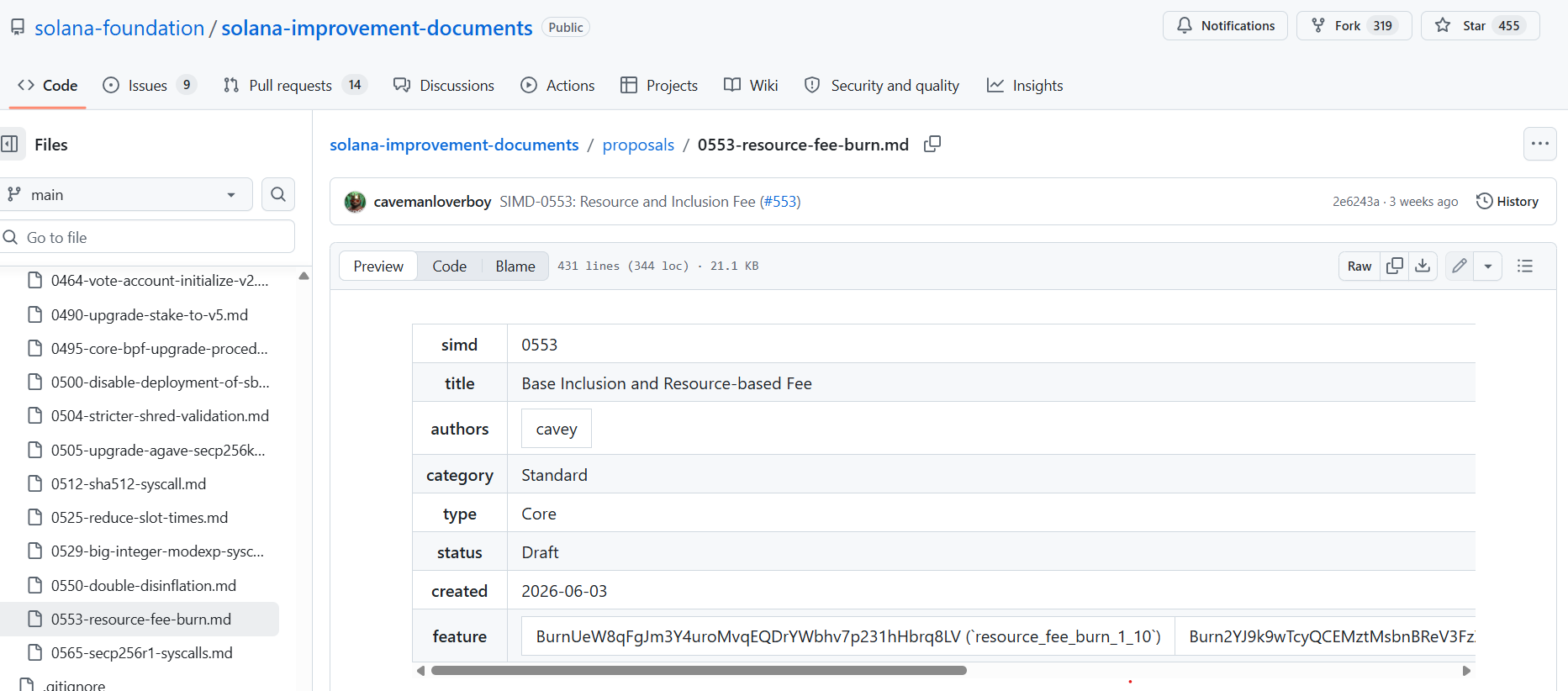
Solana is preparing to change how it charges for computing resources on the network.
Solana Improvement Document (SIMD-0553) would make its most resource-intensive users pay more while cutting the costs for simpler transactions. As a bonus, it would increase SOL’s burn rate in stages — and one day could even help make it deflationary.
Cavey, a researcher at Solana infrastructure firm Temporal and author of the proposal, tells Magazine that fees currently don’t reflect the real costs:
“If I submit a transaction that does nothing versus a transaction that burns 200 million CPU cycles, I’m charged the same amount.”
This proposal would change that by tying fees more closely to the resources each transaction requests. Rather than going to validators, the resource fee would be burned, removing SOL from circulation.
Of course, reducing validator income has not been welcomed by all. Contributor bji argues on github:
“I like the aspect of this proposal that gives tx submitters extra incentive to be accurate with CU limits. Everything else I’m meh to negative on. ‘More burn’ should not be a goal. Validator incomes should not be arbitrarily reduced.”
SIMD-0553 entered Solana’s new onchain governance process in early August and cleared its initial support phase on August 4.
It is currently in the support and discussion phase, which typically lasts seven epochs, or roughly two weeks. If it’s approved, it would change the incentives around Solana’s cheap blockspace.
So what’s the catch?
Wasting resources becomes expensive
Cavey says that Solana’s current fee structure creates a problem for developers.
Core Solana devs have spent years making the network faster, but applications have almost no financial incentive to stop wasting resources — an inefficient transaction costs the same as an efficient one.
Related: Ethereum, Solana led crypto hack losses in H1 2026: Blockaid
“By installing this resource pricing right now, suddenly app developers have to optimize,” Cavey says.
If the proposal is adopted, developers who reduce resource use could lower costs for end users and make their apps more attractive. Developers who consume more of Solana’s computing capacity would have to pay their fair share.
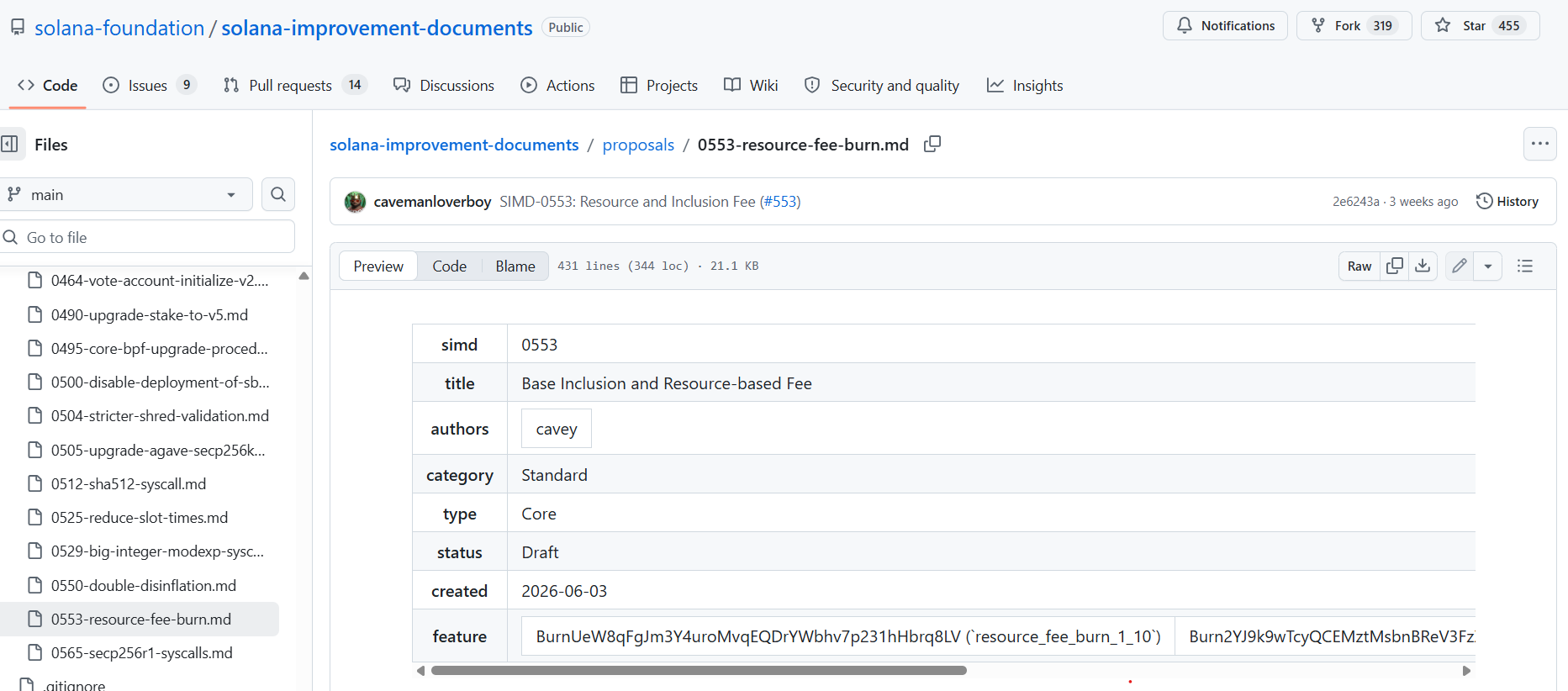
Solana Improvement Document (SIMD-0553). Source: Solana Foundation GitHub
Cavey says the proposal is particularly aimed at computationally wasteful arbitrage, where searchers can submit huge numbers of transactions that mostly fail, while paying very little.
In the past 30 days, he says, five of the traders with the highest failure rates submitted 11.5 million transactions, consuming 929 million compute units across 2,477 trades that generated $16,091 in profit, while paying just 78 SOL in fees.
A resource fee would push arbitrage searchers toward more informed and reactive strategies.
Stablecoin and token transfers could become roughly 20% cheaper, Cavey says. Temporal’s modeling also finds that vote transactions would cost around 12.3% less and oracle updates 16.9% less under the proposed model.
The trade-off?
Some trading activity would become considerably more expensive.
Temporal estimates that a high-priority swap routed through DFlow would cost 9.72% more under the proposed terminal fee rate, while a mid-priority OKX swap would cost 301% more and a pump.fun swap with zero priority would cost 3150% more.
That means some of the network’s heaviest users could see their transaction costs balloon, particularly traders using bots that submit large numbers of transactions.
Don’t worry though, as the fee increase is off a low base. Cavey argues that even the most compute-intensive transactions would cost around $0.05 under the proposed model, compared with the $2 to $5 fees a user might pay to swap $100 on a centralized exchange.
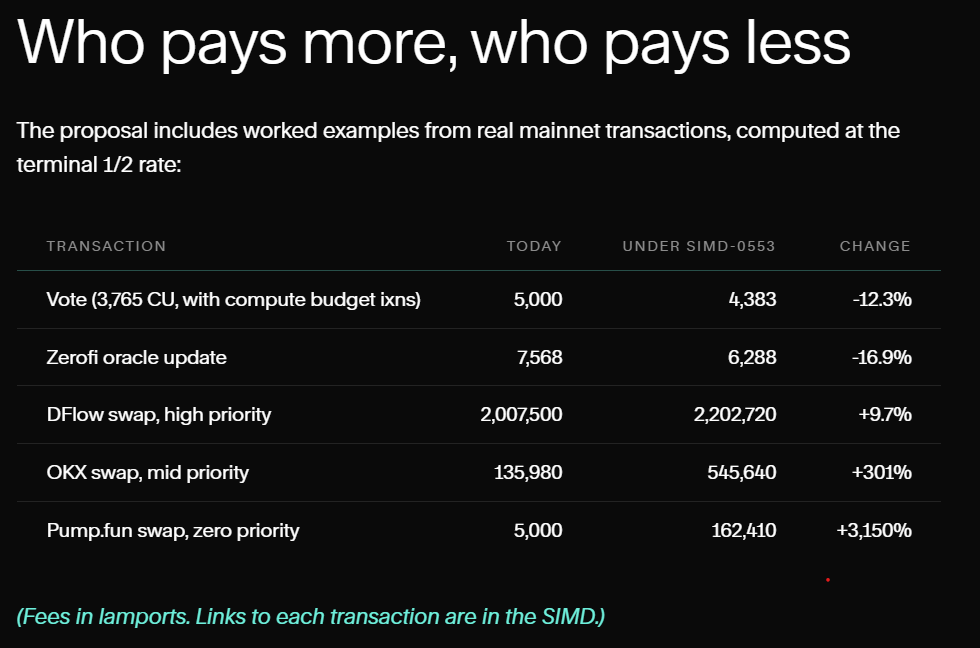
Who pays more, who pays less. Source: Temporal.xyz
The current proposal rejects a uniform increase to Solana’s existing 5,000-lamport fee, arguing that it would disproportionately hurt high-volume senders such as market makers while still failing to properly price resource usage.
Other costs to consider
“There have been a few people that have raised concerns about the parameters, but overall, everyone’s been very supportive,” Cavey says, citing validator income, higher costs for high-frequency users and increased complexity among the core issues.
One contributor, mschneider, asks why fees should be based on the resources a transaction requests rather than what it actually uses. “Units used seems more natural,” he says.
Cavey says there’s a reason the fee is based on the resources a transaction requests, rather than what it actually uses: it lets users know the cost upfront and allows validators to check they can afford it before processing the transaction. But it also means users can pay for resources they don’t end up using, giving developers an incentive to estimate their needs accurately.
Validators could initially see a small reduction in base-fee revenue by around 4%. While Cavey says the parameter can be adjusted to offset that impact if needed, some contributors like bji remain unconvinced and believe validator income should take precedence over the additional burn.
Related: MoneyGram expands crypto cash ramps to Solana
The proposal also raises questions about complexity, with some contributors questioning whether the new fee model could make Solana harder to use. Cavey rejects the concern, saying most users will not have to calculate fees themselves because applications and exchanges generally handle it. Automated traders are already “sophisticated” enough to adapt to changes in Solana’s fee structure, he says.
What about the SOL burn?
SIMD-0553 would increase the amount of SOL burned by transaction fees, reducing more of the token from circulation rather than paying it to validators.
According to the proposal, the current daily burn of around 648 SOL could rise to roughly 7,500 to 9,000 SOL at the proposed terminal fee rate, representing a roughly 12 to 14-fold increase if current resource demand remains unchanged.
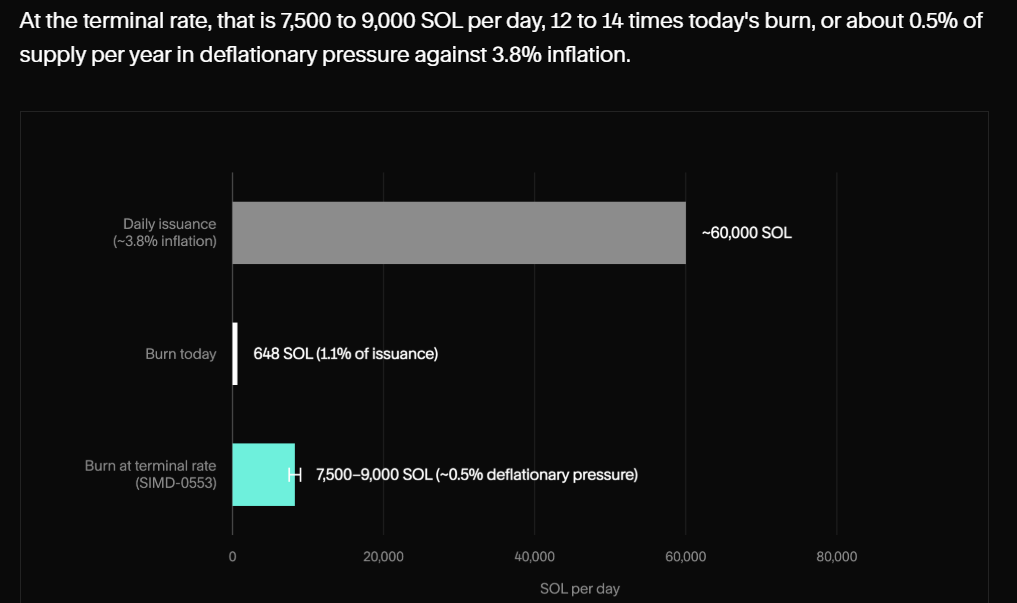
SIMD-0553 would increase the amount of SOL burned by transaction fees. Source: Temporal.xyz
Cavey says the higher burn could eventually push SOL into deflationary territory:
“If Solana wins, there’s a chance that Solana could actually become a deflationary currency.”
Burning the resource fee also reduces incentives for validators to include unnecessarily resource-intensive transactions.
Solana currently issues roughly 60,000 SOL a day, so even a 9,000-SOL daily burn would not by itself make the token deflationary (although a separate proposal called SIMD-0550 would curb inflation faster than currently scheduled). Network activity would need to grow substantially before the burn outweighed new issuance. Cavey says that would be “a nice secondary effect” rather than the main objective.
“The primary goal is to align core devs, developers, and app developers to make Solana faster. That is objective number one, and that is enough of a reason for this proposal, in my opinion.”
Magazine: El Salvador’s Bitcoin experiment turns 5: ‘It was for us, not them’
Cointelegraph publishes long-form journalism, analysis and narrative reporting produced by Cointelegraph’s in-house editorial team with subject-matter expertise. All articles are edited and reviewed by Cointelegraph editors in line with our editorial standards. Some articles contain affiliate links, from which Cointelegraph may earn a commission. These relationships do not influence which products we review or our editorial conclusions. Content published in here does not constitute financial, legal or investment advice. Readers should conduct their own research and consult qualified professionals where appropriate. Cointelegraph maintains full editorial independence.

Baltimore has taken legal action against prediction market operators Kalshi and Polymarket, accusing both companies of offering illegal sports betting in the city.
Mayor Brandon M. Scott and the Baltimore City Council filed separate lawsuits on August 13 in the Circuit Court. The cases allege violations of Baltimore’s Consumer Protection Ordinance and accuse the companies of misleading consumers about whether their products are legal and properly regulated.
Illegal Sports Betting
The complaints claimed that Kalshi and Polymarket allow Baltimore residents to bet on game winners, point spreads, point totals, player statistics, and other outcomes commonly offered by licensed sportsbooks. The companies describe these products as “event contracts” or prediction-market trades. According to the officials, the label does not change what the products are.
Neither platform, according to the lawsuits, has the licenses required to offer sports betting in Maryland. The city said that this lets them compete with regulated sportsbooks while avoiding the oversight, taxation, responsible-gambling requirements, and consumer protections imposed on licensed operators.
Questions have also been raised about how the companies promote their platforms. Baltimore alleged that Kalshi and Polymarket market their platforms in ways that can create a false or misleading impression that the offerings are legal and properly regulated. The city added that this can make gambling more accessible and expose vulnerable consumers, including young adults and people with gambling addictions, to financial harm.
Baltimore is seeking civil penalties, injunctive relief, restitution for affected consumers, disgorgement of alleged ill-gotten profits, and other relief allowed under law.
Legal Battles on Multiple Fronts
The two companies are already dealing with several other legal and regulatory disputes. For example, Kalshi recently faced a lawsuit from New York State Attorney General Letitia James seeking to shut down its operations in the state. The US Commodity Futures Trading Commission then used its emergency authority to require Kalshi to continue operating in New York after the company sought federal help. The agency said the order followed the platform’s request for assistance after the state lawsuit was filed at the end of July.
It also faced a lawsuit from flight-tracking company FlightAware over flight-related prediction markets. FlightAware accused Kalshi of using its data and name without permission to host markets on flight cancellations. But the case was withdrawn just a day later. Its lawyers said the lawsuit was voluntarily dismissed without prejudice against all defendants.
Polymarket has faced separate problems as well. JPMorgan Chase stopped providing banking services to it late last year. Polymarket has since moved to another lender, although its name has not been disclosed.
A separate consumer protection lawsuit has also been filed against it in Washington, D.C. The National Association of Consumer Advocates alleges that the company, CEO Shayne Coplan, and Chief Marketing Officer Matthew Modabber ran “flagrantly deceptive” social media advertising campaigns that promoted Polymarket to American consumers and encouraged betting on a platform that was not technically available in the US.
The complaint also refers to reports of political influencers praising Polymarket’s accuracy without disclosing paid deals. It cites a Wall Street Journal investigation that found viral videos using simulated versions of the platform to suggest creators had won bets.
The post It’s Not Just Baltimore: Kalshi and Polymarket Face More Legal Trouble appeared first on CryptoPotato.
Crypto World
What to Know About the Growing Concerns Over Conditions on the Long-Deployed USS Abraham Lincoln

In a letter to Hegseth and Cao, Sen. Richard Blumenthal of Connecticut, a member of the Senate Armed Services Committee, noted that the vessel’s crew members have not been to a port in a record-setting 200-plus days and demanded answers to a series of questions about the crew and the state of the ship.
“There have been widespread reports of shortages of basic supplies, water contamination, plumbing issues, deteriorating mental health, deck safety concerns, and disruptions in the mail system,” Blumenthal wrote. “These reports warrant immediate attention, but they also raise a broader question: whether the Navy can sustain the operational tempo now being demanded of its carrier force, particularly as this Administration repeatedly commits U.S. forces to conflicts of its own choosing and increasingly relies on aircraft carriers to sustain those operations.”
He also noted that the long deployment of the Lincoln is not an isolated incident, “suggesting that extended deployments may be becoming a feature rather than an exception of the Navy’s force-generation model.” The USS Gerald R. Ford, used for the U.S.’s military operation in Venezuela, spent 326 days at sea before its return in May, Blumenthal wrote, which he noted was “nearly twice the length of a traditional six-month carrier deployment and the longest modern U.S. carrier deployment since the Vietnam era.”


Cointelegraph is committed to providing independent, high-quality journalism across the crypto, blockchain, AI, and fintech industries.
All news, reviews, and analyses are produced with full journalistic independence and integrity. For more details on our standards and processes, please read our Editorial Policy.


JPMorgan’s reported position in BlackRock’s Bitcoin exchange-traded fund increased by about 25% in the second quarter, while its Ether ETF position more than quadrupled, according to its latest securities filing.
The Form 13F filing with the US Securities and Exchange Commission, submitted Wednesday, covers holdings as of June 30 and includes 17 other investment managers across JPMorgan.
That makes it difficult to determine whether individual positions reflect a directional market view, Jonatan Randin, senior market analyst at PrimeXBT, told Cointelegraph.
“It gives you some idea of what they are doing but not their opinion about the future direction of a specific market,” Randin said.
JPMorgan reports larger Bitcoin, Ether ETF positions
The filing showed about 10.4 million shares in BlackRock’s iShares Bitcoin Trust ETF (IBIT) in Q2, up from 8.3 million shares in Q1 with a reported value of roughly $356 million.
Its position in the iShares Ethereum Trust ETF (ETHA) rose more sharply, climbing more than fourfold to about 1.17 million shares from roughly 267,000.
Randin said a 13F can combine holdings from different parts of an institution, including positions related to client activity and inventory, making it difficult to determine the purpose behind individual holdings. Form 13F filings also exclude short positions, meaning JPMorgan’s reported long holdings do not show its net exposure.
XRP appears in JPMorgan’s holdings
Beyond Bitcoin and Ether, Randin pointed to small positions reported in XRP investment products.
JPMorgan reported 181 shares of Grayscale’s XRP product worth $3,763 and 113 shares of Bitwise’s XRP ETF worth $1,356 in Q2, after reporting no positions in either product in Q1.
Randin linked the timing to regulatory developments around XRP and the emergence of spot XRP investment products in the US.
“From my point of view this adds credibility to the regulatory improvements surrounding XRP,” he said.
Related: Crypto whales accumulate as bear market nears late stage: CryptoQuant
Additionally, JPMorgan cut positions in several Bitcoin miners, which Randin said have become less straightforward proxies for Bitcoin as some expand into artificial intelligence and high-performance computing.
“If that was the reason for holding them, trimming that part of the portfolio makes a lot of sense regardless of your view of the future direction of price,” he said.
Magazine: Sorry everyone, Bitcoin is headed down to $43,500: Michael Terpin


The Commodity Futures Trading Commission is conducting an internal review into “mention markets” on prediction platforms, people familiar with the situation told CNBC Friday.
Mention markets are made up of contracts where traders speculate on whether specific words will be used in a speech, a corporate earnings call with analysts and investors or a television broadcast.
One of the people familiar with the matter said the CFTC first alerted platform Kalshi of the review several weeks ago. The platform removed sports-related mention markets around the same time the CFTC — the federal regulator for prediction markets — alerted the company, the person said. NPR first reported an inquiry into mention markets late Thursday.
It’s unclear if the inquiry only applies to sports-related mention markets, or all of them regardless of topic.
Kalshi and the CFTC declined to comment.
Most scrutinized
Mention markets are some of prediction markets’ most scrutinized offerings. Critics view them as easily manipulable by one individual, and some platforms don’t offer them. Mention markets saw about $3.3 million in trading volume on Kalshi last month, according to Dune Analytics, far behind larger markets such as those devoted to cryptocurrencies.
In July, the CFTC said it was investigating a former teleprompter operator for President Donald Trump who allegedly made $90,000 in profits on Kalshi betting on the content of Trump’s speeches.
Coinbase CEO Brian Armstrong last December rattled off a series of random words at the end of an earnings call to demonstrate how easily prediction market wagers can be manipulated. “I just want to add here the words bitcoin, ethereum, blockchain, staking and Web3 to make sure we get those in before the end of the call,” he said.
Proponents of mention markets argue words by powerful individuals have the power to move billions of dollars of money across traditional markets, making it useful to have attach predictive power to them.
“The suggestion that Mentions Markets create ‘new’ manipulation incentives is, on close inspection, overstated,” Kalshi head of market operations Arjun Sawai wrote in a letter to the CFTC as part of a public comment period last month. “They merely add a marginal, regulated, transparent, position-limited, surveilled increment to a vastly larger existing incentive structure.”
Platform Polymarket does not have mention markets on its CFTC-regulated U.S. exchange, but offers them overseas.
Meeting next week
The probe into prediction market contracts comes ahead of a meeting of the CFTC’s Innovation Advisory Committee on Aug. 20. The committee will discuss prediction markets, as well as artificial intelligence and cryptocurrency, according to a public agenda.
The latest investigation also comes after the CFTC increased scrutiny of prediction market platforms in recent weeks, even as it supports the event contract exchanges in a battle with states over sports-related wagers and gambling. The commission has sued nine states to defend what it sees as its exclusive jurisdiction to regulate event contracts.
Last month, the CFTC invited public comments on vertical integration among regulated entities, warning platforms to avoid sending broadly-worded, self-certified event contracts. The agency also sent letters to the platforms last week, reminding them not to present their odds in a casino-style format.
A Washington state judge on Thursday issued an order blocking several of Kalshi’s markets from operating there, including mention markets, sports, elections and other high volume categories. Kalshi is likely violating state law by operating as an illegal gambling operation, according to the order.
Washington becomes the fourth state blocking Kalshi, joining Michigan, Nevada and Massachusetts. A federal judge in Minnesota last month overturned a potential statewide ban on prediction market platforms.
The Financial Times reported Friday that Polymarket was cut off from financial services by JPMorgan last October over concerns about government regulation. A Polymarket spokesperson told CNBC it’s still maintaining a relationship with the largest U.S. bank.
“We maintain a close, active relationship with JPMorgan across multiple entities, operational integrations, and material handling customer fund flows; the strength of our relationship is highlighted by our CEO speaking at three of their flagship events in the past year alone,” a Polymarket spokesperson said in a statement. “Any suggestion otherwise fundamentally mischaracterizes our relationship.”
Disclosure: CNBC and Kalshi have a commercial relationship that includes customer acquisition and a minority investment.
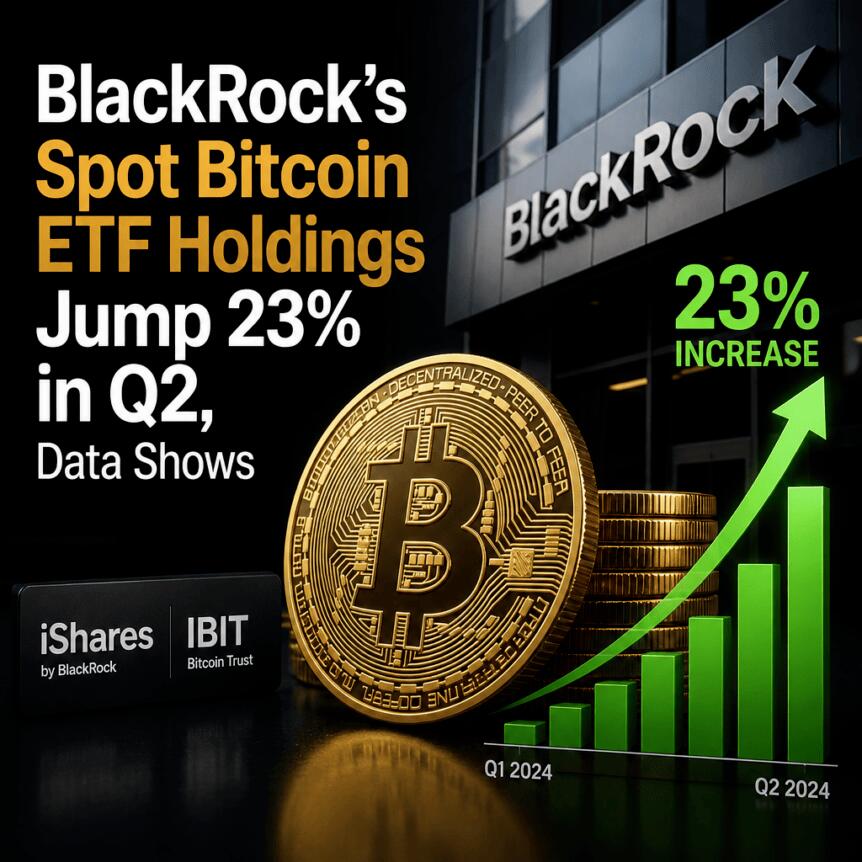
Morgan Stanley increased its reported cryptocurrency-related positions in the second quarter, according to its Q2 13F filing with the US Securities and Exchange Commission. The most notable change was a significant step-up in holdings of BlackRock’s Bitcoin ETF, alongside broader adjustments across other crypto-linked equities and exchange-traded funds.
Specifically, Morgan Stanley’s reported exposure to the iShares Bitcoin Trust ETF (IBIT) rose to roughly 16.5 million shares from 13.4 million, an increase of about 23%, as reflected in the SEC filing submitted on Thursday. The firm also reported 2.57 million shares of its own Morgan Stanley Bitcoin Trust (MSBT), which began trading in April.
Key takeaways
- Morgan Stanley boosted its IBIT share count by more than 3 million shares in Q2, even as the reported dollar value declined due to weaker Bitcoin prices during the quarter.
- Its MSBT position was initiated in the period, adding a new channel for the firm’s own spot Bitcoin product exposure.
- Ether exposure expanded as well, with major increases in iShares Ethereum Trust (ETHA) and Grayscale’s Ethereum staking-focused mini fund.
- The filing shows uneven positioning across the broader crypto equity complex, with gains in some miners and Circle (USDC issuer) contrasted by cuts in others.
- Morgan Stanley’s Circle (CRCL) holdings rose sharply, while reported holdings in Coinbase and some mining names declined.
IBIT adds volume, valuation drops with Bitcoin
While Morgan Stanley added approximately 3.04 million shares to its IBIT position, the value of that stake fell by about 18% to $549 million from $667 million. The filing’s figures reflect a common dynamic for large investors: even when share counts rise, reported portfolio value can still decline if the underlying asset—here, Bitcoin—trades lower over the reporting window.
The SEC filing indicates the increase in IBIT shares occurred alongside also adding to several other Bitcoin ETF exposures. Morgan Stanley reported higher allocations to products including Grayscale’s Bitcoin Mini Trust ETF and Bitwise’s Bitcoin ETF, while its Fidelity Wise Origin Bitcoin Fund (FBTC) position rose by nearly 38%.
Beyond the headline IBIT change, the broader pattern suggests Morgan Stanley was concentrating more into established spot Bitcoin vehicles rather than trimming exposure at the start of Q2. Investors often watch this kind of behavior for clues on whether institutional demand is strengthening at the ETF level, particularly when the share count rises faster than the reported valuation.
Ether positions expand across spot and staking-linked products
Morgan Stanley’s Q2 filing also showed substantial growth in reported Ether-related ETF holdings. Its iShares Ethereum Trust ETF (ETHA) position increased by about 202% to around 4.6 million shares. Morgan Stanley also raised its Grayscale Ethereum Staking Mini ETF (ETH) holding by approximately 26% to about 5.1 million shares.
These increases matter because they signal that Morgan Stanley’s crypto ETF footprint is not limited to Bitcoin. For market participants, large incremental allocations to Ether products can be interpreted as broader institutional participation—especially when the increases span both mainstream spot-style Ether exposure (ETHA) and products linked to staking (Grayscale’s staking-focused mini fund).
In addition, Morgan Stanley initiated new exposure to Solana-related funds. The filing showed additions to Grayscale Solana Staking ETF (GSOL) and Fidelity’s Solana fund (FSOL), with those positions reported at about $4.25 million and $2.26 million, respectively.
Circle and mining/infrastructure names show selective momentum
Beyond ETFs, Morgan Stanley also adjusted its holdings in crypto-adjacent public companies. The firm dramatically increased its reported stake in Circle Internet Group (CRCL), the company behind the USDC stablecoin. According to the Q2 filing, Circle shares rose from roughly 1.46 million to about 8.32 million.
On the mining and infrastructure side, the filing reflected additions to several names, including Cipher Digital (CIFR), Core Scientific (CORZ), Hut 8 (HUT), and Bitdeer Technologies (BTDR). For investors tracking institutional risk appetite, expanding positions across multiple miners and infrastructure providers can indicate confidence in the sector’s operational resilience—or at least a willingness to accumulate exposure while valuations and market conditions fluctuate.
However, the changes were not uniformly positive across every crypto-linked equity. Morgan Stanley reported about 550,000 fewer shares of Coinbase (COIN). It also cut its CleanSpark (CLSK) position by more than 3.1 million shares and fully exited a roughly 8 million-share holding in Bitfarms (BITF).
That mix—adding in some areas while trimming others—suggests a more selective approach rather than a broad increase across the entire crypto equity basket.
What to watch after Morgan Stanley’s Q2 adjustments
Going into the next reporting period, investors will likely focus on whether Morgan Stanley continues to build its ETF share counts—particularly in IBIT and ETHA—or whether the firm’s activity reverts toward valuation-driven changes as crypto prices move. The SEC 13F updates also remain a key way to observe institutional positioning shifts, even though they are inherently lagging compared with day-to-day market flows.
US investment banking giant Morgan Stanley reported larger crypto fund positions in the second quarter, led by an increase of more than 3 million shares in BlackRock’s Bitcoin exchange-traded fund (ETF).
Morgan Stanley’s reported holdings in BlackRock’s iShares Bitcoin Trust ETF (IBIT) increased by 23% to around 16.5 million shares from 13.4 million, according to its Q2 13F filing with the US Securities and Exchange Commission on Thursday.
Morgan Stanley also reported 2.57 million shares of its own Morgan Stanley Bitcoin Trust (MSBT), worth about $43.3 million. The product began trading in April.
The filing showed increases across several direct crypto fund positions in Q2, even as reported holdings declined in Coinbase and some other crypto-linked companies.
Morgan Stanley grows Bitcoin and Ether ETF exposure
Despite adding about 3.04 million IBIT shares, the position’s value fell about 18% to $549 million from $667 million as Bitcoin fell during the quarter.
Morgan Stanley also sharply increased several smaller Bitcoin ETF positions, including the Grayscale Bitcoin Mini Trust ETF (BTC) and Bitwise Bitcoin ETF (BITB), while its Fidelity Wise Origin Bitcoin Fund (FBTC) holding rose nearly 38%.
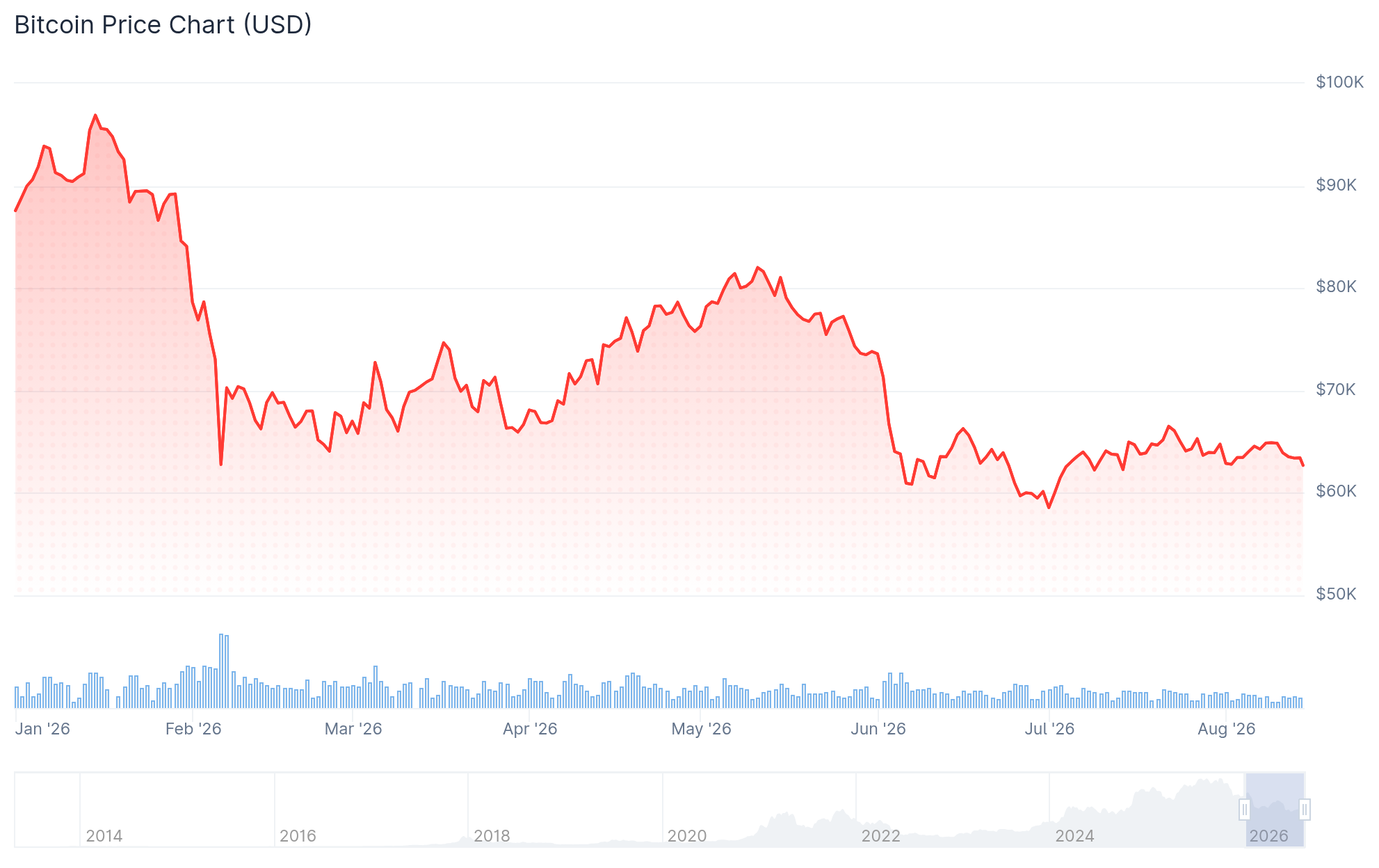
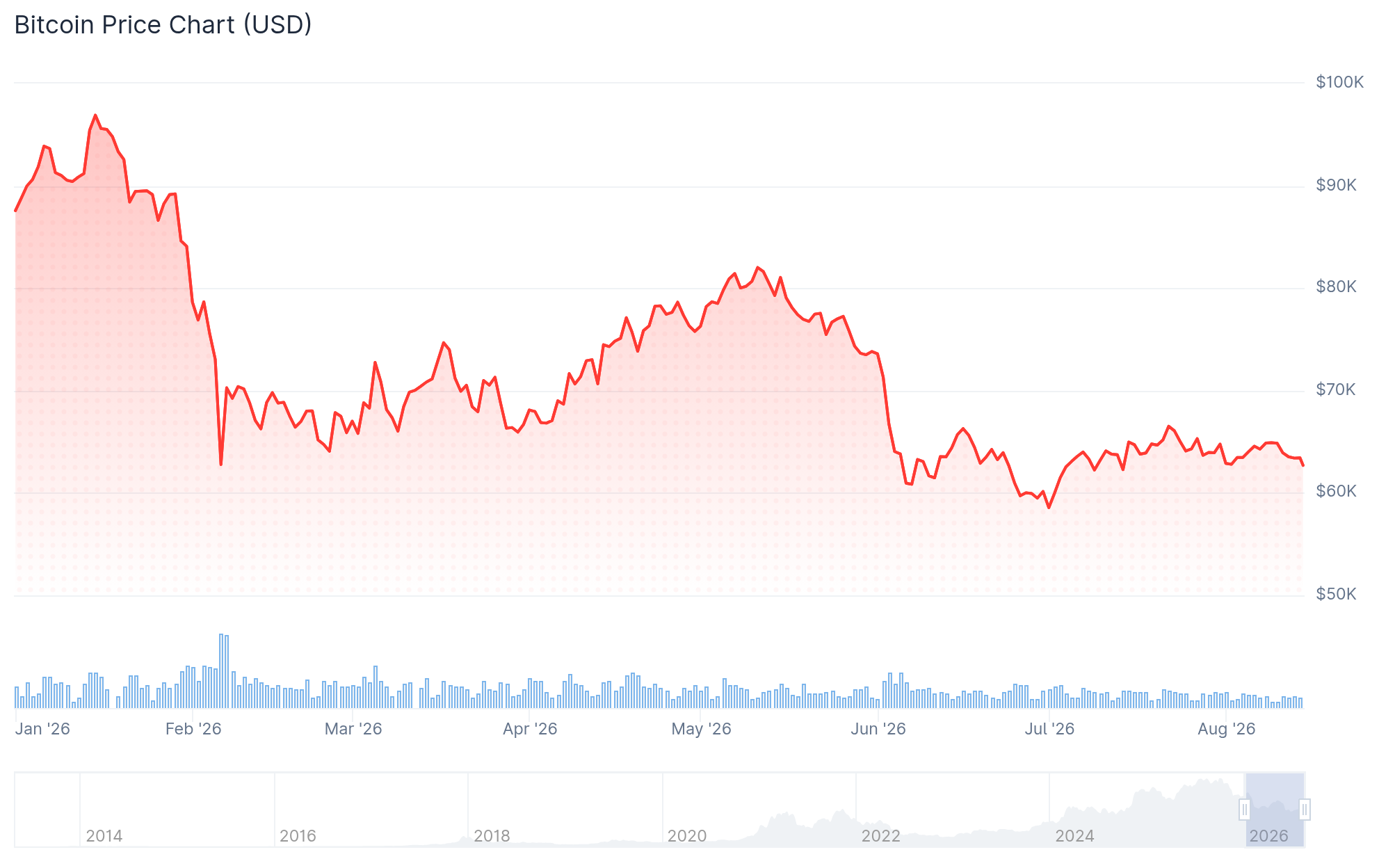
Bitcoin (BTC) price chart year-to-date. Source: CoinGecko
Ether holdings grew as well, with Morgan Stanley increasing its iShares Ethereum Trust ETF (ETHA) position by about 202% to 4.6 million shares and its Grayscale Ethereum Staking Mini ETF (ETH) position by about 26% to 5.1 million shares.
Related: Italy’s biggest bank triples staked Ether ETF holdings while cutting IBIT shares
In addition to initiating its MSBT position, Morgan Stanley added new exposure to the Grayscale Solana Staking ETF (GSOL) and Fidelity Solana Fund (FSOL), worth about $4.25 million and $2.26 million, respectively.
Circle and Bitcoin miners gain ground
Morgan Stanley made an even larger move in Circle Internet Group (CRCL), the company behind the USDC stablecoin, with reported holdings increasing from about 1.46 million shares to 8.32 million shares.
The filing also showed substantial additions to several Bitcoin mining and infrastructure companies, including Cipher Digital (CIFR), Core Scientific (CORZ), Hut 8 (HUT) and Bitdeer Technologies (BTDR).
Not every crypto-linked position grew. Morgan Stanley reported about 550,000 fewer Coinbase (COIN) shares, cut its CleanSpark (CLSK) position by more than 3.1 million shares and fully exited a roughly 8 million-share Bitfarms (BITF) position.
Magazine: Bitcoin will never fall below $60K again: Nansen founder


Cointelegraph is committed to providing independent, high-quality journalism across the crypto, blockchain, AI, and fintech industries.
All news, reviews, and analyses are produced with full journalistic independence and integrity. For more details on our standards and processes, please read our Editorial Policy.

RedotPay’s planned US initial public offering (IPO) has reportedly been pushed back as the stablecoin payments firm focuses on expanding into the United States. Bloomberg reported on Friday that the timing of the offering has been delayed, citing people familiar with the matter as RedotPay works through regulatory approvals and ongoing legal disputes.
A RedotPay representative declined to comment on specific IPO timing when asked by Cointelegraph. Instead, the company highlighted its near-term operational priorities, saying it obtained a US money transmitter license this week and is preparing to launch its product in the country.
Key takeaways
- Bloomberg reports RedotPay’s US IPO plans have been delayed while the company pursues additional approvals and manages legal risk.
- RedotPay says it secured a US money transmitter license this week and is preparing a US product launch.
- The delay comes amid a lawsuit in which Binance affiliates are seeking nearly $473 million in damages.
- RedotPay has previously discussed a potential New York listing and has also explored raising additional funding ahead of a public-market debut.
US IPO ambitions meet a shifting priority list
RedotPay first drew attention in February, when reports said the company was considering a New York listing. At the time, the prospect included the involvement of major Wall Street firms—JPMorgan Chase, Goldman Sachs, and Jefferies Financial Group were reported to be involved—and RedotPay was said to be targeting a valuation above $4 billion.
Bloomberg’s latest report frames the IPO slowdown less as a withdrawal of intent and more as a timing adjustment: RedotPay appears to be working to strengthen its US compliance footing while legal challenges continue to play out. For investors and market watchers, the practical question is whether the company can align its regulatory rollout with public-market readiness, especially in a US environment where stablecoin-related businesses face heightened scrutiny.
Separately, Cointelegraph reported earlier this year that RedotPay had been in discussions to raise as much as $150 million, even as it adjusted its organization to support a potential “unicorn” transition. Those reported funding and leadership changes suggest RedotPay was already positioning itself for a future listing—making any IPO deferral notable for shareholders watching catalysts and timelines.
New US licensing is a near-term catalyst
While RedotPay’s IPO timetable appears to have moved, the company’s immediate focus is its US expansion. According to a statement provided to Cointelegraph, RedotPay obtained a money transmitter license in the US this week and is preparing to launch its product in the country.
That licensing step matters because it speaks directly to whether a stablecoin payments business can operate with the regulatory infrastructure required in the United States. If the company’s launch proceeds as planned, it could help RedotPay generate real-world traction in one of the most important markets for crypto-adjacent payment services—even if the public offering itself takes longer than originally contemplated.
Still, the licensing win does not automatically resolve everything needed for an IPO. Public listings typically require a clear path through regulatory and legal uncertainties, along with disclosure and risk management that underwriters and boards must be comfortable with. RedotPay’s recent legal entanglements therefore remain a central factor shaping how quickly investors may see a filing or public-market debut.
Binance lawsuit raises pressure on timing and risk profile
Legal issues have intensified around RedotPay. Earlier in August, Binance affiliates filed a lawsuit in Hong Kong against RedotPay’s founders, seeking nearly $473 million in damages. The plaintiffs allege that confidential information—obtained through prior work with Binance—was used to build a competing payments business and to attract Binance users to RedotPay.
RedotPay denies the allegations and told Cointelegraph it would “vigorously defend all claims.” Even so, litigation of this size can affect corporate decision-making, particularly for companies weighing a US IPO where due diligence, disclosures, and investor risk appetite are tightly linked to ongoing disputes.
The conflict has also spread into Singapore. Cointelegraph previously reported that Binance and RedotPay disagree on the outcome of a related case. RedotPay told Cointelegraph this week that it expected Binance to discontinue that matter, while Binance rejected RedotPay’s account and stated its claims remain active.
This multi-jurisdiction picture is part of what may be pushing IPO timing later. For potential investors, it creates uncertainty around the company’s future legal costs, settlement risk, and potential operational distractions—factors that can weigh on underwriting timelines and the composition of any public-market narrative.
What to watch next for RedotPay
RedotPay’s next moves likely hinge on two tracks running in parallel: regulatory execution in the US and the evolution of its legal disputes. The company’s money transmitter license and planned product launch provide a concrete operational milestone, but the reported IPO delay suggests that legal overhang still matters for capital market plans.
For readers tracking the story, the key developments to monitor are whether RedotPay’s US launch progresses smoothly, whether any court proceedings shift in the Binance-related cases, and whether RedotPay revises its earlier public-market timeline after regulatory and legal questions become clearer.

Solana’s Fee Overhaul Increases Burn and Makes Resource Hogs Pay

Beyond the Gates: Randy Betrays Hayley Completely – Switches Sides to Protect Himself?

XRP HOLDERS! 24 HOUR WARNING! CLARITY Act Countdown Begins!


-

 News Videos6 days ago
Can Astrology Help Find Gold and Silver Trends? A Financial Astrology Guide
-

 Business5 days ago
Datadog: Best Of Breed For Multiple Reasons
-

 Tech7 days ago
Rinn Pharma & Biopharma to join NordicPharmaTrain network
-

 Business6 days ago
How to Start a Cleaning Business: A Step-by-Step Guide
-

 Business6 days ago
BDC Weekly Review: Private BDC Q2 Numbers Are Strong
-
 NewsBeat3 days ago
Communication cards help banking customers access services or report scams
-
 Business4 days ago
Oil Price Today (August 11): Crude oil rises to $88 after Trump’s compensation demand dents Hormuz opening. Here’s why
-

 Fashion3 hours ago
Weekend Open Thread: Ann Taylor
-
 Entertainment7 days ago
10 R-Rated Drama Movies That Can Be Called Masterpieces
-

 Fashion5 days ago
Amazon Sundays: Closet Care Before Fall
-

 Business7 days ago
SharkNinja Keeps Eating
-

 Politics6 days ago
Be quiet, Miriam! – spiked
-

 Business5 days ago
5 Things You Must Know About Jorge Messi, the Father and Longtime Agent Who Shaped Lionel Messi’s Career
-

 Business6 days ago
Mutual Fund Manager Scoops Up Beaten-Down Stocks
-

 Politics5 days ago
Ben-Gvir’s crocodile project halted but abuses at Ketziot Prison continue
-

 Tech7 days ago
Metabase SQLi zero-day exploited in customer data-theft attacks
-

 Politics5 days ago
The Church of England’s ruinous reparations racket
-
 Crypto World4 days ago
Why Did Nvidia Stock Fall on Monday Despite a $500 Billion Wall Street AI Deal?
-

 Politics6 days ago
Calls to permanently pedestrianise central Belfast following festival success
-

 Crypto World6 days ago
A Deep Dive Into One Of The Most Significant Hacks In Recent Memory
You must be logged in to post a comment Login