
Crypto World
Bitcoin Treasury Strategy Breakeven Achieved as BTC Tops $77K


Bitcoin pushed to fresh highs on Friday, revisiting the $77,000 area and trading at levels not seen since late May. The rally coincided with renewed confidence around Strategy’s corporate treasury position, which had been under scrutiny after the firm’s earlier BTC sales.
According to TradingView data cited in the report, BTC/USD posted local highs above $77,400 before the week’s final Wall Street session. The move also placed Strategy’s holdings back above its stated cost basis, a threshold that matters to investors watching whether the company’s Bitcoin-backed capital strategy remains sustainable.
Key takeaways
- Bitcoin reached about $77,000, its highest level since May 26, after trading above key resistance and reclaiming important technical levels.
- Strategy’s Bitcoin treasury returned to profit versus its reported cost basis of $75,385 for 840,447 BTC.
- On-chain analytics from Glassnode highlighted a dense realized-price cost-basis cluster forming below $70,000, with roughly 11% of BTC supply in the $58,000–$67,000 band.
- Support is forming around a technical and on-chain overlap near $68,000, after BTC broke above levels including the 200-day simple moving average around $68,967.
Bitcoin revisits $77,000 as Strategy turns the corner
The latest upswing appears to have been driven by a mix of market momentum and a specific corporate timing factor: Strategy’s reported treasury economics improved as BTC rose back above its cost basis.
Data referenced from BitcoinTreasuries indicates that Strategy’s cost basis for its BTC holdings—840,447 BTC—stands at $75,385. With Bitcoin now trading above that figure, the report states Strategy has returned to a year-to-date gain of roughly $450 million. For traders, corporate treasury profitability can influence market narratives around large holders; for Strategy-watching investors, it reduces the immediate pressure tied to “mark-to-market” concerns during drawdowns.
In the same broader context, TradingView monitoring cited in the coverage shows BTC/USD briefly pressing above $77,400 on its way toward Friday’s close. The article notes that BTC did not meaningfully consolidate in the immediate run-up, underscoring how quickly sentiment can shift once price clears prior levels.
Earlier BTC sales and the buyback structure
Strategy’s improving position did not occur in a vacuum. Earlier in August, Cointelegraph previously reported that between Aug. 3 and Aug. 9, Strategy sold a portion of its Bitcoin holdings—1,690 BTC—then used the proceeds to repurchase 1.15 million shares of its STRC preferred stock for $108.6 million. That was described at the time as the company’s fourth Bitcoin sale of 2026.
Those transactions raised questions among some observers about the long-term durability of Strategy’s Bitcoin investment thesis. In response to such concerns, analyst William Clemente argued that the subsequent BTC price strength should reduce the urgency of those fears. On X, Clemente wrote that the “Saylor/Strategy fears” should have been less relevant after Michael Saylor indicated willingness to sell BTC to fund STRC buybacks, and that with the current price impulse Strategy is now “even more over-collateralized” by its BTC holdings.
The corporate backdrop also included comments from Strategy’s current CEO, Phong Le, in an earlier August Fox News interview. Le said Strategy would return to buying Bitcoin before the end of the year—an assertion that, if followed through, would be consistent with the idea that sales have been used tactically rather than signaling an exit.
On-chain “buy wall” forms below $70,000
Beyond Strategy-specific developments, the report points to a broader market support structure visible in on-chain data. During a period when investors have been assessing whether Bitcoin’s upside can hold, Glassnode analysis highlighted a growing “safety net” below $70,000 based on realized cost basis distribution.
As summarized in the article, some 3.44 million BTC now have an on-chain cost basis between $58,000 and $67,000. Of that amount, 2.23 million BTC—approximately 11% of total supply—was added over the past 11 weeks. Glassnode cofounder Rafael Schultze-Kraft described this concentration as the “densest cost-basis cluster below spot,” calling it a key potential support zone should price retrace.
In practical terms, realized cost-basis clusters can matter because they represent coins bought (or last moved/realized) near specific price levels. When price falls back toward those areas, supply behavior often changes: holders may be more inclined to defend those positions or, conversely, may be more likely to sell if they were waiting for confirmation to exit. The article’s framing suggests that, for now, the market is developing a cushion rather than a void.
Technical levels reclaimed: $68,000 and the 200-day SMA
The week’s price action also included important technical confirmation. The report notes that BTC/USD broke through several key resistance levels, including the 200-day simple moving average (SMA) around $68,967—described as a “key target to reclaim” to end the long-term downtrend.
This technical reclaim lines up with the on-chain support narrative. The on-chain cluster discussed by Glassnode sits below $70,000, while the article specifically references a “new band of support” forming around the $68,000 area. It’s the overlap between these two kinds of signals—an SMA that tends to influence longer-horizon positioning, and a realized-price cluster that may anchor dip demand—that can strengthen market conviction during volatility.
Still, the report emphasizes that volatility remains part of the equation, with investors looking for whether the move can translate from a breakout to sustained consolidation above reclaimed levels.
Going forward, traders and long-term holders will likely watch whether Bitcoin can hold above the reclaimed resistance zone near $68,000–$69,000 and whether on-chain support beneath $70,000 continues to grow; Strategy’s treasury also remains a focal point, since continued BTC purchases (as CEO Phong Le indicated) would further shape market sentiment about large-holder intent.



Laser Digital Japan will offer liquidity to domestic crypto providers, with institutional trading services planned to follow as the appetite for crypto in Japan grows.


Ripple CEO Brad Garlinghouse said on Aug. 20 that the company is aggressively adopting artificial intelligence as it pursues further revenue and workforce growth.
Summary
- Garlinghouse said Ripple has adopted artificial intelligence aggressively to accelerate growth across its expanding business.
- Ripple employs about 1,500 people globally and plans continued hiring as revenue grows further worldwide.
- Garlinghouse expects Ripple to more than double annual revenue during 2026, despite continuing market weakness.
- Ripple currently lists 94 roles publicly, including engineering positions focused on AI driven operations worldwide.
- Ripple Prime clears more than $3 trillion annually for over 300 institutional customers across markets.
Speaking at the SALT Wyoming Blockchain Symposium, Garlinghouse described AI as an “enabler and an accelerant” for companies that already have growing businesses and customer demand.
“AI, if you are in a business that has opportunity to grow and you’re serving customers and have compelling solutions, AI just lets you do that better and faster and stronger,” Garlinghouse said during the recorded interview.
He added that Ripple has approximately 1,500 employees worldwide and 150 open positions. Garlinghouse said the company intends to keep expanding because its business is growing.
Ripple sees AI as an expansion tool
Garlinghouse rejected the argument that AI is necessarily responsible for large corporate layoffs. He suggested that some companies may be using the technology to justify workforce reductions that were already needed.
“When I see companies announce big layoffs and they say, ‘Oh, well, AI X, Y, and Z,’ that to me says, ‘Well, they were bloated before and they’re using this as an excuse,’” he said.
His comments represent an opinion about recent layoffs rather than evidence about individual companies. Businesses have attributed workforce reductions to several factors, including automation, restructuring, operating costs and changes in customer demand.
Ripple’s public careers portal displayed 94 available positions when reviewed. The difference from Garlinghouse’s figure may reflect roles that have not been posted publicly, positions under recruitment through other channels or changes since the conference appearance.
Some listings directly connect Ripple’s engineering strategy with AI. One senior engineering role calls for an “AI native operation” using agentic development methods to expand the company’s payout network without relying entirely on traditional headcount growth.
Institutional expansion supports Ripple’s growth claim
Garlinghouse said Ripple expects a record year and will “more than double revenue year on year.” Ripple is privately held and does not publish the audited quarterly financial statements required of public companies. The revenue projection therefore remains company guidance.
The company has expanded beyond its original cross border payments business through acquisitions and new institutional services. Ripple completed its $1.25 billion purchase of Hidden Road in October 2025 and renamed the business Ripple Prime.
As previously reported, the acquisition expanded Ripple into global prime brokerage services covering digital assets and traditional markets. Ripple says the division clears more than $3 trillion annually for over 300 institutional customers.
Ripple previously said the prime brokerage business had tripled in size between the acquisition announcement and its completion. That figure is a company supplied measure and has not been independently audited through public financial filings.
The company has also expanded into corporate treasury management. In related coverage, Ripple introduced an enterprise platform for managing digital assets and liquidity following its acquisition of treasury software provider GTreasury.
Ripple’s AI strategy targets financial infrastructure
Garlinghouse connected the company’s outlook with its longstanding focus on financial infrastructure. Ripple sells payment, custody, stablecoin, prime brokerage and treasury services to institutions.
“More and more people are realizing that the infrastructure side, the institutional side is where it’s at,” he said. He described Ripple’s role as connecting traditional finance with decentralized financial infrastructure.
Ripple President Monica Long made a similar case in the company’s 2026 predictions. She said AI models could work alongside blockchains to automate liquidity management, margin calls and portfolio rebalancing.
The strategy does not mean Ripple will replace employees with autonomous systems. Its current position is that AI can increase the output of existing teams while helping the company serve more customers and enter additional markets.
The next measurable tests will be Ripple’s hiring activity and whether it reaches Garlinghouse’s revenue target. Any public listing could eventually provide independently audited financial information, but the company has not announced a confirmed timetable for an initial public offering.
Ripple’s commercial growth also should not be treated as automatic growth for XRP. Ripple is a private company, while XRP is a separate digital asset. As crypto.news previously explained, many Ripple services can grow without creating direct demand for XRP.
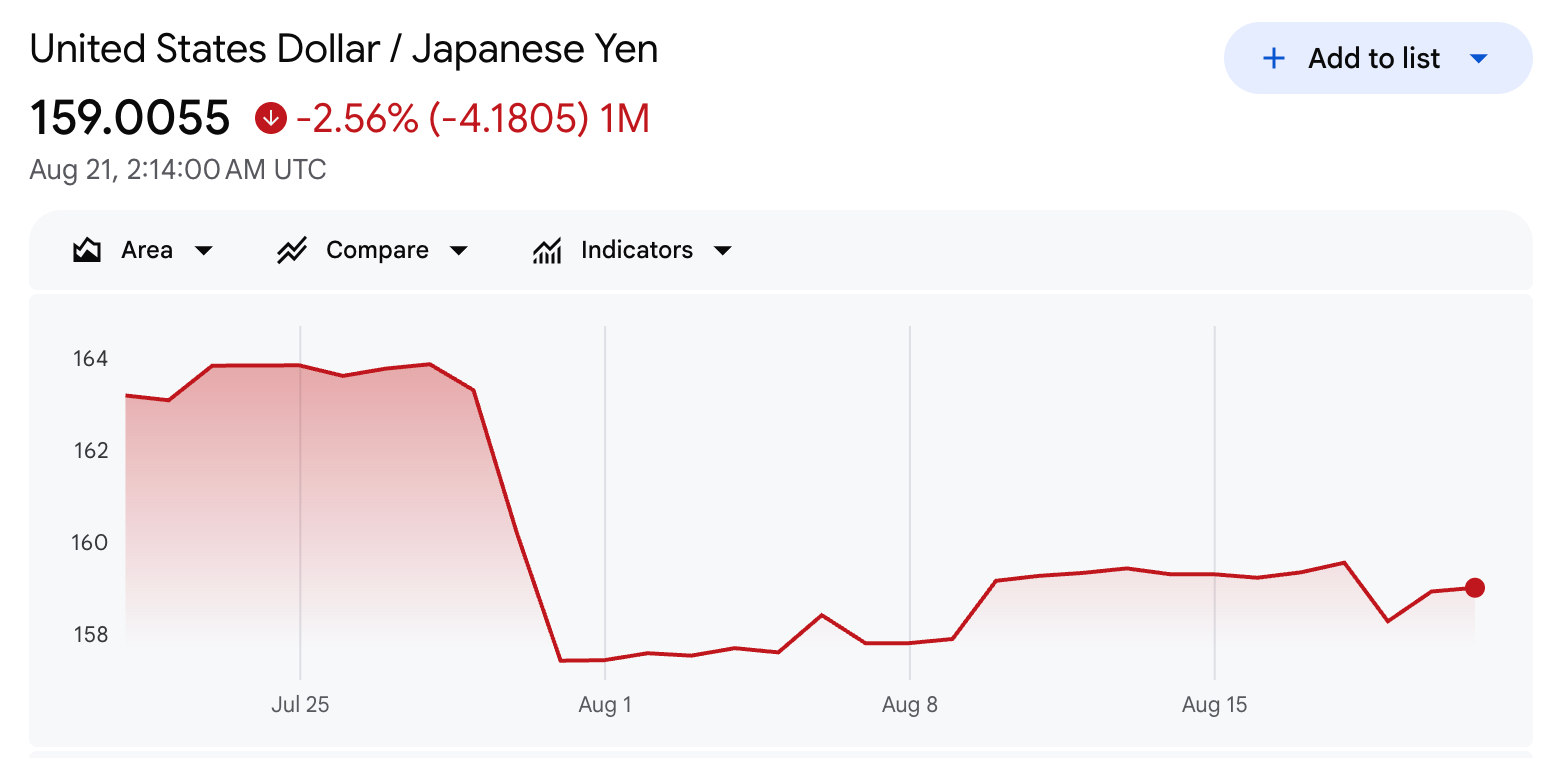
Japan’s headline inflation rate reached 1.9% in July, its highest level this year, as the Iran conflict pushed energy costs higher and the yen drifted back toward 159 per dollar.
Both readings now point the Bank of Japan toward the same decision in September, when its board next meets to set the policy rate.
Energy Costs Lift Japan’s Inflation to a 2026 High
Core inflation, which excludes fresh food but keeps energy, matched forecasts at 1.8%. The so-called core-core rate, stripping out both, came in at 1.9%.
Energy prices climbed for the first time since November 2025 despite government support. That fed into wholesale inflation, which reached 7.2% in July.
Electricity charges were the largest contributor. Fresh food prices climbed 7%, a sharp acceleration from the 3.9% increase recorded in June.
Analysts have said subsidies from Prime Minister Sanae Takaichi’s administration are holding down consumer prices. The measures shield households from energy costs.
Meanwhile, the BOJ warned last month that core inflation would clearly move above 2% starting in the second half of its 2026 fiscal year, which runs from September to March. It cited wage increases feeding into selling prices, higher crude oil prices, and the recent depreciation of the yen.
Follow us on X to get the latest news as it happens
Intervention Gave Carry Traders a Cheaper Entry
The joint US-Japan operation lifted the yen from roughly 164 per dollar to about 155 per dollar. Most of that move has since unwound, even though Japan’s intervention firepower remains substantial.

Nonetheless, Japanese investors treated the stronger yen as an opportunity to double down on the carry trade. They net bought more than 5 trillion yen of foreign equities and long-term bonds in the two weeks to August 15, reversing net sales of more than 300 billion yen.
“Intervention has ‘turbo charged’ the carry trade for fundamental & long-term investors,” Jesper Koll, expert director at Monex Group, told CNBC.
The US-Japan 10-year yield spread stood near 1.8 percentage points on August 20. The wide gap continues to support the carry trade by preserving the incentive to fund investments in higher-yielding overseas assets with relatively low-yielding yen.
That dynamic is unlikely to change materially unless the Bank of Japan raises rates enough to narrow the yield differential.
Both Pressures Point the BOJ the Same Way
This leaves the BOJ facing pressure from two directions at once. July’s inflation print argues for tightening, and so does a currency the market keeps selling back down.
Traders have already moved. Polymarket now assigns 84% odds to a 25-basis-point increase at the September 17-18 meeting, against 15% for no change. Those odds sat near 21% earlier.

The BOJ lifted its policy rate to 1% in June, the highest level since 1995. Whether one more quarter-point move does anything to a 1.8 point yield gap is the question September leaves open.
Subscribe to our YouTube channel to watch leaders and journalists provide expert insights
The post Japan’s Inflation Print Just Made a September BOJ Hike Harder to Avoid appeared first on BeInCrypto.
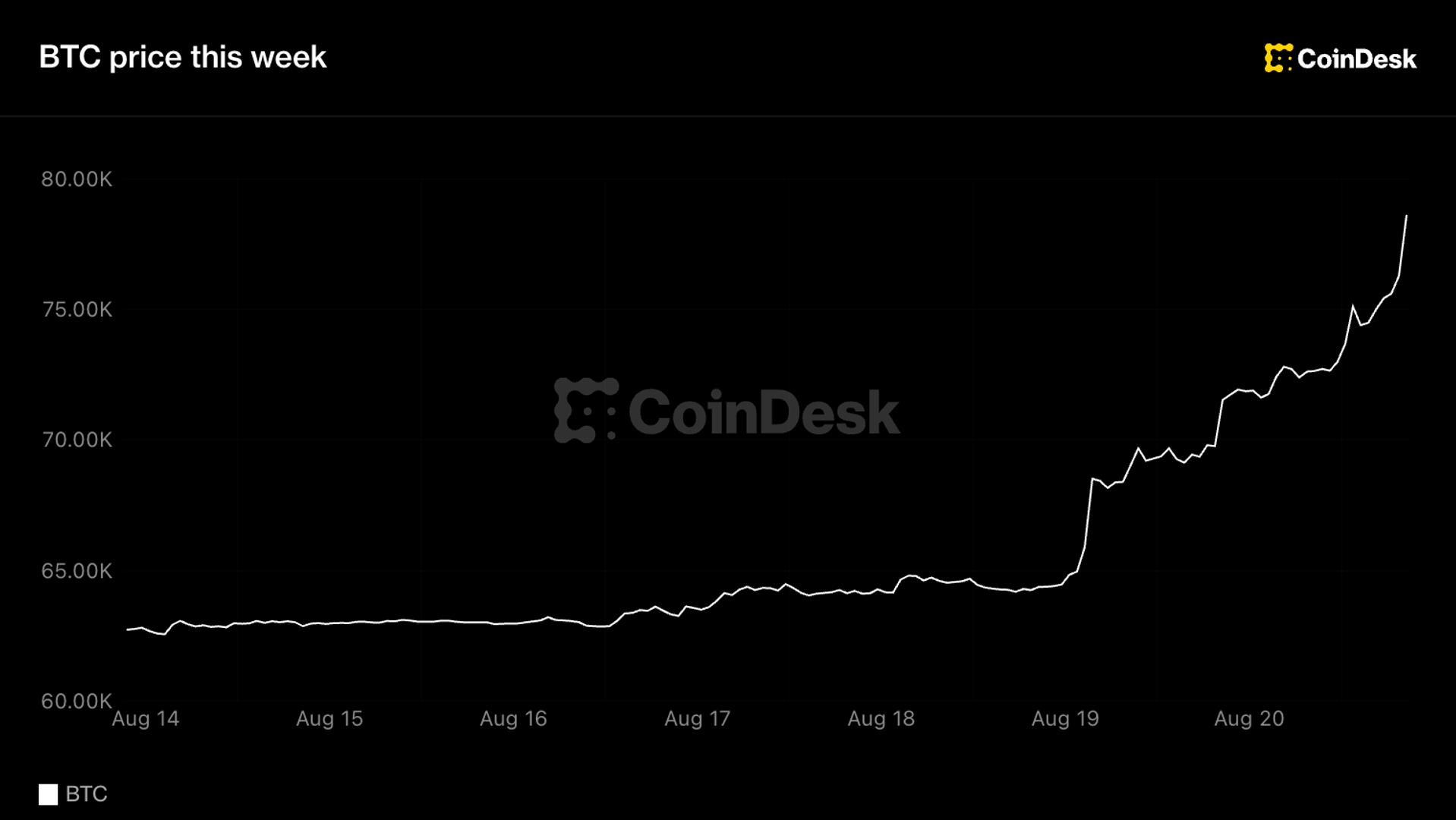
BTC has gained 24% since Monday and reached the level implied by its inverse head-and-shoulders break, with shorts still taking a contrarian position.
Bitcoin Infinity Day arrives on Friday, August 21, and the ritual comes with one rule. Holders either buy Bitcoin or sit on their hands, because the day forbids selling.
The date hides a code. Rotate the 8, and it becomes the infinity symbol, while 21 points at Bitcoin’s fixed cap of 21 million coins.
How Bitcoin Infinity Day Started
Swedish author Knut Svanholm floated the idea on August 10, 2021. He framed it as a coordinated pause in selling, and the hashtag spread across X within days.
Svanholm built his work around one line of arithmetic, everything divided by 21 million. Put every asset on Earth over a fixed denominator, and the answer carries no ceiling.
That thought produced the ∞ / 21M symbol, which he still keeps in his display name. In practice, the rules stay simple. Buy any amount, or do nothing at all. Sellers get no exemption, not for rent money, not for profit taking.
Five years on, the day has become a fixture on the Bitcoin calendar. The community reposts the infinity tag every August, so the ritual now outlives the tweet that started it.
The argument rests on scarcity. Value can climb toward infinity because the supply schedule never bends, however the coin count stays frozen at 21 million. Adam Back rejected a push to lift Bitcoin’s supply cap earlier this month, calling the case a false narrative.
HODL Rules Meet a Market That Just Flipped to Greed
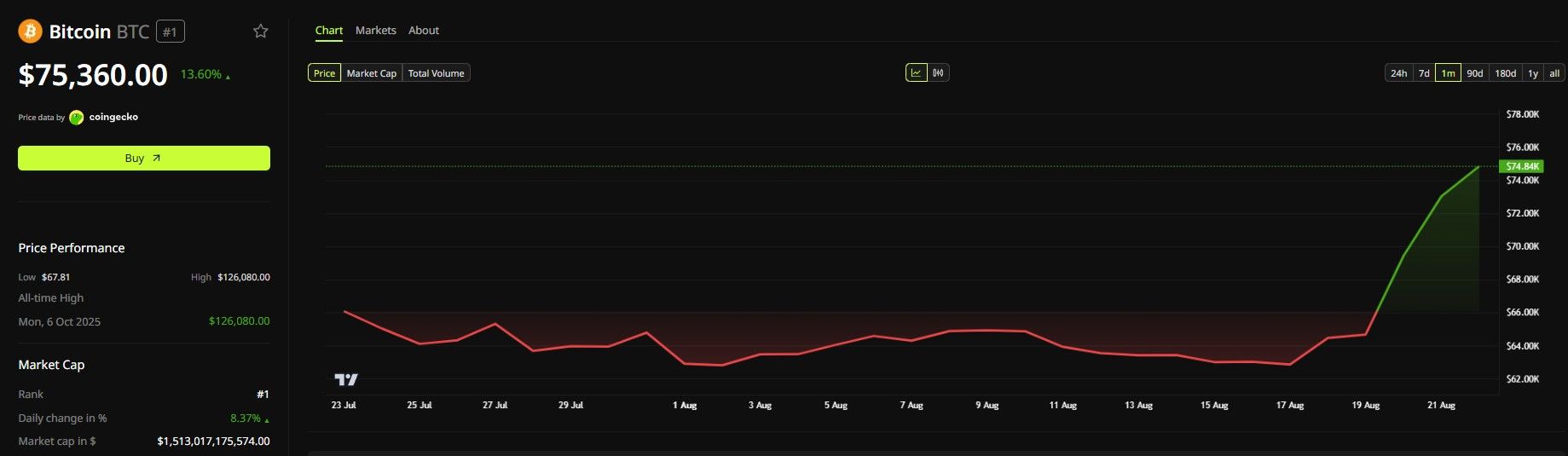
This year, the timing looks kinder. Bitcoin trades near $75,360 after a 8.37% daily jump, and its market value has climbed back above $1.51 trillion.

Sentiment turned with it. The Crypto Fear and Greed Index flipped fear into greed overnight on Thursday, climbing from 46 to 62.
Short sellers paid for the swing. Exchanges wiped out short positions worth roughly $1.06 billion in a single day, and the squeeze then fed on itself.
Even so, the record stays distant. Bitcoin peaked at $126,080 on October 6, 2025, so the price still sits about 40% lower.
Scarcity talk survived that drawdown. Binance founder Changpeng Zhao warned last week that millionaires soon cannot afford one full Bitcoin. Dormant and lost coins, he argued, keep shrinking the tradable float.
Conversion stories still surface as well. Entrepreneur Jeff Booth spent 15,000 hours of research at breaking Bitcoin, never managed it, and changed how he invests.
Supporters argue that a synchronized bid, however small, shows the market what fixed supply looks like when demand refuses to blink. Critics counter that one Friday of restraint barely registers against global spot volume.
Nobody has proven that a single coordinated day moves the price. Still, the ritual hands holders a shared script, and this year the market shows up in a better mood.
The post What Is Bitcoin Infinity Day? The 8/21 Ritual That Bans Selling for a Day appeared first on BeInCrypto.

Disclosure: This article does not represent investment advice. The content and materials featured on this page are for educational purposes only.
Bitcoin tops $72,500 as SHRMiner draws attention with simplified cloud mining contracts for digital asset holders.
Summary
- Bitcoin climbs above $72,500 after a $10,000 four-day rally, boosting optimism as SHRMiner gains attention.
- BTC’s renewed momentum drives investor interest in cloud mining as SHRMiner offers contracts across several digital assets.
- SHRMiner attracts crypto holders seeking alternatives to trading as Bitcoin’s latest rally pushes market optimism higher.
While U.S. stocks cooled amid U.S. threats of an “economic war” against Iran, Bitcoin continued to climb, reaching a multi-month high above $72,500.
After gaining nearly $10,000 in just four days, Bitcoin’s renewed momentum has fueled growing optimism among market participants.
As the crypto market enters a new cycle, Bitcoin (BTC) is once again becoming a major focus for investors worldwide. At the same time, the SHRMiner cloud mining platform is attracting increasing attention from market participants.
SHRMiner allows users to participate in cloud computing power contracts using digital assets such as BTC, ETH, DOGE/LTC, ZEC, and USDT. There is no need to purchase mining hardware or deal with complicated equipment deployment, technical maintenance, or day-to-day operations. Users can participate in digital asset mining while receiving earnings that are automatically settled according to the terms of their contracts.
For crypto holders who want to reduce frequent trading while exploring additional cash-flow opportunities, this offers an alternative way to put digital assets to work beyond simply buying and selling.
Why is SHRMiner attracting more attention?
Unlike traditional mining, which often comes with a high technical barrier to entry, SHRMiner focuses on simplicity and a user-friendly experience, making cloud mining more accessible to everyday users.
The platform currently offers several key features:
- Supports major digital assets including BTC, ETH, LTC, and DOGE
- Automatically allocates cloud computing power after a user selects a contract
- Uses enterprise-grade data centers to operate mining infrastructure
- Some infrastructure is powered by renewable energy
- Contract earnings are automatically settled every 24 hours according to the agreed terms
- Users can monitor their accounts and earnings from either desktop or mobile devices
For crypto investors, this model offers an alternative to simply holding assets and waiting for prices to rise. By using computing power contracts, users can put a portion of their digital assets to work in an effort to generate ongoing returns.
This is also why cloud mining continues to attract attention even when major cryptocurrencies such as BTC experience short-term price volatility. More investors are looking beyond short-term price movements and paying greater attention to asset efficiency, earning cycles, and cash-flow management.
SHRMiner beginner’s guide: Start cloud mining in four steps
SHRMiner has simplified the entire process so that even users with no previous mining experience can get started.
1. Create an account
Visit the official SHRMiner website or use its mobile service and register with an email address.
For a limited time, new users can receive a $15 signup bonus. (Click here to create an account.)
2. Choose a cloud mining contract
The platform offers cloud mining contracts with different funding levels, contract periods, and projected return structures.
Users can choose a plan based on their budget, preferred capital commitment period, and risk tolerance without having to research mining hardware models, hash rate configurations, or data center infrastructure themselves.
3. Use supported digital assets
Users can purchase eligible cloud mining contracts with supported digital assets such as BTC, ETH, XRP, and USDT.
Once the purchase is completed, the platform allocates the corresponding cloud computing resources based on the selected plan, while the data center handles ongoing operation and maintenance.
4. Activate the contract and start earning
Once the contract is activated, earnings begin to accrue according to the terms of the selected contract.
Earnings are generally settled automatically to the user’s account every 24 hours. Users can choose to withdraw their earnings based on their own financial plans or apply them toward additional contracts to explore the potential benefits of compounding.
The entire process eliminates the need to purchase mining equipment, build mining systems, manage electricity consumption, or handle hardware maintenance, significantly reducing the technical barriers traditionally associated with digital asset mining.
Popular cloud mining contracts
| Contract Name | Price | Duration | Daily Output | Principal + Total Return |
| New User Experience Agreement | $100 | 2 Days | $4 | $108 |
| Bitdeer Sealminer A2 Pro | $500 | 5 Days | $6.25 | $531.25 |
| Litecoin Miner L9 | $1,000 | 10 Days | $13 | $1,130 |
| Bitcoin Miner S21 XP Imm | $5,000 | 25 Days | $70 | $6,750 |
| Bitcoin Miner S21e XP Hyd | $10,000 | 35 Days | $150 | $15,250 |
| ANTSPACE HK3 | $30,000 | 40 Days | $510 | $50,400 |
Different contracts vary in investment amount, operating period, and projected earnings, allowing users to select a mining contract based on their individual financial preferences.
Once a contract begins, the corresponding earnings are automatically credited to the account according to the contract terms. When the contract expires, the corresponding principal will also be returned according to the applicable contract terms. Actual amounts, contract periods, and earnings depend on the specific contract selected by the user.
For additional mining contracts and complete terms, click here to view product details.

Why are more investors paying attention to cloud mining?
Compared with operating mining equipment independently, the biggest difference with cloud mining is that users do not have to directly manage complex mining infrastructure.
Key advantages include:
- No need to purchase or maintain specialized mining equipment
- No need to directly manage electricity expenses or day-to-day hardware operations
- No need to constantly monitor markets or trade frequently
- Contract earnings are automatically settled every 24 hours, with withdrawals available anytime and no hidden fees
- Users can choose computing power contracts with different amounts and durations based on their individual capital requirements
For crypto enthusiasts who already hold BTC, ETC, DOGE, LTC, ZEC, and other digital assets, the appeal is straightforward: they can maintain their existing digital asset strategy while exploring the possibility of generating additional returns through cloud computing power.
In other words, investors are increasingly shifting their focus from simply asking “Will the asset price go up?” to considering “How can I make my digital assets work more efficiently?”
In short
For those who are looking for ways to increase passive income, cloud mining can provide another option to consider. When used appropriately, these opportunities can help users accumulate crypto assets in a more automated way while requiring relatively little day-to-day involvement.
At the very least, the model can require significantly less time than many forms of active trading. Passive income remains an important goal for many investors and traders, and with SHRMiner, exploring ways to maximize passive-income potential has become more accessible than ever.
Disclosure: This content is provided by a third party. Neither crypto.news nor the author of this article endorses any product mentioned on this page. Users should conduct their own research before taking any action related to the company.
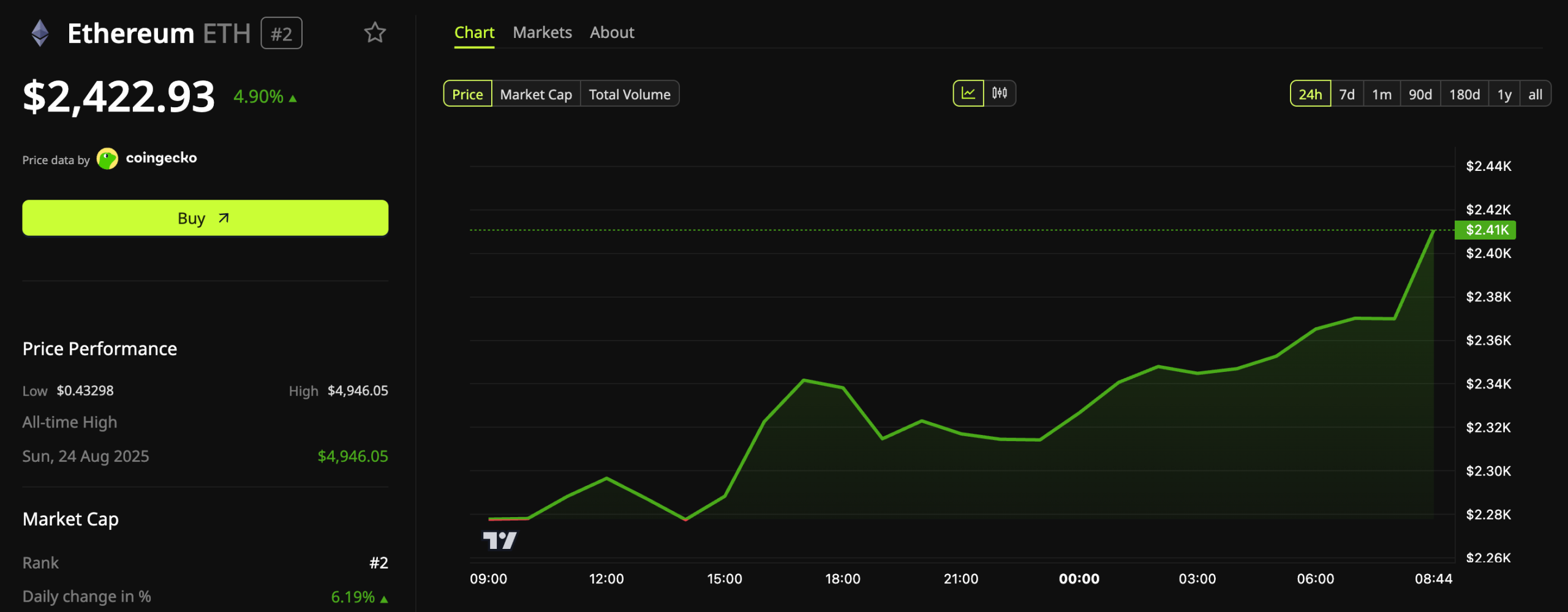
Ethereum (ETH) climbed above $2,430 on Friday, its highest price in roughly four months, as US spot ETFs absorbed their largest daily inflow since October, and whales pulled fresh supply off Binance.
The altcoin has gained 29% over the past week. At press time, it traded at $2,422. Despite the price gain, not every large holder is buying.

Follow us on X to get the latest news as it happens
Ethereum ETF Demand Hits a 10-Month Peak
US-listed Ethereum ETFs took in $220.77 million on August 20, per SoSoValue data. This is the strongest daily haul since October 28, 2025.
The inflow capped a four-day run of positive flows worth $512.25 million. Demand accelerated through the stretch, climbing from $30.85 million on August 17.
Total net assets across the funds reached $13.58 billion, the highest since May 11. Cumulative net inflows now stand at $11.97 billion.
The strength extends beyond Ethereum. Bitcoin also surged to $79,000 for the first time since mid-May
Whales Split as Ethereum Rallies
On-chain data shows large holders moving in both directions. Lookonchain flagged wallet 0x2d59 as withdrawing 30,000 ETH, worth $67.42 million, from Binance.
This wallet has now taken 120,000 ETH off the exchange over three weeks, valued at $237.7 million. Abraxas Capital withdrew another 18,000 ETH worth $39.56 million.
A newly created wallet, 0x2261, moved out 6,704 ETH worth $14 million from the same exchange.
On the other hand, sellers are just as active. According to Lookonchain, 7 Siblings offloaded 14,000 ETH for $32.85 million at an average price of $2,346.
Wallet 0xFD10 swapped 11,252 Lido Staked Ether (stETH) and 1,824 ETH into 30.78 million Tether (USDT). Whale 0x4cee booked a $1.76 million profit on 5,250 ETH.
Exchange outflows point to accumulation, yet the selling shows conviction is far from uniform above $2,400.
Subscribe to our YouTube channel to watch leaders and journalists provide expert insights
The post Ethereum’s 29% Price Rally Divides Whales Across the Market appeared first on BeInCrypto.
Bitcoin’s price reached nearly $79,500 moments ago, causing all sorts of reactions across the crypto community. This brings its total gains for the past 24 hours to slightly more than 13%.
The parabolic move has been mirrored across most of the altcoin market, with many large-cap cryptocurrencies bringing outsized gains throughout the past week. Just today, Ripple’s XRP exploded by 25%, for example.
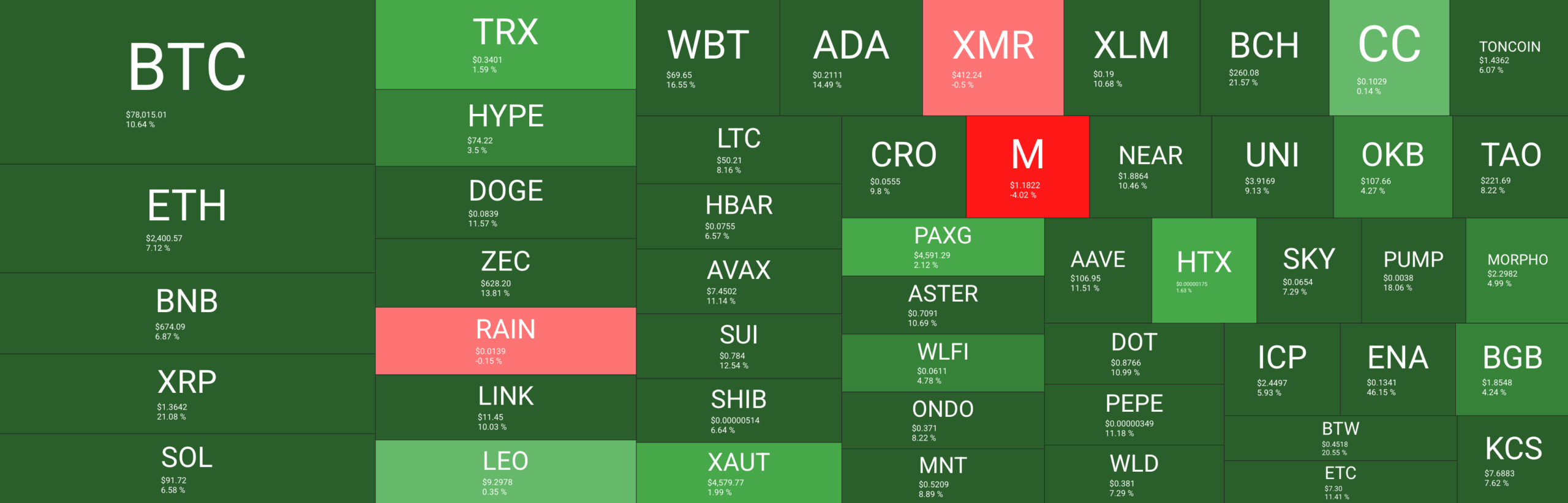
The price has since retraced to slightly below $78K. In any case, volatility has led to severe liquidations for yet another day across derivatives markets. Data from Coinglass shows that, in the past hour alone, total liquidations surpassed $330 million, the bulk of which came from short traders – somewhat expectedly.
Total liquidations over the past 24 hours are approaching $1.5 billion, making this yet another historic day in the market. Most of the liquidations are also associated with Bitcoin positions – about $825M at the time of this writing. Binance leads in terms of exchanges, with Hyperliquid reporting about half as much.
In total, over 170,000 traders were wiped out, and the largest single liquidation order occurred on Hyperliquid, with a face value of $23.59 million.
The post Bitcoin’s Price Approaches $80K, Millions Liquidated in Hours appeared first on CryptoPotato.


The rally in hard assets isn’t necessarily about what the Treasury is doing, but what its move signals to the market.


Key takeaways
- Bitcoin, Ethereum, and XRP have gained nearly 20%, over 25%, and almost 30%, respectively, this week.
- Expanded U.S. Treasury debt buybacks have improved liquidity expectations and boosted demand for risk assets.
- Bitcoin trades around $76,800 after breaking above its 50-day, 100-day, and 200-day exponential moving averages.
Bitcoin, Ethereum, and XRP extended their rallies Friday as improving liquidity expectations continued to lift the broader cryptocurrency market.
Bitcoin has gained nearly 20% this week, while Ethereum has risen more than 25% and XRP has advanced almost 30%.
The rally gained momentum after the U.S. Treasury announced plans to double the size of certain debt buyback operations.
The decision eased liquidity concerns and strengthened demand for risk-sensitive assets.
With the three cryptocurrencies trading firmly higher, investors are now watching whether Bitcoin can reach $80,000, Ethereum can reclaim $2,500, and XRP can advance toward $1.50.
Treasury buyback expansion strengthens crypto rally
The U.S. Treasury’s decision to expand its debt buyback program has helped improve sentiment across financial markets.
Larger buybacks can support liquidity in the market for longer-dated Treasury securities, easing financial pressures and encouraging investors to increase their exposure to riskier assets.
Cryptocurrencies responded strongly to the announcement, with Bitcoin, Ethereum, and XRP recording double-digit weekly gains.
Short liquidations also accelerated the rally as bearish traders were forced to close their positions, adding further buying pressure.
Bitcoin was trading around $76,800 on Friday after decisively breaking above its major exponential moving averages.
The 200-day EMA stands at $71,545, while the 100-day and 50-day EMAs are located at $66,727 and $65,286, respectively.
BTC’s position above all three indicators supports a bullish near-term outlook and suggests the market’s broader technical structure has improved considerably.
The breakout was accompanied by strong trading volume, adding credibility to the latest upward move.
Sustained trading above the 200-day EMA would reinforce the case for further gains and could establish the level as new support.
BTC bulls target the $80,000 resistance
Bitcoin’s next major resistance lies near the psychological and horizontal barrier at $80,000.
A move from $74,700 to $80,000 would represent an additional gain of approximately 7.1%.
However, the $80,000 level could attract profit-taking and fresh selling pressure following Bitcoin’s rapid weekly advance.
A decisive break and daily close above the barrier would strengthen the bullish outlook and potentially open the way to higher levels.
Failure to clear $80,000 could lead to a period of consolidation as traders digest the recent gains.
Bitcoin’s momentum indicators remain bullish but increasingly stretched. The relative strength index is hovering near 83, placing BTC firmly in overbought territory. Such an elevated reading does not guarantee an immediate reversal, but it indicates that the rally may be vulnerable to a corrective pause.
The moving average convergence divergence remains strongly positive, showing that upward momentum is still intact.
Together, the indicators suggest bulls remain in control, although the risk of short-term profit-taking has increased.
If Bitcoin retreats, initial support sits at the 200-day EMA near $71,545. Holding above this indicator would preserve the immediate bullish structure and could provide a foundation for another attempt at $80,000.

A deeper correction could bring the 100-day EMA at $66,727 and the nearby horizontal level at $66,500 into focus.
Below that region, the 50-day EMA at $65,286 offers another layer of support, followed by the structural floor at $62,300.
A sustained decline below $62,300 would weaken the broader bullish outlook, while continued trading above the 200-day EMA would keep the $80,000 target within reach.
Olly Murphy throws open his stable doors to public during National Racehorse Week

ASEAN’s Digital Economy Pact: Can Consensus Unite 11 Nations

Nomura-backed Laser Digital wins Japan's first crypto approval in four years





-

 Fashion7 days ago
Weekend Open Thread: Ann Taylor
-

 Sports6 days ago
Birmingham 2026: Day 6 Timetable for Irish Athletes
-
 NewsBeat6 days ago
Myanmar says over 300,000 Rohingya refugees verified for repatriation as exodus enters ninth year
-

 Politics6 days ago
SEQ Code: The Three Letter Boarding Pass Code That Could Give You The Worst Seat
-

 Business3 days ago
SMA Solar Technology AG (SMTGY) Q2 2026 Earnings Call Transcript
-

 Tech3 days ago
Qwen3.8-27B runs frontier-class coding agents and reasoning locally, no cloud API required
-

 Crypto World6 days ago
Pi Network Protocol 27 endgame: last upgrade before what?
-

 Crypto World3 days ago
OCC Greenlights Trump Family Crypto Firm for Trust Charter
-
 Tech6 days ago
Every fusion startup that has raised over $100M
-
 Entertainment6 days ago
Marvel Studios Reveals New X-Men Cast Including Adam Driver and Sadie Sink
-
 Business6 days ago
Monarch Mutual Fund set to enter MF space with maiden overnight fund; files draft with Sebi
-

 Fashion7 days ago
Weekly News Update, 8.14.26 – Corporette.com
-

 Fashion7 days ago
Silver bangles for women – Newbridge Silverware
-

 Business6 days ago
Cristiano Ronaldo’s Secret Wedding Deepens As Presenter Claims Family Learned ’30 Seconds’ Before
-

 News Videos1 day ago
Don’t Leave Your Financial Future To Chance | August 19, 2026
-

 Business6 days ago
Facebook Down Now? Users Report Login And Loading Problems As Outage Trackers Monitor Ongoing Issues
-

 Crypto World3 days ago
NAVI Prime launches institutional lending framework on Sui
-

 Fashion7 days ago
Cart Confidential Vol. 44 – Julia Berolzheimer
-

 Crypto World4 days ago
Data of 54K Wallet Users Leaked, Clarity Odds Just 10%: Hodler’s Digest, Aug. 16
-
 Fashion7 days ago
knitwear for women sale – up to 50% off
You must be logged in to post a comment Login