
Crypto World
Bitcoin Treasury Trades Signal Shift as Holdings Drop 10%, Analysis

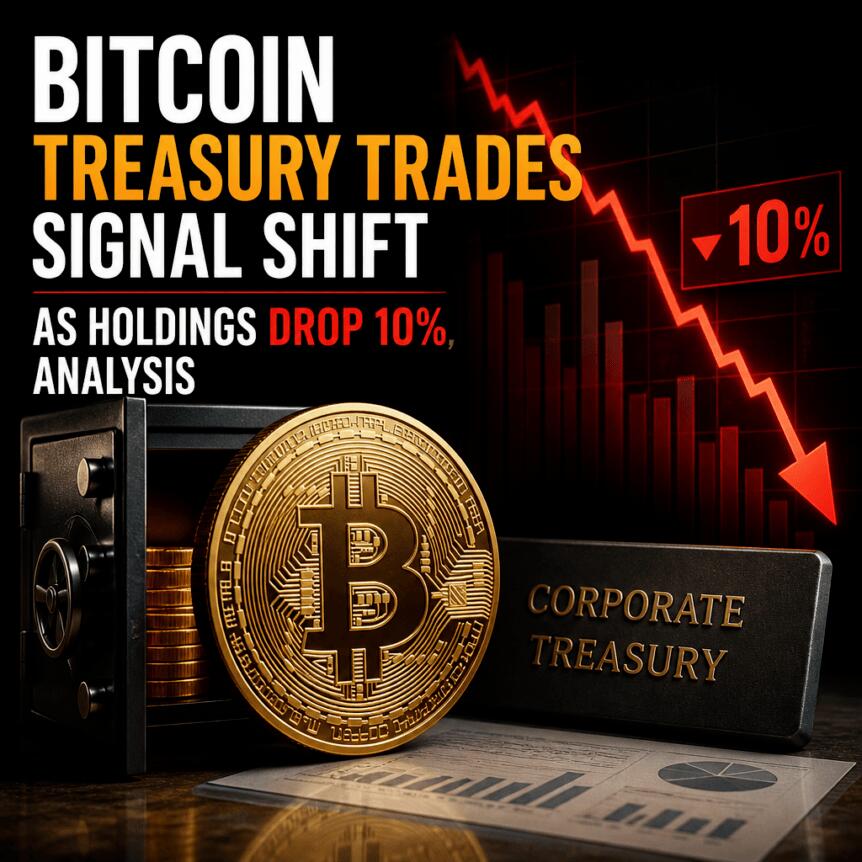
Bitcoin’s institutional footprint appears to be shrinking again, with on-chain and market metrics pointing to weaker demand from the category of holders that typically amplifies price through financial engineering and “treasury” models. According to data compiled by CryptoQuant, combined exposure across institutional Bitcoin vehicles has dropped from 1.33 million BTC to 1.20 million BTC over the past three months—an approximate 10% reduction since May.
The pullback is occurring alongside a prolonged dislocation in exchange pricing. CryptoQuant also highlights a Coinbase Premium streak that has turned persistently negative for a record 93 days, a pattern analysts often associate with muted institutional buying—particularly from U.S. participants—until the premium meaningfully improves.
Key takeaways
- CryptoQuant data shows combined holdings across institutional Bitcoin vehicles fell from 1.33 million BTC to 1.20 million BTC over three months (about 10%).
- CryptoQuant links the broader decline to pressure on “Bitcoin treasury” companies when their equity trades below the value of their BTC holdings.
- Strategy, the largest publicly held Bitcoin treasury company, reportedly sold 1,638 BTC last week.
- The Coinbase Premium index has remained negative for 93 days, reaching a record streak since early May.
Institutional exposure declines as treasury models weaken
CryptoQuant’s analysis attributes part of the institutional drawdown to the changing economics of Bitcoin treasury companies—public firms that hold significant BTC and often rely on their market valuations to finance additional purchases. In CryptoQuant’s framing, when those firms’ share prices trade above the net asset value (NAV) of their Bitcoin holdings, the market can function like a “reflexive” loop: companies issue equity or debt, buy more Bitcoin, and reinforce the premium.
That loop, however, weakens when market capitalisations fall below NAV and new financing becomes dilutive. As Novaque Research put it, the mechanism “weakens when market capitalisations fall below net asset value, and financing becomes dilutive.” In that environment, the treasury story can shift from growth-by-capital-market access to a more constrained model where additional BTC purchases become harder to justify.
CryptoQuant notes that on-chain evidence supports a loss of institutional demand, though it also cautions that the data cannot directly isolate treasury companies as the sole driver. Still, the company points to the valuation pressure facing several Bitcoin treasury names that trade at a discount to the NAV of their BTC holdings.
Strategy’s recent BTC sale spotlights the discount dilemma
The drawdown theme is reinforced by recent activity from Strategy. Business intelligence software company Strategy, which holds the largest Bitcoin treasury among public corporations, sold 1,638 BTC last week, according to earlier reporting.
CryptoQuant’s discussion centers on how market valuation discounts can distort the treasury thesis. It highlights that in Strategy’s case, a discount disappears depending on the valuation methodology used. CryptoQuant provides an additional view: on a basic share-count basis, the discount is 0.7 as of Thursday. But after taking into account Strategy’s $8 billion debt and the liquidation preference tied to its STRC preferred stock, CryptoQuant reports an mNAV of 1.03.
In practical terms, this kind of accounting sensitivity matters because treasury strategies often rely on the market’s willingness to value the BTC pile at or above the company’s implied “Bitcoin NAV.” When that valuation wobbles—or flips into a discount—capital-market support can weaken, which can show up in reduced net accumulation.
Coinbase Premium hits a record negative streak
The institutional exposure slide is happening at the same time as a separate market signal: Coinbase Premium. CryptoQuant states that the index has recorded a record 93 days of negative readings.
The Coinbase Premium measures the difference in price between Coinbase and Binance for BTC/USDT pairs. A negative reading implies Coinbase’s pricing is lower relative to Binance’s, a divergence that often aligns with lower U.S.-centric demand and/or constraints in how quickly capital moves into regulated venues.
Cointelegraph previously reported that the premium has been negative since the start of May, and that this period represents the longest run of negative readings in its observed history. A visual on CryptoQuant’s charts accompanies the analysis in the current report, showing the prolonged downside drift.
For some analysts, the record streak is more consistent with a demand shortage than with heavy, persistent selling pressure. In a post shared via X, Web3 marketing platform FOUR argued that the genesis of the months-long negative reading “did not lie in blanket US selling pressure,” adding that as long as the premium stays negative, institutional buying from U.S. investors appears muted. FOUR’s message, as captured in the reporting, is that the market should watch for when the premium flips positive as a potential prerequisite for a stronger recovery.
Why the premium, treasury valuations, and ETF flows are linked
Although the on-chain holding changes and the Coinbase Premium signal don’t automatically prove a single cause, they point in the same direction: institutional behavior appears less supportive than it was earlier in the year. Reuters previously reported on Citi’s view that ETF flows are an “important driver of prices,” and that the bank had cut its BTC price forecast to $53,000 through 2027 while ETF flow dynamics turned less favorable.
That matters because ETFs and other regulated U.S. access points are often central to institutional participation narratives. If ETF flows weaken, the pressure can show up first in exchange-relative indicators like Coinbase Premium. Then, as treasury companies face less supportive market pricing versus NAV, their ability—or willingness—to add BTC via equity and debt financing can become more limited. The result may be exactly what CryptoQuant is observing: institutional exposure falling across trusts, ETFs, and closed-end vehicles.
At the same time, CryptoQuant’s analysis is careful about causality. It states that the on-chain evidence supports a loss of institutional demand but cannot directly isolate the role of treasury companies. That uncertainty is important for readers: the data suggests direction and correlation, but investors should avoid assuming a single entity or single mechanism is responsible for the full change.
Going forward, the key watch-items are straightforward: whether Coinbase Premium eventually turns positive after the 93-day negative streak, whether institutional vehicles stabilize their BTC holdings after the approximate 10% decline since May, and whether treasury companies return to a valuation environment that makes incremental financing less dilutive. Those signals together can help clarify if the current institutional cooling is temporary or part of a longer reset in how Bitcoin is funded and accumulated.


The world’s largest cryptocurrency exchange will conduct a major scheduled upgrade on Saturday that will pause certain trading activities.
The second major statement from the firm outlined the delisting of numerous trading pairs, one even against BTC.
An Upgrade and Delistings
Binance revealed that it will temporarily halt US stock trading on the platform on August 8 due to a scheduled system upgrade carried out by a partner broker. The process is set to be completed in approximately three hours, and during this period, users will not be able to access such services.
The company has the habit of briefly pausing operations to support certain improvements. Not long ago, it performed wallet maintenance for the Tron Network, making TRX deposits and withdrawals unavailable for about an hour. It also supported a Zcash hard fork, temporarily suspending ZEC deposits and withdrawals.
Binance also regularly checks all listed spot trading pairs available on its platform and scraps those that no longer meet important criteria like adequate liquidity and volume. Based on its latest analysis, it will delist QNT/BTC, RPL/USDC, SIGN/BNB, and SKL/USDC on August 7.
“The delisting of a spot trading pair does not affect the availability of the tokens on Binance Spot. Users can still trade the spot trading pair’s base and quote assets on other trading pair(s) that are available on Binance,” it clarified.
The Previous Announcement
The aforementioned disclosure did not cause a significant decline in the involved cryptocurrencies, which is rather normal, as such a reaction is usually witnessed in the event of a total delisting. Being the leading crypto exchange, withdrawing support from Binance leads to reduced availability, thinner liquidity, and reputational damage.
Earlier this month, Binance said goodbye to Across Protocol (ACX), Hashflow (HFT), PIVX (PIVX), Vulcan Forged PYR (PYR), Vanar (VANRY), and Viction (VIC), and their prices headed south by double digits.
Prior to that, the company terminated all services with Alchemix (ALCX), Ardor (ARDR), NFPrompt Token (NFP), and Marlin (POND), triggering a similar collapse for the affected tokens.
The post Binance Pauses Services and Delists Several Crypto Pairs: Who Is Affected? appeared first on CryptoPotato.
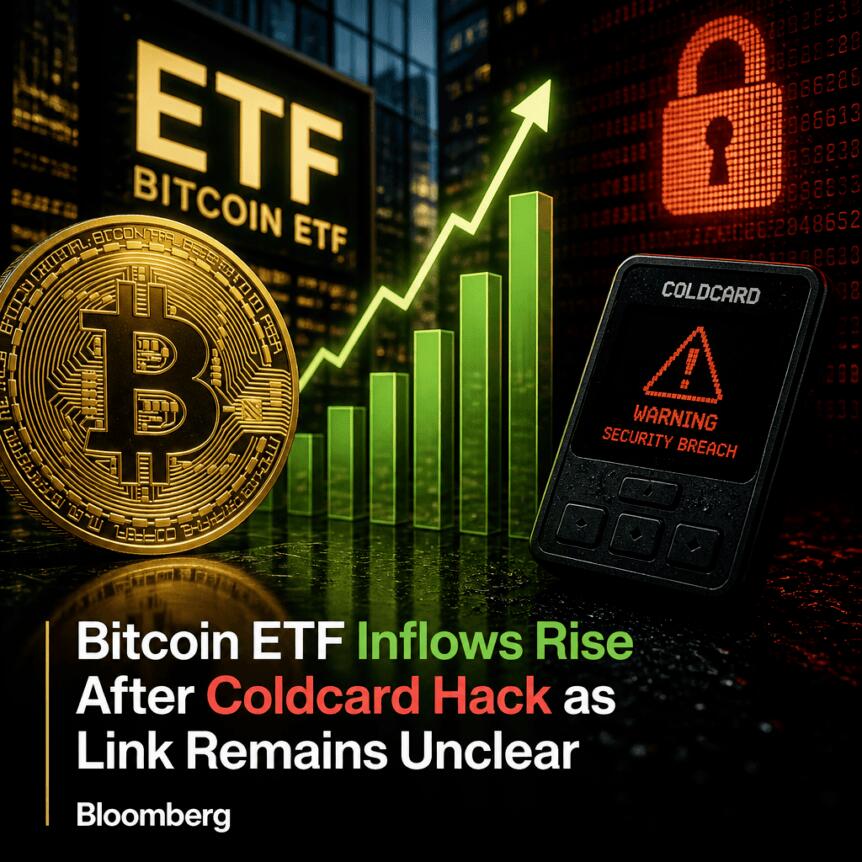
Demand for US spot Bitcoin exchange-traded funds (ETFs) picked up over the past week, according to Bloomberg ETF analyst Eric Balchunas, with multiple products posting inflows on every trading day since the Coldcard wallet exploit. The timing has sparked fresh discussion about whether some investors are reassessing the risks of self-custody.
Balchunas said that BlackRock’s iShares Bitcoin Trust (IBIT), Fidelity’s Fidelity Wise Origin Bitcoin Fund (FBTC), Bitwise’s Bitcoin ETF (BITB), ARK 21Shares’ Bitcoin ETF (ARKB), and Defiance Daily Target 2X Long MSTR ETF (MSBT) all recorded inflows every day since the weekend breach. The combined total was roughly $620 million, aligning with Cointelegraph’s earlier reporting on an ETF inflow streak.
Key takeaways
- Bloomberg’s Eric Balchunas attributes the latest run of daily inflows (about $620 million) to several major spot Bitcoin ETFs starting after the Coldcard exploit.
- TRM Labs estimates the Coldcard attack drained more than $116 million in Bitcoin from over 5,200 wallet addresses.
- Balchunas cautioned that a direct connection between the hack and ETF buying is unproven, but acknowledged some investors may be shifting toward regulated custody.
- Industry figures including Binance co-founder Changpeng Zhao argued that, based on available data, exchange custody may be “statistically safer” than self-custody—though underreporting remains a concern.
- Broader security debates are intensifying as AI-assisted exploits accelerate the pace at which vulnerabilities are identified and attacked.
Spot Bitcoin ETFs see daily inflow streak after Coldcard exploit
In his update shared on X, Balchunas highlighted a multi-day pattern of inflows across several leading spot Bitcoin ETFs. The list included large, established issuers (including BlackRock and Fidelity) as well as other active fund providers. Per Balchunas, inflows have continued every trading day since the weekend of the Coldcard exploit, with the group’s cumulative figure landing at roughly $620 million.
Cointelegraph previously reported on the continuation of a Bitcoin ETF inflow streak, noting that the latest totals were consistent with that trend. Together, the data suggest that recent capital flows have been persistent rather than limited to a single “reaction” day after the incident.
Still, Balchunas explicitly framed the connection as speculative. “I’m not saying it’s connected, we just don’t know,” he wrote, while adding that over the long term he can’t imagine there aren’t investors who choose to migrate away from self-custody after incidents like this.
Coldcard hack highlights exposure even for hardware wallet users
The renewed self-custody debate traces back to the Coldcard wallet exploit. Cointelegraph reported that the incident involved an attack against the Coldcard ecosystem, draining more than $116 million worth of Bitcoin from over 5,200 wallet addresses, according to blockchain intelligence firm TRM Labs.
For many participants in the market, hardware wallets are viewed as a last line of defense—designed to keep private keys offline and reduce the risk of direct theft through compromised online environments. However, the Coldcard incident underscored that end-to-end security still depends on firmware integrity and operational handling, and that even users of advanced self-custody tools may be vulnerable if software components are compromised.
Self-custody vs regulated custody: CZ’s “statistically safer” argument
The Coldcard hack fed into a longer-running argument about the relative risks of self-custody and centralized exchange (CEX) custody. Binance co-founder Changpeng “CZ” Zhao weighed in, suggesting that storing crypto on centralized exchanges could now be “statistically safer” than self-custody.
Zhao pointed to analysis by Willy Woo, claiming that cumulative Bitcoin losses from self-custody incidents have surpassed losses from exchange hacks. In his X post, Zhao also argued that differences in reporting make direct comparisons difficult: “Hack data is easier to collect on the CEX side, usually major news. It is harder on the self-custody side, where hacks, lost coins, etc are often not reported.”
That framing matters for investors because it shifts the conversation from a purely technical question (“Which custody model is more secure?”) to an evidentiary one (“Which system’s failures are more visible and therefore easier to measure?”). Until self-custody incidents are tracked with the same completeness as major exchange events, any conclusion about relative safety remains inherently asymmetric.
Security pressure is mounting as AI-assisted attacks evolve
Beyond the Coldcard case, the broader cyber threat landscape is intensifying. Cointelegraph earlier reported that on Monday, Bitcoin swap service Boltz suspended its non-custodial bridge after citing a steady rise in AI-assisted exploits. The service said attackers were using artificial intelligence to identify and exploit vulnerabilities faster than its team could patch them.
While that suspension does not confirm a direct link to the Coldcard incident, it reinforces a common theme across current security discussions: defenders face a faster and more adaptive attack cycle. For ordinary users, this can translate into a growing sense that the gap between “known risks” and “unknown vulnerabilities” is narrowing.
For ETF investors, the implication is more indirect but still important. Regulated investment products typically centralize custody with institutional providers and established operational controls, meaning some risks are moved away from individual users and into broader compliance and security frameworks. Whether that results in higher safety in practice is difficult to quantify, but the market’s recent capital flows suggest that at least some investors are paying close attention to custody trade-offs after high-profile self-custody failures.
Going forward, readers should watch whether the daily inflow pattern persists beyond the immediate post-incident window, and whether additional analysis clarifies how (or if) the Coldcard exploit influenced investor behavior. The key open question is whether the ETF buying reflects a short-term narrative shift or a longer-term reallocation toward regulated custody.

United Wholesale Mortgage at the NYSE, January 22, 2021
Source: The New York Stock Exchange
Shares in UWM Holdings, parent of United Wholesale Mortgage, plunged 40% on Thursday after the biggest U.S. mortgage lender suspended its dividend and raised fresh capital.
UWM announced a $2.05 billion equity investment from Oaktree Capital Management and SFS Group Capital LLC, a newly formed investment vehicle owned by family of CEO Mat Ishbia. The family is also the majority owner of the NBA’s Phoenix Suns.
Pontiac, Michigan-based UWM also said it suspended its quarterly dividend to preserve capital.
“We’re taking decisive action to make UWM stronger, more liquid and better positioned to win for years to come,” Ishbia said in a statement.
UWM shares have now collapsed about 85% from their 52-week high, set in September 2025.

UWM Holdings year to date
The capital raise comes as UWM’s financial position weakened during the latest quarter. Total equity fell to about $1 billion as of June 30 from $1.6 billion at the end of March, while available liquidity stood at approximately $1.3 billion, including $498 million in cash and borrowing capacity.
The moves come as mortgage lenders continue to grapple with one of the toughest operating environments in years. Investors have recently pushed up Treasury yields amid renewed expectations that benchmark Federal Reserve lending rates could stay where they are or even move up in the face of stubborn inflation. Elevated mortgage rates that are tied to the Treasury market have in turn kept homebuyers on the sidelines and limited refinancing activity, further dimming the outlook for the housing market.
UWM lost $451.9 million on revenue of $888 million in the second quarter, reversing net income of $170.4 million in the first quarter and a profit of $314.5 million a year earlier.
Mortgage originations totaled $39.7 billion in the second quarter, down from $44.9 billion in the prior quarter but were essentially unchanged from a year earlier.
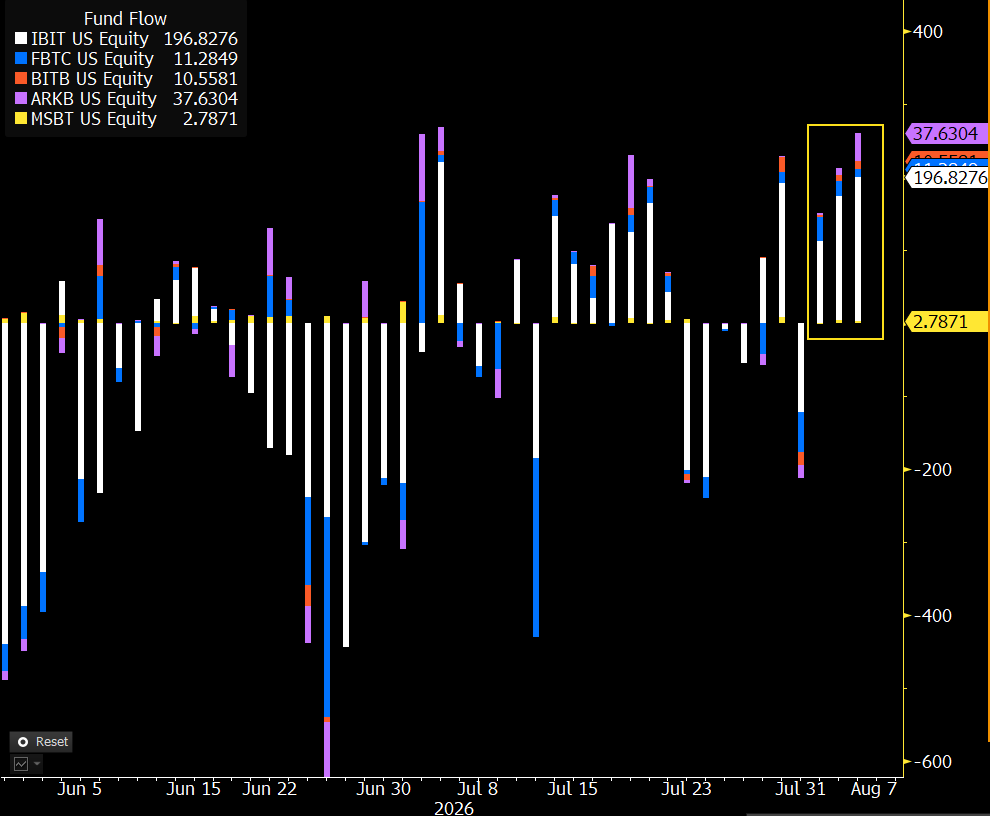
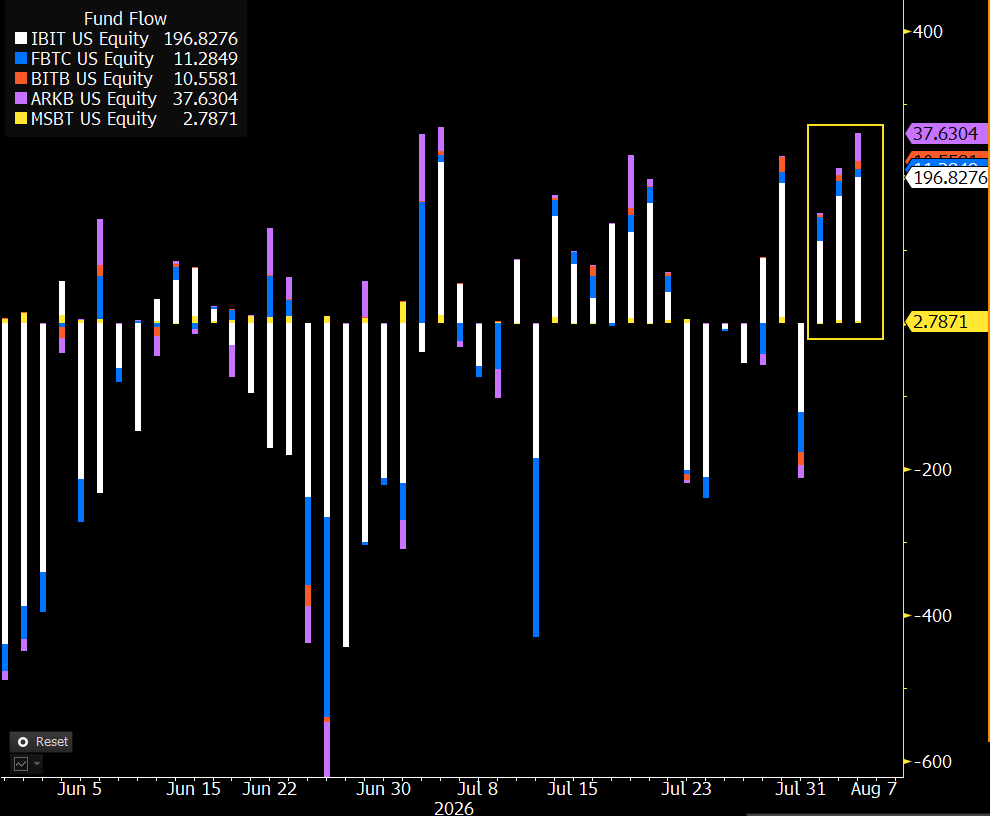
Demand for US spot Bitcoin exchange-traded funds (ETFs) has accelerated over the past week, with a string of daily inflows coinciding with the Coldcard wallet hack — timing that has prompted speculation about whether some investors are reconsidering self-custody.
According to Bloomberg senior ETF analyst Eric Balchunas, BlackRock’s iShares Bitcoin Trust (IBIT), Fidelity Wise Origin Bitcoin Fund (FBTC), Bitwise Bitcoin ETF (BITB), ARK 21Shares Bitcoin ETF (ARKB) as well as Defiance Daily Target 2X Long MSTR ETF (MSBT) have recorded inflows every trading day since the weekend exploit, totaling roughly $620 million. The cumulative figure is consistent with Cointelegraph’s recent reporting on the ETF inflow streak.
The Coldcard exploit drained more than $116 million worth of Bitcoin from over 5,200 wallet addresses, according to blockchain intelligence firm TRM Labs.
“I’m not saying it’s connected, we just don’t know,” Balchunas said in a post on X. “[Although] long-term I can’t imagine there aren’t some who migrate over.”
Source: Eric Balchunas
Related: Bitcoin Red Team reports 5K findings in sweeping security audit
Coldcard exploit renews debate over self-custody risks
The Coldcard hack renewed concerns that even hardware wallet users can be exposed to firmware flaws and software vulnerabilities, highlighting the operational risks that come with self-custody.
The incident also reignited debate over the trade-offs between holding Bitcoin directly and gaining exposure through regulated investment products such as spot Bitcoin ETFs, where asset custody and security are handled by institutional providers.
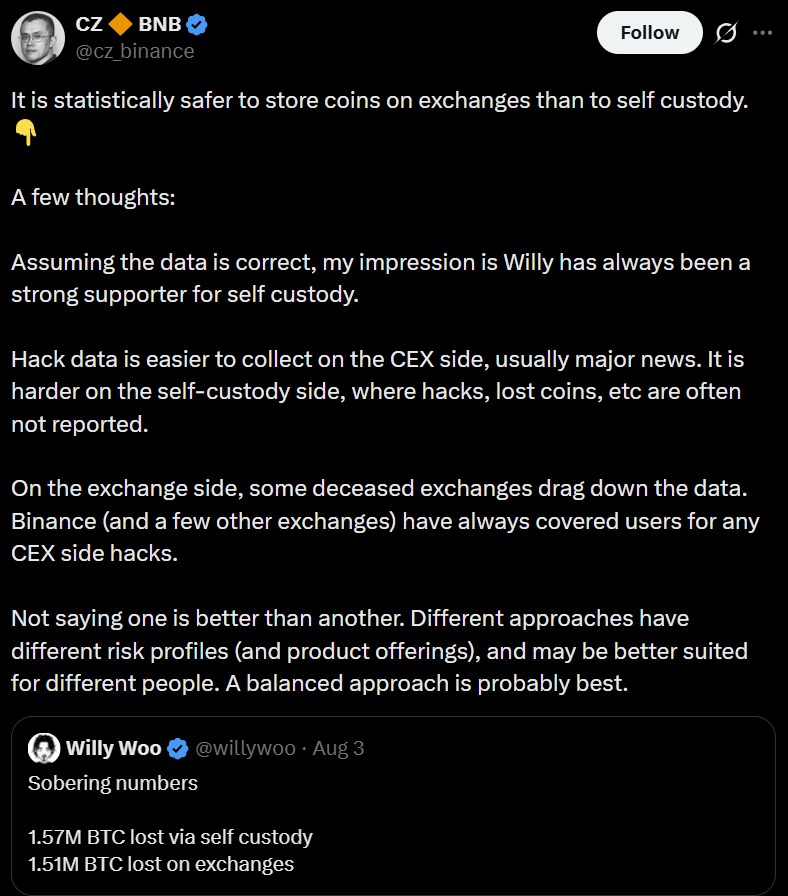
Binance co-founder Changpeng “CZ” Zhao also weighed in on the debate, arguing that storing crypto on centralized exchanges may now be “statistically safer” than self-custody, citing data from analyst Willy Woo that cumulative Bitcoin losses from self-custody incidents have surpassed those from exchange hacks.
Source: Changpeng Zhao
“Hack data is easier to collect on the CEX side, usually major news. It is harder on the self-custody side, where hacks, lost coins, etc are often not reported,” CZ said.
The debate comes as AI-assisted cyberattacks are becoming increasingly sophisticated. On Monday, Bitcoin swap service Boltz suspended its non-custodial bridge, citing a steady rise in AI-assisted exploits that were allowing attackers to identify and exploit vulnerabilities faster than its team could patch them.
Magazine: Do the Coldcard attacks mean all hardware wallets are now insecure?
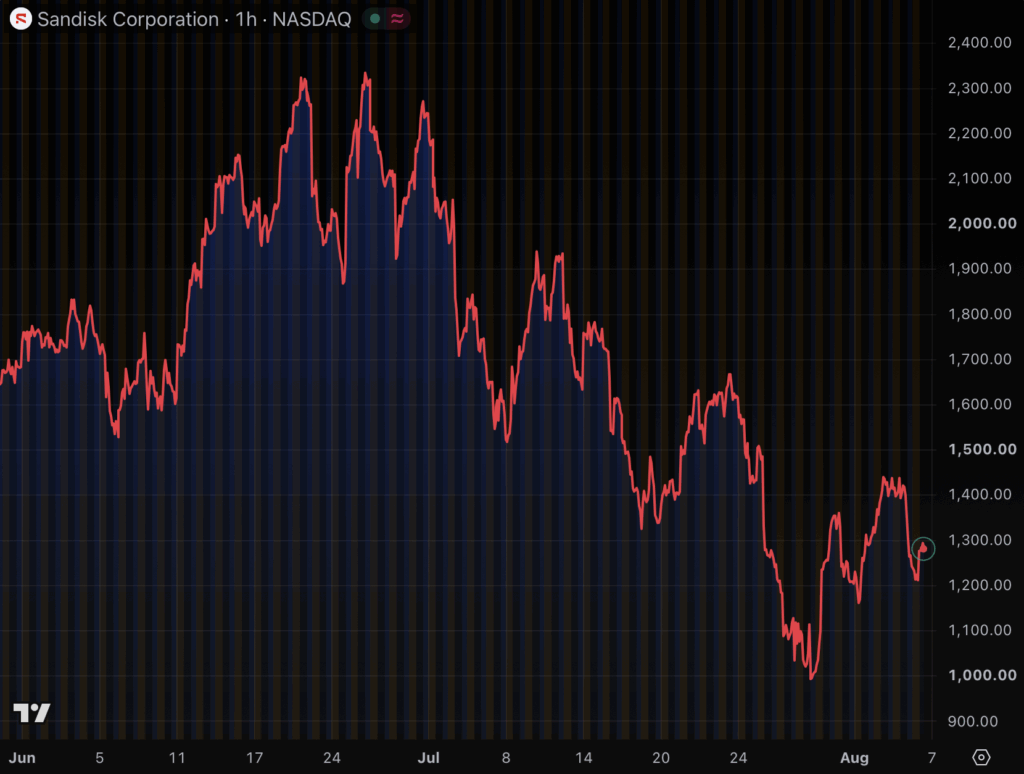
This morning, Jefferies slashed its price target on SanDisk stock 42% from $3,000 to $1,750. ZeroHedge laughed out loud at the drastic action.
Just six weeks ago, on June 26, analysts at the investment bank had set their $3,000 price target. Nonetheless, SanDisk stock price is down, even after the AI chipmaker reported the best quarterly earnings in its history yesterday.
Its most recent quarterly revenue was a 372% year-over-year gain to $8.97 billion, far surpassing its own guidance range of $7.75-8.25 billion.
Non-GAAP gross margin landed at 84.6%, dwarfing the prior year’s 26.4% and beating its guidance range of 79-81%. Non-GAAP earnings of $39.25 per share beat a FactSet consensus of analysts’ estimates by more than 12%.
Numbers from the blockbuster quarter were invariably positive. Data center revenue, the business SanDisk spent a year building, grew 103% in a single quarter to $2.98 billion.
Chairman and CEO David Goeckeler told analysts the company “delivered record revenue, gross margin, and earnings per share, each above the high end of our guidance, and repurchased $4.5 billion of company stock.”
Then, the board authorized another $14 billion of share buybacks.
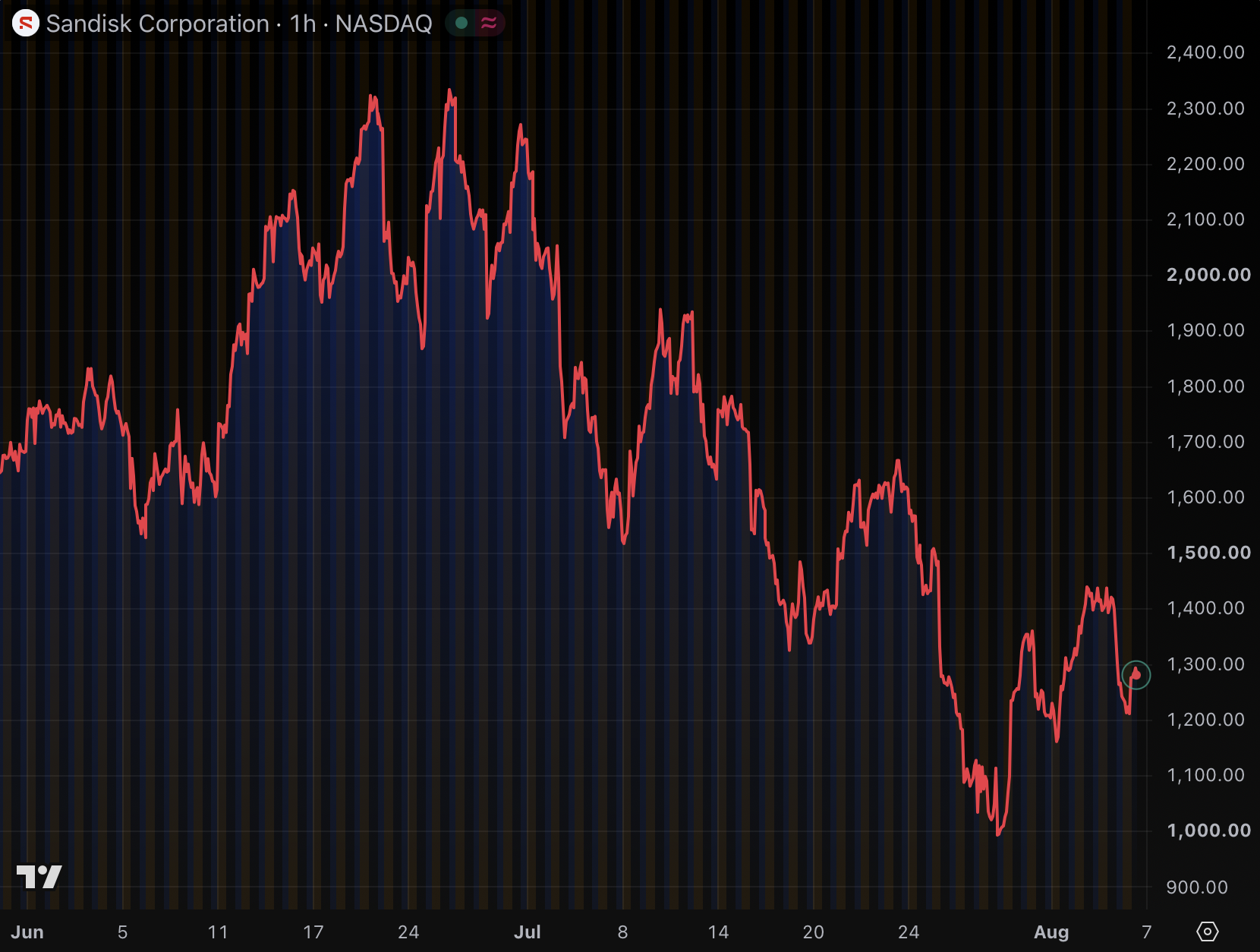
SanDisk has lost a quarter of its value in a month
Despite these celebratory figures, SanDisk’s stock has crashed by 25% over the past month.
Analysts cut estimates. Susquehanna reduced 6%; Evercore trimmed to $2,800 from $3,100; Citi dropped from $2,500 to $2,100; Jefferies cut 42%, the deepest of them all.
Read more: Amazon gained the market cap SpaceX lost in six weeks
Today’s reduction to $1,750 is Jefferies’ first interruption of an up-only trend.
Its analyst, Blayne Curtis, has raised Jefferies’ price target on SanDisk seven times since July 2025 from $60 to $3,000. His rating was “buy” at every rung.
Morgan Stanley analyst Joseph Moore reached his $1,750 price target on June 3 and left it alone through Sandisk’s record earnings report and the stock’s slide.
Jefferies has now spent nine weeks traveling to the same number via $3,000.
Got a tip? Send us an email securely via Protos Leaks. For more informed news and investigations, follow us on X, Bluesky, and Google News, or subscribe to our YouTube channel.

Koray Kavukcuoglu, DeepMind’s chief technology officer, will replace Hassabis at the helm of DeepMind, though in a senior vice president position rather than as CEO, Google boss Sundar Pichai wrote in a memo on Wednesday.
Kavukcuoglu had been taking responsibility for the development of Gemini long before Wednesday’s news. In company briefings, Kavukcuoglu would lead Gemini discussions, and Hassabis had been absent from many day-to-day meetings about Gemini, attending only for the most significant ones, one DeepMind employee tells TIME. Meanwhile, Hassabis was regularly present for meetings about post-AGI readiness, safety, and AI governance, the person said, and was spending more of his time working with governments, including attending the recent G7 summit.
“Koray’s philosophy has always been clear: advancing the frontier of AI and building it responsibly are the exact same mission,” a Google spokesperson said in a statement. “Frontier model safety has lived directly within the Gemini team from the very beginning, under Koray’s leadership. His teams collaborate closely with the safety and policy teams across Google and Google DeepMind, and that will continue.”


Banco Santander, the Spanish banking group with more than $16 billion in disclosed U.S. equity holdings, reported a stake in BlackRock's iShares Bitcoin Trust for the first time, according to a 13F filing submitted to the Securities and Exchange Commission on Wednesday. The filing shows 129,615… Read the full story at The Defiant


A federal appeals court has issued its mandate affirming Sam Bankman-Fried’s fraud conviction, 25-year prison sentence and $11 billion forfeiture order.
Summary
- The Second Circuit formally upheld seven felony convictions against the former FTX chief.
- Bankman-Fried’s 25-year prison sentence and roughly $11 billion forfeiture order remain in place.
- The court rejected claims that FTX’s later asset recovery weakened the government’s fraud case.
- A Supreme Court petition or presidential clemency now represents his clearest remaining options.
Second Circuit closes Bankman-Fried appeal
The U.S. Court of Appeals for the Second Circuit filed its mandate on Aug. 4, putting its June 12 judgment into effect and returning jurisdiction over the case to the lower court.
The mandate formally affirmed the judgment issued by the U.S. District Court for the Southern District of New York. A jury convicted Bankman-Fried in November 2023 on seven counts of fraud and conspiracy tied to the collapse of FTX and its affiliated trading firm, Alameda Research.
U.S. District Judge Lewis Kaplan sentenced him to 25 years in federal prison in March 2024. Kaplan also imposed a forfeiture order of approximately $11 billion.
The three-judge appellate panel unanimously rejected Bankman-Fried’s effort to overturn both his conviction and sentence. Judges Barrington Parker, Eunice Lee and Maria Araújo Kahn found no reversible error in the trial court’s evidentiary decisions or jury instructions.
“For the reasons set forth below, we affirm the judgment of the district court,” the panel said in its June opinion.
The mandate adds no new legal reasoning. It makes the earlier appellate ruling official and closes the regular proceeding before the three-judge panel.
FTX repayments did not erase the fraud
Bankman-Fried argued that the trial court unfairly restricted evidence suggesting FTX held assets that could eventually make customers whole. His defense maintained that the exchange had sufficient value and that creditors’ losses were not necessarily permanent.
The Second Circuit rejected that argument. It ruled that wire fraud occurred when customer funds were transferred to Alameda without authorization, regardless of whether Bankman-Fried believed the money could later be repaid.
“As the district court made clear, FTX customers were defrauded as soon as Bankman-Fried transferred their money to Alameda regardless of how strongly he believed he might later return the money,” Parker wrote.
The court also found that evidence about the subsequent value of FTX-linked investments was not relevant to whether the initial transfers constituted fraud. Prosecutors presented evidence that customer assets funded investments, political donations and real estate purchases while Bankman-Fried publicly claimed the deposits were safe.
The decision separates Bankman-Fried’s criminal liability from the recovery creditors may receive through FTX’s bankruptcy proceedings.
FTX creditor payments continue separately
As crypto.news reported, FTX scheduled its fifth creditor distribution for July 31, with nearly $900 million expected to reach claimants holding approved Convenience and Non-Convenience Class claims.
Eligible creditors had to complete the exchange’s pre-distribution requirements by the June 16 record date. Kraken, Payoneer and BitGo were among the approved providers handling payments.
The distributions arise from FTX’s Chapter 11 reorganization plan and do not reverse the criminal findings against Bankman-Fried. The appeals court said later repayment or asset appreciation could not excuse the original misuse of customer funds.
The distinction is relevant to U.S. creditors, some of whom may recover approved bankruptcy claims while Bankman-Fried continues serving his federal sentence.
Supreme Court or clemency remain possible
Bankman-Fried can still ask the U.S. Supreme Court to review the case. The Supreme Court accepts only a small share of petitions, and filing one would not automatically suspend his sentence or overturn the appellate mandate.
Presidential clemency provides another route outside the courts. Bankman-Fried has publicly said he wants a pardon, but President Donald Trump said in January that he was not considering one.
Political resistance has also grown. In July, the U.S. Senate passed a nonbinding resolution by unanimous consent opposing a pardon, commutation or other form of federal clemency for the former FTX executive.
The resolution does not limit the president’s constitutional pardon power. However, it signals bipartisan opposition to reducing Bankman-Fried’s punishment as FTX continues returning recovered assets to creditors.
Lumber futures have fallen for 10 consecutive sessions, their longest losing streak since December 2024. The lumber price trades near $586 after a sharp rejection from the $650 resistance zone.
The slide matters well beyond the timber trade. Lumber demand tracks US homebuilding almost one to one, and the streak arrived while builder confidence sits near multi-year lows.
Why Lumber Price Is Falling Despite a Supply Squeeze
Barchart data shows lumber has closed lower for 10 straight days, a streak unseen since December 2024. Two weeks ago, however, the market told the opposite story.
Futures touched $650 per thousand board feet on July 28, a 12-month high. The rally had gained over 30% from December lows as supply shocks piled up.
The Wall Street Journal reported that steep duties on Canadian lumber, wildfires, and sawmill closures had cut supply and lifted prices. More than 900 wildfires burned across Western Canada, the source of most US softwood imports.
Combined duties near 35% also add roughly $10,000 to the cost of a new American home, according to the NAHB. Nevertheless, prices collapsed the moment demand weakness took over.
US construction spending on single-family projects fell 3.3% year-over-year in June, per TradingEconomics. Therefore, a market falling this hard against a constrained supply base points to demand destruction, not oversupply.
US Housing Market Cracks Keep Widening
The demand rot shows up across housing data. The NAHB/Wells Fargo Housing Market Index (HMI) fell to 34 in July, its 15th straight month below 50. That is the longest weak stretch since 2012.
Meanwhile, 37% of builders cut prices in July, at an average discount of 6%. Robert Dietz, chief economist at the NAHB, described the pressure directly in the group’s July report.
“Affordability remains the home building industry’s primary challenge.”
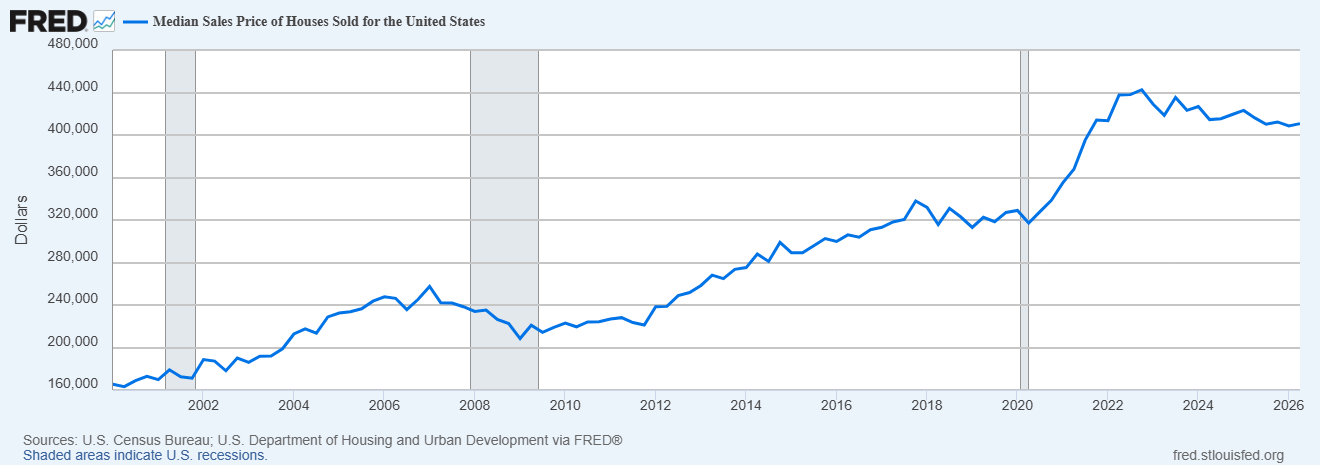
Slower-moving data confirms the trend. The median sales price of US homes peaked near $440,000 in late 2022, according to FRED. It has since drifted to roughly $410,000, the longest stretch of price weakness since 2008.

Residential construction absorbs an estimated 70% to 80% of North American wood demand. Consequently, lumber acts as a real-time gauge of housing health, and it now joins other unusual indicators flashing late-cycle warnings. Prediction markets have already lifted US recession odds this year.
Lumber Price Prediction Hinges on $580 Support
On the daily chart, lumber broke down from the $650 resistance region after repeated failures in late July. The decline also cut through an ascending trendline that had supported the market since December 2025.
Lumber trades at $585.75 at the time of writing, down 0.9% on the day and pressing the $580 support zone. If buyers defend this area, the setup may favor a relief bounce.

The daily Relative Strength Index (RSI) sits in oversold territory at its lowest since September 2025, when a durable rebound followed. However, the broken trendline near $590 may now act as resistance and cap any recovery.
Level
Role
$650
Major resistance and July rejection zone
$590
Broken trendline, potential resistance
$580
Immediate support under test
$565
Next support if $580 breaks
In contrast, a decisive close below $580 would expose the next support at $565, about 3.5% lower. That zone has stopped several sell-offs since late 2025.
Beyond the chart, the main catalyst remains the Federal Reserve. Expected rate cuts could pull mortgage rates lower and revive builder demand for wood. A deeper housing slowdown, meanwhile, could ripple into risk assets, including crypto.
The next several sessions should reveal whether oversold conditions spark a rebound or the housing warning grows louder.
The post Lumber Falls for 10 Straight Sessions as US Housing Cracks Widen appeared first on BeInCrypto.

Bitcoin miners are increasingly positioning themselves as AI and high-performance computing (HPC) infrastructure providers, reshaping revenue models around hosting demand rather than solely on mining economics. But a new industry analysis suggests that the market’s excitement for fresh AI-capacity announcements has cooled—meaning new deals may be generating less immediate upside for stocks than they did in earlier waves of adoption.
According to an analysis by Blocksbridge Consulting, published in TheEnergyMag’s Miner Weekly, the impact of AI infrastructure deal news has weakened over the past two years. The report examined 25 AI and HPC infrastructure deals announced between June 2024 and August 2026, finding a clear decline in how much investors moved the day a deal was announced.
Key takeaways
- Blocksbridge Consulting reports the average announcement-day stock move for AI and HPC infrastructure deals fell from about 24% in the earliest cohort to roughly 10% in the most recent cohort.
- Median gains from these announcements dropped by about half over the same period, even as deal sizes and contract values increased.
- Revenue per contracted megawatt has edged higher over time, indicating AI hosting is becoming more lucrative, but the market is less impressed by headline contract totals.
- Examples of early CoreWeave-related deals triggered large one-day stock surges, while later “mega-deals” produced smaller or short-lived price reactions.
- TheEnergyMag’s TEM AI Infrastructure Growth Index is down about 28.5% from its June peak, aligning with a broader pullback in AI infrastructure-linked equities.
AI hosting deals are bigger, but the stock reaction is smaller
Blocksbridge Consulting’s review points to a market that is still allocating capital to AI infrastructure—but in a more selective way. While the report shows that revenue annualized per contracted megawatt has generally improved as time has passed, the way investors respond to deal announcements has changed.
The most striking trend is how much less “market-moving” announcements have become. Blocksbridge’s dataset shows the average announcement-day move falling steadily from around a mid-20% figure for earlier deals to near 10% for the latest. Median gains roughly halved as well, suggesting the market’s expectations have matured: investors may be focusing less on the fact that a deal exists and more on whether a company can reliably execute and monetize it.
The report also frames this as a shift away from reacting primarily to contract headlines toward questions like financing structure, execution capability, and long-term profitability—factors that can determine whether AI hosting becomes durable earnings rather than a one-off boost.
From blockbuster reactions to muted follow-through
Deal-by-deal reactions illustrate the pattern. In earlier examples, markets appeared to reward companies far more aggressively for landing AI hosting arrangements. Core Scientific’s initial hosting agreement with CoreWeave reportedly sent its shares up more than 40%. Applied Digital’s first CoreWeave lease gained nearly 49%, while TeraWulf’s first Fluidstack deal surged almost 60%.
More recent announcements, by contrast, have tended to generate smaller immediate moves—sometimes followed by fading gains. TeraWulf’s 401-megawatt lease with Anthropic lifted its shares by about 5%. CleanSpark’s $6.6 billion AI hosting agreement gained nearly 9%. Bitdeer’s new Tydal contract reportedly pushed its stock up roughly 12% at one point, but those gains disappeared by the close.
For investors, this difference matters because it can signal a reduced probability that “new capacity” news automatically translates into near-term outperformance. If the market expects more deals to follow—and has already priced in a portion of AI hosting growth—then additional announcements may only narrow the gap between winners and laggards rather than create fresh upside broadly.
Bitcoin miners’ AI pivot meets a more cautious equity market
The muted deal reaction trend also shows up in broader performance among AI-leaning miners and infrastructure operators. TheEnergyMag’s TEM AI Infrastructure Growth Index, which tracks publicly traded companies building AI data center and digital infrastructure businesses, is down roughly 28.5% from its June peak. That decline suggests investor caution has risen even while underlying demand for AI infrastructure has remained strong.
Notably, TheEnergyMag’s index is still higher over the past year, but its momentum appears to have slowed in recent months. This is consistent with the idea that the market may be rebalancing: investors may believe in the long-term direction of AI infrastructure, yet be less willing to pay large premiums for announcements until execution risk, customer retention, and the path to sustained margins become clearer.
The report’s slowdown narrative aligns with a wider pullback in related equities. The Philadelphia Semiconductor Index reportedly fell nearly 17% from its July peak, reinforcing the sense that risk appetite across technology-linked sectors has cooled rather than AI demand disappearing overnight.
What investors should watch next
As AI hosting arrangements become more commonplace, the key question is likely to shift from “who lands the next contract?” to “who converts contracted megawatts into dependable, financed, and profitable operations.” Readers should watch for evidence that revenue per contracted megawatt keeps rising, while companies demonstrate execution—especially in financing structures and long-term profitability—so markets have less reason to fade gains after major announcements.
Binance Pauses Services and Delists Several Crypto Pairs: Who Is Affected?

Asian Games 2026, men’s cricket: India full schedule and live match timings | Cricket News

Hisense Adds Dolby Vision 2 Max to Select 2026 TVs With Software Update

Renter of Home in Anne Heche Crash Denies Settlement With Son

No Jackpot Winner as $257 Million Prize Rolls Over to $269 Million Monday Draw

Weekend Open Thread: Staud – Corporette.com

Why She Said No to a $20 Million Settlement Deal #shorts #money

Cryptocurrency Halal or Haram? #muftitariqmasood #tariqmasood #crypto #cryptocurrency

How To Use Money Wisely: Unlock Financial Freedom With Myles Munroe | MunroeGlobal.com
-

 Fashion6 days ago
Weekend Open Thread: Wit & Wisdom
-

 Politics6 days ago
Meta enters AI-training agreement with far-right ‘propaganda rag’ Newsmax
-

 Politics4 days ago
Zack Polanski: an incitement to murder Nigel Farage?
-

 Crypto World5 days ago
MicroStrategy Post-Earnings CLARITY Act Push Could Add New Catalyst for Its Stock
-

 Crypto World6 days ago
XRP Ledger v3.3.0 brings five institutional features
-

 Sports7 days ago
Seema Kaliramna Wins Discus Throw Bronze, Takes India’s CWG Medals Tally To 17
-

 Crypto World6 days ago
New York sues Kalshi over prediction market gambling
-

 Crypto World4 days ago
Crypto PAC spending tops $2M in Michigan House race
-

 Business4 days ago
DTCR: Deleveraging And A Hedge Fund Collapse Point To A Possible AI Bottom
-

 Business6 days ago
Trump Announces Hamas Disarmament Agreement as Iran Strikes Kuwait Air Base and US Attacks Pause Overnight
-
 Crypto World6 days ago
3 Fed Officials Just Explained Their Rate Hike Vote: Is Inflation Winning?
-

 Tech5 days ago
ESET tracks rise in malicious AI skills and adaptable malware
-

 Tech6 days ago
Gemini Spark can now use Chrome logins and saved passwords to run errands on your behalf
-

 Sports5 days ago
France Cricket implodes: letters hidden in a drawer and a board at war
-

 Tech6 days ago
Building A Reproduction PlayStation Motherboard
-
Crypto World4 days ago
XRP Ledger urges node upgrade after manifest flood
-

 Crypto World6 days ago
Moneyflip CEO charged in $40K murder-for-hire plot
-
 Sports6 days ago
Bruno Fernandes decision made as Man United ‘discuss’ striker transfer option
-

 News Videos5 days ago
Financial Crash Expert: The 90-Day Collapse Timeline They Are Desperately Hiding.
-

 NewsBeat7 days ago
Spain sending troops as thousands enter enclave of Ceuta from Morocco
You must be logged in to post a comment Login