

Crypto World
Bitcoin’s Drop Below $80K Was Not Random: Here Are the 3 Hidden Triggers


After flying past $82,000 at the start of the week, Bitcoin fell below $79,000 at one point yesterday before recovering near $80,000.
According to analysts, that selloff was not random, but rather, it was the result of three different pressures hitting at the same time.
What the On-Chain Data Showed Before the Drop
The warning signs were building way before prices moved, as noted by on-chain technician Easy On Chain, who said that exchange outflows on May 11 had already collapsed to 19,995 BTC. That number is far below the early May range of 28,000 to 35,000 BTC and well under the period’s daily average of 25,600 BTC.
When outflows fall that sharply, it means that there are fewer coins being withdrawn from exchanges, which means the sell-side supply sitting on platforms is growing rather than shrinking. That is what Easy On Chain calls a “positive Netflow,” and it made the market’s ability to absorb downward pressure considerably weaker.
At the same time, the derivatives market was pricing in a decline. Between May 8 and 10, open interest climbed to 1.04 times the analysis period’s average, while funding rates turned negative and kept deepening into May 10.
It means that traders were actively building short positions, betting on a drop, and when the selling pressure finally arrived, it hit a market full of leveraged longs with nowhere to go.
“On May 12 alone, long liquidations reached 11.8 times the short liquidations,” the market watcher wrote. “Over three days (May 11-13), a total of approximately $109.7M in long positions were forcefully liquidated, acting as the primary driver of the crash.”
Finally, there was the release of US CPI and PPI data, which, alongside growing inflation concerns, gave traders the trigger they needed.
Another analyst, Carmelo Alemán, linked the move to concentrated whale selling, saying wallets holding between 1,000 and 10,000 BTC sold some 7,650 BTC during the decline, which was equal to about $616 million at average prices near $80,500.
That period saw Bitcoin drop from around $81,000 to below $79,000 while open interest went up by almost $590 million, a sign that fresh leverage entered the market as prices fell.
Where Bitcoin Stands Now
At the time of writing, BTC was almost 300 bucks below $80,000, after shedding about 2% of its value in the last 24 hours and a similar 2% over the past seven days.
However, across 30 days, the asset is up nearly 7%, although it is still down over 23% year-over-year and stuck more than 36% below its October 2025 all-time high near $126,000.
For now, Easy On Chain says traders should focus on two signals: whether exchange netflows return negative, which would show renewed withdrawals, and whether liquidation pressure in leveraged longs begins to cool. Until then, they claim, Bitcoin’s attempts to reclaim $82,000 may continue running into resistance.
The post Bitcoin’s Drop Below $80K Was Not Random: Here Are the 3 Hidden Triggers appeared first on CryptoPotato.


Key Takeaways
- New Street Research initiated coverage on 10 space industry stocks, assigning Buy recommendations to Rocket Lab, Viasat, EchoStar, and Space42.
- SpaceX aims to go public mid-2026 at a potential $2 trillion valuation.
- The Starship launch system could slash orbital delivery costs by 90% versus SpaceX’s own Falcon 9.
- Rocket Lab shares have surged 415% in the past year, with 80% of analysts rating it a Buy.
- Morgan Stanley projects the space sector could hit $1 trillion in value by 2040.
New Street Research has initiated coverage across 10 companies operating in the space sector, issuing Buy recommendations for four of them. The timing coincides with heightened market interest as SpaceX prepares for its highly anticipated public debut.
SpaceX is eyeing a mid-2026 initial public offering that could generate up to $75 billion in proceeds. At a potential valuation approaching $2 trillion, the listing would rank among history’s largest market debuts. New Street indicated it will initiate SpaceX coverage before the company goes public.
The firm characterizes space as “the next frontier,” projecting it could unlock trillions in economic value throughout the coming decades. New Street believes orbital systems will reshape sectors spanning telecommunications, national security, and artificial intelligence infrastructure.
Alphabet and SpaceX have both signaled plans to deploy AI computing facilities in space. Military and defense-focused space applications are projected to expand significantly in coming years.
Falling launch economics represent a critical catalyst for industry expansion. SpaceX’s Falcon 9 decreased space access costs by over 95% compared to the Space Shuttle era. The company’s next-generation Starship platform could deliver an additional 90% cost reduction versus Falcon 9.
New Street’s Preferred Space Investments
The four stocks receiving Buy ratings from New Street are Rocket Lab, Viasat, EchoStar, and Space42, headquartered in the UAE.
Rocket Lab stands out as the sole Western competitor to SpaceX in commercial launch services. The stock has rocketed 415% higher over the trailing 12 months. Analyst consensus targets approximately $105 per share, while New Street establishes its price objective at $150. Shares concluded Wednesday’s session at $124.15.
Roughly 80% of Wall Street analysts tracking Rocket Lab maintain Buy recommendations. The company is projected to achieve profitability by 2028.
Viasat and Space42 earned recognition for their spectrum portfolios — the radio frequencies essential for transmitting communications and data. EchoStar maintains an ownership position in SpaceX while also controlling valuable spectrum licenses.
Satellite communications providers AST SpaceMobile, SES, and Iridium were assigned Hold ratings. Eutelsat, Planet Labs, and Telesat received Sell recommendations.
Industry Outlook and Considerations
Morgan Stanley forecasts the global space economy could reach $1 trillion by 2040. However, analysts emphasize significant risks accompany the sector — substantial capital requirements, heavy dependence on government contracts, and intricate technological challenges.
Lockheed Martin stands as one of the industry’s dominant participants. Space-related operations contribute over 15% of company revenue, with additional involvement in hypersonic weapons and satellite production through a joint venture with Boeing.
L3Harris broadened its space capabilities via the 2023 purchase of Aerojet Rocketdyne, which at the time was one of just two domestic manufacturers of large rocket propulsion systems.
AST SpaceMobile is developing technology to enable standard smartphones to communicate directly with satellites. While the company has secured partnerships with wireless carriers, it faces substantial expenses to deploy its complete satellite constellation.
Rocket Lab currently trades at 111 times forward 12-month sales. New Street’s $150 price target incorporates assumptions including 30 times anticipated 2030 operating earnings.
EchoStar shares finished Wednesday at $133.23, compared to New Street’s $161 target. Viasat closed at $70.58, versus the firm’s $100 price objective.

Crypto World
AST SpaceMobile (ASTS) Stock Gains Momentum After Major Carriers Announce Satellite Partnership

Key Takeaways
- America’s three largest wireless carriers—AT&T, Verizon, and T-Mobile—are creating a collaborative venture to leverage satellite technology for eliminating cellular coverage gaps nationwide.
- Shares of AST SpaceMobile climbed approximately 2.1% following the announcement, after reaching nearly 5% gains earlier in the session.
- AST SpaceMobile maintains existing partnerships with both AT&T and Verizon, positioning the joint venture as confirmation of its direct-to-device satellite approach.
- The space communications company requires between 45 and 60 operational satellites for full commercial deployment but operates only six currently, with progress hampered by a Blue Origin launch mishap in April.
- First-quarter 2026 financial results significantly underperformed projections—posting a loss of $0.66 per share versus the anticipated $0.21 loss—though management maintained its ambitious $1 billion revenue forecast for 2027.
In an unprecedented move, AT&T, Verizon, and T-Mobile—fierce competitors in the wireless market—revealed plans Thursday to establish a joint venture aimed at eliminating cellular connectivity gaps throughout the United States through satellite-powered networks. The telecommunications giants intend to combine their spectrum assets to enhance network capacity and expand satellite operators’ customer reach.
The partnership remains contingent upon finalizing a comprehensive agreement, and each carrier retains the flexibility to pursue independent connectivity initiatives.
AST SpaceMobile benefited immediately from the disclosure. Shares of ASTS gained 2.1% during early Thursday market activity, following an earlier spike approaching 5% immediately after the news broke.
The strategic significance is considerable. AST SpaceMobile has established commercial agreements with both AT&T and Verizon to provide direct-to-smartphone connectivity—eliminating the need for specialized equipment. This newly announced joint venture essentially confirms the viability of AST’s strategic direction: delivering 5G-grade voice communications, data transmission, and video streaming capabilities via low Earth orbit satellites.
Chief Executive Abel Avellan expressed optimism regarding the development. “AST SpaceMobile is happy to see how the industry is preparing to enable space-based cellular broadband connectivity to every American,” he said. “We plan to be a key enabler of this transformation.”
The Satellite Deployment Challenge
A significant obstacle remains. AST SpaceMobile currently operates just six satellites, while requiring 45 to 60 functioning units to deliver commercial service across northern latitudes. The company projects achieving this milestone by year-end 2025.
That schedule suffered a setback in April following a failed Blue Origin launch mission that was scheduled to deploy an AST satellite. The carriers explicitly stated their intention to collaborate with multiple satellite providers—meaning AST SpaceMobile cannot afford significant delays.
Competitive dynamics are intensifying. SpaceX has committed to launching Starlink Mobile service before 2027 concludes, while Amazon entered the sector through its Globalstar acquisition, targeting a 2028 market entry.
William Blair, maintaining its Market Perform stance on ASTS this week, observed substantial stock volatility—including a 10% after-hours decline in one recent trading session that reversed a 10% increase from the previous day. Notwithstanding these fluctuations, ASTS has surged approximately 204% over the trailing twelve months and commands a market capitalization near $32 billion.
First Quarter Performance Falls Short
AST SpaceMobile’s recently reported first-quarter 2026 financial performance significantly underperformed Wall Street expectations. The company recorded an earnings per share loss of $0.66 compared to consensus estimates of a $0.21 loss. Revenue reached $14.7 million, falling short of analyst projections of $37.48 million.
Notwithstanding the disappointing results, AST SpaceMobile maintained its revenue guidance and highlighted advances in satellite technology development, which helped stabilize investor sentiment following the earnings release.
Management also confirmed its $1 billion revenue objective for 2027 during the quarterly earnings conference call. William Blair indicated its belief that favorable developments have emerged concerning the New Glenn rocket anomaly investigation, although AST SpaceMobile faces restrictions on public disclosure of specifics.

Key Takeaways
- Treasury Secretary Scott Bessent revealed expectations for a substantial Boeing aircraft order from China coinciding with President Trump’s Beijing summit.
- Boeing (BA) shares advanced 1.2% in premarket sessions Thursday after Bessent’s CNBC interview aired.
- Negotiations extend to increased Chinese acquisitions of American energy products and agricultural commodities.
- Officials from both nations are discussing innovative investment frameworks, including proposed “Board of Trade” and “Board of Investment” mechanisms.
- Bessent emphasized the strategy focuses on increasing American exports to China instead of reducing import volumes.
Boeing (BA) shares gained 1.2% during Thursday’s premarket session following remarks from Treasury Secretary Scott Bessent, who indicated China plans to announce a substantial aircraft purchase from Boeing while President Donald Trump’s delegation conducts meetings in Beijing.
“I think we’re going to see the large Boeing orders,” Bessent stated during his appearance on CNBC’s “Squawk Box.”
These remarks emerged as American and Chinese representatives launched a two-day economic summit aimed at recalibrating financial relationships between the planet’s two dominant economies.
The anticipated Boeing purchase is positioned as a centerpiece achievement from the Beijing negotiations. Such an announcement would represent a significant pivot following years of commercial tensions between the two superpowers.
Bessent indicated the scope of discussions reaches well beyond aviation. Enhanced Chinese procurement of American energy resources and farm products remains under consideration, alongside innovative structures enabling Chinese capital deployment in non-critical American industries.
Energy Imports and Investment Structures Under Discussion
Regarding energy commerce, Bessent noted Chinese representatives have shown appetite for increased purchases of American liquefied natural gas, especially as additional export infrastructure becomes operational.
Agricultural commerce features in the dialogue as well, though Bessent observed that soybean purchase obligations are essentially predetermined through current agreements.
Both governments are examining two novel bilateral oversight mechanisms: a “Board of Trade” and a “Board of Investment.” These structures would facilitate Chinese capital deployment in America while avoiding national security examination processes.
“What we want to do is make sure that these investments don’t get referred to CFIUS,” Bessent explained, referencing the Committee on Foreign Investment in the United States.
He additionally dismissed speculation regarding enormous capital pledges from Beijing. “I’m not sure where this $1 trillion investment number has come from,” he remarked.
Trade Balance Restoration Remains Primary Objective
Bessent articulated the overarching purpose driving the negotiations: achieving equilibrium in bilateral commerce between both nations.
“That’s the goal here, and that can be done one of two ways — either the U.S. receives fewer imports from China, or we sell more to China,” he explained. “We’re trying to balance that out.”
His comments suggested a preference toward expanding American export volumes rather than implementing import restrictions.
Boeing has traditionally served as a primary recipient of commercial benefits from U.S.-China trade agreements. Chinese aviation companies constitute a substantial portion of global demand for Boeing’s passenger aircraft.
The aerospace manufacturer has navigated challenging conditions throughout recent years — manufacturing complications, regulatory oversight intensification, and fluctuating market demand have collectively pressured the enterprise. A significant Chinese aircraft order would deliver meaningful operational momentum.
Boeing (BA) shares advanced 1.2% during Thursday’s premarket trading. The official order revelation, should it materialize, is anticipated during Trump’s ongoing Beijing diplomatic mission.
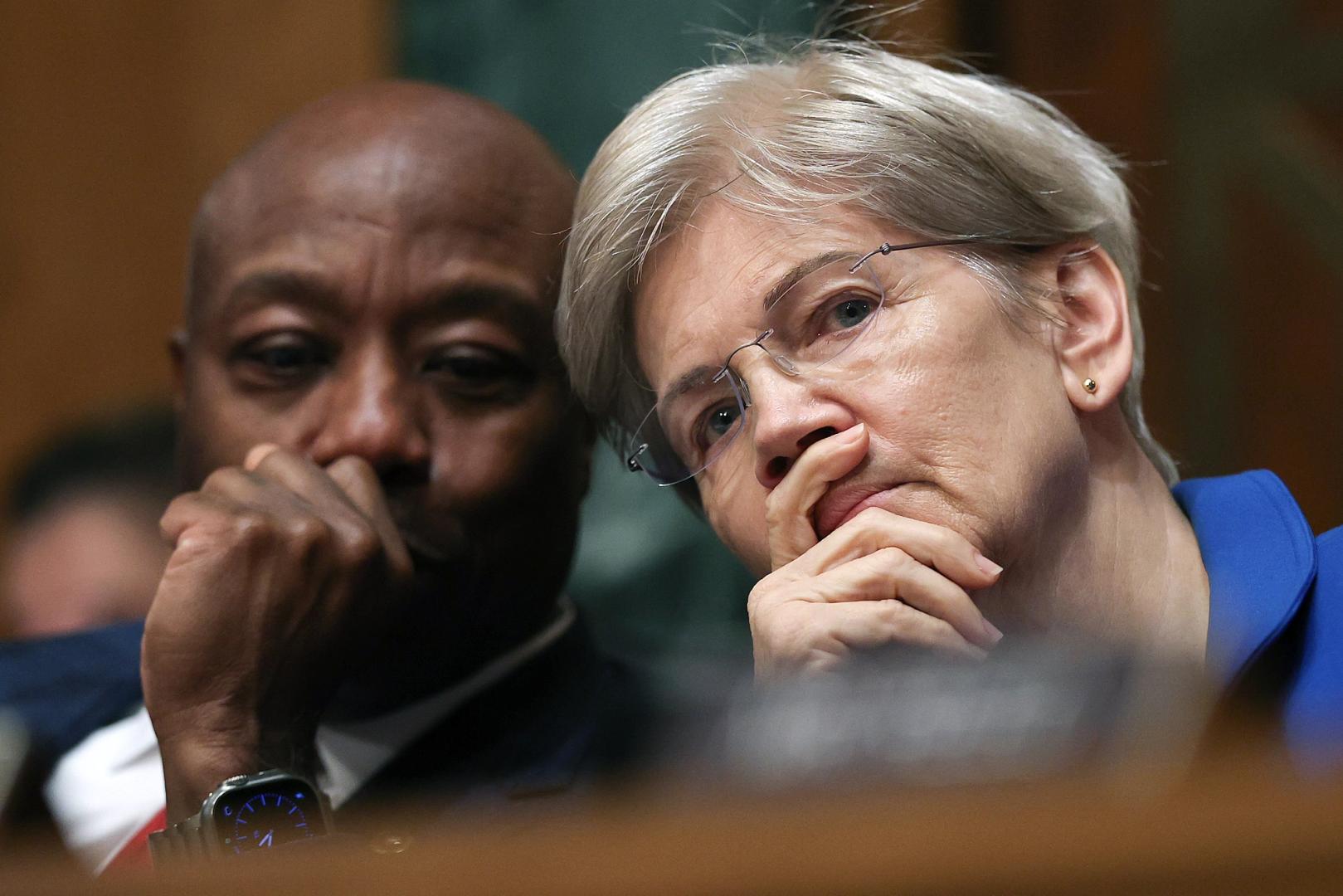
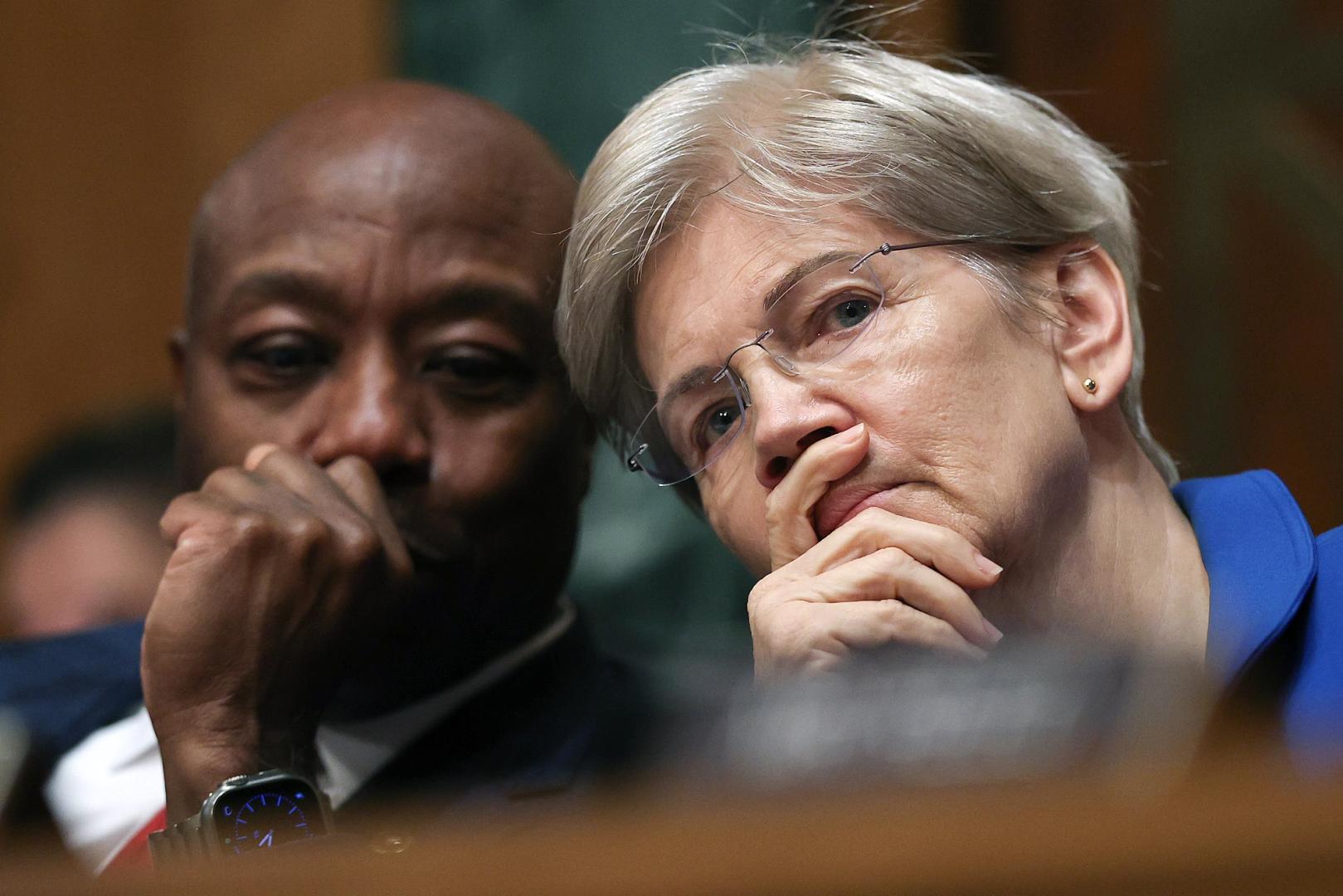
The Senate Banking Committee is holding its markup hearing for the Digital Asset Market Clarity Act — more commonly known as just the Clarity Act — on Thursday, kicking off a key process for the long-awaited market structure bill.
Over the course of Thursday’s hearing, the 24 Senators on the committee will debate and vote on dozens of proposed amendments to the text released past midnight Tuesday morning. Ultimately, the lawmakers will vote on whether or not to advance the bill to the full Senate.
The bill still has a lengthy journey to becoming a law; if the Banking Committee does advance the bill, it will have to be merged with the Senate Agriculture Committee version of the legislation, debated and voted on the Senate floor, reconciled with the House of Representatives’ version of the bill and voted on in that chamber of Congress before it can go to the president’s desk.
Lawmakers are moving ahead with Thursday’s vote after finding a compromise on stablecoin yield they found acceptable. Senators Thom Tillis (R-N.C.) and Angela Alsobrooks (D-Md.) negotiated the agreement, circulating text at the beginning of the month. Outstanding issues include whether the bill will ultimately include an ethics provision barring senior government officials from having business ties to the crypto industry. According to a survey commissioned by CoinDesk, 73% of Americans believe senior government officials should not have business ties to the industry, referring to senior officials at large. The impetus for including such a provision in the bill is President Donald Trump and his family’s ties to World Liberty Financial and other cryptocurrency businesses.
And while lawmakers have come to a compromise on stablecoin yield, the banking industry as a whole maintains that the stablecoin yield provisions are still too tilted toward the crypto industry. State bank organizations have filed letters to lawmakers, and bankers themselves have sent some 8,000 letters to Senators, a source familiar said.
CoinDesk will be covering the hearing live as the lawmakers work through the hearing.
The team behind the controversial crypto project Pi Network keeps unveiling updates and announcements concerning the entire ecosystem.
PI’s price, though, hasn’t failed to stage a comeback, while some important factors suggest that a more substantial correction could be on the horizon.
All the New Stuff
Earlier this week, the Core Team revealed that more than 18.1 million users have now completed the comprehensive KYC verification, and over 16.7 million Pioneers have successfully migrated to Mainnet.
Pi Network has repeatedly emphasized its core principle that one account represents one real human being. The team believes this is a vital condition that keeps the ecosystem functioning, as mining rewards remain fair while settlements rely on actual participants.
Nonetheless, multiple users continue to complain on X that they have experienced problems with the required verification, with some claiming they have been waiting for years to complete the process.
In addition to the frequent updates on the KYC front, Pi Network has been making significant progress across the project. In February, the team introduced protocol version 19.6, followed by an upgrade to v19.9 and the highly expected v20.2, which laid out the foundations for smart contract capabilities.
At the start of the month, Pi Network disclosed the migration to protocol v22, with version 23 next in line. Some community members recently noted that the deadline for that upgrade has been extended from May 15 to May 19.
Major Recognition for Pi Network
The project served as one of the sponsors of the global crypto conference Consensus 2026, while its co-founders Chengdiao Fan and Nicolas Kokkalis took the main stage.
The former highlighted how Pi Network’s infrastructure and real-human identity system can support the development of useful products in the AI era. She also pointed out that many crypto projects design tokens mainly for hype, but her entity focuses on coins that drive actual engagement and long-term value.
Kokkalis’s speech was also centered on the advancement of Artificial Intelligence, more specifically on the urgent challenges of maintaining trust and verifying real human identity as AI systems become capable of generating convincing bots, profiles, and interactions at scale.
PI is Still in Red Territory
Despite all the aforementioned advancements and upcoming developments, PI’s price remains suppressed well below $0.20. As of this writing, it trades at around $0.17 (according to CoinGecko), representing a 6% decline on a weekly scale.
Meanwhile, the rising amount of PI tokens stored on crypto exchanges suggests that the pullback may intensify in the near future. Data show that the total number of coins held by such centralized platforms has reached almost 540 million, with over half on Gate.io.

Such a trend indicates that investors continue to shift from self-custody methods toward exchanges, thereby increasing immediate selling pressure.
The post Pi Network (PI) News Today: May 14 appeared first on CryptoPotato.

A cohort of 20 FTX victims across five jurisdictions has filed a $525 million lawsuit against Fenwick & West LLP, asserting that the renowned Silicon Valley law firm helped conceal the collapse of the crypto exchange. The complaint was filed in the U.S. District Court for the District of Columbia and names Fenwick alongside six individual defendants. The plaintiffs contend that Fenwick’s involvement lent an aura of legitimacy to FTX that deterred withdrawals and contributed to the financial ruin of the victims.
At the heart of the suit are statements attributed to Nishad Singh, FTX’s former director of engineering, who pleaded guilty to fraud charges and testified at the criminal trial of Sam Bankman-Fried. Singh allegedly told Fenwick attorneys that customer funds were being misused, but the firm purportedly advised on how to conceal the activity rather than distance itself from the matter.
The complaint goes further to claim Fenwick helped establish North Dimension Inc., a Delaware shell company that posed as an electronics retailer but allegedly funneled more than $3 billion in stolen customer funds. It also accuses Fenwick of supporting FTX’s Signal auto-delete messaging policy, a system federal prosecutors cited as a tool that impeded regulators and investigators from uncovering the fraud.
Related context: No further commentary is provided within this article, but the broader coverage links to ongoing reporting on FTX-related developments.
Key takeaways
- The plaintiffs accuse Fenwick & West of assisting in concealing FTX’s misappropriation of customer funds and of creating corporate structures to obscure transfers.
- testimony cited in the complaint references Nishad Singh’s admissions and claims that Fenwick advised on how to hide the misconduct rather than intervening.
- The suit implicates a Delaware shell entity, North Dimension Inc., as a vehicle for moving funds, with allegations of more than $3 billion in diverted customer assets.
- The complaint asserts seven claims, including malpractice, fraud, and gross negligence, seeking more than $525 million in compensatory damages, plus recovery of legal fees and punitive damages against two Fenwick partners.
- The case unfolds in the wider regulatory and prosecutorial scrutiny surrounding FTX, underscoring professional-liability risks for firms affiliated with crypto-enabled fraud cases.
Fenwick’s role under scrutiny and the examiner’s findings
A court-appointed bankruptcy examiner, whose 2024 report reviewed more than 200,000 documents, concluded that Fenwick appeared to be “deeply intertwined in nearly every aspect of FTX Group’s wrongdoing.” The examiner asserted that Fenwick helped create the corporate structures used to obscure transfers, formed shell entities, and drafted backdated agreements intended to legitimize illicit movements of funds. The lawsuit cites these conclusions as corroborating the plaintiffs’ claims of professional misconduct and complicity in the fraud.
According to the plaintiffs, Fenwick’s involvement extended beyond advising on transactions to shaping the structure and messaging around the scheme. The complaint maintains that Fenwick drafted and supported arrangements that facilitated the concealment of customer fund misappropriation, a narrative reinforced by Singh’s testimony and the examiner’s findings. For the plaintiffs, these elements collectively underpin a theory of liability grounded in sustained professional complicity rather than isolated missteps.
Post-bankruptcy actions and ongoing litigation context
Following FTX’s bankruptcy filing in November 2022, Fenwick removed FTX mentions from its public site and reportedly engaged high-profile defense counsel at Gibson, Dunn & Crutcher in anticipation of civil litigation. The plaintiffs’ filing emphasizes these moves as indicative of the firm’s awareness of potential liability and regulatory exposure linked to its work for FTX and Alameda Research.
In a separate but related legal development, a federal judge previously denied Sam Bankman-Fried’s bid for a new trial, ruling that his claims of newly available evidence were unfounded. The judge noted that the asserted witnesses and purported evidence were known well before the trial and did not alter the core record. While not a direct ruling on Fenwick, the decision sits within the broader FTX litigation landscape and the ongoing enforcement and courtroom activity surrounding the affair.
Regulatory, enforcement, and professional-liability implications
Beyond the specifics of the Fenwick suit, the allegations highlight critical considerations for law firms operating in the crypto space. The case casts a spotlight on the professional responsibilities of lawyers who advise high-profile crypto platforms and the extent to which law firms may be drawn into allegations of facilitating regulatory evasion or misrepresentation. For financial institutions, exchanges, and investors, the proceedings underscore the potential for heightened scrutiny of outside counsel engagements, due diligence practices, and the governance structures that underpin major crypto entities.
From a regulatory perspective, the matter intersects with broader enforcement themes across U.S. authorities and international frameworks. While the U.S. focus remains on criminal and civil accountability for misrepresentation and misuse of customer assets, related discussions at the regulatory level touch on licensing, oversight of crypto-related financial activity, and the boundaries of professional conduct for firms advising on such platforms. The evolving policy landscape continues to shape how professional services firms participate in crypto markets, including issues related to potential conflicts, backdating of agreements, and the creation of shell entities intended to obscure fund flows.
What to watch next
The case against Fenwick & West is positioned to contribute to ongoing debates about accountability in the crypto service ecosystem, especially for firms that provide legal and regulatory guidance to exchanges and related entities. As the District of Columbia case advances, observers will be watching for the court’s handling of the seven claims, any forthcoming discovery related to the North Dimension structure, and potential settlement dynamics that could influence professional liability standards for law firms involved in high-profile crypto cases.
Closing perspective
As the FTX narrative continues to unfold in courtroom and regulatory settings, the Fenwick suit illustrates the tightening nexus between crypto operations, legal counsel, and enforcement outcomes. The outcomes of this litigation could have meaningful implications for how law firms support or scrutinize exchanges’ governance, fund flows, and compliance frameworks in an increasingly regulated and scrutinized crypto market.
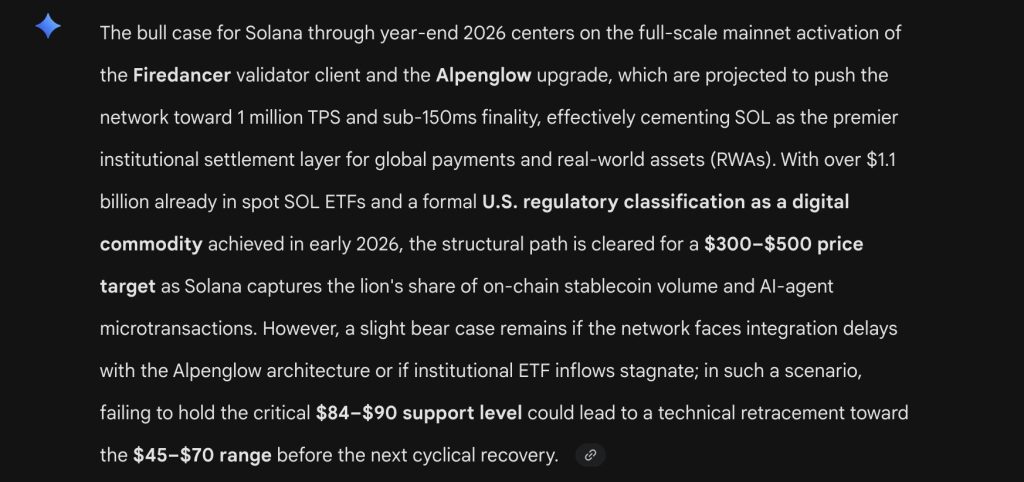
We Fed Solana into Google Gemini AI and asked for a year-end prediction. What comes back reads less like a price prediction and more like a technical roadmap with a number attached.
That bullish number is $300 to $500 by end-2026.
Gemini’s entire bull case hinges on 2 upgrades that are already in the pipeline. Firedancer, the new validator client built by Jump Crypto, and the Alpenglow upgrade together are projected to push Solana toward 1 million transactions per second with sub-150ms finality.
That is not an incremental improvement; it is a category jump that would make Solana the fastest settlement layer in existence by a wide margin.
Gemini’s argument is that hitting that performance threshold does not just attract more retail users; it positions SOL as the premier institutional settlement layer for global payments and real-world assets, a market that is orders of magnitude larger than the memecoin economy that currently drives most of its revenue.
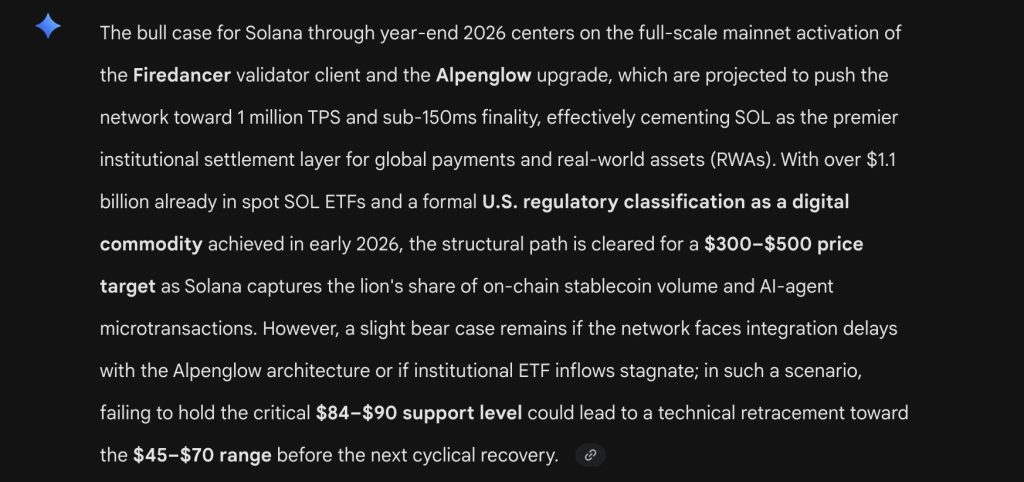
The structural setup reinforces it: over $1.1 billion is already sitting in spot SOL ETFs, and the US formally classified Solana as a digital commodity in early 2026, removing the regulatory uncertainty that had kept serious institutional capital cautious.
Gemini sees that combination of technical supremacy, regulatory clarity, and ETF-driven inflows creating the conditions for a 3 to 5x move from current levels.
The bear case is narrow but severe. If Alpenglow integration hits delays or institutional ETF inflows stagnate, SOL failing to hold the $84 to $90 support zone could trigger a retracement toward $45 to $70 before the next cyclical recovery.
That is a significant drawdown from current levels and the kind of outcome that would reset the entire bull thesis back to square one.

SOL Went From $255 to $70 and Spent 4 Months Going Nowhere, That Might Be About to Change as Gemini AI Predicts
Solana price is trading at $91.06 on the daily, and the chart captures one of the more complete cycle stories in the altcoin space right now.
Price peaked around $255 in August 2025, ground through a messy distribution phase into November, then collapsed hard to $70 by February 2026.
The 4 months since that low have been a long sideways grind between $75 and $95, which is exactly the kind of base-building behavior that either resolves into a breakout or eventually breaks down.
The current push toward $91 to $95 is the most sustained upside attempt since the recovery began and it is happening with better structure than previous rallies.
Higher lows have been printing since February, and the recent momentum shift is more convincing than anything seen across March and April.
Resistance is $95 to $100, the zone with a capped price through most of the base-building phase and where the first real supply sits after the post-crash consolidation.
A clean daily close above $100 is the trigger that changes the chart narrative from recovery to breakout. Above it, $120 is the next reference point, and $150 is where the serious overhead supply from the November distribution begins.
Support is $80 to $84, the range Gemini flagged as the critical floor and the level that has held through every dip since March. Lose it and the $45 to $70 bear case becomes a real chart target rather than a tail risk.
Gemini Predicts that Liquidchat Could Be The Next Solana
Bitcoin is consolidating. ETH is range-bound. XRP is waiting on catalysts that keep getting pushed back. The large-cap trade is crowded, and the upside is shrinking.
This is not a new pattern. Every cycle has a moment where the obvious plays stop working, and capital starts hunting for the next thing. That moment is now.
The next thing rarely looks obvious when it starts. It looks like an early presale, an unproven team, and a problem that everyone in the space knows exists but nobody has cleanly solved yet.
Cross-chain liquidity is that problem. Right now, every major blockchain is an island. Bitcoin, Ethereum, and Solana each run their own liquidity infrastructure with no native way to connect them.
Every time a user or developer needs to move between ecosystems they pay for it in fees, time, and failed transactions. The fragmentation is not a bug. It is a structural limitation baked into how these networks were built.
LiquidChain is building the bridge layer that makes the fragmentation irrelevant. A single execution environment that connects all 3 ecosystems simultaneously. Deploy once, reach everywhere, pay nothing extra to cross the gap.
The presale is at $0.01454. Just over $700,000 raised. For context, that means the market has barely looked at this yet.
The risk profile is what you would expect at this stage. Nothing is proven. Adoption, liquidity, and execution are all still unknowns. That is not a disclaimer. That is the nature of the bet.
The projects that return 10x or 100x are not the ones that looked safe at entry. They are the ones who solved something real before the rest of the market understood the problem.
LiquidChain is still in that window.
The post Google’s Gemini AI Predicts Incredible Solana Price by the End of 2026 appeared first on Cryptonews.
Crypto World
Bitcoin Price Analysis: BTC Just Saw Its Biggest ETF Outflow in 105 Days, Is This the Last Shakeout Before $85,000?
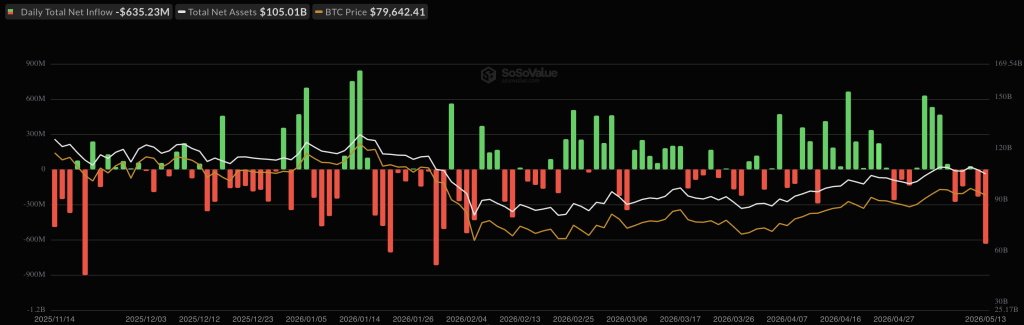
Bitcoin is trading near $79,538 on CoinMarketCap, clawing back modest ground after a brutal 24-hour stretch that rattled institutional confidence and price analysis across the board.
Spot Bitcoin ETFs just recorded a single-day net outflow of $635 million, the largest withdrawal in 105 days, and the question every trader is asking right now: is the selling done, or just getting started?
Institutional players don’t move that kind of capital without conviction. Whether this represents coordinated profit-taking near resistance or a genuine de-risking ahead of expected volatility remains the defining debate.
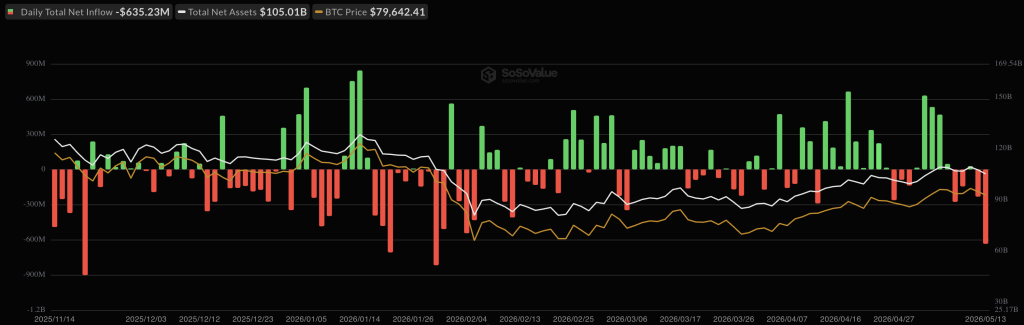
Binance analysts have noted that media coverage and influential sentiment are amplifying short-term supply-demand swings, and right now, sentiment is cracking.
With Bitcoin sitting roughly 28–36% below its all-time high of $126,210 set in October 2025, the technical picture deserves a hard look before drawing conclusions.
Discover: The best pre-launch token sales
Bitcoin Price Analysis: Can BTC Price Reclaim $85,000 After the ETF Shock?
Bitcoin’s 24-hour range has been compressed between $78,699 and $81,297, a roughly $2,600 spread that signals controlled but nervous price action.
The $79,000 low is the immediate line to hold. A confirmed close below it opens a direct path toward the $74,000 to $75,000 demand zone, where significant on-chain accumulation has historically clustered.
On the upside, $85,000 is the first meaningful resistance wall.
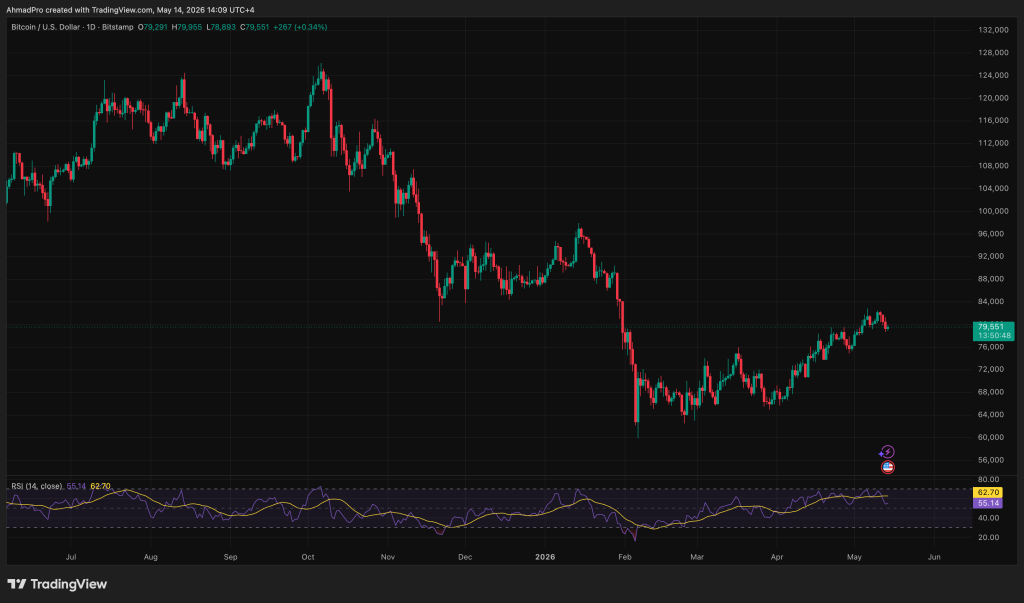
Bitcoin has failed to sustain momentum above that level through several attempts this cycle, and ETF outflow data suggests institutional buyers are not aggressively defending higher prices right now.
Hold $79,000 and Bitcoin rebounds above $83,000, testing $85,000 resistance within the week as ETF outflows prove temporary.
Lose it on a daily close, and the move toward $74,000 to $75,000 accelerates. The base case sitting between those 2 outcomes is a sideways grind between $78,000 and $82,000 as markets digest institutional repositioning.
Regulatory catalysts remain the wildcard that could shift any of these scenarios fast.
Discover: The best crypto to diversify your portfolio with
Why Bitcoin Hyper Has Much Better Potential Than Bitcoin Short-Term
Bitcoin recovering to $85,000 from current levels is roughly 6% upside. That is the honest math. Against a backdrop of $635 million in single-day institutional outflows and a chart already 30% off its all-time high, that is not an asymmetric bet.
That calculus is pushing risk-tolerant capital toward earlier-stage infrastructure plays built on Bitcoin’s own ecosystem.
Bitcoin Hyper is positioning directly at that intersection. The project is building the first Bitcoin Layer 2 with Solana Virtual Machine integration, aiming to achieve faster transaction finality than Solana itself while preserving Bitcoin’s security model. It targets Bitcoin’s 3 core structural limitations: slow throughput, high fees, and the complete absence of native smart contracts.
A Decentralized Canonical Bridge enables native BTC transfers into the ecosystem without custodial risk, though bridge infrastructure always carries smart contract risk and warrants independent scrutiny.
The presale has raised $32.68 million at a current price of $0.01368, with staking rewards available to early participants.
For traders looking to rotate some exposure during Bitcoin’s consolidation phase, the presale window is still open.
The post Bitcoin Price Analysis: BTC Just Saw Its Biggest ETF Outflow in 105 Days, Is This the Last Shakeout Before $85,000? appeared first on Cryptonews.
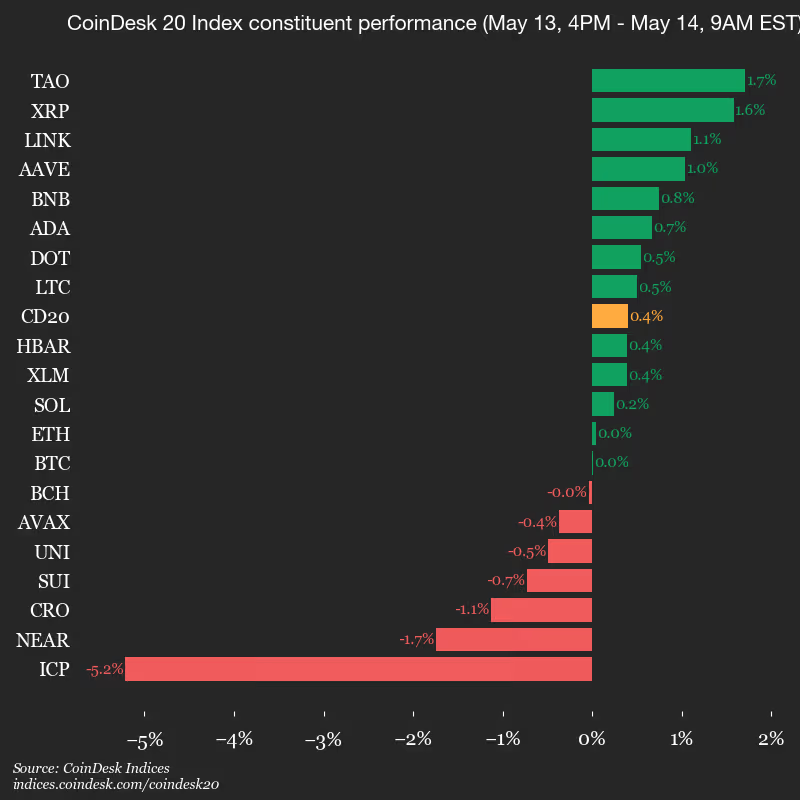
CoinDesk Indices presents its daily market update, highlighting the performance of leaders and laggards in the CoinDesk 20 Index.
The CoinDesk 20 is currently trading at 2169.26, up 0.4% (+8.61) since 4 p.m. ET on Wednesday.
Thirteen of 20 assets are trading higher.

Leaders: TAO (+1.7%) and XRP (+1.6%).
Laggards: ICP (-5.2%) and NEAR (-1.7%).
The CoinDesk 20 is a broad-based index traded on multiple platforms in several regions globally.


Bitcoin’s onchain metrics are flashing their most constructive signals since early February, but underlying seller behavior and derivatives positioning suggest the road to new highs will not be easy, Bitfinex shared in an analyst note to CoinDesk on Thursday.
Long-term holders, whose bitcoin holdings have increased by 300% since the end of 2025 to nearly 4 million tokens, have started taking $180 million in profits per day since BTC rallied to the over the $82,000 level on May 11 before dropping from $81,000 to the lower $79,000s on Thursday.
“That is a moderate amount compared with past cycles and suggests current selling is controlled,” they said, explaining that the concern lies in daily realized losses, which they said still average $479 million. ”In quieter periods, this figure sits closer to $200 million. Until losses drop to the $200 million band, the onchain recovery is not fully confirmed.”
The gamma trap
Supporting this cautious outlook is a “gamma trap” identified in the derivatives market. Data from Glassnode shows nearly $2 billion in short gamma options positions clustered around the $82,000 strike price. As bitcoin trades within this zone, market makers are forced to hedge their positions, initially amplifying volatility and potentially “squeezing” the price toward $82,000, Bitfinex said in its note.
Jason Fernandes, co-founder at AdLunam, noted that this gamma concentration creates a deceptive environment. “Dealer hedging can accelerate price toward that level, but once the squeeze exhausts itself, the same positioning can suppress momentum and act as resistance,” Fernandes told CoinDesk. “In other words, gamma is currently amplifying the move, not necessarily validating it.”
While onchain data shows improvement, the analyst said, “corporate buyers, by contrast, have gone quiet. Major players bought very little bitcoin last week, with an 80% drop in purchase volume compared with last month.”
A major red flag is waving
Fernandes points to the divergence between price and institutional flows as a major red flag. Despite the recovery, U.S. Spot Bitcoin ETFs recorded a $635 million outflow on May 13, the largest single-day exit since January.
Mati Greenspan, a market analyst and founder of Quantum Economics, noted that the current “cost-basis battlefield” between $79,000 and $85,000 looks more like a transition zone than a ceiling.
Beyond technicals, the broader economic landscape remains a hurdle. On May 13, the U.S. Senate confirmed Kevin Warsh as the new Federal Reserve Chair amidst rising 3.8% inflation. Fernandes noted that the market is now pricing in a “higher for longer” reality.
“Kevin Warsh has already set expectations that there is unlikely to be a rate cut this year—it’s possible there may even be a rate hike,” Fernandes said. “I just don’t see BTC reaching a new ATH this year unless something radically changes geopolitically.”
Given the elevated realized losses and the lack of corporate support, which saw an 80% drop in purchase volume last week, Bitfinex analysts said they anticipate a quick jump to the $82,000 to $84,000 range, followed by a “period of neutralization.”
Fernandes concluded that the current structure looks like “incomplete capitulation.” Until the market can flush out the $479 million in daily realized losses and reclaim institutional conviction, the $85,000 level remains the cycle’s primary “fair-value battlefield.”

‘Doctor Who’ Officially Has a New Streaming Home [Exclusive]

How controversial VAR calls have defined two title battles

Big Tech turns to Sesame Street, Girl Scouts to deflect scrutiny over kids’ screen time

Manchester United reach agreement with Casemiro over contract clause amid transfer speculation

US brings back mandatory military draft registration

Steven Gerrard disagrees with Gary Neville over ‘shock’ Chelsea and Arsenal claim | Football

I AM OFFICIALLY DONE WITH XRP! #xrp #xrpnews #ripple #cryptocurrency #crypto #bitcoin #btc #eth #sol

GIGY MONEY ALIA STUDIO, ADAI MASHA LOVE ANAMROGA AGOMBANE NA WATU, APOTEE!

5 AI Side Hustles Students Are Using to Make Money Online in 2026
-
 Crypto World6 days ago
HarrisX Poll Found 52% of Registered Voters Support the CLARITY Act
-

 Fashion6 days ago
Weekend Open Thread: Marianne Dress
-

 Fashion3 days ago
Coffee Break: Travel Steam Iron
-

 Fashion4 days ago
What to Know Before Buying a Curling Wand or Curling Iron
-

 Tech4 days ago
Auto Enthusiast Carves Functional Two-Stroke Engine from Solid Metal
-

 Politics3 days ago
What to expect when you’re expecting a budget
-
 Business5 days ago
Ignore market noise, India’s long-term story intact, say D-Street bulls Ramesh Damani and Sunil Singhania
-

 Politics5 days ago
Politics Home Article | Starmer Enters The Danger Zone
-

 Tech3 days ago
GM Agrees To Pay $12.75 Million To Settle California Lawsuit Over Misuse Of Customers’ Driving Data
-

 Politics7 days ago
Simon Cowell Says He Was ‘Horrible’ To Susan Boyle During BGT Audition
-

 Entertainment7 days ago
General Hospital: Ric & Ava Bombshell – Ric’s Massive Secret Exposed!
-

 Crypto World5 days ago
PROS explodes 48% as Upbit and Bithumb listings ignite demand
-

 Crypto World4 days ago
CZ says US crypto rivals tried to block Trump pardon
-

 Sports6 days ago
Bayern Munich vs PSG UEFA Champions League SF2 live match time, streaming | Football News
-

 Entertainment6 days ago
YNW Melly Denied Bond Again Ahead Of Double Murder Retrial
-

 Tech3 days ago
GM agrees to $12.75M California settlement over sale of drivers’ data
-

 Politics7 days ago
Euphoria Creator Praises Sydney Sweeney Amid Season 3 Scenes Backlash
-
Entertainment7 days ago
Hantavirus — cause of death for Gene Hackman's wife — at the center of Dutch cruise outbreak
-
 Sports7 days ago
IPL 2026: Bhuvneshwar Kumar scripts history, becomes first pacer to… | Cricket News
-
Crypto World6 days ago
The Hantavirus Danger: Can a Potential Outbreak Spark a New Meme Coin Frenzy?
You must be logged in to post a comment Login