

Crypto World
Boeing (BA) Stock Gains After Treasury Chief Hints at Massive China Aircraft Deal


Key Takeaways
- Treasury Secretary Scott Bessent revealed expectations for a substantial Boeing aircraft order from China coinciding with President Trump’s Beijing summit.
- Boeing (BA) shares advanced 1.2% in premarket sessions Thursday after Bessent’s CNBC interview aired.
- Negotiations extend to increased Chinese acquisitions of American energy products and agricultural commodities.
- Officials from both nations are discussing innovative investment frameworks, including proposed “Board of Trade” and “Board of Investment” mechanisms.
- Bessent emphasized the strategy focuses on increasing American exports to China instead of reducing import volumes.
Boeing (BA) shares gained 1.2% during Thursday’s premarket session following remarks from Treasury Secretary Scott Bessent, who indicated China plans to announce a substantial aircraft purchase from Boeing while President Donald Trump’s delegation conducts meetings in Beijing.
“I think we’re going to see the large Boeing orders,” Bessent stated during his appearance on CNBC’s “Squawk Box.”
These remarks emerged as American and Chinese representatives launched a two-day economic summit aimed at recalibrating financial relationships between the planet’s two dominant economies.
The anticipated Boeing purchase is positioned as a centerpiece achievement from the Beijing negotiations. Such an announcement would represent a significant pivot following years of commercial tensions between the two superpowers.
Bessent indicated the scope of discussions reaches well beyond aviation. Enhanced Chinese procurement of American energy resources and farm products remains under consideration, alongside innovative structures enabling Chinese capital deployment in non-critical American industries.
Energy Imports and Investment Structures Under Discussion
Regarding energy commerce, Bessent noted Chinese representatives have shown appetite for increased purchases of American liquefied natural gas, especially as additional export infrastructure becomes operational.
Agricultural commerce features in the dialogue as well, though Bessent observed that soybean purchase obligations are essentially predetermined through current agreements.
Both governments are examining two novel bilateral oversight mechanisms: a “Board of Trade” and a “Board of Investment.” These structures would facilitate Chinese capital deployment in America while avoiding national security examination processes.
“What we want to do is make sure that these investments don’t get referred to CFIUS,” Bessent explained, referencing the Committee on Foreign Investment in the United States.
He additionally dismissed speculation regarding enormous capital pledges from Beijing. “I’m not sure where this $1 trillion investment number has come from,” he remarked.
Trade Balance Restoration Remains Primary Objective
Bessent articulated the overarching purpose driving the negotiations: achieving equilibrium in bilateral commerce between both nations.
“That’s the goal here, and that can be done one of two ways — either the U.S. receives fewer imports from China, or we sell more to China,” he explained. “We’re trying to balance that out.”
His comments suggested a preference toward expanding American export volumes rather than implementing import restrictions.
Boeing has traditionally served as a primary recipient of commercial benefits from U.S.-China trade agreements. Chinese aviation companies constitute a substantial portion of global demand for Boeing’s passenger aircraft.
The aerospace manufacturer has navigated challenging conditions throughout recent years — manufacturing complications, regulatory oversight intensification, and fluctuating market demand have collectively pressured the enterprise. A significant Chinese aircraft order would deliver meaningful operational momentum.
Boeing (BA) shares advanced 1.2% during Thursday’s premarket trading. The official order revelation, should it materialize, is anticipated during Trump’s ongoing Beijing diplomatic mission.


RLUSD Records Strong Minting Activity on XRP Ledger
Ripple USD (RLUSD) recorded a strong liquidity increase during the past week as activity expanded across the XRP Ledger. Fresh minting transactions significantly exceeded token redemptions during the period. Consequently, the stablecoin added more than $275 million in net liquidity while its market capitalization continued to grow.
RLUSD experienced a notable rise in network activity over the last seven days. Several large minting and redemption transactions took place on the XRP Ledger. As a result, the stablecoin supply expanded during the reporting period.
Data from XRP Ledger activity showed substantial token creation across multiple days. On May 22, RLUSD Treasury minted more than 10 million RLUSD. Meanwhile, additional minting and burning transactions occurred on May 21 and May 20.
The largest transaction involved the creation of 230 million RLUSD on the XRP Ledger. At the same time, Ripple removed smaller amounts of RLUSD from circulation through treasury burn events. Consequently, minting activity outweighed redemptions by a wide margin.
Network data showed that RLUSD minted approximately $354.4 million during the week. In contrast, total burned supply reached about $78.7 million. Therefore, the stablecoin generated a net liquidity increase exceeding $275 million.
The latest figures highlight growing usage of RLUSD within the XRP Ledger ecosystem. Increased token issuance often reflects higher demand for settlement and liquidity purposes. Moreover, stablecoin activity can support broader network participation.
RLUSD continues to serve as a key component of Ripple’s expanding digital payments strategy. The stablecoin supports value transfers while maintaining a dollar-pegged structure. As adoption grows, transaction volumes may continue increasing across supported platforms.
Binance Expands RLUSD Utility Through Trading Support
Major cryptocurrency exchange Binance contributed to RLUSD activity during the reporting period. The platform processed RLUSD transactions on the XRP Ledger. Consequently, exchange-related flows added to overall network volume.
Binance expanded support for RLUSD earlier this year through several product integrations. The exchange introduced spot trading support for the stablecoin. Additionally, it enabled portfolio margin eligibility for qualifying users.
The platform also added RLUSD to its Earn products. These additions created more use cases for holders across trading and yield-related services. Therefore, RLUSD gained broader exposure within the cryptocurrency market.
Exchange support often plays an important role in stablecoin growth. Larger trading venues provide liquidity and increase accessibility for users. Moreover, integration with multiple products can encourage wider adoption.
The recent increase in RLUSD activity coincided with continued exchange participation. Transaction processing across major platforms supported the movement of newly issued tokens. As a result, liquidity expanded alongside network usage.
Growing exchange availability may strengthen RLUSD’s position among dollar-backed digital assets. Stablecoins rely on liquidity and accessibility to support adoption. Therefore, exchange partnerships remain an important factor in future growth.
RLUSD Market Cap Climbs as Ecosystem Growth Continues
RLUSD’s market capitalization recently surpassed $1.7 billion. The milestone reflects continued expansion since the stablecoin entered the market. Furthermore, growing transaction activity has supported that upward trend.
Ripple has positioned RLUSD for use in payments and decentralized finance applications. These sectors continue to represent major growth areas for stablecoins. Consequently, broader utility may contribute to sustained demand.
Market participants also expect additional ecosystem developments in the near term. Industry discussions have pointed to potential end-of-month activity involving the cryptocurrency exchange Gemini. Such developments could generate further minting and redemption transactions.
Stablecoin growth remains a significant trend across the digital asset sector. Companies continue expanding products that support blockchain-based payments and settlements. Moreover, increased liquidity often improves efficiency across related services.
RLUSD’s latest expansion demonstrates rising activity on the XRP Ledger. Strong minting volumes drove a substantial weekly liquidity increase. As adoption advances, the stablecoin continues strengthening its presence within the broader digital asset ecosystem.

TLDR
- Bitcoin traded near $61,100 after a 10% weekly decline as ETF outflows extended.
- Wintermute linked the selloff to US institutional exits rather than panic-driven retail selling.
- Spot Bitcoin ETFs recorded their longest outflow streak, totaling nearly $2.97 billion by May 30.
- Changpeng Zhao urged calm, stating Bitcoin “won’t be dead for too long.”
- On-chain data showed small wallets increased holdings while large holders reduced exposure.
Bitcoin traded near $61,100 on June 9 after a weekly drop of about 10%, while ETF outflows and whale selling persisted. Binance founder Changpeng Zhao urged calm as trading firm Wintermute linked the decline to US institutional flows. On-chain data from Santiment showed retail buyers adding exposure as larger wallets reduced holdings.
Bitcoin Faces ETF Outflows and Institutional Selling
Bitcoin extended losses as US spot ETFs recorded their longest outflow streak on record through late May. Wintermute estimated cumulative outflows near $2.97 billion by May 30, while fresh inflows remained absent. The firm stated, “With prior support gone, there’s not much underneath to lean on,” and added that flows now set direction.
Wintermute attributed the decline to US institutions unwinding positions built weeks earlier, not panic selling. Analysts said Bitcoin never formed strong support between $50,000 and $59,000 during the 2024 rally. As a result, traders lack clear technical levels and rely on capital movement to guide price action.
Bitcoin remains more than 50% below its October 2025 peak above $126,000. MicroStrategy sold 32 BTC, marking its first disposal since 2022, though it called the sale immaterial. Still, the transaction drew attention as ETF outflows persisted and liquidity conditions tightened.
Macro data reinforced the pressure as US payrolls increased by 172,000 in May. That figure exceeded expectations near 80,000, while April payrolls were revised up to 179,000. Strong labor data lifted yields and reduced near-term expectations for Federal Reserve rate cuts.
CZ Urges Calm as Whales Reduce Holdings
Changpeng Zhao addressed the decline after stepping back from Binance leadership in 2023. He wrote, “Bitcoin won’t be ‘dead’ for too long. Don’t panic,” framing the pullback as temporary. His message arrived as ETF outflows extended and sentiment weakened across derivatives markets.
Santiment reported a widening split between small and large holders over two weeks. Wallets holding under 0.01 BTC increased balances by 0.36%, while wallets holding 10 to 10,000 BTC reduced holdings by 0.20%. The firm said durable bottoms often follow retail capitulation rather than steady retail buying.
Santiment added, “That widespread surrender simply isn’t showing up yet,” describing current behavior. Analysts stated markets often move against retail expectations and align with whale positioning. As whales trimmed exposure, retail accumulation continued without coordinated large-wallet support.
Some long-term holders began accumulating at current levels, citing multi-year positioning strategies. However, blockchain data has not shown aggressive whale accumulation that marked prior cycle lows. ETF flow trends and wallet distribution metrics remain the most recent indicators shaping Bitcoin’s short-term direction.

Bitcoin (BTC) slid near $62,500 as the Crypto Fear and Greed Index hit 10. Bitcoin fear this extreme has appeared only near past cycle bottoms.
The index sat at 8 a day earlier and at 47 a month ago. Two widely followed momentum charts show why the drop happened and what could signal a turn.
Momentum Broke First, Then Price Followed
A Glassnode chart shared by analyst BitcoinVector tracks Bitcoin price, price momentum, and spot cumulative volume delta side by side. Momentum fell below the +0.5 threshold well before price broke down.
The same chart shows spot demand weakening at that moment. Cumulative volume delta flipped to roughly negative 1,000, a sign that aggressive sellers took control on spot exchanges. Momentum now sits pinned at the -1.00 floor.
BitcoinVector argues the order of events matters. Momentum weakens first, spot demand fades second, and price breaks last.
Crypto Sentiment Collapsed From Neutral to Extreme Fear
The Crypto Fear and Greed Index weighs volatility, momentum, volume, and social signals on a 0-100 scale. It read 47, or neutral, just one month ago.
Within weeks, it fell to 23, then to 8, and now sits at 10. Both recent readings land in extreme fear, the zone where panic usually dominates trading.

That pessimism mirrors a fear streak that recently became one of the longest since the FTX collapse. Past work on crypto emotions suggests that sentiment often moves toward extremes rather than the middle.
Bitcoin Fear at These Levels Has Marked Past Bottoms
A chart from BitboBTC colors Bitcoin price data by its fear reading. Deep extreme-fear values cluster almost only at major lows.
The blue circles mark those moments. They line up with the late-2018 bottom near $3,000, the March 2020 crash near $4,800, and the 2022 bear-market low near $18,000.

Today’s reading of 10 places current sentiment alongside those events. BTC is down about 50% from its October 2025 record near $126,200.
However, fear has stayed low for weeks before, and prices ground lower afterward, so some analysts have urged patience at similar readings.
What Would Confirm a Bitcoin Recovery
An earlier Swissblock chart frames the recovery trigger. Momentum needs to cross back above -0.5 to signal that capitulation is easing.
Swissblock calls that move the first sign of structural reconstruction. Until it happens, the firm sees a fragile base case where price builds a range or grinds lower.
For now, BTC trades near $62,500, down about 1.7% over the past 24 hours, with a market cap of about $1.25 trillion.
A reclaim of -0.5 momentum could open room toward the $70,000 area, while a failure to hold could extend the decline. Two competing scenarios stay in play until the signal turns.
Bitcoin fear remains historically extreme, yet a confirmed bottom is only clear in hindsight. This article is for information only and does not constitute financial advice.
The post Bitcoin Fear Hit Levels Last Seen at $3,000 and $18,000 Price Points appeared first on BeInCrypto.
Crypto World
Starknet Launches STRK20 Privacy Layer, Bringing Shielded ERC-20 Balances and Transfers to Ethereum L2


Starknet rolled out STRK20, a note-based privacy layer for ERC-20 tokens, on Tuesday, allowing users to shield balances and conduct private transfers and swaps on the Ethereum layer-2 network. The launch is the first phase of STRK20, a framework Starknet has been building since its v0.14.2 protocol… Read the full story at The Defiant
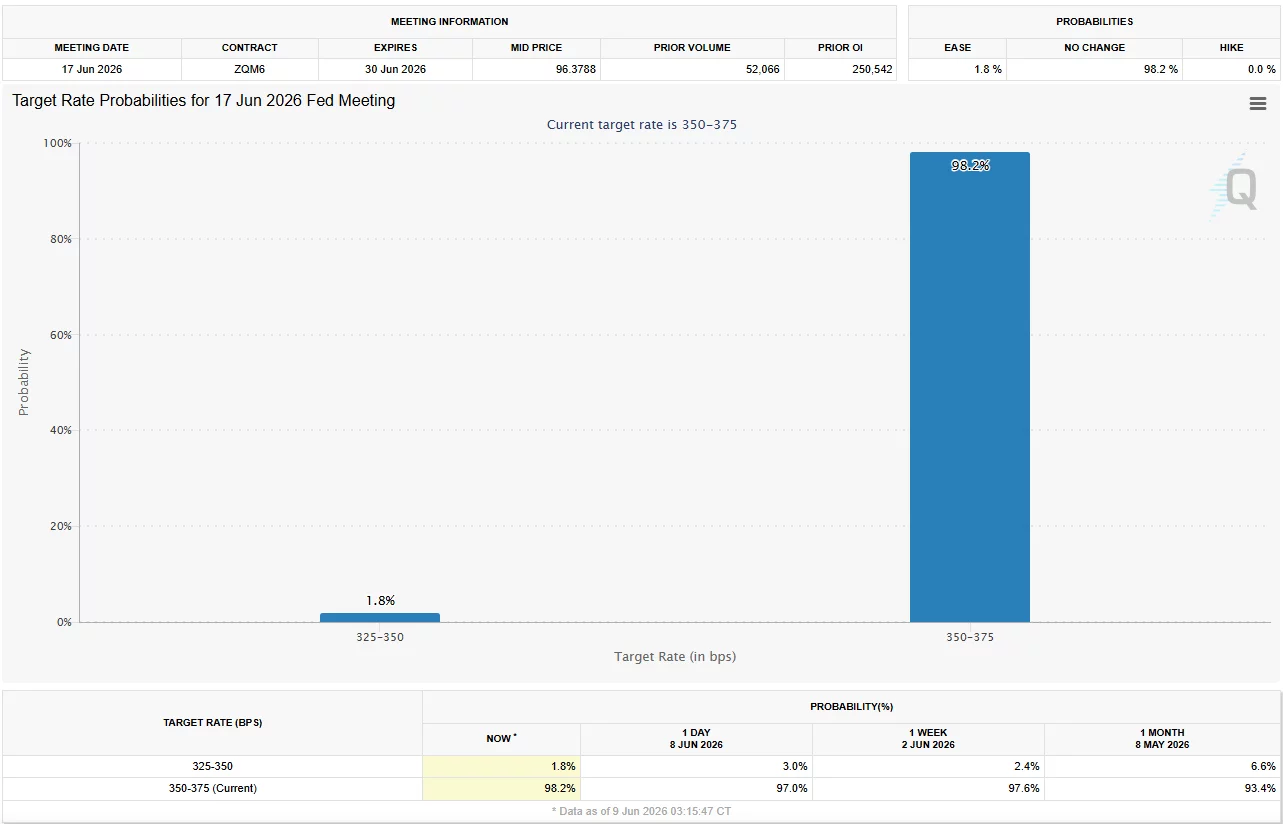
Bitcoin traders have positioned for a Federal Reserve pause next week, with CME FedWatch data showing a 98.2% probability that policymakers will leave interest rates unchanged at the June 16-17 meeting.
Summary
- CME FedWatch data shows a 98.3% chance the Fed will leave rates unchanged at its June 16-17 meeting.
- Bitcoin and the broader crypto market have weakened as traders reduce risk ahead of the policy decision.
- Investors are focusing on Fed Chair Kevin Warsh’s forecasts, dot plot, and policy outlook for clues on future rates.
According to CME FedWatch data, markets are assigning only a 1.8% chance of a rate cut and no meaningful probability of a rate increase, leaving investors focused less on the decision itself and more on what Federal Reserve officials signal about the path ahead.
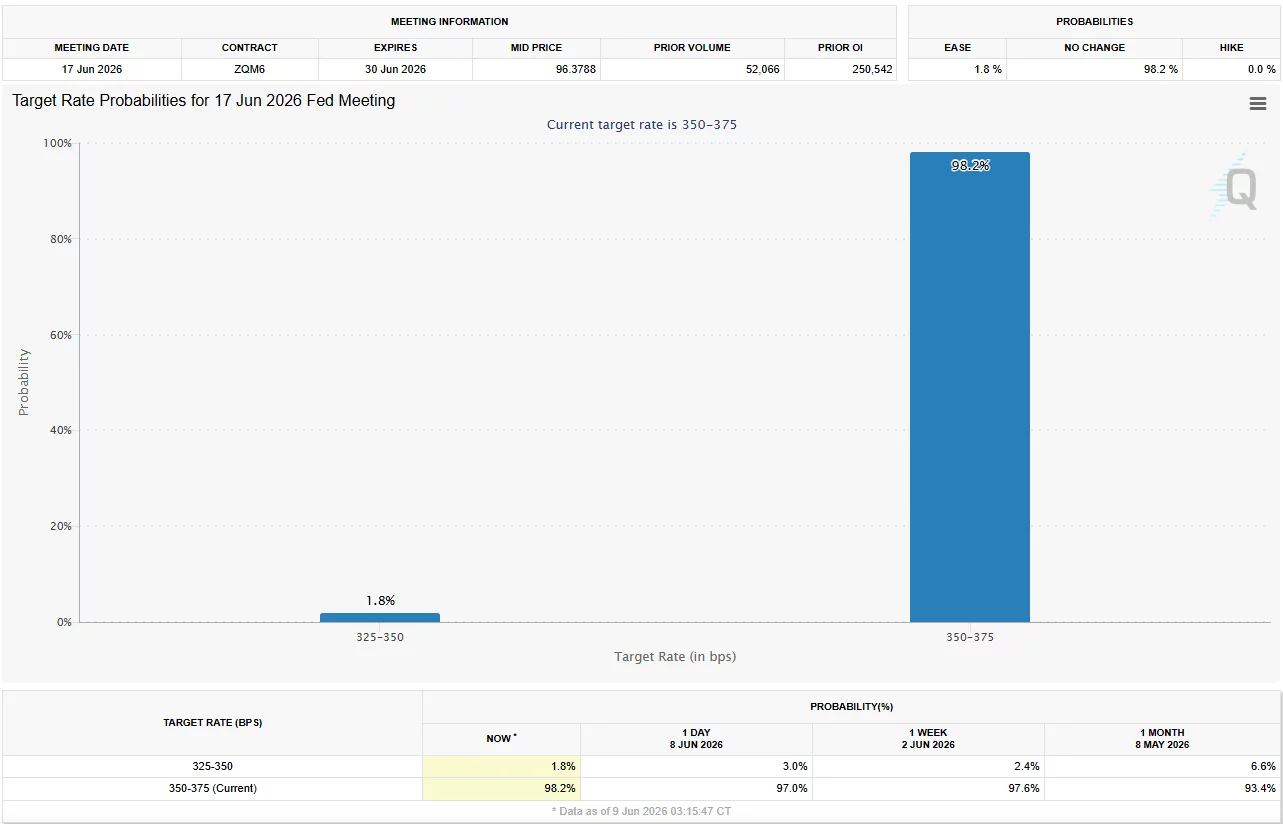
Attention has increasingly turned to the first Federal Open Market Committee meeting chaired by Kevin Warsh, who will oversee both the rate announcement and the release of updated economic projections.
Alongside the policy statement, officials will publish a revised Summary of Economic Projections and the closely watched dot plot, which outlines where policymakers expect interest rates to move in the coming years.
The cautious positioning has coincided with weakness across digital assets. Crypto market data shows total market capitalization falling 2.47% over the past 24 hours to roughly $2.13 trillion, while Bitcoin (BTC) has also retreated as traders reduce risk exposure before the Fed decision.
Economists expect rates to stay unchanged through 2026
Fresh forecasts from Wall Street suggest policymakers may remain on hold for far longer than markets expected earlier this year.
According to a Reuters survey conducted between June 4 and June 9, 72 of 102 economists expect the federal funds rate to remain within the current 3.50% to 3.75% range through the end of 2026. Reuters noted that this represents the strongest consensus so far this year against additional rate cuts.
Several factors have contributed to that outlook. Reuters reported that stronger-than-expected economic data and ongoing inflation concerns have reduced expectations that the central bank will ease policy in the coming months.
Rate markets have moved in a similar direction. As reported by crypto.news, futures traders are now pricing the possibility of at least one rate increase by late 2026 rather than anticipating renewed cuts.
Additional support for the higher-rate outlook has come from major financial institutions. According to a crypto.news report, BNP Paribas recently revised its forecast and now expects the Federal Reserve to begin raising rates in December 2026. The French bank projects three increases that would effectively reverse the three rate cuts delivered during 2025.
Markets are watching the Fed’s projections and tone
Although traders overwhelmingly expect no change in borrowing costs next week, the accompanying forecasts could have a larger impact on financial markets.
Current Federal Reserve data places the effective federal funds rate near 3.62%, within the target range of 3.50% to 3.75%. Any adjustments to inflation forecasts, growth expectations, or the dot plot could influence expectations for 2027 and beyond.
Inflation remains a key variable heading into the meeting. Market commentary cited in the original report noted expectations for U.S. inflation around 4.2%, keeping investors attentive to how Fed officials assess price pressures and future policy risks.
Political pressure has also remained part of the discussion. As crypto.news previously reported, President Donald Trump has continued to advocate for lower interest rates, while Warsh has stated that monetary policy decisions will remain independent of political influence.
For Bitcoin traders, a rate hold appears largely priced in. Instead, market participants are preparing for signals from Warsh’s press conference and the Fed’s updated projections, which could shape expectations for liquidity conditions and risk assets during the second half of the year.
Disclosure: This article does not represent investment advice. The content and materials featured on this page are for educational purposes only.

Privacy coins rose 4.5% on Monday, led by Zcash and Monero, even as the sector is still down 12% on the month. The bounce is here, but on-chain data and whale books disagree on whether it will last.
Network activity held up better than price through the slump. Yet smart money is short and sentiment cratered, so the recovery rests on shakier ground than the green candles suggest.
The Privacy Coin Bounce Traces Back to a Sentiment Break, Not a Network Failure
Start with what broke. The privacy coin category fell hard over the past month after a Zcash bug tied to its shielded pool rattled confidence across the sector.
Want more token insights like this? Sign up for Editor Harsh Notariya’s Daily Crypto Newsletter here.
Zcash (ZEC) rose about 7% on the day, and Monero (XMR) added close to 7.6%. Dash (DASH) gained 1.6%. Yet, all three remain deep in monthly losses.
The key point is what did the damage. This was a privacy coin sentiment break, where confidence cracked faster than the networks themselves.
Zcash’s positive sentiment collapsed from 163.9 on June 5 to about 0.73 days later.

The upcoming Ironwood upgrade, scheduled for July 2026, is expected to lift sentiment.
Monero fell from roughly 35 to 1.72, worsened by its addition to an audit queue.

Sentiment, not usage, drove the selloff. That distinction is the whole story, because it means the networks may be healthier than the price implies.
On-Chain Privacy Activity Held Up Better Than Price
Here, the bounce earns credibility. Across the top privacy coins, on-chain activity stayed firmer than the falling token prices.
Dash shows the clearest tension. Active addresses cooled from a late-May peak near 66,000 to about 34,000, and transactions eased from roughly 18,400 to 13,000.

Dash’s address and transaction cooling also align directly with the cooling sentiment, whose score fell from a high of 6.67 to 1.74.

Yet Dash’s money flow rose anyway. The 30-day exchange volume trend is climbing again, with cumulative volume near $2.96 billion and a recent peak day at $210 million. Usage is building even as address counts slow.

Monero reinforces the read. Daily transactions climbed from about 23,900 on June 7 to a peak near 28,600, and the mining hash rate has held near 5.9 GH/s after a shallow dip, a sign of miner conviction.


The sharpest signal sits in Decred’s 90-day view. The price fell about 54%, while transactions dropped only 12%. The network is holding up far better than the token.

Strong networks are one half of the picture. What the biggest wallets are doing is the opposite.
Smart Money Is Short While Whale Conviction Splits
The network strength explains why whales are not running, but the positioning data shows they are not all-in either.
The smart money cohort, the wallets with the strongest track records, is net short on both coins. That group sits short about $9.6 million on Zcash and $1 million on Monero.
That short bias fits the sentiment break, not the network data. Smart money is trading the confidence shock, betting the price bounce fades before the healthy on-chain activity is rewarded.
Whales read it differently, and the split maps neatly onto each coin’s network picture. On Zcash, where activity stayed elevated, whale longs entered below $410 and now sit up 15% to 37%, with combined unrealized profit above $8.5 million. Their conviction aligns with a network that kept users through the break.
On Monero, the story is patience, not profit. Every major whale long is underwater, with entries clustered between $337 and $407, yet none have folded.
They are sitting through the drawdown because the transaction count and mining hash rate kept climbing, a strength that the price has not yet priced in.

One flag runs counter to the bullish read. Zcash exchange inflows hit $42.5 million over seven days, about 3.3 times the average, a move that often precedes large holders selling into strength.
That single signal is the tension. Strong networks and profitable whales say accumulate, while smart money shorts and heavy inflows say the bounce could be a place to sell.
The final clue comes from a network that genuinely broke, Cardano.
Why Cardano Belongs in This Conversation
Cardano enters here for one reason. It suffered its own sentiment break at almost the same time, after reports that Charles Hoskinson-linked DApps were winding down, making it a clear-cut case of what real disengagement looks like.
That parallel lets the data separate a sentiment scare from a network in actual decline. The active addresses comparison is the tell.
During last autumn’s rally, Zcash transactions and active addresses spiked far above their one-year baselines, then faded but remained elevated.
By early June, Zcash’s active addresses were still near 342, down from its baseline.
Cardano (ADA) sat near 91 on the same index, below its baseline. Users kept transacting on Zcash through the shock, while Cardano shows a slow drain as the network loses engagement.

The contrast frames the bullish case. Zcash entered this slump from on-chain strength, not weakness, which is exactly what a recovering asset should look like underneath a broken price.
That positions the privacy coin space for a possible bottom, where the worst of the selloff may be behind it.
Unlike Cardano, whose falling addresses and DApp exits point to users genuinely leaving, the privacy coins kept their networks busy through the scare, so the recovery has something real to build on.
What the On-Chain Picture Says Now
Pulling the threads together, the privacy coin bounce has a real foundation and a real warning.
The foundation is network health. Transactions, mining, and volume held up far better than price across Zcash, Monero, and Dash, and Decred. Plus, Zcash kept more activity than a genuinely fading chain like Cardano.
The warning is positioning. Smart money is net short on both leaders, and Zcash exchange inflows running 3.3 times average hint that some large holders may sell into the rally.
Whether privacy coins extend this move depends on the outcome of that standoff. Network strength and profitable Zcash whales pull one way, while smart money shorts and rising exchange inflows pull the other.
The on-chain health says the bounce is not hollow. The positioning data says do not mistake it for an all-clear.
The post Are Privacy Coins Still Bullish? On-Chain Data and Whales Reveal the Truth appeared first on BeInCrypto.
The Better Business Bureau’s National Advertising Division has referred Kalshi, the prediction-market platform, to state Attorneys General and other regulators after Kalshi declined to take part in a voluntary NAD review of its social media advertising. The move signals renewed regulatory attention on how Kalshi markets itself and whether influencer-promoted content adheres to fair disclosure standards under FTC endorsement guidelines.
In a statement published on Monday, NAD said it will forward the matter to appropriate regulatory authorities for possible enforcement action. The inquiry focused on whether material connections between Kalshi and influencers or affiliates were clearly disclosed in social media promotions and whether Kalshi took adequate steps to comply with advertising rules.
Kalshi did not participate in NAD’s voluntary review, the BBB explained, and as a result the agency will notify the social platforms where Kalshi ads appeared. Separately, Media Matters for America has highlighted Kalshi’s marketing on TikTok and Instagram that framed prediction trading as a “side hustle.”
Kalshi’s rapid growth has been propelled in large part by social-media marketing, a strategy that has propelled user acquisition and trading activity tied to real-world events. A Kalshi spokesperson told Bloomberg that the company is on track for a $1.5 billion annualized revenue run rate, a momentum that helped secure a $1 billion funding round and a valuation around $22 billion.
Against this backdrop, Kalshi’s advertising practices sit within a broader regulatory context. There is an ongoing dispute between state regulators and the Commodity Futures Trading Commission over the legality and oversight of event contracts, and the industry has also faced insider-trading allegations. In a May report, Bernstein researchers argued that the sector is entering an “institutional” era, citing a Kalshi block trade as evidence of improving liquidity and more efficient price discovery. The analysts noted that block trading and bespoke contracts could broaden participation from institutions seeking targeted exposure to event risk.
Kalshi operates as a centralized prediction market, a model that sits in contrast to decentralized rivals. The platform has drawn attention not only for its growth but also for regulatory and legal questions that could shape how such markets evolve. Related coverage has highlighted ongoing state-level actions in Minnesota and Rhode Island, as well as regulatory considerations surrounding the CFTC’s approach to prediction-market activities. For readers tracking the broader regulatory arc, see the report outlining Kalshi and related developments in state actions and enforcement discussions.
Key takeaways
- NAD has referred Kalshi to state Attorneys General and other regulators for possible enforcement action after Kalshi declined to participate in the NAD review of its social-media advertising.
- The inquiry scrutinized whether Kalshi clearly disclosed paid relationships in influencer promotions and whether it complied with FTC endorsement guidelines.
- Kalshi’s growth has been accelerated by social-media marketing, with Bloomberg citing a path to a $1.5 billion annualized revenue run rate and a $22 billion valuation following a $1 billion funding round.
- The regulatory environment for prediction markets remains unsettled, with ongoing CFTC-state regulator tensions and insider-trading concerns shaping how platforms operate and market themselves.
- Analysts from Bernstein argue the sector is maturing into an institutional era, with evidence that improved liquidity and bespoke contracts could attract more institutional participants.
Regulatory scrutiny and market momentum collide
Kalshi’s situation underscores a central tension in the fast-growing prediction-market segment: rapid user growth and investor enthusiasm versus a regulatory perimeter that is still taking shape. NAD’s referral to state authorities reflects a willingness to escalate potential enforcement actions if advertising disclosures are found wanting. The agency’s move also signals to advertisers and platforms that self-regulation may not be sufficient to satisfy compliance expectations as the market scales.
From a market perspective, Kalshi’s funding-driven expansion—bolstered by a recent round that attracted significant capital and catalyzed a high enterprise value—adds urgency to how the platform balances growth with governance. While the company has pursued aggressive marketing to broaden its user base, regulators are asking whether those campaigns adequately disclose relationships with influencers and whether endorsements comply with established guidelines.
Industry observers note that the broader prediction-market landscape is undergoing a maturation phase. A Bernstein May report characterized the sector as entering an institutional era, pointing to a Kalshi block trade as an illustration of deeper liquidity and more precise price discovery. The implication is that institutional investors could increasingly demand structured products, bespoke contracts, and transparent trading venues—provided the regulatory framework can accommodate such evolution.
Beyond regulatory headlines, Kalshi’s positioning within the ecosystem remains notable. The platform sits alongside decentralized competitors in a crowded space, with recent disclosures suggesting ongoing strategic moves to enhance credibility and resilience in the face of scrutiny. In related coverage, analysts highlighted Kalshi’s collaboration with market terms and its efforts to curb malpractice through policy and tools, a topic that has also been linked to similar actions by Polymarket in response to insider trading concerns.
For readers watching the regulatory arc, the next steps are clear: regulators will likely outline whether Kalshi’s advertising practices meet statutory disclosure requirements, while Kalshi and its peers continue to navigate questions of liquidity, product design, and institutional access. The evolving stance of state authorities, the CFTC, and other watchdogs will shape how prediction markets evolve—from the structure of endorsed promotions to the types of contracts available and the participants that can access them.
What happens next remains uncertain: any enforcement actions, consent orders, or policy adjustments could recalibrate incentives for marketers, influencers, and operators in the space. Investors and users should monitor regulatory developments closely, as well as Kalshi’s responses to scrutiny and how the platform adapts its advertising and governance frameworks in the months ahead.


A Newcastle, Washington, man has received five years in prison for helping move fraud proceeds through bank accounts and crypto exchanges. The U.S. Attorney’s Office said Geoffrey K. Auyeung pleaded guilty to conspiracy to commit money laundering.
Summary
- Geoffrey K. Auyeung received five years in prison after pleading guilty to conspiracy to commit money laundering.
- Prosecutors said $97.1 million passed through bank accounts and crypto exchange accounts opened by Auyeung.
- Authorities said funds moved through Bitcoin, Tether, USD Coin, Ethereum, and Binance-linked accounts overseas.
Prosecutors said nearly $100 million passed through accounts he opened and linked to cryptocurrency platforms.
Auyeung sentenced in Seattle federal court
U.S. District Judge John C. Coughenour sentenced Auyeung in Seattle federal court. The judge said the sentence followed “the scope and magnitude of this fraud.” Auyeung was arrested in August 2024 and pleaded guilty last February.
According to prosecutors, he continued communicating with coconspirators after his indictment and arrest. First Assistant U.S. Attorney Neil Floyd said Auyeung helped fraudsters take investor funds. “Mr. Auyeung facilitated a fraud, developed by others,” Floyd said in a statement.
Floyd said victims believed they were sending money to legitimate escrow accounts. He also said Auyeung later routed illicit fees through his wife’s bank accounts. One victim traveled from the United Kingdom to attend the sentencing hearing. The victim told Auyeung, “You caused a lot of pain.”
Oil and gas scheme used bank and crypto accounts
Court records said Auyeung created at least nine entities to receive investor funds. The entities used names tied to oil, gas, logistics, escrow, and energy services. From August 2022 through August 2024, coconspirators told victims they were investing in oil storage. Prosecutors said the storage sites involved Rotterdam in the Netherlands and Houston.
Victims were told they could profit by renting tank storage to others. After payments reached Auyeung-controlled accounts, funds moved to other accounts, offshore destinations, or crypto exchanges.
Prosecutors said Auyeung opened at least 81 bank accounts across 24 financial institutions. He also opened 19 accounts across eight cryptocurrency exchanges. Between June 2022 and July 2024, those accounts received $97.1 million in third-party deposits. The government said all deposits in the accounts represented fraud proceeds.
Bitcoin and stablecoin transfers moved proceeds
Authorities said Auyeung used exchanges including Gemini, BitStamp, and Coinbase to buy crypto. The purchases included Bitcoin, Tether, USD Coin, and Ethereum. Much of the crypto later moved to Binance accounts, according to court records. Prosecutors said individuals in Nigeria and Russia controlled those Binance accounts.
In sentencing papers, prosecutors said Auyeung helped hide proceeds from financial institutions and law enforcement. They said he used false transaction descriptions and fictitious supporting documents.
Prosecutors also said he moved victim funds among accounts with no business purpose. They said he rapidly converted fiat funds into crypto and sent assets to coconspirator-controlled addresses. Auyeung received at least $4,078,348 in commission payments, according to prosecutors. They said he demanded higher commissions as he became more aware of the fraud.
Restitution and forfeiture remain pending
The court referred the restitution calculation to a magistrate judge. Prosecutors asked for $24,707,031 in restitution for victims. Auyeung will forfeit about $2.3 million seized from bank accounts and his home.
Additionally, he will forfeit an Audi SQ8, according to the U.S. Attorney’s Office. He agreed not to contest the civil forfeiture of about $7.1 million seized from crypto wallets. He also agreed to surrender about $300,000 from bank accounts toward restitution.
Judge Coughenour praised prosecutors’ efforts to recover funds for victims. “The conduct was superb,” the judge said during sentencing. Homeland Security Investigations and IRS Criminal Investigation handled the case. Assistant U.S. Attorneys Jehiel I. Baer and Yunah Chung prosecuted the matter.
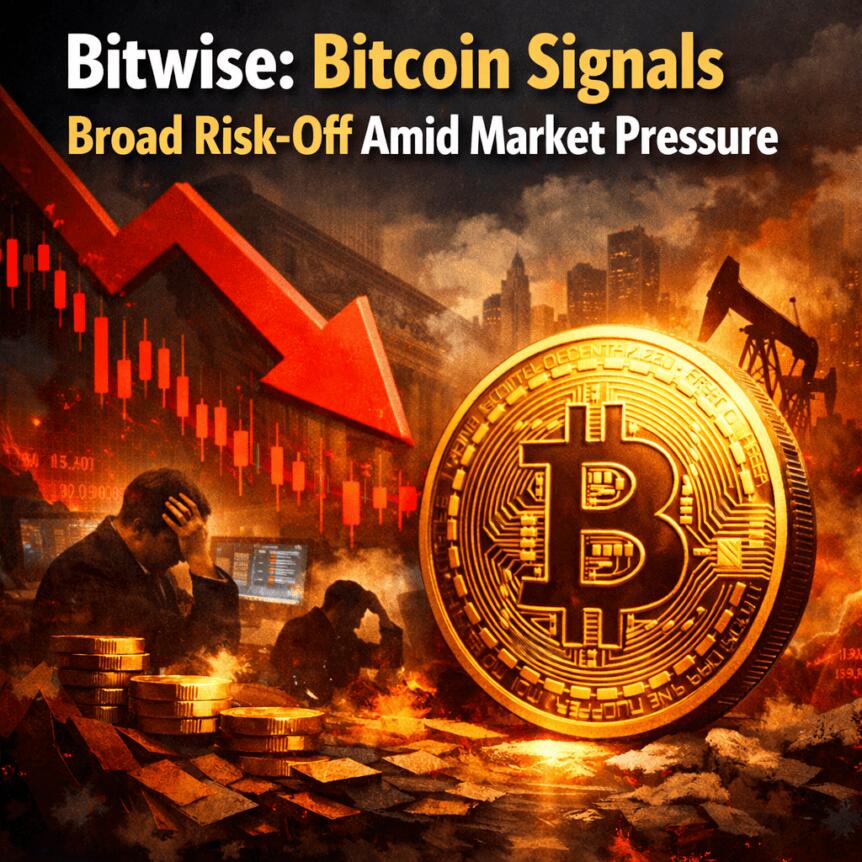
Bitcoin’s latest price action may illuminate something bigger than a routine risk-off move: it underscores how liquidity conditions and macro forces influence the crypto market ahead of traditional assets. According to Bitwise, BTC often serves as a “canary in the macro coal mine,” reacting to shifts in liquidity and financial conditions before equities do. With stock indices under pressure and rate expectations shifting, Bitcoin’s slide fits a broader narrative about how crypto assets are pricing in the evolving liquidity backdrop.
The latest market snapshot shows BTC and Ether at the low end of their cycles, with BTC at around the $58,000 mark and Ether near $1,507, as global risk assets came under renewed strain. The Nasdaq endured its sharpest daily decline in months, while South Korea’s KOSPI triggered a temporary trading halt after a semiconductor-led sell-off. In the background, stronger-than-expected US labor data dampened expectations for rapid Federal Reserve easing, keeping the 10-year US Treasury yield anchored around the mid-4% range and complicating the path for growth-sensitive assets. Bitwise notes that the yield held near 4.53% after a peak near 4.68% last month, signaling that higher-for-longer rate expectations remain a key driver of market mood.
Key takeaways
- Bitcoin and Ethereum touched cycle lows of about $58,000 and $1,507 as broad risk assets faced renewed pressure.
- BTC is described as a macro canary, often weakening ahead of equities when liquidity tightens, signaling a broader risk-off adjustment in markets.
- On-chain indicators show a possible supply of buying power on the sidelines: the Stablecoin Supply Ratio (SSR) RSI sits near an oversold reading of 13, implying substantial stablecoins relative to Bitcoin value.
- Exchange reserves for major stablecoins remain elevated, near $72 billion (USDT ~ $57.7B and USDC ~ $12B), suggesting dry powder even as BTC trades near the lower end of recent ranges.
- The overall liquidity backdrop remains mixed: global M2 liquidity sits around $122.6 trillion, hinting at an ongoing tension between expanded liquidity and tighter risk conditions.
Bitcoin as a macro signal and the liquidity puzzle
Bitwise’s analysis frames Bitcoin as a reliable early indicator of shifts in the macro regime. When liquidity tightens, BTC tends to weaken ahead of equities, a pattern that has shown up again as the market digests stronger U.S. labor news and higher-for-longer rate expectations. The implication for traders is not a binary punt on crypto weakness, but a more nuanced read on how liquidity cycles shape risk appetite across asset classes. As Bitwise notes, BTC’s liquidity-driven movement contrasts with traditional markets that move more gradually, given their hours-long trading cycles and broader asset bases. This dynamic suggests that Bitcoin could be pricing in a slower, more protracted adjustment if liquidity conditions remain constrained, even if equities later stabilize.
Linked to this view is the interaction between on-chain signals and macro data. The observed price action sits within a broader context of rising global liquidity in another sense—the on-chain metrics show a potential cushion for buying activity that could re-enter the market when liquidity loosens. If Bitcoin historically weakens in advance of risk assets but is supported by a backstop of stablecoins ready to deploy, traders may watch for signs of renewed appetite as policy and liquidity evolve. The question now is whether the current balance between on-chain liquidity signals and macro constraints marks a temporary pause or the onset of a longer adjustment phase.
Stablecoin liquidity signals and what they imply
On-chain analytics provide a contrasting lens to price moves. Independent analyst Maartunn highlighted the Stablecoin Supply Ratio (SSR) RSI, which has slipped to an oversold reading of 13. The SSR compares Bitcoin’s market capitalization to the market value of major stablecoins, such as Tether’s USDT and Circle’s USDC. A lower SSR RSI indicates a larger stablecoin balance relative to BTC’s price, implying substantial buying power waiting on the sidelines. Historically, similar SSR RSI readings have tended to accompany accumulation phases, followed by periods of stronger price performance once liquidity returns to the market.
That on-chain signal sits alongside another liquidity barometer: exchange reserves. Collectively, the major stablecoins on exchanges total around $72 billion, with roughly $57.7 billion in USDT and about $12 billion in USDC. While this total has eased from late-2025 peaks above $80 billion, it remains well above historical norms, indicating a sizable pool of liquidity that could be deployed if price action turns favorable. In practice, this “dry powder” can give market participants confidence that there is material capacity to support a rebound should macro conditions permit.
Taken together, these metrics offer a more nuanced view of a market that has already repriced significantly. The SSR RSI’s oversold reading hints at potential buying pressure building beneath the surface, while elevated stablecoin reserves suggest the capacity for a rapid liquidity re-entry if risk appetite improves. The key question for traders is not whether BTC will continue to drift lower in a risk-off regime, but at what point on the scale the liquidity backdrop shifts enough to spark renewed interest from buyers who have been waiting on the sidelines.
Global liquidity backdrop and the path forward
Beyond crypto-specific dynamics, the broader macro backdrop remains a mixture of expansion and constraint. Global M2 liquidity stands around $122.6 trillion, a figure that has trended upward over the past year. The tension between expanding liquidity and a higher-for-longer rate environment creates a complex interplay for crypto assets: liquidity expansion tends to support risk-taking during disinflationary periods, while persistent rate yields and liquidity constraints can cap upside for sensitive assets like Bitcoin and equities. The divergence between on-chain signals and macro metrics suggests that BTC’s next move could hinge on a shift in policy expectations or a late-cycle improvement in liquidity conditions rather than a straightforward reaction to price movements alone.
For market participants, the current configuration means watching two closely related channels: how the macro cycle evolves in terms of policy stance and liquidity, and how on-chain indicators respond to that evolution. If SSR RSI readings begin to climb and exchange reserves remain robust or increase further, complacency could give way to a fresh round of volatility as traders position for an eventual liquidity upturn. Conversely, if macro data continues to push yields higher and liquidity remains tight, Bitcoin may remain in a prolonged drift as risk assets absorb the new rate paradigm.
What investors should watch next
As the market digests recent data and the liquidity narrative evolves, several watchpoints emerge. First, the path of US monetary policy and expectations for rate cuts or further tightening will be a primary driver of risk sentiment. Second, on-chain signals such as the SSR RSI and stablecoin reserve levels will continue to offer early hints about where demand could re-emerge. Third, the performance of major risk assets—especially the Nasdaq and tech equities—will test whether BTC’s macro-caninara role remains valid or if equities find a bottom that reduces BTC’s sensitivity to liquidity shifts.
In the near term, investors should consider how new liquidity enters the market. A rebound in risk appetite could materialize if stablecoins remain available and if on-chain liquidity signals align with a broader improvement in macro conditions. On the other hand, persistent rate persistence or liquidity constraints could keep Bitcoin in a cautious trading range until there is clearer evidence of a policy shift or a sustained improvement in macro fundamentals.
As Bitwise frames it, Bitcoin’s behavior is a telling barometer, not a standalone predictor. Its price path in coming weeks will likely reflect a confluence of liquidity dynamics, macro data, and the readiness of market participants to deploy capital from stablecoin reserves back into risk assets.
The story remains dynamic, and readers should stay tuned for any shifts in liquidity signals, on-chain metrics, or macro developments that could tilt the balance toward renewed risk-taking or a deeper risk-off stance.
OKX is rolling out expiry futures tied to the Magnificent 7, SPY, QQQ and major commodity benchmarks for European retail customers.
In a Tuesday release shared with Cointelegraph, OKX said the new X-Perps markets allow users to trade futures linked to individual Magnificent 7 stocks, alongside index-linked contracts based on the S&P 500 and Nasdaq-100 via SPY and QQQ.
The products also provide exposure to gold, silver and oil with up to 10x leverage, using the same margin pool as customers’ crypto holdings.
OKX defines its X-Perps lineup as a regulated derivatives product that combines leveraged trading with a funding rate mechanism designed to track underlying spot prices. It launched in April with crypto-linked contracts including Bitcoin (BTC), Ether (ETH), Solana (SOL) and XRP.
Crypto exchanges are increasingly converging equities and derivatives trading into single retail platforms in Europe, where regulatory overlap between the Markets in Financial Instruments Directive (MiFID II) and the European Union’s Markets in Crypto Assets (MiCA) framework is reshaping how traditional and digital asset exposure is packaged for retail investors.
OKX Europe launched X-Perps. Source: OKX
Crypto exchanges race to bring stock derivatives onshore
The addition of contracts linked to the Magnificent 7, a nickname for seven of the largest US tech companies, comes as exchanges increasingly package traditional financial assets into crypto-native trading products.
Kraken rolled out regulated tokenized equity perpetual futures for non-US clients in February, including instruments tied to the S&P 500, Nasdaq 100, Magnificent 7 and gold, built on its xStocks framework.
Coinbase followed in March, launching stock perpetual futures for non-US users via Coinbase Advanced and Coinbase International Exchange with crypto-settled margin.
Binance has also expanded into equities-linked products, rolling out commission-free trading for US-listed stocks and exchange-traded funds for non-US users earlier in June.
Related: France’s AMF regulator sets June 30 deadline for MiCA licensing
OKX’s bet is that X-Perps bring that equity derivatives functionality for European retail in a single, regulated account, rather than forcing traders to juggle a broker regulated under MiFID II for stocks and an offshore crypto exchange for derivatives trading.
Erald Ghoos, chief executive of OKX Europe, told Cointelegraph that X-Perps volumes in Europe have risen more than 447% since May 1 and are “predominantly” being driven by new clients who previously traded US equity-linked derivatives on offshore or unlicensed platforms.
Regulators weigh rules for crypto-linked derivatives
The growth of stock-linked products on crypto platforms comes as European regulators examine how existing securities and derivatives rules apply to crypto-linked investment products.
The European Securities and Markets Authority (ESMA) warned in February that leveraged crypto-linked derivatives may fall under existing EU CFD rules, which impose limits on leverage, margin close-out protections and risk warnings.
European regulators are also examining how investor protection rules apply to perpetual derivatives and tokenized stock products ahead of the EU’s full MiCA framework implementation on July 1, 2026.
Crypto asset service providers that fail to obtain authorization will be required to stop serving EU clients.
Magazine: Guide to the top and emerging global crypto hubs — Mid-2026

Breightmet residents raise concerns as Travellers remain on field

Kalshi to make some users reveal job details to tackle insider trading

RLUSD Surges With $275M Liquidity Boost as XRP Ledger Activity Jumps



-

 Fashion4 days ago
Weekend Open Thread: Evereve – Corporette.com
-
 Crypto World5 days ago
Jensen Huang Approves Samsung, SK Hynix, and Micron for NVIDIA (NVDA) HBM4 Memory Supply
-

 Crypto World2 days ago
Anatomy of the June crypto crash: Fed, Iran, Saylor
-

 Business7 days ago
Trump Taps Housing Chief Bill Pulte as Acting Intelligence Director After Gabbard Exit
-
Crypto World3 days ago
Senator Cynthia Lummis Calls CLARITY Act the Most Consequential Financial Legislation of This Generation
-

 NewsBeat2 days ago
Alexander Zverev wins the French Open to finally earn a 1st Grand Slam title
-

 Tech5 days ago
Microsoft launches MXC, an OS-level sandbox for AI agents, with OpenAI and Nvidia already on board
-
 Entertainment3 days ago
The Best Mystery Series of All Time Is Surging on Streaming 30 Years After It Ended
-
 Business3 days ago
The Pain Points Taking a Fragile Tech Rally Down a Notch
-

 Tech3 days ago
Microsoft unveils seven homegrown AI models in new bid for ‘long term self-sufficiency’
-
Crypto World5 days ago
LBank Surpasses 25 Million Users Worldwide as AFA Partnership Continues to Drive Global Growth
-

 Tech4 days ago
Suspicious Polyfill login prompts pop up on Toshiba, Muji websites
-

 Crypto World3 days ago
Trump’s AI Ownership Plan Could Benefit Anthropic at OpenAI’s Expense
-
 Sports10 hours ago
Bangladesh beat Australia after 20 years in ODIs, register only their second win over six-time world champions | Cricket News
-

 Business5 days ago
(VIDEO) Justin Bieber Delivers Surprise Happy Birthday Serenade to Diners at Los Angeles Mexican Restaurant
-

 Tech5 days ago
RCS Messages Between iPhone and Android Get End-to-End Encryption With iOS 26.5
-

 Tech5 days ago
Meta steals a tactic from Tesla and builds data centers in tents
-
 Crypto World2 days ago
Eli Lilly (LLY) Stock Surges 4% Following Breakthrough Sleep Apnea Trial Results
-

 Tech4 days ago
Hackers now exploit SolarWinds Serv-U flaw to crash servers
-
Business7 days ago
Asia stocks rise past US-Iran jitters; Nikkei hits record high on stimulus cheer
You must be logged in to post a comment Login