
Crypto World
Bitcoin’s sell-side pressure slips to rare lows as $80K sellers exit

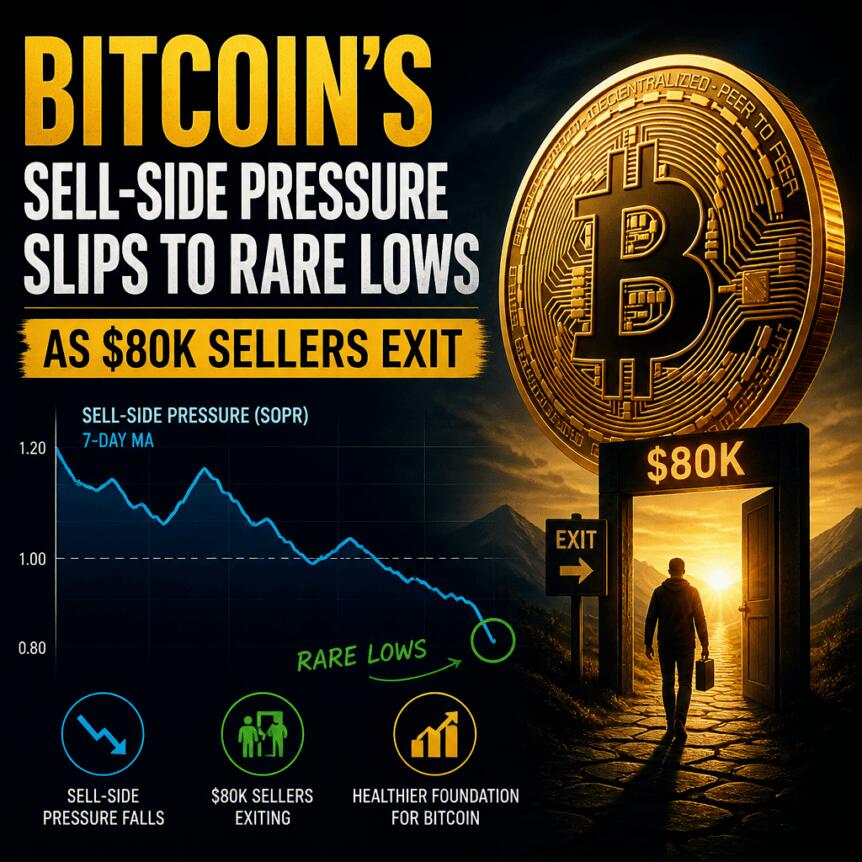
Bitcoin’s near-term sell pressure has eased sharply, with onchain data pointing to a “low sell-side risk” environment as August profit-taking fades into September. Glassnode’s latest weekly onchain report shows Bitcoin’s sell-side risk ratio has fallen to 7—down from 16 in September—an improvement that can matter for traders who watch realized profits as a trigger for faster, more emotional selling.
The same Glassnode update also highlights how long-term holders are realizing profits more selectively, while US spot Bitcoin ETF investors remain deeply underwater on an aggregate basis relative to their breakeven level near $86,000.
Key takeaways
- Glassnode reports Bitcoin’s sell-side risk ratio reset lower, dropping to 7—among the lowest readings recorded.
- Lower selling pressure coincides with Bitcoin holding most of its roughly 25% August gains.
- Long-term holders’ share of realized profit fell to 47% from 88% at the August peak.
- US spot Bitcoin ETF investors have spent 229 sessions below the aggregate breakeven point near $86,000, with paper losses around $3.9 billion.
Why the sell-side risk ratio matters
Glassnode frames its sell-side risk ratio (SSRR) as a measure of “realized” pressure rather than just price movement. The metric takes the total value of onchain realized profits and losses and divides it by Bitcoin’s realized market capitalization. In other words, it aims to capture how much US-dollar value has actually changed hands versus the size of the realized coin base for the period in question.
In the report, Glassnode says lower SSRR values typically align with conditions such as “macro market bottoms, accumulation phases and relatively low sell-side risk environments.” That interpretation is particularly relevant for markets that have recently rallied, because periods of heavy realized profit can increase the likelihood that holders decide to lock gains if price momentum stalls.
September cooling after August’s rebound
Glassnode ties the SSRR decline to a post-rebound shift in realized behavior. The company noted that SSRR reached 16 when Bitcoin surged to multimonth highs above $80,000 in late August. As of this week, the ratio has more than halved to 7, which Glassnode characterizes as one of the lowest readings on record.
The onchain analytics platform argues that the August price rebound “drawn little supply,” referring to an absence of meaningful supply emergence in onchain activity. Glassnode also contextualizes how unusual this is versus other periods: it pointed out that similar “supply draw” conditions were not observed in the same way at later points in the year, and that only a small share of days across the past year have posted readings lower than today.
That matters because a low SSRR environment can reduce the probability that even a relatively modest pullback immediately triggers aggressive selling. It doesn’t eliminate downside risk—price can still move on macro factors or liquidity—but it can change the balance between who is likely to sell and how much profit exists to be realized.
Profit-taking shifts: long-term holders selling less
Beyond aggregate sell pressure, Glassnode also focused on who is realizing profits onchain. The report defines long-term holders as wallet entities that hold a UTXO without spending it for at least six months. According to Glassnode, these holders are realizing profits at a lower rate this month.
Specifically, Glassnode says long-term holders’ share of realized profit has fallen to 47% from 88% at the August peak. It also notes that September’s realized profit spike on September 3, 2026 was under half the size of August’s. The combined message is that the “profit who sells” dynamic appears to be shifting away from the most patient holders.
“The sellers this month are recent buyers, and even they are selling less.”
For investors, that distinction can be meaningful: recent entrants are often more sensitive to near-term price changes, while long-term holders typically respond differently. If the selling impulse is increasingly concentrated among newer holders—and even they are moderating—it can help explain why SSRR is trending down even after a strong month.
ETF breakevens remain a key reference point
Even with improving sell-side risk, the report underscores that ETF positioning is still a notable overhang. Glassnode says US spot Bitcoin ETF investors would return to aggregate profit at roughly $86,000. According to the report, Bitcoin has closed below that level for the past 229 sessions, and ETF investors’ paper losses are currently around $3.9 billion.
This doesn’t necessarily mean ETF holders are selling aggressively—paper losses can persist through drawdowns when investors maintain exposure through continued inflows or hold through volatility. But from a behavioral perspective, breakeven levels often become a psychological and institutional reference point. If prices revisit $86,000, ETF investors may face pressure to reassess risk, while the opposite scenario (further declines) could intensify the temptation to reduce exposure.
The SSRR decline may therefore help temper fears that a correction automatically forces a cascade of realized selling. At the same time, ETF breakeven dynamics serve as a reminder that a large cohort is still sitting on losses, and that sentiment could change quickly if price action approaches or moves away from that threshold.
Readers should watch whether SSRR stays near these low levels as Bitcoin’s price continues to trade relative to the $80,000 area and whether ETF performance moves ETF investors closer to—or further from—aggregate breakeven near $86,000. The key question is whether September’s “lower sell-side risk” environment persists as realized profit levels evolve.



Liquid Network has resumed block production without processing transactions after a $320 million Bitcoin withdrawal forced the sidechain to halt operations.
Summary
- Functionary nodes have resumed signing and validating blocks after receiving required software updates.
- Transactions and BTC peg operations remain suspended while Liquid monitors the network.
- Hackers returned 3,400 BTC, leaving about 598 BTC outside the federation wallet.
- Elements v23.3.4 changes how the software verifies and stores confidential transaction proofs.
Liquid Network said in a Thursday update that its functionary nodes were again producing blocks as intended, but the network would operate “without transactions” while developers monitored its condition.
The limited restart allows Liquid to test its updated infrastructure without reopening transfers or exposing the peg system to new activity. According to the network, keeping transactions disabled will help operators “confirm full stabilization” before they restore other services.
Functionary and bridge nodes have received the required software changes, Liquid added. Its functionaries can now sign and validate blocks, though users cannot yet send regular transactions or move funds between Bitcoin and Liquid.
Peg operations also remain suspended, including withdrawals approved through Peg-out Authorization Keys, or PAKs. Liquid said the restrictions would stay in place while it works to restore the reserve that supports Bitcoin issued on the sidechain as L-BTC.
Liquid Network has restarted with transactions disabled
Block production represents only one part of Liquid’s return to service because its transaction and bridge systems remain unavailable. The network has not provided a date for reopening either function.
Under normal conditions, users deposit BTC into the federation-controlled peg and receive an equal amount of L-BTC for use on Liquid. Holders can later burn L-BTC through an approved peg-out service to release the corresponding Bitcoin on the base layer.
Operators stopped that process after an actor created unbacked L-BTC by exploiting a proof-verification flaw in Elements, the open-source software behind Liquid. The actor then submitted the tokens through SideSwap’s authorized peg-out service, prompting the federation to release real Bitcoin.
As crypto.news previously reported, the transaction removed about 3,996 BTC and reduced the federation wallet from approximately 4,205 BTC to about 202 BTC. The withdrawal represented roughly 95% of the Bitcoin held in the wallet at the time.
Liquid described the actors as “purported white-hat hackers” after they identified themselves as white hats through messages attached to Bitcoin transactions. Their claim did not establish that they had permission to create the L-BTC or withdraw the underlying Bitcoin.
SideSwap said a customer had sent 4,000 L-BTC to its peg-out service, which processed the request under its normal system. Liquid and SideSwap said the key used to authorize the transaction had not been compromised.
Elements update changes proof-verification cache
One day before restarting block production, Liquid released an emergency Elements update designed to address the flaw connected to the withdrawal.
Elements v23.3.4 changes the cache keys used when validating range proofs, according to Liquid. Range proofs allow the network to confirm that a hidden transaction amount is valid without publicly revealing the amount, forming part of Liquid’s confidential transaction system.
The affected software stored successful proof-verification results so nodes could reuse them instead of repeating the full calculation. Previous reporting found that the cache did not include enough transaction context, allowing a valid proof result to be reused where it should have failed.
By exploiting that weakness, the actor created L-BTC without first locking an equal amount of Bitcoin in the federation wallet. Functionary nodes running the affected code accepted the tokens, while SideSwap’s peg-out process treated them as valid L-BTC and processed the withdrawal.
Liquid said version 23.3.4 hardens the cache keys associated with range proofs. Functionary and bridge nodes received the update before block signing restarted, although the network is still withholding transactions while operators check the deployment.
Liquid’s federation uses functionary nodes to confirm sidechain blocks and control the Bitcoin held behind L-BTC. The system relies on 15 rotating functionaries and requires 11 signatures to move funds from its multisignature wallet, according to an earlier technical account of the incident.
No federation signing key was reported stolen during the withdrawal. The failure instead involved the software used to decide whether the L-BTC submitted for redemption was valid.
Hackers returned 3,400 BTC after nodes were patched
Communication between Blockstream and the actors took place through messages embedded in Bitcoin transactions. In one message, the actors said they would return the assets after the vulnerable nodes had been repaired.
“Please fix the bug first,” the message said. “Make sure every node is patched. Then we will transfer the money back safely after confirming the fix.”
Blockstream later sent a signed message stating that its bridge nodes had been patched and that the Bitcoin was “safe to return.” Following that confirmation, the actors transferred 3,400 BTC back to the federation wallet.
The 3,400 BTC repayment restored about 85% of the withdrawn funds. At the time of the transfer, the returned Bitcoin was worth approximately $270 million.
About 598.5 BTC remained in the withdrawal-linked address after the repayment. The outstanding balance was worth roughly $46 million based on the Bitcoin price cited in the supplied report, though its dollar value changes with the market.
No public agreement has identified the remaining Bitcoin as an approved security bounty. The actors have not publicly stated whether they plan to return another portion, while Blockstream has not announced terms allowing them to keep the balance.
Ledger Chief Technology Officer Charles Guillemet questioned the white-hat label after the partial repayment. In an X post, he argued that retaining about 600 BTC without publicly disclosed terms looked more like extortion than a standard security reward.
L-BTC holders await restoration of peg services
Liquid operates as a federated Bitcoin sidechain that allows exchanges, trading firms and other users to transfer BTC-linked assets with shorter settlement times than Bitcoin’s base layer. Blockstream launched the production network in 2018 using Elements software.
L-BTC depends on Bitcoin held in the federation wallet to maintain its one-to-one backing. Until Liquid restores peg operations, holders cannot use the normal bridge process to redeem L-BTC for native Bitcoin.
A previous bridge security explainer described how systems that lock assets on one chain and issue linked tokens on another depend on their custody, validation, and message-processing controls. A failure in any part of that process can suspend redemptions even when the underlying blockchain continues to operate.
For U.S. users, the current effect is limited to access and operations rather than a stated change in federal policy. American L-BTC holders face the same transaction and peg restrictions as users elsewhere, while BTC held directly on Bitcoin’s base layer remains separate from the Liquid system.
No U.S. regulator or law enforcement agency has announced an action connected to the withdrawal. Liquid also has not given a timetable for restoring transactions, PAK-authorized peg-outs, or other bridge operations.


A grant application went into Claude, its safety filter caught it and refused. Days later, the same operator was back, and the refused prompts were reportedly flowing to a rival AI model instead.
Anthropic published that story about itself, revealing a case where an AI company shows its own models touching possible biological weapons work.
The Grant That Got Blocked
The application sought money to study chikungunya, a mosquito-borne virus that brings months of pain and has no cure. The plan was to help it spread better and dodge the immune system. Civilian scientists wrote it. A military institute was to host the work.
Every exchange was blocked, but it found a workaround. The service carrying those researchers built a fallback to a competitor’s model. Claude helped write that code. The job was sold to it as a fix for over-refusal.
Five Cases, No Proven Intent
The report runs 154 pages and carries five biology cases. Anthropic banned the accounts, withheld the labs, then stopped short of the accusation everyone expected.
“We do not assert that they intended harm, and identifying them or their labs could expose them to harm,” the team said in the report.
Notably, however, the filters did work sometimes. A bird flu researcher was pushed onto weaker models, and Anthropic calls that help mostly clerical.
Anthropic Biological Weapons Cases by the Numbers
| Figure | What it counts |
|---|---|
| 154 | Pages in the report |
| 5 | Biology cases published |
| 35 | Research efforts found in a 30-day sweep of state-linked institutions |
| 1 hour | Time one user took to draft a smallpox-family grant on Opus 5 |
Follow us on X to get the latest news as it happens
The Part That Should Worry People
Most of those 35 efforts were ordinary civilian science. That is the problem. The same knowledge builds a vaccine or a weapon, and a filter cannot read a mind.
“A classifier cannot simultaneously enable benefit and prevent harm,” Anthropic said.
Its limits have been tested before. In April a Discord group reached its restricted model on day one.
Against the backdrops of these growing scares, Washington is moving,. with representatives Ted Lieu and Nathaniel Moran filing the AI Kill Switch Act in July. It would force developers to keep the power to shut their systems down.
The same report also banned clients who used Claude to track dissidents.
The post Anthropic Says AI Aided Possible Biological Weapons Research appeared first on BeInCrypto.
Crypto World
New Clarity Act text tweaks DeFi, credit union provisions, but road ahead for bill remains murky


The Clarity Act needs 60 votes when the Senate returns from its recess next week. Republicans circulated a fresh draft on Thursday ahead of the vote.
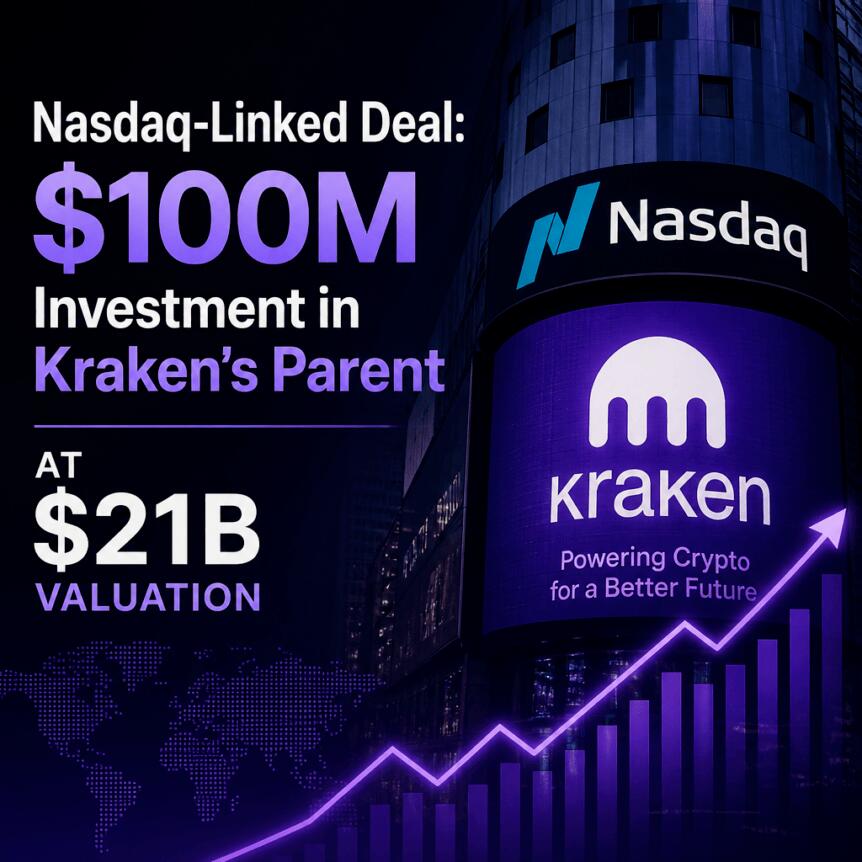
Nasdaq has put $100 million into Payward, the parent company behind the Kraken cryptocurrency exchange, as part of an expansion push into tokenized assets. The investment is positioned to connect Nasdaq-listed equities to tokenized trading through Kraken’s platform, while also bringing Nasdaq surveillance tools into Payward’s broader markets infrastructure.
The deal deepens an already existing relationship between Nasdaq and Payward. In March, Nasdaq announced its partnership with Payward to support tokenized equities, and Thursday’s announcement adds both capital and operational integration.
Key takeaways
- Nasdaq’s venture arm invested $100 million in Payward, valuing Kraken’s parent at $21 billion, according to people familiar with the matter cited by Bloomberg.
- Kraken is set to offer tokenized versions of Nasdaq-listed stocks on its own exchange platform.
- Payward will adopt Nasdaq surveillance technology across its venues spanning crypto, equities, tokenized equities, futures, and options.
- The move follows recent European expansion efforts tied to tokenized stocks from other major exchanges, including Deutsche Börse and the London Stock Exchange.
- RWA.xyz data shows tokenized stocks have a distributed value above $2.9 billion, up 7.4% over the past month.
Nasdaq invests in Kraken’s parent to scale tokenized equity offerings
Nasdaq disclosed that its venture unit made the $100 million investment in Payward. Payward is the corporate parent of Kraken, which has been positioning itself as a venue for digital-asset trading and, increasingly, tokenized versions of traditional financial instruments.
Under the terms of the announcement, Kraken will offer tokenized versions of Nasdaq-listed stocks directly on its own platform. The announcement builds on the framework Nasdaq and Payward outlined earlier, including a partnership described by Cointelegraph in March as focused on issuer-centric tokenized equities.
For investors, the practical significance is straightforward: the investment signals that tokenized equities are moving from isolated pilots toward more mainstream exchange distribution channels. Kraken’s customer base and trading infrastructure may become a larger on-ramp for investors seeking 24/5 access to equity-linked products—an approach other venues have also been testing.
Surveillance tech integration across crypto and tokenized markets
Beyond the capital infusion, Nasdaq said Payward will adopt its surveillance technology across multiple market types. According to the announcement, the coverage will extend across Payward’s crypto venues, equities venues, tokenized equity venues, futures, and options.
That matters because surveillance and monitoring are central to how regulated trading ecosystems address market integrity, compliance, and risk management. Rather than treating tokenized equities as a separate back-office experiment, the announcement describes a consolidation of tooling across asset classes and trading formats.
In effect, Nasdaq is leveraging its infrastructure and regulatory experience to support a wider deployment of tokenized products—while Payward gains access to a standardized monitoring layer that can help it scale listings and operations without reinventing compliance workflows for each new category.
What the $21 billion valuation implies for the tokenization race
Bloomberg reported that the investment valued Kraken’s parent, Payward, at $21 billion, citing people familiar with the matter. Nasdaq did not provide that valuation figure in the disclosure itself, but the reported number gives readers a benchmark for how much strategic capital major exchange operators are willing to attach to blockchain-native market infrastructure.
Cointelegraph previously noted that Nasdaq has been pushing for “always-on” markets, which includes exploring regulatory pathways for trading tokenized stocks. In the context of this latest investment, the $21 billion figure suggests tokenization is becoming a core part of Nasdaq’s growth narrative rather than a side project.
Earlier this month, Nasdaq also shared plans to acquire Level Markets as part of its always-on strategy. And a year ago, Nasdaq filed a proposal with the US Securities and Exchange Commission related to tokenization—showing that the current momentum is supported by longer-term regulatory work rather than a sudden shift.
Momentum across major exchanges: Deutsche Börse and London Stock Exchange
Nasdaq’s move arrives amid a wider flurry of exchange activity around tokenized equities.
Earlier this month, Kraken partnered with the London Stock Exchange to launch access to 24/5 trading of tokenized stocks tracking UK equity products, with the initiative expected to start in 2027. In April, Deutsche Börse invested $200 million in Payward, aligning with its own plans to broaden access to blockchain-based securities and tokenized investment products.
Taken together, these investments show that competitive pressure is no longer limited to cryptocurrency trading. Exchange groups are positioning tokenized stocks as part of the next evolution in market access—especially in markets where investors want trading flexibility outside traditional windows.
For market participants, the key question now is not just whether tokenized equities can be issued, but whether liquidity, custody, settlement, and compliance can scale across multiple issuers, venues, and jurisdictions without fragmenting the user experience.
How big is the tokenized stocks market today?
Tokenization remains a niche compared with the broader equities market, but growth is visible. Data compiled by RWA.xyz indicates the current distributed value of tokenized stocks is more than $2.9 billion, up 7.4% over the past month.
That metric doesn’t directly measure overall trading volume across all tokenized products, but it provides a useful read on how much capital is currently locked into tokenized stock representations. With Nasdaq’s $100 million bet and broader exchange partnerships around tokenized equities, the next phase to watch is whether distributed value and real trading activity rise in tandem.
As Nasdaq, Kraken, and other exchanges continue to connect tokenized stocks to mainstream trading infrastructure, investors should pay close attention to how quickly tokenized Nasdaq-listed stocks launch on Kraken, how surveillance and compliance integration affects operational rollout, and whether distributed value continues accelerating alongside new listings.
Crypto World
TIME Convenes Leaders Shaping the Future of Health for Third Annual TIME100 Health Leadership Forum


Today, TIME convenes the third annual TIME100 Health Leadership Forum in New York City, featuring conversations on equity, longevity, and solution-driven care with leaders taking action toward a world with more reliable healthcare solutions.
The TIME100 Health Leadership Forum will bring together individuals from the TIME and TIME100 Health communities and beyond who are actively shaping the health industry.
Speakers will include journalist, founder of Cleveland Clinic’s Women’s Alzheimer’s Movement and co-founder of Cleveland Clinic’s Comprehensive Women’s Health and Research Center Maria Shriver; gastrointestinal medical oncologist at Memorial Sloan Kettering Cancer Center Dr. Andrea Cercek; psychiatrist, researcher and author, Dr. Judith Joseph; chief executive officer of the American Cancer Society and the American Cancer Society Cancer Action Network Shane Jacobson; director, president and chief executive officer of Insulet Corporation Ashley McEvoy; professor at Harvard Medical School David Sinclair; Director of Pediatric Cell Therapy and Transplant and Cancer Clinical Research and Oregon Health & Science University, Dr. Eneida R. Nemecek; executive vice president of Kite Cindy Perettie; founder and chief executive officer of Musely Jack Jia; on-air host of Elvis Duran and the Morning Show and T1D advocate, Garrett Vogel; neuroscientist and women’s health biotech founder Jennifer Garrison; chief executive officer of NMDP Amy Ronneberg; and director of the Center for Cell Therapy and Transplant at Penn Medicine Dr. David L. Porter.
“Tonight, we’ll bring together leaders taking on some of the most important challenges in health today to share ideas, build connections, and move important work forward. We thank our partners for their commitment to advancing health and driving meaningful change,” said TIME Chief Executive Officer Jessica Sibley.
“The TIME100 Health Leadership Forum gives us a chance to hear directly from those shaping the future of health, learn from their experiences and ideas, and gain a clearer view of where health is headed next,” said TIME Executive Editor and Chief Strategy Officer Dan Macsai, who oversees the TIME100 franchise.
Now in its third year, the TIME100 Health Leadership Forum is an integral part of TIME’s longstanding commitment to spotlighting the people and stories shaping health and sits alongside the annual TIME100 Health list.
The TIME100 Health Leadership Forum is presented by signature partners The American Cancer Society, Insulet, Kite—a Gilead Sciences company, and Musely, and supporting partner NMDP.
To read TIME’s coverage of the TIME100 Health Leadership Forum in New York City, visit TIME.com.
###
Crypto World
XRPPower has launched a short-term program allowing XRP holders to use automated trading features for free, with a daily trading limit of up to $70,000
As artificial intelligence and digital asset technologies continue to converge, automated systems are emerging as a key focus in the digital asset services sector.
XRPPower has recently launched short-term intelligent service plans, offering XRP holders an entry point into AI-driven automated trading systems.
Leveraging AI data analysis and automation technology, the system aims to minimize the need for constant manual intervention while helping users explore digital asset service plans across various timeframes. Some of the plans currently featured on the platform offer potential daily returns of up to $70,000, with actual results depending on the specific plan, market conditions, and platform rules.
How to get started with XRPPower?
01 Create an Account
02 Explore Automated Features
Visit the platform to view automated trading options and related intelligent services, and learn about how they operate, service durations, participation requirements, and specific rules.
03 Check Supported Assets
View the assets currently supported by the platform—such as XRP, BTC, ETH, and USDT—and confirm the relevant networks and usage requirements.
04 View and Manage Your Account
Users can view service history, balances, and related data through their accounts, and choose whether to withdraw funds or purchase additional yield contracts based on their preferences.
Popular Yield Contracts
Investment Amount: $1,000 | Duration: 7 Days | Daily Return: $13.20 | Principal Refund at Maturity: $1,000
Investment Amount: $5,000 | Duration: 15 Days | Daily Return: $70.50 | Principal Refund at Maturity: $5,000
Click to view all contract yields
How to earn long-term returns with zero investment
Extra Referral Rewards
Log in to your account and use your unique invitation code or referral link to invite friends and family to join the XRPPower platform; you can earn permanent rewards of 3% + 2%.
Example Scenario:
(A) User A refers User B to make an investment; if User B invests $10,000, User A receives a 3% reward ($300).
(B) User B refers User C to make an additional investment; if C invests $10,000, B receives a 3% ($300) reward, while A receives a 2% ($200) secondary referral reward.
XRPPower Continuously Upgrades Smart Technology to Build a More Convenient Digital Service Ecosystem
Artificial intelligence and automation technologies are constantly transforming how digital asset services are utilized. Addressing user concerns regarding security, efficiency, stability, and information transparency, XRPPower continuously optimizes its platform’s technical architecture and service workflows, exploring smarter digital service experiences.
Integrating AI Technology into Platform Services
XRPPower applies AI data analysis and automation technologies to platform operations. Through systematic data processing and status monitoring, the platform enhances information processing efficiency and reduces repetitive tasks, enabling users to more easily access information about platform services and their accounts.
Strengthening Multi-Layered Security Protection
The platform reinforces security management across multiple dimensions—including accounts, data, networks, and access privileges—by employing technical measures such as SSL/TLS encryption, two-factor authentication (2FA), access control, multi-signature technology, hot/cold wallet management, DDoS protection, and WAF (Web Application Firewall) to safeguard the platform’s infrastructure.
Adopting Professional Management Principles
Regarding platform operations and risk management, XRPPower keeps abreast of industry-standard practices in risk control, internal management, and information security. It references concepts and methodologies published by international professional firms—such as PwC—to refine its own internal processes.
It should be noted that referencing publicly available industry concepts does not imply that PwC has audited, certified, or officially endorsed XRPPower, absent any publicly verifiable official documentation.
Enhancing Information Transparency
XRPPower continuously optimizes its user interface and account features, clearly displaying service details, participation criteria, timeframes, relevant rules, and account records. Users can view this information through their accounts and make informed decisions about whether to use specific services after fully understanding the service details and associated risks.
Continuing to Explore AI Applications
As AI technology rapidly evolves, automation, data analysis, and intelligent management will play increasingly vital roles in digital services. XRPPower remains committed to technological upgrades, refining its services with a focus on security, efficiency, transparency, and user experience to provide users with a clearer, more convenient digital environment.
Learn more at: https://xrppower.com/
Email: [email protected]
ZEC has undoubtedly become crypto’s rock star lately, with its price skyrocketing to a ten-year high above $1,200.
However, certain worrying signals suggest that a short-term pullback may abruptly replace the rally.
Are the Bears Coming?
Earlier this month, ZEC surpassed $1,200 for the first time since 2016 and reached almost $1,300. Currently, it trades around $1,220 (per CoinGecko), representing a 150% monthly increase and a staggering 2,450% explosion on a yearly scale. The main drivers behind the spectacular surge include the launch of Grayscale’s ZEC ETF, along with other factors, which you can explore in our detailed article here.
Nonetheless, three key developments suggest the asset’s relentless climb may be coming to an end. The first one is the TD Sequential indicator, which, according to analyst Ali Martinez, has flashed a sell signal on the 3-day chart.
“The last time this setup appeared, on May 19, it resulted in a 64% price correction. Worth paying attention to this one,” he said.
The second is ZEC’s Relative Strength Index (RSI), which has surged past 70. This indicates that the token has entered overbought territory and could be gearing up for a pullback. Conversely, ratios under 30 are typically considered bullish.

Last but not least, investors have been shifting from self-custody to crypto exchanges. This development is interpreted as bearish because it increases immediate selling pressure.

$10K on the Way?
Despite the worrying signals mentioned above, many market observers believe ZEC still has plenty of fuel left to post further gains. X user Altcoin Sherpa described the $1,000 and $1,100 levels as “interesting,” adding they would rather see price spend time in a specific region and “base out” than check the exact price for the bottom.
“I still think this is a fantastic one to buy though for this cycle,” the analyst concluded.
Crypto With Harris ₿ argued that as long as the price stays above $1,050, “there is no need to worry.” In his view, the masses buying now out of FOMO could trigger a major pump to a new all-time high of $10,000, and he predicts ZEC could reach that milestone before Ethereum (ETH).
The post 3 Reasons Why Zcash (ZEC) Can Plunge Following Its 150% Monthly Explosion appeared first on CryptoPotato.
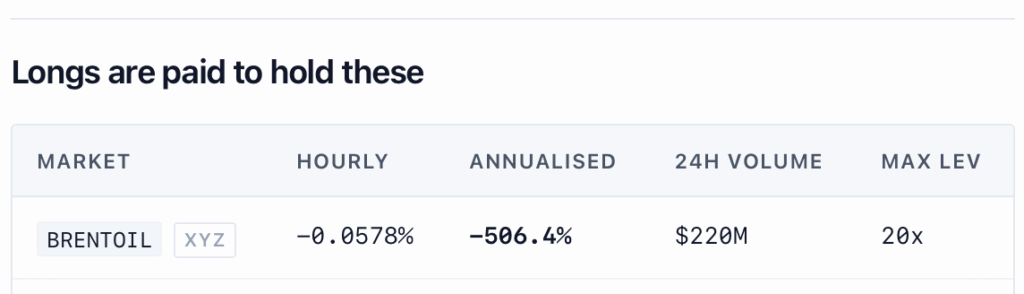
Crypto exchange Hyperliquid is paying traders 500% a year to hold long oil derivatives. Payouts are hourly as an additional reward atop the price appreciation of oil itself which has regained $100 per barrel.
Of course, if it sounds too good to be true, it probably is. There are no free lunches on Wall Street.
First of all, Hyperliquid offers extreme leverage — up to 20x on Brent oil, for example — so unremarkable, intraday price fluctuations can easily wipe out a portfolio.
Moreover, even unlevered trades on Hyperliquid inherit innumerable financial risks from bugs, hackers, market manipulators, vulnerable technologies, and offshore counterparties.
Still, Brent and WTI oil perpetuals on the crypto exchange printed deeply negative hourly funding rates today, meaning that the short side of the trade is overcrowded and must pay fees to borrow margin exposure from less popular longs.
Traders on the venue are so one-sided that shorts must pay 500% annualized fees to anyone willing to go long.
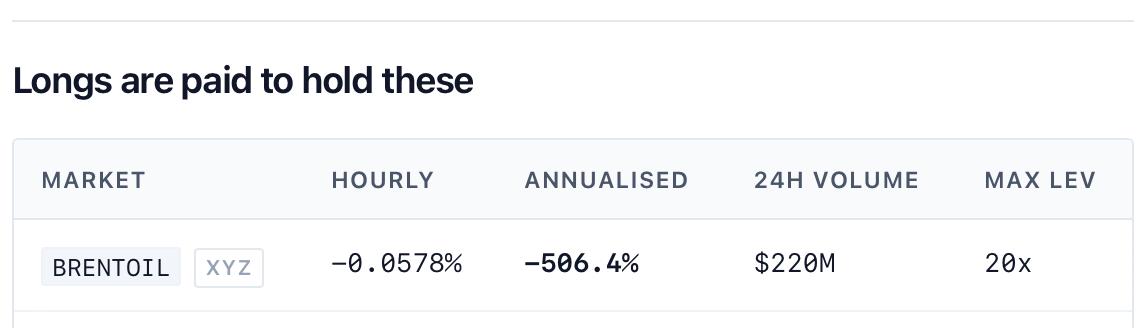
Of course, many Hyperliquid short-sellers are day traders who incur minimal funding fees during a quick trade of a few minutes or hours. Still, the funding rate mismatch between shorts and longs is incredible.
Although Brent oil is trading below its $126 peak on April 30 as a reward for long-term shorts since that date, longs have been winning recently.
As shorts stare in disbelief at rapidly rising prices, longs not only benefit from leveraged gains but also receive hourly funding payouts.
Oil has rallied 6% today alone, and the world’s most actively traded commodity is 24% more expensive than 30 days ago amid escalating tensions in the tanker straits of Hormuz and Bab el-Mandeb.
Year to date, oil is up 75%.
The Iran war that began in February has kept squeezing seaborne supply and global logistics for millions of barrels that the world burns daily.
Read more: Crypto traders paid 8,700% annualized fees to bet on Anthropic
Hyperliquid isn’t literally paying from a corporate account
Technically, funding rates on Hyperliquid aren’t an exchange fee. Hyperliquid isn’t generally in the business of discretionary choices about these fees.
Instead, funding fees are algorithmically determined and occur as hourly transfers between traders.
The intention of funding rates is to tug Hyperliquid’s crypto-native perpetual contract for oil back toward the so-called “oracle” price. Oracle data providers attempt to monitor real-world, off-blockchain prices and broadcast that data onto blockchains in a well-formatted, standardized, and reliable way.
When the contract trades cheaply relative to the oracle price, shorts pay longs, and vice versa.
Hyperliquid News blamed the monthly futures contract roll for today’s particularly egregious funding rates. Writers at the publication opined, “It’s simply due to the roll schedule.”
Specifically, Trade[XYZ] does roll WTI oil from V6 to X6, and Brent from X6 to Z6, between September 8 and September 14.
However, funding rates don’t normally spike this high during futures contracts rolling dates. Given the volatility of oil itself, Hyperliquid’s contracts are particularly popular and one-sided for a variety of reasons this week.
Earlier this year, US exchanges ICE and CME asked Washington to police Hyperliquid’s anonymous oil books, warning the venue could distort the global price.
Got a tip? Send us an email securely via Protos Leaks. For more informed news and investigations, follow us on X, Bluesky, and Google News, or subscribe to our YouTube channel.
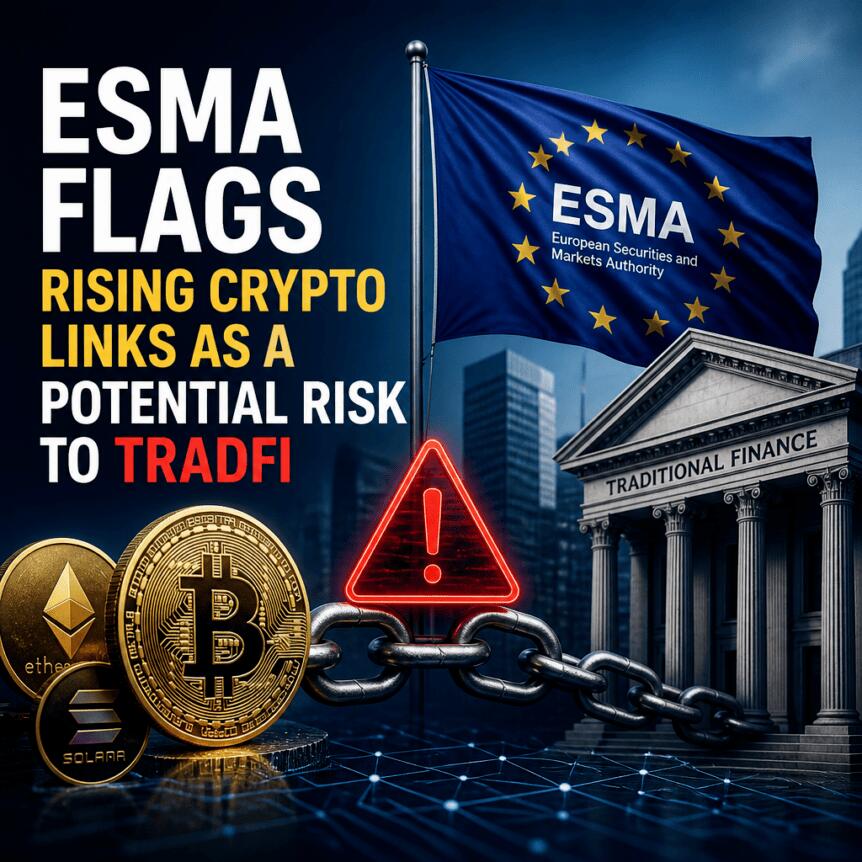
Europe’s top securities regulator is urging closer surveillance of how crypto markets are increasingly intertwined with traditional finance, warning that vulnerabilities in digital-asset ecosystems could contribute to wider financial-system shocks.
In a risk monitoring report published Thursday, the European Securities and Markets Authority (ESMA) highlighted the “growing linkage between increasingly vulnerable crypto-asset markets and the broader financial system,” pointing to both new forms of market integration and specific activity it says can amplify contagion risk.
Key takeaways
- ESMA warns crypto-to-traditional finance links may help shocks spread as crypto activity becomes more connected to mainstream market infrastructure.
- Tokenized equities remain small globally but are gaining traction in Europe, potentially changing who participates and how markets are structured.
- DeFi exploits are on ESMA’s radar as another channel through which crypto disruptions could spill into the wider system.
- Prediction markets are flagged as an emerging concern, with particular focus on insider trading, wash trading, and coordinated manipulation.
- The US regulatory fight over prediction markets continues and could ultimately be settled by the US Supreme Court.
Crypto’s growing connection to traditional markets
ESMA’s warning centers on the possibility that vulnerabilities concentrated in crypto markets could be transmitted into the broader financial system—especially as adoption broadens beyond purely crypto-native venues.
The regulator singled out two developments that could deepen these connections: increased interest in tokenized equities and ongoing risks tied to decentralized finance (DeFi).
On tokenized equities, ESMA stressed that their scale is still negligible relative to global stock markets. However, the report argues that even small segments can matter if they begin pulling in new participants, infrastructure, and liquidity pathways that are shared with, or tightly linked to, mainstream markets.
In DeFi, ESMA pointed to the continued occurrence of exploits—an area that can trigger rapid losses, liquidations, and liquidity stress. While ESMA did not claim direct causal links in every case, its broader message was clear: as crypto mechanisms intersect more frequently with traditional systems, risk events may no longer stay contained within crypto.
Prediction markets: harder enforcement, new compliance challenges
Among ESMA’s most notable emerging flags is the growing use of prediction markets. The regulator said concerns could intensify around insider trading and market manipulation, especially when crypto tools are involved.
ESMA’s report indicates that crypto use in prediction-market activity can complicate detection of problematic conduct such as wash trading and coordinated manipulation. The issue is not only who trades, but how activity is routed and recorded—factors that can affect the visibility regulators have into trading intent and coordination.
The warning matters for traders and market operators because enforcement often depends on the practical ability to identify patterns quickly and attribute them to individuals or entities. If crypto mechanics reduce the clarity of market surveillance, regulators may face higher compliance burdens and potentially stricter controls as authorities react.
US jurisdiction battle over event contracts
ESMA’s European concerns arrive as prediction markets in the United States face a separate, but related, regulatory struggle over what rules apply. The core disagreement is whether event contracts are treated as federal derivatives or fall under state gambling frameworks.
According to ESMA’s report context, the Commodity Futures Trading Commission (CFTC) has issued guidance for prediction markets throughout 2026, while defending what it says is its exclusive jurisdiction over federally regulated event contracts.
That position has been tested in court. The CFTC has sued multiple states—including Kentucky, New Mexico, Illinois and Connecticut, and Minnesota—after those authorities attempted to apply state gambling laws to prediction market operators.
ESMA’s warning about manipulation and insider trading sits in the middle of this broader policy tension: if legal categories remain contested, compliance requirements can differ sharply depending on how a court characterizes the underlying instrument.
The dispute could also reach the US Supreme Court. On September 2, New Jersey officials petitioned the court to decide whether states may enforce sports gambling laws against prediction markets registered with the CFTC. The officials cited ongoing litigation across at least 20 states.
Whether the Supreme Court will accept the case remains uncertain, but a ruling—if it occurs—could materially affect how market operators structure products and how regulators allocate oversight authority.
What investors and builders should watch next
ESMA’s report is a reminder that regulators are tracking not only crypto trading activity, but also how crypto-native products could plug into mainstream financial plumbing. The next question for investors and market participants is whether measures meant to protect traditional markets will keep pace with fast-evolving crypto linkages—particularly in areas ESMA highlighted, such as tokenized equities, DeFi exploits, and prediction markets.
As enforcement and jurisdiction battles continue—especially in the US—readers should watch for updates to surveillance expectations, compliance requirements, and how courts ultimately define the legal category of prediction-market contracts.
Cryptocurrency exchange Coinbase partnered with financial platform Moov to bring stablecoin infrastructure to more than 1,000 community banks and credit unions that are part of Moov’s customer base.
The partnership will combine Coinbase’s regulated digital asset infrastructure and Moov’s payments platform to offer stablecoin payment acceptance, settlement and real-time funding, according to a Thursday announcement.
The infrastructure will support use cases such as consumer stablecoin payments, merchant settlement and payouts. It will also offer businesses and merchants access to Coinbase custodial accounts.
Community banks in the US typically have less than $10 billion in total assets and include state chartered institutions as well as savings and loan holding companies.
The announcement comes as some of the largest US banks are experimenting with stablecoin infrastructure. On Wednesday, U.S. Bank, the fifth-largest commercial bank in the US, completed a live cross-border payment using its proprietary USBDC stablecoin on the Stellar blockchain.
Earlier this month, 21 financial institutions, including Bank of America, Citi, Goldman Sachs, Deutsche Bank and UBS, announced plans to form a company to issue stablecoins, including a US dollar-denominated stablecoin in the first half of 2027.
Non-bank competitors are entering the stablecoin niche. In August, Western Union partnered with stablecoin infrastructure provider Rain to launch a digital wallet and Visa-branded card that enables users to hold and spend a US dollar-backed stablecoin.
Related: Mastercard, Borderless test shared identity checks for stablecoin transfers

USA Bitcoin Adoption

Pierce Brosnan dismisses Tom Hardy feud as ‘storm in a teacup’

Critics Say Bullock, Kidman ‘Cast Quite The Spell’ In Mixed Reviews For ‘Practical Magic 2’


-
 Tech2 days ago
Memory prices are slowing because buyers ran out of money
-

 Business20 hours ago
Micron Stock Climbs Above $1,031 as AI Memory Crunch and a $50 Billion Outlook Fuel the Rally
-

 Crypto World2 days ago
Bitcoin price risks $76K drop as $78K support weakens
-

 Business21 hours ago
AMD Stock Climbs After Management Lifts 2027 Data Center Outlook Toward $70 Billion in AI Sales
-

 Crypto World2 days ago
Ethereum price stalls below $2,500 as ADX drops to 11
-

 Crypto World2 days ago
Robinhood Stock: How To Take Advantage With Reduced Risk
-

 NewsBeat2 days ago
What went right this week: an ‘historic’ fall in violent crime, plus more
-

 Crypto World22 hours ago
Bitcoin price risks $70K if $78K neckline breaks
-
 Crypto World2 days ago
Bitcoin price holds near $79K as cycle drawdowns narrow
-
 Sports2 days ago
Phones confiscated, players sent home: Pakistan’s England tour turmoil revives memories of Mohammad Amir, Salman Butt and Mohammad Asif’s 2010 Lord’s spot-fixing scandal | Cricket News
-

 NewsBeat2 days ago
England up in reading, maths and science rankings as Scotland and Wales dip
-

 Business2 days ago
Meta debuts long-awaited personal AI agent, Muse
-
 Crypto World2 days ago
Brent Crude Oil Moves Above $100 for the First Time in 3 Months
-
 Crypto World2 days ago
Intel Stock Jumps 9% on Chip Price Hike Report, US Stake Gains $36 Billion
-

 Crypto World2 days ago
Pump Fun and Kraken delete Hunter Biden $LAPTOP promotion
-

 Crypto World2 days ago
Visa expands stablecoin card network to 160 programs
-
 Crypto World20 hours ago
Ethereum price breakout hinges on a close above $2,535
-
 Tech3 days ago
Strong Password Policy and Password Manager Guide
-

 Business2 days ago
Egyptian TV Presenter Sarah Khalifa, 11 Others Sentenced To Death In Major Drug Trafficking Case In Cairo
-

 Business2 days ago
ServiceTitan, Inc. (TTAN) Q2 2027 Earnings Call Transcript
You must be logged in to post a comment Login