
Crypto World
Bitget CEO Says It’s Waiting for Bitcoin’s $50K, Not Chasing Rally


Bitget CEO Gracy Chen says she does not view Bitcoin’s recent surge toward the $79,000 area as proof the bear market is finished. In an interview on Trade Secrets, Chen argued that downside could still be ahead and indicated she is prepared to keep a large portion of her own portfolio in stablecoins while waiting for a better entry level.
Chen said she would personally look to buy Bitcoin again if the market drops by more than $25,000 from current levels—pinning that “buyback” zone around $50,000. She also cautioned that she does not have special insight into Bitcoin’s next move, while acknowledging that traders can still debate where the year ends.
Key takeaways
- Bitget CEO Gracy Chen is keeping a significant share of her portfolio in stablecoins while monitoring for a possible deeper pullback.
- Chen’s personal Bitcoin re-entry level centers around roughly $50,000, rather than assuming the rally marks a lasting floor.
- She does not expect her timing to be perfect and explicitly avoids committing to a specific month for a $50,000 move.
- Chen says most of her portfolio is Bitcoin and the S&P 500, with small allocations to assets like Ethereum and Solana.
- On altcoins, she appears selective—citing Hyperliquid as the one she is currently more bullish on, conditional on regulatory access in the US.
Why Chen isn’t treating $79,000 as the end of the decline
Bitcoin’s climb over the past week has pushed it to levels near $79,000, but Chen’s reaction is cautious. She framed the rally as something that could still be followed by volatility and a meaningful retracement, rather than an automatic signal that the long downturn is over.
In the same interview, Chen described her approach as pragmatic: she is not trying to predict the exact path of an asset known for sharp reversals. Instead, she is watching for a specific kind of opportunity—a pullback she believes could be large enough to justify adding back exposure.
Chen told Trade Secrets that while she is keeping her expectations open, her personal “sort of price” target for a buyback sits around $50,000. She put it in practical terms, saying she could act if Bitcoin falls by more than $25,000 from where it is now.
Importantly, Chen also avoided presenting her view as a broader forecast. She said she lacks any proprietary edge in timing Bitcoin’s unpredictable market and compared herself to an exchange operator rather than an analyst “good at analyzing Bitcoin price,” emphasizing her role in providing a trading venue.
Other traders still see more downside before the next leg
Chen’s caution is not an outlier in crypto circles. The interview surfaced multiple perspectives suggesting that even with Bitcoin up strongly over a short period, deeper drops remain plausible.
Earlier this month, Transform Ventures founder Michael Terpin told Trade Secrets that “we still have more pain to go,” arguing Bitcoin could eventually fall far from its October 2025 all-time high of $126,100. Terpin’s scenario—described in the interview as a potential 66% decline—would imply a move into the “40s.”
Before this week’s rally, veteran trader Peter Brandt similarly pointed to a potential “bottom on Oct. 4,” according to prior coverage cited within the interview.
While these figures differ in magnitude and timing, the common theme is that traders are separating “short-term strength” from “cycle confirmation.” Chen’s stablecoin posture reflects the same idea: wait for price to reach a level that better matches her risk-reward, even if momentum has already improved.
Chen’s Bitcoin plan: no exact date, but an expectation for volatility
Although Chen anchored a buyback area around $50,000, she was careful not to attach a firm timetable to it. She said her own prediction is not meant to be treated as a precise catalyst or schedule.
Chen explained that she does not have a specific month in mind, offering only a range of possibilities—suggesting “later this year might be a good estimate,” but also saying “maybe next year” is possible.
Her stance matters for readers because it highlights a difference between conviction and commitment. Chen’s view is directionally cautious, but she is not claiming certainty on timing—an approach that aligns with how many traders manage uncertainty in a market that can swing quickly.
Portfolio preferences: Bitcoin focus, minimal altcoin exposure
Beyond price levels, Chen’s comments also shed light on how she approaches risk across the broader market. She said that most of her portfolio is split between Bitcoin and the S&P 500, while noting she does not actively trade much because of her responsibilities running a major exchange.
Chen estimated that less than 1% of her portfolio is allocated to Ethereum and Solana combined, reinforcing the idea that her current exposure is relatively concentrated rather than broadly diversified across many major tokens.
She is also openly selective about altcoins. While running a platform that lists many different assets, Chen said she is “not particularly” enamored with altcoins and singled out one asset as currently more compelling: Hyperliquid. She said she is bullish on Hyperliquid (and referenced the HYPE token’s strong move) in the context of a more crypto-friendly regulatory posture toward the network.
The interview further connected Chen’s enthusiasm to a US regulatory development. She stated that if the CFTC finds a way to allow Hyperliquid to enter the US market properly, it would be a major factor in her optimism. The article notes that President Trump indicated this week that CFTC chair Mike Selig was working on allowing Hyperliquid to officially trade in regulated US markets.
Chen also voiced skepticism toward memecoins, saying she believes the market will not repeat a “memecoin season” like in prior cycles because too many retail investors have been burned. Her remark included the idea that “retails are not stupid,” framing her view as a response to investor experience rather than a claim about any one token’s fundamentals.
On the $1M narrative and Bitcoin’s diminishing cycle returns
In addition to short-term trade levels, Chen addressed a longer-running topic on Trade Secrets: whether Bitcoin can realistically reach $1 million by 2030. She said she does not believe it will happen.
Chen referenced Bitcoin’s shrinking returns across its four-year cycles as a central reason. According to her explanation, the ratio between the all-time high in one cycle and the all-time low in that same cycle has been decreasing over time—implying that future cycle rebounds may not scale in the same way as earlier periods.
Her perspective comes alongside broader debate mentioned in the interview, including bullish calls from figures such as Brian Armstrong and Cathie Wood, but Chen’s argument is anchored in a repeated pattern she believes has emerged from past cycles.
For readers, the main takeaway is that even as Bitcoin regains momentum, market participants are still split between “cycle bottom confirmed” and “rally before deeper retracement.” Watch whether Bitcoin can hold above key levels that traders treat as near-term support; just as importantly, pay attention to whether exchanges and regulated access narratives—such as those involving Hyperliquid—continue to shape where liquidity flows across the ecosystem.

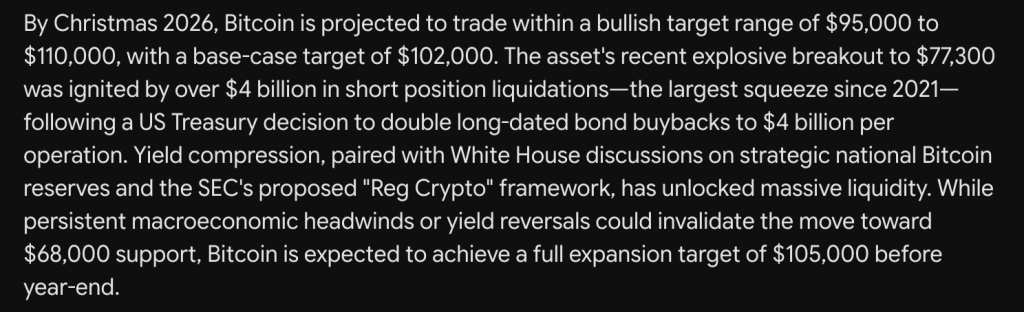
Picture the last week of December with Bitcoin (BTC) back above $100,000. That is the scene behind the latest Google Gemini AI price prediction, which puts the base case at $102,000 by Christmas 2026.
The full bullish range spans $95,000 to $110,000. Gemini also flags a full expansion target of $105,000 before year-end.
The setup started with a violent unwind. Bitcoin broke out to $77,300 amid more than $4 billion in short-position liquidations, the largest squeeze since 2021.
The fuse was lit in Washington. The US Treasury decided to double long-dated bond buybacks to $4 billion per operation, and yields compressed almost immediately.

That compression did the heavy lifting. Cheaper money flows into risk, and Bitcoin sits at the front of that queue.
Policy is stacking on top of it. White House discussions on strategic national Bitcoin reserves have kept institutional attention locked in.
The regulatory piece matters just as much. The SEC has proposed a framework called Reg Crypto, and Gemini reads the combination as unlocking massive liquidity.
The bear case is not exotic. Persistent macroeconomic headwinds or a reversal in yields would invalidate the whole move.
That scenario points price back toward the $68,000 support. It is a straightforward unwind of the same conditions that created the breakout.

Make Your Prediction Count With $25 For Free on Kalshi
Bitcoin Price Prediction: Google Gemini AI Predicts a Six-Figure Christmas
The year has been a series of failed recoveries. Bitcoin topped near $97,500 in January 2026, then collapsed through February to just under $60,000.
March and April built a slow repair toward $82,500 by early May. June erased it, dumping BTC price back to $57,500 in a single leg.
July and August looked dead. Bitcoin traded in a narrow band between roughly $62,500 and $65,500 for weeks before exploding vertically last week.
The move is now consolidating rather than extending. Bitcoin closed at $77,335, up $269 for a gain of 0.35%, with a session range from $75,568 to $77,741.
That tiny change after a vertical candle is the story. Resistance sits at $77,741, then the May swing near $82,500, and $68,000 marks the level Gemini names on the downside.
RSI reads 80.40 against a signal line at 58.84. The gap of roughly 22 points confirms how recent this move is.
Notice that RSI has curled slightly lower while BTC price held. Momentum is cooling without breaking, which is what healthy digestion looks like.
This shelf holds the whole test. Defend it, and the road to $102,000 stays open into December.
Supercharge Your Trading in 2026 With BloFin AI Trading Bots
Bitcoin Is Chasing $100K Again. Bitcoin Hyper Is Building for the Capital That Comes With It.
A six-figure Bitcoin would do more than lift the headline price. It would also put fresh attention on what that capital can actually do once it arrives on-chain.
Bitcoin Hyper is building around that second-order opportunity.
The project uses the Solana Virtual Machine to give Bitcoin-linked applications faster execution, low fees, and full smart contract functionality without altering Bitcoin’s base layer. A Canonical Bridge is designed to move BTC into that environment, while HYPER powers gas, staking, and governance across the network.
That gives Bitcoin Hyper a different upside thesis from simply waiting for BTC to move from $77,000 to $102,000. If a renewed Bitcoin cycle brings more users, liquidity, and developer activity with it, the infrastructure extending Bitcoin’s utility could benefit alongside the asset itself.
The presale has already raised more than $33 million, with buyers currently able to stake HYPER for yields of up to 36% APY ahead of the planned 2026 launch.
Unlock Access to Bitcoin’s New Layer 2 Here
The post Google Gemini AI Predicts Most Likely Bitcoin Price by Christmas 2026 appeared first on Cryptonews.
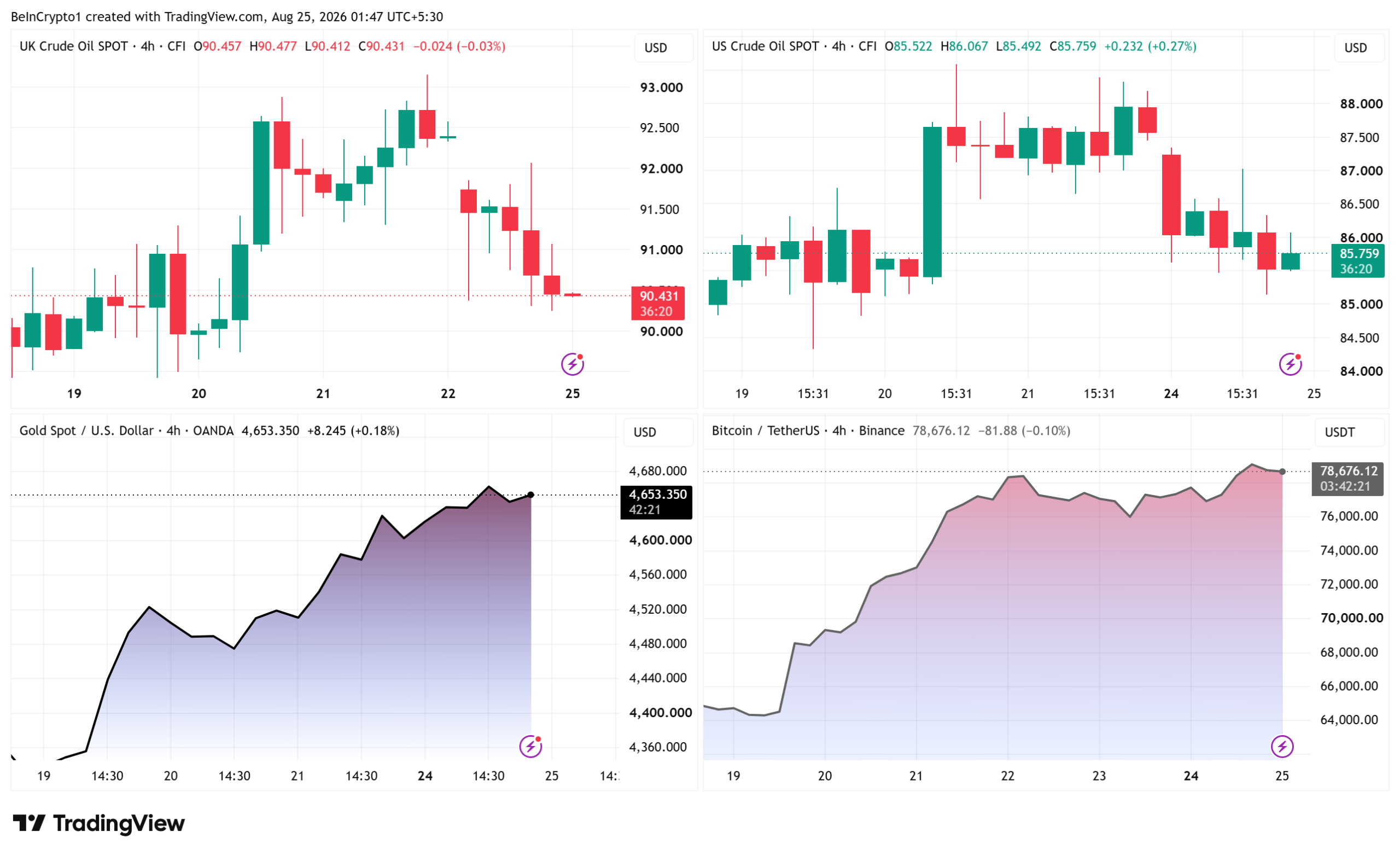
Treasury Secretary Scott Bessent threatened on Monday to cut anyone who launders money for Iran out of the U.S. dollar system. Oil fell, Bitcoin rose, and no institution was named.
The promised sanctions have not been imposed. Washington will first send individual countries deadlines to shut down activity it has identified.
Markets Priced a Warning, Not a Hit
Brent crude slid to $90.44 while West Texas Intermediate lost roughly 2% to $85.76. Traders sold into the news after a two-week rally, as oil prices fell Monday across the energy complex.
Gold went the other way. Spot bullion touched $4,653.23, hovering around its highest level in three months. Bitcoin traded near $78,676, up 1.9% on the day. Iran’s rial hit a record low near 2,020,000 to the dollar.

What Treasury Actually Signed
The campaign, called Operation Economic Outcast, names five sectors. Digital assets, technology, gold, aviation and shipping.
The determination runs a single page. OFAC Director Bradley T. Smith signed it at 9:25 a.m. Eastern, effective the same day.
It is the first time any country’s crypto sector has been designated. Executive Order 13902 had been used twice before, for financial services in 2020 and petroleum in 2024.
Any person operating in the named sectors can now be blocked, whatever their nationality or location. No firm was designated under the new sectors on Monday.
Crypto did appear elsewhere in the day’s actions. Treasury named Ivan Obukhov, a UAE-based broker for Iran’s shadow fleet of tankers.
Since 2023, he has processed over $100 million in cryptocurrency payments, according to the release. That money paid for Revolutionary Guard oil sales.
That follows a year of pressure. Tether’s kill switch has frozen close to $475 million in Central Bank of Iran stablecoins.
The Bank Test Is Still Ahead
Bessent’s core threat was blunt.
“Any entity that facilitates money laundering on behalf of Iran will be removed from the U.S. dollar system. The clock is ticking.”
The record behind it is thin. Treasury keeps a public list of foreign banks barred from US correspondent accounts. One institution sits on it.
That is Bank of Kunlun, a small lender in Xinjiang, cut off in 2012. The only other case is Bank of Dandong, barred in 2017 over North Korea.
None of China’s four biggest lenders has ever been designated. Since March 2025, Washington has hit five Chinese refineries plus ports and shipping firms. Not one bank.
China still takes around 90% of Iran’s oil exports on Treasury’s own estimate. Asked whether Chinese lenders would be spared, Bessent refused to carve out an exemption.
“If they facilitate transactions and are part of the ecosystem that turns Iranian oil into money, into repression, they will be targeted,” CNBC reported, citing Bessent.
Beijing answered within hours. Foreign Ministry spokesperson Lin Jian said sanctions only escalate tensions. President Xi Jinping is due in Washington in late September. Meanwhile, Iran says it is fully prepared for a new US economic campaign.
Markets will price the threat properly when a name appears under it.
The post Bessent's Iran Sanctions: Markets Price Limited Teeth Until a Major Bank Gets Hit appeared first on BeInCrypto.
France’s Telegram case turned two years old on Monday. Founder Pavel Durov marked the date by accusing governments of punishing the app for refusing censorship demands.
The French criminal investigation opened in August 2024 remains active. Durov argues the case has weakened as evidence about Telegram’s moderation record has accumulated.
How France’s Telegram Case Began
French police held Durov for three days in 2024, the longest period allowed before charges. He describes the move as a first, with a platform executive accused over offenses committed by users.
Restrictions on him have since loosened. France lifted his travel restrictions in November 2025, ending a year of mandatory police check-ins.
However, the probe itself never closed. French prosecutors have examined whether Telegram enabled criminal activity by failing to cooperate with lawful requests. Durov now says two years of data undercut its premise. Telegram, he argues, neither moderated worse than rivals nor cooperated less with authorities.
A Pattern Durov Says Repeats Across Countries
Durov says officials in several countries quietly asked Telegram for political favors, including censorship and surveillance he considers illegal. Refusal, he argues, triggers campaigns from local media and advocacy groups.
He has previously described requests tied to elections in Romania and Moldova. He and Elon Musk have separately accused European regulators of using child safety as leverage.
Telegram’s safety page reports 23.6 million groups and channels blocked this year. Of those, 370,777 were tied to child abuse material and 164,099 to terrorist content.
Meanwhile, Durov points to platforms he says escape comparable scrutiny. The Tech Transparency Project, a corporate accountability watchdog, reviewed Meta’s ad library this month. It found more than 50 paid ads carrying AI-generated child sexual abuse material.
What Comes Next for the French Case
Durov expects the investigation to eventually face questions of its own. He points to domestic pushback against President Emmanuel Macron’s online rules.
That pushback is now visible in French courts. Judges have begun testing how far the government can restrict platforms before free expression protections apply.
France’s Constitutional Council struck down a ban on social media for children under 15. The August 14 decision cited freedom of expression.
Durov has made similar accusations against Russia, which charged him with terrorism offenses in July.
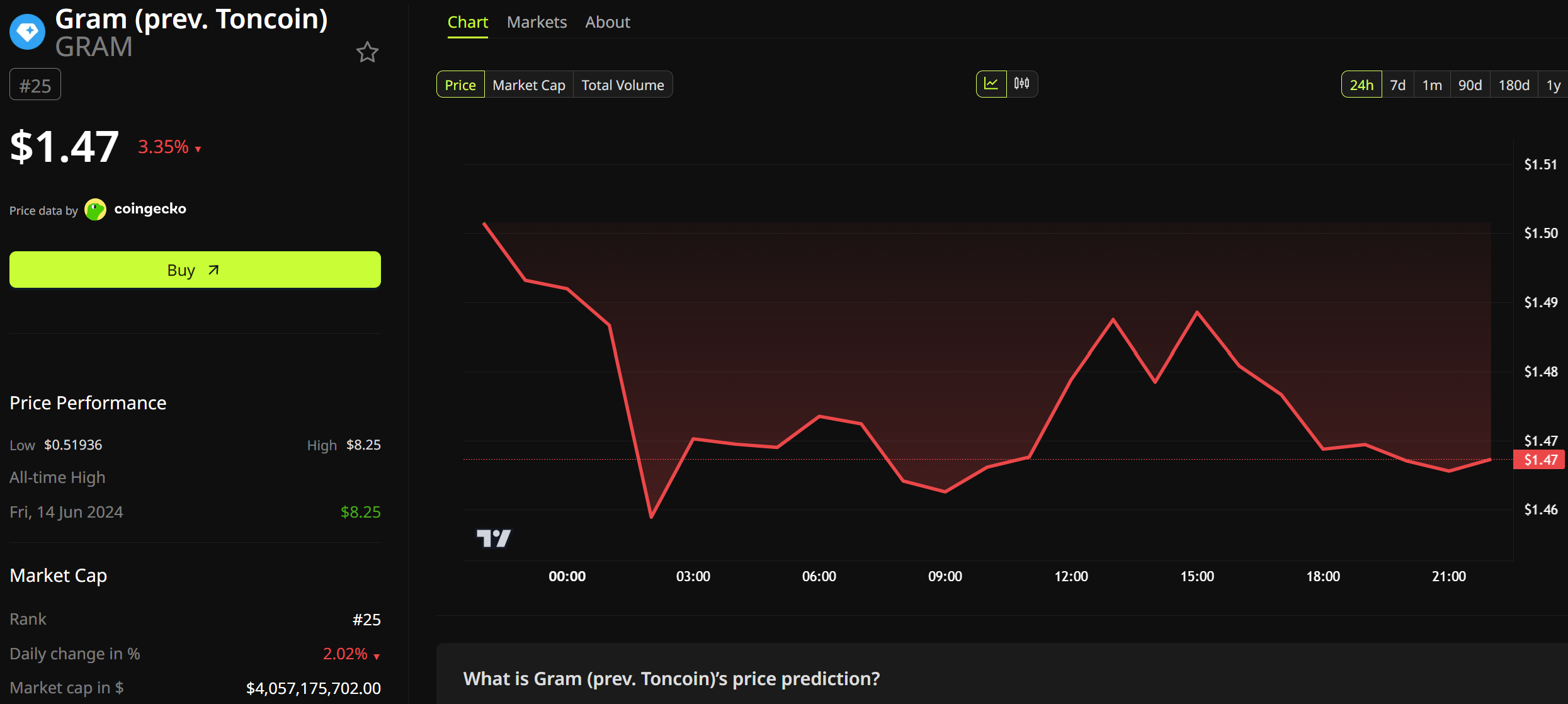
GRAM, the Telegram-linked token formerly known as Toncoin, traded around $1.47 on Monday, down roughly 3% in 24 hours.

Whether French prosecutors move toward trial or quietly wind the case down may become clearer in the months ahead.
The post France Telegram Case Turns 2: Is Durov Being Prosecuted for Saying No? appeared first on BeInCrypto.
Arthur Hayes argues Treasury Secretary Scott Bessent is running the same money-printing playbook former Secretary Janet Yellen used in 2023. If the pattern holds, the math points to a six-figure Bitcoin target.
Bessent’s Treasury has already doubled long-term bond buyback operations this month. Hayes says the policy mirrors the liquidity mechanics that fueled Bitcoin’s 2023-2024 rally under Yellen.
Why Hayes Sees a Bessent-Yellen Repeat
Hayes, the BitMEX co-founder and Maelstrom chief investment officer, made a similar case in a recent Hayes interview. He argues Bessent faces the same problem Yellen did in 2023. Both face a government that keeps spending. Historically, that has forced a Treasury Secretary to defend the 10-year yield below 5%.
Yellen’s fix was shifting issuance toward short-term bills. The move drained the Fed’s reverse repo facility from $2.5 trillion to about $100 billion. That drawdown ran from mid-2023 to January 2025, when Bessent took over. That cash flowed into bank reserves and, Hayes argues, into Bitcoin’s 2023-2024 rally.

Bessent’s version of the same trade is already underway. The Treasury doubled long-term bond buybacks from $2 billion to $4 billion per operation this month. Officials are also weighing whether to tap the roughly $950 billion Treasury General Account (TGA) to fund even larger purchases.
The move briefly pushed Bitcoin to $80,000 before it slipped back near $78,800. That mirrors how quickly the bond market clawed back August’s earlier buyback rally.
The Bitcoin Math Behind the $224,000 Target
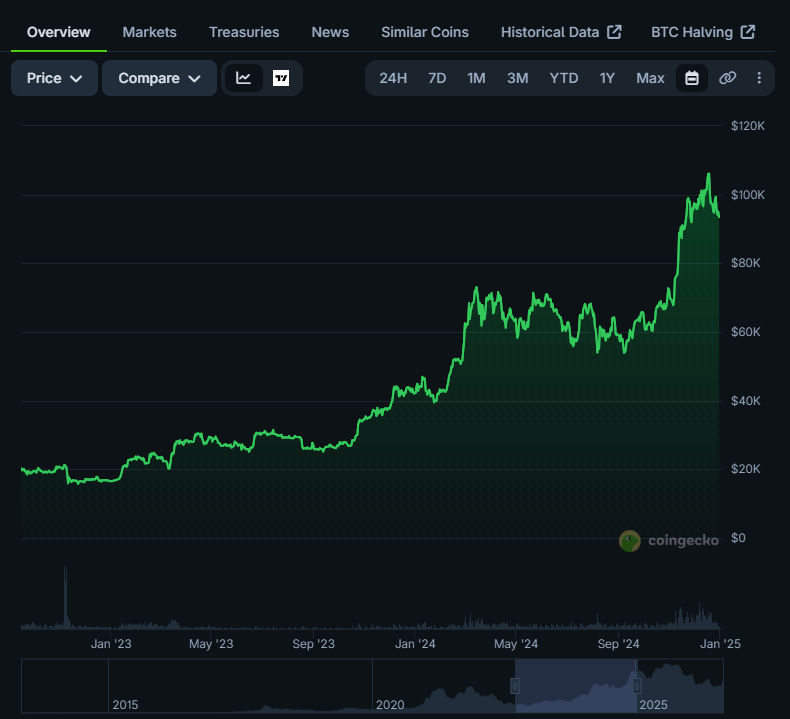
Applying Hayes’ 2023 comparison literally produces a specific target. Bitcoin traded near $26,000 in mid-2023, when Yellen’s bill-heavy issuance began draining the reverse repo facility. It peaked near $73,750 in March 2024, before the halving and spot ETF approvals added their own momentum. That’s a 2.84x move.
Applying the same multiple to Bitcoin’s current price of roughly $78,800 produces a target near $224,000. That figure is a simple calculation based on Hayes’ framework, not a number Hayes stated himself.
But, the number does carry some caveats. The 2023-2024 rally wasn’t driven by reverse repo drainage alone. Spot Bitcoin ETF approval in January 2024 and April 2024’s halving both landed in the same window. Each moved price independently of Treasury issuance mechanics. However, implicit money printing has always been a big catalyst for Bitcoin growth
Citadel Securities has also pushed back on Bessent’s buyback strategy. The firm warns the approach resembles financial repression that could weaken the dollar and stoke inflation.
Whether Bitcoin gets anywhere near that math depends on one thing.
Can Bessent’s buybacks hold up better than August’s first attempt did? Or will they fade the way the bond market rally already has twice this month?
The post If Bessent Repeats Yellen's 2023 Money Printing Playbook, BTC Math Points to $224K appeared first on BeInCrypto.


Bitcoin’s strongest weekly advance since March 2023 pushed the asset close to $80,000, but analysts said further gains may depend on easing US bond yields, continued spot ETF demand, and progress on the CLARITY Act.
Summary
- Bitcoin gained roughly 24% last week and reached a three-month high near $79,550.
- US spot Bitcoin ETFs recorded approximately $1.9 billion in weekly net inflows.
- Analysts linked the breakout to Treasury buybacks, ETF demand, and forced short covering.
- BTSE’s Jeff Mei sees $80,000–$90,000 as possible but warns of a return to $70,000.
Can Bitcoin hold near $80,000 after its strongest rally since 2023?
Bitcoin (BTC) traded near $79,800 on Aug. 24 after climbing from below $64,000 on Aug. 19. The cryptocurrency reached approximately $79,550 during the rally, its highest level since May.
The gain amounted to roughly 24% over the week, according to Gadi Chait, investment manager at Xapo Bank, making it Bitcoin’s strongest weekly advance since March 2023.
US policy developments helped trigger the move. On Aug. 19, the US Treasury announced that it would at least double the maximum size of its liquidity-support buybacks for nominal Treasury securities with maturities of 10 to 30 years.
The operations will increase from a maximum of $2 billion to at least $4 billion each, beginning Sept. 9. Markets interpreted the decision as an effort to improve liquidity in long-dated government debt after yields reached levels that weighed on risk assets.
Bitcoin also benefited from renewed expectations for clearer US crypto rules after President Donald Trump urged lawmakers to advance the CLARITY Act. The proposed legislation remains subject to action in the Senate, where its progress could provide the market with another policy catalyst.
ETF inflows strengthened the Bitcoin rally
Chait said the sources of demand behind the rally were as important as the size of the price increase.
“Approximately $1.9 billion flowed into US spot Bitcoin ETFs, providing evidence of genuine investor demand, while record short liquidations added further momentum.”
US spot Bitcoin ETFs recorded five consecutive trading days of inflows during the week ending Aug. 21. The approximately $1.9 billion total marked a sharp return of institutional demand after funds struggled to attract consistent capital earlier in the year.
The inflows also showed that forced buying in derivatives markets was not the rally’s only source of support. Traders holding leveraged short positions were liquidated as Bitcoin broke through resistance levels, creating additional market orders that accelerated the advance.
Justin d’Anethan, head of research at Arctic Digital, said changing expectations around US rates brought investors back to an asset that had underperformed for several months.
“In the case of Bitcoin, with pent-up demand and a multi-month underperformance, the trade wrote itself and algos along with sophisticated trading firms and asset managers piled back in.”
He said leveraged traders were caught on the wrong side of the breakout, producing what he described as the largest single-day short liquidation event. Profit-taking and selling from investors who had been waiting to exit could now produce a short-term pullback as the market absorbs the move.
Rising bond yields test the Treasury narrative
Jeff Mei, chief operating officer of crypto exchange BTSE, said enthusiasm surrounding the Treasury buybacks had cooled as bond yields began rising again.
“The size of these buyback operations is relatively small compared to the overall Treasuries market, which is over $30 trillion.”
Treasury buybacks are designed to support market liquidity by replacing older, less actively traded securities with newly issued debt. They do not amount to quantitative easing because the Treasury must finance its operations, while Federal Reserve asset purchases create central bank reserves.
Mei said the market would need to see whether the Treasury expands the program beyond the initial $4 billion maximum for each operation. Without an increase, the program’s effect on the broader bond market may remain limited.
D’Anethan viewed rates as the rally’s main driver, arguing that ETF flows, regulatory developments and large investor activity had failed to move Bitcoin substantially until expectations surrounding Treasury policy changed.
Chait said the macro shift also strengthened Bitcoin’s longer-term case as US government debt continued rising.
“As rising debt fuels concerns about potential currency debasement, its fixed supply and independence from any government or central bank become increasingly relevant.”
Bitcoin could reach $90,000 if US catalysts hold
Mei said Bitcoin could establish a range between $80,000 and $90,000 if the Treasury expands its buybacks and the CLARITY Act makes material progress by mid-September. A Federal Reserve rate cut or another form of monetary support could provide further upside, he added.
The scenario remains conditional because higher yields increase the relative appeal of government debt while raising borrowing costs across the financial system. A lack of new policy support or weakening ETF demand could therefore leave Bitcoin vulnerable after its rapid advance.
“Without further positive catalysts and sustained investor confidence, it’s also possible that Bitcoin could give back recent gains and fall again to the $70k mark,” Mei said.
The CLARITY Act provides another near-term US catalyst, although its passage is not guaranteed. Investors will be watching whether lawmakers move the bill forward and whether proposed rules translate into clearer conditions for exchanges, token issuers and institutional market participants.
Bitcoin charts point to a possible trend reversal
D’Anethan said bullish engulfing patterns had appeared on Bitcoin’s daily and weekly charts, while a similar monthly signal was developing but had not yet been confirmed by the candle’s close.
The patterns followed an extended period in which several momentum indicators remained in oversold territory. Their recovery may support a longer-term reversal, although the speed of the recent rally increases the possibility of consolidation or profit-taking.
Bitcoin’s immediate challenge is holding the area around $77,000 to $80,000 after reaching its three-month high. A sustained break above $80,000 would support Mei’s $80,000–$90,000 scenario, while a deeper retracement would bring $70,000 back into focus.
The mid-$60,000 range could become a broader accumulation area for long-term investors if Bitcoin fails to hold $70,000, according to d’Anethan. Near-term direction, however, will likely depend on bond yields, ETF demand and whether US policy developments produce concrete action after the initial rally.
Disclosure: This article does not represent investment advice. The content and materials featured on this page are for educational purposes only.
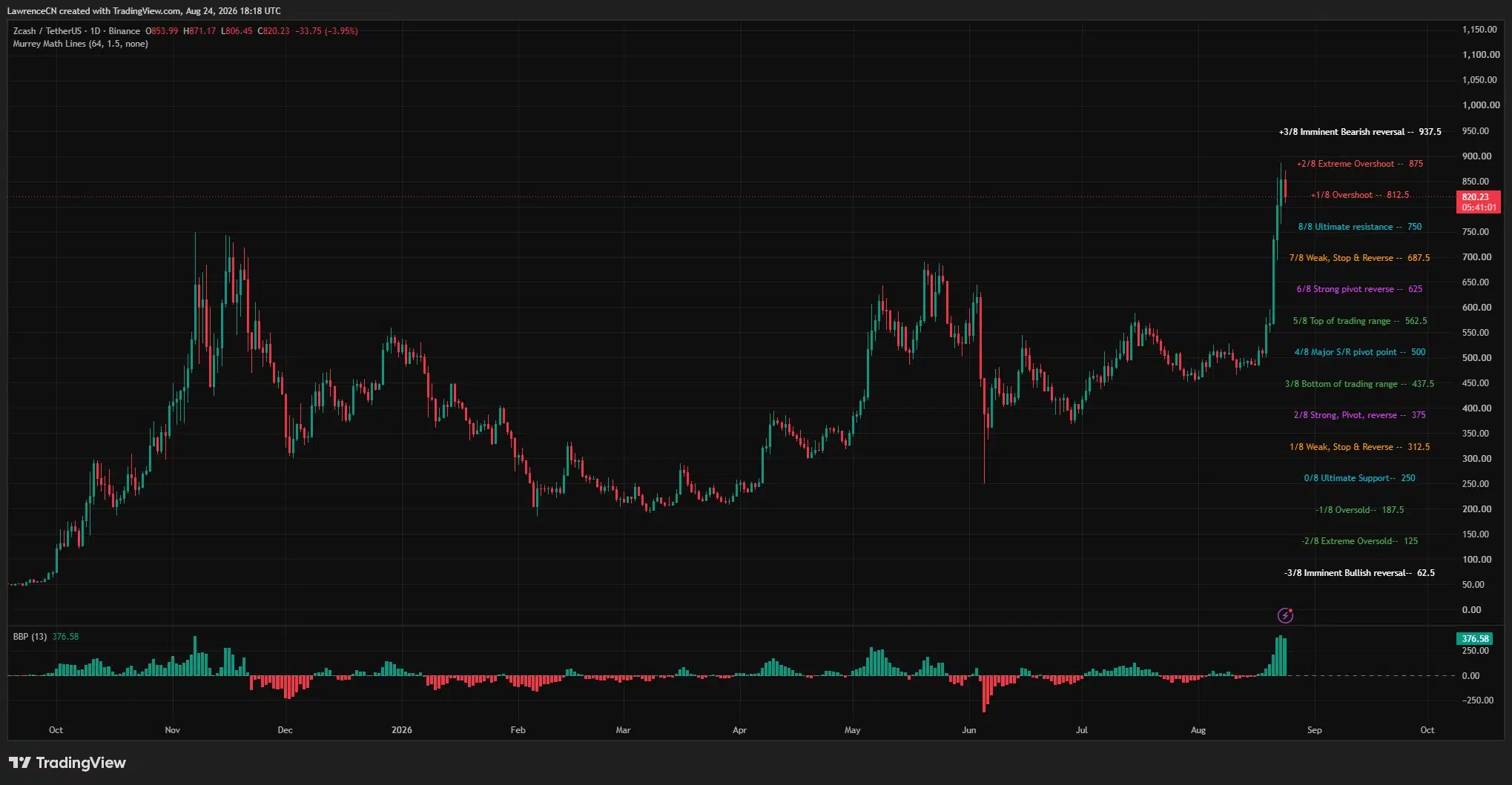
Zcash price surged more than 70% over the past week to an eight-year high near $885 before retreating below $820, as Grayscale’s ETF conversion plan and an NU7 governance vote drew traders toward ZEC.
Summary
- ZEC reached its highest price since 2018 after breaking above the major $750 resistance level.
- Grayscale’s amended filing seeks to convert its Zcash Trust into an NYSE Arca-listed spot ETF.
- NU7 voting eligibility was determined by the shielded ZEC held during an August 24 network snapshot.
- Technical charts show support near $812 and $750, while $875 remains the immediate resistance.
Zcash price pulls back after reaching $885
According to data from crypto.news, Zcash (ZEC) price traded near $820 at the time of writing after reaching approximately $885 earlier in the session, according to exchange data. The privacy coin gained more than 70% during the past seven days and reached its highest level since 2018.
The rally accelerated after ZEC cleared $562.50, which marked the upper boundary of its previous trading range on the daily chart. Buyers then pushed through successive levels at $625, $687.50, and $750.
ZEC moved as much as 77% above its August consolidation area near $500 before sellers emerged around $875. Its daily candle subsequently fell about 4%, with the price slipping from an opening level near $854 to approximately $820.
The retreat has not yet erased the wider breakout. ZEC remains above the former $750 resistance identified by Rand Group, which said the level would need to become support for another bullish wave to develop.
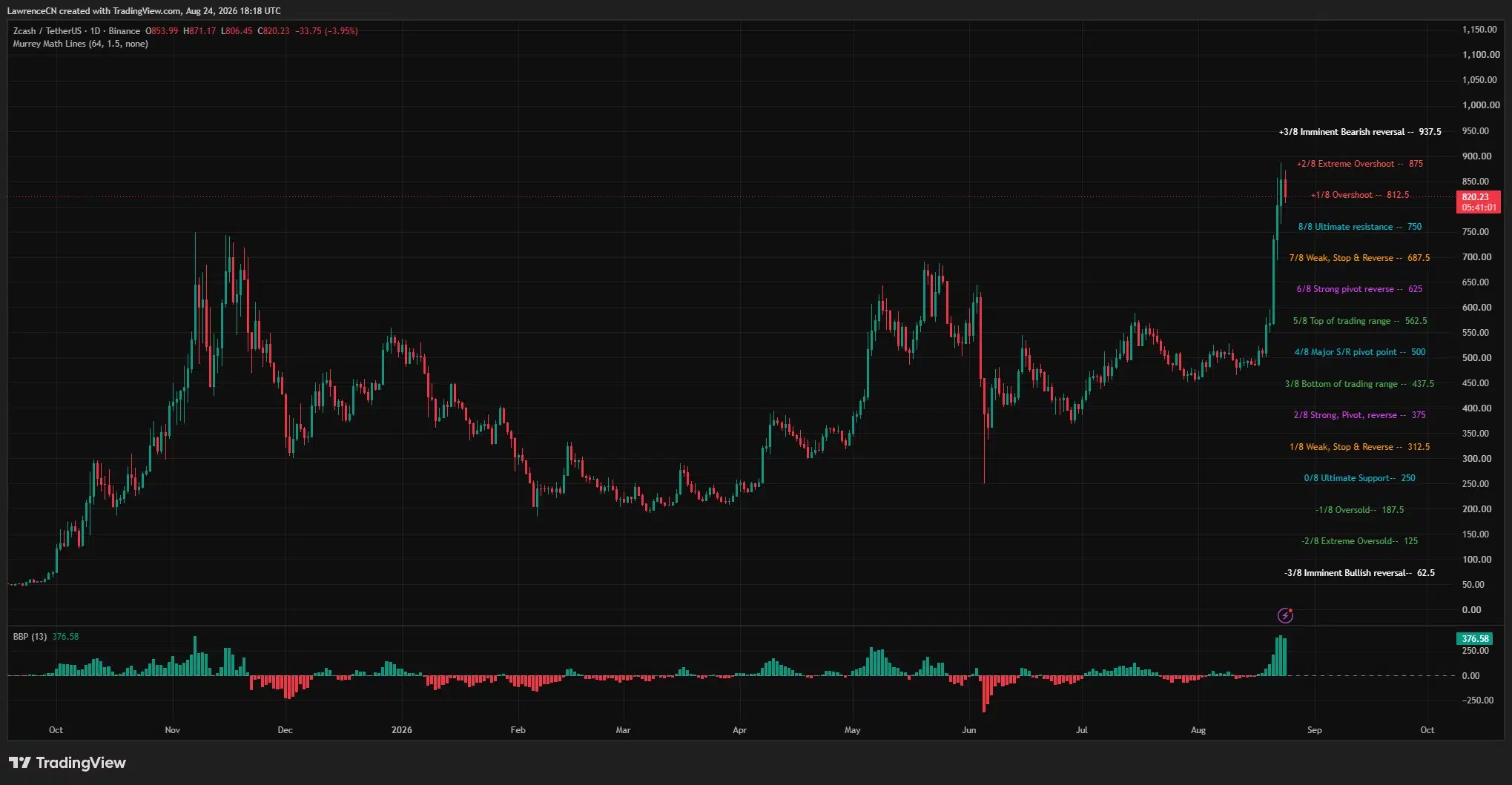
The daily Bull Bear Power reading stood at 376.58, showing that buying pressure remained elevated despite the pullback. However, the size of the indicator’s recent increase also reflects how far and quickly ZEC has moved away from its earlier range.
Grayscale ETF filing adds an institutional catalyst
The price advance followed Grayscale Investments’ latest amended registration statement for the Grayscale Zcash Trust.
Grayscale is seeking to convert the existing trust into an exchange-traded product expected to trade on NYSE Arca under the ticker ZCSH. An accompanying filing said shares were anticipated to begin trading on or around August 25, subject to regulatory approvals.
The proposed structure would give eligible US investors exposure to ZEC through a regulated brokerage product without requiring them to hold the token directly. The registration statement does not mean the SEC has approved the conversion, and the planned listing date remains subject to completion of the regulatory process.
The filing also disclosed non-binding discussions involving DCG International Investments Ltd., a Digital Currency Group subsidiary. Under the potential transaction, the company could contribute about 200,000 ZEC to the trust in exchange for shares.
At the valuation cited when the amendment was reported, the proposed contribution was worth approximately $110 million. The filing describes the transaction as being under discussion, meaning it should not be treated as a completed ZEC purchase or confirmed capital allocation.
Grayscale reported that the trust had about $263.5 million in assets under management as of August 21. The proposed conversion would bring a privacy-focused crypto asset into the US spot ETF market, although Zcash continues to face regulatory and exchange-access risks linked to its privacy features.
NU7 vote follows the Ironwood snapshot
A separate Zcash-specific event may have added demand for shielded ZEC ahead of the rally. According to the NU7 vote announcement on the Zcash Community Forum, Valar Group and Project Tachyon scheduled an approximately 18-day coinholder vote beginning August 25.
Voting eligibility was based on spendable, shielded ZEC held in the Ironwood pool at mainnet block height 3,459,350. The snapshot was expected at approximately 19:00 UTC on August 24, after which holders could move their funds without losing their voting rights.
Voting is scheduled to close on September 14 at 19:00 UTC. The process requires at least 1 million eligible ZEC to meet its minimum participation threshold, while supported wallets allow holders to vote privately and publish only aggregated results.
The ballot will help determine the scope of the planned NU7 network upgrade, including possible changes to Zcash’s issuance schedule and block-production model. The snapshot may have encouraged some holders to transfer tokens into the Ironwood shielded pool, but available data does not establish how much of the price increase came directly from voting-related transfers.
Zcash price faces resistance at $875
The 4-hour chart shows that ZEC remains above the Bollinger Bands’ middle line near $803.35. Holding that level would keep the short-term breakout structure intact, while a sustained drop below it could expose the psychological $800 level.
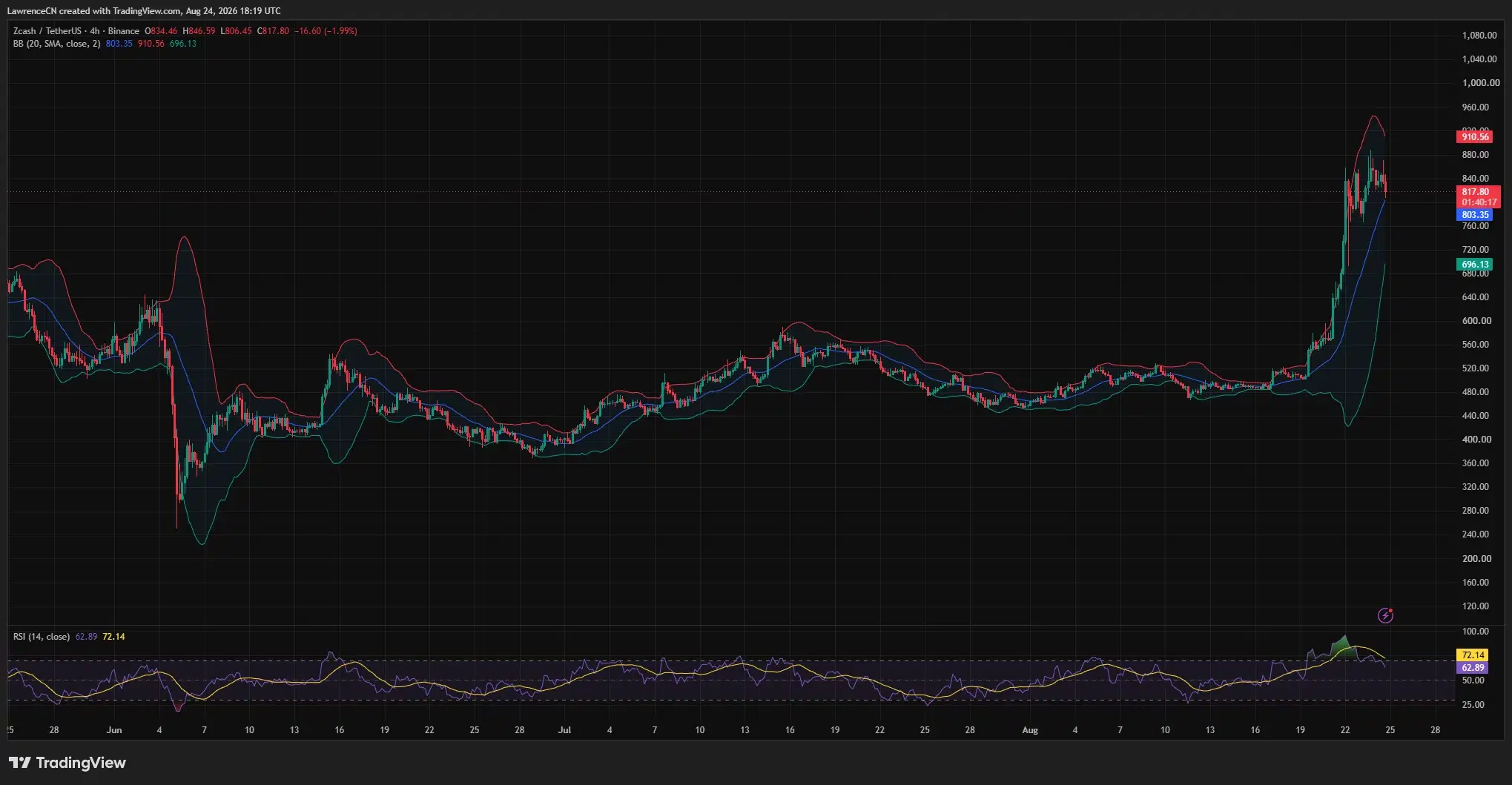
ZEC’s 4-hour Relative Strength Index fell to 62.89 after previously moving into overbought territory. The indicator’s moving average remained higher at 72.14, suggesting that momentum has cooled as the price pulled back from its peak.
The first upside barrier sits between $870 and $875. The daily Murrey Math chart marks $875 as an extreme overshoot level, while the upper 4-hour Bollinger Band stands near $910.56.
A decisive close above $875 could allow buyers to test $910 and then $937.50. The latter is identified on the daily chart as a zone where the risk of a bearish reversal may increase.
On the downside, $812.50 is the first key level to monitor. ZEC was trading only slightly above that line at the time of the chart capture, making it the immediate test for buyers after the intraday reversal.
Below $812.50, the Bollinger midpoint near $803 and the former breakout level at $750 provide the next support areas. A fall below $750 would weaken the breakout and could open a deeper correction toward $696 and $687.50.
Liquidation clusters could increase ZEC volatility
CoinGlass’ 24-hour liquidation heatmap showed concentrated leveraged positions on both sides of ZEC’s market price.
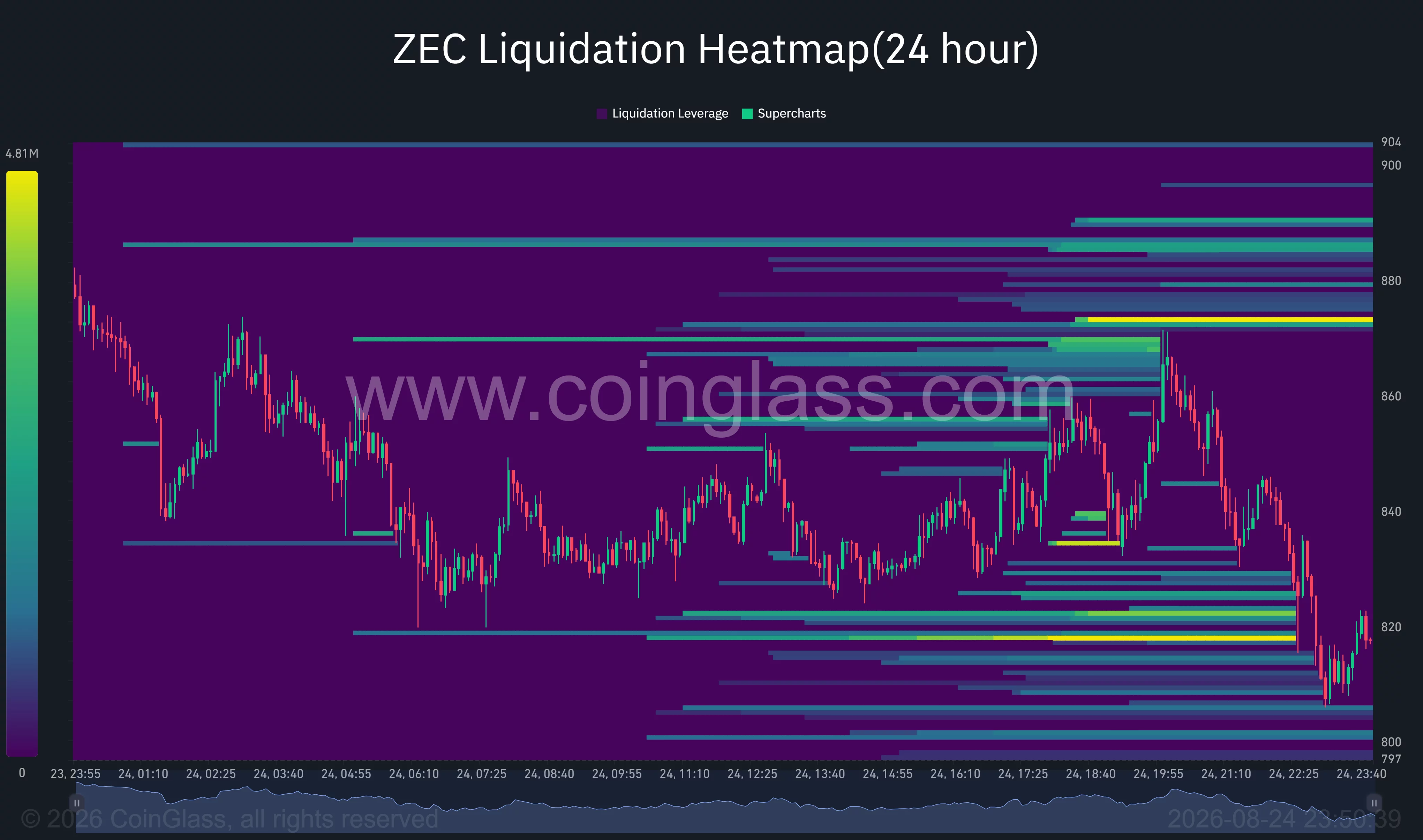
The largest nearby upside liquidity cluster appeared around $872 to $874, matching the chart’s immediate resistance zone. Additional liquidation levels were visible around $882 to $886, which could attract price if ZEC regains upward momentum.
Below the market, a strong concentration appeared near $818 to $820, with further liquidity around $808 and $800. ZEC briefly moved toward these lower clusters during its late-session decline before rebounding above $817.
Liquidation heatmaps show where leveraged positions may face forced closure, but they do not predict which level the price will reach first. With ZEC trading between dense clusters near $800 and $875 after a weekly gain exceeding 70%, a sharp move in either direction could trigger another round of liquidations.
Disclosure: This article does not represent investment advice. The content and materials featured on this page are for educational purposes only.

Elon Musk celebrated a new partnership between SpaceX and NVIDIA on Monday, confirming plans to launch an optimized Vera Rubin system into orbit as early as 2027.
Despite his enthusiasm, both companies’ stocks fell on the day of the announcement.
What Elon Musk Confirmed About the Deal
NVIDIA announced that SpaceXAI will deploy its new Vera CPU to power the next generation of agentic AI workloads, extending the chipmaker’s architecture from Earth-based data centers into orbital computing infrastructure. Musk responded directly on X.
He described Vera as the first CPU built for agents, saying it would accelerate the orchestration, code execution, and data processing that keep SpaceX’s AI agents acting fast.
“Our design is significantly simpler, lower cost, denser and lighter than a traditional rack,” Musk said on X.
Vera itself packs 88 NVIDIA-designed Olympus cores and up to 1.2 TB/s of memory bandwidth, claiming task completion times up to 1.8 times faster than comparable x86 processors.
SpaceXAI will pair the chip with NVIDIA’s broader Vera Rubin platform to scale infrastructure behind Grok toward gigawatt-level computing capacity.

Why Both Stocks Fell Anyway
NVIDIA shares fell 2.91% to $208.48, extending a rough week that left the stock down 5.95% over five sessions, according to TradingView data. The pullback comes just two days ahead of NVIDIA’s next earnings report, scheduled for August 26.
SpaceX stock declined as well. Shares of Space Exploration Technologies Corp, trading under the ticker SPCX since its June IPO, closed down 1.44% to $135, then slipped a further 0.22% in after-hours trading to $134.70.
Subscribe to our YouTube channel to watch leaders and journalists provide expert insights.

The joint decline suggests Musk’s endorsement was not enough to offset broader pressure on both names.
NVIDIA trades near its 52-week range amid ongoing concerns over memory costs and export uncertainty in China, while SpaceX shares remain well below their $135 IPO price and June peak of $225.64, still recovering from an all-time low of $104.83 hit on August 3.
Neither move appears large enough to be attributed directly to the Vera partnership alone, suggesting that NVIDIA’s upcoming earnings and SpaceX’s ongoing post-IPO volatility carried more weight with investors than Monday’s announcement or Musk’s public praise.
The post Elon Musk Praises New SpaceX and NVIDIA Partnership, Yet Both Stocks Fall appeared first on BeInCrypto.
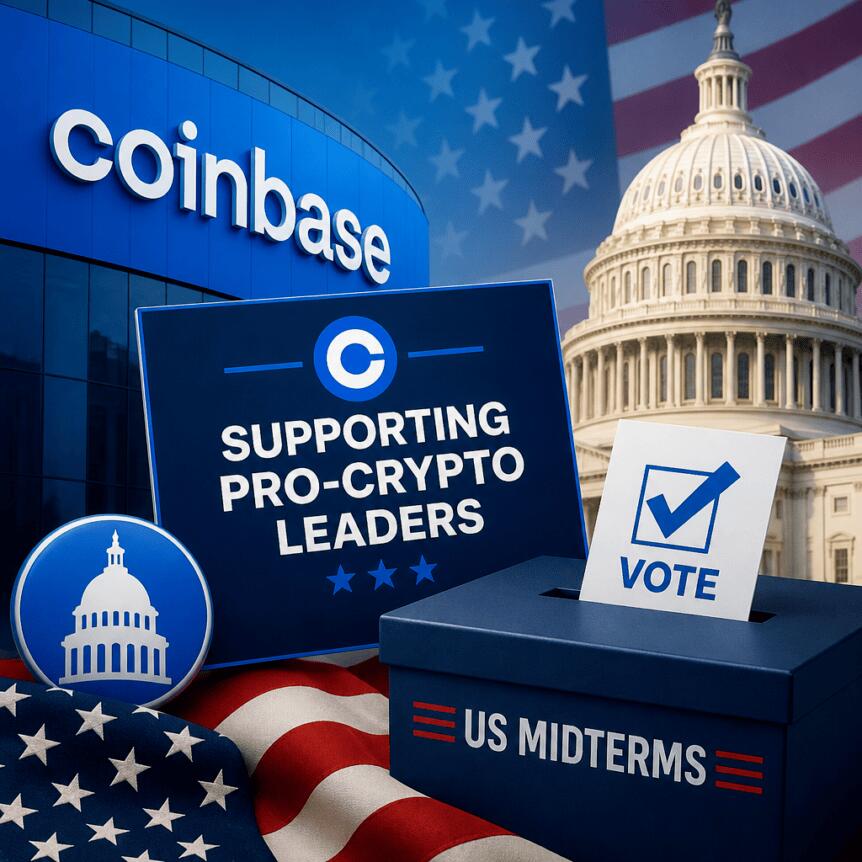
Stand With Crypto, the pro-crypto advocacy group launched by Coinbase in 2023, has endorsed 32 candidates for the 2026 US House elections, positioning the slate as part of a broader campaign to influence federal digital-asset policy ahead of the midterms.
In a notice released on Monday, the organization said its endorsements target lawmakers it describes as “proven digital asset policy champions,” with an emphasis on competitive districts where it believes its influence can most directly affect outcomes. Stand With Crypto also framed crypto voters as an increasingly dependable voting bloc during close races.
Key takeaways
- Stand With Crypto is backing 32 House candidates for the 2026 midterms based on their digital asset policy positions.
- The group says it will focus resources on winnable, competitive races where its advocacy is most likely to sway results.
- Stand With Crypto executive director Mason Lynaugh argues crypto voters could “swing” congressional outcomes as candidates look beyond traditional constituencies.
- The endorsements arrive amid uncertainty over whether the Senate will advance the Digital Asset Market Clarity (CLARITY) Act before the 2026 election.
- Recent political momentum around CLARITY includes calls from President Donald Trump to pass a “fair version,” though questions about conflicts remain in public polling.
A targeted endorsement slate for the 2026 midterms
According to Stand With Crypto, the 32-candidate program is designed to increase pressure on Washington to adopt clearer rules for digital assets. The organization’s framing suggests that endorsements are not simply symbolic, but strategically selected to shape outcomes during the 2026 House elections.
Stand With Crypto executive director Mason Lynaugh said crypto voters are now “durable” and motivated enough to matter in national politics. In his remarks, he linked the group’s push to what he described as a policy “inflection point” for digital assets in Washington—arguing that candidates from both parties may miss an important constituency if they do not engage crypto voters.
The notice also referenced how the advocacy strategy has evolved. Earlier coverage from the period surrounding its debut program noted that Stand With Crypto launched its first wave of endorsements in March. That initial slate included six candidates—three Republicans and three Democrats—each of whom advanced through their primaries to compete in November.
Crypto’s growing role in election spending and lobbying
The political emphasis on digital assets is occurring alongside rising involvement from crypto-related political spending. During the 2024 election cycle, organizations and political action committees backed by crypto companies spent more than $170 million supporting candidates they believed would be favorable to the industry, many of whom won their races, according to the organization’s statement.
Stand With Crypto also claimed that more than 270 “pro-crypto” candidates were sent to Congress in 2025, positioning its endorsement program as part of a continuing effort to shape legislative outcomes on matters affecting the sector. One example highlighted in its notice was the Guiding and Establishing National Innovation for US Stablecoins (GENIUS) Act.
For investors and market participants, the practical impact of these political efforts typically lies in how Congress responds to key regulatory questions—especially those tied to stablecoins and market structure. Even when bills move slowly, endorsement drives and campaign messaging can influence negotiations, committee priorities, and the willingness of lawmakers to take up complex rulemakings.
CLARITY’s timeline and the Senate’s decision window
Beyond election endorsements, one of the most immediate legislative uncertainties involves the fate of the Digital Asset Market Clarity (CLARITY) Act. The House passed CLARITY in July 2025 with bipartisan support, but the Senate has not advanced it in the same way. The remaining hurdles have included debate tied to ethics considerations as well as questions associated with tokenization and stablecoin rewards.
According to reporting referenced in the notice, CLARITY is expected to face a cloture motion once the Senate returns from recess on Sept. 15. However, the Senate’s calendar appears tight: the chamber would have only 14 days in session before it breaks ahead of the November election.
After the midterms, the Senate is expected to have another 22 days before 2027—creating a later opportunity for senators to return the bill to the House if additional steps are needed. If that pathway holds, CLARITY could still progress to the president for approval, but the timing remains uncertain as the election approaches.
That sequencing matters. For market participants, “delay risk” can translate into continued regulatory ambiguity—especially in areas where exchanges, custody providers, and other intermediaries want clearer rules on how digital assets fit into existing securities and commodities frameworks.
Trump’s call for a “fair version” and questions over conflicts
In the lead-up to the Senate’s next procedural phase, political attention has also focused on statements by President Donald Trump. Stand With Crypto’s broader context included references to Trump urging the Senate to pass a “fair version” of CLARITY alongside crypto industry executives.
Yet, concerns about conflicts can complicate the political environment around the bill. The notice pointed to a poll finding that a majority of Americans said Trump’s crypto investments were not “appropriate.” While public opinion does not determine legislative outcomes by itself, it can influence how senators weigh ethics arguments and how lawmakers respond to pressure from both supporters and critics.
For readers watching CLARITY, the key question remains whether the Senate can align its procedural path—including any amendments or debate around tokenization and stablecoin rewards—within the brief pre-election window. If senators do not move quickly, the legislative timetable may effectively shift the decision toward the post-midterm period.
As the 2026 campaign cycle ramps up, Stand With Crypto’s endorsements will likely serve as one signal of where the pro-crypto policy push is concentrating its political leverage. The most important thing to watch next is whether the Senate can progress CLARITY before the election, or whether the bill’s fate is deferred into the longer 2027 timeline—leaving market participants to navigate continued regulatory uncertainty.


The European Central Bank (ECB) is defending the privacy design of its planned central bank digital currency (CBDC).
In an Aug. 10 interview published Monday, ECB Executive Board member Piero Cipollone said the digital euro’s design would limit the amount of transaction information available to the central bank.
“The Eurosystem would not be able to identify the users making or receiving payments,” Cipollone said.
Cipollone said only banks involved in transactions would be able to identify users, including for anti-money laundering purposes, while the Eurosystem would not be able to directly link specific individuals to digital euro payments. Meanwhile, offline digital euro transactions would allow payment details to be available only to the payer and payee.
Despite the ECB’s efforts to quell privacy concerns over the planned digital euro, lawmakers, privacy advocates and crypto community members have warned that government-issued digital currencies could expand financial surveillance.
In the US, President Donald Trump prohibited federal agencies from developing or promoting a CBDC in January 2025, citing risks to financial stability, individual privacy and US sovereignty. House lawmakers have separately advanced the Anti-CBDC Surveillance State Act, which seeks to prohibit the Federal Reserve from issuing a CBDC.
Related: ECB picks 36 payment providers to test digital euro ahead of 2027 pilot
Digital euro pitched as payment sovereignty tool
Beyond privacy, the ECB has presented the digital euro as part of Europe’s effort to strengthen its payments infrastructure and reduce reliance on non-European payment providers.
In an April public lecture held in Latvia, Cipollone said that Europe’s reliance on non-European payment providers creates a strategic vulnerability. He said two-thirds of euro-area card transactions are governed by non-European companies, and that the digital euro could reduce that dependence and provide European-controlled payment infrastructure.
The European Parliament’s Economic and Monetary Affairs Committee backed its position on the digital euro legislation in June, while lawmakers later cleared the proposal for negotiations with the Council in July.
The ECB has said a digital euro could be issued as early as 2029, provided the necessary legislation is adopted and the project clears its remaining technical and operational stages.
Magazine: The digital euro: Surveillance money, or a better alternative to cash?
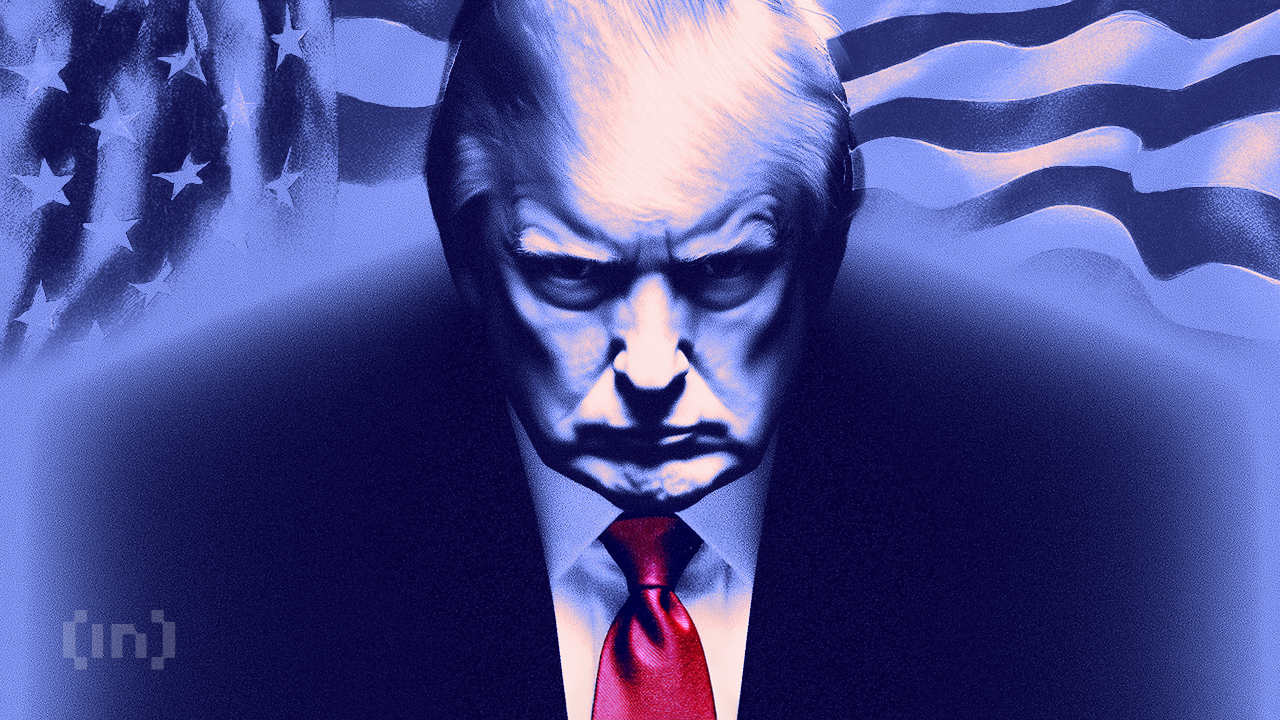

Trump Media’s interim CEO, Kevin McGurn, defended the company’s Truth API service on CNBC Monday. He said customer sign-ups have grown to the mid-teens since the product launched on August 1.
Truth API sells high-frequency trading firms early access to President Donald Trump’s Truth Social posts. Critics say the arrangement lets paying customers trade on the president’s statements before the public sees them.
Sign-Ups Grow For Trump’s Signals
McGurn told CNBC’s Squawk Box that demand for the service came directly from the market, not from the company itself. He compared it to APIs long used by social platforms to feed trading firms, news outlets, and prediction markets.
“We’re getting into the mid-teens now, and we’re climbing.”
Kevin McGurn, CNBC
That is up from the more than 10 customer agreements McGurn cited on Trump Media’s earnings call two weeks earlier. Truth API costs up to $100,000 per month.
Congress Looking Into It
The service has drawn scrutiny from Congress and faces at least one lawsuit alleging it is unconstitutional. One federal complaint argues Trump cannot sell early access to posts the public effectively owns.
Trump holds his stake in Trump Media through a revocable trust. The structure lets him retain ownership without daily control. The company has already earned over $1 million from the service since its launch.
McGurn said Truth API also plans to expand into retail trading platforms, large language models, and prediction markets.
Whether the growing customer base outpaces the legal and political pressure remains the open question heading into the midterms.
The post Trump Media CEO Defends Truth API: Will Scrutiny Slow Sign-Ups? appeared first on BeInCrypto.

Situational Awareness, star AI hedge fund that nearly imploded, now being probed by the SEC

The Best Financial Advice I EVER Received

Perez Hilton suffered multiple broken bones the night of his horror self-harm livestream





-

 Fashion3 days ago
Weekend Open Thread: Madewell – Corporette.com
-

 Business2 days ago
Musk’s Tesla, SpaceX Confirm $16.8 Billion ‘Terafab’ Chip Plant as World’s Largest Building in Texas
-

 Crypto World3 days ago
anatomy of crypto’s biggest liquidation event since 2021
-

 Business7 days ago
SMA Solar Technology AG (SMTGY) Q2 2026 Earnings Call Transcript
-

 Tech7 days ago
Qwen3.8-27B runs frontier-class coding agents and reasoning locally, no cloud API required
-

 Politics3 days ago
6 months on, Irish renters crushed by effects of government housing bill
-
 NewsBeat3 days ago
The ‘Lucky Dip Gang’ causing carnage for clicks: After five thugs were killed speeding in the wrong direction on a motorway, GUY ADAMS investigates a sick new trend… and why police aren’t even allowed to pursue them
-

 Tech6 days ago
GLM-5.3 hits the API at $1.4/$4.4 per million tokens
-

 News Videos5 days ago
Don’t Leave Your Financial Future To Chance | August 19, 2026
-

 Business2 days ago
Mystery AI Model ‘Ox Alpha’ Draws Developers With Free Access as Chinese Lab Origins Remain Debated
-

 Tech7 days ago
Keychron K8 Ultra 8K review: a great value keyboard with comfort issues
-

 Business7 days ago
Stock Market Today: Tech Futures Slide As Treasury Yields Jump; Nvidia, Micron, Sandisk Sell Off
-

 Business5 days ago
Marvell Shares Jump 7% as Google Chip Deal Confirms Custom AI Silicon Partnership, Analysts
-

 Business4 days ago
Five Below: Kids Discount Retailer Reaps Rich Rewards
-

 Tech7 days ago
Ken Okuyama’s Kode89 Supercar Features Three Pedals and a Choice of V12s
-

 Politics6 days ago
The House Opinion Article | Security means more than military spending
-

 Fashion7 days ago
The Dressier Side of Shorts
-

 Business7 days ago
Nasdaq Ticks Higher as Wall Street Awaits Retail Earnings and Weighs Fed’s Next Move at Jackson Hole Meeting
-

 Crypto World7 days ago
Compound approves $52M institutional DeFi program
-

 Tech7 days ago
Payments giant Stripe is about to drop over $7 billion to become a gateway to AI token sales
You must be logged in to post a comment Login