
Crypto World
Bitget marks 8 years with multi-asset expansion



Bitget has opened its eighth-anniversary campaign with a $3 million trading competition and a separate 50,000 USDT community reward pool.
Summary
- Bitget is celebrating its eighth anniversary with campaigns offering combined rewards exceeding 3 million USDT.
- The exchange says its Universal Exchange combines cryptocurrencies, stocks, commodities, forex, options, and CFDs together.
- Bitget expanded proof-of-reserves coverage from four cryptocurrencies to more than 20 supported digital assets recently.
- August’s proof-of-reserves report showed a company-reported 122% ratio after 45 consecutive monthly disclosures were published.
- Participants can submit 500-character trading stories for a share of the 50,000 USDT promotion pool.
Bitget’s official anniversary page presents the campaign as part of its expansion from a cryptocurrency exchange into a platform covering digital assets and traditional financial products. The company calls the model a Universal Exchange, or UEX.
Meanwhile, the “8uilt for Perfect Trades” campaign invites users to submit personal trading stories of up to 500 characters. Eligible participants will compete for a share of 50,000 USDT, according to the company.
Submissions can be made through the anniversary page or a linked Google form. Bitget had not displayed a closing date on the public anniversary page at the time of review, so participants must check the campaign rules and regional eligibility requirements before entering.
A separate competition, KCGI 2026, offers a reward pool of 3 million USDT. The contest covers cryptocurrency futures, traditional finance perpetual contracts and contracts for difference.
Bitget describes KCGI as a multi-asset trading contest. Its anniversary page directs users to a dedicated registration section containing the competition’s schedules, volume requirements and reward conditions.
The company has created a VIP fast-track campaign as another anniversary activity. Users who complete specified tasks can receive temporary tier upgrades and access benefits connected with its traditional finance products.
Top participants may reach VIP7, Bitget’s highest published account tier. Access remains subject to the exchange’s campaign conditions, verification requirements and restrictions applying in each jurisdiction.
Bitget uses UEX to combine several asset classes
Founded in 2018, Bitget began with cryptocurrency spot trading. It introduced USDT-margined futures in 2019 and launched one-click copy trading in 2020, according to the company’s product timeline.
Grid trading followed in 2022, while PoolX and pre-market trading arrived in 2024. Bitget opened its on-chain trading service in April 2025 before launching stock perpetual contracts four months later.
By September 2025, the platform had listed more than 100 U.S. stock tokens powered by Ondo Finance. Contracts for difference arrived in January 2026, followed by a pre-IPO product called PreSPCX in April.
The exchange released rToken stock trading in June through Reality, an infrastructure provider for tokenized real-world assets. Stock+ and U.S. equity options followed later that month.
Bitget says UEX now places cryptocurrencies, stocks, exchange-traded funds, forex, gold and commodity products within one account. Product availability differs across countries because securities, derivatives and digital assets fall under separate local rules.
Tokenized stock products have drawn increased industry attention as platforms test different legal and technical structures. As crypto.news reported, Base tokenized stock trading reached $100 million in daily decentralized exchange volume, with Aerodrome accounting for most activity during the measured period.
Questions remain over whether certain products represent direct share ownership or financial exposure through separate instruments. In related coverage, Robinhood defended third-party stock tokens that do not alter an issuer’s shareholder records.
Product figures come from Bitget’s internal data
On its anniversary page, Bitget reports daily cryptocurrency spot volume exceeding 600 million USDT and USDT-margined futures volume above 16 billion USDT. The figures were not accompanied by independently audited trading-volume statements.
Traditional finance perpetual contracts generate more than $10 billion in daily volume across stocks, commodities and precious metals, the company said. Bitget reported another $10 billion in daily CFD volume covering forex, crude oil and gold.
Bitget claims rToken has processed more than 3 million trades since its June launch. The exchange says one in four new users begins trading through the tokenized-stock product.
Earlier company material stated that rToken crossed $100 million in assets under management within five weeks. Bitget has not published an independent audit confirming the adoption and volume figures presented in its anniversary campaign.
Non-cryptocurrency products represented as much as 40% of total platform trading volume during parts of the previous year, according to Bitget. The exchange did not provide a complete monthly breakdown showing how the share changed during that period.
“Crypto and traditional markets are converging, AI is changing the trading experience, and institutional participation is accelerating,” CEO Gracy Chen said in the anniversary statement.
Chen described UEX as Bitget’s proposed model for bringing different markets onto one platform. Her remarks represent the company’s strategy and are not a forecast guaranteeing future adoption or revenue.
Proof-of-reserves coverage grows beyond four assets
Three days before the anniversary announcement, Bitget expanded its proof-of-reserves system from four cryptocurrencies to more than 20 assets. The previous coverage was limited to Bitcoin, Ether, USDT and USDC.
The current list contains BGB, BTC, USDT, USDGO, ETH, USDC, XRP, SOL, HYPE, DOGE, BNB, XAUT, TRX, SUI, TAO, LINK, ONDO, ADA, PI and NEAR.
Users can inspect reserve ratios, customer balances, platform holdings and their distribution across supported blockchains. The exchange provides personal verification through Merkle tree records containing an encrypted user identifier, asset amounts, a nonce and the corresponding Merkle leaf.
Bitget’s open-source verification software is available through its repository. Customers can use the tool to check whether their balances were included in a particular snapshot.
The August report was Bitget’s 45th consecutive monthly disclosure since December 2022. It showed a company-reported total reserve ratio of 122%, meaning the assets included in the calculation exceeded covered customer balances by 22%.
A proof-of-reserves snapshot does not disclose every corporate obligation or provide the same information as a full financial-statement audit. No independent audit opinion covering Bitget’s entire balance sheet accompanied the anniversary announcement.
Bitget maintains a separate protection fund containing 5,500 BTC, according to the fund’s public page. The company said its average value during August was approximately $382 million, while the anniversary material describes it as a fund worth at least $300 million.
Customers whose accounts are compromised through events not attributed to their own actions may submit a claim. Bitget retains the right to investigate each case and decide eligibility based on its findings.
Institutional services form part of the ninth-year plan
Bitget reported a 45% increase in net assets held by institutional customers during the second quarter compared with the end of 2025. The number of what it calls core active market makers grew from 90 to 248 during the same period.
The exchange plans to invest in execution systems, application programming interfaces, quantitative trading tools and off-exchange settlement services. Future product releases remain subject to technical development and regulatory permission.
Artificial intelligence forms another part of the company’s product plan. Bitget has introduced AI Playbook, which it describes as an autonomous trading agent designed to provide access to AI-assisted strategies.
The exchange previously launched GetAgent as an AI-based market assistant. Its published 2026 roadmap lists UEX, artificial intelligence and compliance as the three main business priorities.
Bitget says it serves 125 million users and employs more than 2,000 people worldwide. The anniversary page separately claims licensing or registration across more than 10 regions, though access to individual products depends on local regulations.
During the anniversary period, the exchange will run regional events, product-community missions and trading-volume challenges. Entrants seeking rewards must use Bitget’s official campaign pages because eligibility, account verification and distribution rules may differ between promotions.



A former US Federal Trade Commission (FTC) commissioner has dismissed the wave of artificial intelligence (AI) doom warnings coming out of the biggest labs.
Alvaro Bedoya served on the commission from 2022 until his disputed removal in 2025. His post lands in the middle of a public argument over how fast AI should move.
Humanity Has Survived Worse
Bedoya lists what humans have already lived through.
“AI will not eradicate humanity. Humans survived an ice age, the Black Death, two world wars, and (so far) the advent of nuclear weapons. Anyone who is loudly warning of AI-caused human extinction should not be taken seriously,” he said.
He rejects the idea that he is an AI booster or that the technology is harmless. His target is the use of AI extinction language. Bedoya calls it a strawman deployed to justify a cartel of billionaire AI companies.
He offered a test for sincerity. Anyone who truly believed the product might kill everyone would halt operations and call the police.
Follow us on X to get the latest news as it happens
A 2014 Memo Already Answered This
Anthropic chief Dario Amodei asked Washington for a narrow antitrust waiver so labs could hold safety talks. It sits inside the second of three steps in the pacing plan Sam Altman endorsed last week. Elon Musk backed the idea, too.
Bedoya says they never had to ask. He points to a joint policy statement the Justice Department and the FTC issued on April 10, 2014. It said antitrust is not, and should not be, a roadblock to legitimate cybersecurity information sharing.
“I am, rather, explaining that the companies have, right now and yesterday, the ability to coordinate to stop any safety and health risks. Antitrust is no barrier to that,” Bedoya wrote on X
Safety coordination is legal, he explained. Coordination that locks cheaper rivals out of the market is not.
He tied that risk to the economics. The biggest labs are burning cash without reaching profitability. Open weight models undercut them on price.
“The panic of individual employees may be sincere if misguided, but the moves by their CEOs to achieve some kind of broad antitrust waiver or exemption should be meet with deep skepticism in light of the economics of the industry and the threat they face from open models,” he added.
Altman has reached a similar conclusion from the other side. In a longer post on X, he said OpenAI does not believe it needs to wait for an antitrust exemption or legislation to start the work.
He still wants a federal framework setting consistent safety requirements for frontier labs. Where government help is needed, he said, is international coordination.
That skepticism runs against a week of warnings from inside the labs themselves. The debate traces back to September 9, when Anthropic researcher Jacob Coxon quit. Lawmakers started advocating for a ban on superintelligence. Bridgewater investment chief Greg Jensen has also warned that nothing changes until AI kills someone.
Subscribe to our YouTube channel to watch leaders and journalists provide expert insights
The post Worried AI Will Kill Everyone? A Former FTC Commissioner Says Ignore the Doomers appeared first on BeInCrypto.
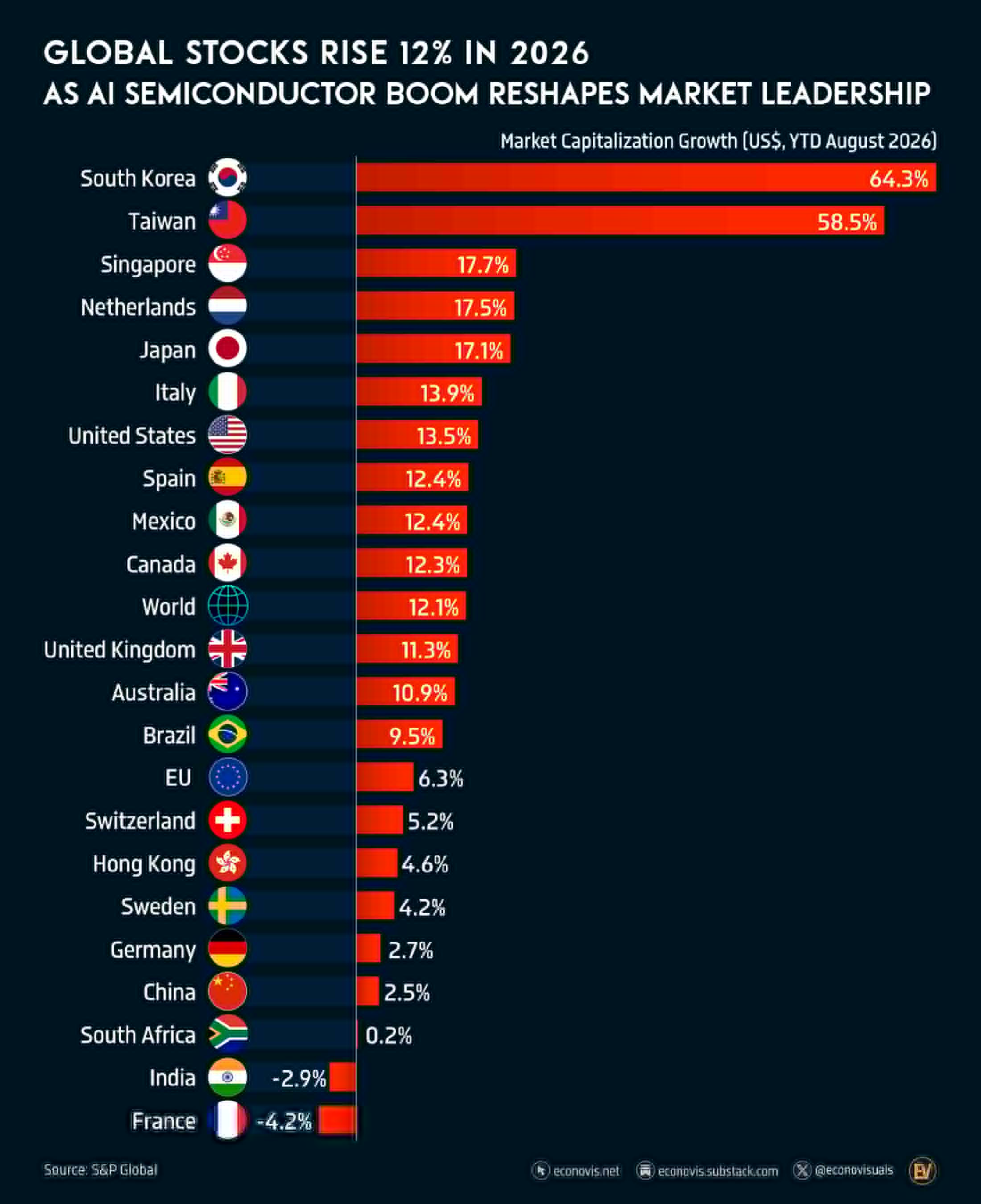
South Korea’s economy is booming on demand for artificial intelligence (AI) chips, with nominal GDP growing 21.9% in the first half of 2026.
Almost 70% of that expansion comes from semiconductors alone.
How the AI Chip Boom Is Powering South Korea
The KOSPI is South Korea’s benchmark stock index, dominated by semiconductor giants Samsung Electronics and SK Hynix. Both companies now concentrate close to half of their market cap and most of their earnings growth in the first six months of 2026.
The Bank of Korea confirms a scale of chip revenues not seen since the 1970s. Semiconductor exports exceed 40% of the country’s total shipments in some months during 2026. Real GDP growth forecasts have been revised upward to 3.3%-3.5% for the year.

Global demand for high-bandwidth memory (HBM) and advanced DRAM chips is the direct trigger of the rally. Nvidia, AMD, Microsoft, Google, Amazon, Meta, and Oracle all depend on Samsung and SK Hynix for AI accelerator memory. Along with Micron, they are the only large-scale global suppliers of these advanced chips.
The rally has also reshaped market structure across the region. Leveraged ETFs listed in Hong Kong tied to major Korean tech names multiplied more than 20-fold during the first half of 2026 alone, according to the Bank of Korea report published this week.

What Happens if the AI Chip Cycle Turns?
Analyst David K. Williams described the concentration bluntly after the Bank of Korea report. The trade has become so large that the central bank treats it as a financial stability issue, not merely an equity rally driven by strong fundamentals.
A slowdown in global AI infrastructure spending expected for 2027 or 2028 would hit the Korean economy systemically. Rising Chinese competition in memory chips could compound the damage. Exposure runs through supply chains, financial markets, and consumer wealth simultaneously across the country.
The Bank of Korea already flags signs of vendor financing similar to the dot-com era. Excess liquidity is flowing into real estate and leveraged products, raising bubble risk. Traditional manufacturing, youth employment, and domestic demand remain weak while chips dominate the narrative.
Structural problems compound the medium-term challenge for the country. South Korea has the world’s lowest fertility rate near 0.7 and an aging population profile. Household debt remains high and external shocks like oil above $100 or trade tensions would multiply the vulnerability further.
Global markets would feel the shock immediately if Korean production stumbles. Nvidia and AMD share prices track Korean chip output. AI-themed funds and semiconductor indices would face rapid repricing. A Chinese acceleration in memory production could redraw the supply chain quickly.
The post Bank of Korea Says the AI Chip Trade Is Now a Financial Stability Problem appeared first on BeInCrypto.
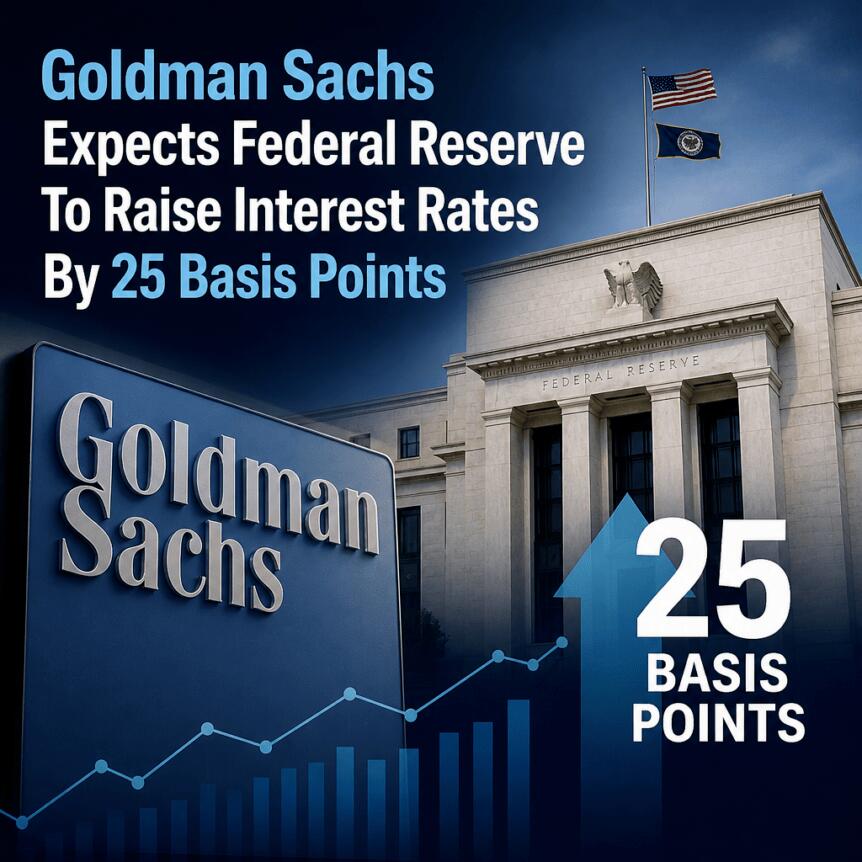
Banking giant Goldman Sachs expects the US Federal Reserve to raise interest rates by 25 basis points following Wednesday’s Federal Open Market Committee (FOMC) meeting, scheduled for September 15 to 16.
JPMorgan also offered a hawkish outlook after data revealed consumer and producer prices rose more than expected in August, and oil prices returned above $100 following renewed Middle East hostilities.
Goldman Sachs Walks Back On Interest Rate Forecast
Goldman Sachs initially stated it did not expect the Federal Reserve to raise interest rates following September’s FOMC meeting. However, it walked back on its prediction after August data strengthened the case for a hike. The banking giant now expects a 25 basis-point rate hike, which would lift the target range from 3.50%–3.75% to 3.75%–4%.
According to the Federal Reserve’s official calendar, the Federal Open Market Committee is expected to announce its decision on September 16 at 2 p.m. Eastern Time. A rate hike could put substantial pressure on Bitcoin (BTC) and other risk assets. Higher rates generally lead to a stronger dollar and tighter liquidity conditions.
“Goldman Sachs has abandoned its forecast for the Fed to keep rates unchanged next week. The bank now expects a 25 basis-point rate hike at the September 15–16 meeting. That could put pressure on Bitcoin and other risk assets, as higher rates generally mean tighter financial conditions and a stronger dollar.”
According to a research note by Goldman Sachs, the bank made a marginal adjustment to its Personal Consumption Expenditures estimate, raising it to 0.26%. The bank stated in its research note, “[The report] has not changed our fundamental inflation view.”
However, it warned of a sharp market response if interest rates were held steady, given it had already assigned a nearly 90% probability of a rate hike following the meeting.
August Inflation Data Muddles Waters
According to data from the Bureau of Labor Statistics, the US Consumer Price Index (CPI) rose 0.4% in August, while headline inflation remained steady at 3.4% over 12 months. Core CPI, which removes food and energy, rose 0.3% in August, but its annual rate declined from 2.5% to 2.4%, its lowest level in five years. However, the energy index climbed 16.3%, while food prices increased 2.7%. Airline fares, communication services, lodging, education, and used vehicles also rose, while medical care and motor vehicle insurance declined.
According to Diane Swonk, chief economist at KPMG, the Federal Reserve is not happy with some of the service sector numbers, despite the annual core rate falling. According to her estimates, services excluding housing rose 0.5% in August and 3% over one year.
“The gains were heavily in services.”
According to Swonk, August headline PCE inflation could rise 0.4%, while core PCE could increase by 0.3%, putting annual rates at 3.8% and 3.4%, respectively.
Economists Argue Against Hawkish Forecast
However, some economists have pushed back against forecasts by Wall Street banks. James Thorne, chief marketing strategist at Wellington-Altus, questioned Goldman Sachs’ revised position, stating that it likely reflected market expectations rather than a changed inflation outlook. Thorne stated, “No material change in inflation outlook, but a hike to calm Wall Street.”
He also highlighted a 3.1% increase in the annual wage to buttress the argument against a wage-price spiral. He added that higher borrowing costs cannot impact oil production or supply-chain disruptions, and that a rate hike could reduce demand, investments, and purchasing power.
Meanwhile, Swonk believes there will be three rate hikes by early 2027, stating, “We now expect three rate hikes by early 2027.”
Bitcoin Price Action
Bitcoin (BTC) is currently trading around $77,700, up almost 1% over the past 24 hours. However, it is more than 2% in the red on the weekly timeframe. The flagship cryptocurrency briefly crossed $78,000 after the odds of a rate hike reached 81%, and was trading above $79,000 before the inflation figures were released.
The flagship cryptocurrency started the previous week in the red, dropping 1.55% to $79,091. Selling pressure persisted on Tuesday, with the price dropping 0.82% to $78,447, before falling to an intraday low of $77,589. Buyers attempted a recovery on Wednesday as BTC reached an intraday high of $79,752. However, it lost momentum after reaching this level, marginally declining and closing the day at $78,283. Selling pressure intensified on Thursday as BTC fell over 2% to $76,536.
Buying pressure returned on Friday, and BTC climbed to an intraday high of $79,852. However, it could not cross $80,000, losing momentum and ultimately settling at $77,208, up 0.88% from Thursday. The price rose marginally on Saturday before declining 0.60% to $76,799. BTC is up 1.28% during the ongoing session, trading around $77,780.
The 14-day RSI is currently in the mid-50s, putting it in neutral territory. Meanwhile, the MACD has flipped to bearish, but suggests downward momentum is waning. The Fear & Greed Index is currently at 68, putting it firmly in “Greed” territory. However, markets expect a decline in BTC prices if the Federal Reserve raises interest rates following the FOMC meeting.
Disclaimer: This article is provided for informational purposes only. It is not offered or intended to be used as legal, tax, investment, financial, or other advice.
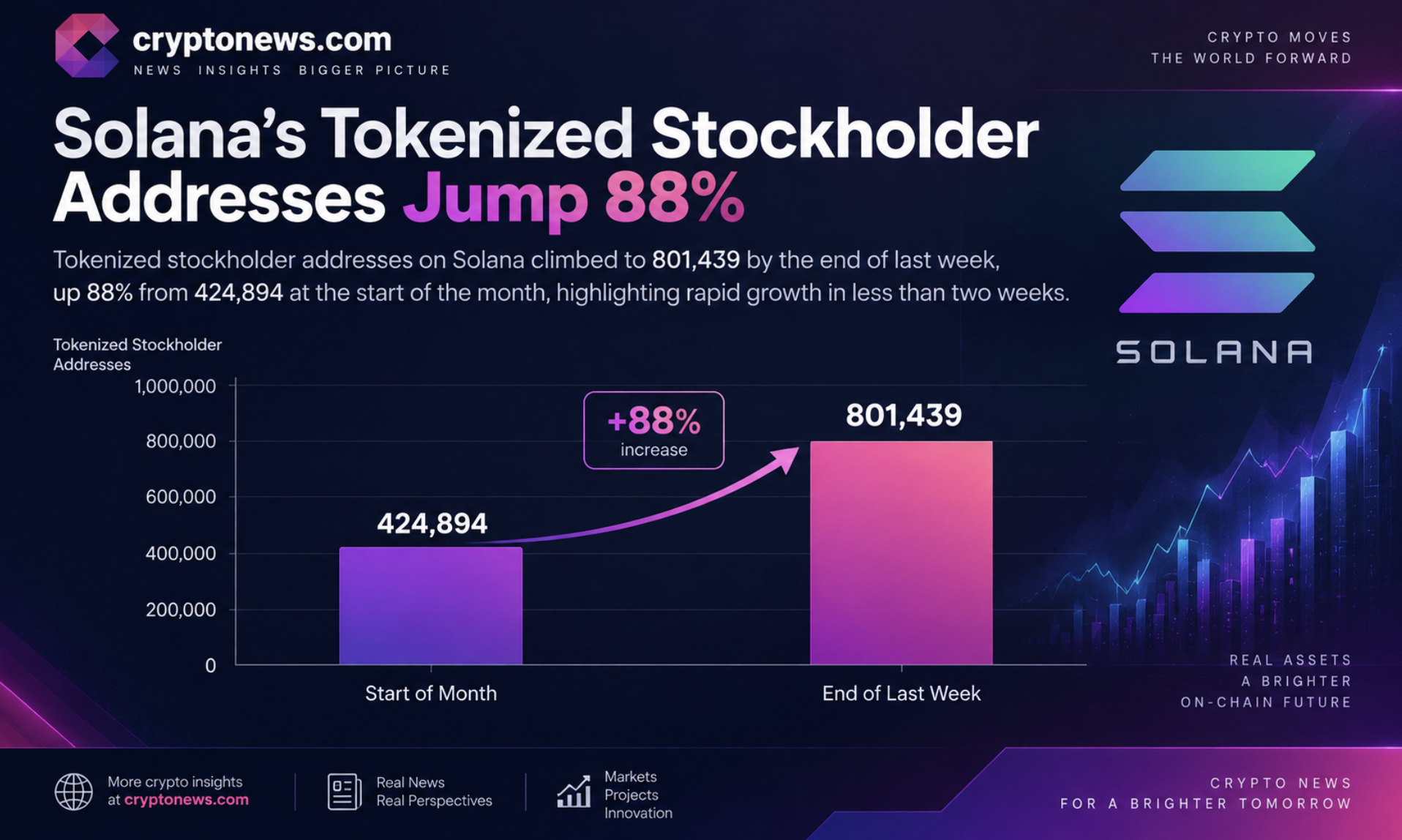
Solana’s tokenized stockholder addresses climbed to 801,439 by the end of last week, up 88% from 424,894 at the start of the month. The news point to a rapid increase in the number of solana addresses counted in the tokenized stockholder category over less than two weeks.
Holder-address data can be useful for tracking an on-chain footprint, but it should not be treated as a census of new investors or new capital. The label identifies addresses associated with the category, and the reported figures do not separately identify wallet ownership, account relationships, or the duration for which each address held a tokenized stock.

The available reporting also does not identify a specific reason for the increase. The figures establish the change in the holder-address count, but they do not assign that move to a particular issuer, product, platform, or type of participant.
As a result, the data is most directly useful as a measure of activity and distribution at the address level.
Discover: The Best Token Presales
Where This News Fits Solana RWA Push?

The tokenized-equity figure sits within Solana’s broader real-world-asset ecosystem. Solana’s ecosystem reporting said that, as of late July 2026, the network hosted $3.7 billion in non-stablecoin real-world-asset value across more than 313,000 holders.
That category includes tokenized Treasuries, public equities, private credit, reinsurance, sovereign debt, commodities, liquidity funds, and stablecoin settlement infrastructure.
Those figures measure a wider set of assets at an earlier point in time, so they should not be read as the same measure as the 801,439 tokenized-stock holder addresses reported for September. The RWA holder total and the tokenized-equity address total describe different categories and may also reflect different methods of measurement.
Earn $50 and Enter $300K Prize Draw on EdgeX
Solana’s ecosystem report also cited Blockworks data showing that 97% of all on-chain tokenized-equity spot volume to date had settled on Solana as of late July 2026. The report described tokenized equities as an area of accelerating RWA growth on the network, while noting that the category remains early relative to traditional public equity markets.
For readers following tokenized stocks, the 801,439 figure is best understood as an on-chain infrastructure metric. It indicates a larger recorded address footprint in the category between the two reported September dates, while leaving open questions about the number of unique holders represented by those addresses.
Trade Solana on Bybit and Get a Chance to Win Our $1,000 USDT Airdrop
The post Solana News: Tokenized-Stock Footprint Passes 800,000 Addresses appeared first on Cryptonews.

Ripple’s cross-border token posted a modest 3% daily gain, which was enough for analyst Ali Martinez to suggest it “appears to be breaking out” and to predict a much larger increase.
Meanwhile, institutional interest in the asset remains solid and could indeed set the stage for a further upside.
Ready for a Big Jump?
Less than a month ago, XRP surged to almost $1.70 but quickly lost momentum and currently trades at around $1.39 (per CoinGecko). Still, Martinez argued that the ongoing setup may be more bullish than it seems. He said a sustained close above $1.38 would confirm a breakout and could open the door to a rally toward $1.60.
It is important to note that he hasn’t been entirely positive about XRP lately. Just a few days ago, he claimed that the asset’s pullback from the local top to around $1.35 was likely driven in part by profit-taking, with whales selling or redistributing around 90 million units in a week. He also warned that network activity has fallen sharply, with daily active addresses down more than 90%.
Other market observers who have recently given their two cents include X user STEPH IS CRYPTO and Crypto Bitlord, as both stand in the bulls’ corner. The former noted the formation of a “cup and handle” pattern on XRP’s price chart and projected a potential ascent to $2.50.
The latter was even more optimistic, suggesting that the asset’s volatility appears to be stabilizing. The analyst said they are 99% certain that a push toward $2 is coming next, followed by an explosion to a new all-time high.
ETFs Keep Impressing
Growing institutional demand may support the bullish long-term outlook for XRP. Recently, spot XRP ETFs smashed another all-time high, with total net inflows reaching $1.7 billion.
Last week was the ninth consecutive one that finished in the green, attracting nearly $19 million. Companies that have launched such products so far include Bitwise, Franklin Templeton, Canary Capital, 21Shares, and Grayscale. Bitwise has attracted $608 million to date, while Canary Capital ranks second with roughly $490 million.
Meanwhile, T. Rowe Price recently updated its crypto ETF filing, which will enable exposure to multiple digital assets. Following the amendment, XRP sits at a 9.15% weight, while Bitcoin (BTC) leads at 39.54%.
For its part, Exchange Listed Funds Trust filed the “CYBER HORNER S&P 500® and XRP 75/25 Strategy ETF” with the SEC. If the watchdog approves it, the investment vehicle will let investors gain exposure to both the stock market and Ripple’s native cryptocurrency in a 75/25 ratio.
The post Ripple on the Move: Is XRP Ready for a Double-Digit Pump? appeared first on CryptoPotato.

Our Bitcoin price prediction is leaning bullish, as it trades at $77,700 and holds firm while equities take a beating. There’s a detail buried in the volume data that suggests this resilience isn’t accidental.
AI stocks got hammered in pre-market trading on Monday after Anthropic CEO Dario Amodei called for the industry to slow development, with Sam Altman and Elon Musk both voicing agreement over the weekend. South Korea’s Kospi dropped 3%, SK Hynix fell 6%, and the Nasdaq 100-tracking QQQ slid 1.5% as neocloud names like Nebius and CoreWeave got dragged down 5-6%.
Meanwhile, Brent crude spiked more than 3% to $107 a barrel, adding inflation pressure just as traders brace for the Senate’s first procedural vote on the CLARITY Act tomorrow. Crypto is decoupling from tech’s AI-panic selloff, for now. The gap, paired with a tight regulatory timeline, sets up one of the more interesting 48-hour windows crypto has seen this quarter.
Discover: The Best Token Presales
Bitcoin Price Prediction: Can BTC Hit $80,000 This Week?
BTC is consolidating in the $76,000–$78,000 band. Analysts are flagging $76,432 as a critical defense line, with deeper support at $75,674 and $71,781 if the CLARITY vote disappoints.
On the upside, resistance clusters at $78,146, $78,260, and the broader $80,000–$82,793 ceiling. The bull case is a clean CLARITY Act procedural pass tomorrow, triggering a break above $79,730 toward $81,000.

The base case will see continued range-bound grinding between $ 76k and $78k as the market waits out the Fed meeting on September 15-16. And the bear case sees a stalled vote, combined with rising oil and sticky inflation expectations, sending BTC testing $75,674 quickly.
For a deeper technical context, see this Bitcoin price prediction breakdown. Watch the vote, not the noise.
Earn $50 and Enter $300K Prize Draw on EdgeX
Bitcoin Hyper Targets Early Mover Upside as Bitcoin Tests Key Levels
Bitcoin holding $77,700 while AI stocks bleed is a genuinely bullish signal; it confirms crypto’s decoupling narrative has legs. But here’s the uncomfortable math: at a $1.5 trillion-plus market cap, BTC doubling from here is a much heavier lift than it was in 2020.
Traders chasing outsized returns are increasingly rotating into infrastructure plays built on top of Bitcoin itself, rather than waiting on BTC’s own price action.
Bitcoin Hyper is refining the developer experience with clearer documentation, familiar tooling, predictable APIs, and better feedback for builders. — Bitcoin Hyper (@BTC_Hyper2) September 2, 2026
The goal: make the network easier to understand, connect existing tools, and start building with less friction. 

Read the… pic.twitter.com/kAo1w7Xa06
Bitcoin Hyper ($HYPER) is positioning as the first Bitcoin Layer 2 with SVM integration, aiming for execution speeds faster than Solana while settling back to Bitcoin’s base security. The presale has raised $33.1 million at a current token price of $0.0136862, with staking rewards live at launch.
Its Decentralized Canonical Bridge targets the exact problems that have kept Bitcoin illiquid for smart contract use, slow transactions, high fees, and zero programmability. P
Research Bitcoin Hyper before the presale window closes.
Trade XRP on Bybit and Get a Chance to Win Our $1,000 USDT Airdrop
The post Bitcoin Price Prediction: AI Falls, Oil Jumps as Crypto Awaits Tomorrow’s Clarity Act appeared first on Cryptonews.
Crypto World
Filecoin (FIL) Rockets 25% to $1, Bitcoin (BTC) Maintains $77K as Big Week Begins: Market Watch
Bitcoin’s price dipped below $77,000 on Sunday but has managed to recover about a grand since that local low, and now sits closer to $78,000 ahead of what is expected to be its most important week this year.
Ripple’s XRP is trying to take down the $1.40 resistance once again, while ZEC has rebounded past $1,130. BTW is today’s top performer, surging by 36%, and it’s followed by FIL.
BTC Begins Crucial Week
Bitcoin entered the previous business week on the right foot, as it tried to overcome the $80,000 mark for the third or fourth time in the past 10 days. However, the bears were once again more persistent and didn’t allow it. Instead, the cryptocurrency started to lose value gradually and dipped to $77,600 by Wednesday.
It bounced to $79,600 twice on Thursday morning, but each attempt was halted, especially after the PPI data came out. More volatility was expected on Friday with the release of the CPI data, and it didn’t disappoint. Once the number came out, bitcoin went from over $77,000 to $76,000, before it shot up to $79,800 – all within just over an hour.
It was rejected at $80,000 once again and returned to its starting point at around $77,000. The weekend was less eventful, as usual, with BTC dipping to $76,400 yesterday and this morning. However, it has bounced to almost $78,000 as of press time as it begins arguably its most important week this year, with the Fed’s decision and the voting on the CLARITY Act.
Its market cap is back at $1.560 trillion, while its dominance over the alts is up to 59% on CMC.

FIL, BTW on a Roll
Ethereum has rebounded to over $2,500 today, while BNB remains north of $720. Ripple’s XRP is up by more than 3%, and it’s knocking on the $1.40 door. ZEC is up to $1,140 after a 5% increase, while XMR has slipped by almost 4% to $515.
The two top gainers from the 100 largest altcoins are BTW and FIL. The former has skyrocketed by more than 32% to $0.77, while the latter has tapped the $1.00 level after a 25% surge.
The cumulative market cap of all crypto assets has increased by 1% daily to $2.650 trillion on CMC.

The post Filecoin (FIL) Rockets 25% to $1, Bitcoin (BTC) Maintains $77K as Big Week Begins: Market Watch appeared first on CryptoPotato.
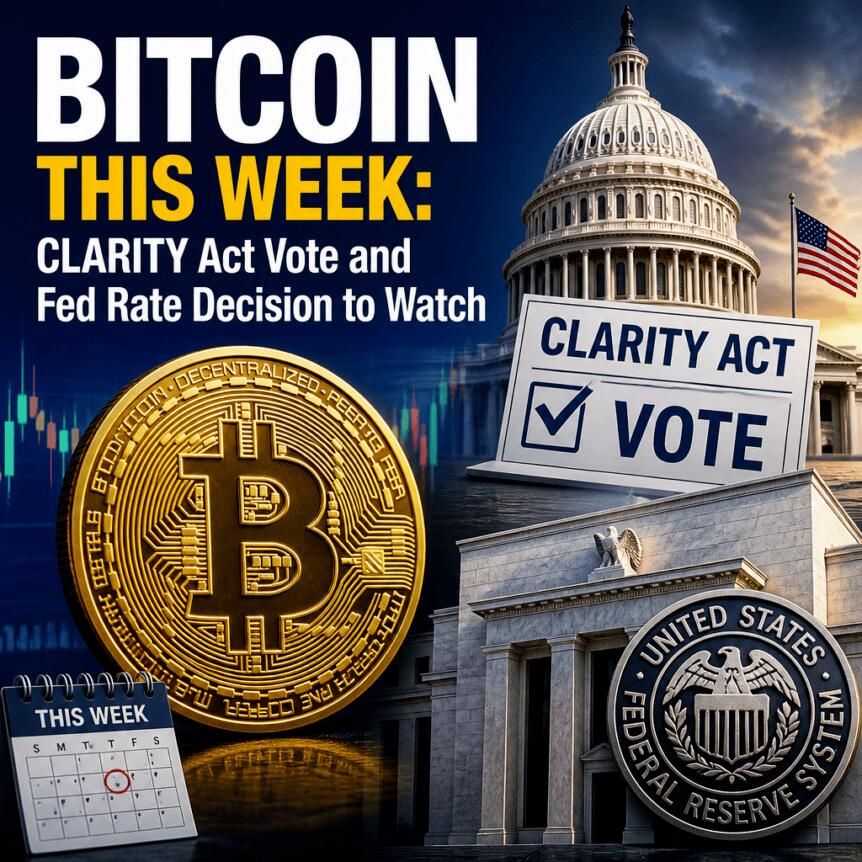
Bitcoin is entering the third week of September trading beneath important weekly support levels, with traders bracing for two closely watched US catalysts: a Federal Reserve interest-rate decision on Wednesday and a Senate procedural vote on the proposed CLARITY Act on Tuesday.
While macro expectations and policy headlines are driving near-term caution, market structure remains mixed. On the one hand, funding-related indicators point to an ongoing build-up of bullish leverage. On the other, Bitcoin’s latest weekly close failed to hold the technical thresholds that bulls had been defending.
Key takeaways
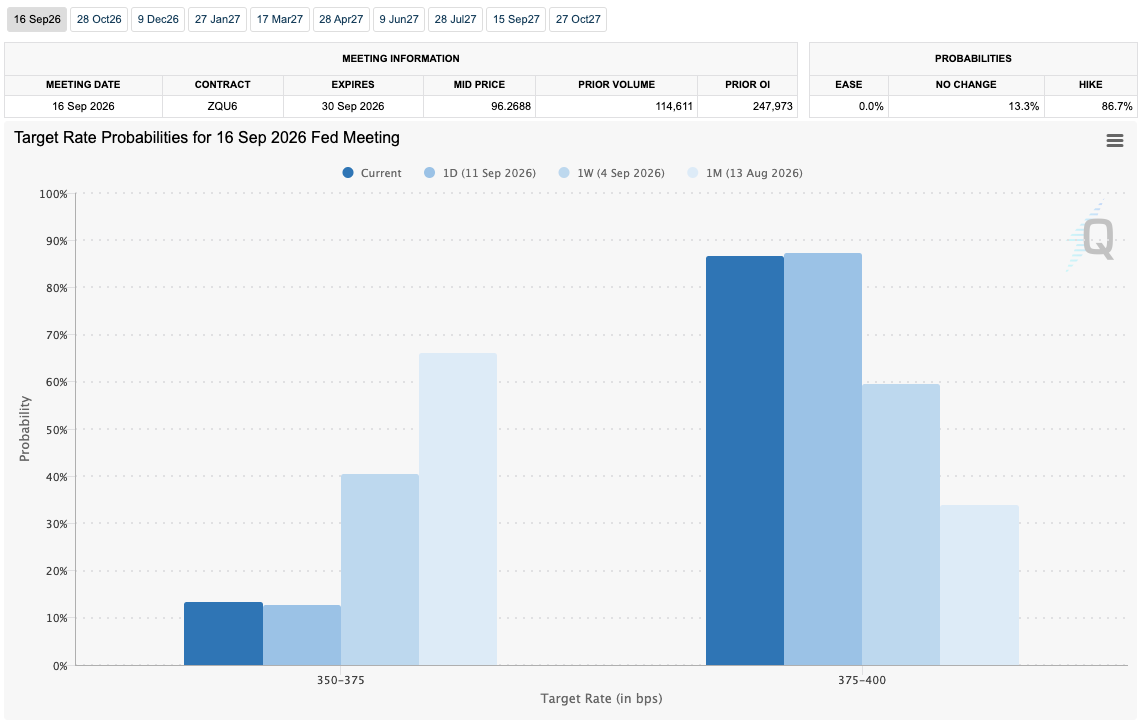
- CME Group’s FedWatch pricing has shifted toward another rate hike, with the probability of holding steady around 13.3% at the time of writing.
- The Senate is set to hold a procedural vote on the CLARITY Act Tuesday, a step that could send the bill to the floor if it clears.
- Crypto sentiment data from Santiment shows a notable drop in Bitcoin open interest in the week through Sept. 11, suggesting traders trimmed exposure ahead of volatility.
- CryptoQuant’s research highlights a return of positive aggregate funding rates since late May, indicating longs are increasingly paying shorts.
- Technically, Bitcoin closed below its 50-week EMA near $77,380, while RSI divergence remains a lingering bullish factor.
Fed decision becomes the main volatility trigger
For risk assets, Wednesday’s Fed outcome is the centerpiece. Multiple policy dynamics are converging: persistent inflation concerns, energy-driven price pressures, and ongoing debate within the central bank about whether rates should be raised.
According to CME Group’s FedWatch Tool, markets were pricing in a low likelihood of a pause. At the time of writing, the implied probability of rates staying at current levels was about 13.3%. Cointelegraph previously noted that markets had reacted differently to earlier decisions—especially around periods when Chair Kevin Warsh kept rates unchanged while some officials preferred a hike—setting up a backdrop where trader expectations can swing quickly.
The shift in pricing comes as inflation data did not deliver major upside surprises, but crude oil has remained a headwind. Markets reacted hawkishly despite the CPI and PPI prints, reflecting elevated energy costs and the sense that supply constraints may not be easing.
Commentary from The Kobeissi Letter emphasized how disruptions tied to key maritime routes could intensify the energy shock. In an X post cited by Cointelegraph, the account warned that roughly 30 million barrels per day may be unable to transit through certain routes, with additional risk flagged for the Bab el-Mandeb Strait. It also pointed to consumer inflation expectations rising, with gas prices and tariffs frequently referenced as contributors.
CLARITY Act vote turns into a near-term sentiment test
Alongside the Fed, US legislative progress on crypto regulation is on the calendar. Tuesday’s Senate procedural vote on the CLARITY Act could become a catalyst for speculative positioning because it determines whether the bill advances toward debate on the floor.
On Monday, Senate Republicans released what they described as their “last, best and final offer” for the Act’s text after bipartisan negotiations aimed at producing a clearer legal framework. Senator Cynthia Lummis, who released a 635-page updated proposal, said the bill was ready following a year of negotiations. She also highlighted ethics restrictions in the proposal and argued that a procedural “no” would oppose reforms and leave US digital-asset markets with insufficient protections.
The procedural step requires 60 votes to pass, with a vote scheduled for 2:15 pm on Tuesday. If the bill clears, it can move to the Senate floor for debate. If it fails, traders are likely to reassess the timeline for regulatory clarity—an uncertainty that can spill over into broader risk appetite.
Market expectations for passage remain cautious. On Polymarket, odds of the CLARITY Act being signed into law in 2026 were cited at about 34% at the time of reporting, with higher probabilities last seen earlier in August.
Derivatives positioning: traders de-risk before headlines
In the lead-up to Tuesday’s Senate vote and Wednesday’s Fed announcement, multiple analytics snapshots suggested traders were adjusting exposure rather than leaning aggressively into the next move.
According to Santiment’s analysis of open interest across exchanges, positioning had already shifted ahead of the two headline events. Santiment commented that the market appeared to have “already made its move,” pointing to the idea that derivatives participants had started preparing for volatility.
Specifically, Santiment data showed Bitcoin open interest in BTC terms falling 13.5% in the week through Sept. 11—down from about 321,497 BTC to roughly 278,151 BTC—followed by only a modest rebound. Over the same period, spot price was reported to have fallen about 5%. Santiment also stated that positioning sat around 20% below levels seen before the mid-August rally.
In practical terms, that matters because reduced open interest often limits how much leverage can amplify price swings. Still, a decline in open interest can also be consistent with traders waiting on confirmation from upcoming policy decisions.
Funding rates stay bullish as Bitcoin trades near $80,000
Even as traders trimmed derivatives exposure, onchain research pointed to continued improvement in sentiment reflected by funding rates. CryptoQuant argued that new signals in perpetual funding suggest bullish pressure building as BTC/USD trades near the $80,000 area.
CryptoQuant noted that aggregate funding rates have gradually risen since the end of May, after a period of negative funding that began in early March. Funding rates—driven by the balance of long and short demand—can reveal whether the market is paying to hold longs or shorts.
In the research cited by Cointelegraph, CryptoQuant described how bearish sentiment had prevailed during a “disbelief phase,” during which funding rates reflected one of the most bearish readings in Binance derivatives. It suggested that the buildup of shorts after a roughly -52% drawdown contributed to the rally seen in May.
CryptoQuant further observed that negative cumulative 30-day funding rates on Binance tended to line up with late-stage bear markets and with major corrections inside bull-market periods. This pattern-based framing is useful for traders, but it does not eliminate uncertainty—funding can remain bullish even if price action later fails to follow through.
Cointelegraph also previously reported concerns about the lack of spot-market participation in Bitcoin’s upside, implying that derivatives-led momentum may not always translate into sustained spot-driven uptrends.
Weekly structure weakens: support breaks under the 50-week EMA
Technical analysis remains the clearest immediate map for where risk may rise or fall. Bitcoin’s latest weekly close did not hold the levels bulls were watching.
As reported, Bitcoin ended the Sunday weekly close around $76,800 after failing to defend key support. Trader and analyst Rekt Capital said that $78,300 was necessary to hold at the weekly close. Failure to do so, he warned, could reopen the possibility of repeating the “failed breakout” pattern seen earlier in May.
Rekt Capital also pointed to a chart of lower highs, suggesting Bitcoin continues to preserve a longer-term bearish market structure. The weekly close was additionally below Bitcoin’s 50-week exponential moving average at about $77,380—a trend line that bulls typically want reclaimed as part of a more durable bullish shift.
Looking to the next technical level, Rekt Capital referenced the 21-week EMA near $72,270 as a potential line in the sand. He added that both the 21-week and 50-week EMAs often act as support in bull markets, and that losing them sustainably would be evidence that Bitcoin is not yet in a fully established bull cycle.
Despite these weaknesses, a bullish factor remains in the background: Bitcoin’s RSI kept higher lows through 2026, maintaining a “weekly bullish divergence” that some analysts treat as a supportive signal even when price temporarily dips.
What to watch next
With the Senate vote on the CLARITY Act and the Fed’s Wednesday rate decision approaching, traders may continue to reshape risk quickly—especially if derivatives positioning swings alongside any procedural or macro outcome. Beyond the headlines, investors should monitor whether Bitcoin can reclaim the 50-week EMA area and whether RSI divergence continues to hold as confirmation, or fades as support weakens.

You are one of three people who started the company in 2007. There aren’t that many founders leading Fortune 500 companies. How do you think the fact that you founded this company shapes how you lead it today?
The people that build companies tend to be more in the details, more decisive, bigger authority, …They tend to take bigger, bolder risks partly because they have the moral authority to. For example, I could—I wouldn’t—but I could change the name of the company because I came up with the name of the company. Somebody who is a professional manager, I don’t think they would ever dare change the name of their company. They would feel like it’s not theirs to change.
You’ve said that you think CEOs think about hiring wrong. Why is that?
Because I thought about hiring wrong…When I was starting Airbnb…Sam Altman…said hiring should be 50% of your job. I’m not even sure it was 50% of his job.
Has your thinking about the value of remote work shifted as we’ve gotten further from the pandemic?
I have a view that if your office policy’s is easy to explain, it might be wrong because it might be one size fits all.
You’re vocal about the fact that you think leaders don’t need to have regular one on one meetings with their direct reports.
I think it’s not only unnecessary, it’s probably inferior. And if you go through the list of great CEOs, almost none of them that I’m aware of do recurring one-on-ones…
Now you can get a hotel on Airbnb. Why?
I was ideologically against hotels. In fact, I think our first tag line was “forget hotels.” So why would I ever offer them? And so that was my party line for probably 10 years. In 2018, 2019 my stubbornness got the best of me and many of our customers told us that we want hotels. And ultimately I had to make a decision. You know if you’re a brand, just because your customer wants something doesn’t mean you sell it to them. You can decide no, go somewhere else…But we noticed there were three types of people. There are people that only book Airbnbs. There are people that only book hotels, but most people are willing to book both.
You’re building your own AI frontier lab separate from Airbnb. Why not build that within Airbnb and what will be the relationship between the two?
I thought about building inside of Airbnb….I like to think that our shareholders know what they get themselves into, and I never sold them on us being a frontier company and spending billions and billions of dollars of capital expenditure and then spending huge sums recruiting these engineers or these AI researchers….The benefit to Airbnb and to me is I’m gonna learn a lot about AI, but it’s also a totally different kind of culture. So I wanted to keep them separate.
You’re announcing a number of new initiatives around housing. People say Airbnb makes cities more expensive. What role do you want the company to play in making places more affordable?
I think Airbnb has been a place people pointed to over the last 15 years, especially the last decade…for reasons why cities are expensive. And so we have wanted to be part of the solution, not part of the problem.
We’re creating a $250 million fund to house the last dollar for projects. There’s about 750,000 homes in America development projects that are stalled because they don’t have the last dollar of completion … .We want to do something called the City Index. We want to open source data around cities, policies, the cost of living, permitting to basically show the cities that are most successful at lowering housing costs by having the best policies….We want to do the housing prize where we’re going to do a million dollar prize every year for five years for any company, private or or nonprofit that has ideas around technology that can make housing development easier.
Bitcoin (BTC) is starting the third week of September below key weekly support levels as traders eye volatility cues.
- The US Federal Reserve is expected to raise interest rates by 0.25% on Wednesday amid stubborn inflation and a mounting oil-price squeeze.
- The Senate will vote on whether to advance the crypto CLARITY Act on Tuesday — a key moment for market sentiment.
- Bitcoin finished last week below its 50-week moving average near $77,400, although a bullish RSI divergence continues to play out.
Fed’s Warsh seen hiking rates despite Trump pressure
The Federal Reserve takes the spotlight for risk-asset traders this week as Wednesday’s decision on interest rates dictates the mood.
On the back of high inflation and cautious words from chair Kevin Warsh, the Fed is widely expected to hike benchmark rates by 25 basis points to 3.75-4% despite several dissenting officials in favor of holding them at current levels. The setup echoes that of the Fed’s July rate decision, when Warsh held rates while several voices argued for a hike. Now, Warsh faces pressure from US president Donald Trump not only to avoid a hike but to enact rate cuts.
The latest data from the CME Group’s FedWatch Tool puts the odds of rates staying at their current levels at just 13.3% at the time of writing. A week ago, the implied probability of a rate pause was above 40%, but it pulled back in the face of recent inflation data and oil-price gains from escalation in the Middle East.
Fed target rate probability comparison for September FOMC meeting (screenshot). Source: CME Group
While the August print of the Consumer Price Index (CPI) and Producer Price Index (PPI) both avoided major upside surprises, markets reacted hawkishly as oil prices returned above $100 per barrel with no end to the supply crisis in sight.
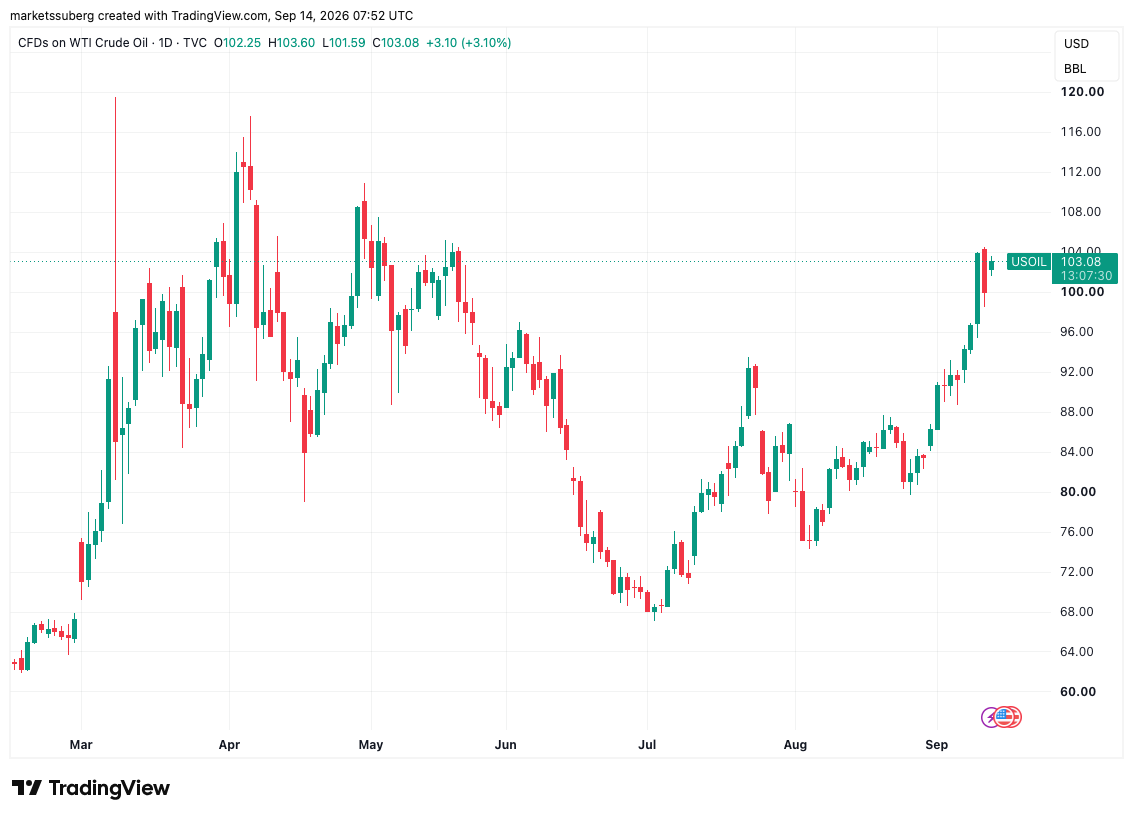
CFDs on WTI crude oil one-day chart. Source: Cointelegraph/TradingView
Commenting, trading resource The Kobeissi Letter warned of the severity of the resulting energy shock, as 30 million barrels per day will be unable to transit through the Strait of Hormuz or Saudi Arabia’s East-West pipeline, with the Bab el-Mandeb Strait now also at risk.
“Even after accounting for some overlap between these routes, the scale of the potential disruption is enormous relative to the ~100 million barrel per day global oil market,” it wrote in a post on X.
Kobeissi noted increasing inflation expectations among US consumers, who saw price increases hitting 4.6% over the coming year — 1.1% more than their outlook at the start of 2026 — with gas prices and trade tariffs frequently referenced.
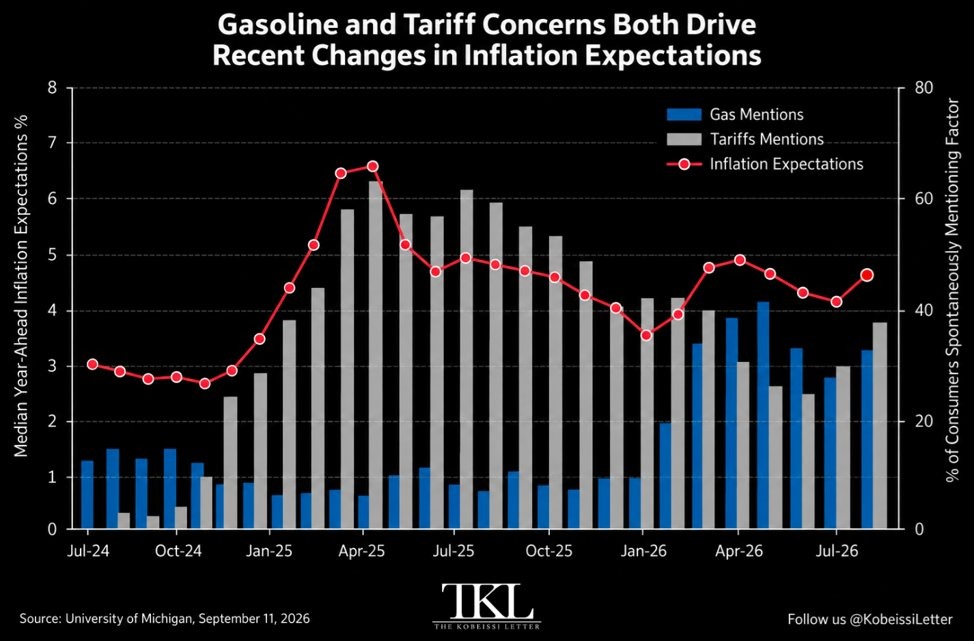
US consumer inflation expectations data. Source: The Kobeissi Letter on X.com
CLARITY Act rewrite faces crucial vote
On Tuesday, a day prior to the Fed decision, crypto markets will face their own reckoning as US officials debate the CLARITY Act.
On Monday, Senate Republicans released what they called their “last, best and final offer” for the text of the Act, part of bipartisan negotiations that seek to provide the industry with a clear legal framework in the US.
“After a year of intense daily bipartisan negotiations, this bill is ready,” Senator Cynthia Lummis, who released the 635-page updated proposal, said in an official release.
“President Trump voluntarily agreed to unprecedented ethics restrictions, holding every federally elected official, judge, and their spouses to some of the toughest ethics restrictions in US history.”
CLARITY now faces a procedural vote at 2:15 pm on Tuesday, requiring 60 votes to pass. Snap volatility could ensue on the back of the result. If the bill passes in its latest form, it can advance to the floor for Senate debate.
“A no vote on Tuesday means opposing real ethics reforms on politicians’ personal investments, handing American leadership in digital assets to our foreign competitors, and leaving Americans with zero protections in the digital asset markets,” Lummis added.
Speaking to podcast host Kyle Chasse on Saturday, crypto policy insider Tyler Williams, formerly a crypto adviser to US Treasury Secretary Scott Bessent, was upbeat about Tuesday’s prospects.
“What are the odds? I think they are better than they have ever been. We are closer — we are on the precipice of this becoming law,” he said.
Among Polymarket users, the odds of CLARITY being signed into law in 2026 remain low. At the time of writing, there was a mere 34% chance of that outcome. Higher odds were last seen at the start of August.
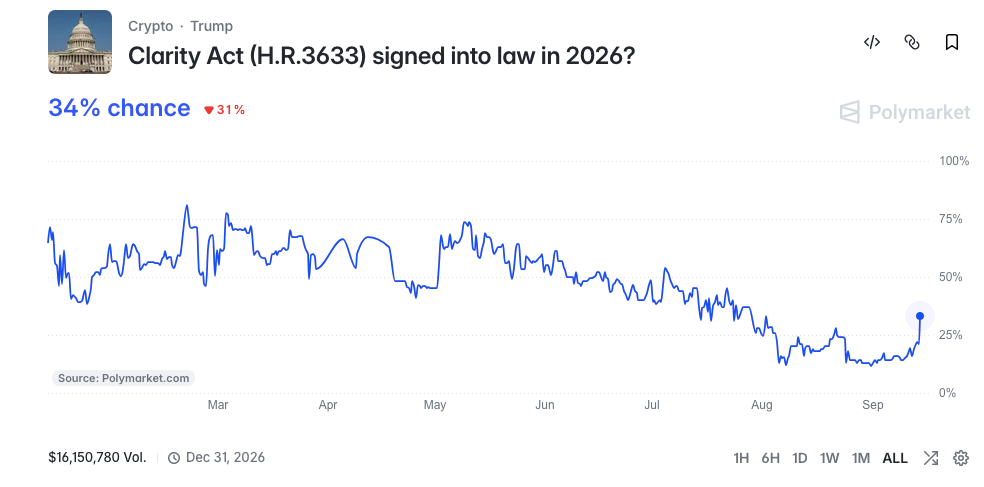
Betting odds for CLARITY Act passing into law. Source: Polymarket
Crypto traders de-risk in advance of CLARITY, Fed
The latest market analysis indicates that traders are removing risk prior to Tuesday’s and Wednesday’s headline events.
Examining changes in open interest (OI) across exchanges, crypto sentiment platform Santiment argued that markets are already prepared for volatility ahead of both the CLARITY Act vote and Fed interest-rate announcement.
“Everyone is watching Tuesday’s cloture vote and Wednesday’s Fed. The positioning data says the market already made its move,” it commented on Monday.
Santiment data shows that OI in BTC terms, calculated from USD-denominated OI divided by the BTC price, fell 13.5% in the week through Sept. 11, from 321,497 BTC to 278,151 BTC, subsequently rebounding only modestly. At the same time, spot price itself fell by 5%.
“Positioning sits about 20% below where it was before the mid-August rally,” Santiment added.
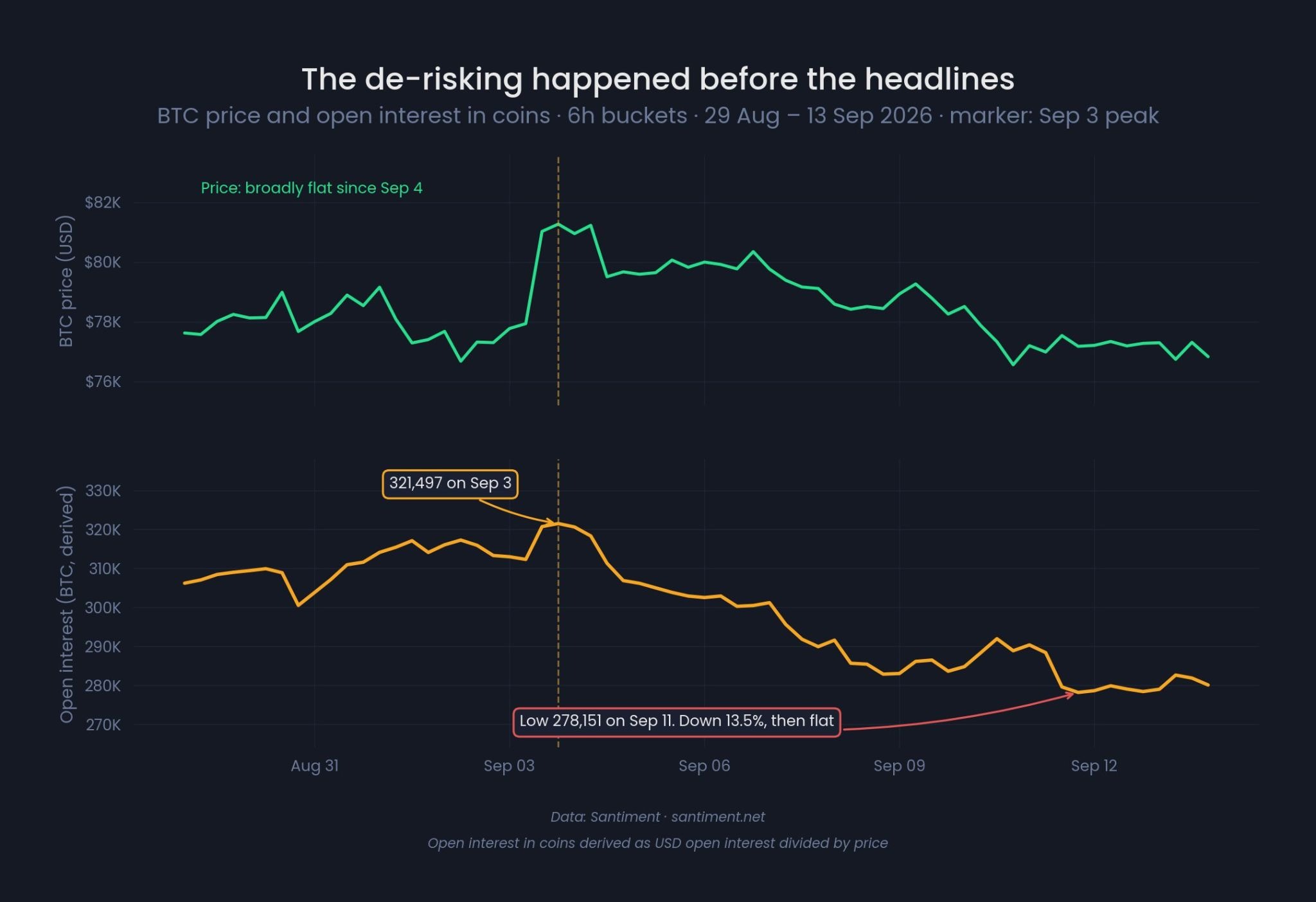
Bitcoin OI data. Source: Santiment
Funding rates repeat bullish trends
Funding rates continue to build bullish sentiment as BTC/USD trades near $80,000, new research from onchain analytics platform CryptoQuant argues.
Since the end of May, aggregate funding rates across exchanges have gradually increased, following the end of a negative-rate period that began in early March. Funding rates reflect the balance of long and short interest among traders.
“After a disbelief phase, during which funding rates reflected one of the most bearish sentiments ever seen in Binance derivatives, the buildup of shorts that followed a -52% drawdown ended up fueling May’s rally,” CryptoQuant commented in a blog post on Sunday.
“It’s particularly interesting to observe how this bearish consensus has consistently shown up whenever Bitcoin was nearing the end of a correction.”
CryptoQuant data shows that negative cumulative 30-day funding rates on Binance have accompanied the final stages of Bitcoin bear markets, as well as major corrections within bull markets.
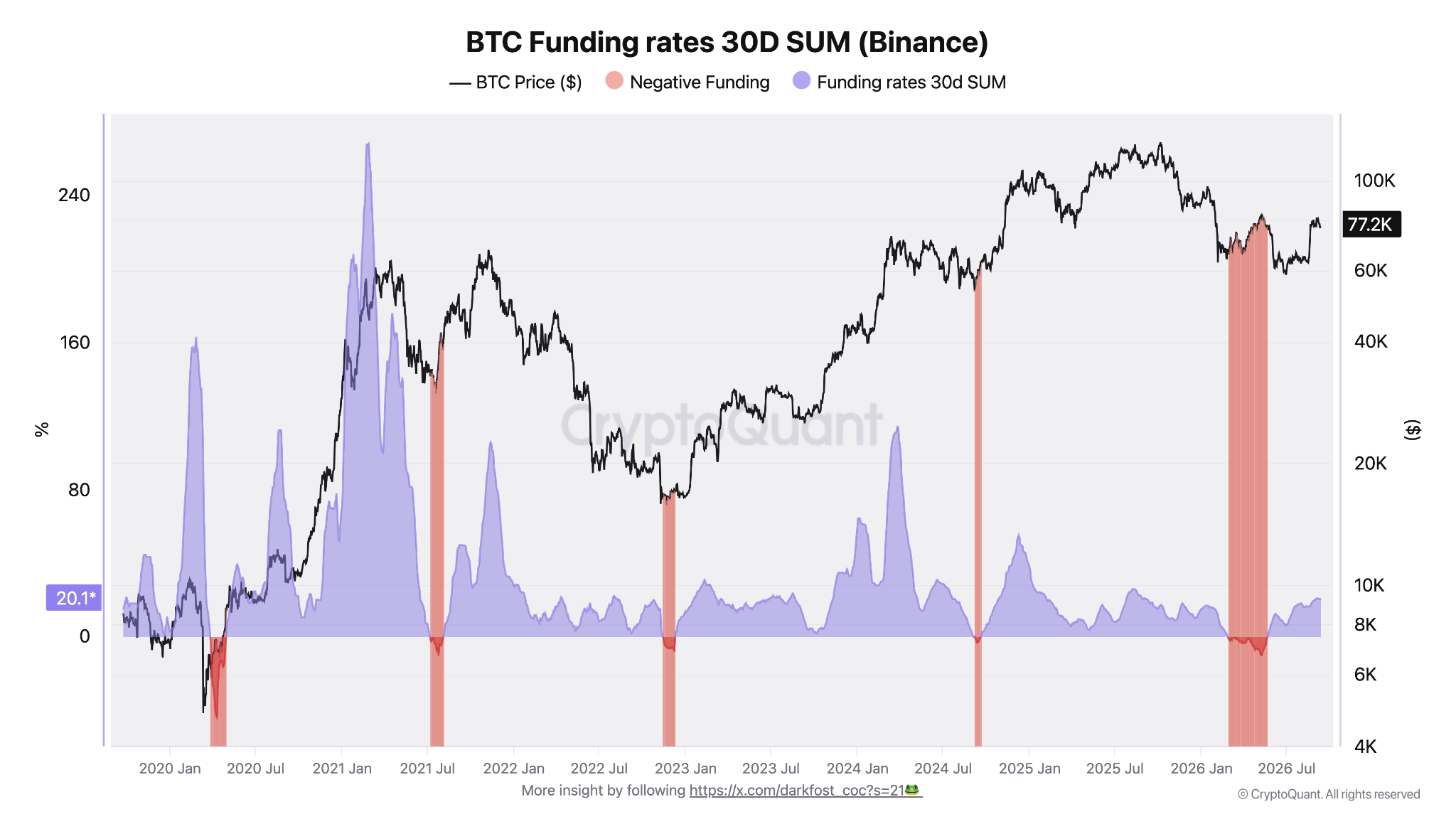
Bitcoin 30-day summed funding rates (Binance). Source: CryptoQuant
Previously, Cointelegraph reported on the ongoing lack of spot-market participation in Bitcoin’s recent upside, with analysis warning that the derivatives-led market momentum was unlikely to last.
Bitcoin weekly support slips from bulls’ grasp
Bitcoin’s price failed to defend a key support level during Sunday’s weekly close, ending around $76,800.
Related: Here’s what happened in crypto today
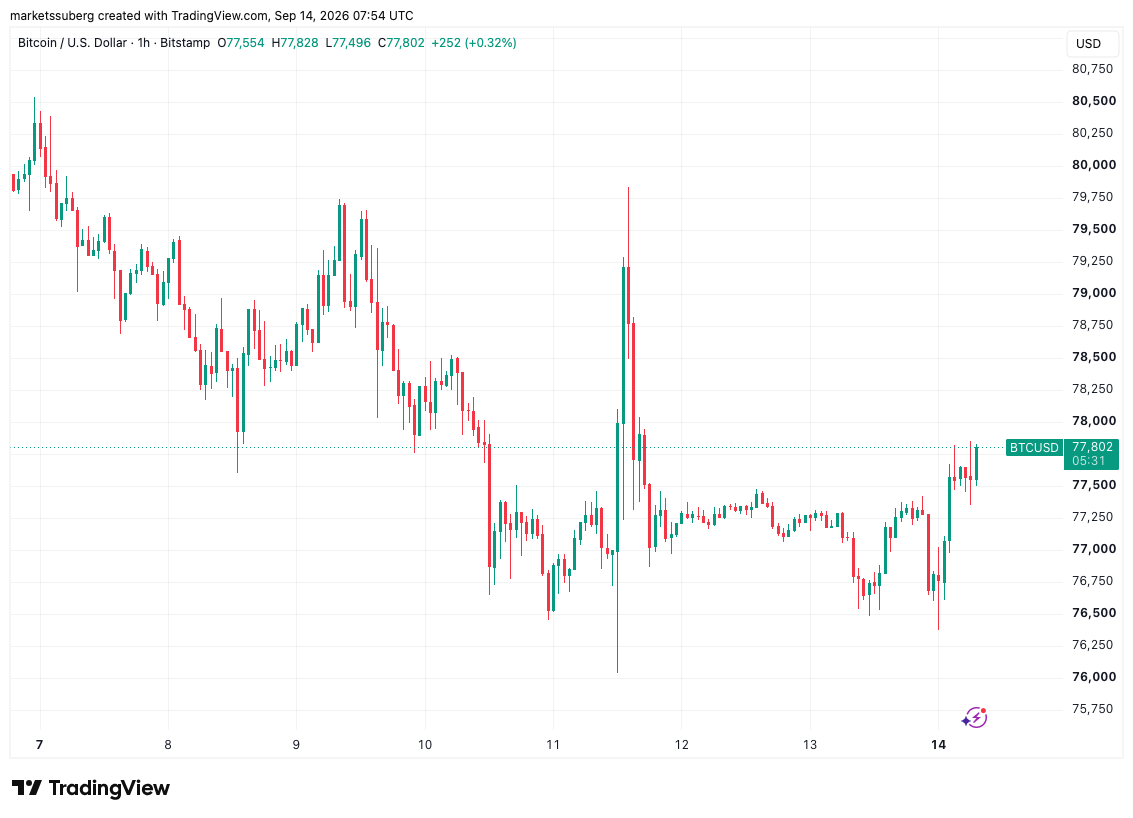
BTC/USD one-hour chart. Source: Cointelegraph/TradingView
In comments on Sunday, trader and analyst Rekt Capital reiterated that $78,300 was necessary to hold at the weekly close. Failure to do so, he warned, would open the path for Bitcoin to repeat its failed breakout from early May.
An accompanying chart shows BTC/USD continuing to form a pattern of lower highs, keeping the long-term bear-market structure intact.
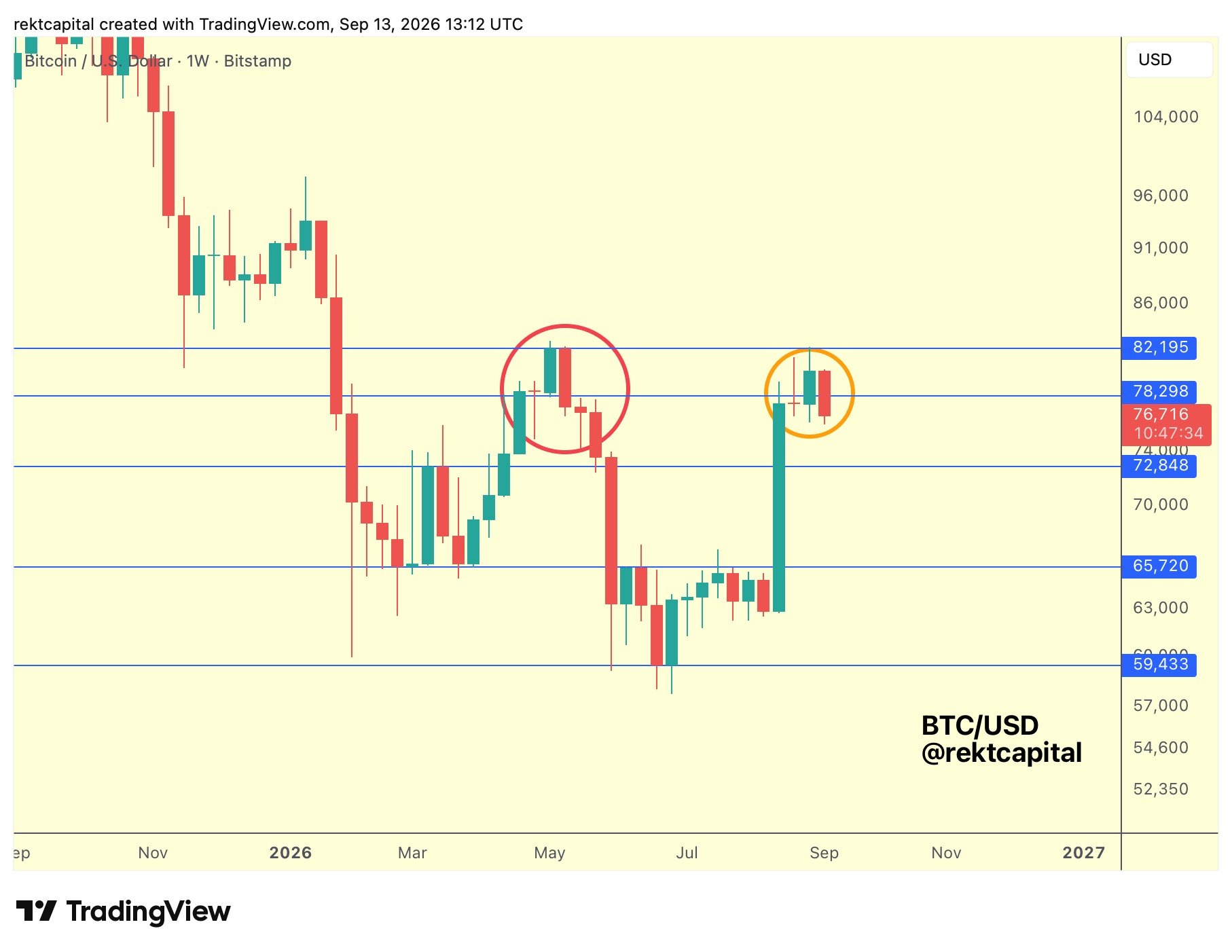
BTC/USD one-week chart. Source: Rekt Capital on X.com
Bitcoin also closed below its 50-week exponential moving average (EMA) at $77,380, a trend line necessary to clear as part of a sustainable bullish trend change. Rekt Capital eyed the 21-week EMA at $72,270 as bulls’ next line in the sand.
“Both of these EMAs tend to act as support in a Bull Market. So if they can’t hold sustainably as support then that would be a confirmation of the trend not being in a full-blown Bull Cycle yet,” he told X followers.
The close nonetheless preserved a weekly bullish divergence on Bitcoin’s relative strength index (RSI), which continues to see higher lows through 2026.
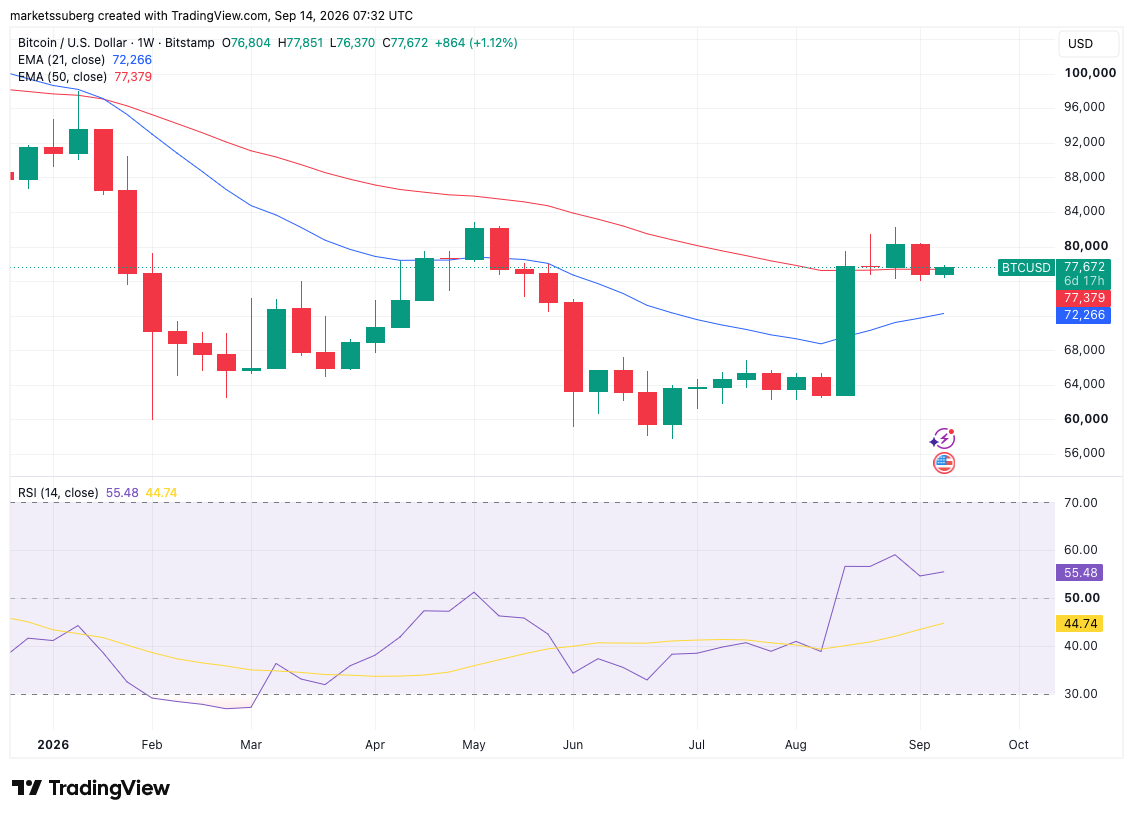
BTC/USD one-week chart with 21, 50 EMA; RSI. Source: Cointelegraph/TradingView

Sami Zayn Sends Six-Word Message After Shocking CM Punk Victory To Become WWE Champion Again

Acemagic launches an affordable Intel Wildcat Lake mini PC with 12GB RAM

Trade with Rs. 100 @deltaexchange || #trader #trading #bitcoin #cryptocurrency #deltaexchange


-
 Tech6 days ago
Memory prices are slowing because buyers ran out of money
-

 Tech23 hours ago
The Latest Weird Thing to Play Doom Is the Mapped-Out Brain of a Fruit Fly
-

 Business4 days ago
Micron Stock Climbs Above $1,031 as AI Memory Crunch and a $50 Billion Outlook Fuel the Rally
-

 Business4 days ago
AMD Stock Climbs After Management Lifts 2027 Data Center Outlook Toward $70 Billion in AI Sales
-
 Crypto World5 days ago
Bitcoin price risks $76K drop as $78K support weakens
-

 Fashion3 days ago
Weekend Open Thread – Corporette.com
-

 Crypto World6 days ago
Robinhood Stock: How To Take Advantage With Reduced Risk
-

 Crypto World3 days ago
XAG/USD: Silver’s Short-Term Rally Meets Its Moment of Truth
-
 Crypto World4 days ago
2 Chip Stocks Broke Out This Week. Neither Was Nvidia
-
 Crypto World5 days ago
Ethereum price stalls below $2,500 as ADX drops to 11
-

 NewsBeat6 days ago
England up in reading, maths and science rankings as Scotland and Wales dip
-

 Business3 days ago
10 Most-Streamed Songs On Spotify In 2026 So Far, Led By Ella Langley’s Dominant Run On The Charts This Year
-

 Crypto World4 days ago
OKX launches 10x OpenAI, Anthropic X-Perps in Europe
-

 Tech4 days ago
Battery life is the only iPhone 18 Pro and iPhone Duo upgrade I care about. Apple didn’t disappoint
-

 Crypto World3 days ago
Diesel Tops $6 a Gallon for the First Time as 28 States Set Records
-
 Crypto World6 days ago
Intel Stock Jumps 9% on Chip Price Hike Report, US Stake Gains $36 Billion
-

 NewsBeat5 days ago
What went right this week: an ‘historic’ fall in violent crime, plus more
-

 Tech5 days ago
Apple Watch Ultra 4 vs Watch Ultra 3: Should you really spend another $799?
-
 Crypto World5 days ago
Bitcoin price risks $70K if $78K neckline breaks
-

 Crypto World6 days ago
Pump Fun and Kraken delete Hunter Biden $LAPTOP promotion
You must be logged in to post a comment Login